




Abstract
The study investigates the association of the extent of remote work with men’s and women’s behavioral work-family conflict and their partners’ behavioral work-family conflict. The authors examine if these effects vary by parental status. Analyses of survey data from 343 U.S. dual-earning couples collected during the coronavirus disease 2019 pandemic show that among couples with children, their extent of remote work is positively associated with both their own and their partners’ behavioral family-to-work conflict but is not associated with their own or their partners’ behavioral work-to-family conflict. For child-free couples, findings show that their extent of remote work does not affect their own work-family conflict (bidirectional). For child-free women only, behavioral work-to-family and family-to-work conflict increase as a function of their partners’ extent of remote work. The authors offer insights into potential policy for work organizations, including benefits that provide time or financial assistance to help employees manage family obligations that might interfere with work.
The coronavirus disease 2019 (COVID-19) pandemic and the resulting federal and state lockdown measures, including school and childcare center closures and the shift to remote work for nonessential workers, caused significant changes in work and family life. These changes placed strain on dual-earning couples (Montazer et al. 2022, 2024), especially those with young children (Schieman et al. 2021). In the United States, remote work had risen steadily over the years, but in March 2020, it rose to unprecedented levels. Before the pandemic, about 20 percent of U.S. employees worked remotely, at least part-time (Bureau of Labor Statistics 2020). Estimates suggest that as many as 69 percent worked remotely at the peak of the pandemic (Barrero, Bloom, and Davis 2023). Consequently, the widespread adoption of remote work created various possible work-from-home configurations among couples, with some both working from home all the time, some not at all, and others working unique patterns of days home and days on the job site. For many, these configurations were new, causing changes to everyday routines and patterns as they tried to negotiate this “new normal” (St. Cyr Brisini and Solomon 2023). For those who physically went to work locations, they had added challenges with increased protocols to ensure the safety of workers and customers and/or clients and concerns for the safety of their families when they came home (Soubelet-Fagoaga et al. 2022).
Within this context, there is a unique opportunity to examine how varying degrees of home-based remote work are associated with the work-family conflict of individuals and their partners. The potential flexibility between work and home may help create a sense of balance and order for managing responsibilities, but the absence of a clear boundary also has the potential for increased permeability between the domains and may be a source of conflict (Allen, Cho, and Meier 2014; Clark 2000; Schieman and Badawy 2020). When work and family lives collide, individuals may experience work-family conflict in which role pressures at work make participation at home more difficult and vice versa (Greenhaus and Beutell 1985). To understand the outcomes of work-family conflict, most scholarship uses perceptual measures, such as increased stress or lack of energy (e.g., Carlson, Kacmar, and Williams 2000; Netemeyer, Boles, and McMurrian 1996). Clark et al. (2019) offer a behavioral role scale as another way to assess conflict between work and family/home demands, such as less engagement, less attentiveness, frustration, or short-temperedness with family or coworkers.
In this study, we use survey data from both members of heterosexual, dual-earning, cohabitating U.S. couples (n = 343) collected during the COVID-19 pandemic to examine whether the extent of remote work at home is significantly associated with one’s own individual behavioral work-family conflict and one’s partner’s behavioral work-family conflict (Clark et al. 2019). Using the actor-partner interdependence model (APIM; Cook and Kenny 2005; Kenny, Kashy, and Cook 2006), we analyze both directions of conflict: behavioral work-to-family and behavioral family-to-work. Couple-level data are important because partners do not always have sufficient information about each other’s experiences of both behavioral and perceptual work-family conflict (Young, Schieman, and Milkie 2014), which leads to assumed similarity bias, whereby one may assume that another’s experience is similar to one’s own experience (Kenny and Acitelli 2001). Among couples living together, whose lives are inextricably linked, navigating the dual responsibilities may be taxing, particularly if they have added pressures with children (Schooreel and Verbruggen 2016). Given the still predominate role of women, especially mothers, as caretakers of the home and family (Blair-Loy 2003; Stefanova, Farrell, and Latu 2023) and as maintainers of the emotional quality of relationships (Daminger 2020; Loscocco and Walzer 2013), work-family conflict may also have distinct gender and parental status outcomes (Collins et al. 2020; Craig and Churchill 2020; Landivar et al. 2020). It is this context that motivates our study. Specifically, we examine (1) the association of the extent of remote work with one’s own behavioral work-family conflict and (2) the crossover association with one’s partner’s behavioral work-family conflict, essential for understanding the interrelatedness and coordination of couples’ lives.
This work contributes to our existing knowledge in two primary ways. First, we do not know enough about the association between remote work and work-family conflict within couples living in the United States. Most crossover studies examine contagion effects of strain, marital satisfaction, or social support, for instance, on their partner (for reviews, see, e.g., Bakker, Westman, and Hetty van Emmerik 2009; Steiner and Krings 2016; Westman 2001). According to various reviews of the work-family conflict literature, only one study examined the use of remote work, but combined with other types of flexibility (Schooreel and Verbruggen 2016), and showed that an actor’s use of flexibility policies decreases their partner’s work-family conflict. A review of pandemic studies (Vitória et al. 2022) showed that only one used dyadic analysis, but it addressed the effects of work-family conflict on depression (Zou et al. 2022). While a dyadic study from China and South Korea examined how remote work may affect work-family conflict indirectly through task completion, it did not report direct crossover effects of one partner’s working from home on the other partner’s work-family conflict (Hu et al. 2023). Although this study provides valuable insights into remote work and work-family conflict, research on this association among dual-earning relationships remains limited. In response to Howard et al.’s (2021) call for research that explores “both within- and between-person experiences via spillover and crossover as a prominent manifestation of pandemic forced workplace shifts” (p. 251), our study empirically adds to the limited body of research to dyadically analyze the extent of remote work on both directions of work-family conflict.
Second, our study builds on theorizing on the association between remote work and work-family conflict. Because remote work was imposed by governments or companies, the pandemic context removed the explanatory nature of motivation to work remotely. Prior research suggests that men may choose remote work for personal or work-related reasons (e.g., improve productivity) and women to help balance competing demands between work and family (Chung 2022; Sullivan and Lewis 2001). However, the reduction of support (e.g., schools, daycare, other social and family support networks), particularly in the first year of the pandemic, may have led couples to adjust their time between work and family. It is possible that work-family conflict stemming from increased integration may be buffered by couples working together to find solutions for both individuals (Shockley et al. 2021). Conversely, an entrenchment of time based on gendered roles (Milkie, Wray, and Boeckmann 2021; Yucel and Laß 2024) may have led women to prioritize the home and family (Blair-Loy 2003) and men to prioritize work, particularly with the added pressure of job insecurity (Montazer et al. 2024). With 49.7 percent of U.S. families living in dual-earning relationships (Bureau of Labor Statistics 2023; 45.5 percent in 2020), our study offers insight into how the extent of remote work affects the work-family conflict of couples.
Background
Work-Family Conflict
Work-family conflict encompasses both work interfering with family (work-to-family conflict), where work role demands hinder participation in the family role, and family interfering with work (family-to-work conflict), where familial or personal responsibilities impede meeting work role expectations (Greenhaus and Beutell 1985). The broader quantitative scholarship on the work-family nexus has been dominated by an almost exclusive reliance on perceptual measures of work-family conflict (Carlson et al. 2000; Netemeyer et al. 1996), such as feeling stress, difficulty concentrating, or having insufficient time or energy to fulfill responsibilities in either domain. Scholars have noted shortcomings associated with the reliance on perceptual work-family conflict measures (Lapierre and McMullan 2016), particularly among certain employee subgroups (Min et al. 2021). For instance, meta-analytic evidence predating the pandemic shows that men and women generally do not report different levels of perceived work-family conflict (Allen, Golden, and Shockley 2015; Shockley et al. 2017). However, there is a modest moderating effect by dual-earning couple status, whereby women in dual-earning couples report significantly higher family-to-work conflict than their male counterparts (Shockley et al. 2017).
Clark et al. (2019) argue that overlooked are measures of work-family conflict that assess the range of behaviors that may manifest because of incompatibility between the two domains. Like perceptual measures, behavioral instances occur when the performance in one role is affected because of demands and expectations in the other role (Clark et al. 2019). For instance, individuals may act differently, such as talking less to family, using family time to catch up on work, or forgetting to pay bills. In the work domain, individuals may arrive late or leave work early, perform at a lower level, or be short tempered. Given that our study goes beyond individual effects to include within-couple ones, we were interested to learn if behavioral instances of work-family conflict affect couples, particularly critical as their lives are intertwined in many ways. That is, work and family boundaries are relational: how one partner responds to demands in either domain affects the other (and vice versa) as they co-construct boundaries within the couple.
Remote Work and Work-Family Conflict
To address the tension between work and home domains, employers may offer flexibility to provide employees with some control over when, where, and for how long they work. One policy is the ability to work in another location, most commonly the home, at least some of the time, instead of the physical work location. Various terms have been used to capture this arrangement, including telecommuting, telework, remote work, virtual work, and flexplace (Golden and Morganson 2023). In this article, we use remote work. In contrast to working on site, remote work may introduce temporal and spatial challenges to maintain boundaries and borders around work and home, affecting employees’ experience of work-family conflict.
Work-family border theory (Clark 2000) offers a useful framework for understanding how remote work can affect actor and partner work-family conflict. This theory posits that work and family interactions can range from complete separation, where the boundaries between work and family are distinct, to complete integration, where the boundaries are blurred. The extent to which work and family roles overlap depends on the permeability of these boundaries: the degree to which one can be physically present in one domain while mentally or behaviorally engaged in another (Glavin and Schieman 2012), such as making personal or family-related calls while at work or catching up on work during family time. Thus, border theory suggests that as remote work increases, the permeability between home and work boundaries also increases, leading to greater work-family conflict for the individual.
Prepandemic research supports this assertion. For instance, some research showed an increase in work-family conflict with remote work use (Kossek, Lautsch, and Eaton 2006), particularly for those who prefer clear boundaries between work and nonwork roles (Allen et al. 2014). Employees may work longer hours at home to show their productivity (Chung 2022), affecting their ability to manage both responsibilities. Additionally, the extent of remote work may yield different employee experiences of work-family conflict (Gajendran and Harrison 2007; Golden and Morganson 2023). Whereas more extensive remote work is positively linked to lower levels of work-to-family conflict (Golden 2021; Golden, Veiga, and Simsek 2006), it increases family-to-work conflict (Golden et al. 2006). Given the linked lives of couples, greater permeability between actors’ domains of work and home could also lead to greater partner work-family conflict, particularly when both members of a couple work remotely and expectations of interaction may shift (Worley and Shelton 2020). Within dual-earing couples this is especially true as they negotiate and co-construct boundaries between work and home (Hu et al. 2023).
The COVID-19 pandemic provides a unique opportunity to reexamine individual and couple-level relationships, as it disrupted the physical, temporal, and psychological parameters of work and home domains in unprecedented ways. Lockdown measures and social distancing protocols may have reduced conflict because individuals experienced less familial and friendship pressures to spend time together (Schieman et al. 2021). However, the reduction in caregiving support, the presence of other family members, and the likelihood of greater distractions to maintain boundaries around work and home may have led to elevated levels of family responsibilities interfering with work (Montazer et al. 2022; Schieman et al. 2021). Consequently, it is possible that more extensive remote work may exacerbate family-to-work conflict. Additionally, the pattern of lower work-to-family conflict with more extensive remote work (Golden 2021) may have shifted with concerns over showing productivity, especially given the newness of remote work for many. In short, the pandemic context may make visible the tension between work and family not previously shown in extant studies.
The Added Dimension of Gender
Men and women typically have had different reasons for opting into remote work: women, particularly mothers, to manage home and family demands and men to advance their careers or improve work productivity (Radcliffe and Cassell 2015; Sullivan and Lewis 2001). Although the mandated remote work circumstances of the pandemic leveled this distinction, the circumstances around remote work may still produce gender-based outcomes on work-family conflict, particularly because women are more likely to experience conflict and blurred boundaries between work and home than men (Calarco et al. 2021; Sullivan and Lewis 2001; Yucel and Chung 2023). Despite initial optimism that remote work may reduce the stubborn gender gap (Craig and Churchill 2020; Sullivan, Gershuny, and Robinson 2018) in the division of household labor (Carlson, Petts, and Pepin 2022; Petts et al. 2023), women were especially hard hit during the pandemic (Carlson, Fielding-Singh, et al. 2022; Craig and Churchill 2020; Collins et al. 2020; Hu et al. 2023; Landivar et al. 2020; Petts, Carlson, and Pepin 2021; Soubelet-Fagoaga et al. 2021). Like prepandemic research (Brumley and St. George 2023; Offer and Kaplan 2021), women report partner involvement in the household, but usually as a helper (Çoban 2021) and not with routine tasks (Chung et al. 2021).
There is evidence to suggest that during the pandemic, there were differential outcomes in high permeability contexts, particularly for women, despite some studies demonstrating no differences in work-family conflict by gender (e.g., Montazer et al. 2022; Schieman et al. 2021). For example, Soubelet-Fagoaga et al. (2021) found that women who worked remotely experienced higher levels of family-to-work conflict than men who worked remotely and those who worked on site. Stefanova et al. (2023) found that women remote workers experienced more work-family conflict (bidirectionally) than men. Among remote workers only, Leroy, Schmidt, and Madjar (2021) found that more family interruptions predicted higher family-to-work conflict among them, and women experienced more family and home interference than men. Finally, Hu et al. (2023) found that when working from home, both partners completed more family tasks, but when wives worked from home, their husbands completed fewer family tasks. The exception to this occurred when the wives had less flexibility; then, the husbands completed more family tasks when home than when working from the office. These behaviors had distinct psychological impacts: for wives, completing more work tasks led to feelings of guilt toward their family because of work-to-family conflict, while for both partners, handling more family tasks resulted in psychological withdrawal from work through family-to-work conflict.
The Gendered Direct Hypotheses
Borrowing from border theory (Clark 2000), we expect that the greater integration of work and home in remote work contexts results in high permeability such that both family-to-work and work-to-family conflict will increase as dual earners engage in more remote work. Yet we expect that the gendered norms around work and family (Blair-Loy 2003; Rinaldo and Whalen 2023; Sullivan and Lewis 2001; Yucel and Laß 2024) will drive the differential values that women and men assign to each domain. Thus, the more permeable the boundary between work and home, the more family demands interfere with work for women than men, as women may be more tempted or expected to perform household tasks, which may interfere with their paid work. Conversely, we expect that greater permeability means that work will interfere in the home domain more for men than women, as men prioritize work over family when working from home. Based on this rationale, we propose the following formal hypotheses:
Hypothesis 1a (direct): The positive association between the extent of remote work and behavioral family-to-work conflict is stronger for women than for men.
Hypothesis 2a (direct): The positive association between the extent of remote work and behavioral work-to-family conflict is stronger for men than for women.
The Gendered Crossover Hypotheses
There is little research that specifically examines crossover effects of remote work on work-family conflict in dual-earning couples. The studies that do exist provide some support for predictions between remote work and family-to-work conflict. Although not a dyadic study, research by Worley and Shelton (2020) explores whether partner interference—when one’s partner impedes their ability to accomplish goals and routines—is associated with reports of work-family conflict, finding that as a spouse’s work duties increasingly interfere with one’s own family involvement, they report higher perceptions of partner interference. Similarly, as there are greater instances of family interfering with one’s own work, perceptions of partner interference also increase. From these results, it is possible to posit that the more someone’s relational partner works from home, the increased permeability means greater opportunity for them to interfere with their ability to work, resulting in a crossover effect in family-to-work conflict. Hu et al. (2023) find that one’s own work task completion is positively related to their spouse’s family-to-work conflict, supporting the prediction for crossover effects of remote work to their partner’s experience of family-to-work conflict. Although remote work leads to increased completion of family tasks for both husbands and wives, when the wife works from home, the husband completes fewer family tasks (Hu et al. 2023). From this perspective, we hypothesize that the crossover effect will be stronger between the amount of remote work (i.e., higher permeability) for men’s than women’s experiences of family-to-work conflict:
Hypothesis 1b (crossover): Men’s extent of remote work is more strongly associated with their partners’ behavioral family-to-work conflict than women’s extent of remote work is with their partners’ behavioral family-to-work conflict.
Unlike the remote work/family-to-work crossover prediction, it is difficult to offer predictions between a partner’s remote work and their own reports of work-to-family conflict, as previous research has failed to uncover such crossover effects (Hu et al. 2023). However, given that Westman (2001) suggests that social interaction is a factor in understanding the crossover effect of work-family conflict, it is likely that having a partner work from home presents opportunities for more social interaction and together time, which can help couples withstand transitions such as those brought by COVID-19. Indeed, St. Cyr Brisini and Solomon (2023) found that husbands’ and wives’ attempts at increased interaction helped increase confidence and interdependence during the COVID-19 pandemic. Based on border theory, it is possible that the higher level of permeability from work-home integration would support the easing of conflict, particularly enhanced by the restricted-spheres argument (Schieman et al. 2021) that there was “less ‘life’ for work to interfere with, at least outside the home” (p. 2). However, when work gets in the way of partners spending quality time together, especially during remote work situations, this higher degree of permeability may lead to higher levels of work-family conflict. As women often take on more responsibility for maintaining relationships (Loscocco and Walzer 2013), they may feel even more pressure when their partners work from home. This could mean that women experience a stronger connection between their own work-family conflict and their partner’s remote work compared with men, who might not feel the same pressure to maintain the relationship during remote work.
Hypothesis 2b (crossover): Men’s extent of remote work is more strongly associated with their partners’ behavioral work-to-family conflict than women’s extent of remote work is with their partners’ behavioral work-to-family conflict.
The Role of Parental Status
The proposed gendered associations above may also differ by parental status. The dynamic of children at home during the pandemic, coupled with gendered norms may make the associations more apparent among mothers compared with fathers and to child-free couples. For instance, Schieman et al. (2021) showed that work-to-family conflict decreased for nonparents and parents of teenagers, but there was no change for parents of younger children; this difference was wider for those who worked solely from home, likely because of the increased attention to younger children’s needs. Similarly, others have found lower work-to-family conflict among nonparents but higher family-to-work conflict among parents (Montazer et al. 2022).
However, research indicates that mothers and fathers may not experience the same degree of association between high permeability and work-family conflict. As the default parent, mothers are, on average, more likely to compromise their work schedules (Collins et al. 2020; Rinaldo and Whalen 2023; Offer and Kaplan 2021) because their work is perceived as secondary and more flexible, whereas men’s is more rigid (Calarco et al. 2021; Fan and Moen 2022; Young, Milkie, and Schieman 2023). For instance, research suggests that mothers are more likely than fathers to receive family interruptions (e.g., attending to children in another room, receiving a phone call) and feel guilt over their lack of availability for childcare (Rinaldo and Whalen 2023; Parry 2024). Stefanova et al. (2023) show that although women and men caregivers experience more family-to-work conflict than their noncaregiver counterparts, women caregivers experience it more than men caregivers. Although Lyttelton, Zang, and Musick (2023) find that remote work increases childcare time for both mothers and fathers, and more so for fathers if their spouses work full-time, they also find that mothers spend more time on housework and are more likely to work when children are present at home than fathers.
For fathers, who see financial security for the family as part of their breadwinner role (Calarco et al 2021; Yucel and Laß 2024), the stressful context within which the pandemic manifested may prompt concern to remain good workers for job security (Shoss 2017). Thus, work intensification on the part of men, but particularly fathers when doing “remote work” combined with their backing off childhood and household tasks leaves the burden on women, particularly mothers (Li et al. 2024). These findings may result from the “always on” expectation, concerns of productivity, and job security fears (Chung 2022; Montazer et al. 2024), along with greater distractions at home that blur the work/family domains.
Although the research just described suggests that gendered perceptions of work and family may be more amplified during times of crisis, particularly for parents, all couples experienced a restricted sphere during COVID-19 (Schieman et al. 2021). Perhaps because of the “in this together” sentiment, parent couples renegotiated how to divide their time, whereas with fewer competing demands at home, child-free couples maintained their time divisions (Shockley et al. 2021). At least initially, evidence suggests that there was a narrowing of the gap in household tasks (Carlson, Petts, et al. 2022; Petts et al. 2023). Given these competing arguments, we do not propose formal hypotheses but test for parental differences on the extent of remote work and behavioral work-family conflict (bidirectional) in our direct and crossover analyses.
Methods
Data and Analytic Sample
The data for this study are from time 1 of a mixed-methods, longitudinal study that examines the effects of various job and home demands and resources on work-family conflict, mental health, and relational outcomes within the context of the COVID-19 pandemic. ROI Rocket, a third-party research panel provider, recruited both members of heterosexual, dual-earning U.S. couples between August 2020 and March 2021. Although a nonprobability sample, this type of data collection is an increasingly common way that social science researchers gather data. 1 In what follows, we describe our study criteria, situated within the larger U.S. context at the time of data collection, and the measures we took to ensure high data quality.
To qualify for the online surveys, (1) couples must have been married or living together with their spouses or romantic partners of the opposite sex for at least one year, (2) couples must be living in the United States, and (3) both members of the couple must have worked greater than 30 hours per week at their primary employers for at least one year and not held more than two jobs concurrently. Each member of qualified couples was independently surveyed, asked to complete measures of behavioral work-family conflict (bidirectionally) and the extent of home-based remote work, as well as various other measures and demographic questions.
At the time of our wave one data collection, federally and state-mandated lockdown measures had begun to shift in some places. At the pandemic’s height, about 70 percent of employees worked remotely, with more than 41 million workers having filed for unemployment (Wilson et al. 2020). As the pandemic wore on in the first year, businesses slowly brought remote workers back, but remote work remained at levels much higher than before the pandemic. What was a mostly unified response of school/daycare closures, turned into an array of responses at the state level for the 2020–2021 school year (Collins et al. 2021), at the time of the majority of our data collection. Our study criteria combined with the U.S. context shaped our data collection efforts.
In total, 22,030 individuals in ROI Rocket’s panel network (referred to as focal participants) began the time 1 survey, with 1,603 qualifying and completing the survey in its entirety (7.28 percent). There were 1,134 spouses or partners of the focal individuals who began the survey, with 714 qualifying and completing it. Although the low percentage of respondents who met the eligibility criteria is typical of studies that use online panels (e.g., Grace and VanHeuvelen 2022; Montazer et al. 2024), the primary explanation for the significant drop-off for both focal individuals and their partners or spouses was employment ineligibility. 2 This finding triangulates broader economic trends of the U.S. labor market during the pandemic, which saw a sharp decline in employment (3.5 percent unemployed in February 2020 compared with 14.4 percent in April, likely an underestimate) (Bartik et al. 2020). The other criteria that led to a decline in potential respondents were sexual orientation (e.g., 2,110 invited focal respondents self-identified as gay or lesbian, bisexual, or some other way) and relationship status (e.g., 5,459 invited focal respondents self-identified as separated, divorced, widowed, or never married, and 411 self-identified as married or in romantic relationships but living apart). The remaining potential respondents were terminated because of age and our exclusion of parent couples that only had children 18 years or older. This allowed the parent and child-free couples to be closer in terms of average age and life cycle (or career stage).
Various data screening procedures were used to arrive at the final dyadic dataset. 3 First, we used techniques to remove inattentive or fraudulent responses post hoc to ensure “high” data quality. We examined the data for time duration (i.e., speeders) and found no low outliers. We retained couples at the high end to account for the possibility that they stepped away for some time while taking the survey. We also inspected the focal and spouse or partner datasets independently for the presence of duplicate Internet protocol addresses (Bernerth, Aguinis, and Taylor 2021). Complete, high-quality focal and partner or spouse responses were matched using unique identifiers, and their responses were manually inspected to confirm accuracy of the pairing (e.g., relationship status, parental status, number of children [when applicable], living situation, and ZIP code [for couples living together]). The final sample size, after screening, was 371 couples. We provided a $15 cash incentive to couples who completed the surveys.
To further ensure our sample quality, we closely reviewed the data of the initial 371 couples retained at time 1. Specifically, we had a secondary layer of questions for which participants had to indicate if they were working at the time of survey (not the employment status question), and the work-from-home question had an option that stated, “I am not working at all right now.” We excluded couples who had at least one member report that they were not working at the time of survey to these other questions. We excluded couples who disagreed on their parental status, with one reporting parental status and the other reporting child-free. We also did not retain couples who had completed the survey more than 31 days apart. After this review, we retained 90.45 percent of couples for analyses (n1 = 343 [686 individuals]).
Of the 343 couples retained in the study, 74 percent are parents, and 88 percent are married. Couples reported living together an average of 12.7 years (SD = 7.5 years). Our sample is overwhelmingly white (78 percent women, 78 percent men). This may be due in part to the higher rate of job loss among racial minorities during the early stages of the COVID-19 pandemic (Cortes and Forsythe 2023). We have a wide distribution of education levels, with more women holding bachelor’s degrees (42 percent), or postgraduate degrees (24 percent) than men (38 percent and 16 percent, respectively). However, a higher percentage of men than women hold an associate degree or less (46 percent of men, 34 percent of women). Most respondents indicated having supervisors or managers (90 percent of women, 85 percent of men) and working a regular daytime schedule (88 percent of women, 78 percent of men). Women indicated working an average of 43.78 hours per week (SD = 23.46), while men indicated working 44.18 hours per week (SD = 14.73). Finally, the inclusion criteria of only including dual-earning couples who were working full-time created higher joint incomes. Thus, our online sampling resulted in a financially privileged sample of respondents. In 2020, the U.S. median income was $67,521 for households and $41,535 for individuals (Shrider et al. 2021). Our sample’s individual incomes are higher: both men’s and women’s median incomes were between $50,000 and 75,000, resulting in a median household income of $100,000 to $150,000.
Measures
Extent of Home-Based Remote Work
We measured extent of home-based remote work by asking, “Are you currently working from home?” (Barrero, Bloom, and Davis 2021): “Yes, entirely,” “Yes, mostly,” “Yes, some of the time,” “No, but that may change in the future,” “No, and this is unlikely to change in the future,” and “No, and this will definitely not change in the future.” We recoded responses into an ordinal rank to measure the extent of home-based remote work as follows: 0 = all those with no remote work; 1 = yes, some of the time; 2 = yes, mostly; and 3 = yes, entirely. 4
Behavioral Work-Family Conflict
Respondents rated their behavioral work-family conflict using the scale developed by Clark et al. (2019). There are 15 items for each direction of conflict (see Appendix A for the full scale). Respondents rated the frequency with which each of the behaviors occurred in the past three months on a scale ranging from 1 (“never”) to 5 (“very frequently”). The sets of items were then averaged to create a scale, with an overall score of 1 to 5, for behavioral work-to-family conflict (BWFC) and for behavioral family-to-work conflict (BFWC). We included the following instructions for all workers: “Think about your behavior in the past 3 months, not about your behavior in general.” For remote workers, instructions also included When we refer to “work” we mean your work location, wherever it is (e.g., your employer’s physical work location, remote work). When we say to “leave work,” this refers to ending your workday, wherever that “work” takes place. “Arrive to work” is about starting your workday, wherever that “work” takes place.
Internal consistency estimates for BWFC and BFWC exceeded levels deemed acceptable for use in research (i.e., α > .70; Nunnally and Bernstein 1994) when calculated using all women (αWIF = .94, αFIW = .94) and men (αWIF = .93, αFIW = .93).
Covariates
We considered a few background characteristics as potential covariates that may influence our hypothesized associations (e.g., Montazer et al. 2022; Schooreel and Verbruggen 2016). Specifically, we controlled for two couple-level and three person-level control variables. Our couple-level variables include parental status (1 = parent, 0 = not parent) and an ordinal variable for the age of the youngest child (1 = 5 years and younger, 2 = between the ages of 6 and 12 years, and 3 = between the ages of 13 and 17 years). The person-level variables included supervisor status (1 = supervises others, 0 = does not supervise others), age (years), and a dummy variable for occupation created by dichotomizing four occupation categories (1 = management and professional, 0 = technician and clerical and other). Although we also considered controlling for work hours, one-sample t tests indicated that there was no significant difference between men and women both in the entire sample (43.78 hours for women, 44.18 hours for men) as well as within both subsamples (i.e., parents [42.53 hours for women, 43.89 hours for men] and nonparents [48.96 hours for women, 46.77 hours for men]). Thus, we do not include this control for the sake of parsimony.
Dyadic Data Analytical Approach
We analyze data from the time 1, cross-sectional online survey administered to both members of each couple. We used both a traditional single-person data analysis strategy and a dyadic data analytical method referred to as APIM (Cook and Kenny 2005; Kenny et al. 2006). Kenny and colleagues (Cook and Kenny 2005; Kenny et al. 2006) developed and refined theory around the APIM framework to rigorously measure multidirectional effects in interpersonal relationships. The APIM incorporates a conceptual view and statistical techniques for testing interdependence. For each dyad member, there is an actor effect, or the effect of the independent variable on one’s own outcome. There also is a partner effect, or the effect of each partner’s independent variable on the other partner’s outcome. Notably, this differs from crossover, which is the bidirectional effect from one dyad member to the other on a single variable. Much of the research on dyads has examined crossover and not true partner effects (Cook and Kenny 2005; Kenny et al. 2006). Thus, using APIM allows us to measure multidirectional effects within relationships from both members of our sample of 343 heterosexual, dual-earning, cohabitating U.S. couples. All analyses included covariates discussed earlier. Analyses that examined the association between extent of remote work and work-family conflict separately for parents and nonparents excluded some of the covariates. For example, we did not include age of youngest child in the analyses for the child-free.
To prepare our covariates for analyses, we first regressed the four outcome variables (women’s work-to-family conflict, women’s family-to-work conflict, men’s work-to-family conflict, and men’ family-to-work conflict) onto the control variables (in four separate regressions), and then the residuals were saved and used for all the remaining analyses. Thus, the variance associated with the control variables was taken out of the outcome variables before we made the covariance matrices that were used in the APIM analyses. Structural equation modeling techniques using LISREL 10 (Jöreskog and Sörbom 2018) were used to estimate the APIM, as well as to test the strength, direction, and nature of the hypothesized paths. Multiple indices of model fit were used; good fit is indicated by a small nonsignificant χ2 value (Bollen 1989) and comparative fit index and normed fit index values of .90 or higher (Bentler 1990; Hoyle 1995). Widaman (1985) suggested that when comparing alternative models, normed fit index or comparative fit index differences of less than .01 generally indicate functionally equivalent models. For all analyses, a model with the actor and partner effects being constrained to be equal was run first, as this was the most parsimonious model. If this model had good model fit, as defined above, then this model was chosen, as by definition, there were then no gender effects evident. However, if this model did not indicate good model fit then models were run that tested constraining only the actor effects or partner effects separately. If one of those resulted in good model fit, it was chosen as the end model. If neither of those models indicated good fit, then a model with both partner and actor effects being unconstrained was run.
Power and Sample Size
Well-powered, simple APIM analyses with distinguishable members require approximately 250 dyads for partner effects and 93 dyads for actor effects (Ledermann et al. 2022). This means that our overall and parent models are adequately powered for detecting both actor and partner effects (n = 343 and n = 256, respectively). Although the child-free model (n = 87) may be adequately powered to detect actor effects, it is somewhat underpowered to detect partner effects, and thus nonsignificant partner effects should be interpreted with caution.
Results
Summary statistics for, and correlations between, study variables are provided in Tables 1 and 2, respectively. Given that the age of the youngest child is a couple-level control, we do not include it in the tables. However, 34 percent of parents had at least one child between the ages of 0 and 5 years, 43.5 percent had a youngest child between the ages of 6 and 12 years, and 22.53 percent had a youngest child between the ages of 13 and 17 years.
Descriptive Statistics for Focal Variables (n = 343).
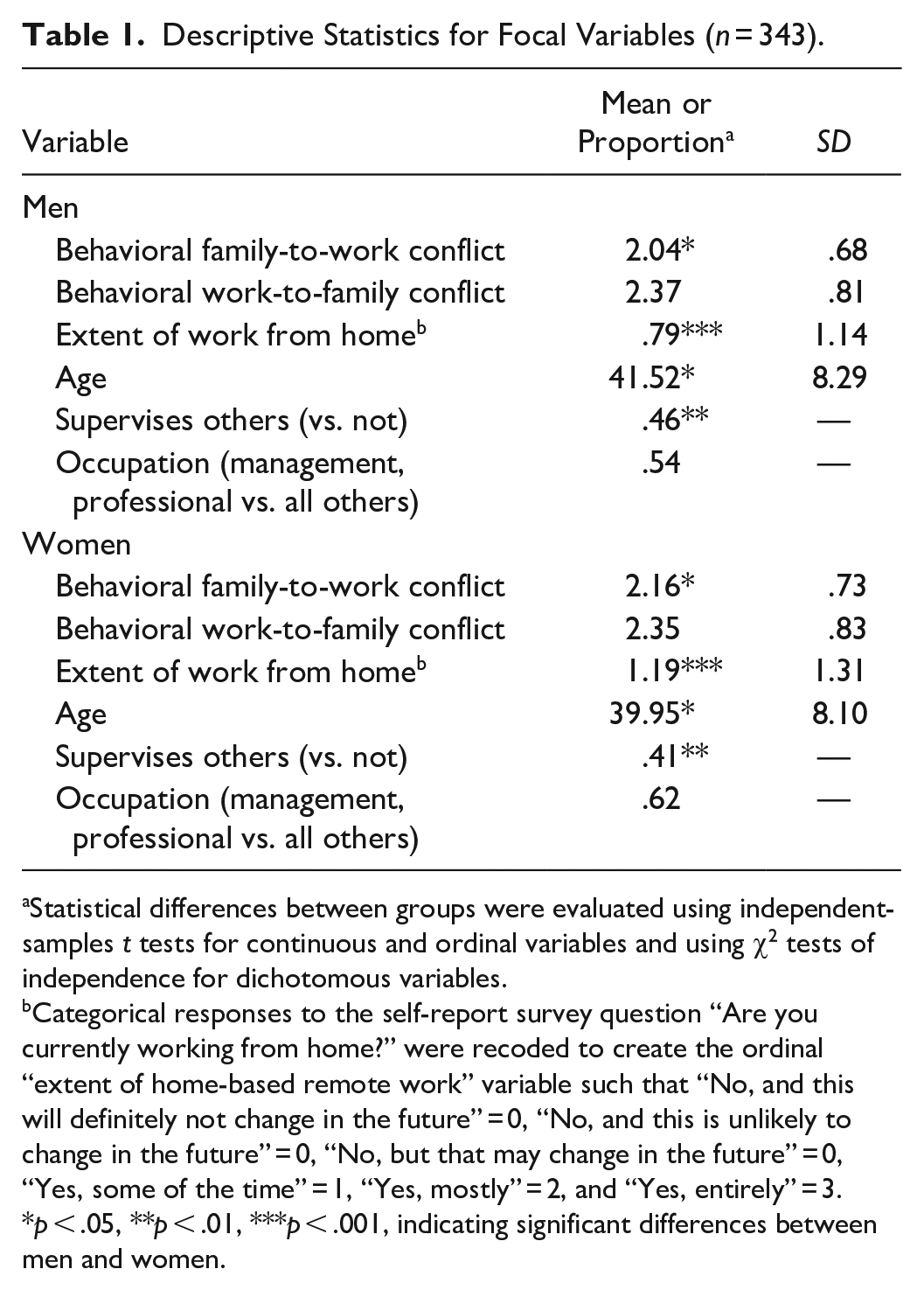
Statistical differences between groups were evaluated using independent-samples t tests for continuous and ordinal variables and using χ2 tests of independence for dichotomous variables.
Categorical responses to the self-report survey question “Are you currently working from home?” were recoded to create the ordinal “extent of home-based remote work” variable such that “No, and this will definitely not change in the future” = 0, “No, and this is unlikely to change in the future” = 0, “No, but that may change in the future” = 0, “Yes, some of the time” = 1, “Yes, mostly” = 2, and “Yes, entirely” = 3.
p < .05, **p < .01, ***p < .001, indicating significant differences between men and women.
Means, Standard Deviations, and Correlations with Confidence Intervals.

Categorical responses to the self-report survey question “Are you currently working from home?” were recoded to create the ordinal “extent of home-based remote work” variable such that “No, and this will definitely not change in the future” = 0, “No, and this is unlikely to change in the future” = 0, “No, but that may change in the future” = 0, “Yes, some of the time” = 1, “Yes, mostly” = 2, and “Yes, entirely” = 3.
Dummy coding for supervisor status (1 = supervises others, 0 = does not supervise others) and occupation categories (1 = management and professional, 0 = technician and clerical and other).
p < .05. **p < .01.
Behavioral Family-to-Work Conflict
To test hypothesis 1a that the positive association between the extent of remote work and BFWC is stronger for women than men (direct) and hypothesis 1b that the positive association between the actor’s amount of remote work and partner’s BFWC is stronger for men than women (crossover), we examined APIM for this outcome with all controls included in the model. Overall, we found that the best fitting and most parsimonious model was one where all the pathways were held equal (Figure 1). Although we found women’s BFWC to be positively affected not only by their extent of remote work (b = .054) but also their partners’ extent of remote work (b = .054), we found this also to be the case for men. Thus, contrary to the predictions of hypotheses 1a and 1b, we do not find a gender difference: the extent of one’s own (direct) and one’s partner’s (crossover) remote work and family-to-work conflict is the same for women and men. As seen from the amount of variance explained in both women’s BFWC (2 percent) and men’s BFWC (3 percent), the relationship between the amount of remote work and BFWC is small. However, it is important to note that this represents the unique variance explained after controlling for other variables known to contribute to work-family conflict.
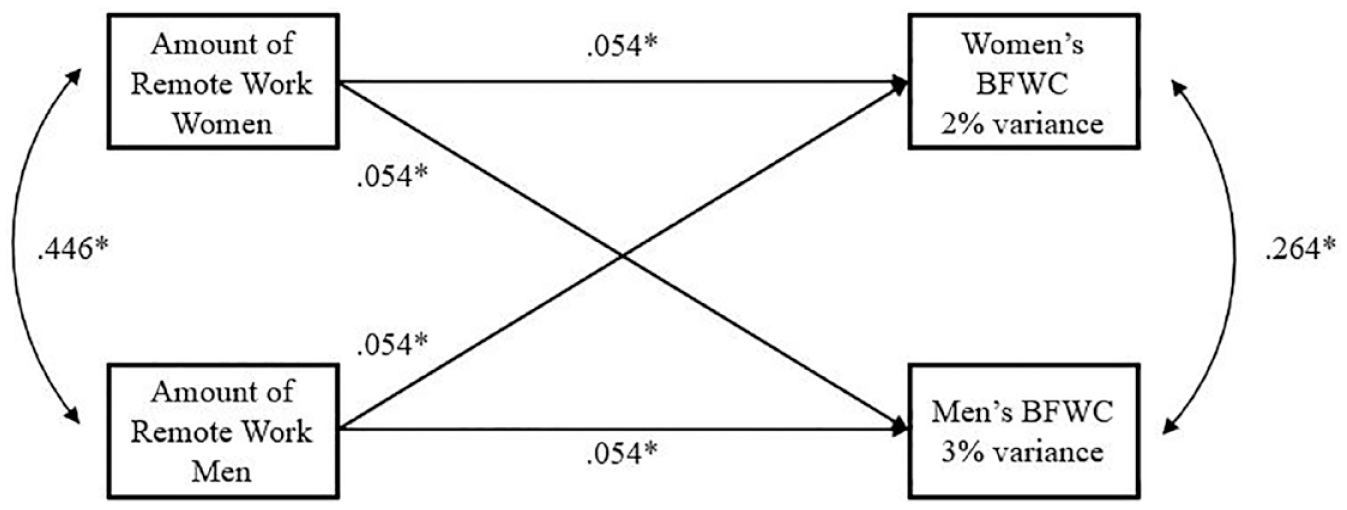
Extent of remote work predicting all couples’ behavioral family-to-work conflict (BFWC) (n = 343).
Behavioral Work-to-Family Conflict
Moving on to hypothesis 2a that the positive association between the extent of remote work and BWFC is stronger for men than women (direct) and hypothesis 2b that the positive association between the actor’s amount of remote work and partner’s BWFC is stronger for men than women (crossover), we examined APIM with all controls included in the model. As with BFWC, we found the best fitting and most parsimonious model was one in which all pathways were held equal (Figure 2). Contrary to the predictions of hypotheses 2a and 2b, women’s BWFC was not affected by their extent of remote work (b = .022) or their partners’ extent of remote work (b = .022), and vice versa. In turn, the amount of variance explained in BWFC was lower than those observed in the overall model predicting BFWC (.00 < .03). We did not find direct or crossover effects in the association between extent of remote work and BWFC for women or men.

Extent of remote work predicting all couples’ behavioral work-to-family conflict (BWFC) (n = 343).
Gender, Parental Status, and Behavioral Work-Family Conflict
We next examined if the relationships we saw in the full model (shown above) remain consistent when we separate our sample by parental status. Whereas the previous results control for parental status, in the following analyses, we examined APIM for either outcome, separately for parents and child-free respondents. We discuss the results for each outcome variables in turn.
For couples with children, we found similar results as the full sample, albeit with somewhat stronger effects than the overall model (Figure 3). The best fitting and most parsimonious model was the one in which all pathways were held equal. As can be seen, mothers’ and fathers’ BFWC increased as a function of not only their own extent of remote work (b = .057) but also their partners’ extent of remote work (b = .057).

Extent of remote work predicting behavioral family-to-work conflict (BFWC) for parent couples (n = 256).
For child-free couples, the best fitting and most parsimonious model was one in which actor effects were held equal, but partner effects were allowed to differ (Figure 4). We found that one’s own extent of remote work did not affect BFWC. However, child-free women’s BFWC (but not men’s) increased as a function of their partners’ extent of remote work. Notably, the effects (and variance explained) in this model were unique and stronger than observed for couples with children. Also, gender differences were found, as child-free men’s extent of remote work more strongly influenced their child-free partners’ BFWC (b = .100) than vice versa (b = .067). Our results suggest that the positive association between the actor’s extent of remote work and the partner’s family-to-work conflict is stronger for child-free women than men but not different for mothers and fathers.

Extent of remote work predicting behavioral family-to-work conflict (BFWC) for child-free couples (n = 87).
Turning to BWFC among our couples with children, we found the best fitting and most parsimonious model was one in which all pathways were held equal (Figure 5). As with the full sample, mothers’ BWFC was not affected by their extent of remote work (b = .015) or their partners’ extent of remote work (b = .015) and vice versa.

Extent of remote work predicting behavioral work-to-family conflict (BWFC) of parent couples (n = 256).
In the case of child-free couples, we found the best fitting and most parsimonious model was one in which actor effects were held equal, but partner effects were allowed to differ (Figure 6). For both child-free men and women, BWFC does not change as a function of their own extent of remote work (b = .006). However, for child-free women only, BWFC increased as a function of their partners’ extent of remote work (b = .097). There was no association between partner’s extent of remote work and BWFC for men. Thus, our results indicate that the positive association between the actor’s extent of remote work and the partner’s BWFC is stronger for child-free women than men and not different for mothers and fathers.

Extent of remote work predicting behavioral work-to-family conflict (BWFC) of child-free couples (n = 87).
Discussion
The COVID-19 pandemic has changed how employees and employers think about and experience remote work. Whereas prior to the pandemic, (some) employees may have had an option to work remotely (Barrero et al. 2023), during the pandemic, it was imposed by U.S. federal and state governments or by companies, dramatically increasing the number of home-based remote workers. Given this unprecedented context, our study analyzes the association of the extent of remote work on work-family conflict for the individual and, importantly, offers insight into our limited understanding of crossover effects to partner’s work-family conflict within dual-earning couples living in the United States. We discuss our major findings in what follows.
First, we find direct and crossover effects of remote work on behavioral family-to-work conflict for the whole sample. However, further analysis suggests that these effects may be driven primarily by the parents in our sample, as the results were replicated for parents but not for nonparents. Early evidence of the pandemic suggests the possibility of higher family-to-work conflict, particularly for parent couples (Montazer et al. 2022; Schieman et al. 2021). As expected, the reduction in care supports (e.g., schools, centers, other support such as family or nannies) likely affected this relationship. Some behaviors may be more salient because parents were working from home (e.g., taking a personal call “at work,” not having time because of a heavy workload, distractions, particularly for parents helping school-aged children). That we find positive associations of the extent of remote work on behavioral family-to-work conflict also may be an artifact of individuals working from home for the first time and the learning curve to find how to manage both simultaneously (Fan and Moen 2022). It may be more acute depending on the household setup: whether they have a private space and can be away from family or if they colocated. Thus, the more enmeshed the physical workspaces, the more behavioral family-to-work conflict would likely occur.
Second, we did not find a stronger association for women than men, although women reported significantly more behavioral family-to-work conflict than men and more remote work than men (see Table 1). In the model with the covariates included, any differences disappeared. The lack of a gender difference corroborates some studies (Montazer et al. 2022, 2024; Schieman et al. 2021). Early pandemic research suggested greater support by men and fathers (Carlson, Fielding-Singh, et al. 2022; Petts et al. 2023), whereas later research suggested that this did not persist (Carlson, Fielding-Singh, et al. 2022; Hu et al. 2023; Li et al. 2024). Whereas other research showed that a reduction in mothers’ work hours may lead them to perceive less conflict because they have adjusted their schedules to accommodate family demands (Parry 2024; Young, Milkie, and Schieman 2023), in our study, the women and men did not work significantly different hours. 5 Unlike other pandemic scholarship showing that mothers were particularly affected (Craig and Churchill 2020; Leroy et al. 2021; Petts et al. 2021; Soubelet-Fagoaga et al. 2021; Stefanova et al. 2023), our findings seem to suggest that the presence of both parents in the home acted as a protective factor against differential experiences of mothers’ and fathers’ family-to-work conflict. We suggest that differential values on work and family demands and roles based on traditional divisions of household labor may reduce the gap between their work-family conflict. Thus, our results might align with others who found that mothers and fathers justify an unequal household division of labor because of perceived work flexibility (Calarco et al. 2021; Daminger 2020). Or mothers expect to have more home and family demands and thus, perceive less conflict day to day, responding in a way that is congruent with their gender role (Shockley et al. 2017; Offer and Kaplan 2021; Yucel and Laß 2024). Fathers may perceive home and family demands as interrupting their expected breadwinner role and thus overestimate perceived conflict. Future dyadic research disentangling this puzzle is warranted.
Third, unlike behavioral family-to-work conflict, we did not find direct or crossover effects for remote work on behavioral work-to-family conflict for the entire sample or by parental status. There are no significant gender differences to suggest that the increased permeability mattered, lending support for the restricted life spheres argument (Schieman et al. 2021). That is, the forced restriction on lives reduced the possibilities for personal life pressures or interests to creep into the work domain. Ironically, although the pandemic lockdown might theoretically have led to more opportunity for behavioral work-to-family conflict, the situation itself may have prevented negative behavioral manifestations when work interfered with family as it was almost to be expected, given the circumstances, so not “conflictual.” Or there may have been other mitigating factors such as external attributions of the situation that may be attenuating behavioral manifestations of any perceived work-to-family conflict; it is not the demands of work or family, it may be the situation itself related to COVID-19. It is also possible that the behavioral measures for work-to-family conflict were created with traditional arrangements in mind. Thus, although our survey instructed that “leave work” and “arrive home” refers to ending/starting the workday, wherever the “work” takes place (e.g., remote, at their workplace), some respondents may not have interpreted it that way. Finally, the demands of work may have a lesser effect on family life because they are intertwined, or there may have been fewer demands at work in general, though this is not the case for all professions.
Fourth, we did not find direct effects for either behavioral family-to-work or behavioral work-to family conflict for child-free men and women. It is possible that this is because they may feel more in control of their own behavior and interactions—when to engage with one domain or the other—without other added distractions. However, we did find crossover effects for child-free women, whereby the more their partners works from home, the more they report both behavioral family-to-work and behavioral work-to-family conflict. We suggest that this result aligns with deeply held gender norms that persisted among the child-free. Although the presence of children in the household coupled with lack of childcare support may have initially led to some equalization in gender norms and behaviors among parents, nonparents may have continued to maintain a gendered view of various roles despite the changes brought on by the pandemic. As the expected caretakers for relationship maintenance (Blair-Loy 2003; Daminger 2020), child-free women may have felt a heightened obligation to respond to their partners. Given gendered expectations of work, these women may have respected their partners’ work boundaries, refraining from bothering them, but their partners may not have reciprocated. Instead, work may have been seen as detracting from these women’s ability to interact with their partners when they were around.
Although this study furthers the conversation on remote work and work-family conflict, there are some limitations. Conditions have changed since the height of the pandemic, and thus we cannot speak to noncrisis circumstances. Our sample of dual-earning, cohabitating couples is economically privileged, limiting our ability to generalize these findings to couples with more precarious work and family conditions. Given that our study is focused on home-based remote work, findings should not be used to make inferences about individuals who perform their job duties at locations beyond the home and office (Hislop and Axtell 2007) or individuals who only work from home outside of working hours (Golden 2021; Morganson et al. 2010). Future research should retest our analyses with new samples of workers. Our sample size does not let us compare workers by occupation, a potentially important distinction given that work arrangements are shaped by various factors, such as organizational policies, supervisor support, and role salience (Barrero et al. 2023; Yucel and Laß 2024). Additionally, the child-free subset is on the cusp of recommended sample size minimums to power APIMs. Although the magnitude of our findings is small, couples still experienced work-family conflict. Thus, we encourage further studies that use the behavioral work-family conflict scale as an additional dimension beyond perceptual scales, particularly critical as employees have adjusted to a “new normal.”
Overall, our study offers some advantages to the extant literature on remote work and work-family conflict. To the best of our knowledge, this is one of the first studies to conduct couple-level dyadic analyses on the direct association between the extent of remote work and work-family conflict using U.S. data. By adopting a couple-level dyadic perspective, we move beyond the conventional individual-level analyses, providing a more complete understanding of the interplay between remote work and work-family conflict. In the current landscape in which the debate over remote versus in-office work continues (Goldberg 2023), and an interest in maintaining remote work as an option remains high for many employees (Barrero et al. 2023), our study’s findings carry significant policy implications. Examining the intertwined lives of couples in the association between remote work and the work-family interface, our study contributes to decision making at the organizational level on remote work policies to promote work environments that prioritize both professional productivity and familial well-being. Employers could also offer support benefits that provide time or financial assistance to help employees manage family obligations that might interfere with work. These may include extended parental or caregiver leave, subsidized childcare, or concierge services that assist with household tasks. Our findings underscore the importance of employers to recognize and address the complex interplay between remote work and work-family dynamics. By better understanding these relationships, we can pave the way for more flexible and supportive work arrangements that cater to the diverse needs of modern couples and foster thriving workplaces and families alike.
Footnotes
Appendix A
Funding
The author(s) disclosed receipt of the following financial support for the research, authorship, and/or publication of this article: This study was supported by the National Science Foundation (“RAPID: Work, Family, and Social Well-Being among Couples in the Context of COVID-19,” award 2031726).
