




Abstract
Given the roles of patriarchy and pronatalist culture and the high prevalence of spousal violence against partnered women in Nigeria, the authors estimate and visualize the moderating effect of years of marriage on the probability of experiencing spousal violence (ESV) among involuntarily childless women (ICW) (vs. non-childless women [NCW]). Using multiple binary logistic regression, the authors analyze the 2018 Nigeria Demographic and Health Survey among married women (15–49 years of age). The authors define ICW as nulliparous women who have never used contraception and have never experienced pregnancy termination, while NCW are the comparison group. The graphical result suggests that despite the lower probability of ESV among ICW (vs. NCW), the probability of ESV is higher among ICW as years of marriage increase.
In Nigeria, childbearing in marriage is cherished and celebrated across cultures, while childlessness—the inability to have ever birthed a child or primary infertility (Solanke, Bisiriyu, and Oyedokun 2018)—is heavily stigmatized. Most patriarchal cultures in Africa consider fertility to be a woman’s responsibility; hence, childless women are blamed, stigmatized, and abused (Ikeke 2021). Consequently, a higher risk of marital infidelity has been observed among childless married women in a quest to bear children (Olamijuwon, Odimegwu, and Chemhaka 2021), thus increasing the risk of misattributed paternity. Because some cultures do not discourage polygynous intention, some childless married men may resort to marital infidelity or marry another wife. Such a marital arrangement may become inconducive to the childless wives who may end up victimized and denied spousal attention—thus jeopardizing their social, mental, and physical well-being—especially if the new cowives bear children.
Previous studies in Nigeria revealed that the likelihood of spousal violence is lower among childless women than non-childless women (NCW) (Solanke et al. 2018; Titilayo et al. 2019). However, those studies did not consider whether the risk of spousal violence remains high among involuntarily childless women (ICW), because most married women desire to have children. Their striving with their husbands to have children may promote interspousal empathy and lower their risk of spousal violence. However, it has been observed that some husbands become bothered (suffer backlash and pressure from their friends, clan, and communities), leading to a loss of patience as their wives’ involuntary childlessness lingers. This situation may increase the risk of spousal rift and violence (Aduloju et al. 2015).
Given the lack of studies on the association between involuntary childlessness and spousal violence and what happens in the context of the duration of marriage, we analyze the data of married women of reproductive age (15–49 years; n = 6,662) without no history of multiple unions and answered questions in the violence module from the 2018 Nigeria Demographic and Health Survey (National Population Commission and ICF 2019). We exclude those with a history of multiple unions because the survey question on years of marriage (YOM) pertains to the first marriage, and their multiple unions might have resulted from previous spousal violence. We measure ICW as nulliparous women who have never used contraception and never experienced pregnancy termination (coded 1); NCW are the comparison group (coded 0). To compare the probability of experiencing spousal violence (ESV) between ICW and NCW, we plot the probability of ESV from the regression of ESV on ICW versus NCW. Second, we plot the probability of ESV as a function of YOM. Lastly, we plot the moderation effect of YOM. We control for sociodemographic and economic correlates of childlessness and spousal violence (see the Supplemental Appendix for the full details).
Our preliminary results show that the probability of ESV is significantly lower for ICW compared with NCW (odds ratio [OR] = 0.56, 95% confidence interval [CI] = 0.38–0.82), but there is a nonsignificant association between YOM and the probability of ESV (OR = 1.01, 95% CI = 0.99–1.03) (see the graphs in the Supplemental Appendix). Our final result shows a positive association between YOM and the probability of ESV among ICW compared with NCW (OR = 1.07, 95% CI = 1.02–1.12) (Figure 1). In other words, the probability of ESV increases among ICW compared with NCW as YOM increase (see the Supplemental Appendix for the other side of the interaction, in line with the recommendation of Mize 2019).
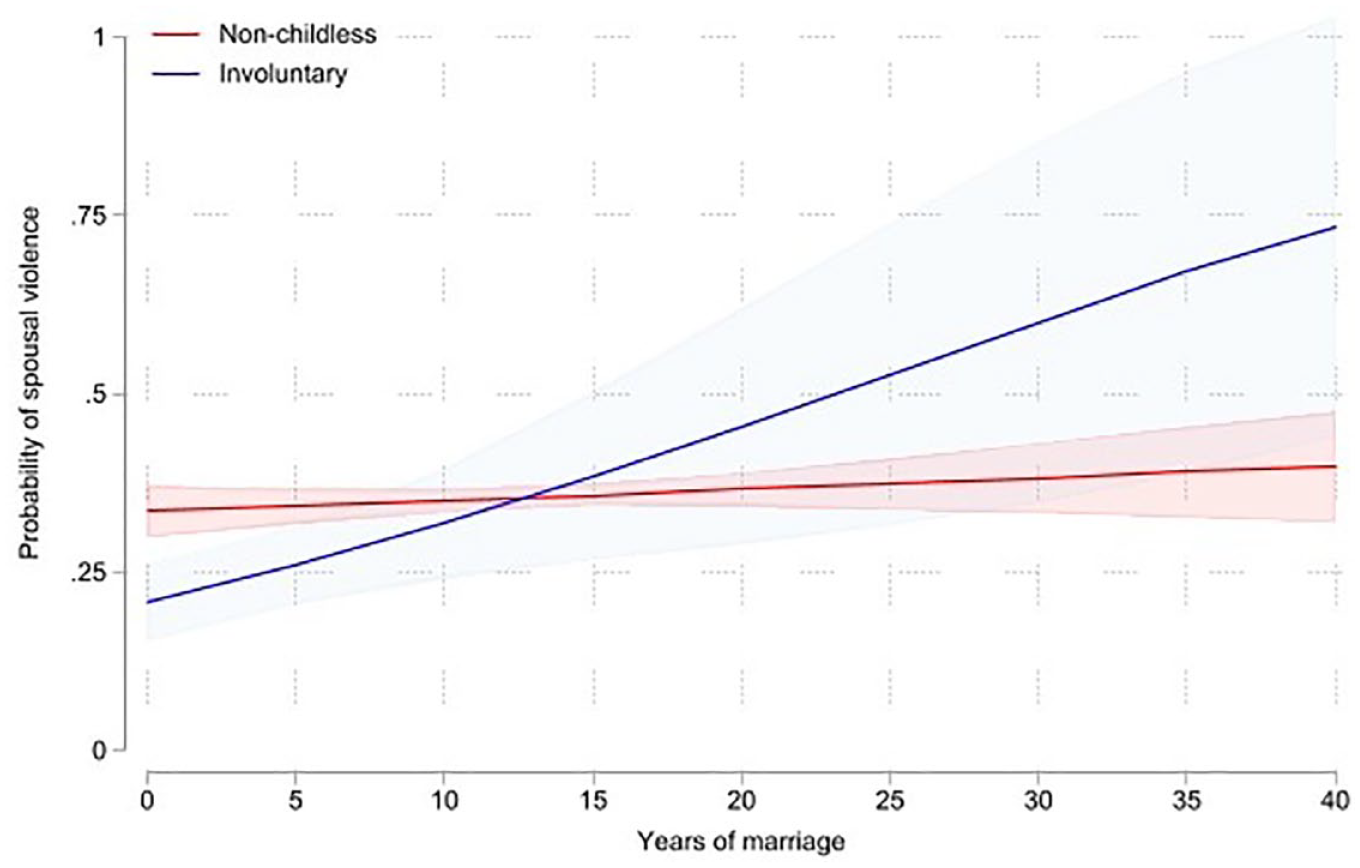
Association of involuntary childlessness and spousal violence and the moderating role of duration of marriage (measured as years of marriage).
The bottom line from the visualizations is that although ICW are less likely to experience spousal violence compared with NCW, this association reverses in the context of the duration of marriage. In other words, prolonged involuntary childlessness in marriage is associated with higher odds of spousal violence for ICW.
Given the high tendency for most cultures to exonerate married men and hold their wives culpable for childless marriages, our result suggests the need for interventions to safeguard married women with prolonged involuntary childlessness from spousal violence. Although we measured involuntary childlessness as married women who never used contraception and never experienced pregnancy termination, some women might have experienced miscarriages. Induced abortion and miscarriage were not separated in the data. Future studies should measure involuntary childlessness as women who are childless and have never used contraception or experienced miscarriage.
Supplemental Material
sj-docx-1-srd-10.1177_23780231241285933 – Supplemental material for Duration of Marriage Exacerbates the Likelihood of Spousal Violence among Involuntarily Childless Women in Nigeria: Evidence from a National Survey
Supplemental material, sj-docx-1-srd-10.1177_23780231241285933 for Duration of Marriage Exacerbates the Likelihood of Spousal Violence among Involuntarily Childless Women in Nigeria: Evidence from a National Survey by David Aduragbemi Okunlola, Khadijat Adeleye and Oluranti M. Ogundele in Socius
Supplemental Material
sj-docx-2-srd-10.1177_23780231241285933 – Supplemental material for Duration of Marriage Exacerbates the Likelihood of Spousal Violence among Involuntarily Childless Women in Nigeria: Evidence from a National Survey
Supplemental material, sj-docx-2-srd-10.1177_23780231241285933 for Duration of Marriage Exacerbates the Likelihood of Spousal Violence among Involuntarily Childless Women in Nigeria: Evidence from a National Survey by David Aduragbemi Okunlola, Khadijat Adeleye and Oluranti M. Ogundele in Socius
Footnotes
Acknowledgements
We thank the MEASURE DHS and the National Population Commission for allowing us to download and use the data.

Supplemental Material
Supplemental material for this article is available online.
Author Biographies
References
Supplementary Material
Please find the following supplemental material available below.
For Open Access articles published under a Creative Commons License, all supplemental material carries the same license as the article it is associated with.
For non-Open Access articles published, all supplemental material carries a non-exclusive license, and permission requests for re-use of supplemental material or any part of supplemental material shall be sent directly to the copyright owner as specified in the copyright notice associated with the article.
