




Abstract
Sociologists have long been puzzled by whether attitudes inform behaviors or vice versa. Accurately assessing both possibilities requires panel data collected at relatively short intervals. In this study, I leverage intensive panel data from the Relationship Dynamics and Social Life Study to assess the case of young women’s premarital sexual attitudes and behavior. Through a series of descriptive analyses and cross-lagged panel models, I show that opposition to premarital sex in young adulthood is only sometimes associated with subsequent sexual behavior and that premarital sex is negatively associated with later opposition to premarital sex. Young women are especially likely to reduce their opposition following first sex relative to sex reported at any time. Thus, initial behavioral experiences may result in outsized shocks to attitudes, following an active updating model. That subsequent sex is associated with less attitudinal change suggests that young women initially update their attitudes before settling into them. This study nuances long-standing debates on the malleability of attitudes within a person over time and with respect to behavior and has implications for how people approach behavior according to their attitudes across a wide spectrum of social phenomena.
Social scientists have long debated whether cultural meanings are settled over time or adapt in advance of or in response to external influences, changes in behavior, or both (Brett and Miles 2021; Christensen and Carpenter 1962; Swidler 2001; Vaisey 2009). Some research finds that adults maintain consistent culture regardless of their behavioral experiences (Lizardo 2017; Vaisey and Lizardo 2016). Other scholarship suggests that people revise their cultural meanings before or after engaging in a related behavior (Vaisey 2009), particularly when their behaviors conflict initial perspectives. This tension is especially present in socially contentious topics such as attitudes toward and use of abortion (Thomas, Norris, and Gallo 2017), religious experiences and religiosity (Pearce and Denton 2011), perceptions of drugs and drug use (Hoffmann 2014), or climate or weather events and attitudes toward climate change (Guilbeault, Becker, and Centola 2018). To determine their behavior, people may rely on attitudes, defined as personal beliefs about what others would or should do in a given situation (Ajzen 2001; Cerulo, Leschziner, and Shepherd 2021).
Given the uncertain relationship between attitudes and behaviors of the same domain (Bicchieri 2017; Casterline and El-Zeini 2007; Glasman and Albarracín 2006; Jerolmack and Khan 2014; LaPiere 1934), it is possible that inconsistencies exist because their relationship is bidirectional. Attitudes may inform behaviors, behaviors may lead to a revision of attitudes, or both may occur (Rebellon et al. 2014). Attitudes should thus be measured both before and after an associated behavior. Gathering repeated measures of attitudes and behaviors garners researchers additional purchase on whether behaviors are responsive to attitudes or vice versa (Hudde and Jacob 2023). However, common data sources often preclude analyses of the reciprocity between attitudes and behaviors because attitudes are frequently collected at only one point in time (Huber et al. 2017; National Center for Health Statistics 2020).
Given its salience to young adults, premarital sex among young women in the United States offers a unique case to answer these questions. Attitudes toward sex in adolescence and young adulthood are particularly relevant because they are controversial and vary widely according to the source of information (Mollborn 2017; Mollborn and Sennott 2015). Young people absorb these norms from myriad sources, including formal sex education (Guttmacher Institute 2023), social media (Fowler et al. 2022), pornography (Common Sense Media 2023), friends (Mollborn 2017; Wade 2017), and family (Manlove et al. 2012), among others. On the one hand, sexuality studies indicate that sexual activity in young adulthood is normative and offers the benefits of pleasure and enjoyment and connection to an intimate partner (Impett and Tolman 2006), thus promoting overall satisfaction and well-being (Harden 2014). On the other hand, two-thirds of U.S. students receive abstinence-focused sex education, which emphasizes attitudes against premarital sex (Bearman and Brückner 2001; Lindberg and Kantor 2021), or the idea that young people should not have sex before marriage. Narratives about sex in late adolescence and young adulthood are also highly gendered: Men are encouraged to explore their sexuality, and women encounter mixed messaging in which women are sexualized but discouraged and shamed for exploring their own sexuality (Kreager and Staff 2009). Despite the wealth of messaging about sexuality among young people, less is known about the extent to which attitudes are adopted by young women and whether such attitudes are present as they engage in sexual activity.
At the population level, the number of people who oppose sex in adolescence and young adulthood tends to decline with age (Tillman, Brewster, and Holway 2019; Victor, Miles, and Vaisey 2015), and by age 20, over three-quarters of young women have had sex (Lindberg et al. 2021). This is unsurprising given that young people undergo myriad changes to their social contexts (Arnett 2016; Bearak 2014) and update their beliefs across a variety of domains (Kiley and Vaisey 2020). In essence, young women may revise both their sexual attitudes and behaviors, but the sequencing of these events is not clear. It also less clear whether young people continue to revise their attitudes following initial behavioral experiences and if attitudes become settled with time after an initial learning process. The timing of measures is thus critical to determine if there is a relationship between premarital sexual attitudes and behaviors and vice versa (Guzzo, Lang, and Hayford 2021).
Investigating the reciprocity between premarital sexual attitudes and behaviors can also reveal whether young adults feel positively or negatively toward sex once they become sexually active. Given the varied messages about sex and slut shaming young people receive, particularly those directed at young women, their sexual attitudes could affect the quality of their initial and subsequent sexual relationships, their self-esteem, and their sense of sexual self-concept (Harden 2014; Olmstead 2020; Tolman and McClelland 2011). Women who adopted attitudes against sex in adolescence later report dissociating from their own body, being unable to feel comfortable in intimate relationships, or not enjoying sex and instead feeling guilty, ashamed, or objectified, even within marriage (Estrada 2022; Haberman 2021). More broadly, engaging in a behavior that feels deviant often leads people to hide their behavior or take risks, which could lead to unwanted sexual contact, unprotected intercourse, a sexually transmitted infection (STI), or a pregnancy (Kahn and Halpern 2018). Thus, studying relationships between sexual attitudes and behaviors can elucidate how many people behave in ways that are inconsistent with their purported attitudes and whether defying one’s own attitudes has negative implications for personal health and well-being.
In this study, I explore the potential reciprocity between young women’s sexual attitudes and behaviors using intensive longitudinal data from the United States. Specifically, I capitalize on repeated measures of attitudes and behaviors collected in short time intervals to ask four questions. First, do young women’s attitudes toward premarital sex vary according to prior experiences with sex? Second, do attitudes against premarital sex predict premarital sexual intercourse? And how do women adjust their attitudes, if at all, when they engage in premarital sex? Finally, is first sex an especially relevant behavioral event in predicting subsequent sexual attitudes? Taken together, this study advances our understanding of the relationships between attitudes and behavior, whether behavioral exposure is necessary to modify an attitude, and whether initial behavioral experiences are especially relevant to attitude retention. This research points to important implications for understanding cultural notions of socially contentious issues across a wide scope of issues beyond sex.
Background
Individual and Supraindividual Culture: From Norms to Attitudes
Cultural sociologists have long debated the role of personal and social meanings in people’s lives and their relationship to individual behavior (DiMaggio 1997; Mills 1940; Swidler 2001; Vaisey 2009). Across most domains, such as gender, family, and race, cultural meanings tend to remain settled over time and do not change even when a contradictory account or experience occurs (Kiley and Vaisey 2020). The consistency of settled attitudes has been documented extensively in adulthood using panels of cultural attitudes, although adolescents and young adults may still be learning from their experiences and updating their attitudes (Kiley and Vaisey 2020; Pampel 2016; Vaisey and Kiley 2021). In other cases, people report behavior that contradicts their self-reported attitudes, and they sometimes rely on explanations that are readily available or make sense at the time to explain the contradiction (DiMaggio 1997; Lersch 2023; Swidler 2001; Vaisey and Lizardo 2016). People’s attitudes, or ideas about what is appropriate for oneself (Ajzen 2002), take shape when they endorse cultural scripts or norms (culture dictated at the group level), which may influence their behavior (Bicchieri 2017; Shepherd and Marshall 2018).
Social or cultural norms indicate how people think others will behave (descriptive norms) or should behave (injunctive norms) in a given situation (Bicchieri 2017; Horne and Mollborn 2020). For sexual behavior, injunctive norms specify whether and how sexual encounters should unfold. In the United States, young people are exposed to contradictory sexual norms (Eilers 2022; Mollborn 2017). On the one hand, popular media and social media portray young women as sexually desiring and desirable. On the other hand, institutions such as schools, Christian religious groups, and sometimes family tend to employ proscriptive sexual norms that condemn sex before marriage (Bronfenbrenner 1979; Lindberg and Kantor 2021; Manlove et al. 2012; Meier 2003). Outside of the United States, cultural models of sexuality describe ways in which competing cultural norms about intimacy and safety lead to semiotic frameworks that discourage condom use in contexts with high HIV incidence (Tavory and Swidler 2009) and how breaking from normative cultural repertoires by having sex has negative repercussions for young women’s educational trajectories, not because of women’s own perspectives on their behavior but because of others’ norms that sexual activity is incompatible with future education (Frye 2017). These norms influence varying sexual scripts, or templates for how and under what circumstances behaviors unfold (or do not unfold; Ford 2018; Masters et al. 2013; Olmstead 2020; Simon and Gagnon 2003).
Script theory, which is based on symbolic interactionism, provides a framework of the distinct cultural scripts young people absorb about sexuality, both normative and nonnormative, that relate to sex in adolescence and young adulthood, such as which age is acceptable for first sex and which contexts are appropriate for sex, such as before marriage (Harding 2007; Swidler 2001). In adolescence, young women may learn a script that any sexual encounter is risky to their reputation (Kreager and Staff 2009; Mollborn 2017) or that one way to subvert this risk is to have sex only within a romantic relationship (Mollborn 2017). Other scripts describe the possible consequences of sexual activity (Tillman et al., 2019). Positive consequences may include emotional closeness with a partner, whereas negative consequences could include STI transmission or unwanted pregnancy (Meier 2003; Schalet 2011a), which might inhibit academic and career ambitions (Harding 2007). Finally, scripts about the ways in which sex unfolds tend to be highly gendered and suggest that “men want sex and women want love” (Carpenter 2010). Such scripts might discourage some women from having sex if they seek sexual intimacy as a means of connection; alternatively, they could encourage women to have sex if they seek to reject traditional scripts (Masters et al. 2013; Sanchez, Crocker, and Boike 2005).
Based on these diverse scripts, young women may form personal attitudes about sexual activity in adolescence and early adulthood or in relation to marriage (Horne and Mollborn 2020; Martin and Lembo 2020; Swidler 2001). In this way, opposition to premarital sex in early adulthood is an attitude that reflects an internalization of and/or a public demonstration of proscriptive social norms toward sex (Bicchieri 2005; Eilers and Weitzman 2019; Mollborn 2017). Notably, public commitments to premarital abstinence remain common in conservative Christian communities, where one in eight American teens has taken a virginity pledge (Landor and Simons 2014; Paik, Sanchagrin, and Heimer 2016). I define an attitude as a personal belief when someone endorses a cultural script or norm that may influence their behavior (Ajzen 2001; Bicchieri 2005; Cerulo et al. 2021; Collett and Lizardo 2014; Masters et al. 2013).
Is There a Reciprocal Relationship between Premarital Sexual Attitudes and Behaviors?
Young adulthood ushers in a new developmental period in the life course in which young people experience changes to their social environment and can explore their identity and form social connections—both friendships and romantic partnerships (Arnett 2016; Eilers 2022). During this phase, exposure to positive cultural scripts about sex may give women the space to reject traditional gender norms and embrace their own sexuality (Masters et al. 2013; Sanchez et al. 2005). This phase is also characterized by sexual exploration and experimentation (Hawkins et al. 2011; Olmstead 2020), which may occur in the context of a romantic relationship or in a hookup (Mollborn 2017; Wade 2017). As a result, young people rely on a combination of discursive norms to which they are exposed and their own personal experiences when developing their attitudes—a cultural toolkit that may directly shape their behavioral decisions or may be responsive to those decisions (Swidler 1986, 2001). Unlike earlier stages, young adulthood often unfolds without the oversight of parental or adult figures who may enforce rules and norms about a young person’s behavior or the company they keep (Allison 2016; Arnett 2016; van de Bongardt et al. 2017). Indeed, premarital sex is more normative and common in emerging adulthood than adolescence (Halpern and Kaestle 2014; Vasilenko 2017). By age 25, 87 percent of young people have engaged in premarital sex (Wu, Martin, and England 2018)—offering an ideal case to test the relationship and sequencing between a nearly universal behavior and its associated attitudes.
The sequencing and reciprocity between attitudes and behaviors continue to puzzle social scientists in part due to several data limitations. Surveys rarely ask about both attitudes and their corresponding behaviors (National Center for Health Statistics 2020; Smith et al. 2015), and existing data often include only retrospective reports of sexual activity in a given time period (Christopher and Cate 1984; National Center for Health Statistics 2020). When attitudes are collected, they are often gathered only at one time point, precluding accurate temporal linkages to behavior. Retrospective recall may lead to social desirability bias, particularly regarding sensitive topics such as sex (Barber and Gatny 2021; Rackin and Morgan 2018). Prospective measures, in contrast, offer an idea of how future behavior may unfold and whether initial behavior change is especially important to attitudes and attitude change (Rackin and Morgan 2018). Capturing attitudes and behaviors over time instead offers a window into the potential dynamics between the two.
Given the case of young women’s premarital sexual attitudes and behaviors, this analysis addresses four questions: First, how do young women’s reports of sexual attitudes vary for sexually active women, women reporting first sex, and sexually abstinent women? Second, do attitudes against premarital sex predict premarital sexual intercourse? Third, are reports of premarital sex associated with lower adoption of anti-sex attitudes? Finally, among those who specifically report first sex during the study, how do women adjust their premarital sexual attitudes, if at all?
Empirical Predictions
Cultural sociologists have long noted that people’s stated attitudes often do not align with their behaviors and vice versa (Ajzen and Fishbein 2005; Glasman and Albarracín 2006; Horne and Mollborn 2020; Schuman and Johnson 1976). These inconsistencies may reflect how strongly a person ascribes to a given attitude, a recent behavioral experience that may lead to a change in attitudes, measurement error, or social desirability bias (Ajzen 2002; Borgida and Campbell 1982; Glasman and Albarracín 2006; LaPiere 1934; Vaisey 2014). In response to this conundrum, scholars have formalized explanations for the seemingly discordant relationships between attitudes and behaviors. These explanations could unfold according to the settled dispositions model (Lizardo 2017; Mohr et al. 2020; Vaisey 2014) or the active updating model, following either a motivation or justification sequence.
Settled Dispositions Model
Some sociologists adhere to the settled disposition model, which questions the malleability of attitudes. It proposes that people adopt attitudes early in life and hold onto them (Bicchieri 2017; Kiley and Vaisey 2020; Lizardo 2017). In studies of generalized attitudes, adults’ attitudes about premarital sex tend to remain settled, although it is less clear whether this extends to young adulthood (Kiley and Vaisey 2020). In the case of sexual attitudes and behavior, young women may ignore their own attitudes and instead engage in a related behavior if their attitudes come into conflict with other priorities (Mills 1940; Vaisey 2009). For example, a woman may contradict her attitudes and have premarital sex because she is surrounded by a social network that encourages it, such as friends or a romantic partner (Meier 2003; Mollborn 2017; Sieving et al. 2006). Women are also are bombarded with messaging that promotes sexuality and increases young women’s desire for sex (Weitzman 2020). This messaging could lead some to initiate sex as soon as possible even if it contradicts their sexual attitudes (Carpenter 2002; Humphreys 2013). In this case, no relationship would exist between a woman’s attitudes and her behavior. Regarding premarital sex and subsequent attitudes, young women may uphold anti-sex attitudes despite engaging in sex if they view their own behavior as an exception to their generalized attitudes toward young people or if they seek to conceal their contradictory behavior (Mollborn 2017). Following the settled dispositions model, there would be no relationship between any sexual intercourse and subsequent sexual attitudes.
Hypothesis 1: Agreement with premarital sexual attitudes at one time point will not be associated with premarital sex in the following survey quarter when controlling for social context. And reporting any premarital sex at one time point will not be associated with subsequent sexual attitudes after accounting for social context.
Active Updating Model
Alternatively, following the active updating model, individuals who oppose premarital sex may decide to abstain from sex, in line with their attitudes and adhering to a motivational explanation of behavior change (Vaisey 2009). For these women, attitudes remain salient and guide their (absence of) behavior. According to this model, increased opposition to sex would be associated with a lower likelihood of reporting any sex.
In terms of attitudes responding to behavior, other sociologists suggest that people revise their attitudes after a behavior change to bring them in line with those behaviors, following a justification sequence of the active updating model (Vaisey 2009). A woman may first change her behavior and then revise her sexual attitudes after she has a concrete experience with sex and/or enjoys sex (Bem 1967; Stryker 2008; Swidler 2001). Moreover, having sex when opposed to it can lead to cognitive dissonance, which can be uncomfortable. A woman may resultantly reduce her opposition in order to avoid dissonance or to justify her behavior (Festinger 1957; Mollborn and Sennott 2015; Rebellon et al. 2014).
Hypothesis 2: Increased opposition to premarital sexual at one time point will be negatively associated with premarital sex in the following survey quarter when controlling for social context. And reporting any premarital intercourse at one time point will be negatively associated with subsequent attitudes against premarital sex after adjusting for young women’s social context.
Due to the outsized cultural emphasis on first penetrative sex in the United States and the variety of cultural repertoires about sex that people draw from (Carpenter 2010; Swidler 1986), first sex could mark an important developmental milestone in the life course separate from subsequent sexual encounters (Arnett 2000; Elder, Johnson, and Crosnoe 2003). Indeed, some, although not all, young people assign importance to their first sexual experience (Bearman and Brückner 2001; Carpenter 2002; Holway, Brewster, and Tillman 2022), particularly young people who are religious and/or think of first sex as significant. However, this is a gendered phenomenon, and many teens, especially young men, describe wanting to lose their virginity in order to “get it over with,” and definitions of what constitutes first sex are ambiguous (Carpenter 2001, 2010). Many start having sex in a romantic relationship (Mollborn 2017; Schalet 2011b), whereas others report first sex in a nonromantic hookup (Wade 2017). Regardless of relationship context, we might expect a more pronounced rejection of anti-sex attitudes following this initial experience compared to later sexual encounters. This would suggest that initial behavioral “shocks” operate as a learning experience that is especially important to active updating of one’s attitudes either immediately following the initial experience or slowly over time (Lizardo 2017). If women’s first sexual encounters are associated with a larger decline in opposition relative to later sex, this would indicate that the updating process slows with experience as young women settle into their new state, suggesting both an initial active updating process that is followed by settling into a new disposition. Thus, examining the dynamic relationship between attitudes about premarital sex and sexual intercourse for all women and for women reporting first sex can distinguish whether an initial experience is more consequential in linking attitudes and behaviors.
Hypothesis 3: Adjusting for young women’s social context, reporting first intercourse will be negatively associated with subsequent attitudes against premarital sex in young adulthood and to a greater degree than subsequent reports of sex.
Data and Methods
Sample
To answer these questions, I harness intensive panel data collected in the Relationship Dynamics and Social Life (RDSL) study (Barber, Kusunoki, and Gatny 2016). This study collected weekly data from a sample of 1,003 young women ages 18 to 22. Women ages 18 and 19 who were residents of Genesee County at baseline were eligible to participate, were randomly selected from the Michigan Drivers’ License and Personal Identification Card Database, and were invited to enroll in the study on a rolling basis between 2008 and 2009. 1 Participants first completed a 50-minute in-person survey about their perceived norms and attitudes, prior sexual behavior, contraceptive use, pregnancies, childhood social environment, and sociodemographic background. Subsequently, participants were invited to complete surveys each week (called “journals”), online or by automatic telephone service, for up to 2.5 years. The RDSL had an overall response rate of 84 percent, with 94 percent among women who were successfully located (Barber, Kusunoki, Gatny, and Schultz, 2016).
Each week, women reported sexual activity, contraceptive use, relationship dynamics, and pregnancy status in the journals, and they indicated their premarital sexual attitudes every 12 weeks. Eighty-four percent of respondents completed journals for at least six months, 79% for a year or more, and 75% for 1.5 years or longer, averaging one journal every eight days (Axinn, Gatny, and Wagner 2015; Barber et al. 2016;). 2 A randomized experiment conducted alongside the RDSL provided little indication that repeatedly answering attitudinal and behavioral questions about sex influenced women’s attitudes or behavior (Barber et al. 2016). 3
Although not nationally representative, the sample’s strength lies in its repeated measures capturing the endorsement of an attitude about premarital sex and corresponding behavioral measures of sexual intercourse. Another important sample inclusion pertains to women’s age at enrollment, which corresponds to the initial stage of emerging adulthood and to a period of early sexual activity (Olmstead 2020). Women who report no prior sex when they join the study are older than the national average age of first penile-vaginal sex of 17 years (Tillman et al. 2019). Delaying first sex occurs for numerous reasons, including lack of a partner, disinterest in sex, or strongly held attitudes against premarital intercourse (Holway et al. 2022; Zimmer-Gembeck and Helfand 2008). At the same time, sex is common during emerging adulthood (Lindberg et al. 2021; Wu et al., 2018). Therefore, this sample offers a compelling case for understanding the evolution of sexual attitudes and their relationship to intercourse because young women may have intentionally delayed first sex precisely because of their attitudes but will likely have premarital sex at some point in emerging adulthood.
To understand the reciprocal relationship between premarital sexual attitudes and sexual intercourse, I focus the analysis on unmarried women at baseline. Only women with at least two sequential quarters of data are included in the sample in order to fit cross-lagged panel models with time-varying predictors (Usami 2021; Zyphur et al. 2019). As a result, 183 women (n = 183 quarters) are excluded due to early attrition. I also exclude 10 women married by baseline (n = 47 survey quarters) and 51 survey quarters from 11 women who married within the first two quarters of the study because their data would be dropped from the focal models. I right censor 15 women who marry later in the first year once they report marriage (n = 69 survey quarters excluded once married). I include 49 women who were pregnant at baseline because women who oppose sex before marriage but go on to have sex are less likely to contracept and thus increase their risk of pregnancy (Bearman and Brückner 2001). I retain women regardless of sexual orientation, including self-reported heterosexual, bisexual, and lesbian women, because sexual orientation can be dynamic in young adulthood and does not always correspond to sexual behavior (Ela and Budnick 2017). 4 Furthermore, because attitudes are measured every 12 weeks, or each quarter, data are analyzed at the survey-quarter level. This results in a final sample of 3,337 survey quarters from 788 women. Of these, 985 survey quarters from 212 women (comprising 30 percent of survey quarters and 27 percent of women in the sample) reported no intercourse by baseline. Women contributed an average of 4.9 survey quarters, or just over one year of data. Missing data within surveys are rare in the RDSL; for each variable included in analytic models, fewer than 1 percent of responses are missing.
Table 1 details the sample in terms of demographic characteristics and sexual attitudes. To better illustrate the data setup and varying experiences women report throughout the study, Figure 1 highlights example trajectories for four women. Woman 1 (top row) enters the study at age 19 and is already sexually active. She reports no opposition to premarital sex during the study. Woman 2 enrolls at age 18.5, reports no first sex and opposes premarital sex. She reports first sex at age 19 and subsequently does not oppose premarital sex. Woman 3 has never had sex, does not have sex during the study, and remains opposed to premarital sex, and Woman 4 is opposed to premarital sex before and following first sex (Figure 1).
Sample Characteristics.
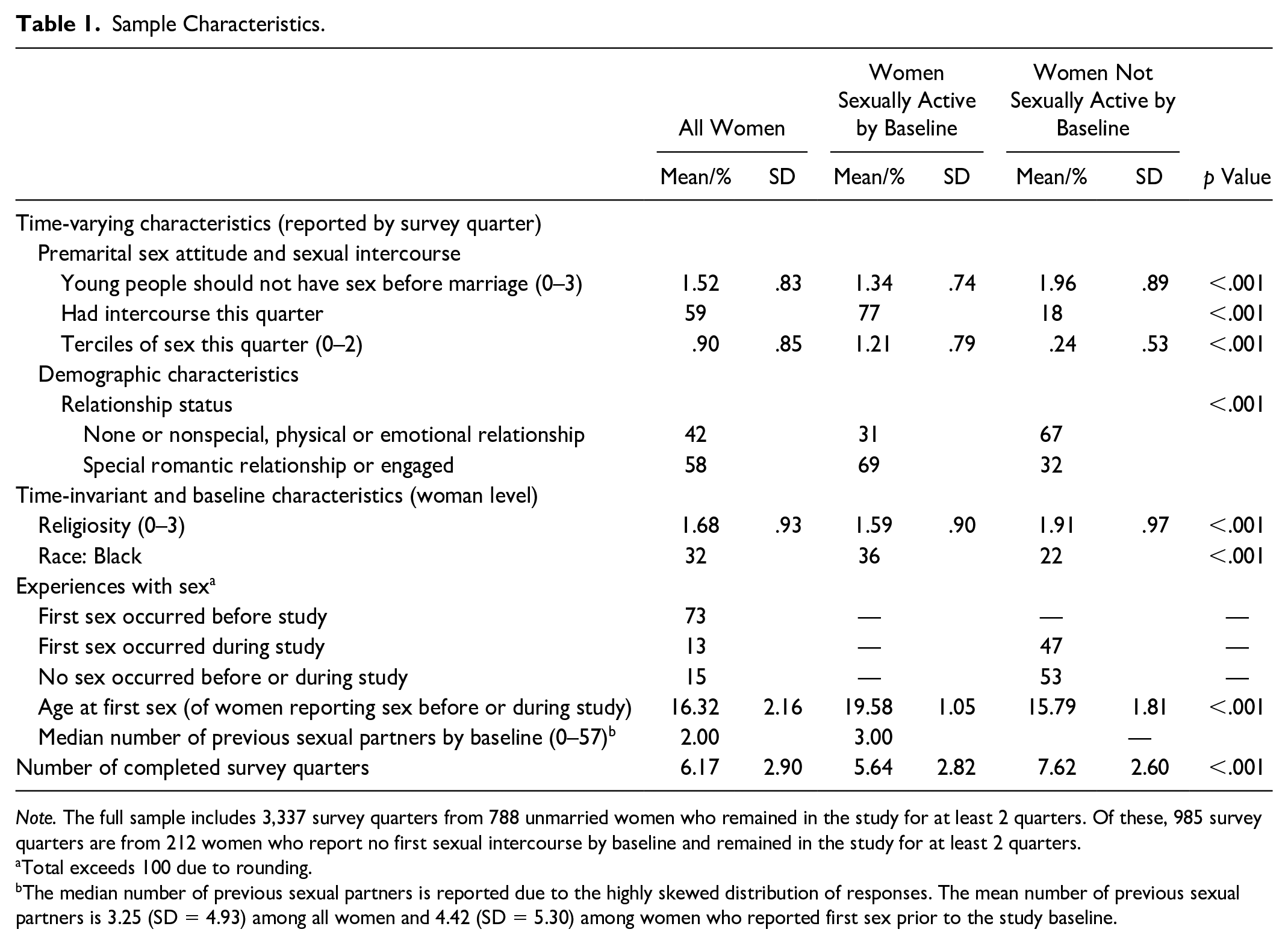
Note. The full sample includes 3,337 survey quarters from 788 unmarried women who remained in the study for at least 2 quarters. Of these, 985 survey quarters are from 212 women who report no first sexual intercourse by baseline and remained in the study for at least 2 quarters.
Total exceeds 100 due to rounding.
The median number of previous sexual partners is reported due to the highly skewed distribution of responses. The mean number of previous sexual partners is 3.25 (SD = 4.93) among all women and 4.42 (SD = 5.30) among women who reported first sex prior to the study baseline.
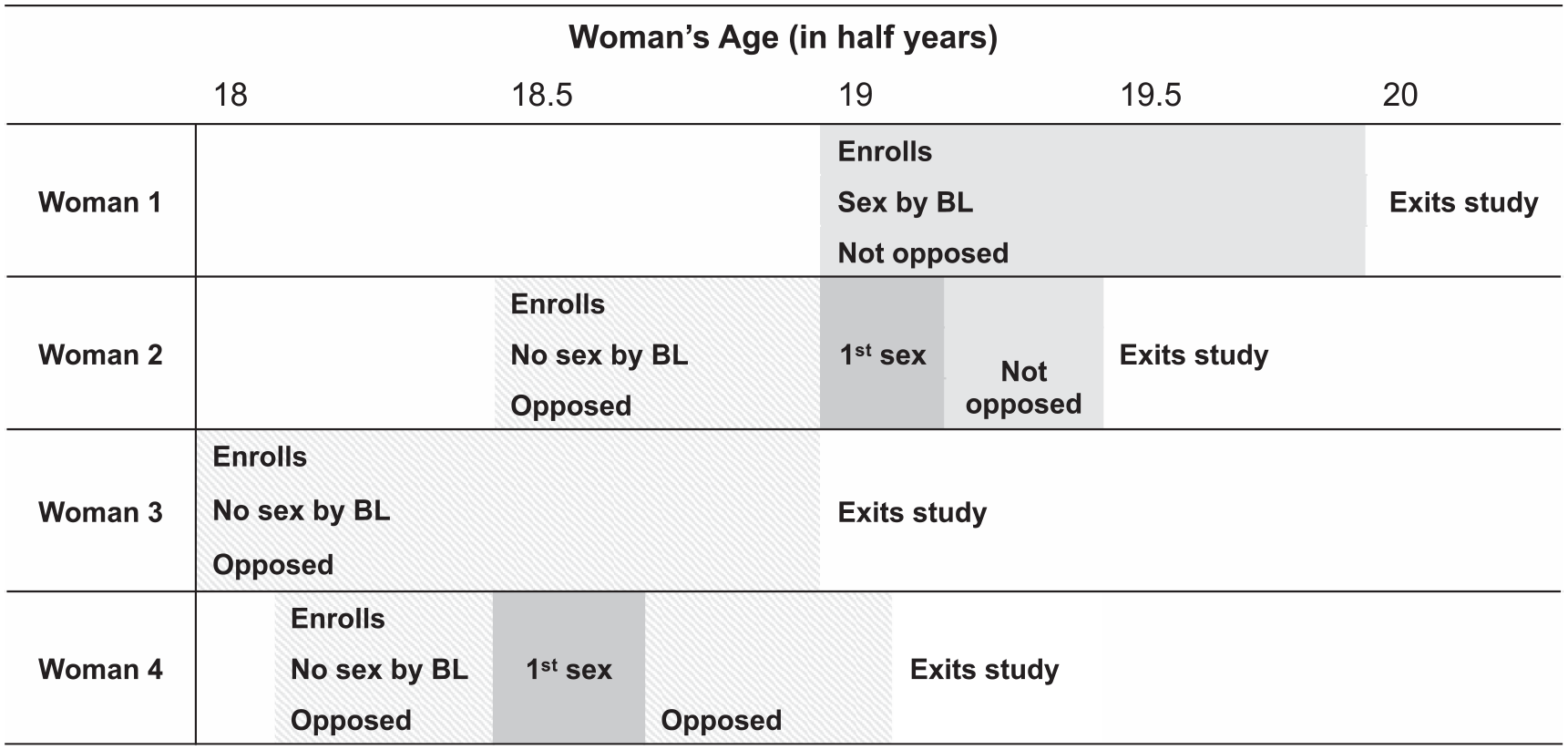
Example trajectories of women’s premarital sexual attitudes and behavior by age.
Measures
Intercourse
Intercourse was assessed weekly and was defined as having penile-vaginal sex (“when a man puts his penis in a woman’s vagina”). 5 For this analysis, intercourse is captured as a binary measure of (1) any sex reported during a survey quarter and (0) otherwise and terciles of sex in a quarter (no sex; sex 1 percent to 50 percent of weeks; sex 51 percent to 100 percent of weeks). Women who were sexually active at baseline reported intercourse in 77 percent of quarters, whereas women who never had intercourse by baseline reported sex in 18 percent of quarters (p < .001; Table 1).
First intercourse
First intercourse was assessed at baseline by asking respondents, “Have you ever had sexual intercourse?” For those who said “no,” I assigned first sex to the first quarter in the study in which they first reported sex. Because this question was asked each week, I am able to discern the timing of first sex with great accuracy. At baseline, 73 percent of respondents were already sexually active. Another 13 percent reported first sex during the study, and 15 percent reported no sex before or during the study (Table 1).
Sexual attitudes
Every 12 weeks, women were asked how much they agreed with the statement, “Young people should not have sex before marriage.” This measure captures a personal attitude about young adult sexual activity and premarital sex (Pampel 2016). 6 Possible responses included (0) strongly disagree, (1) disagree, (2) agree, and (3) strongly agree. Average agreement was lower for women who reported prior sex, indicating a 1.34 mean opposition, compared to a mean opposition of 1.96 among those reporting no sex by baseline (p < .001; Table 1). 7
Demographic characteristics
All multivariable models control for four characteristics previously shown to be associated with women’s premarital sexual attitudes and behaviors, including age at first sex, baseline religiosity, time-varying number of prior sexual partners, and time-varying relationship status (Johnson and Tyler 2007; Tillman et al. 2019). For respondents’ age at first sexual intercourse, mean age of first sex was 15.8 years for women sexually active by baseline and 19.6 years among those who reported first sex during the study. 8 Religiosity was captured on a 0 to 3 scale of religious importance ranging from (0) not important to (3) more important than anything else. Sexually active women had a mean religiosity of 1.59 compared to 1.91 religiosity from women reporting no sex by baseline (p < .001). 9 Number of prior sexual partners was updated weekly by asking women if they had a new partner and if they had sex the prior week. At baseline, women were asked the number of sexual partners they had ever had, and then new partners were noted during the study. The median number of previous sexual partners in the study was 2 in the full sample and 3 among women who were sexually active by baseline (Table 1). Relationship status was updated weekly by asking women whether they were engaged; in a special, romantic relationship; or in “any type of relationship that involves physical or emotional contact.” From these responses, I created a dichotomous indicator, updated each quarter, of whether women were (1) in a romantic relationship or engaged or (0) in no relationship or a casual relationship. 10 For women whose relationship status changed within a survey quarter (12-week period), I assigned their response from the beginning of the quarter. Fifty-eight percent of women reported a romantic relationship or engagement (Table 1). I combined casual relationship and no relationship because women were asked about their sexual activity only when they reported having a partner of any kind. Retaining a separate category for no relationship would be perfectly predictive of no sex because these women were not asked about intercourse when they reported no partner.
Analytic Plan
To determine whether and how attitudes change over time and with respect to prior sexual history, the first research question, I first descriptively compare the progression of average premarital sexual attitudes between women who were sexually active by baseline, women who became sexually active during the study, and women who remained sexually abstinent throughout the study using Kernel-weighted local polynomial smoothing plots (Cox 2005; Stata command graph twoway lpolyci).
Next, to answer the second and third questions, I fit a series of cross-lagged panel models (or lagged dependent variable models) that simultaneously estimate the relationship between sexual attitudes and subsequent sexual intercourse and vice versa across five survey waves, or just over one year, of data (Figure 2 shows the model setup; Zyphur et al. 2019). Cross-lagged panel models are a form of longitudinal structural equation model that model directionality of relationships between two variables over time and the stability of each measure over time (Allison, Williams, and Moral-Benito 2017). The first model predicts the probability of any intercourse in the subsequent quarter (time t) given a young woman’s sexual attitude in the reference quarter (time t – 1; Allison et al., 2017; Zyphur et al. 2019). The second model simultaneously predicts the reverse relationship, the third question, estimating a young woman’s opposition to premarital sex (time t) based on whether she reports any sex in the prior quarter (time t – 1). Women may report sexual activity in one quarter and not in the subsequent quarter, and I conceptualize sexual behavior as a state change from “sexually active” to “sexually inactive” or vice versa at each time point. Especially for women reporting initial sexual intercourse, which is an irreversible transition, sexual activity is sometimes intermittent (Tillman et al., 2019). Young people may experience periods of no sex if they lack a consistent sexual partner, if their initial sexual experiences did not align with the script they envisioned (Carpenter 2010), or if they decide to stop having sex (Byers, O’Sullivan, and Brotto 2016) for normative reasons, such as fear of reputational costs, or nonnormative considerations, such as fear of STI transmission, unwanted pregnancy, or a coercive partner (Holway et al., 2022).

Cross-lagged panel model setup to assess the reciprocal relationship between opposition to premarital sex and sexual intercourse.
These models decompose the cross-lagged effects from the stability of a woman’s average attitudes and behaviors collected across multiple time points over time, also called “autoregressive effects” (horizontal dotted lines in Figure 2; Mulder and Hamaker 2021). A large autoregressive effect indicates stable constructs over time (Hamaker, Kuiper, and Grasman 2015). Finally, the models control for remaining covariance between attitudes and sex within one time period and contextual measures associated with both sexual attitudes and behavior (vertical lines between opposition and sex in Figure 2), including age at first sex, baseline religiosity, time-varying number of prior sexual partners, and time-varying relationship status.
Respondents who reported attitudes in at least two consecutive survey quarters are included in the model in order to retain respondents who are right censored due to attrition at later waves. Their missing data at later waves are imputed using full information maximum likelihood (Johnson and Young 2011; Young and Johnson 2015). Full information maximum likelihood yields less biased estimates than listwise deletion and is preferable to multiple imputation (Johnson and Young 2011). 11 I determined the final model based on theoretically relevant covariates, model parsimony, and two overlapping fit indices: the root mean square error of approximation (RMSEA) and comparative fit index (CFI; Hawkins, Amato, and King 2007). Good model fit is specified at thresholds of RMSEA < .08 and CFI > .95 (Bentler 1990). To obtain a model with adequate fit, I limited the covariates to age at first sex, baseline religiosity (religiosity was measured only at baseline in the RDSL), time-varying number of prior sexual partners, and time-varying relationship status. Full models with demographic characteristics are available in Supplements A, B, and C. This precludes analysis of other potentially relevant demographic characteristics, including race and religiosity, which I explored in two supplemental analyses (Supplements E and F). The final model with all women had an RMSEA of .055 and a CFI of .963 (Table 2), and the model of women reporting no sex by baseline had an RMSEA of .079 and CFI of .927 (Table 3), likely due to the smaller sample size.
Multivariable Cross-Lagged Panel Models Estimating Standardized Opposition to Premarital Sex and Sexual Intercourse in the Following Quarter, among All Women.
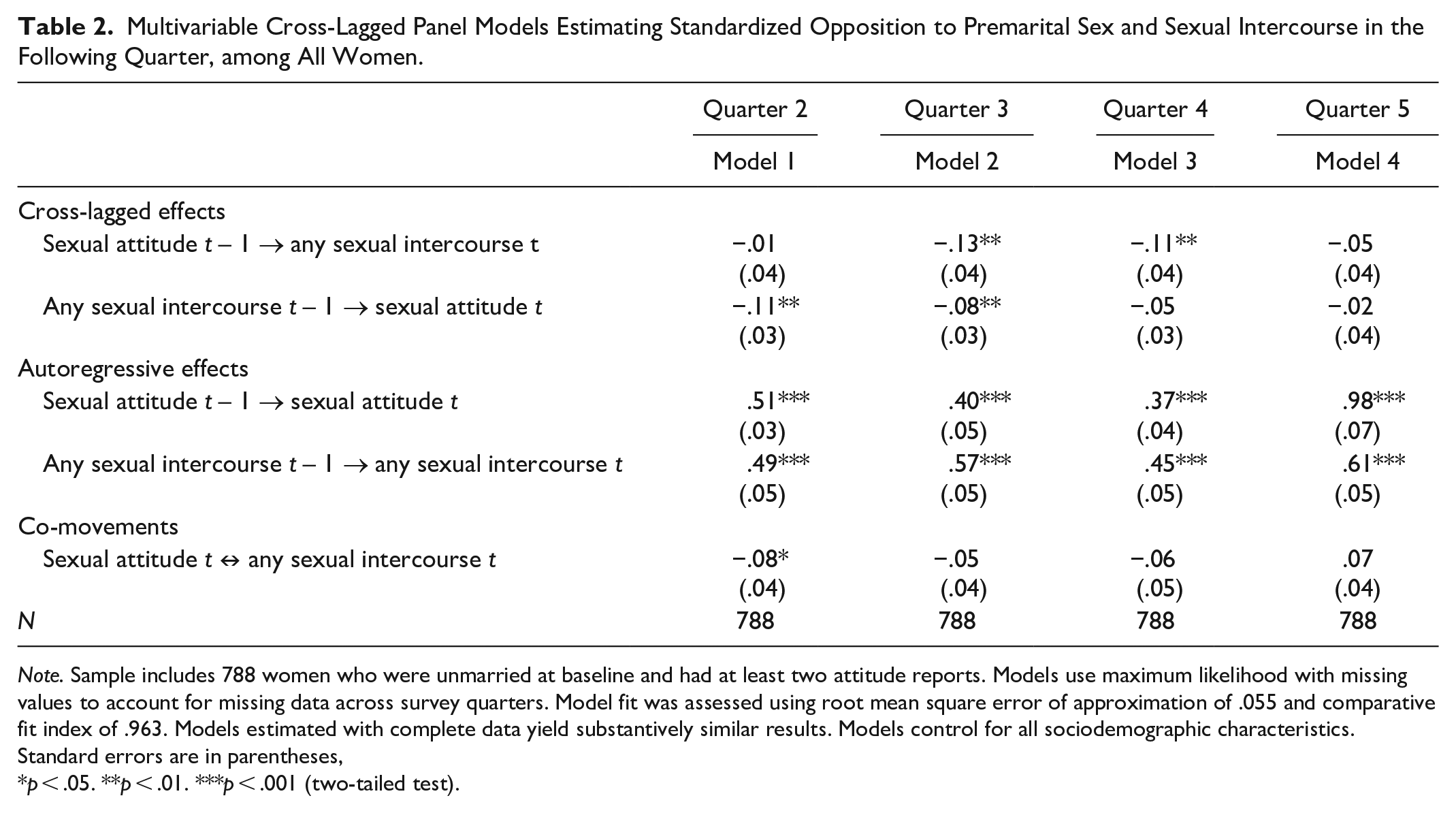
Note. Sample includes 788 women who were unmarried at baseline and had at least two attitude reports. Models use maximum likelihood with missing values to account for missing data across survey quarters. Model fit was assessed using root mean square error of approximation of .055 and comparative fit index of .963. Models estimated with complete data yield substantively similar results. Models control for all sociodemographic characteristics. Standard errors are in parentheses,
p < .05. **p < .01. ***p < .001 (two-tailed test).
Multivariable Cross-Lagged Panel Models Estimating Standardized Opposition to Premarital Sex and Sexual Intercourse in the Following Quarter, among Women Who Are Not Sexually Active by Baseline.

Note. Sample includes 212 women who never reported sex, were unmarried at baseline, and had at least two attitude reports. Models use maximum likelihood with missing values to account for missing data across survey quarters. Model fit was assessed using root mean square error of approximation of .079 and comparative fit index of .927. Models estimated with complete data yield substantively similar results. Models control for all sociodemographic characteristics.
p < .05. *p < .01. ***p < .001 (two-tailed test).
Finally, having established whether attitudes and behaviors are related (and vice versa), I assess heterogeneity in attitude response among women reporting first sex and according to amount of sexual activity in a given quarter. I first leverage the women who report no sex by baseline to assess whether and how their attitudes respond to first sex. To do so, I descriptively plot the distribution and changes to opposition to premarital sex in the three survey quarters (about nine months) following first sex, including if a woman “remains unopposed,” “becomes less opposed,” “remains opposed,” or “becomes more opposed” to premarital sex following first sex (Figure 4). Second, to determine whether the amount of sexual intercourse affects the amount of change to subsequent sexual attitudes, based on the model results from regressions with person fixed effects, I plot the marginal effects of reporting sex in terciles in a survey quarter (no sex; sex in 1 percent to 50 percent of weeks; sex in 51 percent to 100 percent of weeks) on women’s subsequent sexual attitudes, comparing women with and without prior sexual experience before the study (Figure 5). I estimate attitudes based on terciles rather than weeks of sex due to low power to make meaningful distinctions in attitudes by individual weeks of sex.
Results
Opposition to Premarital Sex by Sexual Experience
To assess the progression of young women’s premarital sexual attitudes with respect to their prior sexual behavior, I plot opposition to premarital sex between ages 18 and 20 using Kernel-weighted local polynomial plots (Figure 3). Opposition declined with age for all women, although the sharpest declines occurred among women who reported first sex during the study. Women not sexually active by baseline initially reported a 2.3 opposition on the 0 to 3 scale. Women reporting no sex before or during the study reduced their opposition by just 13 percent by age 20, whereas women reporting first sex during the study lowered their opposition by almost 30 percent. These trajectories overlap somewhat until age 19.5, at which point their confidence intervals separate entirely. Finally, women who are sexually active by baseline reported consistently lower opposition, remaining at 1.5 on a 0 to 3 scale and declining by 19 percent by age 20 (Figure 3).

Smoothed local polynomial curves of opposition to premarital sex by age and by first sexual intercourse status at baseline.
Bidirectional Relationships between Sexual Attitudes and Intercourse
To assess whether sexual attitudes predict subsequent intercourse and vice versa, I fit a series of cross-lagged panel models across five survey waves of data (corresponding to just over one year; Hamaker et al., 2015). I first model these relationships among all young women regardless of whether they were sexually active by baseline (Table 2). Focusing on the cross-lagged effects of opposition on the probability of any intercourse in the following quarter (Table 2, top row), Models 2 and 3 demonstrate that stronger opposition is associated with a 13 and 11 percentage point decline in the probability of sex the following quarter, respectively, after controlling for a young women’s prior reports of opposition and intercourse and her time-varying and time-invariant characteristics. Although these effects are statistically significant, they are relatively small—between a 10 and 15 percentage point change in the probability of reporting any sex. Moreover, there is no association between attitudes and premarital sex in quarters two and five (Models 1 and 4). I next assess the reverse relationship among all women between intercourse and subsequent attitudes (Table 2, second row). Across the first two quarters, reporting sex in one quarter is associated with a decline in opposition the following quarter. This ranges from a .1 SD and a .14 SD decline in quarters two and three (a .11- and .08-point decline, respectively), although there is no effect in quarters four and five after controlling for prior attitudes, intercourse, and demographic characteristics. Taken together, the decline in opposition suggests that any declines occur earlier in the study and are resolved by the later quarters, potentially as women are sexually active for longer periods of time.
Now focusing on women who reported no sex prior to the study, for attitudes and subsequent first sex, attitudes are associated with behavior only in quarter five, showing a 10 percentage point decline in the probability of sex (Table 3, top row). Attitudes are not associated with subsequent sexual behavior in other quarters. The relatively small effect on intercourse and null effects in the remaining quarters are consistent with the pooled results and offer further evidence that young women’s attitudes do not consistently predict the likelihood of reporting initial sex. Considering the reverse relationship (Table 3, second row), reporting first sex is associated with a large, .23-point lower opposition in quarter two and an .11-point lower opposition in quarter four. This amounts to a .25 SD and a .16 SD decline in opposition following first sex, respectively. The relationship is not significant in quarters three or five.
Overall, these findings indicate a small and inconsistent relationship between sexual attitudes and later intercourse. Young women’s attitudes about premarital sex play a minor role in determining whether they have sex, even first sex. On the other hand, reporting sex indicates an initial decline in opposition, particularly among women reporting first sexual experiences. These findings provide additional support for the idea that women revise their attitudes following sex and then settle into those attitudes.
Do Women’s Attitudes Consistently Respond to Behavior Change?
Having considered the bidirectional relationship between sexual attitudes and behaviors by prior sexual activity, I next demonstrate the variation in young women’s attitudes following first sex among women who reported first sex in the study. Figure 4 shows opposition toward premarital sex in the three quarters (or about nine months) following a woman’s first report of sex among women who reported first sex and then remained in the study for at least one additional quarter after this report (n = 88 women). 12 In the quarter following first sex (Figure 4, left bar), 39 percent of women remain opposed to premarital sex. Just under 25 percent of women who report first sex become less opposed afterward, another 33 percent remain unopposed, and a negligible fraction become more opposed (Figure 4). Two quarters following first sex (middle bar), 33 percent of women stayed opposed to premarital sex, whereas 55 percent became less opposed or remained unopposed. The increase in women who remain unopposed is likely women who became less opposed to premarital sex in the quarter just after first sex and remained less opposed over time. A similar pattern continues in the third quarter after first sex (Figure 4 right bar).

Distribution of opposition to premarital sex following first sex (n = 88 women).
Finally, I test whether the amount of sex a woman reports in a quarter has a differential effect on her subsequent attitudes (Figure 5). Using pooled linear regression models with person fixed effects, I plot the marginal effects of terciles of sex reported in a quarter (no sex, sex in 1 percent to 50 percent of weeks, sex in 51 percent to 100 percent of weeks) on a woman’s subsequent attitudes. 13 For women already sexually active by baseline, there is no association between the amount of sex and subsequent opposition to it (Figure 5, left). Women report a mean opposition of about 1.5 on a 0 to 3 scale, corresponding to about halfway between disagree and agree that young people should not have sex before marriage, regardless of how much sex they report. Women not sexually active by baseline, in contrast, report lower opposition with each increase in amount of sex in the prior quarter (Figure 5, right). Women reporting no sex indicated an opposition of 1.92, corresponding to agree that young people should not have sex before marriage. This falls to 1.76 for women who reported sex between 1 percent and 50 percent of weeks in the previous quarter. Although not statistically distinguishable from reporting sex in 1 percent to 50 percent of weeks, women reporting sex in more than 50 percent of weeks report an even lower opposition, of about 1.59, corresponding to a .33 SD decline in opposition compared to women reporting no sex. Overall, women reporting initial sexual activity see a modest decline in opposition as their sexual frequency increases.
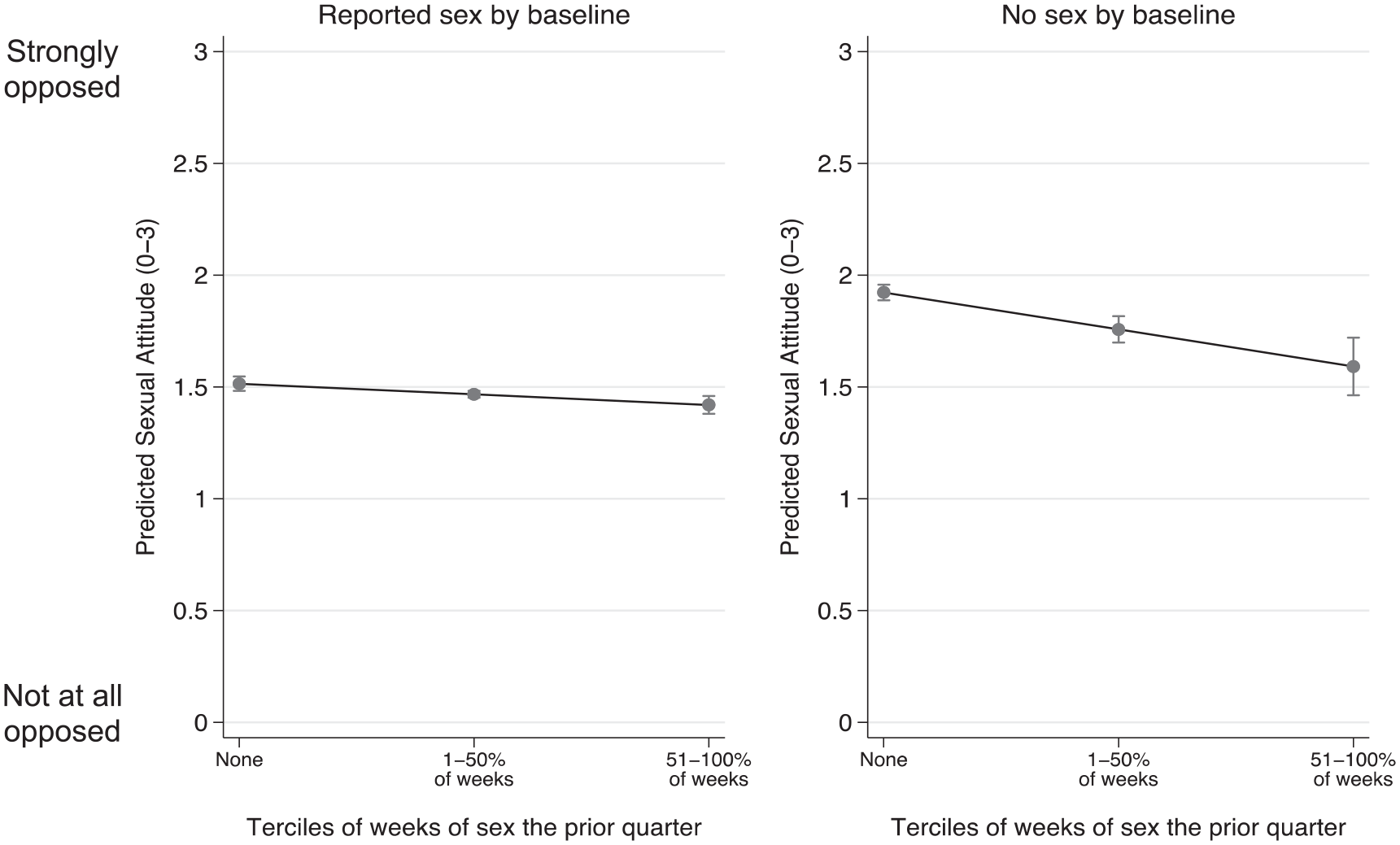
Predicted opposition to premarital sex by terciles of weeks of sexual intercourse in the prior quarter among (left) sexually active women at baseline and (right) women not sexually active by baseline.
In summary, three findings are noteworthy. First, there are only minor and inconsistent associations between a woman’s opposition to premarital sex and her likelihood of sex in the subsequent quarter among all women and women not sexually active by baseline (Table 2). Second, among all women, reporting sex is associated with a decline in opposition the following quarter, ranging from an .11 point decline for all women to a .23 point decline for women who report first sex (Table 2). That women’s first sex is associated with a decline in opposition of more than double that of women reporting later sexual activity highlights the centrality of first behavioral experiences to updating of attitudes and a settling of attitudes over time as women continue to have sex. This is further evinced by assessing the amount of sex women report in a given quarter. The experience of having any sex has notable declines on opposition for women reporting first sex, but having more sex does not have significantly increasing declines (Figure 5). Third, although average opposition to premarital sex trends downward following first sex, women’s attitudes respond in distinct ways following initial sexual activity (Figure 4). One-third report lower opposition to premarital sex; however, 40 percent of women remain opposed to premarital sex following first sex (Figure 4). Together, these results suggest that women engage in sexual intercourse regardless of their initial attitudes about it, providing weak evidence of a motivational explanation of the active updating model. In terms of the ideological response to sexual activity, these results suggest overall support for the active updating model following behavior change, particularly among women reporting first sex, whose experience of first sex doles an especially notable shock to their subsequent attitudes about sex.
Supplemental Analyses
Alternative Modeling Specification: Linear Regressions with Person Fixed Effects
To more fully isolate the dynamic role of changes to sexual attitudes on changes to the probability of intercourse and vice versa from women’s other unchanging characteristics, I fit pooled linear regressions with person fixed effects. 14 The first model predicts the probability of any intercourse in the subsequent quarter (time t) given a young woman’s change in sexual attitudes in the reference quarter (time t – 1; Allison 2009). The second model predicts the reverse relationship, estimating any change to a young woman’s sexual attitudes (time t) based on whether she reports sex in the prior quarter (time t – 1). I compare the effects first among all women, then among women who were sexually active by study baseline, and finally, for women who reported no sex by baseline (Supplement D). 15 All models are fit using the Stata command xtreg, fe in Stata Version 17.0 (StataCorp LLC 2021). Hausman tests confirm that linear regressions with person fixed effects are better suited to the data than are regressions with random effects (Allison 2009). I fit linear models instead of logistic regressions to estimate the probability of any sex to retain all women in the models. Logistic regression models with person fixed effects include only those who vary on the outcome measure, omitting women who never or always report sexual intercourse (Allison 2009). Omitting such women may bias the effects of sexual attitudes on intercourse, which are likely affected by their attitudes.
I first model the effects of a change in opposition on the probability of any intercourse in the following quarter for all women, followed by women who reported sex by baseline, and finally, among women who did not (Supplement D, left panels). Models 1, 2, and 3 demonstrate that increased opposition is not associated with any sex the following quarter after controlling for a young women’s prior reports of opposition, intercourse, time-varying characteristics (prior sexual partners and relationship status), and survey observation as a proxy for time. Together, these findings suggest additional support that women’s attitudes are not associated with their sexual activity rather than that attitudes motivate women to avoid sex.
I next estimate the relationship between any sex in a quarter on a young woman’s subsequent sexual attitudes (Supplement D, right panel). Among all women, Model 4 shows that reporting sex was associated with an .11 point decline in opposition after controlling for prior attitudes, intercourse, demographic characteristics, and time. When separated by prior sexual experience, among women who had sex by baseline, reporting any sex in a quarter is not associated with opposition the following quarter (Model 5). However, for women who have not had sex by baseline, shown in Model 6, reporting any sex in a quarter is associated with a .20 point decline in opposition, corresponding to .5 SD. This effect is 5 times the magnitude compared to women who were sexually active prior to the study.
Taken together, the decline in opposition is consistent with the primary, cross-lagged panel models and in support of an active updating model of behavior change. Young women appear to justify their behavior by becoming less opposed to premarital sex after reporting it, especially following first sex. At the same time, once women continue to have sex, they have more time to adjust their opposition and are less likely to further downwardly revise their attitudes. Both findings are consistent with Hypothesis 3, that initial behavioral shocks are especially important to women’s attitude updating but are then followed by a slowing of updates wherein women settle into their new attitudes.
Demographic Correlates of and Variation in Attitude-Behavioral Relationships
It is also possible that the bidirectional relationships between sexual attitudes and their corresponding behaviors vary by demographic characteristics, including race, religiosity, and relationship status (Guzzo et al., 2021; Weitzman and Mallory 2019). This may be due to differing normative and nonnormative messages about sex that vary across key demographic groups (Anderson 2014; Harding 2007; Meier 2003). To consider this possibility, I refit pooled linear regression models with random effects and interact each characteristic with attitudes in the model estimating sexual intercourse and vice versa. I rely on models with random effects instead of person fixed effects because race and religiosity are measured only at baseline in the RDSL. I fit models separately for all women and women reporting no sex by baseline. In terms of race, I find no evidence that opposing premarital sex differentially predicts the probability of sex for Black or white women (see Supplement E). To the contrary, Black and white women’s attitudes respond in distinct ways to premarital sex. Black women’s opposition remains unchanged after premarital sex, whereas sex is associated with a 17 percent lower opposition following sex for white women regardless of prior sexual experience and 24% lower opposition among those not sexually active by baseline. This suggests Black women are more likely to maintain their earlier attitudes despite engaging in contradictory behavior. For religiosity, I find substantively similar effects across levels of religiosity in estimating sex, although I find that religiosity has a strong independent effect on attitudes and also moderates the role between sex and attitudes such that women with stronger religiosity tend to see a larger decline in opposition in quarters in which they have sex compared to quarters they do not. This effect is not seen in the model with just women who report no sex by baseline (see Supplement F). Moreover, women’s relationship status may influence their premarital sexual attitudes and behaviors because partners can be key sources of influence. However, I find that the relationships between premarital sexual attitudes and behaviors and vice versa are substantively similar across relationship type in terms of direction, magnitude, and significance (see Supplement G).
Finally, to partially account for whether young women’s sexual encounters were wanted or unwanted, I refit linear regressions with person fixed effects and controlled for time-varying measures of relationship decision-making, fighting, and verbal, physical, and threats of intimate partner violence victimization. Including these variables yields substantively similar results (see Supplement H).
Discussion and Conclusion
This study addresses the reciprocal relationship between young women’s premarital sexual attitudes and behaviors and how their attitudes respond to sex. First, this study shows that 44 percent of young women oppose premarital sex, including 77 percent of women reporting no sex by study baseline. Despite the frequency of holding such an attitude, cross-lagged panel models reveal that a woman’s opposition is associated with 11 to 13 percentage point declines in the probability of premarital sexual activity in two survey quarters, suggesting that attitudes play a minor role in whether women engage in sex. Once they report sex, women on average subsequently report less opposition to it, particularly earlier in the study. These associations occur both when assessing the full sample and among women reporting first sex during the study.
For women’s initial sexual experiences, this effect is twice as large and significant in the second quarter—indicating that women most sharply revise their sexual attitudes once they become sexually active rather than by accumulating additional sexual experiences. This finding is consistent with the idea that key behavioral experiences are important to active updating processes, and because women in this study are in late adolescence and early adulthood, it is unsurprising that they revise their attitudes. However, given the associations occur earlier in the study for women who reported first sex prior to the study, it appears that once women experience this initial updating period, they revert to a revised settled dispositions model in adulthood (Kiley and Vaisey 2020; Vaisey 2009).
Descriptively, it is possible to see that the negative association between initial sexual intercourse and subsequent attitudes masks heterogeneity in women’s attitudes following first sex (Figure 4). One-third of women reduce their opposition to premarital sex following first sex (Figure 4). These women may revise their attitudes in order to justify their behavior or because they enjoyed their experiences with sex (Mollborn 2017; Vaisey 2009). This may alleviate cognitive dissonance about their prior opposition to sex once they become sexually active. Alternatively, it may allow them to usher in a newfound identity and embrace their sexuality (Bem 1967; Tolman 2002).
At the same time, another 40 percent remain opposed after becoming sexually active, suggesting an initial durability of sexual attitudes. This variation may result from differing cultural scripts about when, under what circumstances, and with whom sex is appropriate (Harding 2007). Alternatively, these women may be indicating a transition stage of becoming sexually active that unfolds over a period of time or with more sexual experiences as opposed to someone who has sex and immediately revises their attitudes. Because many women are bombarded with stigmatizing messaging about sex, women in this transition may be especially vulnerable to feeling badly about having sex, acting against their attitudes, or engaging in risky sexual behavior (Kahn and Halpern 2018). This, in turn, could also dictate whether they maintain attitudes despite engaging in contradictory behaviors. Together, these findings indicate that attitudes about premarital sex do not follow a consistent trajectory that corresponds to cultural stability or change for all women (Kiley and Vaisey 2020; Vaisey 2009). Instead, women likely draw on distinct cultural repertoires in response to their behavior, which could have consequential effects on their future behavior, identity, and overall well-being (Swidler 1986, 2001).
This phenomenon is especially apparent when assessing variation in attitude responses to behavior by race (Supplement E). Black women are more likely to remain opposed than white women following sexual intercourse (Kiley and Vaisey 2020; Vaisey and Lizardo 2016). Premarital sexual attitudes may be more consequential to Black women’s identity or reputation than white women’s and may also lead to an increased risk of cognitive dissonance when their attitudes contradict their behaviors (Horne and Mollborn 2020; Mollborn and Sennott 2015). Future research should consider the distinct lived experiences faced by marginalized people in studying the role of cultural meanings and their relation to behaviors.
Using repeated, prospective measures of both attitudes and behaviors that are updated in short time intervals reveals the dynamics between premarital sexual attitudes and behaviors. Such dynamics would otherwise be missed in cross-sectional data or longitudinal surveys collected over wide time horizons. Scholars across a broad range of disciplines would benefit from collecting repeated measures of attitudes and related behaviors, including fertility attitudes and pregnancy (Barber and Gatny 2021; Ray et al. 2018), neighborhood preferences and school choice (Roda and Wells 2013), or climate change attitudes and environmental conservation efforts (Guilbeault et al., 2018), to name a few. Furthermore, relationships between attitudes and behaviors are not consistent across all women, suggesting a need to investigate heterogeneous responses to behavior change across key social and demographic contexts. Future work should investigate variation in the associations between attitudes and behaviors across social contexts that may uniquely shape personal culture.
Given that attitudes only predict first sex in quarter five suggests that some women begin their sexual lives feeling opposed to premarital sex. This finding could indicate that some young women do not feel prepared to discuss sex, boundaries, and consent with their partners, potentially risking unwanted or unprotected sexual encounters (Ford 2021; Weitzman and Mallory 2019). They may also lack adequate knowledge of or access to contraceptive methods to keep them safe from unintended pregnancy or STI transmission (Tolman 2002). Furthermore, although reporting sex is associated with subsequent declines in opposition for certain women, this does not preclude the experience of guilt or regret, which can be harmful to mental health and well-being (Brooks and Weitzman 2022). This study suggests a need for transparent information about sexual development in adolescence and young adulthood as a normative process so that all young people can recognize and embrace their own sexual desires and experiences without shame or stigma (Harden 2014). These skills will enable young people to discuss sexual interests and healthy practices with their partners and to have positive, consensual, and enjoyable sexual experiences in which they do not feel that their actions are out of sync with their attitudes.
Limitations
This study provides novel empirical evidence of the relationship between premarital sexual attitudes and behaviors among young women. Future research should disentangle reasons that underlie women’s premarital sexual attitudes, which are not captured by the RDSL but may be tied to both their beliefs about sexual activity in adolescence or early adulthood and beliefs about premarital sex. Specifically, beliefs may be informed by norms about early sex or premarital sex (Hirsch and Khan 2020; Mollborn 2017; Olmstead 2020) or by nonnormative factors, such as avoiding risks of pregnancy or STI transmission (Holway et al., 2022; Irfan et al. 2020; Long-Middleton et al. 2013). 16 Furthermore, for the focal attitudinal measure, women were only able to select a neutral response (neither agree nor disagree) in the RDSL baseline interview and not subsequent journals. As a result, women’s responses may be biased either negatively or positively, which could reduce the effects of attitudes on behaviors (or vice versa) toward the null. 17 Future research of sexual attitudes should include a neutral response option. Moreover, future research should specify whether reported intercourse was wanted or unwanted, which was not collected by the RDSL. These factors may help explain whether women report attitudes about sex as a proxy for a wanted or unwanted sexual encounter (Ford 2021). Additionally, the RDSL is representative of young women from just one county in Michigan; as such, the study does not claim to be nationally representative (Barber and Gatny 2021). However, the RDSL sample offers a similar demographic composition of women in emerging adulthood in terms of childhood family structure, educational attainment, and employment (Clark 2018; Ela and Budnick 2017); mean ages at first birth; and rates of nonmarital and teen childbearing and cohabitation and marriage (Lesthaeghe and Neidert 2006; Michigan Department of Health and Human Services 2008, 2020; National Center for Health Statistics 2021; Osterman et al. 2021). Future scholarship should also account for men’s sexual attitudes and behaviors because they are also involved in penile-vaginal intercourse and because their premarital sexual attitudes may shape their partners’ attitudes and behaviors (Olmstead 2020). Finally, the RDSL study collected data only on penile-vaginal sexual intercourse and did not include gender-diverse relationships. As a result, these analyses are limited to penile-vaginal intercourse in mixed-gender relationships and omit other sexual experiences (i.e., anal sex or oral sex) and gender-diverse relationships. This precludes comparisons of attitude-behavioral links across all people and across diverse sexual activities. Future research should collect data on the full spectrum of sexual behaviors and their corresponding attitudes from all people regardless of sexual orientation or gender identity.
Conclusion
This research has implications for understanding relationships between attitudes and behaviors regarding socially contentious behaviors, such as sexual activity in emerging adulthood. Its potential applications extend beyond sexual attitudes and behaviors, however, to social phenomena such as pregnancy attitudes and childbearing (Ray et al. 2018), mental health and well-being (Meier 2007), commitment to social causes and action to support the cause (Romero 2020), views on race and perpetuating discrimination (Brensinger and Sotoudeh 2022), and political preferences and democratic elections (Bail et al. 2018), among others. By collecting repeated measures of both attitudes and behaviors, social scientists can uncover the dynamic ways in which people make decisions relative to their self-reported attitudes. In the case of premarital sex in early adulthood, collecting repeated data allows sociologists to identify whether young adults begin their sexual lives feeling opposed to premarital sex, which is a possible proxy for low information about sex, consent, and sexual self-efficacy. Overall, this study offers empirical evidence for whether and how attitudes and behaviors change in relation to one another, nuancing long-standing debates on the malleability of attitudes within a person over time and the potentially reciprocal relationships between attitudes and behavior. The findings highlight the diverse responses people experience with respect to their behaviors, particularly for initial experiences or transitions that may be deemed important or consequential.
Supplemental Material
sj-docx-1-srd-10.1177_23780231241277690 – Supplemental material for Attitudes and Behavior Feedback Loops for Young Women’s Premarital Sex
Supplemental material, sj-docx-1-srd-10.1177_23780231241277690 for Attitudes and Behavior Feedback Loops for Young Women’s Premarital Sex by Michelle A. Eilers in Socius
Footnotes
Acknowledgements
The author would like to thank Claire Kamp Dush, Alex VanBergen, Abigail Weitzman, Kelly Raley, Stefanie Möllborn, Kari White, Deborah Umberson, Kristen Burke, Isabel Brooks, Lindsay Bing, Chloe Craig, Kim McErlean, Sumin Lee, the students in the Spring 2022 Publishing in Sociology course, and the FAMDEM working group at the University of Texas at Austin for reviewing earlier drafts of this article.
Funding
The author(s) disclosed receipt of the following financial support for the research, authorship, and/or publication of this article: This research was supported by Grants T32HD095134 and P2C HD041023, National Institute of Child Health and Human Development, Minnesota Population Center, awarded to the Minnesota Population Center at the University of Minnesota – Twin Cities by the Eunice Kennedy Shriver National Institute of Child Health and Human Development. The research was also supported by Grants P2C HD042849 and T32HD007081, National Institute of Child Health and Human Development, Population Research Center, awarded to the Population Research Center at The University of Texas at Austin by the Eunice Kennedy Shriver National Institute of Child Health and Human Development, and the University of Texas at Austin Graduate School Continuing Fellowship. The content is solely the responsibility of the author and does not necessarily represent the official views of the National Institutes of Health.
Supplemental Material
Supplemental material for this article is available online.
1
Women temporarily residing outside the county for school or work were also eligible.
2
Attrition rates differed by race and baseline education: Black women and women who had not attended college, respectively, completed 11 and 12 fewer journals, on average, than White respondents and respondents with at least some college education.
3
The RDSL is not considered nationally representative given its sampling approach; other research has found that Hispanic women are half as represented and Black women are twice as represented in the RDSL compared to nationally representative samples (Barber and Gatny 2021;  ).
).
4
The RDSL collected sexual orientation from only a subset of respondents (n = 590) in a supplemental survey that excluded women who had already completed the study. Models estimated with only heterosexual and bisexual women yielded substantively similar results in terms of magnitude, direction, and significance.
5
This study focuses on penile-vaginal intercourse only because RDSL does not ask about other sexual activity, such as oral or anal sex, in which young people may engage in addition to or instead of penile-vaginal intercourse.
6
This measure could be considered a norm according to frameworks in social psychology, but for cultural sociology, designating this measure as an attitude is more appropriate (Ajzen 2001; ).
7
Women were only offered an option to neither agree nor disagree with the measure at baseline. Thirty-one women included in the analytic sample selected this option. Their reported attitudes in subsequent journals without a neutral option were somewhat lower than the full sample (1.64 vs. 1.94), indicating they were more likely to disagree with the measure. Including a control for these women does not substantively change the model results.
8
9
Religiosity was only asked at baseline in the RDSL, precluding time-varying analyses between religiosity, norms, and sexual activity.
10
Not combining engaged and romantic relationships and treating them as ordered categories instead leads to substantively similar conclusions. See Supplement C for the results using this alternative specification of relationship status.
11
12
Of the 101 women who reported first sex during the study, 88 provided attitudinal data in subsequent survey quarters. Because some women exit the study due to attrition or study completion, the sample size declines at each quarter. Reporting attitudes of only those remaining at least two quarters following first sex (n = 73) yields substantively similar results.
13
I estimate attitudes based on terciles rather than weeks of sex due to low power to detect meaningful distinctions in attitudes at each individual week of reported sex.
14
Person fixed effects also account for women’s age at first sex if they are sexually active by baseline, allowing me to better isolate the persistent effects of sex on a woman’s opposition.
15
The sample size is reduced at each survey quarter following first sex due to study attrition; however, results are robust when only analyzing women who remained in the study for three or more quarters following first sex.
16
17
Less than 1 percent of women (n = 31) opted for a neutral response at baseline.
Author Biography
References
Supplementary Material
Please find the following supplemental material available below.
For Open Access articles published under a Creative Commons License, all supplemental material carries the same license as the article it is associated with.
For non-Open Access articles published, all supplemental material carries a non-exclusive license, and permission requests for re-use of supplemental material or any part of supplemental material shall be sent directly to the copyright owner as specified in the copyright notice associated with the article.
