




Abstract
Scholars have reached different conclusions about the relationship between carceral contact and community engagement and civic participation. We offer a theoretical account that aims to synthesize this work to argue that incarceration should depress trust in the state but may increase, decrease, or produce no substantial effect on community or civic engagement, leading to no overall average association. We use data from the Family History of Incarceration Survey (FamHIS), a nationally representative survey of adults in the United States (n = 2,703) to conduct an expansive test of associations between direct (own) and indirect (family member) incarceration and trust in the state, civic participation, and community engagement. Our findings show that incarceration may not uniformly depress political and civic behaviors, on average. Furthermore, they inform our understanding of seemingly divergent conclusions in prior research, underscoring potential variability of prosocial actions and their enabling and constraining conditions in the wake of carceral contact.
Keywords
Direct and vicarious carceral contact are now ubiquitous in the United States, especially for those from historically marginalized groups (e.g., Bonczar 2003; Chung and Hepburn 2018; Enns et al. 2019; Lee, Porter, and Comfort 2014; Pettit and Western 2004; Roehrkasse and Wildeman 2022; Wildeman 2009). Indeed, nearly half of adults in the United States have had an immediate family member spend at least one night in a jail or a prison; over two-thirds have had an immediate or extended family member incarcerated at least overnight (Enns et al. 2019). Rates of own incarceration, although lower, are also quite high (Enns et al. 2019). Although carceral contact, especially within one’s broader family network, is now quite common in the United States, incarceration remains unequally distributed; for instance, in addition to racial/ethnic disparities in the prevalence of family incarceration, there are substantial disparities in the average number of family members ever incarcerated (e.g., Yi 2023). Ultimately, these racial/ethnic and socioeconomic disparities along with the exceptional breadth and reach of the U.S. jail (e.g., Turney and Conner 2019) and prison systems (Enns 2016) leave the United States with the highest incarceration rate in the world (e.g., Enns 2016:chapter one; Fair and Walmsley 2021).
Were this contact with the carceral state inconsequential for those who experience it, the high and disparate levels of incarceration would remain central to our understanding of punishment regimes but less central to our understanding of inequality in particular domains of life. Yet existing research on direct and indirect contact with incarceration mostly suggests negative effects, with often substantial implications for inequality. Research on own incarceration, for instance, suggests harms ranging from worse employment outcomes to compromised health to destabilized family life (e.g., Comfort 2008; Kirk and Wakefield 2018; Turney 2014; Wakefield and Uggen 2010; Western 2006). Immediate family member incarceration, moreover, has been linked to poor child well-being (e.g., Haskins 2014; Wakefield and Wildeman 2014), poor health (e.g., Goldman 2019; Lee, Wildeman, et al. 2014; Wildeman, Schnittker, and Turney 2012), material hardship (e.g., Geller et al. 2012; Testa and Jackson 2020), and even higher levels of own criminal legal contact (e.g., Roettger and Swisher 2011; Wildeman 2020).
Our research focuses on an important potential mediator between carceral contact and well-being and life chances—civic and political trust and engagement. Many characteristics and features have been identified as predictors of individuals’ participation in civic and community life (Campbell 2013; Rosenstone and Hansen 1993; Skocpol and Fiorina 1999; Verba, Schlozman, and Brady 1995) and attitudes toward and trust in public institutions and government (Chanley, Rudolph, and Rahn 2000; Levi and Stoker 2000; Zmerli and van der Meer 2017). We focus, however, on the intersection of the carceral state and (1) attitudes toward the state and (2) publicly oriented action. Each of these potential effects of carceral contact—on trust in the state, civic participation, and community engagement—may fuel social processes that maintain and/or exacerbate existing patterns and cycles of racial/ethnic, socioeconomic, and social inequality more generally by contributing to divergences in civic behavior with repercussive effects on political representation and the quality of community life (e.g., Burch 2013; Clear 2007; Gottschalk 2008; Kirk and Matsuda 2011; Roberts 2004; Tyler 2006; Tyler and Huo 2002; Uggen and Manza 2002). Indeed, existing analyses of the associations between incarceration and civic participation and community engagement have primarily emphasized suppressive effects. Yet more recent work offers a combination of empirical results, with some research pointing to conditions under which carceral contact can be mobilizing (e.g., Owens 2014; Walker 2020).
These seemingly contradictory findings mean that although social scientists have been examining the overall association between incarceration and civic and political participation for some time, this remains an open theoretical and empirical question. In this article, we seek to extend research on the associations between carceral contact and trust in the state and community and civically engaged behaviors in both theoretical and empirical ways. Theoretically, we seek to provide clarity around how existing sociolegal theories provide a robust framework for understanding why associations between carceral contact and trust in the state are likely to be strongly—and almost universally—negative even though associations between carceral contact and community-minded and civically minded behavior are likely to yield no statistically significant association on average. We believe the absence of a unified theoretical framework for how carceral contact diminishes trust in the state but not necessarily civic and community engagement helps explain why scholars often portray the literature and their own results as suggesting a stronger negative relationship between carceral contact and engagement than in fact is suggested by prior analysis.
In this article, we provide the first nationally representative assessment of how direct and indirect carceral contact are associated with trust in the state, community engagement, and civic participation using data from the Family History of Incarceration Study (FamHIS). Our results provide support for several conclusions that align with our theoretical framework. First, own and immediate family member incarceration are both associated with deep distrust of the state. This conclusion mirrors findings from existing research about criminal legal system involvement and corresponding legal cynicism and lower levels of trust and confidence in the state (e.g., Brayne 2014; Muller and Schrage 2014; Sugie 2015). Because our theoretical framework predicts no overall relationship between carceral contact and civic or community engagement, this replication of past work regarding a negative association with trust in the state is a critical first step in our analysis, demonstrating that the FamHIS data can provide reliable estimates of outcomes that are understood to be associated with incarceration. These findings also extend previous research by leveraging multiple measures of trust and incarceration exposure.
Second, and in a break from much prior research, our results show that neither own nor family member incarceration is statistically significantly or consistently associated with civic participation or community engagement. This conclusion holds when using composite scales of civic engagement and community participation and for individual action or behavior-specific measures in each construct and models stratified by race/ethnicity and family member type. Although the cross-sectional nature of our data and the scope of our investigation preclude causal claims, the absence of an observed statistical relationship suggests that a more nuanced view of the consequences of the carceral state is merited. Although negative effects of personal and family incarceration are well established, we cannot unequivocally conclude the same when it comes to the potential for direct and vicarious contact with the carceral state to shape action in civic and community life.
Theoretical Expectations
Our argument begins with a discussion of legal cynicism and the external legitimacy of criminal legal institutions (e.g., Bell 2016; Levi, Sacks, and Tyler 2009) and how these theoretical perspectives combined with the realities of what it means to serve time directly or vicariously (e.g., Comfort 2008; Miller 2021; Walker 2022) undergird our expectation that carceral contact is negatively associated with trust in the state. We then draw on research examining between-group and contextual variation in the ways people and communities engage with the public sphere (e.g., Remster and Kramer 2018), the resilience and agency of impacted persons and families (e.g., Comfort 2008; Walker and García-Castañon 2017), and potential floor effects of carceral contact on daily life (e.g., Massoglia, Firebaugh, and Warner 2013) to suggest why, on average, it would be reasonable to expect no consistent statistically distinguishable association between direct and indirect carceral contact and community-minded and civically minded behavior. Our argument, in short, is that (1) potentially offsetting positive and negative associations and/or (2) the resilience and agency of persons impacted by the carceral state are likely to lead to no statistically significant average association between carceral contact and levels of engagement with the state and the community. Although some research acknowledges the potentially heterogeneous effects of carceral contact, our argument offers an important addition to broader discourse that has overwhelmingly emphasized a negative relationship between carceral contact and civic and community engagement. Our argument also offers an important validation for localized studies and analyses of variation across groups and types of carceral contact that may find consistent mobilizing or demobilizing effects even when our analysis shows at the national level no discernable effect exists for the activities we analyze.
Strong, Consistent Evidence That Incarceration Deepens Distrust in the State
Our first area of focus is trust in state institutions. Our expectations are undergirded by the framework of legal cynicism, or “anomie about the law,” the state in which individuals and communities view legal institutions and state actors with skepticism and distrust (Bell 2016; Kirk and Papachristos 2011; Sampson and Bartusch 1998). Analysis of the correlates of trust in the state, community engagement, and civic participation has long been a core project of the social science of governance and the body politic (e.g., Levi and Stoker 2000; Stokes 1962). Although a number of characteristics and experiences have been identified as correlates of individual likelihoods of participation in civic and community life (Campbell 2013; Rosenstone and Hansen 1993; Skocpol and Fiorina 1999; Verba et al. 1995) and attitudes toward and trust in public institutions and governance (Chanley et al., 2000; Levi and Stoker 2000; Zmerli and van der Meer 2017), our focus is on the impact of own and family incarceration on these views and behaviors.
Prior scholarship emphasizes processes by which adverse contact with the state may negatively impact both routine and more substantial types of engagement with public institutions, including system avoidance (Brayne 2014), diminished sense of duty to mainstream civic institutions (Davis 2020), and negative political socialization, or the process by which incarceration experience leads to withdrawal from government (Sugie 2015), for example. In aggregate, these “chilling effects” are observed in the linkages between lower levels of trust, lower perceptions of the state’s political efficacy, and greater institutional alienation (e.g., Lee, Porter, and Comfort 2014; Weaver, Prowse, and Piston 2020). These along with legal cynicism, or the perception of criminal legal illegitimacy and inefficacy, may coincide with high rates of criminal legal contact, even in neighborhoods where violence and crime are prevalent and of serious concern to residents (Kirk and Papachristos 2011; Sampson and Bartusch 1998).
Given large disparities in the frequency and nature of contact with the legal system (Edwards, Lee, and Esposito 2019; Sewell, Jefferson, and Lee 2016) and effects of inequality on trust (Hastings 2018; Kawachi and Kennedy 1997; Kawachi, Lochner, and Prothrow-Stith 1997), we expect incarceration to be associated with lower levels of trust in the state (Muller and Schrage 2014). Indeed, prior empirical tests of this relationship appear relatively unambiguous: Across a range of types of contact, measures, samples, and even units of analysis, research consistently finds a strong, significant negative association between both direct and vicarious contact with the carceral state and trust in various state institutions (e.g., Burch 2014; Davis 2020; Foster and Hagan 2007; Gerber et al. 2017; Lee, Porter, and Comfort 2014; Muller and Schrage 2014; Weaver and Lerman 2010).
However, important questions about the likely negative associations between incarceration and trust in the state remain, primarily due to limitations in available data and variation in how carceral contact and trust in the state have been operationalized. For instance, much of this work has centered on analysis of select subgroups, using data such as the National Longitudinal Survey of Youth 1997 and the National Longitudinal Study of Adolescent to Adult Health, which focus on particular cohorts of the population (e.g., Foster and Hagan 2007; Lee, Porter, and Comfort 2014), or on particular jurisdictions (e.g., Burch 2014; Gerber et al. 2017). Other work relies on indirect evidence, such as the relationship between state prison populations and aggregate descriptions of public views of state courts (e.g., Muller and Schrage 2014), as opposed to analyzing individual-level dynamics. Evaluation of this hypothesis with data on multiple measures of trust and measures of both own and family incarceration from a nationally representative sample of adults offers an important empirical extension of existing literature.
Uneven Evidence That Incarceration Shapes Civically Minded and Community-Minded Action
Given our prediction that own and family incarceration will correspond with lower levels of trust in the state, it might be natural to extend this to an expectation that own and family incarceration corresponds with lower levels of civic engagement and political participation. Although this remains a dominant conclusion in the literature (Brayne 2014; Burch 2014; Clear 2007; Lerman and Weaver 2014; Sugie 2015; Weaver and Lerman 2010), other analyses of how carceral contact shapes civically minded and community-minded behavior point toward mixed impacts (White 2022). Indeed, some research indicates that incarceration may be activating, spurring individuals to engage in their communities and institutions (Christiani and Shoub 2022; Owens and Walker 2018; Remster and Kramer 2018; Walker and García-Castañon 2017). Yet other research finds these experiences may have no effect on such behaviors (Eife 2021; Gerber et al. 2017; Owens and Walker 2018). This depiction of these findings may be surprising; as Weaver et al. (2020:605) explain, “In the midst of renewed attention to policing and criminal justice expansion, the most prominent storyline has been . . . an anti-politics, as scholars document ways in which coercive, involuntary interactions with carceral institutions lead to political withdrawal at the individual and community levels” (e.g., Burch 2013; Lerman and Weaver 2014; Manza and Uggen 2006; White 2019b).
Despite this overall portrayal, the summary of the literature presented in Figure 1 and Appendix Table A1 highlights the range of measures used to describe carceral contact and civic and community engagement and the resultant variation in empirical findings about relationships between carceral exposure and political and civic outcomes and behaviors. Indeed, quantitative analyses suggest a combination of demobilizing (8 analyses), activating (1 analysis), mixed (19 analyses), or no impact of carceral contact (1 analysis). Figure 1 shows that the multidisciplinary literature examining the relationship between criminal legal system contact and civic participation and community engagement yields a range of estimated associations and a diverse array of research designs, varying with respect to types of criminal legal system contact, pathways of exposure (e.g., family member vs. community) and corresponding levels of analysis (e.g., family/household vs. neighborhood), and populations and places. This observed heterogeneity across studies is informative, revealing the potentially contingent nature of the current study’s focus on the relationship between carceral contact and civic and community participation. However, even if contingent, given the salience of personal or family incarceration, we believe our focus contributes in important ways to the broader literature, which has emphasized a negative relationship between legal system contact and public action. Next, we discuss the theoretical considerations that might help explain this variation and then show why—when considered together and alongside other theoretical considerations—there are several reasons to expect no observed relationship between own or family incarceration and community or civic engagement.

Summary of selected works on carceral contact and civic and community engagement in the United States.
The Civic Demobilization Hypothesis
Consequences of incarceration that extend beyond facility walls and into life postrelease, whether following one’s own incarceration or that of a family member, may further diminish civic and community engagement, in part by structuring and limiting opportunities to do so. In many states, those who have been convicted of a felony cannot vote (e.g., Manza and Uggen 2006; Roberts 2004; Uggen and Manza 2002; Uggen, Manza, and Thompson 2006). 1 Other connections with government are also severely limited. Some sanctions that place strict limits on the geographic mobility and autonomy of persons under the purview of the carceral state—such as restrictions from nighttime driving and other conditions of parole or probation—directly impact individuals’ ability to participate (Beckett and Herbert 2008). With rare exception, 2 for persons with conviction and incarceration histories, education loans and grants are not permitted. Social service benefits and opportunities for employment and economic mobility are also limited (Pager 2003; Uggen et al. 2014; Western 2002; Widdowson and Fisher 2020).
Carceral and punitive responses to civic participation and community engagement—such as enhanced law enforcement presence at political demonstrations and the threat of arrest and detention if apprehended—may operate as deterrents to such activities for all persons but even more so for those whose standing, or that of their loved ones, is legally precarious (e.g., Brayne 2014; Burch 2014; Lerman and Weaver 2014). Other work on familial loss and separation (e.g., Hobbs, Christakis, and Fowler 2014; Stoker and Jennings 1995) and on disproportionately high and invasive levels of criminal legal contact and surveillance in predominantly Black and lower income neighborhoods (e.g., Edwards et al. 2019; Sewell et al. 2016) suggests these disruptions depress political participation, detrimental to collective efficacy and social dynamics that would otherwise benefit community life (Clear 2007; Reich and Prins 2020; Remster and Kramer 2023), and it is plausible that family incarceration has similar impacts. Lerman and Weaver (2014), for example, conclude that exclusionary and disenfranchising processes have differentially structured opportunities of and capacity for civic and community engagement in the United States, resulting in a racialized and classed custodial citizenship (Lerman and Weaver 2014:21, 231–32) or, as others have noted, carceral citizenship (Miller and Alexander 2016:294; Miller and Stuart 2017). Even comparatively short amounts of time in prison or jail—either personal or that of a loved one—have life-changing effects, including loss of employment, family disruption, or residential instability (Turney and Conner 2019). Taken together, work in these areas implies multiple ways in which social isolation and disruption introduced by criminal legal contact might depress civically oriented behaviors and trust in government institutions.
The Civic Engagement Hypothesis
However, prior work on social movements and change offer theoretical perspectives that lead us to consider the opposite: that adverse criminal legal contact could be mobilizing. Indeed, experiences of marginalization and negative state interactions, particularly experiences understood as threats to freedom or personal interests, may activate a desire or imperative for change, which could, in turn, lead to political involvement and mobilization (Gamson 1968, 1975; Piven and Cloward 1978; Tarrow 2000; Walker 2020). Although legal cynicism offers a framework through which we can understand negative associations and impacts of carceral contact with trust in the state, other work has shown that even in contexts with high levels of legal cynicism, community engagement is prevalent (Duck 2015; Ellickson 1991; Riggs 2020), potentially challenging the conclusion that incarceration exposure necessarily and consistently lowers civic participation and community engagement (e.g., Clear 2007; Lerman and Weaver 2014).
Indeed, some suggest that adverse experiences with the state or skepticism about political life may serve as catalysts for public engagement, even if motivated by a negative view of state actors and institutions (Bennett et al., 2013; Gonzales 2021; Rios 2006). The analyses that identify these positive associations highlight this in Black communities, describing this process as an “activation effect” (e.g., Walker 2020) or “active involvement” (e.g., Rios 2006), which can take many forms. Through these mechanisms, the criminal legal system and its injustices, being most salient to those impacted (e.g., Eife 2021; Muller and Schrage 2014), can compel people and communities to action, whether by confronting the state (e.g., Owens 2014; Thompson 2016) or through disengagement from the state to prioritize community-centered power and authority for a “collective autonomy” (Weaver et al. 2020:621). This may be enabled by personal responses to crisis (e.g., Comfort 2008) and by social movements and organizations that work to mobilize those given the least space to engage in the political process, including those of racialized groups historically excluded from mainstream political processes and those with histories of incarceration (e.g., Bennett et al., 2013; Flores 2018; Law 2009; Owens and Walker 2018). These processes are particularly important in considering racial/ethnic inequality in risks of criminal legal contact and implications for racial/ethnic inequality in civic and community engagement.
Agency and the No Effect Hypothesis
Although aspects of experiences of carceral contact and its consequences surely impede the abilities and opportunities for many individuals and their loved ones to engage fully in all dimensions of social life, limitations and divergence in the extant literature leave us to consider the question open. Indeed, as a few have suggested already (e.g., Walker 2020; White 2019a), it is possible that the effect of incarceration on civic and political participation is heterogeneous, produced by a combination of the two preceding hypothesized processes. The inconsistent and, at times, contradictory findings might also be driven by the methodological and conceptual problem of treating political participation and policy contexts as monolithic or coherent. As noted previously, there are many reasons to believe that carceral contact could be one of the most salient considerations influencing trust in government and the legal system. However, other political and community actions and behaviors, although discussed in relation to the same set of research questions about consequences of criminal legal system exposure, may in fact be distinct from the construct of trust in the state.
In fact, particular interactions with state institutions, including those within the criminal legal system, although consequential, may have varying levels of salience across domains. Criminal legal system involvement (notably, carceral contact or incarceration, the focus of this study), carceral contact and resultant system avoidance (Brayne 2014; Haskins and Jacobsen 2017), withdrawal from public institutions (Sugie 2015), or diminished senses of civic duty and trust in government (Davis 2020) may or may not be central to decision-making about civic and political action. Indeed, “civic participation” and “community engagement” may encompass a range of activities, such as attending a protest, volunteering, or attending a PTA meeting (Figure 1; Appendix Table A1). The decision to attend a PTA meeting, for example, may be directly impacted through exclusions to school engagement for caregivers and family members with criminal records 3 and indirectly through adverse experiences with public institutions, concerns about schools as spaces of surveillance, stigma around parental incarceration, and other experiences shaped by carceral contact (e.g., Wildeman et al. 2017). Alternatively, factors largely independent of any legal experience, such as a child’s academic engagement and performance, the proximity of the school to one’s home, the extent to which caregivers are integrated at particular schools (e.g., Li and Fischer 2017), and when and how information about meetings is circulated, may determine PTA attendance.
Furthermore, racial and socioeconomic factors, among others, likely play a part, although it is not clear whether carceral contact is always an independent predictor of that decision. Affluent individuals with carceral contact will have more opportunities and flexibility to engage, and those without carceral contact working multiple jobs or who live far away from the school will have limited opportunity. Community organizations and institutions, such as schools, for instance, are likely to offer differential opportunities and experiences for engagement for individuals and families with and without carceral contact in ways that are racialized, classed, gendered, and otherwise socially contingent in ways that extend beyond the consequences of incarceration (e.g., Rafalow 2020; Ray 2019; Williams and Sánchez 2013). Carceral contact could magnify these patterns or be dwarfed by these considerations. In other words, those with carceral experience may make day-to-day decisions about participating in various activities in similar ways to those without carceral experience, and assuming otherwise runs the risk of ignoring the agency and discretion exercised by individuals and families impacted by incarceration (Remster and Kramer 2023; Walker and García-Castañon 2017). Based on our review of these literatures, we argue that although the associations between own and family incarceration and trust in the state should be straightforward and almost universally negative, it is unclear how, on average, incarceration exposure should be related to community engagement and civic participation, even descriptively.
Current Study
Ultimately, we are left with clear predictions for a negative association between incarceration and trust in public institutions. Although past research has not relied on national-level data on adults in the United States, prior work on the relationships between own and family member incarceration and trust in public institutions largely aligns with our theoretical expectations (e.g., Davis 2020; Muller and Schrage 2014; O’Brien 2020). Our expectations related to the effects of own and family member incarceration on civic engagement and community participation are more complex. We recognize that recent research on and our expectations of null effects of incarceration on civic engagement and community participation at the population level run contrary to much prior work on the topic. However, we have outlined two mechanisms that motivate a hypothesis of no effects. First, many decisions about public engagement are driven by life beyond criminal legal system contact, thus operating largely independently of incarceration, on average. Second, as suggested by scholars such as Owens and Walker (2018), incarceration could have both mobilizing and demobilizing effects on civic and community engagement. The results of such heterogeneous impacts and associations could be offsetting at the population level. Although such a result would be consistent with the mixed conclusions drawn from previous research, as summarized in Figure 1 and Appendix Table A1, the absence to date of national-level studies of U.S. adults means that this remains an open empirical question. The subsequent analysis uses the largest topically relevant nationally representative data set available to date to speak directly to our understanding of what carceral citizenship looks like in the United States, taking into consideration these multidirectional social processes.
The question of whether such claims hold nationally is not simply one of empirical extrapolation and scale. Indeed, if we were to find that there is no significant relationship, on average, between incarceration and civic and community engagement at the national level, the implications would be multifold. First, it would problematize the characterization of own and family member incarceration as uniform in their impacts and necessarily totalizing and demobilizing when it comes to public engagement both in terms of willingness to participate and conditions and structural factors shaping ability and opportunities to do so. Additionally, considered along insights from prior analyses of these experiences, such findings would highlight the contextual nature of mass incarceration and the extent to which the carceral system intersects with other social institutions and aspects of social life that may also shape civic and community participation (Finlay, Mueller-Smith, and Streeter 2022; Remster and Kramer 2018). Finally, it would point toward the importance of subnational policy and socioeconomic and political contexts as spaces for interventions to address consequences of the carceral state (Lynch 2011). Should our analyses confirm our expectation that average associations between incarceration and civic participation and community engagement are null at the population level, we could understand this divergence as being suggestive of the salience of local context in explaining these associations. Our empirical contribution, then, is to test these hypotheses by providing a nationally representative, descriptive assessment of how direct and indirect incarceration are associated with trust in the state, community engagement, and civic participation among adults in the United States using data from the (FamHIS).
Data, Measures, and Methods
The Family History of Incarceration Survey
The Family History of Incarceration Survey (FamHIS) data have three features that make our analyses of the associations between contact with the penal system and trust in state institutions, community engagement, and civic participation possible. First, the data come from a large national probability sample. As a result, the data represent experiences of the U.S. adult population, beyond those of one cohort, one group at a certain life course stage, or people from one specific locale. Second, the data include indicators of cumulative exposure to both direct contact (through own incarceration) and indirect contact (through family member incarceration) with the carceral system. Moreover, these measures rely on the same wording, making any comparison of direct and indirect carceral contact’s associations an “apples to apples” comparison. Finally, the data include a wealth of indicators of trust in the state (5), community engagement (4), and civic participation (11), making it possible for us to consider a range of associations between incarceration and each of these constructs. These indicators are descriptive of types of trust, participation, and engagement that have been examined in prior research—including volunteering, participation in a rally, and trust in the government—making it possible to situate our analyses in relation to existing empirical work. 4
The FamHIS includes 4,041 respondents recruited from the National Opinion Research Center’s AmeriSpeak Panel (Enns et al. 2018). The respondents’ characteristics precisely mirror population-level estimates of the characteristics of U.S. adults, as shown in Table 1 and in earlier work using the FamHIS (Enns et al. 2019). The FamHIS survey instrument asked all 4,041 respondents to share information about immediate family incarceration in an initial screener module. Among those 4,041, a multistep procedure identified the subset of respondents to proceed to the remainder of the FamHIS survey instrument. This subset was comprised of all respondents who reported having had any immediate family member incarcerated for at least one night in a jail or prison (n = 1,808) and a random sample of the remaining respondents who did not report having had an immediate family member incarcerated (n = 1,009). This sample design ensures we have a nationally representative sample of those with an immediate family member who was previously incarcerated and those without immediate family member incarceration experience but who could have been incarcerated themselves. A total of 2,815 of the original 4,041 respondents completed the full version of the survey. We further restrict the analytic sample to those who had complete information on all items used in this analysis; this resulted in the loss of an additional 112 persons, resulting in a final analytic sample of 2,703 respondents, representing 96 percent of all of those eligible to complete the full FamHIS survey instrument.
Sample Characteristics by Own and Immediate Family Member Incarceration.

Note: Sample sizes for estimation of descriptive statistics for the full FamHIS sample vary due to item-specific nonresponse (minimum N = 3,588). Estimates are weighted to be representative of the noninstitutionalized adult U.S. population. Standard deviations are in parentheses. FamHIS = Family History of Incarceration Study.
Table 1 provides information on all individuals who participated in any part of the FamHIS survey and the analytic sample that forms the core of our study. For the analytic sample, we present information for all 2,703 respondents who met the aforementioned criteria. We also break the sample down into four mutually exclusive groups: those (1) with neither own (direct) nor immediate family (indirect) incarceration, (2) only own incarceration, (3) only immediate family member incarceration, and (4) both own and immediate family incarceration.
Own and Family Member Incarceration
We examine both respondents’ own incarceration experiences and those of their immediate family members. Unlike some other surveys, such as the National Longitudinal Survey of Youth 1997, that only ask about incarceration among those who have responded affirmatively to questions about lower levels of criminal legal system contact (i.e., arrest), the FamHIS asks all respondents who completed the full survey about their own incarceration experiences to avoid bias that could be introduced by these skip patterns. The survey measure capturing respondents’ exposure to immediate family member incarceration was similar, asking respondents if they had ever had an immediate family member incarcerated and using an identical definition of incarceration. As such, the measures are highly comparable.
The FamHIS employs a definition of immediate family that aims to capture a broader range of close family relations than would be captured using a strict normative definition of family (e.g., marital spouses and biological parents, siblings, and children). Therefore, the definition of immediate family members includes respondents’ parents, brothers, sisters, children, current spouses, romantic partners (regardless of marital or coresidential status), and persons with whom the respondent has had a child (regardless of current and prior partnership, marital, and coresidential status). It also includes step, adoptive, and foster family relations. As such, the measure of immediate family member incarceration used in the FamHIS is broader than measures based on biology and marriage and those based on household rosters.
By combining information about own incarceration and immediate family incarceration, we are able to construct a categorical descriptor comprised of four mutually exclusive categories: only own incarceration, only immediate family incarceration, both own and immediate family incarceration, or neither own nor immediate family incarceration, the last of which serves as the reference group for the duration of our analyses. Our analyses also allow us to analyze potential overlap in carceral experiences—exposure to both own and immediate family incarceration—that are commonly studied in isolation. As shown in Table 1, in the analytic sample, half of the sample had not experienced own or immediate family incarceration, consistent with prior research (Enns et al. 2019). Fourteen percent of respondents had experienced both own and immediate family incarceration, 5 percent of the sample had experienced exclusively own incarceration, and just under one-third had experienced exclusively immediate family incarceration.
Trust in the State, Community Engagement, and Civic Participation
The wide-ranging scope of FamHIS measures of respondents’ trust in the state, community engagement, and civic participation provide a rich set of measures for considering how contact with the penal state shapes both attitudes and activities. This broad set of measures allows us to relate our findings to a wide range of examples of civic and community attitudes and actions examined in prior research, allowing us to assess whether any findings that differ from our analysis and prior research are a function of specific measures analyzed.
Importantly, this array of measures also allows us to differentiate between trust and two types of engagement in the public domain. We create three distinct scales, of trust in the state, community engagement, and civic participation, all of which are standardized to allow for comparison across models (Tables 2 and 3). The individual items capturing trust in the state are based on how often (always, most of the time, about half the time, some of the time, and never) the respondent said that they could trust (1) the police and the (2) federal, (3) state, and (4) local governments and (5) how much confidence they had in the criminal justice system in their area (very little, some, and a great deal). The community engagement items indicate whether the respondent had (1) attended a PTA/school group meeting, (2) attended a community group meeting, (3) donated blood, (4) given money to a charity or your church, and (5) worked for a charity or your church in the last 12 months. The civic participation items report whether the respondent had (1) attended a political protest or rally; (2) contacted a government official; (3) volunteered or worked for a presidential campaign; (4) volunteered or worked for a campaign for another political candidate, issue, or cause; (5) given money to a presidential campaign; (6) given money to another political candidate, issue, or cause; (7) worked with others in their community to solve a problem; (8) served on a community board; (9) written a letter to the editor; (10) commented about politics on a message board or internet site in the last 12 months; or (11) held a publicly elected office. 5
Trust in the State by Own and Family Member Incarceration.

Note: Estimates are weighted to be representative of the noninstitutionalized adult U.S. population. Standard deviations are in parentheses. Respondents who report having experienced own and family incarceration contribute data to the estimates in both the “own” and “family” columns.
Civic Participation and Community Engagement by Own and Family Member Incarceration.

Note: Estimates are weighted to be representative of the noninstitutionalized adult U.S. population. Standard deviations are in parentheses. α is the Cronbach’s alpha for each scale, a measure of internal coherence between the scale’s constitutive elements (Cronbach 1951). Respondents who report having experienced own and family incarceration contribute data to the estimates in both the own and family columns.
Sociodemographic and Economic Characteristics
We also incorporate a number of other descriptors of respondents’ characteristics and broader social contexts, all of which are summarized in Table 1. These measures are respondent gender, age, race/ethnicity; whether they had married or was currently cohabiting with a romantic partner; household size; whether there were children in the household; whether they lived in a metropolitan area; region of residence (Midwest, Northeast, South, West); and their income quintile, employment status (employed; underemployed–temporary layoff, searching for work; or not in the labor force–retired, not working due to disability, and/or not looking for employment), and level of educational attainment (less than high school, high school/equivalent, some college, bachelor’s degree or more).
Analytic Approach
We use a series of generalized linear regression models to estimate associations between own and immediate family incarceration and one’s trust in the state, civic participation, and community engagement. For the latter two constructs, the scales are totals of the number of actions that the respondent reports having taken during the last year. For trust in the state, however, because the scale’s constitutive items vary in range, we scale each item to contribute equally to the additive scale and then take their sum. For each of the three scales, we estimate sets of three models. The baseline model is a bivariate model that estimates trust in the state, community engagement, and civic participation strictly as a function of our categorical measure of incarceration exposure. The second model is a multivariate model that estimates the same associations but adjusts for a number of sociodemographic characteristics that prior scholarship has found to be independently correlated with political participation and/or mechanically linked to risks of family incarceration. The third model adds information about respondents’ income, employment, and educational attainment, which, in addition to being correlates of political participation, can be causes and consequences of incarceration exposure (DeFina and Hannon 2013; Miller 2013; Wakefield and Uggen 2010) and are directly tied to incarceration by legal barriers to college enrollment and employment opportunities in some contexts (e.g., Pager 2003; Stewart and Uggen 2020; Vuolo, Lageson, and Uggen 2017). As a result, Model 3 could be seen as “overcontrolling” by including factors that may mediate the association between incarceration and the dependent variables or due to the cross-sectional nature of the data, factors that are actually potential outcomes of incarceration. Although the objective of this analysis is to offer a novel descriptive account of average associations as opposed to abstracted causal effects, we incorporate this information into our analysis for three key reasons. First, other components of life shape unequal likelihoods of incarceration exposure. For instance, those with children and/or romantic partners or are simply older are, in demographic terms, “at risk” of having accumulated more familial relationships and are therefore at higher risk of family incarceration. Second, because this analysis extends and engages with prior scholarship, covariate adjustment allows us to situate our study in relation to analyses that attempt to isolate effects of incarceration. Third, some of these characteristics and contextual factors are potentially independently associated with incarceration and trust in the state, civic participation, and community engagement. Although our objective is not causal inference, covariate adjustment allows us to evaluate whether observed relationships persist as we consider additional aspects of social life.
In supplementary analyses, we engage alternative explanations for our findings, exploring five potential sources of complexity: (1) variation in the duration of incarceration exposure (i.e., jail vs. imprisonment), (2) a novel survey experiment to explore potential effects of the FamHIS’s distinctive survey language on our estimates of family member incarceration, (3) potential variation across specific items that constitute the three scales in our main analyses, (4) heterogeneity in associations across racial/ethnic groups and types of family incarceration, and (5) systematic differences between respondents who have and have not experienced own and family incarceration. These supplementary analyses are detailed in Appendix B and discussed in the following.
All models were weighted to account for the sampling design of the FamHIS, adjust the estimates to benchmarks of the U.S. population’s sociodemographic and economic composition, and account for individual respondents’ likelihoods of selection into the full FamHIS survey and the final analytic sample (for more detail, see Enns et al. 2019). Analyses were conducted in Stata/SE 15.1 (StataCorp 2017) and R (R Core Team 2020).
Results
Trust in the State
Figure 2 presents coefficient estimates from generalized linear regression models of associations between own and family incarceration and a scale of trust in the state. Because the scales have been standardized, the estimates can be interpreted as changes in standard deviations of each scale associated with unit changes in the untransformed independent variables. Column one reports coefficients describing estimates from models of respondents’ trust in the state as functions of exposure to own incarceration only (row one), immediate family incarceration only (row two), and both own and immediate family incarceration (row three). Estimates from these bivariate models indicate that individuals who had ever been incarcerated for a night or longer without experiencing immediate family incarceration report lower levels of trust in the state (Figure 2, Model 1; β = −0.29, 95% confidence interval [CI] = −0.55, −0.04). These models also show that those who only had an immediate family member incarcerated report lower levels of trust and confidence in the state (β = −0.25, 95% CI = −0.36, −0.15). A third categorical descriptor allows us to see potentially distinct associations of direct and indirect incarceration for those who have experienced both own and immediate family incarceration relative to those who have experienced only one or neither type of incarceration and finds that exposure to both own and immediate family incarceration are negatively associated with trust in the state (β = −0.55, 95% CI = −0.70, −0.40). Looking across these estimates, the magnitudes of the coefficients are suggestive of a dose response: Exposure to both own and immediate family incarceration is associated with lower relative odds of trust in the state compared to only own or only immediate family incarceration.
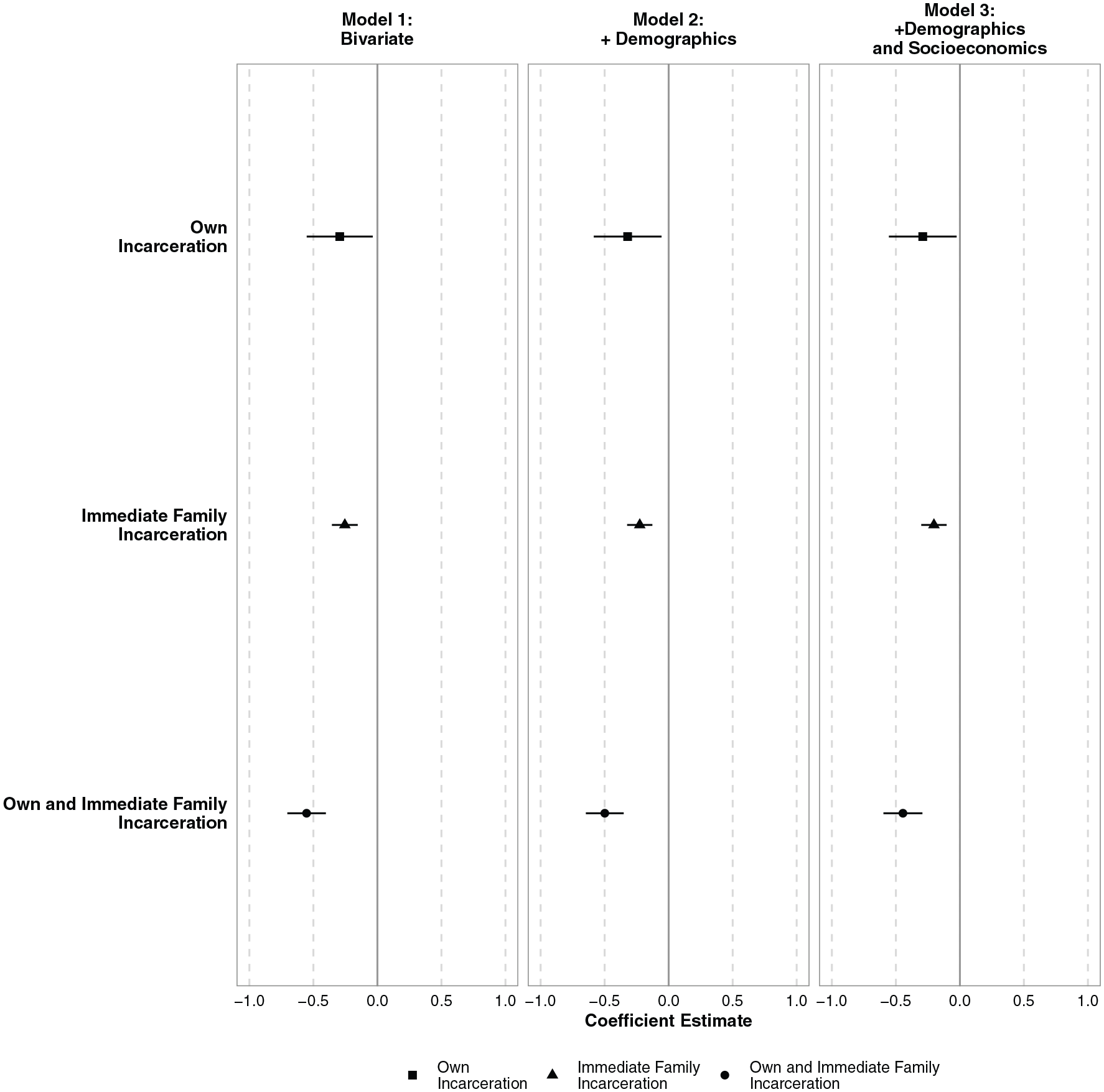
Associations between incarceration and trust in the state.
Model 2 adds statistical controls for respondents’ sociodemographic characteristics, and Model 3 adjusts further for respondents’ socioeconomic variation. Full results from the fully adjusted models are shown in Appendix Table A2. Across models, although the point estimates and confidence intervals move slightly, the results remain the same. In the full model, own incarceration, indirect exposure to incarceration through one’s immediate family, and combined own and immediate family incarceration are all statistically significantly and negatively associated with trust in the state. Own incarceration is associated with −0.29 SD [95% CI = −0.55, −0.03] lower levels of trust in the state, only immediate family incarceration is associated with −0.20 SD [95% CI = −0.30, −0.10] lower levels of trust in the state, and combined own and immediate family incarceration is associated with −0.44 SD [95% CI = −0.60, −0.29] lower levels of trust in the state (Figure 2).
Community Engagement and Civic Participation
We next consider how own and immediate family member incarceration are associated with individuals’ civic participation and community engagement using the same progression of models specified and presented in analyses of trust in the state. The results of these analyses are presented in Figure 3. Recall that our theoretical expectations differ from much of the extant literature because we argue why we may not observe often anticipated negative associations between incarceration and civic participation and community engagement.
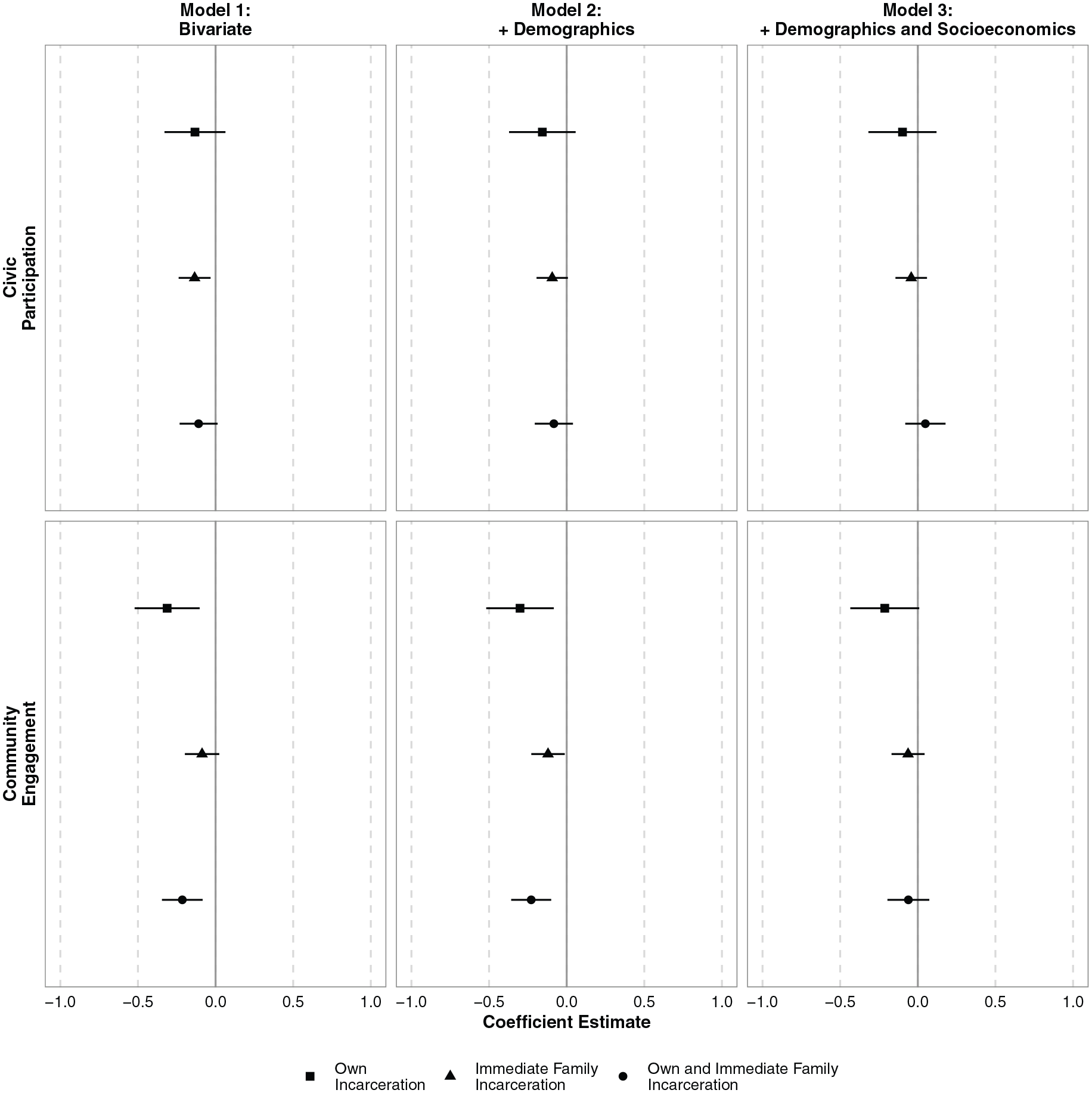
Associations between own and immediate family incarceration and community engagement and civic participation.
In the bivariate models (Model 1), own incarceration (β = −0.13, 95% CI = −0.33, 0.06) and combined own and immediate family incarceration (β = −0.11, 95% CI = −0.23, 0.01) were not estimated to be statistically associated with civic participation (Figure 3). However, immediate family incarceration with no own incarceration was negatively associated with civic participation (β = −0.13, 95% CI = −0.24, −0.03). In the models of community engagement, the bivariate pattern is essentially flipped, with statistically distinguishable negative associations between community engagement and own incarceration (β = −0.31, 95% CI = −0.52, −0.10) and combined own and immediate family incarceration (β = −0.21, 95% CI = −0.35, −0.08) and an estimated null association with only immediate family incarceration (β = −0.09, 95% CI = −0.20, 0.02).
Models 2 and 3 adjust for respondents’ sociodemographic characteristics and contexts (Model 2) and educational attainment and income quintile (Model 3). Full regression results from the fully adjusted models are presented in Appendix Table A2. In the fully adjusted models (Model 3), none of our descriptors of incarceration exposure—own incarceration only, immediate family incarceration only, and both own and immediate family incarceration—are statistically associated with the scales of civic participation and community engagement. Taken together, our main analyses provide support for our hypotheses. In line with expectations, we find consistently negative associations between direct and indirect incarceration exposure and trust in the state. The results for civic participation and community engagement are more mixed. In the bivariate models, all associations are negative in direction, although only half of these estimates are statistically significant. In the fully adjusted models, no results are statistically significant. Furthermore, the estimated magnitudes of the associations are quite small. For community engagement, coefficient estimates of associations with incarceration range from −0.21 (own incarceration only) to −0.06 (immediate family incarceration only, both own and immediate family incarceration); for civic participation, the estimated coefficients range from −0.1 (own incarceration only) to 0.05 (both own and immediate family incarceration). Overall, we take this as evidence that the relationship between and community engagement and civic participation is much more nuanced than often suggested in the literature.
Supplementary Analyses
The objective of the current study is to reconcile the many ways in which prior scholarship has operationalized carceral contact, trust in the state, civic participation, and community engagement and the resultant inconclusiveness of those analyses by focusing on a specific type of carceral contact—own and family incarceration—and a range of measures of trust in the state, civic participation, and community engagement. In supplementary analyses, we consider five potential substantive and methodological explanations for our main findings and their partial divergence from larger claims about carceral contact, trust in the state, and public engagement: (1) variation in duration of incarceration exposure (i.e., imprisonment); (2) the unique breadth and inclusivity of the FamHIS survey measures of incarceration compared to those in other relevant data sources; (3) the operationalization of trust, civic participation, and community engagement as action-specific items as opposed to composite constructs; (4) heterogeneous effects of incarceration across racial/ethnic groups and types of family members incarcerated; and (5) potential confounders linked to both public trust and engagement and risks of incarceration exposure. Taken together, these supplementary analyses corroborate our main findings, as we summarize here. A full discussion of our supplementary analyses, including methodological details and results, is in Appendix B.
First, it is possible that the negative to null associations found between incarceration and civic participation and community engagement is due to variation across types of incarceration—jail incarceration and imprisonment. Our first set of supplementary analyses explores the possibility that findings may be due to variation across types of incarceration: jail incarceration and imprisonment. Therefore, we respecify the main fully adjusted models of scales of trust in the state, civic participation, and community engagement as functions of own and family imprisonment (i.e., not jail incarceration), proxied with available measures of own and immediate family incarceration for more than one year. These models corroborate our hypotheses and our main findings: Own and immediate family imprisonment are negatively associated with trust in the state but not associated with civic participation or community engagement (Appendix Figure B1).
Second, we consider potential impacts of the FamHIS’s unique design on our findings. More specifically, the novel inclusivity and breadth of the incarceration measures may contribute to our findings’ divergence from research that focuses on select family relations (e.g., Foster and Hagan 2007) or on generalized indicators of indirect carceral exposure (e.g., White 2019a). We draw on new survey experiment data collected by Verasight from February 22, 2022, to March 7, 2022, with the specific intent of testing the robustness of our measurement of family member incarceration to variation in question wording about (a) facility type, (b) duration, and (c) type of family incarceration (i.e., which family member incarcerated). Taken together, the survey experiment results show that our estimates of family incarceration are robust to this variation in wording (Appendix Figure B2).
We next reconsider our conceptualization of trust in the state, civic participation, and community engagement as constructs, instead estimating models for each item underlying the scales in the main models. The results of these analyses are presented in Appendix Figures B3 (trust in the state) and B4 (civic participation and community engagement). Immediate family incarceration and combined own and immediate family incarceration are negatively associated with all measures of trust in the state. Estimates for own incarceration are statistically nonsignificant but negative in direction. Turning to types of civic participation and community engagement, 42 of the 45 estimated associations between the incarceration types and civic and community action items are not statistically distinguishable from a null association. Furthermore, two-thirds of the estimated coefficients are negative in magnitude, and one-third are positive, suggesting an inconsistent story about impacts of incarceration on prosocial engagement. As a result, the item-specific supplementary models largely support our theoretical predictions.
Although this study focuses primarily on average negative associations of incarceration exposure, prior evidence that points to plausibly heterogeneous implications of incarceration for civic participation and community engagement, particularly across racial/ethnic groups and aspects of family life, merit additional investigation. In that vein, we consider two more possibilities: that our estimated average (non)associations are driven by heterogeneous associations across subgroups or statistical imbalance on observed characteristics associated with both incarceration and public engagement. To do so, we estimate supplementary models of own and family incarceration separately for Black, Hispanic, and non-Hispanic White respondents (Appendix Figure B5) and separately for incarceration of parents, sibling, partners/coparents, and children (Appendix Figure B6). These models do not produce novel overarching conclusions about variation in these associations across racial/ethnic or family subgroups. Models estimated by broad racial/ethnic group yield mostly null associations (23 of 27 models), with, yet again, mixed directions across coefficients, in line with prior insights on both chilling (e.g., Burch 2013) and activating (e.g., Remster and Kramer 2023) effects of criminal legal contact. The few exceptions are observed in the estimated associations for White respondents, with negative estimated associations for own incarceration (without immediate family incarceration) and immediate family incarceration (without own incarceration) and trust in the state and for combined own and immediate family incarceration and community engagement and civic participation (Appendix Figure B5). For models stratified by the type of family member incarcerated, child, sibling, and partner incarceration are statistically and negatively associated with trust in the state. Community engagement and civic participation are not statistically associated with any of the four types of family incarceration. Taken together, insights from these stratified models corroborate our main findings.
Finally, we reestimate the focal associations using a coarsened exact matching (CEM) design. This nonparametric approach is typically used to address potential confounding on observables by matching across comparison groups to achieve greater statistical balance (e.g., Blackwell et al. 2009; Sugie 2015). Because this requires two-group comparisons, we focus on the dichotomous measures of own and immediate family incarceration. The CEM models confirm our main findings: Trust in the state is statistically distinguishably negatively associated with own and immediate family incarceration (Appendix Figure B7). Community engagement and civic participation are not statistically associated with either type of incarceration, with coefficients pointing in positive and negative directions. Taken together, the CEM models support our theoretical expectations and main findings.
Conclusion
Profound, unequally concentrated increases in the American incarceration rate over the last 50 years mean that contact with prisons and jails has become an incredibly common life course event for Black and economically marginalized individuals (e.g., Bonczar 2003; Pettit and Western 2004; Roehrkasse and Wildeman 2022) and their families (e.g., Enns et al. 2019; Lee, Porter, and Comfort 2014; Wildeman 2009). Social scientists have sought to consider how mass incarceration has reshaped individual lives and social inequality more broadly (e.g., Clear 2007; Wakefield and Wildeman 2014; Western 2006).
Relatedly, over the last decade, research considering the consequences of contact with the criminal legal system on trust in the state, community engagement, and civic participation has expanded substantially (Figure 1; Appendix A, Table A1). Although much of the work in this area emphasizes negative effects of contact with prisons and jails on both attitudes and behaviors (e.g., Brayne 2014; Burch 2014; Lerman and Weaver 2014; Weaver and Lerman 2010), other studies suggest that negative contact with the state could activate engagement in community and civic life (e.g., Eife 2021; Owens and Walker 2018; Walker and García-Castañon 2017). However, no study has estimated how direct (i.e., own) and indirect (i.e., family) incarceration are associated with attitudes about state institutions and political and community behaviors using nationally representative data, necessary to address this question of the broader democratic consequences of the carceral state. As a result, research is limited because it has yet to present a “bird’s-eye view” of individual-level associations between incarceration and trust in the state, community engagement, and civic participation that is inclusive of a range of types of carceral exposure and civic and community actions and attitudes, necessary for a descriptive understanding of the role that the carceral state plays in shaping social inequality and stratification.
Using data from the Family History of Incarceration Survey, the first nationally representative study to ask about direct and indirect contact with the carceral system and about a range of relevant person-level indicators of trust in the state and political behaviors, this article sought to consider how own and family member incarceration are, on average, associated with trust in the state, community engagement, and civic participation. In so doing, this article provides foundational information on the political consequences of the carceral state. Results from our analyses point to three core conclusions, each of which supports our theoretical expectations that on average, own and immediate family incarceration would be negatively associated with trust in the state but statistically not associated with civic participation and community engagement. First, and aligning with prior research (Figure 1, Appendix Table A1), own incarceration is strongly associated with lower levels of trust in the state, and these associations are substantial. Second, and again in alignment with prior research, immediate family incarceration is also associated with lower levels of trust in the state. Taken together, we see these first two findings as further evidence of the broader sociopolitical consequences of incarceration and as indicative of the appropriateness of the FamHIS data for considering the average association between direct and indirect contact with the penal system and community engagement and civic participation.
Finally, and most provocatively, overall, our analyses show minimal evidence of a definitively negative average association between own and family member incarceration and civic participation and community engagement. In fact, when we limit the analyses to incarceration of one year or longer, associations are near zero and not statistically significant. The lack of evidence for a negative relationship persists in a wide array of supplementary analyses, including subgroup-stratified models, item-specific models of 15 indicators of community engagement and civic participation, and exploration of potential statistical imbalance across comparison groups. Importantly, the magnitudes of estimated associations for civic participation and community engagement suggest underlying heterogeneity across types of action and potentially across groups. Although we do not suggest that carceral exposure never has a negative effect on community engagement or civic participation, our findings and evidence in prior work on positive relationships indicate that “the” negative association is in fact plural and more complex. As a result, perhaps not surprisingly, in this study, we have found that own and immediate family incarceration are not, on average, associated with overarching constructs of community engagement or civic participation, with exceptions in the race-specific model estimated for White respondents, putting forward an important question about racialized conceptualization, social construction, and analysis of constructs of public engagement and impacts of institutional marginalization on these actions (Walker and García-Castañon 2017).
Although we see each of these findings as making an important contribution to our understanding of how the carceral state shapes the lives of Americans, our analyses nonetheless have some important limitations. First, the FamHIS does not include institutionalized adults in the sampling frame, and as a result, our estimated associations for own incarceration may be biased due to exclusion of persons incarcerated at the time of survey (e.g., Western and Beckett 1999; Pettit 2012). Second, we do not model associations with voter registration or voting because those data were not available in the FamHIS and the fact that these data are de-identified precludes us from linkage to voter data. Although this is a limitation, we see it as minor given the wealth of existing research using voter records (Figure 1, Appendix Table A1; e.g., Burch 2014; Sugie 2015), including work that finds inconsistent support for expected negative effects of imprisonment on voting (Gerber et al. 2017). Furthermore, because many are interested in the potentially causal effects of incarceration, we view it as a minor limitation that the cross-sectional nature of our data precludes making causal statements. As a result, we cannot conclude that own and immediate family incarceration do indeed have causal effects on trust in the state and have no causal effect on community engagement or civic participation, although we find evidence of negative associations with trust in the state and no associations with the civic and community engagement types that we examine.
Another set of limitations centered on underlying heterogeneity that may partially explain our findings on civic and community engagement points to avenues for future research. Although the FamHIS allows us to examine a wide range of civic and community activities, potential ambiguity remains about what particular activities mean, particularly in relation to limitations of how we measure civic and community engagement and the nature of certain activities specific to terms of formerly incarcerated persons’ release. For instance, did respondents consider activities mandated as a condition of one’s parole or probation in lieu of or following incarceration as a type of volunteer work or community service included in the FamHIS survey? If so, is it reasonable to understand these activities as similar or comparable to free participation in civic and community life? In the same vein, there are likely actions and behaviors in the face of criminal legal encounters that have not been historically conceptualized as civic participation or community engagement and are absent from these data but are examples of political agency and, as Bell (2019:206–208, 211–12) theorizes, of resistance and transformation in communities potentially mobilized by the justice system (Cohen 2004; Remster and Kramer 2023). Additionally, this study focuses specifically on two types of criminal legal system involvement: own (direct) incarceration and family (indirect) incarceration. However, as shown in our review of scholarship examining criminal legal system involvement and civic and community engagement, operationalization and definition of system involvement vary tremendously. Future research can build on this work by directly comparing types of carceral contact and criminal legal exposure as factors that may or may not shape civic and community action.
Finally, we attempt to explore racial/ethnic heterogeneity in stratified models. However, the combination of overall low levels and prevalence of civic and community engagement (Table 3) and the design of the FamHIS—to be representative of the national population, as opposed to tailored for race-specific or stratified analysis—results in estimates that are underpowered and prohibit meaningful comparison across racial/ethnic groups, as indicated by the large confidence intervals for estimates of Black and Hispanic respondents (Appendix Figure B5). Future research using qualitative and quantitative methods to analyze how these social processes unfold and how they are experienced and understood by individuals and families and analysis of incarceration and civic engagement within and across subgroups most likely to experience incarceration and criminal legal system involvement will help address these open questions.
Limitations aside, we nonetheless see this study as providing important descriptive insights into how the carceral state shapes beliefs and behaviors of contemporary Americans. Both direct and indirect contact appear to be strongly associated with diminished trust in the state. Although these associations are most profound when it comes to the police and the criminal justice system, these dynamics spill out to broader state institutions, including local, state, and federal governments. This finding is not new (Figure 1). However, the magnitude of these associations in a nationally representative data set provides sobering insight into how incarceration undermines trust in the state in ways that extend beyond particular locales. Incarceration, at least in this domain, seems to shape how people think about the state. However, these lower levels of trust do not appear to translate, on average, into any appreciable net differences in likelihoods of community engagement or civic participation, with some suggestive evidence that these associations may vary across types of activities and social groups.
As we argue, these null associations could be driven by several things, two of which future research must especially seek to test. First, which we see as more likely to be the case, there may be heterogeneous effects that cancel each other out in the aggregate; this may be variation across subgroups and contexts but also variation across types of community engagement and civic participation that are differentially impacted by incarceration (Appendix Figures B5, B6; e.g., Smith and Kinzel 2021; Uggen et al. 2006). Second, there may be little heterogeneity, and this null association may simply reflect no direct linkage between incarceration exposure and likelihoods of civic and community involvement. If that is the case, researchers must interrogate why it is so, an important avenue for future investigation. On the one hand, a definitively null association between incarceration and civic participation and community engagement might indicate some combination of apathy to community and state; floor effects, as previous research on the effects of incarceration highlights (e.g., Massoglia, Firebaugh, and Warner 2013), or some combination, although our reading of the literature suggests this is unlikely the case. On the other hand, it may be that this null association suggests that citizens who directly and vicariously experience incarceration may be struggling to maintain the same levels of community engagement and civic participation while managing the myriad disruptions incarceration causes in their lives. In this sense, it may well be that a null association—and absence of a negative association—represents resilience and commitment to social integration and participation as citizens seek to stay engaged with state and community in the face of adversity (e.g., Comfort 2008; Rios 2006; Woodall and Shannon 2022).
The combined empirical and theoretical argument presented in this study offers a departure from common characterizations of public engagement and attitudes of those who have experienced incarceration; a coherent framework for understanding and analyzing the multifaceted relationships between incarceration, trust in the state, and civic and community engagement; and important avenues for future research.
Supplemental Material
sj-pdf-1-srd-10.1177_23780231241277436 – Supplemental material for Reconsidering the Relationship between Incarceration, Trust in the State, Community Engagement, and Civic Participation
Supplemental material, sj-pdf-1-srd-10.1177_23780231241277436 for Reconsidering the Relationship between Incarceration, Trust in the State, Community Engagement, and Civic Participation by Youngmin Yi, Peter K. Enns and Christopher Wildeman in Socius
Footnotes
Acknowledgements
Sarah Sernaker provided excellent research assistance on data coding, analysis, and visualization; Clayton Covington provided excellent research assistance on the review of existing research; and Bruna Costa and Alexandra Gibbons provided excellent research assistance around references and formatting.
Author’s note
Peter K. Enns is also affiliated with Verasight, San Francisco, CA, USA.
Supplemental Material
Supplemental material for this article is available online.
1
Currently, in 48 states, persons convicted of felonies cannot vote during their incarceration. In 14 of these states, individuals convicted of felonies go onto remain disenfranchised for a period of time following their incarceration (e.g., parole), and in 11 of these states, some or all persons ever convicted of felonies—regardless of their incarceration histories—are forever stripped of voting rights ( ).
).
2
In 2015, the U.S. Department of Education (2015) initiated an Experimental Sites Initiative called the Second Chance Pell Experiment that allows participating institutions of higher education to provide federal Pell Grant funding to students who are imprisoned but would otherwise be eligible for funding to support postsecondary education. In 2020, the announced that this initiative would extend invitations to an additional 67 postsecondary educational institutions.
3
The state of Massachusetts, for example, requires anyone seeking to volunteer to support their children’s school activities or programming—including caregivers and family members—to undergo a formal state Criminal Offender Record Information (CORI) check (Massachusetts General Law c. 71, § 38R 2007).
4
The FamHIS does not include measures of voting or registration. Although these are core indicators of civic engagement, self-reported turnout is typically overstated by 10 points or more in even the most prominent election studies (e.g., ), and the de-identified nature of these data precluded the possibility of analyzing linked voter data. We discuss the implications of not having measures of voting or registration in the conclusion.
5
As noted previously, the FamHIS data do not include measures of voting or voter registration.
Author Biographies
References
Supplementary Material
Please find the following supplemental material available below.
For Open Access articles published under a Creative Commons License, all supplemental material carries the same license as the article it is associated with.
For non-Open Access articles published, all supplemental material carries a non-exclusive license, and permission requests for re-use of supplemental material or any part of supplemental material shall be sent directly to the copyright owner as specified in the copyright notice associated with the article.
