




Abstract
Women’s status in Taiwan has improved substantially due to rapid social and legal changes, yet how female empowerment affects child custody outcomes has been studied little. This study analyzes the entirety of divorce registration records in 2002–2004 and 2018–2020 to reveal the evolution of custodial arrangements in Taiwan. It pays particular attention to how mother’s changing traits and spousal pairings in age and education affect the probability of different child custody outcomes. The findings show that maternal age and education matter in both absolute and relative terms. Higher maternal age and education are associated with more mother-sole and joint custody decisions. Women in age and educational hypogamy secure mother-sole custody more often than their nonhypogamous peers. Furthermore, with improved women’s status at the society level, all women and particularly those in nontraditional unions now have become less likely to face a complete loss of child custody upon divorce than before.
Divorce rates have been rising over the past few decades in Taiwan and East Asia along with rising female empowerment, reflected in women’s higher age and educational attainment at the time of divorce. Yet research on child custody remains quite limited both in the region and on a global scale (Chen 2016; Schneider and Kreyenfeld 2021). An investigation of child custody outcomes in Taiwan offers a unique lens for viewing the evolution of custodial arrangements in a patriarchal context undergoing rapid social and legal changes.
The rise of divorce in Taiwan is associated with the improved status of women over the past 50 years. Female empowerment affects partnership behaviors through positive assortative mating because empowered women often marry later and tend to partner with men who are closer in age and education, although some may opt for hypogamous marriages (Carmichael 2011; Cheng and Kolk 2021; Esteve, García-Román, and Permanyer 2012; Van Bavel, Schwartz, and Esteve 2018). Although the impact of assortative mating has been studied for a number of family outcomes, such as union formation, the division of labor in the home, fertility, relationship quality, risk of divorce, and child development (Esteve et al. 2016; Schwartz 2013), there has been little exploration as to how it shapes child custody outcomes upon divorce.
In a traditional society that emphasizes male dominance, such as Taiwan, family laws often hold a paternal presumption in custody assignments upon divorce (Htun and Weldon 2011). Children are often considered the “property” of a given family, and mothers have limited access to children after divorce. In fact, the court awarded father-sole custody in about 80 percent to 90 percent of litigious divorces (Liu 2001) before the mid-1990s family law reforms. Child custody decisions likely changed a lot after the 1996 legal reforms because it began to base child custody on the child’s best interest, yet very little is known about the patterns of change that occurred.
The two major changes of female empowerment and family law reforms necessitate an investigation into the outcomes of child custody for women in different social groups and spousal pairs as they went through a divorce. The experiences of Taiwan also fill a gap in current literature that is dominated by child custody research in Western contexts. The lack of empirical studies on custody arrangements is often due to data availability issues because most existing research relies on court records that may not be available for research in many societies (Cancian and Meyer 1998; Cancian et al. 2014; Chen 2016; Cheng 2015; Fox and Kelly 1995; Meyer, Cancian, and Cook 2017; Solsona and Spijker 2016). Studies that analyzed survey data (Donnelly and Finkelhor 1993; Hakovirta et al. 2023; Juby, Le Bourdais, and Marcil-Gratton 2005; Kitterød and Lyngstad 2012; Meyer, Carlson, and Ul Alam 2022; Sodermans, Matthijs, and Swicegood 2013) are mostly done for European or American divorced families. Rarely has any study attempted to investigate the custodial outcomes of all divorces, including those that are consensual and those that are mediated or accomplished through settlement. The divorce registration records in Taiwan used in this study are precious resources to this end.
The Case of Taiwan: Changing Social and Legal Contexts
The Changing Taiwanese Society
With the increasing prevalence of divorce since the early 1970s, Taiwan’s crude divorce rate (CDR) rose from below 0.5 percent during the postwar years and peaked at 2.87 percent in 2003, making the CDR in Taiwan one of the world’s highest (Wu, Lin, and Kuo 2012). In a fault-based divorce system, about 54,000 marriages on average dissolved annually in the past decade. Unlike in Europe. where union status could affect child custody arrangements (Zilincikova 2021), nonmarital dissolved unions involving children are rare in Taiwan. The share of nonmarital births has been less than 4 percent in recent decades despite many family changes typical of low-fertility societies that have been observed.
In the meantime, substantial improvements have been achieved in women’s status in terms of educational and occupational attainment since the 1980s. The share of women ages 25 to 29 with tertiary education has grown from 10.6 percent in 1980 to 76.1 percent in 2020 (Ministry of the Interior 1975–2020). The expansion of the education system over many years has better prepared Taiwanese women to become economically independent before entering marriage and becoming mothers. The participation of women ages 15 and above in the labor force also increased notably, from 39.25 percent in 1980 to 51.41 percent in 2020 (Ministry of Labor 2020). This has undoubtedly increased women’s agency in marriage and given them more bargaining power in child custody disputes upon divorce. In fact, this rise in women’s status is partly reflected in the changing gender profiles of judicial divorce statistics in Taiwan. The share of male plaintiffs (57 percent) dominated that of female ones (42.9 percent) in 2011, yet the reverse became true for the first time in 2021, and the share of female plaintiffs reached 51.3 percent in 2022 (Judicial Yuan 2023).
The Legal Reforms on Family Law
Similar to many family laws that emphasize patriarchy and other forms of male dominance (Htun and Weldon 2011; Raday 2019), a paternal presumption has long existed in Taiwanese family law since the Japanese colonial rule circa 1900. The Civil Codes of Taiwan stipulated that child custody belonged to the father unless the divorcing couple agreed on other arrangements in a consensual divorce (Article 1051) or the court had made other decisions for the interest of a child (Article 1055). Such a tradition of paternal presumption had shifted earlier in a number of Western countries, such as Britain and the United States (Cancian and Meyer 1998; Kelly 1994). Child custody arrangements in these countries began to be dominated by mother-sole custody in the 1800s (Cancian and Meyer 1998; Kelly 1994) due to the “tender years” doctrine and have shifted toward more shared custody (or joint custody 1 ) only in recent decades (Kelly 1994; Meyer et al., 2017; Sodermans et al., 2013; Solsona and Spijker 2016).
Whereas the United States and Sweden were the pioneers of joint custody in the 1970s (Halla 2015), Taiwan has had a more patriarchal past before the new millennium. Prior to the 1996 legal reforms to the presumption of child custody, the court gave sole custody to the fathers in about 80 percent to 90 percent of litigious divorces (Liu 2001). Joint custody was never an option for much of the twentieth century. In addition, the state does not distinguish between legal and physical child custody in Taiwan. Physical custody is included in the right to legal custody, and arrangements for the duration of physical custody are often specified in court verdicts for judicial divorces or agreed on by divorcing parents who opt for consensual divorces.
After years of women’s movements and female advancement in education and employment, the year 1985 saw the first wave of legal reforms to the patriarchal articles of the family book in the Civil Codes, resulting in more gender-neutral grounds for filing a litigious divorce. Later, another wave of feminist legal reform came with the termination of the period of martial law in 1987. In particular, a major shift in the stance of the Civil Codes came when the Constitutional Court declared the rule of paternal preference in child custody unconstitutional in 1994, largely because it violated the fundamental right of equal protection for both sexes. Due to this crucial ruling and considerable pressure from women’s movements in Taiwan, the presumption of paternal custody in the family book was finally shifted to the best interest of the child principle in 1996 along with new stipulations regarding child support and visitation rights and the possibility for the court to assign joint custody to divorcing parents. The legal reforms of 1985 and 1996 were major breakthroughs in the raising of women’s agency in the face of marital disruption and signaled a shift from a paternal preference to gender neutrality in family law. A series of family law amendments continued into the 2000s to improve gender equality and to alleviate the burden during the divorce process, such as revisions of the marital property law in 2002, the availability of divorce through mediation or settlement in 2010, the addition of friendly-parent principle to child custody decisions in 2012, and the implementation of the Family Act in 2012.
Conceptual Framework
As the status of women in Taiwan has risen over the past several decades and the average age of marriage has increased along with legal reforms to the family law, a reconceptualization of how both individual characteristics, such as age and education, and marriage patterns, such as hypergamy, homogamy, and hypogamy, affect women’s status in a marital union and shape different family outcomes is needed. For instance, as women’s status improved over time, there is a growing number of divorcing women who are equipped with better human and social capital, making divorce litigation or negotiation more affordable and offering them stronger agency in acquiring full or partial child custody. How maternal and spousal characteristics shape child custody outcomes during the divorce process becomes an important empirical question.
The Role of Maternal Traits in Shaping Child Custody Outcomes
The majority of child custody was usually given to the father in Confucian Taiwan (Liu 2001; Shao, Leflar, and Huang 2023) and East Asia for some time (Jones 2006; Kim 1994; Raday 2019). Mothers began to secure full or partial child custody only in the past decade or two in Taiwan. In turn, studies on maternal traits as key determinants of winning child custody rights in this region are very limited.
Most existing research on parental traits and child custody outcomes has been done in Western contexts and mainly focuses on parental traits of joint custody. In general, mothers with tertiary education are less likely to lose child custody to her husband because relative educational attainment matters and a better educated spouse is more likely to have physical custody of the child in the United States and in Flanders, Belgium (Fox and Kelly 1995; Maccoby and Mnookin 1992; Sodermans et al. 2013). Even if not winning sole custody of her child(ren), a mother’s higher socioeconomic resources in terms of education, employment status, and income all lower her odds of a complete loss of child custody (i.e., ending up with shared or split custody) upon divorce (Cancian et al. 2014; Cancian and Meyer 1998; Fox and Kelly 1995). Findings from different social contexts in Europe also suggest that joint custody is most often awarded to or chosen by self-selected, highly educated parents with high socioeconomic status and a low conflict level (Fransson et al. 2018; Sodermans et al. 2013; Steinbach 2019). This is because highly educated parents are more likely to know about and have the financial resources to implement shared custody (Donnelly and Finkelhor 1993). Aside from socioeconomic characteristics, a mother’s older age at divorce and being the plaintiff of divorce have also been linked to increased odds of securing mother-sole or shared custody in the United States and in Flanders, Belgium (Cancian et al. 2014; Cancian and Meyer 1998; Fox and Kelly 1995; Sodermans et al. 2013).
Overall, the characteristics of a woman affect her status in a conjugal relationship, and this is closely related to dyadic power relations when spousal differences in age and education are considered (Carmichael 2011; Evertsson and Nermo 2007; Van de Putte et al. 2009). Women who marry at older ages tend to have more say in the union and marry a man closer in age. In a similar vein, better educated women also tend to have more agency and are also more likely to avoid hypergamous marriages in which the husband has much stronger credentials (Esteve et al. 2016; Van de Putte et al. 2009). Hence, one would expect that a woman’s older age at divorce and better education are associated with a higher likelihood of winning sole or partial maternal custody (Hypothesis 1a). It is also reasonable to suppose that compared to couples in age and educational hypergamy, women in homogamous and hypogamous unions have a better chance of acquiring full or partial custody (Hypothesis 1b).
Rising Female Empowerment, Assortative Mating, and Family Outcomes
The social context within which changing marriage pairings takes place has been reported to matter for family outcomes (Knudsen and Wærness 2008; Theunis et al. 2018; Vink et al. 2022). Educational hypogamous couples where the wives are better educated than their husbands used to face lower relationship quality and higher divorce risk than their homogamous peers due to their unconventionality (Goldstein and Harknett 2006; Kalmijn 2003; Teachman 2002; Vink et al. 2022). However, Schwartz and Han (2014) noted that hypogamy was no longer linked to increased divorce risk for recent American marriage cohorts, in which such unions were more common. Recent research also showed that in Belgium, hypogamy was not associated with lower marital stability in communities where such unions prevail (Theunis et al. 2018). European research also indicated that relationship quality among income hypogamous couples was lower in countries with traditional gender norms, and such a negative association is not found in societies with higher gender egalitarian values (Vink et al. 2022). These findings indicated that with improved women’s status and the reversal of the gender gap in education across time and space, the negative impact of hypogamy on many family outcomes could shift accordingly. However, unlike the many outcomes reported to associate with assortative mating, how the impact of spousal pairings on child custody arrangements has changed over time received scant attention.
Changes in the marriage matching patterns have been driven by improved status of women in twentieth-century Taiwan (Thornton and Lin 1994). Whereas very few women married in their 30s in the past, it has now become rare for women to marry in their 20s. Marriages were once arranged under parental authority and involved much older men and younger women (Cheng and Kolk 2021). Economic security was a major incentive for this particular age pairing, and it has diminished as women become more empowered with their own human capital. Marriages are now shaped more by individual choice rather than the parental authority of the past. This is particularly shown in women’s shifting preference toward men of similar age and education, leading to more similarly aged couples and more educational homogamy and even hypogamy in Taiwan over the past few decades (Cheng 2014; Cheng and Kolk 2021; Yang, Li, and Chen 2006). In addition, even though female marriage migrants often marry much older Taiwanese men because they tend to be younger and less educated than local women, the substantial decrease of their annual migration flow from nearly 45,000 to fewer than 10,000 between 2002 and 2020 also contributes to a smaller spousal age and education gap over time.
The trend toward more positive assortative mating has been made possible largely because Taiwanese women now have the freedom and autonomy to steer clear of traditional marriages that were characterized by male dominance in age and education (Cheng and Kolk 2021). These patterns of declining spousal differences are consistent with those found in other developed societies (Esteve, Cortina, and Cabré 2009; Van Poppel et al. 2001). They also concern the power dynamics between spouses and play a role in the intense negotiation, if not conflict, that arises during divorce (Evertsson 2001). How a couple parts ways and divides assets and child custody are some of the many issues that can be shaped by spousal characteristics. For instance, when it was once common to award custody to the father, even women in nonhypergamous unions faced formidable barriers to obtaining custody rights in Taiwan despite their better standing in a marriage. As age and educational homogamy and hypogamy increase and the patriarchal family law is gradually reformed, one would expect the shifting social milieu toward higher gender equality benefits divorced women in child custody outcomes. In turn, the association between nonhypergamous unions and securing child custody should become more positive over time as women become more educated and marry later. Indeed, past research has pointed out that women’s status gains are more likely to translate into fairer division of labor at the couple level in social contexts where gender equality is higher (Cooke et al. 2013; Knudsen and Wærness 2008; Lachance-Grzela and Bouchard 2010; Van Bavel et al. 2018). Therefore, it is expected that with improved female empowerment across two decades, women’s equal or better footing in a marriage (i.e., homogamy or hypogamy in age and education) is likely to increase their odds of securing sole or partial child custody over time (Hypothesis 2).
Research Design
Data
Digitalized divorce registration data are only available from 1998 onward, and in 2002, a set of four additional pieces of information became available on divorce registration cards: the number of children in father-sole custody, in mother-sole custody, in joint (or shared) custody, and in other custody. The average number of divorces with children falls within the range of 51,610 to 64,995 cases annually in the period of 2002 to 2020. Of these divorces, about 60.8 percent (n = 661,186) involved child custody arrangements. For the purpose of examining changes over the two-decade span, only divorces with custody decisions for husbands and wives above age 20 in 2002 to 2004 and 2018 to 2020 were analyzed. To make sure using either the first and last years or all years of the 2002 to 2020 data series capture similar changes, additional analyses 2 were done (see Table S1 in the Supplementary Materials). The divorce registration form includes key information on the age, education, and nationality of the wife and husband; the type of divorce; number of children; and date of marriage. An important advantage of this data set over past research on child custody is that it contains all divorce records. This includes divorce by consent, judicial divorce, mediated divorce, and divorce through settlement. Many existing custody studies are based on court records, and the data used here can avoid the problem of leaving out a considerable share of consensual divorces occurring outside of court.
Measurements and Variables
Outcome variable
The variable child custody type was constructed using the four variables available in the divorce register data that indicate the number of children in different custody arrangements. Although most children were under one specific type of custody, some had different custodial parents than their siblings. For instance, some divorced couples have one child with the father and one with the mother (i.e., split custody), others have one child with the father or mother and another one under joint custody, and still others have one child with each of the parents and one under another type of custody. With different combinations of custody arrangements, the initial variable of child custody type yielded 11 different custody categories. This variable is further collapsed into a five-type custody arrangement variable: father-sole custody, mother-sole custody, joint custody, split custody, and other custody. The detailed cross-tabulations of these two variables are shown in Appendix 1.
Main variables of interest
Age at divorce is measured in 10-year intervals from ages 20–29 to 50+, with ages 20–29 as the reference group. The spousal age gap is a five-category variable (i.e., husband > 5+ years, husband > 2–4 years, similar age, wife > 2–4 years, wife > 5+ years), with similarly aged couples (defined as ±1 year) as the reference. The wife and husband’s education is a four-category variable (i.e., less than high school, high school, junior college, university and beyond), with the lowest education as the reference. The spousal education gap is a five-category variable (i.e., husband > 2+ levels, husband > 1 level, equal education, wife > 1 level, wife > 2+ levels), with the same level of education as the reference. This variable is constructed using a finer six-category education variable (i.e., primary education, junior high school, high school, junior college, university, and graduate degree).
Other covariates
For the period before 2010, divorce type is a variable that can be either consensual or judicial divorce. Starting from 2010, the two additional types of mediated and settled divorces became available to separating married couples. One thing to be noted is that most separating couples in Taiwan seek consensual divorce when they can due to the lengthy, expensive, and cumbersome nature of court proceedings. In turn, judicial divorces tend to be more conflictual and involve more unsettled issues between spouses. Whether judicial, mediated, or settled, only 15 percent of all divorce cases have taken place in court in recent years. Thus, a dummy variable for consensual divorce is created, with nonconsensual divorce as the reference. In addition, the duration of the marriage (in months), the mother’s aboriginal status, and the mother’s country of origin will also be controlled to see how they affect the final child custody outcomes. The mother’s country of origin includes the five categories of mainland China, developing countries, developed countries, other countries, and Taiwan. The group of developing countries consists of migrant women from Indonesia, the Philippines, Thailand, Myanmar, Vietnam, Cambodia, Laos, Swaziland, South Africa, Lesotho, and Mauritius, whereas developed countries include overseas Chinese women and those from Hong Kong and Macau, Japan, South Korea, Malaysia, Singapore, the United States, Canada, Australia, New Zealand, the United Kingdom, France, and Germany.
Analytical Strategies
This study will first present the descriptive statistics showing the sociodemographic characteristics of the divorced population with children and their custody arrangements in 2002 to 2004 and 2018 to 2020. Then, the differences in child custody profiles for consensual and nonconsensual divorces will be shown to highlight the advantage of using divorce register data. Due to the mutual exclusivity of different custody outcomes and to observe change over time, two multinomial logistic regression models were run for years 2002 to 2004 and 2018 to 2020 (see Appendix 2), excluding other custody type due to their small numbers. Marginal effects of maternal age and education and spousal pairings will be calculated using these regression models. Research Hypothesis 1 will be tested by examining the associations between maternal and spousal traits and child custody decisions. To examine whether the association between spousal pairings and child custody has changed over time, marginal effects from the two multinomial regression models will be compared. One key fact to bear in mind when reading the figures in Appendix 2 and Figures 1 to 4 is that the data analyzed represent all divorced couples (i.e., the population) with child custody arrangements observed in a given period, and thus, coefficients can be interpreted directly without making statistical inferences through tests (Berk 2004). This is why standard errors and p values were not listed in Appendix 2.
Results
Table 1 presents the characteristics of the divorce records analyzed in this study. About 210,571 dissolved unions registered in 2002 to 2004 and 2018 to 2020 were used as the analytical sample. Table 1 shows the changing profiles of divorcees and child custody cases observed in 2002 to 2004 and 2018 to 2020. Within a span of two decades, father-sole custody arrangements have declined from nearly half (48 percent) in 2002 to 2004 to 33 percent in 2018 to 2020. In contrast, the percentage of mother-sole custody has remained stable at a level of roughly one-third. One notable change is the rapid growth of joint custody—from about 10.6 percent in 2002 to 2004 to 27.3 percent in 2018 to 2020. In other words, child custody arrangements in 2018 to 2020 can be roughly split into three types: father-sole, mother-sole, and joint custody. The proportion of split custody declined gradually from about 8.5 percent in 2002 to 2004 to 5.7 percent in 2018 to 2020, and the share of other forms of custody was quite minimal in all years observed. Both divorcing wife’s and husband’s mean age and educational attainment increased between 2002 and 2020. In particular, women’s mean age at divorce rose from 33.4 to 36 in the period from 2002 to 2020, and the share of mothers without a high school degree shrunk considerably, from 41.6 percent to 24.1 percent, in the same period. There has also been a substantial expansion of tertiary-educated divorcing mothers, from 13.8 percent in 2002 to 2004 to nearly 35.4 percent in 2018 to 2020. Changes in age and education profiles of wives and husbands have led to different patterns of marriage pairings across two decades: Age homogamy and hypogamy have increased, and women now are more likely to be better educated than their husbands. The share of consensual and judicial divorces both decreased, and the latter is replaced by more mediated and settled divorces. Mean duration of the dissolved marriages also decreased, and more divorces involve an aboriginal wife or migrant wife from China and nearby developing countries from 2002 to 2020.
Descriptive Statistics of All Divorces with Children during 2002 to 2004 and 2018 to 2020.

Information on wife’s country of origin was first collected in 2003 on the divorce registration card.
The Evolution of Different Child Custody Arrangements by Divorce Type over Time
Table 2 reveals that for all consensual divorces observed in 2002 to 2004 and 2018 to 2020, there was a notable decline in father-sole custody, from 49.5 percent to 34.1 percent, and a more than 2.5-fold increase in joint custody, from 11 percent to 28.2 percent. The share of mother-sole custody remained quite stable in this period, and that of split custody declined slightly. In other words, although nearly half of divorcing fathers used to have sole custody of their children in consensual divorces, this has decreased substantially in the last two decades.
The Changing Distribution of Child Custody Arrangements by Divorce Type.

Note: Nonconsensual divorces include judicial divorces and divorces through mediation and settlement.
For nonconsensual divorces observed in 2002 to 2004 and 2018 to 2020, the proportion of joint custody cases expanded dramatically, and that of split custody increased a little. In 2002 to 2004, a substantial share of divorced mothers from nonconsensual divorces received sole custody of their children (about 60 percent), which declined to about 47 percent in 2018 to 2020 but is still much higher than the share observed in consensual divorces. In contrast to consensual divorces that are increasingly likely to end in joint custody, the majority of nonconsensual divorces in these two periods involved custody awarded to one parent, mostly to mothers. This pattern likely reflects the uncooperative and conflictual relationship between parents who pursue divorce through court processes, and thus, it is relatively difficult to ask them to share child custody. Despite this, the share of joint custody for nonconsensual divorces shows a notable rose from 5 percent in 2002 to 2004 to 20 percent in 2018 to 2020.
The Association of Maternal and Spousal Traits and Child Custody Arrangements
Figure 1 shows the marginal effects of maternal age at divorce on different child custody outcomes based on the models shown in Appendix 2. The analytical period for the multinomial models in Appendix 2 is split into 2002 to 2004 and 2018 to 2020 to observe trend change at both ends of a time span. In general, older mothers are more likely to have sole or joint custody of their children than to lose it entirely in both periods, with the exception of split custody. Older mothers seem to be less likely to opt for split custody in both time periods, although the share of split custody is quite small in both periods.

Marginal effects of maternal age on the probabilities of child custody outcomes.
Regarding how maternal education is related to child custody, marginal effects in Figure 2 show that higher maternal education used to be associated with a higher probability of mother-sole custody in 2002 to 2004, yet such gradients almost diminished in 2018 to 2020. The probabilities of split custody seem to be similar across maternal education groups in both periods. In general, more maternal education not only substantially lowered the likelihood of father-sole custody in the two-decade period analyzed but also facilitated the placement of more children under joint custody, which could likely benefit many children going through a divorce. The patterns shown in Figures 1 and 2 support Research Hypothesis 1a.
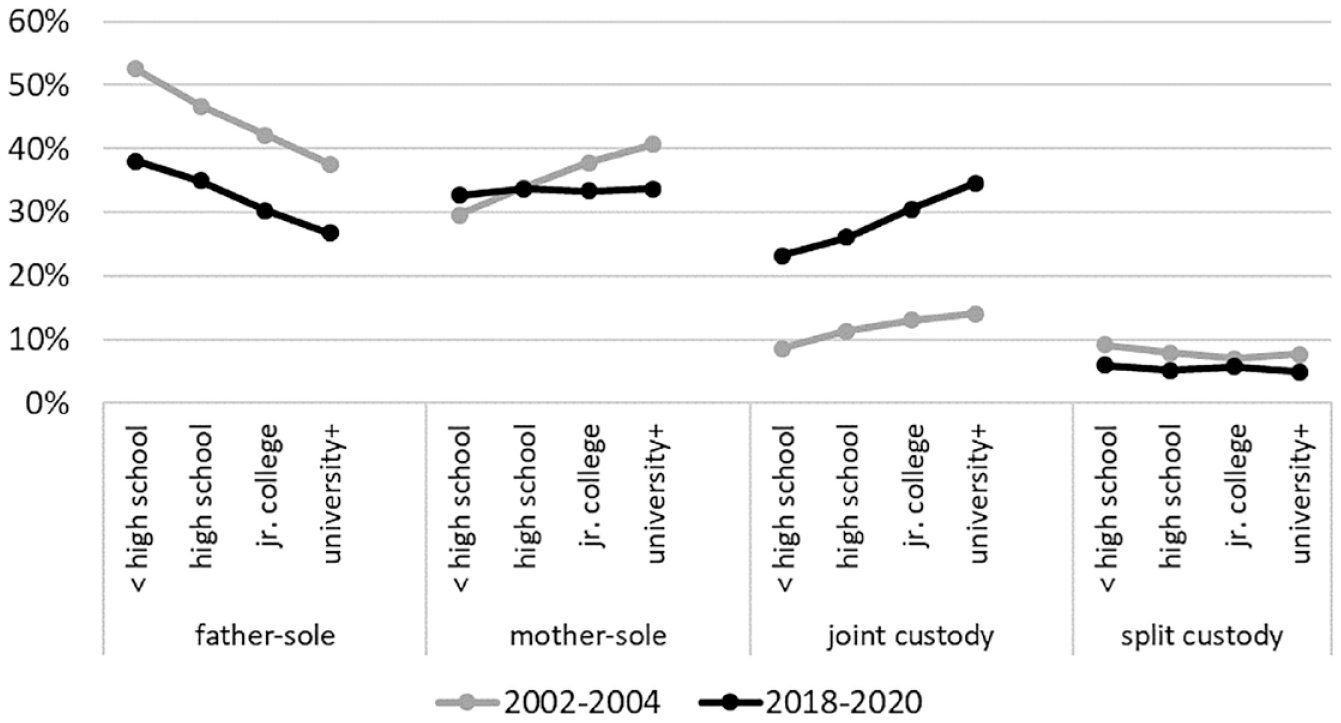
Marginal effects of maternal education on the probabilities of child custody outcomes.
One might also wonder how the father’s age and education are associated with child custody decisions upon divorce. It is likely that a more nuanced picture would emerge when one considers spousal pairings by age and education and relates them to child custody outcomes. Indeed, the figures in Table 1 indicate that divorcing mothers now have higher agency as they become more likely to be married in age and educational hypogamous unions, and this could likely increase their chances of securing child custody. The marginal effects presented in Figures 3 and 4 further show the associations of spousal pairings and child custody outcomes. In both figures, stronger hypogamy in age and education is generally associated with women’s increased chance of winning sole or shared custody of their children upon divorce. This pattern holds true in both periods, which supports Research Hypothesis 1b.

Marginal effects of different spousal age pairings on the probabilities of child custody outcomes.

Marginal effects of different spousal education pairings on the probabilities of child custody outcomes.
Rising Female Empowerment and the Link between Spousal Pairings and Custody Outcomes
As discussed earlier, the social and legal changes observed have improved gender equality in Taiwan, and this will likely further benefit divorced women when trying to secure child custody at the time of marital disruption.
Figure 3 shows that divorces of all spousal age pairings used to have a much higher chance of father-sole custody than the other three custody arrangements in 2002 to 2004, although in each custody type, the spousal pairing gradient was not very strong. This pattern changed over the two-decade span. By 2018 to 2020, divorced couples with older wives have a much lower probability of opting for father-sole custody and a higher chance of mother-sole custody than hypergamous couples. In addition, the probability of joint custody more than doubled in the two periods analyzed, though different age pairings do not substantially affect the probability of joint custody.
The patterns shown in Figure 4 resemble those observed in Figure 3. That is, divorced couples with better educated wives now have a much lower chance of going for father-sole custody and a higher probability of opting for mother-sole custody than hypergamous couples; the probability of joint custody also more than doubled from 2002 to 2004 to 2018 to 2020. Overall, the probability of gaining sole or shared custody of their children tends to increase with the level of hypogamy in age and education, and such custody-winning effect becomes stronger in 2018 to 2020 than in 2002 to 2004 due to the substantial decline in father-sole custody and the doubling of shared custody. These findings support Research Hypothesis 2.
Conclusion and Discussion
Female empowerment over the past decades has made a lasting impact on marriage and divorce in Taiwan. Along with a series of legal reforms to the patriarchal family laws, the landscape of child custody decisions upon divorce has changed remarkably in the first two decades of the twenty-first century.
As noted earlier, maternal age and education matter in both absolute and relative terms. Higher maternal age and education at divorce are associated with much lower likelihood of father-sole custody. In addition, from a spousal pairing perspective, more women were now involved in age and educational hypogamous marriages than two decades ago. Divorced mothers in age and educational hypogamous marriages are more likely to end up with mother-sole custody than their nonhypogamous peers, and their chances of losing child custody to the fathers are lower than their nonhypogamous peers, too. These are in line with prior studies that reported how higher age and education are associated with increased bargaining power for women (Bozon 1991; Esteve et al. 2016; Van de Putte et al. 2009), and this is particularly true when it comes to winning child custody. The results on maternal age and spousal age pairings resonate with past research conducted in Western societies (Cancian et al. 2014; Cancian and Meyer 1998; Fox and Kelly 1995; Halla 2015). Findings on child custody arrangements among better educated mothers also show they are more likely to have sole custody of their children or to agree to a joint custody arrangement. This goes with findings reported in the United States and Belgium (Fox and Kelly 1995; Sodermans et al., 2013), where joint custody is more common among high socioeconomic status divorced couples.
The contextual change of rising women’s status since the early 2000s also affects child custody outcomes for couples in different age and education pairings. For instance, divorced mothers in stronger age and educational hypogamy became more likely to secure mother-sole custody than their nonhypogamous counterparts in 2018 to 2020 than in 2002 to 2004. Moreover, the probability of father-sole custody has declined even for the most extreme type of hypergamy in age and education. This resonates with other outcomes, such as better relationship quality and fairer division of labor, favoring women in hypogamous unions in more egalitarian contexts reported by prior research (Knudsen and Wærness 2008; Vink et al. 2022). Overall, with improved women’s status at the society level, all women, particularly those in nontraditional unions, now have become less likely to face a complete loss of child custody upon divorce. These findings underscore the non-negligible role of female empowerment during the divorce process and how contextual changes also matter for child custody decisions.
Given that an overwhelming share of judicial divorces since 1996 appear to have ended in decisions of sole maternal custody, this has given the impression that custody is now mostly awarded to mothers (Liu 2001). The findings show that judicial divorces are indeed significantly more likely to be associated with mother-sole custody decisions, which is likely due to the substantial increase in divorces filed by wives after 1996 (Liu 2003). In all the years analyzed, mothers who went through litigation were twice as likely as fathers to be given sole custody by the court. This pattern again highlights the role of female empowerment in shaping child custody outcomes. The advantages mothers face in judicial divorces are similar to the situation in the United States—when child custody is contested, the decision has favored the mother about twice as often as the father (Cancian and Meyer 1998). Such a dramatic shift from father-sole custody to mother-sole custody as a dominating custody type is in stark contrast with the situation before the 1996 legal reforms, when the great majority of judicial divorces ended in father-sole custody arrangements (Liu 2001). Although family scholars and legal practitioners may find this notable, one should also bear in mind that marriages dissolved in court have at the most constituted only 15 percent of all divorces in the past two decades. The great majority of divorces observed are ones of mutual consent, and these still tended to more often end in father-sole custody than in other custody types before 2020.
Indeed, although father-sole custody cases have decreased since the 1996 legal reforms that abolished the paternal presumption for child custody, they remain the most prevalent outcome in the period 2002 to 2020. Twenty years after the 1996 reform, father-sole custody cases in 2016 still made up nearly 38 percent of all divorces with children (a decline from 48 percent in 2002), the rest being 33.6 percent of mother-sole custody cases, 22.7 percent of joint custody cases, and 5.8 percent of split custody cases. It was not until 2020 that a three-way split between father-sole (31 percent), mother-sole (32.8 percent), and joint custody (30.3%) cases was observed. Moreover, the probabilities of having father-sole custody among similar age and equally educated couples were still about 31 percent to 33 percent in both Figures 3 and 4, and for couples with extreme age and educational hypogamy, still more than a quarter (28 percent to 29 percent) ended up with father-sole custody in 2018 to 2020. The good news might be that about 31 percent of highly hypergamous couples opted for joint custody in the same period, which is more than a 2.5-fold growth from 2002 to 2004. These results show that although women are having more say in postdivorce arrangements, the impact of traditional practice stays strong, and legal changes in family laws take considerable time to influence the awareness and choices of couples undergoing a divorce.
The rapid increase in joint custody arrangements in Taiwan is another phenomenon worth noting. The proportion of shared custody in all custody cases rose from 10.6 percent in 2002 to 27.3 percent in 2020—more than a 2.5-fold increase over two decades. Even though it is unclear whether the share of joint custody will continue to grow, the current level observed in Taiwan is approaching those reported in countries, such as Belgium and Sweden (Steinbach 2019), with a long history of joint physical custody as the primary custodial arrangement. The increasing prevalence of joint custody showcases that mothers now have more say and bargaining power regarding postdivorce arrangements, and their better economic independence also makes sharing child custody more financially feasible for them.
There are a number of limitations to be noted. First, the divorce register data analyzed reveal only the total number of children in different types of custody arrangements, and there is no information on their sex and age. In a Confucian patrilineal society such as Taiwan, having a male heir is still essential for many families and married men in particular. However, the limitations of the data preclude an investigation of whether fathers are more likely than mothers to be awarded child custody of sons or whether more judicial divorces involve a parental struggle over winning custody of a son. One existing study with a small sample of judicial divorce cases (N = 70) suggests that custody disputes in Taiwan are not dominated by a clash between parents over a son’s custody (Chen 2016). Similarly, the child’s age often matters for child custody decisions in that younger children are more likely to be taken care of by custodial mothers and older, teenage children are more likely to be taken care of by fathers according to existing research in the West (Cancian et al. 2014; Cancian and Meyer 1998; Fox and Kelly 1995; Sodermans et al., 2013). A recent study by Cheng (2015) showed that the likelihood of mothers receiving full custody of their children did not vary substantially from infancy to late adolescence. These findings are based on the records of 803 children from 540 judicial divorces from 2012 to 2014. Whether this pattern holds for other types of divorces awaits further research. Second, there is a lack of detailed information in the divorce register data on child support paid by noncustodial parents and their visitation arrangements, nor is anything known about whether alimony is paid. These elements of a judicial divorce have been stipulated in the new post-1996 law for custody arrangements, yet very little is known about how they are practiced by the parents involved and whether parental traits matter. Finally, the divorce register does not include a couple’s prior marital history, so it is not clear whether remarried men and women behave differently from first-marriage couples when their unions dissolve. Nor does it include information on the reasons for the divorce or which party initiated it. Such information could reveal important factors that shape the outcomes of child custody, yet they tend to be available only in court verdicts for judicial divorces and are not in the divorce registration files.
Despite the aforementioned data limitations, this study has shown the role of female empowerment in shaping child custody outcomes over two decades of substantial social and legal changes. Child custody arrangements are critical in divorce because they have long-term implications for the well-being of the parents and children involved. An empirical analysis of the child custody profiles of divorced families broadens our understanding of the factors involved in custody decisions and reveals evolving gender relations and emerging new social inequalities in contemporary families. All in all, there is a great need for further research into how parental rights and responsibilities are negotiated during the process because divorce rates remain high in many modern societies like Taiwan.
Supplemental Material
sj-docx-1-srd-10.1177_23780231241277119 – Supplemental material for Who Gets the Kid? Female Empowerment and Child Custody in Taiwan
Supplemental material, sj-docx-1-srd-10.1177_23780231241277119 for Who Gets the Kid? Female Empowerment and Child Custody in Taiwan by Yen-hsin Alice Cheng in Socius
Footnotes
Appendix
Odds Ratios for Multinomial Logistic Regression Predicting Child Custody Outcomes (Reference Category: Father-Sole Custody), Excluding “Other Custody” Cases.
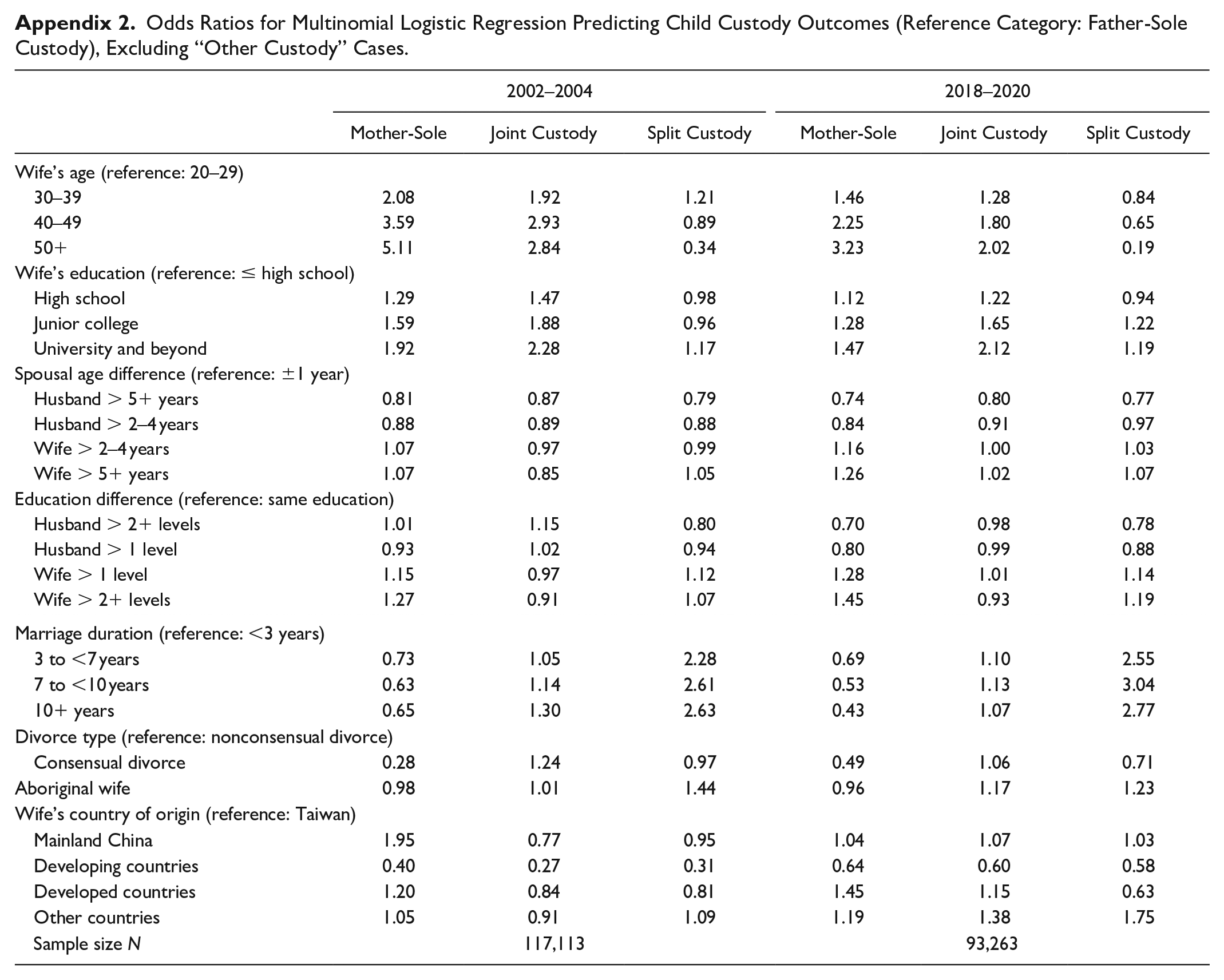
| 2002–2004 | 2018–2020 | |||||
|---|---|---|---|---|---|---|
| Mother-Sole | Joint Custody | Split Custody | Mother-Sole | Joint Custody | Split Custody | |
| Wife’s age (reference: 20–29) | ||||||
| 30–39 | 2.08 | 1.92 | 1.21 | 1.46 | 1.28 | 0.84 |
| 40–49 | 3.59 | 2.93 | 0.89 | 2.25 | 1.80 | 0.65 |
| 50+ | 5.11 | 2.84 | 0.34 | 3.23 | 2.02 | 0.19 |
| Wife’s education (reference: ≤ high school) | ||||||
| High school | 1.29 | 1.47 | 0.98 | 1.12 | 1.22 | 0.94 |
| Junior college | 1.59 | 1.88 | 0.96 | 1.28 | 1.65 | 1.22 |
| University and beyond | 1.92 | 2.28 | 1.17 | 1.47 | 2.12 | 1.19 |
| Spousal age difference (reference: ±1 year) | ||||||
| Husband > 5+ years | 0.81 | 0.87 | 0.79 | 0.74 | 0.80 | 0.77 |
| Husband > 2–4 years | 0.88 | 0.89 | 0.88 | 0.84 | 0.91 | 0.97 |
| Wife > 2–4 years | 1.07 | 0.97 | 0.99 | 1.16 | 1.00 | 1.03 |
| Wife > 5+ years | 1.07 | 0.85 | 1.05 | 1.26 | 1.02 | 1.07 |
| Education difference (reference: same education) | ||||||
| Husband > 2+ levels | 1.01 | 1.15 | 0.80 | 0.70 | 0.98 | 0.78 |
| Husband > 1 level | 0.93 | 1.02 | 0.94 | 0.80 | 0.99 | 0.88 |
| Wife > 1 level | 1.15 | 0.97 | 1.12 | 1.28 | 1.01 | 1.14 |
| Wife > 2+ levels | 1.27 | 0.91 | 1.07 | 1.45 | 0.93 | 1.19 |
| Marriage duration (reference: <3 years) | ||||||
| 3 to <7 years | 0.73 | 1.05 | 2.28 | 0.69 | 1.10 | 2.55 |
| 7 to <10 years | 0.63 | 1.14 | 2.61 | 0.53 | 1.13 | 3.04 |
| 10+ years | 0.65 | 1.30 | 2.63 | 0.43 | 1.07 | 2.77 |
| Divorce type (reference: nonconsensual divorce) | ||||||
| Consensual divorce | 0.28 | 1.24 | 0.97 | 0.49 | 1.06 | 0.71 |
| Aboriginal wife | 0.98 | 1.01 | 1.44 | 0.96 | 1.17 | 1.23 |
| Wife’s country of origin (reference: Taiwan) | ||||||
| Mainland China | 1.95 | 0.77 | 0.95 | 1.04 | 1.07 | 1.03 |
| Developing countries | 0.40 | 0.27 | 0.31 | 0.64 | 0.60 | 0.58 |
| Developed countries | 1.20 | 0.84 | 0.81 | 1.45 | 1.15 | 0.63 |
| Other countries | 1.05 | 0.91 | 1.09 | 1.19 | 1.38 | 1.75 |
| Sample size N | 117,113 | 93,263 | ||||
Acknowledgements
The author thanks Drs. Wei-hsin Yu, Tsui-O Tai, Jui-Chung Allen Li, and Shi-Yi Chao for their valuable comments on previous versions of this article.
Funding
The author disclosed receipt of the following financial support for the research, authorship, and/or publication of this article: This project is supported by a grant from the National Science and Technology Council in Taiwan under Grant No. MOST 111-2410-H-001-047-MY2.

Supplemental Material
Supplemental material for this article is available online.
1
Joint custody in Taiwan does not involve a strict definition as to how time should be divided between parents. As long as there is some kind of shared parenting, be it 50–50 or 20–80, it can be considered as adopting joint custody.
2
There are three reasons why only the first and last three years of data were used to show the changing patterns of child custody arrangements. First, the data used include all divorces and thus involve a large number of observations. Given that I only care about the overall evolution of custody profiles over the past two decades, using the starting and ending years of the data series is reasonable and justifiable. It is also not uncommon to see studies use only the beginning and ending years to capture and describe changes. Second, if all years of data were used, a time metric has to be included. Including a continuous year variable would impose a strong assumption that the change over time is linear, yet it is highly likely that there are fluctuations over the period of 2002 to 2020. Third, running two models for two periods also avoids the unintuitive interpretations of interaction terms with “year” with two reference categories in mind (i.e., the categorical variable and the multinomial outcomes). The sensitivity analyses in Table S1 in the Supplemental Material indicate that with rising women’s status, divorced mothers from nonhypergamous unions have become more likely to gain full or partial custody in recent years than earlier. The findings are in line with those from two separate models for 2002 to 2004 and 2018 to 2020.
Author Biography
References
Supplementary Material
Please find the following supplemental material available below.
For Open Access articles published under a Creative Commons License, all supplemental material carries the same license as the article it is associated with.
For non-Open Access articles published, all supplemental material carries a non-exclusive license, and permission requests for re-use of supplemental material or any part of supplemental material shall be sent directly to the copyright owner as specified in the copyright notice associated with the article.
