




Abstract
What repercussions does Islamist terrorism have for Arab/Muslim minorities in targeted countries? We highlight consequences in the domain of online real estate rental. Using high-frequency data on all transactions happening on the largest Parisian online rental market over the period of November 2014 to March 2018, we are able to trace the evolution of prices and occupancy rates over time. We demonstrate that discrimination against properties hosted by Arab/Muslims rises swiftly in the aftermath of the terror attacks in November 2015 and wanes at a much slower pace. We quantify the average financial loss per listing that results from increased discrimination to equal $178 per month. Our findings not only highlight the presence of discrimination in peer-to-peer transactions but also show how sharing economy data measuring these transactions can be used as a “seismograph” to track and measure the development of discriminatory attitudes in response to societal events.
On November 13, 2015, three teams of terrorists coordinated a series of terrorist attacks in Paris. This resulted in 130 innocent deaths, including 90 at the Bataclan concert hall and another 416 injured, almost 100 of them critically. The attacks, for which the Islamic State claimed responsibility, were the second deadliest in the European Union and dominated the psychological, political, and media landscape of France for months. Among the many consequences was a strong drop in tourism. Thierry Dufort, a rental host on the website Airbnb, summarized the situation succinctly: “People are afraid to come to Paris” (Newton-Small 2015). Thierry’s efforts to rent out a room close to Arc de Triomphe were clearly running into difficulties. But how much more difficult would it have been to find renters had Thierry’s name been Mehdi instead, given that worries about Islamic terrorism were now on everyone’s mind? This, in a nutshell, is the question we propose to answer by analyzing three years of data from the Airbnb online rental company.
The last two decades have been marked by an increase in frequency, lethality, and visibility of Islamist terrorism. An entirely unrelated but contemporaneous trend has been the rise of the sharing economy, a system of socioeconomic exchanges built around online peer-to-peer transactions of goods and services. There is ample evidence that discrimination against Arab-Muslim minorities increases following terrorist attacks (Davila and Mora 2005; Gautier, Siegmann, and Van Vuuren 2009; Glover 2019; Kaushal, Kaestner, and Reimers 2007; Rabby and Rodgers 2011; Ratcliffe and von Hinke 2015). There is also sizeable evidence that the peer-to-peer environment of the sharing economy promotes discriminatory behavior via rich personal characteristics disclosed during transactions (Edelman and Luca 2014; Ge et al. 2016).
These two insights beg the question whether the big, high-frequency data of the sharing economy can serve social scientists as a “seismograph” to detect shifts in societal attitudes and to plot trends in discriminatory behavior following events such as terrorist attacks.
Using panel data from the largest online real estate rental market, Airbnb, we show this to be the case. The November 2015 attacks leave clear traces in the rental data both because they led to a strong contraction in rentals and because they document a rise in discrimination.
Our approach contributes to the understanding of social and psychological reactions to terrorist events and to research on discrimination in the sharing economy. It helps reveal a clear temporal shape of reactions to terrorism, providing monthly estimates of discriminatory behavior in the years following an attack. This information brings better data to evaluate theories on how societies react to terrorism. It also helps illustrate the potential of sharing economy data to detect shifts in discriminatory behavior emanating from unrelated social trends. Past research observes consistent correlations of sharing economy outcomes with racial attributes of users, but causal claims about overt discriminatory behavior in transactions have been difficult to establish. The rise of discriminatory patterns in transactions following the exogenous shock the terrorist attacks exerted on the Airbnb market gives credence to the idea that the observed correlations reflect actual discriminatory behavior.
In the following, we begin with a discussion of research on discriminatory behavior toward Arabs and Muslims and of evidence on its reactivity to terrorist events.
A subsequent section describes recent findings on day-to-day discrimination in the sharing economy. The rest of the article presents data and methods and ultimately, results from the empirical analysis of data from the largest online market for temporary vacation rentals, which we use to track and measure trends in discrimination before and after the November 2015 terrorist attack.
Terrorism-Induced Discrimination toward Arab/Muslims
In many Western countries, surveys measuring anti-immigrant attitudes and studies capturing discriminatory behavior record a distinct disadvantage for individuals of Muslim religious backgrounds and of Arab and North African ethnicity (Panagopoulos 2006; Park, Felix, and Lee 2007). France is no exception. Its population of Arab and/or Muslim origin is among the largest in relative and absolute numbers in the European Union (Pew Research Center 2017). In light of French colonial past, most are descendant from North Africa and make up the country’s largest ethnic minority group (Simon, Beauchemin, and Hamel 2016; Tribalat 2015). Often second- or third-generation French citizens, they are particularly concentrated in and around the city of Paris (Aubry and Tribalat 2011) and experience recurrent discrimination in labor (Adida, Laitin, and Valfort 2010; Pierné 2013; Safi and Simon 2013; Valfort 2018) and housing (Acolin, Bostic, and Painter 2016; Bunel et al. 2017, 2018; Le Gallo et al. 2018) markets.
Studies show that public opinion and discriminatory behavior against these groups intensify in response to terrorist acts. A rise in anti-immigrant sentiment and Arab- and Muslim-related prejudices has been registered in European societies independent of whether terrorist attacks took place on local territory (Echebarria-Echabe and Fernández-Guede 2006; Legewie 2013) or far from home countries (Åslund and Rooth 2005; Finseraas and Listhaug 2013; Schüller 2016; Sheridan 2006). Terrorism-induced shifts in public opinion can lead to changes in partisan (Hersh 2013) and voting behaviors (Montalvo 2011). They have further been shown to produce adverse economic consequences for Arab and Muslim minorities. The evidence points to declines in earnings (Davila and Mora 2005; Kaushal et al. 2007) and in employment in the United States (Rabby and Rodgers 2011) and in France (Glover 2019). In direct relation to our analysis, a decline in house prices and sales in majority Muslim neighborhoods has been measured in the aftermath of attacks in Amsterdam (Gautier et al. 2009) and in London (Ratcliffe and von Hinke 2015).
What mechanism may explain the rise in discrimination against innocent individuals whose only connection to the attacks is to belong to the same ethno-religious minority as the terrorists? Although theories vary in their accounts of the decision-making and psychology of discriminatory behavior, most tell a story of perceptions of increased threat by an out-group. Group-threat theory postulates this explicitly: Prejudice toward an out-group stems directly from it being perceived as a threat to the privileges of the in-group (Quillian 1995). A proponent of statistical discrimination (Arrow 1971) would argue that a terrorist attack provides individuals with new information on the statistical risks associated with members of certain ethnic or religious groups and hence leads to a rational reduction in interactions. In contrast, a proponent of taste-based discrimination (Becker 1971) would argue terrorism leads to irrational distaste of an out-group resulting in discrimination. Although the normative evaluations these theories offer for the rise in discriminatory behavior differ greatly, a heightened out-group threat perception is a common element to all of them. A correspondence study on the online used car market in Israel (Zussman 2013) provides relevant insights on the pertinence of statistical versus taste-based discrimination in online transactions via the fielding of an additional questionnaire to sellers. Jewish car sellers (the in-group) who did not expect higher rates of cheating by Arab customers (the out-group) also did not discriminate, whereas those expecting higher rates of cheating were the main drivers of discrimination by not responding to transaction requests, thereby bolstering an interpretation of discrimination as being based on “statistical” considerations. Our study can only test these theories as an ensemble in the broadest sense. The common denominator of an increased group threat, or perception thereof, would lead them all to predict a rapid increase in discrimination following a terrorist attack. An example of terrorism affecting in-group preferences and out-group biases comes from the study of Israeli and Arab court judges, both of whom display in-group preferences that intensify with increased terrorism intensity in the vicinity of courts (Shayo and Zussman 2011).
Yet beyond the prediction of an initial spike, these theories provide little guidance on how the abrupt rise in discrimination ought to evolve over time: Is it temporary, long-lasting, or permanent? A commonly applied framework to think about the temporal window of social reactions to rare, idiosyncratic events such as terror attacks comes from the literature on natural disasters. The “disaster paradigm” served the National Research Council (2002) as a primary social science resource to analyze reactions to the September 11th attacks and has since been extended to the study of other acts of terrorism (Fullerton et al. 2003; Smelser 2007; Spilerman and Stecklov 2009). The paradigm draws on similarities between terrorist attacks and natural disasters. Both constitute traumatic events that upend social order and normal ways of life with observable effects in the affected community: heightened levels of stress and anxiety, decline in perceived well-being, and adoption of safety behaviors.
To appreciate the comparison, it is instructive to invoke Durkheim’s concept of anomie, which refers to the psychological experience of normlessness in societies in temporary disequilibrium (Bearman 1991). Anomie can result from an economic crisis or a social upheaval on the condition that the ensuing disruption of social order is not anticipated (Durkheim 2010). The disaster paradigm follows a similar logic. A catastrophic event, for example, an earthquake, begets a state of anomie independent of the community’s experience with such disasters because an earthquake is by definition unpredictable. So are terrorist attacks. Individuals and the community react strongly to the shock to the social system in the immediate aftermath of a disaster. As time passes, the perception of the event as a singular, abnormal occurrence leads to a gradual return to routine activities. One expects, therefore, to observe a timely but temporary response before the community transitions back to normalcy. The fundamental reason for which we see the disaster paradigm as transposable to discrimination following terror is that in both cases, individuals face an unexpected alteration of their sense of safety and risk calculus. In the case of terror attacks, increased safety concerns translate to heightened risk perceptions toward out-groups that are perceived as being associated with the attacks (Shayo and Zussman 2011), which, in turn, results in increased statistical discrimination (Zussman 2013).
Empirical findings on natural disasters indicate the spike in responses may take as little as six weeks (Pennebaker and Harber 1993) to several months or less frequently, a couple of years (Arcaya, Raker, and Waters 2020) to return to predisaster levels. Research on the major recent Islamic attacks in the United States (Hopkins 2010; Scott, Poulin, and Silver 2013), London (Prager et al. 2011), Madrid (Rimé et al. 2010), and Paris (Garcia and Rimé 2019; Pelletier and Drozda-Senkowska 2016) finds similar temporal ranges for responses related, respectively, to anti-immigrant attitudes, posttraumatic stress, safety behaviors, and emotional reactions.
An example illustrating the temporal evolution of terror-induced, population-wide stress comes from the analysis of driving behavior in Israel (Stecklov and Goldstein 2004, 2010). Accidents decrease on the day after an attack because individuals increase their safety behavior; however, the reaction quickly wanes with accidents spiking above previous levels after three days. Neither of these studies measures discriminatory practices, but the empirical work that does, although not examining the exact temporal development, reports evidence of upward spikes and some evidence of subsequent decay (Gautier et al. 2009; Rabby and Rodgers 2011; Ratcliffe and von Hinke 2015).
In sum, the disaster paradigm implies a specific temporal trajectory for terrorism-induced responses, which are expected to follow a clear sequential pattern: an initial upward spike and a subsequent decay. We expect this trajectory holds true for discriminatory behaviors, which we interpret as a response to perceived increase in out-group threat following a terrorist attack. The evidence from studies of discrimination in economic markets points in this direction, although they lack sufficiently temporally dense data to explicitly measure the temporal form and duration of the rise in discrimination. This is an important caveat we address in this study by using detailed monthly data on the online market of short-term rentals. We turn next to a review of research of discrimination on sharing economy markets to clarify our expectations of the effects of terrorism on peer-to-peer transactions.
Measuring Discrimination with Sharing Economy Data
The sharing economy has expanded to ever more aspects of social life over the last decade. Along with transactional ease, these online markets provide platforms for day-to-day discrimination between strangers. The rich data sharing economy transactions produce provide unique opportunities to observe behavior that is otherwise mostly invisible.
Given the specific designs of online markets and the selectivity of their users, observed behaviors might be specific to the sharing economy, but they also hold the potential to capture the evolution of broader societal attitudes, tastes, and discrimination in ways that are otherwise immeasurable.
Systematic discrimination in the traditional economy is a staple finding of social science research (Pager and Shepherd 2008; Quillian et al. 2017; Rich 2014). The sharing economy differs in two important ways, however. First, it encourages market exchanges between mostly private individuals, and second, the conclusion of an exchange is facilitated by seller and buyer revealing personal information. This information offers otherwise unobservable cues about the quality and experience of the marketed good or service and about the trustworthiness of the exchange (Abrahao et al. 2017; Diekmann et al. 2014). On certain online platforms, such as the product market eBay, revealed personal information during an exchange is minimal and not necessarily mutual, although still a source susceptible to produce discrimination (Ayres, Banaji, and Jolls 2015; Doleac and Stein 2013; Nunley, Owens, and Howard 2011). But on peer-to-peer services, which involve the sharing of intimate personal space, during a commute, for example, or the temporary rental, for instance, of one’s vehicle or living quarters, the incentive for sellers and buyers to reveal, voluntarily and mutually, extensive personal information is so high as to become an essential feature of these market exchanges.
The spectacular growth of online peer-to-peer markets results in hundreds of millions of individuals worldwide who participate in transactions whereby they make choices incorporating the personal information of other private individuals. Absent sufficient legal safeguards (Calo and Rosenblat 2017; Leong and Belzer 2017; Todisco 2015), these choices are susceptible to reproduce long-standing prejudices and inequalities with economic consequences that disadvantage individuals based on gender, class, race, ethnicity, and religion (Abrahao et al. 2017). A growing list of studies of online peer-to-peer platforms offers evidence on the troubling extent of observed day-today discrimination on these platforms and of general discriminatory behavior in society becoming detectable through these novel data sources.
Consider a few telling examples. A field experiment on ride services by transportation companies Uber and Lyft in two large U.S. cities found longer waiting time and higher cancellation rates for passengers who use African American sounding names and longer, more expensive rides for female passengers (Ge et al. 2016). In a similar vein, analysis of the data of a German ride-sharing company found a discriminatory price premium of 32 percent for passengers with typically Arab, Persian, or Turkish names (Tjaden, Schwemmer, and Khadjavi 2018), and a study of the online car purchasing market in Israel found discrimination against Arab buyers (Zussman 2013). Several studies of the short-term rental company Airbnb showed lower acceptance rates in large U.S. cities for guests with African American names (Cui, Li, and Zhang 2016; Edelman and Luca 2014), lower rental price rates for apartments of African American hosts in New York City (Edelman and Luca 2014), and lower rental prices for Asian and Hispanic hosts in San Francisco (Kakar et al. 2018).
Edelman and Luca’s (2014) findings on discrimination are an important reference for this study because we also analyze data from an Airbnb market, in our case, the market in the French capital Paris. Their precursory work illustrated that discriminatory practices in short-term rentals in the sharing economy market occur at equally troubling rates as is documented for long-term rentals in the traditional housing market in the United States (Massey 2005; Pager and Shepherd 2008). Notwithstanding differences in both institutions and ethnic composition of minorities in Europe, there, too, exists extensive evidence of discrimination in national housing markets (Flage 2018), including the French one (Acolin et al. 2016; Bunel et al. 2017, 2018; Le Gallo et al. 2018). Bridging evidence from both continents, a recent study of Airbnb from 6 U.S., 3 Canadian, and 10 West European large or capital cities shows that Edelman and Luca’s (2014) findings extend beyond the American case and apply, with comparable amplitude, to Arab/Muslim individuals, North American and European alike (Laouenan and Rathelot 2017).
Taking the lead from these findings, we explore how peer-to-peer interactions based on trust and risk evaluation react in the context of a massive terrorist attack. The large-scale attacks on November 2015 in Paris offer a fertile testing ground for whether studies of discrimination in the sharing economy can be extended from documenting the existence of discrimination to measuring its strength and reactivity to societal events.
In line with research on the disaster paradigm and theories on perceptions of out-group threat, we expect to observe an upward spike in discrimination against individuals with ostensible characteristics of Arab/Muslim origin. Studies measuring direct terrorism-induced behavioral or attitudinal responses, such as anti-immigrant attitudes (Hopkins 2010), posttraumatic stress (Scott et al. 2013), safety behaviors (Prager et al. 2011), and emotional reactions (Garcia and Rimé 2019; Pelletier and Drozda-Senkowska 2016; Rimé et al. 2019), report evidence of an abrupt spike following an attack. On the other hand, studies of terrorism-induced discrimination looking at immigrant share in housing markets observe a slower response rate, with discrimination appearing gradually. This is likely due to institutional inertia, longer lasting and less frequent exchanges, and price learning effects (Gautier et al. 2009; Ratcliffe and von Hinke 2015). Weakly institutionalized and with a higher turnover, the Airbnb short-term rental market is likely sufficiently dynamic to expect a higher reactivity in transactions, hence a more abrupt initial spike in discrimination reflecting immediate emotional reactions rather than the “stickier” reaction in traditional housing markets. For similar reasons, we expect the upward trend to subside in less time than studies of housing markets report. There, housing prices are generally not found to reverse to prior levels in the measured time frames, and an ongoing drop in relative prices continues to be observed for 10 (Gautier et al. 2009) or even 24 months (Ratcliffe and von Hinke 2015) after attacks. Our expectation is that the disaster paradigm and previous results on emotional reactions to terror provide a better guide to trends in high frequency peer-to-peer interactions that rely heavily on revealed personal characteristics. We thus expect a spike reaction following the attacks and a shorter decay function of a few months at most (Hopkins 2010). To test our predictions, the Airbnb platform offers high-density and high-volume rental data to track and measure the development of discriminatory behaviors before and after the November 2015 attacks with unique temporal precision. We turn next to the presentation of the data.
Data
To examine discrimination on the Airbnb market, we analyzed monthly panel data on all rentals listed in the city of Paris between November 2014 and March 2018. The data were purchased from AIRDNA, a short-term rental data and analytics company. They include exact monthly information on the number of days a property was listed as available and the number of days it was rented out in a given month along with the corresponding rental price. The data capture additional descriptive information on listing properties that is available to customers on the Airbnb website. We restrict the analysis to a sample of hosts whose names we can identify as uniquely French or Arab/Muslim (see Annex in the supplemental material). As a robustness check, we also classified names of Anglo/German, Southern European, Latin, and Eastern European origins in separate categories. We analyze only monthly observations for which the hosts’ properties were listed as available for rent for at least one day. The resulting data set consists of 1,044,022 monthly observations for 72,991 distinct properties over a time period of 41 months.
We categorize variables into the following groups: dependent variables Yi, host characteristics Hi, neighborhood fixed effects Ni, time-invariant listing characteristics Li, time-variant listing characteristics lit, and reviews rit.
Our two dependent variables are occupancy rate and log price. Occupancy rate is measured by dividing the number of days a listing was rented out in a given month by the number of days it was listed as available for rental on the website. A listing on Airbnb has several prices because hosts can set different rates depending on length of visit. Furthermore, cleaning fees are added to the overall price. Except for a study by Kakar et al. (2018), most work done on Airbnb so far looks at the daily price rate hosts demand (Edelman and Luca 2014; Laouenan and Rathelot 2017). Our data have the advantage that in addition to scraped prices from the Airbnb website, we have information on when and for what price a listing was rented out. This allows us to measure the rate a listing was rented out for each day it was booked. Taking the average of those daily prices for all days a listing was rented out in a month gives our price variable. We take the log of the price variable to obtain coefficients that can be interpreted as elasticities. The advantage of this approach is that we exclude properties with listed prices but no solicited rental and hence measure discrimination on prices actually paid by consumers. This also avoids having our price data distorted by host strategies, such as setting high daily prices and low weekly or monthly rates to attract more long-term rentals and so on. The disadvantage is that listings that were not rented out in a given month have no recorded observation for price and are thus only used for modeling occupancy rates. In modeling price, we therefore use a limited sample of 522,991 monthly observations. To assure that different results for price and occupancy rate are not driven by this sample reduction for the price variable, we redo all analysis on occupancy rates on this smaller sample as a robustness check.
Discrimination is measured via Airbnb host names, our explanatory variable of interest. We classified these as distinctly Arab/Muslim or typically French using lists of names applied in two previous studies (Behaghel et al. 2015; Laouenan and Rathelot 2017). We complement these lists with publicly available data on the French government’s opengouv.fr website, which is based on an extensive online classification project on the etymology of first names. Detailed information on the classification of names is provided in the Appendix in the supplemental material. As control variables, we incorporate all information on the characteristics of the listing visible to a visitor of the Airbnb website with the exception of visual content and written descriptions. Time-invariant listing information includes the number of guests, the number of bedrooms, the number of bathrooms, and dummy variables for the type of the listing, which can be either a shared room (with another guest or inhabitant), a private room (in a house or apartment generally inhabited by the host or shared with other guests), or an entire home/apartment. Time-variant listing information includes dummies for whether the cancellation policy is strict, moderate, or flexible, resulting in different possible times and reimbursements for cancellation; the number of photos listed on the listing site; the minimum stay period specified; if “instant booking” is enabled; if a host has “superhost” status; and if a listing has “business ready” status. The Appendix in the supplemental material provides detailed descriptions of these certification variables.
Review variables measure the amount and type of reviews a listing has received by former guests up to the month we observe the listing. They include the number of reviews, the overall rating, and the rating for quality of communication, accuracy of descriptions, cleanliness, check-in, and location. The overall rating for a listing is shown on a scale of 0.0 to 5.0 and thus includes 50 possible values. The ratings on the more detailed evaluation scales go up to 5 stars, with the possibility of showing half stars, and thus include 10 categories. We rescaled all rating variables to go from 0 to 10.
Finally, we create neighborhood fixed effects to control for the spatial distribution of listings. Using geocoded information on the listings, we divided the city into 81 neighborhood zones that we use as dummy controls. We further assigned listings to 13 designated tourist zones as published by the Mairie de Paris (Paris City Hall) on their Open Data website, which overlap with the 81 neighborhood zones. We included each of these tourist zones as additional fixed effects to account for spatial effects. (Figure 3 in the Appendix in the supplemental material displays the 81 Airbnb districts in gray and the 13 tourist zones in blue, and Figures 4 and 5 show the distribution of Arab/Muslim names and prices across the 81 zones.)
Table 1 summarizes descriptive statistics of these variables for the entire panel and for the January 2015 and January 2018 monthly cross-sections. The latter provide monthly snapshots of data from the beginning and end of our sample, which are comparable without being affected by monthly seasonality patterns.
Descriptive Statistics: Mean (SD).
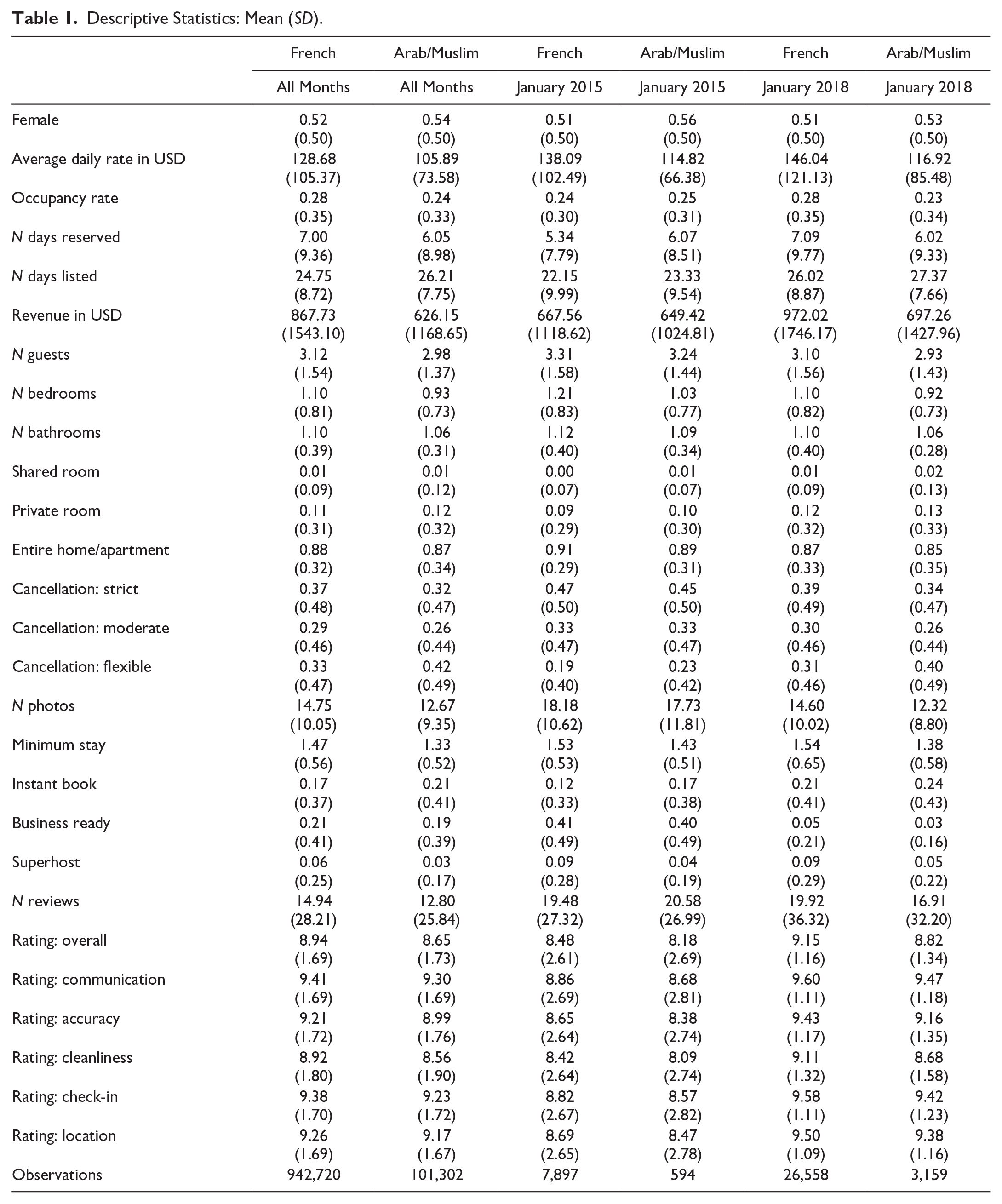
Because Airbnb is a marketplace in which listings can enter and exit, we also looked at its evolution over time. The number of available listings tripled over the 41 months we observed, with hosts having Arab/Muslim names making up 7 percent of available listings in November 2014 and 9 percent in March 2018 (see Figure 6 in the supplemental material). There was no notable effect of the November 2015 terrorist attacks on the upward trend in the number of listings or the relative share of listings by Arab/Muslim hosts. Throughout the entire observed time period, we also found no substantive differences between the rates of French and Arab/Muslim host listings exiting the market, which we defined as the last date a listing was actively rented out (see Figure 7 in the supplemental material).
Methods
We use three different methodological approaches to measure discrimination against Arab/Muslim hosts. First, we estimate a random effects panel model, also known as a random intercept multilevel model, predicting log price and occupancy rates using host and listing characteristics. This gives us an indication of the average price and occupancy rate discount hosts with Arab/Muslim names face, conditional on the characteristics of their listings. Second, we run repeated ordinary least squares (OLS) regressions for every month in our sample and look at the monthly coefficients for being Arab/Muslim hosts. This measures the evolution of discrimination over time and allows us to assess the effects of the November 2015 terrorist attacks. Third, we employ fixed effects models using a difference in difference strategy. This allows us to look specifically at how the average strength of discrimination changes from the time period before and after the November 2015 attacks.
For each of these three approaches, we estimate three nested versions of the models, with expanding sets of controls. Writing out the three nested versions for our first approach, the random effects (random intercept) model, will serve as an illustration. We initially estimate raw differences between hosts with French and Arab/Muslim names beyond the effect of time fixed effects and then examine these differences following the inclusion of effects of listing characteristics and neighborhoods and in a third model, of reviews.
Model 1 looks at the raw effect of host name Hi on occupancy rate or log price yit after controlling only for a set of monthly time dummies dt :

Model 2 adds neighborhood fixed effects Ni, and controls for time-invariant listing characteristics, Li and time-variant ones lit:

Model 3 adds information on reviews rit:

The coefficient β captures how much lower occupancy rates are and by what percentage prices are lower for hosts with typically Arab/Muslim instead of French names, conditional on the controls included in each model. We use log price and thus obtain an elasticity for price but not log occupancy rate because we have many values of zero for occupancy rates in our data. A key assumption of the random effects model is that the individual-level (listing) error term is not correlated with the predictors. Under this assumption, we can interpret β as the degree of discrimination a host faces due to his or her ethnicity. The fact that a guest’s booking decision is made based on the information on the website, which we incorporate in the last two models, lends credibility to this assumption. We include reviews in a separate model because they might be influenced by host ethnicity, and thus, inclusion of reviews might control not only for listing characteristics but also for part of the discrimination Arab/Muslim hosts face. Because similar listings are repeatedly observed in different months, standard errors are clustered at the listing level.
As outlined, our second set of models are OLS regressions for each month t in our panel to evaluate if discrimination against Arab/Muslim hosts changed over time. The dependent and explanatory variables remain the same as in the random effects model. The β t now yields the effect of having an Arab/Muslim name compared to a French name in month t. Analyzing whether there is a discontinuity in the evolution of coefficients around the date of the November 2015 terrorist attacks in Paris helps discern effects of the terror attack on discrimination.
Finally, we assess the effects of the November 2015 attacks again, estimating fixed effects models with both listing and time (month-year) fixed effects. The advantage of including listing fixed effects is that any time-invariant listing characteristics—in particular, the description of listings, the quality of photos, and the neighborhood—will not bias our estimates. However, we cannot include our variable on whether hosts have Arab/Muslim or French names because this is a time-invariant characteristic. Instead, we use a difference in differences strategy by looking at the interaction of being a host with an Arab/Muslim name with observations following the November 2015 attacks:

We now only include the listing time-variant characteristics lit and review variables rit as controls. LDi are the listing dummies included in the listing fixed effects approach, and pa is a post-attacks dummy variable that takes the value 1 for observations after the November 2015 attacks up to March 2018 and the value 0 for those prior to November 2015. We estimate this model twice, once using only listing fixed effects λiLDi and once with the additional inclusion of month-year fixed effects ηtdt. We exclude observations for November 2015 from the sample. Our parameter of interest is the coefficient γ for our interaction variable H × pa, which estimates whether the effect on price and occupancy rates of being an Arab/Muslim host changes after the November 2015 attacks.
Although the listing fixed effects model has the advantage of controlling for unobserved time-invariant listing characteristics, its disadvantage is that the sample of hosts we estimate these effects on is significantly smaller and more selective. Only listings that were in the sample before and after the attacks can be used for estimating γ. Therefore, the model does not measure the amount of discrimination faced by newly entering, less experienced, and less certified hosts, and the sample is biased toward listings with high survival times. Assessing the effects of the terrorist attacks via repeated OLS thus assures a more representative sample capturing the entire market, whereas assessing it via a fixed effects model eliminates worries about any omitted variable bias stemming from non-time-varying characteristics. A key identifying assumption of the difference in difference approach in Model 4 is that the difference in y between the treated (Arab/Muslim) and untreated (French) is constant prior to the treatment (terror attacks). To test this parallel trends assumption, we provide descriptive trends of the outcome variables in the results section.
Using the results from these estimations, we proceed to calculate counterfactual revenues for Arab/Muslim hosts. Counterfactual revenues are derived by increasing the observed average daily price and occupancy rate of all Arab/Muslim hosts in our sample by the percentage that the parameter β in the repeated monthly OLS indicates as being the Arab/Muslim name penalty in a given month. Based on the counterfactual occupancy rate and monthly price, we calculate a counterfactual revenue from which we derive the average monthly and the cumulative foregone revenue of all Arab/Muslim hosts. We identify the additional costs resulting from the November 2015 attacks based on a comparison of the average monthly loss of individual hosts before and after the attacks. This allows us to derive the total amount of additional losses resulting from average discrimination being higher after the attacks. As a robustness check, we also calculate additional revenue loss stemming from the effects using the fixed effects modeling approach (see Appendix in the supplemental material for a more detailed description).
Because we exclude listings that were not rented out in a given month in the sample used for estimating price but not in the sample used for estimating occupancy rate, we checked the robustness of our results by redoing the occupancy rate analysis on the sample used for price estimations.
Results
The first step in our analysis was to measure the overall level of discrimination against hosts with typically Arab/Muslim names via random effects panel models. With these measurements at hand, we then analyzed how discrimination evolved over time using repeated OLS models and then looked in particular at changes around the November 2015 Paris terrorist attacks via listing fixed effects models.
The results from the random effects model in Figure 1 show economically meaningful discrimination based on ethnic/religious characteristics. For reasons of parsimony, we display only select control variables (see Appendix Table 4 for full results and Appendix Table 5 for additional results from random effects models for nonlogged price and total revenue in the supplemental material). Overall, listings of hosts with Arab/Muslim names have lower price and occupancy levels. We find that listings of Arab/Muslim hosts had a 13 percent lower price level and a 4.5 percent reduction of the occupancy rate. Note that the size of the coefficients is not directly comparable between models for price and occupancy rate because they measure elasticities (percentage change in price) in the first case and in the latter, deviations from the occupancy rate, which has a sample average of 28 percent, in absolute percentage terms. We provide an estimate of the relative effect of differences in price and occupancy rates in the section on costs.
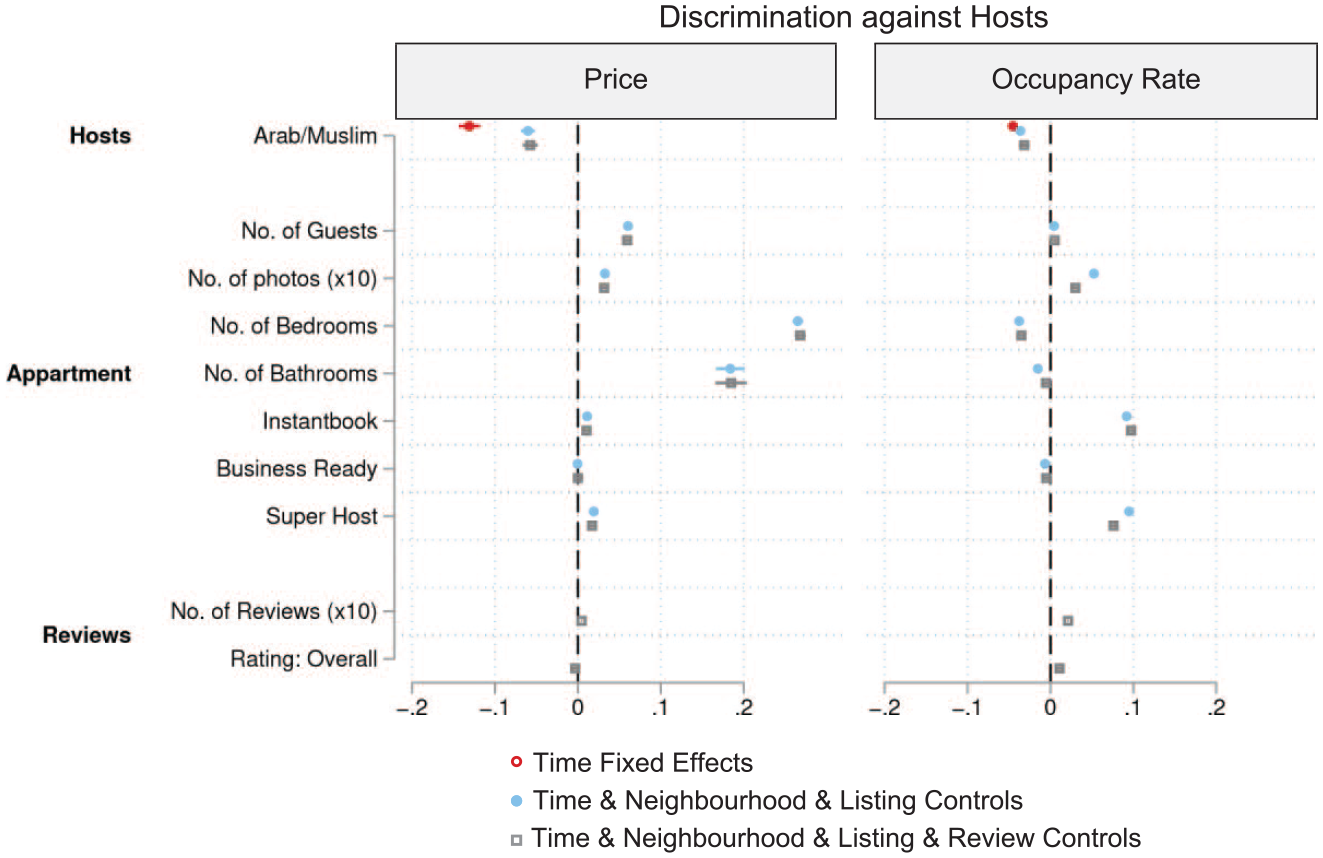
Selected coefficients from random effects models for listing price and occupancy rate with 95 percent confidence intervals.
The reported raw differences result in part from variations in the quality and location of listings. Following the introduction of controls for listing characteristics (and reviews), differences in price levels decline to a disadvantage of 6.0 percent (5.8 percent with review controls); for occupancy rates, estimates drop to a disadvantage of 3.6 percent (3.2 percent) for hosts with Arab/Muslim names. In sum, we find that hosts with Arab/Muslim names incur a clear disadvantage in revenue due to both lower prices and lower occupancy rates relative to hosts with typically French names. The inclusion of names we categorized as falling into other ethnic groups shows that several groups receive price and/or occupancy rate penalties, all of which are however inferior to penalties for Arab/Muslim hosts (see Appendix Figures 20 and 21 in the supplemental material). 1
Increases in Discrimination after November 2015 Attacks
Having established the average amount of discrimination, we proceed to explore whether the strength of discrimination changed over time, in particular, around November 2015, when Paris was struck by a series of coordinated, multisite, lethal terrorist attacks. The events led to a logical contraction of the Airbnb market. In our data, the effect is visible in the abrupt and substantial drop in average price and occupancy rates of listings; price levels took over a year to recover to the preattacks levels (Figure 2, left). When looking for differences between French and Arab/Muslim hosts, we see that prior to November 2015, there is no visible and statistically significant difference between the occupancy rates. But for every month thereafter, listings of Arab/Muslim hosts display lower occupancy rates. The effect appears to add onto differences in price levels. The trend in price rates is visibly sensitive to the attacks, but the price gap of around $20 between hosts with French and Arab/Muslim names remains stable around November 2015 and throughout the entire period. The terrorist attacks appear to increase discrimination against Arab/Muslim hosts by adding a penalty on occupancy beyond and over a preexisting price gap.
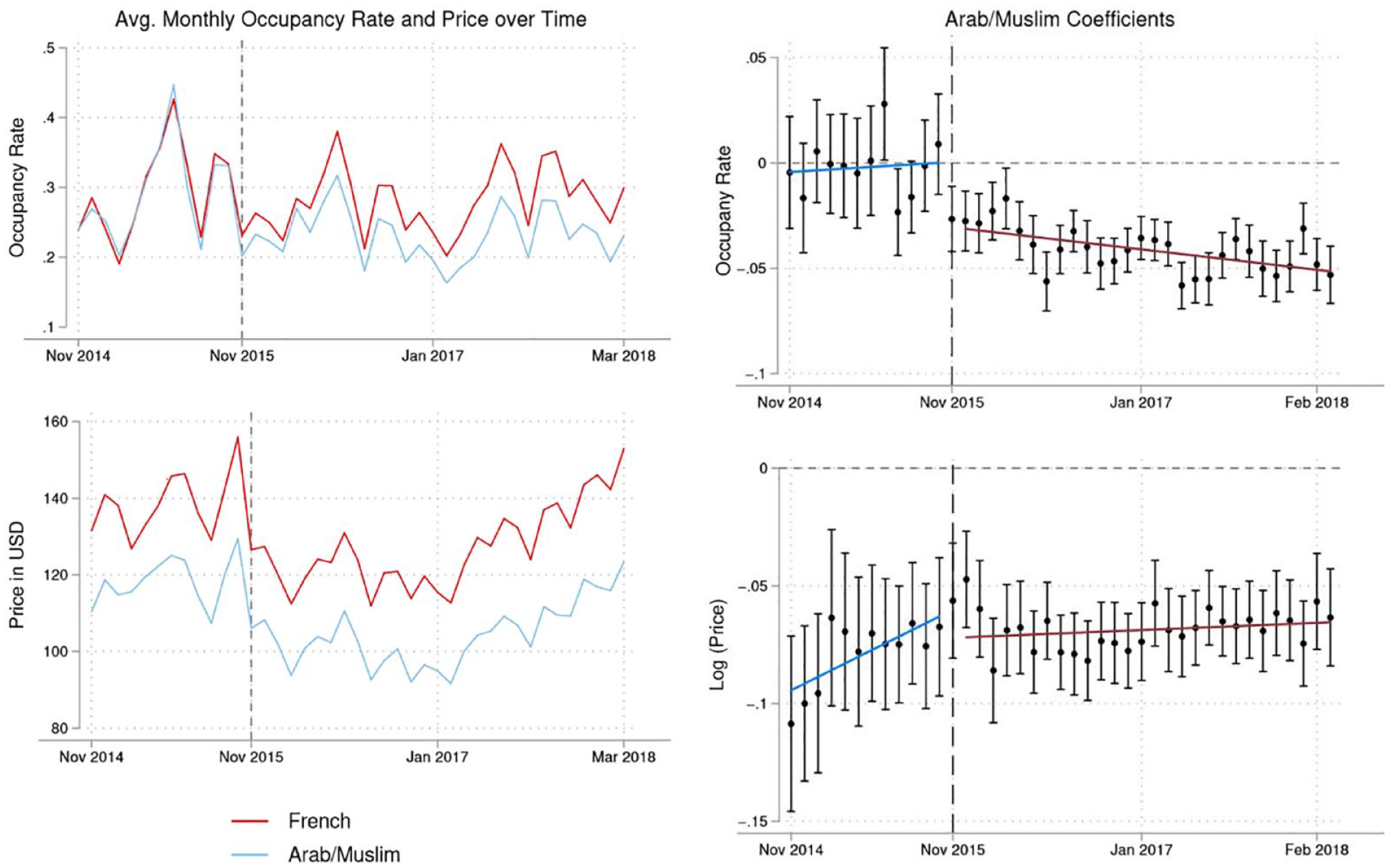
(Left) Average monthly occupancy rate and price for Arab/Muslim and French listings. (Right) Coefficients for hosts with Arab/Muslim names including 95 percent confidence intervals from repeated monthly ordinary least squares regressions on occupancy rate and price.
Another important takeaway from the trends is how parallel occupancy rates of Arab/Muslim and French hosts are developing prior to the November 2015 attacks, whereas on price, there is a small reduction in French and Arab/Muslim differences happening around February 2015. Parallel trends are then fully verified from February 2015 to November 2015. Overall, the parallel trends assumption is clearly fulfilled for occupancy rates, but results on price might warrant more cautious interpretations.
We corroborated the conclusions from the descriptive trends via repeated OLS regressions, modeling monthly price and occupancy rate separately for each month. The models measure the effect of being an Arab/Muslim host conditional on listing characteristics. We estimated models with and without listing reviews; results being broadly similar, we display the coefficients of models with the full set of controls except reviews in the Figure 2 (right; for results without any controls and with review controls, see Appendix Figures 11–14 in the supplemental material). The figure displays coefficients and confidence intervals showing the effects of being a host with an Arab/Muslim name relative to a French name on price and occupancy rates in each month. Coefficients for the models with log(price) as dependent variable show fluctuations in the trend, indicating a decline in the price gap at the beginning of the time period in the last months of 2014. The overall trend is nonetheless stable over time, with an average price differential in the range of 5 percent to 8 percent at the expense of Arab/Muslim hosts. The coefficients for the effect of a host having an Arab/Muslim name show no difference in occupancy rates before the month of the attacks. A persistent and stable gap opens after that point, however, with Arab/Muslim hosts incurring a 2 percent to 5 percent lower occupancy rate.
In an additional test of the effect of the terrorist attacks, we estimated models with listing fixed effects, displayed in Table 2 (full results are in Appendix Table 7 in the supplemental material). Model 1 displays the results without fixed effects, and Models 2 and 3 subsequently introduce listing fixed effects and month fixed effects. Model 2 has the advantage that all unobserved non-time-varying characteristics of listings do not influence our estimates, nor do any differences in listing characteristics of hosts who enter the market after November 2015. The time fixed effects in Model 3 control for monthly fluctuations in price and occupancy. The disadvantage of these models is that we cannot estimate the overall level of discrimination against Arab/Muslim hosts because the ethnic/religious affiliation of host names is a time-invariant characteristic. As discussed in the methods section, we do, however, model the change in strength of discrimination before and after the attacks. The parameter identifying this change is calculated on a smaller sample of hosts with higher survival times and better certification. This is because listings had to be present in the data before and after the attacks to identify the influence of host characteristics on changes in price and occupancy rates within individual listings. This also means that new participants entering the market after the November 2015 attacks and being potentially treated differently is not captured by these models. 2 This notwithstanding, the fixed effects models show a significant drop in occupancy rates for Arab/Muslim hosts (2.3 percent) after the attacks, with the effect size being only slightly smaller than in the repeated OLS models. Additionally and in contrast to the repeated OLS regressions, the listing fixed effects approach shows a 1.8 percent higher price penalty for Arab/Muslim hosts after the terrorist attacks.
Random (Model 1) and Fixed Effects (Models 2 and 3) Regressions for Postattack Changes.

t statistics in parentheses.
p < .05. **p < .01. ***p < .001.
Robustness checks, reestimating the repeated OLS model on a balanced panel (Figure 22 in the supplemental material), which, akin to the fixed effects model includes only listings that were available before and after the terror attacks, indicate that the different price effects in the fixed effects model might at least partially stem from the changed sample composition. Despite this difference, the two modeling approaches yield a consistent picture of the rise in discrimination against hosts with Arab/Muslim names following the attacks. Although results on price discrimination should be interpreted with caution, our subsequent estimation of monetary losses associated with the rise in discrimination after November 2015 show that the results from both approaches arrive at cost estimates in a comparable range and that both identify the decline in occupancy rates among Arab/Muslim listings as the main driver (around over two-thirds) of rising costs for hosts with Arab/Muslim names (see Appendix Table 12 in the supplemental material). We also reproduced descriptive statistics and models looking at changes over time including names classified as belonging to different ethnic groups (see Figures 18–21 in the Appendix in the supplemental material). Results confirm that the gap in occupancy rates opening up between hosts with Arab/Muslim names and hosts with French names right after the November 2015 attacks is unique to that group. However, looking at the longer term trends all the way up to January 2018 shows a secular trend in which listings hosted by hosts with French names tend to slowly improve their performance in terms of occupancy rates relative to hosts with names in all other ethnic groups. This leaves us with little doubt about the immediate discriminatory impact of the attacks but means that the long-lasting effects might have to be interpreted as resulting from a mix of increased discrimination against Arab-Muslim hosts and a secular trend toward higher occupancy rates of French hosts relative to all other market participants.
Calculation of Revenue Loss
Based on our results, we provide estimates of how much revenue hosts with Arab/Muslim names lost due to observed differences in price and occupancy rates. These estimates give an intuitive, monetary measure of the effect of discrimination and a unit for comparing the contribution of price and occupancy rate differences to lowering the revenue of minority hosts. We calculated counterfactual scenarios for the additional amount of revenue that listings of Arab/Muslim named hosts would have received if there would have been no differences in price and/or occupancy rates after controlling for listing characteristics. More precisely, we inferred the potential gains for price and occupancy rates from the coefficients for having an Arab/Muslim name in repeated monthly OLS regression models with controls for listing characteristics. The sample of analysis includes listings for which there are observations for monthly price—a necessary condition to estimate counterfactual prices (see Appendix for details on the modeling approach and Appendix Tables 11 and 12 for additional results in the supplemental material). In Table 3, we report observed average monthly revenue of Arab/Muslim and French listings along with estimates for average monthly revenue gains for hosts with Arab/Muslim names under three scenarios of absence of differences: in occupancy rates only, in price only, and in both. We report results for the entire sample and for the subsamples of observations before (November 2014 to October 2015) and after (December 2015 to March 2018) the terrorist attacks.
Average Monthly Revenue of Listings and Additional Revenue of Hosts with Arab/Muslim Names under the Assumption that Occupancy Rate and/or Price Differences Associated with Ethnic/Religious Origin of Host Name Do Not Exist. Calculations are done for the entire sample and separtely for oberviations prior to November 2015 (Pre-Attack) and those after (Post-Attack).
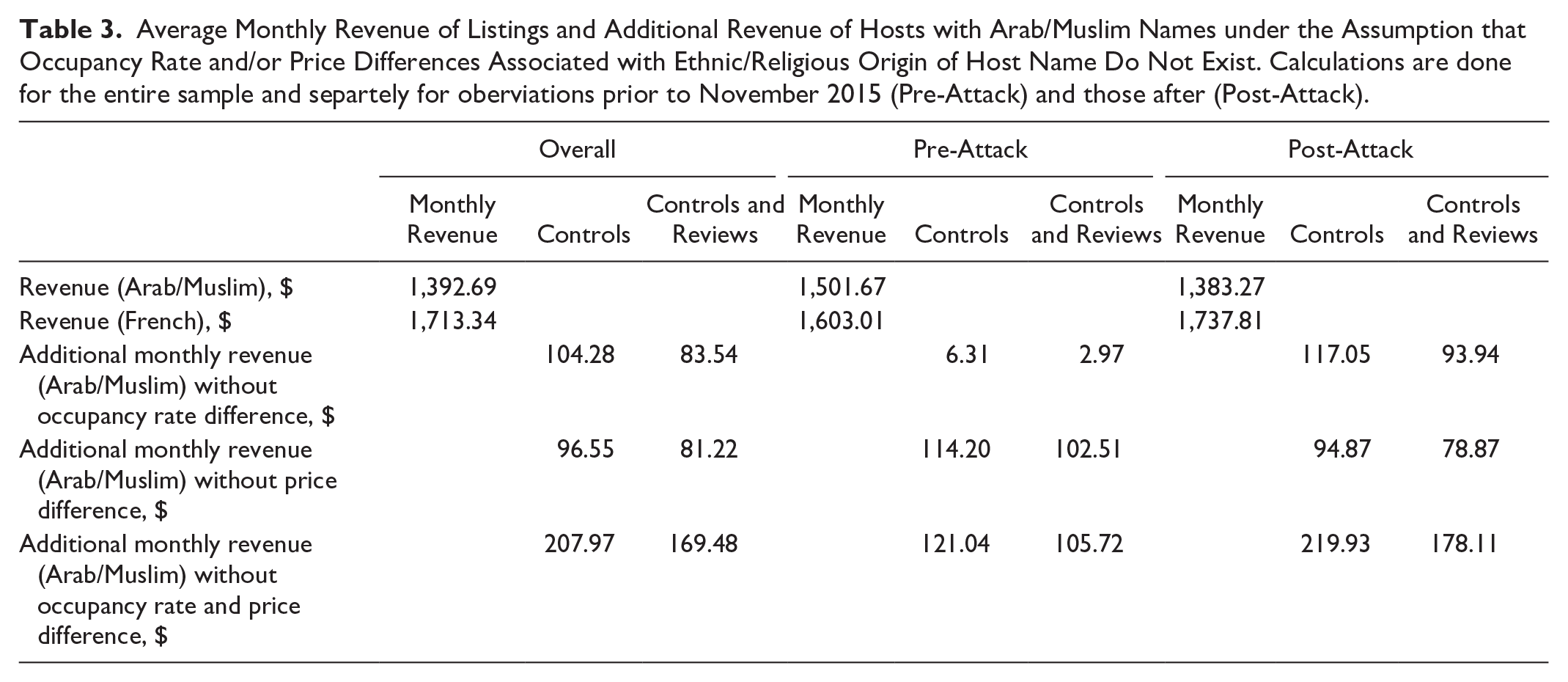
The average monthly revenue for a listing of a host with a French name is $1.713 (US dollars), whereas that of a hosts with an Arab/Muslim name is $1.392, resulting in a difference of $321. Following controls for listing characteristics, the difference drops to $208 ($169 with review controls). Differences in price and occupancy rates contribute almost equal parts to observed differences in revenue between hosts with French and Arab/Muslim names. Note that the revenue gains under the scenarios modeling counterfactual occupancy rate and price separately do not add up to the value of the scenario that models them jointly because a higher occupancy rate yields even greater returns if price is higher and vice versa.
A comparison of the estimates for two subsamples of observations, one prior to and the other following the terrorist attacks of November 2015, illustrates how discrimination changed in size and substance. For one, we can note that it increased overall because we find an increase in the differences in observed average monthly revenues for French and Arab/Muslim listings. Average monthly revenue for hosts with Arab/Muslim names declined from $1,502 before the attacks to $1,383 after, whereas it increased from $1,603 to $1,738 for those with French names. Similarly, after controlling for listing characteristics, we find that the revenue difference attributable to having Arab/Muslim names increased from $121 ($106 with review controls) prior to the attacks to $220 ($178) thereafter. Second, discrimination changed in substance. Price differences accounted almost entirely for estimated revenue losses in Arab/Muslim listings before November 2015. After the attack, the effect of differences in occupancy rates overcomes, by a substantial margin, the contribution of price differences to discrimination against hosts with Arab/Muslim names.
Additionally, we provide estimates of the overall market revenue foregone on Arab/Muslim listings. We estimate that the revenue lost across all hosts of Arab/Muslim listings ranged from $5.5 million (model with review controls) to $6.2 million (without review controls). Absent any differences in price and occupancy rates, this would have corresponded to a 10 percent increase in the total revenue that Arab/Muslim hosts collected between November 2014 and March 2018. Absent differences in price only, the result would have been an additional revenue of $3.5 to $3.6 million. Absent differences in occupancy rates only, this number would have amounted to $2.3 to $2.9 million of additional revenue.
Discussion
This study contributes to two strains of recent scholarship. One is research on the contemporary wave of terrorist attacks and its effects on health conditions, political participation, housing prices, wages, and employment. The other concerns research on the sharing economy and the pervasive discrimination in peer-to-peer interactions. Our work builds on these findings and extends them. We show that the sharing economy is not only subject to discriminatory behaviors but is also a unique source of data to track their intensity and their change in reaction to societal events. We show this for the case of a massive terrorist attack. With regards to our contribution to research on the sharing economy, we build on a growing number of findings that document ethnic disadvantages on a variety of platforms. The results from our random effects modeling approach are in line with evidence of a price penalty on the rental platform Airbnb for hosts with names associated with ethno-racial minorities (Edelman, Luca, and Svirsky 2017; Laouenan and Rathelot 2017). The results from the repeated OLS and fixed effects models add a novel twist to these findings. They show that online discriminatory behavior intensifies and stays for a long while at its new high point in reaction to an exogenous event such as the November 2015 Paris attacks. This is significant for two reasons.
First, many studies of discrimination in the sharing economy rely on observational data that are subject to omitted variable bias. In our case, for example, this may result from missing data on the content of visuals and on written descriptions of Airbnb properties and from any unobserved micro-level neighborhood differences, each of which, if correlated with host ethnicity, may bias model estimates. Potential biases of this kind would raise credible doubts on whether evidence of disadvantages for members of a certain ethnicity signals discrimination. However, none of these omitted variables are likely to influence a change in discrimination in response to an exogenous event. The fact that discriminatory behaviors on sharing economy platforms react to such events, as our results demonstrate, lends credibility to other studies documenting such discrimination and makes it less likely that observed discrimination is a statistical artifact of unobserved variable bias.
A second contribution of our results is the practical illustration of how data from the sharing economy can act as a social seismograph. As shown by our study, these data provide ample opportunities for researchers to track societal changes and gradations in attitudes and behaviors. Caveats to bear in mind are that sharing economy users represent a considerable but still select sample of the population and that changes in attitudes might not generalize to other populations. Changes in discrimination could also be influenced by changes in the composition of visitors after the attacks. If, for example, individuals with Arab/Muslim backgrounds decide to visit Paris less and if those visitors in turn display an in-group preference for Arab/Muslim hosts, visitor patterns might contribute to discriminatory trends. Results from our robustness checks on how discrimination varies in intensity as a function of the ethno-racial association of names (Appendix section on name classification in the supplemental material) is another example of this potential.
With regards to our contribution to research on the behavioral consequences of terrorism, our study provides a clear picture of the temporal evolution of discrimination for a time period spanning over 2 years following the terrorist attacks. The results show an immediate upward spike in discriminatory behavior. Whereas results on price discrimination are either small or nonexistent (depending on the modeling strategy), discrimination is reflected in a sudden decline in relative consumer demand after the attacks, with a direct effect on listings held by Arab/Muslim hosts, whose occupancy rates drop disproportionately. This is in line with what one might expect based on group threat theories of discrimination. It is also consistent with the prediction of the disaster paradigm—the most prominent theory on the temporal shape of societal reactions to acts of terror.
However, contrary to our prediction, the higher levels of discrimination linger longer than expected, up to our last data point in March 2018, that is, some 28 months following the attacks. Different and not mutually exclusive interpretations of this finding are possible. First, the increase in discrimination may reflect behavioral adjustments going beyond the logic of safety behaviors in response to disasters. More pointed research would be needed to disentangle why the consequences of terror attacks last longer for discriminatory behaviors than they do for psychological well-being, emotions, attitudes, and safety behaviors (Garcia and Rimé, 2019; Hopkins 2010; Pelletier and Drozda-Senkowska, 2016; Prager et al. 2011; Rimé et al. 2010; Scott et al. 2013). Second, the November 2015 attacks led, among other things, the French government to declare a three-month state of emergency and had an expected strong and long-lasting resonance in the media. Although difficult to measure, it is plausible such institutional and normative changes transformed the initial postattack conditions, making the disaster paradigm less applicable in the longer run. Finally, the level of discrimination we measure against Arab/Muslim hosts may be subject to a particular bias in the long run. As part of our robustness checks, we compare the performance of French hosts relative to those of other ethnicities (Appendix section on name classification in the supplemental material). Although we did not find a similar spike in discrimination around the attacks, we did find that over the long run, the relative performance of French-named hosts increased. This trend makes us reluctant to necessarily interpret the longer-term trends as being driven exclusively by the post-attack increase in discrimination; there are likely also secular trends related to the tourism market.
In conclusion, our analysis complemented past findings on the persistence and intensity of day-to-day discrimination in online peer-to-peer markets and showed evidence on their sensitivity to terrorist attacks. Neither of these is an exclusive feature of the sharing economy. Evidence of discrimination in the traditional economy is aplenty (Adida et al. 2010; Pager and Shepherd 2008; Quillian et al. 2017) and not lacking with regard to the effects of terrorism (Davila and Mora 2005; Gautier et al. 2009; Glover 2019; Kaushal et al. 2007; Ratcliffe and von Hinke 2015). But as the sharing economy and its characteristic reliance on revealed personal information of buyers and sellers has grown to become an essential feature of contemporary economies, our findings invite further scrutiny on these new markets by researchers and policymakers willing to understand the specific mechanisms of discrimination and to limit its consequences. Lastly, insofar as these markets represent weakly institutionalized settings in which a majority of private individuals rely heavily on trust to exchange goods and services, there is reason to infer from our findings that the observed effects of terrorism likely apply to a wide range of daily interactions.
Supplemental Material
sj-docx-1-srd-10.1177_23780231241276343 – Supplemental material for The Economic Penalty of Terrorism: Increase in Discrimination against Arabs and Muslims after Paris Attacks
Supplemental material, sj-docx-1-srd-10.1177_23780231241276343 for The Economic Penalty of Terrorism: Increase in Discrimination against Arabs and Muslims after Paris Attacks by Sander Wagner and Ivaylo D. Petev in Socius
Footnotes
Funding
The author(s) disclosed receipt of the following financial support for the research, authorship, and/or publication of this article: This research is supported by a grant of the French National Research Agency (ANR), “Investissements d’Avenir” (Labex ECODEC-ANR-11-LABX-0047).

Supplemental Material
Supplemental material for this article is available online.
1
New market entrants are, however, included and discrimination against them is captured in the repeated ordinary least squares models.
2
Southern European/Mediterranean names have lower prices and occupancy rates, Eastern European names have lower prices and higher occupancy rates, and Anglo/German names have higher price and lower occupancy rates relative to French names.
Author Biographies
References
Supplementary Material
Please find the following supplemental material available below.
For Open Access articles published under a Creative Commons License, all supplemental material carries the same license as the article it is associated with.
For non-Open Access articles published, all supplemental material carries a non-exclusive license, and permission requests for re-use of supplemental material or any part of supplemental material shall be sent directly to the copyright owner as specified in the copyright notice associated with the article.
