




Abstract
Previous work has documented the rise of educational expectations among U.S. adolescents and the change in its ability to predict future educational attainment. However, studies have yet to examine these longitudinal changes across generational birth cohorts defined by ever-shifting social norms, cultural contexts, and social policies. Using Monitoring the Future Study panel data, we conducted cohort-stratified modified Poisson regression models to estimate the probability of bachelor’s degree completion by educational expectations overall and by gender, race and ethnicity, and parental educational attainment. We found that despite high educational expectations, non-Hispanic Black, Hispanic, and first-generation students had a low likelihood of bachelor’s degree completion. These relationships persisted across generational cohorts. These findings suggest that social and economic resources remain salient factors that structure educational opportunities for students from minoritized racial and ethnic backgrounds and first-generation students.
Keywords
A vast body of work has examined the relationship between college educational expectations and educational outcomes, with some debating the nature of the link and whether or not it has changed substantively over time (Freeman and Wilson 2022; Jacob and Wilder 2010; Reynolds and Johnson 2011). Unlike aspirations, which reflect what students hope will happen, expectations are what students think will happen (Jacob and Wilder 2010). Most scholars in the educational expectations-attainment literature agree that there has been a general trend of increased expectations among U.S. adolescents concerning the pursuit and completion of a bachelor’s degree (Freeman and Wilson 2022; Jacob and Wilder 2010; Reynolds and Johnson 2011). However, whereas some view educational expectations as a key indicator of adolescent motivation and future educational success (Reynolds and Johnson 2011), others remain more skeptical, pointing to evidence of the widening gap between student expectations and graduating from a four-year college (Reynolds et al. 2006; Reynolds and Pemberton 2001). Of particular concern is that this misalignment between expectations and attainment appears to be much more prominent among young men, students from racially and ethnically minoritized backgrounds, and first-generation students (Jacob and Wilder 2010; Wilbur and Roscigno 2016).
Many economic, structural, and cultural factors influence adolescent educational expectations (Lucas and Irwin 2018; Riegle-Crumb, Kyte, and Morton 2018). However, studies have yet to explore how the relationship between educational expectations and attainment has changed in the context of differing generational birth cohorts, defined by ever-shifting social norms, cultural contexts, and social policies (Elder and George 2016; Settersten 2006; Uhlenberg and Miner 1996). Using the framework of generational cohorts provides a unique opportunity to understand how different formative experiences and structural changes interact with and shape adolescents’ worldviews and subsequent expectation setting and behavior. Generational differences may stem from changes in the processes and content of socialization alone or with key historical events and policy changes (Elder and George 2016; Settersten 2006; Uhlenberg and Miner 1996). These changes may, in turn, influence the nature of the expectations-attainment relationship across gender, race and ethnicity, and parental education within each generational cohort (Lucas and Irwin 2018; Riegle-Crumb et al. 2018).
Using data from the longitudinal arm (1976–2014) of the Monitoring the Future Study (MTF), this article expands on the literature on the educational expectations-attainment relationship by adopting a cohort/life course perspective to examine generational cohort trends in the relationship between education expectations and bachelor’s degree completion. First, we examine the changing associations between educational expectations and bachelor’s degree completion across three generational birth cohorts spanning 50 years: Baby Boomers (1946–1964), Generation X (1965–1980), and Millennials (1981–1996). Second, we use a four-category measure of educational expectations rather than a dichotomized measure, as some prior work has done (Jacob and Wilder 2010; Reynolds et al. 2006), allowing us to compare the predicted probability of bachelor’s degree completion at different levels of expectations (“definitely will,” “probably will,” and “probably won’t” graduate from a four-year college) versus the lowest level of educational expectations (“definitely won’t” graduate from a four-year college). Lastly, within each generational cohort, we examined whether these relationships varied by gender, race and ethnicity, and parental educational attainment. This study expands previous knowledge on the link between expectations and attainment by highlighting the change and persistence in educational attainment disparities.
Background
Educational Expectations and Educational Attainment by Gender, Race and Ethnicity, Parental Education
Several decades of work point to an amalgamation of factors influencing student educational expectations, many of which also influence educational attainment. These factors include social capital (e.g., support of friends, family, teachers), cultural capital (e.g., aspirational, familial, resistance), household socioeconomic status (SES; e.g., parental education, household income), parental involvement, peers and role models, school quality, and individual ability (Jacob and Wilder 2010; Villalobos 2021). Structural or environmental factors (e.g., area-level unemployment, residential segregation) have also been associated with lower educational expectations (Jacob and Wilder 2010). Although some have raised questions about the predictive or causal power of expectations (Jacob and Wilder 2010), the salience of expectations and their consequences in the lives of students persists as a site of inquiry (Khattab 2015). Other studies have investigated how social location, particularly gender, race and ethnicity, and parental education, influence educational expectations and later educational outcomes (Morgan 1996; Reynolds and Johnson 2011; Young, Beutel, and Burge 2023).
Research finds that female students have reported substantially higher educational expectations than their male peers (Young et al. 2023), partly explained by differential socialization and the feminization of education (Morris 2012). Simultaneously, women’s college enrollment and attainment have exceeded their male peers since the 1970s (DiPrete and Buchmann 2006; Jacob and Wilder 2010; Reynolds and Burge 2008). Rational actor models explain women’s advancement in higher education via an increase in the perceived benefits of obtaining a bachelor’s degree for women (Charles and Luoh 2003; DiPrete and Buchmann 2006) and a better, more equal opportunity structure to pursue and succeed in college (Charles and Luoh 2003).
Most racially and ethnically minoritized students have seen an increase in college completion since the 1970s (National Center for Education Statistics 2020). However, the racial gap in educational attainment persists for some minoritized groups (National Center for Education Statistics 2020). Since the late 1980s, non-Hispanic Asian students have had the highest enrollment at two- and four-year institutions and were more likely to complete college than any other racial and ethnic group (National Center for Education Statistics 2020). Yet recent declines in the share of non-Hispanic Black students on college campuses is a growing concern (National Center for Education Statistics 2020). Some studies find that after controlling for socioeconomic factors (e.g., parental education, financial strain), minoritized youth report significantly higher levels of educational aspirations and expectations than their non-Hispanic White peers (Morgan 1996). Historical and ongoing discrimination has resulted in differential opportunity structures and trust among non-Hispanic Black and Hispanic communities, with adolescents doubting that they will see similar returns from their educational investments (e.g., occupation, salary) as their non-Hispanic White counterparts. How the educational expectations-attainment relationship varies by race and ethnicity over time remains an active area of study (Villalobos 2021).
Parental education has also been strongly linked to educational expectations and attainment (Freeman and Wilson 2022; Hoff and Laursen 2019; Stull 2013). Direct links between parental education, educational expectations, and bachelor’s degree completion stem from the economic advantages and social and cultural capital conferred to households with greater economic resources (Andres et al. 2007; Stull 2013). Students who have one or more parents who have completed their bachelor’s degree may perceive greater familial and financial support from their parents (Freeman and Wilson 2022) and greater parental expectations and involvement (Hoff and Laursen 2019; Stull 2013), which may bolster their educational expectations and later college attainment. Conversely, first-generation students, defined as those students whose parents did not complete their bachelor’s degree, may face additional barriers beyond lower social, cultural, economic capital then their non-first-generation peers (Wilbur and Roscigno 2016). For first-generation students, college is not a “rite of passage” (Armstrong and Hamilton 2013). Many may find their habitus, or their worldview and disposition (Bourdieu 2020), shaped by formative experiences in their home community, may be dramatically different or at odds with the habitus they will need to succeed in college (Lee and Kramer 2018). Some first-generation students may choose to completely sever ties to their home community, for which they were an integral part of the emotional and labor ecosystem (Lee and Kramer 2018; Wilbur and Roscigno 2016), resulting in feelings of betrayal, shame, guilt, or rebellion (Armstrong and Hamilton 2013; Hurst 2018). Others may embrace their first-generation student status as a coping strategy (Hurst 2018). Still others may adopt a habitus that melds their home and college identities (Hurst 2018). First-generation students’ home community experiences and the ways in which they adapt to college can impact the social and capital-building strategies they employ, such as studying abroad, getting involved in student organizations, and conducting research with faculty (Jack and Irwin 2018; Stuber 2011). However, first-generation students may be more likely than their non-first-generation student peers to have to balance those activities against the need to work for pay or live at home (Stuber 2011).
Educational Expectations-Attainment Changes over Time
In addition to the empirical work examining the influence of social location, a growing body of work highlights how educational expectations and their subsequent impact on attainment have changed over time (Jacob and Wilder 2010; Reynolds et al. 2006; Reynolds and Pemberton 2001). Several studies find a stronger correlation between student expectations and educational outcomes among high school cohorts in the 1970s and 1980s than among those in the 1990s and 2000s (Jacob and Wilder 2010; Reynolds et al. 2006; Reynolds and Pemberton 2001). Others have found that high school seniors became more successful at meeting their expectations from 1976 to 1990 (Reynolds and Johnson 2011). Researchers suggest the changes in the expectations-attainment relationship resulted from many factors, including a growth in the (unrealistic) expectations of more recent high school seniors (Reynolds et al. 2006). Other factors include shifting to an individualized curriculum rather than college preparatory, general education, and vocational courses (Reynolds et al. 2006; Reynolds and Pemberton 2001). Authors argue that such flexibility introduced more ambiguity and a loss of feedback on students’ abilities, limiting the information needed to assess whether students have the grades or academic ability to enroll in and succeed in college. Others have pointed to the rise of community colleges to explain the change in student educational expectations. Community colleges improved access to higher education and offered vocational training and continuing adult education. However, some researchers have observed that the availability of two-year degree programs may have persuaded students not to pursue a bachelor’s degree (Reynolds and Burge 2008). Other structural factors, including higher education reform after the Civil rights movement (Jacob and Wilder 2010; Reynolds et al. 2006) and the ballooning costs of college (Jacob and Wilder 2010), may also explain changes in educational expectations.
Research also finds important differences over time in the impact of expectations on attainment by gender, race and ethnicity, and parental education (DiPrete and Buchmann 2006; Freeman and Wilson 2022; Villalobos 2021). Reynolds and Johnson (2011), using 1976 to 1990 data from high school seniors, found evidence that the probability of men’s and women’s expectations predicting their bachelor’s degree completion converged over time. Still, they found that parental education and race and ethnicity were strong predictors of the gap between expectations and attainment, with students with less educated parents and those who were Hispanic or non-Hispanic Black faring most poorly (Reynolds and Johnson 2011). Villalobos (2021) found that in a 2004 cohort of high school seniors, the association between high educational expectations and college enrollment was largest for non-Hispanic White students and smallest for non-Hispanic Black and Hispanic students. However, in the 2013 cohort, there were no detectable differences in college educational expectations and college enrollment by race and ethnicity (Villalobos 2021). These findings suggest that the nature and impact of educational expectations on educational disparities may change over time and warrant further investigation.
The Importance of Generational Cohort
Fundamental assumptions of life course theory are that continuity and change, social structures, and the relationship between “time and place” shape lives (Elder, Johnson, and Crosnoe 2003; Settersten 2006). Central to “time and place” is acknowledging that socio-historical times and places in which their lives evolve shape individuals (Settersten 2006; Uhlenberg and Miner 1996). Birth cohorts (i.e., membership within a group based on birth year) expose members to various socio-historical events, norms, and structural circumstances that shape individual life trajectories (Uhlenberg and Miner 1996). Pertinent to the present study, the institution of higher education and adjacent social institutions (e.g., family) saw a whirlwind of change throughout the latter part of the twentieth century that may have altered the relationship between educational expectations and attainment by gender, race and ethnicity, and SES (Figure 1).

Timeline of select sociopolitical events impacting college educational expectations and attainment across three generational birth cohorts.
After WWII, via governmental programs like the GI Bill and Pell grants (Thelin 2011), the generation known as the Baby Boomers—the cohort born between 1946 and 1964—encountered the rapid expansion of higher education. Student enrollment increased from 2.66 million in 1949–1950 to 8.00 million in 1966–1970, and the role of colleges and universities in American society changed dramatically (Lazerson 1998). Desegregation after the historic Brown v. Board of Education case and the passage of the landmark Higher Education Act of 1965 also saw higher education institutions become more diverse across gender and race and ethnicity (Thelin 2011). Society began to perceive colleges and universities as a public good, and local and federal governments rallied behind their expansion via financial support (Lazerson 1998).
Generation X—the cohort born after 1965 to the late 1970s—saw a continuation in the expansion of higher education alongside other cultural and structural shifts, including technological advances (i.e., the internet), changes in family formation and stability (i.e., increase in divorce), and an increase in occupational credentialism (i.e., undue emphasis on credentials, typically via a college degree, as prerequisites to employment) to gain access to middle-class opportunities and upward mobility (Brown 2001; Tomlinson and Watermeyer 2020). Such changes may have transformed college education expectations because seeking advanced education during this period became normative for many rather than a privilege for a few (Brown 2001; Tomlinson and Watermeyer 2022).
During the 1980s, Millennials—those born in the early 1980s to mid-1990s—were met with a “college-going” culture that glorified postsecondary education as a necessary stage in the life course, which was supported by other social institutions (i.e., readiness programs) early and often (McKillip, Godfrey, and Rawls 2013). Therefore, unsurprisingly, Millennials have been labeled a unique generation with high expectations for their professional and personal life (Bishop 2006). A 2011 study found that 80 percent of Millennials reported having high expectations for themselves, and three-quarters felt confident about attaining their goals (Bresiger 2011). However, this period saw several structural educational changes that may have made attaining their expectations more challenging. K–12 education saw the removal of vocational training programs across schools in the United States as a direct result of funding tied to standardized test scores and a curriculum that prioritized college preparation (Hanford 2014). Beginning in the 1990s, students also saw college tuition increase and simultaneous disinvestment in higher education by state and federal governments (Mitchell et al. 2018). Some figures suggest that the cost of an undergraduate degree has increased by 213 percent in public schools and 129 percent in private schools (Ma 2021). Moreover, there has been a dramatic increase in student loan debt for individuals and families. Education historians have argued that such changes have resulted in a generation of college-bound students forced to face financial struggles entirely foreign for past generations, which disproportionately burden non-Hispanic Black, Hispanic, and first-generation students (Wilbur and Roscigno 2016).
Shifting cultural and economic landscapes may shape college expectations across generations. Millennials, the largest, most ethnically diverse generation in U.S. history, are on track to be the most educated generation to date and are more likely than earlier generations to think American higher education is not working as well as it could (Jones 2018). If student educational expectations reflect a realistic assessment of the likelihood that advanced educational attainment will occur, then understanding how college expectations have changed over time is critical. Moreover, elucidating how those expectations vary by important social identities, such as gender, race and ethnicity, and parental education, may give us a better picture of salient factors influencing college completion.
Based on prior work, we hypothesized that educational expectations would increase across generational birth cohorts, with the highest expectations among Millennials. We also hypothesized that compared to the lowest educational expectations, students with the highest expectations would have the highest probability of bachelor’s degree completion. Based on work by Reynolds and Johnson (2011), we further hypothesized that the highest educational expectations would become more predictive of bachelor’s degree completion over time but that the gap between the lowest and highest expectations would widen (Reynolds and Johnson 2011). Lastly, we hypothesized that gender would not significantly predict differences between expectations and attainment in later generations (i.e., Generation X and Millennials male and female students will achieve parity). However, there would still be significant differences across race and ethnicity and parental education across all generational birth cohorts.
Methods
Study Population
We used data from the longitudinal arm of the MTF study. Baseline MTF survey data, fielded annually since 1976, were collected using a multistage cluster sampling technique that included 125 to 140 public and private schools to obtain a nationally representative sample of high school seniors (Miech et al. 2022). The MTF study selected a representative subsample of approximately 2,450 high school seniors for longitudinal follow-up each year (Patrick et al. 2022). The MTF study randomly splits the subsample into two halves, followed biennially.
Although the longitudinal arm of the MTF study follows high school graduation cohorts, in our analyses, we grouped students into three distinct generational cohorts: students born between 1946 and 1964 (Baby Boomers), students born between 1965 and 1980 (Generation X), and students born between 1981 and 1996 (Millennials). We grouped students in this manner to form cohorts with similar national and temporal sociopolitical, economic, and cultural exposures from birth that may impact their college educational expectations and outcomes (Figure 1). We used baseline data from 1976 to 2014 (in 12th grade at modal age 18) and follow-up data from 1981 to 2019. The analytic sample sizes varied by birth cohort, ranging from 10,763 to 20,792.
Dependent Variable
The primary outcome measured at follow-up was bachelor’s degree completion at modal age 23 to 24. We estimated bachelor’s degree completion by calculating who had completed a bachelor’s degree by modal age 23 to 24.
College Educational Expectations
Students in their senior year of high school were asked about their college educational expectations with the question, “How likely is it that you will do each of the following things after high school? . . . Graduate from college (four-year program).” The response options were (1) “definitely won’t,” (2) “probably won’t,” (3) “probably will,” and (4) “definitely will,” with definitely won’t surviving as the referent category in regression analysis.
Moderators
Using self-reported gender, race and ethnicity, and parental education, we investigated whether these sociodemographic characteristics modified the expectations-attainment association across generational cohorts. We defined gender as male and female due to limitations in how the MTF survey asks about sex and gender, which is “What is your sex?” This self-reported sex identity served as our best proxy measure for evaluating societal norms around gender socialization and identity in each cohort. Therefore, we interpreted this variable as gender going forward. We created four mutually exclusive racial and ethnic categories: non-Hispanic White, non-Hispanic Black, Hispanic, and another race and ethnicity. The “another race and ethnicity” category included Asian American, American Indian or Alaska Native, Native Hawaiian or other Pacific Islander, multiracial students, and students from other races. We aggregated these categories due to small sample sizes and because before 2006, the “other” race category on the MTF survey did not have disaggregated options. Students reported parental education for their mothers and fathers. This measure is a commonly used proxy measure to assess SES in youth populations (Janmaat and Hoskins 2022); however, we recognize that parental education is but one of many measures of household or family SES (Patrick et al. 2012). Parental education also allowed us to consider the impact of being a first-generation student, defined as both parents not having received a bachelor’s degree (Wilbur and Roscigno 2016). We used the highest education level attained by either parent in each household to create the parental education variable. Parental education categories were (1) high school graduate or less, (2) some college, and (3) college graduate or more.
Covariates
Our analysis controlled for school-related predictors related to educational expectations and bachelor’s degree completion (Jacob and Wilder 2010). We included high school curriculum (college prep, general, vocational/technical, other), hours worked per week during the school year (none, 0–20, 20+), and the number of parents in the home (0, 1, 2). We also controlled for several behaviors known to impact educational outcomes, including (1) heavy cigarette use in the past 30 days (one-half pack or more per day vs. other), (2) binge drinking in the past two weeks (once or more vs. none), and (3) heavy marijuana use during the past 30 days (more than 20 occasions vs. other; Bugbee et al. 2019). All covariates were baseline measurements collected during participants’ senior year of high school.
Statistical Analysis
We generated weighted percentages and 95 percent confidence intervals (CIs) for our educational expectation measure, bachelor’s degree completion at modal age 23 to 24, and covariates stratified by generational cohort to describe our sample. We conducted separate, cohort-stratified modified Poisson regression models with a sandwich variance estimator (Zou and Donner 2013) to examine the relationship between college educational expectations and bachelor’s degree completion at follow-up. We used modified Poisson regression models, which directly estimate risk ratios rather than odds ratios, as with logistic regression, and do not face the same issues with convergence as log-binomial models for estimating probabilities (Zou and Donner 2013). We used these estimates to generate average marginal effects (AMEs) on the additive scale, interpreted as probabilities, maintaining all covariates at their actual, observed values (Zou and Donner 2013). We also explored effect modification by sociodemographic characteristics by including a single interaction term between college educational expectations and gender, race and ethnicity, or parental education in separate models. To adjust for multiple testing in interaction models, we applied the Benjamini-Hochberg correction with the false discovery rate at 5 percent across the interaction models for each outcome and birth cohort. We also ran stratified models to examine the relationship between college educational expectations and bachelor’s degree completion by modal age 23 to 24 by birth cohort and each sociodemographic factor. For ease of interpretation of these results, we present these findings by graphing the predicted probabilities for bachelor’s degree completion by modal age 23 to 24 associated with educational expectations stratified by cohort and by cohort and gender, race and ethnicity, and parental educational attainment. Supplemental Table 1 contains all AMEs and 95 percent CIs.
We applied attrition weights to account for loss to follow-up, oversampling of students who used drugs, and the complex survey design of the MTF study. We calculated attrition weights as the inverse of the probability of participation at follow-up based on gender, race and ethnicity, parental education, college educational expectations, truancy, high school grades, number of patents in the home, religiosity, alcohol use, cigarette use, marijuana use, other illicit drug use, region, cohort, and sampling weight. We conducted all analyses using Stata MP 17.0 (StataCorp 2023) and SAS 9.4 software (SAS Institute Inc. 2022).
Secondary Analyses
Timing of college completion is complex, with students delaying completion due to social, financial, or other factors (Lucas and Irwin 2018; Riegle-Crumb et al. 2018). To capture this complexity, we ran a secondary set of analyses examining bachelor’s degree completion at modal ages 25 to 26, allowing for later completion. Supplemental Table 6 contains all AMEs and 95 percent CIs.
Results
Sample Student Characteristics across Generational Cohorts
The percentage of sample students who completed their bachelor’s degree at modal age 23 to 24 increased across generation cohorts, with 26.3 percent of Baby Boomers, 34.0 percent of Generation X, and 44.0 percent of Millennials receiving four-year degrees (Table 1). The percentage of students who said they definitely will graduate from a four-year college also increased across cohorts, with 32.6 percent of Baby Boomers, 50.7 percent of Generation X, and 62.8 percent of Millennials having these high educational expectations. Over half of sample students were female, increasing slightly across generational cohorts. The racial and ethnic diversity of students increased across cohorts. The share of students in the Baby Boomer (84.1 percent), Generation X (77.1 percent), and Millennial (68.7 percent) identifying as non-Hispanic White declined across cohorts. In contrast, the percentage of non-Hispanic Black, Hispanic, or another race and ethnicity students increased. The educational attainment of students’ parents also increased across generational cohorts. Fewer students reported that the highest level of educational attainment of either parent was high school or less among Baby Boomers (48.9 percent), Generation X (33.5 percent), and Millennials (26.1 percent), and far more Baby Boomer (33.4 percent), Generation X (45.3 percent), and Millennial (53.1 percent) students reported their parents had a college degree or more, indicating fewer first-generation students over time. Single-parent households also increased from 14.8 percent among Baby Boomers to 24.6 percent among Millennials. The percentage of students enrolled in vocational/technical high school curricula declined over generational cohorts among Baby Boomer (15.3 percent), Generation X (9.6 percent), and Millennial (5.9 percent) students. In comparison, the percentage of Baby Boomer (48.3 percent), Generation X (58.1 percent), and Millennial (59.5 percent) students in college preparatory programs increased. Millennial (31.9 percent) students reported not working more than Baby Boomer (20.6 percent) or Generation X (22.7 percent) students. Lastly, the percentage of students reporting past 30-day heavy cigarette use, binge drinking in the past two weeks, or past 30-day heavy marijuana use declined over generational cohorts.
Weighted Descriptive Statistics for Respondents Included in the Analysis of Bachelor’s Degree Completion at Modal Age 23 to 24 by Generational Birth Cohort, Monitoring the Future Longitudinal Sample, Baseline Years 1976–2014.

Note: CI = confidence interval.
Trends in Educational Expectations by Gender, Race and Ethnicity, and Parental Education
The percentage of male Baby Boomer students (33.6 percent) reporting the highest educational expectations (i.e., definitely will graduate from a four-year college) was not statistically different from that of female Baby Boomer students (31.7%; p = .052; Table 2). However, this pattern changed among Generation X, with female student expectations (54.4 percent) exceeding that of their male counterparts (46.4 percent; p < .001). The greatest difference was observed among Millennial female (67.4 percent) and male students (57.2 percent; p < .001). Non-Hispanic Black students (35.3 percent) had the highest educational expectations among racial and ethnic groups among Baby Boomers; however, racial and ethnic differences were not statistically significantly. Although educational expectations increased over generational cohorts for all racial and ethnic groups, those students identifying as another racial and ethnic group had the highest expectations in the Generation X (56.0 percent) and Millennial (65.9 percent) cohorts. Hispanic students consistently had the lowest educational expectations across generational cohorts. Racial and ethnic differences in educational expectations for Generation X (p < .001) and Millennials (p < .001) were statistically significantly different. Regarding educational expectations by parental educational attainment, students with at least one parent with a college degree or higher consistently had higher educational expectations across generational cohorts compared to first-generation students. However, among first-generation students, those whose parents’ highest educational attainment was a high school degree or less showed the greatest increase across generational cohorts, doubling from 20.0 percent in the Baby Boomer cohort to 45.4 percent in the Millennial cohort. Differences in educational expectations by parents’ highest educational attainment were statistically significantly different by cohort (p < .001).
The Percentage of Students Included in the Analysis of Bachelor’s Degree Completion at Modal Age 23 to 24 Who Responded That They “Definitely Will” Graduate from a Four-Year College (High Educational Expectations) by Sociodemographic Factors and Generational Birth Cohorts, Monitoring the Future Longitudinal Sample, Baseline Years 1976–2014.

Note: CI = confidence interval.
Educational Expectations and Actual Attainment across Generational Cohorts
Across generational cohorts, the highest educational expectations were increasingly predictive of bachelor’s degree completion by modal age 23 to 24 after adjustment for sociodemographic factors, family structure, high school curriculum, and substance use (Figure 1). This relationship was further reflected by the widening difference in predicted probabilities between students with the highest educational expectations relative to those with the lowest educational expectations (i.e., definitely won’t graduate from a four-year college) among the Baby Boomers (AME = 0.375, 95 percent CI = 0.354, 0.396), Generation X (AME = 0.399, 95 percent CI = 0.383, 0.415), and Millennials (AME = 0.454, 95 percent CI = 0.425, 0.482; Table 3). Notably, the predictive probability of bachelor’s degree completion also increased across generational cohorts for those who said they definitely won’t graduate from a four-year college and slightly increased for those who said they probably won’t; the predictive probability of those who said they probably will remained relatively stable (Figure 2). This pattern across cohorts indicates the gap in the predictive probability of bachelor’s degree completion between those who said they probably will and probably won’t relative to those who said they definitely won’t narrowed slightly.
Average Marginal Effects for the Association between College Educational Expectations and Bachelor’s Degree Completion at Modal Age 23 to 24 by Generational Birth Cohort, Monitoring the Future Longitudinal Sample, Baseline Years 1976–2014.

Note: Each average marginal effect is estimated from a single model with college educational expectations as the independent variable. All models control for baseline covariates, as shown in Table 1, for each generational birth cohort. AME = average marginal effect; CI = confidence interval.
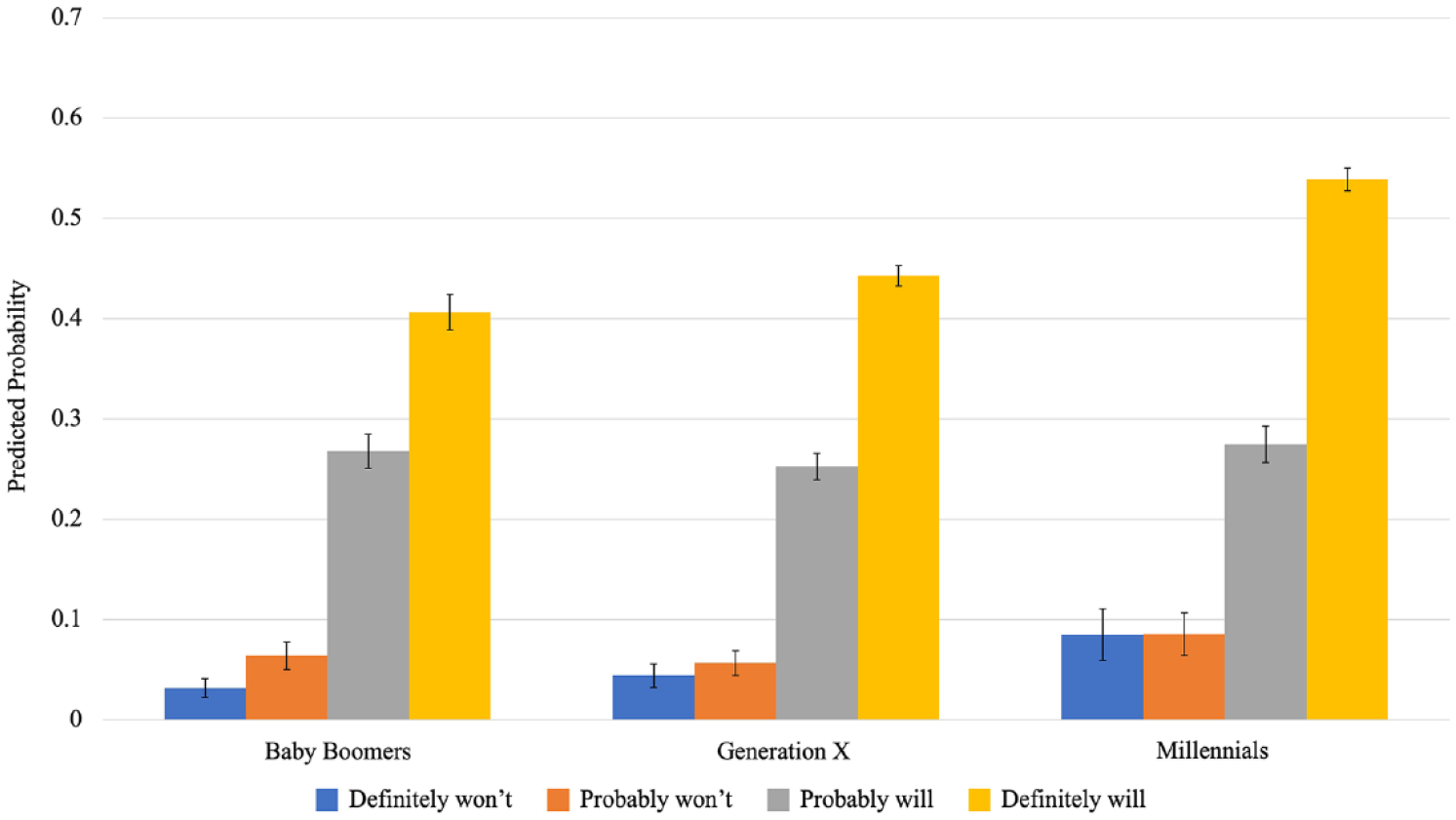
Association between educational expectations and bachelor’s degree completion at modal age 23 to 24 by generational birth cohort, Monitoring the Future Longitudinal sample, baseline years 1976 to 2014.
Educational Expectations and Attainment and the Role of Gender, Race and Ethnicity, and Parental Education across Generational Cohorts
The predicted probability of bachelor’s degree completion by modal age 23 to 24 associated with high educational expectations was similar among male and female students (p = .783) among Baby Boomers (Table 4; Figure 3). However, the predicted probability of bachelor’s degree completion associated with the highest educational expectations diverged among male (AME = 0.411, 95% CI = 0.396, 0.427) and female (AME = 0.469, 95% CI = 0.457, 0.482) Generation X students (p < .001; see Supplemental Table 1). Although the predicted probability of bachelor’s degree completion associated with the highest educational expectations remained greater for Millennial female students, there were no statistically significant differences between male and female students (p = .293).
Additive p Values for the Interaction between College Educational Expectations and Key Sociodemographic Factors and Its Association with Bachelor’s Degree Completion at modal Age 23 to 24 by Generational Birth Cohort, Monitoring the Future Longitudinal Sample, Baseline Years 1976–2014.

Note: Each interaction is estimated from a separate Poisson model with all main effects and a single interaction term between college educational expectations and either gender, race and ethnicity, or parental education. All models controlled for covariates shown in Table 1 for each generational cohort. Boldface p values indicate significance after controlling false discovery rate at 5 percent.

Association between educational expectations and bachelor’s degree completion at modal age 23 to 24 by gender and generational birth cohort, Monitoring the Future Longitudinal sample, baseline years 1976 to 2014.
The predicted probability of bachelor’s degree completion by modal age 23 to 24 associated with the highest educational expectations was greatest among non-Hispanic White students (AME = 0.440, 95% CI = 0.420, 0.459), followed by students from another racial and ethnic group (AME = 0.287, 95% CI = 0.185, 0.389) among Baby Boomers (Figure 4; Supplemental Table 1). These racial and ethnic differences among Baby Boomer students were statistically significantly different (p < .001; Table 4). This pattern held among Generation X students, with statistically significant racial and ethnic differences also observed (p < .001). Among Millennial students, the predicted probability of bachelor’s degree completion associated with the highest educational expectations was similar for non-Hispanic White students (AME = 0.595, 95% CI = 0.583, 0.608) and students from another racial and ethnic background (AME = 0.593, 95% CI = 0.0.552, 0.635). However, racial and ethnic differences continued to persist among Millennials (p < .001), driven by lower predicted probabilities associated with the highest educational expectations among non-Hispanic Black (AME = 0.365, 95% CI = 0.324, 0.406) and Hispanic (AME = 0.365, 95% CI = 0.328, 0.402) students, which persisted across all generational cohorts.

Association between educational expectations and bachelor’s degree completion at modal age 23 to 24 by race and ethnicity and generational birth cohort, Monitoring the Future Longitudinal sample, baseline years 1976 to 2014.
Students with at least one parent who had a college degree or more had the greatest predicted probability of bachelor’s degree completion by modal age 23 to 24 associated with the highest educational expectations (AME = 0.554, 95% CI = 0.530, 0.578; Figure 5; Supplemental Table 1). However, observed differences by parental education were not statistically different among Baby Boomers (p = .263; Table 4). The gap in predicted probabilities between those students with at least one parent with a college degree or more and first-generation students grew among Generation X (p < .001) and Millennials (p < .001), becoming statistically significantly different. Among Millennials, as with prior cohorts, a clear socioeconomic gradient persisted by parental education, with those with a college degree or more (AME = 0.659, 95% CI = 0.645, 0.672) having the predicted probabilities, followed by those with some college (AME = 0.443, 95% CI = 0.416, 0.469) and a high school education or less (AME = 0.374, 95% 0.348, 0.400; Supplemental Table 1).

Association of educational expectations on bachelor’s degree completion at modal age 23 to 24 by parental education and generational birth cohort, Monitoring the Future Longitudinal sample, baseline years 1976 to 2014.
Secondary Analyses
Supplemental Table 2 provides information on student characteristics and college educational expectations for the sample included in the bachelor’s degree completion analysis at modal age 25 to 26. As with our primary analyses, we observed that higher expectations were associated with a high probability of bachelor’s degree completion by modal age 25 to 26 (Supplemental Tables 3 and 4; Supplemental Figure 1). By gender, we observed that male and female students had similar predicted probabilities among the Baby Boomers (p = .203) and Millennials (p = .320) but differed among Generation X (p < .001; Supplemental Tables 4 and 6; Supplemental Figure 2). Regarding racial and ethnic differences, in contrast to our primary findings, we observed a difference in predicted probabilities among the Baby Boomer (p < .001) and Generation X (p < .001) cohorts but not among Millennials (p = .091; Supplemental Tables 4 and 6; Supplemental Figure 3). Also, in contrast to our primary findings, we observed a statistically significant difference in predicted probabilities by parental education among the Generation X (p < .001) cohort but not among Baby Boomers (p = .263) or Millennials (p = .071; Supplemental Tables 4 and 6; Supplemental Figure 4).
Discussion
Prior work has pointed to educational expectations as important determinants of educational attainment; however, the predictive power of expectations across time has remained an open question (Freeman and Wilson 2022; Hoff and Laursen 2019; Villalobos 2021). In this study, we add to the growing body of work examining how educational expectations and college educational outcomes have changed over time and how the relationship varies by salient social identities. Using a generational birth cohort framework, we found key differences in the expectations-attainment relationship across gender, race and ethnicity, and parental education within and across generations with like national and temporal sociopolitical, cultural, and policy exposures.
Consistent with prior work, we found that educational expectations increased across generational cohorts and predicted bachelor’s degree completion (Reynolds et al. 2006; Reynolds and Pemberton 2001; Villalobos 2021). We also observed this pattern across generational cohorts. Moreover, the observed predictive power of educational expectations increased across cohorts for college completion, with this measure being most salient for Millennials.
To the extent that generational cohorts are defined by predominant social norms, cultural context, and social policies of their time, our findings are in line with previous research that demonstrated critical generational differences in the association between educational expectations and educational outcomes (Goyette 2008; Park, Wells, and Bills 2015). Educational expectations and bachelor’s degree completion have increased in the last several decades (Goyette 2008; Park et al. 2015). These trends may be partly explained by policy efforts over the last several decades, such as Title VI of the Higher Education Act, Title X of the Educational Amendments of 1972, and Affirmative Action programs aimed at closing sociodemographic disparities in educational outcomes (Park et al. 2015). We have also seen substantial cultural shifts in the meaning and nature of higher education; college education is now a culturally normative expectation by employers (Goyette 2008; Park et al. 2015). However, we also observed differential trends in the educational expectations-attainment relationship such that gains across cohorts were unequal across gender, race and ethnicity, and parental education.
Regarding the role of gender, we detected a difference between men and women in the predicted probability of bachelor’s degree completion for Generation X but not for Baby Boomers or Millennials. Our findings align with prior work that found women realized their college educational expectations more often than men from 1972 to 1994; however, the gap began to close at the end of this period (Reynolds and Johnson 2011). We could not detect gender differences in the role of educational expectations for Millennials. For Generation X female students, educational expectations increased their bachelor’s degree completion probability compared to male students. This generational difference could be partly explained by the convergence of social forces and policy changes, such as the passage of Title IX of the Educational Amendments of 1972, the Civil Rights Act of 1964, second wave feminism, and the advancement of coed institutions during the 1970s (Park et al. 2015). Such social factors and the active enforcement of social policies have shown tremendous power in shifting the gender gap in college attendance and completion. For example, in 1970, 58 percent of college students were men, but by the 1980s (cohorts born in the 1960s), the gender gap in college attendance had reversed, and since that time, women have made substantial gains in all realms of education (Wells, Seifert, and Saunders 2013). Historians of higher education have pointed to the aforementioned legislative policies and social changes as the reasons institutions of higher education are now organized based on function, not gender (Tuttle 2004). However, there is some evidence that this progress has slowed (Bailey and DiPrete 2016). This decline in progress may partly be due to changes in the perceived returns to education. Despite being more educated than men, women are consistently paid less for the same job (Blau and Kahn 2020). Future work is needed to examine gender differences in the perception of the returns to education to understand better how more recent cohorts of women understand and value education.
The most consistent difference in the association between educational expectations and completion by generational cohort was observed across racial and ethnic groups. Educational expectations were most predictive for non-Hispanic White students and students from another race and ethnicity and least predictive for non-Hispanic Black or Hispanic students. Consistent with prior work, we found that despite having higher educational expectations than non-Hispanic White students, these expectations were less likely to predict bachelor’s degree completion among non-Hispanic Black and Hispanic students (Reynolds and Johnson 2011; Villalobos 2021). Prior research has found that many social, economic, psychological, and cultural factors influence student educational expectations (Park et al. 2015; Villalobos 2021). For non-Hispanic Black students, prior work with high school seniors revealed their uncertainty and concerns over the cost of college are perceived barriers to college attendance and completion despite their expectations (Comeaux, Chapman, and Contreras 2020). Other research pointed to racial and ethnic differences in social and cultural capital between and college attendance, with educational expectations being a less important predictor of college attendance for non-Hispanic Black students than non-Hispanic White or Hispanic students (Perna 2000). One possible explanation for these findings is that non-Hispanic Black students have less access to information and knowledge about how to acquire a college education and attain their educational goals compared to their non-Hispanic White and Hispanic students with the exact educational expectations (Jacob and Wilder 2010; Perna 2000; Reynolds et al. 2006).
Lastly, the association between educational expectations and bachelor’s degree completion differed across parental education levels among Generation X and Millennial students, with expectations far less predictive of attainment for first-generation students. Our work is in line with Wilbur and Roscigno (2016), who found that first-generation students were 23 percent to 58 percent less likely to complete their four-year college degree than their non-first-generation peers using nationally representative 2002 to 2012 Educational Longitudinal Survey data (Wilbur and Roscigno 2016). Prior work has highlighted the strong influence of parental education on children’s college educational expectations (Wells et al. 2013; Wilbur and Roscigno 2016). Parental education is associated with social class, earnings, wealth, and the resources available to students enrolling in college to complete their degrees (Wells et al. 2013). Students with greater resourced parents are less likely to have economic circumstances negatively impact their ability to obtain their degree (Wells et al. 2013). Moreover, parents who have completed their bachelor’s degree are likely better positioned to model behaviors and assist their children in the precollege and college process in ways that increase academic success (Wells et al. 2013). Some first-generation students report that their parents are just as nurturing and supportive as parents with bachelor’s degrees but lack the experience and cultural capital to provide their children with the guidance they might need to navigate an unfamiliar and challenging academic environment (Hamilton 2016). Others report that their parents are disinterested in their college life or even feel a sense of betrayal (Hurst 2018). Navigating responsibilities to their home and college communities can be a potent stressor in first-generation students’ lives, with many feeling a greater sense of loss of their home community support system than their non-first-generation peers (Hamilton 2016; Lee and Kramer 2018; Wilbur and Roscigno 2016). Prior work has also found that parental education, and SES more broadly, is more important to student success now than 50 years ago (Duncan and Murnane 2011). Evidence points to a set of social conditions, policy choices, and educational practices, including growing income inequality, differential investments in time and resources, and differences in school quality and opportunities, as key explanations for the growing importance of parental education and SES on children’s educational expectations and attainment over time (Hoff and Laursen 2019; Stull 2013). The role of parental education for future generations of college-bound students remains unknown; however, there may be reasons to expect its importance to persist as the wealth gap between low-income and high-income families grows. Examining how the experiences of first-generation students both before and during college shape their expectations and attainment and how these relationships may be changing across generational cohorts may be a notable direction of future work.
Several limitations of the present student are worth noting, but they also point to important future directions. First, we acknowledge that self-reported sex and gender identity are conceptually distinct. This analysis was limited to the data collected by the MTF survey. Therefore, self-reported sex served as our best proxy measure to examine the impact of gender norms and socialization. Future work should use more inclusive questions around gender identity and sex assigned at birth.
Second, we did not examine college attendance, two-year college attendance or completion, or the selectivity of four-year colleges. MTF only asks high school seniors, who may already know whether they will attend college in the fall, about their plans to graduate from a four-year college. Therefore, these estimates would likely be biased. Attending a two-year college is a pathway by which some minoritized or low SES students enter four-year institutions. However, we attempted to capture this population by examining bachelor’s degree completion across two modal ages. Future work should examine the role of two-year institutions as essential stepping stones for racially and ethnically minoritized and first-generation students (Patrick, Schulenberg, and O’Malley 2016). Prior work has demonstrated disparities in attendance by gender, race, and SES, with highly selective institutions favoring students who are male and non-Hispanic White and come from high SES backgrounds. These disparities have important implications for employment and social and economic mobility given that college “brand” tends to play an outsized role in employment opportunities and future earnings (Riegle-Crumb et al. 2018).
Third, small sample size and survey limitations necessitated aggregating multiple racial and ethnic groups into a single “another race and ethnicity” category. Future work should investigate the role of educational expectations using additional categories for race and ethnicity to better understand heterogeneous associations within other racial and ethnic populations. We also could not examine differences at the intersection of gender, race and ethnicity, and parental education due to sample size limitations. We recognize how intersecting identities—especially at the intersection of race and ethnicity and parental education—may further shape educational expectations and the resources and tools to actualize those expectations. This limitation highlights the need for more diverse, longitudinal, and representative cohorts that oversample students from racially and ethnically minoritized backgrounds, allowing for a more detailed examination of all racial and ethnic groups, including multiracial students, first-generation students, and students from lower income households.
Despite these limitations, the present study’s findings demonstrate that the impact of educational expectations on bachelor’s degree completion depends on cohort and important social identities. Despite high educational expectations, non-Hispanic Black, Hispanic, and first-generation students are less likely to complete college than their peers. These patterns persist across generational cohorts and point to the entrenched social and economic forces that limit opportunities for minoritized and marginalized students. More research is needed at the intersection of social identities to understand better the mechanisms behind these substantial inequalities in educational outcomes.
Supplemental Material
sj-docx-1-srd-10.1177_23780231241275394 – Supplemental material for Generational and Sociodemographic Differences in the Impact of Educational Expectations on Bachelor’s Degree Completion: The Monitoring the Future Study
Supplemental material, sj-docx-1-srd-10.1177_23780231241275394 for Generational and Sociodemographic Differences in the Impact of Educational Expectations on Bachelor’s Degree Completion: The Monitoring the Future Study by James H. Buszkiewicz, Andrea K. Henderson, Yanmei Xie, Megan E. Patrick and Nancy L. Fleischer in Socius
Footnotes
Funding
The author(s) disclosed receipt of the following financial support for the research, authorship, and/or publication of this article: This work was supported by the National Cancer Institute of the National Institutes of Health (R37 CA214787) and by the National Institute on Drug Abuse (R01 DA001411). The content is solely the authors’ responsibility and does not necessarily represent the official views of the National Institutes of Health

Supplemental Material
Supplemental material for this article is available online.
Author Biographies
References
Supplementary Material
Please find the following supplemental material available below.
For Open Access articles published under a Creative Commons License, all supplemental material carries the same license as the article it is associated with.
For non-Open Access articles published, all supplemental material carries a non-exclusive license, and permission requests for re-use of supplemental material or any part of supplemental material shall be sent directly to the copyright owner as specified in the copyright notice associated with the article.
