




Abstract
Although we now know that disaster and climate migration is complex and nonlinear, less is known about how migrants from environmentally threatened areas are affected by disasters back home. This study centers the perspectives and care of 30 migrants from several high-risk coastal Louisiana communities who helped their kin in the wake of Hurricane Ida (2021). In fusing the disaster migration and disaster care literature, it illustrates how migrants engage in gendered care work from afar. It also shows how gender shapes decision making to stay in or stay attached to such environments and even perpetuates the need for future care. The theoretical concept of a “disaster carescape” is proposed to highlight intergenerational care across time and space while emphasizing place (environmentally threatened landscapes) and place attachment in shaping these care relations. The author concludes by suggesting that disaster carescapes will be important to understand as demographics in climate-affected areas shift during this century.
After Hurricane Ida, a devastating category 4 hurricane, struck coastal Louisiana on August 29, 2021 (exactly 16 years to the day of Hurricane Katrina), a flurry of disaster relief organizations dispatched to help the bayou communities. Less visible, however, were bayou natives such as Nakota, 1 who boarded the first plane to Louisiana to help his family, or Deanna, who spent weeks hosting displaced kin at her home in Tennessee. Despite diverse motivations for leaving one of the most high-risk and disaster-frequented regions in the United States—Nakota for work opportunities and Deanna because of a hurricane flood event—these migrants’ lives were still deeply affected by distant disasters made more severe by climate change. In exploring the experiences, perceptions, and care of these migrants, 2 a growing and increasingly important population around the world, this article emphasizes how climate-affected landscapes continue to affect the lives of migrants through kinship ties and place-based identities even when they have moved to higher ground.
Scholarly attention to the relationship between migrants and disaster is moving beyond simplistic linear models (Black et al. 2013) to recognize the complex nature of movement and the influence of social networks on a range of postdisaster outcomes and strategies (Abu, Codjoe, and Sward 2013; Hauer et al. 2019; Hunter, Luna, and Norton 2015; McLeman 2014). Although some of this literature focuses on the benefits of outside linkages for people in disaster-affected areas, it tends to overlook migrants’ emotional experiences and caregiving roles. Feminist disaster scholarship, while emphasizing the gendered dimensions of disaster recovery and care work, tends to be restricted to locals and residents at ground zero (Akerkar and Fordham 2017; Enarson, Fothergill, and Peek 2018; Peek and Fothergill 2008; Whittle et al. 2012). Both strands of scholarship contribute to our understanding of resilience and adaptation over time and space but overlook migrants’ emotional and caregiving dynamics as these intersect with place attachment and environmentally threated hometown landscapes.
The experiences of individuals from Louisiana’s disaster-prone coastal communities hold promise to illuminate these connections. Within a five-year span, two of the most catastrophic rapid-onset disasters of this century in the United States occurred in the area: Hurricane Katrina (2005) and the BP oil spill (2010). Louisiana has also experienced the most intense coastal wetland loss around the globe at a rate which mirrors sea-level rise projections for other coastal communities this century (Couvillion et al. 2017; Hauer et al. 2019). Scholarship of Louisiana’s rural coastal communities illustrates that migration is complex and often unrelated to disasters and climate change (Hauer et al. 2019; Simms 2017). Likewise, locals tend to possess especially strong attachments to the watery landscapes and cultural folkways of the region (Harrison 2020; Maldonado 2018). To date, we know little about the emotional ties connecting people and places and how they care when disasters strike their hometowns.
Drawing from interviews with 30 migrants from coastal Louisiana in the aftermath of Hurricane Ida, this article reveals the emotional journeys migrants make physically and virtually to their hometowns when disaster strikes. I propose the theoretical concept of a “disaster carescape” to illuminate how migrants (1) care about their family and the places they come from during disasters, (2) perform gendered care work that extends long after impact, and (3) navigate perceptions of and gendered attachments to the environmentally threatened landscapes which anchor their identities and their loved ones. First theorized by feminist geographer Sophie Bowlby, a “carescape” highlights the intergenerational dimension of care, memory, and anticipations of care over the life course (Bowlby 2012). A “disaster carescape,” as conceptualized in the following discussion, retains the intergenerational component of care, while emphasizing space and explicitly adding place to the interlocking networks of feelings and obligations that are preexistent but made more acute during disasters. In other words, “disaster carescapes” combines anticipation for the care needs and future of family members with that of the durability of and concern for the environmentally threatened places that unite them.
Literature Review
Migrants and Disasters
Research at the nexus of migration and disasters has only recently begun to develop into a rich and nuanced subfield which captures connections between migrants and the disaster-affected places they left behind. Early migration studies framed disasters as pushing people away and tended to substitute environmental factors for economic and political push-pull forces (Klepp 2017). Later research captured the complexity of movement (Black et al. 2013) and how preexisting social conditions intersect with movement and migration status to (re)produce vulnerability, affect adaptive capacity, and shape movement in nonlinear ways (Atun and Fonio 2021; Fussell and Elliott 2009; Raker 2022). However, movement or migration status was generally associated with negative outcomes. More recently by focusing on translocal connections between migrants and their sending communities within their respective larger systems (Boas et al. 2022; Farbotko 2022; Pemberton et al. 2021; Zickgraf 2022) scholars not only destigmatize migration but reframe it as an adaptation strategy that contributes to recovery instead of defeat (Entzinger and Scholten 2022; Hunter et al. 2015).
These translocal approaches challenge the way scholars draw boundaries of disaster-affected areas (Curtis and Schneider 2011) by highlighting the spatial nature of social networks and the role of outside connections in recovery efforts and mobility decisions (Bott, Pritchard, and Braun 2020; Pemberton et al. 2021). Translocal ties outside one’s place of residence are instrumental in times of large-scale disasters (Cope et al. 2018) and even more important for long-term recovery (Elliott, Haney, and Sams-Abiodun 2010). Households with “translocal social capital” have more adaptive capacity and are more likely to practice measures to protect against social hazards (Bott et al. 2020). Likewise, disaster remittances research seeks to measure the role of translocal connections in affecting recovery (Bragg et al. 2018). Although some studies note the costs of remitting on remitters (Savage and Harvey 2007), they generally seek to determine the precise quantity and value of remittances on creating resilience in the disaster-affected location (Zickgraf 2022). These studies show how neighboring communities and survivors’ social ties shape the recovery process (Arcaya, Raker, and Waters 2020), but seldom explore the subjective experiences of those who, through their connections, are also affected and vulnerable from afar.
Gender and Care Work in Disasters
To speak of differing degrees of vulnerability to disasters is to recognize how identities and individual characteristics shape subjective experiences (Arcaya et al. 2020). Gender is one of many such elements found to shape vulnerability and coping strategies. Women report twice as much postdisaster disruption because of the responsibilities they assume afterward, which often include caring and care work (Akerkar and Fordham 2017; Enarson 2012).
Definitions of care and care work are heterogenous and contested (Sabio, Pandey, and Parreñas 2022). “Care” is commonly defined as either a physical or emotional activity performed on behalf of someone else and includes “caring about” (having emotional concern about others) and “caring for” (tending to someone) (Bowlby 2012). This suggests that caring has both an internal element (feeling) and an external element (action), which are distinct and can occur independently. Although many “care work” definitions emphasize the commodification of emotions and care, others focus on informal and/or unpaid domestic forms of care (Sabio et al. 2022). Perhaps the most apt definition of care work is offered by Glenn (2010): care work is “the relationships and activities involved in maintaining people on a daily basis and intergenerationally” (p. 5). Care work, like care itself, involves physical, emotional, and cognitive processes and activities (Lynch 2007). While it can occur in any social context, the scope, mutuality, and time commitment is more intensive in primary relationships (parents and children) than in secondary or tertiary relationships (Lynch 2007). 3
The divergent understandings of care work are also evident in disaster research. Some studies focus on unpaid daily care activities in the context of the family, whereas others emphasize the additional care required in formal jobs after disaster. In both settings, women bear a disproportionate amount of the care burden which is often invisible and undervalued (Ewert 2021). For example, in community and domestic settings, men often perform “frontstage” physical work, such as moving heavy equipment and building dikes outdoors, while women perform “backstage” care work centered on family needs, such as cleaning or replacing household items, cooking, hosting, and managing the “paper flood” of disasters (i.e., registering for household assistance, filing insurance claims, and searching for relief money) (Enarson 2012; Peek and Fothergill 2008). Assuming caretaking roles and maintaining social ties is often an unwanted increase in women’s emotional burden as they try to get back to their jobs while also maintaining relationships with their partners (Peek and Fothergill 2008), particularly for the “sandwich generation” (i.e., middle-aged women) who lose the institutional care supports for young and old family members (Enarson 2012). In formal work settings, women tend to have occupations—such as primarily teachers, counselors, and community workers—that create additional behind-the-scenes work. Upon return to school, teachers must not only deal with the private consequences of disasters but perform additional and unpaid emotional labor to support the needs of a more vulnerable population (i.e., students), which Shtob and Petrucci (2021) referred to as a gendered form of environmental injustice. Studies that fuse care exchange in the private and public spheres expand the temporal aspect of disasters in ways that challenge commonly held views of who is affected, where they are affected, and how (Whittle et al. 2012). Still this research is restricted to care provided in disaster-affected areas, generally by the victims themselves.
Transnational Migration and Theories of Care
Transnational migration theories hold promise for framing migrants’ connections, care, and experiences of disasters from afar. Concepts such as “bifocality” and “transnational social fields” (TSFs) improved prior theories which viewed migrants as embedded in social life in either the destination or the sending country. Bifocality emphasized how migrants could be aware of and engage in social life in both places simultaneously (Vertovec 2004), while TSFs broadened the scope to include interaction between players in both places (Lubbers, Verdery, and Molina 2020). Viewed as existing in the same social field, migrants could be continually informed and connected to those back home and “act if events motivate them to do so” (Levitt and Glick Schiller 2004:1009).
Care work, which challenged the bifurcation of the private-public sphere, was always spatially informed, but framed within TSFs, studies explicitly focused on flows of care (Baldassar 2007; Parreñas 2001) and other resources across borders, including financial and social remittances (Levitt 1998). “Care chains,” for example, was a political economic theory developed to highlight gendered inequalities and how production and social reproduction activities (i.e., care) were interlinked and commodified on a global scale (Ehrenreich and Hochschild 2004; Sabio et al. 2022). Working in this framework, qualitative scholars of international migration and care captured the diverse experiences, motivations, and challenges of women in their attempts to maintain connections to their family and provide care from afar, be it practical, financial, personal (hands on) or emotional/moral support (Baldassar 2007). Moving beyond the impact of care on the receiving communities, these studies captured how a sense of obligation produces sentiments and actions in migrants and nonmigrants (Schröder-Butterfill 2022; Skrbis 2008; Svasek 2008), including the various forms of care, work, worry, emotion and relationship management typically unseen and unrewarded in translocal care relations (Baldassar 2007; Herrero-Arias et al. 2021; Katigbak 2015; Parreñas 2001; Yarris 2017). These theories and studies, although very useful in conceptualizing multisited relationships and actions, were limited mainly to social phenomena occurring transnationally. To date, a translocal care lens has not been extended to the study of disasters and climate change at the micro level of interaction, neither transnationally nor domestically.
Disaster Carescapes: Highlighting Time, Space, and Place in Care
The complex intergenerational connections between migrants and those back home, encompassing their emotions, activities, and place attachments, might best be understood through the concept of a “carescape.” As first theorized by Bowlby (2012), carescapes added temporality to preexisting gendered studies of care. Among the temporal elements core to carescapes is generational interdependence in the human life course as well as memory and habituation. By highlighting the importance of reciprocity and anticipation over time in caring for and about others, carescapes emphasizes Lynch’s (2007) primary and secondary relations: those that exist primarily in family relations and exclude formal or paid forms of care. Bowlby’s “carescape” could be understood to describe the flows of such “care” within a social field, which could be translocal or transnational (Lubbers et al. 2020). But while acknowledging the importance of care for nonhuman entities and the environment, it leaves space and place out of the carescape.
Returning to Appadurai’s (2008) original theorization of -scapes might prove helpful in highlighting both. Borrowing the suffix -scapes from “landscapes,” Appadurai’s decolonial theory emphasizes the importance of subjectivity and perspective in cultural flows across space. Implicit in such theory is not only physical and social space, but specific places that are the ground upon which individuals stand to discern and engage with the social world. In other words, places have their own histories and trajectories that ultimately shape people and their engagement with the multidirectional flows of culture (i.e., various -scapes) which interact in constructive and destabilizing ways with each other. Additionally, places are not simply social settings where care occurs, they are also the objects of care most often operationalized as place attachment and place meanings (Armstrong and Stedman 2019; Stedman 2003; Wiles and Jayasinha 2013). Because places include symbols and nonhuman elements, as well as the meanings associated with them, they are “a force with detectable and interdependent effects on social life” (Gieryn 2000:466). That is, places can act upon the social world and by extension care relationships.
Stated differently, care does not just flow between people across physical and social space. It flows to, through, and is contoured by specific places. The changing and agentic nature of place (Vertovec 2001) may become more evident during disasters on the frontlines of climate change. To speak of a “disaster carescape,” then, is to bring the disaster-affected “landscape” into the care relationship and -scape interaction.
Lay of the Land: How Coastal Louisiana’s Landscape Shapes Disaster Carescapes
Hurricane Ida made landfall as a category 4 hurricane near Port Fourchon, Louisiana, on August 29, 2021, as the second most destructive storm on record in Louisiana. It heavily damaged the energy and communications systems and left survivors unable to communicate with their loved ones. The area also endured several other significant disasters in recent memory, including Katrina and Rita (2005), Gustav (2008), Ike (2008), Issac (2012), and Zeta (2020), as well as the BP Macondo oil spill, which ravaged the region in 2010. It is far from hyperbole to state that the coastal communities affected by Hurricane Ida have witnessed some of the most severe rapid-onset destruction of the twenty-first century in the United States. Yet these communities have also experienced a slow-onset disaster, specifically, rapid land loss, unrivaled in scope (Couvillion et al. 2017; Hauer et al. 2019). 4 The complex and politicized causes of land loss are well studied and beyond the scope of this study, and include hurricanes and natural wave erosion, subsidence, levee construction, oil canal development and dredging, and sea-level rise (Burley et al. 2007). Irrespective of the reasons, the rate of land loss mirrors sea-level rise projections for other coastal areas this century (Hauer et al. 2019) and thus makes the specific social, economic, and political impacts important to researchers interested in the social dimensions of climate change.
Even in the face of such challenges, most research of the area describes persistent resilience and attachment in these communities (Burley et al. 2007; Harrison 2020; Simms 2017). Strong emotional ties connect locals to the land and water and create an unwillingness “to turn their back on their heritage even in the face of impending ecological disaster” (Bailey, Gramling, and Laska 2014: 126). The emotional dissonance caused by “socio-environmental degradation and migration possibilities” in coastal Louisiana has been referred to as solastalgia (Simms 2021:3)
Still, residents have been making difficult relocation decisions for decades, even if only in a “measured manner” (Bailey et al. 2014:126; Colten et al. 2018; Nelson et al. 2022). Studies show that movement tends to be localized and of short distances (Curtis, Fussell, and DeWaard 2015; Hauer et al. 2019) and describe risks and hazards, feelings of loss, and socioeconomic status as key determinants (Simms 2017). Even though movement in these areas could be “completely unrelated to environmental change” (Hauer et al. 2019:383), to date there is a lacuna of research that highlights the translocal connections between those who left rural spaces (for a range of reasons) and those who remain behind in postdisaster landscapes. This is a peculiar absence, as scholars recognize that climate migration is shaped by preexisting social structures and migration patterns (Bittle 2021; Elliott 2015) and that migrants play a critical role in responding to disasters and shaping resilience (Entzinger and Scholten 2022; Zickgraf 2022).
In this study I use the narratives and experiences of 30 migrants, who left high-risk coastal Louisiana communities (for a range of reasons over time) but were still connected to their home communities and affected by Hurricane Ida, to develop the theory of a “disaster carescape.” A “carescape” is conceptualized as the manifestation of intense, emotional, and relational caring and care work that is unpaid and interwoven with expectations and moral obligations connected to the life course, memory, and habituation (Bowlby 2012). Specifically, a “disaster carescape” foregrounds space and place and is a special mobilization of the interlocking networks of kinship obligations during disasters and disaster recovery. It includes both the specific concern about and recovery activities for people and places resulting directly from disaster but intersects with and includes everyday matters that are intensified or made more acute because of disaster. In this way, migrant kin who worry about or care for a child or aging parent are embedded in a “carescape,” but it is precisely the way their feelings and care intersect with place attachments and questions of place durability that generate a “disaster carescape.” As such, a “disaster carescape” extends beyond human-to-human care and includes place in the interaction.
Methods
I entered the field within 6 months of Hurricane Ida, hoping to find several locals displaced by the disaster. Of greater interest, however, was hearing from those who had migrated out prior to Ida. Even with my positionality as a migrant from and raised in the research area, it was difficult recruiting this demographic, as the focal communities are among the least mobile in the nation (Bailey et al. 2014). Using a combination of snowball and purposive sampling, I recruited 90 respondents from the study area, specifically the southern parts of three parishes: Terrebonne, Lafourche, and Jefferson (only Grand Isle). Of these 90 respondents, 30 were still living in the study area and 60 were originally from the area but had migrated out prior to being interviewed (Table 1). I define the southern part of the parish as south of the Intracoastal Canal and a migrant as anyone who moved north of the canal at any point in time. The Intracoastal Canal was chosen as a migration-defining boundary because of its strategic role in demarcating areas of risk (LA SAFE 2019) in parish developmental plans (see Figure 1).
Participant Demographics.
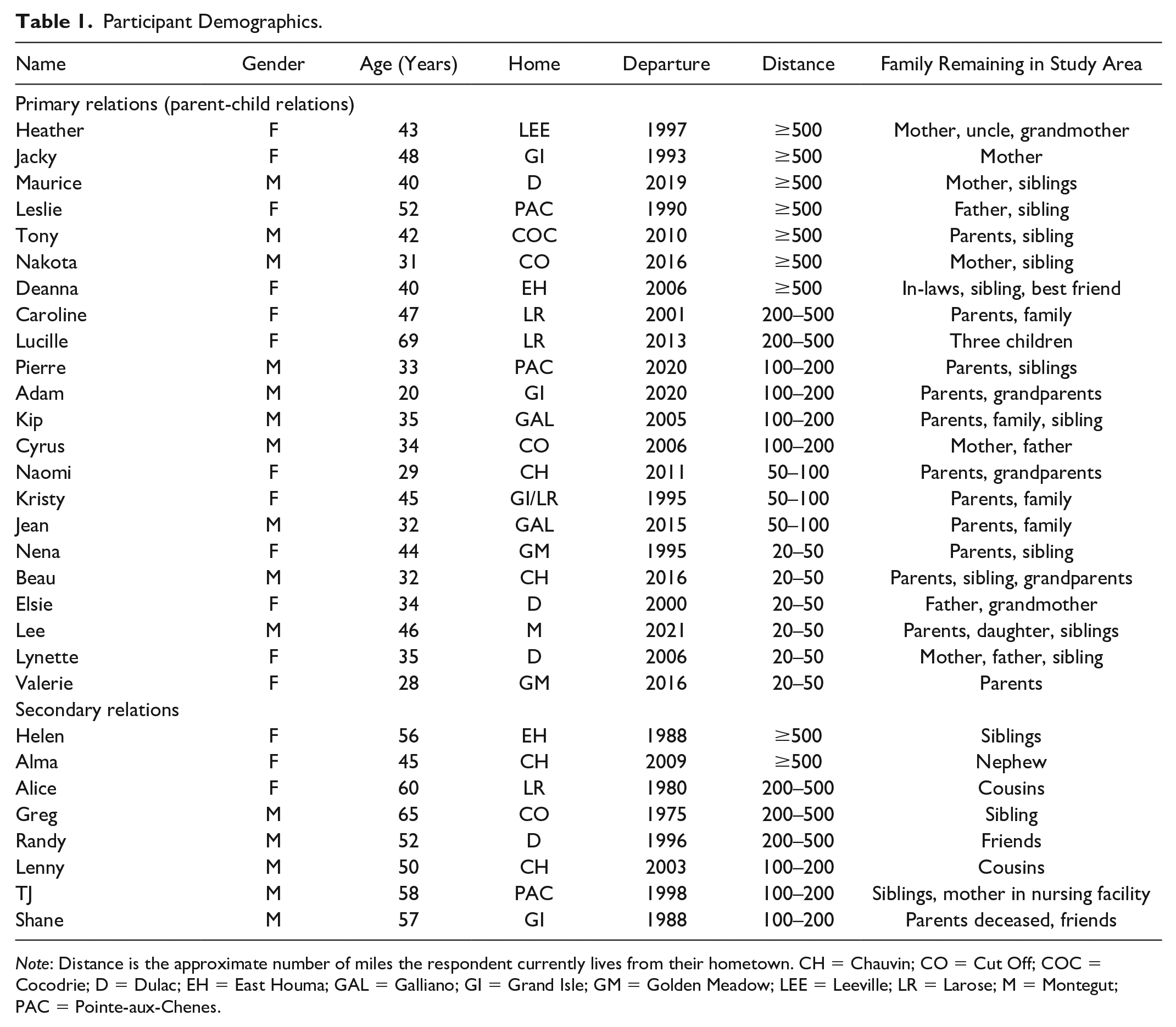
Note: Distance is the approximate number of miles the respondent currently lives from their hometown. CH = Chauvin; CO = Cut Off; COC = Cocodrie; D = Dulac; EH = East Houma; GAL = Galliano; GI = Grand Isle; GM = Golden Meadow; LEE = Leeville; LR = Larose; M = Montegut; PAC = Pointe-aux-Chenes.

Study area map.
All migrants were asked about their views regarding migration in their communities, their memories and attachments to place, perceptions of major challenges facing their community, and their views about the future. Migrants were also asked to describe their motivations for leaving and the ways they maintained connections to home. Of the 60 migrants, half (30) were excluded from this analysis because they left after Hurricane Ida or lived close enough to have their own homes significantly affected by the hurricane. Those who migrated before Hurricane Ida were consulted about how they experienced Hurricane Ida from afar, the role they played in disaster recovery, their thoughts about the disaster response, and the degree to which Ida affected their views of home. The care activities listed in Table 2 emerged in response to these questions and are not exhaustive of all possible respondent activities. Likewise, some respondents may have forgotten or not mentioned activities.
Pre- and Postdisaster Care Work of Migrants by Activity and Gender.

Interviews were conducted in person or telephonically on the basis of the informant’s preference. The interviews, which lasted between 1 and 3 hours, were recorded with permission then transcribed. Transcripts were then analyzed using Nvivo. Initial coding focused on pre- and postdisaster efforts. Although I was interested in their descriptions of the event and the activities involved, it became evident that the hurricane was an emotionally taxing event for some migrants more than others. Later analysis revealed that gender and the strength of their social ties to the area were key factors shaping their experiences. Seven of the 30 informants attributed pre-Ida disasters in their movement narratives; however, no key differences were found in how they experienced or provided care compared with nondisaster migrants. This research was approved by the University of Oregon’s Institutional Review Board.
Results
The findings illustrate three components of a disaster carescape. The first section describes how migrants from at risk communities care about their family and hometowns before and during disasters. The second section illustrates how migrants care for family afterward in the form of care work, the type and duration of which are gendered and influenced by the strength of ties to the area. Similarly, the final section illustrates how environmentally threatened landscapes, or places, are an important element in the carescape. Communities at risk of disasters contend with alteration of the surrounding physical landscape and their attachments to place (Shtob 2019) in a manner which is also informed by the strength of social ties and gender.
Carescapes: Caring about People Back Home When Calamity Strikes
Disasters heighten anxiety and concern for the safety and survival of migrants’ loved ones and the places they come from. This uncertainty penetrates migrants’ homes and lives and was especially evident among those with primary kin relations living in the study area.
Thirty years after leaving for California, Leslie still experienced immense anxiety each time a hurricane made landfall where she grew up and her father and sister remained: being over here and seeing it on TV. . . . I feel is scarier than actually living through it. . . . And you get worried . . . that feeling of helplessness, that there’s nothing you can do . . . it’s easier to be going through it than to have to watch it emotionally.
Leslie’s bold claim suggests that even people who are not actually in the eye of the storm feel it, perhaps even more intensely. This experience starts before landfall and is filtered through memories stretching back decades to previous hurricanes that struck the coast. Leslie eventually returned home to help her father recover, but she spent weeks helplessly worrying from afar.
Deanna, who moved to Tennessee after Hurricane Rita (2005), was overcome by great anxiety over the safety of her family and friends who remained on the coast once she learned of Ida’s intensity.
I was telling my sister “get out!” She’s so stubborn. . . . She wanted to stay with her husband, which I understand. I’m like, “You got a place to come and stay. You can come visit with us.” . . . And [my husband’s] family stayed because they couldn’t afford to leave. Even though we’d tell them that we would pay for their gas money. They’re like, “Oh, it ain’t gonna be nothing.” . . . And then when you couldn’t get in touch with them because the phone lines were down. . . . I kept worrying. Why are you doing this to us, making us worry over this?
Deanna’s comment suggests that migrants are acted upon by those who do not remove themselves from risk. Hoping to scare folks into evacuating, she even shared fearmongering Facebook posts, what she referred to as “conspiracy theories,” about Ida’s potential to wipe her hometown off the map.
Several individuals struggled to contact kin because of destroyed cellular towers. Tony described the comforting relief of seeing people check in on Facebook. But not hearing from his parents overwhelmed him emotionally: “I was supposed to work the following day, and I couldn’t even go to work . . . because at that time I hadn’t heard from anybody. I was like, ‘this place looks destroyed. I just need one day off.’” Tony requested leave to cope with the uncertainty until learning his parents were safe.
Although some did not have to worry for their family’s physical safety because they lived near enough to provide an evacuation shelter, intense feelings still penetrated their homes. Caroline’s family nervously watched the disaster unfold on TV and via text message in her Houston home: My dad’s neighbor stayed and sent my dad a text that his roof was all over the front yard. And I could see the anguish on my parents’ faces thinking that, you know, their house was gone. And not knowing when they were going to be able to get back. It was tough. It was a really, really, sad, sad time at my house.
Caroline’s experience illustrates the entangled nature of anxiety and care work. Safely in her living room, she experienced apprehension about the uncertain future of her hometown and her parents’ future there while simultaneously playing hostess and tending to her own family. This was just the beginning of the care work performed by migrants such as Caroline who not only made several trips back home to help but had family still living with her several months after the disaster.
Carescapes: Caring for People Back Home after Disaster
Migrants engaged in gendered care activities remotely and upon return home (see Table 2). Although women and men both partook in frontstage recovery work, men generally engaged in activities that were shorter in duration, while women engaged in backstage activities that were time intensive and affected their lives. People with stronger social ties (parent-child relations) were more consumed by these care activities.
Nakota, who moved to Virginia during the 2016 oilfield downturn, was acutely aware that the “big one” was coming but remained inadequately prepared for the impact it would have on his life. He explains: Every hurricane season since I moved up here, I’m like “what would I do if it was bad-bad?” And in every scenario, I’m like, “I’m going to leave work! I’m going to tell them this!” And then like the time actually came for it to happen and I was like, “Fuck! How am I going to pay the bills,” like the reality of my choices was coming up.
Although Nakota’s boss did approve his leave request, he had already determined to return home no matter the costs. The following day, he flew to Lafayette, rented a vehicle, and filled it with supplies to return home and clean up his mother and sister’s yards. Lucille, who moved to north Louisiana after Hurricane Gustav (2012), rented a U-Haul, filled it with supplies, and drove down to help her children who remained in the area.
Others engaged in more community-focused fundraising and logistical efforts. Alice, who left in the 1990s and had only distant family on the bayou, used her social networks to secure access to local airports to fly in supplies (and food which she helped cook) from a neighboring state. Lenny worked for a company headquartered in the devastated area and returned to restore operations at their facility and assist friends and family get generators operating.
Those who could not return engaged in important work behind the scenes. For example, Helen, who left the area in 1988 and lived in Kentucky, took to social media to help her brother track down fuel and other essentials. Far from the coast and thus with reliable Internet, she was “his link to civilization” (i.e., the one who could obtain distribution info and pass it along).
Women were more engaged in fundraising, volunteering, and dealing with the paper flood of insurance and disaster aid and relief. The invisibility (or inadequate news coverage) of the area was a common frustration among respondents. In her fundraising attempts, Leslie saw it as her mission to make her hometown’s plight more visible: New Orleans is what everybody knows . . . they very rarely mentioned Terrebonne Parish and Lafourche Parish on these news channels that get broadcast around the United States. So, I let people know that this was my hometown, and that they were in desperate need.
In this way, Leslie’s care for kin was interwoven with her concern about the place she comes from and its environmental challenges.
Others were assisting family navigate nightmarish bureaucratic headaches (insurance and contractors) when interviewed a year after Ida. Alma helped her nephew (who lived in her deceased grandmother’s Chauvin home) file insurance claims. Caroline, an accountant, spent an estimated 40 hours dealing with insurance on her parents’ behalf.
For some migrants, evacuation homes turned into longer term living arrangements. Cyrus’s mother, whose trailer in Cut Off was destroyed, moved in with him before getting her own place nearby. Cyrus described the stress of hosting her and the weekend trips back home to clean up: My partner was eight months pregnant, and we got mom living with us, within the nursery that we’re supposed to be getting ready for the baby. And then we had to help my mom like tarp up the house, get rid of everything out her mildewed house because the thing was just filled with mold. It was like, just a real pain in the ass in so many ways . . . it was just a rough emotional time.
Cyrus was one of seven men who offered their homes as evacuation shelters and/or short-term housing, but the only one who had family still there one month after the storm, whereas six women did. The combination of recovery work and the emotional management required to host family for extended periods affected their lives
Lynette returned home to live with her family during recovery. Having lost her home to flooding for Hurricane Rita (2005) her senior year of high school and an apartment in Lake Charles to Hurricane Laura (2020), Lynette was no stranger to disasters. She had just moved to New Orleans to start over and enroll in college after Laura when Ida leveled her hometown. She describes the deep sense of obligation to return home (where she stayed for more than six months) doing everything from repair work and paperwork to consoling her overwhelmed mother: It’s like I can’t have my own life because I have to help my mom and her life or whatever. Because these hurricanes keep coming. You know, if the hurricane wouldn’t have come, [I’d] probably be in English 102 by now . . . it’s just like, God, I can’t, not that I want to leave my mom, you know. It’s my mom. But I can’t just leave her like that with a messed-up house.
Lynette was not alone in struggling to move forward with her own life while being pulled back into disaster chaos through family connections. Like Lynette, Jacky and her family had weathered countless disasters in the years preceding Ida. She spent nine weeks in Grand Isle the year prior to Ida helping her elderly parents deal with a combination of health and storm issues. Jacky described the difficulty of being attached to two places at once and the impact on her relationship with her husband and child: when you move, you have a life in the place you are, and you have a family in the place you are. And in some ways, my constant going back to Grand Isle for emergencies meant that my heart and my attention in my life was attached to that place.
As illustrated, those with weaker ties remaining in the area also engaged in care work, but these activities tended to consume less of their time and emotional bandwidth.
Carescapes: Interwoven Anticipations of Family Futures and Disappearing Landscapes
Whereas the first two sections illustrated how migrants care for and about their loved ones from afar (i.e., the spatial dimension), this final section reveals how the environmentally threatened landscapes (i.e., place) are important elements in the “disaster carescape.” Places are both objects of care and entities which shape feelings and care relationships. Hurricane Ida’s destruction forced to the surface immense emotions and provoked difficult conversations about the future. Some migrants’ anticipation for a future of aging parents and their care needs was interwoven with anxiety about, and care for, the vitality of the sinking coastal communities and places that house their cultural identities and memories. With few exceptions, these attachments to place were strongest in men. Of migrants with parents still in the area, their fathers were most reluctant to relocate. Among migrants with weaker ties (deceased or relocated parents), men were more attached (or sought ways to stay attached) to the landscape. Using the lens of a disaster carescape, this section unveils how relocation and detachment may be a drawn-out process intimately intertwined with the disaster-affected landscape, gender, one’s culturally rooted identity, and the aging process
Beyond destroying homes, Ida expedited land loss and was a reminder of the grim future awaiting coastal Louisiana. Valerie returned to Golden Meadow to assist her parents before her siblings returned to help. The hurricane was the place-specific manifestation and verification of her beliefs about climate change: Knowing something, and then like living the consequences of it firsthand, are like two very different things. . . . I was like, “oh, yeah, that’s what this means.” . . . And that’s when it really started sinking in like, “oh no,” because even with natural coastal erosion, I [thought] I’d still be able to come visit these places when I’m an old person. [But] . . . after the storm [I realized] I might be middle-aged, and my hometown doesn’t exist anymore.
Valerie cared deeply about her disappearing hometown, but her parents were determined to stay.
Some migrants, however, sought to relocate their loved ones and detach themselves from the area.
Such was the case for Jacky. The destruction of her parents’ Grand Isle home combined with the death of her father (who was adamantly opposed to relocation) just prior to Ida meant that her 78-year-old mother’s staying no longer made sense. Speaking about her mother’s decision to move nearby, Jacky said, “we’ve pretty much decided it’s a lost cause. And we just need to divest . . . having mom up here and pulling out of Louisiana . . . is something that I kind of owe my husband and my daughter.”
Although many were relieved that their loved ones made the move, some were careful not to push relocation. Migrants understand this deep attachment because of their own intimate connections to the culture and landscape. Lucille, who moved to north Louisiana after Hurricane Gustav in 2012 and recognized the challenges of her community, was a strong climate denier and likened asking her three adult children to relocate after Ida to someone “telling [her] to quit smoking before [she] was ready.” Importantly, her daughter did move permanently on her property after Ida, but her two sons remained on the coast. Kristy, who lived in New Orleans and whose five siblings all migrated away, was supportive of her septuagenarian parents continuing to live on the bayou (even after experiencing six floods in 25 years). Still, she acknowledged that the next big storm would mean certain relocation: “they’ll go kicking and screaming, you know. We’ll have to capture them.”
Caroline first explained that her mother would never leave her octogenarian brother who lived next door and that her aging father was so deeply rooted to the hunting and fishing culture that he would die in his hometown. But Ida had expedited the detachment process. Dispatched from her Houston home by her evacuee father to salvage their family possessions, including his hunting gear, Caroline described an emotionally taxing FaceTime interaction with her father: I’m like, “Dad these waders are, I’m going to have to throw them away.” And he was like, “Okay.” I said, “there’s no saving them.” Then he said, “I probably was never going to use them again anyway.” And that was hard . . . I could see that anguish in his face, that acknowledgement that some of the things that he loved to do like duck hunting, he wasn’t going to be able to do anymore . . . Ida took that away, that ability to keep his head in the sand. . . . So when I had to make that call it was hard. Hard for me, much harder for him.
A major disaster expedited Caroline’s father’s confrontation with the aging process, and both combined to challenge his identity which was rooted to place-based activities, such as duck hunting. In private conversations with her mother and sister one month before Ida, they mused about where their mother would move once their father died. Before learning insurance would cover rebuilding costs, they thought relocation may occur sooner.
Others were more direct in their attempts to convince their parents to relocate. As Kip, who was much more shaken up by the storm than his parents, describes, “I was feeling that same kind of just sorrow with my siblings, and my cousins, like anybody that had left looking back, you know, this thing that you could see coming from miles away.” Kip referred to the tendency to make sense of hurricanes such as Ida by accepting it as part of coastal living rather than an existential crisis as the “bayou mentality” and he was particularly frustrated by his climate change denying father who justified rebuilding the house because of its “strong bones” (studs) having “passed all the tests.” Kip described the weekends spent demolishing the walls of his childhood home as therapeutic detachment. He and his migrant siblings tried to reason their parents away to no avail: You know, we even tried to outvote him. There’s a sense of like, they have trouble letting go. They can’t kind of see like different perspectives on it, which would have been helpful. . . . At the end of the day, it’s their choice and it’s their life. . . . That’s where they raised their kids and memories and all that stuff. So yeah, it’s more or less, “hey, if that’s what you want to do. Okay, you know, we’ll try to go about it the best way we can.”
Similarly, Naomi made “snarky remarks” to her grandparents after Ida to subtly push their hand to move. But she knew her grandmother would never leave while her grandfather was alive. Naomi walked a cultural and political tightrope discussing the future with her family.
Inevitably there will be a hurricane that breaks the levee. . . . [That] is something that I think about sometimes. . . . And my parents kind of brush off anything I say, because they think I’m like, crazy, for thinking that far into the future. They think it’s far off into the future. To be honest. I don’t think it’s that far off.
For Naomi, belief in impending climate doom frames her as the unreasonable one. Although relieved by the talk of her parents possibly selling their home in the future, she seemed frustrated about misaligned time scales.
As observed in the narratives of migrants with primary ties (i.e., parents and children) affected by Ida, women (and younger men) tended to detach themselves and their families from their environmentally threatened hometowns. This gendered phenomenon was also evident in the narratives of the three women and five men with only secondary kinship ties to the study area. For example, all three women engaged in care activities and evoked affection for their home communities, but none desired to maintain physical connections to their hometowns. Conversely, four of the five men with secondary or weakening ties owned property or expressed interest in maintaining connections to the landscape despite Ida’s destruction. For example, Randy owned (and repaired) a camp on the bayou to continue his passion for fishing. Shane maintained the Grand Isle home of his deceased parents, returning frequently to be on the water and cut the grass. Lenny considered purchasing the repaired home of his father (who died unexpectedly before Hurricane Ida) from his siblings to use as a fishing camp. This idea was vetoed by his wife and their “financial situation.” Like nonmigrant fathers, these migrant men, all in their 50s or older, were reluctant to detach themselves from the landscape that they care deeply about and is core to their identities.
Discussion and Conclusion: Why We Should Care about Carescapes
By analyzing how people who are from a disaster-prone area but have migrated outward experience disaster from afar, in this study I spotlight an understudied and often invisible group which challenges the linearity of disaster studies (Kothari, Arnall, and Azfa 2023; McLeman 2014). Rather than focusing on translocal linkages mainly to determine recovery outcomes in affected areas, I sought to understand how migrants are emotionally affected by their kin connections and place attachments to disappearing landscapes. For some, the requisite care that emerges in times of a catastrophic rapid-onset disaster commences conversations about the future that foregrounds the role of anticipation as it is interwoven with intergenerational family care and concerns about the viability of climate-affected places. In this article I refer to this phenomenon as a “disaster carescape” and argue that the concept expands the temporal and spatial limitations of existing studies of care while bringing the impact of threatened environmental landscapes and people’s (migrant and stayer’s) relationship with it into the care conversation.
Although potentially having broad applicability, disaster carescapes underscores temporality and obligatory relationships that are intense, mutual, and unfold (at the micro level) among people and places in times of crisis. In this way, a “carescape” is different from a “care chain,” which, while focusing on micro-level care relations, emphasizes macro-level political economic inequalities unfolding across global space (Sabio et al. 2022). A disaster carescape tracks the flow of “care” within a social field, which could be translocal or transnational (Lubbers et al. 2020), but which primarily emphasizes care relations and anxiety about the future among closely connected people and environmentally threatened places in the context of disaster.
Although I have sought in this article to deemphasize the role of external linkages on resiliency outcomes, disaster carescapes captures an important element increasingly evident in studies of climate mobilities that show families using a mixture of strategies to increase resilience, including some staying in high-risk zones and others leaving (Entwisle, Verdery, and Williams 2020; Entzinger and Scholten 2022; McLeman 2014). These two groups are connected by social relationships and obligations of care for and about the people and places that unite them. Although hardly an intentional strategy, the existing carescapes formed through social and place linkages are important to the immediate recovery of the area, even if the long-term impacts of these linkages are unknown. As migration networks tend to increase the likelihood of outward migration (de Haas, Castles, and Miller 2019), we may expect that place-bound kin networks (or carescapes) will inform outward migration, domestically and globally, in a climate-changed future that will likely expedite the already unfolding demographic shifts that challenge institutionalized care systems and disaster responses in rural places.
As with postdisaster zones more generally (Enarson 2012), place attachments and the care work performed by migrants after disasters tends to be gendered. Women engage in shorter term physical recovery efforts, like men, but are also burdened with prolonged backstage care duties. The attachments to and care for home (among both migrants and stayers) also tends to be gendered. Unlike transnational migration research which finds migrant mothers working to maintain attachments to their family in the sending country (Herrero-Arias et al. 2021), here women seem to play a more active role in promoting relocation and detaching from home. In other contexts, emotional detachment to reduce vulnerability has been documented after disasters (Haney and Gray-Scholz 2020), but in this case it may be a strategy to avoid anticipated care in the future. Nonmigrant mothers and their migrant daughters were, especially postdisaster, more open to family relocation, but men (usually the fathers of migrants and even some migrants themselves) were often willing to increase the risk to their family to preserve their place-based identities (Morioka 2016).
Future studies of disaster carescapes might address some methodological limitations found here. Scholars could, for example, adopt a simultaneous matched samples methodology (Mazzucato 2009) whereby interviews are conducted in several sites simultaneously to capture a multiple-actor perspective (migrants and their nonmigrant kin) (Lubbers et al. 2020). As with all qualitative methods, particularly snowball sampling, the data structure here is networked (Hanson and Theis 2023) and may overemphasize the intensity and prevalence of connections and neglect relationships which are absent or negative (Lubbers et al. 2020). As crises tend to increase social interaction by bringing actors together to narrate, historicize, and assign meaning to their present circumstances (Norton 2014), disasters may amplify the carescape, which may be weaker during normal times or manifest itself differently in places where climate change impacts are subtler. Additionally, future studies might draw inspiration from Soehl and Waldinger (2010), who discovered varying degrees of intensity in transnational connections, to systematically survey respondents about their care activities, place attachments, and precise social ties to uncover variation in the disaster carescape. As a final limitation, my positionality as a man from the study area may have influenced how respondents, especially men, expressed their views about care and the future in ways that tended to conceal their activities and feelings and thus challenge the gendered findings explored above.
Disaster carescapes extends our understandings of climate change vulnerability to include those usually left out of the analysis because of spatial and temporal limitations. Despite not living in high-risk locales, migrants with linkages to these areas remain affected because of their reciprocating care roles and place-based identities. The findings presented here suggest that “solastalgia” (Simms 2021) also applies to migrants and is a gendered phenomenon that may breed future care needs and intensify the carescape during the next disaster.
Footnotes
Acknowledgements
I deeply appreciate each migrant from the study area who shared their experiences of helping family and friends deal with Hurricane Ida, as well as their concerns about the future of their home communities. I also owe a special thank-you to Matthew Norton, Jill A. Harrison, Amanda Sikirica, Dan Shtob, Lee Moore, and Frederick Poole for providing encouragement and thoughtful feedback on previous drafts of this article. Finally, I am grateful for the insightful comments from the two anonymous reviewers at Socius.
