




Abstract
Informal status hierarchy is a ubiquitous feature of social life, and it is one that drives dynamics of dominance, influence, exclusion, and stratification. Utilizing data from the National Longitudinal Study of Adolescent to Adult Health, this article shows that friendship nominations among adolescents are sensitive to status distinctions and that this sensitivity can be exploited to infer status relations and the level of ambiguity those relations entail. A measure is developed to uncover latent status structures based on such relations among students, demonstrating the existence of complex hierarchical structures among communities. Differentiating between students’ rank (verticality) and embeddedness (horizontality), the analysis reveals orthogonal processes of stratification: A student’s rank is associated with their social role at the school, whereas their embeddedness is linked to traditional markers of stratification, such as race and income. The analysis demonstrates the theoretical utility of incorporating ambiguity of status relations and provides a flexible set of statistical tools to study relational status hierarchies.
The processes that underlie social status distinctions are rarely transparent. Status differentiation reflects the ubiquitous and varied discernments of esteem, derision, and prestige that underlie everyday interaction (Martin and Murphy 2020). Many sociological theories of status take a micro-interactional approach grounded in the moment-to-moment acts of contextualized, interpersonal judgments of social life and are well suited to relational approaches (Correll et al. 2017). Network theory in particular provides an attractive set of tools for examining individual actors through the eyes of their peers. The methods and theory of social network analysis promise the ability to contextualize individuals’ social positions within a larger web of structured relations (e.g., Ball and Newman 2013).
However, status relations as such are not easy to observe in empirical settings. Certainly, approaches to understanding status from a theoretical standpoint have contributed significantly to understanding the dynamics and structures of status when the relations are well defined (Holland and Leinhardt 1971; Johnsen 1985; Martin 2009b; Rytina 2020). But empirical examination of status depends on reliable measurement of status orders or status relations. Occasionally, researchers are able to work with what are assumed to be direct proxies of status relations—observed formalized hierarchies (Borgatti and Cross 2003; Danescu-Niculescu-Mizil et al. 2012; Jackson, Schuler, and Rivero 1989), experimentally manipulated status distinctions (Dippong, Kalkhoff, and Johnsen 2017; Melamed et al. 2017; Skvoretz and Fararo 1996), or survey items targeted toward querying relations of authority (Martin 1998; Zablocki 1980). But status as it is experienced is usually not so straightforward as to allow easy observation. The behavior of, for example, adolescents (the empirical focus of this article) can be sensitive to status distinctions without those involved recognizing those distinctions as a driving force: a teenager who tailors the way they talk to different peer groups, a student who reconsiders joining a club after looking at the membership roster, a group of friends with outsize influence over trends at a school. A hallmark of status is its ability to influence behavior in unnoticed—and difficult to measure—ways.
In the face of such a murky empirical outlook, much of the literature on status turns to simple sociometric data to infer status (for a review, see Parkhurst and Hopmeyer 1998). The problem of ascertaining status hierarchies is most often met with an assumption, often implicit, that the sociometric relations collected in some particular network study—friendship, admiration, communication, interaction—can act as a proxy for status, and as such, the structures we see in those networks can be construed as the structures of the status hierarchy within a community. In some cases, regularities in patterns of relations are taken to delimit hierarchical status structures, and status difference is studied in terms of hierarchical relations within those structures (Burt 1987; McFarland et al. 2014). More commonly, networks of positive affect, such as friendship nominations or perceptions of popularity, are treated as direct proxies for individuals’ position in an inferred status hierarchy; measures such as network in-degree or eigenvector centrality are treated as unambiguous measures of a person’s status (Cillessen and Rose 2005; Faris and Felmlee 2011; Terry and Coie 1991). Research using these methods has generated important insights about the dynamics and roles of status in small communities (Martin and Murphy 2020). A defining feature of research in this vein is its conception of status as a clear linear ranking of individuals—a ranking that lacks, at least in its underlying characterization, any ambiguity in the status positions of the ranked actors.
Insistence on simple status ranks is in some ways surprising. Social scientists theorizing about status and its structural corollaries have consistently argued for the central role of relational ambiguity in status determination (e.g., Gould 2002; Martin 2009b; Rytina 2020; Wittek 2022), so why does so much empirical research on status use simple sociometric measures? The individualized, trait-based view of status could be cast as a pragmatic simplification—after all, one can easily reconstruct status relations as differences in status between a pair of individuals. But there are good reasons to reject such an approach. As the theoretical work on status differentiation is keen to emphasize, status distinctions are fundamentally negotiated at the relational level (Closson 2009; Collins 2004; Gould 2003). Although pair-by-pair determinations of status relations are made with an awareness of a larger status structure—individuals are conscious of a larger, “global” status order and react to visible status signals between others (Berger, Cohen, and Zelditch 1972; Correll and Ridgeway 2006)—the final resolution cannot generally be reduced to a simple comparison of personal traits (Martin 2009a). Insisting on status as an individual characteristic, even if that characteristic can be multidimensional (de Klepper et al. 2017; Parkhurst and Hopmeyer 1998), functionally erases the horizontality that is a key component of social status (Martin 2009b:Chapter 5). It is not always clear, even to the people embedded in a specific status order, how a particular pair of individuals would compare in that order. Two people may be in active competition for status dominance, a situation that leads to overt uncertainty in the proper relative “ranking” of the pair. Or one can imagine a different scenario in which two people exist in separate social spheres (like cliques in a high school) and are not generally understood as being comparable with each other on any perceptible status dimension (Martin and Murphy 2020). From the standpoint of a researcher aiming to understand the role of status in a community, ambiguous status relations such as these cannot be seen as the simple result of insufficient data. Ambiguity is a basic component of status as it is experienced by individuals—a component that is linked directly to the inequalities, boundaries, and exclusions that define status systems (Gould 2002; Rytina 2020).
This article has two related goals. First, I propose a new model of the role of status in friendship nominations. The model places status ambiguity in a central role, relying on Bayesian posterior probabilities to quantify ambiguity and yielding a characterization of status orders as directed networks of dyadic status relations. The second goal of the article is to empirically demonstrate the model’s ability to disentangle within-community roles from larger-scale status expectations. I use data on adolescent friendship nominations from the National Longitudinal Study of Adolescent to Adult Health (Add Health; Harris and Udry 2016) to model status among a large set of school-age adolescents in the United States. In addition to contrasting the new model with existing measures of adolescent status, the empirical analysis demonstrates the link between model uncertainty and status horizontality. I show that deriving horizontality from status uncertainty allows for tractable distinctions to be made between role-based status and society-wide status distinctions.
Social Status and Adolescent Communities
Researchers have long recognized that status is an overt driving force of adolescent and preadolescent interaction (Coleman 1961). Status is central to these groups’ understanding of their social dynamics and identities (Adler and Adler 1995, 1996, 1998), and status mobility motivates both prosocial and antisocial behavior (Closson 2009; Faris and Ennett 2012; Sijtsema et al. 2009). Status attainment is closely linked with achievement and well-being of adolescents. High-status students have been shown to be more likely to perform well academically (Diego, Field, and Sanders 2002; Hollingshead 1949; Meijs et al. 2008), to be less likely to suffer from depression and social exclusion (Adler and Adler 1996; Diego et al. 2002; Oldehinkel et al. 2007), and to be more often victimized by their peers (Faris and Felmlee 2014; Rodkin and Berger 2008). It is difficult to imagine an aspect of adolescent life in which social status is not a significant force.
Even with a recognition of status’s central role in adolescence, research on the topic is not settled on what, precisely, status is. The underlying social position that a student’s status reflects—their prominence in a school, the esteem in which they are held by their peers, their role in clique structure, their position in the pecking order, or the broader social categories to which they belong—is often left unresolved (Martin and Murphy 2020). Still, there is wide recognition that a single scale from “top” to “bottom” is insufficient to describe the role status plays in adolescents’ lives. In quantitative research, a division in commonly drawn between “sociometric” and “perceived” popularity as distinct dimensions of social status (Cillessen and Marks 2011; Parkhurst and Hopmeyer 1998; van den Berg, Lansu, and Cillessen 2020; Vörös, Block, and Boda 2019; cf. Lease, Musgrove, and Axelrod 2002). Sociometric popularity, also described as “likability,” describes individuals who are well liked by their peers and who have many friends. Perceived popularity is more subjective, measuring the degree to which a person’s peers believe that the person is high-status, popular, cool, or well liked.
The distinction between these two dimensions of status arises from empirical necessity; researchers have long known that different measures of popularity among children and adolescents produced divergent outcomes (Terry and Coie 1991). In most existing literature, sociometric popularity is ascertained simply by asking students who their friends are, who they like, and who they dislike, whereas perceived popularity is measured by asking students who they think others are friends with and like. Despite the seemingly subtle difference between the measures, empirical studies overwhelmingly support the distinction (Cillessen and Rose 2005; Coie, Dodge, and Coppotelli 1982; Oldehinkel et al. 2007; Vörös et al. 2019). Most adolescents who are perceived as very popular by their peers do not have many friends, and most who have many friends are not perceived as popular (Parkhurst and Hopmeyer 1998). Whereas sociometrically popular adolescents are thought of as kind and trustworthy, those who are perceived as popular are also reported by their peers to be less kind and are more overtly and relationally aggressive (Merten 1997; Rose, Swenson, and Waller 2004).
Adolescent communities typically have complex social structures that further complicate the characterization of status as a simple ranking. Adolescents, especially those in a bounded social environment such as a middle school or high school, are exceptionally cliquish. Students partition themselves into distinct social groups, the boundaries of which are usually carefully policed. Patterns of dominance (Martin 2009a) and popularity (Berger and Dijkstra 2013) are structured around formal participation in athletics teams and extracurricular activities (Coleman 1961; Eccles and Barber 1999; Eder and Kinney 1995). Cliques are central to the definitions of social identities (Adler and Adler 1995, 1996) and therefore provide a scaffolding for community-wide status distinctions (Closson 2009; Dijkstra et al. 2010; Merten 1997). A “cool” student’s coolness is contingent on being friends with the other cool students, and exclusion from established cliques is a primary mechanism for the maintenance of a community-wide status order (Adler and Adler 1995; Rubineau, Lim, and Neblo 2019). But as much as group boundaries structure interclique status relations, they also suggest the importance of intraclique dynamics of dominance. Among members of small adolescent groups, conflicts over status are prevalent, and strong within-clique hierarchies commonly emerge (Martin 2009a). Discernment of popularity in middle school and high school incorporates interpersonal and intergroup dynamics, considering dyadic processes of dominance simultaneously with determinations of group membership and the optics of boundary crossing.
Although many of the dynamics of status among adolescents are particular to the context of the population’s institutional and developmental particularities, they are not immune to the broader social influences that are central to social status processes more generally. Social distinctions such as gender (Adler, Kless, and Adler 1992; Rodkin and Berger 2008), race (Kennedy 1995; Moody 2001), and socioeconomic status (Adler and Alder 1998) are linked to status determinations in middle school and high school. Still, the context of a bounded school community of adolescents fosters distinctive dynamics for the role of gender and race. For instance, rather than determining an implicit ordering in which, for example, girls tend to enjoy lower status than boys, gender appears to divide communities into more or less distinct status orders for boys and for girls (Adler and Adler 1998; Faris and Felmlee 2011). The role of race in status determination among adolescents is strongly dependent on the school context (Meisinger et al. 2007).
One lesson to take from the complexity and heterogeneity of status processes among adolescents is that ambiguity is a driving force of status distinction, especially among adolescents. Status relations draw on multiple and often contradictory ideas of what is important in the social order. Struggles for dominance within social cliques lead to overt uncertainty as to who is currently “on top.” The dynamics of between-clique status maintenance induce uncertainty in status comparisons between students more distant in the social order. Within this context, socially dominant categories of race, gender, and socioeconomic status further complicate the mechanisms underlying status determination. I argue that a linear attribute (like a rank ordering) erases the core dynamics that create and maintain the status hierarchy among adolescents. Instead, a model of status that accounts explicitly for ambiguity and focuses on dyadic relational processes rather than monadic attributes is needed to account for the inherent nonlinearity of adolescent status hierarchies.
Of course, to describe the structure of status across a particular community, it is not necessary to exhaustively model all the contrasting and interacting mechanisms that play a part in the determinations underlying that structure. A good model can illuminate the essential, theoretically motivated features of a system while simplifying (but still allowing for) the intricate details of the driving mechanisms. My claim is that there are two essential features of status structures that models limiting structure to rank order are unable to account for. The first is the relational character of status determinations. Although status is often characterized as a fixed and exogenous structure, a “ladder” that one can strive to climb, the literature on status distinction emphasizes the relational negotiations that fundamentally drive the maintenance of the status order (Martin 2009b; Rytina 2020). What appears to be a global ranking from high to low is constituted by myriad distinctions made in everyday interactions (Bourdieu 1984; Lamont 1992). The second essential feature of status missing from attribute-based models of status is uncertainty. Building on a relational depiction of status structures, it is commonly the case that a particular status relation is unclear (Gould 2003). Such ambiguity is foundational both to the social nature of status determination (Correll et al. 2017) and to the empirical reality of horizontality (Martin 2009b) and clustering (Davis 1970) in status structures. Without accounting relationality and uncertainty, models of status are bound to miss important aspects of the status structures that are so central to the lives of adolescents.
In the following, I address these shortcomings through an investigation of two research questions:
Research Question 1: Is it possible to model status structure in a way that incorporates both dyadic relationality and status ambiguity using just friendship nominations?
Research Question 2: Does the resulting horizontality revealed by such a model reveal otherwise hidden status dynamics?
I first summarize the survey data from Add Health (although the model is quite flexible in its application) and then describe the statistical model in detail. I conclude by using the results of the model to shed light on an existing empirical result, arguing that relational hierarchies capture the complexities of adolescent status more completely than other quantitative methods.
Data
This study uses friendship nomination data from the first wave of Add Health (Harris and Udry 2016), a representative study of students in 7th through 12th grades in the United States, begun in the 1994–1995 school year. The survey is notable for its breadth, collecting data on more than 90,000 students at 132 schools. In addition to in-depth information about behavior, academic performance, and physical and psychological well-being, the in-school survey asked middle- and high-school students to “List your closest (male/female) friends. List your best (male/female) friend first, then your next best friend, and so on. (Girls/Boys) may include (boys/girls) who are friends and (boy/girl) friends.”
Although the survey weights the strength of friendship nominations through follow-up questions on types of interactions (going to their house, talking on the telephone, etc.), the data used here are a simple binary measure counting a friendship if any of those interactions took place. The survey allowed students to name up to five friends from each of two gender categories, 1 for a total of no more than 10 nominations per respondent. Table 1 lists some summary statistics for the 26 pairs of middle schools and high schools used in this analysis. 2 It is important to note that more than half of the ties are unreciprocated. This means that in most cases when a respondent nominated another student as a friend, that student did not nominate the respondent.
Summary Statistics for the School Pairs, Including Total Number of Nominations (directed Edges), Proportion of Reciprocated Nominations (Bidirectional Edges), and Percentage of Students That Identify as White.

This research involves human subjects and was approved by the Social and Behavioral Sciences Institutional Review Board at the University of Chicago (H07047).
A Model-Based Measure of Status Relations
The measure of status relations proposed here is based on a simplified model of friendship nomination. The model focuses on friendship nominations as measurable behavior that is responsive to status difference. It exploits asymmetry in nominations to capture status distinctions and ambiguity in status determination. Friendship homophily (the strong tendency for people to be friends with those similar to themselves) is among the most well-established results in social network research (McPherson, Smith-Lovin, and Cook 2001). Not only do people tend to be friends with others of the same age, race, and socioeconomic background, but close friendships are heavily biased toward those of similar social status (Laumann and Senter 1976; Marsden 1988; McPherson and Smith-Lovin 1987; Shrum, Cheek, and Hunter 1988). Scholarship indicates that friendship is particularly sensitive to status asymmetry. Declarations of friendship are tightly tied to the processes of status maintenance, and individuals treat higher-status alters differently than those of lower status (Fiske 2011; Gould 2002; Hallinan 1978; Rubineau et al. 2019; Smith and Faris 2015; cf. Martin and Murphy 2020). Put differently, “more popular actors are ranked higher and the asymptotic ties are directed ‘upwards’” (Doreian, Batagelj, and Ferligoj 2000:5). Importantly, the difference in treatment of high-status versus low-status alters is not based on community-wide determinations of status but, rather, on relative status differences centered on the individual making the distinction. The opinions we hold of our “superiors” differ markedly from those we hold of our “inferiors” (Berger and Dijkstra 2013; Fiske 2011; Fiske, Cuddy, and Glick 2007). Dijkstra et al. (2010) note the importance of status asymmetry specifically in adolescent friendships, and Ball and Newman (2013) and An and Mcconnell (2015) model this asymmetry directly, finding significant differences between reciprocated and unreciprocated friendship declarations.
To formalize these features (status homophily and status asymmetry in friendship) in a model, consider a school grade consisting of n adolescents,

Here,

Example of nomination probabilities with
It is worth taking a moment to note what this model leaves out. The model does not account for processes of social closure, demographic homophily, or a host of other individual and structural features relevant to friendship formation. Nor does it incorporate established status characteristics, such as age, race, or socioeconomic measures, that could confound the identification of a “residual” status effect. Indeed, the aforementioned model has no observed explanatory variables at all. Although it would be possible to incorporate the status component just described into a formally explanatory model such as an exponential random graph model or a stochastic actor oriented model, the analytical goal here is to elaborate and validate a network measure of status relations that is more complete and theoretically grounded than those in common use in the literature—for example, centrality in a friendship network. As described previously, social status can be seen as a conflation of many distinct (and confounding) processes; the current analysis aims to embrace that conflation by incorporating model uncertainty as a theoretically relevant outcome. The objective is not to explain friendship nominations but to uncover the most salient features of status relations using nomination data.
Model 1 is relatively simple, and it has just four unobserved parameters:
To see how this works in practice, consider a hypothetical group of four high school boys, Harris, Sam, Neal, and Bill. Sam, Neal, and Bill are a tight-knit group, and all nominate one another as friends. They each also nominate Harris, a slightly older student they look up to, as a friend. Harris, however, does not list any of the three other boys as friends. The posterior sample for this group of four would look something like the left side of Figure 2. In virtually every draw from the sample, Harris is ranked higher than the rest of the group—with

Using posterior uncertainty to recover horizontality.
Although such results are rich at the dyadic level, it is possible to simplify them to represent status structure across a community. One can create a pairwise relation between students for whom the posterior probability of difference in rank order is above some threshold—such as 95 percent, or
This model was fit independently for each individual grade level in the sample schools. 6 Thus, a typical high school yields four distinct hierarchies: one each for the 9th-, 10th-, 11th-, and 12th-grade populations. The sample used here contains a total of 154 such school–grade pairs, ranging in size from 50 to 191 students. Before embarking on a formal analysis and interpretation of the estimated results, it is informative to visualize the types of community-wide hierarchies that exist among the grade levels. To construct such hierarchies, it is necessary to identify the minimally ambiguous status relations that exist between students. This is easily achieved by choosing a relatively high threshold—95 percent in this case—and indicating a directed edge to exist between students if the posterior probability of an asymmetric relation between them exceeds that threshold. 7 Figure 3 displays the hierarchies generated for a few of the smaller grades at 95 percent posterior probability. 8 What the pictured hierarchies show are structures that are defined by a clear, overall vertical hierarchy but that have a significant amount of horizontal differentiation in their structure. To make sense of these structures, the following analysis introduces two measures of a student’s status position—their rank and their embeddedness—which are shown to uncover both the status multidimensionalilty and the distinct global and local status dynamics discussed previously.

Estimated hierarchies for four sample grades (95 percent posterior probability, transitive reduction).
Status Rank and Status Embeddedness
The value of the probabilistic model just described derives from its formalized treatment of ambiguity. Status is regarded as fundamentally relational, and latent status relations can exist with more or less uncertainty. As shown previously, this feature induces an implicit horizontality in the overall structure of status among the respondents in a particular community. The following analysis capitalizes on the added structure from such horizontality with a relatively simple distinction between status rank and status embeddedness. Although this distinction gives only a coarse-grained view of the increased nuance implied by the current approach, it nonetheless serves as a stark example of the importance of ambiguity (and the resulting horizontality) in status relations.
Status Rank
As a first analysis of the model estimates, consider a simple measure of students’ status rank. This statistic is calculated by identifying the size of the set of students who are below each respondent in the hierarchy, following arrows only downward (the set of reachable vertices). In Figure 2, this number would be 3 for Harris and 0 for Sam, Neal, and Bill. The count is divided by the total number of students in the grade, resulting in the proportion of the community that is below the focal individual, ranging from 0 to
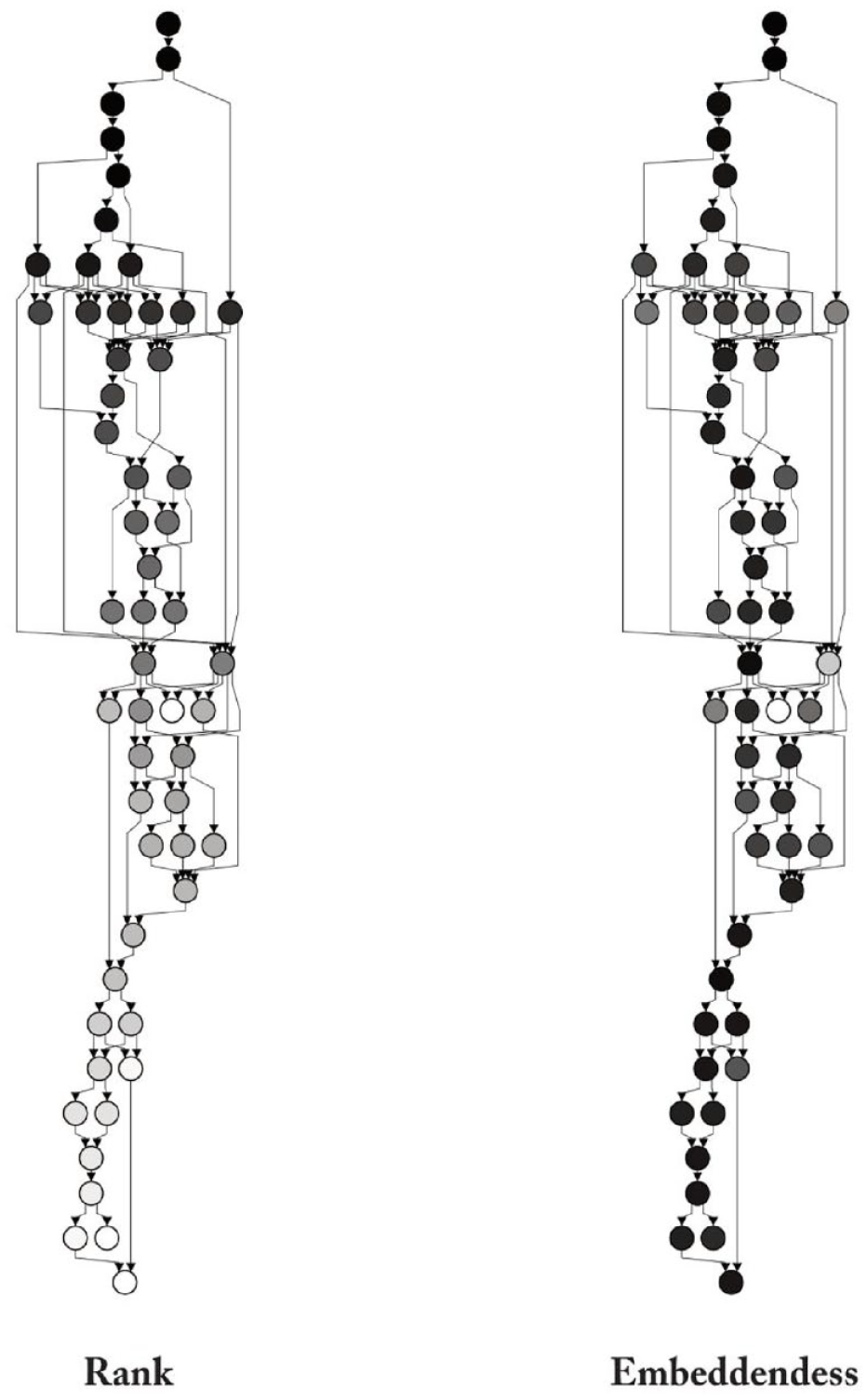
A sample 12th-grade hierarchy with nodes shaded to indicate (left) status rank and (right) status embeddedness. Darker nodes indicate higher values of rank/embeddedness.
To investigate the relationship between this measure of status rank and student characteristics, a random-intercept linear model is used. Because the dependent variable (rank) is constrained between 0 and 1 and because many students are clustered near the limits of the range, I use a logistic transformation on the rank (first shrinking its range to the interval [0.001, 0.999]). In addition to control variables (standardized grade size, number of incoming friendship nominations) and demographic variables (sex, age, ethnicity, and race), I include covariates for students’ membership in 12 school clubs and 13 school sports. The literature on adolescent status structures emphasizes the importance of role and social identity in status determination (Adler and Adler 1998; Schaefer et al. 2011). Clubs and teams, although not a perfect proxy for such roles, capture much of the variation in how and with whom students identify at their schools. The effects of race and ethnicity can depend on the racial and ethnic makeup of a school (Meisinger et al. 2007)—it is very different to be a Black student at a predominantly White school than at a school that is mostly Black—so I include covariates and interactions for proportion Hispanic, Black, Asian, and American Indian. 9 The model incorporates a random-effects term for each school–grade group to account for possible variation in the intercept from community to community.
The center column of Table 2 lists the results of the regression predicting status rank (N = 8,883). The coefficient for the number of incoming nominations is positive and significant, indicating a positive relationship between sociometric status and status rank as measured by this model. If, as I argue, status rank as characterized by this model is akin to perceived popularity, this result is unsurprising. Work comparing sociometric popularity to perceived popularity finds at best a positive but small correlation between the two (Lease, Kennedy, and Axelrod 2002; Parkhurst and Hopmeyer 1998). It is important to note that the other results listed in Table 2 are estimated while controlling for perceived popularity. The findings discussed in the following represent the relationships that exist beyond what a simple linear status measure would allow. Although the status rank calculated here correlates with sociometric popularity, the regression results clearly indicate that the structural position indicated status rank is not simply a linear status attribute by another name.
Estimates from Random-Effects Model Predicting Status Rank and Status Embeddedness.

Note: Standard errors are in parentheses. Estimates in bold are significant at
Before discussing the relationship between student demographics and status rank, it is informative to inspect the coefficients for memberships in the various clubs and teams. Figure 5 shows the estimates and 95 percent confidence intervals for the membership coefficients, sorted by estimate. There is a clear pattern in the order of these coefficients. The variables with positive, significant coefficients are participation in football, basketball, cheerleading, soccer, student council, volleyball, baseball, track, and language clubs. The memberships significantly associated with lower status are computer club, math club, drama, and band. These results fit cultural stereotypes of high school popularity to a remarkable degree. The observation that the football players and cheerleaders are popular and that the students involved in computers and math are unpopular (recalling that the survey was conducted in the mid-1990s) is obvious enough to be uninteresting, but it also provides strong validation that the relation revealed by the model can be interpreted as perceived social status.

The relationship between status rank and membership in clubs and teams, coefficient estimates and 95 percent confidence intervals.
Still, a striking feature of the regression estimates is the lack of correspondence between individual demographic characteristics and status rank. With the exception of American Indians and students that identify as a race not listed on the survey, both of whom make up a very small percentage of the sample population, the model suggests that race and ethnicity have minimal connection to status rank. Hispanic students and Black students, in particular, do not seem to fare much differently than White students, even once the racial and ethnic demographics of their classmates are taken into account. Interestingly, grades with a high proportion of Black students have a lower overall status rank, suggesting that those communities have somewhat less vertical stratification in their status hierarchies.
The relationship between Asian students and status rank stands out. Schools with a large proportion of Asian students have considerably higher rank on average, which can only mean that those schools have a more vertically differentiated hierarchy. But this effect is largely nullified for Asian students in majority-Asian classes. Together, these results suggest that non-Asian students enjoy markedly higher popularity on average if they are at a predominantly Asian school. Finally, students not born in the United States appear to be less popular than their U.S.-born peers on average, although this could have to do with language barriers as much as with the ethnicity of the foreign students.
The contrast between the results for demographics and club and team memberships is telling. Perceptions of popularity seem to be more closely linked with students’ role at the school than with their race or ethnicity. On its surface, this finding is at odds with both traditional wisdom and scholarly research about the relationship between race and social status; minorities, in particular Hispanic and Black individuals in the United States, are consistently found to be at a disadvantage in a wide range of stratified hierarchies (Kao and Thompson 2003; Perkins and Sampson 2015). To make sense of this apparent contradiction, I introduce a second measure of individual status position in the hierarchy, one that takes into account the horizontality of the structure directly.
Status Embeddedness
One benefit of conceiving of status as a directed and potentially ambiguous relation emerges directly from the idea of incomparability—it becomes possible to identify a set of others with whom a particular student is in a direct status hierarchy. For some, it is clear whether they are higher status or lower status than every other student in their class. For others, there is much more ambiguity about their relation to most of their classmates. The hierarchy of 12th graders in Figure 4 provides a good example of this dynamic. The single student at the bottom of the figure is of unambiguously lower status than nearly every other student in the school and therefore has the lowest status rank in the community. The isolated student on the far right of that hierarchy (toward the middle in the figure) is in a much different situation. It is clear that there are some more popular students at the top of the hierarchy that they are below and that they are higher status than most of the students toward the bottom of the hierarchy, but their relationship with the rest of the students at the school is unclear. They are relatively isolated from the much of the status hierarchy, with an ambiguous relationship to a substantial number of its members.
To examine this situation in more detail, I define a measure of a node’s status embeddedness in a hierarchy. A student’s status embeddedness is simply the number of other students with whom they are in a direct status hierarchy—the number of students that are either higher status or lower status than themselves. That is, the embeddedness of a student is the number of other students that are reachable by tracing a path only in the direction of the arrows in the hierarchy plus the number that are reachable tracing a path only against the direction of the arrows. 10 For example the relatively isolated 12th grader mentioned previously would have an embeddedness of 34 because there are 34 other students with whom a status comparison is possible. Status comparisons with the remaining 19 students are ambiguous. In contrast, the lowest-status student in that class would have an embeddedness of 53 (the size of the class – 1) because they are of unambiguously lower status than anyone else in their grade. Status embeddedness represents an aspect of the status order distinct from straightforward status rank examined above—highly embedded students can be of high or low status rank. Rather, status embeddedness indicates something of a core–periphery dynamic among the students. Unembedded (peripheral) students are those that other students do not define their status against because they lie on an uncontested boundary. They are simply not major players in the class-wide status order.
What kinds of students are highly embedded in their class status hierarchy? I answer this question using the same modeling framework as for status rank, simply changing the predicted variable. The estimates and standard errors for this model are in the rightmost column of Table 2. The coefficient estimates predicting status embeddedness differ starkly from those predicting rank. Although there is a smattering of significant but middling positive coefficients relating to club and sport participation, these can be explained as the result of increased social interaction those memberships imply. 11 They certainly do not indicate the kind of strict ordering of status groups that the first regression did. But estimates for Black and Hispanic students indicate that embeddedness is capturing something that rank does not. Both Black and Hispanic students are, on average, less well embedded in their grade’s social hierarchy than White students. This means that even taking into account the racial and ethnic composition of schools’ population, students who are Black or Hispanic tend to be poorly integrated into their community’s hierarchy of popularity. Moreover, this community exclusion does not appear to be mitigated for students at schools with large proportions of students in their same ethnic or racial category.
Some care should be taken when interpreting these results, however. Although the model controls for some aggregate features of the students’ community and includes random intercepts to account for unobserved differences in school–grade contexts, it does not incorporate important structural features of the schools. Things such as funding, curriculum, tracking, and accessibility (among others) can have significant influence on the social structures among students in a school (Dornbusch, Glasgow, and Lin 1996; Frank et al. 2008), and such structural features are likely to intersect significantly both with students’ race and ethnicity and with processes of embeddedness and social cohesion. Although the random intercept model used here can mitigate somewhat the impact on estimates, the degree to which a student’s embeddedness is determined by the opportunity structure provided by their school versus interpersonal dynamics is impossible to fully distinguish.
Still, comparing the results from the two regressions side by side, it becomes apparent that status rank and status embeddedness play very different roles in the school communities. Rank, associated most strongly with the roles and groups that students are parts of, is concordant with prevailing conceptions of popularity or “coolness” in adolescent groups. Complementary to rank is status embeddedness, linked strongly with race and ethnicity in a way that is usually associated with socioeconomic status. This suggests that two important dimensions of adolescent popularity are embedded in the topology of status relations. It would be a mistake, however, to map these dimensions directly onto the space of sociometric popularity versus perceived popularity common in the literature. Although there is reason to believe that status rank as measured here has a good deal of overlap with perceived popularity, it is not the case that status embeddedness has much in common with sociometric popularity. The coefficient estimate in the second regression for incoming nominations, a standard measure of sociometric popularity, is significant but not of great enough magnitude to conclude that it is driving the dependent variable. Still, status rank and status embeddedness capture distinct facets of the schools’ hierarchical orders, facets that are distinguished from one another by the presence of ambiguous status relations.
Discussion
This analysis contributes in two parallel ways to the literature on status orders and on hierarchical social structures more generally. From a theoretical standpoint, the focus on status relations underscores the importance of ambiguous status relations and horizontality that are central to understanding status dynamics (Martin 2009b). Methodologically, the analysis demonstrates a means of uncovering such relational status structures as latent variables from existing data sets. Rather than treating friendship nominations as direct measures of status—an approach that has been found to have problematic results (Vörös et al. 2019)—the method developed here estimates a set of latent relations. Friendship nominations are understood to be sensitive to rather than constitutive of status dynamics. These parallel threads—the theoretical and the methodological—are closely related. The statistical method incorporates relationality and ambiguity of status as basic features, and the quantitative analyses of the resulting status hierarchies focus on the relational nature of the networks. The analysis described here demonstrates the utility of the approach both theoretically and pragmatically.
One important feature of the analysis presented here is its bridging of micro- and macro-level processes. Status hierarchies, like many social structures, depend fundamentally on social processes at multiple levels: individual discernment, interpersonal relations, and the structural features of the community-wide order. The statistical method developed here is micro-relational at its core because it is based on observations of pairwise nominations of friendship among adolescents. Yet the latent hierarchy it uncovers is sensitive to the macro-features of the global status structure—features that are so apparently important among such adolescent communities. The applications presented here underscore the importance of the status order’s global structure. Although a student’s position in such a structure might be defined primarily through their relations to those close to them, it is necessary to consider that position in the broader community context to understand its implications. The empirical analyses demonstrate just some of the ways that such an approach can help disentangle the complex relationship between micro- and macro-dynamics of status.
The analysis has important limitations that are worth raising. As discussed previously, ambiguous status relations take a number of forms, some of which suggest important categorical differences. But the Bayesian model presented here treats all types of uncertainty as the same. Whether a relation is uncertain because of active conflict or whether it is the result of simple incomparability represents an important distinction in types of horizontality—one that the model used here is incapable of making. Moreover, the model risks conflating actual status uncertainty (uncertainty that exists in a community) with model uncertainty (uncertainty might arise from, e.g., lack of observations). A further limitation arises from the computational complexity of the estimation procedure. The MCMC methods used can significantly limit the size of community that can be analyzed, and although optimizations could raise this limit somewhat, the task is an inherently difficult one.
Nevertheless, although this analysis focuses on the inference of status hierarchies among adolescents using friendship nominations, the method is applicable in a much more general context. Indeed, the influence of implicit status relations on individual and institutional interaction is among the core insights of the social-scientific disciplines. Structures of status and deference exist in virtually every social milieu and among myriad social actors, and those structures steer the interactions that constitute the social world. The statistical method described here can be applied directly in many contexts, in particular in cases where social interactions can be interpreted as directed network edges. Contexts as diverse as hiring practices between university departments, “follows” on social media, or cosponsorship of bills in legislative bodies are all amenable to a similar investigation. Taking seriously the relational nature of social hierarchies can open countless avenues of research and help to uncover crucial aspects of human interaction.
Footnotes
Acknowledgements
I thank John Levi Martin, James Evans, John Padgett, James P. Murphy, and Kazuo Yamaguchi for their invaluable feedback on versions of this project.
Funding
The author disclosed receipt of the following financial support for the research, authorship, and/or publication of this article: This research uses data from Add Health, funded by grant P01 HD31921 (Harris) from the Eunice Kennedy Shriver National Institute of Child Health and Human Development, with cooperative funding from 23 other federal agencies and foundations. Add Health is currently directed by Robert A. Hummer and funded by the National Institute on Aging Cooperative Agreements U01 AG071448 (Hummer) and U01AG071450 (Aiello and Hummer) at the University of North Carolina at Chapel Hill. Add Health was designed by J. Richard Udry, Peter S. Bearman, and Kathleen Mullan Harris at the University of North Carolina at Chapel Hill.
