




Abstract
Drawing on the California Health Interview Survey, I test the hypothesis that cost-related movers—renters who recently moved due to unaffordable housing costs—are less likely to trust their neighbors and count on them for support than renters who recently moved for other housing-related reasons and renters who did not recently move. I find that, on average, trust and support are lower among cost-related movers. My findings suggest that cost-related movers might be less trusting because they tend to be more wary of strangers, which could include their neighbors. They further suggest that cost-related movers might be less likely to have neighbors they can count on for support because they are more likely to perceive their neighborhoods as unsafe. The findings contribute to the scholarship on residential mobility by demonstrating that beyond the frequency with which renters move, the types of moves they experience may also shape their local relationships.
Many renters in the United States find themselves threatened by an involuntary move because they can no longer afford to pay rent. In recent decades, the number of cost-burdened renters has increased. According to the Joint Center for Housing Studies of Harvard University (2021), 46 percent of renters allocated more than 30 percent of their incomes to housing costs in 2019, and nearly a quarter of all renters spent more than half of their incomes on rent. Severe cost burdens tend to be more common among low-income renters because the real incomes of renters have declined and there is a shortage of housing that is affordable with earnings from low-wage work (Schwartz 2015). Numerous other factors may contribute to rising rent burdens, such as land-use regulations that limit the supply of affordable housing (Quigley and Raphael 2004), tenant exploitation (Desmond and Wilmers 2019), and declines in renter protections (Wyly et al. 2010). Although housing assistance programs, such as public housing and housing choice vouchers, can mitigate cost burdens and provide renters with stable places to live (Beck 2019a; Phinney 2013), only about a third who qualify for housing assistance actually receive it (Desmond 2015).
Tenants struggling to pay rent may have no choice but to move out of their homes and look for more affordable options elsewhere. A growing body of scholarship suggests that this type of involuntary mobility negatively affects one’s economic, emotional, and physical well-being (DeLuca, Wood, and Rosenblatt 2019; Desmond and Gershenson 2016; Desmond and Kimbro 2015; Goetz 2002). There is also evidence that it negatively affects relationships with family and friends (Desmond 2012a). Fewer studies address how involuntary mobility shapes relationships among neighbors. Much of what is known about involuntary mobility and neighboring comes from studies of housing mobility programs such as HOPE VI (Housing Opportunities for People Everywhere). In the 1990s, HOPE VI provided federal funding to housing authorities for the demolition of distressed public housing complexes, effectively forcing public housing residents to permanently relocate or wait for a replacement unit to be constructed (Kleit and Manzo 2006). There is some evidence that displaced residents were less likely to engage in neighboring activities after being forced out of their homes (Goetz 2002) and little evidence to suggest that such programs promoted neighboring with the middle-class (Chaskin 2013). One limitation of these studies is that they focus on residents with some form of housing assistance. Because only a small share of renters in the United States receive housing assistance, we know little about the effects of involuntary mobility on neighboring more generally.
My interest is in whether moves prompted by unaffordable housing costs shape trust and support among neighbors. Trust in one’s neighbors is the belief that other residents in one’s neighborhood are reliable, particularly with regard to the maintenance of a neighborhood’s social norms and in relationships involving reciprocal exchange. For instance, in neighborhoods where trust is strong, residents may be willing to intervene when the social norms regarding the uses of public spaces are being violated or when someone is in danger (Jacobs 1961; Sampson 2012). Residents who believe that their neighbors are generally reliable may also develop supportive relationships where they are willing to watch each other’s children and property and provide one another with advice (Sampson, Morenoff, and Earls 1999). In studies of neighborhoods, trust and support are often found to be mutually constitutive: Exchanges of support may build trust, and trust may facilitate the provision of support.
It is now well known that residents tend to be more trusting of their neighbors and more likely to exchange material and informational support if they—and their neighbors—move infrequently (Beck 2019a, 2019b; McCabe 2012). Most studies that analyze the relationship between residential mobility and neighboring consider mobility in terms of moving or staying put. Although we know that staying put tends to promote trust and support more than moving, it remains unclear whether different types of residential moves have different effects on residents’ ability to build trusting and supportive relationships with their neighbors.
I ask whether residents who recently moved in response to unaffordable housing costs are less likely to have neighbors they can trust and count on for support than residents who recently moved for other housing-related reasons and residents who did not recently move. I test several hypotheses that explain how moving in response to unaffordable housing costs might affect trust and support. First, it is possible that moving in response to unaffordable housing costs puts residents who are generally wary of strangers at a particular disadvantage: Moving to a new home might entail leaving a neighborhood where one has trusting and supportive relationships and relocating to a place where most or all of one’s neighbors are strangers. Second, residents who move in response to unaffordable housing costs might be less likely to report having neighbors they can trust and count on for support if they have to relocate to homes in neighborhoods with high rates of population turnover—places where trust and support tend to be less common (McCabe 2012; Sampson, Raudenbush, and Earls 1997). Third, residents who move because they can no longer afford to stay put might have no choice but to relocate to a neighborhood where they are racially or ethnically dissimilar to their neighbors (Desmond 2016:37), which could limit trust and support because people tend to be more trusting of others who are similar to themselves (Smith 2010). Fourth, residents who are forced out of their homes because they fall behind on rent may be more likely to relocate to high crime neighborhoods (Desmond and Shollenberger 2015). Moves to high crime neighborhoods could limit trust and support if residents perceive their neighborhoods to be dangerous and choose to keep to themselves as a means of staying safe (Klinenberg 2001; Ross, Mirowsky, and Pribesh 2002; Tach 2009).
To test these hypotheses, I draw on data from the California Health Interview Survey merged with data from the American Community Survey. The combined data set provides observations of renters in California, their reasons for making their last residential moves, the characteristics of their current neighborhoods, and their perceptions of their neighbors. I focus on renters who recently moved because they could no longer afford to pay their housing costs. Following Chen et al. (2020), I refer to these renters as “cost-related” movers. Because studies often find that moving due to unaffordable housing costs is one of the most common sources of involuntary mobility (e.g., Desmond 2012b; Wyly et al. 2010) and because there are multiple ways in which involuntary mobility can reduce trust and support, I expect cost-related movers to be less likely to report having neighbors they can trust and count on for support than renters who moved for other housing-related reasons and renters who did not recently move.
I find that on average, cost-related movers are less likely to report trust in their neighbors than all other renters. Much of the variation in trust can be explained by individual characteristics associated with one’s propensity to trust strangers or other people in general—such as age, racial-ethnic status, and socioeconomic status—suggesting that individuals who are generally wary of strangers may disproportionately experience cost-related moves. I also find evidence that on average, cost-related movers are less likely to report having neighbors they can count on for support. Much of the variation in support can be explained by controlling for perceived neighborhood safety, suggesting that cost-related movers might be less likely to have neighbors they can count on for support because they are more likely to view their neighborhoods as unsafe. The findings contribute to the scholarship on residential mobility by demonstrating that beyond the frequency with which renters move, it may also be the types of residential moves they experience that shape their local relationships.
Residential Mobility and Cost-Related Moves
Scholars have long described residents’ motivations for moving. For instance, residents move in response to housing dissatisfaction, major life events, and progression in the life cycle (Rossi [1956] 1980; Speare 1970, 1974); they move after experiencing a rise in their socioeconomic status (Massey and Mullan 1984); and they move to exercise their locational preferences (Logan and Alba 1993). An assumption in many of these theories is that residents initiate residential moves voluntarily (see Desmond and Shollenberger 2015; Kleit, Kang, and Scally 2016). Although it has long been known that a significant portion of all residential moves are involuntary (Rossi [1956] 1980), scholars have only recently begun studying the effects of moving involuntarily or experiencing enough pressure to move that staying put becomes untenable. Many studies suggest that involuntary mobility can reduce one’s life chances; for instance, it may increase the probability of losing a job (Desmond and Gershenson 2016) and increase the likelihood of experiencing material hardships, stress, and depression (Desmond and Kimbro 2015). Additionally, residents who experience an involuntary move may strain relationships in their support networks by repeatedly calling on their social ties for assistance, leaving them with little choice but to quickly develop new support networks where trust among social ties may be weak (Desmond 2012a).
Although involuntary mobility is a common experience among renters, not all involuntary moves are the same. Renters may face a variety of factors that force them out of their homes, such as economic insecurity, a lack of safety, marital or domestic problems, and problems with their housing unit or neighborhood (Clark 2010; Rosen 2017; Rosenblatt and DeLuca 2012). Because the causes of involuntary mobility vary, so too do the experiences of residents who are forced to move. For instance, some renters may be physically forced from their homes, such as when sheriffs carry out formal evictions (Desmond 2016). In these cases, moves are often abrupt, unplanned, and destabilizing. Other renters move in response to changes in their housing arrangements, such as an increase in rent or a decline in neighborhood safety (DeLuca et al. 2019; Desmond and Shollenberger 2015). These responsive moves could be somewhat better planned than a sudden eviction. Kleit et al. (2016) provide a useful way of conceptualizing differences in residential moves. They argue that involuntary or forced moves are primarily motived by factors that push residents out of their homes, whereas discretionary or voluntary moves are primarily motivated by pull factors that draw residents into higher quality homes and neighborhoods. Viewed in this way, residential mobility exists on a continuum where some moves are more clearly motivated by push factors, other moves are more clearly motivated by pull factors, and still other moves are motivated by a combination of both.
Unaffordable housing costs are push factors that cause many renters to relocate to new homes. Indeed, they are often reported to be the most common source of involuntary mobility. For example, in Wyly et al.’s (2010) study of New York City, “difficulty paying rent” was identified as the most common source of displacement. In Desmond’s (2012b) study of renters in Milwaukee, falling behind on rent payments was found to be a common reason why renters were summoned to eviction court and evicted. When renters are pushed out of their homes because they can no longer afford to pay their housing costs, do they relocate to homes in neighborhoods where they trust their neighbors and can count on them for support? In the following sections, I describe how experiencing a cost-related move could affect trust and support among neighbors.
Trust and Support among Neighbors
Scholars from a range of disciplines have studied trust as such, and they have defined it in a variety of ways, sometimes coupling the formation of trust with the exchange of various types of material and nonmaterial support. Central to many definitions of trust is the idea of reliability. For instance, Rotter’s (1980:1) definition suggests that trust is “a generalized expectancy held by an individual that the word, promise, oral or written statement of another individual or group can be relied on.” Another commonly used definition suggests that trust is “an encapsulated interest,” or a feature of particular relationships where people believe in the reliability of others with whom they share interests (Hardin 2002:1). There are at least three broad ways of conceptualizing trust: (1) generalized trust—a belief in the reliability of people in general (Erikson 1963; Luhmann 1979), (2) particularized trust—a belief in the reliability of groups with whom one shares something in common (Uslaner 2002), and (3) strategic trust—a belief in the reliability of specific individuals with whom one has an enduring relationship (Hardin 2002; Putnam 2000).
In studies of neighboring, trust is often implicitly operationalized in ways consistent with Uslaner’s (2002) notion of particularized trust. It tends to be conceived as a belief in the reliability of others with whom one shares something in common, which in this case, is a neighborhood. For instance, studies of neighborhoods often operationalize trust as a belief that one’s neighbors will reliably uphold local social norms. Jacobs’s (1961) study of urban neighborhoods in The Death and Life of Great American Cities exemplifies this approach. In Jacobs’s observations of New York’s Greenwich Village, she finds that trust is built through routine interactions on the street occurring among residents, storekeepers, and passersby. Although relationships between these individuals are not intimate, there exists a shared understanding that others will intervene if they see someone breaking the norms of public behavior. Jacobs’s view of trust is similar to that found in more recent studies of collective efficacy. “Collective efficacy” refers to the trust that exists among neighbors coupled with their willingness to get involved in neighborhood affairs (Sampson 2012). In this view, trust is built by interacting with neighbors and by observing how neighbors interact with one another (Sampson 2012:153). Trust may be what enables neighbors to exchange various types of support and intervene when there is trouble (Sampson et al. 1999). When residents lack trust in the people living around them, they tend to have more difficulty maintaining social control and may experience higher rates of violent crime in their neighborhoods (Sampson et al. 1997).
Still others who study neighboring have implied that trust may be strategic, involving ongoing relationships with specific neighbors, especially neighbors with whom one provides and receives support. Sociologists have often studied strategic trust in neighborhoods by building off Stack’s (1974) work on personal support networks. In Stack’s research, she finds that individuals can build trust with their neighbors by swapping material goods, favors, or other kinds of support. When a neighbor provides support, an obligation is created but not immediately repaid. The time between the moment when the obligation is created and ultimately repaid is what separates swapping from ordinary exchange; it is this period of time when neighbors learn if their swapping partner is trustworthy. When individuals reciprocate, trust grows, which may allow them to swap things of greater value in the future. In this view, trust and support are mutually constitutive—swapping various forms of support builds trust, and the presence of trust in a relationship facilitates the provision of support. There are many contemporary studies of support networks that are established or strengthened by swapping. For example, swapping has been shown to compensate for material deprivation and to increase social cohesion in low-income communities (Raudenbush 2016; Venkatesh 2000). Swapping has also been found to help recently evicted renters quickly build relationships in order to gain access to housing, food, money, and childcare (Desmond 2012a).
Most studies of neighboring do not operationalize trust in terms of generalized trust, as an individual predisposition toward strangers or other people in general. However, whether residents are inclined to trust other people in general could shape their views of their neighbors after making a residential move, especially because moving may involve relocating to a neighborhood where most other residents are strangers. Scholars who study generalized trust often measure it using survey instruments that ask respondents a question similar to that used by the General Social Survey (NORC at the University of Chicago, 2021): “Generally speaking, would you say that most people can be trusted or that you can’t be too careful in dealing with people?” They tend to find that people who are generalized trusters are socialized from a young age to believe that most people are reliable, they tend to be less wary of strangers, and their predisposition to trust tends to be fairly stable over the life course (Erikson 1963; Uslaner 2002). Not all people are equally likely to be generalized trusters. In the United States, older people tend to be more trusting than younger people, people who are divorced or separated tend to be less trusting than those who are single, women tend to be less trusting than men, and generalized trust is positively correlated with socioeconomic status (Alesina and La Ferrara 2002). Generalized trust also tends to be less common among racial and ethnic minorities (Alesina and La Ferrara 2002; Stolle, Soroka, and Johnston 2008), which may be the result of having experienced discrimination or having lived in marginalized neighborhoods (Smith 2010).
Building on studies of trust and support, I conceive of trust as a belief in the reliability of others with whom one shares a neighborhood. I also conceive of trust as context specific in that when residents claim to trust their neighbors, it is in matters relevant to neighboring. This may entail upholding the social norms of the neighborhood or reciprocating in relationships with particular neighbors by providing various types of support. Because one’s neighbors are a combination of acquaintances and strangers (Uslaner 2002), whether residents perceive their neighbors as reliable is likely a function of one’s personal relationships with other residents and one’s perceptions of residents with whom one has no personal connection. In the following section, I describe how a cost-related move might affect one’s ability to develop trust and support with one’s neighbors.
Cost-Related Moves, Trust, and Support
Renters who recently experienced a cost-related move might be less likely to have neighbors they can trust and count on for support because involuntary mobility might force renters to relocate to homes in places where they perceive the risk of neighboring to be high. Scholars argue that trust is relevant in contexts where the intentions and motivations of others are uncertain (Smith 2010), which means that to trust a neighbor involves some risk of a neighbor acting against one’s interests. Similarly, scholars have argued that reciprocal exchange may involve risking one’s reputation as an exchange partner or excessive exploitation if one’s exchange partner fails to reciprocate (Hardin 2002; Stack 1974). There are several ways in which cost-related moves might increase the perceived risk of trusting one’s neighbors or counting on them for support.
First, it is possible that people who tend to be wary of strangers disproportionately experience cost-related moves and that a cost-related move increases the likelihood of relocating to a neighborhood where most other residents are strangers. For instance, there is evidence that moving due to unaffordable housing costs is a common cause of eviction and that low-income women of color are disproportionately evicted (see Desmond 2012b). There is also evidence that women and racial-ethnic minorities are less likely to be generalized trusters (Alesina and La Ferrara 2002; Smith 2010). Because some groups, such as women and racial-ethnic minorities, might disproportionately experience cost-related moves, and because they might have had experiences that make them less trusting of strangers in general, it is possible that a cost-related move could limit trust in one’s neighbors by forcing someone who is not a generalized truster to relocate to a neighborhood where most of their neighbors are strangers and, consequently, where the risk associated with trusting one’s neighbors is perceived to be high.
Second, a cost-related move might increase the likelihood of relocating to a neighborhood where there is significant residential turnover. Trust and support tend to be more common in neighborhoods with stable populations and among residents who have lived in their homes over long periods of time. For instance, in a study of New York City’s public housing, residents were more likely to report trust in their neighbors the longer they lived in their apartments (Beck 2019b). In a study of housing and trust that draws on the Social Capital Community Survey, residents who had lived in their homes for five or more years were more likely to trust their neighbors than residents with shorter tenures (McCabe 2012). In studies of personal support networks, residents are found to be more likely to swap material goods and services if they live among a stable population (Schieman 2005), if they live in the same home over long periods of time (Beck 2019a), and if they have known their neighbors since their youth (Raudenbush 2016). And in a study of collective efficacy in Chicago, the stability of a neighborhood’s population was found to be a better predictor of social support among neighbors than other structural characteristics, such as poverty rates or the racial/ethnic composition of the population (Sampson et al. 1999). This evidence suggests that renters are more likely to trust their neighbors and to exchange support if they live in a neighborhood with little turnover. One possible explanation for this common finding is that residential stability mitigates the perceived risks of neighboring.
Third, it is possible that renters who experience a cost-related move are less likely to have neighbors they can trust and count on for support because they have little choice but to relocate to neighborhoods where their neighbors are dissimilar to themselves, increasing the perceived risks of neighboring. Scholars find that residents living in economically, racially, and ethnically diverse places tend to be less trusting than residents living in socially homogeneous places (Putnam 2007; Stolle et al. 2008). For instance, in a study using data from the General Social Survey, the authors find that people in the United States are less trusting if they live in metro areas with high levels of racial diversity (Alesina and La Ferrara 2002). If people tend to be less trusting of those who are racially or ethnically dissimilar to themselves, then cost-related moves could reduce trust and support by increasing the likelihood that residents relocate to places where they are dissimilar to their neighbors. There is some evidence to suggest that cost-related moves limit the ability of renters to select the neighborhoods where they live and, in effect, choose their neighbors. For instance, in a study of eviction, residents struggling to pay rent in one of Milwaukee’s predominantly White trailer parks feared eviction because eviction could entail having to relocate to a predominantly Black section of the city where affordable housing was available (Desmond 2016:37). The fear these White residents expressed—whether stemming from racism, stereotypes, or something else—suggests that in the wake of a cost-related move, some residents may be less likely to trust their neighbors and count on them for support if they are forced to relocate to a neighborhood where residents have racial or ethnic identities that differ from their own.
Fourth, renters who experience a cost-related move might be less likely to have neighbors they can trust and count on for support if they have no choice but to relocate to neighborhoods that they perceive to be unsafe. Many residents who move abruptly have no choice but to relocate to homes or neighborhoods that they find dissatisfying for any number of reasons. Consider, for example, renters who are forced to relocate to high crime neighborhoods after an eviction (Desmond and Shollenberger 2015). If they cognitively frame these neighborhoods as dangerous places to live, then they may limit their interactions with neighbors as a means of staying safe (Klinenberg 2001; Tach 2009). In one study, researchers found evidence that people were less likely to trust others if they lived in a neighborhood where they perceived crime and disorder to be present (Marschall and Stolle 2004). Whether renters frame a neighborhood as safe or unsafe could depend on perceptible signs of disorder, such as vandalism, graffiti, or abandoned buildings; it could also depend on observable social disorder, such as drug use (Ross et al. 2002). How residents frame a neighborhood may also hinge on the neighborhood’s reputation and the residents’ personal experiences in that neighborhood (Small 2004). For instance, Tach (2009) found that cognitive frames shaped patterns of neighboring at a mixed-income development in Boston. Newcomers to the development avoided interactions with longtime residents because the development had a reputation for crime and drug use. The development’s reputation influenced the newcomers’ perceptions of the community and contributed to their decision to avoid their neighbors. Because cost-related moves might force some renters to find new homes in neighborhoods that are comparatively dangerous (Desmond and Shollenberger 2015)—or that they perceive to be dangerous—they may be more likely to keep to themselves and avoid the potential risks of associating with their neighbors.
Hypotheses
I test four hypotheses. Because unaffordable housing costs tend to be one of the most common sources of involuntary mobility, and because involuntary mobility could reduce trust and support in numerous ways, the first hypothesis suggests that trust and support are less common among renters who recently experienced a cost-related move:
Hypothesis 1: Renters who recently experienced a cost-related move are less likely to report having neighbors they trust and can count on for support than renters who moved for other housing-related concerns and renters who did not recently move.
The second hypothesis suggests that trust and support are contingent on whether a renter tends to trust other people in general or is generally wary of strangers. Experiencing a cost-related move could force renters who are generally wary of strangers to relocate to homes located in neighborhoods where most other residents are strangers. Because age, gender, race, ethnicity, marital status, and socioeconomic status are correlated with one’s propensity to trust others in general, I test the following hypothesis:
Hypothesis 2: Individual characteristics account for differences in the probability that cost-related movers, other housing movers, and nonmovers report having neighbors they can trust and count on for support.
The third hypothesis considers the possibility that the structural characteristics of neighborhoods—such as residential stability and racial-ethnic composition—affect the probability that renters report having neighbors they can trust and count on for support. I therefore test the following hypothesis:
Hypothesis 3: Neighborhood characteristics account for differences in the probability that cost-related movers, other housing movers, and nonmovers report having neighbors they can trust and count on for support.
The fourth hypothesis suggests that perceived neighborhood safety affects the probability that renters report having neighbors they can trust and count on for support. How renters interact with their neighbors may be contingent on how they cognitively frame their neighborhoods. After experiencing a cost-related move, they may be more likely to relocate to homes located in places that they find disorderly, dangerous, or threatening. I therefore test the following hypothesis:
Hypothesis 4: Perceived neighborhood safety accounts for differences in the probability that cost-related movers, other housing movers, and nonmovers report having neighbors they can trust and count on for support.
Data and Method
To test the hypotheses, I rely on a merged data set containing information from the California Health Interview Survey (CHIS) and the American Community Survey (ACS). The CHIS is a survey of the population of California conducted by the UCLA Center for Health Policy Research. More than 20,000 Californians take the survey each year and respond to questions related to their health and well-being. The CHIS has a complex design that employs a dual-frame, random digit dialing technique to survey California’s population. By utilizing weights that account for the complex sampling design, users of the data set can generate estimates that are representative of California’s population. I draw on waves of the CHIS conducted each year between 2012 and 2016, and I limit my sample to renters only. In these years, the CHIS included questions about residential mobility, housing tenure, trust, and support. Although the CHIS data are not longitudinal, multiple years of cross-sectional data can be combined to create a single data set with thousands of observations. Because the CHIS does not provide detailed information about the neighborhoods where respondents live, I merge the CHIS with the ACS 2012–2016 five-year estimates of census tract characteristics (U.S. Census Bureau 2021).
I use CHIS data to construct two dependent variables. The first derives from a CHIS question that asks survey respondents whether they strongly agree, agree, disagree, or strongly disagree with the following statement: “People in this neighborhood can be trusted” (CHIS 2021). Respondents were not given the option of selecting a neutral response. I create a binary variable that equals 1 if respondents expressed any level of agreement with this statement and that equals 0 if respondents expressed any level of disagreement. The CHIS question about trust can be found in many other survey questionnaires that measure social cohesion. This question has several limitations: Respondents may interpret the question in different ways; for example, they may have different ideas about what constitutes the boundaries of one’s neighborhood or which group of people constitutes one’s neighbors. Another limitation is that by asking respondents directly about their trust in neighbors, rather than asking about trust indirectly using questions about specific trusting behaviors, respondents may actually be reporting how trustworthy they believe themselves to be (see McCabe 2012). Despite the limitations, the CHIS question provides one measure of trust that has been used in similar studies (for examples, see Beck 2019b; McCabe 2012; Sampson et al. 1997).
The second dependent variable derives from a question that asks survey respondents whether they strongly agree, agree, disagree, or strongly disagree with the following statement: “People in my neighborhood are willing to help each other.” I use this question to understand whether respondents believe they have neighbors that they can count on for support. Again, I create a binary variable that equals 1 if respondents expressed any level of agreement with this statement and that equals 0 if respondents expressed any level of disagreement. Social support has been operationalized in a variety of ways, with some studies using observations of supporting behaviors (e.g., see Beck 2019a) and others using perceptions of one’s social ties as supportive, helpful, understanding, and so on (e.g., Schieman 2005). Although the CHIS does not provide estimates of how often respondents exchange various forms of support with their neighbors, respondents’ perceptions of their neighbors as helpful is likely informed by their interactions with their neighbors or the lack of such interaction. I therefore use respondents’ perceptions of their neighbors as helpful or not helpful to indicate whether they have neighbors that they can count on for support.
My independent variables of interest also come from the CHIS data. These variables describe the mobility patterns of respondents. First, following Chen et al. (2020), I create a variable called cost-related move. This variable comes from a CHIS question given to respondents who moved any time in the five years prior to the survey. The question asked respondents to provide their main reason for making their last residential move: “The last time you moved, what was your main reason for moving?” (CHIS 2021). Respondents could select from several options, one of which stated, “couldn’t afford mortgage or rent” (CHIS 2021), which I use to indicate that a respondent moved due to unaffordable housing costs. Other options respondents could select included the following: “change in marital status,” “to establish own household,” “for children’s education,” “to attend or leave college,” “work related,” “other housing related,” “better neighborhood/less crime,” and “other” (CHIS 2021). The CHIS question is limited insofar as it does not provide an exhaustive list of reasons for moving. For instance, there are no categories specifically for eviction, demolition of a home, and so on. Nonetheless, it does identify one of the most common sources of involuntary mobility: unaffordable housing costs.
I create a second independent variable called other housing move. This variable indicates that a respondent moved in the five years prior to the survey and marked that their main reason for doing so was “other housing related” or “better housing/less crime” (CHIS 2021). These respondents comprise a useful comparison group because they are similar to cost-related movers in that they also moved because of housing-related concerns, although costs were not their main concern. I create a third independent variable called other move, which indicates that a respondent moved in the last five years for any of the remaining reasons (e.g., work related, establish new household, etc.). The fourth independent variable that describes respondents’ mobility patterns is called no move and indicates that a respondent did not move in the five years prior to taking the survey. I expect renters who experienced a cost-related move to be less likely to report having neighbors they can trust and count on for support than renters who did not recently move and renters who moved for other housing-related reasons. A limitation of using these variables is that they only provide information about the self-reported, main reason for moving. The distinction between cost-related moves and other housing moves is thus imperfect because unaffordable housing costs could be a secondary or tertiary reason for moving. Therefore, the results might underestimate differences in trust and support between renters who move due to unaffordable housing costs and those who move for other housing-related reasons.
I use logistic regressions to model the relationship between the mobility variables and the dependent variables. The regressions are weighted to account for the CHIS’s complex sampling design. The CHIS also provides replicate weights that specifically account for the geographic stratification of the sampling design. The replicate weights are needed for estimating standard errors, and the jackknife method of estimating standard errors is required for using the replicate weights (see CHIS 2017). In the findings, I report the coefficients from the weighted regressions along with jackknife standard errors.
I begin with a model that includes the dependent variable and the residential mobility variables. Then I add controls to the model, starting with individual-level controls. Whether a renter reports having neighbors they can trust and count on for support may depend on their predisposition to trust others or whether they are generalized trusters. I include in the model individual-level controls that are correlated with generalized trust. I construct controls for age, gender, ethnicity, race, income, employment status, marital status, whether the respondent has children at home, and length of tenure in one’s home. Age is measured in years. Female is a binary variable that equals 1 if a respondent identified as female and 0 if the respondent identified as male (all binary variables are coded 0/1). Race and ethnicity are binary variables indicating whether a respondent self-identified as Hispanic, non-Hispanic Black, non-Hispanic White, or non-Hispanic Asian. A small share of respondents identified using different racial-ethnic categories and are represented by the variable other race/ethnicity. Education is measured in years of schooling. Income is measured as a percentage of the poverty line. I include a series of binary variables that indicate a respondent’s income as a percentage of the poverty line. Employment, marital status, and presence of children in the household are all operationalized as binary variables. And the length of time that respondents have lived in their homes is measured using a binary variable that equals 1 if respondents have lived in their homes for less than one year. 1 I expect these controls to attenuate differences in the probability that cost-related movers, other housing movers, and nonmovers report having neighbors they can trust and count on for support.
Because the structural conditions of neighborhoods can mediate relationships among neighbors, I next add to the model a series of neighborhood-level controls. The CHIS does not provide detailed information about the characteristics of respondents’ neighborhoods. However, by using the confidential version of the CHIS data, the user can match census tract identifiers with tract-level data from the ACS to understand the characteristics of the neighborhoods where respondents live. I control for neighborhood characteristics that might account for variation in trust and support reported by different groups of renters. The first is residential stability, which is operationalized as the median years in residence for the population in the census tract where the respondent lives. The second control indicates the share of residents in a neighborhood that report the same racial-ethnic identity as the respondent. The third is the rate of homeownership, which is measured as the percentage of a neighborhood’s housing that is owner-occupied. The fourth is the poverty rate, measured as the share of residents living below the federal poverty line. I expect to find a strong positive association between the rate of homeownership and each dependent variable because homeowners may have a vested interest in working collectively with their neighbors (Logan and Molotch 1987) and because neighborhoods comprised largely of homeowners may have less population turnover (McCabe 2012).
Finally, because trust and support might be contingent on whether renters cognitively frame their neighborhoods as safe, I include in the model a control for perceived neighborhood safety. This variable is constructed from a question in the CHIS (2021) that asks respondents to complete the phrase, “Do you feel safe in your neighborhood . . . ,” with one of the following options: “none of the time,” “some of the time,” “most of the time,” or “all of the time.” I coded this variable such that perceived neighborhood safety equals 1 if respondents claimed to feel safe none of the time, 2 if they claimed to feel safe some of the time, 3 if they claimed to feel safe most of the time, or 4 if respondents claimed to feel safe all the time. I expect the control for perceived neighborhood safety to attenuate differences in the probability that cost-related movers, other housing movers, and nonmovers report having neighbors they can trust and count on for support.
In addition to constructing models of trust and support, I report the average marginal effects for each residential mobility variable in each regression model. The average marginal effects describe how each type of move affects the probability that respondents report having neighbors they can trust and count on for support, and they make the results from the logistic regressions more easily interpretable.
Results
Weighted descriptive statistics of the CHIS sample are displayed in Table 1. This sample is restricted to renters only and comes from waves of the survey conducted each year from 2012 through 2016. Approximately 66 percent of renters who experienced a cost-related move reported having neighbors they could trust and count on for support, which was less than that reported by renters who moved for other housing reasons, renters who moved for all other reasons, and renters who did not recently move. Renters who experienced a cost-related move were 39 years old, on average; more identified as female than male, and more identified as Hispanic than any other racial or ethnic group. On average, cost-related movers reported 12 years of education, and 33 percent earned an income that put them below the poverty line. Most cost-related movers were employed, not married, did not have children, and had lived in their homes for over a year. On average, they reported feeling safe in their neighborhoods “most of the time.”
Weighted Descriptive Statistics.

Note: Numbers in parentheses are jackknife standard errors. Observations are renters surveyed in the 2012–2016 waves of the California Health Interview Survey. Perceived neighborhood safety is coded 1 = respondents never feel safe, 2 = respondents feel safe some of the time, 3 = respondents feel safe most of the time, 4 = respondents feel safe all of the time.
Descriptive statistics of census tracts are displayed in Table 2. The UCLA Center for Health Policy Research does not permit users of confidential CHIS data to report descriptive statistics of census tracts after they have been merged with observations from the CHIS. This policy is intended to preserve the confidentiality of CHIS respondents. Therefore, the descriptive statistics in Table 2 summarize data for all of California’s census tracts, which could include tracts where no respondents live.
Descriptive Statistics of Census Tracts in California, 2012–2016.

Note: Data from the 2012–2016 American Community Survey provided by Social Explorer.
Table 3 displays the models of trust in one’s neighbors. The first model includes the residential mobility variables. The reference group in Model 1 is cost-related moves, which allows for comparisons to be made with all other residential mobility variables. In Model 1, nonmovers and renters who recently moved for other housing reasons are more likely to report trust in their neighbors than cost-related movers. Using the results in Model 1, I calculate the average marginal effects for each residential mobility variable. Those results are reported in Figure 1 in the row labeled “no controls.” The average marginal effects are reported with 95 percent confidence intervals. Compared to cost-related movers, renters who moved for other housing-related reasons are 5.0 percentage points more likely to report trust in their neighbors, and renters who did not recently move are 6.1 percentage points more likely to report trust in their neighbors. These effects are statistically significant and provide evidence to support Hypothesis 1—renters who recently experienced a cost-related move are less likely to report trust in their neighbors than those who did not recently move and those who recently moved for other housing-related reasons.
Residential Mobility and Trust: Results from Logistic Regressions.

Note: Numbers in parentheses are jackknife standard errors. All models are weighted to account for the California Health Interview Survey design. Models 2, 3 and 4 control for survey-year fixed effects.
p < .05. **p < .01 (two-tailed tests).
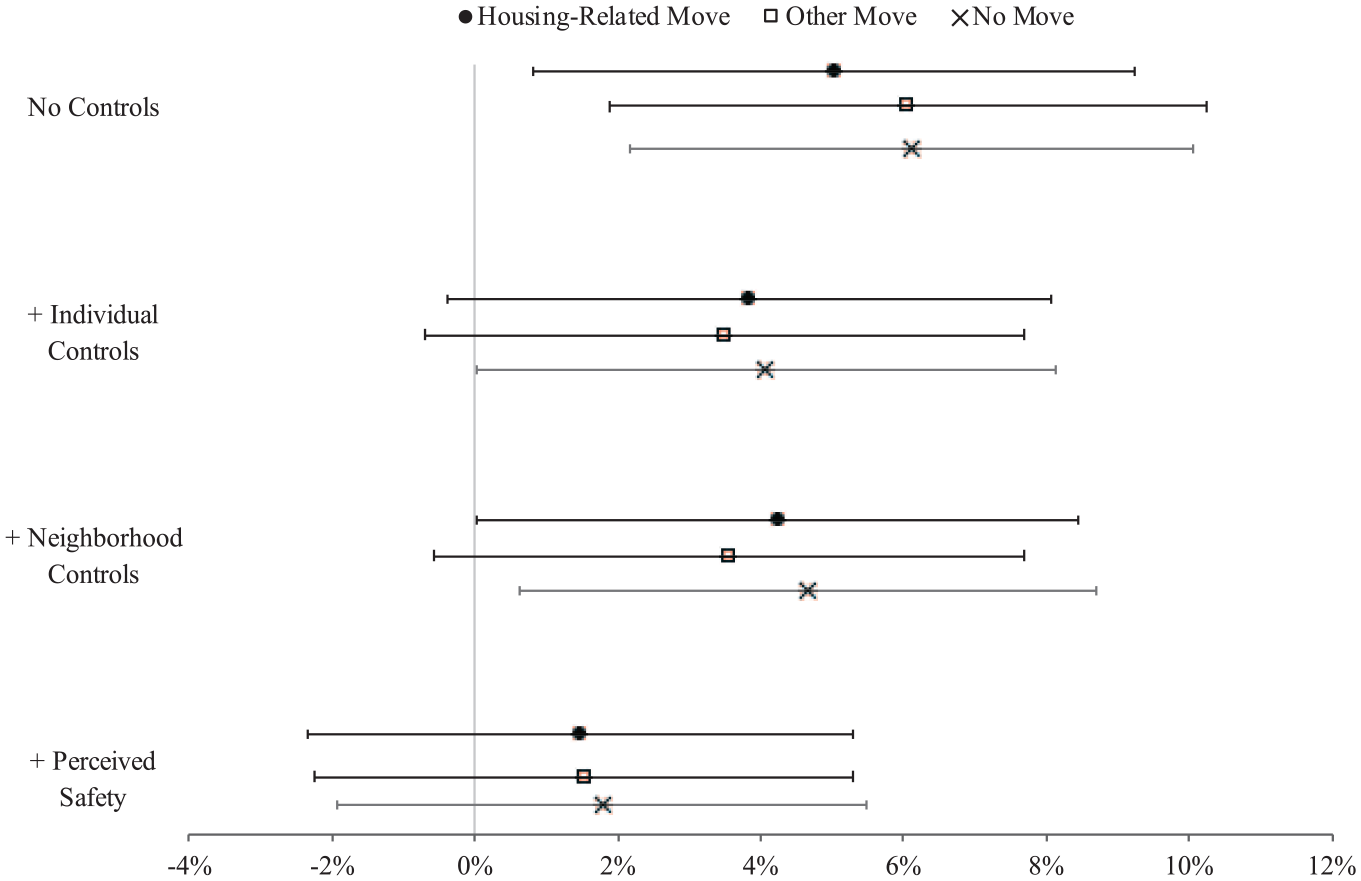
Average marginal effects of residential mobility on trust.
In Model 2, I control for individual-level characteristics that are correlated with generalized trust. I find significant associations between trust and the age, racial-ethnic status, economic status, and marital status of renters. The control for length of time in one’s home is not statistically different from zero, which may be because movers and nonmovers were categorized according to length of tenure. Time in residence may have been effectively controlled when renters were grouped on the basis of whether they had moved in the five years prior to the survey. The coefficient of other housing move continues to be positively signed, but the magnitude of the coefficient has attenuated, and it is no longer statistically different from zero. The coefficient of no move has also attenuated but continues to be statistically significant. Using Model 2, I calculate the average marginal effects for each residential mobility variable. The results are reported in Figure 1 in the row labeled “+ individual controls.” Only the effect for no move is statistically significant. Renters who did not recently move are 4.0 percentage points more likely to report trust in their neighbors than cost-related movers. These results support Hypothesis 2—controlling for individual characteristics accounts for differences in the probability that cost-related movers, other housing movers, and nonmovers report trust in their neighbors.
In Model 3, I control for the structural characteristics of neighborhoods. Net of all other controls, renters are more likely to report trust in their neighbors if they live in neighborhoods where a comparatively large share of residents are homeowners, where the poverty rate is comparatively low, and where their neighbors are racially or ethnically similar to themselves. After controlling for neighborhood characteristics, I find that the coefficients of all residential mobility variables have become larger. The coefficient of other housing move remains positively signed and has a p value of .05, not quite crossing the threshold of statistical significance. The coefficient of no move continues to be significantly greater than zero. I use Model 3 to calculate the average marginal effects of the residential mobility variables. The effects are reported in Figure 1 in the row labeled “+ neighborhood controls.” Compared to cost-related movers, renters who moved for other housing-related reasons are 4.2 percentage points more likely to report trust in their neighbors; however, this effect does not quite cross the threshold statistical significance (p = .05). Nonmovers are 4.7 percentage points more likely to report trust in their neighbors compared to cost-related movers; this effect is statistically significant. These results do not support Hypothesis 3—rather than reducing differences in the probability of reporting trust in one’s neighbors, controlling for the structural characteristics of neighborhoods has made differences between cost-related movers and nonmovers greater than they were in the previous model.
In Model 4, I control for perceived neighborhood safety. The coefficient of perceived neighborhood safety is significantly greater than zero, suggesting that renters who feel safer in their neighborhoods are more likely to trust their neighbors. Including this control attenuates the magnitude of all residential mobility coefficients, and in this model, the residential mobility coefficients are not statistically significant. After calculating the average marginal effects, I find that renters who recently experienced a cost-related move are no more or less likely to report trust in their neighbors than renters who moved for other housing-related reasons and renters who did not recently move. These results are displayed in Figure 1 in the row labeled “+ perceived safety.” The results reported in Figure 1 provide evidence to support Hypothesis 4—controlling for perceived neighborhood safety accounts for differences in the probability that cost-related movers and nonmovers report trust in their neighbors.
Table 4 displays the models of residential mobility and support. Model 5 includes the residential mobility variables with no controls. Nonmovers and renters who recently moved for other housing reasons are more likely to have neighbors they can count on for support than cost-related movers. Using the results in Model 5, I calculate the average marginal effects for each residential mobility variable. Those results are reported in Figure 2 in the row labeled “no controls.” Compared to cost-related movers, renters who moved for other housing-related reasons are 7.8 percentage points more likely to report having supportive neighbors, and renters who did not recently move are 7.9 percentage points more likely to report having supportive neighbors. These effects are statistically significant and provide evidence to support Hypothesis 1.
Residential Mobility and Support: Results from Logistic Regressions.

Note: Numbers in parentheses are jackknife standard errors. All models are weighted to account for the California Health Interview Survey design. Models 2, 3 and 4 control for survey-year fixed effects.
p < .05. **p < .01 (two-tailed tests).

Average marginal effects of residential mobility on support.
Model 6 includes individual-level controls. I find significant associations between support and the age, racial-ethnic status, economic status, and marital status of renters. The residential mobility variables in Model 6 are all significantly greater than zero net of all individual-level controls. Using Model 6, I calculate the average marginal effects for each residential mobility variable. The results are reported in Figure 2 in the row labeled “+ individual controls.” Renters who moved for other housing-related reasons are 6.5 percentage points more likely to report having supportive neighbors than cost-related movers. Renters who did not recently move are 6.7 percentage points more likely to report having supportive neighbors than cost-related movers. These effects are smaller in magnitude compared to the previous model, which provides evidence to support Hypothesis 2.
Model 7 includes controls for the structural characteristics of neighborhoods. The residential mobility variables continue to be positively signed and statistically significant net of all controls. Among the neighborhood-level controls, only the control for the poverty rate is statistically significant, suggesting that renters are less likely to report having supportive neighbors as the poverty rate increases. Using Model 7, I calculate the average marginal effects for each residential mobility variable. The results are reported in Figure 2 in the row labeled “+ neighborhood controls.” The effects for all residential mobility variables are statistically significant, and the magnitude of the effects is nearly identical to those calculated using the previous model, suggesting that these neighborhood controls do not account for differences in the probability that cost-related movers, other housing movers, and nonmovers report having supportive neighbors. These results do not support Hypothesis 3.
Model 8 includes a control for perceived neighborhood safety, the coefficient of which is statistically greater than zero, suggesting that renters are more likely to report having supportive neighbors if they live in neighborhoods that they perceive to be safe. In Model 8, the residential mobility coefficients have attenuated but remain statistically greater than zero. Using Model 8, I calculate the average marginal effects for each residential mobility variable. The results are reported in Figure 2 in the row labeled “+ perceived safety.” Compared to cost-related movers, renters who moved for other housing-related reasons are 4.6 percentage points more likely to report having supportive neighbors; renters who did not recently move are 4.5 percentage points more likely to report having supportive neighbors. Controlling for perceived neighborhood safety accounts for differences in the probability that cost-related movers, other housing movers, and nonmovers report having neighbors they can count on for support. These results support Hypothesis 4.
Conclusion
In this article, I tested whether cost-related movers—renters who recently moved due to unaffordable housing costs—were less likely to have neighbors they could trust and count on for support than renters who moved for other housing-related reasons and renters who did not recently move. I found evidence that on average, cost-related movers were less likely to report trust in their neighbors than all other groups of renters. The negative association between cost-related moves and trust largely attenuated after controlling for individual-level characteristics associated with generalized trust—one’s propensity to trust strangers or other people in general—suggesting that renters who tend to be generally wary of strangers may disproportionately experience cost-related moves. There are at least two implications of this finding. On the one hand, it is possible that people who experience cost-related moves might be reluctant to trust their neighbors regardless of their mobility patterns. On the other hand, it is possible that a cost-related move puts renters who are generally wary of strangers at a particular disadvantage with regard to neighboring: Relocating to a new home might entail leaving a neighborhood where one has trusting relationships—relationships that may have been established over long periods of time—and relocating to a place where most or all of one’s neighbors are strangers. If this is true, then cost-related moves may be particularly detrimental for renters who are not generalized trusters because they may perceive the risks associated with neighboring to be high. To adjudicate between these explanations, research is needed that can track the mobility patterns of individual renters over time and assess how trust in their neighbors varies as they move.
Regarding support, I found that on average, cost-related movers were less likely to report having neighbors they can count on for support compared to all other groups of renters, even when controlling for individual-level characteristics associated with one’s propensity to believe in the reliability of strangers. This association was robust to neighborhood-level controls and attenuated after controlling for perceived neighborhood safety. This finding is consistent with the hypothesis that cost-related movers may disproportionately live in neighborhoods where they do not feel safe, leaving them with fewer neighbors with whom they are willing to exchange support. Scholars have found that when renters feel unsafe, they may retreat into their homes to avoid chance encounters with their neighbors (Klinenberg 2001; Rainwater 1966; Rosen 2017; Tach 2009). They may also become more selective in the neighbors with whom they exchange support, restricting their support networks to neighbors whose trustworthiness has become evident and where the risk of exchanging support appears relatively low (Raudenbush 2016). If cost-related moves do increase the probability of relocating to a home located in a place that is perceived to be unsafe, then unaffordable housing costs could be linked to lower levels of support through the mechanism of perceived neighborhood safety. Future research that utilizes longitudinal data on residential moves should test whether perceived neighborhood safety mediates the relationship between cost-related moves and support among neighbors.
The findings contribute to the scholarship on residential mobility and neighboring in at least two ways. First, the findings suggest that the moving versus staying put framework for understanding variation in neighboring may be oversimplified. Scholars have often concluded that staying put in the same home over long periods of time helps build trust and support with one’s neighbors (Beck 2019a, 2019b; McCabe 2012). However, the findings reported here suggest that limiting certain types of involuntary moves—as opposed to limiting all residential mobility—may be the key to fostering trust and support. Indeed, the findings suggest that some groups of movers, such as those who moved for other housing-related reasons, were about as likely to report having neighbors they can trust and count on for support as nonmovers. Therefore, moving may not limit trust and support when moves are driven by pull factors that draw renters into higher quality homes and neighborhoods where the perceived risks of neighboring are low. In contrast, if moving involuntarily causes renters to relocate to residential contexts where the risks of neighboring are perceived to be high, then involuntary moves might limit certain types of neighboring. In addition to length of tenure, future scholarship on neighborhood social life should consider the conditions under which residents arrived at their current homes as a means of explaining relationships among neighbors.
Second, to the extent that cost-related moves affect trust and support among neighbors, it may not only be the movers who are impacted but also entire neighborhoods. As reported in the findings, the differences in trust and support between cost-related movers and other groups of renters sometimes varied by only several percentage points. However, small differences between these groups could be magnified in the neighborhoods where renters relocate after experiencing a cost-related move. Because residents often sort themselves—and are sorted—into neighborhoods where they share much in common with their neighbors (Sampson 2012), residents who struggle to access affordable housing may find themselves living among neighbors who have also moved in response to unaffordable housing costs (e.g., see Rosen 2020). If cost-related movers tend to relocate to homes in the same neighborhoods, and if moving due to unaffordable housing costs reduces trust or support among neighbors, then cost-related moves could make neighborhoods less cohesive. The implications of declining trust and support among neighbors could include more crime (Sampson 2012), weaker attachments to the neighborhood (Logan and Molotch 1987), and less civic engagement (Putnam 2000). For those interested in improving the quality of neighborhoods, one way of doing so may be to reduce cost-related moves by building more affordable housing.
Footnotes
Acknowledgements
The author would like to thank the University of Hartford for supporting this work. The author would also like to thank the California Health Interview Survey Data Access Center’s staff for their assistance with this research.
Funding
The author(s) disclosed receipt of the following financial support for the research, authorship, and/or publication of this article: This research was supported by the University of Hartford’s Dean’s Research Fund.
