




Abstract
The COVID-19 pandemic had numerous consequences for work and family, but one of the most important was the substantial increase in remote work. Despite interest in changes to remote work and questions about whether the new environment of remote work will persist long-term, we know little about variation in workers’ experiences with remote work since the beginning of the pandemic. In this data visualization, we use longitudinal data on U.S. working parents from 2020–2023 and group-based trajectory models to illustrate varying patterns of remote work for partnered parents. The heterogeneity of parents’ experiences with remote work throughout the pandemic reveals important nuances not previously identified in tracking polls and highlights important gender differences that likely had implications for mothers’ and fathers’ well-being and gender equality.
The COVID-19 pandemic dramatically changed the nature of work. Due to lockdowns and concerns about virus transmission, remote work proliferated (Fan and Moen 2022; Parker, Horowitz, and Minkin 2020). For example, the percentage of eligible workers working remotely jumped from 10 percent to nearly 70 percent in spring 2020 (Wigert and Agrawal 2022). The share of workers working remotely declined as the pandemic persisted but remains elevated today compared to before the pandemic (Palarino, Burrows, and McKenzie 2023; Parker et al. 2022; U.S. Bureau of Labor Statistics 2022). Yet many workers did not have the option to work from home, particularly those in essential or frontline industries (U.S. Bureau of Labor Statistics 2021).
Data from polling firms suggest three general trends: (1) There is a large group of workers who began working remotely in spring 2020, many of whom have begun to return to the office; (2) there is a group of workers who have never been able to work remotely; and (3) there is an increasing group of workers who split their time between home and office (Parker et al. 2020; Wigert and Agrawal 2022). Yet little is known about heterogeneity in remote work patterns, especially for mothers and fathers. Variations in mothers’ and fathers’ remote work experiences are important given the consequences of remote work for work-family justice, parents’ well-being, and gender equality (Carlson et al. 2022; Chung 2022; Collins 2019; Montazer et al. 2022). Using longitudinal data on partnered U.S. parents from before the pandemic (March 2020) to after the pandemic (October 2023) and group-based trajectory models, this data visualization illustrates the heterogeneity in partnered mothers’ and fathers’ remote work experiences.
Figure 1 displays trajectories of remote work for U.S. partnered parents. Results show that approximately half of employed mothers and fathers have not changed their work location since the COVID-19 pandemic; 31 percent of mothers and 41 percent of fathers have never worked from home, whereas one in seven fathers and one in six mothers have worked from home exclusively. Interestingly, although mothers in the consistent exclusively group appear to have always been exclusively remote, fathers in this group worked from home frequently but not exclusively before the pandemic, suggesting a permanent shift to exclusive remote work after lockdowns.
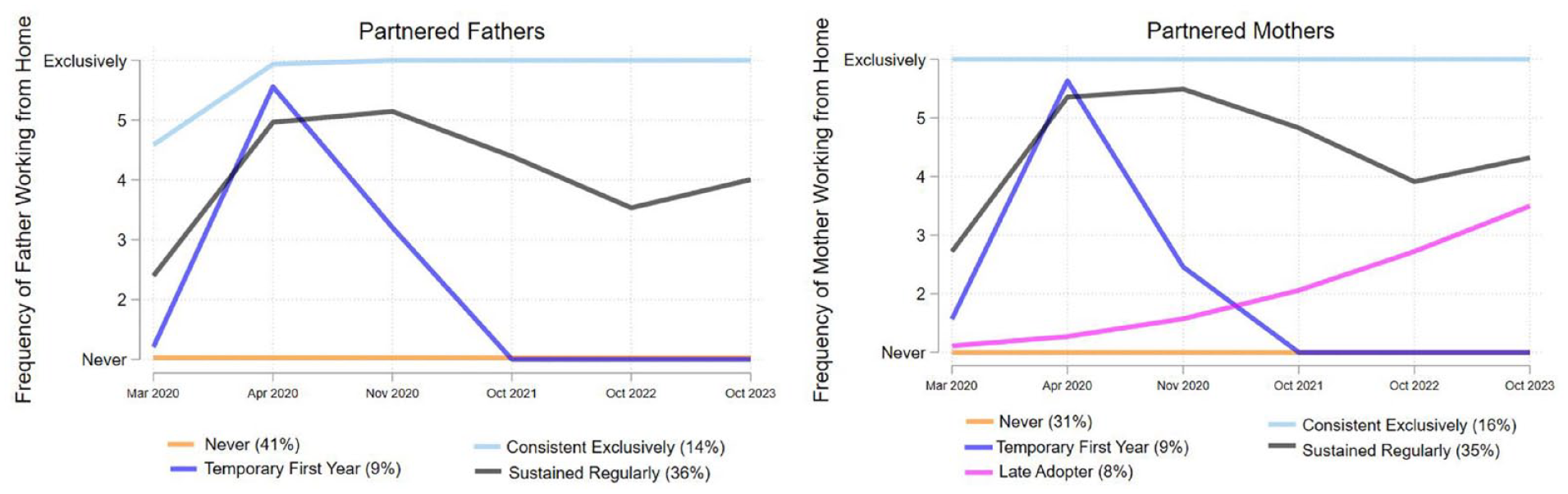
Trajectories of U.S. partnered parents’ remote work during the COVID-19 pandemic.
Among the half of parents with fluctuating remote work experiences, Figure 1 shows substantial variability by parents’ gender with two trajectories of change for fathers and three for mothers. Nine percent of fathers transitioned temporarily to remote work in spring 2020 before returning exclusively to the office by fall 2021. A much larger proportion of fathers (36 percent) who worked from home occasionally before the pandemic (i.e., once a month) began working from home more frequently when the pandemic started and have sustained more frequent remote work (i.e., once a week).
Among mothers, we also observe a temporary first-year group of remote workers (9 percent) who follow a similar pattern as the group for fathers. We also observe a group of mothers who have become regular remote workers (35 percent). This trajectory is similar to the sustained regularly trajectory for fathers, but compared to fathers, mothers who became regular remote workers work from home more frequently. 1 We also find one additional pattern that is unique to mothers: a group of late adopting mothers (8 percent) who did not work remotely before the pandemic but who have increased their frequency of remote work over time. Additional analyses (not shown) suggest that a sizeable portion of the latter group were essential workers in 2020, some of whom transitioned out of essential work.
Conclusion
There is great variability in parents’ experiences of remote work since the start of the COVID-19 pandemic. Half of partnered mothers and fathers transitioned to remote work during the pandemic. Although this transition was temporary for some, the majority continue to work remotely at least once a week, with mothers working from home more frequently than fathers. Among temporary remote workers, all returned to in-person work by fall 2021. A small group of mothers have also recently just begun working remotely and with increasing frequency.
These gendered patterns of remote work likely have consequences for gender equality and parental well-being. Workplace flexibility can help working parents manage work-family conflict (Chung 2022), promoting greater well-being (Fan and Moen 2023). This was especially the case during the pandemic (Carlson et al. 2022; Carlson and Milkie 2023). At the same time, it may also undermine well-being by blurring boundaries between work and family—particularly for mothers (Chung 2022). Moreover, remote work may stigmatize workers (especially mothers), inhibiting career advancement (Chung 2022). Post-COVID, increased remote work appears here to stay, and it is mothers who will likely incur both the benefits and costs of this new reality.
Supplemental Material
sj-docx-1-srd-10.1177_23780231241266764 – Supplemental material for Trajectories of U.S. Parents’ Remote Work during the COVID-19 Pandemic
Supplemental material, sj-docx-1-srd-10.1177_23780231241266764 for Trajectories of U.S. Parents’ Remote Work during the COVID-19 Pandemic by Richard J. Petts and Daniel L. Carlson in Socius
Footnotes
Funding
The author(s) disclosed receipt of the following financial support for the research, authorship, and/or publication of this article: This study was generously supported by the American Sociological Association Fund for the Advancement of the Discipline (2020) and the National Science Foundation under Grant Nos. 2148610 and 2148501. Any opinions, findings, and conclusions or recommendations expressed in this material are those of the authors and do not necessarily reflect the views of the National Science Foundation.
Supplemental Material
Supplemental material for this article is available online.
Notes
Author Biographies
 ).
).
References
Supplementary Material
Please find the following supplemental material available below.
For Open Access articles published under a Creative Commons License, all supplemental material carries the same license as the article it is associated with.
For non-Open Access articles published, all supplemental material carries a non-exclusive license, and permission requests for re-use of supplemental material or any part of supplemental material shall be sent directly to the copyright owner as specified in the copyright notice associated with the article.
