




Abstract
From 2000 to 2019, the number of Black residents in Chicago dropped 25 percent. In this study, we sought to understand how Black Chicagoans make meaning of out-migration, their desires for the city and its future, and the factors they use to navigate questions of whether to stay or leave. We conducted focus groups and interviews with 80 Black Chicagoans who reported either having close friends and family who departed the city or themselves harboring a strong desire to leave. We find that a complex web of factors—a sense of being displaced by White residents, struggles in education, challenges with employment, a sense of declining public safety, and limited access to services—contributed to participants’ sense of the city as increasingly unlivable. We argue that this out-migration constitutes a slow-motion disaster in which cumulative disinvestments interact with socioeconomic vulnerabilities to create a catastrophe for Black Chicagoans.
Once understood to be a “chocolate city” (Hunter and Robinson 2018), Chicago is facing a moment of pivotal change. Although the city’s overall population loss has garnered headlines nationwide, a closer look at the data reveals that this population loss is driven by a decline in the number of Black residents. From 2000 to 2019, Chicago’s population declined by about 7 percent. But the number of Black Chicagoans dropped precipitously by approximately 25 percent (American Community Survey 2019). This enormous drop was masked by population increases in other racial subgroups during this period: The subpopulations of White, Native, and Asian Chicagoans grew by 12 percent, 15 percent, and 56 percent, respectively; the population of Latine Chicagoans declined by 2 percent.
Observers have postulated that the out-migration of Black residents may be attributable to a variety of factors, including declines in economic opportunity, the impacts of policing and incarceration, the demolition of public housing, and school closures (Institute for Research on Race and Public Policy [IRRPP] 2020). In this study, we interrogate these assumptions, asking: How do Black Chicagoans make meaning of these demographic shifts? What are their desires regarding residential life and civic participation? How do residents and their loved ones navigate questions of whether to stay in Chicago or leave? For those who stay, how do the departures of others shape their sense of the city and its future?
To address these questions, we analyze data from nine focus groups of 36 participants and in-depth semistructured interviews with 44 participants—all Black Chicago residents who indicated either that they had close loved ones who had moved away from the city or that they themselves were considering a departure. We find that participants expressed a keen sense of being displaced by White residents but also that education, a need for employment and financial stability, public safety, and a lack of goods and services all contributed to their sense of the city as becoming increasingly unlivable. They also shared their complex feelings about being left behind as other friends and relatives moved away and competing sensibilities about the future of Black Chicago—from optimistic resolve to the sense that the future looks “bleak.” We argue that far from being attributable to a single cause, the present out-migration is a result of several cumulative and interwoven factors and should thereby be characterized as a kind of “slow-motion disaster”: a “long-term collision between corrosive structural processes, counterproductive social policies, and vulnerable populations” (Draus 2009: 360).
Throughout the twentieth century, Black residents were instrumental in shaping what we have come to understand as the fabric of the American city. Currently, our nation is at a point of contestation regarding what the American city will be and who has a right to define it. This article attempts to deepen our understanding of this historically significant moment while placing the meaning-making and insights of Black residents themselves at the center of our inquiry.
Patterns and Potential Causes of Out-Migration
A 2019 comprehensive analysis of regional census data found that although Chicago’s population has declined overall, this pattern does not manifest equally between racial groups or equally across the city. Perhaps drawing on sources of social and financial capital, White residents have been more likely to move to affluent areas of the region, such as Lake County; Black residents are more likely to move to areas with less economic opportunity, such as Gary, Indiana (IRRPP 2020:41). Furthermore, in many neighborhoods, there has been an inverse relationship between White and Black demographic trends: Communities that see a rise in one group also see a decline in the other group and vice versa (IRRPP 2020). The authors suggest that “the factors leading to white population growth have negative effects on the population of black residents,” especially in the areas of housing and economic investment (IRRPP 2020:25). They also argue that mass incarceration, policing, and public school policy may also be potential drivers of out-migration.
Indicators reflecting racial inequality certainly suggest the plausibility of some of these explanations. In 2019, over 20,000 Black Illinoisans were incarcerated, making them over half the population of incarcerated people despite being 14.6 percent of the state population (Carson 2020; U.S. Census Bureau 2021). A Department of Justice investigation completed in 2017 found that the Chicago Police Department (CPD) uses force almost 10 times more often against Black residents than against White residents and that “CPD has tolerated racially discriminatory conduct that not only undermines police legitimacy, but also contributes to the pattern of unreasonable force” (U.S. Department of Justice and United States Attorney’s Office 2017). Even after individuals are no longer incarcerated, they often experience the “afterlife” of incarceration, facing barriers to accessing housing, employment, and other necessities (Miller 2021).
Within the Chicago Public Schools, despite laudable improvements, Black boys have the lowest high school graduation rates and lowest postsecondary attainment rates of any race/gender subgroup (Malone et al. 2021), Black students are drastically more likely to be suspended than students of any other racial or ethnic subgroup (Sartain, Allensworth, and Porter 2015), and Black communities were disproportionately impacted by the historic wave of school closures that occurred in 2013—the largest mass public school closure in the history of the United States (Ewing 2018). In 1970, at the height of the city’s manufacturing boom, unemployment rates among Black and White residents in Chicago came closest to parity, at 6.9 percent and 3.5 percent, respectively. Since then, this gap has rapidly increased; in 2019, the rate of Black unemployment in Chicago was over 3 times that of White unemployment (Chicago Metropolitan Agency for Planning [CMAP] 2020). In 2019, Illinois reported the third highest rate of Black unemployment of any state in the country, after Mississippi and Nebraska (Bureau of Labor Statistics 2021). Thus, although existing analyses have been unable to draw a causal relationship between any of these sociopolitical factors and present demographic patterns, there is a basis of evidence to suggest that the cumulative effect of multiple disparities may be spurring Black people to leave Chicago.
Some observers have speculated that these trends comprise something like a “reverse Great Migration,” in which Black Chicagoans are returning to the Southern locales that their parents or grandparents left generations ago (Saunders 2019). However, census data indicate that the majority of Black Chicago emigrants stay within the region, with 51.3 percent remaining in Illinois or Indiana; Georgia, the next most popular destination, has received 5.4 percent of departing residents, and Mississippi, where many Black Chicagoans have family roots, has been a destination for 2.3 percent of emigrants (IRRPP 2020:41).
Many residents who choose to stay in Illinois elect to relocate to suburbs outside Chicago, in search of the material stability, high-quality housing, and amenities that have become synonymous with suburbia in the national postwar imagination. However, evidence suggests that poverty and segregation—social problems historically associated with urban spaces—are observable in suburban contexts (Massey and Tannen, 2018). The last two decades have seen a marked shift in the residential distribution of American poverty, and in 2010, our nation crossed an important threshold: In that year, 15.3 million low-income people lived in suburbs, and 12.8 million lived in cities (Kneebone and Berube 2013). As Howell and Timberlake (2014:94) note, these demographic trends “may be seen more as a reconstitution of old spatial inequalities than a step toward their amelioration.” In the case of the Chicago region, it is unclear whether departing Black residents are indeed “moving to opportunity” because the counties where they land have, on average, lower educational attainment and lower median wages and income (IRRPP 2020:43). Meanwhile, analysis of school transfer data indicates that thousands of Black public school students leaving Chicago have landed in surrounding school districts that have less consistent funding and lower academic performance than Chicago Public Schools (Belsha 2017).
These changes prompt questions beyond the fact of demography: More fundamentally, who is able to take part in civic life and the opportunity to shape the present and future social fabric of Chicago? In short, who has a right to the city? Harvey (2012:4) has defined the right to the city as “far more than a right of individual or group access to the resources that the city embodies: it is a right to change and reinvent the city more after our hearts’ desire,” a process that “inevitably depends upon the exercise of a collective power.” This exercise of collective power to make the city in one image or another is inherently a site of contestation, as different groups harbor divergent visions for the civic life.
Slow-Motion Disaster
Of the 14 cities that had the largest populations of Black residents in 2000, seven of them (New York City, Los Angeles, Chicago, Detroit, Baltimore, New Orleans, and Washington, DC) have since seen notable declines in Black residents, even as the city population overall has declined at a slower rate or even increased (see Table 1). Chicago, New Orleans, and Detroit have experienced the most drastic declines in Black residents: 25 percent, 29 percent, and 33 percent, respectively. Of these, Chicago is the only city where the decline cannot clearly be attributed to an exogenous factor on a massive scale (i.e., Hurricane Katrina or the collapse of the American automotive industry). However, expanding our understanding of “disaster” beyond a single acute event allows us to observe that Chicago has experienced a form of slow-motion disaster (Bleifuss 2005; Draus 2009; Wallace and Wallace 1997). In contrast to a disaster understood as an acute event—a tornado, an oil spill, a wildfire—with discretely measurable effects, a slow-motion disaster catalyzes results of the same magnitude but with an overlapping set of causes that occurs over a sustained period of time. In the case of Chicago, observers have suggested that current population trends reflect a century-long pattern in which the city’s Black population ebbs and flows in tandem with the relative severity of racial inequality compared to other possible residential areas (IRRPP 2020).
Black Population Trends in U.S. Cities, 2000–2018. a
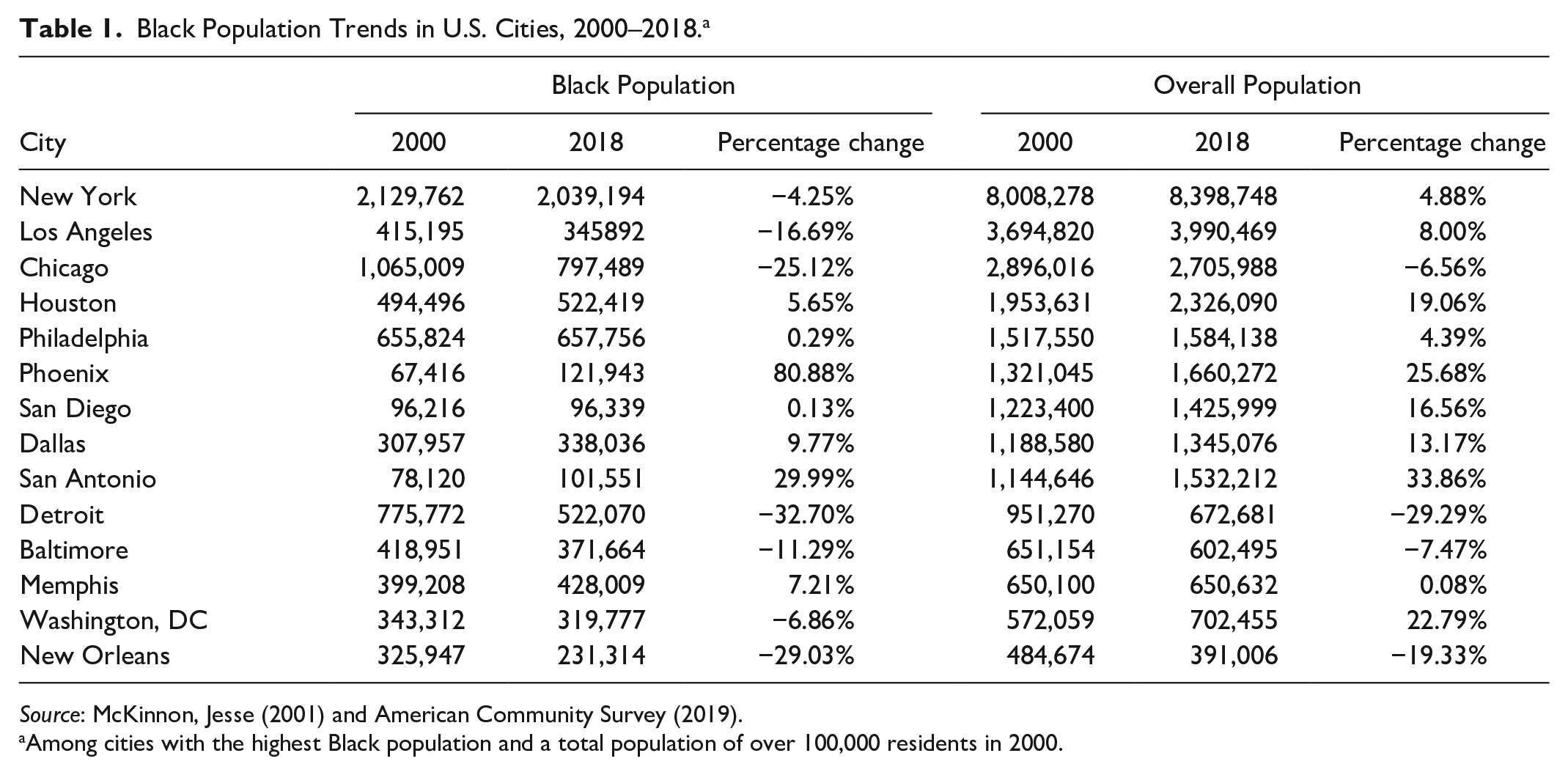
Source: McKinnon, Jesse (2001) and American Community Survey (2019).
Among cities with the highest Black population and a total population of over 100,000 residents in 2000.
In what follows, we describe our efforts to build on these prior empirical and theoretical interventions by seeking a richer qualitative understanding of how Black Chicagoans themselves make meaning of out-migration, its antecedents, its effects, and its bearing on their visions for the future of the city.
Data and Methods
Data collection for this study took two forms: in-person focus groups and following the onset of the COVID-19 pandemic, individual semistructured qualitative interviews conducted over the phone. Both of these approaches allow us to complement existing quantitative analyses of migration patterns with a focus on the epistemological importance of Black people’s narratives; following Yosso (2005) and others, we believe that community conversations and accounts of personal experiences are an important source of evidence.
Participants were considered eligible if they were over the age of 18, identified as Black, had been a resident of the city of Chicago for most or all of their lives, and had either (1) considered moving out of Chicago or (2) had close friends or relatives who had left Chicago. Although an alternative line of inquiry would have led us to focus instead on those who had already left Chicago and ex post facto questions about their departure, our goal for this study was to understand how Black Chicagoans who remain in the city understand and make meaning of the moment in which they find themselves—hence our focus on those who are proximal to departure rather than those who have recently moved away.
Participants were eligible if they lived anywhere within city limits; however, focus groups were scheduled to take place in locations meant to reflect the 10 community areas in the city that have experienced the greatest declines in Black residents since 1980 (see Table 2). We also recruited participants via flyers in popular neighborhood gathering places in the 10 target community areas, via social media, and through partnerships with nonprofit organizations and community centers within these target neighborhoods. Despite these strategies, our final sample reflected a diverse array of participants representing 31 zip codes, not necessarily concentrated around these target regions.
Community Areas in Chicago with the Greatest Black Population Loss, 1990–2016.

The flyers directed potential participants to an online intake form hosted on Qualtrics, allowing us to gather participants’ age, zip code, and gender and to determine eligibility. The participants ranged from age 18 to 67, with a mean age of approximately 37 years old. Although it was not a requirement of our study to disclose gender, 40 participants identified as male, and 40 participants identified as female. None of our participants self-reported being transgender or gender nonconforming. Participants each received a $40 gift card as a token of thanks.
We began data collection via focus groups held in community centers, cafes, and other central locations within or adjacent to the community areas of interest. When used as the primary form of data collection within a qualitative study, a focus group can allow for a more nuanced iteration of experiences than an individual interview. The responses to each question posed by the moderator are equally reliant on each participant’s own experiences and the interaction between the participants in a shared space (Morgan 1997). We used a semistructured conversation protocol and served food at each gathering, and found that the sessions took on a convivial atmosphere, with participants sometimes lingering after the focus group was over to chat casually with one another.
Each focus group was constructed from the pool of recruited participants with the aim of offering individuals a convenient location based on their zip code and in an attempt to establish age and gender diversity. The focus group conversations were facilitated by Black graduate students, three of whom were raised in Chicago and one of whom was raised in Mississippi.
The focus groups typically lasted around 60 to 90 minutes based on the number of participants and were scheduled to take place at various times of day and during the week to ensure that interested participants were able to find a focus group that worked for their schedule. We spoke with a total of 36 participants in the nine focus groups, with nearly two-thirds of these initial participants identifying as female. 1
Beginning in March 2020, we found ourselves unable to continue in-person research and shifted to collecting data via phone interviews. Incidentally, this approach allowed us to connect with participants who may have been unable to attend focus group sessions due to childcare responsibilities or other work commitments. The flexibility of the individual phone interview meant that the facilitator could connect to participants at a date and time that was most convenient for them without the pressure of a group setting. Although the individual phone conversations were shorter, typically lasting around 45 minutes, the facilitators used the same set of questions from the focus groups to gather significant details and probe further on individual responses. We conducted a total of 44 phone interviews between March and July 2020.
After transcribing the audio files, a team of researchers used NVIVO qualitative coding software and the flexible coding method (Deterding and Waters 2018) to create a framework of analysis for this study. Unlike grounded theory, flexible coding allows for the researcher to have preexisting ideas regarding the data they gather (as, in our case, the quantitative and historical context regarding demographic shifts), which allowed for us to code specifically for the answer to our research questions rather than simply open-coding all data. The first round of index codes allowed for us to document key transitions within the conversation based on each question presented to the group or the individual to standardize the points that we coded. To ensure interrater reliability, each transcript was then coded twice using a set of analytic codes. These codes were generated collectively through a team meeting and from analytic memos taken by the researchers throughout the data collection process. The analytic codebook focused on both the reasons for leaving or staying in Chicago and key emotional code words used by participants, which allowed us to capture complex sentiments of optimism, opportunity, and loss (see Table 3). After reviewing participant transcripts sorted by these codes, we determined the salience of the four key themes outlined in our findings in the following.
Analytic Codes.

Findings
After basic introductions and reviewing informed consent protocols, the first substantive question in our discussion guide was: “What factors have made you think about moving away?” This straightforward question spurred participants to describe complex and overlapping feelings about the city and its habitability such that Black out-migration seems less traceable to a single cause than it is attributable to an accumulation of forces. Many participants described a sense that White residents, after fleeing in prior generations, had now returned to “take back” a city that was newly desirable, pushing out Black residents in turn. Participants also expressed dissatisfaction with the civic resources needed to make a good life, most notably in four areas, which we discuss in detail: (1) education, (2) employment and financial stability, (3) public safety, and (4) retail goods and services. Lastly, we found that participants had nuanced and sometimes contradictory feelings about being “left behind” as other Black people move away from Chicago and about their sense of the city’s possible futures. We explore each of these findings in the following.
“They Want It Back”: The Perceived Resurgence of White Desire
From the postwar period through the 1990s, Chicago, like other major American cities, experienced the phenomenon of “White flight” as White residents with the means to do so left the city for the more desirable suburbs (IRRPP 2020; Massey and Denton 1993; Wilson 2012). However, more recent years have seen a resurgence of White residents returning to the city (CMAP 2019) and a massive increase in the proportions of Chicagoans who are wealthy renters; the city now ranks fourth in the nation in its population of renters earning more than $150,000 annually (Bauer 2019). Hyra (2017:101) has argued that White residents of this era are drawn to the urban core of “chocolate cities” based on the marketability of an experience he calls “living the wire”: residing in a community that has an energy and an edge that distinguishes people who live in the inner city from those living in the “boring” homogeneous suburban and central city areas. Living the wire helps newcomers carve out their urban niche in the metropolis. They flock to historic Black neighborhoods to experience the thrill of viewing elements of the iconic ghetto.
Participants we spoke to observed this influx of White residents and the sense that after leaving the city a generation ago, they now “want it back.” Laura,
2
a mother of five, put it this way: In South Shore, it took us almost 15 years to get a grocery—maybe 10 years to get a grocery store. And that was because nobody wants to come to the South Shore area. . . . And now here we are and now they want to move everybody and your cousins to the suburbs, because they want this water. South Shore’s where the water is. South Shore, Hyde Park, Bronzeville, all this is where the water is. They want that. They want it back.
3
For Laura, the sense of being displaced by White newcomers is compounded by the frustration of having struggled for many years to get basic amenities in South Shore, a community area where the proportion of White residents has more than doubled in the last two decades (CMAP 2021). “I think if you have a development where people of different races are more inclined to live in the city,” said Hakim, a 38-year-old from Chatham, “it’s going to sort of naturally push more Black people out in some ways . . . it’s sort of like a hopscotch thing with White people moving one place and Black people have to move to another place and vice versa.” Hakim’s suggestion that such a hopscotch was “natural” reflects the idea that the presence of White people in a neighborhood inevitably leads to both a cascade of increasing White population and concomitant Black declines. This assumption has been borne out in analyses done, for instance, by Rucks-Ahidiana (2021), who find that census tracts experiencing an increase in socioeconomic status are disproportionately characterized by simultaneous White population increase and Black population decline, and Krysan et al. (2009), who found that White residents prefer majority-White neighborhoods and that Black residents prefer more racially diverse neighborhoods.
Laura made a similar observation about South Shore. “White people had South Shore first. Black people took it, made it awesome, loved living over here. White people see the good in it, and they want it back. . . . They’re coming to get—I’m looking at them pass my house now.” For Randell, a 31-year-old living in Hyde Park, the incoming Obama Presidential Center is key to understanding patterns of displacement.
It’s definitely a critical time, and I think the White people who fled to the suburbs are moving back or have moved back and are trying to take the city back. . . . And I think that that, the Obama Center is going to bring some radical changes to the surrounding neighborhoods, and not all good either.
Randell critiqued the idea that new investments such as the presidential center, which the Obama Foundation and civic partners have hailed as a boon for a revitalized South Side, were ultimately intended to serve low-income Black people. He compared them to the “urban renewal” policies of the 1960s. “They’re not coming in these neighborhoods to try to incorporate us into these neighborhoods,” he said. “They’re coming in these neighborhoods pushing us out the neighborhoods, bringing all these other people in these neighborhoods, and then trying to call it diversity. . . . The best way to do it was to be—is to incorporate us into y’all’s ‘renewing.’”
Lemarcus, a 36-year-old from South Shore, made it clear that he did not see such patterns as incidental but, rather, as a strategic effort at displacement. “I think that it’s intentional, and it’s a way to push, particularly, Black people out of the city. To raise rent and to make spaces as uninhabitable as possible to cause them to not want to stay there.” For Randell, it all began with the Plan for Transformation, wherein the city demolished nearly 22,000 units of public housing, including the Harold L. Ickes Homes in the Bronzeville community where he grew up (Ewing 2018:86).
They just—create the situation. . . . And then you come, you wait ’til the property value is really low, then you kick these people out, you rebuild it and you displace these families and then you put them with other displaced people and you continue this cycle of poverty, honestly. That’s how I’ve seen it. They’ve been doing the same thing, they just do it hood by hood. They kick people out and push them to a neighborhood that’s already notoriously bad or push them to the suburbs, but one or the other.
Stovall (2018) describes this process as a “cycle of cleansing,” in which neighborhoods with access to desirable resources become “cleansed” of a population deemed unworthy of occupying this space, who are then forced to relocate to the further periphery to make room for incoming wealth. Meanwhile, the characterization of a neighborhood as “notoriously bad” may be not only a matter of perception but also a reflection of what Sampson (2012) has demonstrated as the surprisingly durable properties of neighborhood-level effects such that certain communities experience pervasive socioeconomic patterns that persist over time.
Participants did not view the increase in amenities, retail goods, and services that accompanied an increase in White population as being something worth celebrating in communities that have long lacked such resources but, rather, as a harbinger of doom spelling out impending total displacement because these amenities are “not for us.” More than one participant mentioned Cabrini-Green, where public housing that was home to thousands of low-income Black residents has been demolished and replaced by costly private residences (Austen 2018). “So when I think about Cabrini-Green, and what it was and now, on that exact site, there really are no Black people in that area,” said Branson, a 38-year-old living near Douglas Park. “So it wasn’t really for the Black folks, and there’s an Apple store on that site right now.” Another participant, Elisiah, described such developments in his Woodlawn community this way as being “not necessarily for us or because of us. I feel like they’re doing it because they know that there’s more White people over here . . . I just feel like they’re building it up, which is fine, but they’re building it up not with us in mind.”
“They didn’t value Black people in this city,” 40-year-old Stacie told us. “And so it’s like now White people are able to move back, and now this community has value.” Stacie’s observation about the systemic devaluation of Black life in Chicago has been manifest in a variety of interwoven social policies and disinvestments in multiple sectors, culminating in a set of circumstances that have made living in the city fundamentally untenable for many. We discuss four of these areas that emerged as salient for our participants: education, employment and financial stability, public safety, and retail goods and services.
Education
Chicago, like some other large urban districts, has pivoted in recent decades away from purely residentially based school assignment policies toward a “choice-based” model in which parents select from among a “portfolio” of schools (Lipman and Haines 2007; Pattillo 2015). Many participants viewed this model as amplifying educational equity rather than mitigating it by creating a marketplace of schools in which some schools and their students were destined to be winners and others were doomed to lose. Neighborhood schools—those schools designed and required to accept any students within their attendance boundary without any special admissions process—have experienced sharp declines in enrollment, with schools designed for over a thousand or two thousand students now often enrolling students in the low hundreds (Richards and Perez 2018). Keanna, who lives in Morgan Park, described her disappointment at her neighborhood high school, Fenger, seeing a steep drop in enrollment. Fenger was home to over 1,100 students at the start of the 2005 school year and has 244 students as of this writing (Chicago Public Schools 2022).
People feel like, “Well, what kind of education can my child get at Fenger compared to one of those charter schools?” And then that competition. Now there’s a moratorium on those charter schools—a lot of them are underperforming and not doing what they’re supposed to do. So I think it’s a culmination of a lot things that ended up messing with the enrollment, but it’s not promoted in a way that helps bring the kids back, bring people back to the neighborhood.
Keanna observed that in a market-based school system, Fenger—which is required to take all students who come through its doors—would never be “promoted” and therefore could not compete with charter schools that have incentives to engage in active marketing regardless of their academic performance (Wilson and Carlsen 2016).
In a study drawing on interviews with 77 Black low-income parents in Chicago, Pattillo (2015) drew attention to the ways that the choice-based system weighs heavily on parents, even those who are eager to participate in this model, because the lack of clarity and disparity of resources make the school choice decision one that leads students on radically different trajectories. Camellia, a Kenwood resident, described herself as “fortunate” because her mother, a teacher, helped her navigate the choice-based system. But knowing that her own family was successful was little solace to her when considering the inconsistency in resources and quality across the school system.
If I’m not able to do what my mom did, and get us into some magnet program with the opportunities to have us be prepared for higher learning, where does that leave a future child of mine that’s stuck in quote unquote “our neighborhood school” that does not have the resources that I know that they should have? So that’s why that’s something that’s always on my mind.
Denis expressed frustration with what he perceived as the unequal distribution of supports for disabled students because of the closing of the schools and the fact that there’s already not that many special ed programs out there. . . . It’s either my child will have to go north or within the outskirts of the city to find the program that he needs to get through school, or move out to the suburbs or even find another state that—where they can get what they need.
Some participants were doing their best to hang on to Chicago residency but had already given up on any hope that the school system could serve them through legitimate means. Instead, they engaged in the common practice of residency fraud—falsely using an address that was not actually the child’s primary residence to enroll them in school. As Harris (2017) has pointed out, residency fraud itself represents a form of “school choice,” albeit one that is not sanctioned by the district’s market system. Whereas parents with the wealth, mobility, transportation access, employment options, and other resources can engage safely in school choice by moving to educational opportunity, low-income parents without such options leave themselves vulnerable to serious risk—including criminal prosecution—in search of the school that they have deemed the best for their child.
Kimberly, who lives in Pullman, described her cousin taking this approach with her daughter. “Her dad is a Chicago police officer. So she uses his information so her daughter can go to Brooks.” But for Jerome and Chrystelle, the risks inherent in trying to play the address system were not worth it.
Me and my wife, we’re educated so—and we were former teachers, so we know how to kind of navigate this system to kind of manipulate it in our favor. But that’s hard if you don’t know all that stuff and you try to navigate city education . . . and if you don’t live in the city you can’t send your kids to CPS and now they want to like throw you in jail for that. And so we don’t want to take that risk because we know we do have relatives in the city.
They’ll come find you at your house. Yeah. I don’t need all that.
Although research and public conversation about choice-based enrollment systems often focus on the individual strategies parents use to garner the best outcome for their individual children (Kimelberg 2014; Lareau 2014; Roda and Wells 2013), participants we spoke to saw greater ramifications of school choice above and beyond the outcomes for their own families. The mere fact of having to choose, of having to rely on special knowledge or even legal fraud to navigate the system rather than being able to count on an equitable district with high-quality schools for all was seen as an indictment against the idea that the city itself was a sustainable choice for Black people long-term.
Employment and Financial Stability
Chicago’s notorious racial inequality is inextricably linked to economic precarity. When compared to their neighbors of other racial and ethnic groups, Black Chicagoans have lower rates of homeownership, lower rates of loan approval from banks, higher rates of home foreclosure, higher relative monthly housing costs, and higher rates of poverty (IRRPP 2017). Although all of these factors can be important ways to understand economic mobility and prosperity, for our participants, challenges with securing employment emerged as the most visible way in which they experienced financial instability. Black unemployment in Chicago is over 4 times the White unemployment rate and remains unaddressed by educational attainment: Black Chicagoans with advanced degrees are more likely to be unemployed than White Chicagoans with a bachelor’s degree (IRRPP 2017:4).
In sharing their frustration with the lack of reliable employment opportunities, some participants identified what they perceived as the magnified importance of social capital in Chicago. “Chicago is a really prejudiced city,” said Laura. “So it’s hard to stay. Chicago, it’s almost like you got to know somebody. You got to let one of us get in and, hopefully, that person remembers the next, and we move forward like that. Because Chicago is—it’s really hard.”
For others, prior involvement in the criminal-legal system limited their eligibility for desirable jobs. Chrystelle, who lives in Morgan Park, shared a sense of sadness at her mother and all of her siblings moving to Wisconsin because felony criminal backgrounds restricted their ability to find work in Chicago.
The reason why they left is because all of them have backgrounds. I don’t have a background so it’s not hard for me to get a job, whereas, for them, it’s very hard for them to get a job. And of course, it affects them financially with housing and just daily living situations. So I’m not leaving, and the reason why it did affect me is because I had a child and my child wasn’t going to—she knows my mom and my siblings but I want her to know more of them.
For James, a 54-year-old who lives in Uptown, a criminal record was equivalent to a total dead end. As he put it, Chicago has “too many obstacles” for people like him: “I have a couple of legal offenses, and people tend to shun especially African Americans. They shun them. And I made a wrong choice. So that’s pretty much it right now.”
Alfred’s loved ones had left Chicago for Iowa, where their limited educational attainment was less of a barrier to them finding financial stability and quality housing. Alfred is 28 years old and lives in Pullman; his relatives had grown up with up to seven people sharing their grandmother’s two-bedroom apartment.
They all grew up on the West Side with minimal education because they only went to high schools that you could go to school for 20 percent of the day and nobody was really paying too much attention. None of them went to college. And so Iowa is the place where they could get jobs that didn’t require more than a high school diploma and be able to get houses for their family.
Other participants we spoke with were members of a managerial class, where backgrounds in the criminal-legal system or a lack of social capital were less of a hindrance. However, they expressed a sense of frustration in finding meaningful employment amid a cadre of similar peers with a pathway for advancement. Having visited other cities, such as Atlanta or Washington, D.C., where they perceived the greater presence of a Black professional class, they shared a sense of being stifled by the limited employment opportunities available to them in Chicago. “Atlanta is a kind of Mecca for wealthy Black people,” said Deven. “And there are a lot of opportunities there for young Black professionals, I think, more than in Chicago.” Cornelius, who lives in Ashburn, agreed: If I’m just being a hundred, when I go to Atlanta, when I go to Houston and I see how much Black business started there, and I come home here and I go through my community, and I’m just being a hundred percent real? I drive down my block and through every major business district, all I see are barbershops, beauty salons, daycare centers . . . storefront churches. It’s depressing.
Since the end of the Civil Rights Movement, a confluence of social, political, and economic actors in the United States have conveyed to Black people that the pursuit of Black capitalism, Black entrepreneurship, and Black-owned businesses are not merely a pathway toward accruing wealth—they are a marker of racial pride, personal and collective accomplishment, and moral value (Baradaran 2017; Chatelain 2020). So for these participants, the sense that Chicago lacked pathways toward entrepreneurship and business success in respectable, high-status firms was not only an obstacle to their own economic success but also a sign of failure. Chrystelle put it this way in describing a trip to Washington, D.C.: I saw all kind of different businesses that was going on. People in IT doing robotics and coding, and different people that they had companies and architectural firms. That kind of stuff make you proud when you see your people doing good. And then you come back here and you don’t see none of that.
Although explanations for these differences commonly locate them in the individual—explainable by differences in motivation or effort—scholars have articulated the structural patterns that can shape disparities in investment and opportunities to ascend the economic ladder through entrepreneurship. These include spatial patterns; patterns of disadvantage accumulate and persist at the neighborhood level, and the economic fortunes of Black people in Chicago and other Midwestern cities have been shaped by the legacy of late twentieth-century deindustrialization in a manner distinct from the political and economic fortunes of the Black middle class in Washington, D.C., or Atlanta (Grieser 2022; Hewitt 2004; Sharkey 2013).
Regardless of why differences in economic prosperity exist between Black communities in Chicago compared to other cities, what is most germane in our findings is the dispiriting perception that they exist. Just as the school choice system held symbolic value for participants above and beyond their own outcomes, so too were professional opportunities more than a personal asset—they were a chance to “see your people doing good.”
Public Safety
The idea that Chicago is an unsafe city due to high rates of gun violence is a well-trafficked national narrative, sometimes used rhetorically in mass political discourse to imply that Black people are savage and ungovernable, or that Democratic-led cities are a political failure, or both (Garbarino 2017; Parham-Payne 2014; Rumore 2020). Rhetoric aside, Black communities in Chicago are disproportionately impacted by gun violence. In 2021, 797 Chicagoans died by homicide; 93.5 percent of them lost their lives to gunshot wounds, and 81.4 percent of them were Black; the five community areas that saw the most homicides in 2021 were all focus areas in our study (Rumore 2022). Together, these 5 community areas—of 77 in the city—experienced over one-third of all 2021 homicides. The severity of this crisis was reflected in our conversations with participants, many of whom listed safety as a significant factor that made Chicago potentially unlivable. However, our participants presented a complicated set of perspectives on the issue. They expressed fear and anxiety about gun violence but also frustration at the apparent lack of systemic investments to prevent such events beyond simply expanding the police force.
Riannah and Mychal both felt fearful for the safety of their loved ones. For Riannah, some of her anxiety emerged from her grandmother attempting to maintain close neighborhood ties and the pursuit of safety based on relationships even as the community was rapidly changing around her.
So I mean, we’ve lost a lot of relationships as far as that, having that close-knit neighborhood where, “Okay, you can play outside but don’t go past such-and-such’s house.” Like, that all died because, guess what? That person is now gone. Her family lost that house. . . . It’s been tough to see. It’s a tough transition because my grandmother is one of those old women who will go out, like, “Don’t sell drugs in front of my house. I got a baseball bat. I’ll pull it out of my trunk and I’ll walk up to you.”
Although the 2008 recession and the housing crisis deepened the racial wealth gap across the country (Burd-Sharps 2015), foreclosure rates in Chicago were higher than those in comparable metropolitan areas, and in the subsequent decade, the number of owner-occupied homes in predominantly Black communities in the city dropped by 13.6 percent, compared to 0.8 percent in majority-White communities and 0.3 percent in majority Latine communities (Smith et al. 2021). For Riannah, the decline in homeownership contributed to neighborhood instability that made her feel like her grandmother no longer had a critical mass of peers to address issues like drug dealing. “She is the last one on the block doing that,” said Riannah. “And it’s, again, it’s, it’s tough to see her, like, okay, you know, fighting for what I’ve paid for.”
For Mychal, the prevalence of gun violence strained his relationship with his son’s mother as they grappled with how to keep the 13-year-old safe. Our conversation took place shortly after the murder of Mohammed Maali, a store clerk shot and killed during a robbery near Mychal’s home (Sutter 2020). “He’s really cool and everyone knew him around the neighborhood,” Mychal recalled.
Stuff like that, I don’t like to experience across the street from my house. Secondly, like, again, I have a 13-year-old son. So like, if he’s here, I’m trying—I don’t want him experiencing that because he’ll run and tell his mother and then we’ll start going back and forth, like, you know, “I don’t want my son around this.” I don’t want him around here neither, but this is a city that I’ve lived here pretty much the majority of my life.
For Mychal, this single incident had ripple effects as he processed the murder of a community member he described as having seen only a few days prior alongside his own fear for his son and his frustration at his son’s mother wanting him to address something he felt that he “had no control over.”
Shevaun, who lives in the Douglas community, similarly described the shock of processing the loss of a community member who had been part of her everyday life. While working at a nonprofit organization that partnered with a local school, she became close to “a favorite lunch lady” with whom she felt a sense of connection and camaraderie.
We used to take the same bus together, but I got off work a little later than she did this particular day, so she was gone before I was. I get to work the next day and my coworkers tell me, like, she got shot and killed about at the gas station up the street . . . like, she was somebody’s wife, she was a mom, her kid was like 14 years old . . . and I literally had saw her the day before.
Shevaun’s description of the deceased woman’s relational ties—“she was a mom”—serve as a stark reminder of the countless intangible ripple effects of gun violence. Critics have pointed out the disparities between media attention paid to mass shootings when the victims are mostly White and the implicit assumption that Black homicide is normal, mundane, and unworthy of special comment or commemoration (Leonard 2017; Parham-Payne 2014). Shevaun’s story reminds us of the many mourners, often unacknowledged, who grapple with the wake of the loss behind each notch on the statistical board.
A drastic increase in police funding and investments has been at the center of Chicago’s strategy to attempt to curtail gun violence (Pratt and Byrne 2021). However, many of our participants criticized this approach. Some simply believed the police were ineffective, like 20-year-old Karysn, who told us that their friend was robbed in front of their high school while the police were across the street, or Lemarcus, who felt that police “let events unfold” instead of intervening during a shooting that occurred on his block. Some participants took their critique a step further, sharing that the police made them feel unsafe. For instance, Daveed, age 30, lived in the Grand Boulevard community and had a cousin who had been shot and killed by a Chicago police officer. “I just don’t think that the constant police presence helps anything,” said another participant, Tony.
If anything, I think it just makes us more, like, wary of them . . . I don’t get how come they don’t operate more like a fire station, where it’s like you call when you need them as opposed to this constant roaming. Because I feel like so many of these situations happen from cops just roaming around to stop somebody, and then that situation can turn violent.
In contrast to violence prevention efforts that focus on individual choice (e.g., the often repeated slogan to “put the guns down”), several of our participants offered a structural critique of violence in Chicago, suggesting that the shootings were actually a symptom of broader long-term disinvestment in Black communities and disdain for Black people. Randell cited the Plan for Transformation as a factor that wantonly incited violence by bringing together rival gangs.
What are you creating, you know what I’m saying? That is purposely creating war. That is purposely creating Chiraq. This is engineered . . . they’re so slick with it that they will just make it like it’s a natural part of what Black people are. Black people are savages. Black people are going to kill each other just because it’s in them. And it’s like no, no, no.
Randell’s choice of words—“it’s engineered”—is reminiscent of Stovall’s (2018: 78) description of “engineered conflict,” in which “the realities of housing, education, law enforcement, paired with gun violence create an instance where these communities have the greatest potential to become collective open-air cages for people to exterminate each other” while then being characterized as inherently hyper-violent. In this view, it is impossible to consider remedies for gun violence that do not address these more fundamental issues. As Hyde Park resident Shakir put it, “I feel as though if somebody really wanted to stop the violence, something would’ve already happened.”
At the time we spoke, Shakir had recently been looking for a new apartment and was considering moving into an area on the North Side, where he might have access to more amenities. However, the city’s aggressive policing strategy—and the fear that his White neighbors might act as an extrajudicial extension of that strategy—limited his sense of safety and therefore mobility.
The feeling of being watched almost by the entirety of the people on the street stuck with me. And I said, “I can’t live in a neighborhood where someone might call the police on me and I’m just trying to go home to my apartment.” Not to sound dramatic, that’s really what I thought to myself. And I realized I can’t live in a neighborhood where that’s going to be what I’m dealing with.
Shakir’s concern reflects the real-life tragedies of Botham Jean or Atatiana Jefferson, both shot in their own homes by police officers while eating ice cream and playing video games, respectively. Laniyonu (2018) has argued that as cities strive to appeal to highly educated, middle- and upper-class White residents, they are more likely to engage in “order maintenance policing” as a strategy—rather than primarily reacting to crime per se, working instead to prevent “disorder.”
Retail Goods and Services
Participants in our study described a sense of frustration with their inability to access convenient retail goods and general public services that they deemed necessary for everyday life. In Chicago, Black residents have less access to grocery stores (Huang 2021) and pharmacies (Qato et al. 2014) than other residents of the city. Jamaal observed that upkeep in businesses was also unreliable, making them discouraging places to visit. He called them “more or less ran down. You can go in these stores and you can go in them for three years, and they don’t do no kind of painting, no kind of remodeling, or none of that to the stores.” John, a 68-year-old living in Avalon Park, saw the situation as worsening, with access to large chain stores decreasing.
We used to have more bigger stores, like Jewel, and Osco, and Food For Less, and CVS, and Walgreens, and just big stores where you can go and you could buy everything at that one store. You’re not trying to go to a corner store where they selling some stuff . . . and they double-charge pricing you. It used to be where you could go to just one big store that was right in the neighborhood. It was clean. Everything, the product, was looking real nice. And they took real good care of the store versus you just throwing some vegetables together, and sometime they ain’t even ripe. Then, the meat that you selling, it’s not good quality meat. So it’s a big difference. Some of these stores, you can go in there and literally you can smell—because they had the meat for so long, it has that odor sometimes.
From 2015 to 2017, 25 grocery stores closed in Chicago (Richter 2017). More recently, Save A Lot and Aldi locations have earned headlines and condemnation from activists for closing locations in areas of the city in which they were the only store (Daniels 2021; Garcia 2020). Whereas grocery stores are a crucial retail amenity that often earns our much deserved attention, retail spaces promoting leisure are important as well, and research suggests that there is very little relationship between retail demand and access in Black urban neighborhoods (Helling and Sawicki 2003; Kwate et al. 2013). That is, Black residents do not have more desire for liquor and less desire for toys than their White counterparts, but retailers ignore demonstrable demand, in a phenomenon that D’Rozario and Williams (2005:177) have referred to as “retail redlining”: “Chain stores willingly cede profitable, inner-city locations,” the authors write, for no discernable economic reason.
Looking back wistfully at his experience growing up, John recalls having greater access to consumer spaces that promoted leisure.
There were a lot of businesses everywhere. They’ve all gone down to a whole lot of boarded-up places and a lot of empty storefronts. . . . We used to go buy model cars and airplanes. And you could buy racing cars, you could race your cars there. You could get puzzles, you could get all kinds of stuff. . . . There were several movie theaters around here, about three of them. . . . There were bowling alleys everywhere. . . . . . . all of them disappeared. Fun Town amusement park was on 95th and Stony Island. It went out of business and disappeared.
Although amusement parks, movie theaters, and hobby shops are not as essential as grocery stores, the opportunity to access enjoyable leisure activities is supposed to be one of the benefits of living in a densely populated urban area. For John, knowing that such opportunities once existed and are now gone was disheartening. Irvin, a 46-year-old from Roseland, shared this story: Last weekend my homeboy went to celebrate his birthday. We go to some fancy crab restaurant up North. Every block that we passed going up North, a ton of businesses thriving. Bookstores and comic book stores, all kind of stuff. Bars on every corner. Then I come back when we’re done eating dinner. I drive on that damn route back South and hit 87, and then I’m right back into my reality, which looks a lot different.
Comparisons like this were painful for many of our participants. Chicago’s stark segregation made the obvious contrast between parts of the city feel more than incidental. It is not simply that one area is the “cool” part of town with more fun things to do; rather, participants saw these disparities as an indictment against any interest the city might have in creating racial equity. Carter, 34 years old, said: Because then when I started working around the city, I started seeing other neighborhoods, and then you just seeing how better they are built and all that kind of stuff. And then you kind of realize like, “Wait, these other places are like this and that.” Then when you’re exposed to just better, you just see more stores and better-looking stores and better-looking places, and better-looking communities, you realize just how much your community lacks in. And it’s like, “Yo, how come?”
Indeed, how come? Some observers argue that the city’s Tax Increment Financing (TIF) program, which is supposed to encourage redevelopment in areas affected by disinvestment, has actually worsened inequalities. This initiative allows Chicago to designate “TIF districts,” areas of the city where increases in property tax income—hundreds of millions of dollars annually—are allocated toward specific needs, such as economic development or public infrastructure (Mayor’s Press Office 2020). As Stacey Sutton has written, TIF funds were intended to incentivize economic development in so called “blighted” communities where private investment has fled; thus, public money is required to stimulate development projects that would not occur “but for” the incentive. Unfortunately, Chicago Aldermen and Mayors have often used TIFs as a vehicle to transfer billions of dollars in tax breaks and subsidies to property entrepreneurs for downtown megaproject developments that arguably would have happened in lieu of TIF. (IRRPP 2020: 8)
The city has maintained large surpluses of TIF money even when faced with massive budget deficits and declining city services, and TIF funds have been used for subsidies in bids to attract high-profile corporations, such as Boeing, to relocate to Chicago. As a result, empirical analyses suggest that TIF has failed to generate local economic development opportunities in areas that need it most and to successfully motivate investment in low-income areas (Lester 2014). Meanwhile, these efforts enhance the attractiveness of majority-White areas of the city by enabling favorable development (Purifoye 2020). As Sutton points out, it is, of course, impossible to directly quantify how many Black residents have been driven from the city by TIFs. However, What is clear is that the stewards of Chicago’s collective wealth, i.e. taxes, uphold TIFs despite common knowledge that it extracts valuable resources from underfunded public entities. . . . While residents leaving Chicago may not blame TIFs, explicitly, they are keenly aware of its indirect effects, namely, underfunded public schools, neighborhood libraries with bankers’ hours, the dearth of accessible neighborhood retail amenities, and promises of jobs that never materialize. (IRRPP 2020:8)
One participant, however, did bring up the TIF program in our conversations. Irvin described living in another part of the state where TIFs were used successfully to bring in jobs and opportunities. “And I come back up here and I’m talking about, ‘Okay, well, this program I’m familiar with. We’re all paying our taxes. We should be using this money to open businesses.’” Instead, Irvin was disappointed. His point about taxes stings, given a 2017 Chicago Tribune investigation of over 100 million property tax records that revealed the Cook County assessor was issuing inflated tax bills to low-income homeowners, leaving them vulnerable to losing their houses (Grotto 2017).
Left behind
Many of our participants expressed sadness at losing access to loved ones whom they had come to rely on for kinship and emotional support. “I feel sad and depressed,” said one participant, Jamaal. “Because [of] how you been knowing them for so long, they your neighbor, you look out for them, they look out for you. Now, because the neighborhood changed, now they just up and leave.”
For some participants, their feelings went beyond just loneliness; losing proximate loved ones meant that they had lost necessary safety nets that they felt could support them in case of an emergency. “Thank God for Facebook,” said James, “but it’s kind of stressful because when a situation occurs that I need somebody . . . I don’t get that immediate help.” Elijah, a 63-year-old living in the South Loop, shared this fear coupled with anger that his loved ones had chosen to leave rather than pooling their resources to remain in Chicago in a more sustainable way.
All my peoples is spreaded out. So it’s like, okay, if anything should happen, what am I gonna do, you know? ’Cause financially I’m not stable, you know what I’m saying? How am I gonna get to them? And they shouldn’t have never moved, you know? They should have just all got together and got a big old house and stay here in Chicago. So, yeah, those things do come in my head. It’s like, if anything go down, that make me feel really bad to even think like that. You know, that I couldn’t get to my people when I needed to, you know?
The COVID-19 pandemic has certainly demonstrated the wisdom beneath Elijah’s anxieties; evidence suggests that social isolation and loneliness are significant risk factors for premature mortality and a variety of biomarkers of health, such as blood pressure and systemic inflammation (Holt-Lunstad 2020). Elijah’s comment that “they shouldn’t have never moved” and that it was their moral obligation to stay also reflects Dawson’s (1994) concept of “linked fates,” a means of understanding the common sentiment in Black communities that individuals have an inherent shared responsibility when it comes to processes that have collective impact. Messaging from social and political environments positively reinforces this sentiment (Dawson 1994). Several participants wrestled with what they saw as the tension between the responsibility to stay in Chicago and help the city to improve, and the sense that doing so might not be the best choice for individual life outcomes. Denis, who lived away from the city from 2006 to 2014, described his friends’ perspective that he “betrayed the neighborhood, I betrayed the city because they expect you to, you know . . . You’re supposed to build your career, your life, and your friendships in Chicago. But they see you leaving in Chicago as a sign of betrayal, even though you try to better yourself.” A few participants scorned their loved ones’ decision to leave the city in pursuit of safety. “The devil knows everybody’s zip code,” said 66-year-old Melvin, and there was therefore no point in “running away.”
One of the most engaging elements of our conversations with participants emerged from our final question: “What do you see as the future of Black Chicago?” Participants were often startled by the straightforward question, sighing heavily, looking away, or laughing nervously. “That is so scary,” 66-year-old Alita said flatly in response to the question. In considering the future of the city, many mapped out a vision in which Black people would no longer be recognized at all as participants in civic life. “I think in the future Chicago won’t really reach the Black people,” said Tiffany, a 28-year-old from Douglas. “I think that in the future the suburbs will be where Black people will remain and the city will be for the people who can actually afford to live [in] it.” For 49-year-old Terry, this outlook was driven by the reality of the city’s deep-rooted financial inequalities. “I think that we’re slowly getting priced out. . . . And there’s nothing to keep us from being pushed out of the city financially as the city gets more and more expensive. . . . So I don’t know what the future holds for Blacks in Chicago. I don’t think we’ll be in Chicago.” Ashlie put it even more simply: “I would say there probably is no future for Black people in Chicago, and that’s really sad to say.”
Discussion and Conclusions
I feel like the city is against its own Black people and I just got to be out. (Paul, age 26, Hyde Park)
The findings presented here are significant for a number of reasons. Our conversations with participants allow us to move past purely speculative or anecdotal explanations for why Black people are leaving Chicago; here, we have described a set of motivations for the wave of out-migration that we hope can be further documented, explored, quantified, or deepened by other scholars. For the Black Chicagoans we spoke with, quotidian challenges with accessing the resources they felt were necessary for a good and dignified life—education, jobs, safety, retail goods and services—were severe enough to make them consider moving away. But perhaps more importantly, for many participants, their frustration was not simply a matter of everyday inconveniences but of something deeper and more hopeful: the sense that people in power have tools at their disposal to avert the ongoing disaster, but they simply choose not to. Beyond the annoyance of having to drive farther to get to a grocery store, this perception left them feeling abandoned, disregarded, and strategically discarded. That is, it is not only the bewilderment of school choice that is a problem, it is having to choose; it is not just the fear of gun violence but the sense that such violence is preventable. More than mere “gentrification,” our participants describe something more akin to exile. That is, they view the present demographic changes as largely preventable through policy actions in arenas such as housing, schools, and retail investment through mechanisms such as TIF funding; by choosing not to prevent it, they reason, city leadership is indicating that Black people are not wanted.
The sense of being willfully cast out felt like an attack for participants who rightly recognized the present “exodus” as not simply a matter of residential preference but as a reflection of more fundamental questions about who has the right to the city. Who gets to define the space and hold a perceived stake in its future? Cities like Chicago, Detroit, New Orleans, Oakland, Washington DC, and other metropolises where Black people shaped the contours of culture, space, and identity in the twentieth century now find themselves in position for a “revitalization” that builds on the capital generated by Black culture without the hindrance of actual Black people. As Summers (2019:3) writes in Black in Place, “the incorporation and appropriation of Black self-fashioning, blackness-as-taste, blackness-as-style, blackness-as-struggle, and blackness-as-nostalgia into mainstream markets have created a new medium of racial representation, consumption, and commercial growth, which conceal the violence of dispossession and highlight the illusion of inclusion within the culture of modern capital.”
Our findings also complicate the ways that “moving,” particularly moving to the suburbs, is often conceptualized. How do we understand the difference between “moving” and “being moved”? As Rhodes and DeLuca (2014:138) note, low-income Black families often find themselves changing residences under extremely constrained circumstances that “often involve unplanned and distressed searches for hard to find housing [as] families try to meet basic needs.” Put simply, “moving to the suburbs” means something substantially different now than it did four decades ago.
Although the impact of the COVID-19 pandemic is not at the center of our analysis, we must note that this public health crisis laid bare many of the preexisting conditions that comprise this slow disaster. Black Chicagoans saw increases in joblessness (Wilson and Patterson 2023) and opioid deaths (Knoebel and Kim 2023). Those who were employed were more likely than their neighbors to have employment requiring them to work in person at a time when there were no vaccines, putting them at significant risk (Chicago Department of Public Health 2022). They also were most likely among racial and ethnic groups in the city during this period to report personally experiencing violence, to have to put off paying for food, to have limited access to internet services, and to lose their health care coverage. Perhaps most disturbingly, the average life expectancy for Black Chicagoans during the first year of the pandemic fell below 70 years for the first time in decades (Chicago Department of Public Health 2022).
One apparent contradiction in our findings bears further discussion. On one hand, many of our participants describe feeling pushed out and witnessing new investments being made in formerly disinvested Black areas that they presume are “not for us.” On the other hand, participants also describe Black neighborhoods lacking retail, infrastructure, and basic amenities. These two findings might seem to contradict one another: Are Black neighborhoods receiving new investments that foreshadow displacements, or are they chronically underinvested? Both can be true at the same time simply because of the vast and diverse array of majority-Black neighborhoods in Chicago. Although observers often use the terms “South Side” and “West Side” as a quick shorthand, Chicago has 28 community areas that are majority-Black, each with widely differing economic, geographic, and political contexts. Understanding these differences in greater detail is a rich area for further inquiry.
It sounds like all of us love Chicago and that’s the hardest part about all of this, is that none of us want to leave. We want to have a good life here in Chicago, but what does that mean? And what does it require to have it a good life? Not a life living on the fringes. (Jeremy, 36, Ashburn)
In her landmark book, Warmth of Other Suns, Wilkerson (2010:11) observes that when the Great Migration was taking place, it was a “folk movement” whose participants did not necessarily conceive of themselves as taking part in a mass migration. Perhaps this is the nature of most historical events; perhaps it is only through the benefit of hindsight that individuals understand themselves to be playing a role in something much more grand than the scope of their single experience. It is incumbent upon social scientists, then, to sound the alarm about massive social shifts as they are happening, and it seems that in Chicago, we may be in the midst of such an event. One of our participants, Tamron, described it as “a storm coming to our community.” But perhaps the storm has been here for a long while. The framework of slow-motion disaster allows us to understand the ways in which, unlike an acute event precipitating mass exodus or displacement, the decline in Chicago’s Black population is the result of long-standing and cumulative social forces.But, it must be said, the framing of something as a disaster suggests that it is unequivocally bad. For the participants in our study, Black out-migration is a tragedy.
However, do civic leaders view it that way? As Smith and Stovall (2008) have documented, decision makers in Chicago have long used the rhetoric of “transformation” and “renaissance” as seemingly race- and class-neutral markers that effectively signal to a majority-White gentry that the city is now a welcoming place for them, with amenities and policies suited to their needs; city leaders promise implicitly that they will pursue avenues that “positively contribute to the larger redevelopment effort—that also result in relocating poor people to the city fringes and border suburbs” (Smith and Stovall 2008:140). The contestation concealed beneath these terms (and their predecessor, “urban renewal”) reflects a question deeper than the matter of who has access to housing, high-quality schools, or reliable public transit. It is an ontological contestation: At issue is what the city is and more fundamentally, who we are collectively as denizens of the city—and who has a right to the city, to participate in its functioning and reap its social rewards. For years now, Chicago has positioned itself as a market city (Emerson and Smiley 2018), in which city leaders strive for success through courtship with business and corporate interests rather than presuming that civic thriving comes first through basic livability. Nevertheless, as Mary Pattillo articulates in an essay calling for what she terms a “Black Chicago Revival,” “Black Chicago ain’t dead . . . Chicago is still a Black Metropolis” (IRRPP 2020:34). What policies would have to be in place to allow the city to remain that way, and is there political will to pursue such policies? Mayor Lori Lightfoot’s INVEST South/West initiative targeted strategic commercial investment in several majority-Black communities but was criticized for the slow pace of its impact (Ecker 2022). Mayor Brandon Johnson has pledged to continue the general strategy of these investment initiatives while also pivoting away from a choice-based education policy agenda (Karp 2023; Woelfel 2023). Are these changes enough to curtail a decades-long pattern of disinvestment? Is there a future where Chicago remains a chocolate city and where the people who live there—Black or not—are indelibly shaped by Black culture, Black lifeways, and Black leadership? Some of the participants we spoke to believed firmly that the answer to this question lies solely in the hands of the political leadership class, whereas others believed with equal certainty that the collective efforts of everyday people would determine the fate of the city. Who is correct? Alas, to quote a great Black Chicagoan, “There is no blueprint for the future course that these cities, these municipalities must follow” (Washington 1983). Whether the Chicago of tomorrow can still be a “sweet home” for its people remains to be seen.
Footnotes
Acknowledgements
This article benefited immeasurably from the feedback of reviewers and the generous advice of René D. Flores, Angela S. García, Yanilda Gonzales, Nia Heard-Garris, Aresha Martinez-Cardoso, Reuben Miller, and Kristen Schilt, as well as keynote and seminar participants at the Association of Black Sociologists annual meeting, the Gerald R. Ford School of Public Policy at the University of Michigan, and the Department of Education at Brown University. Leah Castleberry, Caleb Herod, and Monica Moore led focus groups and interviews and shared many brilliant insights that contributed to this analysis. Our transcripts were coded by Joelle Blankson, Dominique Horton, Anmin Hui, and Micah Clark Moody. Most tremendous thanks are due to the many participants who spoke with us as well as the local businesses and community partners who hosted our focus groups.
Funding
The research on which this article is based has been generously supported by the Spencer Foundation, the National Academy of Education, and the Center for the Study of Race, Politics, and Culture at the University of Chicago.
