




Abstract
During the COVID-19 pandemic, nonbinary and genderfluid adults did information work to discover their gender identities as they explored information on social media, online, and in person. Due to cisnormative restrictions, this information was necessary to identify and validate their gender identity as authentic. During the pandemic, more nonbinary people were able to self-recognize their own gender because there was more time for reflection and more access to nonbinary narratives online, including representations of nonbinary life that defied White, thin, androgynous ideals. By analyzing interviews with 22 U.S. adults who came out as nonbinary during the pandemic, this qualitative study contributes to both the sociological study of nonbinary identity development and to the information science literature on deeply meaningful and profoundly personal information work. This study also contributes to further understanding of why it seems like more nonbinary and genderfluid people “came out” during the height of the pandemic.
Keywords
A handful of TikTok videos about genderfluid people caught Rat’s attention as they were scrolling through YouTube during the shelter-in-place period of the COVID-19 pandemic in the United States in 2020. They decided to scroll through a couple because “I like to scroll through all TikToks that catch my interest.” They explained that “one caught my interest because so many of my friends are part of the LGBTQ community, so I was looking through. I was watching. I was like, ‘You know, a lot of these are hitting really close,’ and that made me think. I was like, ‘No way.’” Rat, an Asian American genderfluid person in their late teens, recalled beginning to search to find articles online to learn more and to check if what they were seeing on TikTok was trustworthy. “At first I didn’t want to believe it. I was like, ‘There’s absolutely no way.’ But everything just aligned.” After cross-referencing “a couple of big health websites” (e.g., Healthline and WebMD) to verify the first-person narratives in those TikTok videos, Rat began to see a throughline: “And I was like, ‘It’s TikTok. Don’t trust everything they say on TikTok.’ So I just went online. I did some research, got some professionals. I think I read an article by Harvard, and I was like, ‘Oh, yikes.’” Rat was discovering their own genderfluid identity with the help of a combination of information sources online. “At first I went to credible websites so I could at least have a solid understanding of what it truly was by professionals and stuff. . . . And once I got a basic understanding, I would go to personal experiences [of people on TikTok] and branch out from there on.” Between TikTok videos and articles from Harvard, Rat learned about what it meant to be genderfluid and decided that identity fit them. And here’s the thing—Rat was not alone.
A June 2021 Pew Research Center survey found that 42 percent of Americans said they “personally know someone who is transgender,” and over a quarter of Americans (26 percent) said they personally knew someone who prefers gender-neutral pronouns such as “they/them,” up from 18 percent in 2018 (Minkin and Brown 2021). A smattering of think pieces and essays on culture sprung up in late 2020 about nonbinary identities, including an article from The Lily at The Washington Post declaring how “They never felt comfortable with the gender binary. The pandemic is giving them time to explore their identity” (Thorne 2020). Scholars have begun to examine why many people came out as nonbinary during the height of the pandemic (Stone and Gallin-Parisi 2024). We were interested in the nonbinary experience during the shelter-in-place period of the pandemic because it appeared to be a unique natural experiment in which to examine gender identity and exploration. This article approaches the experience of nonbinary identity exploration during the COVID-19 pandemic as a process of information work in getting validation and information about one’s new gender identity.
There is a growing body of literature about how individuals use information—both from external sources and embodied—to construct meaning and inform significant, life-changing decisions as opposed to using information for everyday life and work-related practices (Alon and Nachmias 2023; Clemens and Cushing 2010; Huttunen et al. 2019; Huttunen and Kortelainen 2021). Through the analysis of interviews with 22 U.S. adults who came out as nonbinary or genderfluid during the shelter-in-place period of the COVID-19 pandemic, we analyze the importance of information work in nonbinary identity development and self-recognition. Instead of focusing on external social legibility, the present article highlights the importance of engaging in “self-recognition” as a nonbinary or genderfluid person (Goetz 2022). Self-recognition is narrowly defined as “the ability to recognize one’s authentic self in the mirror” (Goetz 2022:263), but we expand this concept of self-recognition to include recognizing one’s authentic self in representations of similar others, a metaphorical online mirror. This qualitative study illuminates how the characteristics of the pandemic shelter-in-place period (i.e., isolation, work from home, experience of extra free time) allowed for nonbinary gender identities to come to the surface through “deeply meaningful and profoundly personal” information work (Clemens and Cushing 2010). By interpreting individuals’ processes of gender self-recognition through the lens of information seeking, we highlight the importance of information work in the exploration and construction of gender identity. The process of information work is shaped by the invisibility of fluid gender identities in a cisnormative society, which is oriented toward privileging cisgender embodiments and identities. Additionally, existing representations of nonbinary people are influenced by homonormative and transnormative pressures along with limited images of nonbinary people as White, thin, young, and androgynous. This limited visibility created information needs for knowledge about gender identities and validation that nonbinary and genderfluid identities could apply to oneself.
LGBTQ+ Information Work
This study fits within an extensive body of literature on how people who identify as either lesbian, gay, bisexual, transgender, queer, or other similar identities (LGBTQ+) do information work. Over the past two decades, scholars have increasingly focused on how LGBTQ+ people use information-seeking behaviors in person (through conversations with friends or going to queer-friendly events), internally through self-reflection, and online (through search engines and social networking sites; e.g., Fox and Ralston 2016; Huttunen et al. 2019; Kitzie, Wagner, and Vera 2021). “Information seeking,” “information behaviors,” and “information practice” have ambiguous and sometimes overlapping definitions and have been conceptualized as umbrella terms that rarely have agreed-on boundaries (Hogan and Palmer 2006; Savolainen 2007). We use Hogan and Palmer’s (2006) concept of “information work,” which puts the focus on the actual labor – the time, effort, resources, and outcomes – necessary in finding and using information, and it accounts for what is done with information after it is sought and found, whether it is assimilated, passed on to a peer, or just filed away for future reference.
For the purposes of this article, the concept of information work best describes how nonbinary and genderfluid people sought, found, and used information to uncover their identities during the pandemic.
Sociology has paid inadequate attention to the digital world and processes of information seeking (Farber 2017; Garrison 2024; Ignatow 2020; Southerton and Clark 2023) despite the importance of online platforms for queer world making and identity formation (Das and Farber 2020). However, there is extensive literature on the information needs, behaviors, and practices of LGBTQ+ people in library and information science (LIS). This study fits into LIS scholarship on the intensity of LGBTQ+ information work since the advent of the internet. As Oakley (2016) plainly states: “Labeling gender has been a part of the online experience since people began speaking to strangers in chat rooms and asking them a/s/l (age/sex/location).” As the internet took hold in the late 1990s, queer people flocked to this new form of computer-mediated communication (CMC) to meet other queer people who were absent from their everyday, real-life experiences. Shaw (1997:143–44) goes so far as to describe CMC as “the only alternative to a gay bar,” with the added benefit of allowing gay men who hide that part of their identity in their daily lives to sit “alone at the keyboard . . . and try on this real identity.” By the late 2000s, danah m. boyd and Nicole B. Ellison (2008) highlighted how over the previous decade, social network sites (SNSs) had become mainstream; SNSs were of particular significance to audiences of specific shared identities, whether racial, sexual, or religious, and were places to manage others’ impressions (boyd and Ellison 2008). Thus, scholars have well established that LGBTQ+ people often deeply engage in information work as a key component of community building, identity formation, and belonging, and this article further extends that engagement by considering the ways nonbinary people use information work to validate their identities.
This study considers the ways that information work done by LGBTQ+ people, particularly trans and nonbinary people, is profoundly personal, which differs from typical, everyday information-seeking behaviors and practices. This information work centers on “meaning-making on gender” and the search for “deeply meaningful information” that can be “triggers for life change” (Huttunen and Kortelainen 2021). LGBTQ+ people engage in information seeking to do meaning-making or to seek information to understand their own lives and assist them through major life transitions (Ruthven 2022). This meaning-making can include the gathering of embodied information or “the sensory information and affects coming from our body, the information coming from others’ bodies, and information sharing with our bodies” (Huttunen et al. 2019). We use this framework of meaning-making, searching for deeply meaningful information and embodied information to understand the information work of nonbinary people in the United States during the shelter-in-place period of the COVID-19 pandemic.
Theorizing Nonbinary Information Work
This study is a major contribution to understanding nonbinary information work. Scholars know less about the information needs and work of nonbinary people because nonbinary and genderfluid experiences are often lumped together with transgender people. We question whether nonbinary people engage in distinct information work central to meaning-making of nonbinary gender identity. Information seeking and other behaviors seem to be pivotal to self-recognition and understanding new gender identities. Cisnormativity, heteronormativity, transnormativity, and binary understandings of gender lead to less visibility for nonbinary and genderfluid identities through “foreclosing fluidity” and obscuring gender and sexual identities outside binary categorization (Johnson 2016; Sumerau, Mathers, and Moon 2020). Cisnormativity and heteronormativity are the normalization of cisgender and heterosexual identities that make cisgender heterosexuality the cultural default and work to limit transgressions of binary understandings of gender and sexual identity. Notably, transnormativity assumes that trans and nonbinary identities are binary and involve a physical transition (Johnson 2016), leaving little space for nonbinary and genderfluid identities.
Because of the invisibility of genderfluid identities within cisnormativity and transnormativity, information needs may be deepest for marginalized people whose identities do not fit within binary models. Nonbinary and genderfluid youth often do not learn about diverse gender identities in formal sexuality education, so instead, they turn to circulation of peer knowledge on social media for emotional support, entertainment, and acquiring LGBTQ+-specific information (Byron and Hunt 2017; Evans et al. 2017). Nonbinary people may get information on their gender identity serendipitously due to a lack of existing vocabulary and identity labels to describe their gender experience (Evans et al. 2017; Floegel and Costello 2019; Huttunen and Kortelainen 2021). This study extends this work by considering the role that information work plays in validating nonbinary and genderfluid identities.
We query whether resisting invalidation through information work may be an important part of self-recognition for nonbinary and genderfluid people. People with identities that do not fit into binary models—such as bisexual and nonbinary identities—experience invalidation of their identities. Bisexual people are often met with confusion and invalidation by others, including persistent beliefs that they are “faking” it (Feinstein et al. 2019). Nonbinary people may experience a “unique minority stressor, gender identity invalidation, which is defined as the refusal to accept someone’s gender identity as real or valid” (Johnson et al. 2023; Matsuno et al. 2022). Online communities are places where nonbinary people can be validated (Cannon et al. 2017). For example, Tumblr bloggers who are nonbinary may have a heightened concern about narratives of authenticity and a “true self” (Oakley 2016). For content creators, this creation of narratives about their own authentic gender and sexual identities may help cultivate community on platforms and indirectly encourage others to adopt those identities as authentic (Oakley 2016). Thus, we consider whether validation through information work may be a critical part of nonbinary identity development.
Information work is a key part of the sociological processes of identity formation and development (Bates, Hobman, and Bell 2020; Jia, Du, and Zhao 2021). Online presence becomes part of transgender development of identity (Haimson 2018). Sociologist Nordmarken (2023:597) theorized that gender-identity formation is a profoundly social process, in which people meet and/or learn about gender minorities, which creates “discursive resources that presented identity options.” This “expansive gender-identity discourse” creates opportunities for gender minorities to reflect on their own gender and gain vocabulary (Nordmarken 2023). Additionally, the concept of self-recognition plays a pivotal role in discovering and validating one’s authentic self. Goetz (2022:266) explains trans people’s gender identity self-recognition as “representing their subjective inner truth.” People with marginalized gender identities may indeed painfully struggle with social legibility, but being able to recognize themselves in the mirror (or in a selfie) as their true and valid gender is equally—if not even more—important. A lack or a loss of self-recognition may erase one’s sense of self (Goetz 2022). We consider whether self-recognition plays an important role in the information work of nonbinary people, particularly as they recognize other nonbinary people with similar embodiments as their own.
Embodied Information
Coming into identity and information work are racialized and embodied processes. Information work can be more happenstance for White gender minorities than gender minorities of color, who often have to actively seek validating information (Nordmarken 2023). Scholars know less about how existing representations of nonbinary and genderfluid people—particularly the whiteness of nonbinary representation—may impact how information work happens and impacts identity formation. Other scholars have noted how even online spaces of queer self-presentation can reinforce dominant norms about and center White creators, which impacts information work (Das and Farber 2020). Furthermore, nonbinary and genderfluid people of color face the dual oppressions of racism and cissexism upon their bodies, which may impact how and where they express and/or modify their gender identities (Sostre et al. 2023).
Bodies and what we learn from our own and others’ bodies are necessarily part of the information environment (Dall’Alba and Barnacle 2005). Embodied knowledge—that is, understanding and using information from, within, and through corporeality—is integral for identity formation, self-recognition, and validation (see Nagatomo 1992). Within LIS, Annemaree Lloyd delved deeply into locating the body as the site of information work through her multiple studies of emergency services workers in firefighting and ambulance services in the early 2000s. Lloyd highlights the path from novice worker to experienced practitioner, that is, from the novice who has had the initial preparatory training to the expert who can draw on their practical knowledge of what it means to move effectively within an emergency scene by using all their senses, from sight to olfactory (Lloyd 2010). Practical competence comes from observation of experienced bodies in practice, from “reading” the environment’s nuanced information and listening to one’s own body, which in turn becomes embodied knowledge. The body is both the source of the new information and the receiver of information. Lloyd’s work harkens back to Erving Goffman’s (1963) sociological work on embodied information, in which he discusses all the senses at work in face-to-face human interaction that create “embodied messages.” Goffman (1963:15) describes that when someone uses “the naked senses to receive embodied messages from others, the individual also makes himself [sic] available as a source of embodied information for them.” Over the last decade, other scholars have built on this concept of corporeal information by studying the role of sensory experience in information work in ultrarunning, music, and liberal arts hobbies (Cox, Griffen, and Hartel 2017; Gorichanaz 2015). The present research examines how the identity formation, self-recognition, and validation of nonbinary and genderfluid people are impacted by their observations of existing representations of nonbinary and genderfluid people. This research also extends these studies to consider the role that information work plays in nonbinary and genderfluid identity formation specifically during the COVID-19 pandemic.
Information Work during the Queerantine
The social conditions of the COVID-19 pandemic set the stage for more intensive information work by nonbinary people by creating more time and space for the labor of information work. In March and April 2020, most states in the United States were “closed” by executive orders for “shelter-in-place,” “curfew,” or “stay-at-home” to curb the spread of the novel coronavirus. In the wake of the COVID-19 pandemic and its devastating ripple effects into all aspects of life, scholars have concentrated on crises that have fallen disproportionately on minoritized, marginalized, racialized, and vulnerable communities and individuals. Research has documented the pandemic’s effects on LGBTQ+ people, particularly the impact of the pandemic on mental health, stress, sexual behavior, and intimate partner violence (e.g., Anderson and Knee 2021; Gonzalez et al. 2021; Jarrett et al. 2021; Manning and Kamp Dush 2022). Scholars have also focused on how the social world moved online, leading to the rise of use of social media platforms like TikTok, which grew at this time (Southerton and Clark 2023). Social media platforms like TikTok were an important source of connection during the physical isolation of the COVID-19 pandemic (Klinenberg and Leigh 2023; McLean, Southerton, and Lupton 2024).
Although there is some research on the information needs and practices of LGBTQ+ people during the pandemic (Dou 2021; Duguay, Trépanier, and Chartrand 2023; martin and Miller 2022), there is a paucity of scholarly literature specifically on nonbinary and genderfluid identity development and “coming out” during the pandemic. Most scholarship focuses on negative aspects of nonbinary and genderfluid experiences during the COVID-19 pandemic, and there is little empirical research that analyzes how the pandemic created productive opportunities for gender or sexual identity formation (Stone and Gallin-Parisi 2024). In an autoethnographic account of the pandemic, Fernández Carbajal (2022:816) described one of the “queerest paradoxes” of the pandemic was that “it was not despite but because of this social isolation that I had the time and space to confront my gender identity.” Queer scholars theorize about the “queerantine”; for queer people, the social isolation of the pandemic was freedom from “the direct public gaze of others,” yet they were still subjected to “a panopticon” online from “virtual observers” (Paceley et al. 2021). This study extends the literature on the trans and nonbinary pandemic experience by approaching this theory about the “queerantine” to include information work of LGBTQ+ people during the pandemic, specifically, the information work of nonbinary and genderfluid people.
Methods
This project is an interview study to understand the process by which adults in the United States came out as nonbinary or genderfluid during the COVID-19 pandemic. Qualitative interviews were the best method for investigating this research question because interviews allowed insight into interviewees’ private life-world during the pandemic (Weiss 1995).
Recruitment
Interviewees were recruited through an online screening survey distributed in 2022 that was taken by 1,600 LGBTQ-identified adults and youth (ages 16–65 years old). This short survey was distributed exclusively for the recruitment of participants into two studies: this study and a study of LGBTQ youth and housing stability. The survey asked questions about age, race, education, state of residence, gender and sexual identity before and after March 2020, experience with online communities, and contact information. The survey was distributed through social media, including promotion by nonprofit organizations in Texas and California, personal social media, and sponsored ads on Instagram, Facebook, and Twitter. The recruitment survey, recruitment materials, and interview questions were approved by the Trinity University Institutional Review Board.
Interviews
Survey respondents who were an adult, were a U.S. resident, and started identifying as nonbinary, agender, or genderfluid during the pandemic were invited into the study. Undergraduate research assistants conducted 22 interviews in April, June, and July 2022 over Zoom. All undergraduate researchers received six hours of training on interviewing and conducted two practice interviews. Researchers received feedback on their first two interviews along with weekly supervision. Five researchers conducted all the interviews, three of whom identify as nonbinary or transgender. The researchers identified as White/non-Hispanic (n = 3), Latina (n = 1), and Filipino American (n = 1).
Interviewers read through an informed consent form to the interviewees before the interview began and obtained verbal consent. The interviews lasted 45 to 120 minutes over Zoom, and researchers asked about the participant’s shelter-in-place experience, information-seeking practices, gender identity, and experience since shelter-in-place. Participants received a $40 Amazon gift card.
Sample
The participants were predominately racially minoritized young adults who lived in Texas. Research on nonbinary people disproportionately uses White samples (Darwin 2020). As described in Table 1, only 10 of the participants identified as White/not Hispanic, and 7 participants identified as Latinx or a similar identity. We use the term “Latinx” to refer expansively to participants with a variety of Hispanic identifications. Other participants had racial and ethnic identities described in Table 1. The majority of participants (n = 15) were from Texas. Participants ranged in age from 18 to 44, and most of the participants were between 20 and 30 years old. The participants had a range of educational backgrounds.
State, Race, Ethnicity, and Education for Participants.

Note: AAPI = Asian American Pacific Islander.
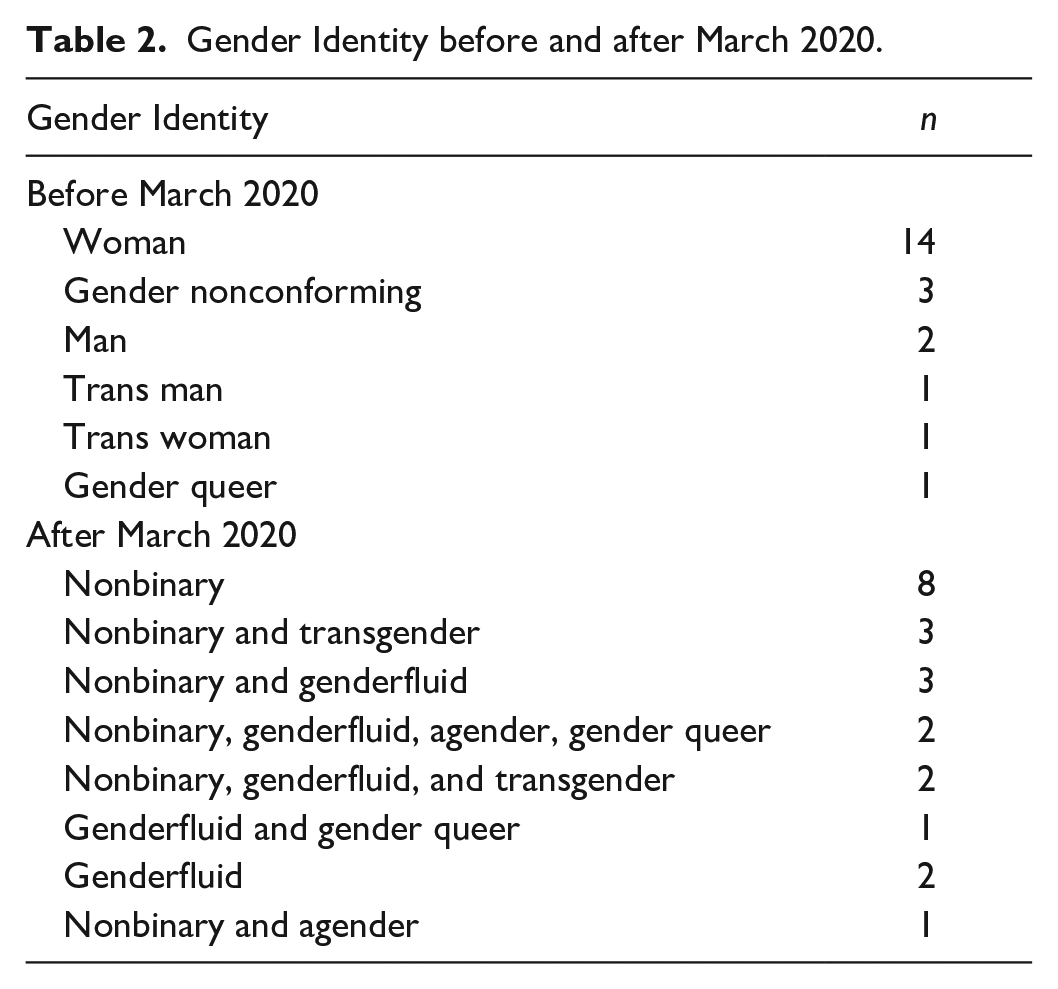
The majority identified as a woman (n = 14) and bisexual/pansexual (n = 15) before the March 2020 pandemic period. After the shelter-in-place part of the pandemic, participants identified as nonbinary, genderfluid, transgender, genderqueer, or agender, often with combinations of identities (see Table 2). We refer to all these identities as “nonbinary” (sometimes “nonbinary or genderfluid”) in this article. A majority of racially minoritized participants identified as genderfluid either alone or in combination with a nonbinary identity. The identity of genderfluid was included in the recruitment materials for the study based on anecdotal evidence that racially minoritized people may find the identity of “genderfluid” more relatable than “nonbinary.”
Gender Identity before and after March 2020.
Almost all interviewees were childfree and quarantined at home during the pandemic. Only Kody, Juniper, and Poppy worked as essential workers. Only two participants had infants at home. Therefore, this sample represents a particular shelter-in-place experience of young adults without dependents doing remote work or school.
Analysis
All interviews were recorded on Zoom, professionally transcribed, and cleaned and organized in NVivo. All pseudonyms and pronouns were selected by the participants. A research assistant coded all the interviews in NVivo using broad, flexible codes, such as “school,” “online,” and “information gathering,” that were developed from the interview guide questions (Deterding and Waters 2021) and interviewer feedback to facilitate analysis by the research team. The first author took the information gathering flexible codes, which included every reference to gathering information mentioned by the interviewees. The first author open coded information gathering for the purpose of thematic analysis (Boyatzis 1998). Both authors developed the themes within the data through examining these open codes together and organizing the open codes into axial codes. The interview participants described similar narratives about their information needs and information practices.
Finding Myself through Information Work
All participants described the shelter-in-place period of the pandemic as a time when they sought out new or additional information about their gender identity. Information seeking implies an information need; participants needed to find information that would explore, interrogate, explain, clarify, and/or confirm their self-recognition as nonbinary or genderfluid. Participants’ information needs came from feeling like they might want to experiment with a new gender identity and then, after seeking out information, discovering that gender could be nonbinary in the first place and, finally, that they identified with that label. Here, we analyze how the shelter-in-place period of the pandemic created time to reflect and what participants’ information needs and sources looked like.
Time to Reflect
The shelter-in-place period of COVID-19 brought about an unexpected pause in the relentless pace of daily life, providing most of our participants with a unique opportunity for introspection. Many participants spoke about how amid the uncertainty and isolation, they found themselves with extra time that was previously occupied by the bustle of prepandemic routines. The additional time allowed for self-discovery and exploration. Sirius, a White nonbinary transgender person in their teens, explained, “I think part of the isolation had me turn inwards a lot more, because a lot of the times I’m like, ‘I don’t want to think about myself. I don’t want to think about this.’ Because it’s hard to think about, especially when you’re really dysphoric.” Charlie, a Latinx nonbinary person in their late teens, admitted that they had never really thought seriously about their gender before because they “didn’t have any time to really just think about it. The pandemic really gave me a chance to work things out without any pressure from other people, what other people might think, anything at school or anything like that.” Leti, a Latinx nonbinary person in their mid-20s, echoed this same sentiment: There’s not really much to do when you’re alone except overthink, I guess. It was more like a deep introspection about who I am, because it’s easy to define yourself by other things when you’re distracted by other things. Like whether it be your commute to work, or your work, or if you’re in school, your schoolwork, or you fill your weekends hanging out with your friends or running errands. But when you’re truly alone and forced to look into yourself, I feel like around that time was when I was like, “OK, well I do exist outside of the binary and that’s OK.”
Azul, a Latinx nonbinary and agender person in their early 30s, was home with their husband and new baby during lockdown but did their work as a full-time student in a separate room. They described still spending a lot of time alone and how “that forced you to be more introspective and to really take a good look at yourself.” Being “forced to look into yourself” and having the time to “work things out,” “turn inward,” and “take a good look at yourself” allowed Leti, Charlie, Sirius, Azul, and other participants to seek information from others and themselves to use for their gender self-recognition. Participants seemed to experience the same self-reflection during this pause from regularly scheduled life.
Although the time for introspection itself was obviously key for many participants, the fact that isolation provided time for external research and learning was equally crucial. Alpha, a Black nonbinary bisexual person in their late teens, explicitly points to this fact: “I think the isolation and time to think was a blessing and curse, because my mental health was really bad and I had to seek therapy, but at the same time I had time to do my research, had time to think, and educate myself.” Kody, a White nonbinary and genderfluid queer person in their early 30s, did not recognize their new gender identity all at once but, rather, was able to take their time to learn more: “I don’t know that there was necessarily one light bulb moment, but that all did start happening during the pandemic, because I had more time to just leisurely scroll and read and listen to videos and stuff.” The digital landscape offered a platform for connecting with individuals and communities that shared similar journeys, fostering a sense of self-recognition and understanding. This isolation was often about introspection but also information-seeking behavior that fulfilled information needs for knowledge and validation.
Fulfilling Information Needs
For many of our participants, “nonbinary” or even “genderfluid” were not terms they were previously familiar with or ever thought to apply to themselves. Their information needs centered on learning about nonbinary and genderfluid terms along with validation that those were appropriate labels for themselves. Part of this validation was the ability to see oneself as a legitimate nonbinary or genderfluid person. At times, this validation involved seeing examples of nonbinary people who did not fit the androgynous, White, thin ideal.
Because of structures that foreclose gender fluidity, such as cisnormativity, many interviewees were unfamiliar with genderfluid identities. Ella, a White nonbinary person in their early 20s, did not hear the term “nonbinary” until several years after they started questioning their cisgender identity: Well, I always had a sneaking suspicion that I was not cis since I was 14. I didn’t have the language for that. And I didn’t know the term nonbinary until it was my senior year of high school when I first heard the term. But up until that point, I’d begun developing feelings of gender dysphoria to a certain extent. And so I knew I wasn’t totally 100% comfortable in my gender, but the label nonbinary came to me, again, senior year of high school.
In a cisnormative world, the complexity of gender-diverse identities are not typically taught in schools or part of everyday discourse. For youth like Ella, encountering the word “nonbinary” was the first step in their journey toward nonbinary identification. Similarly, Jordan, a White nonbinary person in their early 20s, did not encounter the term “nonbinary” until college: Honestly, before I came to [college], I did not have much of an idea about what nonbinary meant or even what transgender meant at all. I would say leading up to that, I’d only met one trans person in high school. And I think I’d always been looking for something like the term nonbinary my whole life without realizing it. . . . I started to realize that these labels and this terminology could actually help me know myself better. Once I learned about what it was, it just made me feel closer to myself.
Learning about trans and nonbinary terms and identities helped Jordan “know myself better” by finding a term that fit their gender feelings. For Echo, a genderfluid person in their late teens who identifies as Asian American Pacific Islander, Black, and Hispanic, they tried to look up what I was experiencing and genderfluid popped up somewhere, and I was like “What is that?” But I do remember seeing on the internet different nonbinary spectrums and genderfluid was listed among those things. I read the definition for that. I was like, “Whoa, well, that sounds like me. I guess I’m going to keep it.”
Echo did not know that being genderfluid was an option until they did some research online. For many participants, the information need was knowledge about identities that matched their own gender expression and identity.
Some interviewees searched for particular identity terms. For Poppy, a White nonbinary genderfluid agender person in their early 20s, I definitely was realizing probably I looked up agender since I was picking that myself. Definitely also I did some research into asexuality, since I’m somewhere on the line there. And I’ve definitely looked into . . . not exactly queer, but adjacent is polyamory. So those are the three main things I would say that I’ve researched the most over the pandemic.
This research was deeply personal because it stemmed from Poppy’s own identity exploration. Poppy knew that they wanted to find some way to recognize themselves in a label but had to search a variety of terms to find some that fit them.
Sometimes this information need is not just knowledge but validation as well. Kurt, a White and Jewish nonbinary person in their late 30s, thought about disassociating themself with the label of “man” early on during quarantine because they no longer liked that label. At the same time, Kurt struggled with shame and disgust about femininity. Kurt went a step further than typical parasocial relationships by seeking out YouTube and TikTok creators who offered paid one-on-one conversations over Zoom. Kurt explained: At some point it just came down to getting past that kind of barrier. . . . Like am I allowed to call myself queer? Am I allowed to call myself nonbinary? Is that some kind of appropriation? Is that some kind of false whatever? If I say that, are you going to say, like, how, I don’t know, like how dare you pretend to be queer? . . . And so getting permission, so to speak, from [content creators online] meant a lot. . . . So I finally, I can’t even remember when it was exactly, but at some point in maybe very late 2020, I finally decided, yeah, this is my label.
For Kurt, this information-gathering behavior filled a need for validation. Kurt questioned whether their affinity for the nonbinary identity label was authentic and real, and connecting with nonbinary content creators affirmed that authenticity. Kurt framed their information seeking as about needing to get “permission” from other nonbinary people, and this information-seeking behavior was an important step in the broader process of forming an identity as a nonbinary person. Kurt felt that creators they spoke to “gave permission” to Kurt to identify as nonbinary and queer.
Similarly with Jamie, a White nonbinary person in their early 20s, information gathering filled their need for validation to dispel concerns about authentic nonbinary identity. For Jamie, doing research addressed concerns that they had alternative reasons for claiming the identity: So I did a lot of research on my own because I was like, oh, I don’t know if I fit in this space. I don’t actually know if I am like, am I just doing this for the attention? Like, am I just doing this because I’m bored? Like, am I doing this because I want to fit in? Fit into what? So I did a lot of research on that and a lot of comments from people who came out as she/they specifically, where they were like, “Look, gender is weird, and if you feel the way you feel like you fit, you don’t have to check every box, you fit, stop trying to fit yourself in a box. If you feel you are nonbinary, you are nonbinary.” And that type of research was really important to me, because it was, like, validating, because it’s like other people have the same experiences as me. Other people also feel this way. It’s yeah. Like, I guess you could say, I didn’t need to do research on what’s gender. I had to do the research of, am I valid?
For both Kurt and Jamie, this research affirmed for them that identifying as nonbinary was a good fit for them. By finding other people, particularly people similar to them, who identified as nonbinary or genderfluid, they could lean into identifying as these gender identities themselves.
This concern about authenticity in identifying as nonbinary or genderfluid is deeply rooted in the fluidity that is foreclosed in nonbinary identities. The ways that nonbinary or bisexual identities are delegitimated often is related to their lack of authenticity and realness. Lamp, a White nonbinary person in their late teens, described the “in-betweenness,” that “if you don’t go all the way, nobody’s going to believe you. If you say you’re nonbinary, people will see you as whatever your birth gender is like as opposed to if you say, ‘No, I’m a completely different gender.’ They don’t often see you as [nonbinary].” For many nonbinary participants, this information seeking was to reassure themselves that nonbinary identities were valid and that they were actually nonbinary.
This information seeking also helped overcome a need to see oneself as valid as nonbinary or genderfluid despite common representations of nonbinary people as thin, White, and young. Notably, several participants who are people of color, identify as not thin or as fat, or who are closer to middle age felt at least an initial discomfort with using the label nonbinary or difficulty seeing themselves using the nonbinary label. Azul felt that their body size and shape precluded them from using the nonbinary label: It’s like that kind of waifish, feminine, masculine. I don’t know how to explain it. It’s like a thin boy basically is the aesthetic that a lot of people are going for with a nonbinary aesthetic. And it’s like, as someone who is very curvy and chubby, I can’t do that. Even when I was thinner, I never had that shape.
For Azul, the limited imagery of nonbinary and genderfluid people was thin only, and not seeing curvy or chubby people like themselves identifying as these gender identities made it difficult for Azul to see themselves as nonbinary. Leti explained how they did not fit into the nonbinary stereotype: Because usually when you think about existing [outside] the binary, it’s very White-centered and very androgynous. But I think the hardest part for me was understanding that existing outside of the binary does not mean androgyny, it means, well, existing outside of the binary. . . . The first time I was introduced to someone who was nonbinary, they were White and androgynous, and then it kept coming up, I mean, in-person and in social media. And I just thought, “Well, that’s not me, so there’s no way I could be that.”
This dominant stereotype of nonbinary people as White or light-skinned and androgynous was reinforced for Leti in their own interactions with nonbinary people and in social media. Without visibility of people that looked like them, Leti found it challenging to imagine themselves as also being nonbinary. V, a Black and Hispanic nonbinary queer person in their late teens, expressed identifying as nonbinary only when they started to see more representation on social media that reflected their racial and ethnic identity: “I know when I follow more Hispanic creators and they talk about . . . they talk in Spanish about their nonbinary experiences. Or when I follow Black creators and they’re talking about them getting top surgery or them just sort of living their life.” For V, they noted that before the pandemic, they operated under the assumption of “everyone thinks of me as a girl, so I will just be a girl.” But during the pandemic, they went online and saw more nonbinary people. “That’s when I really started thinking, ‘Oh yeah. I do consider myself nonbinary.’ I’m not just a girl because people tell me that I’m a girl. I can be a lot of different things.” As we discuss later in this article, finding and using embodied information—particularly as connected to race, hair, and body type—was a pivotal aspect of participants’ self-recognition as nonbinary. For V, Leti, and Azul, finding other nonbinary people who looked like them either in person or online was a critical part of their nonbinary self-recognition.
Latinx participants described this need for validation to overcome the cultural dissonance about nonbinary identities in their family culture. New gender identities do not necessarily translate clearly across linguistic, cultural, and generational lines. Leti’s parents see Leti’s nonbinary identity as “foreign” and “otherworldly.” Although Leti identifies as nonbinary, the newness and otherness of the label itself is tricky for their family to contemplate and accept as real; they described their parents as seeing nonbinary identification as “otherworldly,” explaining that their family asks, “Why would anyone . . . ? That doesn’t make sense. You’re either a man or you’re either a woman.” Socks, a Latinx nonbinary genderfluid person in their late teens, explained a similar struggle with their Hispanic family members as they described Hispanic family members reacting with invalidating comments like, “What the hell are you talking about? No, that doesn’t make any sense. You’re making that up.” Socks described this cultural dissonance as making “coming to terms with gender identity more complicated in my experience.” They suggested that “definitely in the family area, I feel like it’s made things a bit more complicated, and it’s just sometimes I’m like, OK, either how do I explain this to people or how do I get people to not think that I’m not cis.” Whereas identity self-recognition was one hurdle to clear, managing familial and cultural expectations was yet another hurdle.
These information needs grew out of from the limited availability of information and representation about nonbinary and genderfluid people. Participants needed to learn about nonbinary and genderfluid identities and be validated that these identities fit their gender experiences. Before they even disclosed their identities to others, nonbinary and genderfluid people sought validation that these were legitimate and authentic identities. Black and Latinx nonbinary and genderfluid interviewees described needing to find content creators who did not fit the White, thin, androgynous ideal to validate these gender identities for themselves. Participants went to several information sources to get this validation.
Sources of Information
Participants did information work using a variety of sources. Social media platforms like TikTok and Reddit played an indispensable role in sparking a deeper awareness of nonbinary identities. These social media platforms provided opportunities to learn about nonbinary identities but also to engage in a particular kind of embodied information seeking by analyzing the bodily experiences of others. Social media was supplemented with personal information about one’s own body during this time.
Most of the interviewees described doing “research” online, talking to nonbinary friends, and seeing nonbinary or genderfluid representation on social media like TikTok. Among the 442 people in our recruitment survey who reported coming out as nonbinary, genderfluid, or agender during the pandemic, 55 percent of them reported that online communities played a very or extremely significant role in their own understanding of nonbinary identity. Dude, a White nonbinary pansexual person in their late 20s, described watching lots of videos online about people talking about their gender and sexuality. Many younger participants mentioned TikTok and other video watching. Socks described watching videos as part of their “research with some soul searching and even just talking with a lot of my friends.” Jamie described themselves as a “Tumblrina” (someone who was an avid fan of the digital Tumblr platform), saying that they didn’t think about nonbinary things until I got on Tumblr. And I was like, “Oh, there’s people who think this way.” And they have those little fun infographics of what nonbinary is and how it’s different. And I was like, yeah, I guess this checks a lot of boxes for me. I do identify with these little thought processes now.
Several participants looked for the experiences of nonbinary and genderfluid people, particularly people like them, online. Several mentioned TikTok as a space where they could self-recognize themselves in the work, experiences, and bodies of creators. Rat described TikToks as genderfluid people explaining to others, “This is how I feel, like this how I represent myself.” Kurt searched for “creators who are androgynous, yeah, really, I don’t know, kind of boyishly masculine AFAB [assigned female at birth] people, or the other way around. I don’t know. Sort of interested in seeing more of those kinds of people.” For Sirius, they went to Tumblr and TikTok because Tumblr was where people [were] kind of almost like writing a diary entry. And then same with TikTok, you’re seeing these small creators and very real people. It’s not a third party talking about a group that they may not even be a part of. And you just kind of feel closer to these people through that.
Charlie described that “seeing other people that are the same way definitely helped because it’s like I have friends that are nonbinary and use they and them pronouns, but I know them, versus seeing a complete stranger on TikTok talk about it. That, I feel like, was pretty different for me.” Kurt found that through seeing other nonbinary and genderfluid people on TikTok, “I learned a lot from TikTok about people basically teaching me like there’s no one way to be nonbinary.” V, a Black and Hispanic nonbinary queer person, felt that specifically seeing queer people of color “joking and having fun and dressing up” on TikTok helped them understand that a “thin, White person with short hair” was not the only way a nonbinary person could be. V said that seeing queer people of color “made it feel like it was attainable for me. [Seeing those people] just joking and being happy—I think that really did help me feel like that’s something I can do, too.” The video nature of TikTok and the (albeit slightly) increased prominence of nonbinary creators of color on the platform offered the interviewees an opportunity to self-recognize their identities by viewing others who looked like them doing the same.
Participants did not just look for information online; they also found a lot of pertinent information about their newly recognized gender through paying attention to their own bodies and through examining other people’s bodies online. Several participants mentioned a strong desire to change their hair by dyeing or cutting it. Socks described dressing “like a disaster” in high school before the pandemic but noted that their dressing and sense of style got better over the pandemic due to being exposed to options on Instagram. Others talked about feeling “uncomfortable” or feeling dysphoric about their bodies. Alisa, a Latinx nonbinary person in their late teens, described feeling uncomfortable about having breasts and wanting to look instead like a boy in a K-pop music video. During the pandemic, Alisa started wearing a sports bra to flatten their chest, and “that makes it look flatter even though I’m already pretty flat-chested. I started dyeing my hair, and I don’t know why, but that made me feel better.” Sirius experienced “a lot of top dysphoria” that they had ignored prepandemic. They described how during shelter-in-place, they rarely got dressed up in their usual “hyper-feminine” clothes, but when they did, they realized, “Wow, this feels really uncomfortable, and it’s got me thinking about why does this feel so much more uncomfortable now than it did before?” Sirius realized that they had not been listening to their own body but was instead following what society’s compulsory heterosexuality and cisgenderism had told them was best. Only the unexpected pause of the pandemic lockdown gave them a chance to recognize the information contained within their own body. For other participants, seeing nonbinary people online undergo top surgery or bind was affirming and made them feel less alone.
Discussion
During the shelter-in-place period of the COVID-19 pandemic, the social world moved online, and in-person connections were minimized. Individuals who were sheltering in place without dependents suddenly had new space and time to explore their social identities online. People came out as nonbinary and genderfluid during this time after information work that gave them language about these gender identities, allowed them to self-recognize and gather embodied information, and validated that these gender identities applied to them. Some sources of information, such as TikTok, allowed interviewees to see content creators with similar embodiments as their own. Although this information work likely is a critical part of nonbinary identity formation, it was intensified by the social conditions of the COVID-19 pandemic.
For many participants, the information work during the pandemic was both deeply meaningful and profoundly personal (Clemens and Cushing 2010; Huttunen and Kortelainen 2021). The information seeking in “deeply meaningful and profoundly personal contexts” (Huttunen and Kortelainen 2021) helped participants discover new gender identities, make meaning out of them, explore whether those gender identities applied to them, and feel validated in their new nonbinary or genderfluid identities. Some of this validation was finding “people like me,” affirming that not all nonbinary and genderfluid people are White, thin, young, and androgynous. As Ruthven (2022) suggests, this information work helped guide meaning-making to help people understand their own lives. Although online platforms were pivotal to this work of meaning-making, it seems that the pandemic’s isolation offered additional time and isolated space to receive and make use of internet information and communities.
Information versus Invisibility
Searching and finding information sources fulfilled deep information needs that originated in the invisibility of nonbinary and genderfluid identities. Information work is particularly important for nonbinary and genderfluid people because we live in a binary gender world that denies the validity and existence of anything outside that binary. Like other marginalized gender and sexual minority identities, nonbinary and genderfluid participants developed their vocabulary, which in turn validated their gender identities as authentic. The minority stressor of gender identity invalidation (Johnson et al. 2023) applies to gender/sexual-fluid identities that defy transnormative logics of binary gender transitions and mononormative understandings of binary attraction (Sumerau et al. 2020). Indeed, systematic invalidation of these identities as illegitimate or faked may be part of how cisnormativity operates: It creates the cisgendering of reality (Sumerau, Cragun, and Mathers 2016). In this study, nonbinary and genderfluid participants did not describe direct invalidation from others of their identities but instead anticipated this invalidation because of our cisgendered society. The information needs for validation and authenticity may be stronger for some kinds of LGBTQ+ identities, and future theorizing should explore the role of identity invalidation as a cisnormative control mechanism.
Significantly, part of the limited visibility of nonbinary people is a persistent image of nonbinary people as White, thin, young, and androgynous. The information needs of nonbinary and genderfluid individuals who did not fit this stereotype included needing to see people who looked like them in person or online. Most research on nonbinary people has been based on predominately White and young samples (Darwin 2017), but researchers have not adequately theorized about the whiteness of nonbinary identity and representations. Just as homosexuality and transgenderism are co-constructed with whiteness (Somerville 1994) and within histories of racist violence (Meyers 2022; Snorton 2017), nonbinary identity may have emerged through whiteness and the associated thin ideal. Nonbinary representation relies on the “androgynous body ideal” that crafts a “blank slate body” bereft of extra masculine and feminine features (Galupo, Cusack, and Morris 2021). The whiteness of nonbinary identities may be intertwined with thinness due to historical constructions of body size and race (Strings 2019). Notably, the Black Lives Matter protests in the summer of 2020 may have created new opportunities for Black nonbinary and genderfluid creators to be more visible and heard online, which, in turn, may have offered new examples and role models who assisted Black and brown nonbinary and genderfluid people in recognizing their own identities. Further research should consider the racialization of nonbinary identity and the nonbinary body and how that shapes information work specifically.
Information and the Body
Part of our participants’ meaning-making, self-recognition, and validation processes was doing information work using embodied information. Work on embodied information in LIS extended the sociological idea of the “sensuous self,” wherein the “self is necessarily a somatic accomplishment: the embodied self is the material basis as well as the reflexive and interactional outcome of perceived sensations and active sense-making practices” (Waskul et al. 2009: 6). In LIS, we now understand, as Bates (2018:249) states plainly, that “any model of information practice that does not include the body and the nonconscious processing that accompanies the conscious information work is incomplete.” Interviewees’ descriptions of learning about their own bodies by listening to their bodies and self-recognizing themselves in others online could be forms of “body listening” and “observational learning” similar to what Lloyd (2010) had highlighted (St. Jean, Jindal, and Chan 2018); engaging in “intersubjective space” (Lloyd and Olsson 2019); and exploring marginalized, community-based “collective information” (Kitzie et al. 2022) to discover their own individual gender identities. The shelter-in-place period offered people the double opportunities of seeing other people’s self-explorations online through social media while also a respite from routine daily activities so that they could begin to recognize their own subjectivities. The iterative nature of this information work flourished in the quarantine’s pause in time; that is, people may have had additional time to watch others’ bodies online and then explore their own senses and bodies and then, in turn, compare their own bodily experiences with others. This may have allowed people to access “trans-embodied imaginaries” (Goetz 2022:257). The conceptualization of how participants imagined their own bodies should look and feel to themselves “lives intrinsically in one’s fantasies; it is not fabricated with intention” (Goetz 2022:257), meaning that the comparisons could be subconscious. Elsewhere, we have theorized that the reduced gender accountability of the shelter-in-place period of the COVID-19 pandemic created new opportunities for nonbinary identity exploration during the “queerantine” (Stone and Gallin-Parisi 2024). Here, we underscore how embodied information needs to be factored in to future studies of gender identity development.
Limitations
There are some limitations to our research. Although this study comprised a racially diverse set of participants, there is always room for extending samples along various intersectionalities. For example, participants here were young adults, mostly people in their 20s and 30s. It would be interesting to see what information sources older adults use to help recognize their nonbinary identities and how social media plays a role in their discovery. A digital ethnography with older nonbinary or genderfluid participants would provide knowledge about how adults over 50 find relevant nonbinary narratives online. Moreover, although almost all of the participants in this study were either not parents yet or childfree, examining gender identity exploration of nonbinary parents would be another possible avenue of inquiry. Researchers may want to more thoroughly examine the role that information work takes in gender identity formation outside of the pandemic time frame. We suggest that intentional collaborations between information scientists and sociologists and gender scholars would yield fruitful insights into how identities are explored, validated, and formed through information work, including the use of external sources such as social media and embodied sources of information.
Conclusion
Understanding how nonbinary and genderfluid people validate, self-recognize, and engage in embodied information through information work is an important contribution to the sociological study of gender identity formation, knowledge, the body, and COVID-19 pandemic experiences. Sociological approaches to identity formation should consider how fluid and nonbinary identities may be formed differently due to the foreclosing of fluidity in the social world (Sumerau et al. 2020). Social media platforms like TikTok play an important role in knowledge production (Southerton and Clark 2023), and sociologists should consider more broadly how social media creates conditions for identity development, particularly through processes such as self-recognition and embodied information.
This article marks an interesting contribution to the study of nonbinary identity formation and a good example of how the concept of information work helps clarify what individuals are actually doing when they discover their own identities. Although the pandemic was difficult for a variety of reasons, it also provided the time and mental space for nonbinary and genderfluid adults to explore and recognize their gender identities and use their bodies as both sources and recipients of new information. Additionally, our research highlights the propensity for sociology as a field to focus on the binary aspects of gender, therefore missing the experiences of nonbinary and genderfluid people. This research plays a part in describing the factors that led to an apparent increase in nonbinary and genderfluid identity self-recognition during the pandemic. Although here we focus exclusively on the unusual conditions of the pandemic, it raises critical questions about how gender identity formation and self-recognition necessitates information work during nonemergency times. Gender identity never develops in a vacuum, and the access to information often provides people with new choices they never knew existed.
Footnotes
Acknowledgements
The authors thank Cutter Canada, Lauren Stevens, Gwen McCrary, and Megan McGuire for research passion and interviewing.
Funding
The author(s) disclosed receipt of the following financial support for the research, authorship, and/or publication of this article: This research was funded by the Mellon Research Initiative at Trinity University and co-led by Althea Delwiche.
