




Abstract
How do organizations respond to extreme environmental challenges? We revisit DiMaggio and Powell and examine the shift in isomorphic behaviors that occur during a crisis, illustrating how shocks result in the use of nontraditional practices. We empirically examine the impact of the 2008 economic crisis on U.S. art museums’ isomorphic referent transitions in the use of market practices before and after the crisis, covering 2006 to 2011. Our findings indicate that museums altered the scope of mimetic isomorphism, and as a result, U.S. art museums sought solutions by shifting reference groups that were structurally (leader vs. peer), physically (geographical region), or organizational (social networks) proximate during the crisis. We elaborate our understanding of isomorphic behavior as a key factor during times of crisis that destabilized institutional environments, both symbolic and resource spaces. This finding can be generalized to other organizational settings beyond art museums.
In their classic article, DiMaggio and Powell (1983) described a striking outcome, the increasing isomorphism of organizations in the modern world, and highlighted three processes that produce it (Davis 2009; Fiss and Zajac 2004; Soener 2015). In their argument, many modern organizations look the same: rational bureaucratic features, hierarchical lines of authority, separate legal “personality,” functional arrangement of units and subunits with corresponding division of labor, mission statements, strategic plans, the list goes on. DiMaggio and Powell (1983) famously described three processes that contribute to this homogeneity: mimetic, coercive, and normative isomorphism. Although they can overlap, in brief, mimetic isomorphism consisted of the tendency for organizations to copy each other. As an example, consider how often universities benchmark themselves against their “peer institutions.” Coercive isomorphism concerned the ability of external parties to use their leverage over an organization to force it to adopt selected features and practices. For instance, an important customer can often require its suppliers to comply with certain standards and procedures. Similarly, regulatory agencies dictate terms to those they oversee (Carruthers 2015). The last type of isomorphism is normative, which reflected the authority of professionals and other experts to define legitimate organizational practices and arrangements.
DiMaggio and Powell’s (1983) generative analysis has inspired a great deal of research, but there are some overlooked background conditions that support the operation and effects of their isomorphism. In particular, the stability and continuity of the organizational environment affect the operation of isomorphic forces. In a stable environment, an organization’s key reference group is almost self-evident: Both the organization and its benchmarks recognize and orient to each other. Hence, it is clear which group prompts mimetic isomorphic effects. Likewise, stable resource flows undergird normative and coercive isomorphism: Stable patterns of cultural authority enable particular groups and perspectives to exert normative power and make it obvious which external constituents have leverage over an organization.
However, how isomorphic patterns unfold during a crisis is much less clear. Do organizations still imitate others in response to external shocks? If a crisis destabilizes an organization and its environment, it can threaten the boundaries and membership of reference groups and, thus, affect how mimetic isomorphism operates (Davis, Diekmann, and Tinsley 1994). Such events typically refashion the resource flows that normally sustain the organization, potentially redirecting their reference search. Also, external shocks can shift normative power, changing professional authority and altering the strictures that it imposes on organizations (Almandoz and Tilcsik 2016).
Few studies disentangle how isomorphic behaviors are pursued and change organizations during crises. Some of the underlying mechanisms could, for example, produce organizational differentiation rather than similarity (Beckert 2010). Different types of audiences may impact isomorphic proceeses and their operation, especially during environmental fluctuations. For example, Han’s (1994) cross-sectional analysis shows how aspirational mimetic isomorphism varies among firms as they choose their auditors, depending on the firm’s place in the industry status order.
The impact of crisis on isomorphic behaviors is an open empirical question. Even as economic collapse undermined resource flows, heightened uncertainty could have redoubled organizational efforts to pursue mimetic isomorphism even as it destabilized understandings of who should be emulated. Furthermore, unprecedented circumstances can test the limits of professional expertise and disrupt normative isomorphism (Almandoz and Tilcsik 2016). On the one hand, the perception of a crisis as inaugurating a period temporarily free from previous constraints can engender consideration of new possibilities that had previously been unavailable (Paruchuri and Ingram 2012). On the other, extreme uncertainty can limit the ability of organizations to identify new alternatives, akin to “tunnel vision” (Greve and Yue 2017).
In this article, we examine a group of organizations during a crisis, specifically, the global economic crisis of 2008, to investigate if and how forms of isomorphism were disrupted and reshaped. We are mindful of all three types, but our focus is especially on mimetic isomorphism for three reasons. First, the economic disruption clearly undermined the operation of the other two types of isomorphism. Second, crises dramatically increase uncertainty, a key driver of mimetic isomorphism (DiMaggio and Powell 1983:150–51). Third, whereas the global economic downturn and general normative environment were conditions that individual museums could do little about, mimesis was something over which they could exert more control. We argue that as the economic shock dramatically worsened the resource environment, organizations had to temper aspirational mimesis and reorient toward more proximate (variously defined) referents for mimesis. In effect, the shock forced organizations to “get real” about their peers and to give up aspirational endeavors, including emulation, that had become unrealistic.
Our empirical choice of organizations, nonprofit art museums in the United States, offers particular insight in this context. Unlike regular businesses, museums are not subject to the unrelenting imperatives of profit maximization, and they are usually associated with strong institutional effects (Leiter 2013; Meyer and Rowan 1977; Verbruggen, Christiaens, and Milis 2010). Furthermore, they traditionally embraced an “elitist” model of cultural preservation and presentation, accumulating and displaying artifacts that reflected a high cultural aesthetic (Monier 2018). The inclusion of nontraditional “business” features therefore marked a significant organizational change and makes it easier for us to track how isomorphic processes changed. Officially, U.S. art museums did not encourage market-based practices because, as the American Alliance of Museums (AAM; 2004) stated, “It must always be remembered that museums are non-profit-distributing charitable organizations, and that trading and commercial activities must be limited except when they contribute to a museum’s fundamental purpose.” However, the economic crisis afflicted art museums with a dramatically worsened resource environment and suspended normative guidance from field-level organizational associations. As a result, after the 2008 economic crisis, museums began to use more of business features in response to the financial strictures they faced.
We analyze how U.S. art museums expanded their market practices and whether this was affected by shifts in isomorphic behaviors among museums that were symbolically (leader vs. peer), physically (geographical region), or socially (social networks) proximate to each other. We track these organizations before and after the global financial crisis of 2008, covering 2006 to 2011, a period of stress and high uncertainty. Environmental turbulence, such as an economic crisis, destabilizes institutional environments and can drive organizational change within a relatively short period (Seo and Creed 2002; Thornton and Ocasio 2008). Although previous studies have examined situations where institutional change took decades to unfold (Berman 2011; Hinings 2005; Hwang and Powell 2009), the effects of powerful external shocks are often both dramatic and sporadic, as Sine and David (2003) illustrated in the case of the oil crisis. We explore whether such conditions induced museums to change their reference groups in a short time as they sought viable solutions to pressing problems.
We use 318 financially independent American art museums across 46 states to examine if they have included business-related or finance-related positions in their key personnel lists using random-effects logistic regressions. This indicates how market practices (business-related or finance-related) have been embraced differently by art museums before and after the crisis. As a robustness check, we also conducted event history analyses (EHAs) of those 231 and 232 museums that had not adopted either business-related or finance-related positions before the crisis.
Impacts of the 2008 Economic Crisis on Art Museums
“Beginning in late 2008, public and private museums began laying-off staff, cutting wages, reducing hours, and, in some cases, closing altogether” (English 2009). Due to the crisis, U.S. art museums suffered from a dramatically worsened resource environment: Significant decreases in government support, museum endowments, public funding, and membership income caused substantial financial deficits (English 2009). Those with historically larger endowments suffered the most economic strain and budget-cutting pressure (Wilkening and Chung 2009).
After Lehman Brothers, a major corporate sponsor of the Museum of Modern Art (MoMA), filed for bankruptcy in October 2008, MoMA director, Glenn D. Lowry, stated, “We know there’s a storm at sea, and we know it’s going to hit land and it could get ugly” (Vogel 2008). Throughout the crisis, some notable museums, including the Museum of Contemporary Art in Los Angeles, Las Vegas Fine Art Museum, Rose Art Museum, and Detroit Art Museum, shut down or went bankrupt—only the Detroit Art Museum was saved by a last-minute bailout. Others suffered, although they did not close. For example, the American Folk Art Museum was in default on $31.9 million and came close to closure in August 2011 (Pogrebin 2011). It was saved by MoMA after intense public criticism pushed MoMA to buy the building of American Folk Art Museum to pay off the debt. As a result, the American Folk Art Museum shrank into a smaller space near Lincoln Center, and its former building was torn down in 2013 (Davidson 2013).
Of necessity, government grants became a more important revenue stream, but these remained limited. Municipal and state government deficits forced cutbacks to funding for local museums. After the crisis, the Obama administration increased federal support for nonprofit organizations; however, because the number of organizations requesting support also increased, the amount granted to each recipient was significantly lower (almost 20 percent) among our 318 sample museums.
During and after the 2008 economic downturn, field-level organizational associations, such as the AAM and the Association of Art Museum Directors (AAMD), did not provide meaningful or timely guidelines on surviving the crisis. Although museum directors could clearly see that the crisis would significantly affect their institutions, normative guidance was temporarily suspended, and no systematic support was provided to museums in trouble. Instead, the AAMD (2010) sanctioned deaccession rather than helping museums to navigate the financial challenges. Market activities were still clearly stigmatized following the AAM’s training on “Ethical Guidelines 3 – Trading and Commercial Activities,” which emphasized that “a museum must be clear about the way in which its trading and commercial activities contribute to its fundamental purpose. . . . It must always be remembered that museums are non-profit-distributing charitable organizations” (The Museums Association 2004).
This moment of crisis exemplified what Haveman, Russo, and Meyer (2001) described as a period of institutional punctuation that dramatically reduces both the pressure and the reward for organizational inertia. It took three years, starting in late 2011, for the AAM to begin issuing policy statements that addressed “investment strategy of the fund, asset allocation, and permitted and prohibited investment strategies and instruments . . . and liquidity” (Griswold and Jarvis 2011). After some delay, the AAM endorsed some market practices that had previously been considered problematic.
As the economic crisis eroded resources and transformed institutional pressures, art museums considered making significant changes. Some museums even extinguished traditional core positions, such as art curator or exhibition coordinator, while expanding market-related positions. During the crisis, cost-cutting measures, such as workforce reduction, spread across nonprofit organizations, and commercial activity increased as they sought new revenue streams. Gradually, museums were forced to discard the traditional elitist model, which was already happening slowly (DiMaggio 2006; Galaskiewicz, Bielefeld, and Dowell 2006).
Market Practices in Art Museums before Crisis
Before we discuss the relation between crisis and isomorphism, we emphasize that the adoption of market practices in U.S. art museums had long been problematic and remained so circa 2008. This is primarily because elitism has been the durable feature of these museums (David 1999; Foreman-Wernet 2017; Zolberg 1981). The elitist model considers collecting, preserving, and studying artworks to be the museum’s central purpose, where these activities are informed by a cultivated audience—albeit one with an evolving sense of artistic merit. Therefore, treating museums like commercial institutions subject to market imperatives risked dishonoring that elite philanthropic support.
Scholars have also been aware of the paradoxical pursuit of profit by nonprofit organizations (Powell and Steinberg 2006). For example, James (1983, 1987, 1998) argues that nonprofit organizations exist to provide goods and services not offered by the private sector and that nonprofit decision makers prefer donations over commercial income. These studies further suggest that nonprofits engage in commercial activity only when traditional revenue sources decline, with the goal of using commercial revenues to cross-subsidize the goods and services they otherwise prioritize. However, by the 2000s, philanthropic foundations, nongovernmental organizations, galleries, charities, and so on started to adopt more organizational features and strategies of the for-profit world (Powell and Clemens 1998; Weisbrod 1998).
According to DiMaggio (2006) and Brown and Slivinski (2006), many nonprofit organizations that deal with high art used to forgo for-profit behavior, distancing themselves from such activities to maintain their prestigious identity, protect donor relationships, and maintain traditional revenue streams. Increasingly, however, art museums have opened in-house retail shops to generate income that is now almost equal to revenue streams from federal funding or admission and membership fees. Cash flow from sales enables museums to keep admission charges low and operating hours long, thereby increasing their accessibility (Dobrzynski 1997). Therefore, market practices started to receive more attention and appeared to be reasonable as long as they furthered the organization’s objectives and did not endanger core organizational identities (Alexander 1996).
However, aggressive commercialization can still produce problematic side effects that stem from the relationship between donations and program-service income. Commercial revenues can potentially “crowd out” revenues from donations, bequests, and grants embedded in the traditional elitist model. The crowding-out effect has been especially significant in museums. Yetman and Yetman (2003) illustrate how taxable revenue tends to displace charitable donations to arts, culture, and humanistic or public-benefit organizations. Thus, art museums’ adoption of market practices can inadvertently undermine their ability to attract traditional private donations.
Although some studies acknowledge the marketization of art museums before the crisis (e.g., see Feldstein [2009] on Thomas Krens’s term as the director of the Guggenheim Museum), an elitist identity still limits their adoption of market practices or the creation of what are considered “inferior” roles and positions outside key museum functions. Ordinarily, embracing market practices in a key function would have risked undermining government grants, and until underlying norms had decisively shifted, this would have been problematic. However, the 2008 economic crisis gave room for art museums to reconsider market practices as they sought to overcome their financial challenges.
Crisis as a Catalyst for Isomorphic Change
The economic crisis changed not only the resource base but also the symbolic environment of U.S. art museums. The crisis forced decision makers to confront conditions of high uncertainty and ambiguity while specific institutional guidelines were absent. This posed unique normative pressures, and the crisis allowed them to explore possibilities that could previously been less welcomed.
Michael Shapiro, a former director of the New Museum in Atlanta, Georgia, and a board member of the AAMD, recalled the situation in 2008: It was really a fuss, we usually ask around friend directors in other big museums how to deal with problems, but this time it was really hard to do it because no one understood what was really going on and how it would be. But I should continue to call them anyway.
Media reports emphasized that museums had to restructure to survive, and the news of museum and gallery closures caused further concern among museum directors (interview with Michael Shapiro by Author 1 in May 2014). 1 However, the choice of strategy remained unclear.
One way to deal with extreme uncertainty is to pursue a strategy of imitation or in some manner adopt mimetic isomorphism (DiMaggio and Powell 1983; Hirsch 1972). Crisis disrupts normal economic order and puts significant pressure on the members of a community, thus increasing their imperative to imitate (Greve, Kim, and Teh 2016; Greve and Yue 2017; McKendrick 2001; Newell and Simon 1972; Strang and Soule 1998). Imitation also reinforces collective institutional identity, and organizations often emulate the reference groups that they consider to be exemplars (Rao, Monin, and Durand 2003). However, as our previous discussion suggests, studies of isomorphism have not fully considered how imitation occurs during periods of acute stress or which of the different isomorphic behaviors gets adopted. The urgency to change is accelerated by fear of the “unknown” (Swedberg 2012); but this is tempered by the fact that even if a community continues to imitate, who it imitates can change.
When organizations are subject to unexpected resource constraints and external pressure, organizational reactions depend on how decision makers are affected by the two forces: (a) greater freedom in choosing new options due to weakening institutional constraints and (b) restraint in searching for solutions due to a “tunnel-vision” effect. These two different cognitive pressures, one increasing the available options and the other narrowing the search scope, can change an organization’s reference groups.
To gauge the effect of the 2008 economic crisis, we examined imitative behavior among museums grouped according to structural, geographical, and social relations, all of which can impact varying isomorphism dynamics (Han 1994; Lounsbury 2007; Strang and Meyer 1993). We posit three imitative references for organizations to examine the reference shift before and after the crisis: (a) symbolic reference to either a leader organization or structural peer (Abrahamson and Fairchild 1999; D’Aunno, Succi, and Alexander 2000; Haveman 1993), (b) a physically or geographically proximate reference group, and (c) social-relational connections among museums through personnel professional networks (Bearman and Stovel 2000; Kaufman 1989; Westphal 1999; Zajac and Westphal 1996).
After the Crisis: From Leaders to Structural Peers
Economic crises create unique opportunities and impose difficult imperatives on organizations: a need to do something to survive combined with little or no guidance on what exactly to do. Before the crisis, in a stable environment, organizations pay attention to what the leading organizations are doing, especially the most prominent ones in their field. Because leading organizations often set legitimate organizational practices and arrangements, those not in the top tier adopt a “follow the leader” strategy or some kind of aspirational mimesis (Han 1994; Haveman 1993). Occasionally, the imitation is primarily “cosmetic” and does not impose actual demands on capabilities and organization (DiMaggio and Powell 1983; Haveman 1993; Hirsch 1972; Tolbert and Zucker 1983). This leads us to expect that before the crisis, a combination of aspirational mimetic isomorphism and normative isomorphism induced art museums to imitate the leading exemplars: those top museums that embodied the highest standards of professionalism and excellence, with which others had to conform. In other words, art museums would be more likely to adopt market practices if leading museums, such as the San Francisco Museum of Modern Art or the Philadelphia Museum of Art (PMA), had already done so (interview with John Zarobell, a former curator at the PMA).
However, we expect that museums would amend their imitative behavior as the crisis brought unexpected resource constraints and external pressure and forced them to turn away from aspirational mimesis and consider a more “realistic” set of alternatives. As mentioned in the interview with Michael Shapiro, during the crisis, the AAMD offered no clear answers, nor were any guidelines discussed in its annual meetings during and immediately after the crisis.
Under such extreme circumstances, organizations no longer follow leaders in their fields or seek approval from the usual stakeholders. Instead, a number of researchers underscore that organizations often mimic perceived structural peers for practical reasons (D’Aunno et al. 2000) because they operate in similar environments (Greve 1998), because they face similar organizational challenges (Greve and Yue 2017), or because their experience is deemed to be more “relevant” (Greve et al. 2016; McKendrick 2001). In this case, structural peers refer to the similar organizations in their sizes or target audiences despite their physical distance. This overlap leads to competition for resources regardless of their geographical separation.
We expect that organizations pursuing an imitation strategy will change their reference group from current organizational leaders, who are the foremost legitimate and normative actors in stable environments, to peers of some sort, who face similar organizational challenges and possess similar resources. In effect, the crisis forced organizations to temper their aspirations and “get real.”
Hypothesis 1: After the economic crisis, museums would adopt market practices by imitating the behaviors of peers rather than leaders.
After the Crisis: From Structural Peers to Close Peers
Because the shock was so swift and intense, opportunities to gather information on what other museums were doing or discuss the challenges they faced were also quite limited. For example, at the 2009 and 2010 annual meetings of the AAM, the main topics were still “museum experiment” and “museum without borders,” both completely unrelated to the unfolding financial disaster facing U.S. art museums at that point. Although these annual meetings allowed museums to get together, it appears they did not officially discuss the impact of the crisis or offer guidance (AAM 2009). Instead, museums were left to scramble for themselves to figure out what to do and whom to emulate.
Organizational similarity can be defined in terms of structural position and resources (as Hypothesis 1) but also from geographical location and sociopolitical circumstances. For example, museums in the same state or city face similar economic constraints and political conditions; thus, their proximity increases their similarity. In previous studies, physical proximity has been found to engender knowledge flow, trade contact, and network creation (Beck, Gleditsch, and Beardsley 2006; Simmons and Elkins 2004). The diffusion of behavior through geographical cohesion depends on perceived similarities and what is known as “a neighbor effect” (Ramirez-Valles, Zimmerman, and Newcomb 1998).
This proximity effect likely increased as the economic crisis narrowed museum decision makers’ attention and forced them to focus on what close museums were doing. In this case, mimetic isomorphism may lead to the adoption of new practices driven by geographical proximity (Lounsbury 2007). During the 2008 crisis, the impact of the economic turbulence varied across states due to local conditions. Thus, physical distance between organizations will likely also affect decision makers’ preferred reference group, making geographically proximate museums more relevant.
Hypothesis 2: After the economic crisis, museums will adopt market practices by more closely emulating other geographically proximate museums.
After the Crisis: Museum Networks through Employee Movements
Organizational imitation during a crisis can also be influenced by direct organizational connections. Social networks between organizations through board member or employee movement have been described as both a pipe, conveying resources and information, and a prism, offering social and institutional signals about organizational relationships, to diffuse existing institutional norms and practices (Podolny 2001). In stable environments, museums that are more connected serve as channels for diffusing existing norms and practices as a form of normative isomorphism while also selectively sanctioning nonpreferred practices. For example, nonprofit organizations that have fewer network ties to others are less subject to institutional pressure and could more readily adopt market practices before a crisis (Galaskiewicz et al. 2006).
During a crisis, however, such institutional reinforcements or constraints are temporarily lifted, and orgnizational connections can serve more as channels than institutional prisms. Through these connections, organizations can recognize a more “realistic” set of alternatives and observe changes in other museums. Especially in the absence of clear institutional guidelines, the new flow of information from these connections could be an important factor in their decision-making process as they search for viable solutions. Thus, these connected ties can lead to more mimetic isomorphism, especially when the connected museums are adopting more market practices. From the literature on cognizant imitation (Burt 1987), it is clear that organizations that are directly linked are more likely to adopt one another’s practices because social connections readily enable the flow of information across organizational boundaries.
Unsurprisingly, art museums are embedded in a constructed organizational field (DiMaggio 1991), and thus, the movement of museum employees is a potential channel for social connection. As individuals leave one museum for another, they inadvertently create a network tie. Thus, the interorganizational personnel network is likely to affect isomorphic patterns as well. In short, imitative behaviors during the crisis are not simply a function of the competitive environment or organizational neighborhood but also the network of professional relations in which they are enmeshed (Becker 1982; Grams and Warr 2003).
Museums with broader network ties are likely to receive more information about other museums’ adoption of market practices following the crisis, connected by links to various other museums. Not only do numerous connections enable museums to understand changes in market practice adoption across art museums, but their adoption by directly connected museums can also influence the attitudes of focal museums toward market practices. This influence arises from the access to insider information about these practices, enabling them to judge the practices’ utility for their own institutions.
As an economic crisis temporarily reshapes institutional pressures, museums with more network connections would be more likely to adopt market practices by imitating others to whom they were connected.
Hypothesis 3: After the economic crisis, museums highly connected to other museums through employee movements will adopt more market practices.
Methods
Empirical Context and Sample
This study examines the population of financially independent U.S. art museums to observe the inclusion of market practices in response to economic crisis and through changes in organizational imitation. Thus, we exclude those university or corporate museums that are not financially and institutionally independent and consequently do not manage themselves. We used art museums that are among the 501(c)(3) charities on the National Taxonomy of Exempt Entities (NTEE; Code A51, “art museums”), covering a six-year period, 2006 to 2011, which spanned the 2008 global financial crisis. A total of 831 art museums were included in Code A51 of the NTEE (in 2011), but we considered only museums with assets above $20,000 because those with minimal resources were simply unable even to adapt or respond. Additionally, we included only museums listed in the official museum directory published by the AAM at least once between 2006 and 2011 to acquire the key personnel list of art museums. Using this directory provided us with consistent data over time and allowed us to examine the influence of a professional association over museums. Lastly, we excluded museums that lacked funding information regarding government grants and private funding because this information was crucial in measuring the resource constraints faced by museums during the crisis. As a result, our sample consisted of 318 U.S. art museums. Figure 1 illustrates their geographical distribution across the United States. As the figure indicates, our sample represents a well-dispersed population of art museums across the whole country, with a predictable concentration in the Northeast for historical reasons. The observations analyzed in the models include 1,318 (museums × years) cases in panel-data format.

Geographic distribution of U.S. art museums from 2006 to 2011.
Models and Dependent Variables
To assess the inclusion of market practices as a key practice before and after the 2008 economic crisis, we used two binary dependent variables measuring whether in a given year a museum’s key personnel list included (a) business-related positions such as “Business Mgr,” “Dir. Mktg.,” or “Dir. Mktg. & Coord. Events” and (b) finance-related positions such as “CFO”; “CFO, Financial Dir.,” or “Financial Svcs.” as among their key personnel. The business-related and finance-related positions are two especially consequential market practices because they place personnel with business-oriented education and careers into functions and positions, which allow them to compete with the core curatorial positions that traditionally dominated art museums. However, we excluded business positions associated with other services, such as parking, restaurants, and gift shops, which are not a threat to traditional core curatorial positions and mostly operate under supervision of art director or general manager.
During the economic crisis, some museums cut curatorial positions while promoting or even adding additional financial officials and marketing managers, and occasionally, the top financial official was paid more than the chief curator. As museums adopted a market-oriented stance, their marketing teams gained more authority than their curatorial team in controlling budgets and running exhibitions (interview with John Zarobell, a former curator at PMA). In some instances, the revenue from financial investments were greater after the crisis than any other revenue stream, according to IRS 990 forms submitted, further strengthening the importance of financial managers.
At the same time, previous research suggests that nonprofit leaders were generally opposed to providing commercial/business services (James 1983; Schiff and Weisbrod 1991) and often believed that organizational size alone would eventually necessitate the adoption of financial functions, such as a separate accounting or financial department (interview with Michael Shapiro). Thus, whether particular market practice positions were adopted after the economic crisis remains an empirical question.
We used key personnel data from official museum directories and cross-referenced it with the IRS 990 forms to create an inclusive list of key personnel across years (2006–2012). The key personnel list shows which positions are considered important in museum operation because it included only a few positions among full-time staff. For instance, Fort Wayne Museum of Art had 18 full-time employees in 2011 with 8 key personnel listed, including 1 business manager. On average, key personnel lists comprise 4 to 6 positions (maximum 12), varying by the size of museums. Based on the number of these positions at any particular point, we can gauge the market practices that were considered important in each museum. Although the link between job titles and duties might be different or more tenuous for smaller museums, it is highly unlikely that these market-related positions covered traditional curatorial jobs or artistic activities and that museums were simply renaming their curators. Instead, their adoption signaled that distinct market-related activities were occurring and were considered a key organizational function.
Overall, the extent of market practice inclusion varied, but they became increasingly common among U.S. art museums after the crisis. The total number of museums who included either of business-related or finance-related practices in key positions increased 20 percent, from 189 before to 227 (in 2009), after the economic crisis. This is a significant change considering how many museums had to drop personnel through layoff caused by financial restrictions.
We first estimated random-effects logistic regressions of binary outcomes to compare the different imitative strategies before and after the crisis across all samples. When dealing with a panel-data structure, most researchers use a fixed-effects or a random-effects model to account for “within” and “between” variations over time. Unlike pooled cross-sectional models, fixed-effects or random-effects models can adjust for autocorrelation and produce more accurate estimations (Wooldridge 2001). One way to account for the unobserved heterogeneity with panel data is to estimate a random-effects model that accounts simultaneously for within- and between-effects information (Baltagi 2008). Because this study assesses not only the market-practice adoptions for each museum before and after the economic crisis (within-effect) but also the differences between museums both before and after the crisis (between-effect), we used random-effects models for both dependent variables. Random-effects logistic models were used because both dependent variables are binary variables indicating the inclusion of market-practice positions in a museum for that year. 2
As a robustness check, we also conducted EHA with the same dependent variables to focus on museums that had not adopted market practices before the crisis. We looked at how the likelihood of establishing these practices varied with types of isomorphic emulation. For business and marketing positions, we included 231 out of 318 museums that had no business-related position in the list of key personnel before 2008, and 232 museums were selected for finance-related positions.
Independent Variables
Because we focused on organizational imitation, we used as independent variables changes in three organizational reference points—(1) leaders and structural peers, (2) regional propensity, and (3) museum networks through employee movements (i.e., in-degree and connected museums’ practices)—to measure variation in imitative references. First, to capture the shift away from aspirational mimetic isomorphism in reference groups, that is, from leader to structural peer museums, we divided organizations into three categories: (a) top museums, (b) midstatus museums, and (c) small museums, as determined by asset size in a given year. In defining leading organizations in terms of size or resources, we follow Haveman (1993), who previously documented organizational imitation of various leading organizations defined as the largest or richest. This measure divides museums into the top 25 percent, middle 50 percent, and lower 25 percent by each year’s asset-size distribution. Moreover, the size-based separation is often reinforced in practice as museum directors meet one another at the annual AAMD meetings of their museum clusters (which are mostly divided by museum size) to discuss relevant matters. For example, the assets vary from $26 million to $1.5 billion for the top 25 percent, from $586,520 to $25 million for the middle 50 percent, and from $23,330 to $576,082 for the lower 25 percent across the years. The number of top 25 percent museums ranged from 79 to 89, middle museums ranged from 165 to 183, and the lower 25 percent museums ranged from 77 to 94 between 2006 and 2011.
To test isomorphic behavior in relation to leading museums, the leader effect is calculated as the proportion of top museums adopting a market practice in the previous year, and it is used to predict the market-practice adoption among all museums in the current year. Second, for structural peers, we calculated the proportion of market-practice adoption within a museum’s own peer group (defined by their asset-size groups) in the previous year and used this to predict market-practice adoption in the current year. For example, if a museum was among the group of small museums in 2008, the proportion of market-practice adoption among all other small museums in 2007 was included in the model to predict the peer effect.
To test the effect of regional propensity for both geographical location and sociopolitical circumstances, we devised a measure for regional propensity at state level. When a museum is established as a financially independent nonprofit organization, it typically incorporates under state law by filing articles of incorporation with the Secretary of State or other relevant state agency, and this makes the state a “natural” basis for comparison because museums in a state are subject to the same laws and regulations. Also, the impact of the economic turbulence varied across states due to local conditions, which would encourage museums in the same state to pay attention to one another. We calculate the proportion of market practice included by museums within the same state in the previous year, used to predict the current year’s market-practice inclusion in their key personnel list.
An organizational network variable was used to test Hypothesis 3 using the number of network ties created through key employee movement to a focal museum, similar to an in-degree centrality score but only between last year and this year (Wasserman and Faust 1994). This museum connection in-degree score shows how many key employees were received from other museums this year, and it varies over time across 2007 to 2011. We used only the employees’ movement across museums, excluding internal promotion, to capture the explicit channel effect of network ties.
Using data from GuideStar, the IRS 990 forms, and official museum directories between 2006 and 2011, we created a list of a museum’s key employees for each year, which eventually included 11,142 employees over the six-year period. A total of 271 in-degree connections between museums were captured during the period from 2007 to 2011. The base sample started with data from 2006, which was only sending employees to other museums in 2007. For example, if a curator’s name, for example, Anne Hawley, disappears from Museum A in the previous year and then appeared in Museum B in the current year, we deduced that Museums A and B are connected through the movement of Anne Hawley from A to B, counted as the in-degree of B. If we observe the same names multiple times in one year, we determine based on their job positions, such as a curator, administrator, or business manager, and thus assign them a unique ID. When this distinction does not work (only four cases), we use a Google search to determine whether individuals with the same name are, in fact, the same person.
It is clear that this key employee movement network is very sparse because there are only 271 connections over five years. This means that throughout the period under study, there was limited movement of key employees between museums, but we expect these limited ties would still work as important channels to transfer information about change between different museums. In addition to the in-degree network ties variable, we also added connected museums’ practices for what a museum’s organizational ties did in the previous year (if they already had business-related positions or finance-related positions).
We used the same independent variables for all random-effects logistic models except the baseline model (Tables 2 and 3, overall period), where we test to see if the economic crisis has an expected period effect for the market-practice change.
The economic crisis variable is measured in two ways—as a year-dummy variable for 2009 to 2011 in the overall-period model (in Tables 2 and 3) and as two separate samples, before and after the crisis, 2006 to 2008/2009 to 2011—to test the altered effects of independent variables on the changes of market-practice positions. Whereas stock markets and financial markets were directly influenced by the 2008 economic crisis, there was a delay before nonprofit organizations felt the impact, as the director of MoMA, Glenn Lowry, observed in October 2008 (Vogel 2008, 2009). The bailout of the Museum of Contemporary Art occurred on December 23, 2008, and the Metropolitan Museum of Art announced in February 2009 that it would freeze staff hiring and close 15 of its 23 satellite stores nationwide to focus on online stores as a result of their financial restructuring of the retail operation, prompted by a museum-wide assessment of expenses. Because we are exploring changes in job positions based on resource and attention shifts from the crisis, we measured the postcrisis period from 2009.
Control Variables
We have controlled for additional causal factors identified in previous research on organizational change and diffusion and major variables that generally affect nonprofit organizational behavior. We ultimately included a total of nine control variables.
The first three control variables are intended to reflect the effects of status in museums. In general, older museums are more likely to be influential in the museum sector because their longevity connects them to other museums and establishes an enduring reputation; thus, we created a founding years (age of a museum) variable. We also created a binary membership in the AAM variable, which is one of the biggest associations of U.S. art museums. Membership in an exclusive national association such as the AAM can signal a museum’s quality and status not only to the public but also to other museums. Membership also denotes that these museums tend to have similar goals and strategies because they are connected through annual meetings and have access to information provided by the association. The last status variable is a more straightforward quality signal—the accreditation of a museum. A museum’s accreditation is not permanent (it is renewable every 10 years), and all museums must meet the standards of the independent commission to maintain their social and professional status. Therefore, we created the binary variable for each year, measuring whether a museum was accredited or not. Although these two variables represent museum status, we decided to keep these as control variables because the majority of museums among our samples are already part of AAM (72 percent) and accredited (60 percent).
The crisis had a critical impact on organizational resources, and so we also controlled for the museums’ two major resources: private funding and government funding. The two major traditional revenue streams for U.S. art museums are private funding (a function of donations) and government funding (a reflection of government support). Both were significantly reduced during the crisis. Government funding was measured by how many federal grants a museum had received in a given year. For private-funding dependence, we used data on fundraising expenses. These two types of funding are the most important sources that potentially could be “crowded out” as market-oriented revenue increased before the crisis. This avoids possible correlations between government funding and donations that could arise if we used both independent variables from the revenue data. Government funding was divided by $1 million to standardize with other variables, including net assets and cash equivalents. Furthermore, the dependence on private funding is calculated according to the ratio of the general fundraising expense: the professional fundraising expense over the total museum expense in a given year. As with other nonprofits, to raise money, museums had to spend money.
The number of full-time employees and the attendance of museums in the previous year variables were included to gauge the leader and peer effect more accurately by asset size and the network effect by professional networks in museums. The effect of establishing a new department or hiring for a new position is highly sensitive to the total number of employees. We included the number of current full-time employee in the model. Attendance not only reflects the general popularity of art museums, but extremely large attendance records signal the possibility of more market-related activity in relation to those visitors in the following year. Thus, we included the attendance of previous years as a control variable.
As we categorized museums according to the size of their assets to gauge the status distance between them, we also controlled for museums’ actual financial capacity to adopt market practices. We controlled for net assets (total assets less total liabilities) and cash equivalent assets in the previous year for each museum. By controlling for these financial variables in the previous year, we could determine whether the incorporation of more market practices was a functional response, and we could explore why some museums chose to retain market-related positions while struggling with the reduced financial deficits. To adjust the size of the impact, we divided both net assets and cash equivalent assets by $1 million because the mean net asset is $44 million and the mean cash equivalent is $3 million.
Lastly, to account for the non-state-level spatial effects between museums, we included major cities as a control variable. We expect museums in major cities to be behaviorally different from museums in rural areas or sole museums in a city even when they are in the same state. We expect that museums in major cities, where museums are more densely concentrated, would more resemble each other. Thus, we controlled for whether a museum was in a major city that had more than 15 museums, such as Washington, D.C., New York, or San Francisco. Only 16 out of 512 U.S. cities had more than 15 independent art museums; hence, these were classified as major cities.
Results
To illustrate the different imitative patterns before and after the economic crisis, we provide two different random-effects logistic models (Tables 2 and 3) to examine the impact of overall imitative patterns across different reference groups. Table 1 presents descriptive statistics.
Descriptive Statistics.

First, in Tables 2 and 3, the results show the economic crisis as a period variable along with separate precrisis and postcrisis models for both business-related positions and finance-related positions. Each table illustrates how the economic-crisis period effect is disentangled as five different independent variables measure the changes in reference groups while controlling for resource changes during the crisis.
Random-Effects Logistic Regressions for Business-Related Positions.

p < .05. **p < .01. ***p < .001.
Random-Effects Logistic Regressions for Finance-Related Positions.

p < .05. **p < .01. ***p < .001.
The results of the economic crisis as a period in an overall model (Tables 2 and 3) indicate that business-related positions and the finance-related positions in museums significantly increased during this period. The coefficients of the economic-crisis effect in Tables 2 and 3 are 0.581 for business-related positions and 1.673 for finance-related positions; the odds ratio of business practices increased by 79 percent after the crisis, and the odds ratio of financial practice increased by 432 percent. To disentangle the underlying isomorphic mechanisms driving this effect of the economic crisis on the inclusion of market-related positions in key personnel, we then included the sets of reference groups while controlling resource changes for the pre- and postcrisis periods.
In Table 2, we found that the leader effect is positive and significant only before the crisis for business-related positions. However, after the crisis, the structural peer effect became significant, and the leader effect became insignificant. These results strongly support Hypothesis 1 and suggest a clear shift in the reference groups for business-related positions in U.S. art museums. It is apparent that one driver for instituting a business manager position in U.S. art museums was a leader effect before the crisis (consistent with aspirational isomorphism), but this changed to a structural peer effect after the crisis, as expected in Hypothesis 1. However, geographical location had significant effects for both precrisis and postcrisis, suggesting that museums in the same state imitated one another even after controlling for whether they were in a major city with many other museums or somewhere else. Museums paid more attention to nearby museums in addition to their structural peers, but it was not particularly more so after the crisis. Hypothesis 3 states that more connected museums are more likely to include market practices in key personnel after the crisis due to their access to the changes in the trend of other museums’ market practice uses. However, we did not observe any significant change in business-related positions before and after the crisis for the connected museum effect.
In Table 3, we show the results for finance-related positions. Unlike the business-related positions, finance-related positions did not reflect a leader effect before the crisis. This is mainly because the need for a finance-related position was closely bounded by functional necessity based on organizational size (measured in various ways) in addition to institutional norms and pressures. However, the structural peer effect was significant and stronger after the crisis. The imitation of structural peers occurred before the crisis but was further amplified after the crisis (the odds ratio increased from 22 percent to 33 percent). Similarly, the results show a strong demonstration of the ongoing importance of regional proximity, similar to business-related positions. Due to this strong geographical effect precrisis, we could not confirm a crisis-driven change in geographical isomorphism for both business-related and finance-related positions.
Highly connected museums were more likely to include finance-related positions after the crisis, as we proposed in Hypothesis 3. The results for the postcrisis period suggest that new personnel became important channels to transmit the idea of finance-related positions as a way to help address a financially difficult environment. In this case, we witness the significance of the connected museums’ use of finance-related positions. Network connections alone may not effectively promote or halt the spread of certain practices from one museum to another during times of stability, especially when other institutional influences are dominant. However, under the right circumstances and with adequate attention in a period of crisis, these network channels may activate to facilitate understanding what other museums are doing. 3
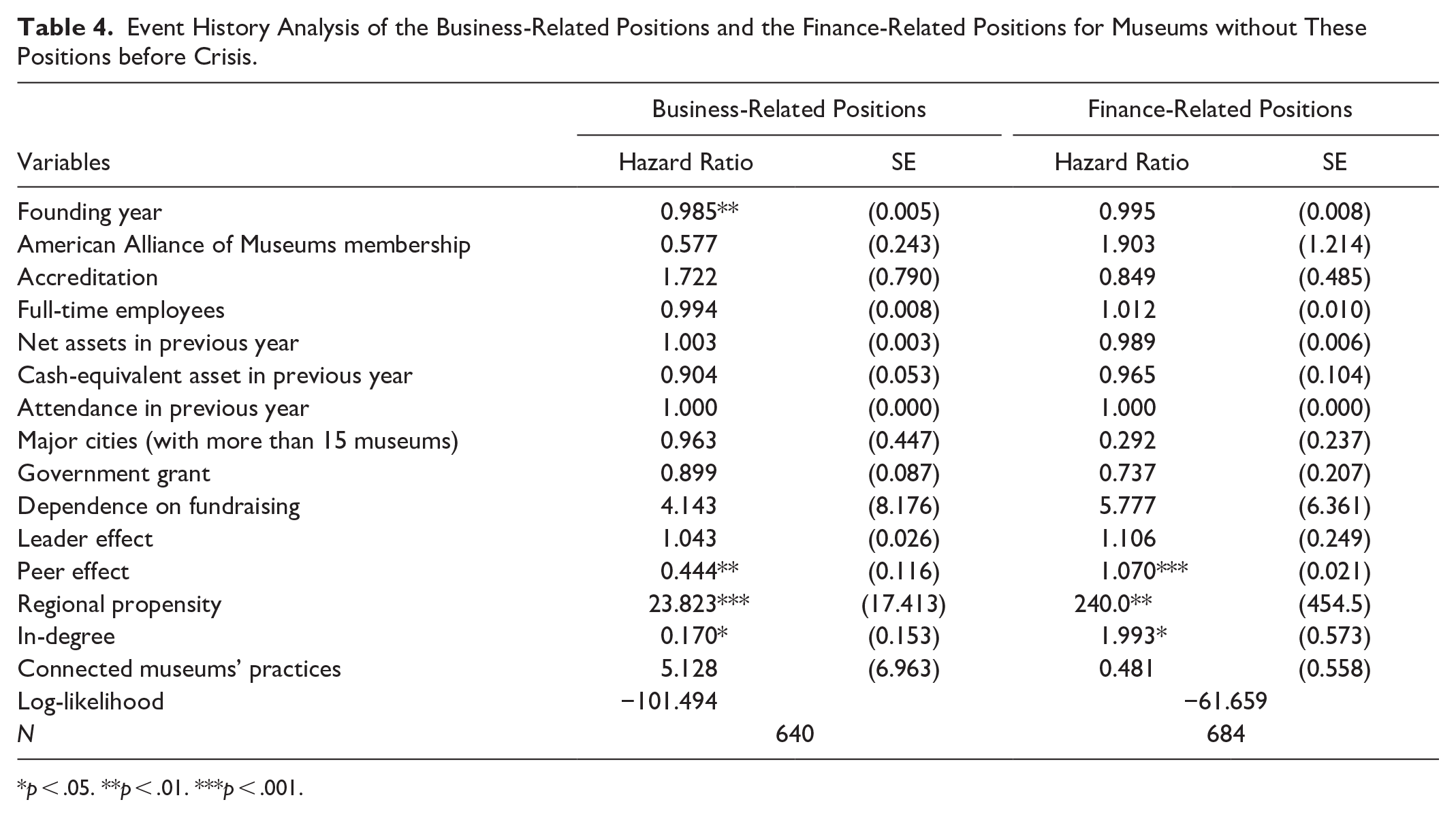
For the robustness check on our results, we present the results of an EHA in Table 4, exclusively considering museums that did not have these positions included in their key personnel before the crisis. Some may be concerned that the results of random-effects logistic regressions could be influenced by museums that had already adopted market practices before the crisis. It is worth noting that although there were a notable number of museums with business-related or finance-related positions before the crisis, the largest group of these museums belonged to the top 25 percent (of asset size), which accounted for 36 percent (for business-related) and 47 percent (for finance-related) of these positions before crisis. By 2011, after the crisis, the prevalence of business-related positions among the top 25 percentile increased to 53 percent (from 36 percent), and finance-related positions increased to 51 percent (from 47 percent) within the same group.
Event History Analysis of the Business-Related Positions and the Finance-Related Positions for Museums without These Positions before Crisis.
p < .05. **p < .01. ***p < .001.
In the EHA results, we found that the museums that adopted market practices for the first time after the crisis did not discard the positions during the rest of the observation period. The Akaike information criterion suggests that the Weibull model is preferred to other parametric models such as the Cox, Gompertz, log-normal, and log-logistic models.
The results in Table 4 indicate a significant positive effect of structural peers, regional proximity, and museum networks through employees on the likelihood of adopting both business- and finance-related positions. Despite use of a different statistical method, these findings robustly support our results in the random-effects logistic regression models (Tables 2 and 3). Although the EHA focused on a subset of museums (only those with no market practices prior to the crisis), it still represents a clear relationship between reference group changes and the adoption of certain practices.
Overall, Hypothesis 1 predominantly works for business-related practices, whereas finance-related positions are more associated with Hypothesis 3. Regional propensity remains a strong predictor throughout the observation period. As market-practice demands surged after the crisis, organizations responded by shifting their references, not only as a new isomorphic pattern but also for their functionality, leading to varied patterns between business- and finance-related positions. Also, museums without prior market practices tended to imitate structural peer, regional, and network-connected institutions while the influence of leaders diminished, as evidenced by the EHA results (Table 4). These findings highlight how mimetic isomorphism operates differently during the time of crisis across various practices and underscore the significant impact of the crisis on the isomorphism patterns and reference groups of U.S. museums during the observation period.
Discussion
By revisiting DiMaggio and Powell (1983) and examining the isomorphic transitions that occur during extreme environmental shifts, we elaborate our understanding of mimetic isomorphism as a key factor in organizational change during times of crisis. Our evidence shows that the use of key market practices by U.S. art museums was accelerated by the 2008 economic crisis, not only because the economic downturn directly undermined their resource base but also because the crisis reshaped museums’ isomorphic behaviors. What we term “aspirational isomorphism” was discarded and replaced by other types of mimesis as new reference groups were emulated, defined by symbolic (leader vs. peer), physical (geographical region), or social (social networks) proximity.
The changes in reference groups during the crisis allow us to trace how and when isomorphic behaviors respond to environmental challenges. As a result, we can see how changes in isomorphism can result in the increase of nontraditional practices.
We examined how two distinct conditions of the crisis activated these isomorphic transitions: (a) absence of internal institutional pressure and (b) a cognitive focus that shifted in the choice of reference groups from aspirational to practical ones. We posited three imitative reference changes for organizations facing extreme uncertainty due to the crisis: a shift from leader to structural peer, the renewed significance of physical proximity, and activation of interpersonnel social networks. Further analysis of key business-related and finance-related personnel positions in art museums revealed that the reference shift from leader to structural peer mostly concerned business-related positions, which had usually triggered institutional tensions within museums before the crisis. In addition, the museums connected through the employee networks experienced increased use of nontraditional practices, especially for the finance-related positions. Unfortunately, the crisis did not clearly show a shift in regional proximity effect before and after the crisis among art museums, but being in the same vicinity consistently influenced mimetic isomorphism throughout the observation period, especially among those museums that had not adopted market practices before the crisis.
Our findings are consistent with previous studies showing that neither an exogenous shock nor a sense of urgency per se was a sufficient catalyst for organizational change. The findings of this study suggest the following conclusions.
First, the core contribution has been to disentangle how and when organizations change isomorphic behaviors during crises. It is important to empirically document that imitation during periods of extreme uncertainty may not be the same as imitation in a stable institutional environment. Whereas previous studies in organizational ecology or neo-institutional theory emphasized the inertia of organizational practices and isomorphism to conform to existing norms and practices, we highlighted the new use of isomorphism to drive change during environmental fluctuation. This study also illustrates how organizational cognition changed by economic crises could alter an institution’s reference groups and in particular, that organizations moved away from aspirational mimesis to mimesis that was more “realistic.” Tough times forced museums into survival mode where emulation of leading organizations became a luxury they could not afford. Previous studies based on the punctuated equilibrium model, which explains fundamental changes in patterns of organizational activity (Haveman 1993; Meyer, Brooks, and Goes 1990; Mezias 1990; Romanelli and Tushman 1994; Tolbert and Zucker 1983), highlighted the structural conditions that allowed new practice adoption. Our findings expand on this and conventional conceptions of institutional isomorphism and indicate how organizations imitate one another in the use of nontraditional practices when normal institutional pressures have been suspended.
Second, our findings uncover an overlooked aspect of institutional change in turbulent conditions. Whereas previous studies of institutional change have highlighted external factors, such as resource-space changes (Hannan and Carroll 1995), or internal factors, such as the rise of advocates for new logics (Rao et al. 2003), our findings indicate how a temporary change caused by external turbulence, even without clear institutional advocates, can produce long-term change through rapid isomorphic transition. Although the effect may not seem huge, its significance increased through imitation and was consistent enough to redirect the trajectory of adoption across all three imitative patterns—and it was not reversed once the crisis had passed. On September 15, 2009, Bernanke (2009) stated that “confidence had now been restored in the financial system and the financial crisis that had started in 2007 was ‘very likely’ over” (see also Labaton 2009); however, even though museum finances and revenue streams bounced back in 2011 to the same levels as 2006, newly altered business practices and the hiring of market-related personnel continued. Small changes that are not reversed eventually amount to big changes.
We cannot conclude that there has been a fundamental institutional shift in norms based strictly on our period of observation. However, it appears that the shift is ongoing and was transforming museum careers until recently (Morris 2019). Morris (2019) emphasizes the relevance of market-related skills to succeed in museums: “I know that what I’m learning about management, the technical skills I’m gaining, and the resilience I’ve developed will only help me continue to excel in the next museum I work in.” It seems that although the crisis was temporary, the changes it wrought were not.
Finally, our study affirms the continuing value of DiMaggio and Powell (1983), 40 years after publication. The experience of U.S. museums through the 2008 crisis reflected a shock to resource flows and professional authority and therefore a disruption of both coercive and normative isomorphism but also a change in mimetic isomorphism. The basis of emulation shifted even as emulation per se continued. Uncertainty creates an incentive for organizations to copy others, and extreme uncertainty even more so, but the question of who to emulate remains open. Should an organization follow leaders in the field or perhaps similar organizations? Do proximate organizations offer relevant models or those linked via network ties? Our evidence suggests that the answers to these questions changed over time among museums but also that more generally, model choice remains a critical part of mimetic isomorphism.
Notwithstanding the contributions of this study, we acknowledge a few important limitations. The first concerns the possibility of alternative explanations for leader and peer dynamics. Although Hypothesis 1 seems to be strongly supported in business-related practices, there could be other explanations for this. If we consider only the results in the random-effects logistics model, it is possible that most leaders had adopted market practices before the crisis; thus, there were not many leaders to imitate after the crisis (thus creating a statistical ceiling effect). Indeed, this possibility was alluded to earlier when we mentioned that the growth of the business side of big museums had started before the crisis. However, when we consider the EHA with only the sample of precrisis nonadopters, the findings stay robust among museums who did not have market practices before. In addition to asset size as an indicator of leader organizations, future research can examine the differential impact of high status on isomorphic patterns and nontraditional practice adoptions (Jourdan, Durand, and Thornton 2017; Phillips and Zuckerman 2001; Sanders and Tuschke 2007) across environmental turbulences.
Related to the first concern, there is also the possibility of alternative operationalizations to define peers and regional boundaries. Despite our efforts to capture the multiple dimensions of references, which highlight differing imitational referents before and after the crisis, there may be more convoluted dynamics within these categories. Structural peers capture distant yet similar performing museums, and museums within the same state reflect both geographical location and sociopolitical circumstances.
However, the museum sizes and the selection of practices may also vary beyond the three categories of top, middle, and low asset size. Using state-level changes could potentially blend referent effects with state-level differences in responses to the financial crisis with respect to the funding of museums. Nevertheless, we were unable to access data on local government grants or support for all museums, nor were we provided clear boundaries for the symbolic distances among museum boundaries because such data are not publicly available. This aspect could be better explored using data with publicly traded for-profit firms, which typically offer more detailed data, to expand on the current findings and assess whether the mimetic referent change patterns among museums differ between for-profit and nonprofit organizations.
A third matter concerns the unavailability of data on revenues generated by specific market practices, which would offer an alternative way to measure the difference of market practices by focusing on how business and financial practices differentially impact nonprofit organizations through their fiscal capacity. Because nonprofit organizations are not all required to report their revenues and expenses—especially if they are small—it is difficult to assemble a representative sample of organizations that includes such financial variables. Additionally, revenue data drawn from the IRS 990 forms were inconsistent over time and across different museums, and detailed revenue information was missing—only a few museums reported revenue from specific organizational practices. A related data issue concerns the inability to systematically measure all possible market-related organizational practices. Surmounting these limitations offers a way forward for future research.
