




Abstract
Our study reevaluates the impact of commuting on mental health, challenging the prevailing view of commuting solely as a job-related demand or stressor that leads to increased mental health problems. Using the 2011 Neighbourhood Effects on Health and Well-Being Study from Toronto, we explore the dual perspectives of commuting distance as a stressful demand versus a potentially beneficial resource among parents of minor children (n = 299). Multivariate results reveal that commuting distance alone is not significantly linked to mental health as measured by psychological distress. However, the nature of commuting—whether it is viewed as a demand or a resource—depends on other factors in parents’ lives. Specifically, our results indicate that an increase in commuting distance exacerbates the negative effects of work hours on psychological distress while simultaneously buffering against the impact of work-to-family conflict on this outcome irrespective of gender.
Commuting to and from work is an important part of the day for many employed individuals. Although the COVID-19 pandemic led to a decline in the proportion of those commuting, recent national data show that commuting is on the rise in Canada. Indeed, in May 2023, 15.9 million Canadians, or four in five workers, were commuting to work—a notable increase from prepandemic levels (Statistics Canada 2023). Prior to the pandemic, the prevalence of commuting had been steadily rising in North America, with Canada experiencing a 30.3 percent increase since 1996 (Statistics Canada 2017). Furthermore, a 2011 report by the Board of Trade highlighted Toronto as having the lengthiest commute times among 21 major cities in North America (Aw 2012). This study is notable given that it focuses on the same time frame and city of the data for the current study. Thus, as commuting rates start to swing upward, it is increasingly important to understand the effect of this daily activity on “everyone’s ultimate dependent variable”: mental health (Wheaton 2001:228).
Commuting has traditionally been characterized as a boundary-spanning time demand that can limit employees’ availability to fulfill family-related roles and routines (e.g., Clark et al. 2020; Costa, Pickup, and Di Martino 1988; Elfering et al. 2020; Koslowsky 1997; Laß and Wooden 2023; Liu, Ettema, and Helbich 2022; Milner et al. 2017; Murphy et al. 2023; Nie and Sousa-Poza 2018; Turcotte 2011; Voydanoff 2005), potentially leading to mental health problems. Yet recent theoretical scholarship suggests that commuting may have an upside: It provides individuals with a liminal space free of both home and work roles, allowing them to unwind, have some targeted personal time, and potentially elevate positive psychosocial outcomes. This liminal space created during the commute offers opportunities for psychological detachment from work and psychological recovery, which are crucial for preventing burnout and work-family conflict and maintaining mental well-being (Jachimowicz et al. 2021; McAlpine and Piszczek 2022; Pindek, Shen, and Andel 2023).
Commuting may exert a more distinct impact on the mental well-being of parents with dependent children at home than those without due to the inherent complexities associated with managing parental duties alongside work commitments (Hofmeister 2003; Rüger et al. 2017; StGeorge and Fletcher 2012). For parents of minor children (those under the age of 18), commuting may present a dual role. On the one hand, commuting may serve as a necessary time-based demand, or wasted time (Milner et al. 2017), adding to the myriad of responsibilities parents must juggle alongside their familial duties, leading to elevated stress and, consequently, mental health problems (Rüger et al. 2017). From this perspective, commuting might also exacerbate other time- or strain-based stressors because it takes additional time away from those alternate concerns (Milner et al. 2017).
On the other hand, commuting may offer a potential respite—a time for parents to unwind, decompress, and mentally transition between work and home life. In this scenario, commuting may not only lead to fewer mental health problems, but it may also buffer the deleterious consequences of other stressors in parents’ lives. This dichotomy underscores the nuanced relationship between commuting and parental mental health, highlighting the need for comprehensive research to elucidate its multifaceted effects on mental health among this population.
Drawing on data from the 2011 Neighbourhood Effects on Health and Well-Being (NEHW) study from Toronto, Canada, we contribute to the expanding body of mental health research by investigating the influence of commuting distance on psychological distress among parents of at least one child at home under 18 years old. Psychological distress, characterized by a combination of depression and anxiety symptoms, serves as a crucial indicator of mental health issues and is frequently observed as a behavioral response to stressful circumstances (Wheaton and Montazer 2017). We then test whether commuting serves to modify the influence of two important stressors—long working hours (used interchangeably with work hours) and work-to-family conflict—on psychological distress. Whereas work hours is a time-based work stressor, work-to-family conflict is a chronic stressor that links the work domain with that of the home domain and exists when demands in both domains are incompatible and one (work) infringes on the other (home). Finally, given mothers’ larger responsibility for day-to-day housework and childcare tasks (Nomaguchi and Milkie 2023; Nomaguchi, Milkie, and Bianchi 2005; Simon and Caputo 2019) that may further impact the association between commuting distance and mental health (Chatterjee et al. 2020; Costa et al. 1988; Roberts, Hodgson, and Dolan 2011), we test whether our modified associations between commuting distance, work hours, work-to-family conflict, and psychological distress (used interchangeably with “mental health problems,” henceforth) further vary by gender for the parents in our sample.
Background
The Consequences of Commute Time and Distance
Research examining the impact of commuting on various individual outcomes has predominantly focused on the negative implications of this activity for the employed irrespective of social and demographic statuses, including parental status (Laß and Wooden 2023; Murphy et al. 2023; Rüger et al. 2017). Commuting has been described as a boundary-spanning demand, encompassing both time and psychological aspects that extend across both work and family domains, potentially leading to conflict and mental health issues (Voydanoff 2005). From this perspective, commuting can be seen as a constraint on time, which may exacerbate mental health problems, such as psychological distress, especially for those with additional demands at home. This prediction aligns with “resource drain theory,” which suggests that time is a finite resource: The more time allocated to one activity, the less is available for others (Edwards and Rothbard 2000). Among parents of minor children in particular, time spent commuting is likely to detract from essential emotional or relational work with or for their children (StGeorge and Fletcher 2012). Thus, an increase in commuting distance to and from work should limit, for example, not only completion of work tasks but also participation in the family domain for this demographic group and time dedicated to health-beneficial activities, such as self-care and physical exercise, leading to greater mental health problems (e.g., Costa et al. 1988; Feng and Boyle 2014; Hofmeister 2003; Nie and Sousa-Poza 2018; Palmer 2005; Turcotte 2011; Voydanoff 2005).
Results of studies examining the association between commuting and mental health irrespective of parental status are inconclusive (Liu et al. 2022). Although some studies do not find a significant association with mental health problems, including psychological distress (Hansson et al. 2011; Humphreys, Goodman, and Ogilvie 2013; Palmer 2005), several studies indicate that commuting can negatively affect various mental health outcomes—for example, depression and distress—particularly among women (Costa et al. 1988; Feng and Boyle 2014; Martin, Goryakin, and Suhrcke 2014; Roberts et al. 2011) or among those who travel by car or public transit compared to those who commute actively by walking or biking (Clark et al. 2020; Jacob et al. 2020; Knott et al. 2018; Liu et al. 2022; Martin et al. 2014; Murphy et al. 2023; Nie and Sousa-Poza 2018; Voydanoff 2005; Wang et al. 2019). Studies also indicate that these issues often arise when commute duration exceeds a certain threshold (Feng and Boyle 2014; Liu et al. 2022); longer commutes appear to be particularly problematic for mental health. The relationship between commuting and mental health may also be influenced by subjective impedance, such as traffic congestion, bad weather conditions, and slow speed (Novaco, Kliewer, and Broquet 1991; Wang et al. 2019). However, a recent review of commuting literature concludes that external travel circumstances, such as accidents, crowdedness, and severe weather conditions, do not appear to significantly impact mental health. This lack of association may be attributed to the fact that most circumstances are specific to particular contexts and may not be consistently experienced over time (Liu et al. 2022).
In contrast to the traditional view of commuting duration/distance as a demand that ought to increase mental health problems, some theoretical scholarship suggests that commuting may be a resource to working parents (e.g., Jachimowicz et al. 2021; Jain and Lyons 2008; McAlpine and Piszczek 2022; Pindek et al. 2023; van Hooff 2015). In support of this perspective, employees who indicate being satisfied with their commutes have reported higher work-family balance (Denstadli, Julsrud, and Christiansen 2017). Extant commuting research also suggests that many workers are satisfied with their commute (Ory et al. 2004) and prefer a commute time of ≈16 minutes compared to no commute at all (Redmond and Mokhtarian 2001). Furthermore, although some studies suggest that a decline in commuting was welcomed by the employed during the early months of the COVID-19 pandemic (e.g., Schudde et al. 2022), others report that some workers actually missed their commute (Fowler 2022; Kaysen 2020). Various press articles praised this daily activity and encouraged workers to recreate their daily commutes through a “fake” or “virtual” commute at the beginning and end of their remote workdays from home to recreate a separation between their workday and their home life (e.g., Bailey and Cohen 2021; Rogers 2021).
According to McAlpine and Piszeczek (2022), during the commute, workers enter a liminal space where they are fully engaged with neither work nor home thoughts and behaviors. This allows them to relax and prepare for their home or work role. Other benefits of commuting include opportunities for social interaction, enjoyment of one’s surroundings, and valuable “me time” amid people’s busy lives (e.g., Pindek et al. 2023).
The perspective of commuting duration or distance as a resource is consistent with “border theory” (Clark 2000), which predicts that role integration from one domain (i.e., work) to another (i.e., family) can be detrimental if the boundaries of domains are too permeable and integrated. Thus, multiple roles may be beneficial to individuals if there is a transition period from one to another. Commuting potentially provides this opportunity and should facilitate these valuable transition times for parents with minor children at home. The results include a clear boundary between work and home life mindsets and dedicated time to mentally switch gears and recover from the demands of the one sphere before entering the other with its associated demands, ultimately aiding in the psychological detachment from work/family and facilitating a recovery process (Ashforth, Kreiner, and Fugate 2000). The aforementioned elaborations suggest competing associations between commuting and mental health and give rise to two opposing hypotheses:
Hypothesis 1 (commuting stressor hypothesis): Greater commuting distance is associated with an increase in psychological distress.
Hypothesis 2 (commuting resource hypothesis): Greater commuting distance is associated with a decrease in psychological distress.
Commuting as a Modifier of the Effect of Other Stressors
Beyond its additive association with psychological distress, we are also interested in examining how commuting may moderate the association between two chronic stressors and psychological distress. Chronic stressors are threats, demands, or structural constraints that have no clear start or end point; are often insidious; and are influenced by the context in which they are experienced (Wheaton et al. 2013). Long work hours and work-to-family conflict are two such chronic stressors (Kleiner, Schunck, and Schömann 2015; Pearlin 1999; Wheaton et al. 2013) that have been linked to psychological distress (Bellavia and Frone 2005; Michel et al. 2011; Montazer et al. 2022, 2024; Park et al. 2020; Pearlin 1999; Sato, Kuroda, and Owan 2020; Tausig 2013; Voydanoff 2007).
Despite the financial incentive often associated with working longer hours (Milner et al. 2017), increased work hours can have detrimental effects on mental and physical health of the employed. Extended work hours can lead to the depletion of one’s energy reserves, making individuals more susceptible to experiencing negative emotions and stress. Moreover, prolonged periods of work can limit opportunities for engaging in restorative activities outside of work, further exacerbating the strain on mental and physical well-being (Caruso et al. 2006; Kleiner et al. 2015; Sato et al. 2020; Voydanoff 2005).
Work-to-family conflict is a second chronic stressor that impacts the mental health of the employed. Work-to-family conflict occurs when one’s work obligations interfere with roles and expectations in the family sphere (Greenhaus and Beutell 1985). There are three forms of conflict often experienced between work and family: time-, strain-, and behavior-based. A plethora of studies document the deleterious mental health effects of work-to-family conflict, including psychological distress, anxiety, depression, anger, and guilt (Goh et al. 2015; Michel et al. 2011; Young, Schieman, and Milkie 2014).
How may commuting impact the mental health consequences of these two stressors? We propose two competing scenarios. On the one hand, if commuting is a necessary boundary spanning demand in the lives of parents, then the negative consequences of long work hours and work-to-family conflict on mental health should be exacerbated or intensified by greater commuting distance. This possibility can be best understood through resource drain theory. Recall that this theory underscores that time is a zero-sum finite resource: the more of either spent on one activity, the less available for others (Edwards and Rothbard 2000). Greater commuting distances imply less time for other activities, including family-related activities and self-care, for example, making these latter events more stressful. For example, parents with long commutes may not only have less time to get ready, exercise, and sleep, but they may also have less time and energy for family—creating greater tension with one’s spouse and less potential involvement with one’s children (Hoehner et al. 2012). The depletion of time and energy associated with longer commutes can decrease parents’ ability to deal with other deleterious stressors in life, especially chronic stressors. Our ideas here are consistent with the engineering model of stress, which underscores that continual stress exposure eventually depletes one’s psychological ability to combat the mental consequences of stressors (Smith 1987; see Wheaton et al. 2013). In our case, long commutes tax individuals mentally, making it more difficult for them to effectively cope with competing chronic stressors and thus exacerbating their psychological damage.
On the other hand, if commuting distance is a resource in the lives of parents with minor children, then greater commuting distance should buffer the negative consequences of work hours and work-to-family conflict on distress. Border theory (Clark 2000) provides the most effective framework for understanding this possibility. As explained earlier, this theory posits that the integration of roles from one domain (e.g., work) to another (e.g., family) is most detrimental when the boundaries between these domains are excessively permeable and integrated. Therefore, commuting, which allows for valuable transition time between roles, should be most beneficial in the context of long work hours and high work-to-family conflict. Accordingly, greater commuting distance may facilitate parents’ work and family performance and well-being by allowing for psychological detachment (e.g., liminality, me time) and recovery from high levels of chronic stressors and thus buffer the negative impact of these stressors on psychological distress.
The Added Dimension of Gender
The aforementioned elaborated associations may differ for fathers and mothers. The limited research that views commuting as a demand suggests that its deleterious effects may be more negative for women than men (Feng and Boyle 2014; Martin et al. 2014; Roberts et al. 2011) for two reasons. First, commuting can be seen as another competing demand on women’s, especially mothers’, time. Despite significant changes in women’s participation in the paid labor market and shifts in gender ideology, the home and family remain central to women (Offer and Kaplan 2021; Scarborough, Sin, and Risman 2019). On top of housework, mothers also tend to be more responsible for running errands and picking and dropping off children even if both partners are employed (Bianchi, Robinson, and Milkie 2006; Collins et al. 2020; Koslowsky 1997; Roberts et al. 2011; Syrda 2022). These additional responsibilities may place strain on their time and energy, resulting in greater mental health problems. Second, commuting may be more harmful to mothers because they, regardless of childcare responsibilities, tend to work shorter hours and earn lower wages than fathers. Put another way, commuting may be more expensive for mothers (Roberts et al. 2011); there is an opportunity cost for women, especially mothers, who commute. Unlike fathers, mothers incur lost time without the countering work rewards in return for their time on the road. In concert, these reasons suggest that an increase in commuting distance should exacerbate the effect of other chronic stressors—like long work hours and work-to-family conflict—on psychological distress of mothers more than fathers.
Nevertheless, there are reasons to believe that commuting might buffer the negative association between chronic stressors and distress more for mothers than fathers. Research suggests that men and women attribute different meanings to work and family roles that influence their well-being. Women, especially mothers, tend to view work and family roles as independent (i.e., work and family exist as separate spheres), whereas men, particularly fathers, see their work and family roles as interdependent (i.e., the financial provision of the family is their contribution to the domestic sphere). These experiences manifest as gender differences in mental health in which mothers report more guilt, negative self-evaluations, and distress compared to fathers (Glavin, Schieman, and Reid 2011; Simon 1995). The view of these domains as independent by mothers may be particularly harmful when the permeability between spheres is greater—as is the case with a limited commute or absence of a commute. Thus, commuting distance/time may provide a valuable transition time that allows mothers to mentally switch gears before arriving home (Jachimowicz et al. 2021; McAlpine and Piszczek 2022; Pindek et al. 2023). Mothers may benefit more from this transition time than fathers who view these domains as interdependent and continue to do less housework and childcare than their female counterparts (Collins et al. 2020; Syrda 2022). Subsequently, greater commuting distance may buffer the negative impact of our selected chronic stressors on distress for employed mothers more than for employed fathers. The aforementioned elaborations give rise to the following sets of competing hypotheses:
Hypothesis 3: Commuting distance will exacerbate the negative effect of work hours on psychological distress (Hypothesis 3a), mainly among mothers (Hypothesis 3b). Hypothesis 4: Commuting distance will exacerbate the negative effect of work-to-family conflict on psychological distress (Hypothesis 4a), mainly among mothers (Hypothesis 4b).
Hypothesis 5: Commuting distance will buffer the negative effect of work hours on psychological distress (Hypothesis 5a), mainly among mothers (Hypothesis 5b). Hypothesis 6: Commuting distance will buffer the negative effect of work-to-family conflict on psychological distress (Hypothesis 6a), mainly among mothers (Hypothesis 6b).
Data and Methods
We test our hypotheses using data from the 2011 Neighbourhood Effects on Health and Well-Being (NEHW) study (O’Campo et al. 2015). The NEHW study is a data set collected at the individual level using a cross-sectional, multilevel design across 47 neighborhoods in the Greater Toronto Area. Face-to-face interviews were conducted between 2009 and 2011 with approximately 20 to 30 respondents in 87 census tracts across the city-defined neighborhoods in Toronto (for more detail on the study methods, see O’Campo et al. 2015). The data set includes interviews with 2,412 individuals. To be eligible for study participation, potential respondents had to be between 25 and 64 years old, be comfortable speaking and understanding English, and at the date of interview, reside at their current address for at least 6 months. The overall response rate was over 80 percent.
Our study focuses on parents of minor children who commute between work and home, exploring how this distance impacts their psychological distress. Therefore, we limit our analytical sample to parents with at least one child under 18 in the household and who have a calculated distance, measured in kilometers, between their place of residence and place of work that is greater than zero. These restrictions resulted in a final sample size of 299 respondents, of which 161 were mothers.
Measures
Commuting distance to/from work
We employ the geodist function in SAS 9.4, which uses the latitude and longitude associated with two geographical points to calculate the exact kilometers between one’s residence and workplace based on respondents’ reported postal codes for each respective location. Canadian postal codes are comprised of a six-character alphanumeric combination (ANA NAN) assigned to one or more postal addresses. Whereas the first three characters of the postal code (alphanumeric combination of “ANA”)–Forward Sortation Area (FSA) represent a specific area within a major geographic region or province, the last three characters (“NAN”)–Local Deliver Unit (LDU) allow for the creation of individual postal codes serviced by postal installations within the FSA (Canada Post 2022). Median commuting distance is 6.31 km with an interquartile range of 3.61 to 12.05 km.
Psychological distress
Sixteen related items from well-known scales, including the CES-D depression scale (Radloff 1977), and symptoms from the Spielberger Anxiety Scale (Spielberger et al. 1979) were used to construct a composite distress scale to assess psychosomatic symptoms of malaise, depression, and anxiety. We first averaged the 16 scores and then standardized the scale by multiplying it by the total number of items. Respondents were asked whether they felt symptoms “none of the time” (1), “a little of the time” (2), “some of the time” (3), “most of the time” (4), or “all of the time” (5). Higher scores reflect greater distress (α = .92). For a full list of the items and correlation details for each, see Appendix A.
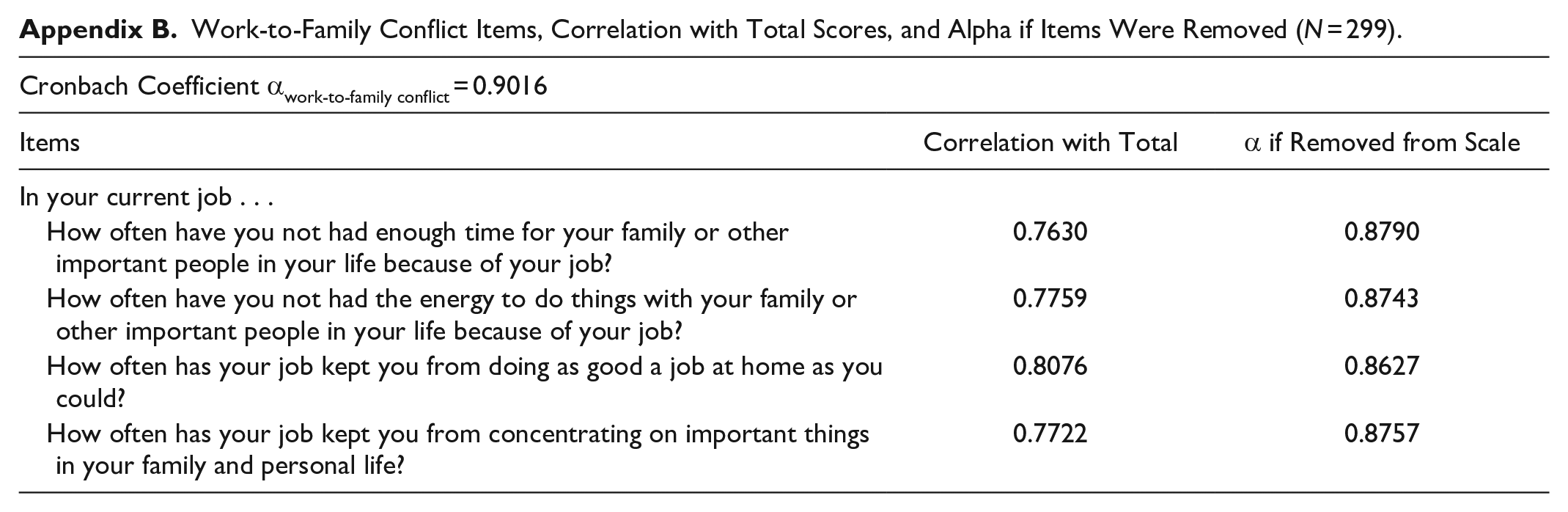
Work-to-family conflict is measured by four commonly referenced items adapted from the National Study of the Changing Workforce (Bond et al. 2003). For the full list of items and correlation details for each, see Appendix B. Response choices for these items include “very often” (5) to “never” (1). We generate an index of work-to-family conflict by averaging responses and then standardize the scale by multiplying it by the total number of items. Higher scores represent greater conflict (α = .90).
Hours worked is measured as the total number of hours the respondent indicated working in a typical week.
We control for a number of covariates noted by previous research that may impact our focal associations (e.g., Axisa, Scott, and Newbold 2012; Feng and Boyle 2014; Koslowsky 1997; Michel et al. 2011; Montazer 2022; Montazer and Young 2020; Novaco et al. 1991; Voydanoff 2007). For instance, we account for income, which may affect both the decision to undertake a longer commute and one’s mental well-being (Montazer and Young 2020; Roberts et al. 2011). Similarly, considering our focus on parents of minor children, we adjust for the presence of a partner, the number of minor children in the household, and household labor (Bianchi et al. 2012; Hofmeister 2003). Finally, given that our data come from Toronto, where nearly 50 percent of residents were foreign-born or identified as racial minorities in 2011 (Toronto 2013), it is important to control for these factors. Foreign-born individuals or racial minorities may be more inclined to commute for work compared to native-born or White European Canadians (Allen et al. 2022; Axisa et al. 2012). Moreover, research indicates a significant association between these demographic characteristics and mental health outcomes, including psychological distress (e.g., Ali 2002; Montazer 2022; Pahwa et al. 2012).
Gender—a focal moderator in this study—is coded 1 for mothers compared to fathers (0, comparison). We also control for respondent’s age (in years); foreign-born (=1); race/ethnicity minority status, which includes individuals who identify as Arab or West Asian, African, Caribbean, East Asian or Pacific Rim, Latin, or south Asian (1 = racial/ethnic minority; 0 = White/Caucasian); number of minor children in the household; household income (a continuous measure presented in thousands of Canadian dollars); and marital status (married or common law vs, other marital statuses). To measure household labor, respondents were asked to record the average number of hours spent on 19 domestic tasks per week, such as “preparing family meals,” “washing dishes and cleaning up after meals,” “cutting the lawn,” “taking care of the kids when spouse is home,” “taking care of kids when spouse is gone,” and so on (Sweet, Bumpass, and Call 1988). Responses were summed to generate total domestic hours per week, including housework and childcare.
According to previous research, the effect of commuting on outcomes may depend on the mode of transportation and impedance—for example, traffic and slow speed (Novaco et al. 1991)—throughout the duration of the trip (Stutzer and Frey 2008). Furthermore, the decision to commute is likely dependent on any known impedance factors and mode of transportation available to the individual. Although the NEHW study does not specifically include such measures, we approximate commuting mode and impedance by controlling for availability of public transportation (poor = 1, excellent = 5) in the respondent’s neighborhood). We also measure the seriousness of traffic (i.e., neighborhood traffic) in the respondents’ residential region with a question that asks them to indicate if heavy road traffic is a serious problem (5), quite a problem (4), more or less a problem (3), a minor problem (2), or not a problem for them (1) in their neighborhood. Higher values suggest more traffic concerns. We believe this measure somewhat captures the experience of traffic delays in one’s day-to-day commute. 1
Analytic Strategy
Given that the design of the NEHW study clusters respondents by neighborhood, error terms across respondents within the same neighborhood are likely correlated. To address clustering concerns and to separate the variance in outcomes across neighborhoods (Level 2) as a proportion of the total variance in each outcome (Level 1), respectively, we use hierarchical linear modeling for all analyses (Raudenbush and Bryk 2002). All variables were grand-mean centered, making the intercept interpretable at the mean value of the predictor variables and to minimize collinearity among predictors (Raudenbush and Bryk 2002).
To address potential underrepresentation due to the study’s inclusion criteria, such as age, residency duration, and English proficiency, we applied sampling weights in our analyses. These weights were based on factors such as nativity, gender, age, household composition, and income, ensuring a balanced representation in line with O’Campo et al. (2015). Regarding missing data, 9 percent of the sample (26 participants) had incomplete information on key variables. We employed multiple imputation methods, creating five data sets to estimate missing values (Little and Rubin 1987). The outcomes from these imputed data sets were then aggregated for all analyses.
Results
Table 1 provides descriptive statistics for all variables used in the analyses separately for men and women and for the entire sample. We note significant gender differences by means and proportions based on t tests and chi-square tests, respectively, with asterisks.
Weighted Descriptive Statistics for All Variables in the Study.

Note: Asterisks indicate significantly different from fathers (two-tailed t test and chi-square tests for continuous and binary variables, respectively).
p < .05.
Commuting Distance and Psychological Distress
In Table 2, we report adjusted results of multivariate analyses for the effect of commuting distance on psychological distress. To test our first two competing hypotheses (commuting stressor hypothesis vs. commuting resource hypothesis), we present results with adjusted covariates and results that include the proposed moderators in the additive association between commuting distance and distress in Models 1 and 2, respectively. 2 Contrary to the predictions of our first two hypotheses, there is no significant association in either direction between commuting distance and psychological distress among parents in our sample. Although not shown in the table, unadjusted results are also not significant for the association between commuting distance and psychological distress (b = −0.005, p = .95).
Regression of Psychological Distress on Commuting Distance, Covariates, and Proposed Moderators (N = 299).

p < .05. ***p < .001 (two-tailed test).
Table 3 displays adjusted results examining how commuting distance moderates the relationship between work hours, work-to-family conflict, and psychological distress. We control for previous noted covariates (Table 2) across all analyses presented in Table 3. In Model 1 of this table, we replicate the results from the full model predicting distress (i.e., results from Model 2, Table 2). To test our two competing hypotheses for the moderated association by commuting distance between (a) work hours and distress and (b) work-to-family conflict and distress (augmentation hypotheses, Hypotheses 3a and 4a vs. buffering hypotheses, Hypotheses 5a and 6a), we estimate the interaction term between commuting distance and work hours in Model 2 and work-to-family conflict and distance in Model 3 of this table. We document a significant interaction term between commuting distance and both work hours and work-to-family conflict on psychological distress. However, although results suggest that greater commuting distance augments the negative effect of work hours on psychological distress (providing support for Hypothesis 3a; see Figure 1), in line with the buffering hypothesis (Hypothesis 6a), greater commuting distance alleviates the negative effect of work-to-family conflict on psychological distress (see Figure 2).
Regression of Psychological Distress on Commuting Distance, Work Hours, and Work-to-Family Conflict (N = 299).

Note: Results include all control variables presented in Table 2.
p < .05. ***p < .001 (two-tailed test).

Graphical representation of the effect of commuting distance by hours worked on psychological distress.
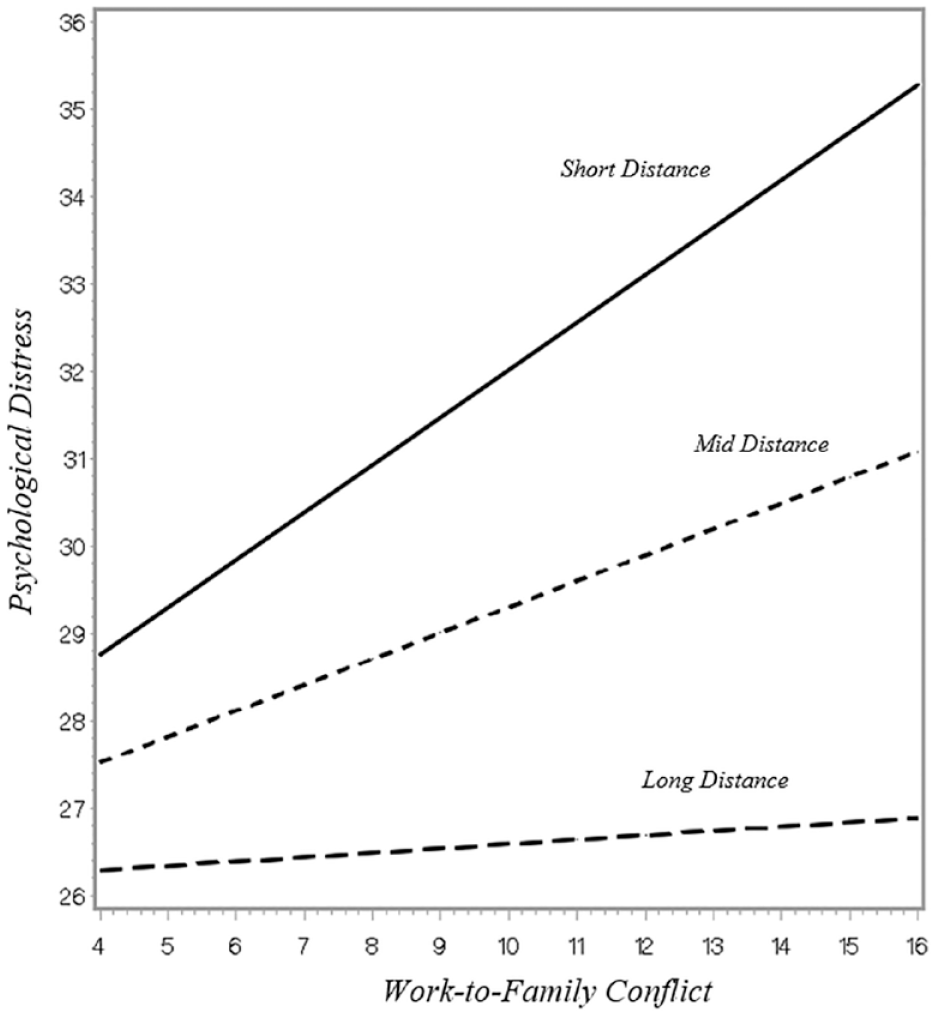
Graphical representation of the effect of commuting distance by work-to-family conflict on psychological distress.
Supplementary analyses did not suggest a significant three-way interaction between commuting distance, work hours, and gender (bcommuting distance × work hours × female = −0.01, p = .59; F = 0.29, p = .59) or between commuting, work-to-family conflict, and gender on psychological distress (bcommuting distance × work-to-family conflict × female = 0.01, p = .76; F = 0.10, p = .75). Thus, we do not find support for Hypothesis 3b or Hypothesis 6b. There were no gender differences detected; irrespective of gender of the parents in our sample, the augmentation hypothesis is supported for work hours, and the buffering hypothesis is supported for work-to-family conflict.
Discussion
Commuting directly reflects the objective duration in time and/or distance between work and family domains (Voydanoff 2005). The traditional view of commuting as a demand suggests that the greater the distance individuals must travel before reaching home, the less time they have for family, home life, and personal self, leading to increased mental health problems (Chatterjee et al. 2020; Clark et al. 2020; Costa et al. 1988; Elfering et al. 2020; Koslowsky 1997; Liu et al. 2022; Milner et al. 2017; Murphy et al. 2023; Nie and Sousa-Poza 2018; Turcotte 2011; Voydanoff 2005). Conversely, some theoretical scholarship suggests the longer it takes to get home from work, the more time individuals have to immerse themselves in a subjectively beneficial liminal space— a time free of both home and work roles. This crucial period may provide opportunities for psychological detachment from work and psychological recovery, which is crucial for maintaining a healthy state of mind (Clark 2000; Jachimowicz et al. 2021; McAlpine and Piszczek 2022; Pindek et al. 2023).
We set out to examine the competing views of commuting as a demand versus a resource in impacting psychological distress among a sample of employed parents with at least one minor child living in the household. We used data from a sample of respondents residing in Toronto, Canada. We operationalized commuting using an objective measure of parents’ commute based on the calculated distance between their reported postal code of residence and workplace and built on the limited and inconclusive work on the effect of commuting in the mental health literature. We took our study a step further by arguing—and subsequently testing—the proposition that commuting would modify the impact of two stressors (long work hours and work-to-family conflict) on parents’ mental health.
Consistent with previous research indicating a lack of association between commuting and mental health outcomes (Hansson et al. 2011; Humphreys et al. 2013; Palmer 2005), we did not find support for the role of commuting as a demand or resource in its additive association with psychological distress. One potential explanation for our null finding may be the limited range of commuting distances (0.15–29 km) in our data set, which might not fully capture commuting experiences. In 2012, Toronto was ranked as the fifth worst city for traffic delays in North America (CityNews Toronto 2012), indicating that commuting distance may not accurately reflect travel time. 3
However, we would caution that this null association should not be overstated because subsequent analyses show that the mental health consequences of commuting do not exist in a vacuum. Instead, they may depend on other stressors endured by workers simultaneously. Indeed, our results indicate that commuting is an important moderator in the association between long work hours, work-to-family conflict, and distress. However, these associations did not play out similarly: Although commuting distance was found to exacerbate the positive association between long work hours and distress, it helped alleviate the positive association between work-to-family conflict and psychological distress for both mothers and fathers. We suspect the contrasting moderating role of commuting distance in the association between our modeled stressors may be due to the type of stressors we chose to analyze: one that objectively takes time away from one’s home life (work hours) and another that subjectively links ones work domain to one’s home domain (work-to-family conflict).
Commuting Distance as a Moderator
Work hours are a time-based stressor or demand (Voydanoff 2005). Theoretically, an increase in work hours can induce job-related stress by draining one’s energy, eliciting negative emotions, and limiting opportunities for recuperative activities outside of work, increasing mental and physical health problems (Caruso et al. 2006; Kleiner et al. 2015; Sato et al. 2020; Voydanoff 2005). However, despite its resource drain on employees’ lives, we find the impact of work hours to only become problematic when compounded by an additional time-depleting activity: commuting distance. According to Milner et al. (2017), commuting time is often perceived as “wasted” because individuals cannot utilize these hours for paid work, spending time with family, or engaging in other activities that could promote mental well-being. This issue may be especially concerning for parents of young children who work long hours; the combination of long work hours and extended commute durations likely leads to increased demands at home and time deficits with children, resulting in heightened psychological distress (Milkie, Nomaguchi, and Schieman 2019; StGeorge and Fletcher 2012). Although our respondents do not experience a negative mental health impact of an increase in work hours on its own, an increase in commuting distance exacerbates this stressor’s impact on their mental well-being. This interaction suggests that commuting may serve as a catalyst, akin to “the needle that broke the camel’s back,” switching on the adverse effects of extended work hours on psychological distress.
Contrary to the augmenting effect of commuting distance in the association between work hours and distress, we find that this activity is protective against the negative effect of another chronic stressor—work-to-family conflict—on psychological distress. Although forms of conflict experienced between work and family can manifest in time-based constraints, such as when work obligations detract from family time, they can also be strain or behaviorally based. For instance, workplace stressors may deplete an individual’s energy or hinder their ability to fulfill familial responsibilities effectively (Greenhaus and Beutell 1985). Our findings suggest that parents may benefit from a transition period (e.g., commuting) before returning to the home environment, when the experience of this stressor is high.
As suggested by border theory (Clark 2000) and some theoretical scholarship (Jachimowicz et al. 2021; McAlpine and Piszczek 2022; Pindek et al. 2023), for workers, irrespective of gender, an increase in commuting distance may provide a useful transition in leaving one domain before entering another. This transition time might reduce the spillover effects from one’s work to one’s family life. Although our respondents still experience the negative impacts of work-to-family conflict, commuting may make it seem less problematic or less salient—perhaps by allowing for problem-solving time or liminality whereby they do not think of demands in either domain. From this view, the commute time serves as a resourceful period for people to reflect on the day’s events and put negative experiences into perspective. It may also allow workers to think through the next day’s schedule and anticipate potential conflicts. The mental space afforded to respondents during the commute may emulate benefits of meditative practices (Koslowsky, Kluger, and Reich 1995). Aside from the traffic and other impediments one might encounter, individuals may finally have the time to shut off the noise of the day or—if on the way to work—prepare for upcoming demands the day may bring. These presumed practices imply that any distress resulting from work-to-family conflict may be subdued during reflective commute time. Of course, our speculations depend on a variety of circumstances we cannot test with our data, including mode of transportation, carpooling options, and time spent in jammed or phantom traffic. Future research should consider these conditions and assess whether our presumptions hold true for other work- or family-related stressors.
Given the persistence of different cultural meanings attached to work and family roles for mothers and fathers (Simon 1995) and the stubborn inequities in the household division of labor (Nomaguchi et al. 2005; Simon and Caputo 2019), we had predicted that both the buffering and augmentation hypotheses would be especially pertinent for mothers. We did not find support for these gender-contingent predictions. The absence of a gender contingency could be attributed to the limited size of our sample, which might not have provided sufficient statistical power to detect significant differences between mothers and fathers.
It is also possible that the lack of a gender contingency in our data may be due to the composition of our sample. Studies suggest that although women may commute shorter distances than men, commuting may be more detrimental to mothers’ mental health because they typically work shorter hours and earn lower wages compared to fathers regardless of childcare responsibilities (Roberts et al. 2011). Although mothers in our sample indeed work significantly fewer hours per week and report dedicating more time to household labor compared to fathers (see Table 1), (a) there is no significant difference in commuting distances between mothers and fathers; (b) a significantly higher proportion of mothers than fathers are in professional occupations (Mmothers = 0.36, Mfathers = 0.26; χ2 = 3.97), whereas there is no statistically significant distinction in the proportion of mothers and fathers in managerial (Mmothers = 0.20, Mfathers = 0.18; χ2 = 0.30), trades/service (Mmothers = 0.19, Mfathers = 0.27; χ2 = 3.66), or administrative/clerical occupations (Mmothers = 0.25; Mfathers = 0.29; χ2 = 0.47); and (c) mothers do not report significantly lower family incomes than their male counterparts. In concert, these findings suggest that the mothers in our sample might be particularly career-driven or may share household responsibilities more equitably with their partners when in relationships. Thus, the absence of a gender contingency may be because commuting is not more “expensive” for mothers than fathers in our sample. However, we cannot directly investigate these notions with our data because we lack measures of gender egalitarianism, occupational relevance, or detailed information about household chores when partners are unavailable. But we encourage future research to investigate this possibility further with a larger and more heterogeneous sample of parents.
Our study is not without limitations. First, the analyses are based on cross-sectional data and cannot address issues of causal order for relationships between our predictors, some covariates, and outcomes. Second, although we made every attempt to include proxy controls for commute impediment (and in supplementary analyses, a proxy measure for mode of transportation), the data do not include these specific measures. Future research should replicate our findings by including such measures in the analyses. Third, our study is generalizable only to parents who live in Toronto, Canada. Finally, we employed an objective measure of commuting distance, which may have advantages over more subjective measures of commuting, such as minimizing inconsistent reporting of commuting duration based on one’s perception of “time.” However, objective commute distance is not without its own limitations because it may not capture the number of minutes it takes respondents to commute to and from work, for example.
Despite these limitations, our study sheds light on previously unexplored and distinctive aspects of how commuting distance affects psychological distress of parents of minor children. The unique experiences of parents, where commuting exacerbates the impact of work hours on distress, underscore the necessity for more nuanced workplace policies and supports sensitive to these dynamics. One potential approach could involve implementing flexible work arrangements or increased schedule control, allowing long work hours to be split between the office and home. This approach may help alleviate the negative impact of long working hours for individuals with long commutes. For instance, a 10-hour workday may be more distressing after a long commute compared to if the commute breaks up those hours midday (i.e., 5 hours at the office/home and another 5 hours at home/office). This may be especially relevant in a “postpandemic” world, where employees are being asked to return to the office after a period of remote work. As the transition back to office-based work occurs, maintaining these flexible work arrangements can help alleviate the challenges of working long hours and commuting long distances—especially among working parents—benefiting their overall well-being and ultimate productivity.
Finally, we would underscore that in all cases of commuting parents, the availability of affordable childcare—a policy currently in development in Canada—can play a crucial role in mitigating the negative impacts of high work-related stress, such as long work hours coupled with long commuting durations. Safe and affordable childcare may also enable parents to utilize this period of liminality or me time when confronted with high levels of strain-based stressors in their lives.
Footnotes
Appendix
Work-to-Family Conflict Items, Correlation with Total Scores, and Alpha if Items Were Removed (N = 299).
| Cronbach Coefficient αwork-to-family conflict = 0.9016 | ||
|---|---|---|
| Items | Correlation with Total | α if Removed from Scale |
| In your current job . . . | ||
| How often have you not had enough time for your family or other important people in your life because of your job? | 0.7630 | 0.8790 |
| How often have you not had the energy to do things with your family or other important people in your life because of your job? | 0.7759 | 0.8743 |
| How often has your job kept you from doing as good a job at home as you could? | 0.8076 | 0.8627 |
| How often has your job kept you from concentrating on important things in your family and personal life? | 0.7722 | 0.8757 |
Funding
The authors disclosed receipt of the following financial support for the research, authorship, and/or publication of this article: This research was supported by grants awarded by the Canadian Institutes of Health Research (MOP-84439), the Social Science and Health Research Council (410-2007-1499) (Blair Wheaton and Patricia O’Campo, principal investigators), and Wayne State University Career Development Chair Award (2023) (Shirin Montazer).
