




Abstract
Few researchers have considered how gentrification affects inequalities of housing wealth between Black and White neighborhoods. Drawing on the U.S. census and the American Community Survey, I test the hypothesis that home values rise more slowly in gentrifying neighborhoods that are majority Black compared to those that are majority White. I find that home values appreciate more quickly in gentrifying neighborhoods that are majority Black, particularly those that are experiencing significant change in their racial-ethnic composition. The findings further suggest that Black gentrifying neighborhoods experiencing racial transition—a large increase in the proportion of White residents and a large decrease in the proportion of Black residents—experience higher rates of home value appreciation than those not experiencing racial transition. I argue that gentrification reproduces the racial stratification of urban neighborhoods because large increases to housing wealth tend to be coupled with the arrival of the White middle-class.
Introduction
Black and White residents have often lived in segregated neighborhoods since the turn of the twentieth century (Du Bois [1899] 1967; Logan and Bellman 2016), and White homeowners, particularly those living in predominantly White neighborhoods, have often enjoyed greater returns to their housing investments (Flippen 2004; Harris 1999; Oliver and Shapiro 1995). Homes of similar size and quality tend to be appraised at lower values when they are located in Black neighborhoods (Howell and Korver-Glenn 2018, 2021), and they tend to appreciate more slowly in neighborhoods that are largely or increasingly Black (Anacker 2010; Flippen 2004; Harris 1999; Kim 2000; Moye 2014; Quercia et al. 2000). Racial inequalities in home values are the result of historical and contemporary housing market discrimination such as redlining (Jackson 1985), which reduced the amount of mortgage money entering Black neighborhoods, and White flight (Rothstein 2017), which lowered demand for homes in neighborhoods with growing Black populations. But by the turn of the twenty-first century, gentrification had become a widespread source of neighborhood change (Ellen and O’Regan 2008; Hyra 2012; Wyly and Hammel 1999), and home values in some Black central city neighborhoods began to rise (Owens 2012). For example, in Chicago’s North Kenwood-Oakland neighborhood, the median home value increased nearly 400 percent between 1990 and 2000 (Pattillo 2007:10). Scholars have often noted that gentrification causes home values to appreciate, but no studies have directly compared rates of home value appreciation across Black and White neighborhoods as they gentrify.
Although gentrification may increase home values, it may not do so to the same extent in Black neighborhoods for at least three reasons. First, there is evidence that gentrification occurs more slowly in Black neighborhoods (Sutton 2020), which may slow the rate at which the housing stock is upgraded (Hwang and Sampson 2014). If homes are slower to upgrade, then home values might be slower to appreciate. Second, middle-class newcomers to Black gentrifying neighborhoods may bring with them less economic capital, such as income, than newcomers to White gentrifying neighborhoods (Rucks-Ahidiana 2021). This could limit home value appreciation because home appraisals are based, in part, on the economic status of the neighborhood where they are located (Howell and Korver-Glenn 2018). Third, because homes tend to be appraised at higher values in White neighborhoods (Howell and Korver-Glenn 2021), home values could increase faster in gentrifying neighborhoods where the proportion of White residents is increasing. Although some studies find evidence that gentrification entails an increase in the proportion of White residents in Black neighborhoods (Boston 2021; Freeman 2006; Hyra 2017), others suggest that this type of change is uncommon (Ellen and O’Regan 2011; McKinnish, Walsh, and White 2010; Timberlake and Johns-Wolfe 2017). It is possible that the Black middle-class tends to gentrify predominantly Black neighborhoods (e.g., Bostic and Martin 2003; Hyra 2008; Pattillo 2007) and that the White middle-class tends to gentrify predominantly White neighborhoods, where home values might rise most quickly.
I test whether home values increase more slowly in gentrifying neighborhoods that are majority Black compared to those that are majority White and whether differences in the rate of home value appreciation are contingent on changes associated with gentrification, including changes to a neighborhood’s housing stock, economic status, and racial-ethnic composition. To test this hypothesis, I draw on data from the 1990 and 2000 U.S. decennial censuses and five-year estimates from the 2008–2012 and 2015–2019 American Community Survey (ACS). The data are standardized to 2010 census tract boundaries using the Longitudinal Tract Database (LTDB) and the accompanying crosswalk files designed to standardize user data aggregated at the level of census tracts (Logan, Xu, and Stults 2014). I use the complied data set to identify neighborhoods that gentrified over the following three time periods: 1990 to 2000, 2000 to 2012, and 2012 to 2019. I compare home value appreciation in gentrifying neighborhoods that were majority Black with those that were majority White at the beginning of each time period. I then assess whether variation in home value appreciation between Black and White neighborhoods attenuates after controlling for changes to a neighborhood’s housing stock, economic status, and racial-ethnic composition. Finally, I test whether home values appreciate at different rates in Black neighborhoods experiencing racial transition—a large increase in the White population and a large decrease in the Black population—compared to those not experiencing racial transition.
I find that the pattern of home value appreciation commonly observed across Black and White neighborhoods is reversed when neighborhoods gentrify. Most studies find that homes in White neighborhoods appreciate faster than homes in Black neighborhoods (Anacker 2010; Flippen 2004; Harris 1999; Kim 2000; Moye 2014; Quercia et al. 2000). In contrast, my findings suggest that on average, home values appreciate faster in gentrifying neighborhoods that are majority Black. Much of the gap in home value appreciation between Black and White gentrifying neighborhoods can be explained by changes in neighborhood racial-ethnic composition. I also find that among gentrifying Black neighborhoods, home values appreciate faster when the proportion of White residents is increasing and the proportion of Black residents is decreasing. Specifically, I estimate that between 1990 and 2019, the median home value increased by an additional $32,501, on average, in Black neighborhoods that experienced racial transition compared with those that did not. These findings suggest that gentrification reproduces the racial stratification of urban neighborhoods because at least some of the economic benefits associated with gentrification, such as increases to housing wealth, tend to be coupled with the arrival of the White middle-class.
The findings contribute to the scholarship on gentrification in at least two ways. First, few studies have considered how the racial composition of neighborhoods affects the ways in which gentrification unfolds (Fallon 2021; Kirkland 2008; Rucks-Ahidiana 2022). To this end, I demonstrate that housing wealth concentrates in gentrifying neighborhoods but does so unevenly, contingent on neighborhood racial composition. Second, the findings demonstrate a new way in which gentrification stratifies urban neighborhoods. Whereas others have found evidence that the material gains associated with gentrification more quickly accumulate in gentrifying neighborhoods that have long been predominantly White (Hwang and Sampson 2014), my findings demonstrate that housing wealth may accumulate in Black neighborhoods that are becoming whiter.
Racial Inequalities in Home Value Appreciation
Much of what is known about inequalities in home value appreciation come from studies of homeownership, wealth, and housing market discrimination. I begin by reviewing these studies to demonstrate a consistent pattern in home value appreciation: Returns to housing investments tend to be greater, on average, for White homeowners compared to Black homeowners and in White neighborhoods compared to Black neighborhoods. Then I consider the existing literature on home value appreciation in gentrifying neighborhoods. Although rising home values are often described as a feature of gentrification (e.g., Freeman 2006; Hwang and Ding 2020; Hyra 2017; Martin and Beck 2018; Pattillo 2007), few studies have considered whether the racial-ethnic composition of a gentrifying neighborhood affects the extent to which home values increase. Scholars have often overlooked the ways in which the racial-ethnic composition of neighborhoods shapes the outcomes of gentrification (Fallon 2021; Kirkland 2008; Rucks-Ahidiana 2022), and a particularly important outcome that has received little attention is housing wealth.
Scholars have long studied the effects of race on home values. In their classic study, Black Wealth, White Wealth, Oliver and Shapiro (1995) found that between the late 1970s and late 1980s, White homeowners who bought relatively inexpensive homes experienced appreciation rates that were more than 40 percentage points greater than those experienced by Black homeowners who purchased similarly priced homes. Studies that improved on this work considered the racial-ethnic composition of neighborhoods in addition to that of homeowners. For instance, using the Panel Study of Income Dynamics, Harris (1999) found that owner-occupied units were worth 22 percent less in neighborhoods where more than 10 percent of the residents were Black. Analyzing a nationally representative sample of adults between 1970 and 1990, Flippen (2004) found evidence that home values appreciated more slowly in neighborhoods that were predominantly Black and in neighborhoods where the Black population was quickly growing, even after controlling for changes in housing unit characteristics, changes in the neighborhood housing stock, and changes in neighborhood poverty rates. Studies drawing on samples from individual cities tend arrive at similar conclusions (for examples, see Kim 2000; Quercia et al. 2000). For instance, in a study of the Philadelphia metro area in the 1990s and 2000s, Moye (2014) found a negative relationship between home value appreciation and the arrival of Black residents to White neighborhoods, even after controlling for the size, age, and architectural style of housing units and the quality of local schools.
There is some evidence to suggest that the relationship between home value appreciation and neighborhood racial-ethnic composition might be changing. Hipp and Singh (2014) analyzed changes in home values in Southern California between 1960 and 2007. They found that increases in the share of Black residents were negatively associated with home value appreciation between 1970 and 2000 but not after 2000. Neighborhoods that were more diverse and that experienced greater increases in racial-ethnic diversity saw greater increases in home values between 2000 and 2007. The authors concluded that the negative relationship between the proportion of minorities in a neighborhood and home values might be weakening. In contrast, the findings from a recent study of U.S. metro areas suggest that the relationship between neighborhood racial-ethnic composition and home values is actually becoming stronger. Howell and Korver-Glenn (2021) found that average home values tend to be higher in White neighborhoods than in neighborhoods of color and that this gap in home values has grown in recent decades.
Most studies conclude that the racial-ethnic composition of neighborhoods continues to affect home value appreciation, even if there is evidence that this relationship is becoming weaker in some places. One reason why this relationship might be changing is due to the growing prevalence of gentrification, which I discuss in the following section.
Gentrification and Home Value Appreciation
Scholars define and operationalize gentrification in ways that highlight particular types of neighborhood change and place-based inequalities, with different definitions sharing some, but often not all, attributes. I define gentrification as the arrival of middle-class residents to a low-income neighborhood in a central city that subsequently experiences a rise in the median home value. This definition is consistent with how gentrification is defined in other quantitative studies (e.g., Freeman 2005; Hwang and Ding 2020), it reflects traditional concerns in the gentrification literature about low-income central city neighborhoods (e.g., Glass 1964; Smith 1979), and it allows me to analyze home value appreciation. Although this definition excludes other types of neighborhood change that fall within the family of neighborhood changes referred to as gentrification, it allows me to hold the type of gentrification constant and more clearly compare changes in home values across gentrifying neighborhoods with different racial compositions.
There are many ways in which gentrification can cause home values to rise. Demand-side theories of gentrification suggest that middle-class preferences have shifted to favor homes in central city neighborhoods and that heightened competition for homes increases the price at which they are sold (Zukin 1987). Supply-side theories of gentrification suggest that central city neighborhoods can be profitable places for housing investments because of their location and that the middle-class will be willing to pay a premium for upgraded homes (Smith 1979). Another explanation suggests that changes in public policies facilitate gentrification and housing upgrades (Smith 1996; for example, see Hyra 2008). The question of how gentrification increases home values could be answered by comparing home value appreciation in gentrifying and nongentrifying neighborhoods. For the purposes of this study, however, I do not make such comparisons. Instead, I consider rising home values to be a feature of the gentrification process, and I determine whether and under what conditions home values increase at different rates in gentrifying Black and White neighborhoods.
Few studies compare home values in gentrifying neighborhoods with different racial-ethnic compositions. Instead, most provide descriptive evidence that home values increase as neighborhoods gentrify (e.g., Freeman 2006; Pattillo 2007) or use rising home values as an indicator of gentrification itself (e.g., Hwang and Ding 2020; Martin and Beck 2018). One exception is Glick’s (2008) study of gentrification, race, and home equity. Glick draws on the American Housing Survey’s metro sample to compare the equity of homeowners from different racial and ethnic backgrounds living in gentrifying and nongentrifying “zones”—large areas of 100,000 people or more—within seven metros. Glick finds that in some metros, Black and Latino homeowners experienced greater increases in their home equity, on average, while White homeowners experienced greater increases to their home equity in other metros. Because this study compares the equity of homeowners from different racial-ethnic groups, it is different from my goal of comparing average rates of home value appreciation in neighborhoods with different racial compositions. It remains unclear whether home values appreciate at different rates in Black and White neighborhoods as they gentrify.
Hypotheses
There are at least three reasons why home values might appreciate at different rates in Black and White gentrifying neighborhoods. First, recent studies suggest that the pace of gentrification—specifically, the rate at which housing stocks are upgraded—may be slower in Black neighborhoods, which could slow the rate at which homes values appreciate. For example, in a study of Chicago, among the city’s neighborhoods that showed early signs of gentrification in 1995, it was the gentrifying neighborhoods that were predominantly White that had experienced the most reinvestment a decade later, which included housing upgrades and new housing developments (Hwang and Sampson 2014). Neighborhoods that were at least 40 percent Black experienced fewer of such upgrades. Similarly, in a study of New York City’s neighborhoods between 1980 and 2010, gentrification—defined as increases in the share of college-educated residents, the share of homeowners, and the size of the population—was found to occur more slowly in neighborhoods with larger shares of Black residents (Sutton 2020). Because gentrification may occur more slowly in Black neighborhoods, and because home values are, in part, a function of the physical condition of homes (Howell and Korver-Glenn 2018; Moye 2014), I test the following hypotheses:
Hypothesis 1: Home values appreciate more slowly in gentrifying neighborhoods that are majority Black compared to those that are majority White.
Hypothesis 2: Changes to the local housing stock account for variation in home value appreciation between Black and White gentrifying neighborhoods.
Second, home values might appreciate more slowly in Black gentrifying neighborhoods because they might be more likely to experience “marginal gentrification” (Rucks-Ahidiana 2021). The idea that gentrification can be marginal derives from Rose’s (1984) concept of a “marginal gentrifier.” Rose pointed out that gentrifiers are not a homogeneous group. Instead, some gentrifiers are likely to be materially wealthy, while others are only marginally so. A marginal gentrifier could be highly educated but may lack the economic capital needed to purchase a home or may be underemployed, seeking employment, or attempting to make a living through self-employment. An example would be a young, highly educated artist who is seeking a space to live and work but lacks consistent income and cannot afford to purchase a home.
Rucks-Ahidiana (2021) found evidence that Black neighborhoods in U.S. metro areas were more likely to experience marginal gentrification than White neighborhoods. Differences in the economic capital of gentrifiers arriving to Black and White neighborhoods could result in unequal rates of home value appreciation. This is because home values tend to be higher in neighborhoods where the economic status of the population is comparatively higher (Howell and Korver-Glenn 2021) and increasing (Flippen 2004). Because gentrification in Black neighborhoods may not result in the same level of economic ascent as in White neighborhoods, and because home values are, in part, a function of a neighborhood’s economic status, I test the following hypothesis:
Hypothesis 3: Changes in neighborhood economic status account for variation in home value appreciation between Black and White gentrifying neighborhoods.
Third, home values might appreciate more slowly in Black gentrifying neighborhoods because they may be more often gentrified by the Black middle-class, and home values continue to be suppressed in neighborhoods that are predominantly Black. Although gentrification has often been described in terms of the White middle-class entering low-income Black neighborhoods (Brown-Saracino 2017; Kirkland 2008), the frequency with which this occurs and the extent to which it results in significant transition of a neighborhood’s racial composition is unclear. Qualitative studies have demonstrated that significant racial transition can occur (Boston 2021; Freeman 2006; Hyra 2017), and quantitative studies have found increases in the number of White residents entering Black neighborhoods, particularly in recent decades (Freeman and Cai 2015; Rucks-Ahidiana 2021). However, most quantitative studies suggest that racial transition is uncommon (for example, see McKinnish et al. 2010), perhaps because White residents might be more likely to both enter and exit gentrifying neighborhoods (Ellen and O’Regan 2011) or because gentrification tends to be a segregated process, with the White middle-class more often gentrifying White neighborhoods and the Black middle-class more often gentrifying Black neighborhoods (Timberlake and Johns-Wolfe 2017).
Home values might not appreciate as quickly in Black neighborhoods gentrified by the Black middle-class due to housing market discrimination. Discrimination continues to occur at virtually all stages of the process of buying and selling homes (Korver-Glenn 2021). For example, in a study of gentrification in Chicago’s North Kenwood-Oakland neighborhood, Pattillo (2007) found that Black middle-class newcomers faced discrimination from mortgage lenders and had to rely on their social networks for help accessing loans to purchase homes and make home improvements. To the extent that members of the Black middle-class face similar obstacles in other gentrifying neighborhoods, homes may be slower to upgrade, and home values may be slower to increase. Recent studies also suggest that homes in predominantly Black neighborhoods may be undervalued due to historical discrimination in home appraisals dating back to the 1930s and due to contemporary home appraisal methods, such as the “sales comparison approach” (Howell and Korver-Glenn 2018, 2021). Because these and other forms of housing market discrimination continue to suppress home values in Black neighborhoods, and because it is likely that some gentrifying Black neighborhoods experience racial transition while others do not, I test the following hypotheses:
Hypothesis 4: Changes in neighborhood racial-ethnic composition account for variation in home value appreciation between Black and White gentrifying neighborhoods.
Hypothesis 5: Among gentrifying Black neighborhoods, the rate of home value appreciation is higher in those experiencing increases in the proportion of White residents.
Hypothesis 6: Among gentrifying Black neighborhoods, the rate of home value appreciation is higher in those experiencing racial transition—an increase in the proportion of White residents and a decrease in the proportion of Black residents.
Data
To test the hypotheses, I draw on data from the 1990 and 2000 U.S. decennial censuses and five-year estimates from the 2008–2012 and 2015–2019 ACS. These sources of data contain information about census tracts, which I use as proxies for neighborhoods. Census tracts are geographic areas that contain roughly 4,000 residents, on average. Because there exist some census tracts with few residents or housing units, I follow the approach of Freeman et al. (2024) and drop from the analysis tracts containing fewer than 100 residents or fewer than 50 housing units. Consistent with early definitions of gentrification (see Glass 1964; Smith 1979), I limit the observations to census tracts in central cities. A challenge of using census tracts to study gentrification is that census tract boundaries change over time. Therefore, I access census tract data from the LTDB (Logan et al. 2014), which provides tract-level estimates from the 1990 and 2000 decennial censuses, and from the 2008–2012 and 2015–2019 ACS, in 2010 census tract boundaries. Census and ACS data not available in the LTDB are retrieved from Social Explorer (U.S. Census Bureau 2023a, 2023b, 2023c, 2023d) and are standardized to 2010 census tract boundaries using the LTDB crosswalk file. For simplicity, I refer to the 2008–2012 ACS data as tract-level estimates from 2012, and I refer to the 2015–2019 ACS data as estimates from 2019.
Measuring Gentrification and Home Value Appreciation
I consider gentrifying neighborhoods as those in central cities that were low-income at the beginning of a time period and that subsequently experienced a relatively large increase in middle-class residents and an increase in the median home value. I identify neighborhoods that gentrified over the following time periods: 1990 to 2000, 2000 to 2012, and 2012 to 2019. Using Ellen and O’Regan’s (2011) method, I identify a low-income neighborhood by comparing a tract’s mean household income to that of the metro area at the beginning of a time period. Specifically, I calculate the ratio of mean household income in a tract to the mean household income of the metro. Then I order these income ratios from smallest to largest and create quintiles of neighborhoods based on their income ratios. I consider neighborhoods in the bottom two quintiles with income ratios of .85 or less to be low-income. Because the census tracts have been standardized to 2010 census tract boundaries, I use tract-level data to calculate metro area mean household income: First, I sum the aggregate household income of all tracts in each metro. Next, I sum the total number of households in all tracts in each metro. Finally, I divide the aggregate household income of each metro by the total number of households in each metro. 1 This approach allows me to generate the mean household incomes of metro areas in constant metro area boundaries. 2
Similar to Hwang and Ding (2020), I operationalize the arrival of the middle-class as an increase in a tract’s share of college-educated residents that is greater than the median increase in the share of college-educated residents across all tracts in the metro area. 3 To operationalize rising home values, I consider any real increase in a tract’s median home value to be evidence of rising home values. I do not impose additional criteria—for example, that the increase in home value be greater than a particular threshold—because gentrification may not occur at the same pace (Hwang and Sampson 2014) or in the same way (Rucks-Ahidiana 2021) in neighborhoods with different racial-ethnic compositions. As a result, home values could increase at different rates in neighborhoods with different racial-ethnic compositions, and I am interested in this variation. I therefore include tracts experiencing relatively small increases in their median home value. I adjust all dollar amounts for inflation using the Consumer Price Index and report them in 2019 dollars.
Because I am interested in the relationship between home value appreciation and a gentrifying neighborhood’s racial-ethnic composition, I group gentrifying neighborhoods by their racial-ethnic composition at the beginning of each time period. Using the categories of race and ethnicity available in the decennial census and the ACS, I create five types of gentrifying neighborhoods: those that were (1) majority non-Hispanic Black, (2) majority non-Hispanic White, (3) majority Asian, (4) majority Hispanic, and (5) neighborhoods with no group in the majority. I consider a racial-ethnic group to be in the majority if over 50 percent of the neighborhood’s population identified as that particular racial-ethnic group at the beginning of a time period. I include all observations of gentrifying neighborhoods in my analysis but specifically focus on comparing neighborhoods that are majority Black and majority White.
I estimate home value appreciation in gentrifying neighborhoods by calculating the percent change in the median value of owner-occupied homes in census tracts over each time period.
Measuring Neighborhood Change
My interest is in three types of neighborhood change associated with gentrification that could affect home values and that might differ across Black and White gentrifying neighborhoods. The first is the extent to which gentrifying neighborhoods experience improvements to their housing stock. One explanation for different rates of home value appreciation suggests that home values appreciate more slowly in Black neighborhoods because the pace of gentrification and the rate of reinvestment in the housing stock are slower than they are in White neighborhoods. To measure changes in the housing stock, I rely on four variables. I use change in the mean number of rooms to indicate change in the size of an average home. I use change in the age of homes—specifically, the proportion of homes 30 years or older— to indicate the extent to which new homes may have been built and old ones may have been razed. I include change in the share of detached homes because home values tend to appreciate faster in neighborhoods with more single-family housing and less multifamily housing. And I include changes in the vacancy rate because home values may increase faster in neighborhoods where housing demand is growing, and a declining vacancy rate may reflect growing demand.
The second type of change associated with gentrification is an increase in a neighborhood’s economic status. Prior research has demonstrated that Black and White neighborhoods may not experience the same kind of economic ascent as they gentrify because newcomers to White neighborhoods may have more economic capital than newcomers to Black neighborhoods (Rucks-Ahidiana 2021). It is possible, then, that home values appreciate more slowly in gentrifying Black neighborhoods because they experience less economic ascent. I measure change in neighborhood economic status through three variables: change in the poverty rate, change in the unemployment rate, and change in the proportion of homeowners. The third type of change associated with gentrification that might affect home values is change in a neighborhood’s racial-ethnic composition. Studies of housing market discrimination suggest that increases in the proportion of a neighborhood’s White population are associated with rising home values. I control for changes in the proportion of a neighborhood’s residents who identify as non-Hispanic Black, non-Hispanic White, Asian, and Hispanic.
Analytic Strategy
I test the hypotheses by comparing descriptive parameters and by constructing a series of multilevel regression models. To test Hypothesis 1—whether home values appreciate more slowly in gentrifying neighborhoods that are Black relative to those that are White—I compare descriptive parameters of home value appreciation in Black and White gentrifying neighborhoods. Because the observations are not a sample of gentrifying neighborhoods in each time period but, rather, the population according to my definition of gentrification, I do not use any tests of statistical significance. I expect to find home values appreciating more slowly in gentrifying neighborhoods that are Black compared to those that are White, on average.
To test the remaining hypotheses, I construct models of home value appreciation. I limit observations in the models to gentrifying neighborhoods only. Because the observations of gentrifying neighborhoods are nested in metro areas, I estimate a linear mixed-effects model with random intercepts for metro areas. Because the observations of gentrifying neighborhoods comprise the population from each time period, I do not report p values or confidence intervals to indicate the statistical significance of coefficients.
I specify six models of home value appreciation for each time period. All models include a control for the median home value at the beginning of the time period, which allows me to more accurately assess appreciation. All models also include controls for metro-level changes in population size, which accounts for changes in housing demand in each metro area. The first model includes binary variables indicating whether a gentrifying neighborhood was majority Black, Hispanic, Asian, White, or had no group in the majority at the beginning of a time period; majority White neighborhoods are the reference category. The first model serves as a baseline for understanding the relationship between neighborhood racial-ethnic composition and home value appreciation in gentrifying neighborhoods. I expect to find a negative association between majority Black gentrifying neighborhoods and home value appreciation.
The second model includes independent variables indicating changes to a neighborhood’s housing stock. I use this model to test Hypothesis 2. I expect to find greater home value appreciation in neighborhoods where the mean number of rooms and the share of detached homes are increasing and where the age of the housing stock and the vacancy rate are decreasing. The third model controls for changes in the economic status of gentrifying neighborhoods. I use this model to test Hypothesis 3. I expect greater home value appreciation in gentrifying neighborhoods where the poverty and unemployment rates are decreasing and where the proportion of homeowners is increasing. The fourth model controls for changes in the racial-ethnic composition of neighborhoods, which I use to test Hypothesis 4. I expect to find greater home value appreciation in gentrifying neighborhoods where the White population is increasing.
The fifth model includes interaction terms. I use the interaction terms to test Hypothesis 5. I construct the interaction terms by multiplying the binary variables describing the initial racial-ethnic composition of neighborhoods by the change in the proportion of White residents. The interaction terms allow me to compare home value appreciation among gentrifying neighborhoods that had the same racial-ethnic composition at the beginning of a time period but that experienced different changes in the proportion of White residents. I expect to find greater home value appreciation in Black neighborhoods experiencing relatively large increases in their White populations compared to Black neighborhoods experiencing relatively small increases—or declines—in their White populations. To illustrate the interaction term more clearly, I graph changes in home value appreciation in gentrifying Black neighborhoods by change in the proportion of White residents.
In the sixth model, I include all independent variables and test Hypothesis 6. I use this model to estimate home value appreciation in Black neighborhoods experiencing racial transition and not experiencing racial transition. To simulate racial transition, I assume that a Black neighborhood experiences a 10 percentage point increase in the proportion of White residents and a 10 percentage point decrease in the proportion of Black residents. Although there is no clear threshold for racial transition, I find a 10 percentage point change to be a useful threshold because such a change is likely perceptible to people living in a gentrifying neighborhood. To provide empirical benchmarks of racial transition, consider this: Between 2000 and 2010, the proportion of White residents in New York’s Central Harlem increased by approximately 10 percentage points, and the proportion of Black residents declined by roughly 19 percentage points (Furman Center 2023). In the Shaw/U-Street neighborhood of Washington, DC, the Black population decreased by 23 percentage points, and the White population increased by 30 percentage points over the same time period (Hyra 2017:169). The simulation I conduct is less extreme than the racial transition that took place in Central Harlem and Shaw/U-Street.
To simulate the second scenario—no racial transition—I assume that a Black neighborhood experiences no change in its racial-ethnic composition as it gentrifies; in effect, it is a Black neighborhood gentrified by the Black middle-class, similar to what Pattillo (2007) found in North Kenwood-Oakland between 1990 and 2000. For both scenarios, I hold changes to the housing stock and changes in neighborhood economic status at their averages for gentrifying Black neighborhoods (see Tables 2 and 3). Due to housing market discrimination, I expect to find greater home value appreciation in Black neighborhoods experiencing racial transition.
Results
I begin with a discussion of the descriptive parameters displayed in the first four tables. The information in these tables describes changes in Black and White gentrifying neighborhoods, including changes in the median home value, housing stock, economic status, and racial-ethnic composition. Then I discuss the findings from the regression models. Finally, I simulate home value appreciation in Black gentrifying neighborhoods that are experiencing racial transition and not experiencing racial transition.
Do home values appreciate more slowly in Black gentrifying neighborhoods? In Table 1, I report home value appreciation and the number of gentrifying neighborhoods by the majority racial-ethnic group. More neighborhoods gentrified between 2000 and 2012 than in any other period. It was also during this period when the greatest number of Black and White neighborhoods were gentrifying. In each time period, more White neighborhoods gentrified than Black neighborhoods, which is consistent with findings in similar studies (e.g., Rucks-Ahidiana 2021; Timberlake and Johns-Wolf 2017). On average, home values appreciated faster in gentrifying Black neighborhoods than in gentrifying White neighborhoods during all three periods. Between 1990 and 2000, the percentage increase in median home value was 12 percentage points higher in Black neighborhoods than in White neighborhoods, on average. Between 2000 and 2012, it was 34 percentage points higher, on average, and between 2012 and 2019, it was 12 percentage points higher, on average. The evidence in Table 1 does not support Hypothesis 1—there is no evidence to suggest that home values appreciate more slowly in gentrifying Black neighborhoods.
Change in Median Home Value of Gentrifying Neighborhoods.

Note: Dollar amounts are reported in 2019 dollars. Means and standard deviations are reported above. Numbers in parentheses are standard deviations.
The higher rate of home value appreciation in Black neighborhoods could result from more substantial housing investments. In Table 2, I report changes in the housing stock characteristics of gentrifying neighborhoods over each time period. Changes in the mean number of rooms is similar in Black and White neighborhoods across all periods. During the first two time periods, the mean number of rooms increased in both Black and White neighborhoods, on average, suggesting that the size of the average home was increasing. This could have been a result of the housing boom that took place leading up to the Great Recession. Changes in the age of homes and changes in the share of detached homes do not consistently provide evidence that housing investments were greater in either Black or White neighborhoods. On average, the proportion of older homes increased more quickly in Black neighborhoods in the earliest time period but not in later periods. The proportion of detached homes increased faster in White neighborhoods in the latest time period but not in earlier periods. Similarly, there is no evidence that housing demand, as indicated by changes in the vacancy rate, was consistently higher in either Black or White gentrifying neighborhoods. Based on the descriptive parameters in Table 2, there is no evidence to suggest that either Black or White neighborhoods consistently received greater housing investments.
Change in Housing Stock of Gentrifying Neighborhoods.

Note: Change in mean number of rooms reported in terms of rooms. All other changes are reported in percentage points. Means and standard deviations are reported above. Numbers in parentheses are standard deviations.
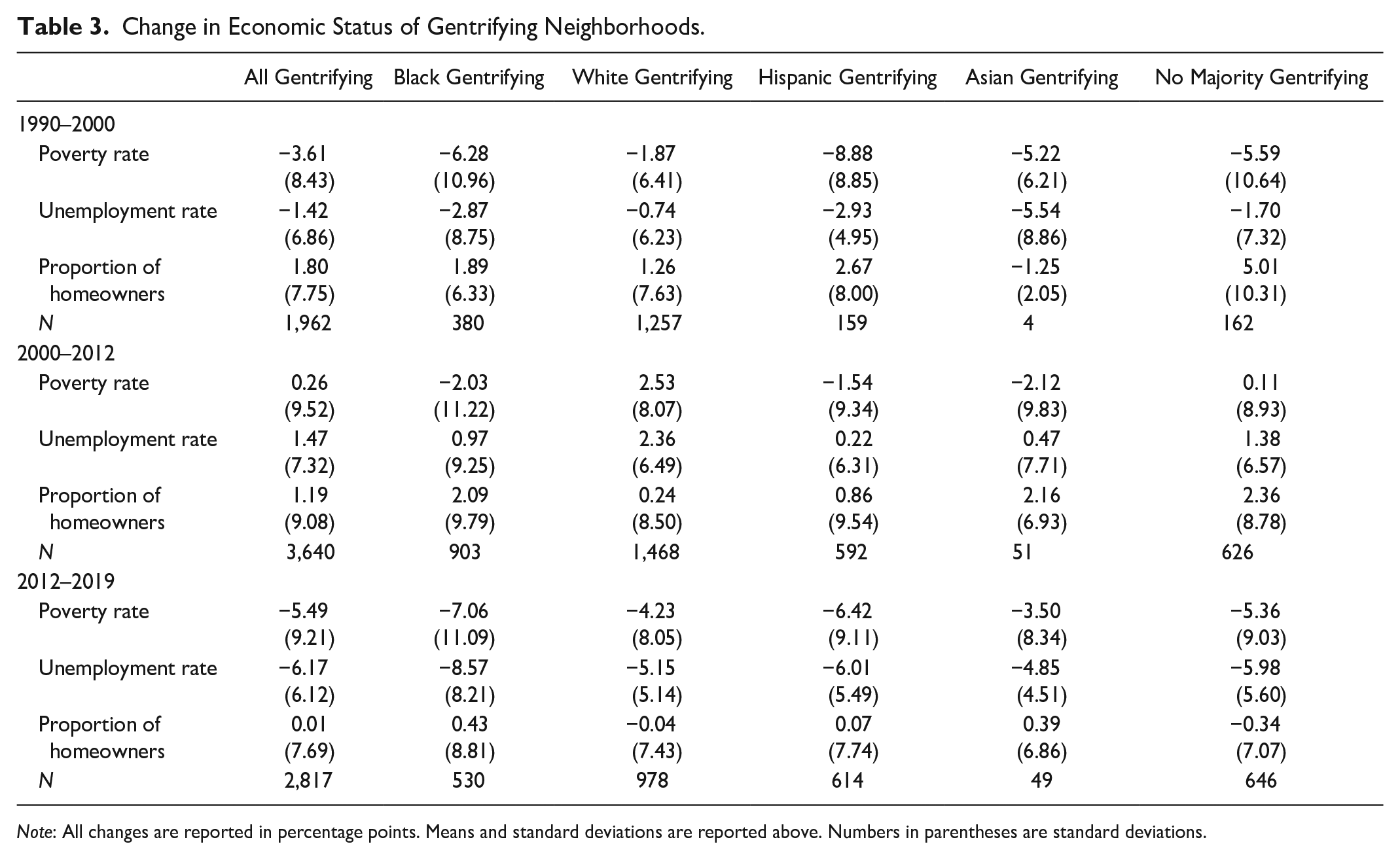
The higher rate of home value appreciation in Black neighborhoods could also result from more substantial increases in the economic status of their populations. In Table 3, I report changes in neighborhood economic status, including changes in the poverty rate, unemployment rate, and the proportion of homeowners. On average, the poverty rates dropped more quickly in Black neighborhoods than in White neighborhoods during all three periods. Between 2000 and 2012, the poverty rate actually increased in White neighborhoods, on average. The unemployment rate dropped in both Black and White neighborhoods in the earliest and latest periods but did so more rapidly in Black neighborhoods, on average. And in all periods, the proportion of homeowners increased more quickly in Black neighborhoods, on average. Because homeowners tend to be more materially wealthy than renters, increases in the rate of homeownership suggest that the economic status of a neighborhood’s population might be increasing. The descriptive parameters in Table 3 suggest that on average, gentrifying Black neighborhoods experienced greater increases in economic status than gentrifying White neighborhoods.
Change in Economic Status of Gentrifying Neighborhoods.
Note: All changes are reported in percentage points. Means and standard deviations are reported above. Numbers in parentheses are standard deviations.
Due to discrimination in housing markets, home values may appreciate more quickly in neighborhoods where the proportion of White residents is growing. In Table 4, I report changes in neighborhood racial-ethnic composition for each time period. I find that both Black and White neighborhoods tend to become more diverse as they gentrify, meaning that majority Black neighborhoods tend to experience declines in the proportion of Black residents while majority White neighborhoods tend to experience declines in the proportion of White residents. I also find that the largest increases in the share of White residents occurred in Black neighborhoods that gentrified during 2000 to 2012 and 2012 to 2019. In these periods, Black neighborhoods experienced increases in their White populations of more than 6 percentage points, on average. It was also during these periods when Black neighborhoods experienced the greatest declines in their Black populations—declines of roughly 10 percentage points, on average. These descriptive parameters suggest that some Black neighborhoods experience substantial changes to their racial composition as they gentrify, which might account for the higher rate of home value appreciation displayed in Table 1.
Change in Racial-Ethnic Composition of Gentrifying Neighborhoods.

Note: All changes reported in percentage points. Means and standard deviations are reported above. Numbers in parentheses are standard deviations.
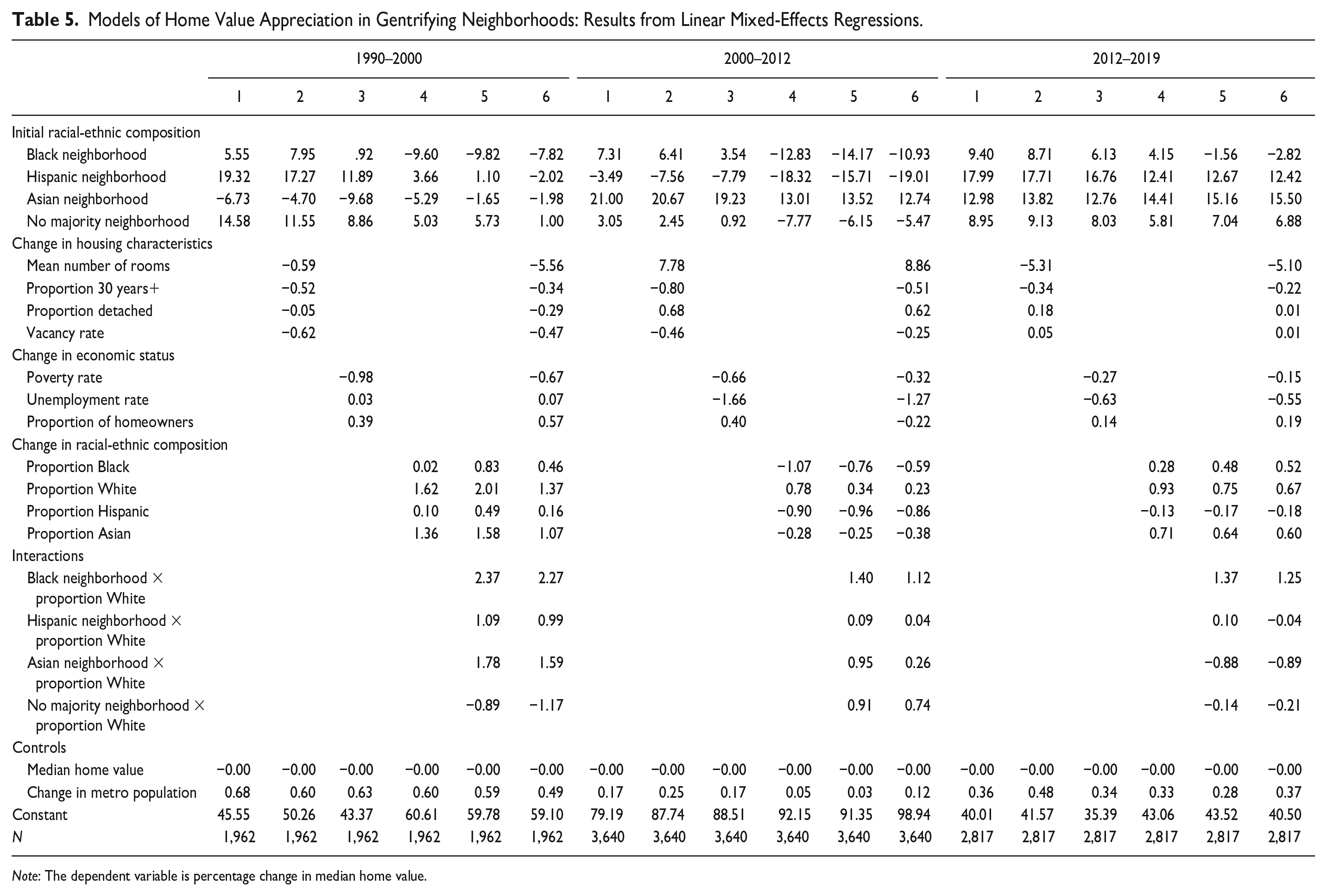
I now turn to Table 5, where I report the models of home value appreciation and test the remaining hypotheses. In the first model, I include variables indicating the racial-ethnic composition of gentrifying neighborhoods at the beginning of each period. The reference category is majority White neighborhoods. In each period, I find that Black neighborhoods experience greater home value appreciation than White neighborhoods, net of all controls. The gap in home value appreciation is greatest in the 2012–2019 period, where home value appreciation is 9.40 percentage points higher in Black neighborhoods than in White neighborhoods, on average. The gap is smaller in the 2000–2012 period (7.31 percentage points) and smaller still in the 1990–2000 period (5.55 percentage points).
Models of Home Value Appreciation in Gentrifying Neighborhoods: Results from Linear Mixed-Effects Regressions.
Note: The dependent variable is percentage change in median home value.
In the second model, I control for changes to the neighborhood housing stock and test Hypothesis 2. I expect the gap in home value appreciation between Black and White gentrifying neighborhoods to decline after controlling for changes to the housing stock. I find that increases in the mean number of rooms is positively associated with rising home values in the 2000–2010 period—where the magnitude of the coefficient is also comparatively large—but negatively associated with home value appreciation in the other two periods. The control for the age of homes is negatively signed in all periods, suggesting that as the share of older homes declines, home values increase. Increases in the share of detached homes is positively associated with home value appreciation in the latter periods, as I expected, but not in the first period, where the coefficient is comparatively small in magnitude. The control for the vacancy rate is negatively signed in the first two periods, as I expected, but positively signed in the final time period, where the coefficient is relatively small in magnitude. The evidence to support Hypothesis 2 is mixed: After controlling for changes to the housing stock, the coefficient of Black neighborhood attenuates slightly during the 2000–2012 and 2012–2019 periods but increases during the 1990–2000 period.
In the third model, I control for changes in neighborhood economic status and test Hypothesis 3. As expected, increases in the poverty rate are negatively associated with rising home values in all time periods, and increases in the proportion of homeowners are positively associated with home value appreciation in all periods. Increases in the unemployment rate are negatively associated with home value appreciation in the latter periods, as expected, but positively associated with home value appreciation and comparatively small in magnitude in the earliest period. There is evidence to support Hypothesis 3: After controlling for changes in neighborhood economic status, the coefficient of Black neighborhood attenuates. Between 1990 and 2000, the average gap in home value appreciation between Black and White gentrifying neighborhoods declines from 5.55 to 0.92 percentage points. Between 2000 and 2012, the gap declines from 7.31 to 3.54 percentage points. And between 2012 and 2019, the gap declines from 9.40 to 6.13 percentage points.
In the fourth model, I control for changes in the racial-ethnic composition of gentrifying neighborhoods. Across all time periods, increases in the proportion of White residents is positively associated with home value appreciation. The magnitude of the coefficient is greatest in the 1990–2000 period, where I find that a 1 percentage point increase in the proportion of White residents in a gentrifying neighborhood is associated with a 1.62 percentage point increase in home value appreciation. The evidence to support Hypothesis 4 is mixed: After controlling for changes in neighborhood racial-ethnic composition, the gap in home value appreciation between Black and White gentrifying neighborhoods becomes smaller during the 2012–2019 period. However, during the earlier time periods, the gaps in home value appreciation become larger, and now it is White gentrifying neighborhoods that experience more appreciation, on average. These models suggest that home value appreciation in gentrifying neighborhoods may be highly contingent on changes in neighborhood racial-ethnic composition.
In the fifth model, I introduce interaction terms. I compare home value appreciation among gentrifying Black neighborhoods that experience different changes in the proportion of White residents. In all three time periods, the coefficient of the interaction term, Black Neighborhood × Proportion White, is positively signed, providing evidence to support Hypothesis 5: Black gentrifying neighborhoods that experienced greater increases in the proportion of White residents also experienced greater home value appreciation, on average, than Black gentrifying neighborhoods that experienced smaller increases—or declines—in the proportion of White residents. For example, in the 1990–2000 period, a 1 percentage point increase in a Black neighborhood’s White population is associated with a 2.37 percentage point increase in home value appreciation.
To better illustrate the interaction term, I use the fifth model to estimate home value appreciation in a Black gentrifying neighborhood where the proportion of White residents is increasing. The results are displayed in Figure 1. The estimates begin by assuming a 2 percentage point increase in the proportion of White residents and no additional changes in neighborhood racial-ethnic composition. Under these conditions and holding all controls at their averages, I estimate that the average home value in a Black gentrifying neighborhood would increase by approximately 47 percent between 1990 and 2000. Assuming a much larger change, such as a 20 percentage point increase in the share of White residents, I estimate that the average home value in a Black gentrifying neighborhood would increase by approximately 126 percent. The estimates suggest that the effect of this particular type of racial change in gentrifying Black neighborhoods was strongest between 1990 and 2000 and declined in the two subsequent periods—periods when the number of gentrifying Black neighborhoods increased.

Estimated home value appreciation in a Black gentrifying neighborhood by change in the proportion of White residents.
In the sixth model, I include all controls and test Hypothesis 6. I use the coefficients from the interaction term Black Neighborhood × Proportion White to estimate home value appreciation in a gentrifying Black neighborhood experiencing racial transition and in a gentrifying Black neighborhood not experiencing racial transition. I report the findings from these simulations in Figure 2. In each time period, I find that home value appreciation was greater in Black gentrifying neighborhoods that experienced racial transition. Between 1990 and 2000, the median home value in a Black neighborhood experiencing racial transition increased by approximately 72 percent, and when not experiencing racial transition, it increased by approximately 40 percent. The difference between these two estimates can be described in terms of dollars. On average, the median home value in a gentrifying Black neighborhood in 1990 was $107,114. A 72 percent increase would result in a median home value of $184,236 in 2000, and a 40 percent increase would result in a median home value of $149,960 in 2000. The difference is $34,276 of housing wealth. I make similar calculations for 2000–2012 and 2012–2019. By the end of the 2000–2012 period, I find that the median home value is $30,192 higher in gentrifying Black neighborhoods that experienced racial transition compared to those that did not. By the end of the 2012–2019 period, the median home value is $33,035 higher in gentrifying Black neighborhoods that experienced racial transition. Averaging across the three time periods, the median home value increased by an additional $32,501 in Black neighborhoods that experienced racial transition compared with those that did not.
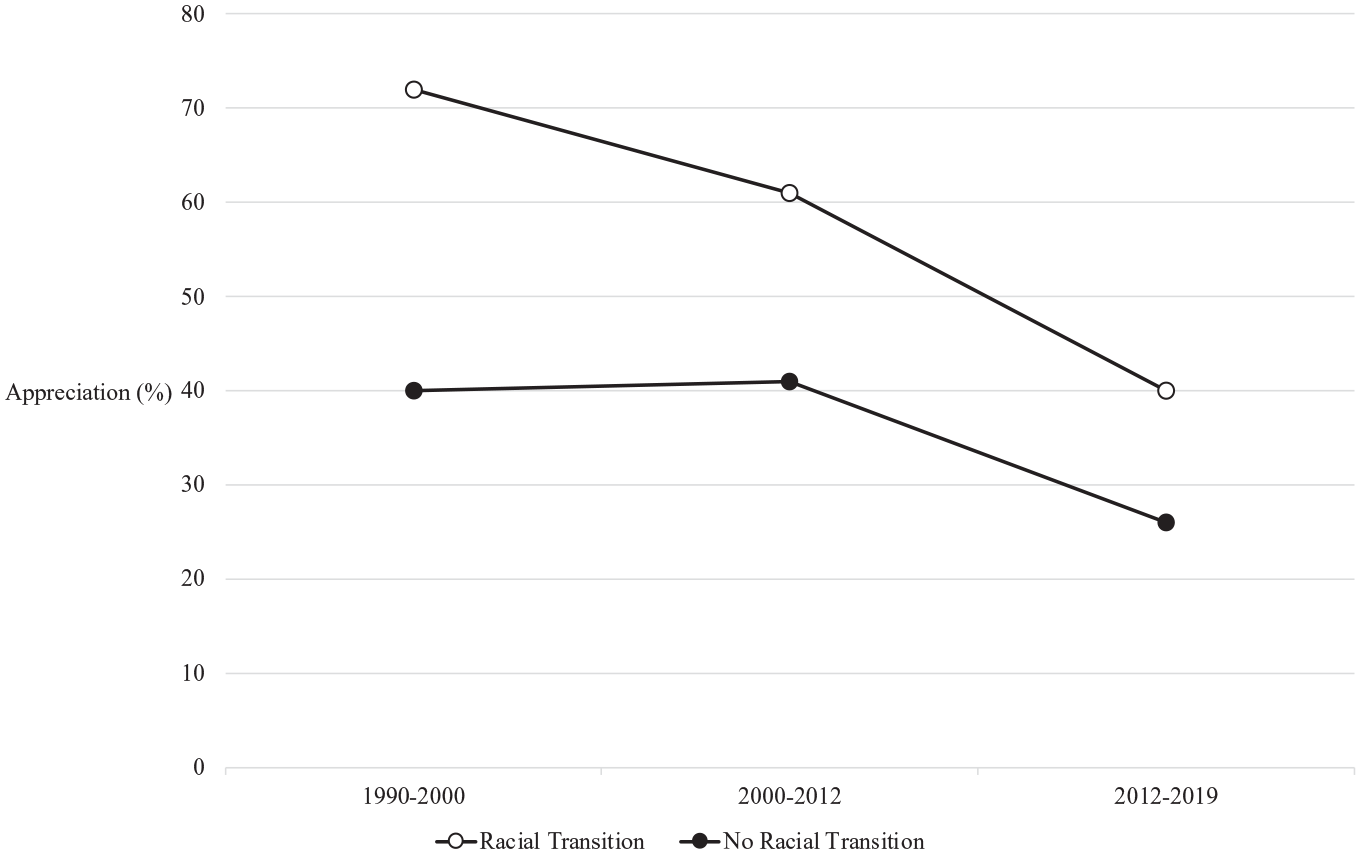
Estimated home value appreciation in a Black gentrifying neighborhood experiencing racial transition and not experiencing racial transition.
The results suggest that on average, home values increased faster in majority Black gentrifying neighborhoods than in majority White gentrifying neighborhoods. I found some evidence to suggest that differences in home value appreciation between Black and White neighborhoods resulted from greater increases in the economic status of Black neighborhoods and greater increases in the share of White residents in Black neighborhoods. Finally, the results suggest that home values may have increased faster in Black neighborhoods experiencing racial transition.
Conclusion
Drawing on data from the decennial census and the ACS, I found that between 1990 and 2019, home values appreciated faster, on average, in gentrifying neighborhoods that were majority Black. This finding diverges from existing research in at least one crucial way: Most studies find evidence of home values appreciating more quickly in neighborhoods that are predominantly White (e.g., Anacker 2010; Flippen 2004; Harris 1999; Kim 2000; Moye 2014; Quercia et al. 2000). This finding contributes to a growing body of scholarship that demonstrates the ways in which gentrification is not a homogeneous process across neighborhoods with different racial-ethnic compositions (see Fallon 2021; Kirkland 2008; Rucks-Ahidiana 2022): The pace of gentrification varies (Hwang and Sampson 2014; Sutton 2020), the types of middle-class newcomers arriving to gentrifying neighborhoods may vary (Rucks-Ahidiana 2021), and as I have demonstrated, the extent to which home values appreciate varies widely as well.
My findings further suggest that home value appreciation in gentrifying neighborhoods may be highly conditioned on changes in neighborhood racial-ethnic composition. Of particular interest to scholars of gentrification, I find evidence that home value appreciation in Black gentrifying neighborhoods may vary depending on whether they are experiencing racial transition. I considered one particular type of racial transition: a majority Black neighborhood where the share of White residents was increasing and the share of Black residents was decreasing. Although racial transition through displacement or succession may not be common among Black gentrifying neighborhoods (Ellen and O’Regan 2011; McKinnish et al. 2010; Timberlake and Johns-Wolfe 2017), my findings suggest that where this type of transition does occur, home value appreciation may be substantially greater relative to Black neighborhoods gentrified by the Black middle-class.
To an extent, gentrification represents a reversal of trends from the mid-twentieth century. Neighborhoods that once experienced White flight now experience White entry (Freeman and Cai 2015). Neighborhoods that were once cut off from mortgage money now receive investments in housing (Wyly and Hammel 1999). Neighborhoods where poverty was once concentrated now experience a concentration of housing wealth (for examples, see Hyra 2008). However, it is unlikely that gentrification reverses inequalities of housing wealth that grew over the twentieth century between Black and White neighborhoods. As my findings suggest, increases in neighborhood housing wealth tend to concentrate in gentrifying Black neighborhoods that are becoming substantially whiter, similar to what occurred in the Washington, DC, Shaw/U-Street neighborhood. According to Hyra (2017), Shaw/U-Street experienced a 145 percent increase in its median home value between 2000 and 2010 and transitioned from majority Black in 2000 (53 percent Black and 23 percent White) to majority White in 2010 (30 percent Black and 53 percent White).
Rapidly rising home values in Black gentrifying neighborhoods experiencing racial transition demonstrate what Hwang and Sampson (2014:729) refer to as a “durable neighborhood hierarchy” but do so in a new way. Hwang and Sampson (2014) found evidence that in Chicago, between 1995 and 2009, Black neighborhoods experienced less gentrification compared to White neighborhoods in the form of housing upgrades, beautification projects, and declines in disorder. Their findings suggest that the material benefits of gentrification tend to accrue to White neighborhoods, reproducing the racial stratification of Chicago’s neighborhoods that has long existed. But whereas their findings demonstrate the persistence of disadvantage and a lack of change in low-income Black neighborhoods, my findings demonstrate how the racial stratification of neighborhoods is reproduced even as Black neighborhoods experience change in the form of gentrification. As I demonstrated, Black neighborhoods that do gentrify and that do experience large increases in housing wealth may be those that over time, cease to be Black neighborhoods. Gentrification may therefore contribute to the racial stratification of neighborhoods by concentrating housing wealth in central city neighborhoods that were once low-income and predominantly Black but that are increasingly occupied by the White middle-class. Gentrification may thus entail not only a resorting of populations throughout urban neighborhoods but also a resorting of housing wealth, creating a new geography of racialized neighborhood inequality.
The limitations of this study provide several opportunities for future research. First, this study is limited to the data available in the U.S. decennial census and the ACS. Specifically, the dependent variable is derived from a question in the census and ACS that asks respondents to self-report their homes’ market values. Although this variable is commonly used to measure home value appreciation, future work might consider measures of home value appreciation that are derived from recent sales prices of homes rather than self-reports. Similarly, by using the census and ACS to measure neighborhood change, this study is limited in the types of neighborhood change that can be assessed. Data on specific housing markets might provide researchers with an opportunity to consider how home value appreciation in gentrifying neighborhoods is contingent on changes in amenities, services, public infrastructure, crime rates, and so on. Other sources of data could also provide more specific information about the reasons why a gentrifying neighborhood’s housing stock is changing; for example, they might provide information about the share of homes that are demolished or converted from multifamily to single-family. Perhaps most importantly, this study is limited insofar as it cannot make claims about how gentrification might affect the housing wealth of individuals. More research is needed to determine how race and ethnicity affect returns to housing investments for individual homeowners living in gentrifying neighborhoods.
