




Abstract
Despite ample research on the relationship between work and sleep, little is known about the relative importance of each job quality dimension for sleep quality and whether the relationship in contingent on job quantity (i.e., working hours). Drawing on a unified analytic framework of job quality and job quantity, this study aims to investigate the interactive relationship between job quality and job quantity and their impact on sleep quality using the 2015 European Working Conditions Survey. Our findings suggest that whereas working hours have a weak association with sleep quality, job quality has a more significant impact on sleep quality, with different dimensions playing varying roles. Most favorable job characteristics (e.g., low work intensity, good physical environment, high working time quality) are linked to better sleep quality. In contrast, high skill and discretion is associated with poorer sleep quality. Furthermore, the importance of most job quality indices remains even when people work shorter hours, highlighting the continued importance of job quality for well-being in the global trend of a shorter working week.
Introduction
In recent years, the rise of neoliberal economic policies and technological advancements has not only led to significant labor market changes such as increasing job polarization and instability but has also stimulated extensive discussions about their implications for employees’ health and well-being (Autor, Katz, and Kearney 2006; Fernández-Macías 2012). As a critical component of well-being (Reid et al. 2006), sleep quality has gained increasing attention in the trend of labor market changes. Prior research has shown that high-quality sleep is critical for employees’ well-being and work engagement (Swanson et al. 2011).
In previous literature, ample research has focused on the negative impact of long working hours on sleep, while another stream of research has investigated the relationships between specific job characteristics (e.g., job demands, job control, workload, and work-family conflict) and sleep quality (Linton et al. 2015; Van Laethem et al. 2013). However, there are important limitations of the previous research. First, although job quantity and job quality are important determinants of sleep, both streams of research have been largely running in separate tracks without engaging in a direct dialogue. Second, although substantial previous studies have examined the multidimensionality of job quality (Eurofound 2017; Kalleberg 2011; Muñoz de Bustillo et al. 2011; Warhurst et al. 2017; Warhurst, Wright, and Lyonette 2018), little is known about its impacts on sleep quality, not to mention the relative relationship with job quantity. Third, previous research assumes that the effects of job quantity and job quality are independent from each other, overlooking their interactive effects on sleep. This could hinder a comprehensive understanding of the relationships between job quality, job quantity, and sleep, thereby impeding the development of effective labor market policies.
To address the research gaps, the present study aims to accomplish three objectives by adopting the sixth wave (2015) of the European Working Conditions Survey. First, the study aims to employ a unified theoretical framework of job quantity and job quality and examine the relative importance of both for sleep quality. Second, drawing on literature from various social science perspectives, this study aims to use a wide range of indicators to measure job quality (including eight job quality indicators from multidisciplinary theoretical perspectives). In doing this, we are able to compare the relative significance and impact of each job characteristic on sleep quality. Third, the study seeks to understand the potential interplay between job quality and job quantity in shaping sleep quality. This will contribute to the discussion about the role of job quality in light of the trend of shorter working hours across the developed countries.
By accomplishing its three objectives, this study has significant theoretical and practical implications in three ways. First, it contributes to the existing literature in the sociology of work by adopting multidimensional concepts of job quality and providing a comprehensive understanding of how various job characteristics influence sleep quality. Second, this study offers a comprehensive investigation of the interaction between job quality, job quantity, and sleep quality. This deepens our understanding of the relative importance of job quantity and job quality, especially in the context of a shorter working week across Europe. The findings shed light on further policy directions by providing a more holistic analytic framework of work and health. Third, the study’s findings have practical implications for labor market policies and the creation of a supportive workplace environment that fosters better sleep quality and mental health for employees. This may lead to more effective policies to address work-related stress and promote a favorable work-life balance.
Literature
Effects of Job Quantity on Sleep Quality
The latent deprivation model emphasizes the significance of employment in shaping an individual’s overall well-being because it provides various latent functions, such as time structure, purposefulness, participation, and shared experiences (Jahoda 1982). Job quantity research builds on this model and has substantively explored the relationship between working hours and sleep quality/mental health, yielding mixed findings. Some studies have demonstrated that long working hours increase the risk of sleep disturbances and inadequate sleep (Bannai and Tamakoshi 2014; Barnes and Drake 2015). In contrast, some other studies have examined that working shorter hours negatively affects employees’ mental health by limiting access to various financial and social benefits associated with employment, such as social status, identity, and interaction, potentially leading to mental health problems (Angrave and Charlwood 2015; Lu, Wang, Ling, et al. 2023; Wang, Kamerāde, Bessa, et al. 2022; Wang, Li, and Coutts 2022). Additionally, working fewer hours may result in poverty, which has been associated with poor sleep quality. Previous research has demonstrated that individuals with low income and low socioeconomic status are more likely to experience poor sleep quality (Hale and Do 2007). Understanding the impact of job quantity on sleep quality is crucial for developing effective labor policies and promoting employee well-being.
Effects of Job Quality on Sleep Quality
Job quality is a multidimensional concept affected by the subjectivity of the observer. There are three broadly different approaches for operationalizing job quality. The first approach centers on workers’ satisfaction, linking it directly to job quality, but acknowledges the impact of non-quality-related factors on satisfaction levels. The second subjective approach involves workers selecting job quality attributes through surveys, followed by objective data measurement. However, relying solely on workers’ opinions has limitations, potentially overlooking essential elements and hindering cross-country comparability. In addition, simply considering something important based on people’s statements may lack sufficient justification for its inclusion in the definition of job quality.
The third approach draws on contemporary social science literature to identify the main elements of job quality. Researchers carefully select choices for a job quality questionnaire based on a predefined model derived from previous research rather than using random or exhaustive lists of attributes. Therefore, the present study employs a unified analytic framework of eight job quality dimensions based on a literature foundation from various social science disciplines. These dimensions, as identified in prior studies (Arranz, García-Serrano, and Hernanz 2019; Eurofound 2017; Piasna, Pedaci, and Czarzasty 2021; Stefana et al. 2021; Wang, Kamerāde, Burchell, et al. 2022), include earnings, skill and discretion, physical environment, social environment, prospects, work intensity, working time quality, and job meaningfulness. Table A1 (Appendix) summarizes the important dimensions of job quality related to mental health and their theoretical backgrounds. Table A2 (Appendix) outlines the components and calculation process of our job quality index.
Regarding the job quality index, under each indicator, there are several dimensions measured through specific items. Each response scored differently according to values labels with varying weights. Each dimension is measured by several items, where every single question weights equally to that dimension. The relationship between sleep quality and mental health is well established, and sleep quality is a critical component of mental health due to the profound impact that sleep has on various cognitive, emotional, and physiological functions (Freeman et al. 2017; Scott et al. 2021). Therefore, the relationship between job quality and sleep quality can be explained through the intermediary factor of mental health. This study seeks to analyze the impact of the eight aforementioned dimensions of job quality on sleep quality drawing on relevant literature in the fields of job quality and mental health.
Earnings
The economic approach emphasizes earnings as a critical aspect of job quality, affecting employees’ sleep quality for two reasons. First, income levels have been found to be significantly correlated with sleep duration, with lower income levels associated with both shorter and longer sleep duration. Second, financial strain and earning deprivation can negatively impact people’s ability to control their lives and undermine their mental health (Fryer 1986). Empirical evidence suggests that lower income and financial precarity are associated with decreased mental health (Reading and Reynolds 2001; Wang, Li, and Coutts 2022). Moreover, because sleep quality is a component of mental health, it is believed that earnings significantly affect sleep quality. Given the widely recognized importance of earnings for sleep quality, it is crucial to include earnings into the job quality framework and compare its relative significance.
Skill and discretion
The traditional sociological perspective emphasizes the importance of skill use and autonomy, which is one critical dimension of job quality. However, the relationship between skill and discretion and sleep quality is mixed. Some studies suggest that individuals who engage in regular intense physical training may experience better sleep quality (Driver and Taylor 2000), and autonomy is believed to promote mental health (Knudsen, Ducharme, and Roman 2007; Lu, Wang, Li, et al. 2023). In contrast, individuals who engage in high levels of cognitive activity or creative work may experience poorer sleep quality due to work demands and work-family multitasking because the demands of creative work may offset the hypothesized resource benefits of creative work (Schieman and Young 2010). Therefore, this study will revisit the relationship between skill and discretion and sleep quality based on the mixed results of previous studies.
Physical environment
The occupational medicine perspective highlights that the physical work environment is an important dimension of job quality. Environmental health science research has shown that the physical work environment can contribute to the deterioration of mental health (Briner 2000). In addition, prolonged exposure to noise has been identified as a significant cause of hearing loss, which can negatively impact mental health (Basner et al. 2014). Because sleep quality is a critical measure of mental health, it is reasonable to involve the physical environment as one job quality index and evaluate its importance with other indicators.
Social environment
The radical and behavioral approach emphasizes industrial democracy, participation, and work organizations, and hence the social environment is another important dimension of job quality for employees’ sleep quality. Studies have consistently shown that social support and positive workplace relationships are associated with better sleep quality, which may be due to the positive emotional and physiological effects of social support (Ong et al. 2006; Troxel et al. 2010). In contrast, social isolation and negative stressors in the workplace can lead to poorer sleep quality and related health problems (Wang, Li, and Coutts 2022). Therefore, the social environment should be included into the job quality framework when assessing the effects on sleep quality, and its comparative significance can be indicated in this study.
Prospects
The institutional approach argues that contract status, employment stability, and career prospects are critical indicators of job quality. From the perspective of occupational medicine, job security is a significant source of stress that can have severe impacts on employees’ sleep quality (Kim and von dem Knesebeck 2016; Mai, Jacobs, and Schieman 2019). In addition, career development is a key component of an individual’s mental health and well-being. One study found that individuals who perceived that they had control over their careers experienced lower levels of anxiety and depression (Miller and Rottinghaus 2014). Because sleep quality is a critical component of mental health, it is sensible to include prospects when predicting job quality’s impacts on sleep quality.
Work intensity
The work-life balance approach highlights work intensity as one critical dimension of job quality that is assumed to be associated with employees’ sleep quality. Studies have consistently shown that work intensity and job demands have a negative impact on employees’ sleep quality, where low job control and a lack of social support further exacerbate this relationship (Knudsen et al. 2007). Work-family conflicts and role conflicts also contribute to poor sleep quality, highlighting the importance of balancing work and family responsibilities (Burgard and Ailshire 2009; Williams et al. 2006). Therefore, this study will consider work intensity as one crucial dimension of job quality and compare its significance with other indicators.
Working time quality
Working time quality is another important dimension of job quality based on the work-life balance approach. Working time quality, including shift work, nonstandard work schedules, and work schedule control, has been shown to significantly affect workers’ sleep quality (Mai et al. 2019; Wang, Li, Lu, et al. 2022). Several studies have demonstrated that shift work and nighttime work are associated with shorter sleep duration, more sleep disturbances, insomnia, excessive sleepiness, and other sleep disorders (Drake et al. 2004). These effects are particularly prominent in health care workers, police officers, firefighters, and other professionals who work in emergency response systems and high-stress environments (Garbarino et al. 2019). Thus, working time quality is an important component of the present study’s framework of job quality, whose relative importance can also be assessed.
Meaningfulness
The classical sociology perspective emphasizes job meaningfulness as another important dimension of job quality indices, which may affect employees’ mental health and well-being. For example, Bakker, Demerouti, and Sanz-Vergel (2014) showed that a sense of fulfillment and work engagement, as a form of job resource, predicted better mental health. In addition, another study also demonstrated that job meaningfulness, as one indicator of job quality, was associated with improved mental health (Wang, Kamerāde, Burchell, et al. 2022). Because sleep quality is a critical component of mental health, work meaningfulness should be an important dimension of job quality, and its relative significance is of great interest.
Interaction Effects between Job Quantity and Job Quality on Sleep Quality
The impact of job quantity and job quality on employees’ sleep quality is a crucial area of investigation given its implications for employee well-being and productivity. To gain a better understanding of this relationship, researchers have drawn up the vitamin model (Warr 1987), which provides a comprehensive framework for examining the influence of job characteristics on employee well-being. The vitamin model identifies 12 job characteristics that affect employees’ satisfaction and well-being, including personal control, interpersonal contact, externally generated goals, skill use opportunities, variety, social position, and supportive supervision. Among these characteristics, interpersonal contact is particularly relevant to the impact of job quantity and job quality on sleep quality. Previous research has demonstrated that positive interpersonal relationships at work can enhance sleep quality and well-being, while conflict-ridden relationships have adverse effects. Additionally, job demands and job resources also play a role in sleep quality. For instance, long work hours (a type of job demand) can have a negative impact on sleep quality, while social support from colleagues and supervisors can have a positive effect.
The concept of workplace “vitamins” has been introduced to describe job characteristics that are essential for maintaining good sleep quality and their optimal dosages. Similar to vitamins in the human body, the right amount of each workplace vitamin is crucial because an excess or deficiency of any particular vitamin can have negative effects. While previous research has focused on job quality or job quantity separately, the interplay between the two has been relatively unexplored. According to Warr’s (1987) vitamin model, varying dosages of job quality can affect an individual’s sleep quality, and the combination of job quality and job quantity may also exert effects. For example, having a high-quality job with shorter working hours may positively impact sleep quality, while a low-quality job with longer working hours may have a negative impact. However, a job with high job quality and moderate working hours may be optimal for good sleep quality.
Despite the importance of this issue, research on the relationship between job quantity and job quality has been limited. Although most studies have focused on underemployment and zero-hours contracts, some research suggests that the correlation between working hours and job quality dimensions is not straightforward or linear, indicating that their interaction can result in diverse outcomes. For example, shorter working hours can reduce work intensity when employees have control over their schedules, while employer-led shorter working hours are often associated with higher work intensity (Piasna 2018). Given the mixed results of previous studies, the primary aim of this study is to explore how the “dosage” of job quality interacting with job quantity affects sleep quality.
Research Gaps and Questions
There has been a lack of communication between research on job quantity and job quality, with both areas largely running in separate tracks without engaging in direct dialogue. This disconnect is unexpected given that both areas are concerned with employees’ sleep quality, and the failure to integrate these areas could result in misguided policy recommendations. Therefore, it is crucial to integrate both job quantity and job quality, as well as their combined effects on employees’ sleep quality, into academic studies and policy implications.
The present study aims to fill these research gaps and contribute to the literature in three main ways. First, while prior research has examined the relationship between job characteristics and sleep quality, few studies have simultaneously examined the impact of job quantity and job quality on sleep quality. Therefore, this study employs a unified analytical framework of job quality with exhaustive indicators to investigate their relative importance to job quantity. Second, although prior research has adopted multidimensional job quality, its association with sleep quality has been ignored. Therefore, this study utilizes eight indices to measure job quality drawing on multiple disciplinary literature. Third, this study aims to examine the interplay between job quantity and job quality and their impact on sleep. Understanding the interaction between job quality and job quantity on sleep quality can provide a more accurate assessment of the impact.
Therefore, the aim of this study is to investigate the independent and interactive effects of job quality and job quantity on employees’ sleep quality. This study aims to answer two primary questions:
Research Question 1: What is the significance of job quality and job quantity (work hours) for the sleep quality of employees?
Research Question 2: To what extent does the interplay between job quality (measured through eight indicators) and job quantity (work hours) impact employees’ sleep quality? Does the effect of job quality on sleep quality depend on the specific work hour category (e.g., 1–20, 21–34, 35–40, 41–48, 48+)?
Method
Data and Sample
The European Working Conditions Survey (EWCS) conducted by Eurofound provides extensive information on work in various countries, sectors, occupations, and age groups. This study employs data from the sixth wave (2015) of EWCS, 1 which surveyed approximately 44,000 workers across 35 countries. The questionnaire covered various aspects of employment. The survey employed a multistage, stratified clustered sampling technique that randomly selected primary sampling units in each country based on the probability proportional to size principle and then sampled households in each primary sampling unit (Eurofound 2017). Moreover, we apply cross-sectional weights to ensure representativeness in the analyses.
In this study, the sample selection focuses on employees between the ages of 18 and 65. Additionally, we exclude respondents who are self-employed because their employment circumstances are primarily determined by themselves. Besides, we concentrate on the top 99% of the sample regarding working hours. After removing cases with missing key values (listwise deletion), the analytical sample consisted of 27,825 individuals (15,771 males, 17,037 females), with a missing data percentage of approximately 15 percent. Further analyses using the multiple imputation method to address missing data are reported in the sensitivity analysis. The steps of final analytical sample construction are presented in Table A3 (Appendix).
Variables
Dependent variable
The current study investigates sleep quality as the dependent variable, which is evaluated by three questions in the survey. Specifically, respondents were asked to report their sleep-related difficulties, including “difficulty falling asleep,” “waking up repeatedly during sleep,” and “waking up with a feeling of exhaustion and fatigue.” The responses were assessed using a 5-point Likert scale, ranging from 1 (daily) to 5 (never). To develop a composite measure of sleep quality, this study employs principal component analysis, which generates a single factor with a Cronbach’s alpha coefficient of 0.80. A higher factor score indicates better sleep quality and fewer sleep-related difficulties. The factor score is standardized and multiplied by 100, resulting in a score range of 0 to 100.
Independent variables
The present study employs work hours of the main job to evaluate job quantity. The actual average working hours per week are divided into five categories: “1–20,” “21–34,” “35–40,” “41–48,” and “48+.” We adopt the Eurofound (2017) standard by setting 20 as the limit. The “1–20” category represents individuals reporting shorter work hours within part-time workers. The “21–34” means relatively shorter work hours, and the third represents full-time working hours. In addition, we chose the threshold of 48 hours in accordance with EU Legislation (2003) that restricts employers from requiring staff to work more than 48 hours on average per week. Therefore, the fourth category suggests relatively longer work hours, and the fifth category indicates overtime work.
To evaluate job quality, eight distinct job quality indices are utilized. This operational framework was originally proposed by Green et al. (2013) and has since been applied in research by other scholars (Felstead et al. 2019; Wang, Kamerāde, Burchell, et al. 2022). The eight indicators are earnings, skills and discretion, physical environment, social environment, work intensity, prospects, working time quality, and the meaningful work index. The first seven indices are constructed using the EWCS (Eurofound 2017), and the meaningful work index is developed by Wang, Kamerāde, Burchell, et al. (2022). Table A2 (Appendix) provides detailed information on the specific components of each index.
Control variables
The present study includes demographic and household characteristics and engagement in nonwork activities as control variables in the analyses. The demographic and household characteristics controlled for in this study include age, age squared, gender, presence of a partner in the household, presence and age of children, ethnicity, and educational attainment. Nonwork activities, specifically, participation in caring for and educating children, cooking and doing housework, and caring for the elderly/disabled, are also included as control variables. Additionally, participation in social leisure activities and activity-restricting illness are included as control variables. The results of robustness checks indicate that there is no issue of multicollinearity among all independent and control variables (variance inflation factor < 2).
Table A4 (Appendix) presents the descriptive statistics of key variables. The average score for sleep quality is 72.99. Regarding average work hours per week, more than half of the respondents report “full-time” working hours, and over 25 percent of respondents report relatively shorter or longer working hours. In terms of the average job quality indicators, the top three dimensions with the highest scores are physical environment (82.91), meaningful work (79.50), and social environment (76.79). The lowest score is observed for skills and discretion (54.63).
Method
Considering that the data are hierarchically collected and structured (individuals are clustered within countries), the present study uses an multivariate ordinary least squares (OLS) regression model with country-level fixed effects. Sleep qualityij is the dependent variable measuring the sleep quality of individual i in country j. Job quantityij and job qualityij are primary predictors measuring the job quantity and job quality of individual i in country j. Covariatesij are control variables, which can vary at both individual and country levels. cj is the country-level error term, and µij is the individual-level error term. The analyses concentrate on within-country variations and highlight individual characteristics by assuring that Cov (Xij, µij) = 0.

To ensure that the coefficients of job quantity and job quality are unbiased, we need to assume that the explanatory variables are independent of two error terms, that is, Cov (Xij, cj) = 0 and Cov (Xij, μij) = 0. To estimate the previous equation, this study uses the multivariate OLS regression model with country-level fixed effects, which focuses only on within-country variation and drops all between-country variation (cj). In doing so, the model needs to satisfy only one assumption (i.e., Cov (Xij, μij) = 0) and is thus less likely to be biased than a multilevel random effects model, which needs to satisfy both assumptions.
In practice, the present study first investigates the relationship between job quantity and sleep quality by adding a series of demographic characteristics. Then, the study adds the eight job quality indices to examine the relative significance of job quantity and job quality and further investigate the most powerful job quality indices. In addition, the study examines the interaction terms between job quality and job quantity to explore group variation in sleep quality.
Results
Main Findings
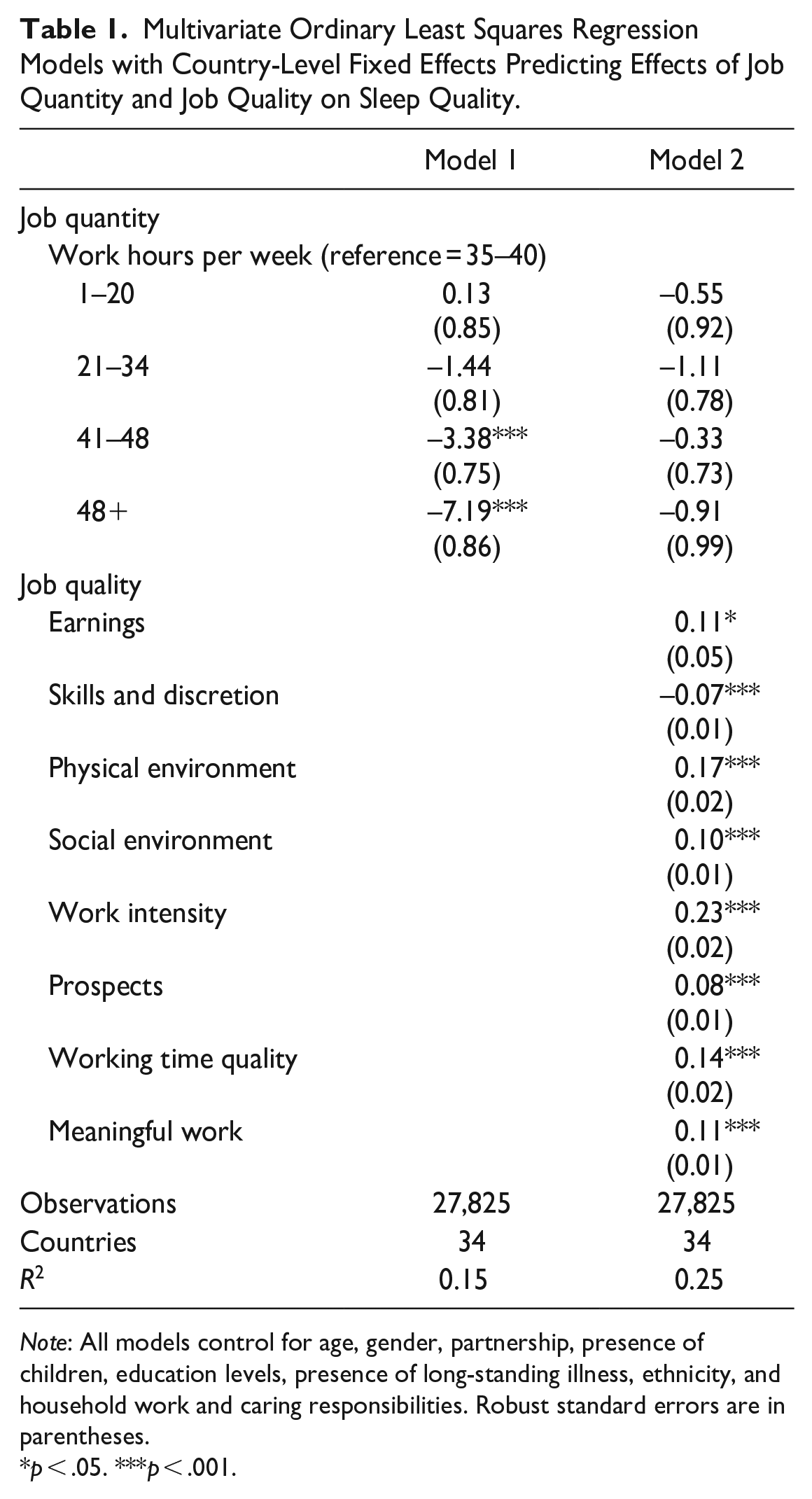
Table 1 presents the findings of multivariate regression models’ country-level fixed effects examining the associations between job quantity, job quality, and sleep quality. Model 1 indicates that individuals who work long hours have lower sleep quality than those who work full-time, while those who work short hours have similar levels of sleep quality. Model 2 extends the analysis by incorporating eight job quality indicators as continuous variables, demonstrating that all job quality dimensions are significantly associated with sleep quality. A joint significance test for all job quality indicators suggests that overall job quality is highly associated with employees’ sleep quality (p < .001), resulting in a substantial increase in R2 from 15 percent in Model 1 to 25 percent in Model 2. The detailed outcomes of the control variables are available in Table A5 in the Appendix. Therefore, job quality proves to be a crucial factor in determining variations in employees’ sleep quality. Moreover, the adverse effects of long working hours are greatly reduced in magnitude or absent after incorporating job quality indicators. This implies that the impacts of long working hours on sleep quality may be partly attributed to employees’ poor job quality. Specifically, most job quality indices positively influence sleep quality, except for the skill and discretion index, which may be due to the longer working hours for jobs with professional and strict requirements.
Multivariate Ordinary Least Squares Regression Models with Country-Level Fixed Effects Predicting Effects of Job Quantity and Job Quality on Sleep Quality.
Note: All models control for age, gender, partnership, presence of children, education levels, presence of long-standing illness, ethnicity, and household work and caring responsibilities. Robust standard errors are in parentheses.
p < .05. ***p < .001.
To compare the relative weights of various job quality indices, a series of Wald tests are conducted. The results show that the work intensity index has the highest coefficient among all job quality indicators, and this effect is statistically significant (p < .001). In addition, physical environment and working time quality have the second and third largest effects compared to the rest of job quality indexes (p < .001). The negative effects of long work hours disappeared after considering job quality indicators, providing further support for the importance of job quality in explaining employees’ sleep quality. In addition, the standard coefficients of several job quality indicators, such as work intensity (0.16), social environment (0.10), physical environment (0.09), and working time quality (0.09), are higher than age (−0.08), gender (−0.09), and education (0.02). In other words, several job quality indicators might have a more significant impact on sleep quality than age, gender, and education, which are commonly assumed to greatly impact sleep and mental health.
Table A6 (Appendix) presents the results of interaction effects between work hours and sleep quality, and Figure 1 utilizes the predicted coefficients to illustrate the interaction effects. The findings show that most of the interaction terms are insignificant, suggesting that the impact of job quality on sleep quality is independent of work hours or job quantity. Additionally, for full-time workers, all eight job quality indices are significantly associated with sleep quality, emphasizing the significance of job quality compared to work hours.
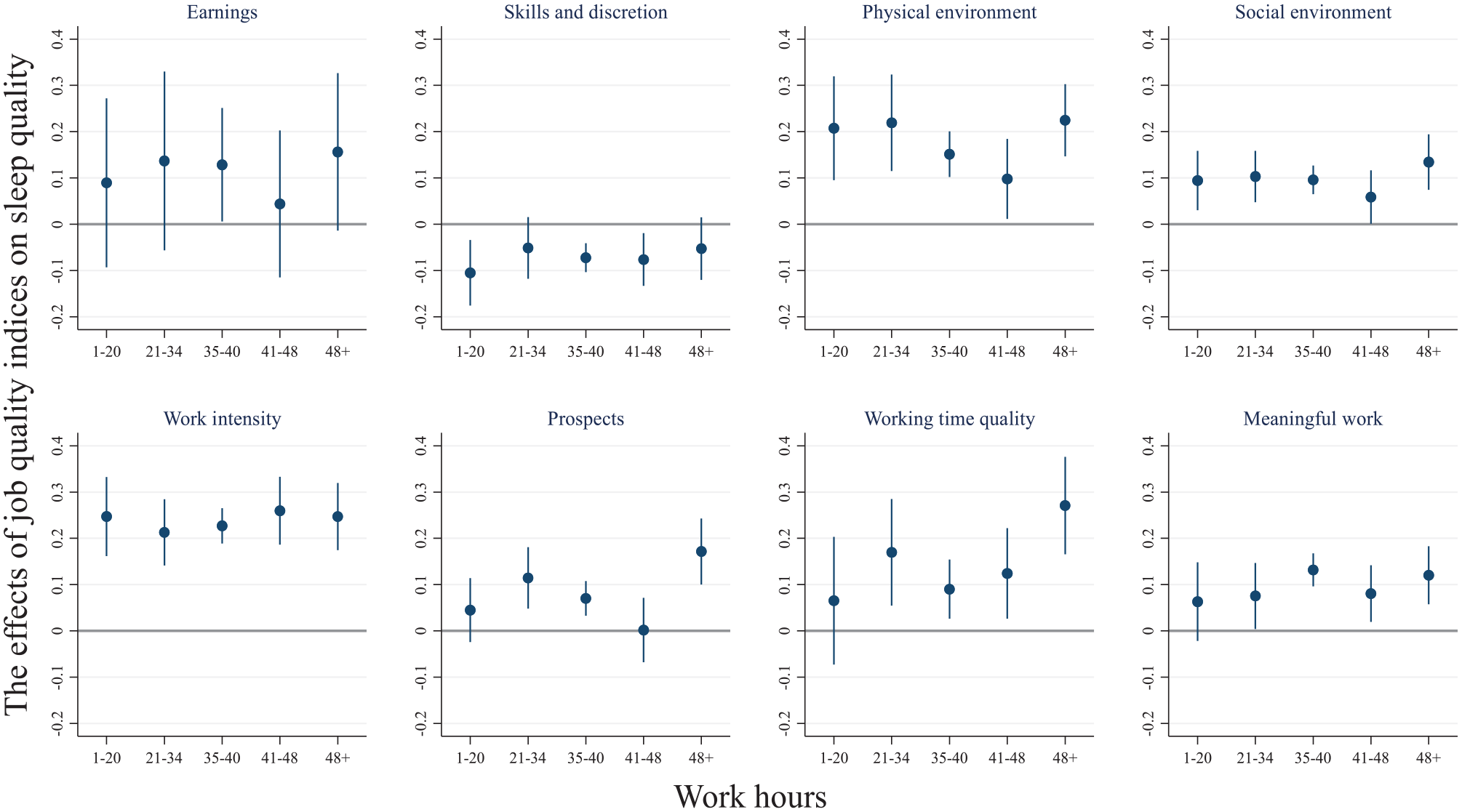
Multivariate ordinary least square regression models with country-level fixed effects examining the effects of job quality on sleep quality by work hours.
Sensitivity Analysis
The study conducts several robustness checks to confirm the results. First, multiple imputation is employed to check the results. In the main analysis, cases with missing key values are removed using listwise deletion, which constitute approximately 15 percent of the sample. Little’s missing completely at random test indicates that the missing values are not missing completely at random, indicating potential bias. To address this issue, multiple imputations are operated using chain equations to create 20 data sets with imputed missing values. The results are presented in Table A7 in the Appendix. The main findings remain consistent after the multiple imputation process, suggesting that the main findings are not greatly influenced by the missing data. Therefore, the results are robust to alternative model specifications.
Second, an alternative work hour measure is applied. We adopt another variable of work hours by including both the primary and the second jobs. Several previous studies have employed this measure to investigate the effects of work hours (Marucci-Wellman et al. 2014; Wang, Kamerāde, Burchell, et al. 2022). Table A8 (Appendix) presents similar results with the main analysis. The results suggest that all job quality indicators are significantly associated with sleep quality, while job quantity weakly affects sleep. In other words, regarding the influence on sleep quality, job quality proves to be more important than job quantity. The results are consistent with the main analysis, reinforcing our primary findings and conclusions. Hence, the results are robust to alternative variable specifications.
Third, a measure combining actual work hours and work hour match is employed for job quantity. Previous studies have explored the association between job quantity and sleep quality/mental health by examining work hour match, which includes categories such as overemployment and underemployment (Bannai and Tamakoshi 2014; Hale and Do 2007). Building on this approach, we create a job quantity variable by combining work hours and a work hour match measure, which is based on respondents’ answers regarding whether their actual working hours match their preferred working hours, and consists of three categories: “overemployed,” “matched,” and “underemployed.” The variable consists of six subcategories: “full-time overemployed,” “full-time matched,” “full-time underemployed,” “part-time overemployed,” “part-time matched,” and “part-time underemployed.” The findings present consistent patterns for the association between job quality, job quantity, and sleep quality, which are reported in Table A9 (Appendix). All job quality indices result in a substantial increase in R2 from 15 percent in Model 1 to 25 percent in Model 2. Moreover, the adverse effects of full-time and part-time overemployment and part-time underemployment are reduced in magnitude and degree of significance after incorporating job quality indicators. This implies that the impacts of long working hours and unmatched work hours on sleep quality may partly be attributed to employees’ poor job quality.
In addition, we check the interaction terms between work hours and work hour match and job quality on sleep quality. By adopting the measure combining subjective and objective aspects of job quantity, Table A10 (Appendix) presents similar results as the main results. The results indicate that almost all of the interaction terms are insignificant, suggesting that the impact of job quality on sleep quality is independent of work hours and work hour match or job quantity. In addition, for full-time workers with matched working time preference, all eight job quality indicators significantly impact sleep quality. Figure A1 (Appendix) utilizes the predicted coefficients to illustrate the interaction effects. In sum, the results are robust to alternative variable specifications.
Fourth, patterns over gender are checked. Women are assumed to undertake primary family responsibilities and are more likely to experience work-family conflict. Some studies have also found gender differences in job quality (Stier and Yaish 2014). Therefore, the present study checks the results for males and females, respectively. The results reveal nuanced heterogeneity over gender. Almost all job quality indicators (except earnings) are associated with sleep quality for both male and female employees, as reported in Table A11 in the Appendix. Earnings only affect males’ sleep quality. In sum, the results are robust with nuanced gender differences.
Fifth, this study explores the variation across five regimes in Europe. While the five regions with different regimes share many cultural similarities, variations exist in the labor market and social environment. Table A12 (Appendix) shows consistent effects of job quantity and job quality across different regions, with no discernible impact. The effects of job quantity on sleep are generally not significant across work hour groups, except for a negative impact on sleep in eastern regions when working 21 to 34 hours. Job quality has a universal positive impact on sleep quality across different regions on work intensity, prospects, and meaningfulness. Some subtle differences are noted. Earnings is significant only in the eastern region, skill and discretion is not adversely significant in market and inclusive regions, physical environment is not significant in inclusive region, social environment is not significant in market region, and working time quality is not significant in dualist and southern regions. Thus, the results are robust with nuanced heterogeneity across different regions of Europe.
Discussion and Conclusions
This study seeks to contribute to the ongoing discourse surrounding job quality and shorter working hours, exploring the interplay between job quality, job quantity, and employees’ sleep quality. There are three main points of contribution.
The first key finding of the study is that job quality has a greater influence on employees’ sleep quality than job quantity, which aligns with theoretical frameworks such as the latent deprivation model and Warr’s (1987) vitamin model. The latent deprivation model suggests unmet psychological needs lead to negative outcomes (Jahoda 1982), while Warr’s (1987) model emphasizes positive job factors as essential for well-being. The study builds on these theories, providing a strong foundation for understanding the complex link between job characteristics and sleep quality. In addition, although previous studies have examined the effects of job quality on sleep quality, few have employed multidimensional job quality indices for sleep quality (Chatzitheochari and Arber 2009; Green 2007; Knudsen et al. 2007; Mai et al. 2019; Schneider and Harknett 2019; Williams et al. 2006). The study fills the gap by using the unified framework of EWCS and reveals that all job quality dimensions are significantly associated with sleep quality, while job quantity has relatively limited impacts on sleep. This finding underscores the nuanced nature of workplace influences on sleep and suggests that interventions focusing on enhancing job quality may yield more substantial improvements in employees’ sleep, contributing to both theoretical advancements in sociology of work and practical implications for organizational well-being strategies.
Second, the study found that the importance of each job quality dimension was not even, with work intensity, physical environment, and working time quality being the three strongest predictors. Moreover, while most favorable job characteristics (e.g., good pay, good physical/social environment, decent career prospects, low work intensity, high working time quality, and meaningful work) are associated with better sleep quality, high skill and discretion is correlated with poor sleep quality. The intense demands of high-requirement work may counteract the benefits of professional training or work, resulting in deteriorated sleep quality. This study provides important theoretical and policy implications for discussions about the relationship between job quality and employees’ sleep quality. The findings highlight the importance of improving job quality indicators, such as promoting the physical environment, doing meaningful and useful work, and lowering work intensity.
Third, the findings of this study, which emphasize the impact of job quality on sleep quality, regardless of job quantity, align notably with Warr’s (1987) vitamin model. The vitamin model posits that both the essential vitamins and the “dosage” of vitamins are crucial for overall well-being. In extending Warr’s (1987) framework, this study delves into how different facets of job quality interact with the dosage of work hours and provides a more nuanced understanding of the complex interplay between work conditions and sleep outcomes. This nuanced perspective adds depth to the existing theoretical landscape, offering a refined lens through which to interpret the intricate relationships within the realm of occupational health and well-being. These findings not only extend our theoretical contribution to sociology of work but also hold practical implications for designing workplace interventions that target specific dimensions of job quality to enhance sleep quality, fostering a holistic approach to employee well-being.
However, the study has limitations as a cross-sectional survey and does not allow for the exploration of long-term and dynamic effects of job quality on sleep quality, although it is already the only available data covering all dimensions of job quality and job quantity as far as we know. Future research could investigate the causal effects of job quantity and job quality on sleep quality using appropriate longitudinal data. Additionally, policymakers may need to consider creating more high-quality, short-hours jobs as an effective approach to prevent unemployment and safeguard the sleep quality and mental health of the population.
Supplemental Material
sj-docx-1-srd-10.1177_23780231241234471 – Supplemental material for Quality Trumps Quantity: Exploring Relationships between Job Quality, Job Quantity, and Sleep
Supplemental material, sj-docx-1-srd-10.1177_23780231241234471 for Quality Trumps Quantity: Exploring Relationships between Job Quality, Job Quantity, and Sleep by Ya Guo and Senhu Wang in Socius
Footnotes
Correction (May 2024):
The article has been updated since publication to correct Ya Guo’s name.

Supplemental Material
Supplemental material for this article is available online.
Notes
Author Biographies
References
Supplementary Material
Please find the following supplemental material available below.
For Open Access articles published under a Creative Commons License, all supplemental material carries the same license as the article it is associated with.
For non-Open Access articles published, all supplemental material carries a non-exclusive license, and permission requests for re-use of supplemental material or any part of supplemental material shall be sent directly to the copyright owner as specified in the copyright notice associated with the article.
