




Abstract
Political polarization has proliferated online. Scholars have identified multiple types of polarizing speech, which elicit stronger public reactions on social media platforms. Little research has focused on how social media platforms might hasten growing partisanship among both elites and the public. The authors examine these dynamics using a sample of 134,442 tweets posted by 527 members of Congress in the period surrounding the 2022 midterm elections. Our findings confirm that all types of polarization increase engagement, but party affiliation plays an important role in the process. Polarizing rhetoric from Republicans generally elicits a stronger reaction relative to that from Democrats. The exception is an increase in retweets of issue-based polarization when posted by Democrats. The authors conclude that all politicians are incentivized to adopt a polarizing presence on social media to raise their profiles. The diffusion of polarization may be shaped by partisanship, with the different parties amplifying different types of content.
A common refrain is that American politics are increasingly acerbic, tribal, and polarized. Political polarization has become an active area of research (Baldassarri and Gelman 2008) and is an area of concern for the general public (Skelley and Fuong 2022). Scholars examining polarization have analyzed the concept in different ways. For example, some assess whether polarization is linked to a growing divide on the basis of political ideology (DiMaggio, Evans, and Bryson 1996). Others focus on affective polarization, or the growing distrust and otherizing directed at individuals who are members of an opposing political party (Iyengar et al. 2019). Although researchers have not yet developed a consensus on how to best conceptualize and measure political polarization, these strands of literature point toward the importance of treating it as a multidimensional phenomenon.
The advent of social media has also been linked to the acceleration of polarizing rhetoric (Ballard et al. 2023). Politicians strategically engage with social media, often relying on communication strategies to attract attention to their political brand (Kreiss et al. 2018). An important metric politicians use to gauge the success of a social media campaign is whether the posts produce user engagement, such as favorites, likes, retweets, or other actions. This engagement indicates that an end user has given measurable attention to specific content (Lee and Xu 2018).
Polarizing speech receives stronger user reactions on social media platforms (Ballard et al. 2023; Simchon, Brady, and Van Bavel 2022). This is consistent with a broader trend where negative emotional expressions on social media increase engagement (Heiss, Schmuck, and Matthes 2019). Yet conceptual and empirical approaches to analyzing polarizing speech are often thinly defined or overgeneralized (Kubin and von Sikorski 2021). As well, existing efforts analyzing the reception of polarizing content have not yet considered the explanatory power of broader social and political changes when considering partisanship (see, e.g., the discussion by Kreiss 2017). We argue that these gaps in the literature remove important context about why polarizing rhetoric flourishes and is so salient online and, as we demonstrate later, how this dynamic manifests differently across political parties.
In this study we attempt to fill these gaps in the literature in two ways. First, we develop four measures of political polarization and focus on the impact of polarization on user reactions. Second, we emphasize how party status might amplify the association between polarizing rhetoric and user reactions, further incentivizing such speech. To do so, we analyze the dynamics of polarizing speech in 134,442 tweets posted by 527 U.S. congressional representatives during the 2022 midterm election cycle. We differentiate among the tone, affective polarization, issue polarization, and cross-party references present in each tweet we collected posted by politicians. 1 These types of online speech are linked but remain empirically distinct. Our results indicate that polarizing communication of all types is associated with higher engagement, on the basis of patterns of favorites and retweets. Importantly, reactions to polarizing rhetoric vary strongly by the political party of each poster, and to a lesser degree, the type of polarizing speech under investigation. Although all types of polarizing content are engaging, individuals who follow Republican politicians tend to react more strongly to polarizing rhetoric in most cases. However, when Democrats tweet content with higher levels of issue polarization, they receive substantially more retweets compared with when Republicans engage in that type of speech. Overall, we conclude that there are incentives for all politicians to adopt a divisive posture on social media, and that reactions to such content may be predicated on party-specific reactions. This may further hasten the already expanding gap between politicians, political parties, and the public more broadly by incentivizing politicians to adopt a polarizing tone on social media, which in turn creates higher levels of engagement. In short, polarizing content can create feedback loops that exacerbate existing political differences.
Online Polarizing Speech, Party Membership, and User Engagement
As social media Web sites emerged in the mid- to late 2000s, politicians increasingly used the platforms to connect with their constituents and post their policy positions (e.g., Golbeck, Grimes, and Rogers 2010; Lassen and Brown 2011). Politicians adopt distinctive styles in their social media use (Evans et al. 2014), and a significant majority of aspiring and sitting political leaders in the western democracies maintain social media accounts. Posting on social media can serve a variety of ends in politics. Early research on the 2010 midterm elections found that political candidates who were early adopters of social media received a small boost in their electoral races (LaMarre and Suzuki-Lambrecht 2013). Politicians also use social media to raise their profiles and seek attention, with a small number of posts going viral and becoming embedded within larger cycles of media attention (Bene 2019; Larson et al. 2019). Social media platforms are also important components of political campaigns (Vergeer, Hermans, and Sams 2013), allowing politicians real-time access to voters (Vergeer 2015).
Researchers focus on polarizing rhetoric posted on social media to capture the wide range of content that is topically dividing, promotes political tribalism, or uses negative or insulting language. Polarizing speech is widespread in politics but is particularly pervasive on social media because of algorithms that create political and ideological echo chambers that squeeze out contrary viewpoints (Cinelli et al. 2021). Polarization, particularly on the basis of partisan identity, is widespread globally but is notably strong in the United States (Gidron, Adams, and Horne 2020), where partisan alignment can significantly shape one’s social identity.
Our discussion and argument proceeds in three parts. We first briefly conceptualize the main dimensions of political polarization. Second, we locate work on political polarization in a broader literature on how user engagement on social media is buttressed by more negative emotional content. We then turn to work analyzing the dynamics of user engagement on social media.
The Dimensions of Political Polarization
Although research on political polarization in sociology, political science, and cognate disciplines has exploded in recent years, the concept itself is often loosely theorized (Mason 2013). Research examining political polarization has concluded that it is manifest in multiple ways. Some scholars emphasize divergence arising from disparate views on issues between members of the public, politicians, and political parties more broadly (DiMaggio et al. 1996; Fiorina and Abrams 2008; Layman, Carsey, and Menasce Horowitz 2006); for example, a partisan chasm is often noted on issues such as abortion or gun control. Others focus on affective polarization, or the growing political tribalism linked to negative assessments and distrust directed at those in opposing political parties (Iyengar et al. 2019). Another active area of work examines the growth of partisan anger (Abramowitz 2010), culminating in the adoption of an increasingly uncivil political discourse by politicians (Mason 2018). Other scholars have emphasized partisan sorting (Baldassarri and Gelman 2008) and cultural or lifestyle differences that are linked to politics (DellaPosta, Shi, and Macy 2015; Shi et al. 2017). These examples do not exhaust the myriad approaches used to study political polarization, but collectively underscore the importance of treating the phenomenon as multidimensional.
A further important distinction involves who is becoming polarized. Scholars have distinguished between mass polarization, or political divisions that are widespread in the general public, and elite polarization, referring to a more restrictive view that polarization has primarily taken root among politicians and political staff. Empirical evidence supporting widespread mass polarization is mixed, with some research challenging its prevalence (Fiorina and Abrams 2008). Partisan members of the public, however, have become demonstrably more polarized over time (Lelkes 2016). Partisan members of the public are also more motivated to participate in political campaigns (Huddy, Mason, and Aarøe 2015) and therefore merit consideration even if they are not representative of the broader public. There is more general agreement among researchers that political elites have become more polarized over time (Layman et al. 2006).
In a systematic review of 94 articles analyzing political polarization on social media, Kubin and von Sikorski (2021) concluded that the types of political polarization researchers examined can be reduced to two types: either ideological or affective polarization. The authors noted that scholars tend to use loose operational definitions of polarization, and often treat different types of polarization as interchangeable, despite meaningful differences across these points of emphasis. We concur with Kubin and van Sikorski that the concept of polarization is often used imprecisely. However, given the diversity of work engaging with polarization we noted above, dichotomizing the concept to only its ideological and affective components may itself ignore important variation or stretch the boundaries of polarizing speech beyond what is reasonable.
Measuring polarization is complex, and following Kubin and von Sikorski (2021), we argue that single-measure strategies may mask significant differences in what a single measure of polarization is actually capable of capturing. For example, Ballard et al. (2023) proposed a novel approach to capturing political polarization, broadly defined, on Twitter using a customized transformer but validate their approach by comparing it with the Valence Aware Dictionary for Sentiment Reasoning (VADER), a sentiment analysis tool (Hutto and Gilbert 2014). VADER quantifies the valence of emotion in text and thus partially captures the negative tone or incivility present in affective polarization (Mason 2013); tone, in short, is a measure of a specific type of polarization rather than a measure of the concept writ large. Unsurprisingly, VADER underperforms at detecting generally polarizing speech compared with the transformer (see Table 1 in Ballard et al. 2023).
Means, Standard Deviations, and Correlations for the Dependent and Independent Variables (n = 134,442).

One aspect of polarizing speech on social media that we believe has received less attention is how such data can be leveraged productively to simultaneously assess patterns of mass and elite polarization. Specifically, we contend that the content and frequency of polarizing rhetoric posted by politicians can yield important insights about elite polarization. At the same time, reactions by social media users to polarizing content provide a partial way to gauge the extent of mass polarization, at least for the more partisan members of the public who follow politicians on social media. Strong positive reactions by users or the amplification of polarizing material on social media platforms signals that some segment of the public approves of such rhetoric, in turn incentivizing political actors to create additional, similar content. Although the users who follow and engage with politicians on social media may not represent all voters, survey research indicates that approximately 35 percent of American adults active on social media follow politicians (Kalogeropoulos 2017), with a strong preference toward ideological congruity (Wojcieszak et al. 2022). Consequently, those who follow a politician of a particular party are likely to either be members of that party or support it when voting. As well, those who engage with politicians online have more interest in politics and are more partisan (Fisher et al. 2019). The preferences and expectations of those most committed to politics can have a significant impact on party platforms. For instance, primary voters play a direct role in the strategies adopted by incumbent and aspiring politicians (Anderson et al. 2020). We now turn to the literature regarding user reactions to online content generally and polarizing rhetoric specifically.
Polarizing Rhetoric and User Engagement
The reception to messages posted on social media platforms varies significantly. Most content posted on social media receives little attention (McClain et al. 2021), in part because of the vast volume of content that is being constantly produced. Tone and emotional expression influence how users respond to posts on social media, with research indicating that stronger emotional expressions elicit more comments, likes, retweets, or other reactions that are platform dependent (Hyvärinen and Beck 2018). Emotional content diffuses more broadly (Brady et al. 2017) and may produce spillover effects, whereby users exposed to negative content become more negative themselves (Kramer et al. 2014). Scholars have recognized that the normative function of emotions leads people to be particularly responsive to emotion (Hochschild 1983) and that emotion is a powerful tool in establishing prosocial, moral behavior (Eisenberg 2000).
Research consistently indicates that similar dynamics inform user reactions to polarizing content posted on social media, likely because of the negative emotional expressions that typically accompany such posts online. Politicians strategically leverage the power of social media to either express their emotions or to provoke particular emotions in their followers (Duncombe 2019). Given the power of negative online emotional expression, the use of polarizing discourse by politicians is unsurprising; posts with a negative tone that insult or belittle cross-party representatives may result in increased engagement from their followers. This, in turn, increases attention directed at political leaders who become incentivized to post radical positions that elicit a stronger response. Prior work, including studies by Ballard et al. (2023) and Simchon et al. (2022), has confirmed that polarizing content is positively associated with user engagement. One important aspect of this relationship that we believe is absent, however, is more detailed attention to how political party affiliation informs user reactions to polarizing material. As we now discuss, there are strong reasons to expect that user reactions follow broader trends in how the Republican Party has evolved over time, particularly after Donald Trump’s candidacy and victory in the 2016 presidential election.
The Evolving Meaning of Partisanship and Political Identity
We suggest that partisanship and political party affiliation are crucial factors shaping both the prevalence of polarizing speech and how social media users react to such content. This is related to, but distinct from, trends in affective polarization, as partisanship has become informed by broader, extrainstitutional changes in society. In the American context, parties have become more ideologically polarized over time (Baldassarri and Gelman 2008), but these changes are sharply asymmetric. The divide between parties is disproportionately a consequence of a steep rightward shift by Republicans (Hacker and Pierson 2015). At the same time, the meaning of partisan identity has changed. Kreiss’s (2017) analysis of the 2016 presidential election indicates that partisan affiliation is one of the most important aspects of how individuals evaluate morality and has undermined a hitherto comparatively more unified acceptance of political facts and truth. Ultimately, Kreiss argued that Trump’s approach to politics has fundamentally altered the American polity, such that party affiliation has replaced widely shared democratic ideals with selective understandings anchored in party interests.
Researchers have proposed a variety of broader social and political factors to account for these changes, particularly as they relate to conservatives and the Republican base. McVeigh and Estep (2019) emphasized the importance of resentment politics in the rise of Trump’s “make America great again” movement, a conclusion shared by several other studies analyzing Trump’s makeover of the Republican Party (Mutz 2018). 2 Other research focuses on external pressures to the Republican Party by grassroots political activists, such as the conservative tea party movement that emerged during the Obama presidency (Rafail and McCarthy 2023). Whitehead et al. (2018) emphasized how Christian nationalists were disproportionately likely to vote for Trump in 2016, likely in reaction to Trump’s explicit use of Christian nationalist discourse on the campaign trail.
When taken together, the net consequence of the political transformation of the American public, particularly on the right, is an appetite for increasingly radicalized, dismissive, and polarizing rhetoric. Trump’s attacks on his critics, we argue, reflect how political parties increasingly serve as proxy vehicles embodying a broader social, political, and cultural gulf between individuals and politicians who speak not just to policy preferences but to core areas of social identity. The rightward drift of the Republican Party, hastened by Trump’s takeover of the party, accelerated a trend toward divisiveness that was already in process. Essentially, however, we argue that the asymmetry applies not just to politicians and elite political actors but has spilled over to individuals more broadly. As a result, we expect broader mass polarization among individual Republicans relative to Democrats, who are disproportionately likely to follow Republican politicians online.
Summary and Hypotheses
Political polarization is multidimensional and may occur within the mass public and among elite politicians. In part because of a general tendency for users to engage with negative, emotional content, polarizing speech of all types has proliferated on social media. As broad social and political forces have reshaped the meaning of partisanship in the United States, we suggest that political party affiliation plays an important role in the reception of polarizing rhetoric, bridging mass and elite polarization. Consequently, not only will polarizing speech of all types receive higher user engagement on social media, but such content will be particularly salient when it is posted by Republicans. We propose the following hypotheses:
Hypothesis 1: Polarizing content of all types will receive more user engagement.
Hypothesis 2: Polarizing content posted by Republicans will receive more user engagement.
We now turn to a description of our data and methods, which allow us to test these hypotheses.
Data and Methods
Our research design uses a sample of Twitter activity posted by accounts used by congressional representatives. We emphasize the period around the 2022 midterm elections, held November 8, 2022. We sampled all tweets posted between September 8, 2022, and January 8, 2023, giving us a two-month buffer before and after the election. We began by creating a list of all official accounts for members of the House of Representatives and the Senate. By “official accounts,” we mean the Twitter accounts maintained by politicians to promote or discuss their official duties. For members of the House of Representatives, we used the list provided by the House’s Press Gallery (https://pressgallery.house.gov/member-data/members-official-twitter-handles, accessed September 2, 2022). For the Senate, we reviewed each senator’s official Web page to locate social media information, which we used to create our list of official accounts. After creating our list of accounts, we narrowed our sample to include only voting representatives from the 50 states, omitting the U.S. territories and the District of Columbia.
Importantly, some representatives maintained personal or campaign accounts in addition to their official accounts. We located such supplementary accounts by Google-searching each political leader and exhaustively collected the handles for all associated accounts. On the basis of a comparison of official, unofficial, and campaign accounts, we excluded the latter two types from our analysis for multiple reasons. First, we found that just 37 percent of politicians maintained personal accounts, and 51 percent had campaign accounts. Mixing different account types would create issues of comparability in our data, as official accounts are subject to a consistent set of restrictions (e.g., concerning fundraising). Second, official accounts generally had more followers and posted more content compared with personal and campaign accounts, with occasional exceptions for politicians with strong individual brands, such as Alexandria Ocasio-Cortez and Ted Cruz. Third, when politicians referenced other politicians, they were more likely to use official account handles. Just 86 tweets exclusively referenced personal accounts without naming at least one official account. Finally, after comparing the account types across our measures of political polarization (described later), the content posted on official accounts, in general, was slightly more polarizing. In summary, we argue that official accounts are a more defensible starting point for sampling tweets.
We built a computer program to pull data from Twitter’s application programming interface (API). At the time of data collection, the Twitter API provided the most recent 3,200 posts per account. Our research design allowed us to collect a nearly complete record of all congressional Twitter activity, excluding only a small number of tweets that were posted and deleted. To minimize any gaps in our data due to deletions, we ran our data collection software to search for new tweets every eight hours over the analytic period. Along with the raw text of each tweet, we also saved its associated metadata, including the time stamp of each post and the number of retweets and favorites for each post. This sampling strategy produced an analytic sample of 134,442 tweets linked to 527 accounts maintained by congressional representatives. Although there were 535 possible representatives across the House and the Senate, 8 representatives either did not maintain Twitter accounts, deleted their accounts, or did not post any content.
Variables and Measurement
Our statistical analysis has two dependent variables, both gauging user reactions to the content posted by congressional representatives. The first is the count of favorites for each tweet, which indicates other users reacted favorably to the content. Second, we use the number of retweets for each tweet. Retweets are the reposting of tweets by other users, making such content more visible on Twitter. 3 Prior research (e.g., Ballard et al. 2023; Lazarus and Thornton 2021) has similarly used these metrics to operationalize user engagement. These measures tap into different aspects of user engagement with political tweets, as the correlation between our dependent variables is 0.47. Descriptive statistics and correlations for all variables are provided in Table 1.
We use four focal independent variables to capture different aspects of polarizing speech, consistent with its multidimensional treatment in the literature. In all cases, we expect that more polarizing speech will be associated with more retweets or favorites, but that the magnitude of these effects will vary by political party. We first calculate the tone of each tweet by using sentiment analysis to automate the extraction of human emotions from textual content (see Liu 2015 for an overview). We used VADER (Hutto and Gilbert 2014) to code the text of each tweet. VADER is ideal for our purposes because it automates the recognition of contextual parts of speech and negation items that can sometimes significantly change the tone of a statement. VADER was trained using social media data to quantify polarity and has been used in several studies working with Twitter data (e.g., Anwar et al. 2021; Elbagir and Yang 2019). We use the VADER compound score in our analysis, which is a composite measure of the tone of each tweet that ranges from −1 (very negative) to 1 (very positive).
Second, we count the number of times words emphasizing affective polarization and issue polarization are present in each tweet. We used the dictionary developed by Simchon et al. (2022) to build both variables, and adopt their terminology in our discussion. The dictionary contains 121 unique words for affective polarization and 82 words for issue polarization. These words were validated across multiple samples and social media platforms. Each of these two variables counts the number of terms from the dictionary present in each tweet. 4
Last, we built an indicator of whether any cross-party references were present in each tweet, defined as a politician directly referencing the opposing party or another representative. We use a combination of references to the full name or the Twitter account handle of politicians to operationalize this variable and any tweets naming the opposing party (i.e., Democrats mentioning Republicans and Republicans mentioning Democrats). To catch as many cross-party references as possible, we also searched for any references to a politician’s personal and campaign accounts as well. We also coded references by Republicans to Joe Biden and by Democrats to Donald Trump, as there were many tweets directed at both. As fewer than 1 percent of tweets had more than one cross-party reference, we operationalize this variable as a dichotomy with categories for no (0) and yes (1).
Our next cluster had five variables to control for political talking points used by both parties during the 2022 midterm election. These variables were developed on the basis of a random sample of tweets that we read to determine the common claims in the data. The variables are operationalized using regular expressions to code the full text of each tweet to produce counts. We specifically searched for references to the border, crime, inflation, democracy (i.e., protecting it), and abortion. For the latter variable, we used a combination of regular expressions to search for references to abortion, prolife, prochoice, the right to choose, Roe, and Dobbs. Together, these variables control for the main issues raised by each party during the 2022 election cycle.
Finally, we use four control variables. These include, first, an indicator of each representative’s political party that distinguishes between Democrats (0) and Republicans (1). 5 Second, we use a variable differentiating between politicians elected to serve in the Senate (0) and the House (1). We also include a variable distinguishing between tweets posted before (0) and after (1) the midterm elections, as we assume that public interest in politics will lessen in the postelection period and may therefore decrease engagement. The final control variable rests on the assumption that representatives in less competitive districts or states may adopt a more negative tone on social media to appeal to their party’s base. To account for this possibility, we built a control variable the percentage of voters supporting the Republican Party in the most recent election cycle. For members of the House, all estimates came from the 2020 election. For members of the Senate, we use the most recent election for each state, which could take place between 2016 and 2020 because of the six-year terms for senators.
Analytic Strategy
We use multilevel negative binomial regression models in our statistical analysis, with tweets nested in accounts. This helps us account for overdispersion in the dependent variables, and to control for unobserved account-level heterogeneity. We specify two models for each dependent variable: the first has our measures of political polarization, talking points, and controls, and the second includes interaction terms between political party and the polarization variables. A comparison of the Bayesian information criterion for each variable indicates that the interactions improve overall model fit. 6
We also include an offset in our models, as the congressional representatives varied significantly in their number of followers or the accounts that receive the tweets posted by the political leaders. This will almost certainly influence the number of favorites and retweets, as more followers creates a bigger captive audience of users who might view and react to posted content. The inclusion of an offset term in our models for the logged number of followers controls for this issue (Hilbe 2014). 7
Results
Representatives varied in their Twitter use, in public reactions to posted content, and in their use of polarizing language. The mean number of tweets for accounts was 255.089, with a median value of 197 and a standard deviation of 221.842. There is a strong rightward skew in the tweeting activity (skewness = 2.328). The minimum number of tweets for an account was 2, with a maximum value of 1,530. Most congressional accounts were active: 90.891 percent of accounts posted at least 50 tweets, and 78.178 percent posted at least 100 times in our analytic period.
Figure 1 summarizes the account-level distributions for our dependent variables. Calculations are based on the average number of favorites or retweets for each congressional account, providing a snapshot of typical user reactions to tweets. Tweets posted by Democrats received a mean of 336 favorites, far above the median of just 14 favorites. A more pronounced pattern of right skewness was present for Republicans, who had a mean of 520 favorites and a median of 12. The distributions of retweets by party were more comparable. Democrats averaged 185 retweets (median = 8), while Republicans had a mean of 195 retweets (median = 8). Users varied substantially in their patterns of reactions, evident in the long right tails in Figure 1. Many tweets received little attention, with 21.133 percent of tweets receiving 0 favorites and 6.132 percent receiving 0 retweets. Even the 90th percentiles for favorites and retweets were just 396 and 244.

Distribution of favorites and retweets for congressional representatives by party during the 2022 midterm elections: (A) favorites by account and (B) retweets by account.
The temporal trends in each type of polarizing speech are summarized in Figure 2. There are two levels of information present in the plots. The solid lines are based on an additive smooth estimated using the entire database. The points are calculated using the daily mean sentiment by party to enhance interpretability. 8 Figure 2 shows that although there are party-level differences in polarizing speech, both parties extensively produce such rhetoric online. Figure 2A indicates that Democrats, on average, expressed more positive sentiment in their tweets relative to Republicans, a pattern that held for nearly the entire analytic period. Republicans had a brief upswing in positivity before the election, but this was offset by a more modest increase in positivity by Democrats. The two smoothed lines do not intersect for most of our analysis, excluding the end of our temporal window when there is a notable increase in negative sentiment in tweets posted by Democrats between late December 2022 and early January 2023. These changes reflect a volley of harsh criticisms posted during contentious election of Kevin McCarthy (R-CA) to speaker of the House of Representatives. McCarthy’s ascendency to speaker required 15 votes, a number unseen in American politics since the Civil War. Democrats used Twitter to criticize the initial stumbles in the newly Republican-controlled House.

Aspects of political polarization in tweets posted by congressional representatives during the 2022 midterm elections: (A) Valence Aware Dictionary for Sentiment Reasoning (VADER) compound score, (B) affective polarization, (C) issue polarization, and (D) cross-party references.
Figure 2B indicates that Republicans and Democrats posted content that was affectively polarizing at comparable rates, though Democrats published slightly more of such material between mid-November and mid-December and then again at the end of December through January. A review of the tweets indicates that the increase between November and December was in response to a mass shooting occurring on November 19, 2022, at Club Q, an LGBTQ* nightclub in Colorado Springs, Colorado. Five people were killed and more than two dozen were injured during the incident. Directly after the shooting, Democrats amplified their calls for gun reform, creating a short-lived increase in ideological polarization. Similar to Figure 2A, Democrats rapidly increased their volume of affectively polarizing speech during the contentious standoff over McCarthy’s speakership. These same trends are indicated in Figure 2C: the two parties equally tweeted content that was polarized on political issues between September and late October. But by November, there was a brief increase in the tweets of Democratic congresspeople expressing issue polarization, followed by a sharp surge at the end of December.
The daily party-level trends in cross-party references are shown in Figure 2D. Republicans were significantly more likely to name Democratic politicians, the party itself, or Joe Biden compared with the reverse. Between 20 percent and 30 percent of Republican tweets references the opposing party for nearly all days, compared with fewer than 10 percent of Democratic tweets. The exception for the Democrats was the final days of our sample, when the election of Kevin McCarthy became more commonly mentioned, consistent with the results in Figures 2A, 2B, and 2C. Overall then, these results suggest that although congresspeople from both parties engage in polarizing speech on Twitter, Republicans consistently express a much more negative tone and reference Democrats in their tweets more regularly. This may reflect a party-level strategy among Republicans to emphasize interparty differences by drawing contrasts with named Democratic politicians or their party.
Our multilevel negative binomial models are summarized in Table 2. Models A and C in Table 2 contain all independent variables for the number of favorites and retweets, respectively. Models B and D add interaction terms between each measure of polarization and political party. Plots with predicted values for the interactions are in Figures 3 and 4.
Multilevel Negative Binomial Regression Model Predicting the Number of Favorites and Retweets for Tweets Posted by Congressional Representatives.

Note: Data are from 134,442 tweets nested in 527 accounts. Models include the number of followers as an offset. Reference categories are Democratic representatives and U.S. senators. VADER = Valence Aware Dictionary for Sentiment Reasoning.
p < .05, **p < .01, and ***p < .001 (two-tailed tests).
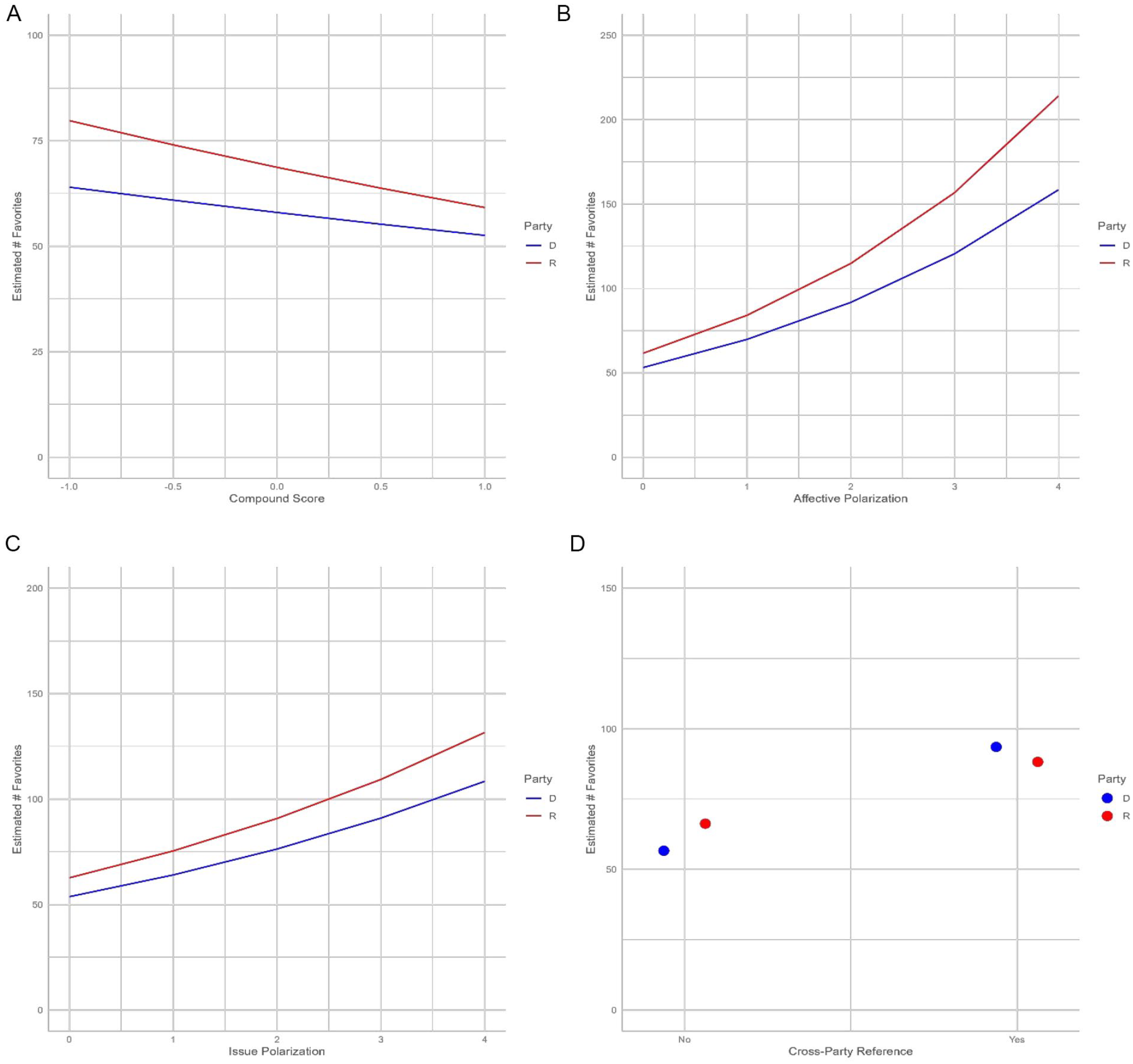
Estimated favorites for tweets with polarizing speech by party during the 2022 midterm elections: (A) Valence Aware Dictionary for Sentiment Reasoning (VADER) compound score, (B) affective polarization, (C) issue polarization, and (D) cross-party references.

Estimated retweets for tweets with polarizing speech by party during the 2022 midterm elections: (A) Valence Aware Dictionary for Sentiment Reasoning (VADER) compound score, (B) affective polarization, (C) issue polarization, and (D) cross-party references.
The regression analysis indicates that all types of polarizing rhetoric are associated with higher user engagement. As the VADER compound score increases—meaning that a tweet has a more positive tone—the number of favorites and retweets decreases. VADER scores with a negative tone fall between −1 and 0 and, when multiplied by the negative coefficient, point to an increase in user engagement for both dependent variables. Tweets with higher levels of issue polarization are associated with more favorites and retweets, with respective increased logged counts of 0.188 and 0.347 (p < .001 for both; values from models A and C). Similarly, The coefficients for cross-party references are also uniformly positively associated with stronger user engagement for both dependent variables (p < .001 for all). The one divergence from this trend appears in our models for retweets. Although an increases in affective polarization are associated with a 0.287 increase in the logged counts of favorites (p < .001), the relationship between retweets and affectively polarizing content is negative: there is a 0.126 decrease in the logged counts of retweets for each additional term from the affective polarization dictionary. We return to this finding later, as the interactions included in models B and D provide potential reasons for this unexpected relationship.
The overall impact of these variables is notable and underscores our first hypothesis, which predicts that polarizing rhetoric of all types will produce higher user engagement. On the basis of the values in models A and C, a tweet with a VADER compound score of −0.9, or highly negative in tone, will have 66 favorites and 110 retweets, holding other variables constant. A score of 0.9, or more positive tone, results in an estimated 53 favorites and 34 retweets. When politicians post tweets without any tokens for affective polarization, models A and C predict 53 favorites and 54 retweets, which changes to 168 favorites and 32 retweets when four polarizing terms are present. Tweets without issue polarization are estimated to have 54 favorites and 47 retweets, while posts with four polarizing tokens have respective values of 114 and 190. Finally, tweets without cross-party references have 57 favorites and 53 retweets, which increases to 82 and 71 when a post contains a cross-party reference. We discuss the magnitude of the interaction effects later.
The variables for political talking points indicate that specific themes invoke varying user reactions. References to border issues increase favorites while lowering retweets, with a similar pattern for our measures of inflation, democracy, and abortion. In contrast, references to crime decrease user engagement for both of our dependent variables. These findings might be nested in larger issues of how each party framed political issues and their relative salience, an issue beyond the current scope. We note, though, that the 2022 midterm elections were somewhat aberrant. Historically, the president’s party lost seats in Congress following the midterm elections, whereas in 2022, the Democrats gained a seat in the Senate and narrowly lost the House of Representatives. As a result, the negative coefficients may, in part, be a product of ineffective political messaging that carried over to online spaces.
Our control variables suggest that party membership alone does not predict user reactions in models A and C. Once the interactions are added in models B and D, the main effects are similarly nonsignificant at p < .05. This indicates that party membership by itself does not yield an advantage or disadvantage in user engagement. In all model specifications, there is a negative relationship between tweets posted after the 2022 midterm elections and favorites and retweets. We expect this is because fewer members of the public pay attention to politics in the postelection period. Members of the House of Representatives receive more favorites and retweets in all models, whereas Republican support in the most recent election is not statistically related to either dependent variable. Research has shown that politicians in less competitive states or districts are more prone to posting polarizing rhetoric (Ballard et al. 2023), however, this does not appear to translate into increased user engagement during the 2022 midterm elections.
The interaction terms from models B and D in Table 2 further illustrate the relationship between partisanship, polarizing rhetoric, and user reactions. We plot the predicted values of these interactions in Figures 3 and 4 to focus on the magnitude of the effects. Excluding the interaction between issue polarization and party membership as predictors of favorites, the interactions are uniformly statistically significant (p < .05). The predicted values in Figure 3 indicate that polarizing rhetoric elicits a baseline increase in favorites for Republicans compared with Democrats, though the magnitude of these effects varies by party. Using VADER scores of −0.9 and 0.9 for our calculations, the plots in Figure 3A show that negative tweets produce an expected 63 favorites for Democrats and 78 favorites for Republicans, which respectively drop to 53 and 60 favorites for positive tone. In Figure 3B, tweets are favorited more when they are affectively polarizing. However, the more polarizing the speech, the more separation we see between the number of favorites Republican congresspeople receive versus Democrats. When Democrats post tweets without affective polarization, our model predicts 53 favorites, which increases to 159 favorites when four tokens are present. In contrast, Republicans start at a value of 62 favorites when affective polarization has a value of zero, and 214 favorites when it is coded at four. In Figure 3C, there is evidence of a bipartisan trend where more ideological polarization is associated with more favorites, with consistently more favorites for Republicans. However, as the interaction itself is not significant, the rate of change for issue polarization does not appear to differ by party. Finally, Figure 3D shows that although tweets posted by members of both parties with a cross-party reference receive more favorites, the magnitude of the effect is higher for Democrats, which nets an estimated 37 more favorites when such rhetoric is present. The comparable figure for Republicans is a net increase of 22 favorites.
Plots of the estimated values from the interactions in model D are in Figure 4. These estimates again indicate that there are significant party-level differences in user reactions to polarizing tweets. The predicted values in Figure 4A show that even though tweets expressing negative tone posted by politicians in both parties receive more retweets, the gap between Republicans and Democrats is quite pronounced. As the VADER score moves from negative to positive, the distance between the line for both parties narrows until they are closer to convergence. At a VADER score of −0.9, our model predicts 106 favorites for Democrats and 135 for Republicans. At a value of 0.9, these values drop to 35 and 40, respectively. Thus, as the content of tweets becomes more positive, user reactions are closer to equal by party. In Figure 4B, we see extreme partisan differences in the retweeting behavior of affectively polarizing tweets. For Republicans, moving from zero to four tokens for affective polarization increases retweets from 61 to 76. For Democrats, the predicted value for zero tokens is 56 retweets, which decreases to 22 when four tokens are present. Republicans appear to be rewarded for affectively polarizing speech, whereas Democrats are penalized. In Figure 4C, this trend reverses. When Democrats engage in issue polarization, they receive substantially more retweets compared with Republicans. When zero polarizing terms are present, our model predicts that a typical tweet by a Republican should have 61 retweets, whereas Democrats have a value of 45. When four polarizing terms were used, Democrats have 438 predicted retweets and Republicans have 777. We note that this pattern of results departs substantively from our other comparisons, in which Republican politicians generally received equal or more favorites or retweets for polarizing behavior. We return to this finding in our discussion. In Figure 4D, our data suggest that when members of both parties reference the opposing party or its individual politicians, it is associated with an increase in retweets. Democrats receive a net increase of about 15 more retweets, while for Republicans, the net increase is 23. The rate of change indicates that cross-party references elicit comparatively stronger reactions when posted by Republicans.
Altogether, our analysis suggests that even after controlling for account-level heterogeneity, adding an offset for follower counts, and adding multiple measures of political talking points and other variables, all types of polarizing speech are more engaging. As well, Republicans generally, but not exclusively, benefit from stronger user reactions when posting polarizing content on Twitter. Importantly, that focal association varies in impact by party and by each of our four measures of political polarization. Republicans generally received stronger user reactions when their rhetoric tapped into affective polarization, adopted a negative tone, or directly mentioning Democrats. Conversely, Democrats elicited significantly more retweets when they used polarizing language linked to issues. This challenges and provides important nuance to our second hypothesis, which predicts heightened reaction to all divisive content posted by Republicans.
Discussion and Conclusion
On February 21, 2023, Rep. Marjorie Taylor Greene (R-GA) appeared on Sean Hannity’s primetime show on Fox News to discuss her recent tweets proposing a national divorce between states led by Republicans and Democrats. These tweets prompted intense public reactions both supporting and opposing her proposal. During the broadcast, Greene argued, “You can take a look at the tweets that I made just yesterday. The amount of likes and retweets that those tweets got should tell people [in Washington DC] a lot.” Although some level of political theater is likely informing Rep. Greene’s comments and framing of the issue, they nonetheless underscore how politicians can and do leverage public engagement on social media as evidence when staking out policy positions, however extreme.
This study contributes to work on this topic by evaluating how different aspects of polarizing speech are linked to user engagement during the 2022 midterm elections. We use a multidimensional approach to measuring political polarization, bridging prior work that has emphasized different aspects of the concept (e.g., Kubin and von Sikorski 2021; Mason 2013). We hypothesize that elite-driven polarizing speech is associated with public reactions, with a particular emphasis on how the evolving meaning of partisanship makes polarizing content posted by Republicans more likely to have the most intense reactions. Using a sample of nearly 140,000 tweets, our statistical results support and challenge our expectations. Although all types of polarizing rhetoric increase public engagement, tweets emphasizing issue polarization posted by Democrats receive more retweets, and Republican politicians leverage affective polarization to gain attention. We conclude by emphasizing three main implications of our work.
First, social media platforms may provide a vehicle for hastening mass polarization, a point that has received less attention by researchers. Atypically strong user reactions to polarizing rhetoric incentivizes politicians to post more of such content. At the same time, polarizing speech becomes increasingly normalized and expected by individuals who follow politicians, arising from a general tendency for negative content online to increase engagement. Together, these dynamics may create a toxic feedback loop where politicians coarsen their rhetoric for attention, while members of the public egg them on and in turn may become more polarized themselves. Our data do not allow us to test how online polarizing rhetoric may translate to offline attitudes or behaviors, but this is an important avenue for future research.
Second, though all our variables measuring political polarization were positively associated with retweets and favorites, they are not interchangeable. The magnitude of each measure’s impact varied, and the four variables only modestly correlate (see Table 1). Given that, we reiterate our argument that political polarization is multidimensional, despite many studies treating it as reducible to a single measure (Kubin and von Sikorski 2021). Our approach is limited in its applicability to textual data sources, particularly from social media platforms; however, our approach is straightforward to implement using existing freely available libraries. For example, Simchon et al.’s (2022) library is available as a supplement to their article, and there are libraries for VADER available in R (Roehrick 2020) and Python (Hutto and Gilbert 2014). A similar or improved multidimensional approach to capturing polarizing speech is necessary in future research on the topic.
Finally, we note an interesting divergence from our second hypothesis that, across the board, Republicans would have stronger reactions to all types of polarizing content. Although Republicans post substantially more affectively polarizing content, Democrats post slightly more issue polarizing content, on average. Furthermore, individuals who follow Democrats on Twitter, a group populated primarily by Democrats (Wojcieszak et al. 2022), amplify this content by retweeting it at higher volume than Republicans. We suggest that this finding is a product of two factors, which are not mutually exclusive. On the one hand, retweets need not be a uniformly positive user reaction to posted content, unlike a favorite, which is more unambiguously positive. That is, users might retweet content that they find objectional or disagreeable while criticizing the initial tweet. To the extent that this happens, part of the dynamic we observe may be Democratic tweets’ being broadcast across more conservative Twitter users. Because of the significant limitations in the Twitter API introduced in 2023, we can no longer directly assess this possibility in a manner consistent with the API’s terms of use. Second, research by Barker, Detamble, and Marietta (2022) indicates that Democrats disproportionately favor intellectual debate, whether real in substance or performative, which may partially explain a stronger reaction when posting divisive content that is grounded in salient political issues. Should this finding replicate beyond our case study, it is an important area for future work to resolve.
