




Abstract
This study represents the first systematic account to test the hypothesis of college as the great equalizer in Japan by analyzing the three-way association among class origin, destination, and education. The authors use data from the Social Stratification and Social Mobility surveys and the Japanese Life Course Panel Surveys. By applying the entropy balancing technique, the authors estimate the heterogeneous causal effect of college education on occupational attainment by the father’s occupation. The results indicate that college education does not function as a great equalizer in Japan. There is no clear evidence to suggest that the occupational returns to a college education are greater among those from less advantaged families than those from more advantaged families. The authors argue that the equalizing effect of a college education is not apparent, because of the specific institutional arrangements of the educational system and the labor market in society.
Keywords
Sociologists have long been concerned with the question of the role of education in intergenerational mobility (Blau and Duncan 1967; Ishida, Müller, and Ridge 1995). Education acts as a mediator between class origin and class destination, while it also modifies the relationship between origin and destination. The relationship among class origin (O), class destination (D), and education (E) is often discussed within the framework of the OED triangle. As shown in Figure 1A, education mediates the influence of O on D, thereby contributing to the reproduction of inequality between the two generations. At the same time, education can be seen as a vehicle of intergenerational mobility because variation in education is not completely explained by social background characteristics; people from less advantaged origins may use education to move up the social ladder. The framework of the OED triangle also allows us to examine the role of education as a modifier or a moderator in the process of intergenerational mobility. Figure 1B shows how education can modify the association between O and D. The extent of the OD association may vary with education level: the influence of parental class on children’s class position may be weaker or stronger depending on the level of education.

Origin-education-destination (OED) triangle (A) and two analytic strategies (B and C).
A number of studies in Europe and the United States have reported that college education functions as a great equalizer in society because once people obtain a college education, social origin no longer seems to affect socioeconomic attainment (Breen 2004, 2010; Breen and Jonsson 2007; Breen and Luijkx 2007; Hout 1984, 1988; Pfeffer and Hertel 2015; Torche 2011; Vallet 2004). These studies are examples of education acting as a modifier, focusing on the OD association conditional on college education (E). They demonstrated that the OD association is absent or weaker among college-educated people than among people with lower levels of education. This weaker OD association among college-educated individuals, together with the expansion of higher education, is thought to be a major explanatory factor for the decline in the overall association between O and D in some European nations and the United States (Breen 2010; Breen and Jonsson 2007; Breen and Müller 2020; Pfeffer and Hertel 2015; Vallet 2004).
In this study, we take up the issue of the role of education in intergenerational mobility in Japan. We first discuss three potential avenues for the development of the OED triangle framework: (1) interpretation, (2) selection and causation, and (3) societal variations. We then examine whether the equalizing effect of a college education is found in Japan by using an alternative approach to analyze the three-way association among O, E, and D. Instead of looking at the OD association by levels of education (E), we focus on how origin (O) modifies the returns to education (ED) after taking into account the selection process for a college education. We argue that the equalizing effect of a college education is not evident in Japan and that the occupational returns to college education are not greater among people from less advantaged families than those from more advantaged families. We highlight the Japanese institutional context within which intergenerational mobility takes place and suggest reasons why the hypothesis of college education being an equalizer is not supported in Japan.
Analytical Framework
Interpretation of the OED Triangle
A typical analytical strategy to studying the OED triangle is to focus on the OD association within the levels of E, as shown in Figure 1B. To interpret the three-way interaction among OEDs, this strategy examines whether the OD association varies by educational level (Breen 2004; Breen and Luijkx 2007; Hout 1984; 1988; Vallet 2004). The hypothesis that a college education is the great equalizer predicts the following empirical observation: the OD association is weaker among college graduates than among nongraduates.
Goldthorpe and Jackson (2008), however, proposed an alternative interpretation of the OED interactions. As shown in Figure 1C, the same three-way interaction can be tested by examining whether the ED association varies by O. This framework is similar to that of studies that investigate heterogeneous occupational or economic returns to education, which have been employed not only in sociology but also in economics (Brand and Xie 2010). These studies have examined who benefits from college education and yielded different results: individuals who are more likely to obtain a college degree receive more economic benefits from college education (positive selection) (Tsai and Xie 2011), and those who are less likely to receive a college degree receive more benefits (negative selection) (Brand and Xie 2010; Tsai and Xie 2008). Brand and Xie (2010) estimated the propensity score (PS) to complete college and examined the heterogeneous effect of college completion on wages by PS strata using a hierarchical linear model. Their finding suggested the negative selection. 1
The hypothesis of college as the great equalizer is consistent with the latter finding and can be verified by the following observation: the ED association is stronger among those from less advantaged social origins than those from more advantaged origins. As Hout (2012) stated clearly, the hypothesis of college as the great equalizer suggests that “education affects the occupational success of lower-origin workers more than higher-origin ones” (p. 386). Similarly, Cheng et al. (2021) suggested that the linkage between the hypothesis of college as the great equalizer and the empirical finding about the greater wage returns to a college degree among disadvantaged individuals.
Using empirical data, we test this observation.
Selection and Causation in the OED Triangle
Similar to other disciplines in social science research, sociological studies have been concerned with the question of causality (Elwert and Winship 2014; Gangl 2010; Morgan and Winship 2014; Sobel 1996). Although many previous studies have revealed that the OD association is weaker when E is higher (i.e., social mobility is more prevalent among those who are highly educated), it is not clear whether these observed patterns are produced by the causal effect of education on intergenerational mobility. Zhou (2019) pointed out that the observed association reflects the selection process such that individuals from low social backgrounds but with high ability and motivation enter university. Zhou found that when such a selection process was considered by a weighting technique called residual balancing, intergenerational income mobility among college graduates became very similar to that among high school graduates. Karlson (2019) also examined whether the selectivity of college graduates explained higher levels of social mobility for college graduates by using the inverse probability weighting technique to control for selectivity on the basis of a set of observed characteristics. Karlson found that even after considering the selection processes, the OD associations measured by the regression coefficient of parents’ socioeconomic index (SEI) and family income on those of children among college graduates did not change, supporting the hypothesis of college as the great equalizer.
The process of selection into education is important in understanding how OED associations arise and in estimating the causal effect of education on destination. In addition to socioeconomic backgrounds, academic performance is one of the most important determinants of educational attainment. Previous studies have included variables related to both socioeconomic backgrounds and academic performance in the model estimating the probability of college completion for the PSs and inversed probability weights (Brand and Xie 2010; Karlson 2019; Zhou 2019). However, further consideration must be given to the fact that, as has been demonstrated by research in social stratification and the sociology of education, these not only independently affect educational attainment but also have interaction effects (Bernardi and Boado 2014; Holm, Hjorth-Trolle, and Jæger 2019). The effect of academic performance on educational attainment is stronger for students from less advantaged social origins than for those from advantaged social origins. That is, students from advantaged social origins are likely to obtain higher levels of education even when their academic performance is poor, whereas students from less advantaged social origins tend to leave education if their academic performance is poor. Furthermore, it is possible that college graduates from less advantaged backgrounds are more likely to possess certain characteristics (higher cognitive ability and motivation) than those from more advantaged backgrounds (Mare 1980; Torche 2011). Because these characteristics are likely to affect socioeconomic outcomes (D), we must consider interaction effects among covariates in the process of selection into college education.
On the basis of the foregoing arguments, we propose the analytical framework of the OED that estimates the heterogeneous causal effect of college education (E) on destination (D) by social origins (O) after controlling for a wide range of pretreatment covariates and their interactions that are likely to be associated with both E and D. Although this approach is very similar to that of Brand and Xie (2010), what should be emphasized here is that instead of using the PS to examine the heterogeneity of the economic returns to education, we consider the modification of the causal effect of education on destinations by directly measured social origins (father’s occupation), which is more in line with the framework of the OED triangle in social mobility research. Moreover, to maintain continuity with previous studies of social mobility investigating OED interactions, this study focuses on occupational mobility rather than income mobility. We define individuals’ educational attainment as a treatment, their occupational attainment (prestige and SEI) as an outcome, and their parental occupation (prestige and SEI) as an effect modifier (see below for details of our methods).
Societal Variations
We seek to examine societal variations in the way social background, education, and socioeconomic attainment are related. There are many studies of OED interactions in the United States (Bloome, Dyer, and Zhou 2018; Hauser and Logan 1992; Hout 1984, 1988; Karlson 2019; Pfeffer and Hertel 2015; Rytina 1992; Semyonov and Roberts 1989; Torche 2011; Witteveen and Attewell 2020; Zhou 2019). These studies used a variety of measures of origin and destination, such as class, SEI, occupational prestige, wage, and income. On the whole, whatever measures of origin and destination are used, there is a tendency that the higher the level of education is, the weaker the origin-destination relationship. However, it should be noted that some recent studies have shown inconsistent results (Brand and Xie 2010; Witteveen and Attewell 2020; Zhou 2019). In addition, there have been various developments in this research topic, such as comparisons based on the selectivity of universities (Chetty et al. 2017; Klein 2021), comparisons between college graduates and those who attended graduate schools (Torche 2011; Witteveen and Attewell 2020), and comparisons of fields of study and selectivity within graduate schools (Torche 2018). Studies of European societies also showed that the OD associations are weaker for those who obtained higher levels of education in the United Kingdom (Breen 2010; Breen and Luijkx 2007; Bukodi and Goldthorpe 2019), France (Vallet 2004), Germany (Breen 2010; Breen and Luijkx 2007), Sweden (Breen 2010; Breen and Jonsson 2007), and Spain (Gil-Hernández, Marqués-Perales, and Fachelli 2017).
There are few studies of OED interactions in societies outside Europe and the United States (Hannum et al. 2019). Chung and Park (2019) showed that in South Korea, the OD associations were weaker for those who obtained a bachelor’s degree or higher than for those who finished high school or less. However, Torche and Ribeiro (2010) found that the OD associations were not weaker among people with higher levels of education in Brazil. These findings indicate that the tendency that the OD associations are weaker for those with higher levels of education is not universal, and social and institutional contexts may be of importance in understanding the various results. Studies of the associations between origin and education (educational inequality) have focused mainly on the educational system (Erikson 1996; Shavit and Müller 1998). In particular, when looking at the relationship between education and destination, we often focus on the institutional characteristics of the education system and labor market (Bol et al. 2019).
When considering the interactions of OEDs, we need to pay attention to the educational system, the structure of the labor market, and the linkage between education and the labor market. In the next section, we describe the Japanese institutional context in which social background, education, and socioeconomic attainment are associated.
The Japanese Context: Bringing Institutions Back In
The Japanese educational system, like those of many other industrial nations, has undergone a dramatic expansion of secondary education and tertiary education. However, the expansion was not linear. The enrollment rate in two-year junior colleges and four-year universities increased sharply in the 1960s and early 1970s, stagnated for two decades at approximately 37 percent and then increased again after the mid-1990s, reaching 59 percent in 2020. Despite the expansion, there was no clear evidence of increasing equality in access to higher levels of education (Aramaki 2000; Hara and Seiyama 2005; Ishida 2007; Kondo 2000). Fujihara and Ishida (2016), for example, reported that when years of school is used as the measure of absolute level of educational attainment, the equality of educational opportunities by social background was increased in postwar Japan. People from less advantaged backgrounds benefited most from the upgrading of education. However, when education was measured as a relative value by taking into account the quality of institutions, there was a trend of increasing inequality. During the period of the second expansion of education, nonselective institutions of higher education expanded while highly selective institutions remained stable in size and continued to enjoy the advantaged position in the educational distribution and the labor market. The relative value of educational attainment for students in nonselective institutions tended to diminish following the expansion of the higher education sector. Because people from advantaged backgrounds had better access to highly selective institutions, the relative gap in educational attainment by people from different backgrounds tended to increase.
The Japanese labor market and class structure exhibit dramatic transformation during the postwar period. Late and rapid industrialization changed Japan from an agrarian society in the 1950s to a mature industrial society in the 1980s. As in other industrial nations, the farming class shrunk rapidly while the professional-managerial class expanded, thereby producing absolute upward mobility. The pace of transformation of the class structure was faster in Japan than in early industrializing nations. Previous studies report that the Japanese class structure has not become more fluid or open during the postwar period despite the rapid changes in class structure and the expansion of the educational system (Hara and Seiyama 2005; Ishida and Miwa 2009). Ishida (2022) showed that the association between class origin and class destination has been stable throughout the postwar period. The strength of association represented by uniform difference parameters showed stability and nonsignificant trendless fluctuation from 1955 to 2015. Unlike many European nations that exhibited increasing social fluidity in the twentieth century (Breen 2004; Breen and Müller 2020), Japanese society showed no sign of the trend of societal openness.
Another important feature of educational expansion is that it occurred along with population decline. The 18-year-old population has been steadily declining since 1992, when the second stage of educational expansion took place. Consequently, the absolute number of students in junior colleges and universities has not increased since the mid-1990s. In other words, there was no clear oversupply of the college-educated population, and the socioeconomic returns to education were thus stable despite educational expansion (Kambayashi, Kawaguchi, and Yokoyama 2008; Kawaguchi and Mori 2016; Mugiyama and Toyonaga 2022).
Throughout the postwar period, youth unemployment has remained low in Japan, at least compared with that of most other industrial nations. This fact is often ascribed to the successful transition from school to first job among Japanese youth (Kariya and Rosenbaum 1987; Rosenbaum and Kariya 1989). The transition from school to work among high school students in Japan is regulated by the rules set forth by the national government (Brinton 2008). The procedure and schedule for recruiting students who are still in high school are determined nationwide by the government. Employers wishing to hire high school students must fill out the job posting forms and submit them to the Public Employment Security Office. The forms are then distributed to high schools by the office. High school students apply for jobs allocated to schools, and the school staff ranks students and nominates the appropriate candidates for job interviews that begin on the specific date. Students nominated by high schools are only allowed to take job interviews, and employers usually honor recommendations by high schools because there are long-term semiformal agreements between particular schools and particular employers. Employers tend to hire students from specific high schools on the basis of the history of recruitment and to trust that these schools nominate students appropriate for them. Schools have delegated authority to select students within schools and nominate them for particular employers. High schools play an active role in matching students to jobs, and most students begin working immediately following school graduation in April (Brinton 2008). Because access to assistance provided by high schools is not related to social origin, mediation by school institutions is likely to weaken the association between social origin and first job (Ishida 2023).
The labor market for college graduates is different from that for high school graduates (Chiavacci 2005; Oshima 2012). Similar to high school students, university students begin looking for jobs while they are still in school, and they begin their employment immediately after graduation. An important institutional characteristic of the labor market for college graduates is that employers set up special recruitment tracks only for college students who are looking for a job before graduation. Similar to high school students, these students do not compete for a job with college graduates who have already been in the labor market. However, unlike high school students, university students are on their own to search for job openings on the web and fill out entry forms. Employers screen the entry forms and invite applicants for personal interviews. Although university placement offices offer assistance to students, they are not involved in the selection process. Employers do not delegate the selection to universities. Because of the less active role of university institutions, family background is likely to affect the chances of getting interviews and interview performance and demeanor (Jackson, Goldthorpe, and Mills 2005; Rivera and Tilcsik 2016).
The linkage between education and the labor market is heavily influenced by Japanese employment relations. Japanese employment relations are often characterized by in-house job training, limited external hiring, internal promotion, and long-term commitment (Kambayashi and Kato 2017; Ono 2010; Shimizutani and Yokoyama 2009), while the proportion of people who work outside such systems is increasing (Brinton 2008; Kalleberg et al. 2021). Because of the emphasis on internal training and promotion, Japanese firms prefer to hire college seniors over those who are already working in the labor market and set up special recruitment tracks and schedules targeted at college seniors every year (Kariya and Honda 2010; Nakamura 1993). However, it is important to note that men benefited from Japanese employment relations, but women did not always do so (Osawa 2011). Some Japanese women left employment following marriage and childbearing, although the extent of withdrawal has become less common in recent years. When these women reentered the labor market, they were not assisted by schools and often occupied part-time employment that is outside the Japanese employment relations. Therefore, with regard to first occupational attainment, both men and women took advantage of school assistance to have a smooth transition to work. However, some women withdraw from the labor market, and their occupational attainments following reentry into the labor market are different from those experienced by men.
In summary, the labor market is highly segregated by educational credentials. The smooth transition from school to work and the special recruitment track for untrained students constitute critical institutional features of the occupational attainment process in Japan. The difference in the role played by school institutions (high schools and universities) is important in understanding how social origins influence occupational destinations in a different way for high school graduates and college graduates.
Methods
Statistical Models
Studies on social mobility often employed log-linear and log-multiplicative models in the analyses of the OED triangle (e.g., Hout 1984, 1988). We use a continuous measure of occupational attainment following recent research (Fiel 2020; Torche and Ribeiro 2010; Zhou 2019) and examine the OED interactions from the analytical framework of the heterogeneous treatment effect (Hu 2023). We apply the method of the effect modification by pretreatment covariates. This method is often employed in epidemiology to evaluate heterogeneous causal effects by pretreatment variables (Hernán and Robins 2020; Robins, Hernán, and Brumback 2000). Let

We are interested in

If the conditional exchangeability Ya⫫
Usually, the marginal structural model includes only treatment variables and does not include covariates if we want to estimate the average treatment effect. However, if we want to investigate the heterogeneous causal effect (effect modification), the marginal structural model includes the subset of the covariates

where

Note that the coefficients
Data
We use data from the Social Stratification and Social Mobility (SSM) surveys and the Japanese Life Course Panel Surveys (JLPS), both of which are nationally representative surveys of Japan. The SSM surveys are repeated cross-sectional surveys and have been conducted in Japan every 10 years since 1955. We used the 1995, 2005, and 2015 SSM datasets, and the respondents were men and women aged 20 to 64 years at the time of the surveys. The JLPS includes longitudinal surveys started in 2007. The respondents were extracted from male and female Japanese residents aged 20 to 40 years in 2006 (born between 1966 and 1986). Additional respondents of the same cohort were added in 2010. We used data from the 2007 to 2019 surveys. Altogether, after omitting the cases with missing values for the treatment and outcome variables, as described below, there were 4,678 and 4,665 male respondents for the first and current occupations, respectively, and 5,741 and 4,712 female respondents for the first and current occupations, respectively. We used multiple imputation (M = 160) for the missing values of the pretreatment covariates by using multivariate imputation by chained equations (Van Buuren 2018).
Variables
The outcome variables (
The treatment variable (
The effect modifier variable (
The pretreatment covariates related to individuals’ social background are the father’s education, the mother’s education (Ishida 2007), number of siblings and birth order. The pretreatment covariates also include the father’s occupation (prestige or SEI), as mentioned above. Because the SSM and JLPS lack information on academic ability or cognitive test scores, we used self-reported grades in ninth grade (self-reported grades relative to the cohort in the third year of junior high school, from bottom to top), high school rank, and high school track (academic or vocational) as proxies for academic ability. The high school rank is based on the respondent’s assessment of the proportion of his or her classmates who attended college after high school graduation, and the values are standardized for each cohort. The Japanese high school system has been highly stratified, and students are allocated into diverse types of high schools according to their academic performance (Kariya and Rosenbaum 1987). Thus, the rank of high school the respondent attended is a good proxy of academic ability and motivation, especially in Japan. Previous studies indicated that self-reported grades in ninth grade and high school rank are accurate measures (Yamamoto and Brinton 2010). We also used birth cohort and the survey year as pretreatment covariates.
There may be an interaction effect of social origin and academic performance on the probability of entering college (Bernardi and Boado 2014; Boudon 1998; Gambetta 1987; Goldthorpe 1996): the effect of social origin on college attendance is weaker for those with higher academic ability. In other words, the effect of academic performance at school on college attendance is weaker for those from more advantageous social origins than for those from less advantageous ones. Thus, we included the interaction terms in estimating the weights.
Although previous studies included not only socioeconomic background variables but also social-psychological variables such as educational aspirations, motivation, and other personal traits (Brand and Xie 2010; Karlson 2019; Zhou 2019), these variables were not available in our datasets. Despite these limitations, essential variables such as those used in the analysis of educational attainment are included. 3 The directed acyclic graph illustrating the causal relationships among the variables can be found in Appendix A. Descriptive statistics are listed in Table 1.
Descriptive Statistics.

Note: Means (SDs) and percentages are computed from the original dataset. GPA = grade point average; HS = high school; JC = junior college; JH = junior high school; JLPS = Japanese Life Course Panel Surveys; SEI = socioeconomic index; SSM = Social Stratification and Social Mobility.
Results
Selection into College Graduation
The column labeled “Before Weighting” in Figure 2 shows the distributions of the pretreatment covariates by treatment status (college graduation or high school graduation) before weighting. Thus, this indicates baseline differences in social origin and academic performance between college graduates and high school graduates. Because of space limitations, we show the results of the analysis for men using occupational prestige as a measure of social origin. College graduates differ in many respects from high school graduates. The levels of fathers’ occupational prestige, fathers’ and mothers’ education, and durable goods ownership at the age of 15 among college graduates tend to be higher than those among high school graduates. College graduates have fewer siblings and are more likely to have a higher birth order than high school graduates. The self-rated grade point average in junior high school and the high school rank were higher for college graduates than for high school graduates. College graduates were more likely to attend academic high schools than vocational schools. Therefore, college graduates tend to be from more advantageous social backgrounds and to have higher academic performance than high school graduates.

The distributions of pretreatment covariates between high school graduates (white) and college graduates (gray) before and after weighting for men.
The column labeled “After Weighting” in Figure 2 shows the distributions of the pretreatment covariates by treatment status after weighting. The distributions of the pretreatment covariates were highly balanced between the treatment group (college graduates) and the control group (high school graduates).
Average Causal Effect of College Graduation
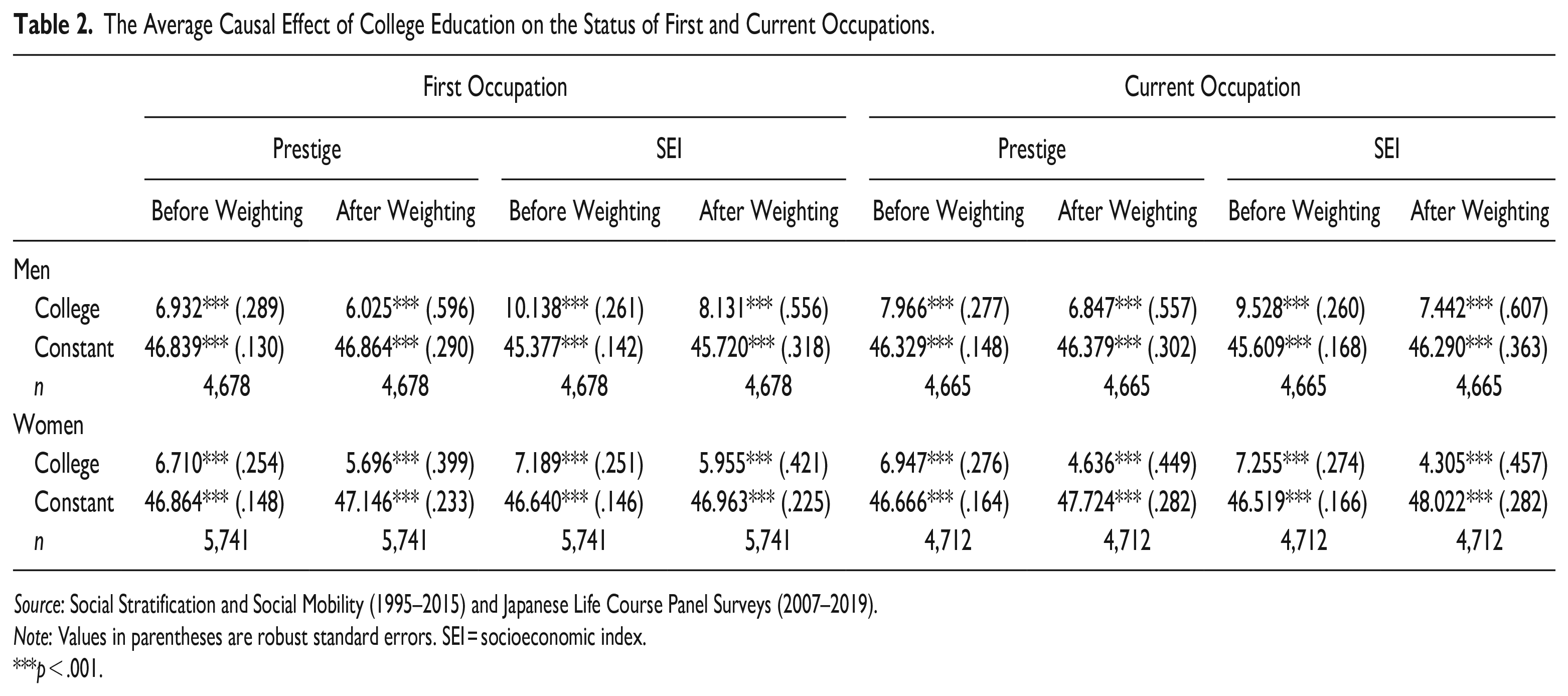
Before investigating the heterogeneous causal effect of college education on occupational attainment by parental occupation, we show the average causal effects in Table 2. We used two different indicators of occupational attainment (prestige and SEI) for the first and current occupations and two analytical models. The first model is the linear regression model (equation 2) with robust standard errors that does not use any weights and thus estimates the gross association between college education and occupational attainment without any control for covariates (column labeled “Before Weighting”). The second model is the linear regression model (equation 2) with the weights estimated by the entropy balancing technique (column labeled “After Weighting”). The result before weighting indicates that for both men and women, college education is associated with each type of status of first and current occupations. After weighting, the coefficients decrease, but there still exist substantive and significant effects of college education on occupational attainment. Because the pretreatment covariates are highly balanced between college and high school graduates (see Figure 2), the estimated coefficients can be interpreted as the average causal effect of college education on occupational attainment.
The Average Causal Effect of College Education on the Status of First and Current Occupations.
Source: Social Stratification and Social Mobility (1995–2015) and Japanese Life Course Panel Surveys (2007–2019).
Note: Values in parentheses are robust standard errors. SEI = socioeconomic index.
p < .001.
Heterogeneous Causal Effect of College Graduation
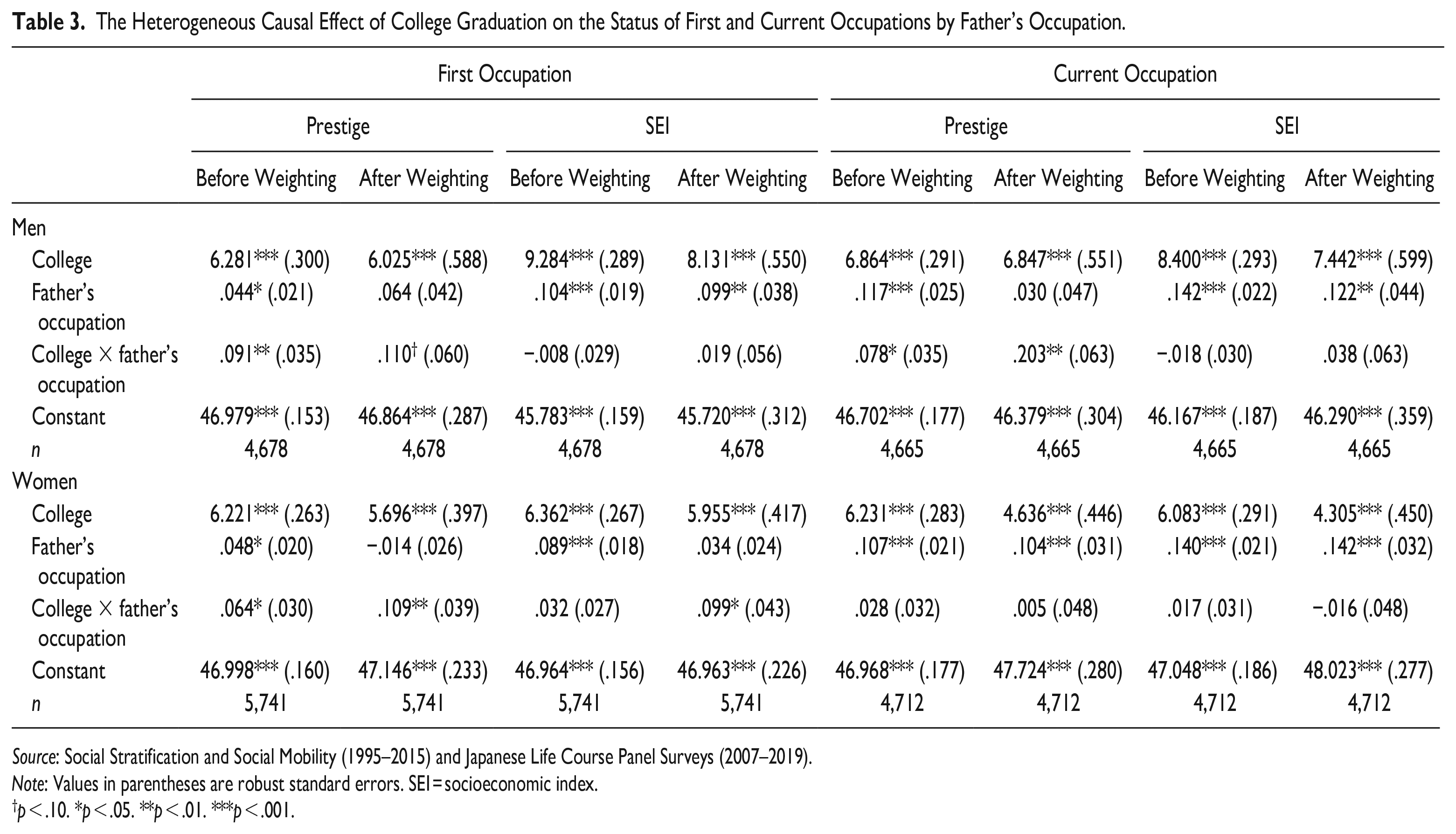
Table 3 shows the results of the regression analysis predicting the respondents’ occupational attainment from equation 4 for men and women. For each type of occupation, we report the results of the regression models before and after weighting. To examine the heterogeneous causal effect, we focus upon the interaction term between college education and fathers’ occupational scale. Because the scores of the father’s occupation were centered at the mean, the coefficient for college education (
The Heterogeneous Causal Effect of College Graduation on the Status of First and Current Occupations by Father’s Occupation.
Source: Social Stratification and Social Mobility (1995–2015) and Japanese Life Course Panel Surveys (2007–2019).
Note: Values in parentheses are robust standard errors. SEI = socioeconomic index.
p < .10. *p < .05. **p < .01. ***p < .001.
We begin with men. First, we examine occupational prestige at first job (the first two columns of the upper panel in Table 3). Before weighting, the coefficient for the interaction between the father’s occupational prestige and college education (
We conducted the same analysis for the current occupation (the last four columns of the upper panel in Table 3). For the columns on occupational prestige, the coefficient for the interaction term was 0.078 before weighting, but it was 0.203 after weighting. The same pattern was not observed for the SEI of the current occupation (the last two columns of the upper panel in Table 3): the coefficient for the interaction term was −0.018 before weighting and 0.038 after weighting (both were not significant).
The results from the analysis of the prestige score are consistent with the positive selection hypothesis, but those from the analysis of SEI support neither the positive selection hypothesis nor the negative selection hypothesis. Positive selection implies that people from advantaged backgrounds who are more likely to obtain a college degree receive more economic benefits from a college education, whereas negative selection implies the opposite. In summary, the overall analysis among men did not show any support for the negative selection hypothesis.
Next, we move to the analysis of women. First, we examine occupational prestige at first job (the first two columns of the lower panel in Table 3). The coefficients for the interaction term were 0.064 before weighting and 0.109 after weighting, and both were significant. The result for SEI of first occupation (the third and fourth columns of the lower panel in Table 3) shows that the coefficients for the interaction term were 0.032 and not significant before weighting and 0.099 and significant after weighting. Among women, the causal effect of education on the status of first occupation was heterogeneous by the father’s occupational status. The causal effect of college graduation on prestige and SEI of the first occupation was greater among women whose fathers had higher status occupations than among those whose fathers had lower status occupations.
However, for the current occupation (the last two columns of the lower panel in Table 3), the coefficients for the interaction term were small and not significant both before and after weighting, suggesting that the causal effect of college completion on current occupation is homogenous across social origin.
The results from the analysis of the first occupation are consistent with the positive selection hypothesis, but those from the analysis of current occupation support neither the positive selection hypothesis nor the negative selection hypothesis. Similar to the results among men, the women’s results do not support the negative selection hypothesis.
Figure 3 provides a graphical representation of the heterogeneous returns to college education by the father’s occupation before and after weighting among men. The dotted line indicates the average occupational scores for high school graduates, and the solid line indicates the scores for college graduates. The gaps between the two lines represent the difference in occupational attainment between high school graduates and college graduates, that is, the effect of college education. When the two lines are parallel to each other, the effects of college education on occupational outcomes are the same across different levels of the father’s occupational status. When SEI is used to measure the first and the current occupational status, the two lines are parallel to each other: the effect of college education is approximately the same for people from different social backgrounds. However, when the two lines diverge as the father’s occupational status increases, the gaps between the two lines are larger for those from the more advantaged background than for those from the less advantaged background. This pattern implies positive selection. We find this pattern for first and current occupational prestige. It is also worth noting that the pattern of positive selection is more pronounced after controlling for covariates by weighting. In other words, after controlling for social background and academic performance, the apparent returns to college education for people from less advantaged backgrounds are reduced, while the same returns for people from more advantaged backgrounds are expanded. Further inspection of Figure 3 suggests that the increasing gaps between the two lines come from the fact that the dotted lines for high school graduates are almost flat. This finding implies that among high school graduates, an increase in a father’s occupational prestige does not always produce an increase in the son’s occupational prestige.

The heterogeneous effect of college education on the status of first and current occupations for men.
Figure 4 provides the same graphical representation of the heterogeneous returns to college education among women. With regard to the first occupation for both prestige and SEI, the pattern shows diverging gaps as the father’s occupational status increases, especially after weighting. The effect of college education appears to be much larger for women from advantaged backgrounds than for those from disadvantaged backgrounds. The dotted line representing high school graduates seems to be flat, indicating that the father’s occupational status does not seem to increase the daughters’ occupational status. This observation was also found among men. We argue later in the “Conclusion and Discussion” section that the weak association between the father’s and the respondent’s occupational status is probably explained by the institutional arrangement of high schools assisting students in finding jobs. With regard to current occupation, the two lines are parallel to each other, indicating that the returns to college education are homogeneous across women with different social backgrounds.

The heterogeneous effect of college education on the status of first and current occupations for women.
Finally, there is the third pattern in which the gaps between the two lines decrease as the father’s occupational status increases, and this pattern is consistent with the negative selection hypothesis. None of the figures we presented thus far exhibit this pattern. What is unique about Japanese society is that the association between college education and occupational attainment does not become weaker as the father’s occupation becomes more advantageous.
Conclusion and Discussion
This study evaluated whether college acts as the great equalizer in Japan using the framework of the OED triangle. Instead of looking at the origin-destination (OD) association by levels of education (E), we focused on how origin (O) modifies the returns to education (ED) within the OED triangle. We estimated the heterogeneous causal effect of a college education on occupational attainment by father’s occupation after controlling for a wide range of pretreatment covariates using the entropy balancing technique. This study represents the first systematic and rigorous account to test the hypothesis of college education as the great equalizer in Japan: socioeconomic returns to a college education are greatest among people from less advantaged backgrounds, and a college degree serves to level the playing field by promoting greater intergenerational mobility for disadvantaged people in Japan.
Our results indicate that a college education does not function as the great equalizer in Japan. There is no clear evidence to suggest that the occupational returns to college education are greater among those who come from less advantaged families than those from more advantaged families, as was predicted by the hypothesis of college as the great equalizer (Torche 2011) or the negative selection hypothesis (Brand and Xie 2010). Among men, after controlling for pretreatment covariates, the causal effect of college completion on occupational attainment was homogeneous when SEI was used to measure occupational attainment, and the causal effect appeared to be even smaller for those from less advantaged families when occupational prestige was used. The reason for the declined returns to college education among the less advantaged comes from selection on the basis of academic performance. 4 Those who attend college from less advantaged origins tend to be high-performing students. Once we control for academic performance, the apparent benefits of college education for those from less advantaged families are reduced. Our results also imply that controlling for pretreatment covariates increases the returns to college education for those from more advantaged families because their benefits of college education seem to be greater when academic ability is held constant.
Among women, the causal effect of college education on current occupational attainment remained homogenous across levels of the father’s occupation, while the causal effect on first occupational attainment appears to show the increased level of returns for women from more advantaged backgrounds. 5 These results were obtained regardless of the measurement of occupational attainment. In summary, among both men and women, there was no clear evidence for greater equalizing benefits of college education for people from disadvantaged backgrounds. Our evidence is more consistent with the homogenous returns to college education or greater returns for people from more advantaged families than negative selection, where the returns are greater for those from disadvantaged families.
The argument about college education as the great equalizer implied that the association between social origins and occupational attainment is absent or much weaker among college-educated individuals than among those with lower education (Hout 1984, 1988; Torche 2011). In some European nations and the United States, once people have completed college education, they have access to a high-skilled labor market, and their attainments are not greatly affected by their social origins because labor markets for college-educated individuals are more meritocratic than those for less educated individuals (Breen and Jonsson 2007). On the other hand, among people with little education, the association between social origin and attainment is strongest. People who have limited educational resources, such as high school dropouts in the United States, have to rely on familial resources to advance in the labor market (Fiel 2020). Advantaged families use familial resources to compensate for their children’s lack of educational resources (Bernardi and Ballarino 2016).
However, the same phenomena were not found in Japan. Why does Japan lack evidence of education as the great equalizer? Two complimentary mechanisms may be at work in Japan. First, social background continues to play an important role in allocating occupational positions among the college educated in Japan. College education does not seem to eliminate the effect of social origins because of the particular institutional features of the labor market for fresh college graduates in Japan. When college graduates enter the labor market, they compete in the labor market specifically reserved for college seniors who are looking for a job following graduation (Arita 2020; Kariya and Honda 2010). College seniors do not compete with college graduates who have already been in the labor market and are looking for a job after graduation because large Japanese firms prefer recruiting fresh school graduates, training them on the job, and promoting them internally over hiring from the external labor market and head-hunting managers. The competition among college seniors means little variation in the skills they possess. Employers focus on the trainability of prospective employees rather than hands-on skills that may be put into practice immediately in the company. The selection is based on personal interviews, and interview performance and demeanor are known to be related to family background (Jackson et al. 2005; Rivera and Tilcsik 2016). This leaves space for family resources to be effectively mobilized. Family resources, including social capital and the network of parents, may be used to establish connections with employers. Although college students can invest in upgrading their qualifications and skills, such as English proficiency, the chances of upgrades are affected by family economic resources. Because of the preference of large Japanese firms to recruit college seniors and train them internally, the influence of family background characteristics continues to surface in the selection process and makes a difference in eventual outcomes.
Second, among individuals with less education (high school graduates), our analyses suggest that the effects of social origins on occupational attainment were not larger than those among college graduates. This outcome is probably related to the institutional context in which high school students find jobs in Japan. As briefly discussed at the beginning of this article, high schools play a critical role in the process of matching students to jobs (Brinton 2008). Employers delegate the selection of students to schools, and only students who are recommended by high school can proceed to the interview stage. Schools normally use meritocratic criteria (grades and attendance records) in the selection process, without any reference to social background (Kariya and Rosenbaum 1987; Rosenbaum and Kariya 1989). 6 Furthermore, the use of school assistance is not related to social background (Ishida 2023). All students, regardless of their social origins, have access to the assistance provided by high schools. High school graduates who lack both educational advantages and familial resources are able to rely on high schools to compensate for their disadvantaged positions. The institutionalized linkage mediated by high schools contributed to weakening the association between social origins and occupational outcomes among high school graduates in Japan. 7
Thanks to these two complementary mechanisms, the returns to college education (that is, the difference in occupational attainment between high school graduates and college graduates) for people from less advantaged backgrounds were not greater than those from more advantaged backgrounds in Japan. The absence in Japan of what researchers in the United States and Europe have portrayed as the great equalizing effect of college education is likely to come from the cross-national difference in the institutional context of the labor market for college graduates and high school graduates in Japan. This study, therefore, highlights the importance of the institutional arrangements of the educational system and the labor market in explaining the relationship among class origin, class destination, and education.
What policy implications can be drawn from this study? Our study indicated that educational expansion alone does not always emancipate people from the influence of social background. Instead, among high school graduates, school institutions play an active role in reducing the effect of social origin in the occupational attainment process. The success found at the high school level may be extended to the college level. Indeed, some nonselective institutions offer their students assistance in the job search process because these students often suffer in the free labor market when competing with students from more selective institutions (Oshima 2012). Government agencies such as the Public Employment Security Office may play a more active role in the job search for college graduates. The key idea is that people who lack familial resources should be able to rely on institutions whose access is not restricted by social background.
Finally, there are a number of future directions that can be taken from this study. First, because of the limitation of the datasets, we were not able to control for a wide range of covariates. The lack of a more accurate measure of cognitive ability is probably the most serious concern. The inclusion of the measures of motivations and expectations is also likely to explain the association between education and occupational attainment.
Second, we did not take up the issue of stratification within the institutions of higher education (Gerber and Cheung 2008). The type of institutions (two year and four year) and the ranking and quality of four-year universities became crucial distinctions in the higher education sector as the attendance rate to higher education increased in postwar Japan in two stages, first during the 1960s and 1970s and then again after the mid-1990s (Fujihara and Ishida 2016; Ishida 2007). Future research should pay close attention not only to the difference between junior college and university but also to stratification within four-year universities and examine their differential effects on occupational attainment.
Third, it is possible to extend the analyses to income mobility. We did not have measurement of income in the parental generation, but if such a measure is available, we could replicate the analyses using different outcomes (monetary returns). Fourth, our approach of bringing in the institutional context within which occupational attainment takes place can be extended to cross-national research. Societies have differing arrangements of transition from school to work and labor market structures. By paying more attention to the institutional context, we should be able to understand how and why college education functions as the great equalizer in a particular society but not in others and to examine the different roles played by family background and institutions in occupational attainment within society.
Supplemental Material
sj-pdf-1-srd-10.1177_23780231231225558 – Supplemental material for College Is Not the Great Equalizer in Japan
Supplemental material, sj-pdf-1-srd-10.1177_23780231231225558 for College Is Not the Great Equalizer in Japan by Sho Fujihara and Hiroshi Ishida in Socius
Footnotes
Acknowledgements
Earlier versions of this article were presented at the XIX International Sociological Association (ISA) World Congress of Sociology in Toronto, Canada, in July 2018, the ISA Research Committee 28 Spring Meeting in Frankfurt, Germany, in March 2019, Research on East Asian Demography and Inequality (READI) meeting (on-line) in August 2020, the 7th Joint US-Japan Conference on Mathematical Sociology and Rational Choice in Los Angeles, U.S.A, in August 2022, and the Center for Applied Social and Economic Research (CASER) Seminar series (on-line) in February 2023 . We thank participants of these meetings and anonymous reviewers for helpful comments. Any remaining errors are the sole responsibility of the authors.
Authors’ Note
The SSM and JLPS datasets are available from the Social Science Japan Data Achieve, University of Tokyo.
Funding
The author(s) disclosed receipt of the following financial support for the research, authorship, and/or publication of this article: This research was supported by KAKENHI Grant-in-Aid for Specially Promoted Research (grants JP25000001, JP18H05204, and JP23H05402) and Scientific Research (S) (grants JP18103003 and JP22223005) from the Japan Society for the Promotion of Science. The research support in conducting the panel surveys was obtained from the Institute of Social Science, University of Tokyo, and The Outsourcing, Inc.
Ethical Approval
The Research Ethics Review Board at the Institute of Social Science, University of Tokyo, approved the JLPS study. Permission to use data from the 2015 SSM survey was obtained from the 2015 SSM Survey Management Committee. The 1995 and 2005 SSM datasets were obtained from the Social Science Japan Data Archives, the Center for Social Research and Data Archives, University of Tokyo. Permission to use the panel data was obtained from the Management Committee of the JLPS.

Supplemental Material
Supplemental material for this article is available online.
Notes
Author Biographies
References
Supplementary Material
Please find the following supplemental material available below.
For Open Access articles published under a Creative Commons License, all supplemental material carries the same license as the article it is associated with.
For non-Open Access articles published, all supplemental material carries a non-exclusive license, and permission requests for re-use of supplemental material or any part of supplemental material shall be sent directly to the copyright owner as specified in the copyright notice associated with the article.
