




Abstract
Who counts as Asian Americans? Previous research with survey data shows that South Asian Americans are less likely to be recognized as Asian Americans compared with East Asian Americans. Using a national news dataset, this visualization presents annual trends in the mentions of three subethnicities (East Asian, South Asian, and Southeast Asian) when discussing Asian Americans from 1977 to 2022. East Asians are the most likely to be mentioned when discussing Asian Americans compared with South Asians and Southeast Asians. The patterns are consistent over time. This suggests that such disparity among Asian subethnic groups is institutionalized in news media.
Asian as a racial category has fundamentally broken the boundaries of culture, histories, religions, languages, and ethnicity and put people of diverse social backgrounds into one single racial category (Lee and Ramakrishnan 2020, 2021). The panethnicity of Asian Americans has been praised by ethnic groups and adopted by social movement mobilizers because it bridges the considerable difference in cultural and ethnic backgrounds, builds connection among minority communities, and develops solidarity among ethnic subgroups (Lopez and Espiritu 1990; Mora and Okamoto 2020; Okamoto 2003). However, despite the recognition of its value and instrumental functions for collective actions in response to segregation and discrimination, a disparity exists between the public perception and the official definition of Asian Americans (Lee and Ramakrishnan 2020; Yamashita 2022). Although Asian Americans include East Asians, South Asians, and Southeast Asians, the default for Asians perceived by the public is typically East Asian, including Chinese, Japanese, and Korean. Although South Asians (e.g., Asian Indians and Pakistanis) tend to perceive themselves as Asian, they are less likely to be identified as Asian by out-groups. In this visualization, I examine the difference in the representations of Asian subethnic groups when Asian Americans are discussed in news media using computational analysis of news articles.
Relying on the ProQuest U.S. Major Dailies database, I collected 4,179 news articles from five U.S. major daily newspapers (the New York Times, the Washington Post, the Wall Street Journal, the Los Angeles Times, and the Chicago Tribune). I use news articles with discussions of Asian Americans as a proxy for the media representation of Asian Americans as a panethnicity and the frequency of the appearance of each subethnicity in these news articles as a proxy for the numerical representation of each subethnic group within Asian Americans. Because of the high proportion of immigrants among Asian Americans and the geographical nature of the naming of each subethnicity, I measure the representation of subethnic groups with the name of each subethnicity (e.g., South Asian) and the corresponding Asian country (e.g., India). The Supplemental Material (Figure S1) presents the proportions of mentions for each subethnicity over time, considering the observed changes in overall mentions. To further validate the findings, I conducted an analysis in which the representation of each subethnicity is measured solely by the mentions of their ethnicity (Figure S2). Additional details regarding the data, main analysis, and robustness checks are available in the Supplemental Material.
Figure 1 suggests that over time, the prevalence of news articles mentioning only East Asian Americans is higher than that of those only mentioning South Asian Americans or Southeast Asian Americans in the five national newspapers. Data from the U.S. Census Bureau show a decline in the population of East Asians in the total Asian American population, from 43 percent in 2000 to 34 percent in 2021, alongside a significant growth of South Asians, from 19 percent to 29 percent, during the same period. Despite the growing presence of South Asian Americans, they receive significantly less news coverage compared with East Asian Americans in discussions about Asian Americans (Welch’s t[40] = −8.3154, p < .001). This disproportionate representation is more apparent in Figure S1 (Supplemental Material), which shows that the proportion of news articles mentioning East Asians in discussions about Asian Americans is substantially higher than that of those mentioning South Asians. These findings all show that South Asian Americans and Southeast Asian Americans are underrepresented in media discussions about Asian Americans, whereas East Asians are more frequently mentioned.
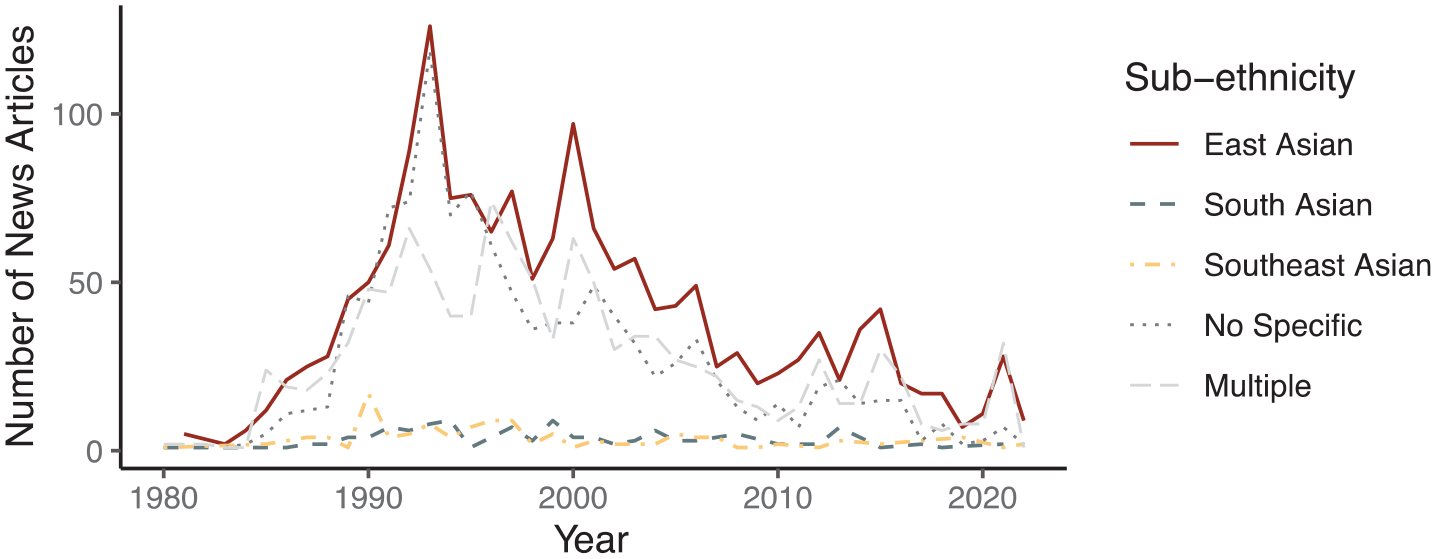
Yearly trends in the representations of subethnicities of Asian Americans among five national daily newspapers (1977–2022). The figure shows the annual frequency of news articles mentioning East Asian, South Asian, Southeast Asian, no specific, or multiple Asian subethnicities. The representation of each subethnicity is measured as mentions of both the ethnicities (e.g., South Asian) and the corresponding Asian countries (e.g., India). The findings suggest that South Asian Americans and Southeast Asian Americans are less likely to be included in discussions about Asian Americans, whereas East Asians are most likely to be mentioned in such discussions. The dataset comprises 4,179 news articles containing the keyword Asian American from the national newspapers from 1977 to 2022.
The general public often equates Asian Americans with East Asian Americans, while overlooking other subethnicities (Lee and Ramakrishnan 2020; Yamashita 2022). Scholars have critiqued how Southeast Asian and South Asian Americans are frequently ignored or marginalized even within Asian American studies (Dave et al. 2000; Kibria 1996; Ocampo 2016). This analysis provides evidence of how news media also equate “Asian American” with “East Asian American” and provides an example of how racial stereotypes and biases are institutionalized in news media. Such disparity may underestimate and obscure the diversity in cultural and socioeconomic status (Fishman 2020; Sakamoto, Goyette, and Kim 2009; Zeng and Xie 2004), civic and political engagement (Xiao and Bass 2021; Zhang 2023), health outcome (Hastings et al. 2015; Yom and Lor 2022), and racial experience (Bozorgmehr, Ong, and Tosh 2016; Lin et al. 2022; Shams 2020; Yamashita 2022; Zhang et al. 2023) among Asian subethnic groups. Although “Asian American” has evolved into a panethnic identity and a racial category, its internal heterogeneity and inequities requires further scholarly and public attention.
Supplemental Material
sj-docx-1-srd-10.1177_23780231231225152 – Supplemental material for Who Represents Asian American in Mainstream Newspapers
Supplemental material, sj-docx-1-srd-10.1177_23780231231225152 for Who Represents Asian American in Mainstream Newspapers by Hao Lin in Socius
Footnotes
Acknowledgements
I would like to thank Yongjun Zhang and Rui Cao for their feedback.

Supplemental Material
Supplemental material for this article is available online.
Author Biography
References
Supplementary Material
Please find the following supplemental material available below.
For Open Access articles published under a Creative Commons License, all supplemental material carries the same license as the article it is associated with.
For non-Open Access articles published, all supplemental material carries a non-exclusive license, and permission requests for re-use of supplemental material or any part of supplemental material shall be sent directly to the copyright owner as specified in the copyright notice associated with the article.
