



Abstract
How does social media content affect users’ online discourse? Existing scholarship sheds light on how several social media features involving content can influence users’ speech. However, this research often conflates content’s lexical dimension with its symbolic dimension. The authors analyze how the symbolic properties of online content can distinctly affect discourse on social media. Specifically, they examine how the symbolic meanings conveyed by Twitter’s reinstatement of Donald Trump’s account influenced Twitter users’ discourse. The results of embedding regressions indicate that Trump’s reinstatement immediately shifted users’ discourse about social and political identity-based groups, but only when they discussed Black and Jewish people. Additional results suggest that the discourse became more politicized and that the discursive shift was short lived. The authors’ findings contribute conceptual and analytical clarity to the sociosemantic dynamics of online discourse, encouraging future research to distinguish and compare the lexical and symbolic dimensions of online content.
How does social media content affect users’ online discourse? Social scientists have devoted extensive effort to understanding how individuals’ exposure to particular content influences what they subsequently say online (Kubin and von Sikorski 2021). However, much of this research does not conceptualize nor operationalize content’s constitutive properties and their potentially distinct effects. For example, work examining social media platforms’ banning of user accounts (e.g., Jaidka, Mukerjee, and Lelkes 2023; Jhaver et al. 2021; Rohlinger et al. 2023) often does not specify whether the ban affects other users because it reduces those users’ exposure to certain words or because they no long encounter a specific symbolic meaning conveyed by the account.
We conceptualize online content as comprising lexical properties and symbolic properties. The former are the words, phrases, opinions, observations, and arguments usually expressed with text and directly observed. The latter are meanings—collective ideas, narratives, sentiments, and morals—evoked by elements of the content, which may be lexical and text, but also include things like images, badges assigned to the account sharing the content, and who the account owner is. The distinction between content’s lexical and symbolic properties is not always clear cut. However, we argue that social media research’s emphasis on the words observed online undercuts the importance of the meanings brought to users’ minds not only by the words in a post, but also by what the words allude to, who posted the words, and the fact that the post exists at all. Our view is analogous to what McLean and Song (2023) called side-directed behavior in social networks: ties that link ego and alter sometimes take on a particular meaning because they are formed in the presence of, or refer to, a third party. In the context of social media content, a user’s message might explicitly say one thing while also conveying another meaning by evoking other users, the author’s background, or some other third entity or concept.
To advance our understanding of how social media content can influence users’ online discourse, we study the consequences of Twitter’s reinstatement of Donald Trump’s account in November 2022. 1 Trump’s reinstatement was manifested as online content consisting of both lexical properties—text shared by the platform’s owner, Elon Musk, announcing, “The people have spoken,” “Trump will be reinstated,” and “Vox Populi, Vox Dei”—and symbolic properties, such as the social and political ideas associated with Trump and what Musk was implying about tolerable discourse on Twitter. Moreover, the events following Trump’s reinstatement—he did not post any public tweets, for example—give us a rare opportunity to isolate the symbolic properties. Thus, our study’s design focuses the analysis on how online content’s symbolic properties can affect online discourse.
Three questions organize our analysis. First, do content’s symbolic properties change social media users’ discourse? Second, if the discourse changes, what are the substantive changes in discourse? Third, if there is a shift in discourse, how durable, or long-lasting, is the shift? Using newly developed methods that place word embedding measurements of meaning in a regression framework, we find evidence that the reinstatement’s symbolic properties did shift users’ discourse. However, this change occurred in only some of users’ discourse—discourse about Black and Jewish people, not discourse about LGBTQ people, women, or migrants—and it was short lived. A close examination of users’ tweets before and after the discursive shift uncovers that Trump’s reinstatement led to a greater politicization of speech. After reinstatement, users increasingly instrumentalized their (noxious) talk about Blacks and Jews to attack political enemies. These latter results suggest that the reinstatement announcement’s symbolic properties influenced discourse by embroiling socially and politically salient identity-based groups in political battles. The results of additional tests indicate that preceding events on Twitter did not lead to the change in users’ speech.
Our findings suggest that online content’s symbolic properties can, distinctly from its lexical properties, influence users’ discourse (at least in the short term). This evidence contributes conceptual and analytical clarity to the sociosemantic dynamics underlying online discourse, encouraging future research to distinguish between the lexical and symbolic dimensions of online content. It also advances our understanding of how politicized symbols can influence online speech, primarily by showing that symbols can spur instrumental references to minority and marginalized groups in political invective, resulting in users adopting certain rhetorical styles. At the same time, we do not find that politicized symbols necessarily lead to explicitly hateful speech, even if the symbol is itself associated with harmful viewpoints. Our findings additionally provide a richer understanding of recent changes on Twitter, now known as X, one of the most influential social media platforms in the world. Specifically, we shed light on discursive shifts, complementing recent work on how user behavior changed (Barrie 2023), while moving beyond broad-stroked reports of increasing hate speech on Twitter (Frenkel and Conger 2022). Finally, our analysis demonstrates the use of the newly introduced embedding regression method for examining discursive shifts in large collections of text.
Rhetoric, Symbols, and Social Media Content
A large body of scholarship has sought to explain how features of social media affect users. Some of this research investigates the activity or experience of using social media, such as the frequency of logging onto a platform (Jung and Lee 2023), the act of sharing messages or posts (Johnson et al. 2020), and receiving algorithmic recommendations to content like videos and external news sites (Chen et al. 2023; Levy 2021). Another portion of this literature focuses on social media content itself (Kubin and von Sikorski 2021). For example, reading novel political opinions on social media can make users more likely to express new political views (Gil de Zúñiga, Molyneux, and Zheng 2014; see also Bail et al. 2018) and, in some cases, even “radicalize” them (Pauwels and Schils 2016; Wahlström, Törnberg, and Ekbrand 2021). This category of work includes the numerous studies examining mis/disinformation and polarization, which show, for instance, that false content diffuses faster and more broadly than true content (Vosoughi, Roy, and Aral 2018) and that reducing the amount of like-minded content consumed by users does not lessen their polarization in beliefs or attitudes (Nyhan et al. 2023). 2
Although prominent in the scholarship, the research on social media content and its effects is sometimes conceptualized and operationalized imprecisely. The imprecision is due largely to conflating the lexical properties of content with what the content symbolizes. 3 For instance, taking a case motivating a recent headline—“Now Is the Time to Pay Attention to Trump’s Violent Language” (Kingsbury 2023)—it might be that a post’s instructions (i.e., “go after”) inspire a user to commit violence, but it could also be that a user is inspired by the fact that they read the words on a platform that symbolized a home community (e.g., Truth Social) or because of racial narratives evoked by the post’s targets (i.e., New York’s attorney general, who is a Black woman, and “shoplifters”). To offer another example, when Mann et al. (2023) analyzed the pathways to extremism on Reddit, they observed that users valued certain fora because of other users’ comments—the lexical component of content—as well as the names of the fora, such as “nonmainstream ideas, such as r/anarchism or r/libertarian,” which intimated that users were “allowed to disagree with each other on certain points” (p. 7).
The conflation of content’s lexical and symbolic properties also appears in research examining the consequences of platforms banning specific accounts (Rohlinger et al. 2023). In this work, it is not always clear whether the ban has (or does not have) an effect on other users because it reduces users’ exposure to certain words or because a symbol—what an account represents—is removed (e.g., Jaidka et al. 2023; Jhaver et al. 2021). We see another example in recent work on social media content and polarization: Nyhan et al. (2023) reduced Facebook users’ consumption of politically like-minded content by manipulating their feeds, but by doing so, they also decreased users’ encounters with like-minded friends and organizations, who were likely among their most familiar, trusted, and uplifting online interlocutors. Therefore, while the authors framed the study as analyzing a change in the words and expressions on users’ feeds, their experiment additionally captured a change in what users’ feeds meant, including the loss of a familiar and convivial digital space, not to mention all the ideas, narratives, sentiments, and morals associated with those users and organizations no longer appearing on their feeds. 4
Some social media scholars have recognized the importance of online content’s symbolic properties, and their studies provide evidence of symbols’ distinct effects and help us understand how symbols appear in social media content. For example, in their study on religious figures’ endorsement of tweets promoting intercommunal tolerance in Lebanon, Siegel and Badaan (2020) argued that although endorsements may be written, their influence depends on invoking, or symbolizing, their authors’ religious standing. Karell et al. (2023) provide an example of a nonwritten symbol by highlighting how accounts’ markers of status—in this case, a gold badge conveying elite status on Parler—can influence other users’ interpretation of these accounts’ posts.
Yet even some of the research sensitive to online content’s symbolic associations does not always isolate the effects of content’s lexical and symbolic properties. In a compelling study showing that some Americans became more likely to describe Black people negatively after reading racist tweets shared by Trump, Anspach (2021) experimentally manipulated tweets’ text but not the fact that a tweet was made by Trump. As a result, we see evidence that Trump’s racist tweets made some users more likely to describe Black Americans derisively, but we do not know how important it was that the tweets were associated with the meanings evoked by Trump.
Hypothesizing the Discursive Influence of Online Symbols
We analyze how the symbolic properties of social media content affect users’ online discourse. To do so, we examine the discursive aftermath of Twitter’s announcement that Trump’s account would be reinstated on the platform, which was communicated in a tweet posted by Musk. We elaborate below how this event can be leveraged to examine the influence of symbolic properties.
The symbol embedded in the reinstatement announcement is the return of Trump, and it conveyed at least two sets of meanings. The first set comprises the narratives, sentiments, and frames widely associated with Trump as a social and political figure. For example, he represented to many a version of the United States where patriotic citizens are valued and protected, rather than described as a “basket of deplorables” (Graham et al. 2021). He also symbolized the type of American who could (re)build that version of the country: White, (nominally) Christian, and stereotypically masculine, including being strong, decisive, and unbeholden to others (Smirnova 2018). Trump additionally embodied boundaries between social and political groups, and especially groups configured in majority-minority relations (e.g., White and Black Americans, native-born Americans and immigrants). In other words, Trump, like other politicized symbols, called to mind meanings that cued specific social and political group boundaries, making salient “who we are in opposition to a partisan them” (Scoville et al. 2022:3).
Building on three earlier discussed literatures—the work indicating that online content’s symbolic properties play some role in shaping users’ discourse (e.g., Anspach 2021; Karell et al. 2023; Siegel and Badaan 2020), the research describing Trump’s significance as a politicized symbol (e.g., Brooks and Harmon 2022; Graham et al. 2021), and the research emphasizing politicized symbols’ ability to cue social and political boundaries (e.g., Scoville et al. 2022; Smirnova 2018)—we construct our first hypothesis.
Hypothesis 1: Trump’s reinstatement on Twitter will be associated with a significant change in Twitter users’ online discourse about social and political identity-based groups, particularly minority and marginalized groups.
The return of Trump also conveyed a second set of meanings consisting of ideas about how to speak about others and do politics. That is, announcing that Trump was allowed on Twitter not only evoked the groups (motivating hypothesis 1), but also brought to mind—and, in the eyes of many, condoned—particular narratives, judgements, and frames about these minority and marginalized groups. For left-leaning Twitter followers of Trump, these sentiments were likely positive and supportive; for right-leaning followers, the sentiments were largely negative and disparaging (Brooks and Harmon 2022; Smirnova 2018; see also Mutz 2018). Given the countervailing nature of these sentiments, it is difficult to predict how the overall discourse about the groups would substantively change after reinstatement. However, we suspect that right-leaning individuals make up the majority of Trump’s followers (i.e., our study population), so we hypothesize as follows:
Hypothesis 2a: Users’ discourse about minority and marginalized groups will shift toward greater derision and hatefulness.
In addition to symbolizing ways to talk about minority and marginalized groups, the return of Trump pointed toward the populist style of doing politics (Brubaker 2017). A key element of this repertoire is actively criticizing and attacking the “elite” in the name of “the people” (Mudde 2004), as well as excluding and attacking outsiders who purportedly threaten the cultural integrity of the people (Brubaker 2017), and doing all this in the service of politics. Another core element is a “low” or “raw” mode of performance: enacting politics in a crude and disruptive style (Brubaker 2017; Ostiguy 2009). Following these insights, we additionally hypothesize as follows:
Hypothesis 2b: Users’ discourse about minority and marginalized groups will shift toward an attacking political rhetoric.
By “an attacking political rhetoric,” we distinguish between explicit harmful and hateful speech—slurs and other offensive terms meant in part to make members of certain groups feel bad (the focus of hypothesis 2a)—and a style that serves as a political tactic. In our context, the style would generally be referring to those groups in a negative way for the purpose of weakening political rivals—liberals and Democrats—and achieving other political aims.
Our data also allow us to examine how long the hypothesized discursive shifts may last. However, we do not have a clear expectation for the temporal duration, so we analyze the “stickiness” of any discursive change in an exploratory manner.
Data
Our analysis draws on two panel datasets, one used to examine an immediate effect of reinstatement’s symbolic properties and the other to examine its effect over time. To create these datasets, we first collected data on 3 million Twitter accounts following Trump on November 19, 2022, the day of reinstatement but before Musk’s declaration of reinstatement. 5 Next, we randomly sampled 10,000 accounts from the 3 million. From this sample, we retained all the accounts which had tweeted at least once before November 18, 2022, the day of Musk’s Twitter poll asking users whether Trump should be reinstated, resulting in a final sample of 2,184 accounts. We then collected these accounts’ existing public tweets, which were all from before Trump’s reinstatement, and continued to collect postreinstatement tweets every three days for a two-month period (while deleting duplicate tweets in the collection). We gathered a total of 155,942 unique English-language tweets, including retweets. 6 These procedures resulted in a database comprising a sample of Trump’s prereinstatement followers who had been at least minimally active on Twitter and the content they publicly shared.
We next constructed “treatment” and “control” indicator variables. To indicate exposure to a content’s symbolic property, we encoded every tweet after 19:47 Eastern time on November 18, 2022, as being exposed, or “treated,” in experimental parlance. This was the moment that Musk launched a Twitter poll asking users whether Trump should be reinstated, and when he communicated the symbol of Trump. The “control” indicator is assigned to every tweet that occurred after 19:47 Eastern time on November 17, 2022: 24 hours before the poll. As we elaborate below, estimating the control effect gives us confidence in the interpretation of our results.
Finally, we created the two panel datasets. The first, used to examine an immediate effect, consists of tweets from October 29, 2022, through 19:47 on November 20, 2022, or 48 hours after exposure to the symbol. The tweets belong only to those users who tweeted at least once before reinstatement (and after October 29, 2022) and at least once afterward (up to the evening of November 20). Thus, when using this panel to estimate an immediate effect of the treatment, we are comparing (1) sampled Trump followers’ discourse between Musk’s takeover of Twitter (on October 28, 2022) and Trump’s reinstatement with (2) these same users’ discourse immediately after reinstatement. We consider a 48-hour period after Musk’s poll as the “immediate” postreinstatement period because it allows all users at least 24 hours to have seen the live poll, which lasted one day. Moreover, the 48-hour period ensures we capture a few hundred unique users who tweeted after exposure. This first dataset contains 661 users and 28,486 tweets. During the 48-hour posttreatment period, these users posted 5,581 tweets, with each user tweeted eight times, on average. Table 1 describes the dataset in more detail.
Descriptive Statistics of the Two Panel Datasets.

The second panel dataset allows us to examine the effect of the symbol over time. It comprises tweets from October 29, 2022 (like panel 1), through 19:47 on December 31, 2022. As with panel 1, it contains only tweets by users who tweeted at least once before reinstatement (and after October 29, 2022) and at least once between reinstatement and the end of December 2022. As a result, the panel enables us to compare (1) the discourse that sampled Trump followers generated between Musk’s takeover of Twitter and Trump’s reinstatement with (2) the same users’ discourse from reinstatement through the end of 2022. Panel 2 contains 1,758 unique users and their 61,788 tweets. After reinstatement, these users created 34,391 tweets and tweeted 21 times each, on average. Note that panel 1 is a subset of panel 2. See Table 1 for further description of the dataset.
Analytical Strategy
Three aspects of our design help us account for the influence of content’s lexical properties; these allow us to improve the identification of symbolic properties’ effects beyond many previous studies. First, the content about Trump’s reinstatement did not refer to the discourse we analyze, which consists of how users discussed certain social and political groups, such as Jewish people and women. 7 This suggests that any effect we detect does not operate through the text Musk typed but rather through what reinstating Trump means to users. Second, the analysis covers a period during which Trump did not tweet. This allows us to rule out the possibility that lexical properties of Twitter-specific content from Trump caused a shift in the users’ discourse. Third, if we assume that the users in our study were exposed to rhetoric and symbols associated with relevant content via other offline and online sources, which is very likely, then, because we analyze a panel of Trump’s followers, exposure to this extra-Twitter content likely remained constant during the study period. After all, the content generated by Trump and his allies during 2022 was largely consistent since 2021, focusing mainly on the 2020 presidential election and other political grievances. 8
We test our hypotheses and explore the effect’s duration by analyzing the data in three steps. Each step adopts an embedding approach, including embedding regression, a recently developed technique for estimating how the meaning of words (or phrases) shifts in relation to changes in covariate values (Rodriguez, Spirling, and Stewart 2023). The broader embedding approach rests on models of text that quantitatively represent words’ semantic information. They are learned from a (typically large) corpus of text. During learning, each word is first located in its contexts, such as the word’s surrounding six words each time it appears in the corpus. Then, an algorithm uses this information to discern linguistic structure in the corpus and locate each word in a D-dimensional space (Rodman 2020; Stoltz and Taylor 2021). 9 We do not necessarily know what each dimension represents. Instead, we understand the dimensions, and the information they contain for each word, as reflections of a coherent linguistic system in the corpus (Arseniev-Koehler 2022).
When embedding models learn the representation of the semantic space, each word is associated with a 1 × D vector. The vectors can be thought of as words’ location coordinates in the space, and words with vectors that place them closer in this space are understood as having similar meaning (Arseniev-Koehler 2022; Stoltz and Taylor 2021). Words that are further apart in the space, or that have more dissimilar vectors, are interpreted as having different meanings. Embeddings models are therefore a useful tool for transparently and reproducibly examining the similarities between selected terms in a corpus, and then using these similarity metrics to make inferences about meaning in some social context of interest (e.g., Nelson 2021).
What does this measurement of “meaning” mean? At a basic level, the embedding measurement aligns with the distributional perspective of “meaning” (Firth 1957; Harris 1954): words’ particular meaning can be understood on the basis of how they co-occur with other terms. At a more abstract level, the embedding technique has affinity with structural linguistics, primarily because it approaches language as relational and coherent (Arseniev-Koehler 2022). Words’ meanings are inferred from their relationships with other words and positions relative to other words, rather than, say, dictionary definitions or properties of the words’ characters or sounds. In addition, the approach is premised on abstracting a coherent system from varied uses of words. Embedding models’ reduction of a corpus’s high-dimensional vocabulary into D dimensions depends on a latent structuring of how words in the vocabulary are used with one another. That is, the dimensions capture semantic information, and more similar vectors—those with more similar values across the dimensions—represent words more closely aligned by the corpus’s semantic system. Therefore, if we adopt the assumptions of relationality and coherence, embedding models offer an approximation of what people meant when expressing the words in a corpus.
Whether adopting the basic or abstract interpretation of how embedding models capture meaning, we understand meaning as giving sense and substance to discourse. Therefore, in the remainder of the article, we refer to measured characteristics or estimated changes in meaning as characteristics or changes in discourse.
Part 1: Estimating an Immediate Discursive Shift
The first part of the analysis tests hypothesis 1 by examining whether Trump’s reinstatement was related to immediate shifts in discourse about minority and marginalized social and political groups using embedding regressions. Embedding regressions work by first recovering the contexts of words (or phrases) of interest, which we refer to as “target terms.” The contexts comprise the terms that co-occur with each usage of any of the target terms within a given window (e.g., six words).
Recall that we expect the symbol of reinstatement to influence users’ discourse about social and political identities and groups, particularly minority and traditionally marginalized groups in the United States. Therefore, our target terms should be associated with these groups. We select the following words and/or phrases:
BLACKS: black(s)
JEWS/JEWISH: jew(s); jewish
LGBTQ: bisexual; gay(s), homo(sexual); lesbian; queer; trans(gender)
MIGRANTS: illegals; illegal alien(s); migrant(s); undocumented; undocumented migrant(s)
WOMEN: woman; women
Of course, there are other identities and groups we could have selected, but we limit ourselves to these few which have featured prominently in the discourse of Trump, the Trumpist movement, and the broader American conservative movement in recent years (Brooks and Harmon 2022; Chen et al. 2023; Mutz 2018; Smirnova 2018). Our data are publicly available, and future research could examine discourse about other identities, groups, and topics.
After selecting our target terms, we convert their context terms (from each of their occurrences) into vectors using an embedding model. The resulting context vectors are then averaged, creating one context vector per target term occurrence, and multiplied by a transformation matrix to down-weight common words. This à la carte (ALC) technique for measuring target terms’ meaning is fast and efficient, and works well with relatively small corpora, such as ours (Khodak et al. 2018; Rodriguez et al. 2023).
10
The result of these initial steps is an N × D matrix,
Finally, we fit the embedding regressions using variations of the matrix equation

where
To evaluate whether these shifts are significantly different from zero, we follow Rodriguez et al. (2023) and use permutation to compute empirical p values (rather than the bootstrapped standard errors, which, again, refer to differences within and across groups). Specifically, information in
In this first part, we use two kinds of embedding regression models. The first is

where ReinstatementTreatment takes a value of 1 if the observation occurred after what we have identified as the symbol of Trump’s reinstatement and 0 otherwise. We fit equation 2 for each set of target terms separately and each time use the panel 1 dataset.
The coefficient of interest, β1, describes how the reinstatement event is associated with a (possible) shift in users’ meanings of the target terms. This association could potentially be interpreted as a causal effect, as it meets one conceptual requirement of causality: it temporally precedes the outcome. However, a causal interpretation is threatened by confounding. For instance, prior changes in Twitter policies or discourse could have led to both Trump’s reinstatement and the discursive shift we observe. Twitter could have decided to reinstate Trump because of changes in users’ speech that had occurred, say, after Musk became the owner. To help assess whether prereinstatement factors explain any results obtained by equation 2, we use a second model:

where ReinstatementControl takes a value of 1 if the observation occurred after what we have defined as the “control” event (i.e., 24 hours before the true reinstatement). It is 0 otherwise. As with equation 2, we fit equation 3 for each set of target terms using the panel 1 dataset.
If we obtain a positive and statistically significant estimate of β1 in equation 2 but not equation 3, we gain confidence that our estimate of the symbol’s effect is not confounded by things that had previously happened on Twitter and that reinstatement likely led to changes in discourse. 11 Nevertheless, to be clear, we do not claim to be identifying a causal effect. Equation 3 is simply a straightforward way to rule out the most obvious source of bias in our estimate.
Part 2: Interpreting the Discursive Shift
Although equation 2 describes the relationship between exposure to the symbolic properties of reinstatement and a shift in discourse, it does not tell us how the discourse changes. Therefore, to understand the substance of a discursive shift, and to test hypotheses 2a and 2b, we identify and read the tweets most similar to the target terms’ ALC vectors before and after Trump’s reinstatement. 12 These tweets can be understood as the tweets with the most prototypical meanings of the target terms’ context words.
While reading, we consider how the most prototypical tweets differ before and after reinstatement. For example, to interpret how the meaning of “Blacks” changed, we first compute the ALC vector for the terms in BLACKS before Trump’s reinstatement. Then, we find the 30 tweets nearest to the target terms’ ALC vector (i.e., the most 30 most prototypical tweets about Blacks during the prereinstatement period). Next, we repeat these two steps for the terms and tweets that occurred after reinstatement. Finally, we examine how the identified tweets from before and after reinstatement compare with one another. We conduct this part of the analysis only for the discursive topics of Black people and Jewish people because, as discussed below, these are the only groups for which we identify an immediate effect of reinstatement.
Part 3: Examining the Duration of the Discursive Shift
Finally, we examine the duration of reinstatement’s potential discursive effect. Although part 1 of our analysis focuses on the immediate influence of Trump’s reinstatement, our analysis’s third and final part explores for how long reinstatement may have affected users’ discourse. Specifically, drawing on the panel 2 dataset and using the main embedding regression model (equation 2), we estimate the shift in discourse that occurred between the prereinstatement period and each 48-hour period after reinstatement (including the first, or “immediate,” period from part 1). 13 As mentioned when explaining part 1, we use a 48-hour period because it is the amount of time that gives us observations from a few hundred unique users while also providing a relatively fine-grained picture of change over time.
In total, we fit the model for 18 postreinstatement periods, stretching from November 20 through December 31, 2020. Each time, we only use tweets from those users who tweeted at least once during the prereinstatement period and at least once during the given 48-hour period. 14 In other words, we preserve the panel structure when examining each period. We again compute bootstrapped standard errors and empirical p values. As with part 2, we apply this part of the analysis only to the two topics for which we find evidence of an immediate discursive shift, Blacks and Jews/Jewish.
Results
We present our results in three parts, each corresponding to one of our research questions. First, we examine evidence that the communication of the symbol is associated with an immediate shift in discourse, which tests hypothesis 1. Second, we interpret the shift in discourse, testing hypotheses 2a and 2b. Third, we assess the duration of the shift, which is an exploratory analysis.
Part 1: Content’s Symbolic Properties Are Associated with an Immediate Shift in Discourse
Figure 1 presents the results of the first part of our analysis. We see that the symbol of reinstating Trump is related to subsequent shifts in discourses about Black people, Jewish people, LGBTQ people, and migrants. The largest estimated change occurred in discourse about Jewish people, although its magnitude is comparable with the shift in discourse about migrants. We do not obtain evidence that reinstatement affected discourse about women.

The shifts in discourse following exposure to the symbolic properties of Trump’s reinstatement, relative to exposure to the control event and across discourses about groups.
We also find that the control event is associated with changes in discourses about LGBTQ people, migrants, and women. These results suggest that something we do not directly identify occurred before Trump’s reinstatement that affected users’ discourse about LGBTQ people, migrants, and women and that it continued to exert an effect as the reinstatement was announced. In other words, the previous estimated effect of reinstatement for those groups is likely best explained by other things that were already happening on Twitter.
After considering the control results, we remain with evidence that the reinstatement’s symbolic properties generated a shift in users’ discourse, but only on topics related to Black and Jewish people. This finding supports hypothesis 1 and is consistent with the argument that content’s symbolic properties can cause immediate changes in discourse (but not necessarily discourse about all topics). Table 2 reports the complete results, including the empirical p values for all estimates.
The Estimated Shifts in Discourse following Trump’s Reinstatement and the Control Event, across Discourses about Groups.

p < .05, **p < .001, and ***p < .001 (empirical p values).
Part 2: Postreinstatement Discourse Focuses on Political Attacks
The evidence from part 1 suggests that exposure to Trump’s reinstatement rapidly shifted discourse about Black and Jewish people. What did these shifts entail? Our examination of the most prototypical tweets about Black people—the tweets located most closely to the ALC vector of the BLACKS target terms—indicates, first and foremost, that the users’ discourse during the period was largely noxious. Although we do not observe many instances of outright hate speech (potentially because of platform moderation), discussion about race and Black people’s place in society was frequently contentious; most tweets have an argumentative and critical tone. However, the negative tenor of the discourse was present before and after Trump’s reinstatement, so we cannot attribute it to the reinstatement. Rather than a change in noxious or hate speech about Blacks after Trump’s reinstatement, we find evidence of a more subtle alteration in discourse. Namely, users politicized their talk about race and Black people; Blacks become an instrument to make political attacks against liberals, Democrats, and left-leaning ideas.
Before reinstatement, people in our panel often used the words “black” and “blacks” in relatively mundane ways, such as in the eighth most prototypical tweet, which discusses dating (i.e., “As a black person your reasons for not dating other black people will never make any sense to me”) and the 10th most prototypical tweet, which criticizes the depiction of Black men in the film Black Panther. Users also sometimes used these terms in ways that were unrelated to race. For example, the third most prototypical tweet prereinstatement is about the Twitter app’s possible demise (Table 3, observation Pre3). The tweet ranked 15th asks, “How many of these do we need to have before we stop calling them black swans?”
The Most Prototypical Tweets about Black People before and after Trump’s Reinstatement.
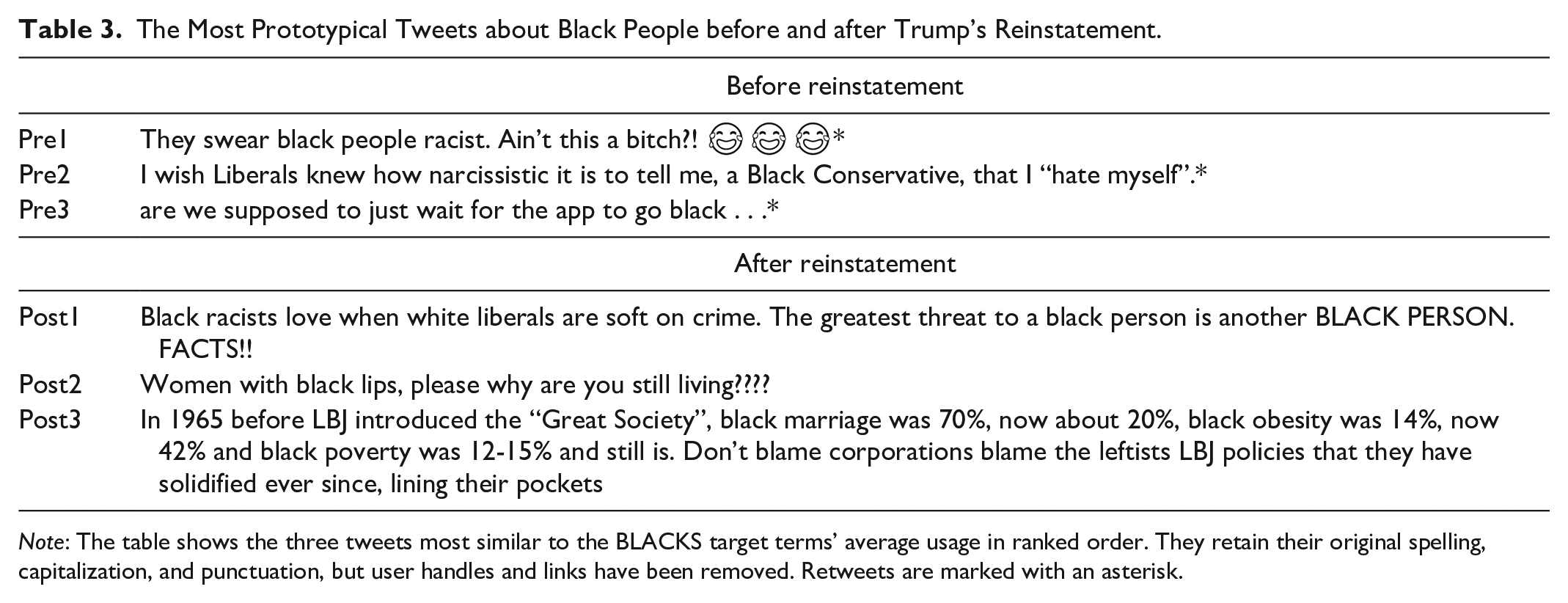
Note: The table shows the three tweets most similar to the BLACKS target terms’ average usage in ranked order. They retain their original spelling, capitalization, and punctuation, but user handles and links have been removed. Retweets are marked with an asterisk.
More often, however, users in our sample discussed Blacks in the context of race and society, and did so with a critical sentiment. Yet rather than expressing stark racism, the users discussed, usually in a negative tone, how others talk about Blacks and engage issues of race and racial disparity. For example, the second ranked tweet expresses dismay about how people talk about Black conservatives (Table 3, observation Pre2). The sixth ranked tweet asks, “Why are so many people in TV ads black? It’s getting silly now. Every family seems to be mixed race. It’s no representative.”
15
The seventh ranked tweet references both how others talk about their race and how race is considered in the context of employment: Elon [Musk] said he only wanted ppl that were willing to do the work, not grifters. If you’re bi-racial, why do you call yourself black? What’s the other race? Pretty sure Musk looked into your contributions, not your skin color, bye!
After reinstatement, we do not find examples of banal comments about Black people or race, nor do we find tweets using “black” or “blacks” in nonracial contexts. Instead, we obtain a few examples of offensive speech and many examples of users referring to Black people in the context of race for the purpose of attacking liberals, Democrats, and left-leaning ideas. Although evocative of one tweet we identify in the pretreatment period (i.e., Table 3, observation Pre2), this kind of speech was far more common after reinstatement. For example, the most prototypical tweet makes claims about Black people and crime while also attacking “white liberals” (Table 3, observation Post1). The third ranked tweet casts Blacks as unmarried, obese, and poor in the service of criticizing “leftists LBJ policies.” The 11th-ranked tweet continues the pattern: Did you tell her the KKK was started by the democrats and that they continue to enslave black ppl to this day? Have her research LBJ’s great society and Margaret Sangers plan to extinguish “negro’s via abortion and PP [Planned Parenthood]. She sounds like the product of public school ed. It’s on you!
Our analysis of the discourse about Jewish people—the only other discursive topic to shift after reinstatement—uncovers a strikingly similar change. As with the users’ discourse about Black people, the discourse before and after reinstatement was overall unfriendly, but did not rise to the level of flagrant hate speech. This aspect of the discourse did not change after reinstatement. Instead, the most prototypical speech about Jews after reinstatement cast Jewish people in a negative light while instrumentalizing them in attacks against political enemies.
Before Trump’s reinstatement, and similar to the prereinstatement discourse about Blacks, we observe a few trite comments, such as the seventh most prototypical tweet, which remarks that “since we are on the subject Jewish people,” pastrami is “good as hell.” However, also akin to the prereinstatement discourse about Blacks, the prevailing trend in users’ discourse was to talk about how other people talk about Jewish people. For example, the top ranked tweet references a controversy over comments by Kyrie Irving, a professional basketball player, about Jews (Table 4, observation Pre1). The second and third ranked tweets are similar. The former is about other Twitter users’ speech about Jews (Table 4, observation Pre2); the latter defends others’ jokes about Jews (Table 4, observation Pre3). This pattern continues outside of the top three tweets. The ninth most prototypical tweet, for example, says, “Normally I think Kyrie a goofball. But that man right. You say anything about jews now a days and it’s antisemitic, regardless if it’s fact.”
The Most Prototypical Tweets about Jewish People before and after Trump’s Reinstatement.

Note: The table shows the three tweets most similar to the JEWS/JEWISH target terms’ average usage in ranked order. They retain their original spelling, capitalization, and punctuation, but user handles and links have been removed. Retweets are marked with an asterisk.
After the Trump’s reinstatement, the users’ discourse about Jews changed in the same way their discourse about Blacks did: it shifted toward instrumentalizing Jews in the service of political attacks. The most prototypical tweet after reinstatement associates Jews with “RADICAL Bolsheviks” in a criticism of the “worst ideas” of a leftist revolution (Table 4, observation Post1). The second ranked tweet similarly links Jews to “Hardline Bolshevist Beliefs” while raising the specter of “Socialism in the West” (Table 4, observation Post2). The third ranked tweet references Jews (alongside Christians and the Bible’s book of Revelations) in a claim that “the left and western powers” do not protect “religious people.”
In sum, we find evidence across discursive topics suggesting that the symbolic properties of Trump’s reinstatement affected users’ discourse by enlisting their speech about Blacks and Jews in the service of political attacks. This shift in speech portrayed Black and Jewish people in a negative light, but its most distinguishing feature is how the uncivil speech was used to denigrate political enemies. We interpret this as evidence supporting hypothesis 2b but not hypothesis 2a.
Part 3: Content’s Symbolic Properties Did Not Lead to a Lasting Shift in Discourse
Finally, we examine the duration of the discursive shift. The evidence indicates that it was short lived. The left panel of Figure 2 shows our estimates of the change in discourse about Black people for each 48-hour period after reinstatement. We see that the discourse in the first period was significantly different from the prereinstatement discourse (empirical p < 0.05). This is the result we report in Part 1 of this section. We also see that the discourse was significantly different during the third 48-hour period (empirical p < 0.05). However, after this time, we find no evidence that the discourse about Blacks differed significantly from before reinstatement.

The shifts in discourses about Black and Jewish people over time.
When considering the change in discourse about Jewish people, our findings are similar. The right panel of Figure 2 shows the immediate effect, also reported in part 1 of this section, and evidence of a significant difference in speech during one period in early December (both estimates have empirical p values <0.05). The figure also shows that the discursive difference was not again significant at any time during the remainder of the year. Overall, our results indicate that reinstating Trump did not have a long-lasting effect on discourse about Black and Jewish people. It changed users’ speech quickly, but users just as quickly reverted to their usual speech.
Discussion and Conclusion
We have examined how the symbolic properties of online content can affect discourse on social media. To do so, we used embedding regression, a newly introduced method for estimating how changes in meaning are associated with attributes of documents (Rodriguez et al. 2023). We found evidence that the symbolic meanings conveyed by Trump’s reinstatement were associated with an immediate shift in users’ discourse about social and political identity-based groups, but only in their discourses about Black and Jewish people. These shifts involved a politicization of their speech: after reinstatement, the most prototypical speech about Blacks and Jews consisted of (negatively toned) references to these groups in the service of attacking users’ political enemies, who were primarily liberals, Democrats, and left-leaning ideas. We additionally found evidence that the symbol’s effect was short lived. Weeks after reinstatement, users’ discourses about Black and Jewish people were not significantly different from their discourse before reinstatement.
Our study’s design helped us untangle the effect of content’s symbolic properties from other sociosemantic dynamics that can shift online discourse. Namely, we gained confidence that lexical properties of online content did not cause the discursive change because of three aspects of our design: Musk did not refer to social or political identities or groups when announcing Trump’s reinstatement; Trump did not tweet after reinstatement; and our study’s subjects, Trump’s Twitter followers, were likely exposed to consistent kinds of content on other media and online channels. In addition, by analyzing a panel of users over a short amount of time—48 hours in the first part of the analysis—it is unlikely that users’ discourse was affected by new sources of social influence or in news ways by existing social relationships. Moreover, a test using a control condition (i.e., tweets from before reinstatement) provided evidence that other things already happening on Twitter before Trump’s reinstatement did not generate our main results. Our findings are consistent with the argument that the symbolic properties of online content can independently influence discourse on social media, although the evidence indicates that only some discourses may be affected and for not very long.
The study has limitations that point toward opportunities for further development. First, it is possible that the results are specific to Trump’s reinstatement. If this is the case, our arguments might have limited generalizability. Future research could adopt our design and examine other influential accounts becoming banned, reinstated, or granted some marker of status, as well as other widely recognized symbols embedded in online content.
Second, our study did not eliminate the effects on users from social influence or exposure to other novel content. For example, although users in our study were not influenced by the text of Trump’s tweets—there were none—they could have been influenced by the words contained in other users’ tweets. However, if we assume that Trump followers are primarily influenced by other Trump followers, then any new peer-generated content causing a change could have itself originated from the symbolic properties of Trump’s (textless) reinstatement.
Another possibility is that users were influenced by (legacy or digital) media outlets that published extensively about Trump’s reinstatement (e.g., Frenkel and Conger 2022). We cannot be sure how these other sources’ content affected users in our study, but it is reasonable to expect that their content’s symbolic properties functioned similarly to those we examine. Nevertheless, other sources’ reporting on reinstatement likely does not seriously threaten our main findings, which are based on an immediate effect, because it took time for these reports to be published, diffuse, be viewed, and be read.
Ultimately, our accounting of alternative sociosemantic dynamics was made through a combination of study design and reasonable assumptions. More research is needed to completely rule out alternative mechanisms and processes, as well as understand how applicable our findings are to other social media platforms and media outlets. Yet rather than “controlling” away alternative mechanisms, we think it would be more fruitful to compare the effects of content’s symbolic properties with those of content’s lexical properties, as well as other sociosemantic mechanisms. For example, our results indicated that politicized symbols embedded in online content can influence online speech by miring references to some minority and marginalized groups in political attacks, and not in explicit hate speech. Another study focusing on politicized rhetoric might find that it is online content’s lexical properties, and not its symbolic properties, which are responsible for shifting discourse toward greater hate speech or changing discourse about a wider range of identities and groups. Indeed, it remains unclear why we observed a change in the discourse about some minority and marginalized groups but not others, and hope future research investigates reasons for this variation.
A third opportunity for further research is to identify and examine whether different types of symbols have different kinds of effects. For example, our results indicate that symbols’ discursive consequences can be short-lived. In contrast, Karell et al. (2023) found evidence that symbols of elite status (i.e., badges assigned to accounts by a social media platform) can influence users a month later. This difference may be due to the analysis of different kinds of symbols; unlike Trump’s reinstatement, the symbols of eliteness explicitly convey a notion of relative social status. Moreover, Karell et al. (2023) argued that the symbols’ effect is due to how it interacts with the content’s lexical dimension. This suggests a related opportunity for future work: after distinguishing content’s lexical and symbolic properties, and perhaps variants of these properties, researchers can theorize and analyze their interactions. Ultimately, whether future research focuses on comparisons or interactions, we argue that differentiating between the lexical and symbolic components forming online content, and examining their relative effects or interplay, can add conceptual and analytical clarity to our understanding of why and how online discourse changes.
Footnotes
Acknowledgements
For helpful comments and suggestions, we thank two anonymous reviewers and the editors of Socius, as well as Tom Davidson, Tom Einhorn, Danielle Melvin Koonce, Laura Nelson, Cat O’Donnell, Eunkyung Song, and Yongjun Zhang (collectively forming the Collective Behavior & Social Movements Group on Computational Methods).
