




Abstract
Attention to the living arrangements of singles has centered around young adults who increasingly reside with their parents. By comparison, midlife singles remain overlooked despite a substantial rise in singlehood during this life-course stage. Using the 2021 American Community Survey five-year estimates, the authors uncovered the disparate living arrangements of midlife single men and women household heads, defining midlife as those aged 30 to 49 and single as those who were neither cohabiting nor married. The findings revealed that the living arrangements of men and women were near inverses of each other, with most men living alone, whereas most women lived with someone else. Relative to men, a far greater share of women were residing with their children, whereas a larger share of men were in arrangements that did not include children. The distinctive living arrangements speak to the potential differences in familial obligations and available support sources.
About 40 percent of U.S. adults are single, neither married nor cohabiting (Juteau 2022). The retreat from marriage has contributed to the well-established growth in singlehood among younger adults. However, nearly 3 in 10 unmarried adults are in midlife (aged 30–49 years), a share that has risen sharply over the past half century (Marino 2023). Despite growing attention to the living arrangement configurations of young adult singles, who increasingly either “fail to launch” or “boomerang back” to their parental households (Fry, Passel, and Cohn 2020; South and Lei 2015), the constellation of living arrangements for midlife singles remains opaque. Midlife single adults are often never married (Juteau 2022), but many have not cohabited, either (Manning, Brown, and Payne 2021). Others are single again following a cohabiting dissolution, divorce, or widowhood.
Being single does not equate to living alone. For instance, many midlife adults have children, and mothers more often have custody of their children than men. Still, other singles may reside with family members, such as parents, siblings, grandparents, or roommates. We aim to illustrate the myriad living arrangements of midlife single adults aged 30 to 49 years, focusing on how these patterns differ between men and women. We define singles as unmarried adults who do not reside with cohabiting partners. Using data from the 2021 five-year American Community Survey (Ruggles et al. 2023), we illustrate the most common living arrangements of single men and women household heads in midlife. Our supplement details the method of analysis.
Results
As shown in Figure 1A, midlife single men’s and women’s living arrangements are diametrically opposed. Even as most single midlife men lived alone (65.52 percent), only a minority of women lived solo (34.31 percent). Instead, women typically lived with others (65.69 percent). By comparison, few midlife single men lived with others (34.48 percent).
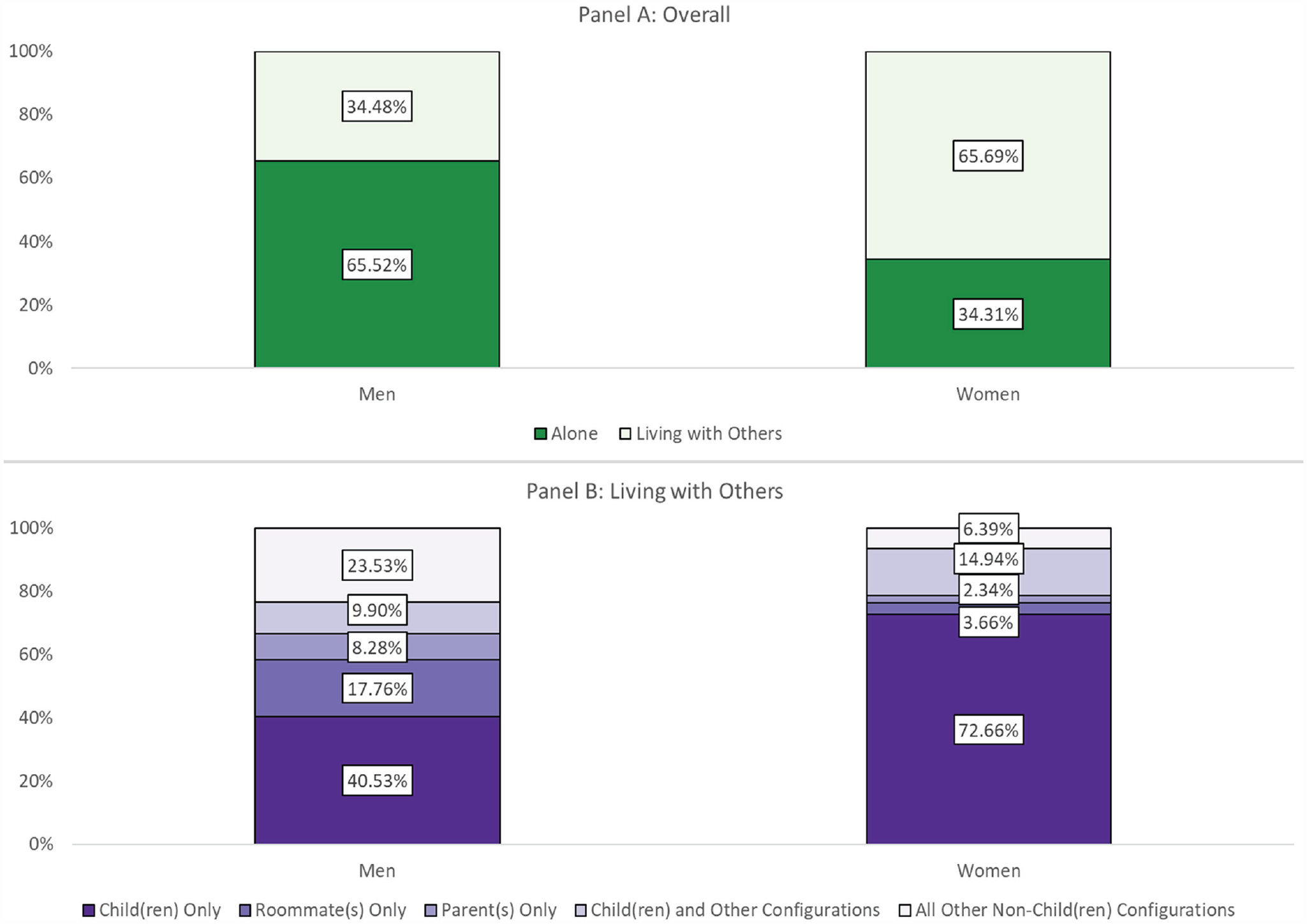
Living arrangements of single midlife men and women: (A) overall and (B) living with others.
Figure 1B illustrates the divergent arrangements between midlife single men and women living with others. For both men and women, living with only their children was the modal arrangement, but nonetheless the gap between men and women was wide: just 40.53 percent of men compared with 72.66 percent of women lived with only their children. Living with only roommates was considerably more common among men (17.76 percent) than women (3.66 percent). Similarly, men more often resided with their parent(s) only (8.28 percent) than did women (2.34 percent). Living with their child(ren) and others was a less frequent arrangement for men (9.90 percent) than women (14.94 percent). Last, a greater share of men resided in some other form of configuration not including children (23.53 percent) relative to women (6.39 percent).
Implications
Single men’s and women’s living arrangements in midlife were essentially the inverse of each other. Whereas two in three men lived alone, roughly two in three women lived with others. Among those living with others, a greater share of women than men were in arrangements that included children, whereas men were more often in any of the arrangements that did not include children. The distinctive experiences of midlife single men and women household heads in terms of living arrangements signal unique constellations of familial and social support and obligations. Examining the stability of these arrangements across time and how they may manifest in differences in health and well-being is a logical next step in the underresearched midlife context.
Supplemental Material
sj-docx-1-srd-10.1177_23780231231205211 – Supplemental material for The Myriad Living Arrangements of U.S. Single Men and Women in Midlife
Supplemental material, sj-docx-1-srd-10.1177_23780231231205211 for The Myriad Living Arrangements of U.S. Single Men and Women in Midlife by Christopher A. Julian and Susan L. Brown in Socius
Footnotes
Funding
The author(s) disclosed receipt of the following financial support for the research, authorship, and/or publication of this article: This work was supported in part by the Center for Family and Demographic Research at Bowling Green State University, which has core funding from the Eunice Kennedy Shriver National Institute of Child Health and Human Development (P2CHD050959).

Supplemental Material
Supplemental material for this article is available online.
Author Biographies
References
Supplementary Material
Please find the following supplemental material available below.
For Open Access articles published under a Creative Commons License, all supplemental material carries the same license as the article it is associated with.
For non-Open Access articles published, all supplemental material carries a non-exclusive license, and permission requests for re-use of supplemental material or any part of supplemental material shall be sent directly to the copyright owner as specified in the copyright notice associated with the article.
