




Abstract
Agency theory explains many processes of interest to sociologists, such as overcoming conflicts of interest, information management, delegation of power and control, and the social dilemmas that arise when one acts on behalf of another. Despite its explanatory power, agency theory has been underused in sociology. To better use and contribute to agency theory, the author proposes a sociological agency model (SAM). This model incorporates a wide range of motivations and behaviors for both principals and agents, embeds the principal-agent dyad in meso- and macro-level structures, and considers the role of legitimacy of control. The author uses SAM to explain how parents and children negotiate teen sexual behavior. Data from the National Longitudinal Study of Adolescent to Adult Health support the expectations of SAM as applied to parent-child negotiations of teen sex. Teenagers avoid parental supervision and control and strategically conceal information to have sex against the wishes of parents.
Keywords
The problems of social control and interest alignment that emerge when one actor acts on behalf of another are fundamentally sociological (Kiser 1999; Shapiro 2005). Examples include loved ones’ entrusting family members with end-of-life care, employers’ regulating worker compliance, gang leaders’ selecting future gang members, and citizens’ controlling politicians whose interests may conflict with their own (Adams 1996; Burau and Andersen 2014; Densley 2012; Kinane 2021; Mitnick 1992; Shapiro 2019; Sharma 1997; Testa 2013). Yet the prevailing account of such relationships found in economics, management, and political science—agency theory—is fundamentally nonsociological. Key explanatory elements of social life with roots in sociology, such as legitimacy of control and social norms, have yet to find a place in these models. Classical agency theory, in other words, focuses on interests, instrumentality, and strategic action at the expense of institutions, legitimacy, and social roles.
In this article I attempt to amend and update agency theory for a sociological audience. To do so, I specify what I call the sociological agency model (SAM), which integrates theories and findings from sociology with the nuts and bolts of classical agency theory. I then use SAM to explain a noneconomic relationship of interest to sociologists: parent-child negotiations over teen sex. In the United States, teen sex often exhibits core elements of agency theory: conflicts of interest between parents and children, children acting on behalf of parents, parental control over children, and information management by adolescents (Mollborn 2017; Schalet 2011). At the same time, parent-child relationships differ from classical principal-agent relationships in ways that demonstrate the value of SAM.
In the remainder of this article, I introduce agency theory in more detail and specify a sociologically situated version of agency theory. Data from the National Longitudinal Study of Adolescent to Adult Health (Add Health) are used to test an agency model of parent-teen negotiations of teen sex. The analysis centers on cases in which abstinence from sex can be interpreted as compliance with parental wishes, and examines how parent and child strategies, contracts, and resources influence compliance. The results suggest that the theoretical scope of agency theory can be extended beyond formal economic exchanges to informal, noneconomic interactions, and that information management is a key mechanism by which low-power actors gain control over matters of interest to them.
Classical Agency Theory
In its simplest form, agency theory specifies two types of actors (Eisenhardt 1989; Jensen and Meckling 1976; Ross 1973). The first actor is the principal, someone who is often in a position of power and authority, but who must delegate some of their power to a second actor, the agent, in exchange for a service or good that the agent provides to the principal and that the principal cannot provide independently. The issue is that the agent, whose interests may differ from those of the principal, has more information about their competence and motivation to render the service than the principal. For the principal, the uncertainty that exists about the relationship between agent’s effort and service provision makes it difficult to evaluate and efficiently regulate agent compliance. The agent, if acting strategically, will exploit the uncertainty and information asymmetry by withholding information to ensure their own interests at the expense of the principal, resulting in noncompliance with service provision. The principal, as a counter-strategy, can attempt to ensure their own interests, and induce agent compliance in several ways: (1) by selecting motivated, honest, and capable agents; (2) by monitoring the actions of agents; and/or (3) by aligning the agents’ interests with their own through value transmission or incentives (e.g., rewarding agents contingent on service provision) (Jensen and Meckling 1976).
In addition to selection, monitoring, and incentives, a number of factors affect compliance in agency relationships. First, principal-agent relationships hinge on a contract, or a mutually agreed-upon understanding of how an exchange takes place and of the conditions under which agents render their services (Jensen and Meckling 1976; Kiser 1999; Shapiro 2005). A contract increases the control capacity of principals and the compliance of agents, but specifying a contract is costly (costs associated with specifying a contract are termed agency costs or transaction costs) (Tirole 1999). Second, a principal’s preferences for, and assessment of, risk affect who they choose as an agent and how effectively they control the agent’s behavior (Eisenhardt 1989; Shapiro 2005). Third, an agent’s dependence on a principal, as well as their aversion to risk, reduces the principal’s need for control and increases the agent’s likelihood of compliance.
The agency problem is a key driver of economic and political outcomes (Ross 1973; Shapiro 2005). Research in political science uses agency theory to determine how the timing and magnitude of sanctions induce politicians to act on behalf of the public, to explain how partisan politics creates scenarios in which agents appease multiple principals, and to examine state-sponsored terrorism (Byman and Kreps 2010; Downs and Rocke 1994; Miller 2005). The extensive literature on agency theory in economics and management science extends original propositions by examining additional motivations for delegation (Hamman, Loewenstein, and Weber 2010) and uses agency models to explain a wide variety of outcomes, including the efficiency of family firms and the enforcement of corporate social responsibility (Block 2011; Ciliberti et al. 2011).
Agency problems also characterize many situations of interest to sociologists, especially those involving conflicts of interest, the delegation of power and control, and the social dilemmas that arise when people act on the behalf of others (Adams 1996; Burau and Andersen 2014; Kinane 2021; Mitnick 1992; Shapiro 2019; Testa 2013). Despite prominent calls to expand the scope of agency theory beyond the fields of economics, management, and political science (Kiser 1999; Mitnick 1992; Shapiro 2005), agency theory has been underused in sociology. The few sociological applications of agency theory examine compliance with economic contracts or with state-level regulations (e.g., Adams 1996; Kiser and Schneider 1994; Reed 2019). In these studies, the relationship between principal and agent is formal and instrumental (e.g., financial, contractual, or legal in nature).
However, specifying a version of agency theory that extends to informal, expressive relationships can add to what we know about acting on someone’s behalf (Kiser 1999; Mitnick 1992; Shapiro 2005). Accounting for the sociological processes that structure principal-agent relationships, such as the forces that give some actors the right to monitor and sanction others, can help specify both what types of actors tend to end up in principal and agent roles and the extent to which third-party enforcement underpins many principal-agent relationships (Mitnick 1992).
A sociological perspective can highlight the many nonpecuniary costs and rewards that affect the behavior of both principals and agents. For example, social rules governing what principals and agents should talk about (and how they should talk about it) can increase the transaction costs of specifying a clear contract governing agent compliance (Rote and Smetana 2016; Tirole 1999; Westin 1967). Emotional and reputational sanctions can be powerful incentives, especially in close, affective relationships (Hao, Hotz, and Jin 2008; Simpson and Willer 2015). And embeddedness in normative or bureaucratic structures, such as religious groups or professional guilds, may facilitate or hinder a principal’s enforcement (Gorski 2003; Horne and Mollborn 2020; Shapiro 2005).
In addition to the gains to classical agency theory from a sociological reformulation, sociology also benefits from embracing a wider model of agency. First, the agency paradigm characterizes many social relationships, including patients and caregivers, migrant workers and recruiters, individuals with specialized knowledge and their patrons, white-collar criminals and their victims, politicians and their constituents, and even, as I show here, parents and children. Second, agency dynamics affect social hierarchies by redistributing control capacity toward those with little initial claim to authority (agents) and by undermining the control of powerful actors (principals). Third, agency theory explains why norm enforcers who are often considered the most effective—those with vested interests—can be rendered powerless by information asymmetries, and how such enforcement problems can, in the aggregate, reduce norm compliance (Horne and Mollborn 2020). In sum, agency theory offers a general account of the pitfalls of interdependence, and the conditions under which actors put the interests of others ahead of their own.
A Sociological Agency Model
In amending classical agency accounts to make them relevant to sociological research, I specify a sociological agency model (SAM). As shown in Table 1, SAM retains the core features of the classical agency model: (1) acting on behalf of someone else as the key relationship linking principals and agents; (2) conflicts of interest between principals and agents, (3) a contract, or mutual understanding of how an agent should act on behalf of the principal; (4) monitoring and sanctioning by the principal to secure their own interests; and (5) information management by the agent to safeguard their interests.
Classical and Sociological Agency Models.

Other aspects of SAM, however, differ from the classical model. The differences between classical agency theory and SAM can be organized in three ways: breadth, embeddedness, and legitimacy.
Breadth
SAM encompasses a wider variety of communications and motivations. Contracts between principals and agents need not be formalized, but can include a range of agreements between principals and agents (Berk 2015; Ertman 2016). Principals’ beliefs about an agent’s trustworthiness increase the likelihood of informal contracts without undermining principal-agent cooperation (Cook, Hardin, and Levi 2005; Kramer 1999; Miller and Whitford 2002). Likewise, SAM allows actors to be motivated by a wide variety of incentives in addition to, or instead of, monetary costs and benefits (Hedstrom 2005; Willer 2009). Social and emotional rewards include respect, social status, and affection, while costs can include relationship dissolution, guilt, loss of social standing, and social exclusion. Such costs are often relationship specific and vary according to (1) the value of the relationship to the agent or principal and (2) the degree of dependence of the agent on the principal (Horne 2009; Reczek and Bosley-Smith 2021).
Embeddedness
In contrast to classical agency theory, which views principals and agents as atomistic dyads (Kiser 1999), SAM does not assume that actors are randomly sorted into roles of principal and agent, but accounts for how the principal-agent relationship is produced by sociological processes such as authority structures, ties to others, and norm enforcement (Sampson, Morenoff, and Earls 1999; Schalet 2011; Shapiro 2019; Westin 1967). Actors’ evaluations of themselves and others on the basis of salient sociological categories, rather than “most efficient” agents and principals, and socioemotional factors such as affection are also considered (Elliott 2012; Hagan, Simpson, and Gillis 1987; Ridgeway 1991).
SAM accounts for the influence of communities and networks. Community members, for instance, are a critical source of social control through the specification and enforcement of social norms (Horne 2009; Horne and Mollborn 2020; Kreager and Staff 2009). 1 Norms can amplify or resolve conflicts of interest, increase compliance, grant some individuals power over others, and establish general rules for acting on behalf of others (e.g., how much privacy should or should not be afforded to others) (Gorski 2003; Horne and Mollborn, 2020; Westin 1967). Communities and social networks influence agency relationships by manipulating information asymmetries between principals and agents (Adams 1996). Friends help teenagers lie to parents about their whereabouts, politicians collude to act against the wishes of voters, and brokers who bridge structural holes manipulate information to advance their interests at the expense of their clients’ (Burt 1992; Stovel and Shaw 2012). Conversely, a network of adults can detect and sanction teen noncompliance more effectively than isolated parents (Sampson et al. 1999; Simons et al. 2005).
SAM also recognizes that principal-agent relationships can span multiple domains and time frames, and be emotionally charged. For instance, a patient and a doctor may also be friends and neighbors; parents and children may have conflicting interests regarding teen sex, but not regarding teen Internet use. In other words, a principal who is connected to an agent in multiple ways (patient, neighbor) may be the principal for one social tie but the agent for another (and vice versa), or a principal and an agent may experience a conflict of interests on one issue (teen sex) but an alignment of interests on another (Internet use). In long-term relationships, the behavior of principals and agents with respect to an agency problem at a specific time is influenced by the shadow of the future, reputational mechanisms, and opportunity costs (Hao et al. 2008). Parents who sanction too harshly risk damaging their relationship with their children for years to come. Finally, because it is difficult to replace actors when they are embedded in familial or expressive relationships (Shapiro 2005), it may be impossible for principals to “hire” and “fire” agents as a means of bolstering compliance, and agents may begrudgingly tolerate unreasonable principals (Tsao et al. 2021).
Legitimacy
In the larger context of embeddedness, a key contribution of SAM is the inclusion of the principal’s right to control the agent. The legitimacy of the principal’s control and authority over the agent is not explicitly defined in classical agency models (Mitnick 1992), but it is a crucial component of agency problems. I draw on Zelditch (2018) to define control as legitimate when it is accepted as “natural, right, proper, or in accord with the way things are or the way things ought to be . . . not only by those who in some way gain from it, but also those who do not” (p. 340). Legitimate control is maintained and supported by normative and material resources, while illegitimate control can be severely sanctioned (Johnson, Dowd, and Ridgeway 2006; Zelditch 2004). Consequently, legitimacy is key to agency relationships because it specifies the capacity of the principal to monitor and control the agent (Schoon 2022). Because the legitimacy of a behavior is determined and upheld by groups of actors, the legitimacy of a principal’s control over an agent implies the involvement of third parties: to understand a principal-agent exchange relationship, we must understand how third parties sanction or endorse the behavior of principals and agents in their respective exchange relationships.
As in the legal definition of an agency relationship (Mitnick 1992), legitimate rights to control the agent often imply a responsibility to control the agent. Because principals are uniquely positioned, permitted, and motivated to control agents, they are often held responsible for agent behavior. This implies that individuals who are collectively recognized in the principal role bear costs for agent noncompliance over and above the costs that would arise if the agency relationship existed independently of others. This is similar to obligations and sanctions that are applied to norm enforcers (Horne 2009), except that principals can be held accountable for an agent’s behavior in both normative and nonnormative settings. As legitimacy facilitates social control, one strategy for the agent may be to delegitimize the principal’s means of control. An example would be politicians who attempt to delegitimize constituent control by challenging voting practices or election results.
Figure 1 summarizes SAM. As Figure 1 shows, SAM retains the core features of the classical agency model, namely the delegation of a task or service by the principal to an agent under conditions of uncertainty, and models compliance on the part of the agent as a function of minimizing conflicts of interest and information asymmetries between the principal and the agent. The dotted lines indicate that the effects of informational asymmetries and interest alignment on compliance are interdependent: information asymmetries influence the efficacy of incentives, and in the absence of a conflict of interest, information asymmetries do not affect compliance.
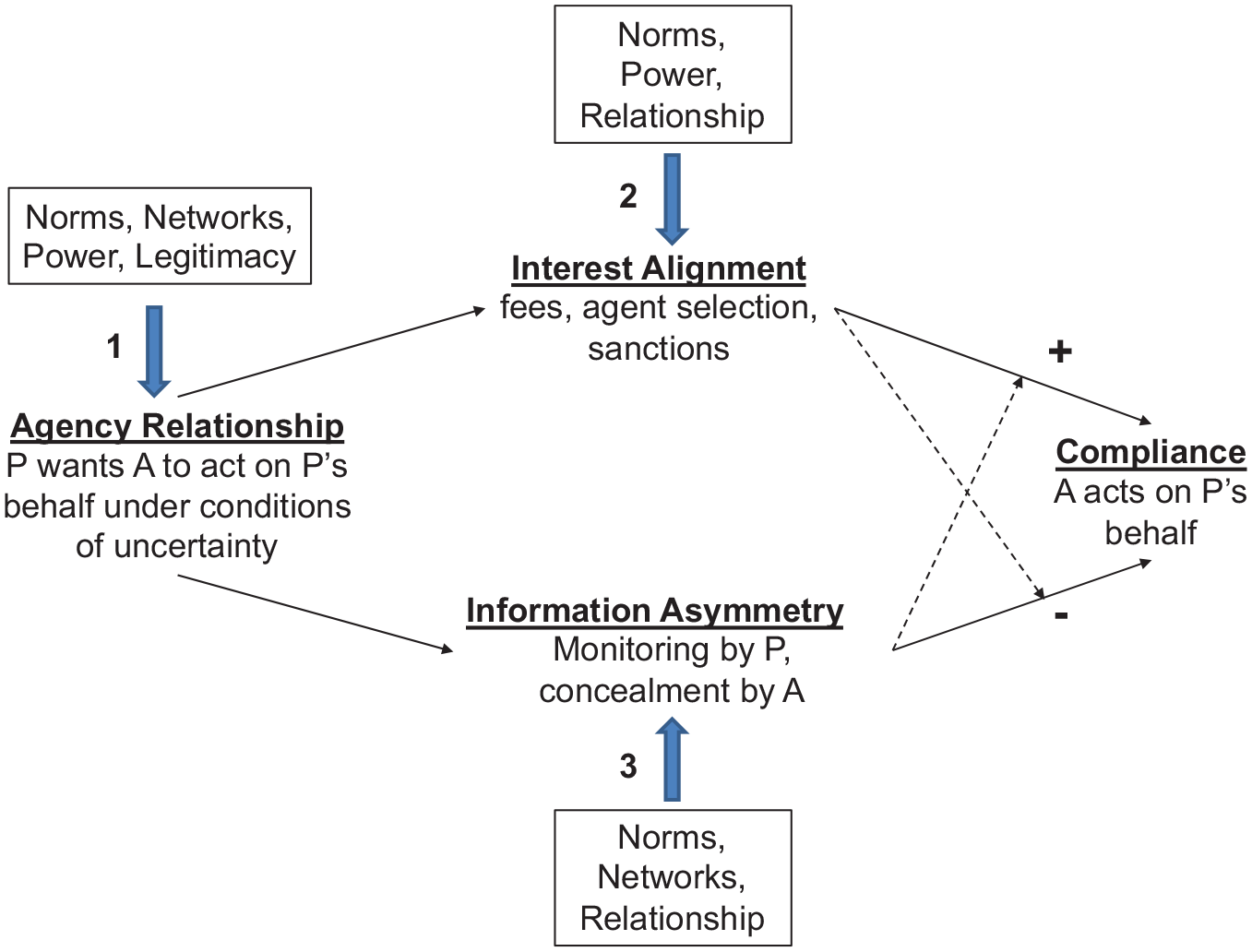
The sociological agency model.
The key contributions and novel components of SAM are found in path 1, path 2, and path 3 in Figure 1. Path 1 models the social context of nonrandom sorting into the roles of principals and agents. Because of the allocation of rights to control inherent in norm enforcement, principals will disproportionately be norm enforcers and agents will disproportionately be norm targets, and disjoint norm enforcement will be increasingly susceptible to agency problems. 2 Principals will also tend to be individuals whose rights to control are legitimized by a given society, and those with more power and status. Last, information brokers—those individuals who span structural holes in social networks (Burt 2009)—will tend to be agents, and those who rely on brokers for information will tend to be principals.
Path 2 models the effect of social context on the conflict of interests between principals and agents. As norm targets internalize norms, they will be more likely to comply with the wishes of norm enforcers. Similarly, in communities with widespread normative consensus about the provision of a particular service, there will be more pressure on agents to comply and more resources for principals to ensure compliance. Norms about compliance, such as “listen to your elders” or “don’t ask, don’t tell,” may benefit either principals or agents depending on the content of the norm (e.g., traditional gender norms versus privacy norms). Finally, the quality, duration, and multiplexity of the relationship between a principal and an agent will also serve to align interests.
Path 3 models the effects of social context on uncertainty and information asymmetries. In this path, dense social networks allow community monitoring of agent compliance, whereas sparse social networks reduce the flow of information to principals and generate greater information asymmetries between principals and agents. To the extent that principals and agents have an interpersonal relationship that is based on good communication, affection, and expectations of honesty and reciprocity in disclosure, agents may be compelled to reduce information asymmetries. Finally, norms about the monitoring of others (e.g., privacy norms) will affect the willingness and ability of principals to monitor agents.
Taken together, SAM goes beyond the standard agency model by (1) including a wider range of salient behaviors and motivations for both principals and agents, (2) embedding the principal-agent dyad within meso- and macro-level structures, and (3) emphasizing third-party endorsement as key to principal control. In short, SAM explicitly models principal-agent relationships as interdependent with the social context in which they are embedded, while retaining the unique properties of “on behalf of” relationships. In the next section, I apply SAM to an empirical case that illustrates the process and value of examining informal relationships through the lens of agency theory.
The Empirical Case
Principal-agent relationships are characterized by competing interests, interdependence, and contests for control. In informal settings, such relationships often exist between family members, particularly between parents and adolescent children (Jensen et al. 2004; Schalet 2011). In the present article, I examine whether the agency approach can explain how parents and adolescents navigate conflicts of interest, particularly those surrounding parent-child negotiations over teen sex.
The onset of sexual activity is an important developmental milestone for adolescents. Sex and romantic relationships offer an arena for youth to assert independence, experience physical and emotional pleasure, and explore new adult roles (Mollborn 2017; Schalet 2011; Tolman and McClelland 2011). At the same time, sex can lead to costly, undesirable outcomes for teenagers, such as sexually transmitted infections (STIs), pregnancy, and sexual violence. Teen sex can also have consequences for parents in the form of negative externalities (Coleman 1990). 3 First, community norms that prohibit and stigmatize teen sex increase the social costs to parents (Elliott 2012; Horne and Mollborn 2020; Mollborn 2017; Schalet 2011). Second, laws prohibiting teen sex impose costs on parents (and teens) through legal sanctions (Elliott 2012; Glosser, Gardiner, and Fishman 2004; Schalet 2011). 4 Third, the lack of governmental and institutional support to mitigate the risks associated with sex (e.g., lack of access to contraception and abortion) increases the likelihood of teen pregnancy and STIs, which can drain parents’ emotional and financial resources (Mollborn 2017; Schalet 2011). Fourth, parents often identify with and care deeply about their children, or see their children’s lives as an investment in the future and something to be cultivated (Lareau 2003; Schalet 2011). In these cases, the costs to teens, such as pregnancy, impose direct costs on parents (Horne 2009).
For parents, the costs of teen sex are not counterbalanced by the rewards that teens experience (Mollborn 2017; Schalet 2011). This results in conflicting interests, with parents desiring sexual abstinence from their adolescent children, while many adolescents desire sex to varying degrees (Fingerson 2005; Meier 2003; Mollborn 2017; Moore, Peterson, and Furstenberg 1986; Schalet 2011). Because teen sex potentially affects children and parents, both parties are motivated to gain control over teen sex (Rote and Smetana 2016; Schalet 2011). Furthermore, U.S. parents have the legitimacy to control their children’s sexual behavior and can be held normatively and legally accountable for their children’s sexual activity (Glosser et al. 2004; Mollborn 2017).
In the United States, parents who disapprove of their teenage children having sex often try to control the sexual behavior of their children. The means of control vary, but generally involve monitoring and sanctioning. Examples include setting curfews, establishing rules that prohibit romantic relationships, using punishments and threats of punishment (such as grounding), and talking to teens about the negative consequences of sex (Mollborn 2017; Schalet 2011). Because communication about sex can be stilted and contentious (Elliott 2012; Mollborn 2017), parent-child negotiations about the rules surrounding sex are often one-sided and authoritarian, reflecting parents’ interests in, and control over, their teenage children’s sex lives. Indeed, both parents and children in U.S. samples report that confrontations over sex are characterized by parental attempts at top-down control and unconditional prohibition of teen sex (Schalet 2011).
Counterintuitively, strict controls and punitive sanctions foster outcomes that parents (and children) want to avoid: STIs, pregnancy, reduced self-esteem about sex, and diminished enjoyment of sex (Schalet 2011). For middle to late adolescents, sex is the norm, rather than the exception, as 55 percent of U.S. teens have had sex by age 18 (Martinez and Abma 2020). Children who want to have sex against their parents’ wishes report hiding their sexual activity. In other words, adolescents exploit parental ignorance to pursue their own interests (i.e., sex) rather than their parents’ interests (i.e., abstinence) (Mollborn 2017; Schalet 2011).
In sum, a significant proportion of parents have trouble motivating their children to act in accordance with their wishes regarding teen sex. Moreover, information asymmetries appear to facilitate adolescent noncompliance. In this way, parents experience problems of agency, and, as I argue here, agency theory explains the parent-child contests over teen sex observed in the empirical literature.
There are a number of ways in which the negotiation of teen sex serves as a useful test case for SAM. First, prior research suggests that the case retains the necessary elements of an agency relationship: (1) parents want adolescents to perform a service on their behalf (remain abstinent), (2) parents’ and children’s interests diverge with respect to service provision, and (3) parents have the right to control adolescents (legitimacy of control) and to monitor and sanction their children’s behavior (Mollborn 2017; Rosenfeld 2007; Rote and Smetana 2016; Schalet 2011). Meanwhile, adolescents have more information about their desire and ability to remain abstinent, which they use to pursue their own interests (Mollborn 2017; Rote and Smetana 2016; Schalet 2011; Stattin and Kerr 2000).
However, parent-child negotiations over teen sex are very different from the instrumental and impersonal exchanges described in classical agency theory. Parents rarely, if ever, pay teens for abstinence, nor are parents able to “hire” their children on the basis of compatible interests. Parent-child relationships are multiplex, long-lasting, and often characterized by intense emotional valence, the alignment of interests on many topics, and wanting “the best” for one another. Finally, the legitimacy and scope of parental control is not uniform, and may have cultural and normative sources (Schalet 2011). If parent-child negotiations over teen sex constitute an agency relationship, it is a highly informal one that provides an ideal empirical case for testing the scope of SAM.
Applying SAM in this way also reveals how agency underpins, complements, or competes with other explanations of social behavior. I review prior explanations of parent-child contests over teen sex, and specify what agency theory adds to these existing accounts. I also examine the potential ways in which existing explanations augment the agency approach. Below, I compare SAM with two popular accounts of parent-child negotiations over teen sex: a cultural explanation posed by Schalet (2011) and a normative explanation offered by Mollborn (2017).
Cultural and Normative Explanations of Teen Sex
In her 2011 book, Amy Schalet interviewed parents and teens in the Netherlands and the United States. Her primary goal was to examine differences in the outcomes of teen sex—as well as how parents and teenagers negotiate sex—between these two countries. Schalet’s central thesis is that differences in how Americans and the Dutch conceptualize interdependence structure parent-child negotiations and, in turn, sexual outcomes for teens. American “adversarial individualism” legitimizes parental control over teens, who are seen as incapable of making autonomous decisions about many aspects of their lives until they have achieved economic independence. In contrast, Dutch “interdependent individualism” allows teens to develop autonomy within the context of economic dependence and without breaking free of social bonds. This form of individualism also assigns parents to the role of partners and advisers, rather than benevolent rulers, of their teenage children.
Schalet’s main point is that adversarial individualism characterizes separation from parents as a necessary, if contested, part of becoming an autonomous individual. Conflict over sex—a symbolic and performative act in which adolescents make claims to autonomy against the wishes of parents—is a key stage in this separation (Schalet 2011:110–12). However, in addition to cultural definitions and performances of familial dependence, Schalet describes several factors that may affect parent-teen interactions by decoupling the interests of parents and children. For example, in the United States, the lack of state provisions that mitigate the risks of sex, the rates of teen pregnancy, and the view of teenagers as impulse driven, make teen sex costly and risky from the standpoint of parents, who report almost unanimous disapproval of teen sex. In contrast, Schalet observed that teens express a desire to have sex for many different reasons, including physical pleasure, peer and partner pressure, and exploration of new roles.
Schalet’s qualitative work illuminates how fraught confrontations surrounding sex can be for parents and children. Teens fear disappointing their parents, being punished, and/or losing financial support, while parents fear that children will ruin their futures, hurt themselves (or others), be a burden on the family, and/or be stigmatized (or subject them to stigma). These accounts highlight how cultural definitions of life course stages, autonomy, and control grant American parents legitimacy to control their children. Moreover, Schalet’s findings underscore the role of state-level definitions of sex and resources for the mitigation of risk in creating the conflict of interest that American parents and children face. In other words, Schalet describes how aspects of the agency model are products of cultural and state-level processes.
Schalet’s descriptions indicate that a teenager’s desire for sex and sneaking around, disagreements between teens and parents, their respective concerns and worries, and threats of punishment go beyond scripted performances and reflect goals, conflicts of interest, and competing strategies. Another way to think about Schalet’s findings is through the lens of SAM: adversarial individualism grants parents legitimacy to control, which, coupled with conflicts of interest about sex and strategic information management, constitute an agency problem in the United States but not in the Netherlands.
Mollborn’s (2017) book Mixed Messages presents another account of teen sex, where parent-child negotiations over teen sex are responses to normative pressures surrounding teen sexuality. Mollborn begins with the idea that parents subscribe to a norm prohibiting teen sex, while teens, as they get older, increasingly subscribe to pro-sex norms and attitudes. Parents communicate and enforce norms that prohibit sexual behavior, including norms about how to think about sex (rationales). Teenagers, who are targets of the norm against sex, interpret and evade parental control. Mollborn connects her account to Schalet’s work, noting that norms reflect and affirm cultural understandings of sex.
The normative approach defines parents as norm enforcers, teens as norm targets, and concealment of sex as a way to evade normative sanctions (Horne and Mollborn 2020). Mollborn made a strong case for the existence of normative proscriptions against teen sex, especially for girls (see also Kreager and Staff 2009). Given this, how does agency theory fit with the normative explanation of parent-child negotiations?
First, normative constraints undoubtedly exist, and yet, given the risks of and beliefs about teen sex in the U.S. context, it is likely that parents enforce abstinence for reasons beyond ensuring that their teens comply with anti-sex norms. Nonnormative reasons include concerns about children’s future educational outcomes, the risk of STIs, and the emotional, physical, and financial costs of pregnancy and child rearing. Likewise, teens may desire sex not only because it is normative, but also because it can be an expression of affection, something their partner pressures or encourages them to do, a source of physical and emotional pleasure, and/or an exploration of new types of relationships and roles (Tolman and McClelland 2011).
Second, even if anti-sex norm compliance is the only issue over which parents and teens clash, it still constitutes a conflict of interest that brings such negotiations into the realm of agency theory (given that other features of agency theory, such as the legitimacy of parents’ control over teens and information asymmetries, are present). In this case, what is in the interest of principals is also what is normatively prescribed. Principals thus become a special type of norm enforcer, and they differ from other norm enforcers in several ways. Unlike other norm enforcers (Horne and Mollborn 2020), principals have legitimate and extensive control over some, but not other, types of norm targets (agents). For example, parents (principals) can ground and yell at their own children (agents) for having sex, but they cannot do so with a strangers’ children (another principal’s agent). Principals also tend to be more invested in agents’ norm compliance than in the compliance of other norm targets, at least in part because principals can be disproportionately punished for their own agent’s noncompliance: If actors outside the principal-agent dyad recognize that principals are effective norm enforcers because of the legitimacy of control, they may disproportionately single out principals as targets of second-order, or metanormative, sanctions. Metanorms are the expectations, sanctions, and rewards that govern norm enforcement (Horne 2009) and serve to incentivize the enforcement of norms (Axelrod 1986; Coleman 1990). SAM helps explain why group members are differentially sorted into the roles of metanorm targets. When third parties have a stake in an agent’s behavior, a principal’s ability and legitimacy to control an agent becomes a responsibility and obligation to control (Mitnick 1992). This is why parents, rather than neighbors, are often blamed for a child’s misbehavior.
In short, parent-child negotiations over teen sex represent a principal-agent problem, as they involve conflicts of interest, legitimacy of control over service provision, and information management (Mollborn 2017; Schalet 2011). These negotiations are also driven by meso- and macro-level factors, cultural understandings of autonomy and control, and conflicting norms about sex. Culture and norms specify the roles of principals and agents and heighten conflicts of interest. Explicitly integrating agency theory with cultural and normative accounts provides both explanations with necessary micro-foundations. In doing so, SAM illuminates important features of the parent-child relationship that cultural and normative explanations of teen sex overlook and neglect. These include the role of parents as a special type of norm enforcer, the importance of parental control, and the role of information asymmetries in compliance. The next section presents a principal-agent model of parent-child negotiations over teen sex, and derives a set of testable hypotheses.
A SAM of Parent-Child Negotiations over Teen Sex
Drawing on SAM, I specify hypotheses that can be evaluated with respect to parents, children, and teen sex. The hypotheses highlight the role of resources, communities, and social categories in specifying strategies for monitoring and sanctioning agents, strategies for concealing information from principals, and the key outcome of compliance (Elliott 2012; Mollborn 2017; Schalet 2011).
Conflicting Interests and Parent-Child Attitudes
Agency models assume that principals and agents have a set of preferences for the outcome of their common enterprise. The principal’s preferences differ from those of the agent, and agents form their preferences independently of the principal. Thus, I expect that parents will generally disapprove of teen sex, that teens will approve of sex, and that children will not take parental wishes into account when forming their appraisals of the desirability of sex. Teen and parent attitudes, however, are not monolithic (Weitzman 2020), and it is an empirical question to what extent parents’ and children’s attitudes toward teen sex are similar. Therefore, although attitudes and preferences are exogenous in the agency framework, I empirically examine the alignment parents’ and children’s attitudes toward teen sex.
The Social Setting
The dynamics of SAM depend on the social embeddedness of the parents and children, as well as on the legitimacy of parental control. To account for the role of social context, I examine how communities, interpersonal trust, and child gender influence parent-child negotiations over teen sex.
Communities
Supervision of agents is costly, and the ability of parents to supervise teens is bolstered by community-level resources (Schneider, Hastings, and LaBriola 2018). 5 Religious communities may help parents enforce compliance in several ways. First, religious communities lend legitimacy and community support to parental sanctions in general and to parental sanctions of sex in particular. 6 Through normative proscriptions against teen or premarital sex, religious communities may help align the preferences of teenagers with those of parents (that is, decreasing teen preference for sex), thereby bolstering compliance. Religious communities also reinforce binding contracts (e.g., virginity pledges), and bolster parental supervision by encouraging community members to monitor each other. Likewise, parental involvement in school communities (e.g., parent-teacher organizations) may supply intergenerational closure: information networks that allow adults from multiple families to monitor and sanction teenagers (Sampson et al. 1999). 7 Thus:
Hypothesis 1: Embeddedness in religious or school-based communities will decrease the likelihood of teen sex by increasing the control and monitoring capacity of parents.
Trust
The extent to which disapproving parents supervise and control children also depends on the perceived trustworthiness of a child. Trust allows principals to minimize the costs of monitoring and sanctioning (Kramer 1999; Miller and Whitford 2002). Therefore, I expect for trust to be an important factor in parents’ monitoring decisions. Thus:
Hypothesis 2: Parents’ beliefs about the trustworthiness of their children will decrease monitoring and control.
Gender and Control
Classical agency theory assumes that agents are considered by principals in terms of their competencies and motivations. I argue that agents are also viewed through the lens of socially constructed stereotypes and norms (Ridgeway 1991). This has two implications for SAM as it applies to parent-child negotiations over teen sex. First, a teen’s gender informs parental attitudes and strategies. Parents, for instance, are more disapproving of girls having sex because social norms surrounding teen sex sanction girls more than boys for being sexually active (Kreager and Staff 2009; Ridgeway and Smith-Lovin 1999). Second, parents monitor and sanction girls more because of the increased legitimacy of controlling young girls and their sexuality (Hagan et al. 1987; Kreager and Staff 2009). I thus expect parents to harbor more disapproving attitudes about teenage daughters having sex and, holding attitudes constant, monitor and control girls more than boys (Elliott 2012; Mollborn 2017; Schalet 2011).
Hypothesis 3: Parents monitor and control girls more than boys.
Noncompliance
In the principal-agent model, the key outcome variable is noncompliance. Noncompliance is operationalized as teens having sex in the context of parental disapproval. In keeping with SAM, I examine the extent to which contracts and strategies predict the likelihood of noncompliance, and how social context affects strategies and compliance.
Contracts and Noncompliance
Recall that principals and agents often specify a contract to aid exchange and clarify agent responsibilities (Jensen and Meckling 1976). Contracts vary in their completeness, or the ability of a contract to account for all aspects of the situation in which a service is being provided, and flexibility, or the extent to which a contract can be renegotiated during the process of service provision. 8 Theoretically, a complete contract is preferable to an incomplete contract, although empirically almost all contracts contain some degree of incompleteness (Tirole 1999) and can be informal (oral) (Marks-Bielska 2021) .
I operationalize contracting as the process by which parents and children come to understand each other’s preferences regarding teen sex and negotiate a set of appropriate sexual behaviors. I examine three possibilities for parental communication of expectations surrounding sex: no communication (no contract), informal discussions such as the sex talk (flexible, incomplete contracts), and promises of abstinence or virginity pledges (inflexible, complete contracts).
Sex talks, or informal conversations with children about sex, can vary in completeness and flexibility: initial rules about sex or sanctions for noncompliance can be renegotiated in light of a serious relationship (Schalet 2011). Unlike actors in economic models, parents may be guided by noneconomic preferences, some of which impose costs on contracts. Parents, for instance, may be willing to forgo a contract to avoid the cultural stigma associated with discussing sex (Elliott 2012). 9
A more complete and inflexible iteration of the parent-child contract is the virginity pledge. Here, the child promises, often publicly, to remain abstinent until marriage. The pledging movement originated in the Christian community in the early 1990’s and gained a sizable following among high school and college students (Bearman and Brückner 2001). The pledge is an efficient contract from a parents’ standpoint because it involves third-party enforcement in the form of community members who know about the pledge, self-enforcement through moral obligations, and costs of breaking a promise in addition to the costs of having sex (Longest and Vaisey 2008; Fried 2015). 10
Following the economic literature on contracts and the literature on normative sanctioning of sex, I expect pledging abstinence to reduce the likelihood of sex more than the sex talk and more than the absence of parent-child negotiations of sex (Bearman and Brückner 2001; Tirole 1999). This effectiveness is due to pledging being a complete, inflexible, and easily enforceable contract. Its public nature bolsters enforceability via sanctioning by peers and other members of the religious community.
Hypothesis 4: Sex talk will decrease the likelihood of teen sex, pledging will decrease the likelihood of teen sex, and pledging will decrease the likelihood of teen sex to a greater extent than the sex talk (pledging > sex talk).
Parental Strategies and Noncompliance
To gather evidence of compliance and to enforce it, principals use different strategies, including selecting suitable agents, monitoring and supervising, and using sanctions and incentives. Because parents cannot select children on the basis of sexual abstinence, the first strategy is unavailable. The focus here is on the remaining two strategies: supervision and sanctioning.
I examine three types of parental supervision: direct monitoring of children, limiting unsupervised behavior through curfews, and “intergenerational closure,” in which parents supervise children indirectly through communication with other parents. Direct supervision has been linked to control over children’s behavior (Steinberg et al. 1994). Likewise, communication with the parents of a child’s friends, who assist in monitoring and sanctioning, increases the control capacity of parents (Sampson et al. 1999).
Parents can also incentivize abstinence by sanctioning sexual activity. The literature on parental discipline suggests that external sanctions, such as corporal punishment, are ineffective in deterring unwanted behavior (Gershoff 2002). Instead, parents who can induce internalized sanctions, such as guilt, are effective at reducing unwanted child behavior (Gottfredson and Hirschi 1990; Schalet 2011). I examine the effects of two anticipated sanctions: teens’ expectations that having sex will upset their mother (external sanction), and that having sex will make them feel guilty (internalized sanction).
It is not a strict expectation that principals’ efforts to monitor and sanction will reduce noncompliance. Rather, the effectiveness of supervision and sanctioning is a symptom of the severity of the principal-agent problem. If information asymmetries are large enough, most monitoring and sanctioning efforts by the principal will be ineffective in inducing compliance (Greif 2006). Therefore, I expect that if any of the monitoring and sanctioning tactics decrease the likelihood of sex, then principals (parents) are able to partially overcome the principal-agent problem. Thus:
Hypothesis 5: Anticipated sanctions and parental supervision will decrease the likelihood of teen sex.
Child Strategies and Noncompliance
Given that some adolescents desire sex despite their parents’ wishes, what can children do to ensure their own interests? According to agency theory, agents maximize their interests by withholding information from principals. In the present analysis, strategic withholding of information is operationalized as teens lying to their parents. I expect that adolescents who desire sex in the context of parental disapproval will exploit unequal access to private information about their sexual behavior and lie to achieve the goal of having sex. Thus:
Hypothesis 6: Given parental disapproval, increases in teens’ positive attitudes toward sex will increase the likelihood of lying to parents.
For there to be a principal-agent problem, the agent’s strategic information management should enable them to avoid complying with the principal’s interests. In the present case, lying should increase the likelihood of teen sex in the context of parental disapproval. This is because, by concealing information about sexual intentions and behavior from disapproving parents, teens can avoid parental intervention and sanctions. Thus:
Hypothesis 7: Lying will increase the likelihood of teen sex.
Data and Methods
Sample
The data used in this analysis come from the first two waves of Add Health. Add Health is a nationally representative, probability-based sample of children in grades 7 to 12, their parents, and school administrators from 132 schools across the country (80 high schools and 52 middle schools). Measures are drawn from the publicly available parent and in-home surveys, and include information on 6,504 respondents and their parents (when available). 11 The first wave of child and parent in-home surveys was collected in 1995. The second wave of the in-home survey was conducted in 1996, with 4,834 respondents included in the publicly available sample. Adolescents who were in 12th grade at the time of wave 1 data collection were excluded from wave 2 by design. Attrition rates between waves 1 and 2 were low, with 88 percent of eligible wave 1 respondents completing the wave 2 survey (Harris et al. 2019). Wave-specific sampling weights were used in the present analysis to help minimize bias associated with attrition.
Dependent Variables
There are two categories of outcome variables in the analysis: parent and child strategies and noncompliance. I summarize each of the measures below, and the exact wording of the measures can be found in section 1 in the Supplemental Materials. Descriptive statistics for all measures are presented in Table 2.
Descriptive Statistics.

Note: All measures that are not explicitly designated as “parent” come from child reports.
Parental Strategies
I assess parental efforts to directly monitor their child in two ways. The first is direct supervision, a seven-item scale of child reports of how often a parent is around to directly observe their children during nonschool hours. The first four items assess how often a parent is at home when the child leaves for school or comes home from school. These items range from 1 (“always”) to 5 (“never”), with a value of 6 indicating that a parent accompanies the child to school. Values from 1 to 5 were reverse coded, and 6 was treated as the maximum, assuming that taking the child to school provides at least as much supervision as being at home when the child leaves for school. The next two items assess how often a parent is at home when the child goes to bed. These items range from 1 (“always”) to 5 (“never”) and are reverse coded so that higher values reflect more frequent bedtime supervision. The final item measures how many times in the past seven days that at least one parent was present for dinner, ranging from 1 (0 days) to 8 (7 days). All items were standardized before scaling to account for differences in metrics (M = −0.053, SD = 0.532). Although the α reliabilities for this scale were low (α = .395), I combine these items into one scale on theoretical grounds. The second measure of parental efforts to directly monitor their children is curfew, a single binary item assessing whether parents enforce a weekend curfew (0 = no, 1 = yes).
Indirect monitoring is assessed through intergenerational closure: whether parents communicate with the parents of the child’s friends. Similar measures of intergenerational closure have been found to deter unwanted child behavior (Sampson et al. 1999). This construct is measured as a single 7-point item on how many parents of the child’s friends the parent has talked to in the past month. Higher values indicate more intergenerational closure (M = 2.033, SD = 1.872).
Anticipated sanctions for having sex are another type of enforcement. The first item measures the extent to which a child anticipates that their mother would be upset if they were to have sex (no such question was asked about fathers at wave 1) (M = 3.930, SD = 1.139). The second item measures the extent to which a child anticipates feelings of guilt if they were to have sex (M = 3.017, SD = 1.232). Each measure is assessed with a single 5-point item and reverse coded so that higher values indicate greater expectations of an upset parent and guilt, respectively.
Child Strategies
Children’s information management strategies are measured with a single item: child reports of how many times in the past year they lied to their parents about where they were or who they were with. This item ranges from 0 (“never”) to 3 (“five or more times”) (M = 0.962, SD = 1.064). Although lying to parents may include other matters, given prior findings that children lie to parents about sex, I use the general lying measure as a proxy for lying about teen sex (Mollborn 2017; Rote and Smetana 2016). Note that a general lying measure runs the risk of underestimating the effect of lying about sex on noncompliance, and provides a conservative test of the relationship between concealment and noncompliance.
Noncompliance
I measure whether a teen has had sex by wave 1 with a binary item asking whether the child has “ever had sexual intercourse” (0 = no, 1 = yes; M = 0.508). Following Dittus and Jaccard (2000), the measure of whether the child had sex between wave 1 and wave 2 is constructed from three variables: their answers to the “Have you ever had sexual intercourse?” questions asked at wave 1 and wave 2, and a variable that flags those respondents who had their last sexual intercourse by the wave 1 interview. This is a binary variable, with 1 indicating that the teen reported having sex since wave 1 (M = 0.472). Because of the way the questions about sex were asked, the current measures are limited to heterosexual intercourse.
Independent Variables
My model specifies exogenous variables that affect parental and child strategies, and noncompliance. These include attitudes toward sex on the part of parents and children, contracts between parents and children, resources available to parents and children, embeddedness in communities that determine the social desirability of sex, and the quality of the relationship between parents and children.
Attitudes
I measure parental disapproval of sex using two measures: parental self-reports of disapproval of sex and teen perceptions of parental disapproval of sex (Ojeda and Hatemi 2015). Parents report their disapproval of their child having sex using a single item that ranges from 1 to 5 and is reverse coded so that higher values indicate greater disapproval (M = 4.230, SD = 1.120). Children report their perceptions of parental disapproval, or the extent to which their mother and father disapprove of sex. The two questions range from 1 to 5, are reverse coded, and form a mean scale, with higher values indicating greater parental disapproval (α = .825, M = 4.148, SD = 0.879).
I use four items to measure children’s attitudes toward sex. The first three items reflect previous measures of attitudes toward sex (Meier 2003): “If you had sexual intercourse,” (1) “it would give you great physical pleasure,” (2) “it would make you more attractive to women/men,” and (3) “you would feel less lonely.” I also include an item measuring how much teenagers want to have sex as part of an ideal romantic relationship. All items were reverse coded to create a mean scale, with higher values indicating more negative attitudes toward sex (α = .696, M = 2.369, SD = 0.677).
Contracts
Contracts between parents and children are measured in two ways. First, I assess whether children have reported pledging to remain a virgin until marriage. Virginity pledge is a binary variable (1 = yes, 0 = no). I also measure parents’ discussion of sex with their children (sex talk). The sex talk measure consists of six 4-point items measuring parental reports of how much parents and children have discussed (“not at all” to “a great deal”) topics such as the risks associated with pregnancy and STIs, moral and social issues surrounding sex, and birth control (α = .903, M = 2.957, SD = 0.811).
Resources
I include measures of resources that may influence strategies regarding sex. Family-level resources, such as household income and living in a two-parent household, may provide parents with the necessary means and time to monitor their children. Income is the natural log of parental reports of household income. I measure the number of parents living in the household, resident parents, using dummy variables that compare families with no or one biological parent to those with two biological parents.
Community-level resources—neighborhood organization and embeddedness in religious and school-based networks—increase intergenerational closure, which helps parents monitor and control their children (Sampson et al. 1999). Neighborhood disorganization is measured using a mean scale of parental reports of drug dealing and the presence of litter and trash on neighborhood streets (α = .561, M = 1.519, SD = 0.552). Higher values indicate more disorganization. Parental embeddedness in school-based networks is captured by the variable parent school involvement (α = .484, M = 0.387, SD = 0.410). This variable is a mean scale consisting of three binary items measuring whether the parent is a member of a parent-teacher organization or is involved in school activities. Finally, religious embeddedness is also treated as a resource for disapproving parents because it can increase intergenerational closure, and also supply punishments for sex and rewards for abstinence (Bearman and Brückner 2001; Mollborn 2017). Religious communities can supply normative proscriptions against teen sex, and help align the interests of parents and children. Religious embeddedness is a mean scale of three items (frequency of children’s attendance at religious social functions and attendance at general religious ceremonies for children and parents). Higher values for the religious embeddedness scale indicate more frequent attendance at religious community services over the prior year (α = .766, M = −0.043, SD = 0.828).
Gender
Children’s self-reported sex (male or female) is used as a proxy for the gender identity of the child.
Trust
I examine whether parents trust their child, since trust can help overcome problems of agency by allowing trusting parents to sanction and control less, while increasing the likelihood that trusted adolescents will comply with parental wishes (Cook et al. 2005; Miller and Whitford 2002). Trust is measured with a single-item 5-point scale of parental agreement with whether they trust their child.
Control variables
I control for a host of variables that have been linked to parent-child attitudes, interactions, and teen sex. The exact wording of the measures can be found in section 1 in the Supplemental Materials. Demographic controls include the child’s age, and race/ethnicity. I also account for the effects of children’s low self-control on lying, parental attitudes, and the likelihood of having sex (Gottfredson and Hirschi 1990; Young et al. 2011). The self-control scale has an α coefficient of .513, with higher values indicating lower self-control. I control for teens’ and parents’ religiosity with two scales: one for parents’ religiosity (α = .820) and one for teens’ religiosity (α = .828). Because learning about sexual risk may affect teen attitudes and behaviors, I control for school-based sex education (Schalet 2011) (α = .606).
I account for several aspects of the parent-child relationship, using both parental and adolescent reports (Korelitz and Garber 2016; Taber 2010). Two 5-point items were averaged to create a scale of parental reports of relationship quality (α = .592, M = 4.023, SD = 0.649). Higher values indicate better relationship quality. Child reports of relationship quality are assessed with a mean of scores on seven 5-point items (wave 1: α = .806, M = 4.492, SD = 0.579). Higher values indicate better relationship quality. To assess parent-child communication, I use child reports and take an average of 10 binary items and three 5-point items. All items were standardized to adjust for the different metrics of the items (wave 1: α = .665, M = 0.012, SD = 0.810). The measure of parental reports of communication consist of an average of two binary items (wave 1: α = .559, M = 0.892, SD = 0.262).
Finally, I control for peer effects (Kreager et al. 2016; Meier 2003) and educational aspirations, including children’s own aspirations and parental aspirations for their child’s educational attainment (child and parent reports).
Analytic Strategy
Ideally, to estimate the proposed model with survey data, I would use a multiwave longitudinal dataset that includes parent reports, child reports, and contains measures of all relevant concepts. Add Health meets three of these requirements: parent reports, child reports, and sufficient measures of the necessary concepts. However, only the first two waves of data are relevant analytically, as the later waves sampled respondents when they were adults. Moreover, parent and child reports for some measures are only available at wave 1. Because of the unavailability of many measures at wave 2, models predicting attitudes, contracts, and strategies are cross-sectional (wave 1 measures). However, the main outcome of noncompliance (teen sex) is modeled at wave 2 with lagged wave 1 predictors. The lagged model allows the correct temporal ordering of the variables.
Married teens were excluded from the present analysis. Marriage complicates the relationship of dependence between parents and children, and sex after marriage is considered normatively and morally acceptable in the United States (Mollborn 2017; Rosenfeld 2007). The analysis is also restricted to respondents age 15 and older since many of the key measures, such as attitudes toward sex, were only asked of these respondents. 12 This sample restriction may affect findings about how parents and teens conceptualize and negotiate teen sex. For example, because teen sex is more prevalent among older teens (Martinez and Abma 2020), teens younger than 15 years and their parents may perceive sex as riskier and more deviant, and thus adjust their negotiations and behaviors accordingly. 13 Therefore, the present findings may not be generalizable to younger adolescent populations. There are 4,430 unmarried respondents aged 15 and older at wave 1 (or 68.11 percent of the total sample).
Using these data, I first examine the relationship between parent and child attitudes toward sex. The second set of models predicts parental strategies of supervision and control and child strategies of information management. The final set of models examines predictors of whether the child had sex despite parental disapproval. These three sets of models—attitudes, strategies, and compliance—provide a series of snapshots aimed at describing the complete principal-agent process (see Figure 1). All model estimation procedures were conducted in Stata 17. Following the recommendations of the Add Health survey team, clustering and stratified selection of respondents into the sample were adjusted by using sample weights and cluster variables, available on the Add Health Web site. All models are estimated using robust full information maximum likelihood linear regression (Allison 1999). Although two of the seven outcomes of interest (i.e., curfew and sex at wave 2) are limited dependent variables that vary between 0 and 1, I model the data in a linear framework because of the ease of interpretation of the results, the efficient estimation of missing data using maximum likelihood, and because the results obtained using linear regression are similar those obtained using logistic regression. Because there is no consensus on the correct way to estimate models with limited dependent variables (Allison 1999; Karlson, Holm, and Breen 2012; Mize 2019) or how to address nonresponse error and adjustment error (Allison 2001; Gelman 2007; Groves et al. 2009), I provide the results of models estimated using logistic regression, and where missing data are listwise deleted, in the Supplemental Materials (see Tables S5 and S6).
Results
Parent-Child Attitudes
The first part of the analysis concerns parent-child attitudes toward sex. I empirically evaluate the assumption that these attitudes are misaligned and that parents disapprove of teen sex more than children do. Consistent with prior literature and assumptions about parental preferences, the majority of Add Health parents—81 percent of the total sample and 68 percent of the subsample of unmarried teens aged 15 and older—disapprove of their child having sex. Likewise, most children think their parents disapprove of them having sex, with 77 percent of teens aged 15 and older reporting, on average, some parental disapproval. Teens are more approving of sex. For the subsample of unmarried teens aged 15 and older, 54 percent report that sex is part of an ideal relationship, compared with 44 percent who say that sex is not a part of an ideal relationship. 14
Table S1 in the Supplemental Materials summarizes the predictors of teen attitudes toward sex, teen perceptions of parental attitudes, and actual parental attitudes. The results indicate that parental attitudes and perceptions of parental disapproval of teen sex account for little variation in child attitudes toward sex (R2 = .002 and R2 = .007, respectively). These results are consistent with the expectation that parental preferences do not predict substantively meaningful variation in children’s attitudes toward sex. 15 To the extent that parental disapproval does not explain variation in teen attitudes toward sex, it can be assumed that adolescents do not take parental interests into account when forming their own attitudes toward sex.
The remaining analyses are limited to the subsample of teens whose parents disapprove of sex: 68.37 percent of all unmarried teens ages 15 and older (46.57 percent of the total Add Health sample). Theoretically, it is important to subset the data in this way because parents are viewed as principals interested in promoting abstinence and preventing teen sex. If parents approve of teen sex, then sex cannot be considered a conflict of interest or a compliance issue, and is outside the explanatory scope of SAM.
Strategies of Parents and Children
According to SAM, parents and children should use certain strategies to secure their interests with respect to teen sex. Parents should attempt to supervise teens and negatively sanction teen sex, while teens should conceal information about their willingness and ability to comply. I examine three parental strategies: controlling how late the child stays out on the weekends (curfew), being with the child before and after school (direct supervision), and the extent to which parents talk to the parents of their child’s friends (intergenerational closure) (Sampson et al. 1999; Steinberg et al. 1994). I also examine two types of anticipated sanctions: the expectation that the mother will be upset if the child has sex (external sanction) and the expectation that teens will feel guilty if they have sex (internal sanction). Finally, I consider lying to parents as a strategy that teens use to facilitate having sex despite parental disapproval. 16
SAM posits that disapproving parents should monitor and sanction to a greater extent than approving parents. Table S4 in the Supplemental Materials shows that, consistent with this expectation, parental disapproval is positively correlated with all forms of monitoring and sanctioning. Having established this expected pattern, Table 3 summarizes the results from models of parent and child strategies for a subsample limited to disapproving parents and their children. 17
Linear Regression Model of Parent and Child Strategies.

Note: Linear regression coefficients are presented, with robust standard errors in parentheses.
p < .05, **p < .01, and ***p < .001 (two tailed).
First, I summarize the findings for parental monitoring and supervision. Monitoring efforts are not costless and require inputs of time, energy, and money that may be available to some parents but not to others. Parental strategies do not uniformly depend on family resources: children in single-parent households are less likely to be directly supervised (β = −0.210, SE = 0.029, p < .001), indirectly supervised (β = −0.267, SE = 0.091, p < .01), or subject to curfew (β = −0.065, SE = 0.021, p < .01). However, although higher income is associated with greater intergenerational closure (β = 0.157, SE = 0.059, p < .01), lower income parents are more likely to directly supervise children (β = −0.135, SE = 0.016, p < .001).
In support of hypothesis 1, indirect supervision is closely related to community resources: being embedded in school networks (β = 0.981, SE = 0.089, p < .001), religious organizations (β = 0.333, SE = 0.064, p < .001), and living in more organized neighborhoods (β = −0.155, SE = 0.066, p < .05) supply the social ties and social capital necessary for intergenerational closure (Sampson et al. 1999). Direct supervision is likewise associated with membership in a religious community (β = 0.040, SE = 0.019, p < .05), while enforcing curfew is related to embeddedness in school networks (β = 0.066, SE = 0.027, p < .05).
In terms of parent-child dynamics, direct supervision is associated with teens’ reports of a good relationship with their parents (β = 0.203, SE = 0.021, p < .001) as well as teens’ negative attitudes toward sex (β = 0.043, SE = 0.016, p < .01). Parents who are more likely to enforce curfew are assessed by teens as being more disapproving of sex (β = 0.038, SE = 0.016, p < .05), and in support of hypothesis 2, less trusting parents are more likely to enforce curfew (β = −0.057, SE = 0.015, p < .001). However, indirect, community-based monitoring is associated with more parental trust (β = 0.158, SE = 0.048, p < .01).
Next, I examine the sources of two anticipated sanctions of noncompliant sex: mothers getting upset and teens feeling guilty about having sex. The results of the models of anticipated sanctions are summarized in Table 3, columns 4 and 5. Both sanctions are correlated with parental disapproval (see Table S4 in the Supplemental Materials). Even within the subsample of disapproving parents, greater perceived (β = .623, SE = 0.038, p < 0.001) and actual (β = 0.120, SE = 0.043, p < 0.01) parental disapproval is associated with anticipating that sex will upset mother, and perceived parental disapproval is associated with feeling guilty (β = 0.294, SE = 0.032, p < 0.001). Feeling guilty is associated with the child’s own negative attitudes toward sex (β = 0.304, SE = 0.057, p < 0.001), while the mother being upset is not. Embeddedness in a religious community increases the expectation that the mother will be upset (β = 0.103, SE = 0.040, p < .05) and the anticipation of guilt (β = 0.183, SE = 0.055, p < .01). Net of personal religiosity and religious embeddedness, pledging abstinence also increases the expectation that the mother will be upset (β = 0.148, SE = 0.062, p < .05) and the anticipation of guilt (β = .534, SE = 0.079, p < .001), suggesting that a pledging contract increases the costs of sex.
SAM predicts that agents gain the ability to advance their interests at the expense of principals by strategically withholding and manipulating information. Table 3 shows that teenagers with disapproving parents lie more when they have more positive attitudes toward sex (β = −0.238, SE = 0.032, p < .001). This supports hypothesis 6 and suggests that children lie to cover up sex-related matters. Lying is also associated with children’s negative evaluations of the parent-child relationship (β = −0.302, SE = 0.047, p < .001), echoing prior findings that children are more forthcoming with warm and supportive parents (Grigoryeva 2018; Keijsers et al. 2010). Teens who are trusted by their parents lie less (β = −0.148, SE = 0.034, p < 0.001) (Daddis and Randolph 2010). Finally, pledging abstinence decreases lying (β = −0.141, SE = 0.056, p < 0.01), indicating that this type of contract undermines concealment.
Gender Differences
Hypothesis 3 predicts that gender determines how parents treat teenagers as agents. Girls should experience more parental control than boys. Echoing prior work, both girls and their parents reported more disapproval of teen sex than did boys and their parents (see Table S1 in the Supplemental Materials). Moreover, girls experienced greater control, supervision, and anticipated sanctions for sex, even after controlling for disapproving attitudes. In support of hypothesis 3, Table 3 shows that girls are more likely to experience a curfew (β = 0.088, SE = 0.122, p < .001) and more likely to anticipate feeling guilty if they have sex (β = 0.158, SE = 0.053, p < .01) than boys, after controlling for parental attitudes toward sex. On the other hand, girls exploit information asymmetries more, and are more likely to lie to their parents (β = 0.215, SE = 0.046, p < .001).
In sum, parents and teenagers appear to adopt strategies consistent with their roles as principals and agents: parental disapproval predicts increased monitoring and anticipated sanctions, while children of disapproving parents are more likely to lie if they have positive attitudes about sex. As predicted by SAM, social context, such as gender roles, trust, and membership in religious communities, influences both preferences and strategies of principals and agents.
Noncompliance
The main problem principals face is agent noncompliance. I operationalize noncompliance as teens having sex despite parental disapproval. Using a sample restricted to families in which parents disapprove of sex, I estimate a lagged model of the effect of attitudes, contract, and strategies at wave 1 on sex at wave 2, while controlling for sex at wave 1. The results of nested models are summarized in Table 4.
Linear Regression of Noncompliance (Teen Sex).

Note: Linear regression coefficients are presented, with robust standard errors in parentheses.
p < .05, **p < .01, and ***p < .001 (two tailed).
Consistent with SAM, teenagers with positive attitudes toward sex are more likely to be noncompliant than teenagers with negative attitudes (Table 4, models 2 and 3, where strategies of noncompliance are not accounted for), and the effect of preferences on noncompliance is accounted for by principal and agent strategies (model 4). 18 Although religious community membership decreases future sex (model 5: β = −.043, SE = .016, p < .01), abstinence pledges are statistically unrelated to future sex. 19 An unexpected finding is that discussing sex with parents increases the likelihood of future sex (model 5: β = .046, SE = .013, p < .01), even after controlling for sex at wave 1, perhaps because parents discuss sex when they suspect that their children are likely having sex. Overall, I find no support for the hypothesis that complete and public contracts directly induce compliance (see hypothesis 4).
None of the supervisory strategies significantly increase compliance. 20 This is consistent with prior findings showing that top-down supervision methods, such as curfew setting, are ineffective (Mollborn 2017; Schalet 2011). For the effects of sanctions on teen sex, anticipating that the mother will be upset is not associated with teen sex, while anticipating guilt decreases the probability of teen sex (β = −0.261, SE = 0.058, p < .001). These findings offer weak empirical support for hypothesis 5, suggesting that a parent’s best chance to enforce compliance may be through fostering internalized sanctions (i.e., guilt). 21 Sanctions and supervision strategies that are negative and parent-centered (i.e., parents setting a curfew or expecting mother to be upset) do not induce compliance. In other words, consistent with the principal-agent problem, parental strategies seem to be ineffective at generating compliance.
For their part, teenagers—the agents—are able to leverage information asymmetries into autonomy, as lying to parents significantly increases noncompliance (β = 0.048, SE = 0.009, p < .001), lending support to hypothesis 7. All of this suggests that parents experience problems of agency, and that teenagers effectively conceal information to facilitate noncompliance.
Summary
As predicted by SAM, strategic information management—lying—allows teens to avoid complying with parental wishes regarding teen sex (Mollborn 2017; Ross 1973; Schalet 2011). Of the measures of supervision and sanctions, only child expectation of guilt affects the likelihood of sex, suggesting that parental strategies are largely unsuccessful at controlling the sexual behavior of children. Notably, the principal-agent problem is particularly salient for girls, who experience more sanctions and supervision than boys, but are also more likely to lie to their parents.
Discussion and Conclusion
The present article offers a version of agency theory that accounts for sociologically salient aspects of the principal-agent relationship, such as legitimacy of control, community resources, status characteristics, and social and affective costs and rewards (Horne 2009; Ridgeway 1991; Sampson et al. 1999; Willer 2009; Zelditch 2018). This model is used to explain how parents and children negotiate teen sexual behavior. Data drawn from Add Health support the expectations of SAM as applied to parent-child negotiation of teen sex. Testing propositions of classical agency theory (Jensen and Meckling 1976), I find that parents’ and children’s interests regarding teen sex are decoupled. Parents overwhelmingly disapprove of sex, while children do not take parental attitudes into account when forming their own, more favorable, views of sex. Disapproving parents monitor and control more, and signal their disapproval in ways that lead teens to anticipate sanctions against sex. In turn, teens are more likely to lie to disapproving parents if they themselves have positive attitudes toward sex.
In keeping with SAM’s proposition that information asymmetries prevent principals from effectively controlling agents, four of the five measures of parental strategies considered here are ineffective in curbing teen sex (Schalet 2011). Finally, consistent with the central role of information management in enabling noncompliance, lying increases the likelihood that children will have sex against their parents’ wishes (Mollborn 2017; Stattin and Kerr 2000).
A central goal of this research was to specify a sociological version of agency relationships in which actors are embedded in communities, imperfect communication leads to misunderstandings, and social categories and affective ties motivate action. My findings reveal several channels through which social context structures agency relationships. First, membership in communities that proscribe sex bolsters the control capacity of principals and agent compliance (Sampson et al. 1999). I show that embeddedness in a religious community is related to all aspects of agency models, including attitude alignment, sanctioning, and compliance. Second, I find that (imperfect) signaling is central to how individuals understand and respond to conflicts of interest. Teens were more influenced by what they thought their parents wanted than by their parents’ actual preferences (Korelitz and Garber 2016; Ojeda and Hatemi 2015; Taber 2010). Third, agency problems are determined by actors’ beliefs about social categories and legitimacy of control, as the agency relationship is more salient for girls than it is for boys (Hagan et al. 1987; Kreager and Staff 2009; Ridgeway and Smith-Lovin 1999). Fourth, relationship quality and trust are associated with negotiations that favor parental interests, including teenagers being honest with their parents and taking abstinence pledges (Brandts et al. 2016; Grigoryeva 2018; Keijsers et al. 2010). 22 Overall, these findings indicate that social context influences whether individuals with vested interests in a common enterprise occupy positions of principal and agent, and illuminate new dynamics of agency problems. In the following paragraphs, I outline the contributions of the present analysis to the literatures on agency theory, social control, and teen sex.
Contributions to Research on Agency Theory
This article presents a framework for analyzing agency problems in sociology beyond the study of political institutions and formal economic relationships (Adams 1996; Kiser and Schneider 1994; Reed 2019). The present framework and findings highlight several ways in which sociologists can engage with the agency paradigm more broadly, and use it to explain informal relationships (Shapiro 2005). First, SAM implies that meso- and macro-level social processes generate agency problems by creating power differentials, conflicts of interest, and support for the control of others. Given the centrality of community resources and social structure in SAM, my model would predict different behavioral outcomes depending on variations in these key inputs. If cultural norms delegitimize top-down parental control of children, or do not decouple interests of parents and children, then SAM predicts less dishonesty on the part of children, and less control on the part of the parents. This is what has been observed empirically, in the Netherlands. Dutch teenagers have autonomous control over their sex lives and are honest and open with their parents, while Dutch parents invest few resources in the supervision and control of their children (Schalet 2011).
Second, it is imperative to collect data from both principals and agents. Both types of actors interpret situations differently and misperceive each other’s signals. Such signaling issues and perceptual biases affect negotiations and strategies, and if left unaccounted for will bias results (Korelitz and Garber 2016; Taber 2010). By using data from principals and agents, the present analysis minimizes such measurement problems, and demonstrates that actors tend to misperceive others as similar to themselves (Prinstein and Wang 2005).
Third, even net of attitudes toward teen sex (which are more disapproving for teen daughters), the strategies used by principals and agents are based on shared cultural understandings of the social categories that principals and agents occupy (Ridgeway 1991; Ridgeway and Smith-Lovin 1999). Status characteristics (such as gender) drive parental control and child concealment. Parents report increased monitoring of daughters, supporting the idea that supervision strategies of parents-as-principals are influenced by the legitimacy of controlling female children and their sexuality (Hagan et al. 1987; Kreager and Staff 2009). In response, girls are more likely to anticipate feeling guilty if they have sex, but are also more likely to lie to parents. In sum, classical agency theory provides a necessary but insufficient account of how individuals behave under conditions of information asymmetry and power differentials. By accounting for sociological processes such as legitimacy and cultural beliefs about gender differences (Ridgeway and Smith-Lovin 1999), SAM supplies the necessary scaffolding for agency problems to emerge and be resolved.
Contributions to Sociology and Research on Teen Sex
SAM offers a broad theoretical approach to explaining relationships in which one person acts on behalf of another. This model details how informational autonomy can be leveraged into behavioral autonomy, even by individuals who are in positions of low power and high dependence (Rosenfeld 2007; Schalet 2011). Going forward, such insights are valuable for sociological research on norms, power, influence, and social control (Horne and Mollborn 2020).
By highlighting the conflicts of interest and competing strategies that exist between parents and children—which have previously been described as a product of culture, structure, and normative expectations (Elliott 2012; Mollborn 2017; Schalet 2011)—the present study contributes to the literature on teen sex. I offer quantitative support for prior qualitative research on parent-child conflicts regarding sex (Mollborn 2017; Schalet 2011). I also provide a general, theoretically grounded explanation for why parental control may not be effective in curbing teen sex. As I show theoretically and empirically, children strategically translate information asymmetries into autonomy and self-determination: despite parental efforts, concealment allows teens to explore sex (Schalet 2011; Villalobos 2014). Moreover, concealment offsets the effects of monitoring practices, such as curfews and parental involvement in school, as these are associated with increased concealment. Teenagers are motivated by intrinsic incentives (i.e., attitudes and guilt), while parental control and negative sanctions do not deter future sex (Gershoff 2002; Schalet 2011). These findings support both general and sex-specific research on parenting and provide additional evidence of the ineffectiveness of top-down parental control (Gershoff 2002; Gottfredson and Hirschi 1990; Steinberg et al. 1994).
Building on qualitative research, I find that religious communities influence not only the sexual behavior of teens, but also the strategies available to teens and parents (Mollborn 2017; Schalet 2011). By encouraging pledging, religious communities attempt to supply group-level solutions to the principal-agent problem. The implication is that the locus of control over teen sex resides not only with parents and teens, but also with community members (Sampson et al. 1999). That something as personal and private as sex is also readily regulated by religious communities provides evidence of considerable faith-based social control in the United States (Gorski 2003; Rosenfeld 2007).
In support of prior research on the sexual double standard for teenage girls (Elliott 2012; Kreager and Staff 2009; Mollborn 2017), I find that both parents’ and children’s attitudes and behavioral strategies are deeply gendered: girls face more parental control and anticipate more sanctions for having sex. Despite increased monitoring, and consistent with their role as strategic agents, I find that girls lie more to their parents and are no less likely to have sex than boys. Consistent with Mollborn’s (2017) findings, my results indicate signaled, rather than actual, compliance with proscriptions against sex.
By modeling the payoffs to agents from exploiting information asymmetries at the individual level, SAM explains why signaled compliance with disjoint norms, such as gendered norms about sex (Mollborn 2017), is likely to be widespread. In some ways, signaled compliance can be seen as a “good enough” means of upholding norms, because when deviant individuals present themselves as norm-compliant, even unpopular norms continue to exist as a standard for behavior (Cowan 2014; Goffman 1963; Horne and Mollborn 2020; Kitts 2003). Conversely, we can think of concealment as rendering gendered norms about sex hollow, since such norms fail to deter behavior despite both intrinsic and extrinsic sanctions. In this way, reliance on public demonstrations of compliance may increasingly discourage actual compliance with sex norms.
Overall, the present findings simultaneously support SAM and the normative and cultural accounts of family negotiations around teen sex (Mollborn 2017; Schalet 2011). Yet the present data are also consistent with SAM in ways that are not hypothesized by the normative or cultural accounts. According to Schalet (2011), for example, the behavior of parents and teenagers are scripted performances of a cultural rite of passage that are independent of attitudes toward sex. In contrast, I find that attitudes toward sex predict the behavior of parents and teens, which is consistent with strategic behavior and the principal-agent problem (Jensen and Meckling 1976; Kiser 1999). Likewise, parental control is a function not only of normative and cultural factors (Mollborn 2017; Schalet 2011) but also of the trust that parents have in their children (Mitnick 1992; Shapiro 2005). As observed in prior agency research, principals who trust their agents invest fewer resources in social control, and trusted agents are less evasive (Miller and Whitford 2002). In sum, the present findings support SAM over and above existing accounts.
Limitations and Directions for Future research
This study is not without limitations. First, the empirical component of the study consists of cross-sectional and two-wave panel models. Although Add Health is the only existing dataset with the measures necessary to test a principal-agent model of teen sex, the nature of the data precludes estimation techniques, such as fixed effects panel models, that better achieve causal identification. Relatedly, although no contemporary dataset can adequately substitute for Add Health in terms of estimating the models presented here, the first and second waves of Add Health were collected over 20 years ago. Although recent work has shown that parents and children continue to have conflicting preferences about teen sex and that teens continue to conceal noncompliance, other salient factors, such as the proportion of U.S. teenagers who are sexually active, have changed over the past 25 years (Martinez and Abma 2020; Mollborn 2017), which may affect the generalizability of my findings. Future work using data with multiple data points on all key variables over time will help strengthen the present findings and provide a contemporary portrait of family negotiations around teen sex.
Second, collecting more refined measures of several constructs would shed additional light on the principal-agent dynamics tested here. Because of data limitations, information management by teens was operationalized as general lying to parents, which offers a conservative test of the links between lying, attitudes toward sex, and sexual behavior. Including other forms of information management, such as secret keeping, would enhance our understanding of how teenagers manage information (Rote and Smetana 2016). Likewise, it is possible that the lack of association between some forms of monitoring and compliance is because the instruments used to measure monitoring are too broad. Collecting data on the types of parental monitoring and control that target sexual activity, such as restrictions on dating or mixed-gender parties, is an important next step.
Third, because of the construction of the sexual activity measures in Add Health, the present analysis is limited to heteronormative teenage sex. Given prior research on teen sexuality, agency models may be especially relevant to parent-child negotiations of same-sex partnerships (Rossi 2010; Savin-Williams 1998). Using data that include a more inclusive measure of sexual activity, or examining children’s information management in the presence of a same-sex significant other, would improve and broaden the explanatory scope of SAM.
Fourth, some aspects of SAM warrant further research. Parent-child negotiations over teen sex are only one part of a long-term, multiplex relationship (Ingram and Roberts 2000). Both parents and children have a wealth of information about each other’s behaviors, preferences, and decisions across a wide range of domains and matters. This knowledge is likely to influence how parents and children negotiate sex. Because of the long-term, interdependent nature of parent-child relationships, learning and reputation mechanisms likely dictate principal-agent interactions (Hao et al. 2008; Simpson and Willer 2015; Shapiro 2005). For instance, a parent’s treatment of an older child can signal their intent to sanction a younger child (Hao et al. 2008). Future work should incorporate temporal and iterative elements into SAM.
Finally, SAM offers an opportunity to better understand a wide range of social situations in which agency and social structure interact (Densley 2012; Kinane 2021; Shapiro 2019). 23 For example, although this analysis treats norms as exogenous, under certain conditions, SAM can supply the individual-level mechanisms by which norms change and erode: when norms are disjoint and a norm target has more information about normative compliance than a norm enforcer, the norm enforcer can be thought of as a principal and the norm target as an agent. In their synthesis of the social norms literature, Horne and Mollborn (2020) identified several key factors in ensuring norm compliance that parallel ideas about compliance in agency research, including information asymmetries and the sanctioning capacity of the norm enforcer. Following the logic of agency theory, we can propose additional factors that affect norm compliance, including contract-like obligations between targets and enforcers, differential selection of norm targets for sanctioning, selective incentives that align the interests of norm targets and norm enforcers, and norm targets’ preferences for the risk for punishment. In this way, the negotiation of norms in interactions that exhibit problems of agency will take a different form—involving less compliance and more normative erosion—than the negotiation of norms in situations where norms are conjoint and where norm enforcers and norm targets are on an equal footing with respect to information about compliance. In short, using SAM to explain a variety of sociological phenomena, including social norms, is a productive avenue for future research.
Conclusions
The present study shows that strategic information management is an important source of control for actors in positions of low power and high dependence. In the case of sex, teenagers effectively avoid parental monitoring and control by strategically concealing sex. Parents, as a result, have an agency problem on their hands. These findings demonstrate the value of applying agency theory to noneconomic cases and highlight SAM’s ability to explain noncompliance in expressive and informal relationships. As Shapiro (2005) noted, “Perhaps sociologists have been studying agency all along and just didn’t know it” (p. 275). The present study demonstrates that there is much to be gained by importing the agency framework into sociology.
Supplemental Material
sj-docx-1-srd-10.1177_23780231231204853 – Supplemental material for A Sociological Model of Agency and Parent-Child Negotiations of Sex
Supplemental material, sj-docx-1-srd-10.1177_23780231231204853 for A Sociological Model of Agency and Parent-Child Negotiations of Sex by Maria S. Grigoryeva in Socius
Footnotes
Acknowledgements
I would like to thank Blaine Robbins, Edgar Kiser, Paula England, Elisabeth Anderson, Sabino Kornrich, Ross Matsueda, Jerald Herting, Hedwig Lee, and Elena Erosheva for helpful comments and suggestions.
Funding
The author(s) disclosed receipt of the following financial support for the research, authorship, and/or publication of this article: Partial support for this research came from a Eunice Kennedy Shriver National Institute of Child Health and Human Development research infrastructure grant to the Center for Studies in Demography and Ecology at the University of Washington (R24 HD042828). This research was also supported by a grant from the National Science Foundation (SES-1436259).

Supplemental Material
Supplemental material for this article is available online.
Notes
Author Biography
References
Supplementary Material
Please find the following supplemental material available below.
For Open Access articles published under a Creative Commons License, all supplemental material carries the same license as the article it is associated with.
For non-Open Access articles published, all supplemental material carries a non-exclusive license, and permission requests for re-use of supplemental material or any part of supplemental material shall be sent directly to the copyright owner as specified in the copyright notice associated with the article.
