




Abstract
This article investigates whether gender differences in children’s math, reading, and behavior problems vary across mothers’ education and family structure. Using data from the National Longitudinal Study of Youth-Children and Young Adults (N > 6,200; age range = 5–14; 51 percent female; 30 percent Black, 20 percent Hispanic, and 50 percent other ethnic backgrounds), we hypothesized that boys growing up with less educated mothers and in single-parent families may lag behind girls more significantly in reading and behavior problems. They may be less ahead in math than their peers from more advantaged backgrounds. Our findings demonstrate this heterogeneity of gender differences by maternal education but not by family structure. This may indicate that cultural norms associated with gender play a significant role in explaining the observed heterogeneity across family circumstances. We replicated these findings for academic achievement using data from the Early Childhood Longitudinal Study Kindergarten Class 1998–1999.
Girls consistently outperform boys in high school graduation, immediate college enrollment, and college performance (Bozick and DeLuca 2005; Conger and Long 2010). Trends in college graduation also show a striking reversal of the gender gap that once favored males (Buchmann and DiPrete 2006; Buchmann, DiPrete, and McDaniel 2008). At the same time, women remain underrepresented in STEM majors and earn fewer STEM degrees (Xie, Fang, and Shauman 2015). To understand the causes of these gendered educational pathways, scholars have investigated gender differences in children’s academic achievement and behavior problems early in the life course. In mathematics, for instance, girls lag behind boys, particularly at the top of the distribution (Cimpian et al. 2016; Entwisle, Alexander, and Olson 1994; Gibbs 2010; Leahey and Guo 2001; Penner 2008). In contrast, they perform better than boys in reading (e.g., Downey and Yuan 2005; Entwisle et al. 2007; Morgan, Farkas, and Hibel 2008; Reilly, Neumann, and Andrews 2019) and exhibit fewer behavioral issues (e.g., Caughy et al. 2016; Downey, Workman, and von Hippel 2019; Lahey et al. 2006; Lee 2010; McIntosh et al. 2013).
However, gender differences in educational outcomes may not be universal and depend on the context in which boys and girls grow up. According to intersectional perspectives, gender does not influence children’s lived experiences in isolation from other sociodemographic characteristics (Hsin 2018). For example, the female advantage in college completion is largest among families with low-educated or absent fathers (Buchmann and DiPrete 2006). Evidence also suggests a significant variation of gender differences in academic achievement across national contexts (Stoet and Geary 2013, 2018). It is hypothesized that boys’ academic achievement and behavior are more sensitive to the family environment than girls’ outcomes (Autor et al. 2019). This is because boys may be less mature than girls and thus more vulnerable in their development to adverse family circumstances. Consequently, Gender differences in academic achievement may depend on and manifest with other child and family characteristics.
Although research on gender differences in developmental outcomes is extensive, less attention has been paid to the interaction between gender and family characteristics, such as family socioeconomic status (SES; Entwisle et al. 2007). Few studies have examined whether the family environment stratifies gender differences in academic achievement and behavioral issues. Recent research by Autor et al. (2019) indicates that boys from disadvantaged families (single parent, low SES) have more disciplinary issues and lower achievement scores than girls from comparable backgrounds. Entwisle et al. (2007) demonstrated that elementary school boys have comparable reading test scores to girls among students with a high SES but are disadvantaged among students with a low SES. In contrast, DiPrete and Jennings (2012) did not observe any variation in the gender gap in reading across SES levels. Penner and Paret (2008) demonstrated that the male advantage in mathematics is greater among parents with higher levels of education than among parents with lower levels of education. However, no study has examined whether gender differences in academic outcomes and behavior develop differently depending on family circumstances throughout childhood and early adolescence.
This article adds to the scant literature by examining how and when the family environment (maternal education, family structure) moderates gender disparities in academic achievement (reading, math) and behavior problems. Examining the intersection of gender and family circumstances can shed light on the causes of gender differences in developmental outcomes. Data from the National Longitudinal Study of Youth-Children and Young Adults (NLSY-CYA) provide comprehensive information on sociodemographic characteristics and allow us to track children from age 5 to age 14 with up to five measurements of math, reading, and behavior problems. To evaluate the robustness of our findings, we replicated the analyses of academic achievement among children who enrolled in kindergarten using the Early Childhood Longitudinal Study Kindergarten Class 1998–1999 (ECLS-K).
The Current Study
In this article, we draw on an intersectional approach and assume that multiple categories of social positions, such as gender and the family environment (mother’s education, family structure), are mutually constituted, reinforce one another, and cannot be treated as separate units of analysis (Bauer 2014). We anticipate that growing up in families with low levels of maternal education and in single-parent households may have a greater adverse effect on the achievement and behavior of boys.
First, parental investments in boys versus girls may vary systematically with family resources (Raley and Bianchi 2006). For example, high-SES mothers devote more time than low-SES mothers to activities (e.g., reading for pleasure) that help their sons succeed in school (Entwisle et al. 2007). The support for education that highly educated parents equally give to both sons and daughters may remediate boys’ alienation toward academic work. In general, mothers spend more time with their daughters than their sons, leaving boys disadvantaged in single-mother households (Baker and Milligan 2016; Bertrand and Pan 2013). In addition, boys experience greater reductions in parental time investment when the family structure shifts from two parents to a single mother (Bibler 2020). Due to the lack of same-sex role models, they may also be at a disadvantage in single-mother households (Autor et al. 2019).
Second, the prevalence of gender stereotypes may vary depending on the family environment (Entwisle et al. 2007). Parents with a higher level of education are more progressive and egalitarian regarding gender roles than those with a lower level of education (Bolzendahl and Myers 2004; Brewster and Padavic 2000; Brooks and Bolzendahl 2004). In turn, parents’ gender stereotypes influence their interactions with their children and their expectations for academic achievement and behavior. For example, low-SES parents expect boys to achieve lower reading scores than girls, but high-SES parents do not discriminate based on gender (Entwisle et al. 2007).
These potential causes of more pronounced gender differences in adverse family environments are not mutually exclusive and may interact. Figure 1 is a stylized representation of our hypotheses regarding the interplay between gender and family environment in determining academic achievement and behavioral problems. We anticipate that compared to boys from more advantaged households (highly educated mothers, two-parent household), boys growing up in disadvantaged families (lower educated mother, single-parent household) will lag more strongly behind girls in areas where they typically achieve less (reading, behavior problems) and will be less ahead of girls in areas where they typically achieve better (math).

Stylized theoretical expectations regarding variation in gender differences in academic achievement and behavioral problems by family background.
Data and Methods
Data
The empirical analyses are based on data from the National Longitudinal Survey of Youth 1979 (NLSY79), a cohort study of men and women living in the United States in 1978 who were born between 1957 and 1964 (Rothstein, Carr, and Cooksey 2019). Since 1986, the study has been supplemented by biennial surveys of more than 11,500 children born to NLSY79 female respondents. The NLSY-Children and Young Adults (NLSY-CYA) data include direct assessments of children’s academic achievement in mathematics and reading and information on behavior issues as reported by the adult respondent, typically the mother. Both types of assessments were administered up to five times between the ages of 5 and 14 and 4 and 13, respectively, making these data ideal for investigating our research questions.
We restricted our analyses to children born between 1980 and 2002 who participated in the survey at the first eligibility age for the assessments (age five to six for academic assessment; age four to five for the behavior assessment). This ensured that the children could complete all five assessments. For the same reason, we excluded children from the sample who were not assessed at the youngest age eligible. We then followed the sample of children until they completed the fifth assessment or were lost to follow-up. The loss to follow-up included temporary or permanent attrition and missing values on any covariate or the respective assessment. The Supplemental Material S1 provides a detailed overview of the number of cases across children’s age and compares the case numbers after the different sample restrictions.
Variables
We used two achievement measures taken from the Peabody Individual Achievement Test, mathematics and reading recognition (Dunn and Markwardt 1970), which were administered for the first time to children aged five or six. Children were then tested at age 7/8, 9/10, 11/12, and 13/14. The mathematics assessment consists of 84 multiple-choice questions covering topics such as number recognition, geometry, and trigonometry. The reading recognition test measures word recognition and pronunciation with 84 items, each with four possible responses. The child begins each assessment at an age-appropriate item and continues until they answer five out of seven questions incorrectly. Our analyses used the raw score for these assessments standardized each assessment time.
We used two subscales measuring a child’s tendency to internalize problems or externalize behaviors that were derived by Guttmannova, Szanyi, and Cali (2008) from 17 of the 28 items of the Behavior Problems Index (Peterson and Zill 1986) used in the NLSY-CYA. Guttmannova et al. (2008) demonstrated that the cross-ethnic and longitudinal measurement invariance of these scales is superior to that of the respective scales derived by Parcel and Menaghan (1988) in the NLSY-CYA. The internalizing subscale includes items such as whether the child is excessively fearful or anxious, unhappy, sad, depressed, tense, or nervous. Externalizing subscale items include whether the child cheats or lies, bullies or is cruel/mean to others, and engages in excessive argumentation. The raw scores used in the analyses were derived by summing the responses of mothers to each scale’s items based on the answer options (0) not true, (1) sometimes true, and (2) often true. The internalizing scale consists of 7 items for children aged 4 to 11 and 6 items for those older than 11. The externalizing score is based on 9 items for children ages 4 to 5, 10 for children ages 6 to 11, and 8 for children ages 12 and older. Children were assessed at 4/5, 6/7, 8/9, 10/11, and 12/13 years of age. We then standardized these scores again within each assessment period.
Our main independent variable is the child’s gender (girl, boy). To capture the family environment, we consider maternal education and family structure at birth. The following categories operationalize maternal education: (1) no degree, (2) high school diploma, (3) some college, and (4) four-year college degree or higher. The family structure distinguishes between families with one parent and those with two.
Our covariates consist of the child’s race (Hispanic, Black, other), the mother’s birth year, and the child’s birth year (1980–1983, 1984–1988, 1989–1994, 1995–2002). In addition, we control for age at the time of assessment (in months) and survey year.
Analytic Strategy
The average gender gap in academic achievement and behavior problems among children with different levels of maternal education and family structure is the primary variable of interest. We also report the group-specific averages for boys and girls to determine whether gender differences across groups are more likely due to differences in girls’ or boys’ achievement. Due to compositional differences between our target groups, we must adjust the quantities described for differences in our covariates.
We obtain estimates of the adjusted average gender gaps and the gender-specific averages using linear regression models that regress the respective standardized score at each assessment on these child and family characteristics. The first series of models addressed the intersection of a child’s gender and maternal education and thus predicted the conditional mean score from child’s gender,

These models include multiple interaction terms between gender, maternal education, and race allowing us to predict group-specific mean scores for boys and girls and to separate moderation of the gender gaps by maternal education from moderation by race. To avoid controlling away part of the moderation by maternal education that runs through the family structure (Augustine 2014), the models do not include an indicator for two-parent families. We run separate models for each assessment time to avoid including additional interaction terms between time and all the terms already included in the model. The models allow us to derive the adjusted gender-specific mean scores and the corresponding estimate of the gender gap averaged over the control variables.
To investigate the intersection of gender and family structure, we extended the models described previously with the binary indicator for two-parent families and respective two-way and three-way interaction terms with the child’s gender and race. Hence, the model allows gender differences by family structure to vary across races while simultaneously adjusting for race-specific gender differences by parental education.
To correct for systematic loss to follow-up, we used weights containing the inverse probability of remaining in the sample in the next wave conditional on the respective outcome measure, child’s gender, and covariates. This probability was estimated using a pooled logistic regression model predicting remaining in the sample in the next wave from the variables described previously. Weighting the sample created a pseudo-population in which loss to follow-up is independent of the variables included in the prediction model, thus avoiding bias from systematic attrition based on the observed variables.
All models used standard errors clustered by the mother to quantify statistical uncertainty. Because the power to detect statistically significant differences in gender gaps across family circumstances is limited, even with a relatively large overall sample size, we replicated the analyses of math and reading with data from the Early Childhood Longitudinal Study, Kindergarten Class 1998–1999 (ECLS-K). This allowed us to assess the robustness of our estimates beyond measures of statistical uncertainty. We refrained from using measures of externalizing and internalizing behavior from the ECLS-K because these were reported by teachers and are thus not comparable with the behavioral information provided by mothers in the NLSY-CYA. Further information on the ECLS-K is provided in Supplemental Material S2.
Findings
Sample Description
Although sample sizes vary depending on the respective outcome considered (see Supplemental Material S1), the distribution of covariates is very similar across samples. Regarding race, around 20 percent of children are Hispanic, 30 percent are Black, and 50 percent are of other racial backgrounds. Approximately 20 percent of the children in our samples have mothers with no degree at birth, 45 percent have mothers with a high school diploma, 20 percent have mothers with some college, and 15 percent have mothers with a college degree. Seventy percent of the children in our samples were born into two-parent households.
Table 1 shows the mean scores for academic achievement and behavioral problems and the p values of two-tailed t tests by age group and gender. In mathematics, boys’ small initial disadvantage over girls becomes a growing advantage over time. At any age, the average reading score of boys is significantly lower than that of girls. Boys consistently score higher than girls for externalizing problems. Although their score for internalizing problems is also higher, except for the first age period, the mean difference is never statistically significant.
Summary Statistics for Academic Achievement and Behavior by Gender.

Note: The p values pertain to two-tailed t tests of mean differences by gender.
P(.) = Distribution of outcome variables.
Gender Differences by Maternal Education
Figure 2 depicts the average adjusted math scores for boys and girls by maternal education as well as gender differences and their respective 95 percent and 83.4 percent confidence intervals. These estimates are derived from weighted linear regression models described previously. The 83.4 percent confidence intervals allow us to evaluate group differences between estimates at a significance level of p = .05 (Knol, Pestman, and Grobbee 2011).

Gender-specific adjusted mean math score and adjusted gender mean difference (with 95 percent and 83.4 percent confidence intervals) by maternal education and age at assessment.
At the first assessment, around the ages of five or six, girls perform marginally better than boys across all age groups, reflecting their overall advantage as shown in Table 1. Over time, boys gain an advantage in mathematics first among children whose mothers have some college education and then among both those whose mothers have a high school diploma and a college degree. Among children whose mothers have a high school diploma or some college, the advantage of boys over girls in mathematics continues to grow throughout childhood. In the last two assessments, boys’ mean math scores were also higher than those of girls whose mothers lacked qualifications. However, at the 5 percent significance level, the difference is not statistically from zero. The same holds for the gender gap among children of college-educated mothers.
Except for the group with the most educated mothers, the results are consistent with the expected pattern of boys’ math advantage increasing with maternal education. However, the differences between the groups are not statistically significant at the 5 percent level (as indicated by the overlap of the 83.4 percent confidence intervals). The variation in gender differences across groups (or lack thereof) is primarily attributable to a greater variation in boys’ mean scores (see the upper part of Figure 2). The ECLS-K data reveal a highly similar pattern of gender differences in math across maternal education (see Figure S4.1 in the Supplemental Material).
Figure 3 provides a summary of the results for reading recognition. We observe a growing disadvantage for boys across all assessments, particularly among children whose mothers did not complete high school. Children whose mothers have completed high school or attended college experience fewer disadvantages. Children whose mothers have earned a college degree is the only group that does not fully conform to our theoretical expectations, with a somewhat larger disadvantage for boys on later assessments. However, the results for gender differences in reading by maternal education in the ECLS-K data are also consistent with theoretical predictions for later assessments (see Figure S4.2 in the Supplemental Material). In conclusion, the lower the mother’s level of education, the greater the disadvantages boys experience in reading. However, at the 5 percent significance level, the education group differences in gender diferences are in most cases statistically nonsignificant (exception is the contrast between some college and no degree in the last assessments).

Gender-specific adjusted mean reading recognition score and adjusted gender mean difference (with 95 percent and 83.4 percent confidence intervals) by maternal education and age at assessment.
Regarding children’s behavior, Figure 4 displays the results for externalizing problems. In line with theoretical expectations, we observe a disadvantage for boys across the first four assessments, which grows the less educated the mother is. At any age, gender differences among children with the most educated mothers are statistically nonsignificant. At age 10/11, the gender gap between children whose mothers have no degree and those with a college degree is statistically significant at the 5 percent level (as indicated by the nonoverlapping 83.4 percent confidence intervals). At age 12/13, gender differences in externalizing problems are not statistically significant in any maternal education group. These smaller gender gaps in externalizing problems are primarily attributable to a decline in externalizing problems among boys, especially those with less educated mothers (see upper part of Figure 4). In conclusion, our analyses indicate that boys’ disadvantage in externalizing behavior problems is especially pronounced among children whose mothers lack formal education (albeit less so at the last assessment).
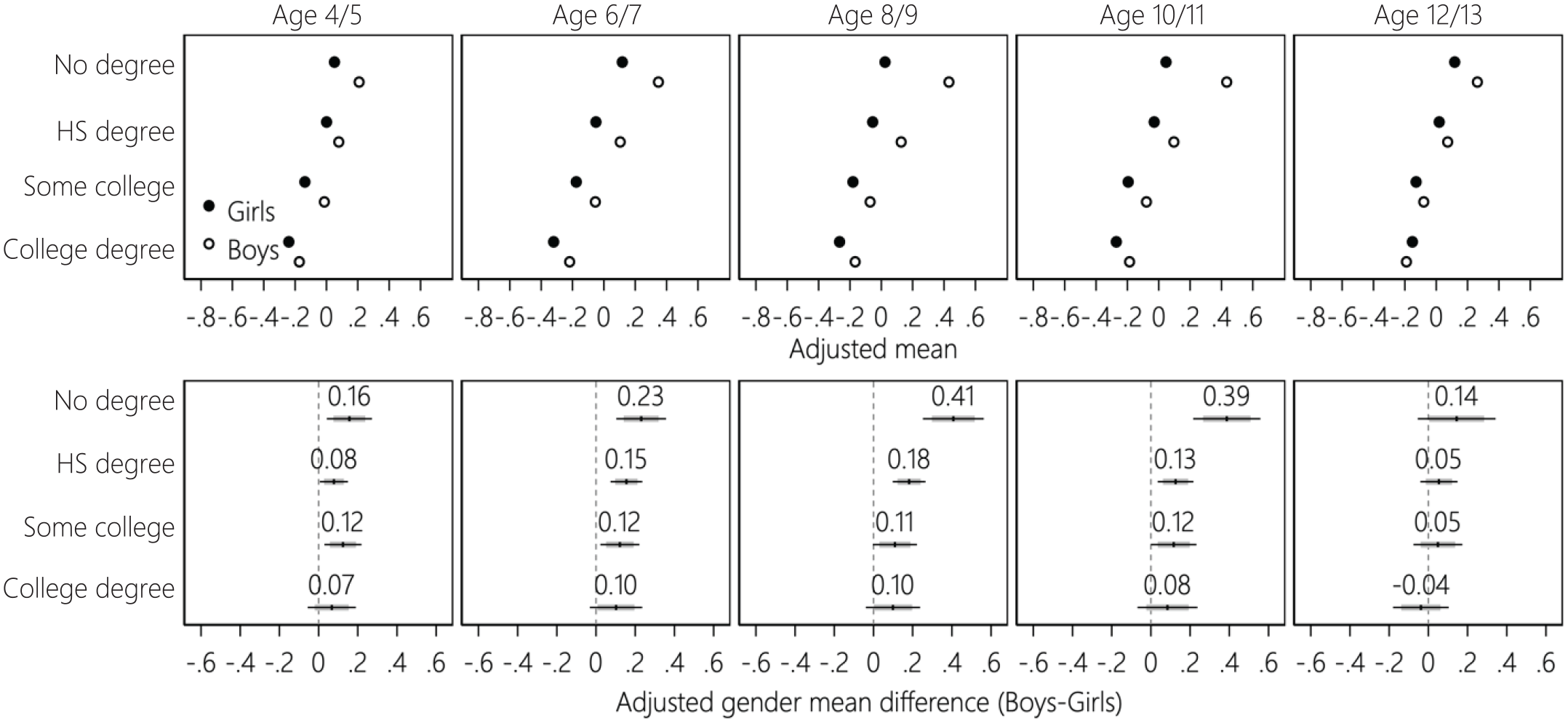
Gender-specific adjusted mean externalizing problems score and adjusted gender mean difference (with 95 percent and 83.4 percent confidence intervals) by maternal education and age at assessment.
Figure 5 largely confirms the earlier findings regarding the minor gender differences in internalizing problems. At the 5 percent significance level, only a few group-specific gender differences are statistically significant. Although the mean score for internalizing problems is generally higher for children with less educated mothers, this pattern holds for both boys and girls.

Gender-specific adjusted mean internalizing problems score and adjusted gender mean difference (with 95 percent and 83.4 percent confidence intervals) by maternal education and age at assessment.
Gender Differences by Family Structure
In the following, we present gender-specific means and gender differences in the means of different outcome scores by family structure at birth.
Figures 6 and 7 display the results for math and reading scores, respectively. On average, children born into two-parent households outperform those born into single-parent households in math and reading. There is no discernible pattern of gender differences between children born into one-parent families and those born into two-parent families. This is also demonstrated by ECLS-K data (see Figures S4.3 and S4.4 in the Supplemental Material). Although children from one-parent families exhibit more externalizing and internalizing behavioral problems than those from two-parent families, there are no discernible gender differences by family structure (see Figures S3.1 and S3.2 in the Supplemental Material).

Gender-specific adjusted mean math score and adjusted gender mean difference (with 95 percent and 83.4 percent confidence interval) by family type and age at assessment.

Gender-specific adjusted mean reading recognition score and adjusted gender mean difference (with 95 percent and 83.4 percent confidence interval) by family type and age at assessment.
Discussion and Conclusion
This study examined whether gender disparities in academic achievement and behavioral issues vary by the family environment. We anticipated that gender differences would be greater among children from disadvantaged families. Our initial findings confirm previous research indicating that boys have reading disadvantages and more externalizing behavior problems than girls. In addition, they achieve higher average math scores than their female counterparts. Although boys experience disadvantages in reading from childhood to adolescence, their advantage in mathematics only emerges in Grade 9/10. This result is consistent with previous findings that older girls are at a disadvantage in math (Cameron et al. 2015; Cornwell, Mustard, and Van Parys 2014). Boys are no longer at a disadvantage when it comes to externalizing behavioral issues around 12 or 13. Nevertheless, due to the disruptions in learning/schooling at the time, it may leave a mark on boys’ long-term educational paths. In accordance with prior research (e.g., Downey et al. 2019), the gender differences in internalizing behavior problems are relatively small.
Our primary findings indicated that gender differences in academic achievement and externalizing behavior problems during childhood vary by maternal education but not family structure. They suggest that as mothers’ education increases, boys’ advantages in mathematics increase, whereas their disadvantages in reading and externalizing behavior problems diminish. The increasing math advantage across mothers’ education confirms previous findings that boys have advantages primarily at the top of the math distribution, given that children with highly educated mothers are more often found among high achievers (e.g., Ellison and Swanson 2010; Entwisle et al. 1994).
The differences in gender gaps across maternal education are primarily attributable to differences in the group-specific mean scores for boys. Academically, boys with less educated mothers significantly lag behind their peers from more privileged educational backgrounds. In addition, they exhibit more externalizing behavior issues than their advantaged counterparts. Girls exhibit less pronounced differences in academic achievement and behavioral issues across maternal education groups. This confirms our hypothesis that boys are more susceptible to a disadvantageous family environment than girls, although we did not find these patterns for family structure. These results are consistent with prior research indicating that mainly boys from low SES families are disadvantaged in reading (Entwisle et al. 2007). Boys’ advantage in mathematics over girls was larger among students whose parents are more educated (Penner and Paret 2008).
In the majority of instances, observed gender gaps across maternal education are statistically nonsignificant, and confidence intervals are frequently large. However, the consistency of these patterns across outcomes and two distinct data sets (NLSY-CYA and ECLS-K) suggests that they may not merely due to random error. In conjunction with prior findings, our replication efforts give us confidence that the observed patterns in the data accurately reflect the interdependent influence of children’s gender and their mothers’ education on their academic achievement and behavior.
Although the observed gender gaps are considerably smaller than differences in outcomes by maternal education, some group-specific gender gaps are not negligible, particularly in reading and externalizing behavior problems. For example, the gender gap in reading at age 13/14 for children whose mothers have not completed high school is approximately half the gap associated with having a mother with a college degree versus a mother with a high school degree. For externalizing problems, the gender gaps at ages 8/9 and 10/11 for children whose mothers did not complete high school are greater than the differences for girls across all maternal education groups.
Our results shed light on the mechanisms underlying gender differences in academic achievement and behavior during childhood. The differences in gender gaps by maternal education highlight the significance of social factors, such as cultural norms or gender-specific parenting, in explaining the advantages and disadvantages of boys and girls. It is unlikely that biological differences between boys and girls would vary across socioeconomic groups and account for differences in achievement and behavior. Moreover, our findings demonstrate that not all aspects of the family environment are equally influential in determining gender differences during childhood. For instance, our finding that there are no systematic differences in gender gaps between children born into one-parent and two-parent households refutes the claim that boys are, by nature, more susceptible to adverse family conditions than girls (Autor et al. 2019). If this were the case, we would also observe greater relative disadvantages for boys in single-parent households. Our findings may suggest that cultural norms (as held by various educational groups) are more significant than family resources and the presence of (male) role models (as captured by family structure after adjusting for maternal education) in explaining the heterogeneity of gender-typical achievement and behavior across family circumstances.
Our research confirms the significance of an intersectional approach to gender differences. Children’s lived experiences are not adequately captured by unitary and multiple category approaches to inequality in academic performance and behavior. If we want to understand the origins of the gender gap in educational outcomes, we must investigate the family circumstances in which these gender inequalities emerge and determine the extent to which they contribute to gender differences in developmental pathways during childhood and adolescence. Therefore, it is essential to examine how gender differences in academic achievement are “ingrained and shaped by hierarchical structures of difference and inequality” (Penner and Paret 2008:251).
Supplemental Material
sj-docx-1-srd-10.1177_23780231231199395 – Supplemental material for Children’s Academic Achievement and Behavior Problems at the Intersection of Gender and Family Environment
Supplemental material, sj-docx-1-srd-10.1177_23780231231199395 for Children’s Academic Achievement and Behavior Problems at the Intersection of Gender and Family Environment by Michael Kühhirt, Markus Klein and Ibrahim Demirer in Socius
Footnotes
Authors’ Note
The raw data for the National Longitudinal Study of Youth and the analysis code are available at https://osf.io/hnaqd/?view_only=aa77751f1fd24354b5f4be1f118378d9. The raw data for the Early Childhood Longitudinal Study Kindergarten can be accessed at  .
.
Supplemental Material
Supplemental material for this article is available online.
Author Biography
References
Supplementary Material
Please find the following supplemental material available below.
For Open Access articles published under a Creative Commons License, all supplemental material carries the same license as the article it is associated with.
For non-Open Access articles published, all supplemental material carries a non-exclusive license, and permission requests for re-use of supplemental material or any part of supplemental material shall be sent directly to the copyright owner as specified in the copyright notice associated with the article.
