




Abstract
This study investigates patterns of communication among non-coresident kin in the aftermath of the COVID-19 pandemic using data from the New York City Robin Hood Poverty Tracker. Over half of New Yorkers spoke to their non-coresident family members several times a week during the pandemic, and nearly half increased their communication with non-coresident kin since March 2020. Siblings and extended kin proved to be especially important ties activated during the pandemic. New Yorkers were most likely to report increased communication with siblings. A quarter of respondents reported that they increased communication with at least one aunt, uncle, cousin, or other extended family member. Although non-Hispanic White respondents reported the highest frequency of communication with kin, it was those groups most impacted by COVID-19—foreign-born, Black, and Hispanic New Yorkers—who were most likely to report that they increased communication with kin in the wake of the pandemic.
Over the past several decades, the boundaries of family systems have been pared down across most advanced societies (Furstenberg 2020). Scholarly attention has become more focused on the nuclear family—that is, spouses/partners, parents, and children—and its immediate upward and downward extensions. Family researchers sometimes argue that most material and nonmaterial exchanges happen across lineal kin ties, with kinship maps increasingly taking the form of beanpoles rather than bushes. The literature tends to assume that extended kin ties are only important in certain types of non-Western family structures or among the poor and racially marginalized groups within Western societies. Working within this framework has often obscured the ways in which families rely on kin outside of the nuclear household for companionship and support. In fact, extended and collateral kin, those outside of direct lines of familial descent, often live in close proximity and play important roles in each other’s lives (Daw, Verdery, and Patterson 2019; Furstenberg 2020; Furstenberg et al. 2020; Nordqvist 2015; Whiteside 1989). Despite their importance for family life, little research to date has examined the communication patterns of extended kin or how extended kin may be activated in times of crises.
This study aims to fill this gap with new survey data on how communication with non-coresident kin was impacted by the COVID-19 pandemic in New York City (NYC). The COVID-19 pandemic provides a scenario—“a once in a lifetime international social experiment about family life,” as defined by Lebow (2020, 309)—to investigate the extent to which individuals draw on their kinship networks for support during a time of extreme upheaval. The pandemic is an important case to examine the activation of kin ties because of the global scale of the crisis. Although the specific ways in which people were impacted varied across the population, everyone’s life was touched by the pandemic in some way. This is different from other types of crises, such as personal health crises (e.g., cancer diagnosis) or localized natural crises (e.g., a hurricane). Because the pandemic impacted all New Yorkers at the same time, this is an interesting case to examine the activation of, often latent, kin ties across a wide range of diverse populations living in the city.
For many, one of the most important resources in facilitating resilience through the pandemic has been kinship ties and the material and immaterial resources that kin can provide, including through simple communication (Lebow 2020). Even when the pandemic forced most relationships to a virtual mode of contact, recent evidence suggests that families continued to play an important role in the lives of people globally (Mikucki-Enyart and Maguire 2021). Family ties help individuals understand, cope with, and adapt to changes which, more generally, help foster resilience (Gayatri and Irawaty 2022; Theiss 2018). Recent research suggests that close family ties were protective against feelings of loneliness during the pandemic lockdowns (Kovacs et al. 2021). Some emerging literature shows that the strength of networks during the COVID-19 pandemic is following typical patterns observed in other situations of crisis, whereby facing external threats increases trust and cooperation “within groups” (in our case, with kin members) but may reinforce boundaries “across groups” (i.e., with nonkin members), leading to the activation and strengthening of ingroup ties such as kin relationships (Lee, Lee, and Hartmann 2023; Völker 2023). Nonetheless, we know little about which family ties are activated in times of crisis and who activates these kinship resources.
We contribute to the family and kinship literature in two ways. First, we describe the extent to which individuals reach out to family members beyond their household in times of crisis and to whom they reach out, reassessing prior statements that individuals draw little support outside of their nuclear family and building on recent research documenting the importance of extended kin (Furstenberg 2020; Grady 2016; Mazzucchelli, Bosoni, and Medina 2020). Second, we categorize the extent to which communication with extended kin varies by groups that have been identified in the literature as differing in their deployment of kinship resources, namely, by gender, social class, immigrant status, age group, and race. Our focus in this study is on who individuals turn to when confronted with a sudden stressor, such as COVID-19. In doing so, we aim to illuminate inequality in access to kin resources that may extend beyond the COVID-19 pandemic, thus contributing to a better understanding of the manifold layers of inequality that pervade U.S. society, many of which originate within the family (Gibson-Davis and Hill 2021; Western, Bloome, and Percheski 2008; Williams and Baker 2021).
This article focuses on family communications by relying on measures of frequency and intensity of communication with kin during the first year of the pandemic using the Robin Hood Poverty Tracker survey conducted in NYC, which includes a COVID-19 module. We report on the amount of and perceived changes in communication with non-coresident family members and describe how patterns of communication vary across social and demographic groups.
NYC is an important site to study the implications of the pandemic because it was the epicenter of the first wave of COVID-19 infections in the United States, leading to major repercussions on the lives of New Yorkers. In the first few months of the pandemic, it is estimated that 20 percent of the city’s population was infected with the virus, leading to the deaths of over 22,000 New Yorkers (Do and Frank 2021; Irons and Raftery 2021). In addition to the health impacts, the lockdown and economic shocks that came with the pandemic increased material hardship and psychological distress (Poverty Tracker Research Group at Columbia University 2022; Williams 2021). These impacts were especially acute in NYC due to the city having some of the strictest lockdowns and a high density of small apartment residences. The health and economic impacts of the pandemic were also experienced unequally across NYC’s diverse neighborhoods, and poor and non-White areas have been found to be impacted the most severely (Do and Frank 2021; Poverty Tracker Research Group at Columbia University 2022). Because of its diversity and the severity of the COVID-19 crisis in the city, NYC is an especially revealing case to examine how kin ties are activated in times of crises and how that activation varies across groups.
Background
Communication with Kin
Most existing research on communication between kin in the United States centers on the nuclear family, which is understood to be the center of the Western kinship structure. This idea has been supported by research suggesting that there is an “implicit” order to kin relationships. Individuals tend to have the most contact with partners, followed by non-coresident parents and children (Jallinoja and Widmer 2011; Thomson 2017). In their classic cross-country comparative study, Höllinger and Haller (1990) found that one predominantly seeks support from a spouse first, only after which do individuals seek support from parents (mostly mothers), then sons or daughters, and lastly, siblings. Much of this research supports early theoretical models, like the convoy model (Kahn and Antonucci 1980), which describes how relationships often form concentric circles of closeness, with individuals relying on those in their closest circle first, often spouses and children. Similarly, Cantor’s (1979) hierarchical compensatory model argues that people rely on others based on their social roles rather than the kind of support needed, unless the person in the preferred role is unavailable, in which case, others, such as friends, may fill in the gaps.
Based on these perspectives, which tend to place the nuclear family at the center of family life, most of the literature focuses on the relationships between spouses, parents, and children. However, this focus is also influenced by the lack of availability of data on extended kin. It is difficult to obtain, through surveys, information on large and complex kin structures, including both the availability of kin (often called the “demography of kinship”) and the closeness of these relationships. The National Survey of Families and Households provides information on interactions within kinship networks, yet these data are outdated and only ask about parents, children, siblings, and “other relatives,” a broad category that greatly obscures the varied layers embedded in more complex kin relations (Furstenberg 2020). New studies using the Health and Retirement Study have highlighted the kinship networks of older adults, again focusing on spouses, parents, siblings, and children (Verdery and Margolis 2017). Studies, including research by Daw, Verdery, and Margolis (2016), have begun to expand kinship research by harnessing the kin data within the Panel Study of Income Dynamics to document kin availability, including extended relatives like grandparents, grandchildren, aunts, uncles, nieces, nephews, and cousins. Daw et al. (2016), however, focus only on counts of available kin and their differences by race, age, and education. There remains much to learn about the nature and intimacy of these kin relationships beyond the nuclear family.
Communication frequency has often been used as a proxy for closeness or strength of ties, supported by findings in the UK that communicating more often is connected to more emotionally strong relationships (Hill and Dunbar 2003). Roberts and Dunbar (2011) studied the communication patterns in women’s social networks in the UK and Belgium, as measured by time since last contact, and found that this was related to the emotional connectedness of that relationship. Those who were emotionally closer had shorter times between contact, particularly for kin. There was one caveat related to the size of kin networks in Roberts and Dunbar’s study: Those in larger kin networks reported having greater time between each contact. In addition, although a lack of contact is connected to relationship decay (Oswald and Clark 2003), research shows that this is a slower process for kin compared to friends (Burt 2000). Although extensive contact and communication usually signal stronger kinship ties, which in turn correlate with higher provision and receipt of social support, we acknowledge that increased contact may, at times, be a source of strain and additional time demands for some individuals (Patterson 2002).
Sociodemographic Variation in Contact with Kin
Research on kinship networks, contact, and exchange has largely focused on racial differences. Older research found that Black families had stronger and more extensive kin networks and were more likely to contact kin compared to White families (see Raley 1995), but more recent studies find mixed results. For example, Black Americans tend to be embedded in larger households (Kamo 2000; Peek et al. 2004) while having smaller networks with a larger proportion of family in that network (Ajrouch, Antonucci, and Janevic 2001). Other differences by race include White Americans having more older kin (parents, grandparents, spouses, full siblings, and aunts/uncles) and Black Americans having more younger kin (children, half siblings, grandchildren, cousins, and nieces/nephews; Daw et al. 2016). Furthermore, Black families more often provide practical support, such as transportation or childcare, whereas White families more often provide financial and emotional support, often manifested as tighter communication with kin (Sarkisian and Gerstel 2004). Studying kin availability from a purely demographic standpoint rather than only kin contact may provide clarity to these conflicting results by determining whether greater kin contact is due to the number/availability of kin, the intensity of those relationships, or both—a challenging research endeavor that is well underway yet far from being fully realized.
Many studies addressing how social class impacts kin contact and exchange often entwine class and race, with inconsistent findings across studies (Furstenberg 2020). However, some studies do disentangle the two. Sarkisian and Gerstel (2004) found that, regardless of race, higher socioeconomic position correlated with greater financial and emotional but not other practical types of kin support. Others have utilized education as a proxy for class, finding those with more education have a higher probability of having living parents, grandparents, and spouses but a lower probability of having two or more children, half siblings, grandchildren, or cousins compared to those with less education (Daw et al. 2016), meaning those with more education may have more kinship ties who are more economically established on which to call for support. The literature on kinship ties has primarily focused on poor families of color, hence research comparing families across the economic spectrum—as we do in this study—is needed (Cooper and Pugh 2020; Furstenberg 2020).
As for gender, existing studies suggest that women tend to maintain tighter relationships with kin, often demonstrated in the form of higher care provision or more frequent patterns of communication. For instance, using data from Europe, David-Barrett et al. (2016) found that women play a more central role in holding together different generations of a family because they are more likely to keep cross-generational communication than men, especially from the middle of the young adulthood phase onward. In a study of adult sibling relations, Lee, Spitze, and Logan (2003) also found that sister pairs of siblings phone and exchange advice more often than do other sibling pairs (either brother-brother or brother-sister). In general, the authors found that women are more likely than men to report feeling close to or getting along with their siblings, suggesting that giving and receiving help may reflect gendered forms of intimacy and of household labor.
Age and life stage also contribute to the strength and types of available ties. Individuals are more likely to have living grandparents, aunts/uncles, and cousins before middle age and spouses and children during middle age (Daw et al. 2016). Research suggests that sibling relationships remain important throughout life but tend to decline in intensity with age (Suitor, Gilligan, and Pillemer 2016; Whiteman, McHale, and Soli 2011). Other research shows that siblings engage in less giving and receiving starting around age 16 but then increase exchanging support around age 70, regardless of proximity (White 2001).
Kin Ties during COVID-19 and Main Contributions of the Study
Recent research has estimated the incidence of family bereavement due to COVID-19 in the United States (Verdery et al. 2020; Zahra, Kidman, and Kohler 2021) and in cross-country analyses (Snyder et al. 2022) and the mental health repercussions of losing a loved one (Wang, Smith-Greenaway, et al. 2022; Wang, Verdery, et al. 2022). Other studies have focused on the extent to which stronger family ties (or tighter intergenerational relationships) may explain more severe outbreaks or diffusion of the virus across different populations, as found by Arpino, Bordone, and Pasqualini (2020) in Europe and by Dowd et al. (2020) in Italy and South Korea. Our interest here goes in a different direction. We ask the question of whether and how patterns of kin contact and communication change in the wake of systemic crises such as the COVID-19 pandemic and if so, with whom.
To the best of our knowledge, little research exists on the topic to date. Although it is undeniable that the pandemic has exacerbated within-couple dynamics leading, for instance, to higher family instability (Manning and Payne 2021), spikes in intimate partner violence (Bullinger, Carr, and Packham 2021; Lindberg et al. 2020), and a greater care burden (Lee and Parolin 2021), the general perception in the media is that the pandemic could also be seen as an opportunity for more extensive communication and strengthening of familial bonds with relatives, both closer and distal ones (Lee et al. 2023). Empirical analyses are, however, lacking, with a few exceptions. One is a survey conducted by StandAlone in collaboration with the University of Cambridge and Edge Hill University in May 2020, which found that during the COVID-19 pandemic, 55 percent of respondents in the United Kingdom felt more alone and less connected to family members (Blake et al. 2020). Respondents reported that they had thought about their estranged family members 56 percent more often, 41 percent the same, and 3 percent less often. Similarly, 78 percent maintained the same amount of contact with family members, whereas 16 percent increased contact, and 6 percent reduced contact. Finally, respondents reported that they had thought about contacting their estranged family members 48 percent the same as usual, 40 percent more than usual, and 12 percent less than usual. In another study, Kovacs et al. (2021) use longitudinal social network data, including both family and nonfamily ties, to show how close relationships were protective against loneliness during the pandemic. A recent article by Lee et al. (2023), who developed a nationwide online survey to explore how Americans mobilized their social ties in response to the pandemic (both kin- and nonkin ties), found remarkable stability in the strength of kin ties relative to the pre-COVID era alongside a significant rise in racial homophily during COVID fostered by the use of online communication technologies.
Our study seeks to contribute to this growing literature on kinship ties in the wake of global-level crises using new data on patterns of communication with non-coresidential kin in a large metropolitan area in the United States. This research addresses some of the gaps in the previous literature (which has focused mostly on nuclear kin ties) by investigating patterns of contact with kin across the whole kinship network. Asking respondents about specific non-coresidential kin, including siblings, aunts/uncles, cousins, grandparents, grandchildren, and others, ensures these kin relationships are not obscured.
Data and Methods
This study uses data from the Robin Hood Poverty Tracker. Launched in 2012, the Poverty Tracker surveys a representative sample of NYC residents contacted every three months, providing critical information on the dynamics of poverty and other forms of disadvantage. The third and fourth panels of the Poverty Tracker, recruited to participate in 2017 and 2020, were used for this analysis. The study uses a rotating panel study design and primarily recruits participants through random digit dialing of both landlines and cell phones. The response rates were 8.1 percent and 6.3 percent for the third and fourth panels, respectively. Although, as with most random digit dialing survey designs, the response rate was relatively low, research has shown that these designs still produce significantly less bias than nonprobability samples and are therefore a valuable sampling approach (Dutwin and Buskirk 2017). An adult in each of the followed households was contacted every three months to complete online, phone, or paper surveys. For this study, we use data from the COVID-19 kinship module, a one-time module designed by the research team and implemented with each study participant between August 2020 and September 2021. Ultimately, 74 percent of the third panel cohort was surveyed with the COVID-19 kinship module and 92 percent of the fourth panel cohort. The bulk of responses (62 percent) were collected in September and November 2020 and therefore reflect respondents’ experiences up to that point in the pandemic. The authors tested whether responses were different depending on when the respondent was surveyed and found only limited evidence of changes over time. In analyses not shown, it was found that variation in survey month did not significantly impact the core results presented here. The initial sample size was 2,397 respondents. The sample was reduced to 2,363 for the analysis through listwise deletion by excluding 34 cases (1.4 percent) with missing data on one or more variables used in the regression analysis. Table 1 includes descriptive statistics on variables used in the analysis and comparative statistics from the census, when available.
Descriptive Statistics.

Source: Robin Hood Poverty Tracker (2020–2021) and census data from the 2020 census and the American Community Survey (2021, 1-year estimates).
Data from either the 2020 census or the 2021 American Community Survey for New York City included as a reference when comparable estimate available. Census data collected from data.census.gov. Only includes those age 18 and older. Sample size in the Robin Hood Poverty Tracker is 2,363. Analytic weights applied.
The main dependent variables in our analysis are measures of the frequency of communication and whether communication increased with non-coresident kin during the pandemic. Frequency of communication with relatives who live outside of one’s household since March 2020 was measured using a categorical question with different levels of frequency. The question did not specify the format of communication, and therefore it could include a variety of methods, including phone calls, text messaging, and in-person meetings. Because so many respondents gave the first option, this variable was transformed into a dichotomous measure of whether the respondent reported speaking to family several times a week (the highest frequency) or not for use in the regression analyses. Respondents were also asked whether their communication with family members living outside of their home increased since the beginning of the pandemic. This was a yes or no question. If the respondent indicated that their communication with non-coresident family increased, they were then asked a series of questions to indicate the type of relatives with whom they had increased communication.
Table 1 also displays data on the demographic characteristics of the sample. These demographic variables are used as independent variables in the regression analyses. The gender variable is an indicator of whether the respondent reported being a woman (53.4 percent). The remainder of respondents reported that they were either a man or that they had some other gender identity. Age is a categorical variable with about a quarter of respondents in each of the four age groups. In addition, 45.1 percent of the sample was born outside of the United States. Respondents who had completed a bachelor’s degree or higher were classified as college educated. The Robin Hood Poverty Tracker also collects extensive data on income to measure the burden of poverty in NYC. The Supplemental Poverty Measure defines income more broadly than the official poverty measure, capturing resources that come to families through the tax system or in the form of near-cash benefits, such as food stamps or housing assistance. Data on poverty status used in this analysis came from the most recent survey wave collected by the Robin Hood Poverty Tracker. For some respondents, their poverty classification is from before the beginning of the pandemic in early 2020. Of respondents, 21.9 percent were classified as below the poverty line. The Poverty Tracker has a five-category measure of race/ethnicity including non-Hispanic White, non-Hispanic Black, Asian, Hispanic, and other (or multiple) races. The final set of variables are dummy indicator variables capturing household composition, including whether the respondent resides with a domestic partner or spouse, at least one of their children, at least one parent, or at least one sibling. Note that the indicator for living with their child(ren) refers to any biological, step, adopted, or foster child, including adult children of the respondent.
The analysis that follows presents both descriptive and regression results. Logistic regressions are used to identify the association between sociodemographic factors and the dichotomous dependent variables of whether the respondent spoke to their family several times a week during the pandemic and whether that frequency of communication constituted an increase since before March 2020. Analyses not shown revealed almost identical results when the frequency of communication variable was kept as an ordinal measure and an ordered logistic regression was used. This is most likely because two-thirds of the sample reported the highest level of frequency of communication. For ease of interpretation, only the logistic regression results have been presented. Results from logistic regressions are presented as odds ratios.
Results
Patterns of Frequency of Communication and Changes in Communication
The descriptive results from the Poverty Tracker COVID-19 module reveal important trends in family communication during the pandemic not captured in any other study to date. Respondents were asked how frequently they spoke with non-coresident family members since the beginning of the pandemic in March 2020. The majority of respondents (55.7 percent) indicated that they spoke with family members outside of their home several times a week, the highest response option given on the survey. In addition, 21.7 percent said that they spoke to their family about once a week, 9.8 percent said they spoke with family two or three times a month, and 6.8 percent spoke with family about once a month. Only 3.1 percent of respondents said that their contact frequency was less than once a month. A further 2.9 percent reported that they had no contact with family members living outside of their home. These findings suggest very frequent communication with kin during the pandemic despite physical distancing restrictions limiting face-to-face meetings.
This high frequency of communication with kin reflects an increase since before the pandemic. As shown in Table 1, 48.6 percent reported that they increased communication with non-coresident family members since March 2020. Figure 1 depicts the results on which non-coresident kin categories respondents reported increased communication. Siblings were at the top of the list; nearly a third (31.0 percent) reported increased communication with at least one sibling. We have divided the remaining kin types into those that are either upward or downward lineal connections, those in the direct line of familial descent, and collateral kin, which includes extended kin such as aunts, uncles, and cousins. In total, 22.3 percent of respondents who reported increased communication with at least one upward kin family member, including 22.3 percent of respondents reported increased communication with at least one parent and 4.3 percent who reported increased communication with at least one grandparent. All respondents who increased communication with at least one grandparent also reported increasing communication with at least one parent. Similarly, 15.6 percent of respondents increased communication with at least one downward lineal kin, including 15.1 percent who reported increased communication with at least one child and 4.9 percent who reported increased communication with at least one grandchild. A larger increase was observed in communication with collateral or other kin. Nearly a quarter of respondents (24.4 percent) reported that they communicated more frequently with at least one aunt or uncle (13.9 percent), a cousin (14.2 percent), or some other relative (7.1 percent). It is important to note that respondents may already have been in very frequent contact with some family members before the pandemic, which could possibly explain why fewer respondents reported that their communication increased with their parents and children, the groups they may normally be in the most frequent contact. What these results reveal is how some kin relationships are activated in new ways that reflect an increased intensity of communication during the pandemic.

Percentage of respondents who reported that they increased communication with different types of non-coresident family members.
Variation by Sociodemographic Characteristics
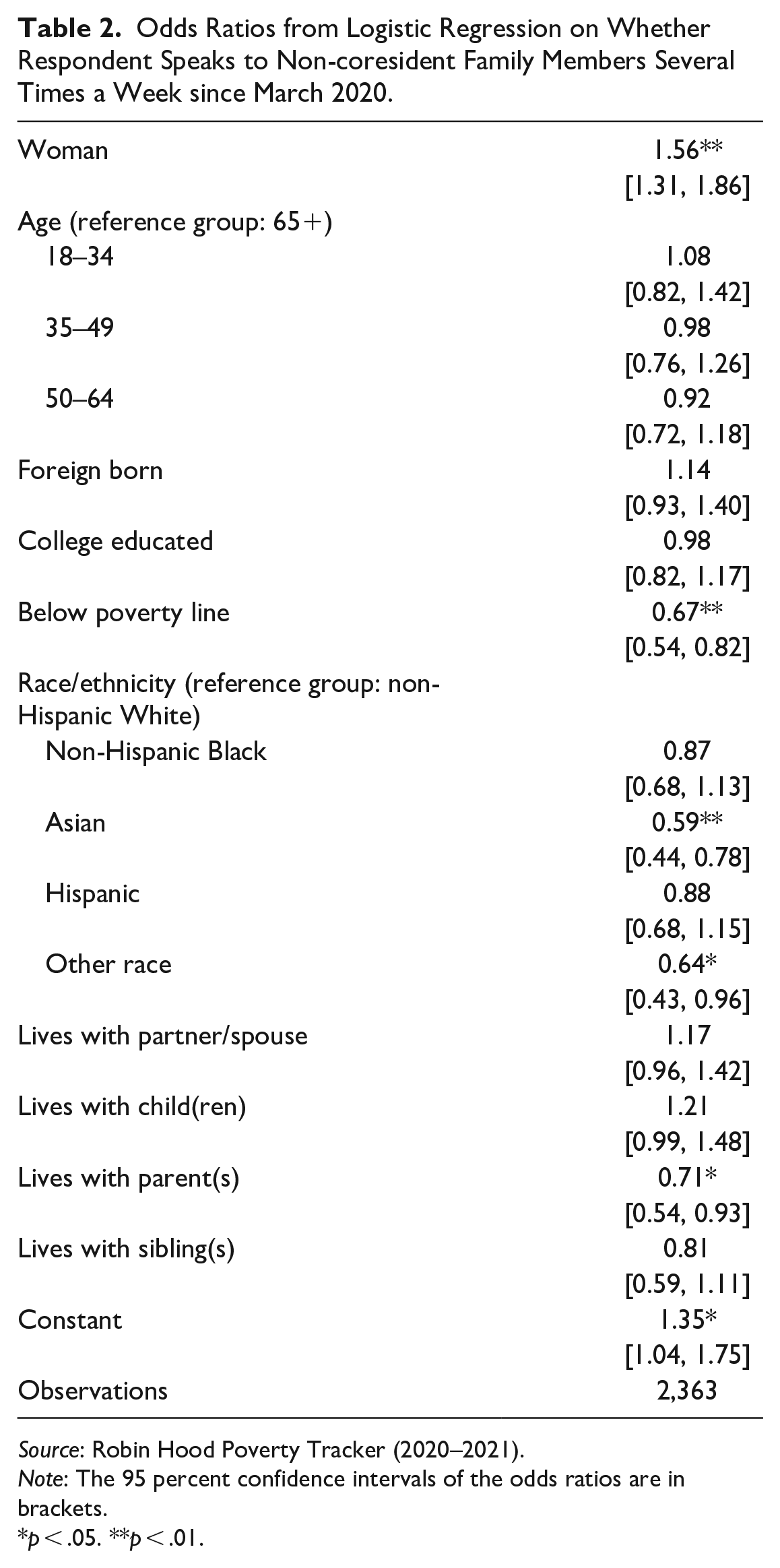
Logistic regressions were used to examine frequency of communication with kin and whether increased communication varied by sociodemographic variables of interest. In addition to examining how communication with non-coresident kin varied by sociodemographic characteristics, the logistic regression framework allows us to control for the kin that respondents may have available to them within their household. The first logistic regression results, presented in the odds ratios found on Table 2, reveal significant variation across the population in frequency of communication with non-coresident family members during the pandemic. Women had over 50 percent higher odds of reporting that they spoke to their relatives several times a week, the highest frequency option, since the pandemic began in March 2020. Those whose incomes placed them below the poverty line were less likely to report that they spoke frequently with relatives living outside of their home. Controlling for all other variables in the regression, there was no significant difference in reported frequency of communication with family by college attainment, age group, or foreign-born status. The results suggest significant variation by racial/ethnic group even after controlling for other sociodemographic variables. Asian respondents and those who had another racial/ethnic identity had significantly lower odds of speaking with their family members several times a week during the pandemic relative to non-Hispanic White respondents. Finally, those respondents who lived with at least one parent had lower odds of speaking with non-coresident family members several times a week compared to those who did not live with a parent. Living with one’s partner, children, or siblings had no statistically significant association with frequency of communication with non-coresident kin.
Odds Ratios from Logistic Regression on Whether Respondent Speaks to Non-coresident Family Members Several Times a Week since March 2020.
Source: Robin Hood Poverty Tracker (2020–2021).
Note: The 95 percent confidence intervals of the odds ratios are in brackets.
p < .05. **p < .01.
Next, we examined how changes in communication due to the pandemic varied by sociodemographic characteristics. Table 3 displays odds ratios and 95 percent confidence intervals from a logistic regression predicting whether the respondent reported that they increased communication with nonhousehold family members since March 2020. Some of these results are similar to those in Table 2, but others are different. As with overall frequency of communication, women had higher odds of reporting that they increased their communication with kin during the pandemic than those who did not identify as a woman. Controlling for the other variables in the analysis, foreign-born respondents had higher odds of reporting that they increased communication with family members during the pandemic. There were no statistically significant differences by age group. The results for the two social class measures are different from those presented in Table 2. There was no statistically significant difference in the odds of increasing communication with family members by poverty status. However, those who were college-educated had higher odds of reporting that they increased communication during the pandemic.
Odds Ratios from Logistic Regression on Whether Respondent Increased Communication with Non-coresident Kin since the Beginning of the Pandemic.

Source: Robin Hood Poverty Tracker (2020–2021).
Note: The 95 percent confidence intervals of the odds ratios are in brackets.
p < .05. **p < .01.
The results by race/ethnicity deviated most dramatically between Tables 2 and 3. Although non-Hispanic White New Yorkers had greater odds of reporting high frequency of communication with their family members, it was non-White groups that were more likely to report that their communication with kin increased during the pandemic. Non-Hispanic Black respondents had nearly twice the odds of reporting that their communication increased with family members during the pandemic. Hispanic respondents were over twice as likely to report that they increased their communication. To further unpack this relationship, Figure 2 depicts the proportion of respondents reporting that they spoke to their family several times a week by race/ethnicity and by whether they reported that this communication reflected an increase in frequency since the beginning of the pandemic. Although analytic weights are applied in Figure 2, this analysis does not include any controls. Figure 2 shows that non-Hispanic White respondents were the most likely to report speaking with their family several times a week during the pandemic. Even among those who reported that their communication with family members increased, non-Hispanic White New Yorkers had the highest rate of communicating most frequently (several times a week), statistically higher than all groups except those who identified as Hispanic. Those who were Asian or listed their race/ethnicity as “other” reported the lowest frequency of communication. Asian New Yorkers who increased communication with their non-coresident family members spoke to their family less frequently (49.5 percent reporting communication several times a week) than non-Hispanic White New Yorkers who did not increase communication during the pandemic (55.7 percent reporting communication several times a week). Figure 2 highlights how different the findings are across the two measures. Despite lower rates of reporting increased communication than some other groups, non-Hispanic White individuals reported very high frequency of communication with kin during the pandemic. In fact, they may have lower rates of increased communication because their rate of communication was already extremely frequent, with the majority reporting that they speak with their family several times a week.

Percentage of respondents reporting that they spoke to their non-coresident family several times a week by race/ethnicity and whether they increased communication with family during the pandemic.
The final set of results, presented in Table 4, show odds ratios from logistic regressions of whether respondents reported that their communication increased during the pandemic with four different kin types. For the purpose of this analysis, we group seven different questions on communication with family members into four categories: (1) collateral or other kin, which includes aunts, uncles, cousins, and “other relatives”; (2) upward kin, which includes parents and grandparents; (3) downward kin, which includes children and grandchildren; and (4) siblings. Women had significantly higher odds of reporting increased communication during the pandemic only with their collateral/other kin and their children/grandchildren. Age group was not associated with any difference in whether the respondent increased communication with their siblings or collateral/other kin. Being younger was associated with much higher odds of reporting increased communication with upward lineal kin. Those who were age 65 or older were much more likely than those in other age groups, including those ages 50 to 64, to report that they increased communication with their downward lineal kin. This result is likely driven by availability of different kin types for people at different life stages given that, for example, only older adults have grandchildren. Those who were born outside of the United States had higher odds of reporting increased communication with their upward and downward lineal kin compared to those born in the United States. College-educated respondents had significantly higher odds of reporting increased communication with siblings, collateral/other kin, and parents/grandparents. Those who were below the poverty line had lower odds of increasing contact with collateral and other kin than those who were not poor. The logistic regressions in Table 4 also include the controls for household composition. Despite being statistically significant in Table 3, the lower odds of increasing communication during the pandemic did not reach statistical significance for those who live with their partner in the individual kin type models in Table 4. Those who live with at least one child had higher odds of increasing communication during the pandemic with their sibling(s) and children and/or grandchildren, controlling for the other variables in the model. Those who live with their parents had lower odds of increasing communication with their siblings and parents. Finally, those who live with at least one sibling were at higher odds of reporting increased communication with their siblings and collateral/other kin.
Odds Ratios from Logistic Regressions on Whether Respondent Increased Communication with Non-coresident Kin since the Beginning of the Pandemic by Type of Kin.

Source: Robin Hood Poverty Tracker (2020–2021).
Note: The 95 percent confidence intervals of the odds ratios are in brackets.
p < .05. **p < .01.
There were differences in increased communication with kin by race/ethnicity. Relative to White respondents, Hispanic respondents had higher odds of reporting increased communication with all kin types. In fact, Hispanic New Yorkers had nearly twice the odds of reporting increased communication with siblings, collateral/other kin, and downward lineal kin. Similarly, non-Hispanic Black respondents had higher odds of increasing communication with all kin types during the pandemic except for parents/grandparents relative to non-Hispanic White respondents. The estimates associated with Hispanic and Black respondents suggest large changes in kin relations for these populations as a result of the COVID-19 pandemic.
Discussion
This study, using the case of the COVID-19 pandemic, provides important evidence of how kin ties are activated during times of crises. The pandemic is a unique case to study family relationships because of both the global scale of the event and the severity of the crisis across multiple domains of life (health, economic, social, and psychological). The findings in this article show that family members reached out beyond the confines of the household during the pandemic to engage in communication with a wide range of kin from parents to uncles. Results from the New York City Poverty Tracker study revealed the extent to which family relations were altered by the pandemic and suggest that people often have latent kin ties that can be activated in times of need.
First, we find that New Yorkers were in very frequent communication with a wide network of family members during the pandemic, a frequency that was significantly higher than we had anticipated when designing the survey questions. Over half of respondents indicated that they spoke to non-coresident family members several times a week since March 2020, the highest category offered in the multiple-choice question. Furthermore, nearly half of respondents said that this high frequency of contact reflected an increase since before the pandemic. These results suggest that the pandemic did alter people’s relationships with their family members as they reached out to kin much more frequently. More broadly, these findings are aligned with growing research showing that in crises like the COVID-19 pandemic, people tend to activate or further strengthen kin ties they trust as a way to deal with uncertainty and risks (Lee et al. 2023; Völker 2023). Research using smartphone usage data also suggests that the pandemic significantly increased people’s use of messaging and voice call apps to stay connected during the first wave of the pandemic (Ohme et al. 2020).
Our results also show that the pandemic impacted family communication across a wide and complex family network. Although many respondents did report increasing communication with their more proximate lineal kin such as parents and children, nearly a quarter of respondents reported that they increased communication with at least one collateral or other family member. The existing literature has paid less attention to extended kin relations, but this study suggests that relationships with cousins, aunts, uncles, grandparents, and grandchildren form an important part of people’s family lives, especially in times of crises. Surprisingly, the group that respondents were most likely to increase contact with was their siblings. Nearly a third of respondents reported that the pandemic had led them to speak with their brothers and/or sisters more frequently. In addition, 14.2 percent of respondents increased communication with their cousins. These findings conform with earlier studies that found people often report that siblings are their preferred contact in case of emergency and that they would often go to a sibling over a spouse for certain types of assistance (White 2001; White and Riedmann 1992). Siblings and cousins are unique kin relationships because the individuals are usually of a similar age and life stage. As respondents sought comfort and advice in the face of uncertainty and loss, these lateral kin relations with one’s peers appeared to be especially important.
Our results provide more evidence of the gendered nature of kin relationships. Women both had higher odds of reporting that they spoke to their family members frequently during the pandemic and were more likely to say that communication had increased since the onset of the pandemic. These results fit with other studies that have shown women maintain tighter relationships with kin, often demonstrated in the form of higher care provision or closer communication (David-Barrett et al. 2016; Lee et al. 2003).
The results from this study reveal how family communication can serve as a social resource with the potential to exacerbate other social inequalities. Privileged groups such as non-Hispanic White New Yorkers and those with higher incomes had more frequent communication with their relatives during the pandemic. Less privileged groups may speak to their family members less frequently for a number of reasons, including lack of leisure time, financial reasons, limited availability of kin, and strained family relations. Related to the last point, it might be possible that, in contexts of poverty, increased communication with kin may impose additional time demands and/or turn into sources of strain rather than comfort.
Increases in frequency of communication with family, however, were found more among marginalized populations most directly impacted by COVID-19. Relative to White New Yorkers, Black and Hispanic New Yorkers were significantly more likely to report that they increased communication with their family members during the pandemic. Foreign-born respondents also had higher odds of reporting increased communication with family. This could be due to the fact that the Black, Hispanic, and immigrant communities of NYC were especially impacted by both COVID-19 illness and the broader economic and social impacts of the lockdown (Clay and Rogus 2021; Do and Frank 2021; Tai et al. 2021). In addition, college-educated respondents were more likely to report that they increased communication during the pandemic. This result is surprising because college-educated populations were less impacted by COVID-19 directly, yet it may be related to other findings that show that college-educated populations were more worried about their safety during the pandemic (Chai, Zhang, and Chang 2020; Ciancio et al. 2020; Rattay et al. 2021). Despite the fact that non-White populations were more likely to increase family communication during the pandemic, the data reveal that their frequency of communication was often still less than the White population’s. This builds on evidence that family ties may end up being “social assets” enjoyed most by privileged populations.
As the first of its kind, this study has some important limitations that point to areas for future research and data collection. First, this survey did not include a measure of frequency of communication before the pandemic, nor do we capture whether their communication might have decreased. Although we do know whether respondents felt that their communication increased after March 2020, we do not have an exact measure of how much it increased. As such, we could not leverage a before-and-after comparison. Second, responses are affected by the availability of kin, a key component of kin relationships not captured in our study. Some older people may not have any living parents or grandparents, and younger people may not yet have children, and so they would be unable to have a change in communication with these kinds of kin. In addition, as recent studies have documented, kin availability was also dramatically impacted by the pandemic itself through deaths in the family (Verdery et al. 2020). Third, the two measures used, which capture frequency of contact and communication at one point in time, may suffer from recall biases and/or be reported with errors. Future studies may want to complement these estimates with those obtained through more detailed time use diaries or surveys. Fourth, this study draws from a random sample of residents of NYC at a specific point in the pandemic (primarily, fall 2020, i.e., following the first wave). How the pandemic impacted kin relations in other regions and at other periods of the unfolding pandemic is an important area for future research. In particular, other regions, where the social and health implications of the pandemic were less severe, may not have seen the same degree of change in family communication. NYC’s experience with the pandemic at the time of the survey was uniquely acute and may have caused far larger impacts on family life than in other places. Fifth, in this study, we are not able to ascertain the nature of the communication that respondents had with their family members and whether it has a positive or negative effect on their lives. Although communication is believed to be associated with social support, we acknowledge that family contact may also be a source of strain for some (Patterson 2002). In-depth qualitative research is needed to disentangle the nature of how the COVID-19 pandemic impacted the relationships people have with their family members beyond these indicators of frequency of communication. Finally, it remains to be seen whether the changes in family communication documented by this study represent a lasting change in American family life or if they, instead, constitute only a temporary response to the COVID-19 crisis that may revert to the status quo.
The global crises created by the COVID-19 pandemic have revealed features of family life that have received limited attention in the scholarly literature, including the importance of extended kin in times of need. Although the pandemic is unique in many ways, extended kin relationships are likely to be important in other types of crises as well, such as natural disasters. The findings of this study are an invitation to further inquiry and should be interpreted alongside the emerging literature providing insights into how kin communication patterns are affected by kin availability, whether increased communication translates into greater social support, and how the family operates as a system of actors who are bound together by assumptions of kinship. Documenting how family bonds have been altered by the pandemic and the ways in which they can promote resilience in the face of challenges is an important agenda for scholarship on the family.
Footnotes
Funding
The author(s) disclosed receipt of the following financial support for the research, authorship, and/or publication of this article: Reed received support from the Population Research Training Grant (NIH T32 HD007242) awarded to the Population Studies Center at the University of Pennsylvania by the National Institutes of Health’s Eunice Kennedy Shriver National Institute of Child Health and Human Development. Pesando acknowledges financial support from the School of Arts at McGill University, the Division of Social Science at New York University (AD) (grant # 76-71240-ADHPG-AD405), and the Jacobs Foundation (grant # 2021-1417-00). Data collection was supported by the Robin Hood foundation.
