




Abstract
Housing discrimination has long been thought to contribute to the persistence of racial segregation, yet evidence indicates that many forms of discrimination have waned over time. We argue that past work has not fully considered the role of racial steering in maintaining segregation. To explore patterns of steering, we leverage experimental audit data from the 2012 Housing Discrimination Study to examine how neighborhoods of homes shown by real estate agents to auditors change dynamically throughout the search process and to assess the conditions under which steering is most likely. As with past research, we find no evidence of steering in Asian-White or Hispanic-White audits. However, we find consistent evidence that agents steer Black homeseekers away from White neighborhoods and toward Black ones, particularly female homeseekers and those with children. We also find that agents steer relatively early in the search process and especially when searches begin in racially-homogeneous neighborhoods.
Despite decades of steady declines in racial segregation, American urban life remains defined by the spatial separation of racial/ethnic groups. Sociological research has extensively documented the pernicious impacts of sustained residential segregation, including limiting access to educational opportunities and social mobility, exacerbating racial inequalities in wealth accumulation, and isolating social networks (Charles 2003; Hwang and McDaniel 2022; Massey 2020). This unrelenting segregation is typically viewed as resulting from socioeconomic differences between groups that shape housing and neighborhood availability, combined with differing preferences for same- and different-race neighbors, all operating in racialized social and spatial structures that dictate searches for housing (Krysan and Crowder 2017).
Racial discrimination in the residential search process has been widely seen as a proximate cause of entrenched segregation, particularly for Black Americans. Overt forms of discrimination included both expressions of racial violence on behalf of White residents and policies that were encoded into federal and local regulations and guidelines that governed housing and lending markets (Gotham 2002; Taylor 2019). However, due in part to the cumulative effects of fair housing legislation and other social changes following the Civil Rights era, the incidence of overt forms of housing discrimination has declined substantially over time (Pitingolo and Ross 2015; Quillian, Lee, and Honoré 2020; Ross and Turner 2005; Turner et al. 2013).
At the same time, more subtle forms of discrimination continue to shape the residential searches of minority homeseekers. Of particular importance to understanding enduring racial segregation is the extent to which real estate agents systematically direct homeseekers toward housing units in neighborhoods that are disproportionately composed of same-race residents (Bruce 1977; Galster and Godfrey 2005; Oh and Yinger 2015). This “steering” process is potentially consequential in that it could intensify racial segregation by bounding the types of neighborhoods that homeseekers are informed of and exposed to. Importantly, steering can occur even in the absence of antiminority sentiment or bias; indeed, steering may occur when real estate agents believe they are offering valuable service to their customers, White and minority alike. Nevertheless, even ostensibly rational steering behaviors are embedded in and serve to perpetuate racialized housing markets (Besbris and Faber 2017; Hirschman and Garbes 2021; Korver-Glenn 2018, 2021).
Although the concept of steering is well known, the few studies that have directly explored it rely on a method of differencing averages in the characteristics of neighborhoods shown to homeseekers, which may distort the full magnitude of steering. Instead, we take a dynamic approach to track steering within an audit study that allows us to identify steering patterns as homeseekers progress in a housing search. This approach also allows us to assess who is being steered—for example, Black homeseekers away from more White neighborhoods or White homeseekers away from more Black neighborhoods—and explore how features of the housing search (e.g., the race of the housing agent), the housing unit (e.g., initial price), and the neighborhood (e.g., initial racial composition) may condition steering.
Our specific research questions are:
Research Question 1: Does the neighborhood racial composition of homes shown to White and minority testers differ?
Research Question 2: When in the housing search does steering occur?
Research Question 3: Do characteristics of homeseekers or housing agents condition steering?
Research Question 4: Do features of the neighborhoods where initial homes are located impact steering?
To address these questions, we analyze quasi-experimental audits of the U.S. sales market 1 from the 2012 Housing Discrimination Study, in which pairs of “testers”—one White and one either Black, Hispanic, or Asian—were matched on observable traits, such as sex and age, and then given matched profiles on a variety of unobservable attributes, such as education, income, assets, and marital and parental status. Each member of the pair visited advertised housing units and recorded their experiences with agents, who showed them the advertised unit plus others that were either shown or recommended. We leverage within-audit variation in the neighborhoods where these additional housing units are located to identify plausibly causal estimates of the differences in the racial compositions of neighborhoods shown to White and minority testers.
This article contributes to the literatures on both housing discrimination and residential segregation. Regarding the former, our approach is the first to measure steering dynamically, by tracking the sequence of neighborhood attributes throughout the search process. Although the evidence we present does not necessarily conform to legal definitions of unlawful steering (for reviews of steering cases, see Bruce 1977; U.S. Department of Justice 2020), our analyses assess the extent to which there is prima facie evidence for significant steering in the U.S. sales market. In so doing, we provide novel evidence on a theoretically proposed but understudied mechanism by which segregation may be maintained. Here, too, we stress that our results do not (and audit results more generally cannot) provide clear evidence of the causal effect of steering on segregation. Rather, we argue that our analyses investigate the plausibility of such a link. In other words, if steering does not happen systematically, then it is hard to see how it could perpetuate segregation. If we do find evidence of steering, then it is at least plausible that steering may contribute to maintaining segregation, although the precise effect size would remain unknown.
Steering in Housing Markets
Steering occurs when housing agents either encourage or discourage clients from acquiring housing in a particular neighborhood or community (Bruce 1977; Galster and Godfrey 2005). 2 Steering can thus be conceived of as a form of matching bias, where agents either act in a prejudicial manner toward one group of clients or make differential assumptions about their clients’ residential preferences. Hence, steering can be thought of as similar to other forms of discrimination, with similar types of motivations as those found in markets for labor (Gaddis 2015; Pager 2003; Quillian et al. 2017) or goods and services (Ayres and Siegelman 1995; Besbris et al. 2015; Bourabain and Verhaeghe 2019).
However, steering behaviors cannot be understood outside of the racialized context in which they operate. That is, even if agents are making seemingly rational actions, they are embedded in and potentially incentivized by a racially and economically stratified housing market (Hirschman and Garbes 2021). 3 To see this, imagine a housing market in which all neighborhoods were completely integrated with respect to race and income. In such a market, and assuming this degree of integration were stable, there would be no incentive—based either in antipathy or rationality—for agents to systematically steer homeseekers from one kind of neighborhood to another, at least on the basis of race and income. Hence, we argue that steering in particular as a form of agent behavior makes sense only when there are relatively homogeneous neighborhoods away from and toward which to steer homeseekers.
The behavioral mechanisms that drive steering—like other forms of discrimination—fall into two basic categories. First, agents may hold antiminority antipathies and prejudices and therefore treat minority homeseekers less favorably than White homeseekers (Ayres and Siegelman 1995; Becker 1971). This explanation has typically been used to explain agents denying services to minority customers, but it extends to steering. For example, agents could provide information to minority homeseekers on different housing units or in different neighborhoods based on beliefs about where minorities or Whites “should” or “should not” live. Although difficult to detect in the absence of other information, we argue that evidence of antiminority antipathy should be more common among White housing agents than minority ones, and thus support for this mechanism would come from observing clear patterns of steering by White agents but not minority ones.
The converse of this explanation is based on the sociological concept of homophily (Besbris and Faber 2017; Bostic 2003). Here the focus is not on the antipathy of agents toward out-group homeseekers but, rather, the preference of agents to work with same-race customers and to focus on familiar, largely same-race neighborhoods. Thus, homophily may operate at one or both of two levels—in the selection of same-race homeseekers by agents and in the willingness of agents to show homeseekers units in familiar neighborhoods. For example, a non-Hispanic White respondent in Besbris and Faber (2017: 864) explains that “I really am selling to people like me. I just don’t have experience in other neighborhoods, and it’s not like I’m going to get it since I’m looking to make more money on fewer deals.” If forces of homophily are operating in steering practices, we would expect minority agents to steer minority testers to increasingly minority neighborhoods more or less equally to the relationship observed among White agents and White testers.
An alternative explanation for steering emphasizes agents’ strategies for maximizing returns on investments in the recruitment of and time spent with clients. Research in real estate economics examines the trade-offs faced by agents in maximizing income, observing that an agent’s potential income is a function of the price of the unit and the probability that the buyer will purchase the unit (see Yinger 1981). Steering could occur if agents maximize earnings by matching buyers to units and neighborhoods that they believe would be more likely to result in a sale. Thus, if agents believe that buyers would be unlikely to purchase a home in a neighborhood with low concentrations of same-race residents, then this may lead agents to steer clients into same-race neighborhoods (see Besbris and Faber 2017).
The assumptions that agents may hold about their clients’ racial preferences are a form of statistical discrimination (Ayres and Siegelman 1995) that would result in at least two forms of steering: (1) White customers being directed away from minority neighborhoods and toward more White ones and (2) minority customers being directed away from White neighborhoods and toward more minority ones. If such dynamics are operating, we would expect to observe similar levels of steering by both White and minority agents of both White and minority testers. In other words, if both White and minority agents hold “shared stereotypes” of both White and minority homeseekers, then both groups of agents should steer all testers equally to same-race neighborhoods.
Prior Research on Steering
Measurement and Evidence
Past studies of steering using paired-tester audits have overwhelmingly relied on one of three strategies for estimating its incidence. First, analysts have calculated the percentage of units shown to White and minority testers in neighborhoods with particular racial or economic compositions. Steering is assumed to happen when the distributions of neighborhood racial or economic compositions vary between White and minority testers. Using this technique, Pearce (1979) showed evidence that Black couples were shown homes in neighborhoods with lower incomes, housing prices, and percentages of White residents than were comparable White couples. A second technique estimates the probability that specific homes are shown to both pairs of testers in Black-White audits. Using this approach, Ondrich, Ross, and Yinger (2001, 2003) find that matched homes increase with distance from the agent’s office, suggesting that customer prejudice is at play.
Most commonly, analysts have averaged neighborhood characteristics (e.g., percentage Black or percentage poor) of the homes shown or recommended and compared these averages between White and minority testers. Each audit then receives a trichotomous steering score, with categories for when the minority tester was favored (e.g., the minority tester was shown homes in neighborhoods with higher incomes than the White tester), the White tester was favored, and testers were treated equally. Typically, the percentage of minority-advantaged audits is subtracted from the percentage of White-advantaged audits to arrive at a “net” incidence of steering. 4
Using this technique, Galster (1990) calculated steering incidence of about 40 percent to 60 percent in audits of Cincinnati and Memphis during the mid-1980s, with the range depending on city, geographic scale (e.g., blocks vs. tracts), and the measure used (e.g., comments made by agents vs. neighborhood racial composition). In an analysis of data from the 1989 Housing Discrimination Study (HDS), Turner, Edwards, and Mikelsons (1991) calculated steering incidences of about 10 percent when the measure was neighborhood percentage White and 17 percent to 18 percent when the measure was one of two “composite indexes,” which combined neighborhood racial composition, income, and home values. Ross and Turner (2005) observe low net steering incidences for Black testers using sales data from the 2000 HDS. Their data show that in Black-White audits, Black testers were steered toward Black neighborhoods about 4 percent to 5 percent more frequently than they were steered to White neighborhoods. However, they found no significant evidence of steering in Hispanic-White audits in HDS 2000 (see also, Galster and Godfrey 2005),
More recently, using the HDS 2012, Oh and Yinger (2015) find increases in the net incidence of racial steering from 2000 to 2012. In terms of homes being recommended in more White tracts, the Black-White net steering incidence was 8 percent, up from 4 percent in 2000. In terms of homes being inspected in more White tracts, this incidence was 5 percent, up slightly from 4 percent in 2000. These authors find no significant steering in Hispanic-White audits in terms of recommended homes, but they do report significant steering in 2000, slightly at odds with the findings of Ross and Turner (2005).
Limitations of Prior Research
We conclude that the quantitative evidence on steering is mixed, both in terms of its severity and the extent to which it has changed over time. Although this research has contributed much to our understanding of steering, we argue that the reliance in the extant research on averaging differences between testers suffers from three key limitations. First, this technique yields no information on who is being steered. Do White testers see increasingly White neighborhoods throughout the search, do minority testers see decreasingly White neighborhoods, or both? Are women more or less likely to be steered? Are those with children at a higher risk of steering? Similarly, prior research has been unable to assess the conditions under which steering is most likely. Is steering more common when the search involves a White housing agent? Does the degree of steering depend on the neighborhood racial composition or listing price of the initial home? Answers to these questions not only help us to understand the conditions under which steering is likely but also provide tentative support for theoretical arguments about the mechanisms by which steering operates.
Finally, by not tracking the sequence of homes shown to testers, past research has not been able to assess when in the search process steering occurs. This limitation matters both empirically, by limiting our understanding of the dynamics of steering, but also has direct implications for assessing both the harm done to steered individuals or families and the effects on persistent residential segregation. If steering tends to occur very late in the search process, then homeseekers would have some exposure to neighborhoods that could result in integrating moves. If steering tends to occur immediately, then homeseekers would have much less information at their disposal regarding homes in diverse or majority other-race neighborhoods.
In sum, our approach allows us to assess steering as a dynamic process, which enables an analysis of who is being steered, under what conditions, and when in the search process it may occur. In the remainder of this article, we describe our novel approach, present results, and discuss their implications for future research and policy interventions meant to disrupt residual discrimination in housing markets.
Data, Measures, and Methods
Data
To assess the incidence of steering in the housing market and to test related theoretical arguments, we draw on housing audit data from the 2012 Housing Discrimination Study (HDS). The U.S. Department of Housing and Urban Development (HUD) has been engaged in monitoring patterns of housing discrimination since 1977, when it first commissioned a large-scale audit of racial discrimination in U.S. housing markets (Wienk et al. 1979). Since then, HUD has sponsored audit studies conducted by the Urban Institute about once every decade (in 1989, 2000, and 2012), with some variation over time in the housing markets tested.
The strength of the HDS studies lies in its experimental design, in which two testers—one White and one non-White—are matched on sex and age group and then assigned a common economic and demographic profile, including similar incomes, education levels, job characteristics, assets, and debts, along with a common marital status, number of children, and housing preferences. This design produces, in theory, estimates of discrimination during the initial housing search process that are not confounded by nonracial characteristics of homeseekers that differ by race. Although the audit methodology is not without its critics (Heckman 1998; Heckman and Siegelman 1993), it nevertheless provides a more powerful test of discrimination than studies relying on statistical adjustment of observational data (National Research Council 2004; Quillian 2006). Moreover, audit studies have been used in a variety of research settings in the social sciences for many years, including in markets for labor (Gaddis 2015; Pager 2003; Quillian et al. 2017), retail goods (Ayres and Siegelman 1995; Besbris et al. 2015; Bourabain and Verhaeghe 2019), and housing (Gaddis and DiRago 2023; Gaddis and Ghosal 2020; Oh and Yinger 2015).
Advertised housing units were selected for the HDS via a three-step sampling process: (1) randomly selecting a ZIP code that is weighted proportionately to the volume of sales listings in a metropolitan area, (2) randomly selecting 10 recent housing advertisements within the sampled ZIP code from a database of continuously harvested online listings (e.g., from a MLS or Zillow), and (3) identifying the first “eligible” unit from this set of 10 advertisements, defined as units within the desired price range that are being sold on the regular market (i.e., not a foreclosure or short sale) and have not been previously audited. After inquiring about the availability of an advertised unit, each tester visited with a housing agent and documented their experiences, yielding information on each unit shown or recommended to the tester (e.g., price, size), agent inquiries or comments about qualifications, unit condition and geographic location, and follow-up contact from the housing agent (Turner et al. 2013).
For this study, we rely on the paired White-Black, White-Hispanic, and White-Asian tests in the sales markets of 28 metropolitan areas. We assembled our database at the housing-unit level, keeping track of when in the housing search a unit was recommended or shown and features of each unit and its geographic location. Overall, HDS testers were referred to an average of 5.9 homes in the sales market, with a minimum of 1 and a maximum of 39. Because the paired tests were conducted a median of 2 days from each other, it is possible that an advertised unit was no longer available by the time the second tester attempted to visit. Accordingly, we report results using two different analytic samples: (1) all audits in which both testers made contact with the agent (and saw units) and (2) the subset of the audits in the sample in which the testers not only made contact with the agent but also saw the same first unit at the start of their search inquiry. 5 The difference in these samples is nontrivial, with only about half of all audits starting at the same first unit. 6
Measures
To characterize the neighborhood attributes of analyzed housing units, we standardized unit addresses using ZP4net and geocoded each using ArcGIS 10.4 StreetMap locator, which is based on Tele Atlas’s 2012 street data. The 26.9 percent of addresses that were not perfectly matched to a street location were processed via Google Maps APIv3 and assigned coordinates based on comparison of StreetMap to Google accuracy predictions. About 2.4 percent of addresses were deemed too inaccurate for use and were discarded from our analytic sample. With the geocodes, we merged census block group data from the 2010 to 2014 American Community Survey (ACS) on racial composition, poverty, educational attainment, and home values. Given the imprecision of ACS block group estimates, we respecified our main models using census tracts as the neighborhood unit. The results of this sensitivity check for Black-White audits are shown in Appendix Table A1 and yield similar conclusions to those reported in this article.
Although the experimental design of housing audits minimizes the confounding of tester race with nonracial characteristics and our analytic design accounts for variation in audit and agent characteristics common to each tester, we incorporate a number of statistical controls for characteristics of testers that vary within audits. Specifically, we include indicators for whether a tester had a college education to account for possible differences in tester presentation or training and for whether testers had prior experience conducting audits or correspondence studies. In addition, we include time (a.m. vs. p.m.) and day dummies for the visit associated with each unit and control for whether a tester was first to visit the advertised unit. Descriptive statistics on these variables, by tester race, are shown in Appendix Table A2.
To test for heterogeneity in steering dynamics, we explore several features of audits and testers that may alter the potential for steering. In particular, we test whether minority agents are less likely to engage in steering behavior than are White agents and also consider the roles of tester sex and parental status as potential sources of differentiation. Similarly, we test whether steering processes are conditioned by the price of the advertised housing unit and the racial composition of the neighborhood where the first unit is located.
Analytic Approach
Our empirical strategy seeks to model the temporal dynamics of the home search process and how characteristics of neighborhoods change as the number of units shown or recommended by housing agents increases. More formally, we estimate the following basic model:

where
Results
As discussed previously, the extent of racial steering has conventionally been assessed by averaging neighborhood features across all housing units a tester was shown or recommended. We replicate this approach using our analytic sample of all audits and report results in Table 1. For Black-White audits, we see that agents showed White testers homes located in neighborhoods with higher percentages of White residents (64.6 percent) than those they showed to Black testers (62.0 percent), a difference that is statistically significant. Likewise, they showed Black testers homes in neighborhoods with slightly—and significantly—higher percentages of Black residents (11.2 percent) than White testers (9.7 percent). Hispanic and Asian neighborhood shares are not meaningfully different between Black and White testers. Similarly, mean differences in neighborhood socioeconomic composition—poverty, education, and housing values—between testers are not significantly differently.
Characteristics of Unit Neighborhoods and Audits: Housing Discrimination Study, 2012.

p < .05.
The second set of columns in Table 1 reports neighborhood outcomes for Hispanic-White audits, showing small and statistically nonsignificant differences in the averages. Notably, agents showed homes to White and Hispanic testers in neighborhoods with statistically similar White and Hispanic shares, although the small and nonsignificant differences work in expected directions. The same is largely true for audits involving White and Asian testers (in the last set of columns), with average neighborhood differences being very small.
Using the mean differences approach employed in most prior research on steering reveals relatively little evidence of steering, other than the modest differences in neighborhood racial composition between White and Black auditors. However, as we argued previously, this approach yields no information on who is being steered, the conditions under which steering is most likely, and the timing of steering in the search process. To address these questions, we report estimates from models depicted in Equation 1 that consider steering a temporal dynamic and compare neighborhood outcomes for testers within the same audit. We display estimates from these models in Tables 2, 3, and 4, for Black-White, Hispanic-White, and Asian-White audits, respectively.
Estimates of Average Marginal Effects (and Standard Errors) of Racial Steering for Black-White Audits: Housing Discrimination Study, 2012.

Note: Models control for order in which testers were assigned to approach agent, time and day of the visit, number of visits with agent, whether the tester had a college education, and whether the tester had prior auditing experience.
p < .05. **p < .01. ***p < .001.
Estimates of Average Marginal Effects (and Standard Errors) of Racial Steering for Hispanic-White Audits: Housing Discrimination Study, 2012.

Note: Models control for order in which testers were assigned to approach agent, time and day of the visit, number of visits with agent, whether the tester had a college education, and whether the tester had prior auditing experience.
Estimates of Average Marginal Effects (and Standard Errors) of Racial Steering for Asian-White Audits: Housing Discrimination Study, 2012.

Note: Models control for order in which testers were assigned to approach agent, time and day of the visit, number of visits with agent, whether the tester had a college education, and whether the tester had prior auditing experience.
p < .05.
In each table, we report average marginal effects (AMEs) of the impact of additional homes being shown on neighborhood outcomes for both White and minority testers. Recall that the sequence estimates are fit with a cubic polynomial, but we report AMEs to simplify interpretation and to calculate appropriate statistical tests for racial differences. The racial difference in these AMEs—that is, the difference in the relationship between homes shown and neighborhood outcomes—is our primary indicator of race-based steering. For each table, we report results from our two analytic samples: The left-side set of models are for all audits, whereas the right-side results are limited to audits where the testers saw the same first housing unit.
Looking first at audits involving Black and White testers (Table 2), the estimates suggest that agents progressively steered Black testers away from more White neighborhoods and into more Black ones. Specifically, for each additional unit shown to a Black tester, the percentage White of the surrounding neighborhood decreases by about 1 percentage point, while percentage Black increases by between 0.51 and 0.67 points, depending on the sample. The racial composition of units shown to corresponding White testers, however, does not meaningfully change across units. The “p Value” column indicates that the difference in the AMEs between White and Black testers is statistically significant (at or below the 5 percent level). The estimates also suggest that agents slightly steer Black testers toward neighborhoods with greater Asian shares, although the point estimate is comparatively small and is not evident in the more restricted same-unit sample.
A visual representation of the underlying estimated curves (for all audits) is shown in Figure 1, which clarifies that agents’ steering of Black testers comes early in the search process and plateaus quickly. At the fifth unit, for instance, agents showed the typical White tester a home in a neighborhood that is about 65.6 percent White and 9.6 percent Black, while the same-audit Black tester was shown a home in a neighborhood that was 61.5 percent White and 12.2 percent Black.

Racial steering curves for Black/White audits.
For the socioeconomic outcomes, there is no meaningful difference in neighborhood poverty or educational attainment between the homes agents showed to White and Black testers. However, our analysis of the full sample of audits indicates that agents’ steering of Black homeseekers results in their being shown home in neighborhoods with lower property values. Specifically, the estimates indicate that neighborhood median home values decline by about $5,500 for each additional unit shown to a Black tester but not for White testers. We do not, however, see any evidence of home value steering in the more stringent sample of testers who saw the same first unit.
Corresponding results for Hispanic-White audits are shown in Table 3, and estimates for Asian-White audits appear in Table 4. Broadly speaking and consistent with prior research, we see no systematic evidence of agents steering in the sales market in terms of neighborhood racial composition or socioeconomic context against either Hispanics or Asians. For audits involving Asian and White testers, our estimates indicate a modest tendency for agents to show Asian testers homes in progressively more Asian neighborhoods, but the estimate is relatively small and not significantly different from the parallel estimate for White testers.
Conditions of Steering
The preceding analysis points to signs that agents steer Black homeseekers toward less White and more Black neighborhoods as the home search process unfolds. To better understand both the plausible motivations for steering and, more generally, the moderating influences of agent, tester, and unit characteristics, we test for heterogeneity in the steering estimates for Black-White audits across several dimensions, including characteristics of the agent, testers, and the advertised housing unit.
In Table 5, steering estimates for percentage White and median home values are differentiated by the race of the housing agent, tester sex, and assigned tester parental status. In the first set of rows, we distinguish between audits involving a White housing agent and a minority housing agent. 8 The estimates from the all-audit sample indicate that Black homeseekers are racially steered in similar ways—away from White neighborhoods—regardless of the race of the agent. The differences in neighborhood home values are somewhat more pronounced, with minority agents’ steering White testers toward higher priced neighborhoods and Black testers toward lower priced neighborhoods; in contrast, White agents seem to steer Black testers toward lower priced neighborhoods. The corresponding estimates for the more limited same first unit sample are generally consistent with this interpretation, although the racial difference from minority agents does not reach statistical significance. Our reading of these findings is that a simple “taste for discrimination” explanation is unlikely to describe the patterns of racial steering in contemporary housing markets; rather, White and minority agents appear to be acting in ways that are not markedly different from each other.
Estimates of Average Marginal Effects (and Standard Errors) of Racial Steering in Black-White Audits, by Agent and Tester Characteristics: Housing Discrimination Study, 2012.

Note: Models control for order in which testers were assigned to approach agent, time and day of the visit, number of visits with agent, whether the tester had a college education, and whether the tester had prior auditing experience.
p < .10. *p < .05. **p < .01. ***p < .001.
The middle set of models in Table 5 explores heterogeneity in steering by tester sex. 9 The results show that steering in terms of neighborhood race and neighborhood home values is concentrated among female testers, with both types of steering—and across both samples—not registering significantly for men. Specifically, the estimates suggest that for each additional unit agents showed to Black women, the neighborhood’s White share declines by about 1.4 points and (in the broader sample) median home values by about $6,700, whereas neighborhood characteristics for units they showed to White women in those same audits remain largely unchanged. For men, there is a slight tendency for agents to direct Black men to less White and less affluent neighborhoods, but the estimates are small and nonsignificant.
Finally, the bottom portion of Table 5 tests for variation in steering dynamics by assigned parental status. 10 We find evidence that agents steered Black testers with and without children away from White neighborhoods. However, it is only for those with assigned children that the difference in steering is statistically significant (at the 5 percent level) between White and Black testers. We find a similar pattern in terms of housing values in the all-audit models, with Black testers with children being steered toward units with significantly lower home values than White parents are, whereas the difference between childless Black and White testers is not statistically significant.
In Table 6, we assess variation in steering by features of the initial/advertised housing unit that testers saw in common. In the upper portion of the table, we test whether steering is differentiated by the listed price of the advertised housing unit and find that it indeed is. Specifically, the estimates from both samples indicate that when an audit begins with a housing listing that is below the county median home value, there is no evidence of racial steering, with neighborhood percentage White staying relatively stable across home showings for both White and Black testers. However, when the advertised unit is priced comparatively high (i.e., above the county median), evidence of the steering of Black homeseekers is clearer. Specifically, when the audit begins with a higher priced home, subsequent showings to Black testers are in neighborhoods that are progressively less White, whereas there is no change in the neighborhood racial composition of the homes shown to White testers. This process of steering away from higher priced homes is also apparent in neighborhood home values for the full sample, with agents showing homes in increasingly lower priced neighborhoods.
Estimates of Average Marginal Effects (and Standard Errors) of Racial Steering in Black-White Audits, by Unit Characteristic: Housing Discrimination Study, 2012.

Note: Models control for order in which testers were assigned to approach agent, time and day of the visit, number of visits with agent, whether the tester had a college education, and whether the tester had prior auditing experience.
p < .10. *p < .05. **p < .01. ***p < .001.
In the middle and bottom panels of Table 6, we explore how these patterns of steering are conditioned by the racial composition of the neighborhood where this initial home is located. Specifically, we categorize all neighborhoods within each county into tertiles of percentage White and percentage Black, thereby identifying whether initial homes are located in low, moderate, or high White or Black shares relative to other areas of the county. 11 The estimates reveal several patterns. When the search begins in neighborhoods with relatively low White shares, both White and Black testers are steered toward more White neighborhoods, but we do see some evidence in the same-unit sample that the degree of steering is noticeably—and significantly—higher for White testers. For moderately White neighborhoods, we see indications in both samples that White testers are steered toward more White neighborhoods. And for audits starting in neighborhoods with high White shares, we find strong indications that Black testers are steered toward less White neighborhoods to a much greater degree than their White counterparts.
A similar conclusion is reached when steering is evaluated based on the initial Black shares. More specifically, we see clearer that when audits start in neighborhoods with low Black shares, agents steered Black testers toward less White neighborhoods to a significantly greater extent than they did White testers. Similarly, when audits begin in neighborhoods with large Black populations, agents clearly steered White testers toward more White neighborhoods.
The results for neighborhood home values, at least in the full sample, largely mirror these patterns of racial steering, although there is greater imprecision in the estimates. Specifically, we find that when audits begin in more White neighborhoods, Black testers tend to be steered toward neighborhoods with lower home values.
Conclusions
Despite some progress toward racial integration, American cities remain highly stratified by race, and residential segregation continues to shape the social well-being and networks of the U.S. population. Empirical work has demonstrated that persistent racial gaps in socioeconomic resources, residential racial preferences that—while liberalizing—continue to favor same-race neighborhoods, and racially homogeneous networks contribute to the persistence of segregation (see Krysan and Crowder 2017). Scholarship has also consistently argued that segregation is maintained via discriminatory practices of housing agents that block minority homeseekers from access to integrated and White neighborhoods (Korver-Glenn 2021; Massey and Denton 1993). Yet a consistent set of experimental audit studies demonstrate that overall levels of overt housing discrimination have declined precipitously over the last several decades (Pitingolo and Ross 2015; Ross and Turner 2005; Turner et al. 2013). This contradiction may result from audit tests failing to capture discrimination where it takes place (e.g., in mortgage lending, rather than in real estate), but it also may stem from failures of past work to fully capture the dynamics of racial steering, whereby real estate agents point White and minority homeseekers into different types of neighborhoods.
In this study, we describe the dynamics of racial steering by posing four key questions: (1) Is there significant evidence of racial steering in housing searches? And if so, (2) who is being steered? (3) Under what conditions is it most likely? And (4) when in the search process does it occur? We extended past work by conceptualizing steering as a dynamic process that unfolds as housing agents show homeseekers potential homes and explored features of agents, homeseekers, and neighborhoods that set in motion a process of steering. To do so, we used information on the homes shown or recommended to testers in over 2,600 housing audits conducted by the Urban Institute that provide quasi-experimental data points for assessing our research questions. Our analytic approach leveraged the experimental quality of the audits to fit dynamic models, with audit fixed effects, that provide direct evidence on patterns of steering as the housing search develops.
Our results provide mixed evidence on the extent of racial steering in the U.S. sales market. On the one hand, we concur with prior work in finding no evidence of the differential steering of Hispanic or Asian testers either in terms of neighborhood racial or socioeconomic composition (see Galster and Godfrey 2005; Ross and Turner 2005). On the other hand, we found consistent indications that agents systematically steered Black homeseekers away from White neighborhoods and toward more Black ones. Specifically, our models indicate that for testers within the same audit, each additional home shown to a Black tester is located in a neighborhood that is about 1 percentage point less White and 0.6 percentage points more Black than their White audit peers. Although this may seem like a modest impact, representative data from the National Association of Realtors (2020) indicates that the typical homebuyer visits a median of nine homes before a purchase is made, implying that the average impact of steering on racial differences in neighborhood context may be nearly 10 percentage points in White shares and 5 points in Black shares. Such effects are sizeable enough to shape patterns of racial segregation across neighborhoods.
Our approach also allowed us to explore the conditions under which steering is most likely. We find that agents mostly commonly steered Black women and those with children. Recent research has shown that Black children are the most racially segregated age group in the United States (see Iceland et al. 2010; Jargowsky 2014; Owens 2017), which is often attributed to preferences for White parents to raise their children in neighborhoods where schools tend to be more White. Although the migration behaviors of White parents (and their children) are likely a dominant explanation for the high segregation of Black children, the agents steering Black mothers away from White neighborhoods is an important overlooked dimension. This finding underscores the importance of considering “intersecting” identities in discriminatory behaviors (see Collins 1990; Crenshaw 1989; Harnois and Ifatunji 2011), with relevant research finding that many groups stereotype Black women as lacking the resources or ability to be self-sufficient (Timberlake and Estes 2007) and provoke images of family dysfunction (Kennelly 1999). This finding is also consistent with prior research demonstrating the discriminatory barriers that impact Black women in various institutional capacities, including the workplace (Ortiz and Roscigno 2009), consumer markets (Ayres and Siegelman 1995), and access to housing (Desmond 2012; Massey and Lundy 2001; Taylor 2019).
Our analysis also demonstrates that steering is conditioned by features of housing units and neighborhoods where the home search begins. Specifically, our estimates indicate that Black steering away from White neighborhoods is most pronounced when the initial home is relatively high priced (i.e., has a listed value above the county median) and when that home is located in a mostly White neighborhood. The implication of this, of course, is that although lower resourced Black families may be priced out of White neighborhoods, better resourced Black families may be steered away from them, which will contribute to the continued segregation of the Black middle class (Iceland and Wilkes 2006; Intrator, Tannen and Massey 2016; Pattillo 2013). Although our estimates emphasize that the targets of steering are generally Black homebuyers, we do find evidence of the steering of White homebuyers when home searches begin in Black neighborhoods.
From a theoretical standpoint, we outlined several possible explanations for why steering may operate in real estate markets. Although our analyses are not positioned to test specific hypotheses about the mechanisms of steering, our models are suggestive that theories based solely on a “taste for discrimination” are incomplete. In particular, we find that the steering of Black homebuyers is about equally likely to occur when homeseekers search with White and minority agents, a result that appears incompatible with a taste for discrimination argument. Instead, explanations based on statistical discrimination or customer prejudice—plausibly grounded in rational, profit-seeking action in the context of deeply racially inequitable housing markets—seem to have greater explanatory potential. Understanding the precise mechanisms through which steering operates is something that future research needs to explore.
Taken together, our analyses lead to several general implications: First, the steering of Black homeseekers, particularly women and those with children, is clearly evident and will contribute to maintaining the high levels of segregation observed in American cities. This is especially so given our findings about the timing of steering—early as opposed to late in the search process. Our findings suggest that Black homeseekers tend to be moved quickly out of the neighborhoods in which the search process began and into increasingly monoracial neighborhoods. This would suggest that Black homeseekers who attempt to make integrating moves may be thwarted, which could lead more strongly to persisting segregation than if steering occurred late in the search process.
However, the magnitude of the steering estimates are, for the most part, modest and should be interpreted cautiously. The main takeaway is that although steering likely contributes to the segregation of Black and White Americans, its role is likely to be relatively small and surely is not the only, or even dominant, explanation for understanding contemporary patterns of segregation. It is also crucial to emphasize that our estimates—like those of others that precede us—find no evidence of the steering of Hispanic or Asian homebuyers. Nevertheless, these results may serve as justification for policies that would increase the costs of racial steering (e.g., through additional sanction or the training of real estate agents on the discriminatory impact of steering practices), even if done on the basis of perceived client preferences.
Footnotes
Appendix
Descriptive Statistics for Tester Characteristics Included in Analysis: Housing Discrimination Study, 2012.
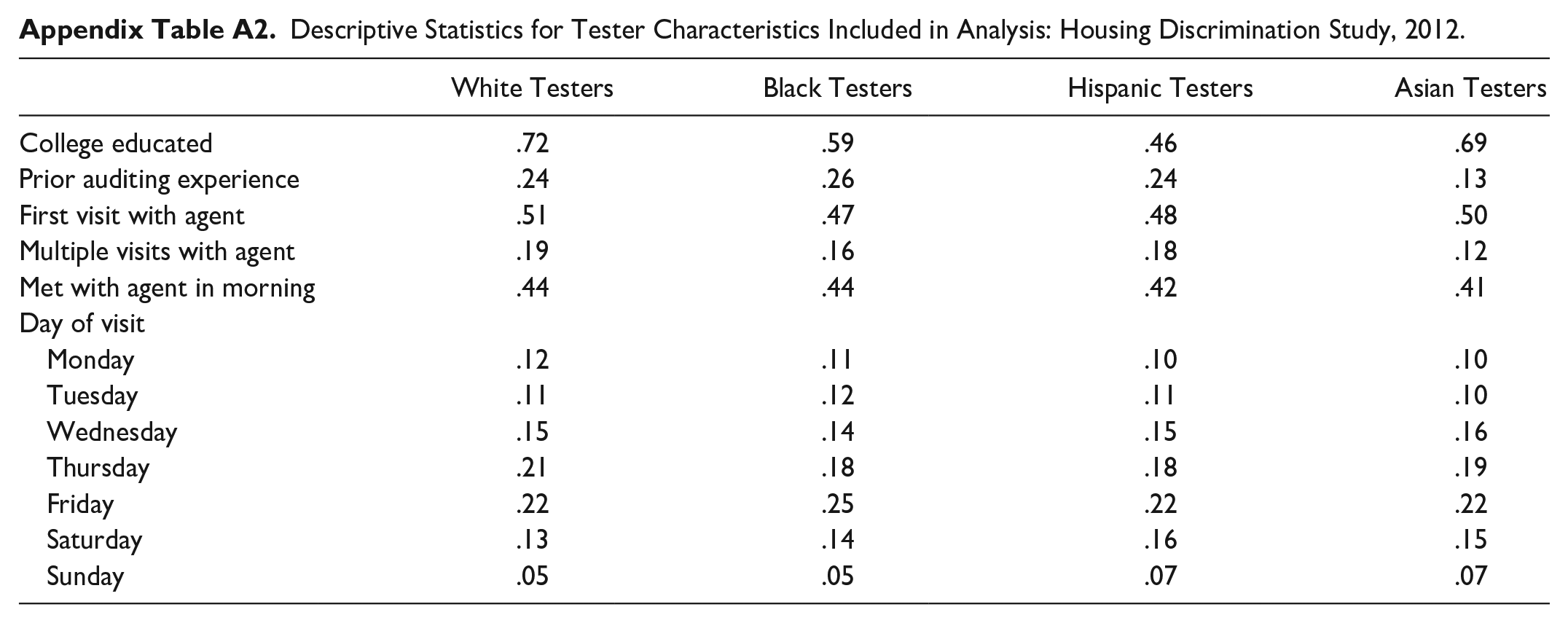
| White Testers | Black Testers | Hispanic Testers | Asian Testers | |
|---|---|---|---|---|
| College educated | .72 | .59 | .46 | .69 |
| Prior auditing experience | .24 | .26 | .24 | .13 |
| First visit with agent | .51 | .47 | .48 | .50 |
| Multiple visits with agent | .19 | .16 | .18 | .12 |
| Met with agent in morning | .44 | .44 | .42 | .41 |
| Day of visit | ||||
| Monday | .12 | .11 | .10 | .10 |
| Tuesday | .11 | .12 | .11 | .10 |
| Wednesday | .15 | .14 | .15 | .16 |
| Thursday | .21 | .18 | .18 | .19 |
| Friday | .22 | .25 | .22 | .22 |
| Saturday | .13 | .14 | .16 | .15 |
| Sunday | .05 | .05 | .07 | .07 |
Acknowledgements
We are grateful to Erin York Cornwell, John Iceland, Peter Rich, and Laura Tach for comments on previous drafts.
Funding
The author(s) disclosed receipt of the following financial support for the research, authorship, and/or publication of this article: We are grateful to the National Science Foundation (Grant No. 1226858), the Cornell Population Center at Cornell University, and the Charles Phelps Taft Research Center at the University of Cincinnati for funding for this study.
