




Abstract
Emerging research on antifeminism documents widespread antagonism among young men toward women and marriage. However, no quantitative study has explicitly investigated the connection between men’s antifeminist ideals and marital desire. Using a nationally representative sample of young Korean men (n = 1,061), the author examines the latent variables of men’s antifeminist sentiments and their association with marital desire. Exploratory factor analysis revealed two dimensions of men’s antifeminist ideals: support for male superiority (e.g., men deserve greater power in society than women) and perceived male victimhood (e.g., male discrimination due to feminism). Support for male superiority predicted more positive attitudes toward marriage. On the contrary, male victimhood predicted substantially less favorable attitudes toward marriage and marital intention. The findings emphasize the multidimensionality of antifeminist sentiments and suggest a new avenue for understanding young men’s marital disinterest in a postindustrial context, that is, perceived male victimhood due to feminism.
Women have made considerable strides in the public sphere, and egalitarian attitudes toward men and women’s equal participation in work, family, and politics have become prevalent in most developed economies. In recent years, however, developed nations have seen an increase in antifeminist sentiment. A growing body of evidence indicates that antifeminist sentiments are particularly strong among young men in contrast to the conventional wisdom that older generations are more likely to oppose progressive social movements. A study of 27 European countries revealed that men in their 20s were more likely than those in their 40s and 50s to believe that “feminism has gone too far and now limits men’s opportunities” (Off, Charron, and Alexander 2022). Younger men have a higher tendency to believe that society discriminates against men over women in the United Kingdom (Green and Shorrocks 2023) and Korea (Ministry of Gender Equality and Family 2021). Recent scholarly work has also established a connection between antifeminist sentiments and recent political trends, including the support for Donald Trump in the United States (Carian and Sobotka 2018; Glick 2019; Godbole, Malvar, and Valian 2019), Yoon Seok-yeol in South Korea (Kim and Lee 2022), Brexit in the United Kingdom (Green and Shorrocks 2023), and the populist radical right party in Spain (Anduiza and Rico 2022; Coffe et al. 2023).
The aim of this study was to examine how this antifeminist dynamic may be connected to men’s growing disinterest in marriage. Studies of antifeminist online communities document widespread hostility toward women and marriage (Górska, Kulicka, and Jemielniak 2022; Jones, Trott, and Wright 2020; Wright, Trott, and Jones 2020). Popular media have also reported an antifeminist movement that promotes male separatism, such as avoiding marriage and having limited contact with women (known as MGTOW [a man going his own way, pronounced “MIG-tau”]; see, for example, Bates 2020). Despite this trend, a negligible amount of academic research has empirically investigated the correlation between men’s antifeminist ideals and their desire to marry.
I used a nationally representative sample of unmarried young Korean men aged 15 to 34 years in 2015 (n = 1,061) to make two important contributions to the literature on gender and family demography. First, using exploratory factor analysis (EFA), this research investigated the underlying structure of men’s antifeminist ideals. Some gender scholars have argued that antifeminism is composed of divergent ideological positions (Bridges 2021; Kimmel 1987; Messner 2016). Whether men’s antifeminist ideals are unidimensional or multidimensional remains an empirical issue. Second, this study is the first to explicitly test the association between men’s antifeminist ideals and marital interest. In high-income countries, including the United States (Bozick 2023) and Korea (Korea Institute for Health and Social Affairs 2018), a growing number of men are expressing disinterest in marriage and parenthood. Emerging body of research argues that men’s perceptions of shifting gender relations play an important role in shaping men’s demographic behaviors in a postindustrial society (Goldscheider, Oláh, and Puur 2010; Miettinen, Basten, and Rotkirch 2011; Puur et al. 2008; Westoff and Higgins 2009). Existing research, however, focused almost exclusively on men’s gender role attitudes, an individual’s beliefs about the appropriate division of paid work and family responsibilities between women and men (Davis and Greenstein 2009) while overlooking antifeminist sentiments.
Background
Multidimensional Aspects of Antifeminist Ideologies
Antifeminism is broadly defined as a social movement consciously oriented toward preventing or revoking gender-related changes sought by a women’s movement (Chafetz and Dworkin 1989). It is generally initiated by the dominant group in the gender hierarchy (White heterosexual men) who perceive that their material and social status are threatened by the advancements achieved by the subordinate group (generally women) (Mansbridge and Shames 2008). Thus, as a key independent variable, I focus on men’s antifeminist ideologies that underlie antifeminist social reactions.
Similar to their explications of heterogeneous feminist thought (Tong and Botts 2018), feminist scholars have recognized heterogeneous antifeminist ideologies (Blais and Dupuis-Déri 2012; Bridges 2021; Kimmel 1987; Messner 2016). Although there is no consensus on the typology of antifeminist attitudes, many scholars have distinguished between two antifeminist strands: traditional or “old-fashioned” antifeminism and modern antifeminism. Traditional antifeminist beliefs typically enact the conventional notions of biological gender differences in their opposition to women’s equal participation in the public sphere (Górska et al. 2022; Kimmel 1987). In particular, traditional antifeminist ideals position women (or femininity) as weak and inferior, while men (or masculinity) are positioned as stronger and superior, thereby endorsing the inevitability of male privilege in both the public and private spheres (Kimmel 1987).
A few researchers have argued that a distinct form of antifeminism, frequently referred to as modern antifeminism, which adheres to the notion of “men as victims,” has emerged as a dominant antifeminist ideology since the 1990s (Anderson 2014; Blais and Dupuis-Déri 2012; Messner 2016). Modern antifeminism claims that full gender equality has been achieved; therefore, the feminist movement is unnecessary (Anderson 2014; Jordan 2016; Swim and Cohen 1997). Although ideologies underlying traditional and modern antifeminism may be correlated and equally propel opposition to feminism, modern antifeminism does not necessarily endorse the notion of male superiority and, in fact, often denies that men have power in society. Rather, it emphasizes men’s oppression and critiques women or feminism as the root cause of male suffering (Anderson 2014; Blais and Dupuis-Déri 2012; Carian 2022; Hopton and Langer 2022).
Recent studies and public opinion data have shown widespread adherence to modern antifeminism among young men. Younger men are more likely to be supportive of equal participation between the genders in paid and unpaid work than older men (Dotti Sani and Quaranta 2017). However, they have a higher tendency than older men and women to argue that “advancing women’s and girl’s rights has gone too far because it threatens men’s and boys’ opportunities” (Hope Not Hate 2020; Off et al. 2022). In high-income countries, the traditional notion of an overtly sexist statement that denies women’s competency and equal opportunity in the public sphere is now considered politically “incorrect,” which has led many to abandon the open endorsement of traditional antifeminism (Ekehammar, Akrami, and Araya 2000; Spence and Hahn 1997). In contrast, modern antifeminist discourse places significant emphasis on the subjugation of men and is often expressed in a more subtle manner, thereby rendering it more socially acceptable than traditional forms of antifeminism (Anduiza and Rico 2022; Becker and Sibley 2016). This approach facilitates the coexistence of antifeminist claims with a professed commitment to gender equality, as modern antifeminists employ the principle of gender equality to legitimize their criticisms of feminism, which they perceive as exhibiting a bias toward women over men. Hence, the nuanced nature of modern antifeminism affords men the ability to circumvent the potential underestimation of their antifeminist movement (Becker and Sibley 2016). Given the sociopolitical climate in high-income countries, in which explicit discrimination against women is widely condemned, I expect that modern antifeminist ideologies may garner considerable backing as a viable means of discourse, particularly among young men.
Minimal sociological research has assessed whether antifeminist ideologies are homogenous or heterogeneous with empirical data. The extant literature on antifeminist online communities provides mixed evidence. Some studies view the conglomeration and intersection of both traditional antifeminist and modern antifeminist as rhetoric (Górska et al. 2022; Jones et al. 2020; Jordan 2016; Marwick and Caplan 2018; Nagle 2017; Wright et al. 2020), while others find contradictions in their underlying ideologies (Hopton and Langer 2022). The psychological literature has demonstrated the multidimensional nature of sexism (Carian 2022; Glick and Fiske 1997; Zehnter et al. 2021). However, existing studies are limited to either small or selective populations, making it difficult to assess the patterns and structure of antifeminist ideals in the general population.
The first aim of this study was to test the underlying construct of antifeminist ideals using a nationally representative sample of young Korean men aged 15 to 34 years in 2015. Korean society has recently experienced the resurgence of feminism movement in what has been called “feminism reboot” (Sohn 2017), making it an interesting setting to examine men’s antifeminist reaction. In August 2015, an online feminist community known as Megalia was founded in response to the growing online misogyny in Korea (Kim 2018). Megalia organized numerous offline and online protests to combat misogyny and raise awareness about gender issues (Kim 2021). Although some have accused Megalia of being too extreme, others see Megalia as playing a crucial role in bringing attention to systematic gender discrimination and creating a sociopolitical climate intolerant of overt sexism and misogyny in Korea (Lee 2020). In fact, Kim (2023) found a considerable increase in support for egalitarian gender role attitudes, which support women’s continued employment uninterrupted by marriage and childbearing, after 2015 for both women and men in Korea (Kim 2023). In contrast, other studies documented a substantial rise in the male backlash toward feminists and feminism, with the center of their discourse highlighting reverse discrimination against men (Oh 2023). In addition, the presence of the conscription system in Korea offers a unique context for understanding the salience of antifeminist sentiments among young men. In Korea, the conscription system remains in place, mandating that all able-bodied men fulfill their military duty for about two years. This requirement places a significant burden on young men as it necessitates interrupting their education, careers, or personal life plans. It is important to note that feminism is not the direct source of mandatory male military service. However, the conscription system plays a critical role in shaping antifeminist attitudes (Choo 2020), as many young men often perceive feminism as advocating primarily for the rights of women without adequately recognizing and addressing the unique challenges faced by young Korean men. Recent government reports indicate that the majority of young Korean men in their 20s (53 percent) believe that Korean society is biased against men, whereas only 18 percent believe that it discriminates against women (Ministry of Gender Equality and Family 2021). Data used in the current study were collected in October 2015, three months after the initiation of the online feminist movement Megalia, providing a valuable opportunity to test the prevalence and dimensionality of men’s antifeminist sentiments among young Korean men.
Connection between Antifeminist Sentiments and Marital Desire among Men
I relied on the gender framework in demography (Goldscheider, Bernhardt, and Lappegård 2015; McDonald 2000) to address the connection between antifeminist sentiments and marital intention among Korean men. The gender framework recognizes two separate stages of the gender revolution: changes outside the home (women’s participation in the labor market) and changes within the home (men’s participation in family responsibilities) (Goldscheider et al. 2015; McDonald 2000). Scholars have argued that the transition from the first to the second stage of the gender revolution is still ongoing yet incomplete in most high-income countries (Gerson 2010; Goldscheider et al. 2015; McDonald 2000). The incomplete gender progress within the home implies that women face competing demands between paid work and familial responsibilities, which raises the opportunity costs of children and thus decreases their desire to have children (Goldscheider et al. 2015; McDonald 2000). With the ongoing gender revolution, the tension between earning and caring is also growing among men and appears to reduce men’s desire for parenthood, particularly among egalitarian men who have greater willingness to invest more time and energy in parenting (Westoff and Higgins 2009). Research generally finds a negative association between men’s egalitarian gender role attitudes and their childbearing intentions although empirical findings on the relationship between men’s gender role attitudes and demographic outcomes remain rather ambiguous (Goldscheider et al. 2010; Kaufman 2000; Miettinen et al. 2011; Puur et al. 2008).
Although existing studies highlight the importance of men’s perceptions of appropriate gender roles, they rarely discuss the implications of men’s views regarding the redistribution of marital power on their desire for family formation. Historically, marriage was a patriarchal and gendered institution premised on “men’s privilege and entitlement of women’s labor, sexuality, and emotions” (Lorber 2005:159). Patriarchal institutions mean that men (unlike women) rarely encounter situations where they sacrifice their interests or engage in marital negotiation regarding obtaining or sharing power in their marriages, irrespective of the amount of resources they bring to the family (Blood and Wolfe 1960; Komter 1989). However, in high-income countries where the gender revolution in the home is ongoing, men are under increasing pressure to negotiate for greater decision-making power in a variety of areas, such as the division of domestic labor, sexuality, fertility, career, family finances, and conflict resolution strategies (Blood and Wolfe 1960; Ferree 1990; Xu and Lai 2002). In addition, with the rapid increase in divorce rates, fathers who desire equal parenting rights need to fight for them with the mothers of their children more frequently than in the past (Kimmel 2017). Thus, contemporary marriage signifies not only a greater investment of time and energy in parenting but also power struggles for men.
Men’s perceptions of the women’s movement could thus be closely connected to evaluations of marriage in a context where the second phase of the gender revolution is ongoing. Antifeminist men who adhere to the notion of male dominance over women may perceive declining male privilege within contemporary marriages as unattractive, thereby expressing limited interest in marriage. Given the conventional advantages of heterosexual marriage such as sexual gratification and domestic assistance are increasingly available outside marriage (Bozick 2023), traditional men may have little incentive to enter a contemporary marriage in which male privilege is being challenged. However, traditional marriages where men and women conform to conventional gender relations are available, particularly in countries where the second gender revolution is slow, such as East Asian societies (Raymo et al. 2015). This suggests that men who support male dominance may not necessarily exhibit negative attitudes toward marriage as they can still form traditional partnerships with women who adhere to traditional domestic roles.
Antifeminist men, particularly those who believe that men are the victims of contemporary gender relations, may perceive contemporary marriages as threatening, harmful to men, and thus, to be avoided. Within the antifeminist discourse, marriage is frequently described as an institution that favors women while entrapping men into provider and protector roles, thus suppressing their economic and personal freedom (Jones et al. 2020; Kimmel 1987). According to qualitative research on the men’s rights movement, members of MGTOW, one of the fastest growing antifeminist groups in the manosphere, assert that the current gynocentric social order, including the institution of marriage, in Western society cannot be reversed, which drives them to seek self-empowerment by rejecting interactions, relationships, and commitments with women (Jones, Trott, and Wright 2020). Despite scientific evidence showing the health and material benefits of marriage for men (McDonald 2020; Monin and Clark 2011), men who support antifeminist principles, particularly those emphasizing male victimhood by feminism, are susceptible to embracing these ideals, which lead them to limit their marital desire.
The connection between men’s antifeminist ideologies and disinterest in marriage may reflect their economic conditions or personal value orientation; thus, their association may not be direct. Young men with unfavorable economic standing or prospects are more likely to oppose progressive social change, which favors vulnerable groups such as women, and may also express limited interest in marriage, given their low feasibility of marriage. In addition, demographic theory suggests that individualistic attitudes are a key contributor to growing disinterest in family formation (Lesthaeghe 2010). People with individualistic attitudes may also view gender inequality as a matter of personal choice rather than as a consequence of structural discrimination and thus oppose the feminist movement as well as express limited interest in marriage. The second purpose of this study was to test whether men’s antifeminist ideals are directly correlated with their attitudes and intentions toward marriage, adjusting for economic and other attitudinal variables. Additionally, I conducted robustness tests using coarsened exact matching to further alleviate concerns regarding bias stemming from unobserved personal characteristics.
Method
Data
I used data from the Survey on Gender Ideals among Young Men, which is an online survey of a nationally representative sample of young Korean men aged 15 to 34 years (n = 1,200). Data were collected by the Korean Women’s Development Institute (KWDI) between October 1 and 20, 2015. The sample was selected through stratified multistage sampling according to region, age, and gender. The primary purpose of this survey was to collect information on young men’s perspectives on various gender-related topics. Thus, it provides detailed information on perceptions of gender roles, men, women, feminism, gender-related policies, and other personal information. These data are not publicly available; hence, I personally obtained them from the KWDI. For the analysis, the sample was limited to unmarried men (n = 1,061). Of the total 1,200 respondents, 1,057 (88.1 percent) were never married, and 4 (0.33 percent) were divorced or separated.
Measures
Attitudes toward Marriage
The study included two dependent variables, namely attitudes toward marriage and marital intention. The survey asked all participants the following question: “What do you think of marriage?” Participants were asked to choose one among the following five options: 1 = “crucial to marry,” 2 = “it is better to marry,” 3 = “marriage is an option,” 4 = “it is better not to marry,” and 5 = “crucial not to marry.” I reverse-coded this item to identify positive marital attitudes. In addition, unmarried respondents were asked if they intended to marry in the future (“Do you intend to marry in the future?”). I created a dichotomous variable for the intention to marry (1 = yes and 0 = no).
Antifeminist Sentiments
I used 25 items on men’s opinions on women, men, gender relations, and feminism to measure latent variables of antifeminist ideologies. The questionnaire included a wide range of items on internalized misogyny (Piggot 2004) and hostile sexism (Glick and Fiske 1997) as well as items pertaining to men’s views about feminist initiatives (e.g., feminist initiatives ignoring the male voice). All items were evaluated using a four-point Likert-type scale, with 1 representing “not at all” and 4 representing “totally agree.” For all items, a higher value indicates more antifeminist ideologies (greater support for men’s dominance, devaluation of women, or negative evaluations of feminist initiatives).
Controls
Sociodemographic, economic, and attitudinal variables were considered as covariates. I included indicators for socioeconomic conditions, including currently unemployed, standard employment, low income (if individual respondents earned less than 180 to 10,000 won per month, which is approximately $1,365 as of 2022), perceived household socioeconomic status (1 = “very low” to 5 = “very high”). Given that a substantial proportion of the sample (55 percent) was in school, I included their perception of future economic prospects (“How likely is it that you will achieve your employment objective in the future?” rated from 1 = “highly unlikely” to 5 = “highly likely”). As for basic covariates, I included age, four-year university degree, current educational status, and place of residence (1 = metropolitan Seoul, 2 = other cities, and 3 = rural areas), frequency of Internet use for nonwork purposes (1 = “less than one hour per day” to 6 = “more than five hours per day”), and conservative political identification (1 = “very progressive” to 5 = “very conservative”).
Analytical Strategy
The first aim of this study was to measure the underlying construct of men’s antifeminist ideologies. I conducted EFA, which is a statistical technique for discovering the latent factors that explain the correlations between a set of observed variables. As previously stated, there is a paucity of direct empirical evidence assessing the patterns and structure of antifeminist ideals in the general population. EFA is particularly useful in the early stages of research when prior knowledge about the underlying factors is limited. In this study, 25 items measuring men’s opinions on women, gender relations, and feminist policies were used to conduct EFA. The EFA procedure involved several steps. First, I conduct the EFA using the principal-axis factor approach to produce factor loadings, which indicate how strongly each observed variable is associated with each extracted factor. These loadings represent the correlations between variables and factors. Second, I assess the eigenvalues and scree plot to determine the number of factors to be retained. Eigenvalues represent the amount of variance explained by each factor, whereas the scree plot helps identify the “elbow” point where the eigenvalue levels off (results shown in Figure A in the Appendix). I used parallel analysis, which compares eigenvalues from the results of a randomly ordered dataset (Carpenter 2018). In this study, I followed the standard recommendation in the literature to retain factors with eigenvalues greater than 1. Third, once the number of factors is retained, the rotation method is applied to simplify the interpretation of the factors. In this study, I applied promax rotation, which assumes that the items included in the analysis were correlated. Here, I specified a minimum loading of >0.50. In general, loadings greater than 0.50 are deemed strong and are often used as a criterion for determining the relevance of variables to identified factors. Consequently, I removed four items with factor loadings less than 0.50. Finally, the Bartlett factor score, which is a standardized value representing each respondent’s position on the component(s) discovered by the EFA, was projected. The Bartlett factor scores quantify the position (or level of endorsement) of individuals on the identified factors. Standardized factor scores have a mean of 0 and a standard deviation of 1. This means that a positive score indicates an above-average position.
Using the factor score predicted from the EFA, I examined the correlation between unmarried men’s antifeminist attitudes and their marital desires and marital intentions, controlling for socioeconomic and attitudinal variables. Subsequently, I introduced men’s economic characteristics and conservative gender values in addition to the baseline model to evaluate whether men’s antifeminist ideals were direct correlates of men’s interest in marriage.
Results
Sample Characteristics
Table 1 presents the basic characteristics of the sample included in the study. The majority of young Korean men positively evaluated marriage: the modal category of marital attitudes was “it is better to marry” (39.6 percent). A significant proportion of men had neutral attitudes toward marriage (37.5 percent), and a small proportion of men (6.6 percent) negatively evaluated marriage (choosing either “it is better not to marry” or “crucial not to marry”). Among the unmarried men, the majority (81.4 percent) reported intentions to marry in the future, whereas the rest (18.6 percent) indicated no such desires.
Sample Characteristics of Young Unmarried Korean Men Aged 15 to 35 Years in 2015 (n = 1,061).

Note: SES = socioeconomic status.
The average age of the participants was approximately 24 years. Overall, only 29 percent of men held university degrees, because more than half of the sample (55 percent) was still in school (either in high school or college). Of those who were not in school, 65 percent had received four-year university degrees, which is comparable with the national statistics (Korean Educational Development Institute 2020). The majority of the sample lived in metropolitan cities, and their political identification leaned slightly more toward a liberal than a conservative attitude.
Exploratory Factor Analysis: Two Dimensions of Antifeminist Ideals
On the basis of the parallel analysis scree plot (Figure A in the Appendix), two factors were extracted. Table 2 lists all 21 items included in the factor analysis (four items were excluded from the analysis because their factor loadings were <0.5 in both factors), their factor loading, and descriptive information. The results in Table 2 support prior studies that point to the multidimensionality of antifeminist ideology. Factor 1 aligns with traditional antifeminist ideals that maintain a belief in male superiority over women on the basis of the notion of gender differences or hegemonic masculinity (Connell and Messerschmidt 2005). I refer to this factor as “support for male superiority” (Cronbach’s α coefficient for all items was .89). Factor 2, in contrast, closely aligns with modern antifeminist sentiments that posit that men are oppressed by the feminist movement and women’s domination (Blais and Dupuis-Déri 2012; Kuhar and Paternotte 2017). I refer to this factor as “perceived male victimhood by feminism” (Cronbach’s α coefficient for all items was .92).
Anti-feminist Ideologies, Final Item Selection, and Factor Loadings from Exploratory Factor Analysis, Young Unmarried Korean Men (n = 1,061).

In addition, Table 2 contains descriptive information on the proportion of respondents who agreed with each item (either agree or strongly agree). Less than a majority of men agreed with all items related to factor 1 (support for male superiority). However, the majority of men agreed to all items loaded on factor 2 (perceived male victimhood by feminism), suggesting that “perceived male victimhood by feminism” is a dominant sentiment among young Korean men. This finding is consistent with the recent literature that found that modern antifeminist sentiment maintaining men’s victimhood and oppression is more widespread than the traditional notion of existing arguments (Blais and Dupuis-Déri 2012; Kuhar and Paternotte 2017). The two factors were modestly positively correlated (r = .24, p < .001). In Table A in the Appendix, I also report the correlation among antifeminist ideals and other attitudinal variables included in the main analyses, including traditional gender role attitudes, hostile attitudes toward homosexuality, and conservative political attitudes. Furthermore, Table A shows that support for male superiority is positively and moderately correlated with traditional gender role attitudes (r = .41), hostile attitudes toward homosexuals (r = .29), and conservative political identity (r = .16). On the contrary, men’s perceived victimhood was modestly positively correlated with hostile attitudes toward homosexuals (r = .14), but not significantly correlated with traditional gender role attitudes and conservative political identity.
Support for Male Superiority and Marital Desire
Table 3 shows the results of the association between men’s support for male superiority and their attitudes and intentions toward marriage. An odds ratio value higher than 1 indicates a greater likelihood of reporting positive marital attitudes, whereas an odds ratio lower than 1 suggests a smaller likelihood of reporting positive marital attitudes. Model 1 shows that men’s support for male superiority predicted a more favorable marital desire in men: a one-unit increase in the male superiority scale was associated with a 36 percent increase in the odds of reporting positive marital attitudes. Model 2 additionally controls for men’s economic status, providing results similar to those in model 1. Model 3 in Table 3 reports the logistic regression results that predict marital intentions among unmarried men. However, model 3 shows that men’s support for superiority was not significantly associated with their marital intentions, controlling for economic and other covariates. Overall, the results in Table 3 do not support the idea that male superiority may negatively shape men’s attitudes and intentions toward marriage.
Support for Male Superiority and Attitudes and Intentions toward Marriage, Young Unmarried Korean Men (n = 1,061).

Note: OR = odds ratio; SES = socioeconomic status.
Estimates were from ordered logistic regression.
Estimates were obtained from logistic regression.
p < .10. *p < .05. **p < 0.01. ***p < 0.001.
Perceived Male Victimhood and Marital Desire
Table 4 presents the results of the association between men’s perceived victimhood and attitudes and intentions toward marriage. In contrast to the results for male superiority, Model 1 in Table 4 shows that men’s perception of victimhood by women and feminism predicted less favorable attitudes toward marriage. A one-unit increase in the male victimhood scale was associated with a 34 percent decrease in the odds of reporting positive marital attitudes. Model 2 shows that the negative association between the male victimhood scale and the marital attitudes remained robust after controlling for economic conditions. Furthermore, model 3 suggests that logistic regression analysis predicting marital intentions among unmarried men provided consistent results. Among unmarried men, a one-unit increase in men’s perceived victimhood scale resulted in a 29 percent decline in the odds of reporting the intention to marry in the future.
Perceived Male Victimhood by Feminism and Attitudes and Intentions toward Marriage, Young Unmarried Korean Men (n = 1,061).

Note: OR = odds ratio; SES = socioeconomic status.
Estimates were from ordered logistic regression.
Estimates were obtained from logistic regression.
p < .10. *p < .05. **p < 0.01. ***p < 0.001.
Robustness Checks
As mentioned, other unobserved characteristics such as individualistic value orientation may confound the association between antifeminist ideals and negative marital attitudes. People with individualistic tendencies tend to view social issues as matters of personal choice rather than structural problems and thus are less likely to support social movements that oppose structural discrimination against minorities such as feminism. Additionally, individualistic attitudes may promote a preference for single life over family life. Unfortunately, the current survey did not measure respondents’ individualistic value orientation. To reduce potential bias stemming from unobserved characteristics, I conduct coarsened exact matching. To do so, I first created a dichotomous variable indicating a “high” male victimhood group if respondents’ male victimhood score is above the top 25th percentile. I then match respondents on the basis of the observed characteristics (age, education, place of residence, political identity, and economic characteristics). I reran analysis in Table 4 including weights produced by coarsened exact matching analysis, which corrects imbalances between the treated and nontreated group. Results on coarsened exact matching produced results similar to those shown in Table 4 that men’s perceived victimhood significantly predic-ted men’s disinterest in marriage (results in Table B in the Appendix)
Additional Analysis
I examined the association between men’s antifeminist ideals and marital intentions using another online survey of a nationally representative sample of young adults aged between 19 and 39 years in 2020 (n = 8,917). Data were collected by the KWDI between October 17 and November 4, 2020. This survey included questions on the participants’ views on women, gender relations, feminism, and marital intentions. However, most questions used to measure antifeminist ideals are not identical to the data used in the main analysis, making it difficult to compare the results. Therefore, I reported the findings from the 2020 data as an additional analysis.
First, I limited the sample to men who were unmarried at the time of the interview (n = 3,513). Then, I selected six items on men’s antifeminist ideals that could bear most resemblance to the antifeminist items used in the main analysis. This included “men are superior than women in work organization and leadership,” “men manage work more reasonably than women,” “women cannot manage work reasonably because they are highly emotional,” “society is extremely unfair toward men,” “women claim gender discrimination even for harmless comments,” and “women demand a lot under the name of equality.” Finally, I separately examined the association between each item and marital intentions, controlling for socioeconomic and other covariates.
Table 5 reports the logistic regression models predicting the association between support for male superiority and marital intentions. Results in this table indicate that all items indicating support for male superiority were not significantly associated with men’s marital intentions. Table 6 shows the logistic regression models predicting the link between items associated with perceived male victimhood and marital intentions. All three items indicating perceived male victimhood were negatively associated with marital intentions among young men. Overall, findings from the additional analysis showed substantively similar results to those in the main analyses.
Support for Male Superiority and Intentions toward Marriage, Young Unmarried Korean Men Aged 19 to 39 Years in 2020 (n = 3,513).

Source: Survey on the Life Course and Future Prospects of Young People in Korea (2020).
Note: All models control for economic (unemployment, standard employment, personal income, subjective socioeconomic status), demographic (place of residence, university degree, current students), and other (the number of hours of Internet usage per day) covariates. OR = odds ratio.
Perceived Male Victimhood by Feminism and Intentions toward Marriage, Young Unmarried Korean Men Aged 19 to 39 Years in 2020 (n = 3,513).
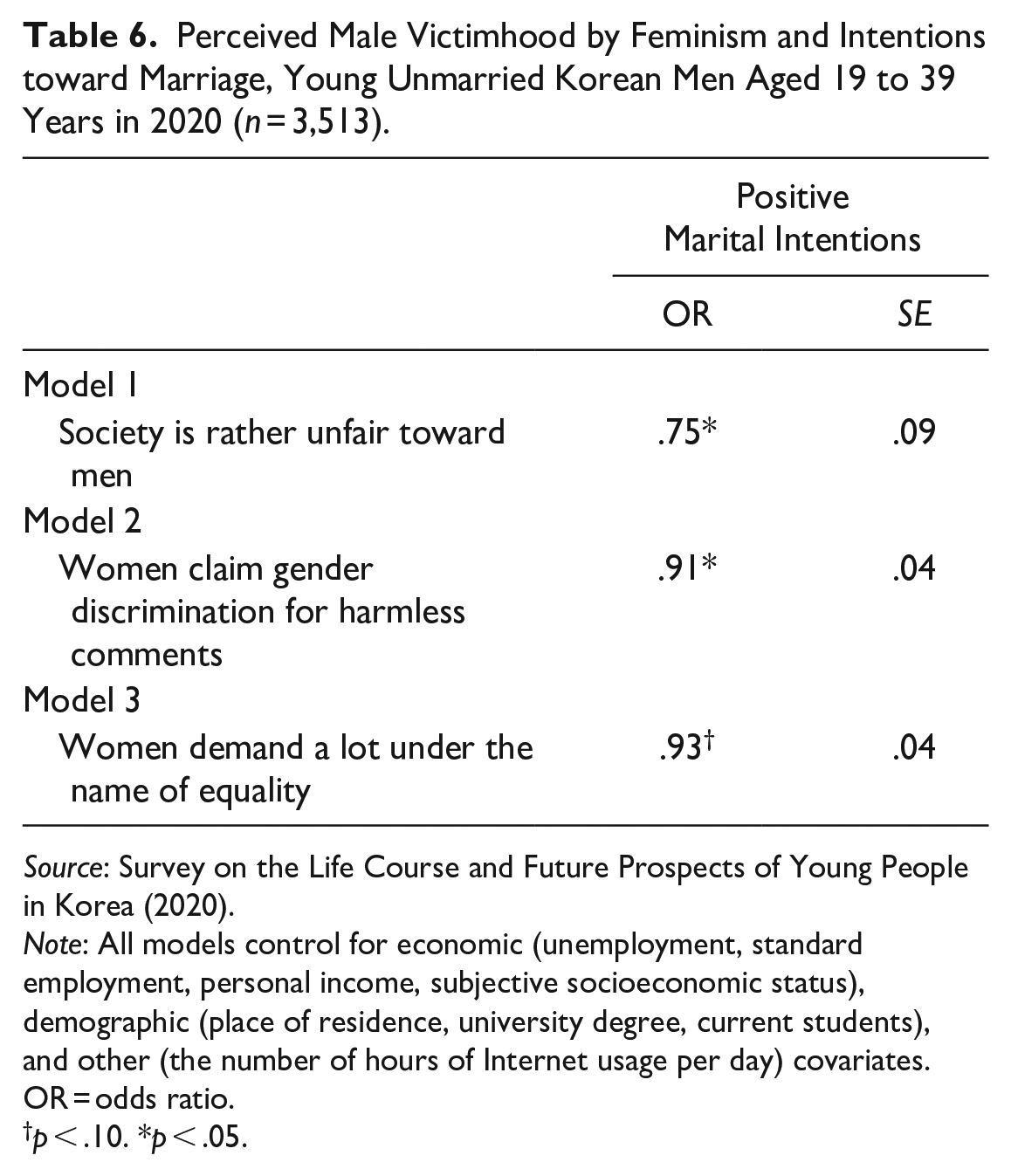
Source: Survey on the Life Course and Future Prospects of Young People in Korea (2020).
Note: All models control for economic (unemployment, standard employment, personal income, subjective socioeconomic status), demographic (place of residence, university degree, current students), and other (the number of hours of Internet usage per day) covariates. OR = odds ratio.
p < .10. *p < .05.
Conclusion
A growing number of men in developed economies are expressing disinterest in marriage and parenthood (Bozick 2023; Puur et al. 2008). Nevertheless, we have a limited understanding of the sources of men’s reluctance to family formation. In this study I explored a novel variable, namely men’s antifeminist sentiments, to explain their disinterest in marriage. Anecdotal evidence increasingly documents widespread hostility toward women and marriage within the antifeminist discourse. However, minimal scholarly work has measured men’s adherence to antifeminist ideologies and explicitly tested the connection between men’s antifeminist ideals and their desires and intentions to marry.
Using a nationally representative sample of young men in Korea, this study identified at least two distinct dimensions of antifeminist ideologies: support for male superiority and perceived male victimhood by feminism. Descriptive statistics show that perceived male victimhood by feminism was a prevalent sentiment among young Korean men whereas support for male superiority was not a dominant ideology. These findings are consistent with the recent antifeminist literature that argues that modern antifeminist rhetoric (emphasizing men’s oppression by feminism) is emerging as a dominant discursive strategy among young men (Blais and Dupuis-Déri 2012; Kuhar and Paternotte 2017). In addition, this research corroborates studies that highlight the divergence of antifeminist ideologies on a nationally representative sample.
This study uncovered mixed evidence regarding men’s antifeminist ideals and marital desires. Young men’s support for male superiority predicted more positive attitudes toward marriage. Support for male superiority and traditional gender role attitudes (i.e., women should focus on family duties and men should focus on paid work) are largely part of conservative family values. Despite the growing trend toward more egalitarian marriages in Korea, the findings suggest that some men may still view marriage as an institution where traditional gender roles are expected to be upheld. In contrast, the present study showed that perceptions of male victimhood are a substantial predictor of men’s disinterest in marriage even when controlling for socioeconomic and other attitudinal covariates. This finding corroborates the evidence of antifeminist online communities endorsing the belief that marriage is an oppressive and harmful institution for men (Jones et al. 2020; Wright et al. 2020). This study is limited to South Korea, where the second phase of the gender revolution lags behind Western contexts. Future studies should test whether the association between men’s perception of male victimhood and marital desire can be generalized to other contexts as well as whether the link varies by different institutional and cultural contexts to better understand the mechanisms underlying the association.
The present study findings have several scholarly and policy implications. First, the present study highlights the importance of understanding modern antifeminist ideals among young adults beyond the conventional measure of attitudes toward separate spheres for men and women. Young adults have increasingly adopted (or at least manifested) egalitarian gender-role attitudes but are also expressing divergent attitudes regarding women’s progress and feminism. These findings warrant conducting a social survey to collect more comprehensive information regarding women, men, gender relations, and feminism to more accurately capture gender perspectives among the younger generation in developed economies. In addition, the present study uncovers a new avenue for understanding men’s attitudes toward family formation in a postindustrial context. Modern antifeminist sentiment which highlights men’s oppression by women and feminism is on the rise among young men (Anderson 2014; Zehnter et al. 2021) and may be an important predictor of future demographic trends in high-income countries. Lastly, this research focused on the desire for marriage among unmarried men. It has been established that gender ideologies are also associated with a variety of marital outcomes, including marital satisfaction, marital conflict, and marital dissolution, among married couples. Future research may investigate the complexities of men’s antifeminist attitudes and their implications for married men’s marital behaviors.
Supplemental Material
sj-docx-1-srd-10.1177_23780231231196791 – Supplemental material for Antifeminist Sentiments and Marital Desire among Young Men: Evidence from South Korea
Supplemental material, sj-docx-1-srd-10.1177_23780231231196791 for Antifeminist Sentiments and Marital Desire among Young Men: Evidence from South Korea by Joeun Kim in Socius
Footnotes

Supplemental Material
Supplemental material for this article is available online.
Author Biography
References
Supplementary Material
Please find the following supplemental material available below.
For Open Access articles published under a Creative Commons License, all supplemental material carries the same license as the article it is associated with.
For non-Open Access articles published, all supplemental material carries a non-exclusive license, and permission requests for re-use of supplemental material or any part of supplemental material shall be sent directly to the copyright owner as specified in the copyright notice associated with the article.
