




Abstract
Empirical research suggests that societies that are diverse as a result of international migration have lower levels of social trust, but little is known about the mechanisms underlying this relationship. The authors test one possible mechanism: that conationality increases interpersonal trust and the willingness to reciprocate trust. As part of large-scale surveys in the United States, South Africa, and Switzerland, respondents were presented with trust vignettes in which information about the nationality of the interaction partner was systematically varied. Despite overall country-level differences in levels of trust and trustworthiness, no in-group bias associated with conationality was found in these types of interactions. This suggests that the negative association between ethnic diversity and social trust cannot be explained by differences in relational trust conditional on sharing the same nationality.
Keywords
Empirical research drawing mostly on cross-sectional observational data suggests that social trust is lower in more ethnically diverse contexts (Dinesen, Schaeffer, and Sønderskov 2020; Van der Meer and Tolsma 2014). However, we still know little about why this negative relationship exists. A common explanation derived from social identity theory (Turner and Tajfel 1986) suggests that in-group favoritism and/or out-group hostility (Putnam 2007) may explain the macro-level pattern of reduced social trust in diverse contexts (Alesina and La Ferrara 2002; Daniele and Geys 2015). General social trust at the societal level is thus often implicitly seen as a product of individuals’ relational trust, or beliefs about the cooperativeness and trustworthiness of an unknown interaction partner (Cook, Hardin, and Levi 2005; Hardin 2002; Robbins 2016). Relational trust, however, may be shaped by common membership in a salient social group (e.g., ethnic groups) as well as diffuse status characteristics (e.g., gender) (Robbins 2017; Tanis and Postmes 2005). Experimental studies have used social identities such as ethnoracial markers to examine group-based biases regarding relational trust and trustworthiness. This research highlights the importance of biased beliefs and stereotyping in interpersonal interactions at the micro-level (Abascal 2015; Cettolin and Suetens 2019; Finseraas et al. 2019; Gereke, Schaub, and Baldassarri 2020).
Work on group boundaries suggests that nationality may be an important but often overlooked dimension shaping differences in relational trust in social and economic interactions (Bauböck and Rundell 2018; Bloemraad and Sheares 2017; Simonsen 2017). As scholars of citizenship and immigrant incorporation point out (Bloemraad, Korteweg, and Yurdakul 2008; Brubaker 2009), citizenship is not just a legal category of membership in a country but also signals common political belonging and provides legitimacy “to make claims about equality” (Bloemraad 2015:592). In other words, the content of citizenship is multifaceted, providing information about status, rights, and identity (Joppke 2010) and may be associated with perceived group loyalty (Jasinskaja-Lahti et al. 2020). However, in contrast to other and more commonly studied markers of immigrant identities (e.g., ethnicity or language; Stevenson et al. 2015), nationality is not visible and immediately known when meeting a stranger. It is therefore difficult to use nationality as a signal of out-group membership in real-life encounters and, consequently, in natural field experiments that study intergroup interactions (Finseraas et al. 2019; Zhang, Gereke, and Baldassarri 2022). Yet nationality is still relevant and known to others in many interpersonal encounters, especially in the context of more formalized situations of economic exchange (e.g., finding a job, getting a loan) (Hainmueller, Hangartner, and Ward 2019). Studies on the formation of interpersonal trust and cooperation that ignore nationality as a social category may confound the underlying mechanisms explaining differences in relational trust.
Given the centrality of trust and trustworthiness for the social and economic fabric of societies (Uslaner 2002), here we connect and extend the literatures on relational trust and citizenship as a salient group boundary by studying how individuals in three ethnoracially diverse societies—the United States, South Africa, and Switzerland—trust and reciprocate trust depending on the nationality of their interaction partners. Specifically, we ask whether people trust foreign nationals residing in their country less than they trust conationals. Given the theoretical predictions of social identity theory about category-based trust (Turner and Tajfel 1986), our first expectation is as follows:
Expectation 1: Trust will be lower in interactions with foreign citizens residing in the same country than with conational alters.
With regard to trustworthiness, research has shown that, because individuals have concrete information regarding the trust placed in them and thus face no risk for exploitation when deciding to reciprocate, behavior is much less likely to be shaped by stereotypes (or statistical discrimination) compared with the trusting decision (Carlin and Love 2013; Cettolin and Suetens 2019). Therefore, our expectation is a weaker effect of alter’s nationality on the decision to reciprocate. Still, our second expectation is as follows:
Expectation 2: Trustworthiness will be lower in interactions with foreign citizens residing in the same country than with conational alters.
To examine these expectations, we conducted a trust game vignette experiment with large online samples of citizens in the United States, South Africa, and Switzerland. The samples were constructed to resemble the overall population on key demographic variables. The study design and hypotheses were preregistered at the Open Science Framework (https://doi.org/10.17605/OSF.IO/Z3DJA).
We find no indication that information about participants’ conationality induces in-group favoritism in the decision to trust or to reciprocate trust (trustworthiness) in any of the three countries. These null results are not an artifact of survey respondents’ lack of understanding, as we show in comprehension and manipulation checks (Supplement 3, Figures 1–4, Tables 4 and 5). In addition, the results are robust to controlling for respondents’ sociodemographic characteristics and immigration attitudes. Put differently, we find no indication that shared group membership as suggested by social identity theory, here studied in terms of conationality, leads to trust discrimination in these hypothetical interactions. This implies that the macro-level phenomenon of lower generalized trust in ethnically diverse communities is unlikely to reflect individual-level decisions to condition relational trust on conationality. Thus, we suggest that future research should examine other potentially relevant mechanisms, such as contact-prone contextual effects (Dinesen et al. 2020; Finseraas et al. 2019) or (self)-selection into contact with out-group members (Baldassarri, Gereke, and Schaub 2023).
This study makes several important contributions to the study of group identity and social exchange. First, we advance empirical work on ethnic diversity and social trust by experimentally testing a specific mechanism at the micro-level that may account for the observable negative pattern at the macro-level (Dinesen et al. 2020). Second, we extend existing mixed evidence on relational trust and trustworthiness across group boundaries in multiethnic societies (Bader and Keuschnigg 2020; Cettolin and Suetens 2019; Gereke et al. 2020; Kas, Corten, and van de Rijt 2022; Robbins 2016) by testing whether nationality (rather than phenotype, race, a specific ethnicity/country of origin, or religious background) is an important fault line undermining trust (van Dijk and De Dreu 2021). Here, our results speak directly to recent research by Bader and Keuschnigg (2020), who reported that participants in an online cross-country trust game trusted respondents from poor countries less. However, there is also some empirical evidence on cross-national trust showing that the nationality of the trustee does not affect trust among individuals who have previously interacted with someone of that nationality in the context of the online marketplace Airbnb (Kas, Delnoij, et al. 2022). Similarly, an earlier study with undergraduate students in the United States showed that nationality did not affect trusting decisions, but it was associated with lower reciprocity or trustworthiness (Glaeser et al. 2000). Third, we add a comparative perspective to earlier research by fielding identical survey experiments with large samples in three democratic societies with high levels of immigration, but differences in social and institutional structure, economic development, and the strength of the welfare state.
Methods and Samples: Trust and Trustworthiness Vignettes
As part of large online surveys with samples that were nationally representative on key demographic characteristics, we implemented two trust vignettes which were modeled after a widely used behavioral trust game (Ermisch et al. 2009). In these vignettes, the first player is given a sum of money (10 hypothetical “Internet dollars”) and has the option to transfer all of it to a second player. 1 The amount transferred is multiplied by 4, and the second player can then decide to transfer some of the money (22 “Internet dollars”) back to the first player. The decision of the first player (transfer or not) 2 thus depends on the expectation that the second player is trustworthy and will reciprocate the transfer. 3 The second decision (transferring back 22 “Internet dollars” vs. keeping 40) accordingly represents a measure of trustworthiness and/or reciprocity. Respondents played both roles sequentially and hence made decisions both to trust and to reciprocate trust (after being informed that a hypothetical first player had already transferred money to them). Following their decisions, respondents were also asked to answer several comprehension and manipulation checks.
The vignettes provided information about the respondents’ fictitious interaction partners. Importantly, we experimentally varied whether the alter was a conational (vs. a resident of the same country with foreign nationality). 4 Each respondent was presented with two vignettes (first trust and then trustworthiness) describing two different interaction partners, yielding a between-subject design. The key features of the experimental design are displayed in Figure 1.
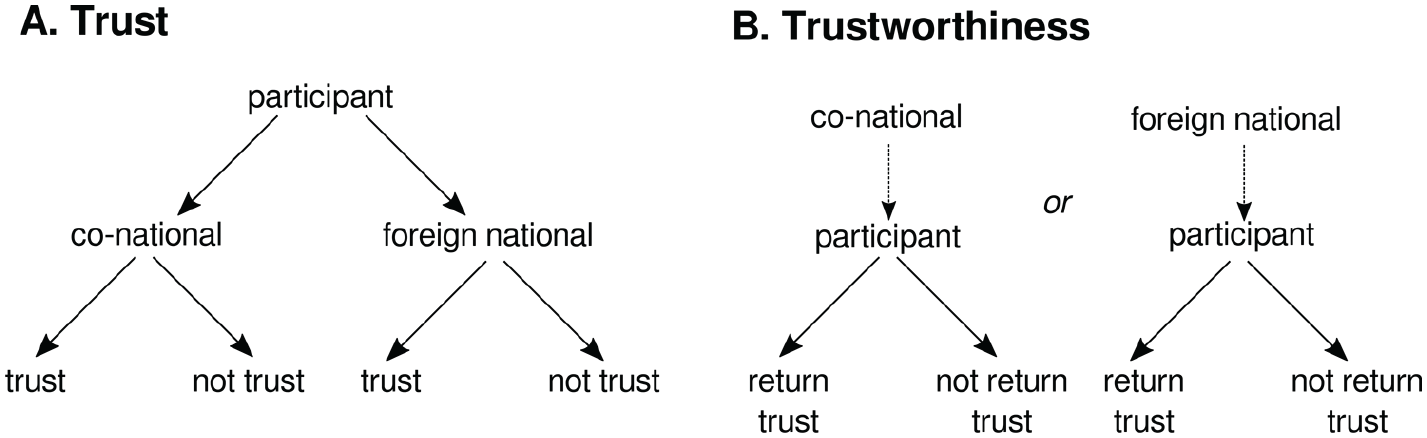
Structure of the trust and trustworthiness decisions. In (A), the participant is the first mover and decides whether to trust the other player depending on conationality (vignette 1). In (B), the other player (conational or foreign national) trusts the participant (dotted line), and the participant (second mover) decides whether to reciprocate trust (vignette 2).
Beyond nationality, our vignettes also provided information on other personal characteristics, such as gender, city of residence, 5 number of siblings, color of their car, and hobbies, to give a richer description of the fictitious interaction partner. Importantly, gender was also manipulated in the surveys fielded in the United States and South Africa to explore possible intersectionality in how nationality affects trust (Gereke et al. 2020; Hedegaard and Larsen 2022; Vernby and Dancygier 2019). Furthermore, we decided to include a rich description of interaction partners to minimize experimenter demand effects and reduce the potential for social desirability bias. 6
The data are drawn from three large online survey experiments conducted in the United States (n = 1,332), South Africa (n = 1,378), and Switzerland (n = 436) using the Qualtrics panel. 7 We used soft quotas to ensure that the sample is representative in terms of age, gender, state or province, and race/ethnicity or population group to maximize the generalizability of the results. 8 We provide a detailed sample description in Table 1 in the Supplement. Speeders who took less than one third of the median time to complete the survey were removed by Qualtrics.
Results: Similar Trust and Trustworthiness for Conational and Foreign Alters
In the first step, we are interested in the extent to which conationality affects decisions about trust. We show the proportion of participants who sent money to a conational (citizen) versus an immigrant foreign national (noncitizen) by country in Figure 2. Contrary to our expectations, we can see no substantial difference in trusting behavior due to the nationality or gender of the alter. In particular, the mean responses are close to each other and the standard deviations indicate that the responses do not differ significantly according to the nationality of the alter (i.e., the two blue bars for trust in women and the two red bars for trust in men are mostly overlapping). By contrast, we note clear country-level differences, with higher levels of trusting behavior in Switzerland than in the United States or South Africa.

Trust by Vignette Profiles and Country. The figure shows the proportion of respondents who trust by the profile of alter in the vignette for each country. We can see similar levels of trust across gender and nationality of the interaction partner in each of the three countries.
Full regression results including a series of control variables can be found in Table 2 in the Supplement. In particular, the results are substantially unchanged when accounting for participants’ preference for natives when jobs are scarce, individual willingness to take risks, stated trust in strangers, and when restricted to those who answered all the “comprehension” check questions correctly (see Figure 3 and Table 4 in the Supplement). This latter result gives us confidence that our null effects do not derive from participants who do not understand the trust game or do not pay attention. Finally, we do not find a significant interaction between gender and nationality
Turning to the decision to reciprocate trust, here as well we do not find systematic differences in trustworthiness for respondents paired with conational versus foreign alters in any of the three countries as shown in Figure 3 (see Table 3 in the Supplement for full regression results). This result is robust to restricting the sample to respondents who answered all manipulation check questions correctly (see Table 5 and Figure 4 in the Supplement). Once again, we observe country-level differences: transfers are significantly more likely in Switzerland, a high-trust environment, than in the other two countries. However, these country-level differences in reciprocity of trust are less pronounced than the effects for trust.

Trustworthiness by Vignette Profiles and Country. The figure shows the proportion of respondents who reciprocated trust by the profile of alter in the vignette for each country We can see similar levels of trustworthiness across gender and nationality of the interaction partner in each of the three countries.
Exploratory Analysis: Attitudes to Immigrants, Risk Taking, and General Trust in Strangers
In a separate exploratory analysis, we also look at heterogeneous treatment effects, as the average null effect may hide different response patterns for subgroups of respondents. In particular, we are interested in the potential interaction effects of risk attitudes and attitudes toward immigrants. 9 To assess attitudes, we asked participants if employers should give priority to natives over immigrants when jobs are scarce.
Participants with high priority for natives do not show substantially different patterns of trust and trustworthiness in the vignettes (Table 6 and Figure 5 in the Supplement).
We also used the vignettes to address a methodological question: to what extent do self-reported attitudinal trust and the responses in the trust game vignettes correspond? Thus, we aim to provide another data point for the ongoing debate about whether commonly used survey questions are sufficient to capture variation in trust and trustworthiness or whether behavioral measures are necessary (Bauer and Freitag 2018; Ermisch et al. 2009; Glaeser et al. 2000). We focus on two questions: (1) “Are you generally a person who is fully prepared to take risks or do you try to avoid taking risks?” and (2) “Are you generally a person who is fully prepared to take risks in trusting strangers or do you try to avoid taking such risks?” We find that both measures of risk attitudes are good predictors of trust in the trust game vignettes. Specifically, in all three countries, the generic question about being prepared to take risk is a good predictor of trust (Tables 7 and 8 in the Supplement). The same is true for the question asking about risk taking “in trusting strangers” in the United States and Switzerland but not in South Africa (Tables 9 and 10 in the Supplement). We suspect that further investigation into the notion of the “stranger” will help in understanding these country-level differences (Solomon and Kosaka 2013).
Turning to correlations between these risk measures and trustworthiness, the associations are more mixed. In the full sample, generic risk attitudes are associated with trustworthiness in the vignette decision in South Africa, and possibly Switzerland, but not in the United States (Table 11 in the Supplement). At the same time, risk taking “in trusting strangers” is not associated with the responses in the game vignette in the United States but has a positive association in Switzerland and a negative association in South Africa (Table 13 in the Supplement). None of these associations can be observed in the restricted sample of participants who passed the attention and comprehension check (Tables 12 and 14 in the Supplement). In sum, our exploration suggests that the generic question on risk taking is a good predictor of trust behavior in vignette 1 but not of trustworthiness in vignette 2. The notion of “the stranger,” however, needs further exploration in cross-country comparisons.
Discussion and Conclusion
Our experimental evidence shows that, contrary to our expectations on the basis of social identity theory, respondents in the United States, South Africa, and Switzerland were as likely to trust foreign nationals residing in their country as strangers with whom they share a common nationality. Similarly, we do not find that trust is reciprocated differently depending on sharing the same nationality with a hypothetically assigned interaction partner in any of the countries studied here. Furthermore, our results are robust across subgroups, as partitioned by opinions as to whether citizens should be prioritized over immigrants when jobs are scarce. We therefore conclude that conationality does not seem to be a salient identity marker or group boundary in these types of interactions, and reduced trust in foreigners cannot explain the overall macro-level pattern of lower levels of social trust in ethnically diverse societies. Of course, this does not mean that discrimination against immigrants does not occur at other stages of interpersonal interactions and social exchanges (e.g., selecting into the interaction in the first place (Baldassarri et al. 2023), or because of other (more visible) or salient identity markers such as race, religiosity or social class (Chuah et al. 2016).
The null effect of nationality on trust and reciprocity adds to mixed evidence on in- and out-group trust. Our findings are consistent with results from a large-scale study using the trust game in German schools, in which native children did not systematically treat immigrants differently on the basis of their citizenship status, both regarding trust as first movers and back transfers as second movers (Felfe et al. 2021). Furthermore, experimental evidence using survey vignettes with various samples in the United States found that social identities and diffuse status characteristics such as (same) race and (same) gender produced only weak to null effects in terms of differences in relational trust (Robbins 2017). Our findings are also consistent with the results of a recent lab-in-the-field experiment with immigrants in Italy, in which no in-group favoritism was found in the standard trust game among Italians presented with immigrants residing in Milan but born in a variety of origin countries (Baldassarri et al. 2023). However, that study also showed that when participants were given the opportunity to choose between interacting with either a coethnic or an immigrant, Italians preferred conationals and were less likely to choose an immigrant. This suggests that in-group bias and out-group discrimination are likely to occur at the point of entry into encounters, rather than manifesting themselves in interactions. Furthermore, our results also add to experimental research on intercultural trust using trust games in cross-national settings (e.g., in Israel, Germany, Palestine, or Japan and the United States), which did not produce evidence for systematic negative discrimination against foreigners in transfers (Goerg et al. 2016; Kuwabara et al. 2007).
However, our findings are not in line with those of other studies on in-group favoritism/out-group bias that have produced partial evidence for lower levels of trust against immigrant men in Germany (Gereke et al. 2020) or lower levels of trustworthiness toward immigrants and their direct descendants in the Netherlands (Cettolin and Suetens 2019). Moreover, Robinson (2016) found in a lab-in-the-field trust experiment in Malawi that shared nationality is a robust predictor of trust equal in magnitude to the impact of shared ethnicity. Her research shows that national identification moderates the degree of ingroup favoritism, so that strong national identity eliminates ethnic ingroup bias. This evidence points to the contextual importance in studying these types of ingroup biases, in particular to differences based on whether these social group memberships are highly politicized categories.
Another possible explanation for our null results may relate to how our vignettes were presented. Compared with other studies, we chose to include more information about alters (e.g., how they like to spend their free time), which may lead to their being perceived as individuals as opposed to mere representations of out-groups (De Dreu 2018; Tanis and Postmes 2005). This may have increased the baseline levels of trust compared with studies in which less information is provided. Although we have used attention and comprehension checks, further research is needed to ascertain that the provision of information on its own is not the cause for the lack of distinction in our treatments. However, if information is the reason for differences with previous research that finds in-group bias, then we have identified an intervention to increase trust and possibly reduce discrimination: the provision of even a limited amount of individualizing information, which may even be unrelated to a specific situation or decision.
Further research is necessary to establish the degree to which our results are generalizable to other countries and other group memberships with more specific stereotypes. We manipulated the nationality of the interaction partner by signaling same vs. foreign nationality of a local resident in the vignette description but did not provide any specific information about the origin country, so that respondents may have imagined a range of “foreign nationals,” including international students, asylum seekers and refugees, or labor migrants and expatriates from various countries. Therefore, it remains unclear what “type” of nonnational respondents were inferred from vignettes. Future research may want to add “who” probes after the vignettes to ask whom respondents imagined as foreign nationals. Moreover, we did not provide any additional information on (overlapping) markers of group membership, such as race in the United States or South Africa or native language in Switzerland or South Africa. Future research may try to manipulate nationality, immigrant status, race, and native language independently (Soroka et al. 2017) or as part of a conjoint design.
Here we add to the comparative cross-country literature on ethnic diversity and trust toward out-groups by using a vignette experiment rather than relying on often criticized general trust questions used in surveys, such as the World Values Survey (Bauer and Freitag 2018; Gundelach 2014; Schilke, Reimann, and Cook 2021), and we uncover substantial country-level differences in trust—Switzerland (67 percent) versus the United States (59 percent) or South Africa (57 percent)—and trustworthiness—Switzerland (80 percent) versus the United States (75 percent) or South Africa (71 percent)—but we cannot evaluate the impact of the social and institutional country-level structure (Paxton 2007) on individual levels of relational trust and trustworthiness. Although we did not aim to explain the different overall country-level patterns in trust and trustworthiness, research has highlighted the important role of institutions in providing security and safety and thus promoting the development and maintenance of interpersonal trust among strangers (Spadaro et al. 2020) and relational trust (Robbins 2016). In particular, democratic governments can foster trust between people who may otherwise be suspicious of each other (Tilly 2004) by protecting minority rights (Paxton 2002). Given that high levels of social trust and trustworthiness are crucial for well-functioning democracies (Knack and Keefer 1997; Putnam 2007) and that the social integration of immigrants affects citizens’ willingness to support distributive welfare policies (Daniele and Geys 2015), our study adds empirical evidence for a better understanding of cross-boundary interactions of social exchange in immigrant-receiving societies. Such cooperation is important in a globalized world, where societies are faced with managing unexpected and pressing social challenges (Romano et al. 2021), such as pandemics, climate change, or the accommodation of a large number of refugees. Future comparative research across a larger number of countries is needed to further understand how these macro- to micro-level interactions influence interpersonal trust and reciprocity.
Supplemental Material
sj-pdf-1-srd-10.1177_23780231231189945 – Supplemental material for Shared Nationality in Social Exchange: A Trust Vignette Experiment in the United States, South Africa, and Switzerland
Supplemental material, sj-pdf-1-srd-10.1177_23780231231189945 for Shared Nationality in Social Exchange: A Trust Vignette Experiment in the United States, South Africa, and Switzerland by Johanna Gereke and Didier Ruedin in Socius
Footnotes
Funding
The author(s) disclosed receipt of the following financial support for the research, authorship, and/or publication of this article: This research received support from the National Center of Competence in Research — On the Move, funded by the Swiss National Science Foundation (grants 51NF40-182897 and 51NF40-205605).
Ethical Approval
Ethical review was carried out at the Swiss Forum for Migration Studies, University of Neuchâtel (SFM-20160607).
Supplemental Material
Supplemental material for this article is available online.
1
Naturally, as we used hypothetical money, participants’ payments did not depend on their answers to the trust vignettes. Although there is concern that the behavior of respondents is just “cheap talk” if not incentivized, previous research comparing a hypothetical with an actual payment condition found that hypothetical payments did not significantly affect the level of in-group favoritism (Romano et al. 2017). Similarly, a meta-analysis of cooperation studies concluded that regardless of whether researchers use hypothetical or paid outcomes, people display the same amount of in-group favoritism (Balliet, Wu, and De Dreu 2014).
2
We decided to implement a binary rather than a continuous measure of trust because it facilitates easier understanding among the survey respondents (as indicated by a pilot). Previous research (Eckel and Wilson 2004;  ) suggests that a one-shot binary-choice trust game more meaningfully captures the theoretical concept of either trusting or not. However, a binary measure of trust provides less variation to explore with regard to our outcome of interest, which is variation due to in-group favoritism.
3
4
We did not test for differences across specific foreign nationalities and can therefore speak only about the comparison between conationals and nonnational residents. Randomization of treatments relied on the random allocation as implemented in Qualtrics software. The sample size is sufficient for an expected statistical power of 99 percent in the United States and South Africa and 80 percent in Switzerland, assuming a small effect size f 2 = 0.02 and p = .05.
5
The cities chosen in the vignettes (Lynchburg, Virginia, and Cincinnati, Ohio, for the United States; East London and Klerksdorp for South Africa; Bern and Zofingen for Switzerland) all have substantial populations from all major population groups, so that no inference on the likely race or other sociodemographic characteristics on the basis of the place of residence of alter should be possible.
6
See Supplement Section 6 for complete game instructions and vignette descriptions.
7
Qualtrics works with local partners that have quality-vetted online panels. The question wordings for all studies are found in the supplementary materials; the trust games were placed first in surveys that covered other issues. The Swiss survey was administered in December 2016, the South African survey in July 2017, and the U.S. survey in November 2017.
8
The sizes of the quotas were based on 2010 census and 2016 American Community Survey estimates in the United States, the Community Survey from Statistics for South Africa, and the population register for Switzerland.
9
We routinely checked for but did not find noteworthy differences by participant employment, formal education, or income.
Author Biographies
References
Supplementary Material
Please find the following supplemental material available below.
For Open Access articles published under a Creative Commons License, all supplemental material carries the same license as the article it is associated with.
For non-Open Access articles published, all supplemental material carries a non-exclusive license, and permission requests for re-use of supplemental material or any part of supplemental material shall be sent directly to the copyright owner as specified in the copyright notice associated with the article.
