




Abstract
The Authors draw on cognitive sociology and attribution theory to infer whether people classify homosexuality as an identity or a behavior. Using six waves of World Values Survey data covering 85 countries, the authors conduct factor and multilevel regression analyses to examine patterns of intolerance toward gay people alongside racialized groups, immigrants, and users of alcohol or illicit substances, in the context of who constitutes an undesirable neighbor. The authors examine changes in these patterns over time and variation across broad cultural zones. Evaluations of homosexuality tend to cluster with alcohol and substance use in non-Western societies, albeit less strongly over time, but with race and nativity among Western and Latin American publics. The authors suggest that homosexuality is widely perceived as an identity in Western and “West-adjacent” countries, whereas elsewhere it is more often understood in behavioral terms. Over time, homosexuality is increasingly interpreted as an identity trait rather than a deviant behavior.
Are gay people acceptable neighbors? 1 How do individuals rate the acceptability of gay neighbors relative to people of different races, immigrants, or users of alcohol and illicit substances? We leverage answers to these questions to understand how people around the world perceive the meaning of homosexuality. Issues such as social desirability bias make it difficult to study attitudes and perceptions directly in large-scale surveys. We attempt to do so indirectly by analyzing the symbolic boundaries individuals implicitly draw around different groups of people. Specifically, we use cross-national data from the World Values Survey (WVS; Inglehart et al. 2020) to examine patterns of responses to questions asking individuals to select groups of people they would not like to have as neighbors, including gay people, 2 people of a different race, immigrants or foreign workers, and alcohol and substance users.
Using factor analysis and multilevel regression models, we consider whether a global sample of survey respondents more often select gay people alongside racialized groups and immigrants or foreigners, on one hand, or alcohol and substance users, on the other, in the context of assessing desirable or undesirable neighbors, with particular interest in how patterns of identification change over time and differ across broad cultural contexts.
Globally, we find that respondents tend to select gay people alongside alcohol and substance users as undesirable neighbors, consistent with perceptions of homosexuality as a negatively evaluated “lifestyle choice” rather than a feature of one’s identity (Wood and Bartkowski 2004). Yet these perceptions are neither uniform cross-culturally nor stable over time. Individuals in Western and Latin American societies, for example, are more likely to select gay people with different races and immigrants, and this tendency increases throughout most of the world over time.
We ground our research in cognitive sociology, drawing especially from Skrentny’s (2002) book The Minority Rights Revolution. Skrentny argued that the hard-fought rights won by Black people during the U.S. civil rights movement empowered other marginalized groups to claim similar rights for themselves. If group members could convince policy makers of their similarity to African Americans, they became heir to the same legal rights and protections established for African Americans. Groups that were less successful in drawing this analogy did not gain new rights and protections.
Our study extends, updates, and expands Skrentny’s (2002) work. We extend it by shifting attention from the interpretive work of policy makers toward meaning-making among “people in the street” (Berger and Luckmann 1966). We update his analysis to take stock of recent changes. We track attitudes from 1990 to 2019, a period characterized by the worldwide emergence, expansion, and diffusion of rights for gay, lesbian, and bisexual people (Frank, Camp, and Boutcher 2010; Frank and Moss 2017; Velasco 2018) as well as a subsequent backlash in many parts of the world (Hadler and Symons 2018; Roberts 2019; Velasco forthcoming). We expand Skrentny’s theory, which focuses on the United States, by analyzing attitudes in global perspective.
Our study also complements social psychological research on beliefs about the nature and etiology of same-sex attraction (Diamond and Rosky 2016; Fry et al. 2020; Grzanka, Zeiders, and Miles 2016; Haslam and Levy 2006; Haslam, Rothschild, and Ernst 2000, 2002; Hegarty 2002; Jayaratne et al. 2006; Morandini et al. 2015; van Anders 2015; Whitley 1990). This literature considers whether and how people essentialize homosexuality by rating agreement with such statements as “Sexual orientation is caused by biological factors such as genes and hormones” and “Doctors and psychologists can help people to change their sexual orientations” (Hegarty 2002). These studies directly interrogate popular understandings of homosexuality in small, unrepresentative samples, often undergraduate students in a single college or university at one point in time (e.g., Haslam and Levy 2006; Haslam et al. 2002).
We take the opposite approach, trading depth for breadth. We study lay ontologies of homosexuality using large representative samples covering more than a quarter million people across 85 countries over three decades. Although we do not (and cannot) directly analyze how people construct meanings of homosexuality, we infer these constructions indirectly and inductively from patterns that emerge in our data. This indirect approach nevertheless has its advantages, as it mitigates social desirability biases that can arise when individuals are asked pointed questions about their attitudes toward homosexuality, race, or other dimensions of identity. We discuss the limitations of our study and the need for additional research in the conclusion.
Lumping and Splitting: A Cognitive Sociology Approach
Humans seem hardwired to impose order on the world, sorting physical and social reality—including people—into categories demarcated by symbolic boundaries (e.g., Barth [1969] 1998; Durkheim [1912] 1995; Durkheim and Mauss 1963; Haslam et al. 2000; Massey 2007; Zerubavel 1991, 1997). One fundamental cognitive propensity is to group “similar” items or phenomena together while distinguishing them collectively from “dissimilar” ones. Individuals, for example, might be sorted on the basis of familiarity (e.g., strangers, acquaintances, intimates) or appearance (e.g., height, skin color). Zerubavel (1997) referred to the mental process by which people generate categories of sameness and difference as “lumping and splitting.”
Although the inclination to classify is cognitively universal, the specific ways people lump and split differ across “thought communities” (Zerubavel 1997). We consider the role of cultural context, particularly a society’s predominant or historically dominant religion, in shaping such categorizations. We draw on an item from the WVS that asks respondents to indicate various groups of people they would not like to have as neighbors (Inglehart et al. 2020), with a focus on attitudes toward gay people, people of a different race, immigrants or foreign workers, heavy drinkers, and substance users. The way respondents sort hypothetical neighbors into normative categories of desirability or undesirability gives insight into the ontological properties they ascribe to different groups of people, regardless of how heterogenous those groups might actually be.
We posit that the distinction between desirability and undesirability will map onto a distinction between “being” and “doing” (Brekhus et al. 2010; Haider-Markel and Joslyn 2008; Hart-Brinson 2016; Mullaney 1999; Wood and Bartkowski 2004). We suspect that some groups will be classified on the basis of their putatively ascriptive identities, by who they are, whereas others will be defined by their ostensibly volitional conduct, by what they do. We further expect, in line with attribution theory (e.g., Haider-Markel and Joslyn 2008; Haslam et al. 2000, 2002; Hegarty 2002; Morandini et al. 2015; Waidzunas 2015; Weiner, Perry, and Magnusson 1988), that states of being deemed essential and immutable will incur less moral condemnation than modes of conduct perceived as voluntary and deliberate.
We think race will be understood primarily in ascriptive terms. Although genetic research gives no basis for delineating human populations into distinct, discrete, or discontinuous racial categories, essentialist conceptions of race remain widespread, not only in lay understandings but also in the scientific and academic community (Jayaratne et al. 2006; Morning 2011). Immigrant status can be viewed alternately as an ascribed trait—a racial, an ethnic, or a national status—or an achieved status, the result of a prior decision to leave one’s country and enter another. Nevertheless, the WVS asks respondents to judge the desirability of “immigrants/foreign workers” as neighbors, perhaps priming them to consider the intrinsic foreignness of this group. Both race and nativity also arise from the conditions of one’s birth, of having been born with given phenotypic characteristics or in a different country.
Conversely, we expect that alcohol and substance users will be perceived and evaluated in terms of “doing” rather than “being” (Waidzunas 2015). Alcohol or substance use can be understood as an “antiascetic” behavior that, although not necessarily prohibited by secular authorities, continues to offend many religious doctrines or cultural sensibilities (Adamczyk 2017; Cochran 1988). 3 Notwithstanding the medicalization of addiction—the American Medical Association designated alcoholism and substance use disorders as diseases in 1956 and 1989, respectively—to be a “drunk” or an “addict” may continue to be popularly understood as a deviant behavior or lifestyle choice. In any case, the WVS asks survey respondents to assess the desirability of “heavy drinkers” or “drug users,” framed in terms of behavior, rather than “alcoholics” or “addicts,” which could be interpreted as symptoms of underlying disease or features of a person’s identity.
Assuming that our hunches are correct—that when asked to evaluate desirable or undesirable neighbors, people lump different races and immigrants together while distinguishing or splitting them from alcohol and substance users—our main task is to analyze how survey respondents classify a hypothetical gay neighbor. The resulting classification, we argue, gives a clue as to whether people understand homosexuality as an ascribed identity or a deviant behavior.
The notion of sexual orientation as a personal identity distinct from sexual behavior is relatively new, emerging only in recent decades (Foucault 1978; Walters 2014). In the early 1990s, gay rights activists in Western societies began to frame homosexuality as an intrinsic identity akin to race or nativity and hence worthy of acceptance (Overby 2014; Sheldon et al. 2007; Waidzunas 2015; Walters 2014; Wilkinson 2014; Wood and Bartkowski 2004). Activists strategically deployed essentialized conceptions of gay identity to counter the belief in many quarters that same-sex attraction is unnatural and corrigible (Diamond and Rosky 2016; Lagos 2022; Waidzunas 2015; Walters 2014). In the United States, younger cohorts tend to analogize homosexuality with race (Hart-Brinson 2016), and a slight majority of Americans now believe that being gay or lesbian is a trait someone has from birth (Saad 2018). 4 Although “sexual ‘orientation’ and race are radically different forms of identity” (Walters 2014:165), the important point is that they are both increasingly understood in terms of identity, such that homosexuality—“being” gay—is now often deemed to transcend sexual behavior (Frank and Phillips 2013). One need not engage in same-sex sexual activity to identify as gay, nor do men who have sex with men or women with women necessarily adopt a gay identity (Frank and Meyer 2002). We expect these identity-based understandings to be most prevalent among survey respondents in Western societies.
In other contexts, who one is and what one does collapse into a single identity-role matrix that derives identity from conduct (Frank and Meyer 2002). In this view, sexual behaviors are constitutive of identity, such that “a ‘heterosexual’ who engages in a ‘homosexual’ act immediately takes on that identity since the act does not match those apropos to the heterosexual ‘type’” (Mullaney 1999:277). Where social and cultural norms define homosexuality as deviant, even a single sexual encounter between two men or two women can be stigmatizing. Such a rigid-minded way of thinking is characteristic of religion (Zerubavel 1991) and may explain why many conservative Christians in the United States lump homosexuality with excessive drinking and substance use (Hart-Brinson 2016).
In what follows, we discuss how identities of “being” forged a pathway to end legal discrimination on the basis of race in the United States. Social identities that remain in the realm of “doing” often continue to be stigmatized in popular (if not always elite or professional) understandings. We consider how homosexuality fits into this theoretical rubric, with attention to the role of cultural context in shaping perceptions of sexual minorities.
The “Minority Rights Revolution” as Touchstone
Skrentny’s (2002) analysis of the “minority rights revolution,” the rapid extension of legal protections originally developed for African Americans to other groups of people, offers a useful point of departure for our analysis. Despite his focus on the United States, Skrentny’s argument that culturally encoded meanings constitute social identities informs our cross-national investigation.
Cultural meanings shape perceptions of different groups of people as alike or different, quite apart from their specific attributes or qualities. As Skrentny (2002) argued, “Meanings shape our analogic reasoning—which things are ‘like’ other things—and divide the world into categories” (p. 11). In his analysis of the civil rights movement, marginalized communities who successfully framed their identities and experiences as analogous to Black people received legal protections from the federal government, even if these analogies proved imperfect or superficial on closer inspection. Two features determined the success of this frame: having an ascribed identity and surpassing an implicit threshold of discrimination.
Lawmakers viewed women and immigrants as comparable to Black people in these terms. According to Skrentny (2002), “Advocates for women’s rights were able to claim that women were a minority just like blacks,” and therefore “it was appropriate that laws designed for blacks be extended and modified for women” (p. 231). Similarly, “immigrants were analogous to blacks and deserved the same equality guarantees,” at least in the eyes of the federal government (p. 52). Like race, sex and nativity were regarded as ascribed, immutable, and involuntary identities deserving of legal protections and rights.
When Skrentny’s book appeared in 2002, sexual minorities had been far less successful than racialized groups or immigrants in securing basic civil rights, even though they were clearly understood to suffer discrimination. As early as 1977, most Americans believed gay people faced as much or more discrimination than Black people, yet support for gay rights remained weak (Skrentny 2002:315). At the time, gay people were widely perceived as fundamentally different from Black people and were instead often compared with substance abusers (Skrentny 2002:319). Such was also the view of the Ninth Circuit Court of Appeals in 1990, when it unanimously dismissed a lawsuit alleging discrimination by a federal agency against gay people. Although the three-judge panel agreed “that homosexuals have suffered a history of discrimination,” it argued that “homosexuals” do not constitute a suspect or quasi-suspect class under U.S. constitutional law, because “homosexuality is not an immutable characteristic; it is behavioral and hence is fundamentally different from traits such as race, gender, or alienage” (High Tech Gays v. Defense Industrial Security Clearance Office et al. 1990:573).
Just one year after the publication of Skrentny’s (2002) book, the legal tide on gay rights in the United States began to shift dramatically. In 2003, the U.S. Supreme Court decriminalized same-sex sexual activity nationwide (Lawrence v. Texas 2003), overturning its decision only 17 years prior to uphold antisodomy laws (Bowers v. Hardwick 1986). Next came the extension of legal protections and equal rights to gay people, with a key effort centering on marriage equality. Massachusetts became the first state to recognize same-sex marriages, by order of its Supreme Judicial Court, in 2003; the following year, voters in 13 states approved constitutional amendments prohibiting such unions, with an additional 14 states following suit between 2005 and 2012.
The Supreme Court’s decision in Obergefell v. Hodges (2015), which ruled that the U.S. Constitution guarantees the fundamental right to marry to same-sex couples, ended this legal backlash. The majority opinion drew an explicit parallel between the marriage rights of interracial and same-sex couples, citing the invalidation of anti-miscegenation laws in Loving v. Virginia (1967) as precedent. Over time, the Court came to understand discrimination against gay people as akin to racial discrimination and hence subject to federal intervention.
Today the struggle for gay rights is often regarded as an extension of racial justice movements. As the late civil rights leader and congressperson John Lewis put it, “I fought too hard and too long against discrimination based on race and color not to stand up and speak up against discrimination against our gay and lesbian brothers and sisters” (Bates 2015). Similarly, support for gay rights in South Africa has been linked to the struggle against apartheid (Adamczyk 2017:85). In the words of Archbishop Desmond Tutu, “I cannot keep quiet when people are penalized for something about which they can do nothing,” a clear reference to his belief that homosexuality is immutable. He added, “I oppose such injustice with the same passion that I opposed apartheid” (Berlinger 2021). In these ways, conceptions of sexuality shifted in a manner that, although not originally anticipated by Skrentny (2002), is nevertheless consistent with his framework.
Of course, analogies developed among lawmakers, leaders, or other elites do not necessarily gain popular traction. When the Supreme Court struck down anti-miscegenation laws in 1967, more than 80 percent of the American public disapproved of interracial marriages (Newport 2013). By the time the Court ruled same-sex marriage constitutional, however, a slight majority of Americans supported marriage equality (Pew Research Center 2019a). Conversely, a majority of South Africans reject homosexuality (Poushter and Kent 2020), even though their government was among the first to ban discrimination on the basis of sexual orientation (in 1996) and recognize same-sex marriage (in 2006).
Sexual Identities in Cross-Cultural Perspective
Legal and professional trends in the United States often anticipated or mirrored broader global developments, in terms of both rights expansions and reactionary backlashes. The criminal regulation of same-sex sexual activity has declined markedly around the world over the past half century (Asal, Sommer, and Harwood 2012; Frank and Moss 2017; Frank et al. 2010). The World Health Organization removed homosexuality from its list of mental disorders in 1990 (Cochran et al. 2014), 17 years after the American Psychiatric Association did so, a decision predicated in part on an analogy between homosexuality and race (Drescher 2015). And in 2000, the Netherlands became the first of some 30 countries to recognize same-sex marriage (Pew Research Center 2019b).
Yet as in the United States, these trends did not go uncontested. Liberalization in some parts of the world triggered reactions in others (Velasco forthcoming). Several countries intensified legal repression of gay people, and popular attitudes became less accepting in many societies (Adamczyk 2017; Hadler and Symons 2018; Roberts 2019). Much of this backlash is traceable to broad cultural programs (Roberts 2019), particularly those grounded in religious traditions. Most religious scriptures and sacred texts condemn homosexuality. The Torah, the New Testament, and the Qur’an describe same-sex sexual activity as detestable, unnatural, and transgressing (Adamczyk 2017; Fish 2011). Hindu texts require penance for engaging in same-sex sex acts (Adamczyk 2017). Buddhist scriptures offer less explicit guidance, but the 14th Dalai Lama has clarified that “from a Buddhist point of view, men-to-men and women-to-women [sexual relations] is generally considered sexual misconduct” (Lattin 1997).
This focus on acts and conduct is telling. When religious texts proscribe homosexuality, they do not refer to identities—the concept of sexual orientation did not exist when these texts were written—but rather to practices. The Catholic Church regards homosexual “acts” but not “inclinations” as sinful (Human Rights Campaign n.d.). The Church of Jesus Christ of Latter-Day Saints takes a similar position, emphasizing that same-sex “attraction itself is not a sin, but acting on it is” (The Church of Jesus Christ of Latter-Day Saints n.d.). Evidence suggests that a sizable share of Muslims in the Middle East and North Africa (MENA) reject same-sex sexual practices but not necessarily people who identify as gay, reflecting a distinction between the “sin” and the “sinner” (Glas and Spierings 2021). 5
Laws criminalizing homosexuality also often distinguish behavior from identity. In Egypt, “people don’t get arrested for who they are but for what they do; conduct is the issue” (quoted in Waites 2009:152). Antigay laws in Russia are predicated on the belief that homosexuality is a “dangerous behavior,” not “a natural phenomenon that constitutes an identity” (Wilkinson 2014:369–70). In Senegal, “homosexuality is not penalized, the fact of being gay,” but rather “it is the behavior that could outrage the public or attack public morals that is penalized” (quoted in Ferguson 2021:712). And in Uganda, homosexuality is widely regarded as “a learned behavior that can be unlearned” (Waidzunas 2015:16). One prominent Ugandan psychiatrist explicitly compared homosexuality with drinking: “If somebody likes to drink alcohol, and they desire to drink, they could be told to avoid drinking. But wanting to drink can’t be removed” (quoted in Waidzunas 2015:224). By implication, same-sex attraction or desire may be refractory, but it should not be acted upon.
This “discontinuity between behaviors and identities” (Tucker 2020:690) can be observed throughout sub-Saharan Africa, including among individuals who engage in same-sex sexual activity. Data from Botswana, Malawi, Namibia, and South Africa suggest that between 41 percent and 67 percent of men who have sex with men do not consider themselves gay (Tucker 2020). In Brazil, self-identification as gay may depend on the type of sex—anal or oral—involved (Phua 2010), and elsewhere it may hinge on whether a man penetrates or is penetrated by another (Waidzunas 2015; Walters 2014). For these reasons, Swiebel (2009) cautioned against the tendency to “reify sexual preferences [NB: not orientations] into solid, essentialist identities,” as to do so “ignore[s] the fact that in non-Western societies same-sex sexual activities exist outside a context of gay or lesbian identities” (p. 32).
We seek to test whether conceptions of homosexuality in terms of identity or behavior differ across broad cultural contexts. Our efforts follow a long line of thought that regards supranational “civilizations” as a distinct level of analysis (e.g., Durkheim and Mauss [1913] 1971; Eisenstadt 2000; Huntington 1996; Inglehart and Baker 2000; Schwartz 2006; Welzel 2013). Collective cultural traditions or religious legacies may influence popular attitudes independently of personally held religious beliefs or value commitments (Adamczyk 2017; Hadler and Symons 2018; Yuchtman-Yaar and Alkalay 2007). An individual’s attitudes may reflect the fact that she lives in a predominantly Catholic rather than Protestant or Muslim society, regardless of her personal religious affiliation. Civilizations—or cultural zones, as we call them—function as “thought communities” in Zerubavel’s (1997) sense, shaping how people perceive the world.
The construction of cultural zones is itself an exercise in lumping and splitting, and there is no definitive method for classifying countries in this manner. 6 Many scholars agree that religion is a primary element of a society’s civilizational culture (Huntington 1996; Inglehart 2018; Maguire 2003; Welzel 2013). Even in largely secular societies, historically dominant religious traditions leave a lasting imprint on national identities, cultural norms, social institutions, government policies, popular attitudes, and cognitive styles, including ontologies of identity and selfhood (Adamczyk 2017; Ho 1995; Inglehart and Norris 2003; Jäckle and Wenzelburger 2015; Nisbett 2003; Norris and Inglehart 2011; classically, Durkheim [1912] 1995).
Cultural zones feature prominently in research on social tolerance in general (e.g., Inglehart 2018; Inglehart and Norris 2003; Welzel 2013) and acceptance of homosexuality in particular (e.g., Adamczyk 2017; Adamczyk and Pitt 2009; Hadler and Symons 2018; Roberts 2019). People living in countries where Western Christianity is or was dominant tend to be more accepting of homosexuality, compared with people in Orthodox Christian, Hindu, Buddhist, or Muslim countries (Adamczyk and Pitt 2009). Indeed, recent research finds that popular acceptance has declined in Orthodox Christian and Muslim countries (Hadler and Symons 2018).
Evaluations of homosexuality also vary across region-specific cultural programs (Roberts 2019). Regions are thought to index shared histories, languages, colonial experiences, institutional profiles, and developmental trajectories (Eisenstadt 2000; Roberts 2019; Schwartz 2006; Welzel 2013). Roberts (2019) found that acceptance of homosexuality is strongest in the West and weakest in predominantly Muslim societies, sub-Saharan Africa, and the former Soviet bloc. Moreover, attitudes toward homosexuality liberalized at a faster rate in the West, Latin America, and East Asia, compared with the rest of the world.
In light of this literature and in conjunction with attribution theory, we expect identity-based perceptions of homosexuality to be strongest in Western countries. Greater levels of acceptance among Western publics may reflect the belief that being gay is natural or immutable, which has been shown to reduce prejudicial attitudes (e.g., Haslam et al. 2002; Jayaratne et al. 2006; Weiner et al. 1988; Whitley 1990). In turn, we expect individuals who hold essentialized views of homosexuality to regard it as analogous to race or nativity.
Data and Methods
We use data from waves 2 through 7 of the WVS, spanning 1990 to 2019, to measure individuals’ attitudes toward different groups of people (Inglehart et al. 2020). Our sample comprises 235,717 respondents—120,330 women and 115,387 men—nested within 198 country-waves and 85 countries. Except where otherwise noted, missing data are handled through listwise deletion.
Intolerance Measures
We assess perceptions of different groups of people with the following item from the WVS: “On this list are various groups of people. Could you please mention any that you would not like to have as neighbors?” We analyze five of the listed groups, which appear in all six waves of data collection: “People of a different race,” “Immigrants/foreign workers,” “Heavy drinkers,” “Drug addicts,” and “Homosexuals.” For each group, a binary variable is coded 1 if a survey respondent selected it as one they would not like to have as neighbors. If the respondent did not identify a group as undesirable, the corresponding variable is coded 0. When we say that survey respondents are intolerant of, disapprove of, or reject a group, we mean that they identified members of that group as being undesirable neighbors.
The binary indicator for “homosexual” neighbors is the dependent variable in our multivariate analyses. The remaining indicators—for people of different races, immigrants, heavy drinkers, and substance users—serve as independent variables. The intent is to examine whether and to what extent disapproval of gay neighbors covaries with intolerance of these other groups.
By this metric, respondents are most accepting of racial diversity. Only 17 percent of individuals in the pooled sample preferred not to have people of a different race as neighbors. A somewhat larger share of respondents, 22 percent, selected immigrants or foreign workers as undesirable neighbors. At the other end of the spectrum, a substantial majority do not want to live near heavy drinkers (65 percent) or substance users (79 percent). Intolerance of gay people falls between these groups, with 49.7 percent identifying them as undesirable neighbors.
Cultural Zones
We seek to understand variation in perceptions of homosexuality across cultural zones. Scholars generally construct such zones in one of two ways. One approach is to group countries by dominant religion. Adamczyk and Pitt (2009), for example, delineated predominantly Buddhist, Catholic, Hindu, Islamic, Orthodox Christian, and Protestant countries. Hadler and Symons (2018) used the same categories but combine Buddhist and Hindu countries into a single “East Asian” zone. Another approach divides countries into geopolitical regions. Roberts (2019) delineated the West (Western Europe, Australia, Canada, New Zealand, and the United States), Latin America and the Caribbean, the former Soviet and Eastern bloc, predominantly Muslim countries (a religious rather than regional category), sub-Saharan Africa, South and Southeast Asia, and East Asia.
We combine these approaches, using both religious demographics and geographical regions to allocate countries across 10 geocultural zones: Western Protestant, Western Catholic, Eastern Europe, Orthodox Christian, Islamic MENA, other Islamic, Hindu, East Asia, Latin America and the Philippines, and (other) sub-Saharan Africa (i.e., sub-Saharan countries for which Islam is not the majority religion). Appendix A reports each country’s affiliation and summary data on religious demographics.
Our framework accounts for meaningful cultural differences within regions (e.g., Catholicism and Protestantism in the West) and salient regional differences within world religions (e.g., Catholicism in Europe and Latin America). Had we based zones exclusively on religious demographics, Australia and Zimbabwe would belong to the same category, as Protestants constitute the plurality in each society (35.8 percent and 35.4 percent, respectively). Yet Christianity in sub-Saharan Africa “shares many assumptions with Islam, and in some matters, can be closer to Islam than to the Christianity of the advanced West” (Jenkins 2006:182). Indeed, Zimbabwe was one of only nine states, all in sub-Saharan Africa, to increase legal penalties for homosexuality in recent years (Hadler and Symons 2018).
Consider too that self-reported values among Catholics incline toward secularism in Europe but remain quite traditional in Latin America (Inglehart 2007; Inglehart and Baker 2000). For this reason, scholars such as Huntington (1996) and Welzel (2013) have distinguished Latin America from the Catholic West, as we do here. (We also include the Philippines in the Latin American zone, as its religious profile is quite similar to countries such as Mexico, Peru, and Venezuela.) Even so, both Huntington and Welzel lumped Muslim-majority countries into a single “Islamic” category, despite important regional differences. According to some research, only a subset of Muslim-majority countries—those located in the Middle East—remain less likely to decriminalize consensual sodomy (Frank and Moss 2017; Frank et al. 2010; cf. Asal et al. 2012). For this reason, we distinguish predominantly Muslim countries in the MENA from those located elsewhere.
Our category for Eastern Europe is similar to Welzel’s (2013) “Returned West,” Schwartz’s (2006) “East Europe” zone, and Yuchtman-Yaar and Alkalay’s (2007) “ex-Socialist Catholic” zone. The countries in this zone are predominantly or historically Christian, mainly Catholic, but fell under Soviet domination after World War II, during which religion was repressed. With the collapse of European communism in the early 1990s, many of these countries experienced a religious revival of sorts, as “religion and nationalism moved in to fill the ideological vacuum left by the collapse of a communist belief system” (Inglehart 2018:58). Perhaps for this reason, Roberts (2019) found that tolerance of homosexuality declined in the former Soviet and Eastern bloc after the Cold War.
The East Asian cultural sphere includes China, Japan, (South) Korea, Singapore, Thailand, and Vietnam (Adamczyk 2017; Nisbett 2003). These countries were historically influenced by Chinese culture, and Buddhism is practiced widely in each. Combining these countries into a single zone is consistent with Jäckle and Wenzelburger (2015), who grouped Buddhism, Confucianism, and Taoism into a single category on the basis of their similar (and comparatively low) levels of homonegativity.
Finally, India is the lone Hindu-majority country in our analysis. We experimented with including India in the East Asian zone but opted to keep it separate, as tolerance of homosexuality is lower in India compared with the countries of East Asia (Adamczyk 2017). Hindu texts are also more explicit than Buddhist doctrines in stigmatizing same-sex relations (Adamczyk 2017:18–19). With more than 8,000 survey respondents in our sample from India, we deemed the single-nation “Hindu” zone large enough for inclusion as a distinct category.
Individual-Level Control Variables
Our multilevel regression models control for survey respondents’ religious affiliation, religiosity, sex, age, educational attainment, and household income, as well as their normative evaluations of homosexuality. We classify individuals into one of 10 religious affiliations using the WVS item for denomination (variable F025 in the time-series data set). These categories are Catholic, Protestant, Evangelical/other Christian, Orthodox Christian, Muslim, Jewish, Buddhist, Hindu, and other, with “none” serving as the reference category. Our purpose is to determine whether collective cultural contexts shape perceptions over and above personal religious commitments.
Perceptions of homosexuality may also be influenced by the strength of one’s religious convictions, independently of the particular religion to which one adheres (Fish 2011). To construct a measure of religiosity, we conducted a principal-components factor analysis of three WVS items: the importance of religion in a survey respondent’s life, with categories for “not at all important,” “not very important,” “rather important,” and “very important” (A006); the importance of God in a one’s life, rated on a 10-category scale ranging from “not at all important” to “very important” (F063); and a 7-category measure for frequency of religious service attendance, ranging from “never or practically never” to “more than once per week” (F028). These variables load strongly onto a single factor with an eigenvalue of 2.12, Cronbach’s α of .70, and rotated factor loadings of .88, .85, and .79, respectively. The predicted score from this analysis is standardized variable with a mean of 0 and standard deviation of 1; it ranges between −2.29 and 1.17 in the sample.
Women tend to be more tolerant of diversity compared with men, and tolerance increases with education and economic security but declines with age (Adamczyk and Pitt 2009; Andersen and Fetner 2008; Hadler 2012; Hadler and Symons 2018). Our models include an indicator for female respondents (X001); 7 age in years (X003); an ordinal scale of educational attainment, ranging from less than primary to university degree or higher (X025); and an ordinal measure of household income in country-specific deciles (X047). We gauge normative evaluations of homosexuality with a variable (F118) rating whether respondents believe homosexuality is justifiable on a 10-point scale ranging from “never justifiable” to “always justifiable.”
Country-Level Control Variables
We further adjust our multivariate estimates for country-level characteristics. Social tolerance increases with democracy (Adamczyk 2017; Hadler 2012), and we include an index of democracy from the Polity database (Marshall, Gurr, and Jaggers 2019) that ranges from −10 (least democratic) to +10 (most democratic). Economic development is theorized to boost social tolerance, in part by shifting focus from survival and security toward postmaterialist values such as self-expression (Adamczyk 2017; Hadler 2012; Inglehart 2018; Inglehart et al. 2017). We use gross domestic product per capita as a proxy for development, measured in constant 2010 U.S. dollars and logged to reduce skew (World Bank 2019). We control for world-cultural influences on public opinion (Hadler 2012; Hadler and Symons 2018; Roberts 2019; Velasco 2018) using the logged number of country linkages to international nongovernmental organizations, on the basis of data from various years of the Yearbook of International Organizations, published by the Union of International Associations. The Yearbook reports memberships at irregular intervals, and we use linear interpolation to produce an annual time series. We proxy for the status of gay people in a country using a variable for “power distributed by sexual orientation” from the Varieties of Democracy database (Coppedge et al. 2020), with higher scores corresponding to greater political participation and influence among lesbian, gay, and bisexual people. Another variable assesses the strength of religiosity at the societal level by averaging individual-level religiosity factor scores, described above, across countries and years. Finally, we include a linear time counter (1990 = 0, 1991 = 1, . . ., 2019 = 29) to control for secular trends in the data (e.g., increasing or decreasing acceptance of different groups over time, net of our other variables). Appendix B reports descriptive statistics for all variables in our analyses.
Analytic Strategy
Our analyses proceed in three steps. First, we conduct principal-components factor analyses to discern whether and how intolerance of gay people, different races, immigrants, and alcohol or substance users as neighbors coalesce. Standard methods of factor analysis assume that variables are continuous and follow a normal distribution. Because our intolerance measures are dichotomous, we perform factor analyses using polychoric correlation matrices suitable for binary variables, with promax oblique rotation that allows the resulting factors to be correlated. 8
In the second step, we estimate multivariate models that regress disapproval of gay neighbors on rejection of the other groups in our analysis, along with the set of cultural zone indicators and control variables. We estimate linear probability models because they are straightforward to interpret and allow cluster-robust standard errors. The linear probability model works well when the independent variables of interest are discrete or take on only a few values (Wooldridge 2010:564), as is the case in our analysis. Hierarchical logit models produced substantively similar findings but highly inflated levels of statistical significance. 9
In the final step, we explore how attitudes toward gay neighbors vary by cultural context, first by conducting factor analyses of the “undesirable neighbor” indicators for each cultural zone, then by allowing the association between rejection of gay people and other groups to vary across zones in multivariate analyses. A final regression model includes three-way interactions between the neighbor indicators, cultural zones, and linear time, to consider temporal changes in culturally contingent perceptions of homosexuality. Together, these analyses lend insight into how broad thought communities influence the way individuals lump and split members of different groups.
When assessing whether the estimates from our multilevel regression analyses are statistically significant, we account for different samples sizes at each level of analysis. Estimated coefficients for individual-level variables are based on a very large sample 235,717 individuals, whereas country-level coefficients are estimated on a much smaller sample of 198 country-years. We consider country-level estimates to be statistically significant using the conventional critical value of |t| > 1.96, corresponding to an α level of .05 for a two-tailed test. When evaluating the statistical significance of individual-level estimates, we use a more conservative threshold that adjusts for large sample sizes. Raftery (1995:139) proposed √ln(n) to identify the absolute value of t at which there is at least weak evidence of statistical significance in large samples, where n is the number of sampled individuals. This approach yields a critical t value of ±3.52 for assessing the statistical significance of the individual-level estimates in our analyses.
Findings
Global Factor Analyses of Intolerance Measures
We begin to examine patterns of lumping and splitting among different groups of people by estimating a factor analysis of the five neighbor indicators for the entire pooled sample. Table 1 presents these results, with rotated absolute factor loadings of .40 and greater highlighted. 10 Following long-standing practice, we retain factors with eigenvalues greater than 1 (Kaiser 1960). 11
Tetrachoric Factor Analysis of Intolerance Measures.

Note: Boldface type denotes rotated factor loadings greater than .4.
Number of respondents = 235,717. Promax rotation was used; resulting factor scores are allowed to be correlated. The largest eigenvalue among factors not retained is .496.
The rejection of alcohol and substance users as neighbors load strongly onto the first factor (.858 and .929, respectively), while disapproval of different races and immigrants cluster on the second (.939 and .903). Respondents are far more likely to reject gay people as neighbors alongside alcohol and substance users (.730) than to select them with different races and immigrants (.309). This finding offers the first piece of evidence that intolerance toward gay people aligns more closely with the rejection of people on the basis of behavioral characteristics (alcohol and substance use) rather than ascribed identities (race and nativity).
Multivariate Analyses for Global Patterns of Intolerance
Our next step uses multilevel regression to analyze patterns of intolerance. Table 2 reports three nested models that regress the indicator for respondents who selected gay people as undesirable neighbors on the corresponding indicators for people of different races, immigrants, heavy drinkers, and substance users, together with cultural zones (Western Protestant is the omitted reference category). Model 1 includes only these variables. model 2 adds individual-level control variables, and model 3 includes both individual- and country-level controls.
Mixed-Effects Linear Probability Models of Intolerance toward Gay People, 1990 to 2019.
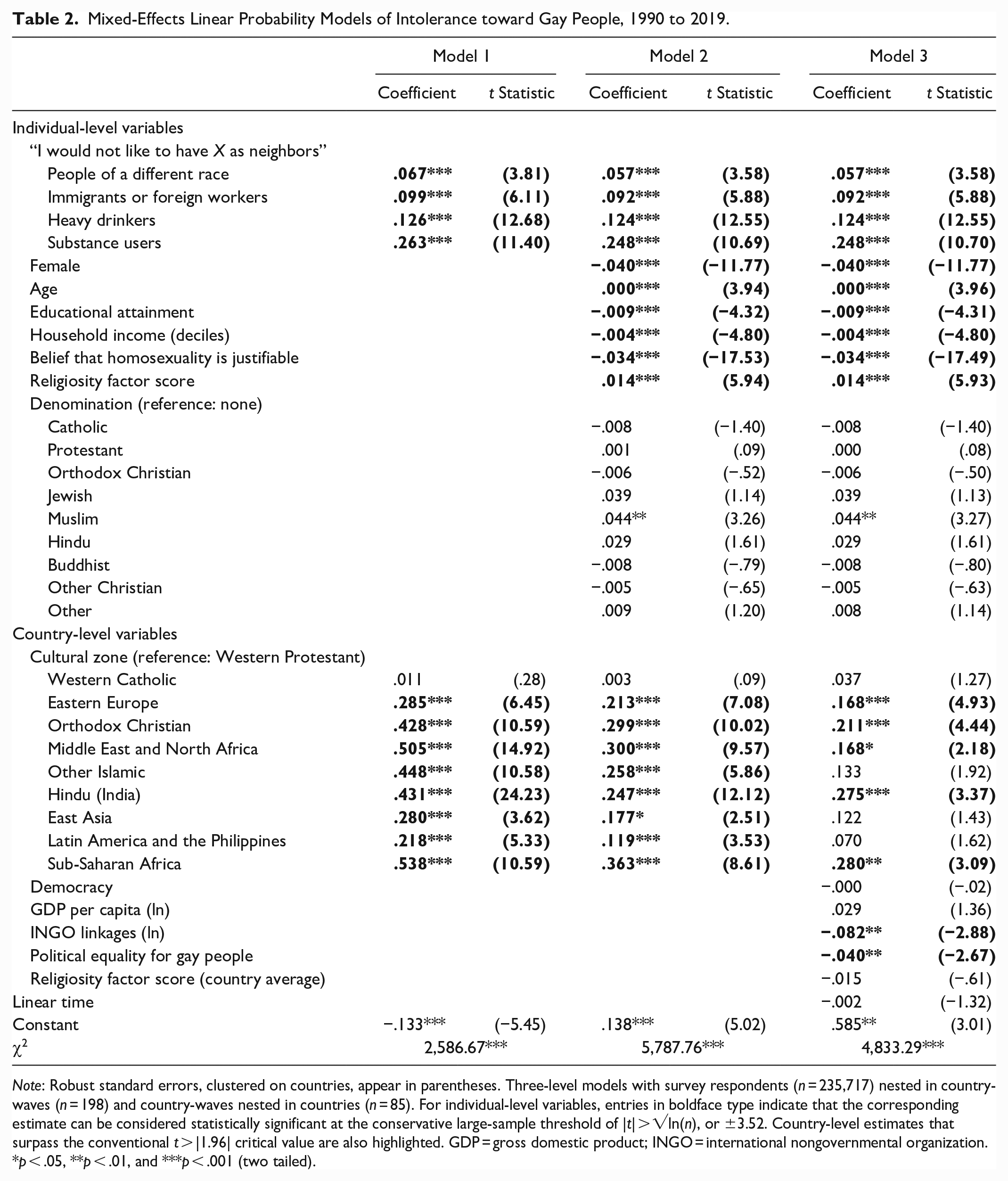
Note: Robust standard errors, clustered on countries, appear in parentheses. Three-level models with survey respondents (n = 235,717) nested in country-waves (n = 198) and country-waves nested in countries (n = 85). For individual-level variables, entries in boldface type indicate that the corresponding estimate can be considered statistically significant at the conservative large-sample threshold of |t| > √ln(n), or ±3.52. Country-level estimates that surpass the conventional t > |1.96| critical value are also highlighted. GDP = gross domestic product; INGO = international nongovernmental organization.
p < .05, **p < .01, and ***p < .001 (two tailed).
Across all three models, rejection of neighbors who use illicit substances is strongly associated with rejection of gay neighbors, followed in descending order by heavy drinkers, immigrants, and different races. These patterns mirror the findings from our factor analysis. Coefficients give the estimated change in the probability associated with a one-unit change in the corresponding variable that a respondent identified gay people as undesirable neighbors. Consider the coefficient for “I would not like to have substance users as neighbors” in model 1 (β = .263, t = 11.40). According to this estimate, respondents who rejected substance users were 26.3 percentage points more likely to reject gay people as neighbors, relative to respondents who did not select substance users as undesirable neighbors. In the same model, respondents who rejected people of different races were only 6.7 percentage points more likely to reject gay neighbors. These estimates are robust across model specifications.
Turning to cultural zones, respondents in each zone except Western Catholic are significantly more likely than respondents in Western Protestant countries to disapprove of gay neighbors. These effects are strongest in sub-Saharan Africa and the two Muslim-majority zones; they are less pronounced in Latin America and the Philippines, East Asia, and Eastern Europe. These effect sizes decrease with the introduction of individual-level control variables in model 2. Women are less likely than men to reject gay neighbors, and disapproval also declines with educational attainment, household income, and the belief that homosexuality is justifiable. Rejection of gay people increases slightly with age and a respondent’s level of religiosity.
Model 3 adds country-level control variables, rendering several cultural zone effects statistically insignificant. Variation in these controls accounts for many cross-cultural differences in evaluations of homosexuality. Respondents in five zones—sub-Saharan Africa, Hindu, Orthodox Christian, Eastern Europe, and MENA, in descending order of magnitude—remain more likely than those in the Protestant West to reject gay neighbors, net of country-level controls. Among these variables, intolerance toward gay people is lower in countries with stronger linkages to world society via international nongovernmental organization memberships and in countries granting greater political equality for gay people.
Multivariate Analyses for Changing Patterns of Intolerance over Time
Model 4 in Table 3 examines changes over time in patterns of intolerance among different groups. Starting with model 3 in the previous analysis, we add interaction terms between each “undesirable neighbor” predictor and linear time.
Mixed-Effects Linear Probability Models of Intolerance toward Gay People, Contingent on Linear Time, 1990 to 2019.
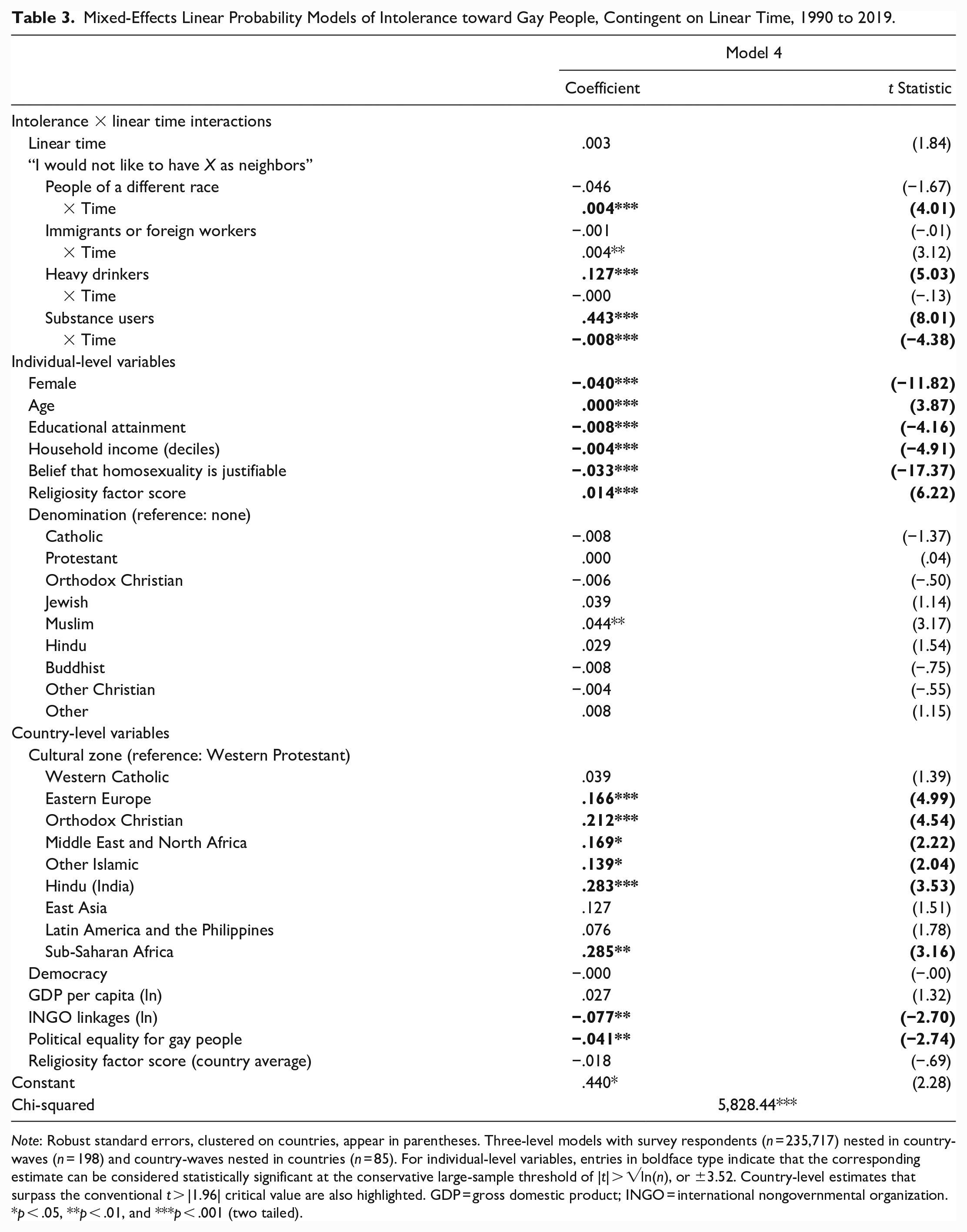
Note: Robust standard errors, clustered on countries, appear in parentheses. Three-level models with survey respondents (n = 235,717) nested in country-waves (n = 198) and country-waves nested in countries (n = 85). For individual-level variables, entries in boldface type indicate that the corresponding estimate can be considered statistically significant at the conservative large-sample threshold of |t| > √ln(n), or ±3.52. Country-level estimates that surpass the conventional t > |1.96| critical value are also highlighted. GDP = gross domestic product; INGO = international nongovernmental organization.
p < .05, **p < .01, and ***p < .001 (two tailed).
Estimates for cultural zones and control variables remain quite stable, so we confine our focus to the interaction effects. To facilitate interpretation, we plot these effects in Figure 1 while holding control variables constant at their mean values. The plots give changes over time in the probability of selecting gay people as undesirable neighbors, given that each of the other groups was also selected. The likelihood of rejecting gay people when different races and immigrants are also rejected increased somewhat over time, as illustrated Figures 1A and 1B. Conversely, the propensity to select gay people alongside substance users declined markedly (Figure 1D). We find no change in the strength of the association between the desire to avoid gay people and heavy drinkers as neighbors in Figure 1C.

Marginal effect of rejecting gay neighbors given rejection of neighbors from other groups, over time: (A) rejects different races, (B) rejects immigrants and foreign workers, (C) rejects heavy drinkers, and (D) rejects substance users.
In sum, patterns of (in)tolerance toward gay people, on one hand, and different races and immigrants, on the other, became increasingly similar between 1990 and 2019, while the tendency to reject gay people in tandem with those who use illicit substances correspondingly declined.
Assessing Cross-Cultural Patterns of Intolerance
Our final step considers how patterns of lumping and splitting differ across cultural zones. This part of our investigation begins with Table 4, which presents principal-components factor analyses of the five “undesirable neighbor” indicators conducted on cultural-zone subsamples. As in the global analysis, intolerance toward different races and immigrants always cluster on one factor, with disapproval of heavy drinkers and substance users loading onto the other. In the Western Protestant and Catholic zones, rejection of gay people clusters with rejection of different races and immigrants. In the two “Western-adjacent” zones of Eastern Europe and Latin America and the Philippines, rejection of gay people loads onto both factors above the .40 threshold, perhaps suggesting that both identity-based and behavioral interpretations of homosexuality remain common. In all other zones, homosexuality loads most strongly on a factor with alcohol and substance users.
Tetrachoric Factor Analysis of Binary Intolerance Measures, by Individual-Level Belief That Homosexuality Is Justified, 1990 to 2019.
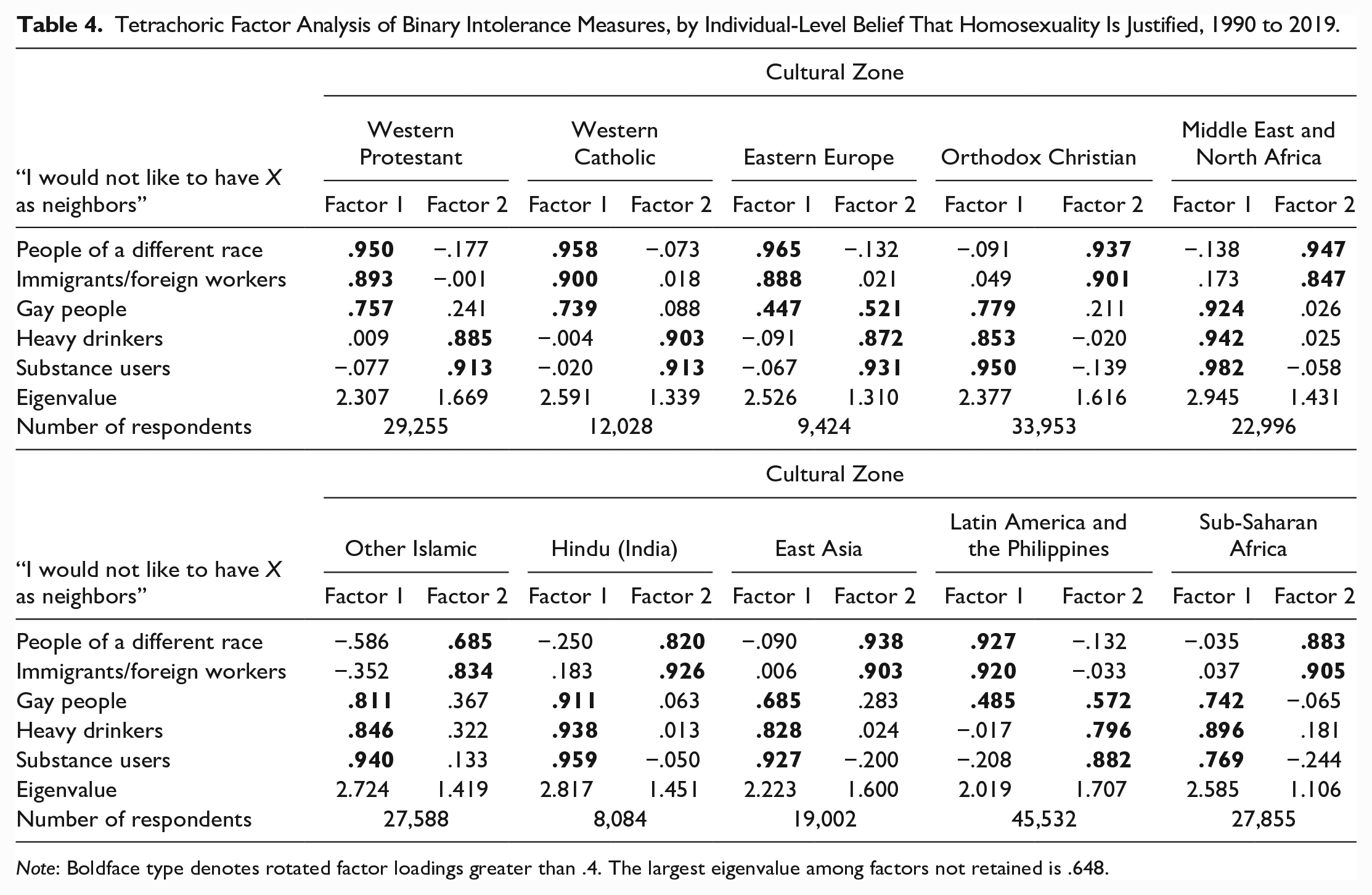
Note: Boldface type denotes rotated factor loadings greater than .4. The largest eigenvalue among factors not retained is .648.
Model 5 in Table 5 subjects these patterns to control variables. This model interacts each “undesirable neighbor” predictor with the set of cultural zone indicators. Figure 2 then plots the marginal effect of rejecting gay people, given that respondents also rejected different races, immigrants, heavy drinkers, or substance users, for each cultural zone. The findings again mirror those in our factor analyses. The propensity to accept of reject gay people alongside different races and immigrants remains strongest in the Western and “Western-adjacent” zones, with non-Western respondents more often citing gay people as undesirable neighbors together with heavy drinkers and substance users.
Mixed-Effects Linear Probability Models of Intolerance toward Gay People, Contingent on Cultural Zones, 1990 to 2019.

Note: Robust standard errors, clustered on countries, appear in parentheses. Three-level models with survey respondents (n = 235,717) nested in country-waves (n = 198) and country-waves nested in countries (n = 85). For individual-level variables, entries in boldface type indicate that the corresponding estimate can be considered statistically significant at the conservative large-sample threshold of |t| > √ln(n), or ±3.52. Country-level estimates that surpass the conventional t > |1.96| critical value are also highlighted. GDP = gross domestic product; INGO = international nongovernmental organization.
p < .05, **p < .01, and ***p < .001 (two tailed).

Marginal effect of rejecting gay neighbors given rejection of neighbors from other groups, by cultural zone: (A) rejects different races, (B) rejects immigrants and foreign workers, (C) rejects heavy drinkers, and (D) rejects substance users.
We conclude by analyzing variation in these zone-specific patterns of identification between gay people and other groups over time. Figure 3 summarizes these analyses, which are based on a model that includes three-way interactions among each “undesirable neighbor” indicator, cultural zones, and linear time, together with the full battery of control variables. We do not present this model, because of its complexity, but it is available upon request.

Marginal effect of rejecting gay neighbors given rejection of neighbors from other groups, by cultural zone over time: (A) different race, (B) immigrants, (C) heavy drinkers, and (D) substance users.
As shown in Figure 3A, the propensity to reject both gay people and different races increases over time in Eastern Europe, Orthodox Christian countries, East Asia, and Latin America and the Philippines. This association declines, however, in Western Catholic countries. There is a positive, statistically significant, and stable association between homosexuality and race in the Protestant West, whereas the association is slightly negative in India. The likelihood of rejecting gay people alongside different races trends upward in Muslim-majority countries, but these estimates are not statistically significant.
Figure 3B reports corresponding analyses for the association between gay people and immigrants or foreign workers, which is positive and statistically significant throughout most or all of the observation period in several zones: Western Protestant, Eastern Europe, Orthodox Christian, Hindu, East Asia, and Latin America and the Philippines. In MENA and other Muslim countries, an upward trend becomes statistically significant in later years. Conversely, the positive association in Western Catholic countries is initially significant but becomes insignificant by the end of the period.
Non-Western survey respondents are generally more likely to reject gay people together with heavy drinkers, as shown in Figure 3C. This relationship strengthens over time in MENA and India but weakens in other Islamic countries, Latin America, and East Asia. In the two Western zones, the association between gay people and heavy drinkers is significantly positive but substantively minor to start the period, and reduces to zero over the course of the analysis. There is a modest positive association between rejection of these two groups in Eastern Europe, Orthodox Christian nations, and sub-Saharan Africa.
Finally, the downward trends for nearly every zone in Figure 3D indicate a declining propensity to reject gay people with substance users as undesirable neighbors between 1990 and 2019 in most of the world. By the end of the period, the association was statistically insignificant in the Protestant West, Catholic West, Latin America, and East Asia. It declined markedly but remained significant in Orthodox, Islamic, Hindu, and sub-Saharan African countries. The decline for Eastern Europe was relatively more modest.
Although the results in Figure 3 are complex, overall a fairly clear picture emerges. In most of the world, people increasingly express similar evaluations of gay people, people of different races, and immigrants over time, whereas their assessments of gay people and substance users (and, to a lesser extent, heavy drinkers) become more distinct. These trends may suggest a shift away from interpretations of homosexuality as a deviant behavior and toward an understanding of it as an ascribed identity.
One superficially striking set of findings warrants brief comment. Respondents in the Catholic West became substantially less likely to select gay people with different races and immigrants throughout the period, which could be taken to imply that identity-based perceptions of homosexuality waned over time. This interpretation would be mistaken. Rather, respondents in Western Catholic countries were less likely to reject gay neighbors overall, regardless of their attitudes toward other groups and despite the Catholic Church’s conservative stance on homosexuality.
Discussion and Conclusions
In this study, we examine how individual- and country-level characteristics shape popular attitudes toward groups of people as desirable or undesirable neighbors, with an emphasis on the way cultural contexts shape these understandings. Our larger goal was to understand whether homosexuality is understood as an innate “orientation” or voluntary “preference,” a state of being or a category of doing. We found that a country’s cultural zone, defined in terms of predominant religion and geographical region, helps explain patterns of tolerance. The trends suggest that religiously inflected “thought communities” (Zerubavel 1997) shape interpretations of homosexuality around the world.
On a global scale, disapproval of homosexuality tends to cluster with rejection of heavy drinkers and substance users, rather than with disapproval of different races and immigrants. This pattern of lumping and splitting implies that homosexuality continues to be understood as an immoral or stigmatized category of doing rather than an immutable state of being. However, these classifications differ across cultural zones. In Western countries and “West-adjacent” regions such as Latin America and Eastern Europe, homosexuality generally clusters with race and nativity. Outside of the West, people are apt to reject homosexuality alongside substance use, albeit with declining likelihood over time.
Our study contributes to research on attitudes toward gay people in cross-national perspective. For example, it modifies Hadler’s (2012) findings, which also analyzed WVS indicators for rejection of different races, immigrants, and gay people as neighbors. According to that study, “xenophobia,” defined as intolerance toward different races and immigrants, is distinct from “homophobia,” or disapproval of homosexuality. By incorporating attitudes toward alcohol and substance use, we find different patterns. Homosexuality aligns with different races and immigrants in some contexts but with alcohol and substance use in others.
Our study has several limitations, many of them inherent in cross-national survey research. We cannot account for the different interpretations survey respondents might give to the idea of “neighbor.” For many people, being a neighbor likely evokes a sense of physical proximity, whereas others might interpret it more abstractly or metaphorically in terms of neighborliness. Moreover, the survey item asking respondents to identify undesirable neighbors does not allow us to analyze interpretations of homosexuality directly. At the same time, our indirect and inferential approach may mitigate social desirability biases that plague survey-based research.
One possible interpretation of our findings is that homosexuality is increasingly understood as a social identity, with Western, Latin American, and Eastern European countries leading the way. Although perceptions of homosexuality as an identity-based characteristic do not automatically translate into greater acceptance or inclusion, a better understanding of how people perceive homosexuality can provide an important step in efforts to combat homophobia. Acknowledging the rights of gay people may sometimes depend on a shift in ontological understandings of homosexuality. In the West, homosexuality is increasingly defined as an ascribed identity worthy of protection and rights, an understanding that remains contested in many parts of the world. Countervailing models, especially those rooted in religion, continue to see homosexuality as deviant and “disordered,” although our results suggest that these perceptions may be changing. Efforts to promote the rights of gay people around the world must address fundamental cultural and cognitive understandings of what it means to be gay.
Footnotes
Appendix
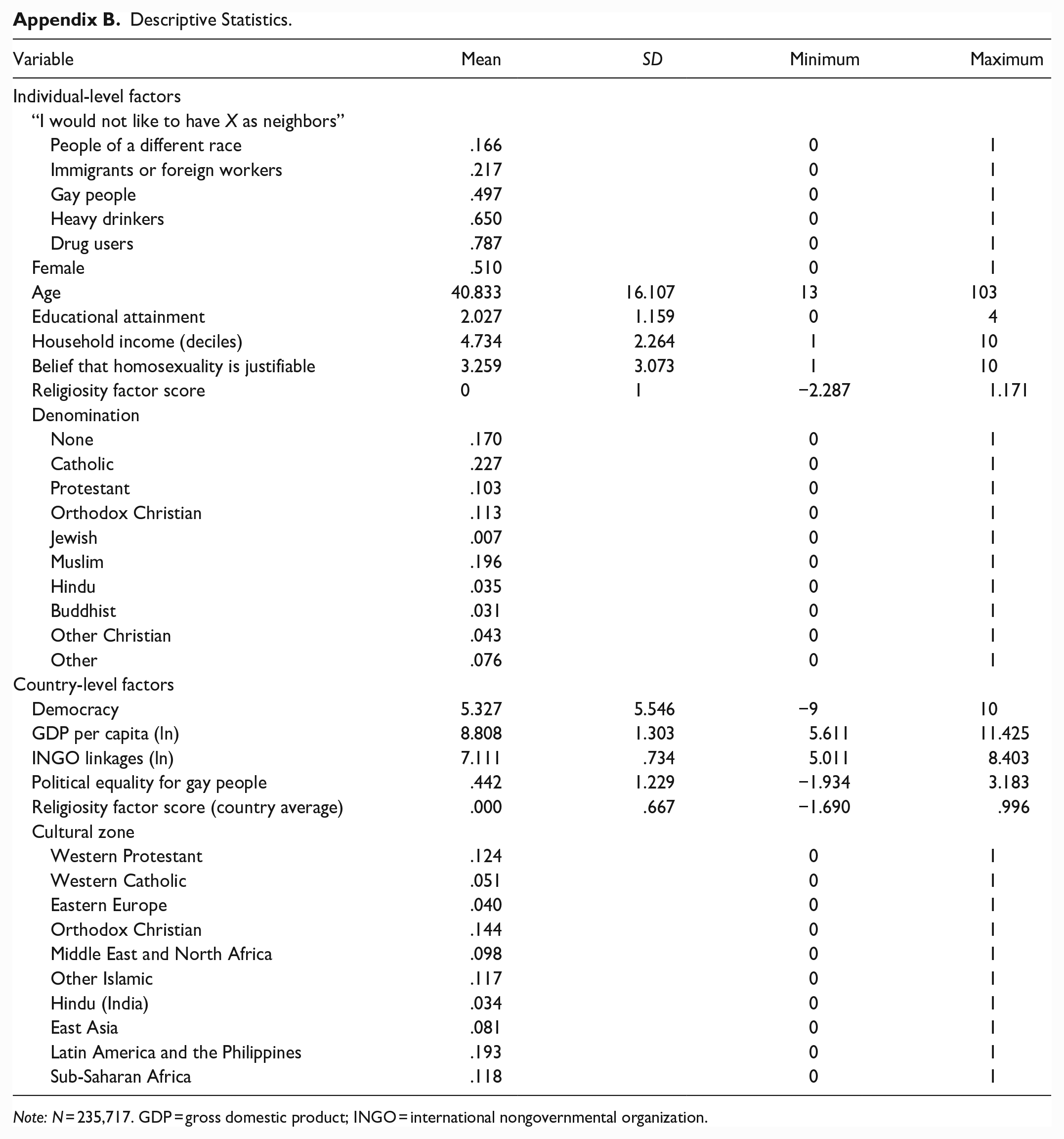
Descriptive Statistics.
| Variable | Mean | SD | Minimum | Maximum |
|---|---|---|---|---|
| Individual-level factors | ||||
| “I would not like to have X as neighbors” | ||||
| People of a different race | .166 | 0 | 1 | |
| Immigrants or foreign workers | .217 | 0 | 1 | |
| Gay people | .497 | 0 | 1 | |
| Heavy drinkers | .650 | 0 | 1 | |
| Drug users | .787 | 0 | 1 | |
| Female | .510 | 0 | 1 | |
| Age | 40.833 | 16.107 | 13 | 103 |
| Educational attainment | 2.027 | 1.159 | 0 | 4 |
| Household income (deciles) | 4.734 | 2.264 | 1 | 10 |
| Belief that homosexuality is justifiable | 3.259 | 3.073 | 1 | 10 |
| Religiosity factor score | 0 | 1 | −2.287 | 1.171 |
| Denomination | ||||
| None | .170 | 0 | 1 | |
| Catholic | .227 | 0 | 1 | |
| Protestant | .103 | 0 | 1 | |
| Orthodox Christian | .113 | 0 | 1 | |
| Jewish | .007 | 0 | 1 | |
| Muslim | .196 | 0 | 1 | |
| Hindu | .035 | 0 | 1 | |
| Buddhist | .031 | 0 | 1 | |
| Other Christian | .043 | 0 | 1 | |
| Other | .076 | 0 | 1 | |
| Country-level factors | ||||
| Democracy | 5.327 | 5.546 | −9 | 10 |
| GDP per capita (ln) | 8.808 | 1.303 | 5.611 | 11.425 |
| INGO linkages (ln) | 7.111 | .734 | 5.011 | 8.403 |
| Political equality for gay people | .442 | 1.229 | −1.934 | 3.183 |
| Religiosity factor score (country average) | .000 | .667 | −1.690 | .996 |
| Cultural zone | ||||
| Western Protestant | .124 | 0 | 1 | |
| Western Catholic | .051 | 0 | 1 | |
| Eastern Europe | .040 | 0 | 1 | |
| Orthodox Christian | .144 | 0 | 1 | |
| Middle East and North Africa | .098 | 0 | 1 | |
| Other Islamic | .117 | 0 | 1 | |
| Hindu (India) | .034 | 0 | 1 | |
| East Asia | .081 | 0 | 1 | |
| Latin America and the Philippines | .193 | 0 | 1 | |
| Sub-Saharan Africa | .118 | 0 | 1 | |
Note: N = 235,717. GDP = gross domestic product; INGO = international nongovernmental organization.
Acknowledgements
We thank David John Frank, Kristopher Velasco, and two anonymous reviewers for their insightful suggestions on previous versions of this article. We alone bear responsibility for any remaining errors.
1
2
The English translation of the WVS instrument uses the term homosexuals, which is now considered outdated and derogatory. We use the terms gay people and homosexuality in line with  style guidelines, while acknowledging that terms such as queer or gays and lesbians might be preferable in some contexts. Likewise, the WVS refers to “drug addicts,” but we use the term substance users.
3
Religiously proscribed activities are sometimes subject to formal legal sanction, as with the prohibition of alcohol consumption in devoutly Muslim countries such as Iran, Saudi Arabia, and Yemen.
4
In 2018, 50 percent of U.S. adults believed that homosexuality was determined at birth, up from only 14 percent in 1977 (Saad 2018). The share of people attributing homosexuality to upbringing or environment declined from 56 percent to 30 percent over the same period, with no more than 13 percent indicating both “nature” and “nurture” as contributing factors. In contrast, experts increasingly acknowledge the fluid nature of sexual identities (e.g., Mock and Eibach 2012), while also arguing that fluidity is not synonymous with choice (Diamond 2008; ). Cultural and legal contexts, which we emphasize, also shape the ability of individuals to embrace and openly inhabit nonheterosexual identities.
5
Except in countries where same-sex marriage has been legalized, same-sex sexual activity is also necessarily extramarital, further stigmatizing it in most religious doctrines.
6
7
The WVS instrument instructs interviewers to code a respondent’s “sex” using only two categories: “male” and “female.” Respondents were unable to self-report their sex, gender, or sexual identities.
8
9
The analyses we report are unweighted, but incorporating country weights produced similar results.
10
This threshold for determining whether a factor loading is reasonably strong or noteworthy is widely suggested (Cabrera-Nguyen 2010; Costello and Osborne 2005; Hinkin 1995; , 387), but it is best viewed as an approximate standard.