




Abstract
In the American system of government, courts are designed to operate within the legal sphere, with limited political interference. Is it possible, though, that a behavior that is at the heart of the political process can be influenced directly by a judicial decision? Focusing on voter registration big data for the universe of voters in North Carolina around the time of Dobbs v. Jackson Women’s Health Organization, the authors assess the roles of gender, political party affiliation, and age in voter registration. North Carolina is the only state whose voter registry has the necessary granularity over time and information needed. Women and Democrats were more likely to register to vote after information about the ruling was released, suggesting that Dobbs influenced their behavior. This effect on voter registration gender gap was unique to June 2022, unlike previous midterm election years (2014 and 2018). Interrupted time-series analyses lend further support to these findings.
Keywords
Much of the credit for the absence of a red wave, predicted for the 2022 midterm elections, was given to the salience of abortion politics (e.g., De Visé 2022; Knoll and Smith 2022). However, this argument is based, at best, on exit polls. At worst, it is predicated on anecdotal conversations with voters. To overcome the myriad problems ranging from limited samples, nonresponse, and response biases to the fact that polls may confound a U.S. Supreme Court ruling on abortion with various political variables, we offer a direct behavioral measure for the reaction to the ruling: voter registration.
In June 2022, the Supreme Court overturned both Roe v. Wade and Planned Parenthood of Southeastern Pennsylvania v. Casey. In jurisprudence developed over nearly half a century, these two cases were pivotal in the judicial doctrine protecting a constitutional right to abortion. In their ruling in Dobbs v. Jackson Women’s Health Organization, the justices removed what, since the mid-1970s, had been an established right. The sense that the decision was primarily a product of partisanship was heightened by the fact that all six justices appointed by Republican presidents formed the majority. At the same time, the minority consisted exclusively of justices appointed by Democratic presidents.
The opinion in Dobbs stated that overturning Roe and Casey reverted abortion from a federally protected constitutional right to a political issue to be decided by the people of each state and their representatives in state legislatures (Congressional Research Service 2022). Although the decision was handed down in June, a draft of the opinion had been leaked in May, generating public discussion of the overruling of Roe before it became a reality (Gerstein and Ward 2022). We link Dobbs to variance in gender gaps in voter registration on the basis of original big data from North Carolina, which is the only state whose voter registry offers the necessary data, granularity over time, and scope of questions. We then identify the matrix of sociopolitical antecedents that can help explain this gap. For robustness, a macro level interrupted time-series analyses further substantiates that Dobbs was a turning point in voter registration gender gap. In June 2022, unlike in the two previous midterm election years, women were energized to register to vote, in particular women Democrats.
In a concurring opinion registered in Dobbs, the conservative justice Clarence Thomas expressed a desire to reevaluate the constitutionality of other Supreme Court rulings tied to Roe and aimed at protecting reproductive rights. That included, but was not limited to, decisions protecting contraceptive access (Kornfield, Bella, and Wang 2022). Thus, Dobbs severely impinged upon rights that were, at least nominally, guaranteed to women for more than half a century. Abortion access provided an alternative to women who faced excessive hurdles related to the procurement of contraceptives (Boudreaux et al. 2022; Charron et al. 2022; Forman Rabinovici and Sommer 2018, 2019; Jones et al. 2015; Sommer and Forman Rabinovici 2019; Swan 2021), the affordability of contraceptives, and education surrounding the various types of contraceptives and how to use them effectively (Bessett et al. 2015; Carlin, Fertig, and Dowd 2016; Durante and Woodhams 2016; Holt et al. 2020; Kumar and Brown 2016; Magoon et al. 2016; Skračić, Lewin, and Roy 2021).
Following Dobbs, many states implemented severe restrictions on abortion. These policy restrictions are rapidly changing. As of November 2022, nine states, including Alabama, Arkansas, Kentucky, Louisiana, Missouri, Oklahoma, South Dakota, Tennessee, and Texas, have banned all abortions without exceptions for rape or incest (The New York Times 2022). In 2023, legislatures in states such as Ohio, Nebraska, South Carolina, and Florida will consider further restrictions or bans on abortion; in Nebraska, this will be a second attempt at introducing an abortion ban, as the one brought before the state legislature in 2022 was not passed (Moloney and Batha 2022). Some states included punishments, some of them severe, for physicians performing abortions (Jaffe 2022). For instance, Texas-based medical providers who perform abortions now face up to life in prison and a $100,000 fine. Dobbs led to immediate, radical changes to the legal landscape surrounding abortions in America, which was quickly followed by political changes during an election year. Handed down four months before the 2022 midterms, Dobbs incited a plethora of political debates in the American public and abortion regulations and protections remain in flux (Human Rights Watch 2023; Kearney et al. 2022).
We ask whether that ruling was associated with a behavioral response among women voters of sufficient proportions to cause political change. Any indication available so far that Dobbs drove women to the ballot box and helped stem a red wave in the 2022 midterm election was based on public opinion surveys (Kirzinger et al. 2022; Perry et al. 2022) and individual interviews (Thomson-DeVeaux and Conroy 2022). Indeed in one review, in as many as 33 different surveys, voters indicated that the decision in Dobbs was a mistake and that Republicans faced a backlash in the midterms (Dandekar 2023). Specifically, we examine whether Dobbs mobilized women to register in greater numbers. Survey-based indications for the effect of Dobbs on the 2022 midterms (Dandekar 2023; Kirzinger et al. 2022; Perry et al. 2022; Thomson-DeVeaux and Conroy 2022), however, may be mired with biases, ranging from social desirability to the difficulty in extrapolating from survey answers to actual behavior. What is more, surveys are based on samples. We offer a different approach on the basis of behavioral measures of an actual political conduct essential for voting, which is registering to vote. These data allow us to look at voters in North Carolina within the period studied. Women tend to register to vote more often than men, with a gender gap of approximately 3 percent (Center for American Women and Politics 2023). The question of concern to us is whether Dobbs produced a change in mass-level political behavior.
Such an effect on election outcomes would stand in stark contrast to traditional views of the Supreme Court within the American system of government and the U.S. constitutional makeup. Such a direct effect on the outcome of the elections through voter mobilization is far from what the Court was designed to do. Having neither sword nor purse, the Court is understood to be the least powerful branch. Its decisions should be devoid of politics and removed from the political sphere.
At various historical points the Court had been embroiled in heated political debates. Yet even during polarizing cases such as Bush v. Gore or civil rights cases decided by the Warren Court, the institution came out largely unscathed and with its legitimacy unaffected (Woodson 2018). One has to go back to the Dred Scott ruling in 1857 to find a Supreme Court decision with serious political consequences, including for the Court itself: “Instead of removing the issue of slavery in the territories from politics, the Court’s ruling became itself a political issue” (McPherson 2003). In the current political environment, the risk is doubly heightened, as levels of political polarization have directly affected the institution (Woodson 2018), for instance around appointments (Krewson and Schroedel 2020; Rogowski and Stone 2021). The polarized nature of the political environment has an effect on the Court and perceptions of the Court (Hasen 2019; Rogowski and Stone 2021). Such a ruling with a possibly direct impact on election outcomes may have implications for the Court’s status and even its legitimacy.
If Dobbs served as a rallying cry for prochoice voters, then the effect of the Court is more profound than just mobilizing citizens. Indeed, if Dobbs had such an effect, it changed established political mobilization patterns. For decades, abortion politics was more likely to mobilize prolife members of the Republican base than prochoice voters (Banda and Cassese 2022). Some of the core constituencies within the base of the Republican party, such as Evangelical Christians, put a political premium on abortion, as reflected in their preferences for and activism on Supreme Court nominations (Marchetti and O’Connell 2018; Ruppanner et al. 2019). Essentially, we test whether Dobbs has turned out to be for prochoice Democrats what Roe had been for Evangelical Christian voters on the right.
Emotional reactions to politics provide a reliable, and strong mobilizing effect (Neyazi and Kuru 2022; Panagopoulos 2013; Safarpour et al. 2022; Valentino et al. 2011), which is also true during off-cycle elections (Safarpour et al. 2022). Dobbs, thus, could have a significant mobilizing effect. Societal influence may also be at play in increasing voter registration among women. Women value social harmony more than men (Harteveld et al. 2019), and they are more likely to be influenced by pressure from their community (Best and Thomas 2004; Eagly 2013; Ickes, Gesn, and Graham 2000; Witt and Wood 2010). This tendency has political implications as social networks, including family, are particularly powerful in motivating individuals to vote (Bond et al. 2017; Klofstad 2007; Nickerson 2008; Panagopoulos 2013; Panagopoulos, Larimer, and Condon 2014). As Dobbs created a flurry of public debate in traditional media and on social media, women’s general tendency to be societally influenced in their political behavior is reason to expect heightened political mobilization among women in the midterms. This leads to our first hypothesis:
Hypothesis 1: Following Dobbs, women were more likely than others to register to vote. This gender effect should go beyond any seasonal effects (i.e., different from previous midterm elections) and should be unique to the point in time when the opinion was leaked and then published, rather than later or earlier in 2022.
The very nature of abortion as a politically salient issue is consequential and makes party identification of particular significance. Issue salience is relevant for mobilization during both on- and off-cycle elections (Biggers 2011; Tolbert, Bowen, and Donovan 2009). Salient issues cause mobilization (Biggers 2011; Childers and Binder 2012; Dyck and Seabrook 2010). Historically, abortion has been a salient issue that has led to voter mobilization in various election cycles (Bauroth 2021; Biggers 2011; Hillygus and Shields 2005; Langer and Cohen 2005). Thus, we anticipate that a radical change in an already salient, controversial issue for the party will mobilize Democratic voters more than Republicans. These ideas lead to the following hypothesis:
Hypothesis 2: Democrats were more likely than Republicans to register to vote after information about the decision in Dobbs was released
We expect ideology also to have an effect. According to gender group identification theory (Conover 1984; Cook 1993; Winfrey, Warner, and Banwart 2014), gender-linked fate (Ruppanner et al. 2019; Stout, Kretschmer, and Ruppanner 2017) concerns the degree to which women view their resources and political futures as tied to the fate of women in general (Dawson 1995; Ruppanner et al. 2019). Given the aforementioned nationwide implications of Dobbs—related to abortion policy as well as to other aspects of women’s rights—and compounded by the fact that abortion restrictions and protections were on the ballot in several states during the 2022 midterms, women who perceive a stronger gender-linked fate have a higher probability of acting politically in ways that they believe benefit women as a whole (Rinehart 1992; Winfrey et al. 2014). Women with a greater sense of gender-linked fate are more likely to be liberal and affiliate with the Democratic party (Goode et al. 2021; Kingston and Finkel 1987; Ruppanner et al. 2019; Stout et al. 2017). These ideas lead to our third hypothesis:
Hypothesis 3: Democratic women will be more likely than other Democrats to register to vote after the Dobbs decision was released.
In most states, women in their 20s account for more than half of all abortions (56.9 percent) (Kortsmit et al. 2021). A woman’s peak reproductive years are between her late teens and late 20s. Hence, this age group has the greatest risk for an unanticipated pregnancy. Beginning in women’s 30s, fertility begins to decline. Women who have their first pregnancies within marital relationships often carry them to term.
Conversely, young women who obtain abortions for their first pregnancy have typically conceived outside of marriage (Harper, Henderson, and Darney 2005; Henshaw and Silverman 1988; Torres and Forrest 1988). Of women undergoing abortions, the vast majority are unmarried (Adamczyk and Felson 2008; Sanger-Katz, Cain Miller, and Bui 2021); Statista estimates that between 1973 and 2020, legal abortions among unmarried women were more than eight times higher than among their married counterparts (Statista, 2022). Although we expect that young women would be especially affected by the Dobbs decision, older women in their 30s and 40s may have also felt under siege. The fertility curve plots birth rate by age for women though their reproduce life. It is normally bell shaped, starting at the onset of menstruation and peaking in early 30s (Burkimsher 2017; Delbaere, Verbiest, Tydén 2020; Frejka and Sardon 2006). Age is the single most important predictor in assessing ovarian reserve (Delbaere et al. 2020; George and Kamath 2010). The ability to create viable embryos and get and remain pregnant begins to decrease in women’s mid-30s. Many women who want children but are unable to do so naturally turn to assisted reproductive technologies, such as in vitro fertilization (Delbaere et al. 2020; Donnez and Dolmans 2017). Depending on the circumstances, they may also use donated sperm and eggs. Embryos produced through in vitro fertilization are often tested for genetic abnormalities (Delbaere et al. 2020; Donnez and Dolmans 2017; Leridon 2004). Problematic ones are often discarded in favor of normal embryos, which are more likely to lead to a successful pregnancy, birth, and a healthy baby.
Many prolife advocates have supported the idea that life begins with conception. Having children is often viewed as supportive of a prolife orientation (Adamczyk 2022). However, when Americans learned about Dobbs, couples and fertility clinics did not know if newly enacted state-level laws would restrict assisted reproductive technologies (Hart and Durkee 2022; MacDonald 2022). As both men and women of reproductive age, which we define as 49 and younger, were affected by those policies, we expect people of reproductive age to be more likely to register after Dobbs. These ideas lead to our final hypothesis:
Hypothesis 4: People of reproductive age will be more likely than others to register to vote following release of information about Dobbs.
Data and Methods
We use voter registration big data from North Carolina to test our hypotheses. Data are taken from the voter registration data of the North Carolina State Board of Elections. However, North Carolina is the only state whose voter registry offers the necessary data, granularity over time, and scope of questions needed for our analysis. We considered using data from other states. Indeed, we systematically searched each state for sources we could use. North Carolina was the only one with accessible data meeting our criteria.
Moreover, North Carolina is a particularly useful case study for the issue of abortion politics, as it is a competitive state, in which every presidential election in the past 16 years was decided by less than 3 percentage points. This indicates that North Carolina is effectively a swing state, which makes it particularly interesting for our purposes. In such purple states, even minimal changes in behavioral patterns—of registration or of voting—may tilt the election in the state, and in the nation, one way or another. Although its racial and ethnic makeup is not a perfect match with the nation—its proportion of African Americans is twice as the national average, and it has half the proportion of Latinos—it is still closer to the nation at large than most other states. North Carolina had a competitive Senate race in 2022. Although abortion access was not specifically on the ballot, these elections had a profound impact on abortion politics; Republicans were within striking distance of getting a supermajority in the North Carolina state legislature, which would allow them to override Democratic governor Roy Cooper’s veto and impose a complete abortion ban. This could have been critical as NC is one of the few southern states where abortion was legal following Dobbs and as a result, saw one of the highest abortion rate increases from out-of-state patients following the ruling.
We have big data from all respondents who registered to vote for several weeks before and several weeks after the Dobbs decision. The state voter registration form asks people a range of questions, including their date of birth, gender, race, and where they were previously registered if it was outside of North Carolina. Only birth date, name, and current address, however, are required on the form. Table 1 presents descriptive statistics of variables included in our analysis. Many people chose not to indicate gender, race, or political party. Eighteen percent of registrants indicated unspecified gender, and 17 percent indicated unspecified race. Thirty-five percent of people did not specify where they were previously registered. Some may be registering for the first time, may not have been registered previously in different states, or may be coming from other countries. Finally, in terms of party identification, slightly less than a third of the people identified as Republicans, a similar share identified as Democrats, and about 42 percent of people indicated undesignated party affiliation, most of them probably falling under the category of independent voters. Some registrants may not feel particularly attached to any party, may not know the difference, or may know that there can be future repercussions to officially affiliating with a political party (e.g., working for the other party in the future).
Descriptive Statistics for Variables Included in the Analysis (N = 296,478).

Although our study is focused on the roles of gender, party affiliation and age in shaping the odds of registering to vote around Dobbs, we also included race and residential origin as control variables. Because only questions about date of birth, name and address were required for registration in North Carolina, we had high proportions of missing data for region of origin, gender, race and political party. We considered using multiple imputation techniques to replace the missing data, but had some concerns. Some of the data were likely not missing at random, which is a requirement for multiple imputation techniques. For example, not affiliating with a political party may have been a conscientious choice for some registrants. Likewise, we had only six variables in our database, and all of them, except age, were categorical, making multiple imputations especially onerous. We tried imputing one database, but after several days of processing, the model would not converge, likely because so much categorical data were responsible for imputing other categories. Additionally, given how little information we had available to impute the missing data, we felt that the models (if we could get them to run) would not provide results that were substantially different from what we present. For these reasons our analysis includes the undesignated categories.
The undesignated category may mean different things depending on the specific variable. For political party affiliation, for instance, the undesignated category is meaningful, as many registrants are indicating that regardless of the reason, they do not want to identify with a specific party. For other categories, it is unclear why people opted not to provide the information. Critical for us is the gender variable, as it is the predictor which is of paramount importance for us. Although women in general are more likely to respond to surveys (Curtin, Presser, and Singer 2000; Moore and Tarnai 2002; Slauson-Blevins and Johnson 2016), men are more likely to fill out all of the questions (Saygin and Atwater 2021). In other words, although men tend to have higher barriers to taking surveys and tests, once that barrier is cleared, they are more likely to finish the survey or test in its entirety. Psychometric indicators, thus, are inconclusive about the meaning of an undesignated category in the gender variable. On the other hand, registering as a woman is a clear political statement of identifying with this particular gender category. As the focus of our project is gender politics, we specify the gender variable as dichotomous, with women in one category and all other responses in the other. Those who register as women distinctly identify as members of this political category, which is of particular importance for the analyses we wish to perform.
To validate the timing of the increase in gender gap in registration, and to increase the overall robustness of our findings, models at the macro level were estimated as well. We conduct an interrupted time-series analysis using longitudinal data to evaluate whether Dobbs was indeed an inflection point in over time patterns of voter registration gender gap. The unit of analysis is the day, starting from May to July 2022. The outcome variable is the ratio between the overall number of women registrants for that day to the overall number of registrants falling into any of the other categories of the gender predictor. This analysis uses three independent variables. First, a longitudinal variable measures the number of days before or after the decision in Dobbs. It aims to capture the overall slope (if, for instance, there is a tendency for more women to register as time goes by, it should be captured by this variable’s coefficient). A second variable indicates whether the relevant day is before or after the cutoff. This variable should capture a jump in registration at this point in time, if one occurs. This variable is the one that is critical for us, as it would indicate an interruption taking place at the hypothesized point in time. Finally, we have a measure of the number of days after our cutoffs (and zero if this day is before the cutoff). This variable is meant to capture a persistent change over time in the slope that occurred in the cutoff, if such a change occurred and persisted. The same analyses were estimated for the three midterm election years we juxtaposed (2014, 2018 and 2022) and, to test robustness, was also replicated for nine different cutoff dates in each of those election years.
Analysis
We focus on the gender gap in registration in North Carolina between May 13 and July 8 in 2014, 2018, and 2022. We selected this time period because it includes the date when the ruling in Dobbs was handed down (June 24, 2022), as well as several weeks before and after. More than a month before the Supreme Court announced its June decision, Politico published in May a leaked version of the opinion (Gerstein and Ward 2022). Hence, we wanted to include the weeks leading up to the official announcement when women may have registered in reaction to the leaked opinion and as they anticipated the upcoming decision. Likewise, as elections get closer, more people tend to register (Carolina Demography 2020), which highlights the importance of analyzing the effect of the particular cutoff, and the trends over time they indicate. Given the leak a month earlier, it is reasonable to expect the change in voter registration patterns to take place even before the formal date in which the decision was announced in late June, but because of questions around the leaked opinion, such as around its authenticity, probably not shortly after the leak. In other words, if Dobbs had an effect, we expect it to peak at early to mid-June.
To reach robust conclusions, we use multiple cutoffs to test for the timing of the change. We chose July 8 as the end date because increases in registrants after that time may be related to the upcoming November election. In sum, we test for multiple cutoffs between May 13 and July 8, every week with the expectation that the cutoff where the gender effect would take place would be in mid-June. By focusing on the same period across three midterm election years, using those multiple cutoffs, we should be able to ascertain two key findings: first, whether or not Dobbs prompted more women to register to vote in 2022 compared with previous midterm elections and, second, whether such a change that was unique to 2022 could indeed be linked to the decision of the court overruling federal abortion rights.
We start with the micro level models. After showing the descriptive statistics of those models, we begin our analysis by presenting maps showing gender differences across counties in North Carolina comparing the weeks leading up to the mid-June point with the weeks after that point in time. Explicitly, we specified June 17 in the maps as the cutoff date. Next we move into our multivariate micro level models. Our outcome variable in the micro level analysis is whether an individual citizen registered before or after the various cutoff dates from May to July 2022. As the outcome is dichotomous, we estimate logistic regression models and report exponentiated odds. We begin by examining the influence of key independent variables (i.e., gender, political affiliation, and age) and controls. We then specify interactions between gender, political party, and age. We illustrate effect sizes using a figure indicating marginal probabilities for the different predictors. To substantiate that the effect occurred around Dobbs and was unique to 2022, we include a figure comparing effect sizes for the coefficient on women at different cutoffs in all three midterm election years: 2014, 2018, and 2022. Our expectation is to find an effect around mid-June, but only in 2022, not in 2014 or 2018.
As we have information on the county where each new registrant currently lives, we considered examining the influence of county-level characteristics (e.g., the proportion of conservative Protestants, proportion with a college degree, whether an abortion clinic is located in the county). However, the intraclass correlation revealed that less than 3 percent of the variation in registration was affected by county-level characteristics. For registering during the months surrounding Dobbs, individual characteristics matter much more. Next, we add a figure that plots the coefficients for the effect of the interaction between gender and political party for the same time period over three midterm election years (2014, 2018, and 2022).
Finally, we present the results from our interrupted time-series analysis to provide robustness for our findings using macro level analyses. We observe changes in registration data from May 13 until July 8 in 2014, 2018, and 2022. We want to see if during the time period surrounding Dobbs, the gender gap in registration widened and that such widening was unique to 2022 compared with the two previous midterm election rounds. As all our hypotheses are directional, we use one-tailed tests for statistical significance in all of the analyses.
Results
We use individual-level big data for new registrants before and after several cutoff dates between May and July 2022. We also estimate comparable analyses for 2014 and 2018, which were the most recent midterm elections prior to 2022. Table 1 outlines the descriptive statistics of all the variables specified in the micro level analyses.
Figure 1 uses aggregate data to show county-level trends on a map. All counties in the state are colored according to the gender gap in registration. Counties where women registered more than men are colored white to red. Counties where the registration gender gap was the opposite are light blue to dark blue. The map at the top is for the three-month period before June 17. The map at the bottom is for the three months following June 17. Overall, counties on average shift from blue hues in the top map to red hues in the map at the bottom. Likewise, counties that were light red in the months leading up to the decision turn darker red in mid-June, suggesting that even where gender gap in voter registration had been in favor of women before the ruling, the magnitude of this gap increased further. In sum, most of the counties show a clear shift in the direction of more women registering to vote and in greater numbers compared with registration among those who did not identify as women on the voter registration form.
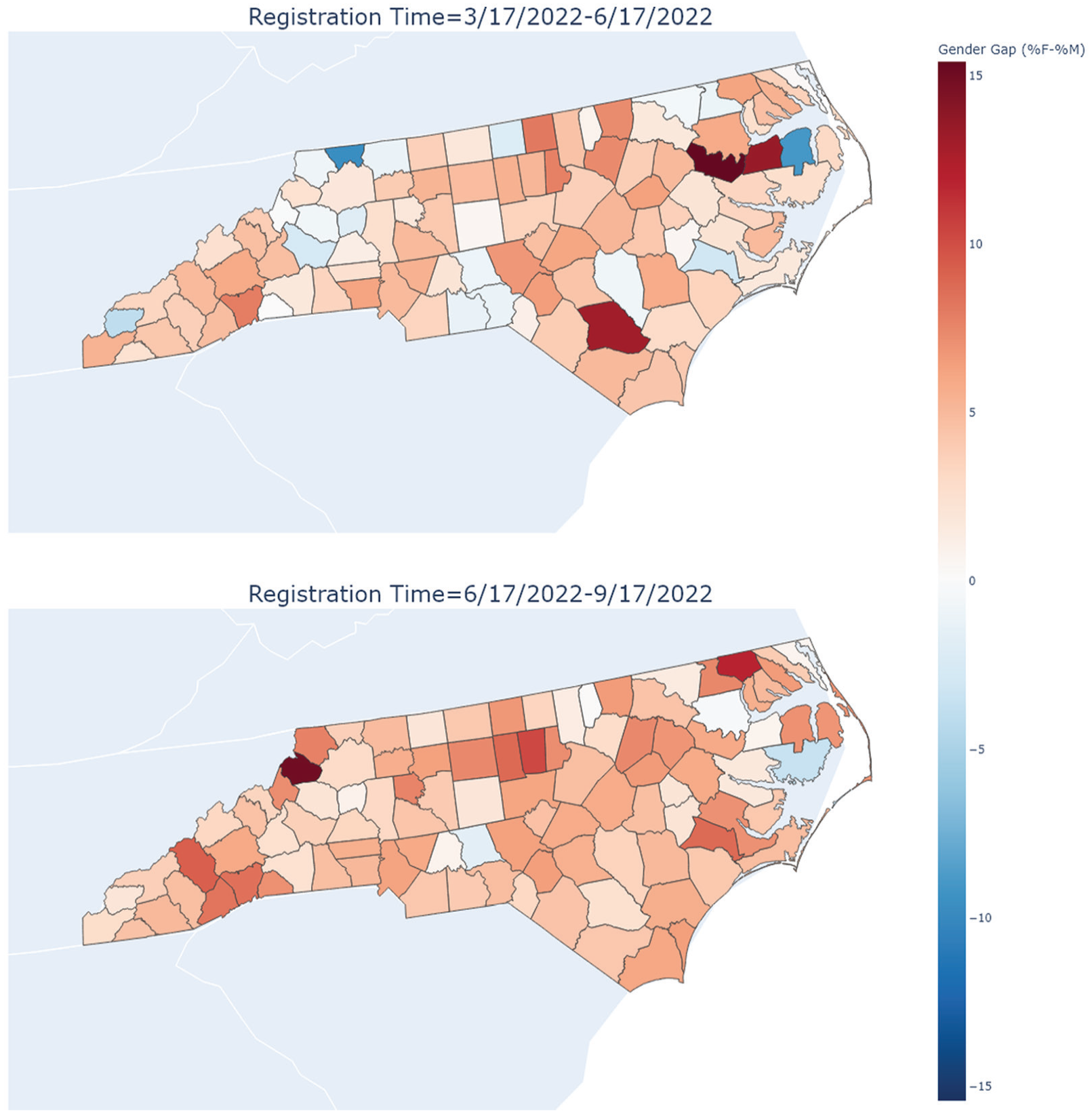
Gender gap in registration by county in North Carolina before and after June 17, 2022.
Figure 2 provides another perspective on county-level trends in voter registration gender gap in North Carolina, highlighting how even what may seem like minor trends can translate into big numbers overall in the aggregate. The size of the circle in each county in the map is proportional to the size of the population in that county. Leftward leaning blue arrows indicate counties where the gender gap shrank after Dobbs, and rightward-leaning red arrows indicate counties in which it increased. The length of the arrow indicates the extent of the change in voter registration gender gap. It is evident that overall there is a significant increase in the gender gap after the cutoff date in mid-June in well over 60 percent of the counties. Most important, with no exception, in all the populous counties in the state, the trend was toward increasing the voter registration gender gap. In the least populous counties, the gap increased by as much as 16 percent. Yet it is the effect in the most populous counties that is the particularly consequential. Even a 1 to 3 percent increase in a populous county can make a real difference. With slightly less than 1 million residents in each, a 1 percent increase in the gender gap in Wake County and in Mecklenburg County may be consequential. The same is true for a 3 percent increase in Guilford County, with its half million residents. Such numbers may prove decisive in a state where the race for the Senate in 2022 was decided with a 121,737-vote margin, and the presidential election two years earlier was determined by a vote margin of fewer than 75,000 votes in the 2020 presidential elections. In sum, Figures 1 and 2 lend strong support to hypothesis 1.

Differences in gender gap registration by county in North Carolina with an indication for the county population size.
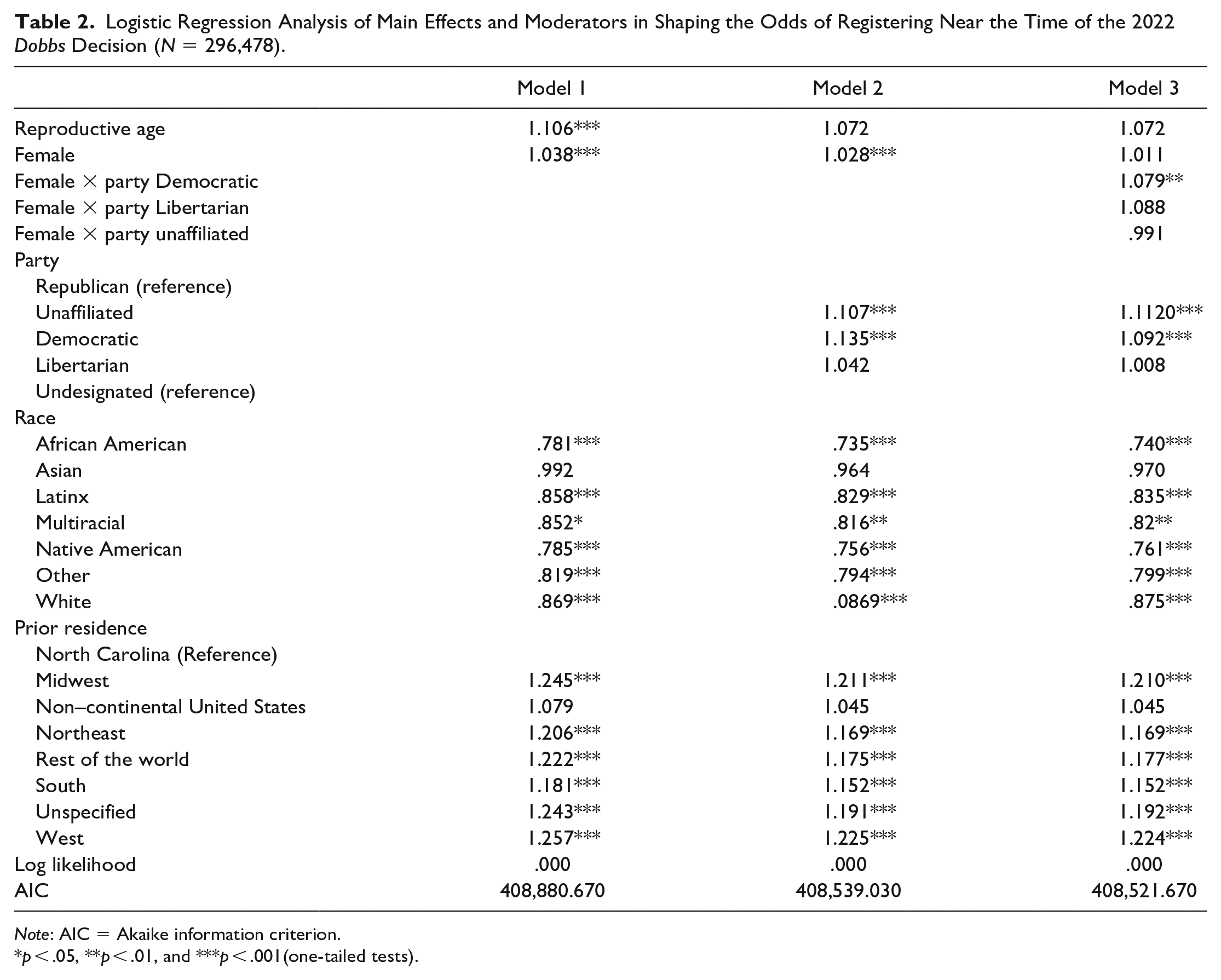
Table 2 presents the results of several multivariate analyses specifying the effects of gender, reproductive age (whether age is <50 or >49 years), and political party, as well as controls for race and registrants’ place of origin. We report exponentiated odds of registering to vote in the weeks after mid-June compared with the weeks before that point in time. Model 1 in Table 2 includes, in addition to the controls, the main effects of reproductive age and gender. Consistent with hypothesis 1, ceteris paribus, following the release of the decision the voter registration gender gap in favor of women increased. Specifically, the odds of women registering to vote after June 17, 2022, were 3.8 percent higher than others, controlling for all other variables. This effect was highly significant.
Logistic Regression Analysis of Main Effects and Moderators in Shaping the Odds of Registering Near the Time of the 2022 Dobbs Decision (N = 296,478).
Note: AIC = Akaike information criterion.
p < .05, **p < .01, and ***p < .001(one-tailed tests).
In model 2 in Table 2, in addition to the effects of gender, we also specified party affiliation. The base category was Republicans. We find support for hypothesis 2 with a statistically significant coefficient that is greater than one for those registering as Democrats. The effect for unaffiliated (likely mostly independent) voters is also significant and again greater than 1, compared with the baseline category of Republicans. The odds for Democrats’ registering to vote following June 17, 2022, were 13.5 percent higher than for Republicans. Many respondents chose not to affiliate with a political party. People who chose not to affiliate with a political party were also more likely than Republicans to register after June 17th, rather than before it, by 10.7 percent. Model 2 also tests for the effect of age, which is not statistically significant. Thus, we do not find support for hypothesis 4, that people of reproductive age will be more likely than others to register to vote following release of information about Dobbs.
Finally, model 2 includes controls for race and place of origin. People who did not designate a race are the reference group. Compared with people with an undesignated race, all other races and ethnic groups were less likely to register to vote after June 17, 2021. As for place of origin, people from North Carolina were less likely than all others (except those outside the continental United States) to register later.
Figure 3 presents the marginal effects of the different predictors and control variables in model 2 in Table 2. The bars indicate the increase in probability of registering after the cutoff when moving between categories of the specific predictor. The marginal effect of gender is positive, and the whiskers for the standard errors indicate that it is also statistically significant. Although the effect size for gender is smaller than for other predictors such as partisan affiliation and reproductive age, its significance suggests that given the small vote margins by which elections are determined in this swing state, the effect of gender on voter registration may carry much weight.

Marginal probabilities of registering after June 17, 2022, by characteristics of registrants.
To fully expound the effect of gender in the context of Dobbs, the results of model 1 in Table 2 fall short in two ways. First, it remains unclear if there is an effect specifically in mid-June or whether alternatively there is constant increase in the gender gap as time goes by. Second, it remains to be seen if indeed the effect was around mid-June whether this effect was unique to 2022. Or alternatively, was a similar effect evident in previous midterm elections? To ascertain that the results indeed support hypotheses we ran 27 different regressions with model specification similar to that of model 1 in Table 3. For each of the 2014, 2018, and 2022 midterm elections, we estimated 9 models, corresponding to 9 different cutoffs, each a week apart. The first cutoff for each year was May 13 and the last was July 8. For the purposes of our discussion, we are focused on the coefficient on gender in each of those models. Figure 4 outlines those coefficients in the 27 models, with 95 percent confidence intervals. The red line indicates the coefficients for 2014, the blue for 2018, and the green for 2022. The patterns for 2014 and 2018 are similar. The coefficients for all cutoffs are positive and statistically significant (determined by whether the shaded area around the lines includes zero or not). In other words, in both those elections years, the effect of gender was to increase voter registration throughout the period from May to July.
Interrupted Time-Series Analysis of Voter Registration Data Near the Time of the Dobbs Decision.

Note: The cutoff date used was June 17, 2022.
p < .05 (one-tailed test). ***p < .001 (one-tailed test).
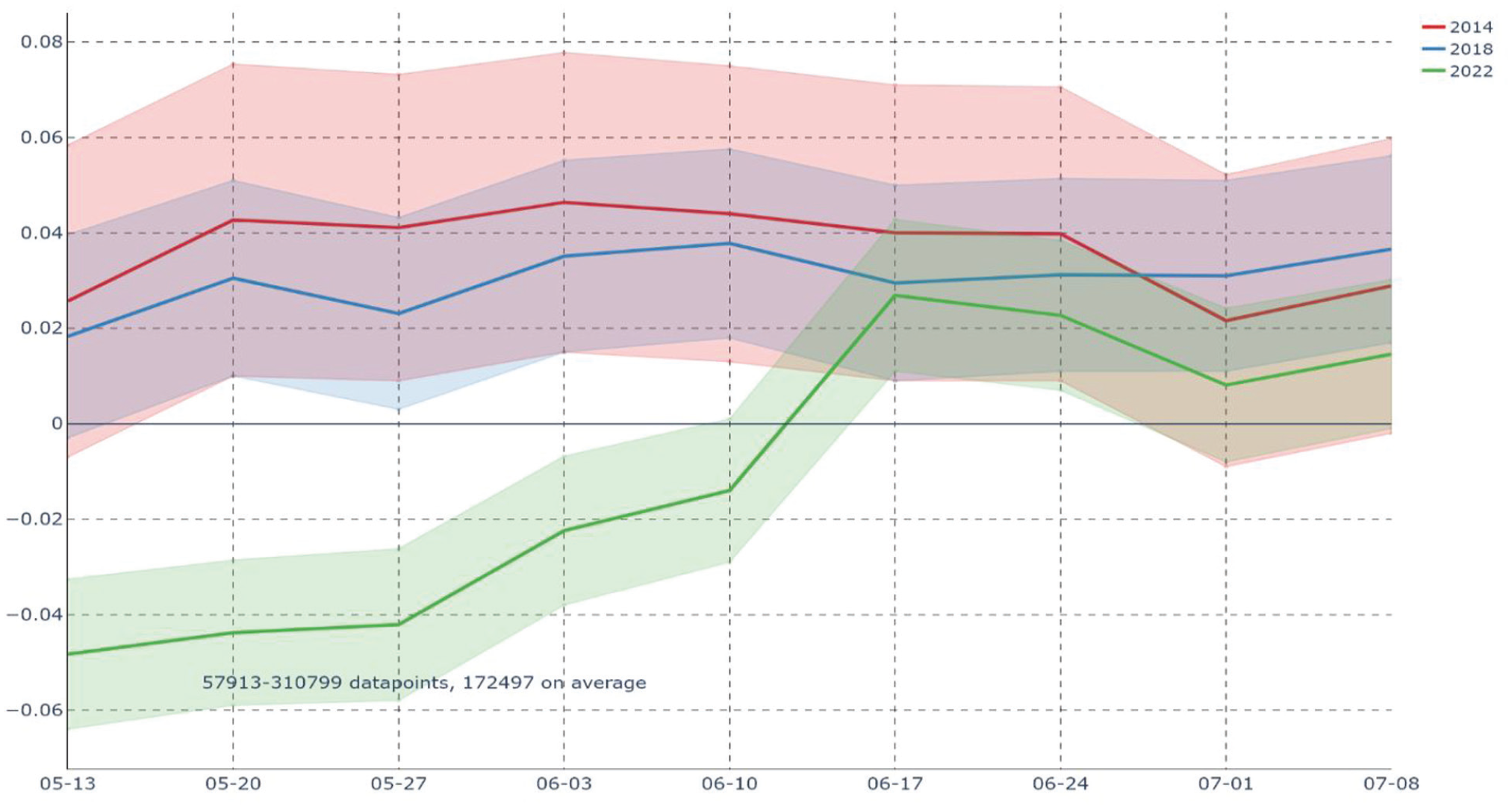
Main effect of gender in different cutoffs in 2014, 2018, and 2022.
Conversely, the pattern for 2022 (green line) is different. In May and early June, the effect of gender is either negative or indistinguishable from zero. However, in mid-June, the relatively sleepy gender effect changes, and the coefficient on gender is positive and significant. Thus, the pattern of the green light suggests that the change in voter registration gender gap indeed happened around mid- to late June. What is more, juxtaposition of the patterns of the green line (2022) with the red and the blue lines (2014 and 2018, respectively) suggests that this effect in June was unique to 2022. It is likely that the election season is slow to pick up in May, as voters expect a red wave in the upcoming elections in November. But once the opinion in Dobbs is leaked and as its official date of publication draws closer in mid- to late June, the effect of gender on voter registration becomes particularly prominent. Women registered to vote more after mid-June 2022 than before that date, and this effect was unique to that midterm elections year.
Model 3 in Table 2 examines the interaction between political party and gender, lending support to hypothesis 3. The exponentiated odds for the interaction between gender and Democrat is greater than one and statistically significance, indicating that women Democrats were even more likely than others to register to vote. There was no such interaction effect for gender with any of the other partisan affiliations. Similar to Figure 4, we wanted to examine whether the statistically significant interaction effect was true for mid- to late June 2022. And in addition, we wanted to see if such an effect in June was unique to that year. Figure 5 outlines the coefficient for the interaction term between gender and partisan affiliation with the Democratic Party in 27 models specified similarly to model 3 in Table 2. For each of the years—2014 (red line), 2018 (blue), and 2022 (green)—we estimated the effects in nine different cutoff dates. Results for 2014 and 2018 follow very similar patterns. Those two midterm election years are similar, suggesting that typically in midterm election years, in the period from mid-May to late June, the interaction term is not statistically significant and becomes negative and significant toward early July. The 2022 pattern is quite distinct, with the interaction term between women and Democrats turning positive and significant in mid-June and remaining so until the end of that month. Combining the results in Figures 4 and 5, we find that not only did women register in bigger numbers around the Dobbs decision in 2022 and they did so in a way that was unique to that year, but also that those women who registered were more likely to be registering as Democrats.

Interaction terms of gender and Democrats in different cutoffs in 2014, 2018, and 2022.
Table 3 presents the results for the interrupted time-series analysis. The analysis at the macro level suggests that our findings about the effect of Dobbs gain support at multiple levels of analysis, both the micro level and the aggregate level. The outcome variable is the ratio of women to men registering in each day from mid-May to early July. The key is to determine whether indeed mid-June was an interruption in this time series, or whether number of women registered gradually increased over this period of time. We find a significant interruption on June 17, 2022. The number of days before and after the cutoff, which tracks a linear effect over time, in which women register increasingly more as Election Day draws closer, is not statistically significant. Likewise, the coefficient for the variable indicating a persistent change at the cutoff is not statistically significant. The only variable that is significant, indicating an interruption to the time series of gender gap voter registration in mid-June, is the jump variable.
To determine whether the effect was unique to 2022 and to this date in 2022, again like Figures 4 and 5, we estimated 27 models, with nine cutoffs for each of the three years. In Figure 6, the coefficients on the jump variable indicating the interruption from all 27 models are presented with red for 2014 coefficients, blue for 2018, and green for 2022. The patterns for 2014 and 2018 are again quite similar, with most of the coefficients being indistinguishable from zero in almost all cutoffs. Conversely, the pattern in 2022 is distinct. We observe a significant effect on June 17, suggesting an interruption to the time series in mid-June, as hypothesized. What is more, unlike the two previous election cycles, the effect consistently increases up to this point and then subsides. In sum, the spike in mid-June finds support in analyses at the macro level as well. Our findings are robust in that sense.

Interrupted time series in 2014, 2018, and 2022.
Discussion
Abortion was a key issue in the 2022 midterm elections. Five states had related ballot initiatives. Election outcomes suggest that the abortion issue indeed had a major effect. This was reflected in victories in the gubernatorial and Senate races in Pennsylvania and in Michigan in both houses of the legislature as well as in the reelection of Governor Gretchen Whitmer. According to AdImpact’s 2022 “Midterm Projections Spending Report,” Democrats spent more money on abortion-related ads than on any other topic in the 2022 campaign. Thus, voting on Election Day may not be a clear reflection of the effect of the decision of the Supreme Court. Rather, it may be confounded by the effect of resources poured into the campaign in the intervening months.
Any indication available so far that Dobbs drove women to the ballot box and helped stem a red wave in the 2022 midterm election was based on public opinion surveys (Dandekar 2023; Kirzinger et al. 2022; Perry et al. 2022) and individual interviews (Thomson-DeVeaux and Conroy 2022). Thus, it may be mired with biases typical of such surveys, be based on a limited sample, and may confound the decision itself with the flurry of political activity it generated in the intervening months before the elections. Indeed, the surveys before the elections often missed the mark. Instead, we offer a direct behavioral measure of women’s reaction to the ruling, on the basis of big data of voters, which can be linked to the judicial decision. To examine the electoral ramifications of the annulment of the constitutional right to abortion, we assessed voter mobilization, specifically in the form of voter registration.
We find that Dobbs altered political behavior of female voters. Although we do not test any emotional reaction directly, it is possible that the ruling of the Supreme Court instilled a sense of urgency and rage sufficiently strong to mobilize those women. We show that gender gaps in voter registration increased following the ruling and that this increase was political in nature. The differentials in voter registration gender gap before and after the ruling are a strong behavioral manifestation of the direct impact of the Court on American voters. Rather than being based on survey responses, our findings are behavioral. In addition, we use data for all the voters registering to vote in the late spring and early summer of 2022 in North Carolina, rather than a sample, thus using big data with nearly 300,000 data points. Furthermore, we test for seasonality and find that the change in voter registration gender gap took place around mid-June 2022, and was unique to this election year. And finally, the results are robust and consistent with micro level data as well as macro level analyses, using interrupted time series models.
The overall trend for nearly 300,000 voters in North Carolina indicates that indeed the ruling coincided with the mobilization of women to register to vote. This trend is clear in the state overall at the level of individual registrants as well as aggregately at the county level and in the state as a whole. Our findings lend strong support to initial indications from surveys that abortion politics was key to the 2022 midterm elections. Yet unlike survey-based research, we provide behavioral evidence founded on big data rather than information based on a limited sample and its possible associated biases, and we identify the key political and sociological correlates.
One limitation of our study is that many registrants did not provide key information on gender, political party, race, or place of origin. The registration form only required name, address and age. As discussed above, we considered this issue when specifying the models and specifically the variables in the models, and found extremely robust results in all models and at different levels of analysis. Given that just a handful of questions tend to be asked on voter registration forms and the responses are typically categorical, making multiple imputation especially onerous, alternative ways of handling the missing data should be considered.
Although North Carolina is a good test state for examining how Dobbs may have affected voter registration, states in more liberal or conservative parts of the country may show different results. We do not know of any other states where registration data were so easily available and demographic information was also provided. However, future research and voter registration administrators might want to consider standardizing the information required on these forms and making it available from a single source so that more analyses could be conducted.
Our findings corroborate that Dobbs shifted voter registration patterns in North Carolina, increasing the number of women registering to vote and in particular female Democrats. Extrapolating from our findings, this suggests that the ruling of the court influenced election outcomes in the state. As abortion was key to the race in this state, and there are robust similarities between the state and the nation as a whole, those results are reasonably generalizable nationwide. It is likely that the ruling of the Supreme Court directly affected the outcome of the 2022 midterm elections through the registration of female voters, as well as registered Democrats, specifically women registered as Democrats. The statistically significant increase in gender gap in registration in favor of women in June 2022 after the Court handed down its decision would be consequential in states with small vote margins, which were of particular interest in the 2022 midterms, as in many other election cycles. If the patterns we identify in North Carolina are indeed generalizable nationally, or at least to some of those swing states, then the bump in female registration following leaked information about Dobbs was conceivably decisive in states such as Pennsylvania, Nevada, Georgia, and Arizona. Given the small margins that decided the elections in those states in 2022, the gender gap in voter registration was conceivably a crucial factor.
