




Abstract
Previous research suggests that family responsibilities can negatively affect work attitudes, particularly for women. The opportunity structure theoretical perspective posits that positions in opportunity structures in the workplace, not gender, shape work attitudes. But few studies have examined how work attitudes change during adulthood or identified which life events precipitate changes in work attitudes. Using six waves of panel data and fixed-effects models, the author examines changes in work attitudes, focusing on aspirations toward work achievement and upon becoming a spouse and subsequently a parent in Japan, a highly gendered, industrialized society. For women, transitions to marriage and parenthood are negatively associated with aspirations, even when controlling for job characteristics, whereas family formation has little association with changes in the aspirations for men. Women scale back their aspirations toward work achievement when forming families, and marriage triggers shifts in the work attitudes.
Keywords
Marriage and becoming a parent are often integral parts of family formation processes and major life events for many individuals. Family responsibilities as a spouse and a parent and associated work-life conflict have been shown to affect attitudes toward paid-work (referred to as work hereafter), which are often negative for women. Examples of such negative effects include decreased long-term expectations for career advancement (Becker and Moen 1999) and work commitment (Desai and Waite 1991; Evertsson 2013) and increased desire to reduce the number of work hours (Reynolds 2005). Another position is represented by scholars who argue that the effect of family on attitudes toward work is best predicted by job characteristics, instead of gender, and have found evidence supporting this claim (Cassirer and Reskin 2000; Kanter 1976, 1993). The individuals with family responsibilities may be channeled into less desirable jobs with less autonomy and fewer opportunities for career advancement. The shift in job conditions, rather than increased family responsibilities, may be mainly responsible for attenuating individuals’ attitudes toward work, such as aspirations toward work achievement. Yet previous research on the relationship between family formation and work attitudes has often relied on relatively small sample interview data or cross-sectional data observed at one point in time. Comparing different individuals with different family lives has limitations in addressing the possibility that unobserved personal attributes explain the transitions to different marital or parental statuses. Moreover, although research using qualitative and cross-sectional data implies that parenthood provokes a major shift in women’s work-related strategies and attitudes (Becker and Moen 1999; Blair-Loy 2001; Evertsson 2013; Maume 2006; Stone 2007), these studies have not identified which life events actually precipitate changes in work attitudes. Whether becoming a parent (vs. another event, such as marriage) triggers changes in work attitudes in both men and women remains unclear. Furthermore, previous research has focused on individuals who are in the labor force. Omitting individuals who are out of the labor force potentially underestimates the impact of family formation on work attitudes.
In this study I examine how the work attitudes of individuals change by using fixed-effects models and nationally representative panel data from Japan. Specifically, I examine the association between family formation and the trajectory of one dimension of work attitudes, aspirations toward work achievement among women and men in Japan in early to middle adulthood. One of the advantages of the survey data that used for this study is that the survey asked all respondents their attitudes toward work, regardless of their work status at the time of the survey. This enables me to estimate the average effect of family formation on work attitudes more accurately than previous research, as individuals espousing negative attitudes toward work may be more likely to be out of the labor force. I use Japan as an illustrative case of a gender context in which marriage and parenthood bring extremely gendered divisions of labor between spouses. In Japan, married women perform most of the housework, even in the case of dual-earner couples (Oshio, Nozaki, and Kobayashi 2013). Once they become parents, fathers spend just one third the time per day on childcare that mothers do (Ishii-Kuntz 2008). Japanese individuals hold much more traditional views toward gender than individuals in most other industrialized countries (Inglehart, Norris, and Welzel 2002). In such a context, the expected findings can be different from theoretical predictions from the opportunity structures perspective. Positions in the workplace indicated by job characteristics may not be sufficient to explain the effect of family formation on attitudes toward work.
Examining attitudes toward work is important, as work attitudes, specifically aspirations toward achievement, have implications for gender inequality inside and outside the home. If women place less priority on work achievement as a result of family formation, that shift in attitudes reinforces and legitimizes the division of household labor, which may hinder women’s labor force participation and career advancement. Work attitudes predict work outcomes such as performance (Judge and Kammeyer-Mueller 2012; Riketta 2008) and may consequentially partially explain worker’s chances of securing higher positions and the net wage penalty or premium that marriage and parenthood bring for women and men. Aspirations toward work achievement also potentially influence how employers treat their employees. Assessing factors that affect work achievement aspirations would be particularly crucial for a country such as Japan, where women account for only 15 percent of senior leadership positions, which is lower than in many advanced economies (World Economic Forum 2019).
By using fixed-effects models to account for systematic differences in unobserved personal attributes among those with different marital or parental status, this study advances our understanding of the effects of family formation on work attitudes, specifically aspirations toward work achievement, during women’s and men’s adulthood. Cross-national studies suggest that work attitudes vary from country to country (de Vaus and McAllister 1991; Hult and Svallfors 2002; Svallfors, Halvorsen, and Andersen 2001). The present study potentially underscores the importance of the normative context of a country when examining the link between family formation and attitudes toward work.
Theoretical Framework
Two theoretical perspectives can explain changes in work attitudes, specifically the opportunity structures and family responsibilities perspectives. The opportunity structures perspective hypothesizes that positions in opportunity structures in the workplace, not gender, shape men’s and women’s work attitudes (Kanter 1976, 1993). The opportunity structures in the workplace are contingent upon expectations and future prospects for upward mobility in the hierarchy and access to increase in skills and rewards (Kanter 1993). Kanter (1976, 1993) argued that women appear to have less vigorous work attitudes than men because women are more likely to occupy jobs with limited advancement opportunities in the workplace and organizations. Focusing on promotion aspirations, Cassirer and Reskin (2000) tested Kanter’s claim and found that workers’ positions in the opportunity structure at work, not their gender, affect their attitudes. Furthermore, after controlling for job characteristics, they did not find evidence indicating that workers’ family characteristics affect the promotion aspirations of either gender. Following the argument proposed by the perspective, family formation is expected to have no or little association with changes in work attitudes for both genders when job and demographic characteristics are adjusted.
In contrast, the family responsibilities perspective highlights different work and family experiences that marriage and parenthood bring for men and women. Women traditionally shoulder larger family responsibilities than men, whether they work full-time or not (Bianchi 2000). Parenthood leads to sharper divisions of labor between spouses among married couples (Sanchez and Thomson 1997). Previous research has shown that women are more likely than men to adjust their work life to meet family demands by, for instance, turning down promotions or interesting work assignments (Maume 2006) and cutting back on work hours and job demands, especially when they have young children (Young and Schieman 2018). Likewise, family demands may affect more work attitudes of women rather than men’s. For instance, Becker and Moen’s (1999) interviews with middle-class dual-earner couples revealed wives who have childrearing responsibilities employ different scaling-back strategies, including reducing long-term expectations for career advancement. Using longitudinal data from Sweden, Evertsson (2013) found that becoming a mother is linked to a decreased emphasis on the importance of work in respondents’ lives. Married men, on the other hand, are traditionally expected to fulfill the role of breadwinner for the family (Hood 1986), suggesting that marriage is associated with men’s income-earning responsibilities more than women’s. Fathers, compared with nonfathers, place greater importance on extrinsic work rewards such as pay and job security (Johnson 2005). Research on the net wage premium that fathers can receive, or the fatherhood wage premium, suggests that the premium is partly explained by fathers’ increased labor market productivity (Killewald 2013). Taking on new family responsibilities, therefore, is expected to lead to changes in attitudes toward work, and the directions differ by gender.
The Japanese Context and Hypotheses
Despite women’s progress in educational attainment and labor force participation (OECD 2017), social norms in Japan still define a husband’s role as the primary breadwinner and define women’s primary role as involving domestic work and childrearing (Fuwa 2004; Ochiai et al. 2008; Yu 2009). In fact, the division of labor at home in Japan is highly unequal compared with that in Western countries (Batalova and Cohen 2002; Davis 2010; Fuwa 2004), and even in the case of dual-earner couples, Japanese married women do 90 percent of the housework, and Japanese men do much less compared with Chinese and Korean men (Oshio et al. 2013).
At the same time, employees, particularly those who work as regular full-time employees and those with more promising positions, are expected to show commitment and loyalty to their employers through long work hours in a male-centered corporate culture (Nemoto 2013; Ono 2018; Yu 2009). Men work 50 hours per week on average, and the employment hours of Japanese husbands in their prime working years have remained relatively stable over the past couple of decades (Kuroda 2010; Tsuya et al. 2012). Possibly because of long work hours and a husband’s expected role as the primary breadwinner in the family, the amount of time Japanese fathers spend on childcare is limited (Ishii-Kuntz 2008). In 2005, Japanese fathers spent just one third as much time as mothers on childcare (Ishii-Kuntz 2008).
In Japan, where the difficulty of combining work and family responsibilities is presumably high, individuals are hypothesized to choose to focus on either work or family responsibilities. As their family responsibilities expand, women’s aspirations toward work achievement are expected to become lower. At the same time, in the Japanese context, in which many women leave the labor force upon marriage or childbirth (Brinton 2001; Yu 2002, 2005), it is even possible that for men, the increased financial responsibilities may lead to higher aspirations toward work. Therefore, I hypothesize as follows:
Hypothesis 1: Being married and becoming a parent are negatively associated with aspirations toward work achievement for women, compared with being never married.
Hypothesis 2: Being married and becoming a parent are positively associated with aspirations toward achievement for men, compared with being never married.
According to the 2020 Gender Gap Index published by the World Economic Forum, Japan ranks 115th among 153 countries on one of the key dimensions of economic participation and opportunity (World Economic Forum 2019). Japanese women remain in relatively less promising positions in opportunity structures in the workplace than their male counterparts. In 2007, 55.2 percent of the female labor force in Japan were nonregular workers, whereas the proportion was 19.9 percent for male workers (Osawa, Kim, and Kingston 2013). After women leave the labor force upon marriage or childbirth, they reenter later but as nonregular or contingent workers (Brinton 2001; Yu 2005). Government statistics for 2015 show that although more than 70 percent of all married Japanese women remain in the labor force upon marriage, only about half of them remain in the labor force around the time when their first children are born (National Institute of Population and Social Security Research 2016). And even when work hours and other job attributes are controlled, women in Japan tend to have much less decision-making authority and have less influence on pay raises or promotions of subordinates in the workplace than their male counterparts (Wright, Baxter, and Birkelund 1995).
Following Kanter’s (1976, 1993) argument, differences in work attitudes are attributed to the fact that women tend to occupy less desirable positions in opportunity structures in the workplace, rather than to their gender itself. Kanter (1993) found that individuals who are in high-mobility tracks “tend to develop attitudes and values that impel them further along the track: work commitment, high aspirations, and upward orientations” (p. 158), whereas those in low-mobility tracks tend to limit their aspirations. Considering that women in Japan are more likely than men to be channeled into less desirable positions in the work sphere upon marriage and childbirth, such job characteristics are expected to primarily explain the changes in work achievement aspirations. Thus, the observed relationship between family formation and aspirations for work achievement is predicted to be mediated by the inclusion of mediator variables which are various job characteristics for both genders. In other words, regardless of gender, once job characteristics in addition to demographic characteristics are included in the models, the associations are hypothesized to be no longer observable. Hence, I expect the following.
Hypothesis 3: Job characteristics mediate the effects of marriage and parenthood on aspirations toward work achievement for both genders.
Data and Methods
The data used for this study come from the University of Tokyo Institute of Social Science Japanese Life Course Panel Survey (JLPS). The JLPS is an ongoing panel survey conducted annually since 2007. The JLPS consists of nationally representative samples of men and women aged 20 to 34 years (youth sample) and 35 to 40 years (middle-aged sample) and is used by many scholars (e.g., Ishida 2013; Shirahase 2010; Yu and Hara 2020). Survey questionnaires are identical for the two surveys, but are conducted at separate times of the year. The JLPS added a supplementary sample of 963 participants during wave 5. For this study, I merged the two original data sets (4,800 in total) as well as the supplementary sample of 963 individuals.
This study concerns one dimension of work attitudes, respondents’ degree of aspirations toward achievement in the sphere of paid work. The two dependent variables are importance of work success and aspiration to improve work-related skills. The importance of work success to respondents was assessed by their responses to the question “How important to you are the following items?” followed by a listing of six items relating to work and life. One of the six items is “success in work,” measured on a 3-point scale (1 = “very important,” 2 = “somewhat important,” 3 = “not important”). Respondents were also asked, “How much do the following items apply to you?” regarding six items relating to work and life. One of the six items is “I would like to improve my work skills.” The response categories ranged from 1 to 4 (1 = “applies strongly,” 4 = “does not apply at all”). Responses for both of the outcomes were reverse coded; thus, a high score indicates that respondents placed a high level of importance on success at work and have a high level of aspiration to improve work skills. The correlation coefficient between the two outcomes is 0.41 and it is statistically significant at p < .001. The JLPS asked all respondents both questions regardless of whether they were working for pay. I used data from waves 1, 3, 5, 7, 9, and 11 with an 11-year window of observation, as the question regarding importance of work success was asked only in these waves.
My key independent variable is family formation, indicated by the combination of marital and parental statuses. Different stages of family formation were classified into “never married,” “married, no child,” and “married, one or more children,” with “never married” as a reference group. In Japan, marriage and childbearing are closely tied (Raymo and Iwasawa 2008), with only 2 percent of children born outside of marriage (Raymo et al. 2015:477). This indicates that the proportion of unmarried mothers is low. Therefore, I did not break up the unmarried category “never married” according to parenthood. As the present study focuses on individuals’ taking on a spousal role, and subsequently a parental role, I restricted the data to observations where individuals did not experience a union dissolution (either by divorce or being widowed).
For control variables, I use demographic characteristics, which include age, types of work, work hours per day including overtime work, income in the previous year, self-rated financial circumstances, educational attainment, whether respondents were enrolled in school, and city size. The JLPS asked respondents to select the type of work they do from among 12 categories. I combine these into 4 categories: not employed, regular employment, nonstandard employment, and self-employment. There are two kinds of workers in the Japanese labor force: regular employees (seishain) and nonregular employees (hiseikishain). The former are granted opportunities for promotion and training and enjoy job security and many fringe benefits (e.g., housing allowances, travel expenses, family allowances). At the same time, however, such career-track employees are expected to adhere to the male-centered norm of working long hours (Nemoto 2013). For nonregular employees, there is little or no chance for promotion and benefits and no guarantee of long-term job security. I assign 0 for work hours of the nonemployed portion of the sample. The majority (91.2 percent) of the nonemployed sample in the six waves of data has labor market experience in previous years, though information on the last job’s characteristics is not available for respondents who skipped any survey rounds or for wave 5 observations of the supplementary sample. Therefore, although work attitudes of the nonemployed sample are possibly influenced by the characteristics of respondents’ last job, the characteristics are not controlled. I also included respondents’ incomes in the previous year as one of the control variables. Five percent of the sample did not provide their income information. Following prior research using longitudinal income data (Cheng 2014), I imputed missing income by using the closest income record of each respondent in the past three years. For household income, 21.5 percent of the sample reported that they either did not respond or reported that they did not know. Any approaches to handle missing data, when the missingness presumably happens not at random, can be expected to produce biased results. Instead of the household income variable, I thus used respondents’ self-rated financial circumstances as a proxy for household income, which were measured on a 5-point scale (1 = “affluent,” 2 = “relatively affluent,” 3 = “average,” 4 = “relatively poor,” and 5 = “poor”). I reverse-coded the answer categories so that 5 indicates the best and 1 indicates the worst financial status.
For part of the analysis, I included respondents’ job titles, occupations, and the sizes of their workplaces. In addition, I also introduced a series of variables measuring multiple dimensions of job characteristics. To identify the dimensions of job characteristics underlying the measured items, I performed factor analysis with a series of questions measured on a 4-point scale (1 = “very much,” 2 = “to some extent,” 3 = “not so much,” and 4 = “not at all”), which I first reverse coded. Two factors with eigenvalues greater than 1 emerged. On the basis of the results of the analysis, I created an index variable that measures the degree to which respondents have job autonomy with two items that assess the extent to which respondents are able to decide their own working pace and the way they perform their jobs. The index variable measuring the extent to which respondents’ jobs enable skill growth is composed of two other items that assess the extent to which they have learning opportunities and opportunities to improve job skills in the workplace. I averaged scores on the two sets of items and created two indices, the “job autonomy” index and the “job enabling skill growth” index (Cronbach’s α = 0.74 and 0.72, respectively). The results of the factor analysis show that the absolute values of the standardized loadings of the two variables measuring respondents’ job flexibility and job insecurity are smaller than 0.3, suggesting that these items capture different aspects of job characteristics by themselves. Therefore, I separately included two additional variables by using the responses to a question about the extent to which respondents are able to adjust their work schedule according to their personal needs and how likely they think it is that they will lose their jobs within a year.
Other variables regarding job characteristics are whether many jobs require a lot of teamwork or can be done mostly independently, whether their workplaces provides opportunities for career advancement, and whether their workplaces are stressful. These three variables come from a multiple-choice question asking respondents to choose all the items that apply to their workplaces. After preparing a dummy variable for each item and assigning 1 if the respondents chose each item and 0 if they did not, I perform principal component analysis, as the method is more common for binary data (Landgraf and Lee 2020). Three factors with eigenvalues greater than 1 emerge. I used the items “the majority of work is team based” and “employees support one another” to create an index variable measuring the degree to which respondents’ jobs require a lot of teamwork and collaboration. I created another variable that measures the degree to which respondents’ workplaces provide opportunities for career advancement with five items: “job rotation option available,” “assigns junior employees a mentor for work or life related issues,” “opportunities available for receiving advice on career advancement,” and “environment of senior employees leading junior employees.” Last, the index variable that assess the degree to which respondents’ workplaces are stressful was based on three items: “requiring overwork almost every day,” “normally facing a shortage of workers,” and “always struggling to meet deadlines.” The absolute value of the standardized loading of the variable assessing whether the majority of respondents’ is performed independently does not pass the 0.3 threshold; therefore, I include the binary variable separately in the models.
Missing values of the variables included in the analysis are within 3 percent. I used a listwise deletion procedure to handle the missing data. For the purpose of this study, I limited my sample to individuals who responded to at least two waves of the survey with nonmissing values on both the dependent and independent variables, as required by fixed-effects models. All independent variables used in the analysis are time varying, as time-invariant variables are dropped with fixed-effects models. For analytical purposes, I converted the data to person-year format. The final sample size is 8,707 person-year observations from 1,914 male respondents and 10,572 person-year observations from 2.245 female respondents. Table 1 presents descriptive statistics for the sample.
Descriptive Statistics of the Analytic Sample.
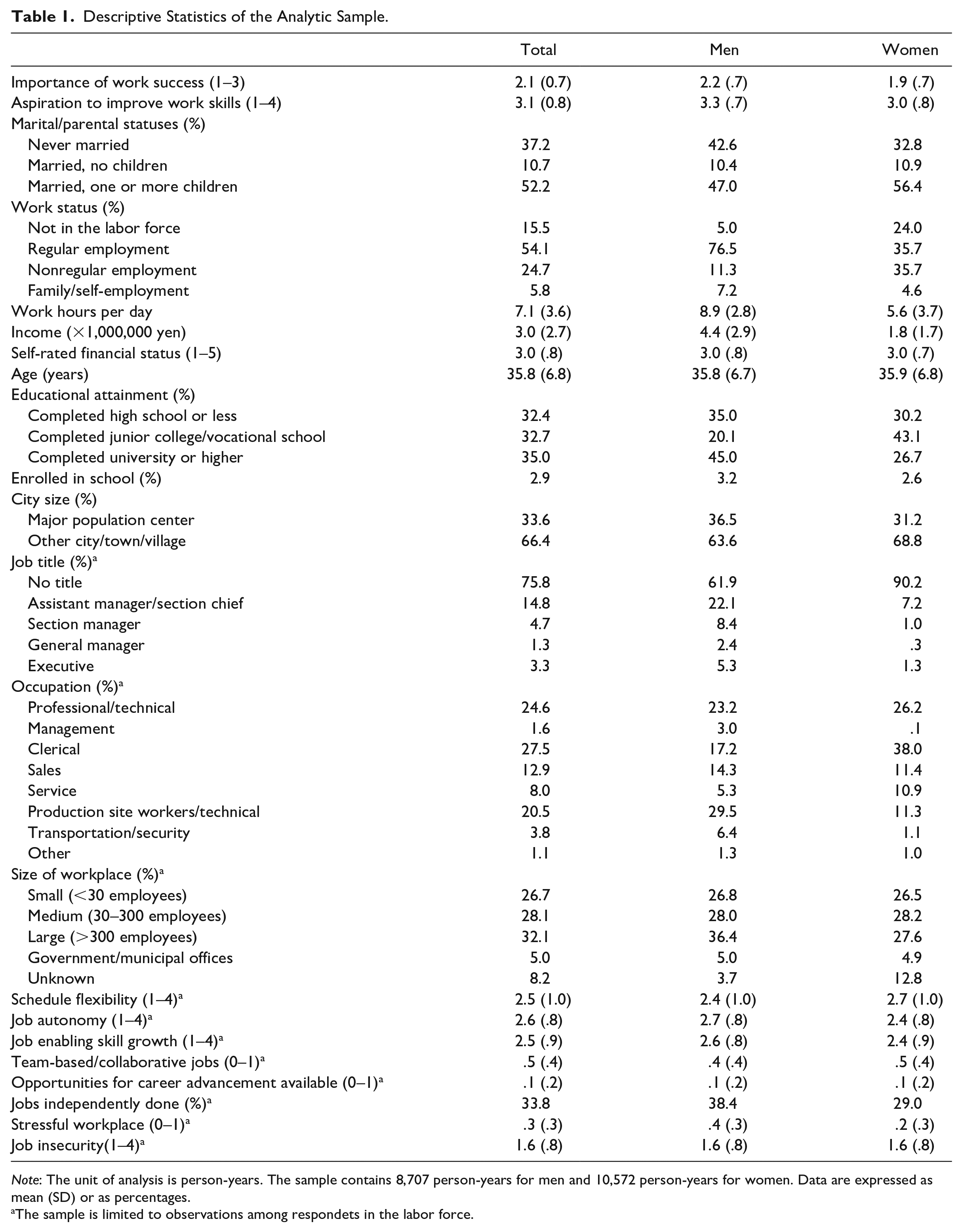
Note: The unit of analysis is person-years. The sample contains 8,707 person-years for men and 10,572 person-years for women. Data are expressed as mean (SD) or as percentages.
The sample is limited to observations among respondets in the labor force.
To examine how changes in family formation stages indicated by marital and parental statuses are associated with aspirations toward work achievement, I used fixed-effects models. Because there may be unmeasured stable characteristics that differentiate unmarried from married individuals or parents and nonparents, fixed-effects models are suitable because the models can minimize such selection biases (Allison 2009). In my exploratory analysis, I also fitted fixed-effects ordered logit models, as the outcome measure is ordinal response categories (results not shown). As the models do not include observations from respondents whose outcomes is constant across waves, results of my exploratory analysis indicate fitting the models leads to a reduction of about 30 percent of observations, losing substantial statistical power. I therefore choose the fixed-effects models over the fixed-effects ordered logit models. On the basis of my hypothesis that being married and becoming a parent are differently associated with men’s and women’s aspirations, I conducted analyses separately for each group.
Results
Figure 1 presents the unadjusted mean differences for the two outcomes by gender and family formation stages. The top left and right panels show, respectively, the average levels of rated importance of work success and aspirations to improve work skills by gender and family formation stages, whereas the bottom left and right panels show the same outcomes but limited to observations when respondents were in the labor force. The four panels indicate that women on average demonstrate a lower degree of aspirations toward work achievement than men regardless of which family formation stage they are in, when demographic and job characteristics are not controlled.

Unadjusted mean differences by gender and family formation stages.
The results of a series of fixed-effects models are presented in Tables 2 and 3 for women and men, respectively. I begin with the baseline models (model 1) with the key independent variable without control variables and subsequently add the control variables. Models 1 and 2 for both outcomes include all respondents regardless of their work status; those who are out of the labor force at the time of the survey are included. In model 3, which is limited to observations of respondents who are in the labor force, I included a series of variables indicating job characteristics.
Fixed-Effects Models Predicting Women’s Aspirations toward Work Achievement.

Source: Japanese Life Course Panel Survey.
Note: Values in parentheses are standard errors.
aThe sample is limited to observations among respondents in the labor force.
p < .10, *p < .05, **p < .01, ***p < .001 (two-tailed tests).
Fixed-Effects Models Predicting Men’s Aspirations toward Work Achievement.

Source: Japanese Life Course Panel Survey.
Note: Values in parentheses are standard errors.
aThe sample is limited to observations among respondents in the labor force.
p < .10, *p < .05, **p < .01, ***p < .001 (two-tailed tests).
I hypothesized that being married and becoming a parent are negatively associated with work achievement aspirations, compared with being never married for women (hypothesis 1). All the models show that both of the family formation stages are associated with a decreased level of importance of work success and of aspirations to improve work skills. Model 2 for both outcomes shows a negative association even when demographic characteristics of respondents are controlled. Furthermore, model 3 for both outcomes indicates that even among observations when respondents are in the labor force, and when job characteristics are controlled, the association between family formation and outcomes remains negative. Therefore, hypothesis 1 is supported. Additionally, I conducted two exploratory analyses to further assess the changes in the outcomes. First, to test whether there are statistically significant differences between “married, no child” and “married, one or more children” for women, I ran the same models first with “married, no child” as the reference group (results not shown). The results do not provide evidence to show that the change from being married but having no child to being a married parent change the outcomes. Second, to test whether there are statistically significant differences in the two outcomes as a function of number of children, I ran the same models by breaking the category “married, one or more children” into “married, one child,” “married, two children,” and “married, three or more children.” The results do not provide evidence to show that the changes from one child to two or two to three or more change the outcomes.
On the other hand, for men, I expected that there would be a positive association between family formation and aspirations toward work achievement, compared with being never married (hypothesis 2). Neither model 2 nor model 3 for the two outcomes provides evidence to show that family formation is linked with aspirations toward work achievement. The results therefore do not support hypothesis 2.
Last, I predicted that job characteristics would mediate the effect of family formation on aspirations toward work achievement for both genders (hypothesis 3). For both genders, among variables measuring different aspects of job characteristics, when respondents’ job is more team based and collaborative, enables skill growth, when there is a higher level of autonomy on the job, and when opportunities for career advancement are available (evident only for men), their aspirations toward work achievement are likely to be higher. In addition, compared with having a position without a title, an executive position is associated with elevated awareness of the importance of work success for women and men. At the same time, compared with being employed as a nonregular employee, being employed as a regular employee is (marginally) negatively associated with aspiration to improve work skills, but only for women. In other words, switching from regular to nonregular employment boosts women’s aspiration to improve work skills, suggesting the difficulty of combining work as a regular employee and family responsibilities in the social context of Japan. For women, even after controlling for job characteristics, however, model 3 for importance of work success demonstrates that family formation stages indicated by marital and parental statuses are still negatively associated with the outcome. Model 3 for aspiration to improve work skills showed similar results. For men, although the baseline models (model 1) indicate that family formation is associated with changes in both of the two outcomes, once job characteristics and other control variables assessing the demographic characteristics are included in the models, the associations are no longer observable. The results do not provide evidence indicating that job characteristics mediate the effects of marriage and parenthood on aspirations toward work achievement for both genders. Therefore, the results do not support hypothesis 3. Figure 2 is a graphical representation of the results of the key independent variable in model 3 on the two outcomes for both genders.

Predicted change in outcomes by gender and family formation stages.
Discussion
The aim of this study was to examine how the association between family formation and changes in aspirations toward work achievement differs by gender, using six waves of panel data of a nationally representative sample from Japan and fixed-effects models. The findings show that family formation stages, marked by transitions to marriage and parenthood, are linked with restrained aspirations toward work achievement among women in the highly gendered industrialized social context of Japan. Men’s aspirations are largely unresponsive to family formation once job and demographic characteristics are adjusted. But women’s aspirations toward work achievement are still negatively associated with family formation, even when controlling for job characteristics. The patterns of changes in aspirations toward work achievement in early to middle adulthood differ by gender. Although women in Japan temporarily leave and reenter the labor force as nonregular or contingent workers with less desirable job characteristics upon marriage or childbirth (Brinton 2001; Yu 2005), the results of the present study demonstrate that such shifts in job characteristics cannot fully explain the change in work attitudes for women.
The findings of the present study suggest that even if women are in desirable positions in the workplace, the demands of family still make women scale back their aspirations toward work achievement, consistent with the family responsibilities perspective. In the gender context of Japanese society, women may curtail their work achievement aspirations after facing work-family conflicts, as they try to fulfill new family responsibilities. When women enter marriage, their achievement aspirations at work starts to wane even before becoming a parent. The lack of evidence indicating that becoming a parent further accelerates a change in aspirations suggests that women may be already thinking ahead about parenthood and downshift their aspirations toward work achievement upon marriage (Bass 2015). In other words, women’s attitudinal shifts may occur not only in response to the actual expansion of family caregiving, but also to anticipated changes. Women’s attitudinal scaling back upon marriage may be further encouraged by their husband’s attitudes, as previous research suggests that husbands’ attitudes toward their wives’ employment influence women’s own employment attitudes (Spitze and Waite 1981). Especially in a country such as Japan, where marriage involves the interests of and influences from the extended family and kinship (Tsuya and Choe 2003), women may also react to pressures from their extended family. In any case, either consciously or unconsciously, many women in such a gendered context may make a trade-off between setting high aspirations for work achievement and actual (as well as expected) family caregiving.
At the same time, the finding that job characteristics do not fully explain or mediate changes in women’s aspirations toward work achievement cannot exclude the possibility that opportunity structures perspective plays a role. Although income, work hours, types of work, job title, occupation, size of the workplace, and multiple dimensions of job characteristics are adjusted, unmeasured time-varying job characteristics and other factors at the workplace, such as employer, supervisor, and/or coworker discriminatory practices and attitudes toward wives and mothers, may still explain the change in attitudes. Previous experiment-based research suggests that mothers are more likely than nonmothers to be perceived by employers to be less competent and committed (Correll, Benard, and Paik 2007; Cuddy, Fiske, and Glick 2004; Fuegen et al. 2004). In a country such as Japan, where marriage is a prerequisite for childbearing, it is possible that married female employees without children are also looked at as less serious about work achievement in the workplace. As a result, upon marriage as well as childbirth, women in Japan are possibly assigned less important tasks and other jobs that do not facilitate upward mobility, which may not be fully captured by the data for this study. Such discriminatory workplace practices and attitudes can lower women’s expectation and future prospects and discourage their enthusiasm toward achievement. To summarize, these findings regarding the relationship between family formation and aspirations can be interpreted with both the family responsibilities perspective and the opportunity structures perspective, which are not mutually exclusive.
Limitations of this study include constraints imposed by the dimensions and meaning of the two work attitudes measurements: importance of work success and aspiration to improve work skills. The two measurements assess the degree of aspirations toward achievement in the sphere of paid work, which is different from work commitment measured by women’s imagined work plans at age 35 (Desai and Waite 1991) or the importance of work in the respondents’ lives (Evertsson 2013). Women may become committed to work but are not necessarily enthusiastic about work or career achievement, as some may work mainly aiming to supplement family income. Nevertheless, work attitudes are multidimensional (Judge and Kammeyer-Mueller 2012), and the present study identified two work attitudes assessing individuals’ degree of achievement aspirations in response to changes in family formation stages. Furthermore, with respect to subjective assessment of the importance of work success, though work success traditionally refers to securing a higher position and salary in the labor market, women and men potentially define success differently (Dyke and Murphy 2006). Regardless of how respondents define work success, however, the results of this study suggest negative consequences of family formation on work attitudes for women. Last, this study focuses on the family formation stages marked by marriage and parenthood, and not others such as becoming a caregiver for the elderly. These limitations point to possible directions for future research.
Despite some limitations, this study advances previous research on the link between family formation and attitudes toward work by providing empirical evidence regarding how work attitudes change over individuals’ life courses on the basis of panel data and the use of fixed-effects models. This case study of Japan reveals that entry into marriage triggers shifts in women’s work attitudes even before they have children. In a normative environment where marriage is prerequisite for childbearing and where marriage and childbirth bring highly asymmetric gender relations, once married, women may downshift their aspirations toward achievement in the sphere of work. The findings reaffirm the close link between marriage and childbearing (Raymo and Iwasawa 2008) and may have implications for other social contexts similar to Japan’s.
