



Abstract
In the United States, science capital is important for navigating many aspects of life. Yet during middle school, science interest declines more for girls than boys. It is unclear, however, whether science identity also declines during the middle school years and if there are differences by gender. The authors advance prior research by modeling changes in science identity and associations with changes in identity-relevant characteristics using growth curve analyses on four waves of data from 760 middle school youth. For girls and boys, science identity changes over time; about 40 percent of the variance is within-person change, with the remainder explained by aggregate between-person differences. The associations of all identity-relevant characteristics with science identity are not significantly different for girls and boys, yet declines in average values of identity-relevant characteristics are larger for girls than boys.
Keywords
Understanding science is valuable for navigating many aspects of life in the contemporary United States, including educational and career pathways, personal health and medical decisions, and civic engagement about science-relevant policies (Durant, Evans, and Thomas 1989; Graf, Fry, and Funk 2018; Miller 2004). Archer et al. (2015) argued for the need to specify science capital in addition to economic, social, cultural, and symbolic capital because it is also a useful resource for numerous social and health outcomes throughout the life course. Yet science capital is unequal because of inequalities in access to education and income and because of discrimination and implicit biases about who can do science. Prior research shows that implicit associations of science with masculinity create barriers to science engagement for girls (Cai et al. 2016; Gauthier et al. 2017). Understanding why youth have lower or higher science identities is important to guide efforts to support science engagement for all.
Identities shape people’s actions (Oyserman 2009). Science identities support persistence in formal science (e.g., classes, majors, degrees, jobs) and engagement in informal science (e.g., camps, clubs, museums, media). Fewer people self-categorize as science kinds of people (i.e., have a science identity) than endorse items indicating high discovery orientation (e.g., curiosity about the world and learning about new discoveries), attitudes that indicate an untapped propensity to science engagement (Hill et al. 2018). It is therefore important to understand to what extent science identity changes during adolescence, if changes over time differ between girls and boys, and if observed changes are linear or responsive to changes in science identity–relevant characteristics.
In the contemporary United States, gender matters for science engagement, outcomes, and identity. Girls and boys have similar science academic ability and achievements, yet girls are less likely to pursue science pathways (for reviews, see Kim and Sinatra 2018; Xie, Fang, and Shauman 2015). The persistence of implicit associations of “male” with science (Miller et al. 2018) suggests that in addition to possible declines in science interest for girls (Blue and Gann 2008; Simpkins, Davis-Kean, and Eccles 2006), science identity may also decline more, or similarly, for girls and boys. Yet no longitudinal study has investigated whether science identities change or diverge for boys and girls. Similar to other associations of identities and corresponding behaviors, science identities matter for continued engagement with science, particularly as choices about course selection and how to spend free time increase after eighth grade. Research on identity development suggests that for science identities to emerge, youth need to perceive science as meaningful and relevant to their daily lives and to perceive that significant others perceive them as science kinds of people (Dou et al. 2019; Foster 2008).
Early adolescence is a critical time for physical, social, and emotional development and identity exploration, particularly related to gender, and science identity is a vital dimension of these developmental trajectories (Marcia 1980; Williams 2002). Considerable research has focused on higher science career interest among boys compared with girls, particularly at the end of middle school and in college, yet less is understood about changes in science identity. Guided by identity theories, we evaluate differences in mean values between boys and girls in a sample of 760 middle school students for up to four waves of survey data, as they progress from sixth through eighth grade. Then we use growth curve analyses to model responsiveness of science identity to changes in identity-relevant characteristics and to compare aggregate level associations.
Background
Decades of efforts to increase participation of women in science still yield uneven results. There are more women in biology and veterinary science than in the past, yet physics and most engineering fields remain dominated by men (Irvine and Vermilya 2010; Leslie et al. 2015). Among adults, substantial gender stratification persists in science enjoyment, science identity, and aspirations toward science careers (Stout, Grunberg, and Ito 2016). There is mixed evidence about difference in science relevance and interest for boys and girls, with some studies showing that gender gaps emerge during early adolescence (Simpkins et al. 2006) and others demonstrating a general decline in science interest plus other science-relevant attitudes for boys and girls (Schpakow, Wendt, and Paynter 2021). We know of no research specifically about changes in science identities during middle school.
The middle school years (i.e., sixth to eighth grade) are a time of active self-development in which youth explore potential identities (Klimstra et al. 2010; Meeus et al. 2010). Youth construct identities from attitudes toward their selves, social roles they enact, groups they belong to, and how they think that “generalized others” perceive them (Stets and Burke 2000; Tajfel and Turner 2004). Adolescence is also a time of considerable identity exploration around science (Eccles and Roeser 2011; Lee 1998; Wang and Degol 2017). Some evidence in youth of high school and college age suggests that science identity is responsive to experiences and influences choices in course taking and participation in optional science-focused activities (Vincent-Ruz and Schunn 2018); little research exists about changes in factors associated with science identities during middle school.
Qualitative work involving elementary and middle school students suggests that science identity changes over time (Barton et al. 2013) and that middle school might be a crucial life stage to understand change in science identity. If youth conclude they are not science kinds of people during middle school, they are less likely to engage in the kinds of opportunities during high school that set them up for developing science capital (Archer et al. 2015; McCreedy and Dierking 2017). Much of the quantitative research on science identity involves undergraduate students (Hazari, Sadler, and Sonnert 2013), graduate students (Stets et al. 2017), or youth in optional science programs or science-focused schools (Allen et al. 2019; Lee 1998; Merolla and Serpe 2013). The absence of quantitative, longitudinal studies of science identity among middle school youth leaves us to assume, but not know, if changes in science-relevant characteristics are associated with change in science identity.
Because women constitute nearly half the labor market, academic, nonprofit, and government groups try to increase girls’ participation in science during childhood to facilitate science careers for all who might want them (Xie et al. 2015). These efforts compete with social, emotional, biological, and developmental changes during early adolescence (e.g., Williams 2002). For example, social and cultural stereotypes, implicit and explicit biases, gender schemas heightened by puberty, and personal and institutional discrimination can constrain science and math trajectories for girls compared with boys (e.g., Bird and Rieker 2008; Charles and Bradley 2009; Leaper and Brown 2008; Ridgeway 2009; Steinke 2017).
In some science classrooms or settings, doing science also implies doing masculinity (Archer, DeWitt, and Willis 2014; Archer et al. 2013; West and Zimmerman 1987). Overlapping with the onset of puberty, youth in middle school are more aware of norms that emphasize masculinity and femininity (Williams 2002), thus potentially making it harder for girls to do science and meet gendered expectations. Studies have shown that women who have a more feminine appearance might be perceived as less “well suited” for science (Banchefsky et al. 2016). Even with similar academic achievement, many youth perceive as normative that boys are more likely to be science kinds of people than girls (Gauthier et al. 2017; Grunspan et al. 2016), thus leading to boys’ often getting more validation from other people about their “fit” as science kinds of people (Cai et al. 2016; Grunspan et al. 2016; Jackson et al. 2019). Similar to the unnecessary barriers to science among girls because of implicit bias, boys also face implicit gendered barriers to fields dominated by women, yet the underrepresentation of men in such fields is not seen as a problem because the fields have lower prestige (Moss-Racusin et al. 2022; Reskin and Roos 1990).
We know of only a few larger sample studies of science identity among adolescents (Hill et al. 2018; Lee 1998, 2002). There are, however, rich ethnographic examples of girls getting less support and sometimes active discouragement in science settings during early adolescence (Archer et al. 2012, 2013; Barton et al. 2013; Carlone, Scott, and Lowder 2014; Wade-Jaimes, King, and Schwartz 2021). Studies of high school and college students suggest that fewer girls than boys take optional or elective science courses and major and graduate in science fields partly because of gendered messages about their “fit” (Green and Sanderson 2018; Jiang, Simpkins, and Eccles 2020; Riegle-Crumb, Moore, and Ramos-Wada 2011; Simpkins et al. 2006).
The links from middle to high school to college are evident in gendered patterns in science persistence after eighth grade. On average, high school girls elect to take fewer advanced courses in science than boys (Gottfried et al. 2017; Riegle-Crumb, Farkas, and Muller 2006). Undergraduate women are less likely than men to select science courses or to choose science majors and programs (Green and Sanderson 2018; Robinson et al. 2019; Shah et al. 2021). Even though women tend to have higher grades than men, fewer women complete undergraduate or graduate-level science degrees (Hazari et al. 2013; Weeden and Cornwell 2020). We next describe the core concepts in social psychological theories that could explain changes in science identities during middle school and possible explanations for gender divergence.
Theoretical Framework
Sociologists have a long tradition of theorizing and studying identity development (Burke and Stets 2009; Cooley 1902; Mead 1934; Stets and Burke 2000; Stryker and Serpe 1982). Why? Because identities shape behaviors and choices (Oyserman 2009). We focus on science identity because youth with higher science identities are more likely to continue to engage in science over time and gain science capital (Archer and DeWitt 2015; Brenner, Serpe, and Stryker 2014; Kim and Sinatra 2018; Merolla and Serpe 2013). Identity theories developed from the symbolic interactionism approach to sociology (Blumer 1986). Theories of identity development emphasize the role of social interactions and perceptions about how others perceive individuals as central to identity development (Burke and Stets 2009).
There are several theoretical approaches to the study of identities, with differences in emphasis on dimensions such as social roles, resources, and group memberships (Burke and Stets 2009; Jasso 2002; Owens, Robinson, and Smith-Lovin 2010; Serpe, Stryker, and Powell 2020). Identity theories provide insight into the causes and consequences of identity formation and change (Hogg and Ridgeway 2003). Identities are based in conceptions of the self and often reflect how people imagine that others see their self, called the “generalized other” (Mead 1934).
In addition to direct social interactions with others, broader societal cues, such as images of mostly male scientists, support implicit associations about who can be a scientist (Cai et al. 2016; Correll 2001). Identities also reflect a sense of group membership and the degree of conflict among valued identities. Several studies suggest that the gender composition of specific science fields matters for how much people see opportunities as open to them or not (Archer and DeWitt 2015; Gonsalves 2014; Leaper 2015; Lockhart 2021). The process of identity development involves the formation of social schemas, or cognitive shortcuts, about the groups one can belong to (Master, Markman, and Dweck 2012; Turner et al. 1987). Gender is such a fundamental categorization scheme that most people automatically frame others through a gender lens (Ridgeway 2009). The importance of group membership and belonging during adolescence leads to exploration of possible selves and attempts by adolescents to assess what identities best fit “who they are” (Crosnoe and Johnson 2011; Oyserman 2009).
Adolescent development is in large part a process of transitioning group memberships and roles (Williams 2002). People negotiate and construct how they view themselves on the basis of feedback from others through an iterative process and through group memberships (Stets and Cast 2007; Stets and Harrod 2004; Swann 1983). In childhood and adolescence, considerable identity development occurs through interactions and play, leading to an understanding of “self” as separate from “other,” often referred to as the “generalized other” (i.e., Holdsworth and Morgan 2007; Mead 1934). The generalized other concept helps explain how youth perceive others see them, thus bringing “society” into youth imaginations (Mead 1934). Identities are conceptions of the self that are both formed and maintained through developmental, interactional, and reflective cognitive and social processes that are embedded in macro-, meso-, and micro-level social structures over time (Serpe et al. 2020). Notions of what youth perceive as the generalized other develops through interactions but is not simply the sum of these perceptions (Felson 1985, 1989). Over time youth develop an abstract idea of what “society” thinks about people like themselves, and they see themselves by taking the role of the societal other (Martin and Sokol 2011).
Identity theories also suggest that if youth perceive that significant others recognize them as science kinds of people, they are more likely to develop a science identity (Burke and Stets 2009; Gee 2000; Owens et al. 2010; Tajfel and Turner 2004). For example, youth may think they are “smart” on the basis of their experiences of figuring things out quickly but may recognize this attribute only if a respected other recognizes and tells them that they are smart. The same youth, however, may encounter a teacher who does not treat them as if they are smart (i.e., lack of recognition), thus potentially contributing to the loss of identity. Indeed, because “brilliance” is associated with “male,” the expectation of brilliance for some disciplines (particularly science, technology, engineering, and mathematics [STEM] fields) is associated with gendered implicit biases that might also explain gender segregation in academic disciplines (Leslie et al. 2015). Because of gendered schemas of science as masculine, boys are more likely to experience recognition of science identities than girls. Evidence that social interactions and actual and perceived differences in science recognition in school and home settings are gendered suggests that such interactions likely contribute to inequalities in science identity between boys and girls (Bhanot and Jovanovic 2009; Lavy and Sand 2015; Shepardson and Pizzini 1992; Tomasetto, Alparone, and Cadinu 2011).
Discovery orientation is a measure of science propensity without using the term science, and is measured by questions about curiosity, exploration, and interest in taking things apart (Hill et al. 2018). Cross-sectional comparisons by gender and race/ethnicity show that discovery orientation tends to be higher than science identity, and that the difference is even larger for girls and for boys of color compared with boys who are white. Discovery orientation is not explicitly referenced in identity theories yet is implied in discussions of play and material resources with significance for social categories (Stets and Burke 2000).
Affective experiences with science, such as degree of enjoyment with science-relevant games, media, and informal exploration (Foster 2008), also varies among youth. Similarly, the examples of science applied to real world issues vary in how relevant they are to the lives of different youth (Bang, Medin, and Cajete 2009; Blanchard Kyte and Riegle-Crumb 2017; Washington and Mondisa 2021). Youth are more likely to develop science identities if they perceive science as enjoyable and relevant to their lives (Shah et al. 2021).
Identifying as a member of a group can also contribute to developing a group identity. For example, identity theories imply that youth in science related clubs will more likely think of themselves as science kinds of people (Barber et al. 2005). It is unclear, however, how youth themselves perceive science identity relative to many possible group memberships in adolescence (Kim and Sinatra 2018). Resistance or ridicule from peers can follow asserting an identity that others do not accept (Carlone and Johnson 2007). For example, Carlone et al. (2014) described elementary school youth with high science curiosity, enjoyment, and engagement who have elementary teachers who recognize their science identities, yet the same youth encounter middle school teachers who do not recognize their claims to being science kinds of people.
Summary and Hypotheses
Prior research and identity theory suggest that science identities should change over time with changes in identity-relevant characteristics. It is unclear, however, if girls or boys will be responsive to changes in identity-relevant characteristics. Steeper declines in science identity over time for girls than boys could reflect differences in associations and/or differences in levels of identity-relevant characteristics. We therefore model changes within youth and aggregate differences between youth in science identity by gender and identity-relevant characteristics. On the basis of identity theories and prior research on gender and science, we evaluate the following hypotheses:
Hypothesis 1: Mean science identity and science identity–relevant characteristics will be similar in sixth grade and higher for boys than girls in eighth grade.
Hypothesis 2: Girls will have more within-person decline in science identity than boys during the progression through middle school.
Hypothesis 3: Within youth over time, science identity–relevant characteristics will have stronger positive associations with changes in science identity for boys than girls.
Methods
To evaluate these hypotheses, we use survey data from a four-wave, longitudinal study of a low-income (Title I) middle school in a midsized midwestern city. All youth in the school were invited to participate in all waves of data collection while they were at the school. Youth who were in eighth grade during the first year of the study and youth who entered sixth grade during the second year of the study had the chance to participate in only two waves (winter and spring) of data collection (see Appendix A). The first wave of data were collected in the winter season of 2013 to 2014 (December and January), the second wave in late spring of 2014, the third wave in January 2015 and the fourth wave in May 2015. All waves included measures of science perceptions, attitudes, and experiences.
All sixth, seventh, and eighth grade students enrolled in science classes were invited to participate in the survey during winter and spring of the 2013–2014 and 2014–2015 school years. Publicly available data about the school indicate that many youth in the school were living in poverty, as greater than 70 percent qualified for the free or reduced-price lunch program. According to the school district data for the focal school, 44 percent of youth were white, compared with 65 percent for the whole district. Most of the youth in the school were enrolled in science classes (approximately 93 percent). Youth who were not in science classes were either suspended or were placed in the lower proficiency English language learner class instead of the science class. To participate in the survey, youth were required to return an informed consent form with parental consent marked and signed. Youth who did not want to participate had the option of participating in an alternative activity. Overall, 792 students completed at least one survey across the study period thus creating 1,991 person-waves. Youth completed the survey during science class on school provided computers. The analytical sample (n = 760, number of person-waves = 1,836), is smaller than the full sample because it is limited to youth who consistently selected “girl” or “boy” in each survey wave they completed. Thirty-two youth (80 person-waves) did not consistently select “girl” or “boy” and were therefore excluded from the analytical sample. These 32 youth consisted of those who always skipped the question about sex category, selected a combination of “girl” and “boy” in different waves, or selected “other” in any wave. The homogeneous subsets were too small to analyze separately (Westbrook and Saperstein 2015).
The progression through middle school (time) was measured with indicator variables for the winter and spring of sixth, seventh, and eighth grade on the basis of the four waves of data collection over two years (see Appendix A). Using indicator variables allows nonlinearity in change over time because the changes within grades (winter to spring) could be different than change from grade to grade. Only the youth who were in sixth or seventh grade in wave 1 could contribute four waves of data, because the youth who were initially in eighth grade left the school after wave 2, and the youth who entered sixth grade in the second year only had the opportunity to participate in waves 3 and 4. Therefore, most of the students who did not complete all four waves of data collection did so because they were not in school at the time. The number of participants in each grade/wave ranged from 117 for sixth grade youth in wave 2 to 196 for eighth grade youth in wave 3. Appendix A provides detailed information about how many youth from each grade participated in each wave of data collection.
Dependent Variable
To measure science identity, we asked youth about their science self-concept: “How much do you think you are a science kind of person?” Responses range from 1 (“not at all”) to 4 (“totally”). This is the same measure used by Hill et al. (2018) and is used widely in scales assessing science identity (Hazari et al. 2013; Kim and Sinatra 2018). Having a single-item measure can be a limitation for validity and reliability. Yet working with youth means that we need to be careful about respondent burden. The measure has face validity and low respondent burden. It is possible that some of the associations would be stronger if we had multiple indicators for the concept of science identity. Because the major focus of the study is on the comparison between boys and girls, and there is no reason to suspect that measurement issues would differ by gender, we decided that the trade-off involved in using a single item indicator was justified (Allen, Iliescu, and Greiff 2022; Gogol et al. 2014).
Independent Variables
We measure science generalized other with the question: “How much do other people think you are a science kind of person?” Responses range from 1 (“not at all”) to 4 (“totally”). Pilot testing indicated that some youth were frustrated with this particular question if they did not know what other people thought of them. We therefore added the response option “I don’t know” to provide a way for youth to give an accurate reflection of their perceptions. Approximately 40 percent of youth at any observation reported “I don’t know” as their answer to the question “How much do others see you as a science kind of person?” Therefore, following the guidance of Pearce-Morris et al. (2014), we consider “I don’t know” a meaningful response rather than “missing.” We followed the course Hill et al. (2018) used and assigned the respondents who marked “I don’t know” the value 1.5. This value represents youth hesitation to commit to the value 1 (“others think I am not a science kind of person”) but also places them lower than the value 2 (“others think I am somewhat of a science kind of person”) (see Hill et al. 2018 for further analysis).
To construct the scales for the remaining identity-relevant characteristics, we averaged the responses to the questions. Science recognition was created using two items: (1) “How much does your parent or guardian tell you that you are good at science?” and (2) “How much do teachers at school make you feel like you are good at science?” (Spearman-Brown correlation coefficient = .56). Discovery orientation consists of the following items: (1) “How much do you like learning about new discoveries?” (2) “How much do you like exploring nature?” and (3) “How curious are you about the world?” (α = 0.66). The science enjoyment scale has two items: (1) “How much do you like science?” and (2) “How boring are science classes for you?” (reverse coded) (α = 0.75, Spearman-Brown correlation coefficient = .66). We measure science relevance using four items: (1) “How much does science help you make decisions that affect your body?” (2) “How often do you use science to solve daily problems?” (3) “How much, if any, do you think studying science will help you in the future?” and (4) “How much, if at all, does science help people?” (α = 0.74). The perceived science ability measure uses three items: (1) “How good are you at science?” (3) “How well do you usually do in science classes?” and (3) “What grades do you usually get in science?” (α = 0.73). Alpha reliabilities and Spearman-Brown correlations are mostly within ranges that indicate adequate reliability (Knekta, Runyon, and Eddy 2019; Reeves and Marbach-Ad 2016). The Spearman-Brown correlation coefficient of .56 for parent and teacher recognition is slightly lower than the conventional cutoff but too high to include them as separate variables because of collinearity.
To indicate sex category (a proxy for gender), we provided youth the options “girl” or “boy” in the first two waves. In the fall before we collected the third and fourth waves (October 2014), we decided to provide an additional choice option, “other,” for youth who did not identify on a gender binary. We recognized that youth in waves 1 and 2 who may not identify on a gender binary may have chosen to skip this question, therefore we added a way to be more inclusive in waves 3 and 4, even though the option “other” is imperfect (Westbrook and Saperstein 2015). We found that there were four youth who had missing data in waves 1 and 2, who selected only “other” in waves 3 and/or 4. Additionally, some youth were inconsistent in their response to sex category in other various combinations over time. Eighteen youth chose a combination of “male” or “female” and “other” across the four waves. An additional six youth changed responses from “male” to “female” or “female” to “male” but never chose the sex category “other.” Altogether, 28 youth did not consistently identity as “male” or “female” or at some point chose the sex category “other.” There were also four youth with missing values for sex category in all waves.
Westbrook and Saperstein (2015) provided a thoughtful review of the challenges and opportunities involved in using surveys to measure diverse sex and gender categories, including the lack of standard practices for analyzing longitudinal data that introduce new categories. Although 32 is a substantial minority of youth, separating them into meaningful additional subgroups such as those who changed from “girl” to “boy” or who changed from “boy” to “girl” or who consistently selected “other” or who changed from girl or boy to “other” would reduce the categories to very small numbers. We therefore conducted two sets of analyses: (1) retaining youth who indicated different sex categories or selected “other” and categorized them on the basis of the category that they selected in the first wave that they participated in the study (n = 792) and (2) analyzing only the youth who consistently selected either “girl” or “boy” (n = 760). The results were not substantively different with the 32 students omitted; therefore, we report the results without them included and we discuss implications of our choice for future research in the discussion section of the article.
Analytic Strategy
The observations are nested within individuals over time. To address the lack of independence of observations we use two-level multilevel models (e.g., Raudenbush and Bryk 2002). The multilevel modeling analyses provide estimates of how person overall level and within-person changes in identity-relevant characteristics are associated with initial level and changes in science identity over time. The indicators for progression through middle school allow linear or nonlinear change in science identity for winter and spring transitions within each grade (see Table 2). The covariates are measured both as time varying (group mean centered) within youth at level 1 and as aggregate average (grand mean centered) stable individual characteristics at level 2. The coefficients for the within-person portion of the model indicate how changes in the independent variables are associated with changes in science identity, measured as deviations around each person’s own mean (i.e., group mean centered). The same independent variables are included in the between portion of the model (grand mean centered), and the coefficients indicate how higher or lower levels on the independent variables are associated with higher or lower science identities.
We estimate the following models to evaluate the hypotheses: model 1 includes only the constant to provide the estimate of the proportion of variance in science identity within youth over time and between youth on average in the absence of other variables (i.e., baseline); model 2 adds the measures of progression through middle school (i.e., time) and provides the estimates of science identity for each grade/season for boys and girls; model 3 adds science generalized other; and model 4 adds all remaining identity-relevant measures. Table 3 provides separate columns of results for girls and boys to assess if the slopes are different. The significance of the interaction of gender by the independent variables is provided in the final column of Table 3, on the basis of models run with interaction terms that are available upon request.
Results
At the bivariate level, over all waves and grades, on average the boys have higher scores on the identity-relevant characteristics than the girls (see Table 1). Table 1 provides the aggregate means and standard deviations for all variables by gender and a t test of the difference between girls and boys. All the concepts were measured using Likert-type scales that range from 1 to 4. On average, girls (n = 364) had lower science identity (M = 2.18) than boys (n = 396; M = 2.51). Girls also had lower science generalized other (M = 1.79) compared with boys (M = 2.05). The biggest average differences were for science identity (girls-boys = −.33), science generalized other (girls-boys = −.26), science enjoyment (girls-boys = −.26), and science relevance (girls-boys = −.22). The smallest difference was for discovery orientation (girls-boys = −.11), and for both girls and boys, the highest scores were for discovery orientation (girls = 3.10, boys = 3.21).
Descriptive Statistics for All Study Variables by Gender (Means and Standard Deviations Shown Averaged across All Waves).
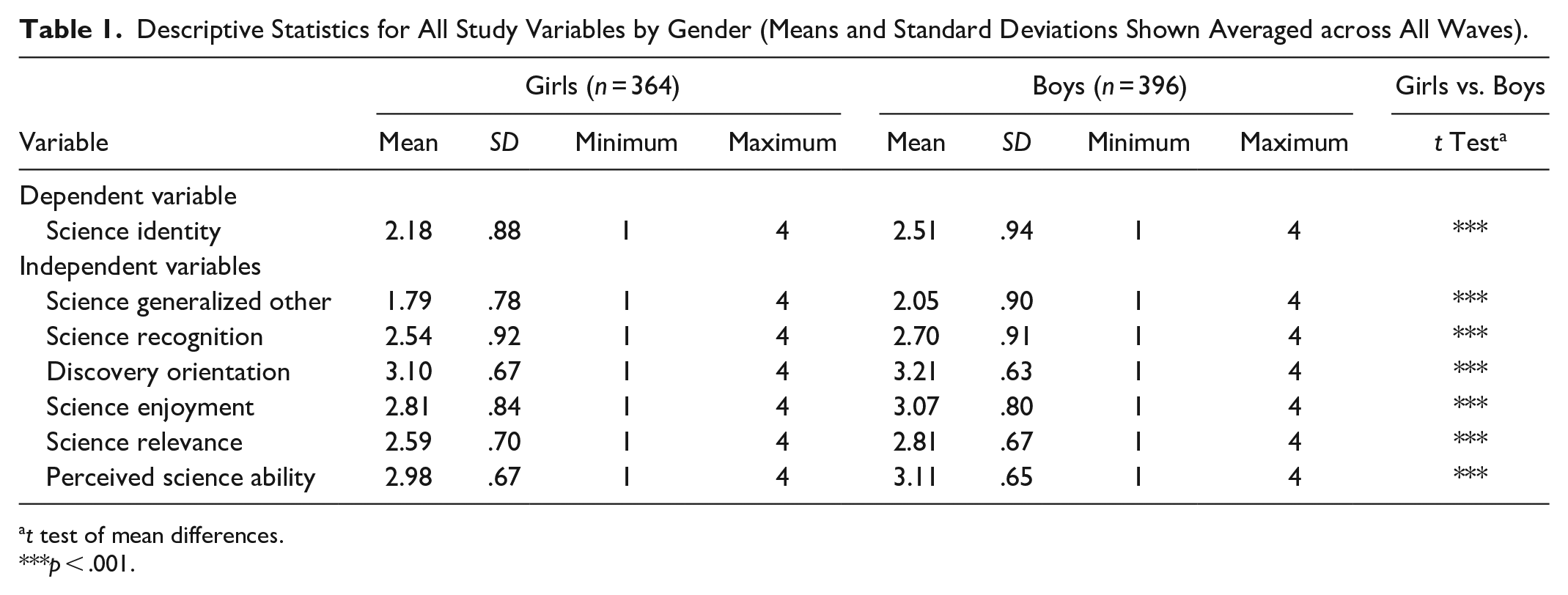
t test of mean differences.
p < .001.
Table 2 shows the mean and standard deviation for each variable by gender and grade and season. Comparing girls and boys for every variable and grade and season shows that the boys have higher levels than the girls. For most variables, the means also differ time to time among girls and boys, but they do not consistently increase or decrease during the progression through middle school.
Descriptive Statistics for All Study Variables by Gender, Cohort, and Wave Progression.

Total cohort/time observations (girls) = 888.
Total cohort/time observations (boys) = 943.
Table 3, model 1, shows the baseline models for science identity as the outcome separately for girls and boys. The constants show that on average, over all survey waves, science identity for girls (B = 2.18, p < .001) was lower than for boys (B = 2.48, p < .001), and the difference is statistically significant (p < .001). For both girls (60 percent) and boys (59 percent), more of the variance in science identity was between youth than within youth over time, yet there was substantial within-person change across the four waves (girls, 40 percent; boys, 41 percent).
Hierarchical Linear Regression Models for Science Identity by Time and Identity-Relevant Characteristics.

Note: CI = confidence interval; Var = variance.
Girls (n = 364 participants, n = 888 observations).
Boys (n = 396 participants n = 943 observations).
Pooled interaction models for all independent variables by gender (significant differences by gender marked with asterisks).
Winter of sixth grade (time = 0) is the omitted reference group (i.e., the constant in model 2 is the mean for science identity in the winter of sixth grade).
p < .05. **p < .01. ***p < .001.
Model 2 included indicators of how science identity changed by middle school grade level and season. Relative to their scores in the winter of sixth grade (constant = 2.33), girls in the spring of sixth grade (B = −.35, p < .001) and the spring of eighth grade (B = −.30, p < .01) have significantly lower scores for science identity. Conversely, boys do not have the same drops in science identity. Boys had significantly higher science identity during the winter of seventh grade (B = .20, p < .05) and during the winter of eighth grade (B = .19, p < .05) than during the winter of sixth grade (constant = 2.41), and these higher values were significantly different from the values for girls at the same points (see the model 2 column in Table 3 labeled “Girls-Boys”). The difference in the constants by gender, represented by the difference in average science identity in the winter of sixth grade (2.33 − 2.41 = −.08), was not significant, yet the difference between girls and boys in the spring of eighth grade (−.30 − .03 = −.33, p < .001) was significant and indicated that girls had substantially lower scores than boys.
In model 3 of Table 3, we added generalized other to the model. For both girls and boys, there were substantial positive associations of changes in science generalized other and science identity (girls B = .23, p < .001; boys B = .25, p < .001). The small difference in the coefficients (girls-boys = −.02) between girls and boys was not statistically significant, however, indicating that boys and girls had similar responses to changes in science generalized other over time.
The coefficients for science generalized other in the between portion of the model were also positive and large (for girls, B = .67, p < .001; for boys, B = .63, p < .001; for both groups, SD > .67). The small difference in the coefficients was not statistically significant. Consistent with theories of identity development, for both girls and boys, those with higher generalized other also tended to have higher science identities. In this model with none of the other identity-relevant variables, the difference in the constants was not statistically significantly different, yet now the coefficient for the girls (B = 2.45, p < .001) is higher than for the boys (B = 2.38, p < .001).
Model 4 included all within- and between-person independent variables. In model 4, girls have significantly lower science identity at all other time points compared with the winter of sixth grade (indicated by the constant), yet the size of the coefficients indicates nonlinear change. For boys, after accounting for all study variables, science identity does not differ in higher grades relative to the initial sixth grade value. In three of the five times after the winter of sixth grade, girls had lower differences in science identity compared with the initial score (indicated by the constant) than the boys (winter seventh grade, girls-boys = −.14; winter eighth grade, girls-boys = −.09; and spring eighth grade, girls-boys = −.26), although the size of the coefficient differed by grade and season. Adjusted for all the variables, for most identity-relevant characteristics, higher values were associated with higher science identity for both girls and boys (model 4). The exception is the small, statistically nonsignificant association of science generalized other and science identity for boys (B = −.02, p > .05). There were no statistically significant associations for discovery orientation nor science recognition for girls and boys at the within level, nor for science recognition for girls or boys at the between level. The associations of within (change over time) and between (compared with peers) identity-relevant characteristics and science identity also did not differ by gender. Similar to model 3, in model 4 the constant for girls (constant = 2.50) is higher than the constant for boys (constant = 2.37), but the difference was not statistically significant, indicating that, adjusting for identity-relevant measures, in the middle of sixth grade girls and boys did not differ in science identity but did differ near the end of eighth grade.
The results indicate support for hypothesis 1, because mean science identity did not differ by gender in the winter of sixth grade and did in the spring of eighth grade.
There was also support for hypothesis 2; girls’ science identity declined more than boys’ during middle school, but the trend was not consistently downward. There was a drop from the middle to the end of sixth grade and another drop at the end of eighth grade. There was partial support for hypothesis 3. Within youth over time, increases in identity-relevant characteristics were associated with increases in science identity, except for discovery orientation and science recognition. The only coefficient that was larger for girls than boys was science enjoyment, but there were no significant differences between girls and boys in the coefficients. Boys, however, had significant, and in many cases substantially, higher average levels of the identity-relevant measures (as indicated in Table 2), particularly science generalized other, enjoyment, and relevance.
If girls and boys had similar science identities near the beginning of sixth grade and there were similar associations of identity-relevant variables, how did girls have lower science identities than boys by the end of eighth grade? There is evidence that the lower levels of the science identity–relevant variables among girls than boys as indicated in Table 2 (e.g., science generalized other, science recognition, science enjoyment, science relevance), and the general trend of even lower scores in higher grades, could explain the results. Particularly interesting was the difference in the coefficients and the constants between model 2 and model 4 in Table 3. Adjusting for mean levels of the identity-relevant measures, girls had even larger negative coefficients for the winter of seventh grade, the spring of seventh grade, and the winter of eighth grade, and the average science identity near the beginning of sixth grade was larger for girls than boys. Therefore, estimating science identity at the mean of all the independent variables suggests that girls do not have to have lower science identities than boys but that elevating science identities in part depends upon discovering how to elevate science generalized other, science recognition, science enjoyment, and relevance.
Discussion
Middle school is an important time of identity exploration and development (Meeus et al. 2010). We provide valuable insights about within-youth change and between-youth differences in science identity during middle school using longitudinal data. Science capital is important for youth to develop to support their trajectories in science education, and in their public understanding of science (Archer and DeWitt 2015; Archer et al. 2015; Durant et al. 1989; Miller 2004). Supporting access to science capital can increase science identities for all youth and will help support continued engagement with science. Therefore it is worthwhile to understand how to support the development and maintenance of science identities (Riegle-Crumb and Humphries 2012).
We also add information beyond the cross-sectional studies that found no differences in science enjoyment for girls and boys in fifth grade but lower enjoyment among girls in ninth grade (Blue and Gann 2008; Simpkins et al. 2006). Repeated measures of science attitudes and identity during the progression through middle school shows nonlinear changes, yet the ultimate result was considerably higher science identities among boys compared with girls by the end of eighth grade, even when initial means in sixth grade were the same. Girls’ science identities are similarly responsive to science-relevant characteristics as boys, yet because they have lower perceptions of generalized other, enjoyment, and relevance, than boys, gender gaps in science identity emerge.
There are decades of research on identity development. Overall, the present study is consistent with prior research. How youth perceive that others see them is associated with how youth see themselves. In addition, the more relevant science is to their lives and the more indications they have that science fits with who they are (e.g., they enjoy it, they are good at it), the more likely they are to have a higher science identity. Also consistent with prior research on gender and science, despite initial similarities in science identities near the beginning of middle school, by the end boys have a science identity advantage. This emergent gap suggests the need to examine girls’ experiences in middle school around science, and whether the salience of gender identity is less compatible with science or whether the informal and formal science experiences they have are themselves less compatible with girls’ identities than they are for boys. This brings forth questions about whether science formal and informal curriculum might need a critical review using a gendered lens (Brotman and Moore 2008; Hughes 2001; Schiebinger 2004; Schiebinger and Schraudner 2011).
We found that boys’ perceptions of the relevance of science was higher than for girls. This measure includes four items that look at the utility of science for solving problems, making decisions, for their future success, and how much science helps people. Girls perceptions of science relevance was lower on each individual item. Research on the socialization of prosocial attitudes and communal and individualistic values indicates that, on average, girls are more likely to hold prosocial and communal attitudes than boys (Boucher et al. 2017; Eagly 2009). While many boys also hold prosocial attitudes, research has shown that for both boys and girls, increasing youth perceptions about how much science helps people would increase science relevance (Fuesting, Diekman, and Hudiburgh 2017). In our study, boys held both more prosocial attitudes about science and reported higher levels for the utility of science for their futures and for solving problems. Unfortunately, we do no have direct measures of what types of science youth were exposed to in or outside of class to know what they were thinking of as “science.”
We suspect that the same implicit associations of science as masculine exist in this school setting as it does in course materials and media representations in the United States (Gauthier et al. 2017; Leaper and Brown 2008; Steinke 2017). Yet the variations in average values from winter to spring and across grades for the same youth suggest that the teachers, the text books, and other more constant factors cannot fully explain the general downward trend for girls and the more steady higher levels of science identity for boys. The almost overlapping and steady means for discovery orientation suggest similar levels of curiosity and desire for exploration among boys and girls. The bigger differences in enjoyment and relevance between boys and girls could indicate that the questions, topics, and story lines used to help youth learn science concepts could better align at some points with topics categorized as more masculine (individualist orientation, objective) than more feminine (science for communal good or prosociality). These questions are fertile ground for future research.
There is evidence that however youth conceptualize “science,” they are more likely to associate boys than girls with science. Gauthier et al. (2017) found that youth schemas of science during middle school presume that boys are “science kinds of people” on the basis of youth perceptions of specific peers in ego networks. Our findings suggest that, for many youth, the link between science and masculinity (e.g., Archer et al. 2014; Cai et al. 2016) emerges during middle school, in part in response to changes in science relevance, science enjoyment, and science generalized other. Exploring the implications of this finding for interventions to remove the impact of gender for science identity processes at the middle school level is an important avenue for future research.
Limitations and Future Directions
As with all research, this study has limitations. First, the present sample is a near census of one middle school, yet this school may not represent the experiences of youth from other schools in the same district, in other regions, or that have different social class or racial/ethnic compositions. Future research should explore whether similar patterns emerge in other middle schools, particularly those with more youth from families with higher socioeconomic backgrounds and/or those with less racial/ethnic diversity. Another limitation of this dataset is that we did not follow a single cohort of students from sixth through eighth grades. Instead, we survey all sixth, seventh, and eighth grade students twice in two consecutive years. To test our theory about changes during the progression through middle school, we restructured the dataset (see Appendix A) so that instead of looking at four waves over time, we look at data from six possible time points through the progression through middle school.
Future research should follow youth over time, not only from sixth through eighth grade but ideally from elementary school through middle school and into high school, as well as across multiple schools. Data from more schools and grades would allow exploration of how particular experiences are more or less likely to nurture science identities. An even stronger research design would involve random assignment of youth to efforts focused on increasing science generalized other, relevance, enjoyment, and recognition. Comparing conventional approaches to science education with approaches that add explicit efforts to nurture science identities is a potentially fruitful future line of inquiry.
Second, we cannot exactly identify to whom youth are referring to in their understanding of other’s perceptions of themselves as being science kinds of people (i.e., science generalized other). Qualitative research is necessary to get a better understanding of youth perceptions of the important “generalized other” concept (e.g., Cooley 1902; Mead 1934). Youth receive messages from peers, parents, teachers, and media about what scientists are like and have the ability to be self-reflective—to take the role of the other—and to imagine how others would see their actions and presentation of self. We find strong evidence that within youth over time, higher values on science generalized other are associated with higher science identity. We need more understanding of what youth mean when they hear the language about how “other people” see them in order to design appropriate interventions.
Third, we selected science generalized other as an independent variable, yet there could be a strong argument for conceptualizing it as a dependent variable as well, or as part of a complex system with feedback loops (Serpe et al. 2020). Identities develop over time and people have some agency in what they focus on and adopt. It is likely that higher science generalized other and science identity are mutually reinforcing. Cooley’s (1902) foundational work suggests that youth look to adults as “looking glasses” that guide the self-concept. It is possible that science identity and science generalized other are associated, co-constitutive, and jointly shaped by science relevance, enjoyment, and recognition, plus cultural schemas about gender and science (Hill et al. 2018).
Fourth, in an ideal world we would have multiple measures of all of the items in the analysis, with high α reliabilities and extensive testing of multiple types of validity. Some of the measures, however, had only two or three measures and somewhat low α or Spearman-Brown reliabilities, yet the correlations are too high to include the items as single measures because of multicollinearity. Including too many items may make respondent burden too high and lead to more missing data. To manage the trade-off between reliability and missing data, we kept the survey as short as possible. The measures have face validity, and errors in measurement are likely to be similar for boys and girls.
Fifth, future research could add multiple measures of concepts and testing of measurement invariance by gender. It would also be valuable to measure self-perceptions of masculinity or femininity rather than assuming that sex category adequately accounts for the relevance of gender in STEM (Westbrook and Saperstein 2015). Changes in bodies during adolescence and puberty may make femininity and masculinity more salient for youth (Williams 2002) and thus contribute to changes in sex/gender and/or science identity, but with the present data we cannot directly test the potential role of bodies in theorizing how identities change (Hegtvedt and Johnson 2017; Pettitt 2004). Additionally, the gendered social context in the United States is in flux about what is considered a legitimate gender identity (Meadow 2018; Risman 2018). Researchers need to take seriously how to capture and measure gender identities when people experience gender as fluid and changing over time (Compton, Meadow, and Schilt 2018; Westbrook and Saperstein 2015). Measuring and accounting for gender identities is particularly important for researchers interested in inequities in STEM because there is evidence that people who identify as LGBTQIA2+ are underrepresented in STEM and experience discrimination in male dominated fields (Cech and Waidzunas 2021; Freeman 2020; Miller et al. 2021).
Sixth, we encourage future studies to explore the micro-dynamics of identity development in adolescence, for example by identifying ways that youth agency factors into perceptions of science generalized other and recognition, and the possible role of changing bodies on experiences of these processes. Intervention studies could also examine youth responses to topics and examples that spark curiosity or are more relevant to youth from groups historically marginalized from science. The concept of science recognition in science identity theories in the science education literature generally pertains to recognition to “significant scientific others” for students who are studying STEM disciplines in undergraduate or graduate school (Carlone and Johnson 2007; Cribbs et al. 2015; Gee 2000; Hazari et al. 2013; Seyranian et al. 2018). The finding that recognition from parent/guardians and teachers was not associated with youth science identity is surprising and suggests the need for more work to assess what science recognition means for middle school youth and who youth consider “important scientific others.”
Seventh, science identity may also indicate belonging to a social group, yet it is unclear how youth themselves perceive science identity relative to the many possible group memberships in adolescence (Kim and Sinatra 2018). For example, we recognize that science, and by extension science identity, is racialized in contemporary society (Wong 2016). If we had a larger sample, we could explore change and stability in science identity by both race/ethnicity and gender. Future research therefore should involve larger and more racially/ethnically diverse samples to fully explore how intersections of identities create contexts relevant to longer term engagement with science and science careers.
Conclusion
Work toward gender equity in science is challenging, nonlinear, and takes considerable time (Laursen and Austin 2020; McQuillan and Hernandez 2021). The present study indicates that there are opportunities to influence youth identity during middle school. Even though the change might be slow and hard to measure, efforts to support, nurture, and maintain curiosity, exploration, and scientific ways of knowing—and labeling those thoughts and behaviors as indications of a science identity—are worthwhile.
Our findings suggest the need for more work to ensure that science is enjoyable and relevant to all youth, and that schemas of scientists do not embed gender assumptions (Miller et al. 2018). Efforts to make science enjoyable and relevant, although worthwhile, do not address all the barriers to equitable access to science capital. There are many barriers, such as sexual harassment, chilly climates, racial discrimination, stereotype threat, unequal funding of schools by neighborhood, and Internet access, that also need attention (Brooks-Gunn, Linver, and Fauth 2005; Godec 2018; Lareau 2011; Leaper and Brown 2008, 2014; Leaper and Starr 2019; Morris and Daniel 2008).
A real strength of this study is the multiple observations of youth over time. Nonlinear change in science identity over time suggests that youth are responding to what they are exposed to and therefore the larger decline for girls is not an inevitable outcome. Focusing efforts to engage youth with science during middle school in ways that will increase enjoyment, relevance, and science identity have the potential to be effective in closing the science identity gap. There are opportunities to make changes in formal education and in informal settings such as museums, zoos, science television shows, and after school clubs (Archer et al. 2015; Dabney et al. 2012; Dou et al. 2019). To increase and maintain higher science capital for all, continued investment in quality science education and outreach is necessary (Afterschool Alliance 2014; Else-Quest, Mineo, and Higgins 2013; Provasnik et al. 2012). Guided by theories of identity, our findings suggest that in addition to emphasizing academic success, identity-relevant characteristics are also important for broader inclusion in science.
Supplemental Material
sj-docx-1-srd-10.1177_23780231231152195 – Supplemental material for Decline Is Not Inevitable: Changes in Science Identity during the Progression through a U.S. Middle School among Boys and Girls
Supplemental material, sj-docx-1-srd-10.1177_23780231231152195 for Decline Is Not Inevitable: Changes in Science Identity during the Progression through a U.S. Middle School among Boys and Girls by Julia McQuillan, Patricia Wonch Hill, Joseph C. Jochman and Grace M. Kelly in Socius
Footnotes
Appendix
Number of Youth at Each Wave during the Progression through Middle School by Grade and Season.

| Indicator Variable for the Progression through Middle School | Wave 1 (Winter) | Wave 2 (Spring) | Wave 3 (Winter) | Wave 4 (Spring) | Total |
|---|---|---|---|---|---|
| Sixth grade winter (=0) | 131 |
|
293 | ||
| Sixth grade spring (=1) | 117 |
|
281 | ||
| Seventh grade winter (=2) | 172 | 149 | 321 | ||
| Seventh grade spring (=3) | 152 | 150 | 302 | ||
| Eighth grade winter (=4) |
|
196 | 323 | ||
| Eighth grade spring (=5) |
|
187 | 311 | ||
| 430 | 393 | 507 | 501 | 1,831 |
Note: The total number of observations (n = 1,831) came from 364 girls and 396 boys (n = 760 youth). Values in italics indicate cohorts that had an opportunity to contribute up to four observations. Values in boldface indicate cohorts that only had an opportunity to contribute two observations.
Acknowledgements
We are grateful to Dr. Judy Diamond for her support of the data collection and to Meghan Leadabrand for her editorial assistance.
Funding
The author(s) disclosed receipt of the following financial support for the research, authorship, and/or publication of this article: Research reported in this publication was supported by the National Institute of General Medical Sciences of the National Institutes of Health under award R25GM129836 (“Worlds of Connections: Engaging Youth with Health Research through Network Science and Stories in Augmented Reality”) and award 1R25OD010506 (“Biology of Human”). The content is solely the responsibility of the authors and does not necessarily represent the official views of the National Institutes of Health.

Supplemental Material
Supplemental material for this article is available online.
Author Biographies
References
Supplementary Material
Please find the following supplemental material available below.
For Open Access articles published under a Creative Commons License, all supplemental material carries the same license as the article it is associated with.
For non-Open Access articles published, all supplemental material carries a non-exclusive license, and permission requests for re-use of supplemental material or any part of supplemental material shall be sent directly to the copyright owner as specified in the copyright notice associated with the article.
