




Abstract
Does racial wage discrimination increase during economic downturns? In this article, the author tests empirically the association between economic conditions and racial wage discrimination for black, Hispanic, and Asian workers. Using data from the Current Population Survey, the author finds that the wage gap between Hispanics and whites, and between Asians and whites, increases with the job-seeker rate and unemployment rate. However, the wage gap between black and white workers increases slightly with the unemployment rate and does not change at all with the job-seeker rate. The author advances the concept of “wage discrimination flexibility” to argue that racial wage discrimination against black workers is more rigid and resistant to changes in economic environments, whereas wage discrimination against Hispanics and Asians is more flexible and responsive to economic conditions. The author discusses the implications of these findings for theories of discrimination and for policies aiming to foster equal opportunities in the labor market.
Does racial wage discrimination increase during economic downturns? The bulk of the existing theories and empirical studies about what drives discrimination have focused on social psychological or individual factors (e.g., racial stereotypes and implicit bias), and meso-level explanations (e.g., organizational characteristics). In this article, I take steps to reorient the existing scholarship beyond individual- and organizational-level theories toward macro-level factors, such as economic conditions. I revisit a long-standing assumption in economics and sociology (e.g., Becker 1957; Reskin and Roos 1990) suggesting a link between macro-level conditions and racial discrimination. This perspective posits that racial discrimination decreases in tight labor markets because employers cannot afford to discriminate when demand for labor is high and the supply of preferred workers (e.g., whites) is low. More recently, however, scholars have posited that racial discrimination increases in tight labor markets because signals associated with unobserved productivity are stronger in upturn economies (Carlsson, Fumarco, and Rooth 2017).
To date, only a handful of studies have examined empirically the association between racial discrimination and economic contexts. However, the existing evidence is mixed. Several studies have shown that racial and ethnic discrimination increases in slack economies (Baert et al. 2013; Boulware and Kuttner 2019; Chattopadhyay and Bianchi 2021). At the same time, one study showed that racial and ethnic discrimination decreases during economic downturns (Carlsson et al. 2017), and another study revealed no association between racial discrimination and economic contexts (Zschirnt and Ruedin 2016).
These contradicting findings could be explained by the different methodologies, different racial and ethnic groups, and different approaches used to measure labor market tightness used in various studies. Three existing studies measured racial and ethnic discrimination from callback rates using correspondence tests (e.g., audit studies) in the European context (Baert et al. 2013; Carlsson et al. 2017; Zschirnt and Ruedin 2016), one study relied on discrimination charges (Boulware and Kuttner 2019), and one study used estimates of discrimination from wage regressions (Chattopadhyay and Bianchi 2021). Studies also vary in terms of their target population. Baert et al. (2013) focused on male immigrants in Flanders, Belgium. Carlsson et al. (2017) examined discrimination against Middle Eastern applicants in Sweden. Zschirnt and Ruedin (2016) conducted a meta-analysis of 43 separate audit studies in Organisation for Economic Co-operation and Development countries. Boulware and Kuttner (2019) and Chattopadhyay and Bianchi (2021) focused on racial discrimination against black workers in the United States. Last, studies also vary in their measurement of labor market tightness, such as the medium duration to fill job vacancies (Baert et al. 2013), vacancy-to-unemployment ratios (Carlsson et al. 2017), or unemployment rates (Boulware and Kuttner 2019; Chattopadhyay and Bianchi 2021; Zschirnt and Ruedin 2016).
In this study, I empirically test existing theoretical predictions about the association between economic conditions and racial wage discrimination for three racial groups in the United States: black, Hispanic, and Asian workers. I use a nationally representative survey, which allows me to reliably measure racial discrimination across time, in a wide range of occupations and industries, in varying economic environments, and across different racial groups. In doing so, I push the existing literature forward in two regards. First, I provide novel empirical evidence showing that, for the most part, wage discrimination between whites and nonwhites increases in slack labor markets, as classical theories predict (Becker 1957; Reskin and Roos 1990). Second, I advance the concept of “wage discrimination flexibility,” whereby racial discrimination is flexible for some racial groups and more rigid (or static) for other groups. My empirical results show that the association between labor market contexts and racial wage discrimination is weaker for black workers compared with Hispanic and Asian workers. I argue that the rigidity of wage racial discrimination against black workers may be due to the unique history of incorporation of African Americans in the United States, which has been characterized by a more rigid and impermeable color line, whereas a more fluid and permeable set of social distinctions may characterize the experiences of Hispanics and Asians in the United States.
This article proceeds as follow. I begin by reviewing the existing literature on the micro- and meso-level factors shaping racial discrimination in the labor market and propose the need to also consider macro-level factors as possible drivers of racial discrimination. I then build on theories from labor economics and the sociology of work to develop a hypothesis examining the association between economic conditions and racial wage discrimination. My theoretical section also elaborates on the concept of “wage discrimination flexibility,” which I use to examine the distinct ways that labor market contexts may shape racial wage discrimination for black, Hispanic, and Asian workers. Next, I turn to a detailed discussion of my data and empirical strategy. I then discuss my empirical results and the implications for existing research on racial wage discrimination.
Theoretical Background: The Drivers of Racial Discrimination
Racial discrimination in the labor market is a well-documented fact in American society (Bertrand and Mullainathan 2004; Mobasseri 2019; Pager, Western, and Bonikowski 2009). Despite much progress since the civil rights movement of the 1960s, recent evidence suggests that racial discrimination against black workers has not decreased in the past several decades and hiring discrimination against Hispanics has declined only modestly (Quillian et al. 2017). An extensive literature in the social and behavioral sciences has identified the causes of racial discrimination. To date, much of the scholarship on the factors that drive discriminatory behavior in the labor market has focused on individual-level and meso-level or institutional explanations. However, macro-level forces, specifically labor market conditions, are relatively absent from the empirical literature on racial discrimination.
Micro-level Theories
Individual-level theories of racial discrimination in sociology, social psychology, and economics focus on employers’ individual motivations or psychological biases. In economics, scholars have identified two possible mechanisms driving discrimination: statistical discrimination and taste-based discrimination. In statistical discrimination, employers may rely on social status characteristics because they have a signal extraction problem. With limited information, employers tend to use ascribed characteristics, such as gender or race, as proxies to infer the expected productivity of job applicants, thus leading to statistical discrimination (Aigner and Cain 1977). In taste-based discrimination, employers’ behaviors are driven by their own distaste or animus toward minority workers (Becker 1957).
Individual-level theories in sociology and psychology propose that individuals are prone to social status categorization apart from calculations based on imperfect information and anticipated productivity. According to social identity theory (Tajfel and Turner 2004), individuals tend to conceptualize the self in terms of different levels of abstraction, and, through social interactions, they develop a conceptualization of the self as a member of an in-group that is distinct (and more positive) from the out-group (Turner and Oakes 1989). Status-based perspectives in sociology show how employers view members of high-status groups as more competent and less threatening than lower-status groups, and group-based perceptions are used to justify who gets hired, wage determination, and promotion opportunities (Correll and Benard 2006; Ridgeway 2001). Employers may not be fully aware of their biases, however, but implicit attitudes toward minority groups may still affect how they are evaluated at the hiring interface and beyond (Rooth 2010).
Meso-level Theories
The scholarship on organizations has proposed that individual-level processes, such as the ones described earlier, can be either amplified or suppressed by organizational structure and culture (Baron and Bielby 1980; Baron, Mittman, and Newman 1991; Reskin 2000; Stainback, Tomaskovic-Devey, and Skaggs 2010). Organizational dynamics are key in creating racial boundaries, and race becomes a central aspect of workplace strategy (Tilly 1998; Tomaskovic-Devey and Avent-Holt 2017). More recently, Ray (2019) conceptualized racialized organizations as “meso-level social structures that limit the personal agency and collective efficacy of subordinate racial groups while magnifying the agency of the dominant racial group” (p. 36). Wingfield and Alston (2014) argued that the work people of color do in “white organizations” may reproduce structures of inequality by conforming to racialized organizational rules.
However, organizations are not static but may change as a response to external environments (Romanelli and Tushman 1994). For instance, Zhang (2021) showed how disruptive events, such as a merger or natural disasters, might force managers to break down “entrenched hierarchies and long-standing routines,” which may lead to more opportunities for racial minorities. Although Zhang did not specifically discuss economic environments (e.g., economic upturn and downturn) as “disrupt events,” it is possible that, in addition to a merger or natural disasters, changing economic conditions may also motivate managers to reassess organizational routines and change their day-to-day operations (e.g., downsizing, internal restructuring, wage setting, hiring, promoting, and termination). Organizational changes as a product of disruptive events (e.g., economic recessions), might therefore lead to the implementation of organizational policies that may hinder or promote racial inclusion in the workplace.
Beyond Micro- and Meso-level Factors: Labor Market Contexts and Racial Discrimination
As the literature discussed earlier illustrates, individual factors (e.g., implicit bias, taste-based discrimination, statistical discrimination) and organizational features are key drivers of racial discrimination and inequality. To be sure, micro-, meso-, and macro-level forces likely interact in the distribution of resources in the workplace. Although I do not empirically test the role of organizational features or individual biases as mechanisms in shaping racial discrimination in the labor market, I argue that just as organizational characteristics may “constrain the biasing effects of automatic cognitive processes” (Reskin 2000:320), external shifts in the economy may shape organizational features, as well as individual behavior, toward racialized minorities. If that is the case, we would predict that an association between economic contexts (e.g., periods of economic upturn and downturn) and racial discrimination exists.
The links between labor market tightness (or slack) and employment discrimination was first articulated by Becker (1957), who argued that discrimination is not sustainable in a perfectly competitive labor market because employers who discriminate would fail to hire productive workers and become less competitive, while firms that do not discriminate would become more productive over time. During periods of labor market tightness, in which demand for labor is higher, employers cannot afford to discriminate because there is lower supply of labor and discriminating employers would face higher costs in the form of friction and unfilled positions. Thus, in periods of labor market tightness, employers are forced to hire nonpreferred workers (e.g., minorities, women, immigrants). Conversely, in periods of labor market slack, demand for labor is lower and the supply of labor is higher, and employers can afford to discriminate against nonpreferred workers.
Similar to Becker’s (1957) original thesis, Reskin and Roos (1990) provided a structural explanation of labor market discrimination that moves beyond human capital, organizational, and stereotyping mechanisms. Reskin and Roos proposed a “job queueing” theory perspective whereby employers construct a rank of potential employees from most desirable to least desirable. However, the employer’s ability to hire or set wages is based on the relative supply of groups in that ranking or ordering, as well as the workers’ preferences for certain jobs. In tight labor markets, the supply of desirable workers may be low, and employers would be more likely to hire less preferred workers (if less preferred workers desire such jobs). Thus, a key distinction between the original model proposed by Becker and the “job queueing” perspective is that the latter considers the number of white workers available to compete for jobs in various economic conditions. In an upturn economy, fewer whites are unemployed and looking for jobs, thus placing nonwhites higher in the job queue. Conversely, ethnoracial discrimination is more pronounced in slack labor markets because demand for labor is low, there are more whites unemployed, and nonwhites are placed lower in the job queue. Following Reskin and Roos (1990), I refer to this perspective as the “job queueing” model:
Hypothesis 1: Racial wage discrimination will be more pronounced during periods of economic slack.
The existing scholarship discussed earlier assumes that the racial wage gap increases during periods of economic slack because of employers’ preferences and bias. However, it is possible that the association between race and economic conditions is driven by occupation and industry segregation, and not employer bias (implicit or explicit). Prior research has shown that industry and occupation account for some of the observed racial gap between white and black workers (Grodsky and Pager 2001; Wilson and Roscigno 2016), and that some occupations and industries are more affected during periods of economic slack than others (Jaimovich and Siu 2012). Moreover, postacquisition restructuring following a disruptive event leads to “skill-biased occupational reconfiguration resulting in more jobs for professionals but fewer for middle managers, back-office workers, and blue-collar workers” (Zhang 2021:421). As black and Hispanic workers are overrepresented in lower skilled jobs, economic recessions may have a disproportionate effect on them relative to whites (and Asians). It is possible, therefore, that the association between the racial gap in wages and economic conditions is driven by occupational and industry effects, not employer preferences and biases, as the extant literature suggests. The null hypothesis is as follows:
Hypothesis 2: Racial wage discrimination does not increase or decrease during changes in economic conditions.
The (In)Flexibility of Racial Wage Discrimination and Labor Market Contexts: Distinct Patterns for Black, Hispanic, and Asian Workers?
In addition to testing whether there is an association between economic contexts and patterns of racial wage discrimination in the United States, my empirical analysis also focuses on examining whether the impact of labor market contexts on racial wage discrimination is similar for black, Hispanic, and Asian workers. The distinct histories, processes of racial boundary formation, and the nature of stereotyping vary among black, Hispanic, and Asian workers, which may suggest that the extent of racial wage discrimination as a product of labor market conditions may vary for these three groups.
The historical incorporation of black individuals in the United States has been characterized by forced migration, slavery, and a stringent Jim Crow two-caste system. Decades of state-sponsored racial oppression produced an “impermeable” racial color line, which was formally and informally enforced through the “one drop” rule, blocked black individuals from becoming incorporated into broader society and hindered social mobility. Discriminatory policies also produced strong group consciousness among black individuals (Omi and Winant 1994; Sears and Savalei 2006).
Despite the removal of legal foundations for racial oppression against black individuals in the 1960s and 1970s, the residues of past policies influence the lives of black individuals to this day. Negative stereotypes about black workers, such as poor work ethic, lack of competence, being unmotivated, and lesser competence, persist and continue to shape employment decisions (Kirschenman and Neckerman 1991; Moss and Tilly 2001; Pedulla 2018; Waldinger and Lichter 2003). Showing the diffusiveness of antiblack discrimination in the labor market, Pedulla et al. (2021) found that even when black job seekers provide additional market-related information on job applications (e.g., references, skills, short essays about their prior work experience and qualifications, background check information), they are still discriminated against at the same rate as when they do not provide such information. These findings suggest the important role of “deep-seated stereotypes and implicit bias” against black job applicants in hiring (Pedulla et al. 2021:12). Furthermore, black workers report experiencing inferiority-based discrimination (e.g., defined in terms of perceived intellectual, economic, and occupational prestige) compared with Hispanic, Asian, and white workers (Zou and Cheryan 2017).
Hispanics and Asians have not been the target of the same state-sponsored and strict color line and highly developed prejudices as black Americans (Sears and Savalei 2006). To be sure, Hispanics and Asians who arrived before 1965 have been targets of persecution and exclusion (Takaki 1993). However, most Hispanics and Asians in the United States today are first- or second-generation immigrants who migrated voluntarily and have experienced greater levels of social integration, measured in terms of interracial marriage and residential segregation, compared with black Americans (Alba and Nee 2003; Massey and Denton 1993).
Moreover, the racial status of Hispanics and Asians have been more ambiguous. Racial boundaries for Hispanics and Asians evolved through a process of panethnicity: the ways in which “multiple ethnic groups relax and widen their boundaries to forge a new, broader grouping and identity” (Okamoto 2014:2). Panethnicity is not merely synonymous with race but rather uniquely defined by an “inherent tension derived from maintaining subgroup distinctions while developing a sense of metagroup unity” (Okamoto and Mora 2014:221). Thus, the panethnicity framework posits that racial boundary formation is not static, but “dynamic and layered” (Okamoto 2014:9).
Stereotypes about Hispanics and Asians are also less consistent than stereotypes about black individuals. Although Hispanics are stereotyped as being less competent, having low socioeconomic status, being more violent, and being more foreign (Zou and Cheryan 2017), they are also perceived as being more family oriented, happy, and communal (Reyna, Dobria, and Wetherell 2013). Although Asians are perceived as being smart, hardworking, educated, and practical, they are also perceived as being socially awkward, competitive, and more foreign than white and black workers (Zou and Cheryan 2017).
My goal is not to examine whether one group is more discriminated than the others. Rather, I am interested in examining whether racial wage discrimination is more fluid or static for these three racial groups across different economic environments. The different ways that discrimination may vary for black, Hispanic, and Asian workers suggest that racial wage discrimination, to the extent that it responds to labor market conditions, may be more flexible for Hispanic and Asian workers and more rigid for black workers.
The concept of flexibility of wage discrimination I develop in this article is similar in nature to the concept of elasticity referred to in neoclassical economic theory. The concept of elasticity measures the responsiveness of one variable (e.g., price increase of consumer goods) to changes in another variable (how much demand for the product decreases or increases). For instance, if firms raise the price by a certain amount and the demand for the product decreases significantly, we will say that there is more elasticity. Conversely, if the price increase does not lead to a large change in demand, then the price of the product is inelastic. The concept of elasticity is also prominent in labor economics, which shows that the supply of labor may also be affected by the wages being offered by employers. This literature posits that workers from different statuses may respond differently to wage setting strategies. For instance, female workers are less likely to leave their jobs for better job opportunities (or relocate to other labor markets) compared with men when they are offered lower wages, thus suggesting that the labor supply of women is more inelastic compared with men’s labor supply (Barth and Dale-Olsen 2009; Ransom and Oaxaca 2010; see also Hirsch and Jahn 2015).
In this article, I argue that the concept of wage discrimination flexibility functions similarly to the concept of elasticity in the sense that changes in wage discrimination toward a particular racial group is conditioned in the changes in economic environments. That is, this concept captures the responsiveness (or flexibility) of racial discrimination on the basis of changes in the economy. This framework views racial discrimination as potentially fluid rather than static and implies that extent of racial discrimination as a response to economic shifts varies by race.
The impermeability, crystallization, and diffuseness of stereotypes about black workers may suggest that the racial gap in wages between black and white workers might be rigid and more resistant to changes during economic upturn and downturn. That is, the racial wage gap between white and black workers will change little or not at all regardless of economic slack or tightness (hypothesis 3). On the other hand, the dynamic and layered nature of racial boundaries and inconsistency of stereotypes for Hispanic and Asian workers might lead to more flexibility of racial wage discrimination for these two groups in the context of changing economic conditions (hypothesis 4).
Hypothesis 3: The wage gap between white and black workers will be more static or rigid across economic conditions.
Hypothesis 4: The wage gaps between white and Hispanic workers and between white and Asian workers will be flexible across economic conditions.
Testing a Possible Mechanism Linking the Racial Wage Gap and Economic Conditions: Reduction in Work Hours
In addition to testing the association between labor market slack/tightness and racial discrimination, I also explore a possible mechanism that might contribute to the decrease or increase in the racial wage gap between whites and nonwhites: the change in working hours during economic recessions. 1 The disproportional representation, on average, of black and Hispanic workers in low-wage occupations and Asian workers in managerial and professional occupations may affect how employers determine working hours for these groups under economic downturns. Employers may decide to reduce working hours for black and Hispanic workers (relative to white workers in the same occupation and industry) but increase working hours for Asian workers (relative to white workers in the same occupation and industry) with no additional compensation.
It is well documented that black and Hispanic workers are segregated in low-wage occupations (Grodsky and Pager 2001; Wilson and Roscigno 2016), often in nonstandard or contingent jobs (i.e., temporary or part-time work) (Bureau of Labor Statistics 2018; Smith 1997; see also Pedulla 2020). Kalleberg (2000) defined contingent jobs as “any job in which an individual does not have an explicit or implicit contract for long-term employment or one in which the minimum hours worked [italics added] can vary in a nonsystematic manner” (p. 354). Employers have a great deal of discretion (and flexibility) to use contingent, part-time, and temporary work to meet fluctuating demands and changing economic conditions (Smith 1997). During periods of economic slack, employers implement working time adjustments and short-term changes that disproportionally affect workers with lower organizational status (e.g., black and Hispanic workers). That is, employers may decide to disproportionately decrease working hours of black and Hispanic workers relative to white workers in similar occupations and industries during economic downturns.
Hypothesis 5: Racial wage discrimination against black and Hispanic workers is mediated by decreased working hours in periods of economic slack.
Wage discrimination during economic slack may be mediated differently for Asian workers because of their higher representation, on average, in occupations that rely less on contingent, nonstandard, and part-time work. Asian workers are on average more educated than black and Hispanic workers and are more likely to work in management and professional occupations. For instance, whereas 67 percent of Asians have a bachelors’ degree, only 34.7 percent of black workers and 25.5 percent of Hispanic workers do. Moreover, 58.2 percent of Asian workers work in management and professional occupations, compared with 34.7 percent and 25.5 percent for black and Hispanic workers, respectively (Bureau of Labor Statistics 2020). In contrast to part-time, nonstandard, and contingent jobs, managerial and professional occupations are often full-time and offer benefits. However, although U.S. wage and hour laws mandate that full-time workers be paid time and a half if they work more than 40 hours per week (or 8 hours per day), managers and professional workers are exempt from these laws (Tomaskovic-Devey and Avent-Holt 2019). As a result, it is common for employers to require managers and professionals to work long hours without additional compensation. Such demands may become more pronounced during periods of financial constraints (e.g., economic recessions). Race-based stereotypes about Asian workers as “hardworking” and “obedient” (Reyna et al. 2013) might influence employers’ behavior to discriminate against Asian workers by demanding more working hours without additional compensation. Having lower organizational status may also limit their “claims-making” ability (Tomaskovic-Devey and Avent-Holt 2019) to seek out organizational resources (e.g., higher wages). Working hours, therefore, may mediate racial wage discrimination against Asian workers during economic slack via increased working hours with no additional work compensation.
Hypothesis 6: Racial wage discrimination against Asian workers is mediated by increased working hours in periods of economic slack.
Data and Methods
Sample
To test the association between labor market conditions and the racial wage gap in employment, and to determine whether the racial wage discrimination varies by race, I used repeated cross-sectional data from the basic monthly surveys from the Current Population Survey (CPS), which I accessed through the Integrated Public Use Microdata Series (Flood et al. 2020). Every month, the basic monthly CPS surveys about 60,000 households to provide nationally representative employment and earnings numbers. I use monthly data covering the period from December 2000 to December 2021. The earliest job-seeker data, which I use as a measurement of labor market tightness or slack, available from the Bureau of Labor Statistics are from December 2000. The monthly data are the most granular time-based data available in the CPS. I restricted the sample to non-Hispanic white, non-Hispanic black, Hispanic (of any race), and non-Hispanic Asian workers who are in the labor force between the ages of 18 and 64 years. The final sample consisted of 2,193,320 respondents and 3,111,563 individual-month observations. 2 Table 1 presents summary statistics for the full sample. The mean hourly wage for the full sample was $24.70. On average, Asian workers have the highest wage at $28.50/hour, followed by white workers ($26.10/hour), black workers ($20.50/hour), and Hispanic workers ($18.70/hour). 3 The average respondent had 13.8 years of education (SD = 2.67 years), was about 40 years old (SD = 12.4 years), and worked 39 hours per week (SD = 12.01 hours). About 49 percent were women, 13 percent were union members or covered by unions, and 15 percent were foreign born.
Descriptive Statistics.

Sources: Data for hourly wage, race, education, age, hours worked, gender, and union status are from the Current Population Survey. Data for the job-seeker rate and the unemployment rate are from the Bureau of Labor Statistics.
Measuring Labor Market Tightness
Finding the best proxy to measure labor market slack or tightness has been difficult. Several approaches have been used in the literature on racial discrimination to measure labor market tightness. Baert et al. (2013) compared ethnic discrimination in hiring in occupations that are more difficult to fill (e.g., it takes longer to fill job vacancies) to occupations that are less difficult to fill. One limitation of using the duration to fill vacancies as a measurement of labor market tightness is that it assumes that the reason it may take longer to fill certain jobs is because the supply of labor is low. This may not be the case, as some occupations may have multiple steps to finalize the hiring process (e.g., multiple interviews, assessments, and final approval processes), whereas other occupations may require fewer steps and evaluate job applicants more quickly.
Other studies have used unemployment rates as a measurement of labor market tightness (Boulware and Kuttner 2019; Chattopadhyay and Bianchi 2021; Zschirnt and Ruedin 2016). In this study, I use the unemployment rate, which has been used in the previous literature, as one of two measures of labor market tightness or slack. The unemployment rate represents the number of unemployed persons as a percentage of the labor force. However, I complement the unemployment rate with the job-seeker rate, which provides the most accurate forecasts of price and wage pressures and is used to assess economic slack by the Bureau of Labor Statistics (Barnichon and Shapiro 2022). The job-seeker rate represents the ratio of the number of unemployed persons to job openings. The job-seeker rate is directly proportional to labor market slack (the higher the job-seeker rate, the more “slack” the job market is), and inversely proportional to labor market tightness (the lower the job-seeker rate, the “tighter” the labor market is). Month-year data for the job seeker ratio and unemployment rate come from the Bureau of Labor Statistics. The mean unemployment rate for the months between December 2000 and December 2021 (253 months) was 6.03 percent (SD = 1.86) and ranged from 3.5 percent to 14.7 percent. The mean job-seeker rate was 2.31 (SD = 1.32), which corresponds to 2.31 individuals unemployed per job opening, and ranged from 0.58 to 6.59. 4
Measuring the Percentage White Unemployed
The percentage of white workers who are unemployed is a key feature of existing theories predicting the association between labor market slack/tightness and racial discrimination. The “job queueing” perspective posits that the number of whites looking for work in a slack economy generates a longer “line” in the job queues, and nonwhites are subsequently placed lower in the job queue (Reskin and Roos 1990). I included the percentage of white workers who are unemployed in month s in year t as a control variable in the ordinary least squares (OLS) regressions. The percentage of whites who are unemployed was calculated analogously to the standard unemployment rate, which is the sum of whites in the CPS in the labor force who are unemployed divided by the total number of whites in the labor force.
Measuring Racial Discrimination
One approach to estimate racial discrimination in the labor market is to use correspondence tests (e.g., audit studies), which are considered the “gold standard” method for detecting discrimination at the hiring interface (Bertrand and Duflo 2017). Field experiments allow researchers to measure causal effects of discrimination more directly by carefully matching job applicants to job openings and then comparing their outcomes (e.g., whether they receive callbacks from employers). To test the association between direct racial discrimination in employment and labor market tightness would require that researchers conduct repeated samples of a wide range of occupations across time when labor market conditions vary (e.g., economic recession and economic expansion). However, because of the higher costs and labor-intensive nature of conducting an audit study, researchers have commonly audited only a small number of labor markets and a few occupations in a short time frame (e.g., about 6 months). Thus, it would be difficult to assess the hypothesized relationship between racial discrimination and labor market tightness.
Alternatively, scholars could conduct a meta-analysis (e.g., Quillian et al. 2017) of field experiments conducted in the United States examining racial discrimination against black Americans over the course of several years and see how estimates of discrimination vary under different economic conditions. However, because audit studies have been fielded only irregularly since the 1990s, 5 it would not be possible to measure how changes in economic conditions are associated with racial discrimination, because of missing data for most years across racial groups. Moreover, prior scholarship using audit studies has focused largely on discrimination against black workers, and few studies have included Hispanic and Asian workers, thus limiting a cross-racial comparison about the impact of economic context on racial discrimination. Furthermore, because researchers use a wide range of methodologies (e.g., in-person audit vs. correspondence tests) and experimental manipulations (e.g., the use of covariates such as criminal record, educational prestige, nonstandard work histories, and résumé quality), the use of pooled data from separate audit studies would limit the reliability of measurements of discrimination across time and contexts.
Another approach is to use legal claims of employer discrimination as a measurement of racial discrimination in employment (e.g., Boulware and Kuttner 2019). However, legal claims of racial discrimination also limit our ability to examine the association between labor market tightness and discrimination, because of missing data and potential issues of simultaneity. For instance, the decision to file a charge could reflect an increased tendency of workers to file charges during economic downturns, not necessarily because of changes in employer behavior as a response to economic conditions.
In this study, I use wage discrimination as a measurement of racial discrimination in the labor market. Prior research has documented racial discrimination by showing that a gap between whites and nonwhites exists even after controlling for premarket and productivity differences (Altonji and Blank 1999; Chattopadhyay and Bianchi 2021; Corcoran and Duncan 1979; Darity and Mason 1998). I use nationally representative data for all months between December 2000 and December 2021, which allows me to measure racial discrimination reliably across different labor market conditions over time (e.g., periods of economic expansion and economic recession) in a wide range of occupations and industries, and across different racial groups (black, white, Hispanic, and Asian workers).
The Racial Gap in Wages during Labor Market Slack or Tightness
I begin by examining whether the hourly wages of nonwhites relative to whites decrease or increase during periods of economic slack. The following OLS models estimate the log hourly wages of individual i in month s in year t using the log job-seeker rate as a measurement of labor market slack (model 1A) and the log unemployment rate as a measurement of labor market slack (model 1B). Using the log hourly wage, the log unemployment rate, and the log job-seeker rate allows me to measure the elasticity of wages as a response to changing economic conditions. I estimate separate models for black, Hispanic, and Asian workers:

and

where the interaction between nonwhite and the job-seeker rate (or unemployment rate) δ3 tests whether nonwhites (black, or Hispanic, or Asian workers) experience a larger hourly wage decrease (or increase) during periods of economic slack. A negative coefficient for the interaction term (δ3) indicates that when the job-seeker rate or the unemployment rate increases (more economic slack), the wages for nonwhites decrease relative to the wages of whites. Conversely, a positive coefficient for δ3 suggests that when the job-seeker rate or the unemployment rate increases, the wages of nonwhites increase relative to whites. The vector Xi, s,t β represents controls for education (in years), number of hours worked per week, work experience (in years), an indicator for gender (where 1 is female and 0 male), an indicator for nativity status (where 1 is foreign-born and 0 otherwise), and an indicator for union membership (where 1 is yes and 0 otherwise). The OLS regressions also include a control variable capturing the percentage of white workers who are unemployed for month s in year t.
I also included industry (n = 144) and occupation (n = 229) fixed effects to control for the possibility that nonwhites are more likely to be sorted into recession-prone occupations and industries compared with whites, and this occupation-industry sorting is driving the observed effects. Last, I included state (n = 51) fixed effects to account for the possibility that there are unobserved differences by state, such as state-level policies to help reduce the economic impact during economic downturns (e.g., state or local cash assistance).
Tests for Conditional Indirect Effects
As discussed earlier, I explore the changes in work hours as a potential mechanism associated with the increase in the racial wage gap during periods of economic downturn. I use moderated mediation analysis to test the conditional indirect effect of log unemployment rate 6 (moderating variable) on the relationship between race (predictor variable) and logged hourly wages (outcome variable) via working hours per week (mediator variable). I test the hypothesized moderated mediation model (Figure 1) using a bootstrapping (n = 1,000 replications) approach to examine the significance of the indirect effects at different levels of hours worked separately for black, Hispanic, and Asian workers. I used the PROCESS macro, model 7 (Hayes 2013), using Stata 17 with bias-corrected 95 percent confidence intervals to test the significance of the conditional indirect effects, that is, the mediated (indirect) effects of race moderated by economic conditions. This model tests the moderating effect of race to mediator path (“path a” in Figure 1). I used the index of moderated mediation to test the significance of the moderated mediation (Hayes 2015).
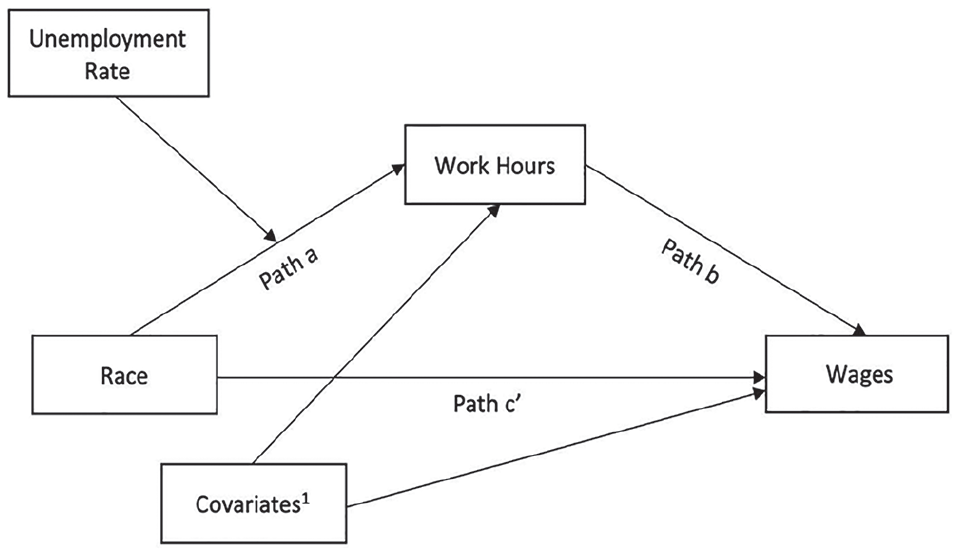
Diagram of the moderated mediation model with hourly work hours as the mediator and unemployment rate (log) as the moderator.
Results
Figure 2A shows the interaction terms between black workers and the job-seeker rate, between Hispanic workers and the job-seeker rate, and between Asian workers and the job-seeker rate predicting hourly wages. For black workers, racial wage discrimination was not moderated by economic conditions (as measured by the job-seeker rate). The interaction term for black workers was small and not statistically significant (b = .003, p > .05). However, the results show that racial wage discrimination was strongly moderated by economic conditions for Asian and Hispanic workers. When the job-seeker rate increases, the wages of Hispanic and Asian workers decrease relative to the wages of white workers. A 1 percent increase in the job-seeker rate was associated with a 0.012 percent decrease (p < .001) in the log hourly wages for Hispanics relative to whites and a 0.023 percent decrease (p < .001) in the log hourly wages for Asians relative to whites.
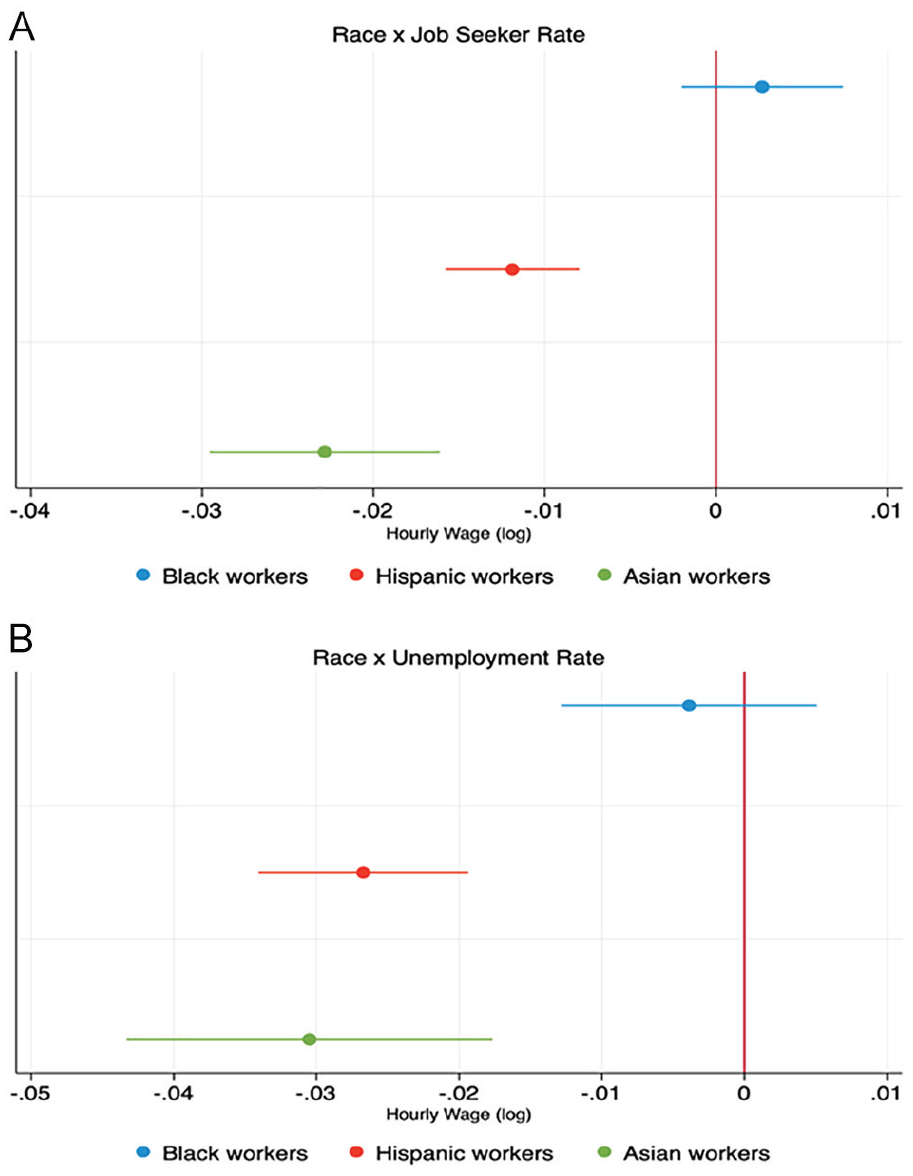
The (A) job-seeker rate (log) and the (B) unemployment rate (log) as predictors of hourly wages for black, Hispanic, and Asian workers relative to whites.
Figure 2B shows the results for the interaction of unemployment rate and race. The results are largely consistent with the findings using the job-seeker rate. The interaction term for black workers remained small and not statistically significant (b = −.004, p > .05). A 1 percent increase in the unemployment rate was associated with a 0.027 percent decrease (p < .001) and a 0.03 percent decrease (p < .001) in the hourly wages for Hispanic and Asian workers, respectively. The full results for all OLS regressions are presented in Table A1 in the Appendix.
Figure 2 shows the predicted hourly wages (log) at different levels of job-seeker rate (log) and unemployment rate (log) using the results from equations 1A and 1B. The hourly wages decreased only slightly more quickly for black workers and white workers when the job-seeker rate (Figure 3A) and the unemployment rate (Figure 3D) increased, although the rate of decrease was similar for the two racial groups, as indicated by the parallel slopes. For Hispanics, the wages decreased more quickly compared with whites (Figures 3B and 3E). The predicted hourly wages for Hispanic workers are similar to those of white workers at low unemployment rates (about 3 percent unemployment), but the racial wage gap widens substantively and the wages for Hispanics drop more quickly as the unemployment rate increases. For Asian workers, the predicted wages were higher relative to the wages for whites during economic upturns (when the job-seeker rate and unemployment rate are low), then began to fall more quickly as the economy became more slack (Figure 3C and 3F). When the job-seeker rate reaches about 4.0 percent (i.e., there are four unemployed workers per job opening), the racial wage gap reverses and white workers gain an advantage over Asian workers. Furthermore, the advantage that Asian workers have during low unemployment rates disappears when the unemployment rate reaches around 7 percent.

Predicted hourly wages (log) for black, Hispanic, Asian, and white workers with 95 percent confidence intervals, given the values for the job seeker rate (A), (B), and (C), and for the unemployment rate (D), (E), and (F).
Sensitivity Analyses
In this section, I conduct a sensitivity analysis to examine whether the results are consistent when excluding the economic recession (and recovery) associated with the coronavirus disease 2019 (COVID-19) outbreak. The unemployment rate during the initial shock of the COVID-19 outbreak was unusually high (14.7 percent) compared with recent recessions (10 percent unemployment at the peak of the 2008 Great Recession). One potential concern about the role of the COVID-19 outbreak is that it affected the composition of workers because of the disproportional effect of the shutdowns on low-wage jobs and concentrated in some industries (e.g., the service sector), which may have affected black, Hispanic, and Asian workers in different ways. For instance, compared with white workers, Asian workers had a 0.42 percent decrease, Hispanic workers had a 1.97 percent increase in employment status, while black workers had a 4.81 percent decrease in employment relative to whites (Gemelas et al. 2021; see also Dias 2021). To test whether the results are sensitive to possible compositional effects associated with the COVID-19 pandemic, I reestimated equations 1A and 1B for the months between December 2000 and March 2020, which exclude the months following the COVID-19 outbreak (Figures 4A and 4B). Full results are presented in Table A2 in the Appendix.

The (A) job-seeker rate (log) and the (B) unemployment rate (log) as predictors of hourly wages for black, Hispanic, and Asian workers relative to whites without the post–coronavirus disease 2019 months (the sample includes months from December 2000 to March 2020).
Overall, the results for the period before the COVID-19 outbreak are consistent with the results including all months (April 2020 to December 2021), with one exception: the interaction coefficient for black workers using unemployment rate (logged) as a measure of economic slack is now statistically significant (p < .01). A 1 percent increase in the unemployment rate was associated with a 0.013 percent decrease (p < .01) in the hourly wages for black workers. However, the magnitude of the effect remains substantially larger for Hispanic (b = −.038, p < .001) and Asian workers (b = −.046, p < .001) compared with black workers (b = −.013). The moderating effects of economic slack as measured by the job-seeker rate for black workers remained small and not statistically significant. These findings continue to support the conclusion that racial wage discrimination is more inflexible for black workers during changing economic conditions and more flexible for Hispanic and Asian workers.
Hours Worked as a Potential Mediator
To test whether the number of hours per week is a potential mechanism linking the association between racial wage discrimination and economic conditions, I conducted a moderated mediation analysis using the PROCESS macro, model 7 (Hayes 2013). This model tests whether the unemployment rate moderates the effect of “path a” (Figure 1). Respondents’ education, age, age squared, union status, foreign-born status, gender, the proportion of whites unemployed, occupation, industry, and state were entered as covariates.
For black workers, unemployment rate (logged) was found to moderate the effect of hours worked per week (unstandardized interaction b = −.317, SE = .078, t = −4.09, p < .001). Test of simple slopes (i.e., conditional effects of “path a”) show a statistically significant association between race and hours worked during low unemployment rates (1 SD below the mean of unemployment rate; b = .258, SE = .032, t = 8.16, p < .001) and during high unemployment rates (1 SD above the mean of unemployment rate; b = .076, SE = .032, t = 2.35, p < .05). Black workers worked fewer hours per week during periods with high unemployment rates compared with those with low unemployment rates. The overall moderated mediation model was supported by the index of moderated mediation of .003 (p < .001). The conditional indirect effect was strongest in the low unemployment condition (1 SD below the mean; effect = −.002, p < .001) and weakest in the high unemployment condition (1SD above the mean; effect = −.001, p < .05).
For Hispanic workers, unemployment rate (logged) was also found to moderate the effect of hours worked per week (unstandardized interaction b = −.523, SE = .068, t = −7.73, p < .001). The moderated mediation analysis shows that Hispanic workers worked fewer hours per week during periods of high unemployment compared with periods of low unemployment. Tests for the conditional effects (“path a” in Figure 1) show a positive and statistically significant association between race and hours worked during low unemployment (1 SD below the mean; b = .169, SE = .031, t = 5.48, p < .001) and negative and statistically significant during periods of high unemployment (1 SD above the mean; b = −.132, SE = .032, t = −4.17, p < .001). The overall moderated mediation model was supported by the index of moderated mediation of .005 (p < .001). A conditional indirect effect of hours worked per week was found for Hispanics in low unemployment (1 SD below the mean; effect = −.002, p < .001) as well as in high unemployment (1 SD above the mean; effect = .001, p < .001).
For Asian workers, a distinct pattern emerges compared with black and Hispanic workers. Although the wages of Asian workers decrease relative to the wages of white workers during economic downturns, Asian workers work more hours during economic slack compared with periods of low unemployment. Unemployment rate (logged) was found to moderate the effect of hours worked per week for Asian workers, but the effects were positive (unstandardized coefficient b = .358, SE = .105, t = 3.43, p < .01). Tests of simple slopes (i.e., conditional effects of “path a”) show a statistically significant association between race and hours worked during low unemployment rates (1 SD below the mean; b = −.873; SE = .048, t = −18, p < .001) and during high unemployment rates (1 SD above the mean; b = −.667, SE = .049, t = −13.5, p < .001). The overall moderated mediation model was supported by the index of moderated mediation of −.003 (p < .001). A conditional indirect effect of hours worked per week was found for Asian workers in low unemployment (1 SD below the mean; effect = .008, p < .001) as well as in high unemployment (1 SD above the mean; effect = .006, p < .001).
Discussion and Conclusion
The results presented here show that for the most part, higher economic slack was associated with a greater wage gap between black and white workers, Hispanic and white workers, and Asian and white workers, after accounting for premarket characteristics, occupation, industry, market factors, and the percentage of white workers unemployed (hypothesis 1). Moreover, changes in the racial wage gap during economic downturns are not driven by occupational and industry effects, as hypothesis 2 predicted. However, the magnitude of the moderating effects of economic condition on racial wage discrimination vary race, and whether the sample includes the economic recession associated with the COVID-19 outbreak. When the months following the COVID-19 outbreak were included in the analysis, I found that racial wage discrimination against black workers was not associated with changing economic conditions (regardless of whether the job-seeker rate or the unemployment rate was used as a measure of economic slack). However, when I restricted the analysis for the months prior to the COVID-19 outbreak (December 2000 to March 2020), I found that black workers experience a smaller decrease in wages relative to whites as the unemployment rate increases. For Hispanic and Asian workers, racial wage discrimination is strongly moderated by economic conditions, and these results are robust to the inclusion or exclusion of the post-COVID-19 months.
The different findings for black workers for the samples excluding and including the post-COVID-19 months may be associated with compositional changes in the labor force that affected black workers during the COVID-19 pandemic. Recent research has shown that black workers were at a higher risk for being laid off (Dias 2021) and continued to experience discrimination in hiring during the post-COVID-19 recovery period (Chavez, Weisshaar, Cabello-Hutt 2022). For different reasons, the employment status of Hispanic and Asian workers was less affected in the post-COVID-19 period. Hispanic workers were disproportionately employed in “frontline” occupations, and were therefore forced to work despite greater risks for infection. Asian workers were less likely to work in frontline occupations and more likely to work in occupations that offered remote and telework options (Gemelas et al. 2021). The disproportional number of lower wage black workers who may have remained out of the labor force after the COVID-19 outbreak may have decreased the black-white racial gap in wages for workers who remained employed.
Overall, the empirical findings presented here suggest that the association between labor market conditions and racial wage discrimination against black workers is, at best, weak (compared with Hispanics and Asians) if we use unemployment as a measurement of labor market condition. At the same time, racial wage discrimination against black workers seems remarkably resistant to changes in economic conditions, if we use the job-seeker rate, regardless of whether the sample is restricted to the pre-COVID-19 months or whether the economic recession associated with the pandemic is included. Taken together, these patterns point to the rigidity of racial wage discrimination against black workers in the labor market. These results are at odds with Boulware and Kuttner’s (2019) conclusion that employers weigh their taste for discrimination “against the opportunity cost of indulging those tastes” (p. 169). Rather, my findings suggest that market-based factors, such as economic tightness and slack, are not enough to change deep-seated stereotypes and organizational structures that enable racial wage discrimination against black workers.
In terms of the potential factors driving the relative wage loss of nonwhites during periods of economic downturns, I found different patterns about the role of work hours as a mechanism explaining the decrease in wages for black, Hispanic, and Asian workers. Black and Hispanic workers worked fewer hours per week during periods of high unemployment rate compared with low unemployment rates. One potential explanation for the decrease in work hours for black and Hispanic workers during periods of economic slack is that employers have greater discretion to adjust working hours of workers employed in lower wage occupations, and this discretion allows them to discriminate against black and Hispanic workers. Because the results from the moderated mediated analyses control for occupation and industry effects, it is unlikely that the change in working hours is driven by these factors but rather is driven by employer behavior in assigning fewer work hours to black and Hispanic workers compared with white workers. Asian workers, on the other hand, are more likely to work longer hours and earn lower wages relative to whites during periods of economic slack. Race-based stereotypes about Asian workers as “hardworking” and “obedient” (Reyna et al. 2013) may shape employer behavior to demand more hours from Asian workers relative to white workers with no additional compensation.
Together, these findings indicate racial wage discrimination is moderated by economic conditions, that the magnitude of the effects varies by race, and economic conditions moderate racial wage discrimination via changes in working hours. Yet this study is not without limitations. First, my findings are based on an indirect measurement of racial discrimination: the racial wage gap, after controlling for premarket and market characteristics. Thus, this research does not consider how racial discrimination in other realms, such as at the point of hire, might change the results. The inclusion of control variables in wage regressions typically gives rise to a downward bias or conservative estimates of wage discrimination (Weichselbaumer and Winter-Ebmer 2005). However, this bias would be consistently measured across time and contexts and would not affect estimates measuring the association between racial wage discrimination and labor market contexts.
Furthermore, the racial categories used in this project may not capture within-group heterogeneity in terms of culture, language, education, and nationality among subgroups that identify as Hispanic and Asian (Okamoto and Mora 2014). Likewise, the racial categories used here may obscure important phenotypical heterogeneity among black, Hispanic, and Asian workers. Prior research has shown that for U.S. black, Hispanic, and Asian workers, having darker skin is associated with lower wages, occupational status, and educational achievement, poorer health outcomes, and higher rates of arrest (Bailey, Fialho, and Penner 2016; Bohara and Davila 1992; Jones 2013; Monk 2015; Telles and Murguia 1990; Viglione, Hannon, and DeFina 2011). Future research will be well served to examine within-race heterogeneity about the impact of economic conditions on wage discrimination.
Furthermore, I do not examine meso-level or micro-level mechanisms linking economic conditions and racial wage discrimination. For instance, it is not possible with the data used in this study to examine how organizations change during economic recessions and how these changes affect wage setting for whites and nonwhites. At the same time, I am not able to examine how changing economic conditions may shape micro-level factors, such as cognitive processes and individual biases among managers. A fruitful avenue for future research is to examine how organizations change in response to economic conditions and how these changes in turn lead to the differential allocation of resources among racial groups, such as hiring, wage setting, promotion, furloughs, and layoffs.
Notwithstanding these limitations, this article makes important contributions to research about the factors driving racial discrimination in the labor market. First, it provides novel empirical evidence about the role of market forces in shaping racial wage discrimination for Hispanics and Asians, two groups that have been previously excluded in prior research. Second, I advance the concept of wage discrimination flexibility to capture the ways in which racial discrimination changes in various economic environments. The rigidity of wage discrimination against black workers in the labor market is consistent with other findings documenting the stability, persistence, and diffuseness of antiblack racism in the U.S. labor market (Pedulla et al. 2021; Quillian et al. 2017). These findings also support Sears and Savalei’s (2006) “black exceptionalism” hypothesis, which posits that an “impermeable color line” continues to hinder the integration of black workers into the broader society, whereas the color line is more porous for other racialized groups (e.g., Hispanic and Asian workers).
The rigidity of racial discrimination for black workers is also consistent with Ray’s (2019) racialized organizations framework. Ray argued that although external factors (e.g., social movements, macro-level policy changes, and state-level incorporation) can shape the racialization of organizations, “the underlying schemas determining sub- and super-ordination have remained largely stable” (p. 45). If “disruptive events,” which may include economic recessions, break down deep-rooted hierarchies and enduring organizational routines, as Zhang (2021) proposed, such organizational changes do not seem to alter the racialized structures within organizations that may lead to more equitable wage allocation for black workers. The fact that racial wage discrimination is more fluid for Hispanics and Asians suggests that different racialization patterns may exist within organizations, and/or that organizational restructuring during disruptive events favors some racial groups but not others.
Last, the findings presented here offer only partial support for the assertion that reduction of racial discrimination should not be overlooked as a benefit of a good economy (Boulware and Kuttner 2019). Even when economies are doing well (e.g., high demand for jobs relative to labor supply and low unemployment rates), black workers benefit very little or not at all. A good economy helps reduce wage discrimination against Asians and Hispanic workers, but not black workers. Fiscal policy makers may consider the benefits of expansionary policy for Asian and Hispanic workers, but a combination of measures beyond market-based forces, such as internal policies (e.g., targeted hires, organizational structures that foster accountability and transparency), as well as external factors (e.g., macro-level policy changes and state-level incorporation) may be a necessary step to reduce the racial gap in wages between white and black workers.
Supplemental Material
sj-docx-1-srd-10.1177_23780231221148932 – Supplemental material for The (In)Flexibility of Racial Discrimination: Labor Market Context and the Racial Wage Gap in the United States, 2000 to 2021
Supplemental material, sj-docx-1-srd-10.1177_23780231221148932 for The (In)Flexibility of Racial Discrimination: Labor Market Context and the Racial Wage Gap in the United States, 2000 to 2021 by Felipe A. Dias in Socius
Footnotes
Appendix
Predicted Probability of Being Laid Off during Recessions.

| Model 1 (Black Workers) | Model 2 (Hispanic Workers) | Model 3 (Asian Workers) | Model 4 (White Workers) | |
|---|---|---|---|---|
| Recession (yes = 1) | .013*** (.001) | .018*** (.001) | .017*** (.001) | .008*** (0) |
| Education (years) | –.003*** (0) | –.001*** (0) | –.001*** (0) | –.002*** (0) |
| Age (years) | .003*** (0) | .001** (0) | .001*** (0) | .001*** (0) |
| Age squared (years) | 0*** (0) | 0* (0) | 0* (0) | 0*** (0) |
| Foreign born | –.006*** (.001) | –.009*** (.001) | –.001 (.001) | –.001 (.001) |
| Female | –.006*** (.001) | –.001 (.001) | –.004*** (.001) | –.002*** (0) |
| State fixed effects | Yes | Yes | Yes | Yes |
| Industry fixed effects | Yes | Yes | Yes | Yes |
| Occupation fixed effects | Yes | Yes | Yes | Yes |
| Constant | .035*** (.005) | .03*** (.004) | .007 (.006) | .022*** (.002) |
| Observations | 370,541 | 484,803 | 182,049 | 2,774,245 |
| R 2 | .017 | .013 | .016 | .013 |
Note: Values in parentheses are robust standard errors and are clustered at the individual level.
p < .05. **p < .01. ***p < .001.

Supplemental Material
Supplemental material for this article is available online.
Notes
Author Biography
References
Supplementary Material
Please find the following supplemental material available below.
For Open Access articles published under a Creative Commons License, all supplemental material carries the same license as the article it is associated with.
For non-Open Access articles published, all supplemental material carries a non-exclusive license, and permission requests for re-use of supplemental material or any part of supplemental material shall be sent directly to the copyright owner as specified in the copyright notice associated with the article.
