




Abstract
Women have many reproductive options, but little is known about their regrets regarding prior reproductive choices and outcomes. Guided by the life-course and stratified reproduction perspectives, this study draws on an open-ended question about reproductive regrets from wave I of the National Survey of Fertility Barriers, a representative telephone survey of reproductive aged U.S. women conducted from 2004 to 2006. The authors classified regrets into five broad categories: (1) none, (2) problematic fertility, (3) unfulfilled fertility desires, (4) family, and (5) pregnancy experiences. The authors conducted the analyses separately by motherhood status. Logistic regression analysis revealed that regardless of parental status, those who were older, had infertility, or were experiencing economic hardship were more likely to report reproductive regrets. The authors also investigated factors associated with the likelihood of expressing specific reproductive regrets. In general, the present findings confirm expectations based on the life-course and stratified reproduction perspectives.
Throughout their lives, many people ask themselves if they would do the same thing if they “had to do it over again” (Newton, Torges, and Stewart 2012; Stewart and Vandewater 1999; Timmer, Westerhof, and Dittmann-Kohli 2005). Widespread access to reliable contraception, medical and surgical interventions, and assisted reproductive technology has created unprecedented reproductive choices for U.S. women, but many women either fall short of or exceed their reproductive goals (Quesnel-Vallée and Morgan 2003). Researchers typically study one type of presumably problematic reproductive condition at a time (Johnson et al. 2018), focusing, for example, on unintended birth (Finer and Zolna 2014; Guzzo 2021), pregnancy loss (McDonald, Dasch-Yee, and Grigg 2022; Wonch Hill et al. 2017); infertility (Chandra, Copen, and Stephen 2013; McQuillan et al. 2003) without directly asking women what they themselves consider to be of concern. To fill the gap in knowledge about women’s reproductive regrets, we analyzed open-ended responses about what women would change about their reproductive choices from wave I of the National Survey of Fertility Barriers (NSFB).
We coded the verbatim responses and classified them into five broad themes: (1) no regrets, (2) regrets about problematic fertility, (3) regrets about unfulfilled fertility desires, (4) regrets about family, and (5) regrets about pregnancy experiences. Because women’s reproductive regrets are intimately linked to motherhood status, we conducted separate analyses for women who did and did not have children. We assessed whether age, fertility status, or marginalized social status were associated with whether women expressed any reproductive regrets as well as different types of reproductive regrets. The life-course perspective (Elder, Johnson, and Crosnoe 2003) suggests the importance of analyzing age and fertility status, and the “stratified reproduction” framework (Colen 1995) suggests the importance of analyzing the relationship between marginalized social statuses and reproductive regrets in the United States. Our results support the utility of analyzing reproductive regrets from both the life-course and stratified reproduction perspectives.
Literature Review
Situating Reproductive Regrets
Morrison and Roese (2011:576) defined regret as “a negative emotion predicated on the realization that a different past decision might have brought a better outcome than what actually transpired.” Because most people wish they had chosen differently at some point in the past, regret is a fairly common emotion (Landman 1987; Landman and Manis 1992; Summerville 2011). For example, 64 percent of a small sample of college-educated women told researchers that they had regrets (Landman et al. 1995), and 65 percent of a large Dutch sample reported regrets (Dijkstra and Barelds 2008). Because regret involves a judgement that things could have been different, it involves a strong cognitive component (Landman 1987). Regret also entails a sense of agency (Beike, Markman, and Karadogan 2009; d’Avelar 2022; Sokolov 2022; Summerville 2011). When something undesirable occurs, we express “disappointment” if we perceive the situation as being out of our control and “regret” if we perceive that we could have chosen a different course of action.
Most studies of regrets have been conducted using small, nonrepresentative samples of college students, university employees and other selected groups of people (Morrison and Roese 2011; Roese and Summerville 2005). To assess regrets, these studies generally use open-ended questions, which are analyzed to construct groupings or categories of regret. For example, Jokisaari (2004) asked, When people look into their past, they sometimes feel that something could have been done in a different way. What kinds of regrets do you have in your life? (What would you leave undone or what would you have wanted to do?)
Another study resulted in the following categories of regret: work/education, family/partners, self-development, leisure, friendship, social engagement, health, and finances (Wrosch and Heckhausen 2002).
There are advantages in allowing respondents to express regrets in their own words, but a notable shortcoming to this approach is that researchers are implicitly defining regret as whatever a participant says it is. As noted above, scholars think of regret in terms of agency; something can only be a regret if one had the ability to decide. It is not clear, however, that respondents always use the term this precisely. A woman might say, for example, “I regret that I had a miscarriage” even if she could not have stopped the event. Thus, researchers may include in their samples some responses that do not technically qualify as regrets. In addition, although researchers generally define regret as being an emotion, the open-ended question format elicits responses focused on cognitive aspects of regrets rather than thinking in terms of emotions. These shortcomings of open-ended questions about regrets also characterize our own work.
Regrets about reproductive choices have generally been coded under the rubric of “family” (Wrosch, Bauer, and Scheier 2005), and family regrets tend to be experienced more intensely than other types of regrets (Wrosch and Heckhausen 2002). A number of researchers have studied regrets about specific reproductive conditions, such as sterilization (Eeckhaut and Sweeney 2018; Shreffler et al. 2020) or infertility (Adachi, Endo, and Ohashi 2020; Daniluk, Koert, and Cheung 2012), and others have examined regretting motherhood (Donath 2015b, 2017). However, we are aware of only one study that asked women specifically about reproductive regrets. Jeffries and Konnert (2002) asked older women, “Do you have goals you intended or sincerely hoped to achieve but never did?” They then asked respondents to rank-order their regrets. If respondents did not spontaneously mention reproductive regrets, they asked whether the women had “any regrets around having or not having children or parenting children.” Voluntarily childfree women listed regrets about having or not having children as the 8th most important concern out of 10 categories, while involuntarily childless women rated it higher (5th), and mothers even higher (3rd).
A Sociological Approach to Reproductive Regrets
A good deal of the research on regrets has been conducted by psychologists and has focused on the relationship between regrets and psychological well-being (Dijkstra and Barelds 2008; Jokisaari 2003, 2004; Landman et al. 1995; Stewart and Vandewater 1999; Wrosch et al. 2005). Thus, many studies treat regret as an independent variable that can be used to explain well-being; fewer studies have treated regrets as a dependent variable or sought to discover social characteristics associated with having regrets or specific types of regrets. Doing so, however, is valuable for determining the reproductive experiences women are most concerned about.
Recently, several sociologists have called for a “sociology of regret” that highlights the role of culture and social structure in shaping the experience of regret (d’Avelar 2022; Donath 2017; Sokolov 2022). Cultural norms provide a roadmap of possibilities and likely causes and effects (Sokolov 2022), and this roadmap informs individuals as to what they are likely to regret in the future. Thus, women in pronatalist societies are warned that motherhood is a “natural” role for women and that any women who does not become a mother will regret it (Donath 2015a, 2015b, 2017). Cultural norms provide perspective concerning what choices people have, and social structure dictates which choices are most consequential (d’Avelar 2022; Koropeckyj-Cox 2002; Morrison and Roese 2001; Newton et al. 2012; Sokolov 2022). Given the importance of education in determining life chances in contemporary societies, it is not surprising that it is common for U.S. women to have regrets about the educational choices they have made (Landman et al. 1995; Morrison and Roese 2011; Roese and Summerville 2005; Stewart and Vandewater 1999). Nor is it surprising, given the individualistic approach to choosing mates in contemporary societies, that family formation and partnership selection regrets are also common (Jokisaari 2003; Landman et al. 1995; Morrison and Roese 2011; Roese and Summerville 2005; Wrosch and Heckhausen 2002).
Regrets also likely vary depending on people’s position along various dimensions of social structure (d’Avelar 2022). Age is an important dimension of social structure that shapes regrets (Alexander et al. 1992; Roese and Summerville 2005); therefore, the life-course perspective is a valuable tool for the analysis of reproductive regrets (Elder et al. 2003). Societies are characterized by age norms (Neugarten, Moore, and Lowe 1965), which shape conceptions of what behaviors and roles are appropriate at different ages. Ideas about what is appropriate reflect a socially constructed “normative structure” (Heckhausen and Buchmann 2019) that provides “cultural deadlines” (Settersten and Hägestad 1996a) for when certain life activities—such as completing one’s education (Settersten and Hägestad 1996b), leaving home (Billari and Liefbroer 2007), starting a family (Settersten and Hägestad 1996a, 1996b), and “being done” with childbearing (Franzese et al. 2019)—should be accomplished (Fry 2008; Holstein and Gubrium 2007; Konietzka and Kreyenfeld 2021). People are generally aware of these culturally constructed deadlines (Alexander et al. 1992; Neugarten et al. 1965; Settersten and Hägestad 1996a, 1996b), although specific expectations change across historical time periods (Koropeckyj-Cox, Romano, and Moras 2007; Mayer 2004; Newton et al. 2012).
Wrosch et al. (2005) suggested that people in midlife and older age should have more regrets than people who are younger (but see Dijkstra and Barelds 2008; Timmer et al. 2005). By the time people reach midlife, most culturally constructed “developmental deadlines” have passed (Heckhausen, Wrosch, and Schulz 2019); thus, aging brings more choices that people can regret and fewer opportunities to choose differently. Compared with younger people, who likely perceive that they still have opportunities to “get things right,” older people may perceive that they now have fewer options to undo past mistakes (Jokisaari 2003, 2004; Roese and Summerville 2005; Wrosch et al. 2005). Agency in the life course entails looking into the future and contemplating possibilities (Hitlin and Kirkpatrick Johnson 2015; Hitlin and Kwon 2016), but as people age, they are more likely to engage in life review than to look forward with the intention of making changes (Band-Winterstein and Manchik-Rimon 2014; DeVries Kerrick, and Oetinger 2007; Dillaway 2012; Stewart and Vandewater 1999). A sense that time has run out is likely to be more common among women who have passed reproductive deadlines because there are biological limitations on fecundity. Because options for overcoming regrets about fertility diminish with age, and each additional year provides more opportunities for reproductive choices and experiences, we anticipate that higher age will be associated with more reproductive regrets.
Life-course norms, and therefore regrets, also vary by gender (Landman et al. 1995). Virtually all societies prescribe different roles and different sequences of roles for women and men (Jokisaari 2004). In an online study of college students, Uecker and Martinez (2017) found that college-age women are three times more likely to regret sexual “hookups” than men. The authors attribute the difference to the sexual “double standard” that denigrates women and rewards men for having multiple sexual partners. Even in contemporary societies, in which women are expected to pursue high levels of education and to enter the workforce, many women still face expectations that they take more responsibility than men for family obligations (Gerson 2011). As a result, women are more likely than men to confront difficult choices regarding family, education, and career, with associated risks for more regrets (Dijkstra and Barelds 2008; Landman et al. 1995). There is indeed evidence that women have more relationship and family regrets than men (Jokisaari 2004).
As we have noted before, to experience regret requires a sense of agency to choose differently (d’Avelar 2022; Sokolov 2022). Hitlin and Kwon (2016) reported that, compared with men, women have less of a sense that they are in control of their own lives. Even in contemporary societies, it is often taken for granted that women ought to become mothers (Dykstra and Hagestad 2007). For example, Donath (2015a) argued that pronatalist ideology in the United States is so strong that some women do not perceive agency to avoid motherhood. She thus regarded the women she studied who regret becoming mothers as exercising “after the fact agency” (Donath 2017). Even though they did not feel they had a choice at the time of the decision, looking back, they regret not making different choices. The same might be said for the older women described by Newton et al. (2012) who, looking back on their lives, regret having prioritized family over career even though they may not have felt at the time that they had a choice.
Other social structures may also shape how much agency people feel they have and the life-course norms they are subject to, thus conditioning risk of reproductive regret. Higher socioeconomic status (SES) is associated with later age deadlines for undergoing important life-course transitions compared with lower SES (Settersten and Hägestad 1996a, 1996b) and more agency compared with people with lower SES (d’Avelar 2022). Having fewer options at important life-course turning points could result in fewer reproductive regrets among less compared with more privileged women. On the other hand, women in historically marginalized groups could perhaps have more regrets than privileged women, because, looking back at their lives, they now feel that they did have choices even though they did not feel that way at the time. As of yet, few scholars have looked at the relationships between SES or race/ethnicity and regret; because of considerable evidence of stratified reproduction in the United States (Bell 2014; Colen 1995; Greil et al. 2011), stratified reproduction is an important perspective informing the analyses.
We also consider measures of personal characteristics, such as religiosity (Bendixen et al. 2017; Longest and Uecker 2018) and perceived social support (Albertini and Mencarini 2014; Connidis and McMullin 1999), that prior studies have shown to be related to reproductive regret. Most religious traditions encourage childbearing and emphasize the importance of family, and there is evidence that higher religiosity is associated with lower acceptance of childlessness (Koropeckyj-Cox and Pendell 2007) and higher fertility intentions (Hayford and Morgan 2008). People with more social support tend to have higher subjective well-being (Cox et al. 2016; Nguyen et al. 2016). Women with higher subjective well-being might have experiences that would cause concern for other women, but their social support resources might insulate them from having actual regrets.
The Range of Reproductive Regrets
Although there is a normative expectation in the United States that women should become mothers, there is also an expectation that women not become mothers until they are “ready” (Morgan and Hagewen 2005; Slauson-Blevins and Park 2016). In other words, the ideal time, according to life-course norms, for women to become mothers is when they are at least in their 20s (i.e., no longer teenagers), have completed their education, are financially and emotionally secure, and have suitable partners (Friese, Becker, and Nachtigall 2006). For many U.S. women, marriage acts as a life-course “trigger” to start thinking about having children (McMahon 1995). Demographic data indicate that Americans have become more accepting of nonmarital births (Thornton and Young-DeMarco 2001), but qualitative data from cohabiting couples suggest that a majority of cohabiters without children consider marriage a prerequisite to having children (Sassler and Cunningham 2008). Women looking back on their reproductive decisions may retrospectively consider that they became pregnant “too soon” or before they were “ready.”
Implicit in the expectation that women should be “ready” to be mothers is the corollary expectation that pregnancies should be planned (Rackin 2013). Women may look back and think that they should have planned their pregnancies, used contraception, or used contraception more effectively. Because normative family size remains around two, some women may retrospectively consider that they had “too many” children. Thus, many women may have regrets about “problematic” fertility. Given the gap between the ideals and reality of motherhood, it is virtually inevitable that some women will discover that motherhood is not all they expected. Several recent studies have described women’s experiences of regret about becoming mothers or certain aspects of motherhood (Donath 2015a, 2015b, 2017; Heffernan and Stone 2021; Matley 2020; More and Abetz 2019; Shelton and Johnson 2006). We classified the many statements about timing, planning, sterilization, number of children, and sex under the category “problematic fertility” (see Table 1).
Themes from Open-Ended Responses to the Question Measuring Regret.

Source: National Survey of Fertility Barriers.
Note: N = 4,167.
Considerable research documents patterns of stratified reproduction (Colen 1995) by SES and race/ethnicity (Bell 2014; Bird and Rieker 2008). Some of the variation in unintended pregnancies is likely due to differential access to contraception (Finer and Zolna 2016). Sweeney and Raley (2014) found that racial/ethnic gaps in unintended childbearing rates persist across SES categories. It is likely, then, that lower SES and marginalized racial status will be associated with problematic fertility. Married women are twice as likely to report their pregnancies as intended than nonmarried women (Finer and Zolna 2014). Thus, it seems likely that that those who never married will be more likely to have regrets about problematic fertility.
Women who have unfulfilled reproductive goals may also experience regrets (Alexander et al. 1992) if they perceive that they could have chosen a different outcome. The proportion of women in the United States who ended their prime reproductive years without having children rose from about 10 percent to about 20 percent between 1980 and 2005 (Dye 2008; Rybińska and Morgan 2019). Over roughly the same period, however, the proportion of women who report zero as their ideal family size increased only from 3 percent to 5 percent (Hagewen and Morgan 2005). It is thus likely that many women who remain without children at the end of their reproductive years had intended to be parents (Koert and Daniluk 2017). In addition, many women with children may have fewer than they had originally hoped or may have had children later than they had desired (Hartnett and Margolis 2019). Casterline and Han (2017) referred to undershooting one’s reproductive goals as “unrealized fertility.” Older women who delay having or adopting children because of education, career, money, or partner issues (Adachi et al. 2020; Daniluk et al. 2012), as well as women who have reached menopause before they felt like they were “done” having children, may also experience regrets (Dillaway 2012). Approximately 8 percent of U.S. women of childbearing age meet criteria for infertility at any given time, and about 38 percent of those women do not have children (Chandra et al. 2013).
We categorized women who experienced regrets about missed opportunities to have desired children as having “unfulfilled fertility desires”. Of our four regrets categories, regrets about problematic fertility and unfulfilled fertility desires seem particularly relevant to the life-course and stratified reproduction perspectives. Because life-course norms dictate that women “ought to have children” by a certain age (Koropeckyj-Cox, Pienta, and Brown 2007), those who are younger still have time to conceive and might not yet have regrets, but older women, who have passed normative times to have children, are more likely to have regrets. Because women with higher SES are more likely to delay having children to manage other goals, they risk having more unfulfilled fertility desires than lower SES women. Because women with infertility are confronted with an inability to achieve a desired goal, it is possible that women who experience infertility will express more regrets about unfulfilled fertility desires than other women. Yet women with infertility vary in how much they think that they have choices to conceive.
Marriage is often considered to be a normative prerequisite for having children; therefore it seems likely that married women will be more likely than unmarried women to express regrets about unfulfilled fertility desires. The dramatic increase in women in the paid labor force in the 1970s and 1980s contributed to numerous studies documenting challenges women experience combining parenthood and careers (Greenhaus and Allen 2011). Normative expectations for women to combine work and family persist even in the absence of institutionalized supports to do so (Rehel 2013). Balancing employer and family demands is more difficult for women than men because of continued gendered expectations that women are primarily responsible for family work (Yavorsky, Kamp Dush, and Schoppe-Sullivan 2015). Some women may wish that they had spent more time with their children. Others may wish that they had had more support from a partner, had a different partner, had not divorced, or had not become a single parent. We classify these concerns as regrets about family (see Table 1).
In response to increasing medicalization of pregnancy and birth in industrialized nations (Greil and McQuillan 2010; Holm 2009), many women have attempted to exert more control over reproductive decisions (Brubaker and Dillaway 2009). For example, because of historical changes in what is considered the “normal” amount of autonomy and influence over birth, some women may look back with regret that their birth experiences were not as “natural” as they had hoped. Others may wish, in retrospect, that they had not refused pain medication. Still others may have regrets about their experiences with doctors or hospitals. We classify these concerns as regrets about pregnancy (see Table 1).
The research summarized here provides indications of the life-course and stratified reproduction indicators that could be associated with having any regrets and with having specific types of regrets. Influenced by a life-course framework, the stratified reproduction perspective, and psychosocial research on the consequences of various reproductive experiences, we model associations between social characteristics and having any regrets versus no regrets—and having specific types of regrets—for women with and without children.
Sample and Method
Sample
We analyzed data from wave I (collected from 2004 to 2006) of the NSFB, a representative telephone survey of women of reproductive age (25–45 years). The NSFB focused primarily on reproductive histories and experiences related to fertility and infertility, thus including women most at risk for infertility. Women were asked about their views on motherhood, childbearing, fertility intentions, and reproductive histories. Data were collected from 4,796 women. The NSFB oversampled women from U.S. census tracts in which more than 40 percent of residents were African American or Hispanic, and a Spanish-language interview was offered. The response rate was 53 percent to the question that screened respondents for inclusion in the study, consistent with declines in participation in telephone survey research in the early 2000s (McCarty et al. 2006). Sample weights provided with the data adjust the sample to match the sample characteristics of the American Community Survey sample characteristics (Johnson 2010). The NSFB data may be accessed at https://www.icpsr.umich.edu/icpsrweb/DSDR/studies/36902#bibcite.
The survey included an open-ended question asking respondents to state whether they would change anything about the reproductive decisions they had made in the past; the 4,167 women who responded to the question constitute the analytic sample for this study.
Measures
Dependent Variable
To create the dependent variable, reproductive regrets, we coded and categorized the open-ended responses to the following question: “We have asked you many questions. If you could change anything about the decisions you have made about pregnancy and childbearing, what would you change?”
Responses to this question were recorded by interviewers, though not necessarily transcribed verbatim. Interviewers were trained to probe respondents for more information on open-ended questions, to list all responses reported, to leave detailed notes on respondent answers, and to clarify if any responses were unclear. Although responses were generally brief, ranging from a single word to a full paragraph, the open-ended question allowed participants to provide their own answers rather than being limited by defined response choices. Two of the authors independently coded all responses and then met to resolve disagreements, finally settling on 75 first-order categories to be used for the purposes of a primarily descriptive qualitative analysis reported upon in a separate article. To allow the quantitative analysis reported upon here, a third author combined these 75 first-order categories into five broader second-order categories: (1) no regrets, (2) regrets about problematic fertility, (3) regrets about unfulfilled fertility desires, (4) regrets about family, and (5) regrets about pregnancy experiences (see Table 1). Every response was put in only one of the five categories, on the basis of a second round of review. All authors reviewed this classificatory scheme and agreed on the final set of categories to be used in this analysis. Of the many possible ways to collapse the detailed responses into manageable categories, we selected a set that had face validity as meaningful and that had few enough categories containing sufficient numbers of cases to permit quantitative analysis. Table 1 displays the 75 first-order categories arranged into final second-order classification scheme of four types of regrets and responses that indicated no reproductive regrets.
Women were classified as having no regrets if they responded that they regretted nothing, that they did not know, or if they said that “everything happens for a reason.” Problematic fertility refers to unintended pregnancies as well as pregnancies judged to have occurred too soon or under circumstances considered inappropriate. Some examples of types of comments classified as problematic fertility include “would have planned pregnancies,” “would use birth control,” and “wait until married.” Women were classified as having unfulfilled fertility desires if they indicated that they were unable to give birth to a child or have as many children as the wanted. Some representative types of comments include “get married sooner,” “would have had more children,” and “would have sought more treatments.” Women were classified as having family regrets if they expressed regrets about their family situation. Examples of family regrets include “have only one father,” “be a better role model,” and “more partner involvement in childcare.” Women were classified as having pregnancy regrets if they described their experience of pregnancy or the labor and delivery process as concerning. Sample comments include “select different doctor,” “use pain meds during delivery,” and “gain less weight.”
Independent Variables
We included measures of several concepts indicated by the life-course perspective (e.g., age, infertility status, child status, marital status), stratified reproduction (e.g., education, economic hardship, private health insurance, race/ethnicity), or prior research (e.g., religiosity and social support). Age was measured in years and then mean centered to facilitate interpretation of the constant. Women were considered to be infertile if they answered “yes” to either of the following questions: “Was there ever time when you were trying to get pregnant but did not conceive within 12 months?” and “Was there ever a time when you regularly had sex without birth control for a year or more without getting pregnant?” or if they ever became pregnant after at least 12 months of having unprotected intercourse without conception. Women who were trying not to become pregnant, who had been sterilized, or who were breastfeeding during the time when they were having regular intercourse without conception were not counted as infertile. Because the meaning of some of the regrets depends upon women’s current parenthood status, we analyzed mothers separately from women without children. Child status was measured by dichotomizing responses to question about the number of children a woman has into “zero” and “one or more.” Marital status at wave I was assessed using the question “What is your current marital status?” On the basis of this measure, we created a binary indicator for never married versus all other statuses.
In keeping with our concern with stratified reproduction, we used four measures of SES (education, economic hardship, private health insurance or not, and employment status) and indicators of race/ethnicity. Years of education was mean centered. Responses to three questions were combined to measure economic hardship: (1) “During the last 12 months, how often did it happen that you had trouble paying the bills?” (2) “During the last 12 months, how often did it happen that you did not have enough money to buy food, clothes, or other things your household needed?” and (3) “During the last 12 months, how often did it happen that you did not have enough money to pay for medical care?” We took the mean of the three items and then mean centered. This is a unidimensional scale with high reliability (α = .82). Private health insurance was assessed using the question “Are you covered by private health insurance, by public health insurance such as Medicaid, or some other kind of health care plan or by no health insurance?” A value of 1 indicates that the respondent has private health insurance, while all other options were coded 0. Employed was measured by a single binary variable indicating either full-time or part-time employment compared with no employment. Race/ethnicity was measured using the standard U.S. Census Bureau wording. Indicator variables were constructed for Black, Hispanic, and Asian compared with white women. Those indicating only “other” races were included in the “white” category, because previous work with this data set has shown that there is little difference between the “white” and “other” categories. The measure of race/ethnicity is a proxy for risk for experiencing the effects of racism.
We also included two control variables in the models. The religiosity scale was developed by the creators of the NSFB and includes four items: “How often do you attend religious services?” “How often do you pray?” “How close do you feel to God most of the time?” and “In general, how much would you say your religious beliefs influence your daily life?” The scale was standardized, mean centered, and coded so that greater value indicates greater religiosity. This measure has an α reliability of .77. Perceived social support, on the basis of Sherbourne and Stewart (1991), was measured by how often the following four kinds of support were available if needed: “someone to give you advice about a crisis,” “someone to give you information to help you understand a situation,” “someone whose advice you really want,” and “someone to share your most private worries and fears with” (coded 1 = often, 2 = occasionally, 3 = seldom, and 4 = never). The scale was created by averaging item responses and then mean centering (α = .84).
Plan of Analysis
As noted above, the research team coded the open-ended responses, first into 75 inductive categories and then into five broader categories of regrets: (1) no regrets, regrets about (2) problematic fertility, (3) unfulfilled fertility desires, (4) family building, and (5) pregnancy experiences. To determine whether women who mentioned specific reproductive regrets had different social characteristics from women who said that they had no reproductive regrets, we created a binary variable in which women in categories 2, 3, 4, and 5 were coded as having reproductive regrets (1), and women in category 1 were coded as not expressing reproductive regrets (0). We conducted separate binary logistic regression analyses by motherhood status with having regrets vs. not having regrets as the dependent variable. To assess whether life-course or stratified reproduction indicators were differentially associated with specific types of reproductive regrets, we conducted separate multinomial logistic regression models by motherhood status with each type of reproductive regret compared with no regret as the reference category. All analyses were conducted in Stata 16.1 (StataCorp, College Station, TX).
Results
Table 2 presents descriptive statistics for the sample as a whole, for women without children, and for women with children (i.e., mothers), together with indications of the significance of the difference between the two groups. Approximately 63 percent of respondents said that they would change nothing, whereas 37 percent did express specific reproductive regrets. More women without children (71 percent) than mothers (60 percent) expressed no reproductive regrets. More women without children than mothers said that they had regrets about unfulfilled fertility desires, but more mothers than women without children expressed regrets about problematic fertility, family, and pregnancy. On average, mothers were about two years older than women without children. More mothers than women without children met criteria for infertility. Average education did not differ by motherhood status. A higher proportion of women without children were never married, had private health insurance, and were employed compared with mothers, but they were less likely than mothers to report economic hardship. Mothers were more likely to identify as Hispanic and less likely to identify as white or Asian than women without children. The proportion Black did not differ by motherhood status.
Descriptive Statistics for the Entire Sample and Separately for Women without and with Children.

Source: National Survey of Fertility Barriers.
Note: Chi-square tests were performed for categorical variables and independent-samples t tests for continuous variables.
p < .01. ***p < .001.
Table 3 provides the logistic regression analysis results with any versus no reproductive regrets as the dependent variable, separately by motherhood status. Older women and women who have experienced infertility had higher odds of regret, but only among mothers was never marrying associated with regret. This association suggests that “single mothers” have higher odds of regret than married mothers. Higher economic hardship was associated with higher odds of regret. Higher education was also associated with higher odds of regret, but only among mothers. Among mothers, women who identified as Hispanic had lower odds of regret than women who identified as white.
Logistic Regression of Having Regrets (Would Change Something = 1) vs. Having No Regrets (Would Not Change Anything = 0) by Selected Variables (n = 4,167).

Source: National Survey of Fertility Barriers.
Note: All continuous variables are mean centered.
p < .05. **p < .01. ***p < .001.
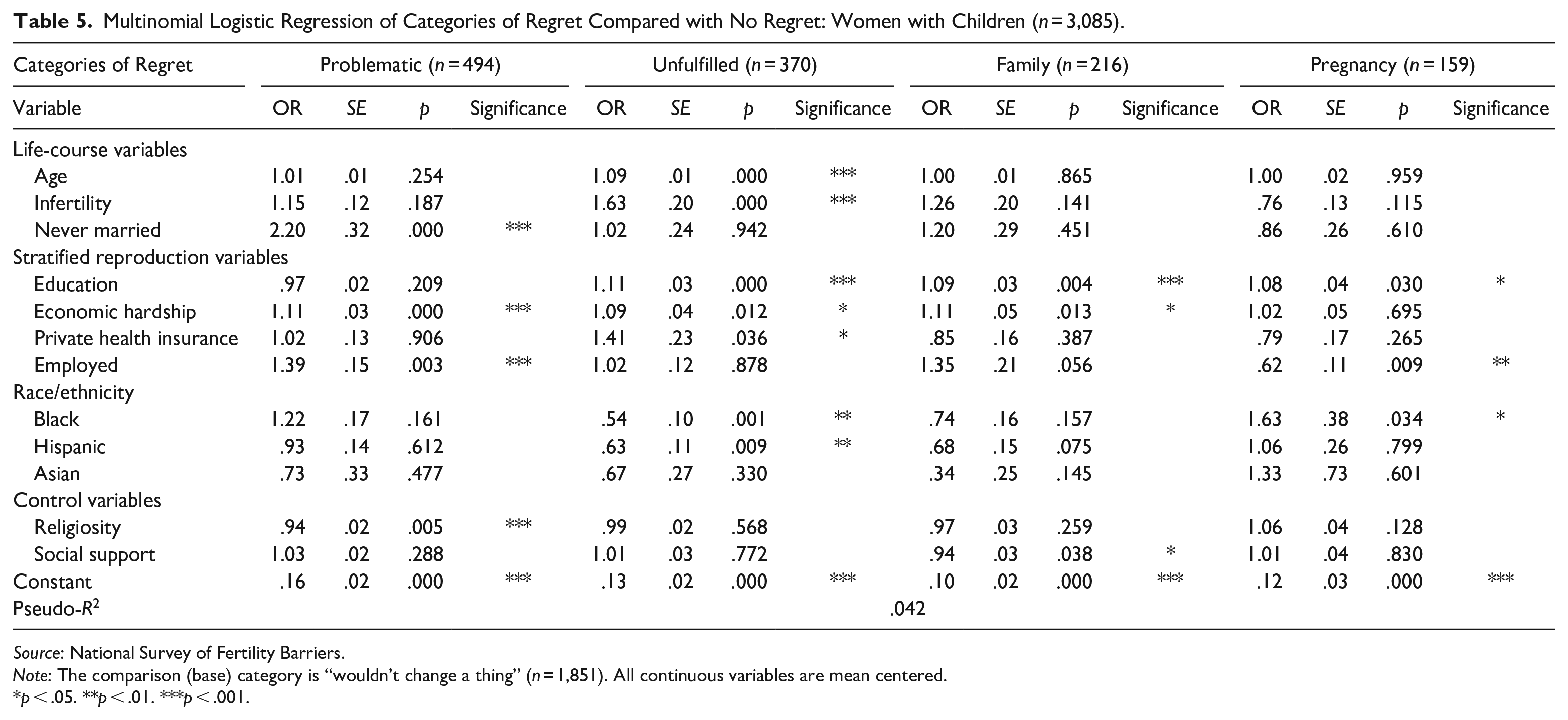
Table 4 (women without children) and Table 5 (mothers) display the results of the multinomial logistic regression analyses comparing those who said that they would change nothing (no regrets) to those in the other four reproductive regrets categories. Among women without children, older age was associated with higher likelihood of unfulfilled fertility desires, family, and problematic fertility regrets but not with problematic fertility. Compared with those who have not experienced infertility, those who have had infertility had higher odds of reporting all of the specific reproductive concerns; this relationship is statistically significant only for problematic fertility, unfulfilled fertility desires, and family concerns. More economic hardship was associated with higher likelihood of regrets about problematic fertility compared with no regrets.
Multinomial Logistic Regression of Categories of Regret Compared with No Regret: Women without Children (n = 1,082).

Source: National Survey of Fertility Barriers.
Note: The comparison (base) category is “wouldn’t change a thing” (n = 768). All continuous variables are mean centered.
p < .05. **p < .01. ***p < .001.
Multinomial Logistic Regression of Categories of Regret Compared with No Regret: Women with Children (n = 3,085).
Source: National Survey of Fertility Barriers.
Note: The comparison (base) category is “wouldn’t change a thing” (n = 1,851). All continuous variables are mean centered.
p < .05. **p < .01. ***p < .001.
Among mothers (Table 5), higher age and infertility were associated only with higher odds of unfulfilled fertility desires and not with any of the other categories of reproductive regrets. Never having been married was associated with substantially higher odds of regret about problematic fertility compared with no regrets. Women with higher education had higher odds of being in all categories of regrets except the problematic pregnancy category. Higher economic hardship was associated with higher odds of being in the regrets categories except for the pregnancy concerns category. Employed women had higher odds of reporting problematic fertility and lower odds of reporting pregnancy concerns. Women who identified as Black and Hispanic had lower odds of reporting unfulfilled fertility desires, and women who identified as Black had higher odds of expressing concerns about pregnancy. Higher religiosity was associated with lower odds of being in the problematic fertility category.
Conclusion
In this study, we analyzed open-ended responses to a question that asked women to reflect back on their reproductive choices and to comment on what they would change. Just over a third (37 percent) of women reported having reproductive regrets. The results provide partial support for the argument that life-course expectations and location in social stratification status hierarchies matter for whether women report reproductive regrets. Age, infertility, and economic hardship were all associated with greater likelihood of expressing reproductive regrets compared with no regrets. Among mothers, those who never married (i.e., “single mothers”) were more likely to express regret compared with those who ever married and those who identified as Hispanic were less likely to express regret compared with those who identified as white. Marital status and race/ethnicity were not associated with regret among women without children.
The finding that older women were more likely to express regrets was consistent with the life-course perspective. Older women have had more time and experiences that could lead to reproductive regrets and likely have fewer opportunities to make changes that would compensate for choices made earlier. The biological limits on pregnancy and birth make age particularly salient for reproductive regrets. That women with infertility were more likely to express reproductive regrets than women without infertility provides support for the life-course perspective insofar as it suggests that that having a blocked life-course goal leads to regret. Life-course scholars need to pay more attention to unrealized fertility (Casterline and Han 2017) and not just to unintended fertility. The observation that single mothers reported more reproductive regrets than single women without children supports the life-course perspective in that it suggests that violating life-course norms leads to regrets later in life. The finding that economic hardship was associated with higher likelihood of expressing reproductive regrets is consistent with other research on stratified reproduction in the United States (Colen 1995). In the United States, medical options for addressing reproductive barriers are often expensive. Bell (2014) found that women with fewer economic resources often have less control over their reproductive outcomes than women with more economic resources.
Several characteristics relevant to life-course experiences or social stratification location also differentiated among specific kinds of regrets among mothers (Table 4) and women without children (Table 5). For reasons outlined above, we were not surprised that women who were older or who had infertility were more likely to experience regret about unfulfilled fertility desires. Also consistent with expectations, compared with the group with no regrets, economic hardship was associated with higher likelihood of belonging to the group with regrets about problematic fertility. That increased age was not associated with higher likelihood of regrets about problematic fertility suggests that the salience of unintended pregnancies might lessen as women age. Given the widespread assumption of strong profamily attitudes among Hispanic (Hartnett and Parrado 2012), we were not surprised to find that Hispanic women without children had higher likelihood of family regrets compared with white women .
We did not anticipate that among women without children, those with infertility would also have higher likelihood of regrets about problematic fertility (Table 4). This is an intriguing finding, worthy of future research. Women with infertility and without children could have experienced an unintended pregnancy and had an abortion or relinquished a child. Such experiences may be especially concerning for women with infertility.
Among mothers (Table 5), those with more education were more likely to have regrets about unfulfilled fertility desires. More educated women are more likely have the resources to pursue fertility treatment (Bell 2014). Infertility might be more salient to more highly educated women because some women delay childbirth to pursue educational goals. More educated women also were more likely to have pregnancy regrets. This could be related to higher levels of awareness of options and, hence, greater regrets when preferences are not realized. Among mothers, economic hardship was associated with higher likelihood of regrets about problematic fertility, unfulfilled fertility desires, and family. This is consistent with the stratified reproduction perspective because it suggests that economic hardship makes the reproductive lives of mothers more difficult. Among mothers, full-time employment was associated with higher likelihood of regrets about problematic fertility; this is not surprising in the U.S. context where women are expected to balance paid labor and family demands (Greenhaus and Allen 2011) and are still disproportionately responsible for child and household related tasks (Yavorsky et al. 2015). That Black and Hispanic women with children were more likely than white women to express regrets about unfulfilled fertility desires makes it clear that infertility is not just a problem for white women.
This study provides strong evidence for the utility of the life-course perspective as a framework for understanding reproductive regrets among women. Furthermore, there is mixed support for the stratified reproduction framework. The association of more economic hardship with regrets in general and regrets specifically about problematic fertility suggests that experiencing more reproductive disruptions is more relevant for regrets than experiencing more choices about reproduction. Also, that higher education is associated with higher likelihood of unfulfilled fertility desires suggests that those who are more advantaged in some ways (e.g., more education) face trade-offs in a society built around an ideal type of people who do not give birth. In contrast to expectations based on stratified reproduction, there were few relationships between education and regrets and between marginalized racial/ethnic status and regrets. More research is necessary to support more definitive conclusions about social inequality and reproductive regrets.
Like all studies, this research has limitations. First, the use of cross-sectional data makes it difficult to justify causal interpretations. However, most of the independent variables employed here appear to be temporally prior to current retrospective regrets. Second, because we coded open-ended questions, we cannot be certain that our classification scheme accurately expresses respondents’ regrets. We chose the five categories described here because they had face validity and because each category included enough cases to permit quantitative analysis. Still, it is possible that another research team might have developed an entirely different classification scheme, and we encourage others to pursue other possibilities. As noted above, it is not clear that all of the respondents’ answers actually conform to a strict definition of “regrets.” Some will find that expressions of wanting to change things one cannot (e.g., “not have infertility”) is not consistent with some conceptualizations of “regret.” We decided to include all of the statements as indicators of regrets because they reflect respondent’s understanding of what they would have liked to change. Unfortunately, the statistical analyses required collapsing many statements into broader categories. In another descriptive, qualitative, article we will provide a richer, thicker, analysis of women’s specific comments to help readers understand the variety of reproductive regrets. It would have been informative to looks at interactions of SES variables in keeping with the idea of “intersectionality, but sample size considerations prevented us from doing this.
It is, at first glance, somewhat surprising that so many women said that they would change nothing. However, the percentage of women who said that they had reproductive regrets is similar to or greater than the percentage of women who reported having regrets about “family” in other studies (Dijkstra and Barelds 2008; Jokisaari 2003; Morrison and Roese 2011; Roese and Summerville 2005). It is impossible to know whether the women who said that they had no regrets actually had no reproductive regrets or whether they were simply unwilling to volunteer their regrets because of social desirability issues. In addition, some women may not feel that they have the agency to have specific fertility desires or plans and may therefore passively accept what is rather than regretting what did not happen. Conducting research on associations between sense of agency and expressing regrets is a potential fruitful avenue for future research.
Even with limitations, the present study is the first we know of to systematically analyze the factors associated with different kinds of reproductive regrets among a probability-based national sample of women in the United States. As such, it makes an important contribution to the nascent subdiscipline of the sociology of regrets. Another important strength of this study is that it allows women to describe in their own words what they consider concerning rather than letting researchers decide what is important to understand about reproduction. Finally, this study contributes to the sociology of reproduction by bringing disparate research traditions about specific kinds of reproductive disruptions together in one study, and situates the sociology of reproduction in terms of such important theoretical concerns as the life-course and stratified reproduction perspectives.
Footnotes
Authors’ Note
This is a revised version of a paper presented at the 2020 meeting of the Eastern Sociological Society in Philadelphia.
Funding
The author(s) disclosed receipt of the following financial support for the research, authorship, and/or publication of this article: This research was supported in part by a grant from the Eunice Kennedy Shriver National Institute of Child Health and Human Development (R01-HD044144, “Infertility: Pathways and Psychosocial Outcomes,” Lynn White and David Johnson, co–principal investigators).
