




Abstract
Work-family policies are promoted to reduce gender inequalities in childcare time. However, the association between work-family policies and childcare time is complicated by the conditions of the policies and how mothers and fathers perform childcare. The authors examine whether three widely discussed work-family policies—paid parental leave, flextime, and flexplace—are associated with reduced gender differences in two dimensions of childcare time: solo versus shared care with a partner and basic versus developmental childcare activities. Using 2017–2018 Leave and Job Flexibilities Module of the American Time Use Survey, this study indicates that gender inequalities in childcare time decrease among parents who have access to paid parental leave or frequently use the flexplace policy, which provide both available time and direct exposure to childcare tasks. Policies with these characteristics also help close gender gaps in solo and basic childcare time that are vital in shaping gender inequalities in society.
Increasing women’s attachment to paid work and strengthening men’s involvement in housework and caregiving are essential in achieving gender equality in society (Noonan 2013; Ray, Gornick, and Schmitt 2010). The role of family-supportive institutions is stressed by work-family scholars, who argue that institutional expectations, constraints, and changes may do more than individual preferences and strategies to generate equal sharing of work and family responsibilities between women and men (Kelly, Moen, and Tranby 2011; Pedulla and Thébaud 2015). Work-family policies are designed to abate the tension between work and family demands. By providing more available time and role exposure to childcare tasks without financial penalty, three widely discussed work-family policies—paid parental leave, flextime, and flexplace—are promoted to reduce gender inequalities in childcare time, especially by incentivizing fathers’ active involvement in childcare (Carlson, Petts, and Pepin 2021; Lyttelton, Zang, and Musick 2022; Noonan 2013; Rehel 2014).
On the other hand, work-family policies may exacerbate gender inequality in childcare time if intensive mothering ideology and masculine norms underlying workplace structures make these policies have a more substantial effect on mothers than fathers (Acker 1990; Blair-Loy 2003; Gornick and Meyers 2003; Williams, Berdahl, and Vandello 2016). Long-term leave-taking decreases mothers’ resources to negotiate household labor with partners or outsource household labor in the market because of interrupting continuous employment (Budig, Misra, and Boeckmann 2016; Gornick and Meyers 2003; Misra, Moller, and Budig 2007; Noonan 2013). Flexibility in schedule or work locations also slightly increases mothers’ time spent in domestic labor.
Evidence also reveals that fathers strengthen their involvement in childcare when taking extended, gender-neutral, or men-focused paid leave or when working at home frequently (Carlson et al. 2021; Petts and Knoester 2018; Petts, Knoester, and Li 2020; Wray 2020, 2021). Less clear is whether fathers’ increased involvement under certain policy conditions is substantial enough to close gender gaps in childcare time, especially gaps in childcare activities that are vital in shaping gender inequalities in society.
Using data from the recent 2017–2018 American Time Use Survey (ATUS) Leave and Job Flexibilities Module, in this study we examines whether work-family are associated with reduced gender differences in childcare time. Consistent with the prior literature, we examine three types of work-family policy, including paid parental leave, flextime, and flexplace. Paid parental leave refers to leave because of illness, childcare, and the birth or adoption of a child. Flextime allows employees to change their work start or end time. Flexplace allows employees to work at home. The access, use, and frequency of access or use of these policies are differentiated. We paid specific attention to childcare time in sole charge and demanding basic childcare tasks, which are at the core of gender inequality in childcare (Craig 2006a; Craig and Mullan 2011; Lamb 2004; Raley, Bianchi, and Wang 2012; Wray 2020, 2021). This study expands previous knowledge by clarifying the circumstances of reduced gender inequalities in childcare time.
Literature Review
Major Mechanisms Linking Work-Family Policies and Childcare Time
Theoretically, work-family policies influence childcare time mainly by increasing parents’ available time and role exposure to childrearing responsibilities without disconnecting them from work (Estes 2011). Longer paid work time commitment is strongly associated with less time spent on childcare (Craig 2006b; Craig and Mullan 2011; Sayer and Gornick 2012). Work-family policies that provide time directly or more control over when, where, and how long they engage in paid work make parenting time more accessible. During the time spent with children, especially children’s first few years after birth, intensive parent-child interactions help parents to establish their identities and find childcare meaningful, rewarding, and emotionally enjoyable (Meier et al. 2018).
How work-family policies relate to parents’ involvement in childcare varies across the policy types (for a review, see Estes 2011). Leave policies allow employees to reduce work hours; thus, parents have more time for childcare. Extended leave-taking can further socialize parents to take the caregiving role. Flexibility in work schedule helps parents adjust their time allocation in response to childcare. Flexibility in work location directly substitutes typical work hours spent in a central workplace, as well as commute and meal times, which similarly helps employed parents be more time available for personal and family life (Allen et al. 2000; Diamond 2002; Noonan 2013). It also stands out for being physically surrounded by childcare tasks during telecommuting periods, thus facilitating socialization toward parental responsibilities (Carlson et al. 2021).
The Gender Differences in the Association between Work-Family Policies and Childcare Time
The potential influences of work-family policies on childcare time may not necessarily be gender neutral (Gornick and Meyers 2003). According to traditional gendered parenting ideology, mothers should be intensively and exclusively engaged in housework and childcare (Acker 1990; Blair-Loy 2003; Williams 2001). In contrast, fathers’ less involvement in childcare is acceptable if they can be good financial providers.
The work devotion schema also defines class and gender identities (Williams et al. 2016). Masculine norms underlie the work structure, making the workplace incompatible with motherhood but compatible with fatherhood in traditional gender norms. In many business cases, managers often assume employed mothers to be the primary users of work-family policies. Female employees also typically cite workplace flexibility as one of the most desirable features of a job and are more likely to use flexibility policies than their male counterparts (Allen et al. 2000; Galinsky, Sakai, and Wigton 2011; Gerstel and Clawson 2018; Lyness et al. 2012; Thompson, Beauvais, and Lyness 1999). On the contrary, organizations rarely encourage fathers to make use of work-family accommodations for family purposes. Extensive studies on the stigma attached to taking family responsibilities reveal the invisibility of fatherhood in the workplace (Ewald, Gilbert, and Huppatz 2020; Munsch 2016; Munsch, Ridgeway, and Williams 2014; Petts, Mize, and Kaufman 2021).
Therefore, work-family policies may operate differently for mothers and fathers. Some early studies found that work-family policies have a more significant impact on mothers than on fathers (Hammer et al. 2005; Noonan, Estes, and Glass 2007; Noonan and Glass 2012). Long-term leave-taking decreases mothers’ employment continuity and increase motherhood penalties in employment and earnings (Budig et al. 2016; Gornick and Meyers 2003; Misra et al. 2007). Evidence shows a negative association between the length of leave policy and mothers’ resources to negotiate household labor with partners or outsource household labor in the market (Noonan 2013). Studies also indicate a weak positive association between flexible work arrangements (including flexibility in schedule and location) and childcare time among mothers. For example, Estes (2005) examined how flexible work arrangements are friendly to mothering. She found that the association between flexible work arrangements and mothering is neither large nor widespread. Applying longitudinal analysis, Noonan et al. (2007) found that mothers who use flexibility policies spent more time in childcare.
However, prior studies have identified certain work-family policies that help increase fathers’ childcare time. For parental leave, the length of leave-taking and whether the leave is gender neutral or reserved for fathers have been considered. Using the Early Childhood Longitudinal Study, Birth Cohort, a nationally representative longitudinal data, Petts and Knoester (2018) examined the relationships between the length of paternity leave and father engagement during the first five years after the birth of a child. Results suggest that taking extended periods of time off is associated with more frequent involvement in childcare during children’s infancy and lasts a few years. Focusing on socioeconomically disadvantaged families, Petts et al. (2020) drew a similar conclusion from children’s perceptions on the basis of the Fragile Families and Child Wellbeing Study: a longer period of leave is associated with a higher quality of father-child relationships.
Many countries, especially Nordic countries, have enacted reserved paternity leave to encourage active father involvement. Studies consistently found that men are strongly incentivized to participate in home-based tasks by men-focused family policies (e.g., Bünning 2015; Kotsadam and Finseraas 2011; Tamm 2019). In Canada, the Quebec Parental Insurance Plan, introduced in 2006, provided fathers an individual and nontransferable parental leave. Treating this policy reform as a natural experiment, Wray (2020) found strong evidence that leave policies explicitly encourage fathers’ involvement in childcare.
For workplace flexibility, Carlson et al. (2021) examined the association between flexplace and fathers’ time spent on housework and childcare in three indicators: whether work exclusively at home, the frequency of work at home, and the reasons for working at home. They found that fathers’ involvement in childcare depends on how they use the flexplace policy. Specifically, fathers who used flexplace more frequently spent more time in childcare than those who never used flexplace. Unlike time spent in housework, which is conditioned by the motivation of working at home and their partners’ employment status, fathers’ time in childcare did not vary by the reasons for using flexplace policy.
Research Gaps and Study Contributions
Prior studies are limited, as whether work-family policies are associated with reduced gender inequalities in childcare time is still unclear if most studies examined the effects of work-family policies exclusively on one gender. Although much evidence has shown fathers strengthened involvement in childcare when they took extended, gender-neutral or men-focused parental leave, or when they frequently use flexplace policy, it is still unknown if this increased involvement is substantial enough to close gender gaps in childcare time. This study explicitly accounts for gender differences to address whether work-family policies are associated with less gendered time use in childcare.
Conceptualizing childcare time from gender perspective is also necessary for evaluating whether and how work-family policies promote gender equality in childcare time. Mothers are more likely than fathers to engage in inflexible and mentally demanding tasks, and more often alone with children (Craig 2006a; Craig and Mullan 2011; Musick, Meier, and Flood 2016; Raley et al. 2012; Sayer 2005). When caring for children alone, the parents’ full responsibility requires mental labor and constraints activity. Basic childcare tasks require a more rigid timetable (e.g., feeding and changing diapers) than others. Thus, solo and basic childcare request full responsibility and psychological commitments, which hinders mothers’ pursuit of employment, leisure, and personal time, as well as positive emotional experiences. In contrast, spending more time on childcare activities traditionally performed by mothers facilitates fathers’ role switching from helper to coparent (Doucet 2018; Rehel 2014). Therefore, fathers’ time spent in direct interaction with children and solo parenting time are recognized as vital in transforming the gendered division of household labor.
Recent studies have started examining how work-family policies affect the gendered nature of childcare time. Evidence shows that extended and men-focused leave policies improve fathers’ total and solo childcare time (Petts and Knoester 2018; Wray 2020), whereas flexibility policies barely increase fathers’ solo parenting time (Wray 2021). This study builds on previous knowledge to further examine whether and to what extent work-family policies are associated with reduced gender differences in childcare time that vital in shaping gender inequalities in society.
This study expands previous literature in several ways. First, we explicitly account for gender differences to address whether work-family policies are associated with less gendered time use in childcare. Second, we draw on multiple measures of work-family policies and a more comprehensive conceptualization of childcare time. Third, we use the recent Leave and Job Flexibilities Module in the ATUS, nationally representative time diaries, to evaluate the progress of work-family policies in promoting gender equality.
Data
Data for this study come from the pooled cross-sectional samples from the 2017–2018 ATUS sponsored by the Bureau of Labor Statistics. The ATUS is a nationally representative sample measuring how people spend their time. The ATUS sample is drawn from a subset of households that have completed their eighth Current Population Survey interview two to five months later. The ATUS sample is randomly distributed in four panels for each month. It is also evenly allocated between weekdays and weekends (10 percent each weekday and 25 percent each weekend day). The response rate was 45.6 percent in 2017 and 43.0 percent in 2018 (Bureau of Labor Statistics 2022).
ATUS data are collected using computer-assisted telephone interview procedures. A designated person aged 15 years or older is selected randomly from each household without any substitutes or proxy responses. Each respondent provides detailed information on their activities for 24 hours, from 4 a.m. on the designated day to 3:59 a.m. the following day. Each activity is recorded along with start and end times, the duration of the activity in minutes, location, who else was present, and whether the respondent was engaged in a secondary activity.
Critical to the analysis on the influences of family-responsive policies on childcare time, the Leave and Job Flexibilities Module (hereafter referred to as the “leave module”) was fielded in 2017 and 2018, asking about the access and use of paid/unpaid leave and the flexibility of work schedules and locations. The leave module respondent had to be an employed wage and salary worker and answer the questions about paid leave, unpaid leave, job flexibility, and ability to work from home. About half of the 2017–2018 ATUS respondents were eligible for this module. The leave module data are weighted to ensure the representativeness among wage and salary workers. We use leave module weights to correct biased results.
The 2017–2018 leave module sample of the ATUS includes 5,132 women and 4,939 men. The sample is limited to parents aged 18 to 64 years, with a different-sex spouse or an unmarried partner present, who had at least one child younger than 18 in the household at the survey year. These restrictions result in a sample of 1,580 mothers and 1,902 fathers, which comprises one third of the 2017–2018 leave module sample.
Variables
Dependent Variables
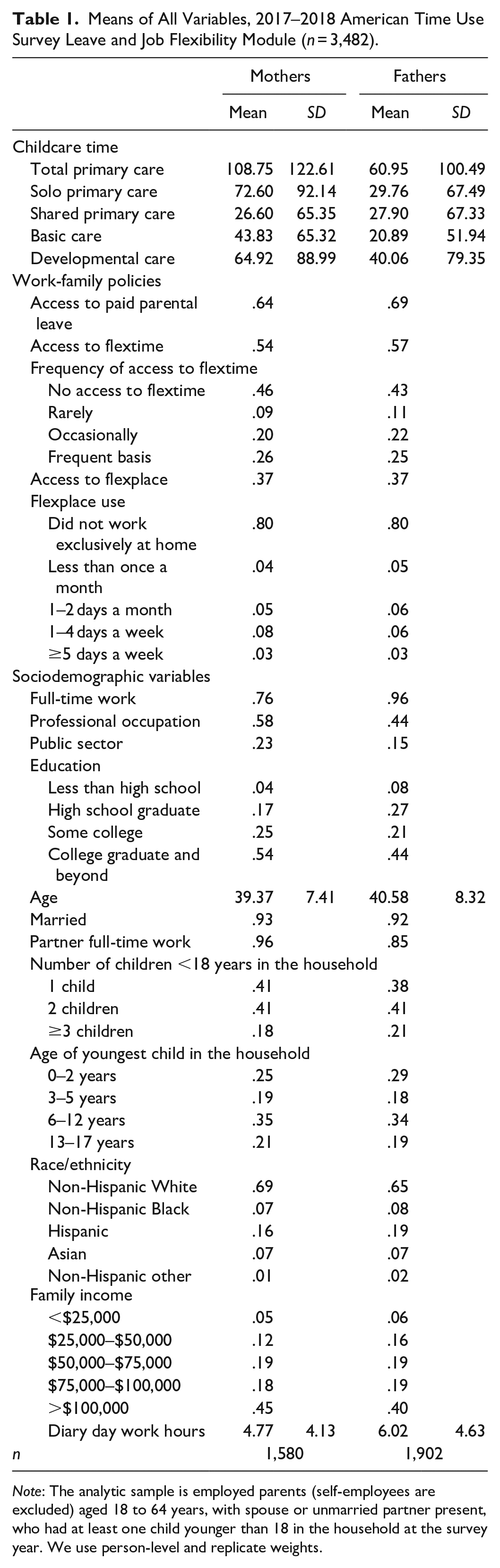
The major dependent variable is parents’ time spent in childcare. We use time-use variables to measure parents’ care of children in different dimensions. Parents’ total primary childcare time during the diary day is calculated by adding up time segments directly engaged in caregiving activities without doing other activities simultaneously. Childcare activities include caring and helping, teaching, and schooling, playing, health care, using professional childcare services, and traveling. Table 1 shows that mothers spend almost twice as much time in primary childcare activities per day as fathers (108.75 minutes for mothers and 60.95 minutes for fathers).
Means of All Variables, 2017–2018 American Time Use Survey Leave and Job Flexibility Module (n = 3,482).
Note: The analytic sample is employed parents (self-employees are excluded) aged 18 to 64 years, with spouse or unmarried partner present, who had at least one child younger than 18 in the household at the survey year. We use person-level and replicate weights.
The amount of time parents spend on primary childcare activities is further measured by whether in sole or shared charge. Compared with sharing parenting (in most cases, with children’s biological parents), solo childcare suggests a full responsibility for the children. To specify whether parents provide primary childcare activities alone or with a spouse or an unmarried partner present, we use the “with whom” filter to restrict the childcare activities that occurred without other adults as solo childcare and activities with a spouse or an unmarried partner as shared childcare. As seen in Table 1, mothers spend a higher proportion of primary childcare time in sole charge, whereas there is little disparity between solo and shared care time among fathers.
The final set of measures captures the content of primary childcare activities, regardless of which partner is present. We differentiate two broad categories of childcare activities, following prior studies (Altintas 2016; Kalil et al. 2012; Musick et al. 2016). Basic childcare tasks encompass physical care and looking after children. Developmental childcare activities include recreation, such as playing and doing arts and crafts; education that consists of reading, talking and listening, helping with homework; and management activities that include organizing and planning for children, attending children’s events, waiting for, picking up, and dropping off children, providing health care, and purchasing professional childcare services. Table 1 suggests that gender disparity in task allocation is greater in basic care than developmental care.
Independent Variables
Three sets of variables are considered work-family policies. The leave module asks whether the respondent receive paid leave on the job because of (1) illness of a family member, (2) childcare (other than for illness), and (3) birth or adoption of a child. We consider receiving paid leave because of illness, childcare, and the birth or adoption of a child as access to paid parental leave because these three are the driving factors of requesting leave for parents. As seen in Table 1, 64 percent of mothers and 69 percent of fathers reported having access to paid parental leave.
For schedule flexibility, the leave module only measures the availability of flextime. Access to flextime is a binary measure that captures whether the respondent can change their work start or end time. Frequency of access to flextime reports how frequently the respondent can change work start or end time. We code this measure into four categories: no access to flextime (reference), rarely, occasionally, and frequently. Table 1 shows that 54 percent of mothers and 57 percent of fathers work under flextime policies, and about a quarter of them can change their work schedules frequently.
Location flexibility has two measures: access and frequency of use. Access to flexplace measures whether the respondent can work at home at their main job (yes = 1, no = 0). Frequency of working exclusively at home measures whether there are days that the respondent works only at home, and the frequency of working exclusively at home, using the following categories: did not work exclusively at home (reference), less than once a month, one to two days a month, one to four days a week, and five or more days a week. Table 1 suggests that 37 percent of mothers and fathers are accessible to flexplace policy. Only 20 percent of parents work exclusively at home.
Controls
Parents’ employment and education affect their availability, ability, and willingness to spend time in childcare. Respondents’ and their partners’ full-time employment status are dichotomous variables indicating whether the respondent and the partner usually work 35 and more hours per week or not (yes = 1, no = 0). As managerial and professional employees are the most likely to gain control and autonomy in working schedules and locations, we control parents’ occupation categories of their main job. Public sector organizations are more likely to permit flexible work policies than private sector organizations. Whether working in the public sector (coded 1) or private sector (coded 0) is generated by the respondent’s class of worker in their main job. The total workload also competes for parents’ time in childcare, so we control work hours on the diary day. Respondents’ education is divided into four categories: less than high school (reference), high school graduate, some college education, college graduate and beyond.
Table 1 suggests that most of the gender differences occur in employment-related variables (only employed wage and salary workers are eligible to complete the leave module). Ninety-six percent of mothers have full-time employed partners, whereas only 85 percent of fathers do. A higher proportion of mothers than fathers work in professional positions and the public sector. Mothers also have more education than fathers. And mothers’ work hours on the diary day are much lower than fathers’ average (4.77 and 6.02 hours for mothers and fathers, respectively).
Children’s characteristics are strongly associated with the time needed to spend in childcare. The number of children younger than 18 in the household is coded into three categories: one (reference), two, and three or more. Thirty-nine percent have one child, 41 percent have two children, and 20 percent have three or more children). Age of the youngest child in the household is coded into four categories: 0 to 2 (reference), 3 to 5, 6 to 12, and 13 to 17 years. For more than one third of the parents, the youngest child is 6 to 12 years. Age of the parent is a continuous variable measured in years. Marital status is divided into married and cohabiting (reference). Most of the parents are married (93 percent of mothers and 92 percent of fathers). Race/ethnicity is coded as five dichotomous variables: non-Hispanic White (reference), non-Hispanic Black, Hispanic, Asian, and non-Hispanic other race. Two thirds are non-Hispanic White, 8 percent are non-Hispanic Black, 18 percent are Hispanic, 7 percent are Asian, and 2 percent are of other race/ethnicity.
Analytic Strategy
We present a series of ordinary least squares regression models of parents’ time-use patterns of childcare with controls for children’s and parents’ characteristics. Each measure of work-family policy, including access, the frequency of access, and the frequency of use, is displayed in different panels. To test gender differences in the associations between work-family policies and childcare time, we interact with each indicator of work-family policy with respondents’ gender in separate models. ATUS does not provide couple-level information. We assess only the population-level gender differences, rather than differences between mothers and fathers in the same households. For all analyses, we use person-level and replicate weights to account for oversampled demographic groups, overestimated time spent in activities done on weekends, and various response rates across demographic groups and days of the week. The ATUS replicate weights come from a modified balanced half-sample method of replication developed for the Current Population Survey (Bureau of Labor Statistics 2022).
Results
Paid Parental Leave
Table 2 and Figure 1 present regression results of the associations between access to paid parental leave and time spent in different kinds of primary childcare and whether the associations varied by parents’ gender. Model 1 shows that fathers with access to paid parental leave spent 11.76 minutes more per day, a 20.2 percent increase, in total primary childcare than fathers who did not have access to paid parental leave (p = .014). In contrast, mothers who had access to paid parental leave did not significantly differ from their counterparts in total childcare time (p = .506, computed using the Stata command lincom). The interaction term between access to paid parental leave and gender suggests that access to paid parental leave was associated with a 16.58-minute (35.4 percent) reduction in the population-level gender gap in total childcare time (p = .044).
Ordinary Least Squares Regression Results of Association between Paid Parental Leave and Parents’ Childcare Time (n = 3,482).

Note: Standard errors are shown in parentheses. Data are based on the 2017 and 2018 Leave and Job Flexibility Module of the American Time Use Survey. The analytic sample is employed parents (self-employees are excluded) aged 18 to 64 years, with spouse or unmarried partner present, who had at least one child younger than 18 in the household at the survey year. We use person-level and replicate weights.
p < .05, **p < .01, ***p < .001.

Parents’ childcare time by access to paid parental leave.
Models 2 and 3 in Table 2 present estimates of the association between access to paid parental leave and parents’ solo and shared childcare time. Accessing paid parental leave was associated with reduced gender difference in solo childcare time, but the decrease was not statistically significant. Parents’ shared childcare time was barely varied by their access to paid parental leave. Results in models 4 and 5 test the association between access to paid parental leave and the time spent in basic and developmental childcare. The population-level gender gap in basic childcare time remained about 20 minutes whether parents had access to paid parental leave or not. In contrast, the gender gap in developmental childcare time was reduced by 13.61 minutes among parents who had access to paid parental leave (p = .019). Such a 54.2 percent reduction in the population-level gender gap was driven by fathers who spent 8.25 minutes more (a 21.6 percent increase; p = .020) in developmental childcare than fathers without access.
Flextime
Table 3 reports whether the associations between parents’ access to flextime policy and childcare time varied by parents’ gender. Results in panel A of Table 3 show that fathers who had access to flextime spent significantly more minutes per day in total, shared, and basic childcare than fathers who did not have access. Findings in panel B of Table 3 and in Figure 2 further indicate that only fathers who could frequently access to flextime significantly increased time spent in most dimensions of childcare compared with fathers who did not have access to flextime. The rates of increase were 26.7 percent for total childcare time, 35.7 percent for shared childcare time, 30.8 percent for basic childcare time, and 24.8 percent for developmental childcare time.
Ordinary Least Squares Regression Results of Association between Flextime and Parents’ Childcare Time (n = 3,482).

Note: Standard errors are shown in parentheses. Data are based on the 2017 and 2018 Leave and Job Flexibility Module of the American Time Use Survey. The analytic sample is employed parents (self-employees are excluded) aged 18 to 64 years, with spouse or unmarried partner present, who had at least one child younger than 18 in the household at the survey year. We use person-level and replicate weights.
p < .05. **p < .01. ***p < .001.
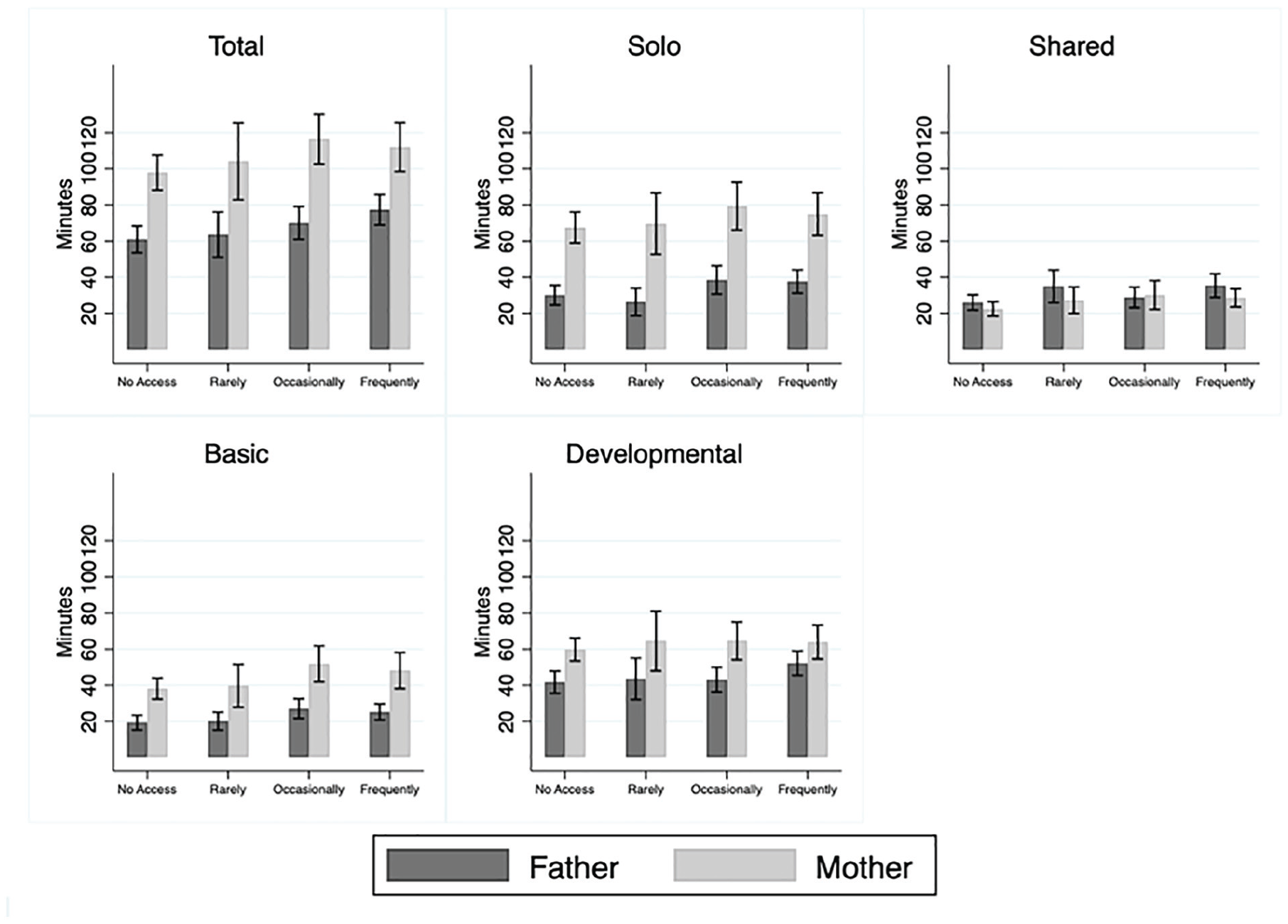
Parents’ childcare time by frequency of access to flextime.
However, gender gaps in all measures of childcare time were not reduced among parents have access, even with frequent access to flextime, because of mothers’ and fathers’ similar increases in childcare time under the same condition. For example, although fathers who had access to flextime spent 10.90 minutes more in total childcare (p = .024) compared with fathers who did not have access to flextime, mothers with access to flextime spent 16.02 minutes more than mothers who did not have access to flextime (p = .019). Therefore, there was no statistically significant change in gender gaps in total childcare time between parents had and did not have access to flextime.
Flexplace
Table 4 shows how access and use of flexplace were associated with time spent in childcare, and whether the associations varied by parents’ gender. Results in panel A (and Figure 3) suggest that access to flexplace was associated with reductions in the population-level gender differences in total, solo, basic, and developmental childcare time, but these reductions were not statistically significant at the .05 level. Findings in panel B of Table 4 (and in Figure 4) show that fathers who used flexplace policy spent more minutes in most childcare measures than fathers who did not use a flexplace policy, especially those worked five or more days a week exclusively at home.
Ordinary Least Squares Regression Results of Association between Flexplace and Parents’ Childcare Time (n = 3,482).

Note: Standard errors are shown in parentheses. Data are based on the 2017 and 2018 Leave and Job Flexibility Module of the American Time Use Survey. The analytic sample is employed parents (self-employees are excluded) aged 18 to 64 years, with spouse or unmarried partner present, who had at least one child younger than 18 in the household at the survey year. We use person-level and replicate weights.
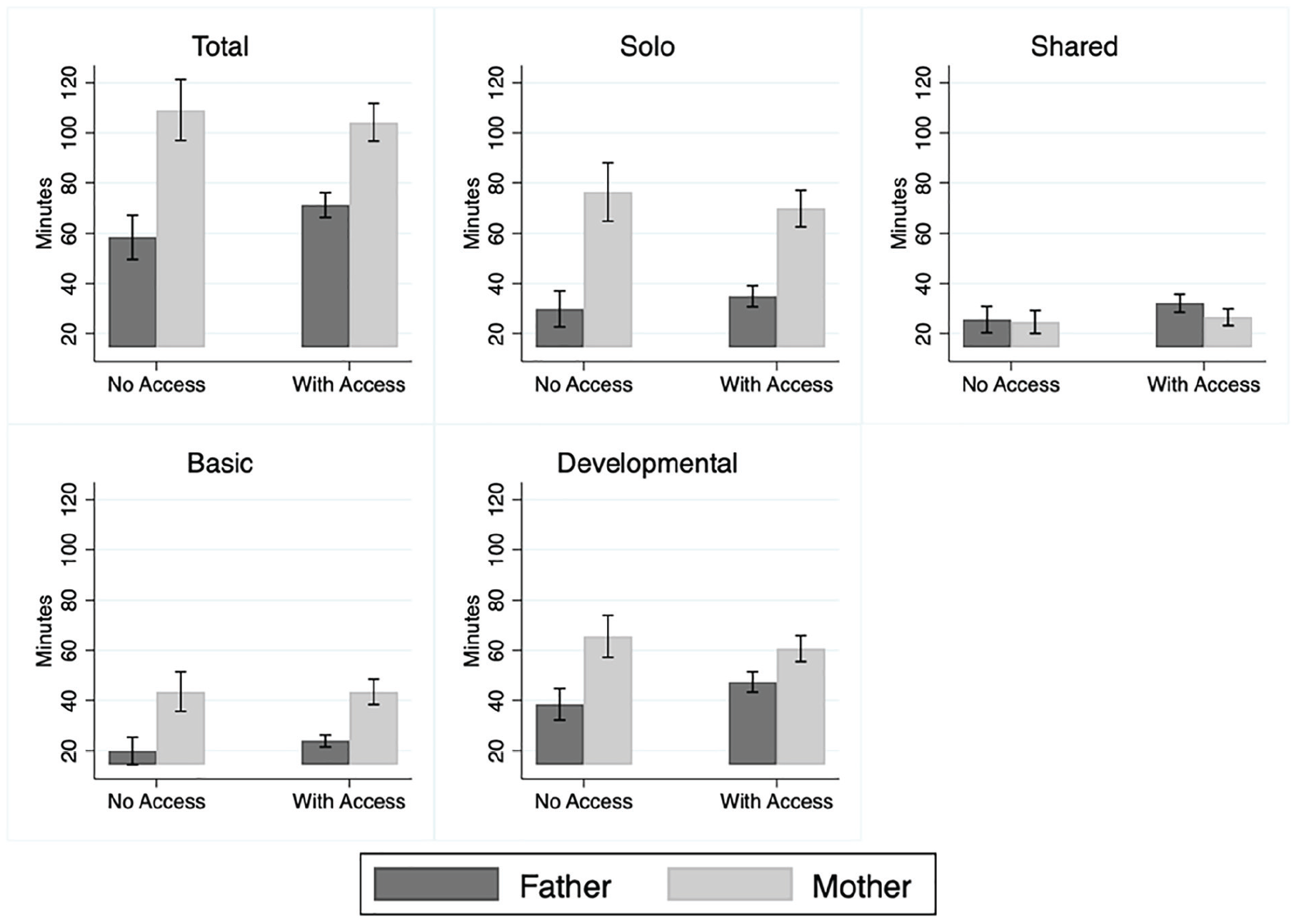
Parents’ childcare time by access to flexplace.

Parents’ childcare time by frequency of flexplace use.
For gender differences in childcare time, model 1 in Table 4, panel B, indicates that among parents who worked exclusively at home for five or more days a week, the difference between mothers’ and fathers’ time spent in total childcare was 40.50 minutes smaller (a 109.8 percent reduction; p = .028) than that among parents did not work exclusively at home. Moreover, model 2 in Table 4, panel B, shows that the gender difference decreased by 31.44 minutes (a 68.1 percent reduction; p = .036) in solo childcare time. Such a decrease in gender differences were driven by fathers who worked exclusively at home for five or more days a week and spent 20.10 minutes more (a 64.9 percent increase; p = .036) in solo childcare activities that those who never worked exclusively at home. Mothers’ solo childcare time did not vary by their frequency of working exclusively at home. Working at home frequently is also associated with reduced gender differences in basic and developmental childcare time; however, the reductions were not statistically significant.
Discussion and Conclusion
We use the recent 2017–2018 leave module of the ATUS to estimate the association between three types of work-family policies—paid parental leave, flextime, and flexplace—and two dimensions of childcare activities: solo versus shared care with a partner and the content of childcare activities. Interactions between each indicator of work-family policy and gender denote whether specified policies are associated with reduced population-level gender difference in a particular type of childcare time. This study reveals three key findings. First, contrary to early studies indicating that work-family policies have a more significant impact on mothers than on fathers, this study shows that some work-family policies might reduce gender gaps in childcare time, primarily because fathers significantly increase their time spent on childcare when accessing or using such policies. In general, mothers’ childcare time does not vary significantly by their access or use of work-family policies.
Second, work-family policies reduce gender gaps in childcare time only under certain conditions. Accessing paid parental leave, working exclusively at home for five or more days a week significantly mitigate gender differences in childcare time by their association with increased father involvement. Flextime, however, is associated with both mothers’ and fathers’ more time spent on childcare. Results suggest that the combination of time availability and socialization may be key to establishing involved fathering identity. This is important, as previous research has shown that only frequent and exclusive exposure to childcare tasks leads fathers to be more engaged in childcare. The pressures of traditional gender norms make mothers spend a large proportion of their time on childcare regardless of policy supports. By providing more available time, mothers with access to flextime may allocate more time on childcare without relying on the commitment to domestic labor.
Third, we deconstructed childcare time into two dimensions, solo or shared care and basic or developmental care, to contour the nature of gendered childcare time. As the literature on involved fathering suggests, fathers’ solo and basic childcare time represent a transformation in the gendered division of household labor. The results show that gender differences in solo or basic childcare time do not vary by parents’ access to paid parental leave, flextime, and flexplace. Gender inequalities in time spent in childcare activities that are vital in shaping gender inequalities in society were only significantly reduced when working exclusively at home almost every day. The findings suggest that although work-family policies address a worthy goal of promoting fathers’ involvement in childcare, even in childcare activities that are traditionally excessively performed by mothers, gender inequalities in childcare time persist under most work-family policy conditions.
Some limitations of this study should be noted. First, this study does not account for couple dynamics and possible selection effects in the relationship between work-family policies and childcare time. ATUS provides cross-sectional data and does not provide the respondent’s partner’s leave and job flexibility information. Parents with stronger commitments to time with children may intentionally choose to work in a family-friendly workplace. There are also negotiations between mothers and fathers (see, e.g., Noonan et al. 2007). However, the data in this study only assess mothers and fathers separately, rather than mothers and fathers in the same households. It is premature to draw firm conclusions on whether work-family policies narrow or widen gender inequalities in childcare within households. Future research should pay particular attention to couple dynamics and selection bias when couple-level and longitudinal data are available.
Second, although we disentangle three types of work-family policies and two dimensions of gender inequalities in childcare time, some details are not included. Because of data constraints, we cannot examine the variations in the use of paid parental leave and the length of leave-taking. For flextime, ATUS does not provide information on the use of flextime. Moreover, as Glass and Finley (2002) reviewed, workplace social support represents the interpersonal dimension of work-family policies. However, this study cannot examine the impact of employers’ support. Considering that work-family policies are usually managed case by case in the United States, future studies should include the interpersonal dimension of policies to more fully evaluate the role of work-family policies in gender inequalities in childcare time. For the indicators of gender inequalities in childcare time, multitasking is not included in this study. Secondary childcare is available only for household children younger than 13 years in ATUS. Expanding indicators of gender inequalities in childcare time would be helpful for future studies in assessing whether work-family policies are associated with more equitable childcare time between mothers and fathers.
Despite these limitations, this study offers insights into whether work-family policies could improve parents’ involvement in childcare and whether policies could alter gendered childcare time. Using recent nationally representative data and addressing the heterogeneity in work-family policies and childcare time, this study clarifies the circumstances of reducing gendered time use in childcare. The results highlight that although paid parental leave, flextime, and flexplace are associated with increased father involvement in childcare tasks, gender inequalities in childcare time decrease only if the policy provides both available time and physical exposure to childcare tasks. These findings are especially intriguing for gender inequalities in light of the coronavirus disease 2019 pandemic. The massive changes in the structure of how people work call for new research on the association between flexible working and gendered time allocation in work and family. Evidence suggests that gender inequalities in childcare have reduced during the lockdown period, which may be related to changes in parents’ time and place of work (Carlson et al. 2021; Chung et al. 2021; Lyttelton et al. 2022; Yavorsky, Qian, and Sargent 2021). Future studies should expand the measures of work-family policies and gender inequalities in childcare time and adopt couple-dynamics analysis to evaluate better the effectiveness of work-family policies in building equitable gender relationships in childrearing.
Supplemental Material
sj-docx-1-srd-10.1177_23780231221142677 – Supplemental material for Work-Family Policies and Gender Inequalities in Childcare Time
Supplemental material, sj-docx-1-srd-10.1177_23780231221142677 for Work-Family Policies and Gender Inequalities in Childcare Time by Melody Ge Gao and Hangqing Ruan in Socius
Footnotes

Supplemental Material
Supplemental material for this article is available online.
Author Biographies
References
Supplementary Material
Please find the following supplemental material available below.
For Open Access articles published under a Creative Commons License, all supplemental material carries the same license as the article it is associated with.
For non-Open Access articles published, all supplemental material carries a non-exclusive license, and permission requests for re-use of supplemental material or any part of supplemental material shall be sent directly to the copyright owner as specified in the copyright notice associated with the article.
