



Abstract
The author examines if the association between immigration and mental health, as measured by psychological distress, is altered by homeownership status among a sample of immigrants to Toronto, Canada compared with the native-born (n = 1,909). Adjusted multivariate results indicate lower psychological distress among foreign-born homeowners compared with native-born renters and owners and foreign-born renters. This association is due in part to greater ontological security among immigrant homeowners, compared with renters (native-born and foreign-born) and higher perceived status attainment compared with foreign-born renters. However, contrary to predictions, the lower psychological distress among foreign-born owners, compared with native-born owners, is not due to higher ontological security among this group of the foreign-born compared with their native-born counterparts.
Empirical research on the mental health of non-refugee immigrants shows that despite barriers in successful social integration, immigrants benefit from superior mental health relative to the native-born. Although this advantage tends to deteriorate over time and across generations (Aglipay, Colman, and Chen 2013; Ali 2002; Cook et al. 2009; Jasso et al. 2004; Montazer 2020), research suggests that at average length of residence (LOR) in the host country, some foreign-born continue to benefit from better psychological health than the native-born (Montazer 2018a). The emotional advantage among immigrants, often dubbed the “healthy immigrant effect,” has been partly attributed to the selection of healthier individuals to migrate, and to selection factors that may be inherent in host-country immigration policies (Cook et al. 2009; Jasso et al. 2004). Aside from selection, the emotional health advantage among immigrants may also be due to integral features of the psychology of migration, for example, the prospect of better life circumstances and opportunities (Beiser 1999). 1
One metric for better life circumstances and opportunities, and a potentially important moderator of immigrant mental health, may be homeownership. 2 Homeownership represents a positive social identity, and a symbol for having achieved high status; it is an expression of economic progress, wealth accumulation, financial well-being at the household level and an asset that can be bequeathed to one’s child(ren) (Constant, Roberts, and Zimmermann 2008; Dietz and Haurin 2003; Dupuis and Thorns 1998; Lindblad and Quercia 2015; Oh 2004). Furthermore, homeownership is associated with security, which likely results in a less stressful life (Rohe, Van Zandt, and McCarthy 2013), and greater place attachment, and it has been linked to improved psychological health for all members of the household (Dietz and Haurin 2003; Manturuk 2012). The beneficial impacts of homeownership for mental health, however, might be particularly important for the psychological health of immigrants compared with the native-born.
Homeownership for immigrants is not only paramount in the development of this groups’ economic and social incorporation and advancement in the host country (Constant et al. 2008; Gellatly and Morissette 2019), but it is also a critical stage of assimilation into the mainstream society (Oh 2004; Yu and Haan 2011). Homeownership may solidify immigrants’ intention to stay as they shift where they invest their time and money from their origin to destination communities (Dustmann and Mestres 2010; Tesfai 2016). Finally, homeownership might be especially conducive to feelings of “having made it,” belonging in the host country and the experience of more “ontological security” (Dupuis and Thorns 1998) for immigrants compared with the native-born and foreign-born renters. Ontological security refers to a feeling of confidence, continuity of self-identity, and constancy of one’s social and material environment (Giddens 1990).
Although on the one hand, immigrant mental health (e.g., Aglipay et al. 2013; Ali 2002; Cook et al. 2009; Montazer, Wheaton, and Noh 2016) and, on the other hand, immigrant housing tenure attainment (e.g., Constant et al. 2008; Gellatly and Morissette 2019; Haan, Yu, and Draghici 2021) have been the focus of separate extant research, to date no study has examined the moderating role of homeownership on the mental health of immigrants. Given the importance of immigration for population growth in highly developed countries such as Canada (Palameta 2004), and the importance of homeownership for most immigrants (Dingman 2022; Gellatly and Morissette 2019; Hiebert 2017), it is important to understand how this form of status attainment affects a central indicator of the adaptive response of immigration: mental health (Ataca and Berry 2002).
Drawing on data from the Neighbourhood Effects on Health and Well-Being (NEHW; O’Campo et al. 2015) study from Toronto, Canada, this work adds to research on immigrant mental health by examining (1) if the mental health of immigrants, as measured by psychological distress, is mitigated by homeownership and, if yes, (2) whether perceptions of ontological security and perceived social status attainment explain the moderated association between immigrant status and psychological distress by homeownership status. Psychological distress is one of the most widely used indicators of mental health and a common behavioral response to stressful conditions, which manifests as a mixture of depression and anxiety (Wheaton and Montazer 2017).
Background
The scholarship on immigration over the past century presents contrasting findings of the effects of immigration on mental health. On the one hand, early twentieth-century scholarship that relied on Warner and Srole’s (1945) “straight line” model of assimilation predicted higher rates of mental health problems among the foreign-born that were expected to decrease with time in the host country as immigrants adopted the “cultural patterns” of the host society (Thomas and Znaniecki [1918–1920] 1984). On the other hand, newer research on post-1965 immigrants reports a healthy-immigrant effect. This newer research views the foreign-born as a highly selected group of individuals who were physically, emotionally, financially, and socially able to leave behind the life they knew and venture to a new and foreign land, factors that should give them a mental health advantage over the native-born (Cook et al. 2009; Jasso et al. 2004; Montazer et al. 2016).
Although the reported mental health advantage among immigrants does not appear to last indefinitely, research suggests that at average LOR immigrants continue to benefit from superior mental health than the native-born (Montazer 2018a). However, as theorized by the stress process model (Pearlin 1999) and suggested by research on this topic, the mental health of immigrants may be sensitive to variation in the unfolding experience of this group in the host country (Montazer 2020); there are diverse trajectories of adaptation and incorporation into the host society that can affect the mental health of the foreign-born (Portes and Zhou 1993). This paper argues that one experience that might have consequences for the unfolding of immigrant mental health is homeownership status.
Homeownership and Mental Health
Social inequalities in mental health may be attributed to both absolute and relative material deprivation, which is the social meaning and feeling people attach to their material circumstances (Dunn 2000). One significant engine of social inequality that has important consequences for mental health, particularly in Western societies that ascribe a great deal of meaning, prestige and status to it, is homeownership (e.g., Dunn 2002; Manturuk 2012). However, not all homeownership is created equal; owning a home in a city with a more challenging housing market may have especially significant material (i.e., wealth generation) and meaningful (i.e., self-identity and pride and a source of social status) dimensions (Fligstein, Hastings, and Goldstein 2017; Herbert and Belsky 2008), which can have especially beneficial consequences for mental health (Dunn 2002). Conversely, inability to enter the housing market in such cities may have detrimental consequences for mental health, as it may lead to a greater sense of relative deprivation and higher mental health problems among renters than owners.
Toronto is one such city, with one of the most expensive housing markets in Canada (Statistics Canada 2014) and the fifth least affordable housing market in the world (Hanson 2021). In 2011 (the year the data for this study were collected), Toronto had the most expensive housing market in Ontario and the third most costly housing market in Canada (after Vancouver and Victoria in British Colombia) (Montazer and Young 2020; Statistics Canada 2014). In 2012, the average price for a detached home in Toronto exceeded CAN$800,000, while the average price for a condominium was more than CAN$350,000 (Pigg 2012). The average price of a home in the greater Toronto area (Toronto and four surrounding regional municipalities) was approximately CAN$500,000. Furthermore, the high land transfer tax for those who are not first-time home buyers and bidding wars can drive the cost of housing even higher (Pigg 2012). Because of a growing proportion of young people, immigration, and the “hot” housing market influencing where people choose to live and work, there is also high demand in the Toronto rental market (Burda 2013). This high demand has led to a 37 percent increase in rent prices in Toronto between 2000 and 2011, while wages increased by only 10 percent during this time. In 2011, the average rent price was CAN$1,072 for private apartments and CAN$1,518 for condominium apartments (Myles 2017).
Despite Toronto’s unaffordable housing market, recent data from Ipsos Public Affairs presented by the Toronto Regional Real Estate Board suggest that a large share of nonrefugee new immigrants in Toronto are home buyers within their first five years of arriving in Canada, and in general they are more interested in homeownership than the non-immigrant population (Dingman 2022; Gellatly and Morissette 2019). Of course, immigrants’ settlement intentions—which are determined by social, structural and cultural integration that designate the process of inclusion in various domains of life in the host country (Sapeha 2016; Toruńczyk-Ruiz and Brunarska 2020)—may affect their decisions to buy property (Dustmann and Mestres 2010). Although data suggest that homeownership may be so important to immigrants to Toronto that some may be willing to pay even more than non-immigrants to purchase a home (Dingman 2022), the unaffordability of Toronto’s housing market may not allow all foreign-born, despite their intention to stay or desire to become homeowners, to be able to purchase a home, leading to mental health differences among immigrants by homeownership status. The aforementioned argument leads to the following hypothesis: psychological distress, at average LOR, will be lower among immigrant homeowners compared with the native-born homeowners and renters and foreign-born renters (hypothesis 1).
Homeownership, Ontological Security, Perceived Status Attainment, and Mental Health
According to Giddens (1984), ontological security is a sense of confidence and trust in the world; it refers to a continuity of self-identity, and constancy of one’s social and material environment. For Giddens, ontological security is best sustained by the routine of face-to-face interaction within the kinship system in the natural premodern world (Dupuis and Thorns 1998). Unlike Giddens, Saunders (1984) believes that ontological security can also be obtained in the built environment of the modern world. For Saunders, the “home is the key locale in modern society where ontological security can be sought” (Dupuis and Thorns 1998:28). According to Saunders, homeownership leads to “ontological security,” which might promote a general sense of well-being (Dupuis and Thorns 1998; Saunders 1984). The home offers individuals a sense of control over their environment, where they feel “free from surveillance, free to be themselves and at ease, in the deepest psychological sense, in a world that might at times be experienced as threatening and uncontrollable” (Dupuis and Thorns 1998:25).
To buttress Saunders’s argument, qualitative research has documented an association between homeownership and ontological security. For example, one study using interview data with 43 adults in Scotland showed that homeowners talked about their homes as a source of stability and consistency and concluded that they felt greater autonomy than renters (Hiscock et al. 2001). Another qualitative study in New Zealand showed that owning a home provided people with a sense of identity and a secure, consistent space to which they could return (Dupuis and Thorns 1998). Thus, it can be argued that the positive association between homeownership and improved mental health (e.g., Dunn 2002; Manturuk 2012; Manturuk, Lindblad, and Quercia 2017), may be due in part to higher ontological security among homeowners compared to renters.
The meaning of home and ontological security, however, might vary by foreign-born status. As elaborated by traditional theories of immigration, the immigrant is a marginal person who is alienated and does not feel like they belong to either the new or old world (Park 1928; Thomas and Znaniecki [1918–1920] 1984). Indeed, even newer research that reports better mental health among the foreign-born does so despite lower reported perceived social support among this group compared with the native-born (Montazer 2020), which highlights the continual marginality of immigrants in their new home countries. Homeownership, then, may be particularly significant for immigrant families, as it may be viewed as a symbol of permanency and belonging in their adopted countries. For this group, homeownership may fulfill a natural possessive instinct and a desire to mark out one’s own territory (e.g., Lindblad and Quercia 2015; Saunders 1990); it may imply a greater sense of ontological security than for the native-born. Accordingly, the next hypothesis proposes that the lower psychological distress among immigrant homeowners, compared with the native-born (owners and renters) and foreign-born renters, will be due in part to higher ontological security among immigrant homeowners compared with either reference group: native-born owners and renters and foreign-born renters (hypothesis 2).
The last hypothesis predicts that the lower psychological distress among immigrant homeowners, compared with immigrant renters, will be due to higher perceived “status attainment” of foreign-born homeowners in the host country (hypothesis 3). According to social comparison theory (Festinger 1954), there is a drive within individuals to evaluate themselves in relation to outside images. Motives for self-comparison may include self-enhancement, perceptions of relative standing, and maintenance of a positive self-evaluation (Kruglanski and Mayseless 1990; Suls, Martin, and Wheeler 2002). As stated above, the better mental health of non-refugee immigrants has been attributed in part to the selection of those who on average have higher skills and qualifications than individuals in the sending countries (Borjas 1994), and who chose to migrate to a new and foreign land to further improve their social standing (Melzer and Muffels 2012). One metric for improved social position is homeownership (Constant et al. 2008; Gellatly and Morissette 2019). Thus, holding constant ontological security and other relevant factors, such as intention to stay, household income, and LOR in the host country, immigrant homeowners may perceive greater general achieved social status, than immigrant renters and should thus benefit from better mental health than this reference group.
Methods
Data
The data for the study come from the NEHW study (O’Campo et al. 2015), which is an individual-level data set gathered using a cross-sectional, multilevel design across 47 neighborhoods in the metropolitan city of the greater Toronto area. Face-to-face interviews were conducted with 20 to 30 respondents in 87 census tracts across the city-defined neighborhoods in Toronto. The NEHW data set comprises interviews with 2,412 individuals conducted between 2009 and 2011. The response rate was more than 80 percent. To be eligible for study participation, individuals had to be residents of the selected households, to be between the ages of 25 and 64 years, to be able to communicate in English, and to have lived in the neighborhood for at least six months (for more details on sampling and study design, see O’Campo et al. 2015). Sampling weights on the basis of nativity, gender, household members, and income were derived to correct for any selection biases that may have occurred because of these sampling restrictions, such as the underrepresentation of the most recent immigrants.
To avoid mixing the adaptation trajectories of child or adolescent respondents with those of adults, two groups that likely experience qualitatively different sets of issues as migrants (Montazer 2018b; Rumbaut 2004), the immigrant sample is restricted to those who came to Canada after the age of 18 years. Furthermore, refugees were excluded from the analyses (n = 46) because they are a different group socially and economically than the general immigrant population (Setia et al. 2011). These restrictions resulted in a final analytic sample size of 1,909, of whom 428 were foreign-born.
Although the NEHW study was originally designed as a study of neighborhood effects on health, it contains relevant measures to test the study hypotheses while controlling for a rich set of measures that may affect mental health and homeownership. These data are also advantageous to the present study, as they are based in Toronto, a metropolitan city comprising close to 50 percent immigrants (O’Campo et al. 2015).
Focal Variables
The focal dependent variable is psychological distress, which is measured using a total of 16 items based on Radloff’s (1977) Center for Epidemiologic Studies Depression Scale and the Spielberger Anxiety Scale (Spielberger et al. 1979) to tap psychosomatic symptoms of malaise, depression, and anxiety. Respondents were asked how often they thought everything was an effort, felt as though they could not get going, had less interest in usual activities, or did they worry over possible misfortunes, for example. Respondents were asked whether they felt symptoms such as these none of the time (1), a little of the time (2), some of the time (3), most of the time (4), or all of the time (5). Factor analyses confirmed that the 16 items selected had comparable factor loadings and an index of these items was created so that higher scores reflect greater psychological distress (α = .95).
The country of birth of respondents was used to create a dummy variable for foreign-born status (vs. native-born). The respondent was also asked, is your home “owned without a mortgage by your household” (1), “owned with a mortgage by your household” (2), or “rented by your household” (3). Responses to the question about homeownership status and foreign-born status are used to create a dummy variable indexed with four categories to measure homeownership/foreign-born status: foreign-born homeowner, foreign-born renter, native-born renter, and native-born homeowner (reference category). 3
Markers of ontological security include constancy, daily routines, privacy, and security (Padgett 2007). Although not all of these markers can be measured with available items in the NEHW study, ontological security is operationalized by creating an index that takes the mean of three items that ask respondents how they feel about various aspects of their home. Respondents were asked the degree to which they agree (1 = “strongly agree” to 5 = “strongly disagree”) with the following statements: “Most of the time, I feel in control of what happens in my home,” “My house/apartment is a place where I feel safe,” and “My house/apartment is a place where I feel at home.” Higher scores indicate greater ontological security (α = .68).
The average of two items adapted from the work of Noh and Avison (1992) and asked only of the foreign-born is used to create an index of perceived status attainment. These respondents were asked to indicate how often they “feel that living in Canada is stressful because” “I am disappointed that my standard of living is not what I had hoped for when I first came to Canada,” and “I do not feel I have the respect I had in my country of origin.” Response options range from “never” (1) to “very often” (4). Items were reverse-coded so that higher values indicate grater perception of status attainment (α = .86). Because these question are relevant only for immigrants (not asked of the native-born), the index is coded conditionally by foreign-born status to allow for the inclusion of the native-born in the analyses (Ross and Mirowsky 1992). The goal is to compare those who are foreign-born with those who are not while representing the effect of perceived status attainment that only applies to the foreign-born. Conditional coding entails that perceived status attainment is entered in the model only as an interaction term with a dummy variable for the groups in which the variable is relevant (i.e., foreign-born respondents) and without a main effect. When perceived status attainment is treated as an outcome variable, the sample is restricted to immigrants only.
Covariates
It is important to carefully control for the wide variety of factors that might simultaneously influence mental health and homeownership; people do not randomly become homeowners and renters (Lindblad and Quercia 2015) and mental health is not randomly distributed in the population (Pearlin 1999). Therefore, the analyses adjust for a number of theoretically important covariates that may affect the predicted associations. 4 For example, research suggests that participation in the housing market reflects sociodemographic characteristics, cultural values, and norms and is affected by chronic health conditions, LOR in the host country among immigrants, immigrant entrance category, and immigrants’ intention to stay in the host country (Chatterjee and Zahirovic-Herbert 2011; Constant et al. 2008; Herbert and Belsky 2008; Leloup, Apparicio, and Esfahani 2011; Manturuk et al. 2017; Sapeha 2016), all factors that also affect mental well-being (e.g., Manturuk et al. 2017; Montazer 2018b, 2020). Furthermore, better neighborhood and residential amenities could be another reason homeownership is related to mental health (Manturuk et al. 2017). Thus, it is important to separate the effect of homeownership from that of neighborhood and residential attributes, by controlling for such factors as living in crowded, multifamily buildings, dwellings with problems, and less ideal neighborhoods. However, a comprehensive model of immigration must also account for possible suppressors, or protective factors, such as social support and household income (Beiser 2004; Montazer 2020; Yang 2020), that may make the association between an independent variable (i.e., foreign-born/homeownership) and a dependent variable (distress) apparent or stronger when included in the model (Schieman 2009).
Gender is a dummy variable that equals 1 for female and 0 for male. Age is coded as a five-category dummy variable to reflect its possible nonlinear effect (O’Campo et al. 2015). The categories include younger than 30 years, between 30 and 39 years, between 40 and 49 years, between 50 and 59 years, and those older than 60 (as the reference group). Marital status is a dummy variable indexed with four categories: married or common law, divorced or separated, widowed, and never married. Employment status is a dummy variable indexed with five categories—employed, homemaker, retired, other, and unemployed—and household income is a continuous variable that ranges between $4,800 and $800,000. Parental status is a dummy variable that equals 1 for parents and 0 for nonparents. Household size is a continuous variable that takes the count of the number of individuals living in the household. Total years of education is a continuous variable that measures the total number of years of education of the respondent. Ethnicity/culture is a dummy variable indexed with eight categories: Arab or West Asian, African, Caribbean, South Asian, East Asian Pacific Rim, Latin, and European, with North American/Canadian ethnic/cultural identity as the reference category. These categories were created from the standard Statistics Canada (2008) ethnicity coding. Chronic health conditions is a continuous variable that takes the count of 18 health conditions the respondent may have, including heart disease, asthma, cancer, and ulcers.
The analyses also adjust for a number of immigration-related covariates, residential related variables, and perceived social support. Immigration related covariates include immigrant entrance class, limited English speaking ability, intention to stay, and LOR in the host country. Immigration entrance category is a dummy variable with three categories: work visa, landed immigrant (a non-Canadian citizen permanent resident), and all other respondents as the reference category. Limited English language speaking ability is coded 1 for those indicating limited English language speaking ability versus those who indicated being proficient (0). Intention to stay is a continuous variable that asks foreign-born respondents to indicate “How likely would [they] say it is that [they] will return to [their] country of origin to live permanently.” This variable ranges from “very likely” (1) to “not at all likely” (5).
LOR is measured by subtracting the year of arrival from the year of the interview for those who indicated being born outside of Canada. As with the measure of perceived status attainment, and intention to stay, LOR is coded conditionally by foreign-born status (Ross and Mirowsky 1992). However, to be sensitive to the association of LOR and mental health by homeownership status, the conditional effect of LOR is subdivided by homeownership status, as opposed to a single dummy variable representing the foreign-born (Montazer 2020).
Residential related covariates comprise value of home, neighborhood quality, percentage of residents with the same ethnicity as the respondent (percentage ethnic same), dwelling problems, multifamily dwelling, rent or mortgage too much, and a continuous variable that measures tenure in the current place of residence (in years). Value of home is a continuous variable that measures the current dollar value of the respondent’s home. As value of home is pertinent only to homeowners, this variable is coded conditionally by homeownership status. Dwelling problems is a dummy variable that equals 1 if the respondent answered “yes” (and 0 if “no”) to the following question: Do you have problems with any of the following in any room in your home: Condensation on windows or walls; damp smell; mold growth on carpets, curtains, or furniture; mold growth on walls, ceilings or floors; mold or rot in window frames?
Respondents were asked, “What type of home do you live in?” Responses to this question was used to create a dummy variable that equals 1 for those indicating living in multifamily dwellings (apartment or flat in a duplex, low-rise apartment building, high-rise apartment building) and 0 for those indicating living in single-family dwellings (single detached house, semidetached house, or row or town house).
Research suggests that immigrants devote a higher proportion of their financial resources to housing than the native-born (Hiebert 2017), which might negate the beneficial impact of homeownership or exacerbate the negative impact of renting for these individuals. To tap this, a dummy variable was created that equals 1 if the respondent indicated that their rent or mortgage is too much (vs. not).
The neighborhood quality index takes the average of 12 items that ask the respondent to indicate how strongly they agree or disagree with the following: my neighborhood “has clean parks, gardens, green or open spaces,” “has safe places for children to play,” “has food stores where I can easily buy healthy foods such as fruits and vegetables,” and “has good recreational and cultural facilities,” for example. Higher values indicate higher quality (α = .82).
To measure the percentage of residents with same ethnicity as the respondent (percentage ethnic same), 14 separate ethnic groups, based on Statistics Canada classifications used in the 2006 census (Statistics Canada 2008), were used to create a percentage measure to account for the number of people in the census tract who match the ethnicity of the respondent (the latter based on self-reports). This measure is considered an individual-level measure, as the value varies by individual rather than by census tract. Residents not included in these percentages are considered dissimilar from the respondent on that particular feature.
Finally, perceived social support is captured with an index that takes the average of 16 items from the Medical Outcomes Study Social Support Survey (Sherbourne and Stewart 1991). Respondents were asked how often (1 = “none of the time,” 2 = “a little of the time,” 3 = “some of the time,” 4 = “most of the time,” or 5 = “all of the time”) different kinds of support are available to them. Some examples include “someone who shows you love and affection,” “someone to give you information to help you understand a situation,” and “someone to do something enjoyable with.” Higher values indicated greater perceptions of social support (α = .96).
Statistical Analyses
The design of the NEHW study clusters respondents by neighborhood. Therefore, error terms across respondents within the same neighborhood are likely correlated. To address clustering concerns and to separate the variance in outcomes across neighborhoods (level 2) as a proportion of the total variance in each outcome (level 1), respectively, all analyses used hierarchical linear modeling (Raudenbush and Bryk 2002). About 3 percent of the total variance in psychological distress occurs because of neighborhood differences. All variables were grand mean centered (Raudenbush and Bryk 2002), which makes the intercept interpretable as the value of the response variable (i.e., distress) at the mean value of the predictor variables, and it also helps with avoiding collinearity among predictors (Wu and Wooldridge 2005). 5
Twenty-five percent of the sample were missing on at least one of the variables used in the analyses (mainly household income). Thus, multiple imputation methods, with five data sets imputed, were used to impute cases missing values on any of these variables (Little and Rubin 1987). The results produced from each imputed data set were then combined to produce one overall analysis. Results of analysis with the nonimputed data (n = 1,447) generated results comparable with those presented here.
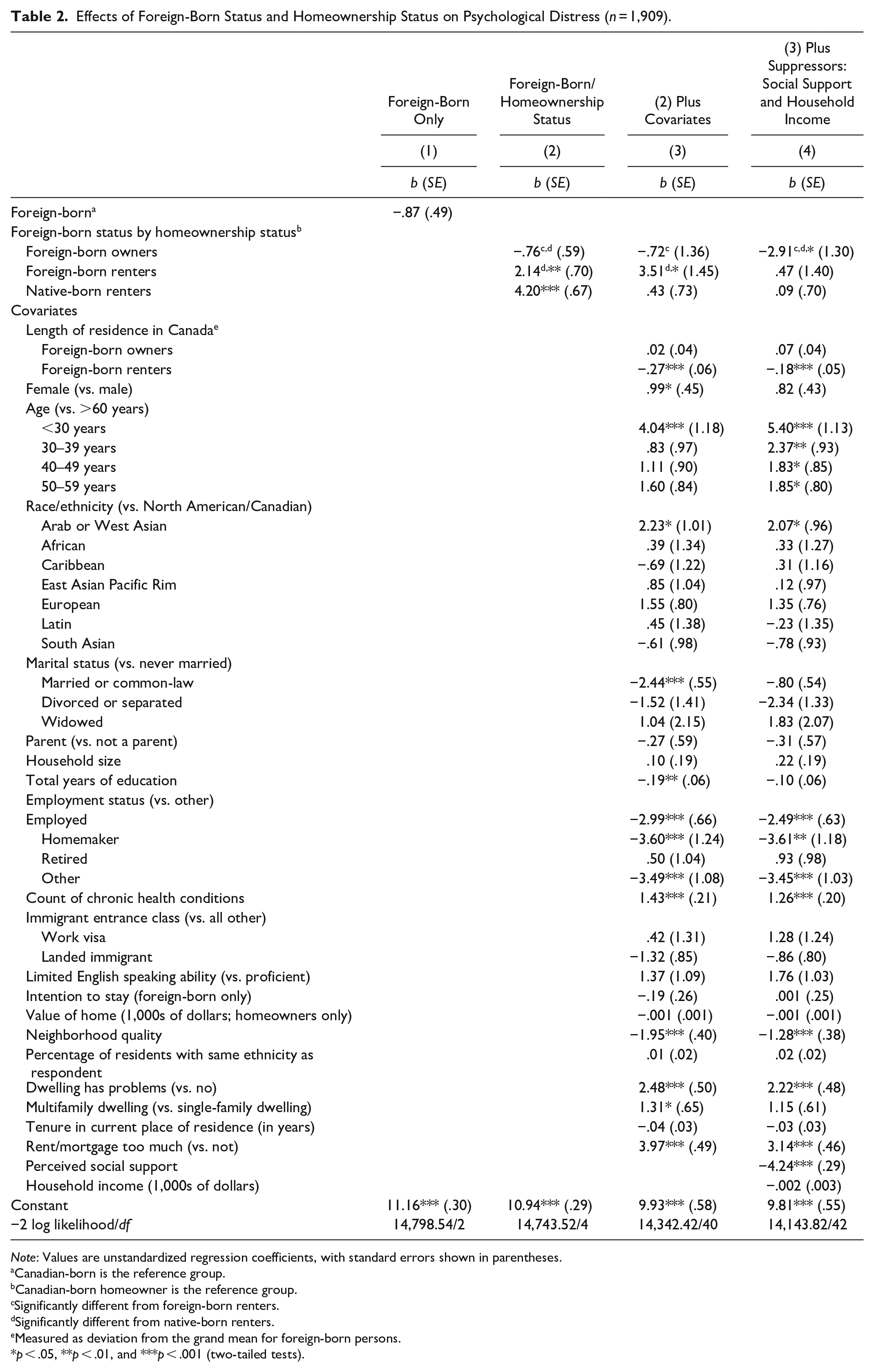
Table 1 presents weighted sample characteristics by foreign-born status and homeownership for all study variables. Significant differences at the bivariate level between the four groups were tested using the χ2 test for categorical variables and analysis of variance (Bonferroni post hoc) or t tests (when two groups were compared) for continuous variables. Table 2 presents multivariate results for the entire sample. Model 1 assesses the unadjusted association between foreign-born status and distress. Unadjusted results for foreign-born status by homeownership are presented in model 2. Native-born homeowners constitute the reference category. The effect of renting among the native-born compared with native-born homeowners is included in all models. Results of post hoc tests are used to indicate significant differences in distress between immigrant homeowners and immigrant renters, as well as between both immigrant groups and native-born renters. Controls are added in model 3, and social support and household income are added in model 4. Results of model 4 provide a test for the first hypothesis. Mediation effects are assessed using the three-pronged approach outlined by Baron and Kenny (1986). Thus, model A in Table 3 presents results for the effects of foreign-born/homeownership on the proposed explanatory variables. Model B in Table 3 assesses the explanatory role of ontological security and perceived status attainment (for the immigrant sample only) in the association between foreign-born/homeownership status and distress by including the effects of the explanatory variables in models 2 and 3. Results of models A and B in Table 3 provide a test for hypotheses 2 and 3.
Weighted Descriptive Statistics for All Variables in the Study (n = 1,909).

Note: Significant mean and proportional differences between subgroups are based on analysis of variance (Bonferroni post hoc), t tests, and c2 tests (α = .05, two-tailed test), respectively. Proportions are presented for categorical variables and mean (SD) for continuous variables.
Significantly different from renters of the same foreign-born status.
Foreign-born only: significantly different from native-born homeowners.
Foreign-born only: significantly different from native-born renters.
Effects of Foreign-Born Status and Homeownership Status on Psychological Distress (n = 1,909).
Note: Values are unstandardized regression coefficients, with standard errors shown in parentheses.
Canadian-born is the reference group.
Canadian-born homeowner is the reference group.
Significantly different from foreign-born renters.
Significantly different from native-born renters.
Measured as deviation from the grand mean for foreign-born persons.
p < .05, **p < .01, and ***p < .001 (two-tailed tests).
Effects of Foreign-Born Status by Homeownership on (A) Explanatory Variables and (B) Psychological Distress with Ontological Security and Perceived Status Attainment as Explanatory Variables (n = 1,909).

Note: Results include all covariates presented in Table 1.
Canadian-born homeowner is the reference group.
Significantly different from foreign-born renters.
Significantly different from native-born renters.
p < .05 and ***p < .001 (two-tailed tests).
Results
Table 1 presents weighted sample characteristics by foreign-born status and homeownership status for all study variables. Results in this table indicate that although foreign-born homeowners have lower average psychological distress (
Homeownership and Mental Health
Contrary to the predictions of the healthy-immigrant effect that immigrants have better mental health than the native-born, results of model 1 (unadjusted results) indicate no significant difference in psychological distress between the foreign-born and the native-born reference group. However, this changes in model 2 when foreign-born status is subdivided by homeownership status. As can be seen in this model, although foreign-born renters report lower average distress than native-born renters, both native-born and foreign-born renters report significantly higher distress than native-born homeowners. Foreign-born homeowners report lower average psychological distress than renters, irrespective of foreign-born status. However, the psychological distress of this group does not vary significantly from that of native-born homeowners.
The pattern for foreign-born renters persists in the adjusted model (model 3). However, the positive association between native-born renters and distress, compared with native-born homeowners, is reduced to nonsignificance. Exploratory analyses (see Appendix A) suggest that the higher distress among native-born renters, compared with native-born homeowners, is due in part to problematic living conditions, such as living in multifamily dwellings and low-quality neighborhoods.
The effect of suppressors are added in model 4. Interestingly, although the positive association between foreign-born renter and distress is reduced to nonsignificance in this model (b = .47, p > .05), the addition of these variables suppresses the association between foreign-born homeowner and psychological distress (model 4). Put in other terms, the proposed suppressors make the initially nonsignificant association between foreign-born homeowner and psychological distress (model 3: b = –.72, p > .05) significant (b = –2.91, p < .05). Auxiliary analyses (see Appendix B) indicate that although lower average social support among immigrants accounts for the higher distress among foreign-born renters, it suppresses the mental health of foreign-born homeowners: if it were not for the lower perceived social support among foreign-born homeowners, they would report significantly lower psychological distress than native-born homeowners and renters. This last model provides support for hypothesis 1: psychological distress, at average LOR, is significantly lower among foreign-born homeowners compared with native-born homeowners and renters and foreign-born renters. 6
Homeownership, Ontological Security, Perceived Status Attainment, and Mental Health
Results in Table 3 provide a test for hypotheses 2 and 3. According to hypothesis 2, the better mental health among immigrants who are homeowners, compared with the native-born (owners and renters) and foreign-born renters, will be due in part to higher ontological security among immigrant homeowners compared with either reference group. Results provide partial support for this hypothesis. Foreign-born homeowners have significantly higher ontological security than renters (model A1). However, they do not report higher ontological security than native-born owners. Although the addition of ontological security in model B2 does not reduce the estimate for foreign-born owners compared with native-born owners, post hoc tests indicate that the inclusion of this variable reduces the estimate for foreign-born owners compared with native-born renters to nonsignificance. Although the difference between foreign-born owners and foreign-born renters continues to be significant, the inclusion of ontological security reduces the effect for foreign-born owners, compared with foreign-born renters, by 20 percent (the estimates for post hoc tests are not shown in the table).
As perceived status attainment is relevant only among the foreign-born, model A2 presents results for the association between homeowner and perceived status attainment, compared with renters, only among the foreign-born. As can be seen, foreign-born owners report significantly higher perceived status attainment than foreign-born renters (b = .34, p < .05). The addition of perceived status attainment in model B3, while holding constant all relevant covariates and ontological security, reduces the association between foreign-born owner and distress (compared with foreign-born renters) to nonsignificance, providing support for hypothesis 3: the lower distress among immigrant homeowners, compared with immigrant renters, is due to higher perceived “status attainment” of the former group in the host country.
Discussion
By using data from Toronto, a city with a population that consists of almost 50 percent immigrants (O’Campo et al. 2015), and controlling for a rich set of measures that may affect homeownership and mental health, the current study reveals evidence of better mental health, at average LOR, only among immigrant homeowners, compared with native-born and foreign-born renters and native-born homeowners. As predicted, the beneficial impact of homeownership for mental health appears to be particularly important for the psychological health of immigrants, compared with the native-born.
Typically, homeownership for immigrants is paramount in the development of their economic and social incorporation and advancement in the host country (Constant et al. 2008; Gellatly and Morissette 2019). It is also a signal of time and monetary investment in their host country and a critical stage of assimilation into mainstream society (Oh 2004; Yu and Haan 2011). For the foreign-born, who have left all that they knew behind and ventured to a new and foreign land, homeownership may fulfill a natural possessive instinct and a desire to mark their territory (e.g., Lindblad and Quercia 2015; Saunders 1990). Indeed, the results of the current study suggest that at average LOR, the beneficial impacts of homeownership for mental health among immigrants compared with renters (native-born and foreign-born) are due to the positive association of homeownership with the experience of greater “ontological security” (Dupuis and Thorns 1998; Saunders 1984) for immigrants, compared with all renters, and higher perceived status attainment, compared with foreign-born renters.
It was also predicted that higher ontological security among foreign-born homeowners would explain the lower psychological distress among this group, compared with native-born homeowners. However, results did not provide support for this prediction. Ontological security was not higher among foreign-born homeowners, compared with native-born homeowners. Other factors may be responsible for the finding of lower distress among foreign-born homeowners compared with their native-born counterparts. For example, the better mental health of immigrants has been partly attributed to the selection of healthier individuals to migrate and to selection factors that may be inherent in host-country immigration policies (Cook et al. 2009; Jasso et al. 2004). In Canada, the points system promotes immigrants who are well educated, skilled, employed, parents, and married (Boyd and Vickers 2000), which could indirectly affect the emotional profile of the immigrant population (Montazer et al. 2016). Thus, it may be that foreign-born individuals who are able to become homeowners constitute an especially selected group of migrants. It is also possible that foreign-born homeowners may have migrated during more favorable years in terms of employment, or housing costs, which may have allowed them easier access to Toronto’s expensive housing market. The analyses did control for a number of factors that may tap at selection, such as immigration entrance category, as well as the LOR in Canada and LOR in the current place of residence. However, other unmeasured selection factors may still account for the better mental health of immigrant homeowners, compared with the native-born. Future research needs to explore these possibilities and better identify the underlying mechanisms that explain variations in mental health outcomes of immigrants across homeownership groups using longitudinal panel data.
It is also possible that the lower distress among foreign-born homeowners, compared with the native-born, is due to higher perceived status attainment among immigrant homeowners, compared with their native-born counterparts. Although homeownership is an important predictor of mental well-being (Dunn 2002), it may be especially so for the foreign-born as it may be one of the most tangible sources of status attainment for this group. In Toronto, where real estate is especially expensive, not owning might not matter as much to the native-born, who may measure their sense of achievement through other factors, such as travel, eating at good restaurants, or driving a nice car. Although the NEHW data did not allow for the measurement of status attainment for the native-born, this possibility should be examined in future research.
It may also be that for immigrant homeowners the home is just one aspect of how they attain ontological security. For this group their community or neighborhood, which they may invest more time in because they may be more committed to staying in the host country (Dustmann and Mestres 2010; Tesfai 2016), could also be a means through which they attain this type of security (Giddens 1990). Thus, future research should examine if a more holistic measure of ontological security—one that does not pertain exclusively to one’s home—explains the lower psychological distress of immigrant homeowners compared with their native-born counterparts.
Future Research, Limitations, and Strength
Previous research has found that the mode of migration and the level of economic development of country of origin may also be responsible for the better mental health of immigrants. Indeed, this research suggests that only primary-immigrants—those who migrated directly from less developed origin countries—benefit from better mental health compared with the native-born (Montazer 2018a). Thus, it is possible that there are nuances that need to be explored further in the association between homeownership and mental health. For example, it may be that homeownership is most beneficial in increasing the ontological security, perceived status attainment, and mental well-being of secondary immigrants from less developed origin countries, whose path to migration was longer and often harder. Future research should also examine the effect of homeownership and foreign-born status on distress in conjunction with membership in other statuses that the individual may hold, including gender and visible minority status. The sample of immigrants in the present study was too small to allow the proposed distinctions.
The present study is limited in several ways. First, the cross-sectional nature of the analysis presents challenges, such as the inability to establish true mediation, and causal order between the outcome, explanatory variables, and some covariates. Although the analyses control for immigration entrance, intention to stay, and LOR in the host country, they do not account for the pull or push factors in the migration process that may determine the migratory forces unique to any year of arrival, such as the political and legal conditions (Jasso et al. 2004) in origin countries that may have affected the ability of the foreign-born to become homeowners in the host country. Third, participation in this study required respondents to have reasonable skills in English and to have lived in their neighborhood for at least six months. These restrictions may have attributed to the overrepresentation of more established immigrants in the sample who have for the most part overcome the most difficult phase of adjustment, which may have underestimated the effect of homeownership on distress among this group. However, the analyses included individual-level sample weights to ensure that the sample was representative of the census tracts from which the participants were drawn (O’Campo et al. 2015).
Fourth, the measure of homeownership used in the analyses does not allow deciphering if the respondent was the actual property owner or if their place of residence was owned by another family member, such as a parent. Although research suggests homeownership to infer beneficial psychological health for all members of the household (Manturuk 2012), and sensitivity analyses did not suggest various coding of homeownership to change the focal associations, future research that has the ability to measure “true” homeownership status should replicate the present study’s findings. Finally, this study is generalizable only to those who live in cities with expensive housing markets and should be replicated with data from cities that have more affordable housing.
The benefits of this study outweigh the above noted limitations. This is the first study to examine the association between immigration and psychological distress by homeownership status. Using data from Toronto the results support the assertion that immigrant mental health is sensitive to variation in the unfolding experience of migrants in the host country: only immigrant homeowners experience elevated mental well-being compared with the native-born renters and owners and foreign-born renters. Although the results of this study are based on 2011 data, the increase in housing prices in the greater Toronto area since then have made homeownership even more unattainable. Given the importance of homeownership for immigrants (Dingman 2022) and the important role this engine of social inequality plays in the mental health of this growing segment of the population, now, more than ever, policy makers are called to help curb the price of housing in one of the most expensive cities in the world.
Footnotes
Appendix
The Association between Foreign-Born Status by Homeownership and Psychological Distress with (Model A) and without (Model B) Immigration and Home/Neighborhood-Related Covariates (Model C) (n = 1,909).

| All Controls (Model 4 in Table 2) | All Controls (Except Immigration-Related Covariates) | All Controls (except Home/Neighborhood-Related Covariates) | |
|---|---|---|---|
| (A) | (B) | (C) | |
| b (SE) | b (SE) | b (SE) | |
| Foreign-born status by homeownership a | |||
| Foreign-born owners | −2.91b,c,* (1.30) | −2.99b,c,** (1.04) | −2.79b,c,** (1.30) |
| Foreign-born renters | .47 (1.40) | .25 (1.20) | 1.22 (1.37) |
| Native-born renters | .09 (.70) | 14 (.70) | 1.13 (.64) |
| Constant | 9.81*** (.55) | 9.83*** (.55) | 9.43*** (.55) |
Note: Results include all covariates presented in Table 1.
Canadian-born homeowner is the reference group.
Significantly different from foreign-born renters.
Significantly different from native-born renters.
p < .05, **p < .01, and ***p < .001 (two-tailed tests).
Funding
The author(s) disclosed receipt of the following financial support for the research, authorship, and/or publication of this article: This research was supported by grants awarded by the Canadian Institutes of Health Research (MOP-84439) and the Social Science and Health Research Council (410-2007-1499) (Blair Wheaton and Patricia O’Campo, principal investigators).
