




Abstract
Previous research on engagement proposals finds that conformity to a traditional engagement proposal script legitimates the couple in the eyes of the larger community. This script, however, has long been held to be heteronormative, enforcing norms about not only marriage but also gender. Using a sample of college students at a midwestern university, the authors explore whether conformity to a heterosexual engagement proposal script transfers the same social legitimacy to same-sex couples. Using vignettes, participants were asked to rate the strength and likelihood of staying together of three types of hypothetical couples (female-male, female-female, and male-male) on the basis of the traditionality of the engagement proposal script. Results suggest that relationships that conform to a traditional engagement proposal script are evaluated as being stronger and more likely to last, regardless of the sex category composition of the couple.
Prior to 2015, when the Supreme Court of the United States handed down the decision in Obergefell v. Hodges, legal access to marriage had been limited to heterosexual couples. Advocates for same-sex marriage argued that same-sex couples should have access to all the legal, economic, health, and social benefits of marriage. For others, same-sex marriage represented conformity to a heterosexist institution and would reify the institution, including normalizing and privileging the gender binary. In other words, same-sex marriage may bring with it certain benefits, but at what cost? 1
Although the numerous legal and economic rights of marriage that same-sex couples gain as a result of the right to marry are clearly identified, the social benefits of marriage or “informal privileges,” have been studied less extensively. The research that does exist suggests that although the majority of the U.S. population favors legal rights for same-sex couples, they remain less likely to view same-sex couples as social equals to heterosexual couples (Doan, Loehr, and Miller 2014, 2015). Arguably, the informal privilege of being seen as a legitimate, committed couple by the larger community may be as important as, if not more important than, formal rights as marriage becomes more of a marker of privilege in society (Cherlin 2004; Coontz 2004; Furstenberg 2010).
Although establishing a legal relationship between two individuals is an important part of the institution of marriage, it is also important to recognize that establishing a legal marriage is not all that is involved in “becoming married.” As Sniezek (2013) points out, establishing a marriage is a process that involves numerous stages, including an engagement proposal. Rather than focusing on whether marriage (which can be thought of as conforming to heterosexual norms) confers informal privileges upon same-sex couples, we focus on whether conforming to the actual practices associated with heterosexual marriage brings informal privileges to same-sex couples.
To do so, we explore whether conformity to traditional heteronormative marital scripts, specifically the engagement proposal script, influences evaluations of same-sex couples. Previous research has shown that couples that conform to traditional engagement proposal scripts are viewed as having stronger relationships, a sign of the social legitimacy bestowed upon those couples that conform (Schweingruber, Cast, and Anahita 2008). Thus, another way of framing our research is to ask whether same-sex couples are required to follow the rules of the standard engagement proposal to gain the benefits of community recognition. If male-male and female-female couples benefit from conformity to a heteronormative engagement proposal script by having their relationships be seen as stronger and more stable than male-female couples, it would suggest that conformity to these heteronormative social scripts is important in understanding the degree to which same-sex couples are viewed as legitimate couples.
We explore this idea using a sample of young adults at a large midwestern university. These are young adults who grew up in what Peter Hart-Brinson (2018) labels the gay rights period (1993–2015). Members of this cohort have been found to have higher support for same-sex marriage than previous cohorts (Hart-Brinson 2018; Powell et al. 2010). Because of this, young adults may be more likely to evaluate same-sex relationships more positively than previous generations, particularly when they conform to heteronormative scripts, such as the traditional engagement proposal script. For this reason, we do not expect most of these students’ evaluations of same-sex engagement proposals to influenced by negative evaluations of same-sex relationships themselves but more in response to conformity to marital rituals.
Marriage: Formal Rights and Informal Privileges
There is evidence that marriage does confer certain benefits upon same-sex couples. One way of characterizing the benefits that couples gain from marriage is to distinguish between formal rights and informal privileges (Doan et al. 2014, 2015; see also Bosley-Smith and Reczek 2018). 2 Formal rights refer to “legal protections that the government grants to privileged groups” (Doan et al. 2014). Formal rights include such benefits as family leave, inheritance rights, and insurance benefits and are more readily identified. In contrast to formal rights, informal privileges are interactional in nature and reflect the degree of legitimacy and privilege afforded to different groups (Doan et al. 2014, 2015).
Evidence suggests that same-sex couples do receive both formal and informal benefits from being legally married. Qualitative research with same-sex couples shows that they report that marriage often brings greater acceptance from family members for their relationships (Green 2010, 2013). Furthermore, individuals in same-sex relationships believe that their marriages show to their families, friends, and the larger community that they are in relationships that are just as committed as female-male marriages (Green 2013; Kimport 2013; Kosbie 2013). Experimental research by Doan et al. (2014, 2015), however, suggests that although marriage may bring full access to the formal privileges of marriage, it does not necessarily extend to support for informal rights for same-sex couples. They found that heterosexuals, gays, and lesbians are equally likely to support formal rights for same-sex couples but also are less likely to support informal rights for same-sex couples.
Heteronormativity and the Traditional Engagement Proposal Script
Like other social institutions, the engagement proposal has a dual nature, creating both opportunity and constraint (Becker 1982a, 1982b). Because heterosexual romance is thoroughly institutionalized, male-female couples have a standard recipe for expressing their commitment to each other and the community. However, the institution of the engagement proposal also produces expectations for couples that constrain them. Failure to follow the recipe may result in a failure to legitimize the relationship in the eyes of the community.
As same-sex marriage became a major goal of LGBT+ social movement advocacy, social scientists and activists began to ask what happens when same-sex couples entered the heteronormative institution of marriage. As Bartholomay (2018) observes, this discussion has tended to oversimplify possible outcomes of same-sex marriage as either challenging or reinforcing or heteronormativity. Same-sex marriage might challenge heteronormativity because the “public exposure of gay lifestyles—even if they resemble the lifestyles of heterosexuals—symbolically challenges the dominance of heterosexuality as the only normative mating arrangement” (Bartholomay 2018:5). Alternatively, same-sex marriage might reinforce heteronormativity if the LGBT+ culture that developed outside of heterosexual marriage is lost, effectively erasing and undermining the transformative forms of identity, family, and kinship that characterize LGBTQ+ communities (Hopkins, Sorenson, and Taylor 2013:98). A related concern is that LGBT+ people assimilated into marriage will reproduce aspects of marriage that feminists have criticized as patriarchal and oppressive. Indeed, Scott and Theron’s (2019) research with transgender-cisgender and lesbian couples concludes that “heteronormativity offers a promise at a price” (p. 448).
Qualitative research on how people attempt to negotiate heteronormative romantic institutions from inside them has shown that these institutions, like other institutions, shape people’s behavior but also create opportunity for resistance and change. One way that this occurs is through the reinvention and transformation of traditional elements while maintaining enough elements to ensure that the marriage is still recognized as a marriage ceremony (Mamali and Stevens 2020:990). For example, couples may simultaneously do, undo, and redo traditional wedding practices through the strategic replication and conspicuous absence of specific traditional practices (Mamali and Stevens 2020). Kimport’s (2013) analysis of same-sex wedding photographs finds that although the gay men in the photos all conformed to gendered norms in their clothing by wearing black tuxedos, they simultaneously challenge heteronormative wedding norms that require someone in a dress. This body of research demonstrates that as people plan their weddings they are able to critique and alter conventional wedding traditions but also that they may find these traditions appealing or feel obligated to use some of them for the messages they send to their audiences.
Although marriage has been a major focus of scholarly work on heteronormative romance because it represents the destination of the heterosexual romantic journey, it is only the culmination of a series of rituals designed to convince audiences that the relationship is socially legitimate. For this reason, the engagement proposal, while seemingly minor compared with the wedding, is also worth examining.
The Standard Engagement Proposal Script
Previous studies of engagement proposals (Chinichian 2008; Hoplock 2016; Hoplock and Stinson 2022; Hunter 2011; Lamont 2014; Moore, Kienzle, and Flood Grady 2015; Ponzetti 2005; Sassler and Miller 2011; Schweingruber, Anahita, and Berns 2004; Sniezek 2013) agree on a number of points, including that the proposal is a ritual with standard elements that ratifies an earlier agreement to marry. This research has identified several standard elements of the proposal (even though they may not be present in every proposal). Schweingruber et al. (2004) claimed that the standard American engagement proposal requires, minimally, the following: (1) the man proposes to the woman, and (2) the man gives the woman a ring. Two other standard elements are that (3) the man gets down on one knee during the proposal, and (4) the man asks permission from the woman’s father or parents. Research also agrees that the man is supposed to orchestrate the proposal so that it will be romantic and surprising (despite being expected), that the proposal typically takes place in private, and that the proposal results in an outpouring of emotion (Schweingruber et al. 2004).These studies also illustrate the heteronormativity of the proposal script: switching the male and female roles in heterosexual proposals may ruin the intended effect of the proposal and “may turn the proposal into a parody that produces amusement, instead of the usual romantic feelings” (Schweingruber et al. 2004:148).
The centrality of the proposal to the engagement process, and in particular a man proposing to a woman, is clear. Schweingruber et al. (2004) report that the man proposed in every successful proposal in their study. One woman proposed to her fiancé twice (before he proposed), but he did not take her proposals seriously. Likewise, Chinichian (2008) reports that the man proposed in all but two cases, but the two exceptions were followed by the men proposing to the women who earlier proposed to them. Sassler and Miller (2011) reported that two women in their study proposed, but “both couples indicate that the man would be ‘redoing’ the proposal in the near future” (p. 498). Men in that study said they would be “shocked or surprised, or worse, that they would laugh” (p. 497) if their cohabitating girlfriends proposed to them.
Following a traditional proposal script is an important part of the display work that establishes the legitimacy of the couples in the eyes of the larger community (Mamali and Stevens 2020; Schweingruber et al. 2004; Sniezek 2013). In Schweingruber et al. (2004), couples describe the importance of following the engagement proposal script because it indicates to family and friends that the relationship is serious and would lead to marriage. Couples felt that a lack of conformity to the traditional engagement script would lead to the couple being perceived as not really engaged, therefore, not serious, even questioning whether the couple would actually get married. Findings from Schweingruber et al. (2008), who surveyed college students, suggest that couples are correct: they find that couples that conform to the traditional proposal script are perceived as having stronger relationships than couples that do not conform. The importance of these practices appear to be especially resistant to change even among young people with egalitarian gender role attitudes (Bair and Kaufman 2020).
Although there is little research on same-sex engagement proposals, Lamont (2017: 638), who interviewed LGBT+ people about romance, reported that “only a few . . . desired a one-sided marriage proposal. Instead, respondents explicitly discussed a reimagination of the proposal script.” The simple fact, however, that Lamont’s respondents recognized which elements to reimagine suggests an awareness of the significance of the engagement proposal. So, although couples may vary the details of the marriage ritual (including the proposal and the wedding ceremony), the traditions associated with marriage still perform important regulative function (Gross 2005). By conforming to traditional engagement proposal scripts, couples indicate a desire to belong within the larger community and to be seen as a full-fledged married couple as they have fulfilled the actions required to achieve that status. Thus, in our research we seek to answer whether a ritual with male and female roles can confer relationship legitimacy when the sex of those taking part is not part of the institutionalized heteronormative script. In doing so, this research contributes to our understanding of the changing meaning of same-sex relationships, perceptions about these relationships, and expectations for same-sex couples, as well as heteronormativity, romantic rituals more generally, and the double-sided nature of social institutions.
Data and Methods
The data for this project were collected from students enrolled in an introduction to sociology undergraduate course at a large midwestern university from the fall of 2015 through the fall of 2018. The survey was administered to a total of 3,871 students who were enrolled in the course over this time period. Approximately 92 percent of the students surveyed granted permission for their data to be used for research purposes. The analyses presented here are based on a total of 3,043 respondents for whom complete data were available and who satisfied manipulation checks.
Experimental Design
To examine the influence of conformity on perceptions of relationship strength and stability among female-male, female-female, and male-male couples, we conducted a between-subjects experimental study with six experimental conditions: (1) female-male couples that conform to traditional engagement proposal scripts, (2) female-female couples that conform to traditional engagement proposal scripts, (3) male-male couples that conform to traditional engagement proposal scripts, (4) female-male couples that do not conform to traditional engagement proposal scripts, (5) female-female couples that do not conform to traditional engagement proposal scripts, and (6) male-male couples that do not conform to traditional engagement proposal scripts.
In the survey, respondents were presented with a single vignette describing an engagement proposal. To design the scripts used in the survey, we drew on results of Schweingruber et al.’s (2008) study that examined the effects of conformity to a traditional engagement script on respondents’ perceptions of relationship strength. This research showed that couples that conformed to a traditional heterosexual engagement proposal script were seen as stronger than couples that did not conform to a traditional engagement proposal script. In that study, the elements of a traditional engagement proposal script that were found to influence perceptions of relationship strength involved the following: (1) a man asking a woman to marry him (as opposed to a woman asking a man), (2) a man on bended knee when asking, (3) a man asking for permission from a woman’s father, and (4) a man presented a woman with a diamond ring. These elements were incorporated into the vignettes used in the present study.
Two different vignettes were developed to examine the effects of conformity. The first vignette described an engagement proposal that conforms to a traditional heterosexual engagement proposal script. The conforming engagement proposal script was as follows: [Name] and [Name] have been dating seriously for two years. They live in a state that recognizes both male-female and same-sex marriages. [Name] recently visited [Name]’s parents and told them he/she planned to ask [Name] to marry him. Last night [Name] took [Name] out for a romantic dinner, asked [Name] to marry him/her and presented him/her with an engagement ring. The couple plans to marry in about a year.
The nonconforming engagement proposal script was as follows: [Name] and [Name] have been dating seriously for two years. They live in a state that recognizes both male-female and same-sex marriages. [Name] and [Name] have had many discussions about their future together and last night they decided to get engaged to be married. Then they shared the good news with their families. The couple plans to marry in about a year.
Gender-typical names were chosen to distinguish the sex category composition of the couples. The female-male couples’ names were Michael and Emily, the female-female couples’ names were Emily and Jessica, and the male-male couples’ names were Michael and Jacob. 3
Manipulation Checks
To ensure that respondents were aware of the experimental manipulations, respondents were asked two questions following the vignette. The first question asked respondents the sex composition of the couples in the vignette and the second question asked respondents whether an engagement ring was presented to one of the individuals in the couple in the vignette. Respondents who answered incorrectly to these questions were dropped from the analysis.
Measures
Perceptions of Relationship
Two single-item measures were used to measure individuals’ perceptions of the relationship. Strength was measured by asking respondents to indicate on a scale ranging from 0 to 10 the strength of the couple’s relationship (0 = “very weak,” 10 = “very strong”). Stability was measured by asking respondents to indicate on a scale ranging from 0 to 10 how likely it was that the couple would stay together (0 = “very likely to break up,” 10 = “very likely to stay together”). These two items are highly correlated (r = .65, p < .05).
Sex Category of Respondent
The sex category of the respondent is a single-item dummy variable (0 = male, 1 = female). The sample is composed of approximately 53 percent women and 47 percent men.
Conformity
The conformity of the engagement proposal script is a dummy variable (0 = nonconforming, 1 = conforming). Approximately 55 percent of the vignettes represented a nonconforming engagement proposal script (n = 1,657), and the remaining 46 percent of vignettes (n = 1,386) represented a conforming engagement proposal script.
Sex Category Composition of Couple
The sex category composition of the hypothetical couple is represented by three categories of couples: 0 = female-male couple, 1 = female-female couple, and 2 = male-male couple. After dropping cases in manipulation checks and missing data, approximately 28 percent of the couples in the analysis were female-male (n = 852), 36.4 percent were female-female (n = 1,107), and the remaining 35.6 percent were male-male (n = 1,084).
Analysis
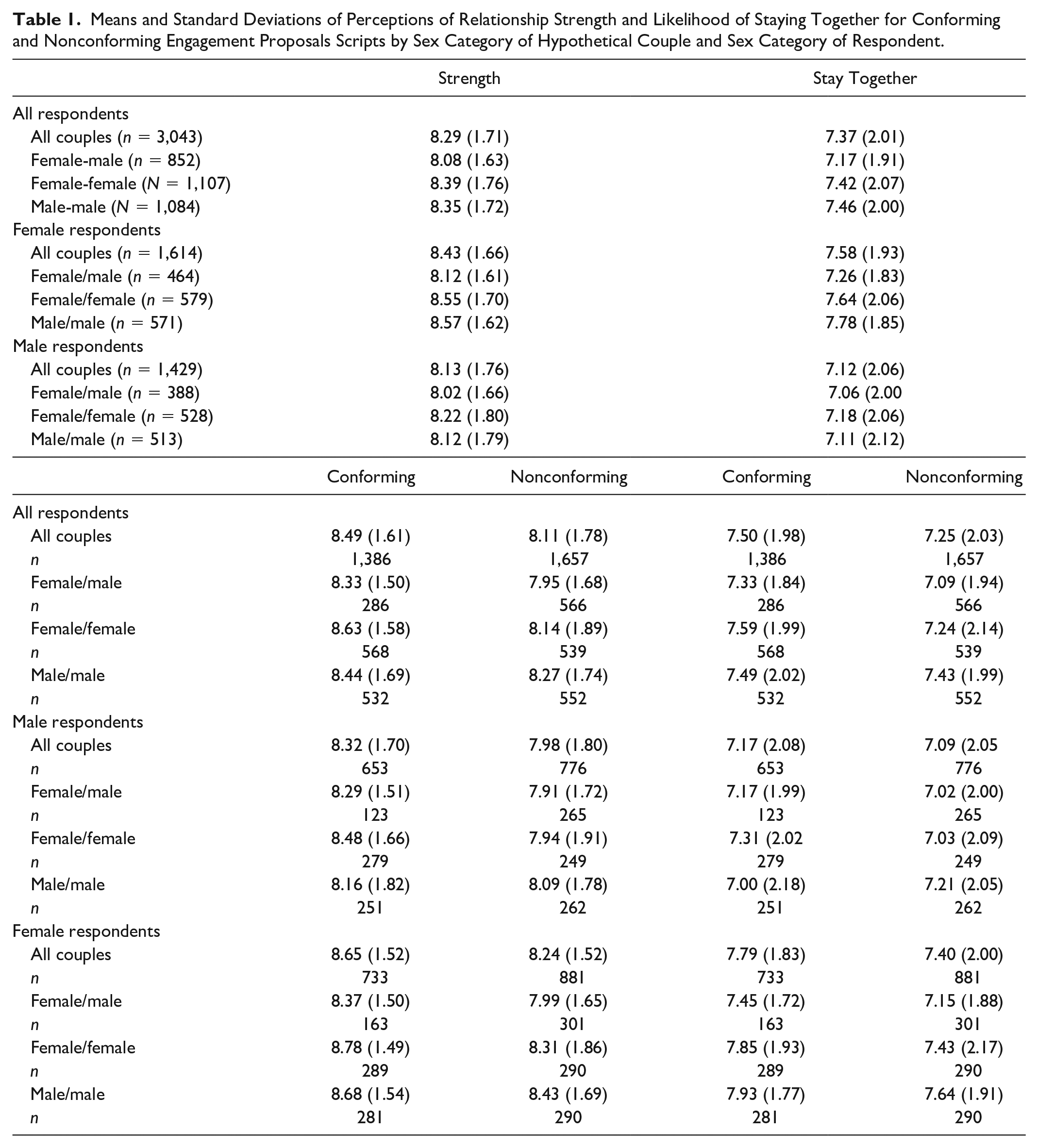
In Table 1, we present descriptive statistics for our variables of interest. To begin, we see that on average, respondents rated the strength of the hypothetical relationships as strong (M = 8.29, SD = 1.71) but rated the likelihood of couples’ staying together (M = 7.37, SD = 2.01) significantly lower in comparison (t = 32.21, p < .05). In the next section, we present findings from multivariate analyses that explore the effects of conformity, respondent’s sex category, and sex category composition of the couple on evaluations of couples’ relationships.
Means and Standard Deviations of Perceptions of Relationship Strength and Likelihood of Staying Together for Conforming and Nonconforming Engagement Proposals Scripts by Sex Category of Hypothetical Couple and Sex Category of Respondent.
Multivariate Analyses
To examine how these factors influence evaluations of couples, we performed a three-way analysis of variance for both dependent variables, relationship strength, and the likelihood of the hypothetical couple staying together. The three-way interaction term was nonsignificant in each analysis: strength, F(2, 3,031) = .38, p > .05, and likelihood of staying together, F(2, 3,031) = .66, p > .05. In an effort to create as parsimonious model as possible, we simplified the analyses and performed a two-way analysis of variance (ANOVA) for each of our dependent variables. The results of these analyses can be seen in Table 2. We present these results below.
Analysis of Variance on Evaluations of Relationship Strength and Likelihood of Staying Together.

Note: SS = sum of squares
p < .05
Strength
Main Effects
A two-way ANOVA was performed to analyze the effect of conformity, respondent sex, and couple’s sex on the perceived strength of the hypothetical couple’s relationship. Specifically, all three main effects (conformity, respondent’s sex, and couple’s sex) were statistically significant. Female respondents (M = 8.43, SD = 1.66) rated the hypothetical couple’s relationship as significantly stronger than male respondents (M = 8.13, SD = 1.76), F(1, 3,033) = 21.46, p < .05. Couples that conformed to traditional engagement proposal scripts (M = 8.49, SD = 1.61) were seen as having stronger relationships than those couples that did not conform to traditional engagement proposal scripts (M = 8.11, SD = 1.78), F(1, 3,033) = 29.77, p < .05. The effect of the hypothetical couple’s sex category on perceived relationship strength was also significant, F(2, 3,033) = 14.92, p < .05. Post hoc Tukey tests showed that female-female couples (M = 8.39, SD = 1.76) and male-male couple (M = 8.35, SD = 1.72) were rated as stronger than female-male couples (M = 8.08, SD = 1.63) (t = 4.07 [p < .05] and t = 3.53 [p < .05], respectively). Mean ratings of relationship strength for female-female (M = 7.41, SD = .06) and male-male couples (M = 7.46, SD = .06), however, were not statistically different from each other (t = –.56, p > .05).
Interaction Effects
All interactions were nonsignificant. There was not a significant difference between the effects of conformity when comparing male and female respondents, F(1, 3,033) = .10, p > .05. Furthermore, male and female respondents did not rate couples significantly differently on the basis of the couple’s sex, F(2, 3,033) = 2.37, p > .05, nor did conformity matter more for one sex category of couples over another, F(2, 3,033 = 2.75, p > .05.
Likelihood of Staying Together
The results of the two-way ANOVA for the second dependent variable, likelihood of staying together, indicated patterns similar to that of the two-way ANOVA for relationship strength. The three main effects (respondent’s sex category, conformity to traditional engagement proposal scripts, and the sex category composition of the hypothetical couple) were statistically significant. All interaction effects were nonsignificant. We discuss the specifics of the analysis in the following.
Main Effects
A two-way ANOVA was performed to analyze the effects of conformity, respondent sex, and couple’s sex on the perceived likelihood of the hypothetical couple staying together. Specifically, all three main effects (conformity, respondent’s sex category, and sex category composition of the hypothetical couple) were statistically significant. Female respondents (M = 7.58, SD = 1.93) rated the hypothetical couple’s relationship as significantly more likely to stay together than male respondents (M = 7.12, SD = 2.06), F(1, 3,033) = 39.17, p < .05. Couples that conformed to traditional engagement proposal scripts (M = 7.50, SD = 1.98) were rated as being more likely to stay together than those couples that did not conform to traditional engagement proposal scripts (M = 7.25, SD = 2.03), F(1, 3,033) = 7.71, p < .05. The effect of the sex category composition of the hypothetical couple on perceived likelihood of staying together was also statistically significant, F(2, 3,033) = 3.87, p < .05. Post hoc Tukey tests showed that female-female couples (M = 7.42, SD = 2.07) and male-male couple (M = 7.46, SD = 2.00) were rated as more likely to stay together than female-male couples (M = 7.17, SD = 1.91) (t = 2.76 [p < .05] and t = 3.20 [p < .05], respectively). Mean ratings of the likelihood of the couple staying together for female-female and male-male couples, however, were not statistically different from each other (t = .48, p > .05).
Interaction Effects
All interactions were nonsignificant. There was not a significant difference between the effects of conformity when comparing male and female respondents, F(1, 3,033) = .3.45, p > .05, on ratings of the likelihood of the hypothetical couples’ staying together. Furthermore, male and female respondents did not rate couples significantly differently on the basis of the sex category composition of the couple, F(2, 3,033) = 2.90, p > .05, nor did conformity matter more for one sex category composition of couples over another, F(2, 3,033 = 1.61, p > .05.
Discussion
Same-sex couples have gained access to the formal rights associated with marriage, but questions about whether same-sex couples have gained access to the informal privileges of marriage remains to be seen. Using a sample of undergraduates at a large, midwestern university, the research presented here examines whether conforming to heteronormative relationships practices, namely, heteronormative engagement proposal scripts, increases access to the social benefits of marriage. Research on romance-related heteronormativity has focused on understanding heteronormative institutions from the inside: how people attempt to negotiate these institutions by selectively using some aspects of them, replacing them, or rejecting them entirely.
However, people are often aware of and take into consideration how an audience of other people may evaluate their decisions, for example, about how to stage their weddings or engagement proposals. In our research, we look at a heteronormative institution from the outside, by looking at how potential audience members of an engagement proposal evaluate couples on the basis of the sex composition of the couple and whether the couples conform to traditional heteronormative marital rituals, specifically the engagement proposal script. Prior research reveals that couples that conform to a heteronormative engagement proposal script are viewed by others as having stronger relationships, thereby bestowing social legitimacy upon these couples. The research presented here extends that research by examining whether same-sex couples that conform to a traditional engagement proposal script also benefit in terms of the social legitimacy of the couple. Because gender is so central to the heteronormative engagement proposal script with distinct roles for male and female actors, altering the male-female gender roles of the engagement proposal may result in an event that fails to convince others of the legitimacy of the couple. Because same-sex couples do not fit the heteronormative script, their performances may not be considered as legitimate by their secondary audience.
Our results, however, suggest that same-sex couples do not seem to be penalized for not fitting the sex roles of the proposal. In brief, we find that couples that conform to traditional proposal scripts, regardless of the sex category composition of the couple, are perceived of as having stronger relationships and are seen as being more likely to stay together. One explanation for this is that the other details of the engagement proposal, rather than the gender roles embodied within it, are more central to establishing the legitimacy of the couple. Same-sex couples that perform an otherwise traditional engagement proposal script are evaluated on the basis of the proposal rather than the sex- category composition of the couple. Put positively, same-sex couples are able to use the standard engagement proposal to legitimate their relationships. In some ways, this is good news for those who advocate for the social legitimacy of same-sex couples.
We also find that, on average, same-sex couples are evaluated more positively than heterosexual couples. This suggests that young adults may actually admire same-sex relationships and may have become somewhat cynical about heterosexual relationships. It may be that the simple fact of deciding to get married legitimizes same-sex relationships in the eyes of today’s young adults, although we would need hypothetical couples that are not planning on marrying in order to definitively make that claim. It may also reflect a recognition of the struggle that same-sex couples have had in order to legally marry. Our finding is also evidence for the rapid institutionalization of same-sex romance. The increasing social acceptance of same-sex romantic relationships and their changed legal status represents a massive social change over just a few decades.
An alternative explanation, of course, is that the respondents in this sample are expressing positive evaluations of same-sex couples in order to avoid being seen as homophobic. The between-subjects nature of our design, however, exposes respondents to only one hypothetical couple; in other words, there is no direct comparison for our subjects. This should minimize possible demand characteristics, but it is still possible that our respondents are expressing more positive views of same-sex couples for this reason.
Although on one hand our results may be viewed as reflecting an increasing acceptance of same-sex couples, our findings can also be interpreted as suggesting that same-sex couples may need to undergo the traditional engagement proposal ritual in order to achieve legitimacy in the eyes of others, just as male-female couples do. This is significant because most same-sex couples may not want to adopt the standard heteronormative proposal script or other heterosexual relationship norms and instead support “egalitarian and non-gendered practices” (Lamont 2017:631; see also Fetner and Heath 2016; Mamali and Stevens 2020). Thus, the legitimating function of the ritual may limit how same-sex couples are able to construct their romances, just as it does for male-female couples. However, it does illustrate the importance of continued conformity to engagement proposal scripts. Even as same-sex couples challenge existing norms about who can marry whom, the fact that they are still required to follow heteronormative scripts in order to gain social legitimacy as a couple lends support to concerns about losing the potential transformative forms of family that same-sex couples represent. In that sense, the social legitimacy of same-sex couples does come at a price; same-sex couples are still required to conform to heteronormative scripts. Thus, this research also contributes to a greater understanding of important variations in the access to the privileges, both formal and informal, of marriage.
According to Cherlin (2004), social change in family institutions may require people to “negotiate new ways of acting, a process that is a potential source of conflict and opportunity,” and this may “engender disagreement and tension among relevant actors” (p. 848). This social change certainly has resulted in disagreement and conflict, but the engagement proposal itself seems to have held firm (Bair and Kaufman 2020). Several features of the standard engagement proposal ritual may help explain its resiliency. First, the engagement proposal is one of the world’s most recognized rituals. It is a ubiquitous way of signaling the beginning of an engagement, an important step toward marriage (Laner and Ventrone 2000). Second, it has no competition. Although gendered dating norms are the subject of much critique, neither feminism, the gay/lesbian civil rights movement, nor any other ideology has been successful in calling into question the traditional model or proposing an alternative that accomplishes the same task as the traditional ritual—communicating unambiguously that the couple is engaged. (Schweingruber et al. 2004:159)
Third, most male-female couples do not see the gendered elements of the proposal as indicating anything about gender (in)equality in their own relationships. In fact, progress women have made in creating more equal relationships “has perhaps led them to believe that they can pick and choose between gendered meanings with no consequences” (Lamont 2014:207).
Thus, the performance of rituals surrounding marriage is an important way that couples achieve legitimacy among their family members and friends and within the larger community. Whether conformity to heteronormative engagement scripts is ultimately good or bad in terms of re/constructing the heterosexist institution of marriage we are unable to answer. But, our results do indicate that conformity to current heteronormative engagement proposal scripts have similar results for both male-female and same-sex couples.
Limitations and Future Research
Although the results here suggest that same-sex couples do benefit from conforming to heterosexual engagement proposal scripts, there are limitations to this research. First, our sample is composed of college students at a large midwestern university. Ideally, we would have a random sample of U.S. adults. As we noted earlier, people the age of traditional college students are more likely to support same-sex marriage than previous birth cohorts so our results may not apply with older U.S. adults. Furthermore, our respondents were students from a midwestern university, and research has shown important regional differences in attitudes toward same-sex couples (Jones, Cox, and Navarro-Rivera 2014). However, although the college students in our sample may not be a representative sample of U.S. adults today, their attitudes and views about relationships can provide a glimpse into future attitudes of the general U.S. population.
Another limitation of the research presented here is that we have not addressed how the race of the couple or the race of the person evaluating the couple may influence judgments of couples, in particular couples of color or mixed-race couples. Our vignettes do not specify the racial category of the couples presented in the survey, however, given the population of our sample (almost entirely white) and “white” as a default category (Frankenberg 1993), it seems likely that our subjects defaulted to the couples in the vignette as being white. So, the generalizability to couples that are not white may be limited.
Race may also influence judgments of couples on the basis of conformity to a traditional engagement proposal script because of historical differences in racial groups’ relationships to marriage. Research has shown that marriage plays a less central place in the lives of Black Americans and Latinx Americans (Cherlin 2020). Although much of this is connected to differences in socioeconomic status, conformity to rituals related to marriage may be less important in terms of how they perceive the relationship strength of a couple. It is also possible, however, that conformity to traditional engagement proposal scripts may be even more important for those of lower socioeconomic status because of the symbolic status represented by marriage (see Edin, Kefalas, and Reed 2004).
The vignette design we use here allows us to make comparisons between two styles of engagement proposals and three different sex-category compositions of couples. However, it does not allow us to explore the details of the actual proposals of particular couples and the response to these proposals by actual people in their social network. Research using interviews, ethnography, social media posts (e.g., Hoplock 2016), or some combination of these would allow researchers to explore how couples that use some version of the standard engagement proposal modify it to fit their own beliefs and circumstances. What elements of the proposal are viewed as most problematic for these couples? Again, to what extent do these couples consider the reaction of their social network to their rejection and replacement of the standard proposal? To what extent do couples feel limited by the traditional proposal script and the anticipated reactions of others? Specifically, for same-sex couples, how do these couples decide how to adapt the gender-specific roles of the standard proposal? Considering the reaction of the audience, how do members of actual couples’ social networks interpret and evaluate their proposals? Couples that alter the standard proposal or replace it with something else may have social networks that are more accepting of other options or who will honor nonstandard proposals because they seem appropriate for the specific couple.
These questions are important because rituals play a key role in creating social reality. And the traditional engagement proposal script appears to be rather resistant to change. The standard heteronormative engagement proposal both reflects a constellation of values and expectations about marriage and plays a role in perpetuating systems of inequality. This ritual does not perpetuate itself but requires couples to adopt it or adapt it. Couples that conform to these rituals, as well as those that reject these rituals, are constructing and reconstructing the social landscape of romance and marriage, and those of us who want to understand this social landscape should be paying attention to them.
