




Abstract
Using newly available nationally representative U.S. data from the National Couples’ Health and Time Study, this visualization presents 2020–2021 estimates of couples’ (n = 3,396) money arrangements by marital and parental status, by age group, and for different-gender and same-gender couples. It shows that cohabiting couples continue to be much less likely than married couples to pool all their money, and the gap is apparent across key demographic characteristics. Among married couples, 66 percent of different-gender couples put all their money together, compared with 45 percent of women partnered with women and 50 percent of men partnered with men. Young couples are as likely as older couples to put all money together when legally married.
A recent survey experiment showed that the most commonly selected money arrangement for a fictional couple was to combine some of their money and keep some money separate (Pepin 2019). Whether U.S. couples’ behaviors have changed in ways consistent with these public beliefs has remained an open empirical question because the most recent publicly available data on U.S. couples’ money arrangements come from the 2012 International Social Survey Programme Family and Changing Gender Roles module. This 10-year gap has hindered crucial knowledge about societal trends in the pursuit of autonomy versus collectivism in relationships. Couples’ treatment of money also has important substantive implications regarding relationship quality and persistent gender inequality within families. Moreover, a comparison between different-gender and same-gender couples’ money arrangements has been unobtainable using nationally representative survey data until now.
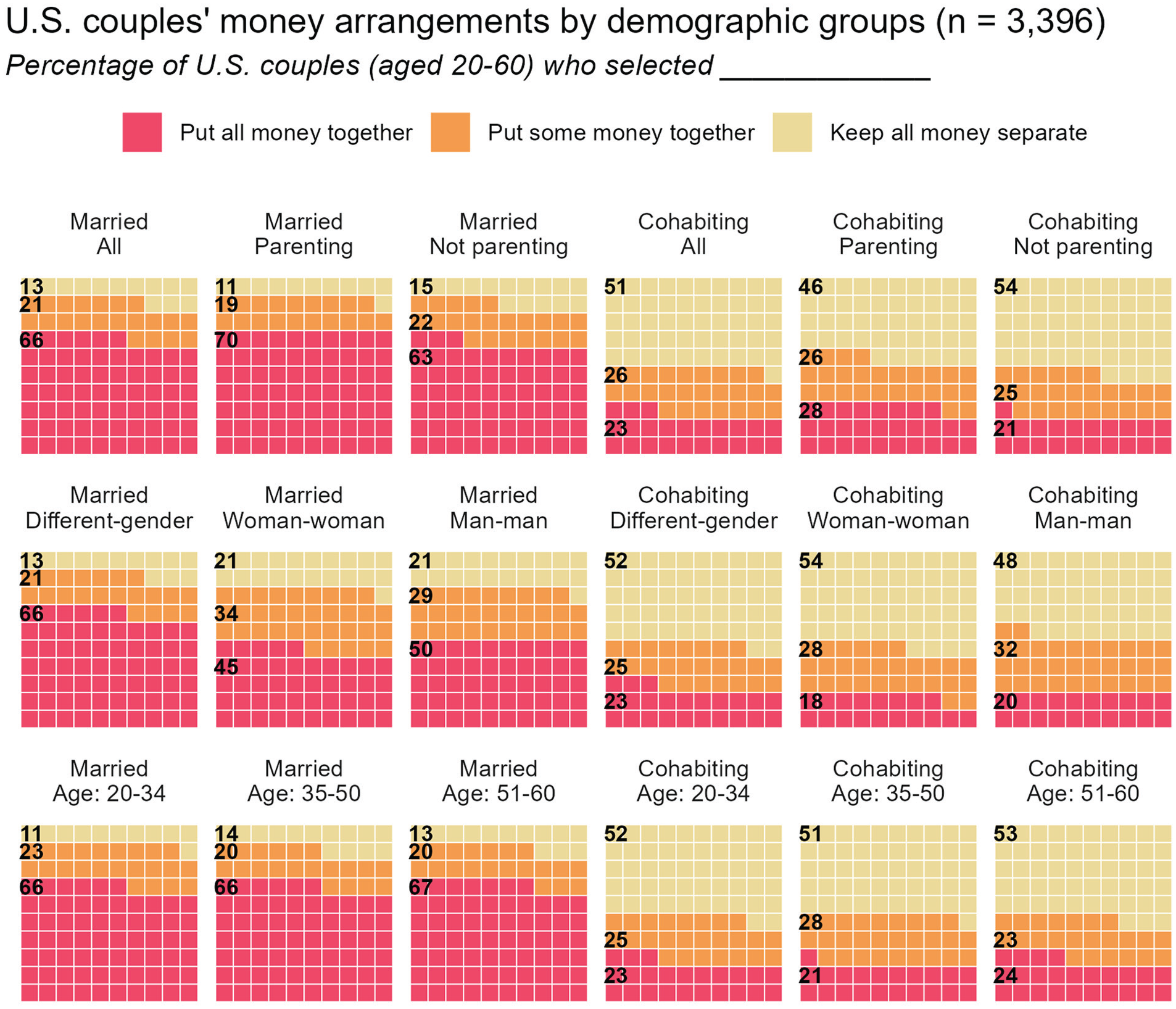
Figure 1 presents updated estimates of couples’ approaches to money using 2020–2021 data from the National Couples’ Health and Time Study (NCHAT), a nationally representative sample of married and cohabiting couples living in the United States (Kamp Dush and Manning 2022). NCHAT oversampled sexual and gender diverse families and is nationally representative of married and cohabiting couples (aged 20–60 years) living in the United States. Couples’ money arrangements are presented by marital and parental status, for different-gender and same-gender couples, and by age group. Results are disaggregated by legal marital status, which has consistently been found to be the determining characteristic influencing couples’ integration of money (Eickmeyer, Manning, and Brown 2019). Each panel in the figure contains a waffle chart consisting of 100 smaller squares colored according to the proportion of couples who report they (1) put all of their money together, (2) put some money together, or (3) keep all of their money separate. Additional details are available in the online supplement, and data access and replication code are available at https://github.com/jrpepin/NCHAT_Money.
Sampling weights are used to adjust for the complex sampling process of the survey, such as the oversample of sexual and gender diverse families. Chi-square tests confirm that all demographic group comparisons between married and cohabiting couples are statistically significant (p < .05). Among married couples, parents and different-gender couples are more likely than their counterparts to report they “put all money together” (p < .05). There are no statistically significant differences by demographic group among cohabiting couples. Additional details about data access, variable construction, cell sizes and distribution, and chi-square tests between and within marital groups are available at https://github.com/jrpepin/NCHAT_Money.
Differences by marital status are apparent, with 66 percent of married couples reporting that they pool everything compared with 23 percent of cohabiting couples taking a complete pooling approach (p < .05). The marriage-cohabitation gap is visible across subgroups, and chi-square tests confirm that it is statistically significantly different within each demographic characteristic (p < .05). Married couples who are parenting are more likely than married couples who are not parenting to put all their money together (p < .05). Two thirds of married different-gender couples put all of their money together compared with 50 percent of married men partnered with men and 45 percent of married women partnered with women (p < .05). Cohabiting couples’ approaches to money are relatively consistent within subgroups and are not statistically significantly different.
Increases in couples more often cohabiting before marrying, attitude data (Pepin 2019), and behavioral estimates from outside the United States (Hu 2021) and from nonrepresentative U.S. samples (Bank of America 2018) all suggest that younger couples may be more likely than their older counterparts to keep their finances separate. Yet this data visualization shows that money arrangements look remarkably similar across age groups. About two thirds of married couples pool their money, regardless of age, compared with less than one quarter of cohabitors (p < .05).
Overall, the figure shows that U.S. couples’ money arrangements remain starkly differentiated by marital status, and cohort differences are less apparent than expected on the basis of empirical data from other contexts and composition changes among U.S. families that are associated with a reduction in pooled finances. These bivariate statistics open many possibilities for use of NCHAT data to answer further questions related to U.S. couples’ treatment of money that have so far remained elusive.
Supplemental Material
sj-docx-1-srd-10.1177_23780231221138719 – Supplemental material for A Visualization of U.S. Couples’ Money Arrangements
Supplemental material, sj-docx-1-srd-10.1177_23780231221138719 for A Visualization of U.S. Couples’ Money Arrangements by Joanna R. Pepin in Socius
Supplemental Material
sj-docx-2-srd-10.1177_23780231221138719 – Supplemental material for A Visualization of U.S. Couples’ Money Arrangements
Supplemental material, sj-docx-2-srd-10.1177_23780231221138719 for A Visualization of U.S. Couples’ Money Arrangements by Joanna R. Pepin in Socius
Footnotes

Supplemental Material
Author Biography
References
Supplementary Material
Please find the following supplemental material available below.
For Open Access articles published under a Creative Commons License, all supplemental material carries the same license as the article it is associated with.
For non-Open Access articles published, all supplemental material carries a non-exclusive license, and permission requests for re-use of supplemental material or any part of supplemental material shall be sent directly to the copyright owner as specified in the copyright notice associated with the article.
