




Abstract
This data visualization describes the warmth of feelings that supporters of all major parties in Germany hold toward their own and all other major parties and how these feelings changed between 1977 and 2020. Data are from more than 700,000 respondents of the study Politbarometer. People have colder feelings toward ideologically more distant parties, and supporters of all other parties hold strongly negative feelings toward the radical right-wing Alternative for Germany (AfD). In most party pairings not involving AfD, feelings have been stable or trending positive. Today, Germany is not politically polarized in the sense of a divide running through the middle. Rather, the party landscape is fractionalized, with a deep affective division between the roughly 10 percent radical right and the rest and minor to moderate divisions between most other parties.
Keywords
In many Western societies, people hold strongly negative feelings toward some or all other political parties and their supporters. Where this is the case, people spend less time with their out-partisan family members, avoid out-partisans on the dating market, or discriminate against them when selecting roommates or employees (for a recent overview, see Jost, Baldassarri, and Druckman 2022). Thereby, politics are a central social dividing line in several countries, straining interactions and social cohesion (Dias and Lelkes 2022).
In most Western publics, party systems have fractionalized in recent decades (Hudde et al. 2022). Suppose we randomly draw two voters in Germany. In the 1970s and early 1980s, there was a 50 percent chance that these two voters supported the same party. Since then, that chance has dropped sharply to about 20 percent in 2021. Fractionalization increases the importance of out-partisan dislike: the more often people can expect to encounter supporters from other parties (which is a function of fractionalization and network segregation), the more important it is that they get along with them (Hudde et al. 2022).
In this data visualization, I describe the warmth of feelings that supporters of all major parties in Germany hold toward their own and all other major parties and how that has changed since 1977. I build upon Harteveld (2021), who analyzed and visualized the affect between all parties in the Netherlands at one point in time. I show these data for Germany and extend the visualization by including changes over time.
Data are from 721,431 respondents of the Politbarometer survey, which has been running monthly since 1977 and is available through December 2020. Feelings toward parties are measured with the widely used feelings thermometer, on which respondents rate their thoughts or feelings toward political parties. Answers are rescaled to range from 0 (very cold or negative feelings) to 10 (very warm or positive feelings). The “respondent’s party” is the party they would vote for if there were an election now (cf. Harteveld 2021). Compared with party affiliation or party leaning, this measure has fewer missing data. Furthermore, party affiliation is not available for new parties (e.g., for AfD only since 2016). A figure in the Online Appendix shows that patterns are very similar for party leaning instead of voting intention.
As Figure 1 shows, supporters of all parties have relatively similar and warm feelings toward their own parties. In multiparty systems, people do not have the same feeling toward all out-parties (Gidron, Adams, and Horne forthcoming; Harteveld 2021). Liking toward different out-parties is mainly a function of their ideological distance: as Figure 1 shows, people tend to have warmer feelings for “neighboring” parties than those that are ideologically further away (cf. Gidron et al. forthcoming; Harteveld 2021). Remarkably, all other partisans hold very negative feelings toward the radical right-wing Alternative for Germany (AfD). Supporters of AfD also dislike the other parties, but the feelings AfD voters send are much warmer than the feelings they receive. That intense dislike of right-wing parties, often more than the policy distance would imply, also shows in other countries and is what Gidron et al. (forthcoming) call “radical right exceptionalism.”
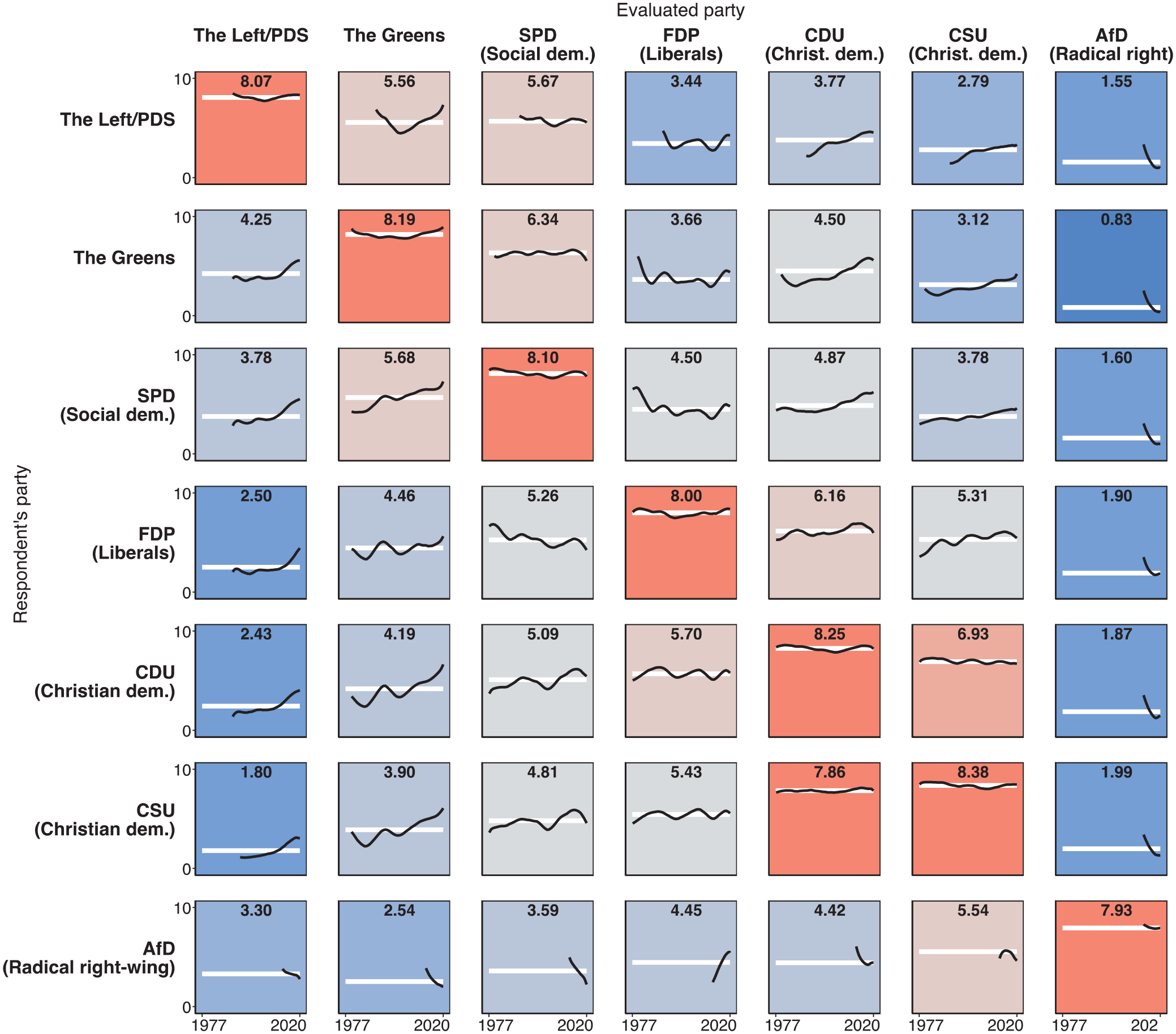
The figure plots the feelings supporters of parties (y-axis) hold for their own and other parties (x-axis). The parties are sorted according to their political left-right positions (the two Christian Democratic parties, CDU and CSU, are depicted as neighboring even though some indicators would place FDP between CDU and CSU). The colors of the tiles represent the average warmth across time. As is typical for the display of temperatures, cold feelings are displayed in blue and warm feelings in red. The medium, “neutral” temperatures are shown in light gray. The white horizontal lines (and the displayed numbers) also mark that average and make it easier to identify time trends visually.
Over time, most feeling relationships are stable or become more positive. The Left, Greens, and Christian Democrats receive warmer feelings over time. This includes an easing of the previously very polarized pairs between the Left and Christian Democrats. Feelings toward Social Democrats and Liberals follow no apparent pattern. The affect the AfD receives from other party supporters moves from rather cold to ice cold.
This visualization condenses a comprehensive overview of partisan affect across all party constellations in Germany and how these have changed over time into one figure. In sum, Germany is not a nation high in affective polarization. There is no divide running through the middle. However, that is not to say that negative partisan affect is no issue in Germany. There is a deep 90:10 divide separating the radical right-wing AfD (10 percent of votes in 2021) from supporters of all other parties. The affective divide against supporters of the Left has softened considerably. For all partisan pairings not involving these margins, feelings have mainly remained at or increased to lukewarm temperatures, far from levels of hostility seen in the United States and some other Western democracies. With party-political fractionalization, people are expected to be confronted with out-partisans more and more frequently. The relative absence of hostility is thereby vital for social cohesion.
Supplemental Material
sj-docx-1-srd-10.1177_23780231221132366 – Supplemental material for Partisan Affect in Times of Fractionalization: Visualizing Who Likes Whom in Germany, 1977 to 2020
Supplemental material, sj-docx-1-srd-10.1177_23780231221132366 for Partisan Affect in Times of Fractionalization: Visualizing Who Likes Whom in Germany, 1977 to 2020 by Ansgar Hudde in Socius
Footnotes

Supplemental Material
Supplemental material for this article is available online.
Author Biography
References
Supplementary Material
Please find the following supplemental material available below.
For Open Access articles published under a Creative Commons License, all supplemental material carries the same license as the article it is associated with.
For non-Open Access articles published, all supplemental material carries a non-exclusive license, and permission requests for re-use of supplemental material or any part of supplemental material shall be sent directly to the copyright owner as specified in the copyright notice associated with the article.
