



Abstract
The term glass ceiling is applied to the well-established phenomenon in which women and people of color are consistently blocked from reaching the uppermost levels of the corporate hierarchy. Focusing on gender, we present an agent-based model that explores how empirically established mechanisms of interpersonal discrimination coevolve with social norms at both the organizational (meso) and societal (macro) levels to produce this glass ceiling effect for women. Our model extends the understanding of how the glass ceiling arises and why it can be resistant to change. We do so by synthesizing existing psychological and structural theories of discrimination into a mathematical model that quantifies explicitly how complex organizational systems can produce and maintain inequality. We discuss implications of our findings for both intervention and future empirical analyses and provide open-source code for those wishing to adapt or extend our work.
Men are overrepresented at higher levels of the corporate hierarchy. The New York Times reports, for instance, that in 2018, there were fewer female chief executives at Fortune 500 companies than male chief executives with the name James, despite the fact that only 3.3 percent of the U.S. population is named James while women make up 50.3 percent of the U.S. population (Miller, Quealy, and Sanger-Katz 2018).
Scholars have long studied potential reasons for this glass ceiling effect—the name given for the general phenomenon in which invisible barriers block women and people of color from reaching high levels of management (Bertrand 2018; Cotter et al. 2001). Here, we focus on literature specifically surrounding gender. Some popular explanations of the glass ceiling revolve around innate or learned differences between men and women, such as psychological differences in risk-taking or taste for competition/negotiation (Babcock and Laschever 2009; Reuben, Sapienza, and Zingales 2015; Schubert, Brown, and Brachinger 2000), or differences on personality traits (Collischon 2021; Filer 1983; Semykina and Linz 2007). Others have focused beyond the individual, to the places where gender norms—roughly, culturally prescribed guidelines for behavior based on one’s own perceived gender and the perceived gender of those around us—and stereotypes—generalized and often unfounded assumptions about someone based on their (perceived) gender—are learned and enforced. To this end, scholars have found that policy, including family leave and flexible scheduling (Bear 2021; Goldin and Katz 2016; Pettit and Hook 2005; Williams and Segal 2003), and interpersonal factors such as harassment (Berdahl and Moore 2006; Stockdale and Bhattacharya 2009) and gender-biased evaluations (Heilman and Haynes 2005; Moss-Racusin et al. 2012), both play significant roles in creating or limiting the upward mobility of women in the workplace.
Due to the limits of what can be operationalized in a single study, efforts to empirically identify causes of the glass ceiling rarely consider more than a few competing ideas and often do so at a single (or a few) moments in time. This can be problematic because corporations are examples of complex social systems (Harrison et al. 2007; Martell, Emrich, and Robison-Cox 2012), where social norms and stereotypes diffuse over time through individuals and groups within the organization and back and forth between the organization and society. The interaction of these multiple and hierarchical social structures creates feedback processes and unexpected outcomes that can confound simple explanations of empirical findings. Empirical work therefore cannot always cleanly capture or quantify the ways in which women experience gender discrimination in many ways over long periods of time.
Acknowledging the limitations of empirical work to understand complex social systems, scholars have turned to simulation, and in particular, agent-based modeling, to study gender disparities in organizations (Bullinaria 2018; Martell, Lane and Emrich 1996; Momennejad, Sinclair, and Cikara 2019; Robison-Cox, Martell, and Emrich 2007). In an agent-based model, a computational, simplified representation of an individual (an “agent”) interacts with other agents using a predefined set of rules. These rules shape macro-level statistics, which can then “feed back” to reshape the parameters of the established rules (Gilbert 2007). Agent-based models have long been used in the social sciences to study phenomena within complex systems because one can rapidly consider experiments that are too large for empirical study and can also easily examine counterfactual arguments within evolving systems (Carley 1991).
The present work proposes a new agent-based model of how the glass ceiling emerges within the complex social system of a hypothetical corporation. We outline how glass ceilings within organizations can emerge through a coupling of (1) stable, hierarchical gendered norms about whose contributions are valued and how and (2) small, discrete instances in which these norms are enacted at the interpersonal level. 1 We use this new model of the glass ceiling effect to study how, together, these impact the success or failure of a quota-based intervention.
Model Overview
Our work is based on the earlier simulation model of Martell et al. (1996), who show how gender disparities in the corporate hierarchy can arise solely from small gender biases during performance evaluation. As in their work, agents in our model represent employees of a hypothetical, eight-level corporate organization, with a prespecified number of agents at each level. The primary difference between our model and Martell et al. (1996) is that we link gender disparity not to a generalized notion of “bias” in performance evaluations, but to specific, empirically identified mechanisms through which this bias manifests. To do so, our model simulates two common process in organizations: Employees engage in projects, and employees are promoted through the ranks of the company. Projects may succeed or fail, and promotions are based on the agents’ perceived promotability.
At the start of the simulation, agents are randomly initialized with a perceived binary gender (man or woman) and a perceived promotability. The simulation then iterates over a series of turns. On each turn, agents receive either an individual or group project. At fixed intervals, we also introduce stretch projects that provide outsized boosts in perceived promotability. Projects randomly succeed or fail with equal probability. When an agent’s project succeeds, the agent receives some credit that increases their perceived promotability. When a project fails, the agent’s perceived promotability drops via some amount of credit.
After some number of simulation turns, there is a promotion cycle. During a promotion cycle, the employees with the highest perceived promotability move up from their current level of the corporate hierarchy to the next. In the rare case where two employees have the same perceived promotabilty, they will have the same probability to get promoted. To make room for promoted agents, a random proportion of the individuals at each level of the hierarchy leave the organization. These spots are then recursively filled until the bottom of the hierarchy is reached. At this point, new agents are then created and “hired” into the entry level of the company. These new agents are equally likely to be men or women.
In this unbiased model, there are no differences between men and women: They are equally likely to begin with a given level of promotability, to succeed or fail on projects, to receive stretch projects, and to leave the company. We introduce our model of how the glass ceiling arises through two experiments that extend this unbiased model. First, we introduce six specific, empirically observed ways in which gender discrimination at the interpersonal level manifests in the workplace. Second, we propose a mechanism through which interpersonal gender discrimination is tied to gendered social norms at the macro and meso levels.
Our first modification of the unbiased model introduces six gender biases that have significant empirical support.
First, women’s errors and failures on projects are penalized more than men’s. For instance, women surgeons experience greater decrease in referrals after a bad outcome: A male surgeon has to have three patient deaths to be penalized the way a female surgeon is penalized after one patient death (Sarsons 2017). We model this gendered penalty by having women agents lose approximately 2 percent more credit than men do for a failed project (see the following).
Second, women’s successes on projects are valued less than men’s (Bowen, Swim, and Jacobs 2000; Castilla 2008; Eagly, Makhijani, and Klonsky 1992; Moss-Racusin et al. 2012; Swim et al. 1989; Swim and Sanna 1996). For instance, in a randomized double-blind study, Moss-Racusin et al. (2012) found that when evaluating candidates for a lab manager position, science faculty at research institutions assigned lower competence values to female applicants than identical male applicants. We model this gendered penalty by having women agents receive approximately 2 percent less credit than men do for a successful project.
Third, women are penalized for exhibiting nonaltruistic behavior (Fanning and David Piercey 2014). Women are seen more unfavorably when they depart from behaviors considered to be stereotypically feminine, such as self-promoting (Rudman 1998). We model this by assigning some percentage of women (here, 10 percent) to complain about receiving less credit than men on project successes. This, in turn, leads them to lose additional credit (here, they receive only 90 percent of the credit they would have gotten had they not complained.
Fourth, women receive fewer opportunities for growth. Women often receive fewer assignments that allow them to develop new skills and report having less access to challenging assignments (King et al. 2012). For example, the American Bar Association found that 44 percent of women of color and 39 percent of white women reported being passed over for desirable assignments in law firms, compared to 2 percent of white men (Rhode 2017). Here, we model this as a requirement that women have 20 percent more successes than a man to be eligible to receive a stretch project.
Fifth, women receive more blame when a mixed-gender team fails (Egan, Matvos, and Seru 2017; Haynes and Lawrence 2012). For instance, participants who receive information about a group’s failure assign more blame to women (Haynes and Lawrence 2012). Here, we model this by having women lose approximately 2 percent more credit than their male teammates when a group project fails.
Sixth, women receive less credit in mixed-gender teams (Heilman and Haynes 2005; Sarsons 2017; Sarsons et al. 2021). For example, coauthoring a paper benefits women economists less than it does men: Each coauthored paper increases men’s probability of achieving tenure 8.2 percent but increases women’s probability of achieving tenure by 5.6 percent (Sarsons et al. 2021). Here, we model this by having women gain approximately 2 percent less credit than their male teammates when a group project succeeds.
These gender biases have empirical support primarily at the interpersonal level. Our model assumes that promotion decisions are made by individuals and that those decisions are a function of gender bias in credit allocation that is accumulated via these six mechanisms. We implement each of these mechanisms into our model as noted briefly previouslu (see the Detailed Methods section at the end of the article for further details).
Most importantly, the six mechanisms vary in their effects. For instance, stretch projects in our model count for 3 times as much as a typical project, so stretch project success can rapidly drive individuals up the corporate hierarchy. In contrast, discounted rewards for women on projects have very small impacts. Thus, a single instance of this form of bias at a single point in time has a minimal effect.
More specifically, to allocate credit for project success and failures, we first assume that the credit
Prior empirical work thus guides our parameter settings for how much gender bias impacts credit allocation for project success and failure. For other parameters, however, no empirical evidence we are aware of exists for calibration. Because of this and because a range of values are possible even for empirically informed parameters, we provide results for a range of other parameter settings in the Online Appendix in the Online supplement. While changing model parameters of course changes absolute measures, unless otherwise noted in the following, qualitative findings are consistent across the range of parameter settings we considered.
Results
Figure 1 shows that the interpersonal acts of discrimination we model lead to a glass ceiling effect. In the unbiased model, each level of the corporate hierarchy shows gender parity, with men and women both making up 50 percent of the employees (left-most plot in Figure 1). In contrast, with all of the mechanisms introduced into the model (right-most plot in Figure 1), men dominate upper levels of the corporate hierarchy, leaving a preponderance of women at the lowest levels. Specifically, in the condition where all six bias mechanisms are applied (the right-most subplot of Figure 1), 84 percent of agents at the top of the corporate hierarchy are men. This finding is comparable to the numbers used in the simulation work from Kogut, Colomer, and Belinky (2014), described further in the following, who find that 8.3 percent of directors and 9.1 percent of directors in the “top 500 firms by market cap” are women.

The percentage of men (y axis) at each level of the corporate hierarchy (different colors) at each simulated promotion cycle (x axis). Different subplots show results for simulations without any empirically validated biases (left-most), with all of these (right-most), or with each individually (middle subplots; results for biases 1 through 6 are shown from left to right). Error bars represent confidence intervals from 300 randomly initialized simulation runs.
However, not all mechanisms we implement have the same impact; the most significant impacts come from mechanisms that are small but frequently applied. Figure 2 shows that the interpersonal acts of discrimination with the strongest effects on gender disparities were those that had most frequently been applied, rather than those with the largest effects on individual agents. As an example of the latter case, differences in growth opportunities via stretch projects—which significantly alter career trajectories, but only for a small number of individuals—impacted gender disparities at the top of the corporate ladder (because successful stretch projects shot individual agents to the top) but were too infrequent in our model to reshape disparities at all levels. Figure 2 also suggests that women who reach high levels are affected more by devaluation for their successes than by penalties for failed projects. This result is explained by the fact that women at higher levels of the hierarchy are more successful (by chance, in our simulation) than women at lower levels. In addition, we find that women at high levels of the corporate hierarchy have a greater track record of successes than their male counterparts (see Online Appendix, Figure A7, in the Online supplement).
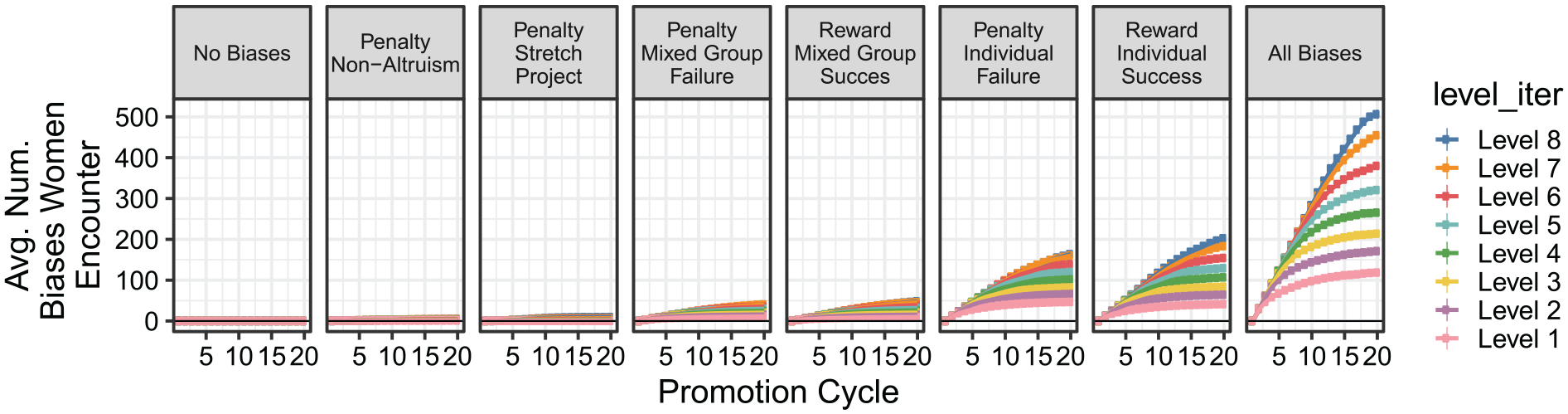
The average number of biases that female agents encounter (y-axis) at each level of the corporate hierarchy (different colors) at each simulated promotion cycle (x-axis). Different subplots show results for simulations without any empirically validated biases (left-most), with all of these (right-most), or with each individually (middle subplots; results for biases 1 through 6 are shown from left to right). Error bars represent confidence intervals from 300 randomly initialized simulation runs.
Incorporating Social Norms
We have shown that enactment of gender bias at the interpersonal level can result in a glass ceiling for women. However, our model to this point does not express clear assumptions about why bias exists in the first place. In this section, we provide such a mechanism based on the existence of gendered social norms at the meso and macro levels. Our starting point is the empirical observation that fewer women in an environment correlates with increased gender discrimination. In management, in the Israeli army, among law students, and in blue-collar work groups, a greater proportion of men results in more bias against women (Lortie-Lussier and Rinfret 2002; Pazy and Oron 2001; Sackett, DuBois, and Noe 1991; Spangler, Gordon, and Pipkin 1978). Prior work has expressed this empirical observation using a mathematical equation that purports that the degree of interpersonal discrimination at one level of the corporate hierarchy changes with the proportion of women at the level above (Robison-Cox et al. 2007). As gender disparities increase, then, gender discrimination does as well, rippling downward throughout the organization.
However, this modeling assumption does little to address claims of “reverse discrimination.” That is, such a model must either assume that gender imbalances that favor women should result in discrimination against men or make the assumption that such reverse discrimination simply cannot exist. The latter claim is unsatisfying theoretically because no underlying mechanism is suggested. However, it is also more consistent with reality. In the few settings where women dominate higher levels of the corporate hierarchy, there is little evidence of men’s promotion abilities being impacted. Instead, while women’s lack of representation in certain occupations exacerbates disadvantage, men, namely, heterosexual white men, when in short supply, enjoy a glass escalator, where they are put on a fast track to advanced positions (Budig 2002; Wingfield 2009), and their evaluation is not affected by their proportion (Pazy and Oron 2001). The preponderance of male school superintendents is one such example (Brunner and Kim 2010).
Our model provides a mechanism that explains both how organizational gender disparities increase gender discrimination and how this can apply only for women. To do so, we draw from scholarship on race and organizations and model how the degree of interpersonal discrimination (and thus resource allocation; Ray 2019) within an organization is a function of social norms that are both internal to (meso-level norms) and external to (macro-level norms) the organization. We focus here only on project evaluations but note that the model can easily be extended to other interpersonal biases we study as well.
More specifically, we introduce the following mathematical model that defines the proportion of variance in project evaluations that is explained by gender:

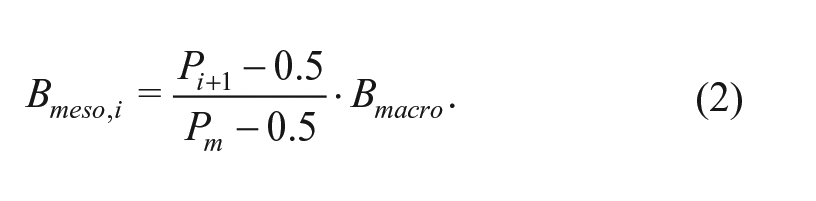
Here,
Under this model, the value of
When the proportion of men in level
When the proportion of men at level
We set

The percentage of employees that are men (y-axis) at each level of the corporate hierarchy (different colors) at each simulated promotion cycle (x-axis). Different columns show results for simulations where we vary the strength of meso-level norms relative to macro-level norms (i.e., the model parameter
Ultimately, then, we show that reverse discrimination can occur, but under very specific conditions. Put another way,
Implications for Intervention
A common approach to mitigating gender disparities in organizations is to implement a quota-based system that enforces rules about promotions based on gender (Pande and Ford 2012). Here, we simulate the effects of a quota-based intervention using our model. After 7 promotion cycles without intervention, a quota system is introduced to our simulated company for six promotion cycles (our finding is robust to the number of promotion cycles, see Online Appendix, Figure A8 and Online Appendix, Figure A9 in the Online supplement). The quota intervention we assume is one where rules on promotions are enforced that target a goal of having K percent of each level of the company above the entry level be women. We vary the value of
We find that gender disparities in our simulated organizations will return over time if company gender norms are at all displaced by gender-biased macro norms, even with quota levels as high as 70 percent. These results are shown in Figure 4; only in the last row of figures, where macro-level norms have no impact on promotion decisions, do we observe gender disparities gradually decrease after reaching the peak. At face value, these findings conflict with those from the agent-based model of Kogut et al. (2014), who find that quotas as small as 20 percent can induce forms of structural equality across genders. However, Kogut et al. (2014) note that their model, while providing important insights into the gendered social network structure of board directors, does not account for the role of societal norms and/or beliefs about gender. Our work thus provides a caution to their findings, noting that one must, as previously mentioned, make generous assumptions about the malleability of macro-level gender norms for quota-based interventions to sustain long-term impacts on the gendered nature of corporate structures.

The percentage of employees that are men (y-axis) at each level of the corporate hierarchy (different colors) at each simulated promotion cycle (x-axis). Different rows show results for simulations where we vary the strength of meso-level norms relative to macro-level norms (i.e., the model parameter
Discussion
Gender disparities in organizations emerge from a complex, dynamic social system (Martell et al. 2012). Prior agent-based models have shown how a variety of mechanisms, such as career interruptions and variable attrition rates (Bullinaria 2018; Momennejad et al. 2019; Robison-Cox et al. 2007), can create gender disparities in these complex organizational systems. Most recently, Momennejad et al. (2019) simulate the costs to individuals and institutions of sexist comments and objections to those comments in meetings, finding interrelationships between structural and learning effects. Their work shows how social learning can prevent structural interventions from being effective.
The present work extends these efforts. We provide a concrete mechanism through which empirical observations of gender discrimination at the interpersonal level can be embedded into a model of complex organizational systems. Doing so paves a path toward better integration of empirical and simulation results in the study of the glass ceiling. Furthermore, prior work has largely focused on identifying the effect sizes of mechanisms for gender bias. Our work instead models both effect size and the frequency with which these small interpersonal acts of gender bias are enacted. This is important because we find in our simulations that biased evaluations that produce small effects but that occur at frequent intervals over a period of time may be the most consequential in producing gender disparities. Finally, we introduce a new hierarchical model of how organizational and societal norms combined to create gender discrimination. In doing so, we argue via simulation that interventions aimed at reducing gender disparity in organizations must attend to the strength of societal gender norms and the stubbornness of outside influences when devising plans to disrupt gender homogeneity in corporate hierarchies. Critically, then, our model encourages further attention toward radical, societal-level change, or at least changes at the meso level that can be expected to diffuse out to macro-level structures, such as quotas in roles with direct policy implications (Beaman et al. 2009) or quotas in combination with efforts to shift widespread societal norms via, for example, coordination with widespread policy change (Ofosu et al. 2019).
In considering these advancements of our work over prior efforts, however, it is important to also note our limitations. First, while we focus on gender as a binary, we emphasize that gender itself is a continuous and socially constructed system (Ridgeway 2011). Second, while our model could be easily extended to focus on intersectional dimensions of inequality and discrimination, the focus in the present work is on gender and thus does not account explicitly for the intersectional nature of inequality or the ways in which stereotypes associated with other groups interact with gender stereotypes to amplify or dilute biases (Hall et al. 2019). Third, it is difficult to know the true impact of small, continuously applied interpersonal biases. In any case, actual effect sizes will vary by organization and by individuals within organizations. Our model, informed by empirical results, assumes very small effect sizes; in the real world, these may be larger, smaller, or inconsistently applied. While we have provided robustness tests for our modeling assumptions in the Online Appendix in the Online supplement, these are of course subject to similar concerns. Fourth, many factors contribute to any individual’s career trajectory beyond those listed here: choices and preferences, workplace family policies, and more. Our model demonstrates only that disparities on the order of magnitude of those seen in the real world can be achieved via the interpersonal mechanisms presented, with full account of the norms on which these interpersonal actions are based.
Despite these limitations, our work serves broader theoretical and policy-oriented goals. With respect to theory, our model provides a link between status construction theory (Mark, Smith-Lovin, and Ridgeway 2009), which focuses on the link between norms and behavior, and Ray’s (2019) theory of racial inequality emphasizing how culture, resources, and ideology interact at the micro, meso, and macro levels of analysis. With respect to policy, laws are designed to address either large events that happen infrequently and can be easily attributed to a single actor—for example, overt sexual harassment by a manager—or “pattern and practice” in an organization, for instance, explicitly discriminatory policies. Our model shows, by contrast, how large organizational disparities can occur via that gradual and diffuse impact of many small, even unintentional events, decisions, and evaluations happening frequently over a long period of time. This raises important questions about the location of accountability within organizations and organizational culture and about what role the legal system or even workplace policies can or should play in cases where the biased evaluations are of the sort we model here.
Detailed Methods
We provide here more complete details on the simulation model used in this article. Full parameter details are in the Online Appendix, Tables A1 through A4 in the Online supplement, and full replication materials are available at https://github.com/yuhaodu/workplace_gender_bias.
Further Model Details: Agents
Agent states in our model are constituted by variables that keep track of the number of successful and failed projects this agent has completed and the agent’s perceived promotability. Each agent also has a binary attribute for their perceived binarized gender—man or woman.
Further Model Details: Company
We model the same eight-level organization as Martell et al. (1996). Level 8 represents the highest level of the company (i.e., the C-suite executives), and Level 1 represents the lowest level. At the beginning of the simulation, all positions at all levels are seeded with agents who are randomly assigned a gender. As in Martell et al. (1996), the eight levels have 10, 40, 75, 100, 150, 200, 350, and 500 agents, respectively.
The company evolves through a series of project turns. Each project turn can be either a traditional project turn or a stretch project turn. Stretch project turns occur once every 12 turns. On a traditional project turn, 50 percent of agents are randomly assigned to individual projects, the others to group projects. On a stretch project turn, stretch projects will first be assigned to
After
Further Model Details: Projects
There are three kinds of projects in our simulation—individual projects, stretch projects, and group projects. Individual projects and stretch projects are both assigned to a single agent. Group projects are assigned to two agents. All projects have an attribute,
Modeling That Women’s Successes (Failures) on Independent and Group Projects Are Valued (Penalized) Less (More) Than Men’s
We operationalize devalued success for women on projects using the percentage of variance in project credit that is explained by agent gender. More specifically, model parameters
To explain how gender bias in project credit allocation is implemented, we focus on this level-independent value
Thus, by fixing
Note also that the quantity
Similarly, for failed individual projects, men’s perceived promotability decreases by
Modeling That Women Are Penalized for Exhibiting Non-altruistic Behavior
In our model, we assign a percentage of women,
Modeling That Women Receive Fewer Opportunities for Growth
In our model, at fixed intervals (every
Modeling the Quota Intervention
The quota-based intervention study we introduce has a single parameter,
We evaluate this intervention by further varying two additional parameters. Figure 4, and in the Online Appendix, Figure A8 and in the Online Appendix, Figure A9 in the Online supplement show the results about different ranges of project turns,
Supplemental Material
sj-pdf-1-srd-10.1177_23780231221117888 – Supplemental material for Insidious Nonetheless: How Small Effects and Hierarchical Norms Create and Maintain Gender Disparities in Organizations
Supplemental material, sj-pdf-1-srd-10.1177_23780231221117888 for Insidious Nonetheless: How Small Effects and Hierarchical Norms Create and Maintain Gender Disparities in Organizations by Yuhao Du, Jessica Nordell and Kenneth Joseph in Socius
Footnotes

Supplemental Material
Supplemental material for this article is available online.
Notes
Author Biographies
References
Supplementary Material
Please find the following supplemental material available below.
For Open Access articles published under a Creative Commons License, all supplemental material carries the same license as the article it is associated with.
For non-Open Access articles published, all supplemental material carries a non-exclusive license, and permission requests for re-use of supplemental material or any part of supplemental material shall be sent directly to the copyright owner as specified in the copyright notice associated with the article.
