




Abstract
Although many studies examine gender perceptions among adults, fewer ask children to report on their personal views and experiences of gender. The authors use an open-ended survey to ask middle school, high school, and college students what they think is best and worst about being a boy and a girl to analyze how gender perceptions vary between younger and older children. The authors find that girls’ perceptions of the benefits and drawbacks of being a boy are similar to boys’ perceptions, suggesting that girls are attuned to boys’ experiences. Students have an easier time identifying the social disadvantages boys and men face, but their recognition of how patriarchy affects girls and women is more limited. Instead, they emphasize perceived biological and appearance-related advantages and disadvantages. Such foci on the body, the authors argue, undercut the potential for change and collective action.
Inequality that disadvantages girls and women persists, and gender ideologies and stereotypes are important in the lives of both children and adults (Armstrong and Hamilton 2013; Morris 2012; Musto 2019; Pascoe 2007). Stereotypes motivate people to adapt to gender norms and can become self-fulfilling prophesies, even if their impact is masked by illusions of meritocracy (Barreto and Ellemers 2015; Ridgeway and Smith-Lovin 1999). Given their power, sociologists have examined the causes and consequences of gender stereotypes and related attitudes in a variety of contexts, from how parental views relate to their children’s attitudes about gender roles (e.g., Moen et al. 1997), to the impact of divorce on attitudes (Amato and Booth 1991) and media influences (Ward and Grower 2020). Much of this research focuses on ideology and gender roles, asking subjects questions such as whether women should work outside the home and how couples should balance childcare and housework. Although many studies examine gender attitudes and ideologies among adults, fewer ask children themselves to report on their personal views and experiences of gender. Such perceptions about gender—attitudes and beliefs that take into account socially constructed gender-based differences that overvalue men and masculinity and undervalue women and femininity—are an important part of gender inequality.
As a result, we know little about when gender stereotypes become salient and meaningful to children. Recent qualitative research shows that middle and high school children struggle to make sense of gender inequalities. Studies on adolescents highlight how school and sports contexts provide a field for the social construction of gender inequality. Young people actively construct their own gender identities, as well as their sense of what gender stratification means in their social worlds; as a focus group study on middle schoolers by Brinkman et al. (2014) concludes, “children’s gender identity development [should] be viewed as a dynamic process in which children are active participants and that they place particular attention to the potential costs of not conforming to gender role norms” (p. 845). In an ethnography on middle school swim teams, for example, Musto (2014) found that gender stereotyping was mediated by a context in which girls’ athletic dominance was obvious. In a later ethnographic study of middle school classes, Musto (2019:370) found that students came to have gender status beliefs— “cultural expectations about traits girls and boys possess”—that held that boys were more exceptionally intelligent than girls. Musto shows how these beliefs were shaped by children’s experiences with teachers who tolerated white boys’ rule breaking. Pomerantz, Raby, and Stefanik’s (2013:187) interview study with girls aged 12 to 17 years demonstrated that they are confused by “girl power” discourse that denies such sexism; continued gender stereotypes and other types of inequality can be “baffling” and hard to counter.
Larger sample studies on middle schoolers have found the prevalence of similar perceptions that disadvantage girls. Cynthia Mee (1995) surveyed 1,500 middle schoolers about their perceptions about the gender they identified with and found that boys thought of themselves as having much to enjoy just by being a boy and few downsides to this identity; girls had few good things to say about being a girl and more negative comments. In a follow-up study, Karen Zittleman (2007) asked 440 middle school students in five schools about the advantages and disadvantages associated with being a girl and being a boy. Combining boys’ and girls’ responses, Zittleman found that boys are seen as benefiting from strength and sports, while girls are seen as having appearance-associated advantages. Comments about the downsides of being a boy were less prevalent and emphasized differential discipline from adults, while the disadvantages associated with being a girl focused on the body: periods, childbirth, and breast cancer. Given the many changes that middle school children encounter because of puberty, their emphasis on embodiment, particularly about girls’ and women’s bodies, is not surprising. We directly build on these studies by Mee and Zittleman in this article by asking not just middle school students but also high school and college students what they perceive to be the best and worst things about being a boy and being a girl.
A cohort-based approach can help us understand how older and younger children and adolescents perceive gender. Is there less of a focus on embodiment in older groups because children become accustomed to maturing bodies and/or exposed to new aspects of gender difference and inequality (and, perhaps, more informed)? How do boys and girls in different age cohorts make sense of the best and worst aspects of their own, and others’, gender? Scholars have found that lived experiences in late adolescence and early adulthood have more influence in the construction and reconstruction of young people’s gender ideology than social and background origins (Davis 2007). Given the fact that the transition to adulthood is a long process in the United States, something emphasized by the literature on the life course (Arnett 2004; Lawrence et al. 2020), we include traditional-aged college students in this study as an older group of adolescents whose gender ideology is still in flux but is nonetheless significant.
In this article, we build the literature in this area with data from an open-ended survey that asked students in three different age groups what they think is best and worst about being a boy and a girl. By comparing across groups, we develop a fuller analysis of when such gender perceptions are salient and how these perceptions vary between younger and older children. Our central finding is that children and young adults have an easier time identifying the social disadvantages boys and men face but have limited recognition of the role patriarchy plays in the lives of girls and women, instead emphasizing perceived biological and appearance-related advantages and disadvantages and “special treatment.” We begin with a discussion of gender salience among young people before developing our theoretical framework about perspective taking and recognizing structural inequality and outlining our data and methods. After presenting our analysis, we conclude with implications of our findings for theory and policy.
Background
Youth, Gender Salience, and Embodiment
Gender is salient to young people of all ages, especially in schools, where they are often grouped as boys or girls in queues and at lunch tables, in play groups, during turn taking, and so forth, and later in sex education classes, at school dances, on athletic teams, and so on (Johnson 2005; Musto 2014, 2019; Smith 2012; Thorne 1993). As children enter middle school and early adolescence, “they tend to separate more and more by gender, with the amount of gender separation peaking in early adolescence” (Thorne 1993:52). Moreover, because of gender inequality, both boys and girls are less likely to be exposed to media focused on what it is like to be a girl or a woman (Diekman and Murnen 2004; Hsiao, Banerji, and Nation 2021; Ward and Grower 2020). There are few movies that feature girls and women as central characters, and books, video games, and other aspects of popular culture are often biased and misogynist (Kowert, Breuer, and Quandt 2017; McCabe et al. 2011). In this context, it is not surprising that boys and young men might feel entitled to structural advantages and less able to empathize with or reflect on the inner lives and experiences of girls and women.
Given the many physical (and psychosocial) changes both boys and girls experience during puberty, an important aspect of this gender salience is embodiment. Girls are socialized to aspire to the dominant thin ideal, while boys are more likely to want to have larger body mass—gender-related variations in body perceptions that are related to girls’ eating disorders during and after puberty, among other mental health issues (Vogt Yuan 2007). To address these variations, scholars have emphasized the objectification of women, but also beliefs that men’s bodies are related to their characters, with taller and more muscular bodies as signifiers of more masculine personality characteristics (Pope, Phillips, and Olivardia 2000). For girls and young women, a key embodied experience is menstruation: a source of power but also embodied suffering and shame (Bobel and Kissling 2011; Fingerson 2006; Johnston-Robledo et al. 2007). Boys and young men, however, often know little about girls’ experiences of menstruation, especially as teenagers. For instance, Allen, Kaestle, and Goldberg (2011) found that young men in college reported that in high school, they saw menstruation as a “mystery” that “was a problem for women to deal with, not men” (p. 145).
Seeing Structural Inequality: Perspective Taking and Entitlement
Boys’ distancing themselves from girls’ experiences can be seen as an example of a failure of perspective taking. Research on race, gender, and other status differences has consistently shown that lower status people find it easier (and more necessary) to take the perspective of people in higher status positions than vice versa (e.g., Berger et al. 1977; Gerber 2009; Love and Davis 2021; Ridgeway 2014). Hochschild’s (1983) work on emotional labor highlights how women must figure out how to think like a man, and W.E.B. Du Bois’s (1903) theoretical insights on double consciousness remind us that minoritized groups are more aware of the dominant group’s perspective than the reverse. The disadvantages of privilege are often easier for dominant groups to see than the inequalities experienced by oppressed ones. For example, scholars of race and ethnicity have found that Whites know little about disadvantages that Black people face, while Black people (including adolescents) are more aware of how they are structurally disadvantaged (Holoien et al. 2015; Manning et al. 2015; Seider et al. 2019). In general, there is a “reluctance to acknowledge unwarranted privilege” (Ellemers, Scheepers, and Popa 2010), which “explains why group-based differences tend to be downplayed and denied—particularly by those who benefit from these differences” (Ellemers 2018:290). Collective guilt induces denial for those with privilege, but people who are disadvantaged by gender stereotypes also have reasons to resist thinking privileges exist; this way, they can continue to imagine they can get ahead on their own merits (Ellemers 2018:290). This one-sided perspective taking is problematic, because as Love and Davis (2021) noted, perspective taking (or “role taking”) is a crucial element of societal maintenance in that it “strengthens social cohesion, reduces stereotypes, increases helping behavior, and supports positive out-group evaluations” (p. 152).
Although girls and women are socialized to be more empathetic and concerned about others’ feelings, scholars have argued that it is status, rather than sex or gender, that makes girls and women better at perspective taking than boys and men (Ridgeway and Correll 2004). In their work on perspective taking and gender, Love and Davis (2014) found that there is a trigger effect: high status decreases individuals’ accuracy in role taking, regardless of gender. When men are put into low-status positions, or women are in high-status positions, the gendered effects of perspective taking disappear. Simply put, women are better at taking the perspective of others because of their differential status relative to men, not gender.
Being unable to take the perspective of those from lesser status groups matters and can help us understand confusion and ambiguity about equality versus special treatment. If boys feel entitled to higher status and do not recognize structural inequality, equality—or any advantages that girls and women receive—can feel like discrimination (Manne 2020). In short, status matters for perspective taking across the life span; insights about status difference from research on adults have been infrequently, yet successfully applied to research on children and youth (e.g., Correll 2001; Lloyd and Cohen 1999), an approach we build on here.
Data and Methods
With school administrators’ and individual teachers’ cooperation, we surveyed middle schoolers (5th to 8th grades, generally 10–14 years old) and high schoolers (9th to 12th grades, generally 14–18 years old) from public schools in a large city in the Northeast, where we had a personal contact who granted us access. Teachers sent home institutional review board–approved consent forms, which parents could sign and return to waive their children’s participation in the study if they did not want their children to complete the survey. The researchers introduced themselves and the study to each class of students, emphasizing the voluntary and confidential nature of their participation, and those whose parents had not opted out completed the paper survey. Data collection occurred during each grade level’s English class to increase response rates, as the class is required of every student at every grade level, and to ensure that no student took the survey more than once.
We also surveyed college students from a large university in the same city taking one of three introductory and upper level sociology courses (introduction to sociology, criminology, and sociology of gender). We chose these courses because they enroll students from a wide range of majors, and there was no enrollment overlap among the three courses. During the first week of class, we administered paper surveys, before students covered any content that may have affected survey responses. All undergraduates received an institutional review board–approved information sheet about the survey and were told that they could decline participation without any penalty to their grades.
Using the same survey questions designed by Mee (1995) and Zittleman (2007), we asked all students to write responses to four open-ended questions, regardless of their own gender identity: “In your opinion, what is the
We received a total of 201 responses from middle and high school students and 162 responses from traditional-aged college students (18–25 years), for a total sample size of 363. Surveys included a series of demographic questions, including gender, year in school, race/ethnicity, and a crudely constructed class question, in which we asked an open-ended question about what their parents did for a living (however, many students, particularly those in the youngest grades, did not know what their parents did for a living, or provided responses such as “they work at their jobs,” so we omit this measure in our analyses).
Table 1 shows the sampled students’ demographic characteristics. The overall sample is 67 percent women (no student self-identified as other than boy or girl) and 46 percent white, though the secondary and middle school students were less likely to be white. Although race structures boys’ and girls’ gender ideologies and perceptions of others, in this study we focus on differences only by age group and gender.
Demographic Characteristics.

We used inductive and deductive coding approaches to analyze the data, starting with researchers’ independently coding each student’s responses to all four questions using predetermined codes modeled on Zittleman (2007) and, when necessary, adding new codes that arose in the data. Content analysis highlighted the key element(s) of each response (e.g., “clothing,” “periods,” “getting free stuff,” “being strong”) generating more than 300 unique codes. Most responses produced a single code, though as many as five codes appeared in some single responses to a question. After an initial pass of descriptive coding, we collaboratively discussed prevalent themes to organize the codes into 11 distinct categories (see Table 2). The categories encompass responses that highlight both individual and structural aspects of a theme. For example, “clothing,” “shoes,” “being ugly,” and “makeup” fit into an umbrella “appearance” category, as do responses that discuss pressures to appear a certain way to fit in. Although “periods” would fit the “embodiment” category, we separated it because of the volume of responses focused on menstruation. We also included blank, “don’t know,” “everything,” and “nothing” response categories.
Coding Categories.

We present our analyses of responses from middle school, secondary, and college students about the best and worst things about being a boy and being a girl in the sections that follow. We separate each age group, and within each group, highlight the differences and similarities between girls’ and boys’ responses. When necessary, we correct simple spelling mistakes for readability but preserve students’ capitalization, punctuation, and grammar.
Findings
Most broadly, our analysis finds that across all age groups, boys tended to focus on embodied and appearance-related aspects of being male or female and appeared to have difficulty seeing outside their own experiences. Thus, they were less likely to refer to systematic oppression and structural disadvantages that girls and women face, exhibiting little to no perspective taking. In fact, boys were more likely to comment that girls get special treatment. In contrast, girls frequently mentioned social aspects of girls’ and boys’ lives, and in older groups girls sympathize with the social perils of masculinity, making boys’ and young men’s inability to reflect on girls’ and women’s experiences more striking. Figures in each section summarize our central findings, showing the percentages of boys and girls within each age group whose comments describing the best and worst things about being a boy and being a girl related to embodiment, power and privilege, or were left blank (a table of all coding categories can be found in the Appendix). In the subsections that follow, we report findings for each age group to pinpoint variation in gender perceptions in childhood, adolescence, and young adulthood.
Middle School: Ignore Patriarchy and Go Shopping
Middle school respondents rarely referenced aspects of structural or social inequality when asked about the best and worst things about being a boy or girl, focusing instead on aspects related to appearance and embodiment, as seen in Figure 1. The data also show two striking patterns. First, the most varied responses from both boys and girls were in response to the “worst thing about girls” and “best thing about boys” questions, suggesting there were many possible answers students were able to think of, and second, girls gave more, and more varied, responses about boys than boys gave about girls.

Middle schoolers’ perceptions of gender.
When asked about the best and worst things about being a girl, middle school boys tended not to respond at all or wrote very little. Some wrote they “don’t know” (4.5 percent) about the worst thing about being a girl, and nearly 40 percent left this question blank; a few resisted answering questions about girls because it is not their lived experience, and thus they felt they could not answer. For example, the response of one sixth grade boy demonstrates this lack of perspective taking: “I’m a boy how am I supposed to know???” Middle school boys also had a hard time coming up with anything good about being a girl: nearly 35 percent left this question blank, and 9 percent said they “don’t know.” Although other interpretations of “blank” responses may be possible, individual boys were selective in the questions they did not answer (i.e., they left only one or two questions blank, not all of them), suggesting that a blank response was equivalent to “don’t know.” When they did respond, boys wrote primarily about the advantage girls have with shopping and having more clothing options. In fact, 30.4 percent of middle school boys identified shopping or prettiness as benefits to being a girl. Four boys (17.4 percent) also pointed to privileges they perceived girls are allowed, like “hitting boys.” As one boy put it, “girls can get anything they want.” Another specified that the best thing about being a girl was “getting things from dad.”
In contrast, when asked about the worst things about being a boy, 4.4 percent of boys wrote “nothing,” and 39.1 percent left this question blank, suggesting that they perhaps could not think of a worst thing. Boys’ perceptions of the worst thing about being a boy were often based on power (8.7 percent) or social advantages that privilege boys (26.1 percent), such as “being brave and everybody counting on u,” or “having to do a lot of hard work.” A few boys commented that the worst thing is “not hitting girls.” Only two boys’ comments referred to embodiment as the worst thing (“underarm hair” and “small”), and none referenced appearance.
Addressing the question about the worst thing about being a girl, middle school girls focused on periods (27.3 percent) and other aspects of embodiment (22.6 percent), as well as appearance (13.6 percent). They frequently wrote about puberty, menstruation, cramps, pregnancy, and childbirth in comments about “having babies” and “we have to get our period every month.” Although girls’ most common responses about the worst thing about being a girl stressed the female body, the most commonly cited best things were shopping and appearance (70.5 percent). For instance, an eighth grade girl wrote, “girls can wear jewelry and skirts and they can be fancy,” and others commented on “all the cute clothes and accessories you can shop for.” Middle school girls also lauded “doing your hair,” “makeup,” and “painting your nails” as best things about being girls.
Although middle school girls were less likely to leave a blank response to the question about the worst thing about being a boy (18.2 percent) or to say “nothing” (2.3 percent), girls’ responses in this age group do not demonstrate a great deal of perspective taking. Rather, girls commented on boys’ appearance and intelligence and indicated a general disdain for boys. Girls wrote that the worst thing about being a boy is “being ugly and dumb,” “being ugly and stupid,” “they’re mostly emotionless and inconsiderate,” “being braindead half their life, then spending the other half of their life drooling over girls,” and as one fifth grade girl succinctly put it, the worst thing about being a boy was “being one.” Twenty percent of girls wrote about disadvantages related to heterosexual romantic relationships, such as “crazy girlfriends” or “getting dumped.” Sympathetic or empathetic responses that targeted social pressures related to privilege (11.4 percent), power (4.6 percent), or patriarchy (6.8 percent) were outliers, such as “you get bullied a lot,” “very high expectations in a household,” and “having to worry about whether you have more swag than the others.”
Middle school girls and boys both largely focused on boys’ social activities when asked what is best about being a boy. For middle school respondents, the best thing about being a boy was being able to do sports and other “boy stuff” (34.8 percent of boys, 40.9 percent of girls). Boys’ responses were often specific, as though they were simply listing their own favorite things to do, such as “getting to skateboard and do a lot of different sports,” or “you like video games.” Relative to girls’ athletic opportunities, middle schoolers highlighted the number and types of sports opportunities available exclusively to boys. For example, a fifth grade girl wrote, “playing sports girls can’t play,” and a sixth grade boy demonstrated the perceived exclusivity of certain sports when he wrote, “you can grow up and get cool sports jobs like football or basketball.”
Among this youngest age group, boys more than girls saw power and privilege as a best thing about being a boy. Middle school boys wrote about showing strength and being on top (“boys can be the boss sometimes,” as one sixth grader put it) and privileges related to getting jobs and money. When boys mentioned embodiment, it was in terms of not having to deal with things girls do (periods, pregnancy). Girls in this age group emphasized a variety of appearance and embodiment responses when asked the best thing about being a boy, for instance, noting that being a boy means you “don’t care what you look like or the clothes you wear.”
High School: Appearance, Peeing, and Periods
Responses from high school students demonstrate a focus on the body: by far the most common responses for the best and worst things about both boys and girls related to appearance and embodiment. High schoolers also see privileges to being a girl, and girls begin to see the social and structural disadvantages that girls face. Boys in this age group see social disadvantages that boys face, but do not comment on how power, privilege, and patriarchy disadvantage girls. Figure 2 summarizes the high school students’ responses in these categories.

High schoolers’ perceptions of gender.
Comments about appearance dominate high schoolers’ responses about the best thing about being a girl. Although middle schoolers associated being a boy with being free to ignore appearance concerns, high schoolers wrote that girls, relative to boys, have more freedom of expression in their appearance. Appearance-related responses tended to highlight the flexible boundaries of femininity and having more “options” (in clothing, shopping, hair, and/or cosmetics), something noted by 26.4 percent of boys and 48.2 percent of girls as the best thing about being a girl. A 10th grade girl wrote that as a girl “you can wear clothes intended for both sexes and not be judged.” An 11th grade girl wrote, “girls can be a lot freer about what they wear and do without being accused of being gay.” High school girls often wrote at length about appearance as being the best thing about being a girl: 39 girls mentioned at least one appearance-related aspect, and 12 mentioned two or more appearance categories.
Both girls and boys often wrote about girls’ bodies when asked about being a girl. In terms of the worst aspects, both boys and girls focused on menstruation; nearly half of boys and 63 percent of girls mention this. Another prevalent response was about the disadvantages of pregnancy, childbirth, and labor (30 percent of boys and 22 percent of girls mentioned these). When asked about the best things about being a girl, boys’ comments were mostly about their own desires and 75 percent of their “embodiment” comments related to breasts. Boys wrote enthusiastically about “Having boobs!” “being able to touch your own boobs,” and “looking down [at breasts],” but only two girls wrote that having breasts was an advantage (though for one, this was conditional: “we can have big breasts and big butts and we can become models if we’re pretty enough”). Boys at this age also suggested that girls’ bodies can be used as an advantage by “wielding sexual dominance” over men and being able to attract boys. Girls’ responses were more likely to mention “the ability to have children,” and a few drew comparisons to girls’ bodies being better than boys’ bodies, as in “not having body odor all the time” or “not having balls that can be kicked at.” One 9th grade girl wrote that the best thing about being a girl is that “women have double the nerve endings in their genitals than men.”
Similarly, boys’ and girls’ responses about advantages of being a boy focused on the perceived biological benefits of the male body, with 38.3 percent of girls and 47.2 percent of boys referencing boys’ bodies, such as “being muscley,” “not having periods,” or “being tall.” But more than muscularity or lack of menstruation, though, high school students emphasized one particular biological function: urination. The fact that “you can stand and pee” is why embodiment was coded most frequently as the best thing about being a boy: nearly half of all boys refer to aspects of embodiment, mostly urinating. Nearly 36 percent of boys and 21 percent of girls in the high school age cohort explicitly mentioned the ability to stand up while urinating as the best aspect of being boy. Urinating while standing, as opposed to sitting, was perceived as both a convenience and a form of freedom for boys. This is summarized by a 10th grade girl who wrote, “the world is your bathroom.” Similarly, a 10th grade boy wrote, “being able to stand and pee. In the bushes, in the stall, on the wall, anywhere.” Boys and girls also mentioned the ability to urinate while doing other activities (“you walk and pee”), “aiming” urine where they want, and not having to wait for the bathroom.
High school boys’ responses about the worst thing about being a boy tended to be related to genitalia—“erections at random moments,” “having a boner in public,” “if U got a tiny PP,” “sensitivity of testicles,” “testicular assault,” and so on—while girls demonstrate a mix of disdain and empathy for boys. Some girls’ responses to this question show disdain or disappointment in boys and men, much as the middle school girls’ responses did. For example, some high school girls wrote that the worst thing about being a boy is that “they’re jerks,” “they’re idiots,” “scientifically proven not as smart as women,” “they don’t know how to treat a girl, most of them don’t,” “kicked in the balls when you don’t pay child support,” and “losing your hair and being ugly.” However, we can also see a turn toward empathy or sympathy for boys and men, too, in a handful of comments related to patriarchy and privilege: “society pressures males to be masculine and remote from emotions,” “they are expected to live up to society’s views of a man,” “too much pressure, bro,” “boys are judged if they don’t ‘act like a man,’” and so on.
When high school students mentioned gender-related privileges, boys’ responses celebrated boys’ freedom alongside complaints that girls get “special treatment.” High school boys’ comments about “privilege” emphasized the “freedom” they associate with the best parts of boyhood (13.2 percent): “more freedom for everything,” as one 11th grade boy put it. Others wrote “social freedom” or mention other types of freedom such as “more freedom from parents.” But boys were actually more likely to comment on privileges they perceive as being the best thing about a girl (20.8 percent), such as that “girls can get away with things guys cannot.” Some pointed to privileges such as “yelling,” “[your] car insurance bill is lower,” “[you] don’t have to ever worry about joining the army unless it’s voluntary,” and “many double standards” that privilege girls.” Nearly 10 percent of boys wrote about negative aspects of privilege in boys’ lives, such as the burden of “more responsibility,” “double standards work against men, have to often pay for everything,” and “if there is a problem with a boy or girl the guy is always going to get blamed.”
Boys also made references to boys being dominant or doing “better”—11.3 percent of boys mentioned things we coded “power”—as the best thing about being a boy, including a 9th grader who wrote, “we are better than girls in everything.” The general pattern was that some boys recognized social power or privilege as a best part of being a boy, but they did not often see negative aspects of that power and privilege and did not question, challenge, or criticize it. Only one boy (11th grade) had a clearly critical remark related to patriarchy (“In today’s society, the male gender seems to be favored on an unfair bias. My life seems to be easier and less stressful”).
When asked about the best things about being a boy, girls did not reference patriarchal structures that advantage boys (0 percent), but when asked about the disadvantages of being a girl, high school girls were more likely than boys to note aspects of patriarchy (14.8 percent vs. 5.7 percent). For example, girls wrote that the worst things about being a girl included: “being judged and discriminated [against] because of your gender,” “girls are viewed as inferior, and often as mere objects,” and that they are “often treated differently in society lowered [sic] than men.”
College: Picking Up on Power and Patriarchy
Undergraduates’ responses shift attention more toward power, privilege, and patriarchy than the middle or high school students’ responses. Although appearance and embodiment are still important defining features of women’s lives (both boys and girls continue to see these as among the best and worst aspects of being a woman), college students come to also see the structural advantages and disadvantages of being a woman. These structural advantages and disadvantages are especially prominent as students reflect on the best and worst things about being a man. In fact, young men and women rarely comment on men’s appearance or embodiment at all, focusing instead on how power, privilege, and patriarchy shape men’s lives, as seen in Figure 3.
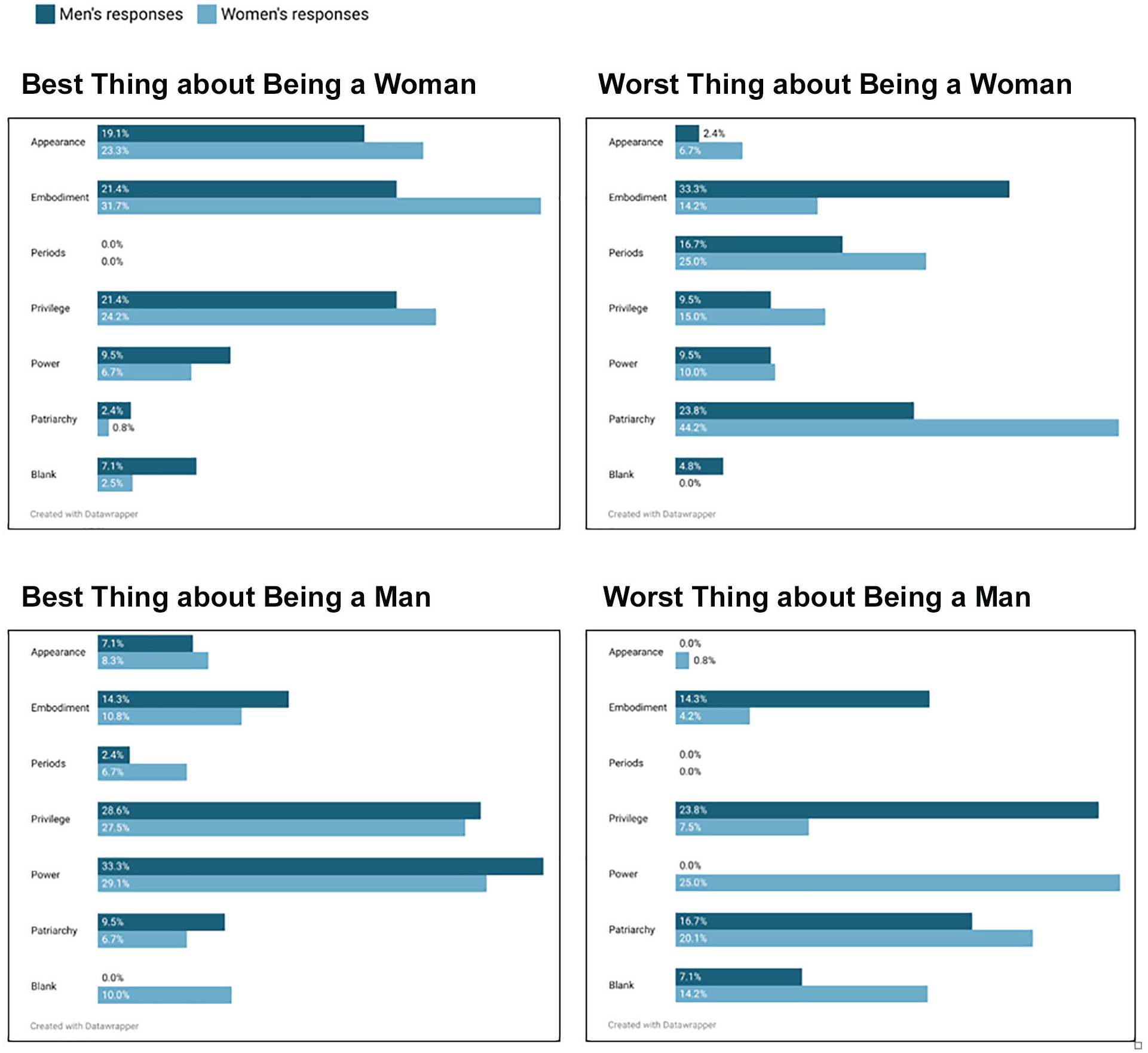
College students’ perceptions of gender.
Young men continued to focus on menstruation (16.7 percent) and childbirth (33.3 percent) as the worst things about being a woman but also began writing about gender as a social position reflecting patriarchal structure. In response to the question about the worst thing about being a woman, 23.8 percent of college men referenced (if obliquely) patriarchy, including one senior who wrote “living in a patriarchal society,” and another, “I would assume it is (or relates to) the constant and systematic oppression women face.” However, most men’s responses about social disadvantage implied that women experience social drawbacks because of their own emotional instability, lack of strength, and “extra hassles of everyday life.” As one senior man wrote about women, Their best thing can easily be their worst thing. They sometimes rely on emotion too much or get trapped by emotions and they fall into these unfortunate situations like falling in love too quick. With the wrong guy.
These patterns and the types of responses reinforce the importance of status: boys and young men cannot see the kinds of systematic oppression and structural disadvantages women face, a pattern all the more evident as we compare men’s responses to women’s.
College-aged women highlighted the social disadvantages experienced by women as a group, within a historical and current context. In fact, 44.2 percent of their comments related to patriarchy. A senior woman noted, “it is such a challenge throughout our history to do the many things that our opposite sex seems to have no problem fulfilling.” Her perceptions were framed by the acknowledgment of long-standing social disadvantages women experienced. Other women complained that women are viewed as inferior—“being looked at as a lower class than men,” as one junior explained—and several women commented on discrimination that women experience in a wide range of settings: “less pay,” “being discriminated against in academic and career fields,” “dealing with the glass ceiling,” “dealing with peoples’ sexist BS,” “obnoxious sexual harassment,” and “getting less respect than men in virtually all aspects of life.” Comments such as these emphasize systematic oppression and structural inequalities.
For college men, the best parts of being a man were related to power (33.3 percent) and privilege (28.6 percent). Many used the idea of privilege or even the term itself, sometimes with implied unfairness or explicit recognition that the privilege was unfair or inappropriate. For example, “The best thing about being a man is the fact that society tends to give us more privileges because we are men. It is sad, but true.” Some recognized but did not critique such privilege: “The best thing about being a man for me is being privileged in society simply because I am a man. Better jobs, more rights, etc.” Fewer were critical of gender inequality and thus coded patriarchy, such as this a senior who wrote, “We rule the world, still, despite efforts of equality. It’s not fair, but still true.” This refrain of something being “sad but true” appeared in other responses; the implication is, perhaps, that although unfortunate, there is not much to be done about such inequities, that they remain “despite efforts of equality.” It probably helps us see why so few college men’s responses (9.5 percent) were coded “patriarchy.”
In contrast, in a pattern that points to lower status awareness of structural inequality, the perception of a privileged position for men could also easily be identified in college women’s responses about the best parts of being a man. Half of college-aged women wrote about a form of social advantage. One was the belief that men were positively perceived simply for being a man. A first-year student wrote that men have “that instant superiority in many situations one deals with in everyday life.” A junior wrote, “the best thing about being a man is the fact that people will pretty much assume your ability to do things unless you prove them otherwise.” Several young women identified these types of advantages as unearned and simply a result of being a man. A senior woman wrote that men are “able to feel as if they are the superior gender and they are entitled to certain things based solely on their gender.” Another senior woman wrote, “the insane amount of privilege that comes just from having different sexual organs.”
Whereas the best things about being a man related to power and privilege, undergraduates saw appearance and embodiment as the best things about being a woman, particularly pregnancy and/or childbirth, mentioned in 31.7 percent of women’s comments and 21.4 percent of men’s. Several women wrote about the ability “to give life” or to “create the next generation.” One senior woman argued, “Even though some people may not think so, the best thing about being a woman is the ability to have children, this gives you a different connection with your children than the father may have.” Women viewed their bodies as unique and, thus, a beneficial aspect of their experience, whereas (like high schoolers) college men either noted the disadvantage of menstruation and pregnancy or wrote about the sexualized nature of women’s bodies. Nearly 20 percent of men’s comments mentioned women’s looks as a “best.” Several perceived that women benefit because “guys check them out” and can be “treated exceptionally well if you are beautiful.” College men were also quick to recognize the privileges that come from being a woman, especially those that derive from men: being “able to get favors done from the guys,” “being treated to drinks,” and “being on the receiving end of chivalry.” In fact, as many of men’s comments were related to these privileges as were focused on embodiment.
Women noted these male-centered privileges that advantage them, too. One wrote, “it’s socially acceptable for a woman to hit a man than vice versa,” and others mentioned “getting away with things,” and “being able to get attention from men.” A curious trend in the college women’s responses is the notion of “proving yourself” in the face of low social expectations. There were nearly a dozen responses such as: “in society odds are stacked against you so proving yourself is a wonderful feeling,” “being able to disprove stereotypes,” “proving people wrong,” “proving men wrong,” “surprising people when you do something that people don’t expect a woman to do,” and so forth. These comments imply agreement with negative stereotypes about women, or at least wanting to feel personally special or different. Their responses are individualistic—and surprising, given how nuanced and thoughtful so many are about men and the obstacles men face. Only one undergraduate woman mentions anything related to patriarchy: “knowing that some of the major historical breakthroughs have been brought about by women.” College women’s comments suggest they are purposely seeing themselves as different from other women, as rising above. This pattern suggests that they do not want to identify with a stigmatized or lower status group.
At the same time, undergraduates saw the benefits of women having a wider latitude in their choices. A senior man explained, “The best thing about being a woman is having so much flexibility and versatility when it comes to fashion and appearance. They have a lot more to work with!” and a 21-year-old woman wrote that an advantage for women comes from “The vast majority of options available to women in career choices, appearance, lifestyle, etc.” Another senior woman enthused: “We can do everything a man can do, plus have children!” Yet when cited by college men, the perceived ability for women to transverse a wider spectrum of appropriate behaviors was referenced as a “double standard”—the perception that there are behaviors that women can perform without recourse, such as hitting men, but for which men perceive they would be punished.
Undergraduate women’s responses demonstrate that they come to sympathize with boys and men about social burdens they experience. In fact, they discuss social disadvantages in similar ways to undergraduate men and are actually more likely to comment on the burdens of power (25 percent of women mentioned this compared with no men). Women’s responses seem sympathetic or empathetic when asked about the worst things about being a man: “Having to always play the tough role,” “men are expected to be tough and insensitive,” “can’t show weakness,” and so on. Compared with the younger participants’ responses, there is a noticeable shift from “boys are” to “boys are pressured to be.” There is less of a tone of disdain in women’s responses about the disadvantages of being a man; even the comments we coded “intelligence” are along the lines of “they don’t understand women,” not that they are inherently “dumb” or “stupid,” as the middle and high school girls suggested. Most comments we coded “emotion” are about social acceptability of certain emotions and an emotional guise that limits men’s relationships; for instance, “society pressures males to be masculine and remote from any emotions” or “Not being able to be too sensitive or emotional without being judged and thought of as weak.” One college woman wrote that the worst thing about being a man is “the pressure to be manly/macho which can mean anything from having to stifle emotions to not pursuing a passion (such as dance or fashion) for fear of being considered less manly.” Another woman wrote a “lack of ability to connect on deep emotional levels with others” is detrimental to men. These comments echo the disadvantages that some men shared (“not socially allowed to show emotion”) and comments about ostracism for not fitting stereotypes (e.g., “we are constantly stereotyped to fit a certain physical and emotional criterion, and those who do not fit the ‘norm’ are isolated and discriminated against”). Thus, we see that as status differences widen in later age groups, those status differences become more apparent, particularly to young women, and their capacity for perspective taking increases as a result.
Conclusion
Earlier studies showed that middle school students had positive things to say about boys and negative things to say about girls (Mee 1995; Zittleman 2007), but these studies obscure differences in how boys and girls think of their own and others’ genders, and focus on only one age group. Using the same questions, but analyzing differences and similarities between boys’ and girls’ perceptions, as we have done, and comparing across different age groups, we can see that perceptions of the ways that boys and men benefit from gender positionality are discussed in strikingly similar ways among boys and girls in each age group. Youth identify similar advantages associated with being a boy, suggesting that girls, despite not having similar lived experiences to boys, are finely attuned to the experiences of boys. Girls and young women more readily provide responses about the best aspects of being a girl or woman, relative to boys and young men. Girls and boys in middle school and high school consistently, and similarly, identify a wide range of biological drawbacks as the “worst” things about being a girl, including frequent responses about “sitting to pee,” menstruation, “getting pregnant,” and childbirth. College-aged men also concentrate on embodied aspects of being female: periods, childbirth, and pregnancy.
Girls’ and boys’ perceptions of benefits associated with being a girl diverge in older age cohorts, highlighting differences in thinking about what it means to be a girl or woman. There are distinct perceived social benefits and bodily advantages that point to different ways of thinking about being a girl between girls and boys in each age group. Looking solely at boys’ responses, we find more similarity than dissimilarity across age cohorts: boys most commonly do not provide answers to questions about being a girl and, when responses are provided, they tend to focus on the position of girls relative to boys, including ways that girls benefit from traditional ideas of femininity and masculinity (such as not paying for dates). Conversely, girls’ responses of social advantage emphasize their experiences as girls and, thus, perceptions of “bests” change from appearance-related benefits to more seemingly consequential benefits of freedom in behavior and empowerment in overcoming their disadvantaged status.
Compared with boys and young men, young women more regularly recognize social aspects of gender that disable and/or create barriers for men and women. When young women discuss the social advantages and disadvantages experienced by boys and men, they empathize with their struggles. This finding suggests that women are to take on the role of the “other” when considering the social implications of gender, a shift we argue is an example of women and girls refining the practice of “doing gender” as they age.
Our analyses do not disentangle responses by race, and we do not have data on social class. Future research should examine intersections of race, gender, and class to understand perspective taking intersectionally. Although some research has shown that Black women are more attuned to others’ situations than White women (see Love and Davis 2021), we know little about such intersections among children or among boys. For example, would younger boys be more able or willing to take the perspective of others if asked about the best things about being White or Black boys? Would children’s perceptions of race crowd out their perceptions of gender? How do school climates and demographic compositions impede or accelerate young people’s understandings of the intersections of race, class, and gender?
The perceptions of gender we have highlighted throughout this article have the potential to solidify, with significant social consequences. Young people have opportunities to see (and experience) negative aspects of gender inequality, but foci on the body and competing messages about individual characteristics undercut the potential for change and collective action. That is, if the worst things about a girl or woman in society are periods, pregnancy, and childbirth, then there really is not much to be done about them. At a moment with vibrant antiracist discourse, when people are pointing very clearly to systemic disadvantages centered on race, much of the discussion about gender continues to be on identity rather than inequality. Girls’ empathy for boys, strongly evident among college women, easily can become what Kate Manne (2017:23) refers to as “himpathy,” the “the flow of sympathy away from female victims toward their male victimizers.” Likewise, boys’ perceptions of unfairness and special treatment reflect their higher status position and add to attitudes of entitlement, linked to a multitude of structural inequalities such as domestic labor, pay equity, sexual double standards, and violence against women (Manne 2020). The entitlement we often see in adult men does not come out of nowhere; we see it even in children’s responses.
Footnotes
Acknowledgements
We are grateful to the teachers and students who assisted with this study, along with Jessica Collett, who provided helpful feedback on earlier drafts.
