




Abstract
In this article, we report the results of a randomized controlled experiment that examines how exposure to information about a global pandemic from Asia affects white Americans’ prosocial behavior towards white, black, and Asian Americans. We find that when exposed to a new disease threat from Asia, (1) white Americans donate significantly less money to Asian American recipients than to white or black American recipients, (2) liberals and conservatives are equally likely to discriminate, and (3) a significant spike in media attention about violence against Asians inhibited this discriminatory behavior—at least temporarily. Our experiment allows us to rule out alternative explanations for the unequal treatment of Asian Americans, providing evidence of a causal link between the COVID-19 pandemic and racial discrimination. The study contributes to knowledge about the spillover effects of external threats on race relations and has implications for public health and science communication.
Reports of harassment and violence against Asians in the United States have surged since COVID-19 was first detected in Wuhan, China, in late 2019 (Jeung et al. 2021). Consistent with mass media reporting, recent cross-sectional evidence suggests that the origin of the pandemic in China led to an increase in negative attitudes and hate crimes toward Asians (Gray and Hansen 2021; He, Zhang, and Xie 2022). Many in the media have pointed to former President Trump and other republicans calling COVID-19 the “China virus” and the “Kung Flu” as the source of the rise in anti-Asian harassment (Itkowitz 2020). An alternative explanation for the surge, however, is that the level of racial prejudice has not changed, but the media attention to stigmatizing rhetoric raised visibility and awareness, which, in turn, increased reporting (Yam 2021). From a different perspective, the rise in racial violence may not necessarily reflect a concomitant increase in the amount of prejudice but, rather, a greater willingness among prejudiced people to act on their antipathies (Daniels et al. 2021).
To evaluate these various interpretations, we join a growing body of research and use experimental methods to assess a causal link between the COVID-19 pandemic and broader patterns of racial/ethnic discrimination (Abascal, Makovi, and Xu 2021; Bartoš et al. 2021; Lu et al. 2021). Investigating pandemic-fueled racism with an experimental design is important because reliance on observational evidence limits our understanding of the scope of the problem and prevents full understanding of more covert exclusionary practices that deny Asian Americans access to societal privileges and benefits. In addition, the focus on Trump supporters and more extreme acts of violence has the potential to underestimate the bias by implying that it lies with xenophobic extremists in the republican party. Without causal evidence of how the pandemic has affected more routine race-related behavior, we may be misspecifying the source of the problem.
Based on extant theory and research on intergroup relations, we expect that the rise in anti-Asian discrimination reflects a broader pattern in which the perception of an external threat outside the United States is reshaping interracial behavior across the political spectrum. In this article, we report the results of a randomized controlled experiment designed to examine how an external threat like a global pandemic from Asia affects white Americans’ prosocial behavior towards white, black, and Asian Americans. We measure respondents’ actual behavior—their differential treatment of various racial groups—rather than expressed racial attitudes or responses to hypothetical scenarios. In addition, the timing of our data collection allowed us to make use of a natural experiment created by the widely reported mass shooting of six Asian women in Atlanta, Georgia, on March 16, 2021. In comparing our findings before and after the shooting, our study has the strength to predict racial discrimination in action (Linn 1965).
Theoretical Background
Racial Discrimination as a Response to Disease Contagion
Behavioral immune system theory argues that when faced with the threat of disease, people discriminate and avoid members of groups who they associate with the disease (Faulkner et al. 2004). Throughout U.S. history, infectious disease outbreaks have prompted the shunning of and scapegoating of individuals presumed to be sources of contagion (Kraut 1994; Markel 1999). Studies on recent epidemics show that U.S. Latinos and travelers from Africa were both subjected to discrimination and public sanction following the outbreaks of H1N1 (“swine flu,” believed to be originated on a Mexican pig farm) and Ebola (Dionne and Seay 2015; Huang et al 2011). During disease outbreaks, scholars have also documented racial prejudice against outgroups not explicitly associated with the disease. Interpreting this evidence from a behavioral immune system framework, scholars argue that individuals consciously and unconsciously treat physically and culturally dissimilar outgroups as possible sources of contagion because they use differentiating characteristics (e.g., skin color, accent, etc.) as heuristics for identifying disease threats (O’Shea et al. 2020).
Recent studies on the effects of the COVID-19 pandemic provide more evidence consistent with behavioral immune system theory. For example, He et al. (2022) found more negative attitudes about Chinese people in U.S. locations with severer COVID-19 outbreaks. Compared to the early days in the pandemic when the outbreak was associated with China, prejudice against Asians declined when China was no longer a disease hotspot, suggesting aversive behaviors that are responsive to pathogen-threat perceptions (Abascal et al. 2021). Lu et al. (2021) report experimental results showing that research subjects who were primed to think about COVID-19 evaluated East Asians as well as South Asian and Hispanic individuals as less desirable hypothetical roommates than people in a control condition. Given that participants discriminated against immigrant outgroups not associated with the origin of the pandemic (e.g., Hispanics), the study suggests that the threat of COVID-19 has led to more generalized xenophobic sentiments.
Additional findings from Lu et al.’s (2021) study, however, raise questions that are not well accounted for by behavioral immune system theory. For example, the study found no evidence that participants discriminated against black outgroups when primed with COVID-19. Given that the media frequently highlighted evidence that black Americans were suffering a greater disease burden than other racial/ethnic groups (Gupta 2020; Williams 2020) and evidence that nonblack Americans see black people as physically and culturally distinct (Hoffman et al. 2016; Leffers and Coley 2021), behavioral immune system theory would predict increased avoidance of black Americans during the pandemic (O’Shea et al. 2020). Lu et al. (2021)’s findings suggest that behavioral immune system theory cannot fully explain why some visibly distinct outgroups face discrimination during periods of disease threat while others do not. In the following, we discuss additional social psychological processes that likely underlie the relationship between disease threats and racial discrimination.
Racial Discrimination as a Response to Status Threat
Theories of group position argue that racial prejudice is often rooted in dominant groups’ motivations to preserve their racial status advantages (Bobo 1999; Quillian 1995). When faced with competition for scarce resources, white Americans’ antipathy toward racial minorities increases. For instance, white people’s opposition to policies perceived to benefit racial minorities (e.g., welfare, school desegregation, and affirmative action) is higher when they feel that their own status advantages are threatened. More recently, researchers have focused on the types of macro-level changes in society that evoke white people’s perception of threat. Specifically, growth in minority populations (Abascal 2015; Craig and Richeson 2014; Wetts and Willer 2018), the election of the first black president (Parker, Sawyer, and Towler 2009), and economic downturns (Wetts and Willer 2018) increase whites’ racial resentment and withdrawal of resources from racial minorities.
Depending on the social context and the relative position of particular racial groups, we may expect different forms of discriminatory behaviors from dominant groups. According to the stereotype content model (Fiske, Cuddy, and Glick 2007a, 2007b), groups that are stereotyped as highly competent but low on warmth (e.g., Asian Americans in the United States) are treated as competitors. During periods of relative societal stability and calm, these groups, while facing social exclusion (e.g., bamboo ceiling encountered by Asian Americans in the workplace), are respected for their perceived competence (Chin 2020). Under periods of threat, however, these groups face active harm from outgroups (e.g., Jews in the Holocaust). The rise in violence against Asians in the United States since the outset of the COVID-19 pandemic is consistent with this model.
The stereotype content model also theorizes that groups evaluated higher in warmth and lower in competence (e.g., the elderly) are treated as lower status in society, invoking pity and sympathy. Although black Americans are often stereotyped as threatening and criminal (Alinor and Tinkler 2021; Sniderman and Piazza 1993), two narratives prominent in the media during the first year of the pandemic characterized them as victims: (1) the disproportionate negative health impact of COVID-19 on black Americans (see e.g., Gupta 2020) and (2) the 2020 police killing of George Floyd, an unarmed black man. In both cases, the media, politicians, and movement activists highlighted structural disadvantages and persistent racial biases against black Americans (Olin 2021; Olorunnipa and Witte 2020; Shah and Widjaya 2020). As a result, characterizations of black Americans during the first year of the COVID-19 pandemic tended toward “paternalistic positivity”—views that are often associated with low-status groups who are seen as relatively warm but incompetent. Treatment of these groups, according to the stereotype content model, vacillates between active helping and passive neglect (Fiske et al. 2007b). During periods of societal threat—like the COVID-19 pandemic—lower status groups are often more vulnerable, prompting political debates about the appropriate level of societal responsibility for mitigating their social, health, and economic disadvantages.
Discriminatory behaviors are further shaped by perceptions of in- versus outgroups. Whereas positions for dominant and subordinate racial/ethnic groups are relatively stable in the status hierarchy, group boundaries are fluid (Brubaker 2002). External threats that are widely felt by most people in a society can shift people’s categorization of “us” versus “them,” thus temporarily altering intergroup relations and hostility toward outgroups. The common ingroup identity model (Gaertner et al. 1993) argues that external threats sometimes lead members of groups to redefine group boundaries to include outgroups who shared in the adversity brought on by the external threat. One field study conducted in Italy showed this effect among children after a destructive earthquake (Vezzali et al. 2015), and another experiment showed that white university students helped black students more when faced with a terrorist threat (Dovidio et al. 2004). Given research that has shown Asian and Latino Americans are perceived as less American than black and white Americans (Chin 2020; Zou and Cheryan 2017), recategorization in the face of an external threat may lead white Americans to see themselves as part of a larger group of Americans that includes black Americans (Dovidio et al. 1997; Gaertner et al. 1993) but not Asians or Latinos (Abascal 2020; Kim 1999).
Hence, we do not expect that priming people with a pandemic threat from Asia will necessarily increase white respondents’ anti-black and anti-Asian prejudice equally. As a “model minority,” Asian Americans may not experience overt discrimination in periods of societal stability. Under the threat of pandemic, however, white Americans see Asians and Asian Americans as both contagious and un-American (Chin 2020; Kim 1999; Lee, Wong, and Alvarez 2009; Zou and Cheryan 2017), leading them to discriminate more strongly against Asian Americans (Fiske et al. 2007a). As for how white Americans treat black Americans when faced with a disease threat, we draw insights from theories and research on intergroup relations (e.g., Blumer 1958; Bobo 1999; Fiske et al. 2007a; Lu et al. 2021; Tajfel and Turner 2004) and predict that white Americans may be motivated to donate money to black Americans for two reasons: (1) as a way of distancing themselves from the racial bias that seems to undergird white-black disparities in COVID-19 health outcomes and (2) as a way to recruit allies in the face of an external threat.
Political Ideology
Narratives about race, class, and politics in mainstream culture and media often paint racism as something practiced by a relatively small subset of aberrant individuals, most of whom are working-class white conservatives (Sullivan 2014; Wellman 1993). Scholarly literature on the topic, however, paints a different picture, showing that racism can be found across the class structure (Wellman 1993) and that racial inequality is perpetuated by both conservatives and liberals (Sullivan 2014). Although studies show that individuals with less education are more likely to score high on measures of traditional prejudice (Wellman 1993; Wodtke 2012), middle- and upper-class whites often oppose race equality policies and practices when such policies are believed to harm their own communities or take advantages away from their families (Lewis and Diamond 2015; Wellman 1993). And although many studies suggest a positive association between conservatism and racial prejudice (Beyer 2020; Sears and Henry 2003; Sidanius, Pratto, and Bobo 1996) or between conservatism and an ingroup bias favoring white Americans (Eastwick et al. 2009; Hoyt and Goldin 2015), studies also find evidence of racial bias among white liberals (Byrd et al. 2015; Daniels at al. 2021; Dupree and Fiske 2019). This body of research and theory suggests that although class-advantaged and liberal white people are more likely to say the “right things” about race and less likely to engage in overtly hostile acts of racism, they are not immune from racial bias and often act in ways that reinforce the racial status quo (Byrd et al. 2015; Dupree and Fiske 2019; Sullivan 2014; Wellman 1993).
When it comes to race, politics, and views of the COVID-19 pandemic, we expect that the threat of a pandemic from Asia will trigger anti-Asian bias across the political spectrum. Although there is a diversity of views about the extent to which China and the Chinese people should shoulder the blame for the COVID-19 pandemic, democrats and republicans express increasingly negative views of Asian people and China specifically (Griffin, Sides, and Tesler 2020). Thus, although explicitly prejudiced views generally (Beyer 2020; Sidanius et al. 1996) and anti-Asian views in particular (Griffin et al. 2020) may be more pronounced among white conservatives, we expect that racial bias among white liberals will also lead them to act in ways that disadvantage Asian Americans relative to white Americans when primed to think about a threat from Asia.
Can Media Attention Disrupt Anti-Asian Biases?
Our argument is that the rise in discrimination against Asians during the COVID-19 pandemic reflects not only behavior immune system processes but also more generalized status threat processes related to Asians’ position in the racial status hierarchy. We should expect, then, that information characterizing Asians as less threatening might reduce discrimination patterns. We are able to evaluate this by comparing our findings before and after a major news event that occurred during data collection. On March 16, 2021, a white man in Atlanta shot and killed six Asian women (Yancey-Bragg 2021). The mass killing was widely covered by mainstream and social media and prompted local and federal politicians to call for strengthening law enforcement responses to hate crimes, including an anti-hate-crime bill passed by Congress weeks after the shooting. The timing of the event allows us to examine whether media attention to the problem of discrimination can reduce discriminatory behavior.
Data and Methods
Overview
To examine the relationship between a disease threat from Asia and racial bias, we conducted an Internet-based experiment. Experimental research is useful for testing causal theories and for identifying the causal mechanisms that underlie observed correlations. In this experiment, we put people in the position many Americans found themselves in during 2020: reading new scientific evidence about the threat of a global pandemic from Asia. Then we compared how being primed about this threat affected people’s prosocial behavior. The experiment randomly assigned white American participants to read one of two excerpts of news articles about current events in Asia. In the disease threat condition, participants read that the next global pandemic was likely to originate in Asia due to higher potential for animal-to-human disease spillover. In the control condition, participants read that the market growth of Android phones was likely to be highest in Asia. Because both the treatment and control conditions made Asia salient in participants’ minds, our test allows us to isolate the effect of the disease threat. After reading the news article, we measured participants’ prosocial behavior toward same-race (i.e., white) or other-race (i.e., black or Asian) recipients. In summary, the study has a 2 (Asia nonthreat vs. Asia disease threat) × 3 (Asian vs. black vs. white American recipients) between-subjects design.
Sample
A total of 907 non-Hispanic white Americans (all U.S. citizens) were recruited via Amazon Mechanical Turk (MTurk) to complete the study in March 2021. Compared to traditional laboratory studies comprised mainly of undergraduate students, the online data pool provides a more diverse sample in terms of demographic characteristics. This is especially valuable when studying racial attitudes that are likely to be influenced by respondents’ political ideology and educational background. Research suggests that online samples yield reliable, high-quality data for studies in social psychology (Anson 2018; Manago, Mize, and Doan 2021; Paolacci and Chandler 2014).
To ensure data quality from our online sample, we administered our survey on CloudResearch—a platform that provides multiple data validity screening techniques to block problematic respondents, participants who are inattentive or mischievous, and foreign Internet “farmers” (i.e., workers who reside outside the United States but use server farm to mask their digital footprint) from participating in the survey. Upon consent, each participant was presented a set of standard demographic questions. Only those who self-identified as a man or woman, non-Hispanic white, and U.S. citizen were allowed to participate in the study (N = 907). We followed the community guideline and compensated participants by the going rate ($9.60 per hour). 1
A total of 855 respondents (with an average of 150 participants per condition) are included in the final analytical sample after attrition due to comprehension and other causes.2,3 Table 1 reports respondent characteristics for the sample. Of the 855 white respondents included in our analytical sample, 62 percent were women, 60 percent were college educated, 61 percent were working as a paid employee, and 47 percent self-identify as liberal and 30 percent as conservative. We checked the distribution of key demographic characteristics of respondents across experimental conditions, finding no evidence of the violation of randomization (see SI Appendix, Table S1 in the Supplemental Material). 4
Respondent Characteristics (N = 855).
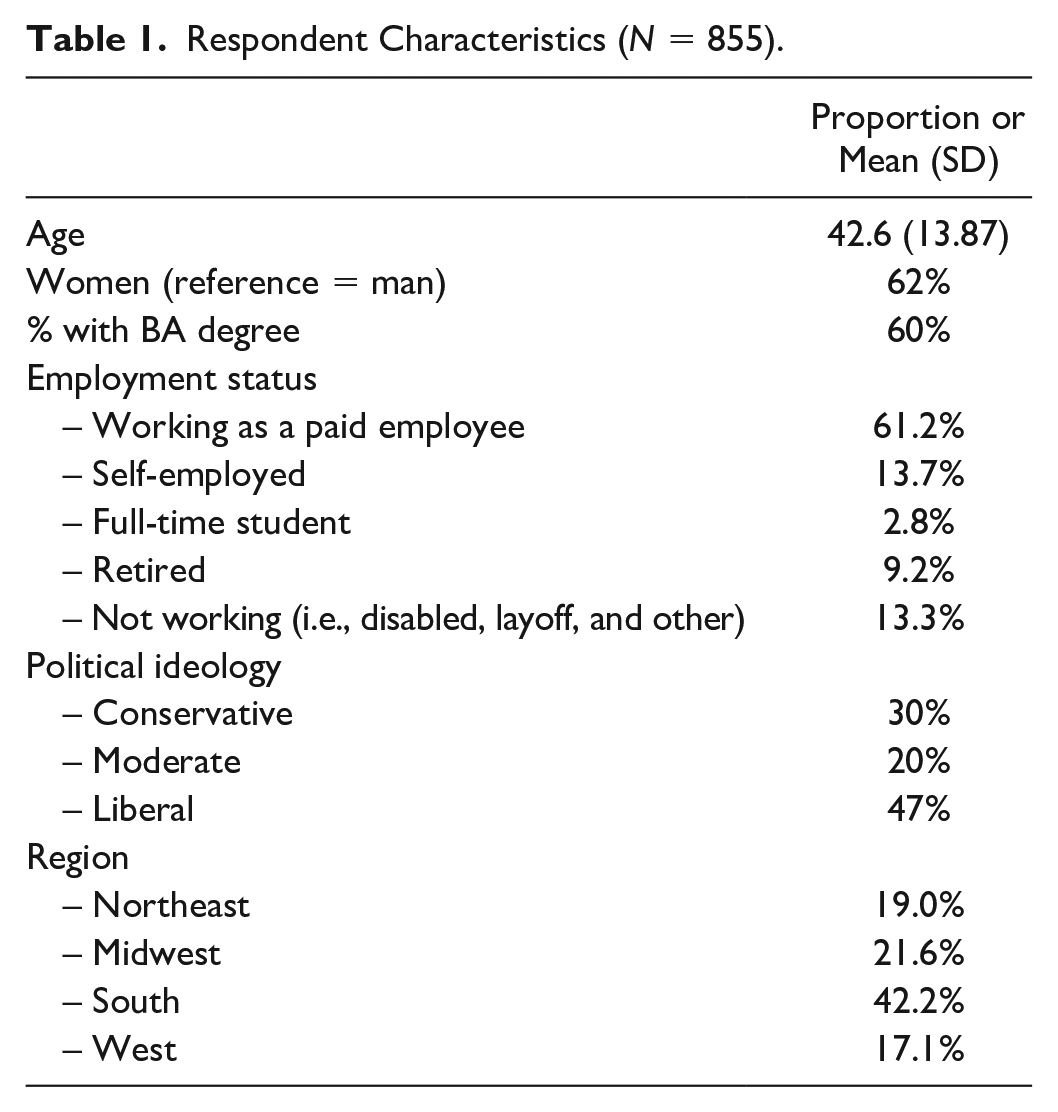
It is important to note that our sample is skewed toward women and is slightly younger, more educated, and more liberal compared to the average white American (see SI Appendix for comparisons between MTurk sample and national sample, Table S2, in the Supplemental Material). This allows us to assess the extent of anti-Asian bias among a group of white Americans that is commonly left out of the narrative surrounding #StopAsianHate, a narrative that tends to depict anti-Asian bias as something perpetuated by white conservatives with low levels of education. Still, because people who identify as liberal and have more education exhibit less overt racial prejudice, evidence of racial bias may be underestimated with these data. Our sample offers high external validity in that MTurk workers rely on online labor markets to supplement their regular income. Thus, any charitable giving in the study meant forgoing real earnings for the respondents.
Procedure
Participants were told that the study’s purpose was to understand people’s memory recall processes, evaluative judgments, and decision-making behavior. After indicating consent, participants were asked to read a story “about a current event affecting the United States” from the Associated Press, a news company widely perceived as unbiased. Depending on the conditions, respondents either read a story about rising risks of another pandemic from Asia (treatment) or about market growth for Android phones in Asia (control). Participants were then asked to answer three multiple-choice questions purportedly to help us understand information about memory recall processes.
After answering the recall questions, participants moved on to play a one-shot dictator game (Baldassarri and Grossman 2013). Dictator games are commonly used to measure prosocial behavior by putting people in the position of giving money to an individual when doing so incurs a monetary cost (see e.g., Abascal 2015). The game captures people’s actual treatment of others rather than just discriminatory intent, thus serving as a better measure of racial discrimination. Participants were informed that the task’s purpose was to better understand economic decision-making behavior. They were told that the researchers had partnered with GoFundMe. Each participant was allocated an endowment of $1 as additional compensation for their participation and informed that they could donate none, some, or all of that amount to someone in need. They were then directed to click on one of several buttons that purportedly took them to different recipients’ GoFundMe pages. To increase credibility, we created donation pages designed to mimic the kind of requests that individuals often use on GoFundMe and assured participants that the recipient’s account had been verified by the researchers. In reality, all donation pages described a recipient who needed financial help to fix the car they use to get to work. The GoFundMe page was identical for all participants except for the race and gender of the recipient as indicated by the name and photo. For a facsimile of the donation page, see SI Appendix, Figure S1, in the Supplemental Material.
After the dictator game, participants completed a survey with emotion and attitudinal questions and questions tapping respondents’ impressions of the GoFundMe profile. At the end of the study, participants were told that the researchers were donating money to a local restaurant hard hit by the pandemic and asked to rank-order six restaurants according to which one should receive the donation. These restaurants vary by the cuisines they serve (i.e., Chinese, soul food, Vietnamese, Italian, Irish, and farm-to-table café), and their culinary features were used as a proxy for the race/ethnicity of the business owners (see details in the following). Finally, participants were debriefed about the purpose of the study.
Threat manipulation
In the disease threat condition, participants read that the next global pandemic was likely to originate in Asia due to higher potential for animal-to-human disease spillover. In the control condition, participants read that the market growth of Android phones was likely to be highest in Asia. Both excerpts were accompanied by the same heat map of the world highlighting areas predominantly in Asia where growth (of animal-to-human diseases/Android market share) was expected. See Figure 1 for the primes.

Primes for Asia disease threat condition (left) and Android market growth in Asia (right).
Recipient’s race/ethnicity manipulation
In the dictator game, participants were randomly assigned to allocate money to either an Asian, black, or white American recipient. To manipulate race/ethnicity, we displayed the name and the photo of the recipient on their profile. We chose names strongly associated with particular racial groups based on prior research (Abascal 2015; Gaddis 2017; Tinkler et al. 2019). The names include Emily Wei-Lin Yang (Asian female), Aisha Jackson (black female), Jill Cook (white female), Edward Wei-Lin Yang (Asian male), Jermaine Jackson (black male), and Brad Cook (white male). We paired first names with racially appropriate surnames. To control for gender effects, women and men participants were always assigned to view recipients of the same gender. 5
We relied on the Chicago Face Database (Ma, Correll, and Wittenbrink 2015), a repository of photos that are paired with ratings of perceived traits from a sample of independent observers. We selected photos that are similar across racial groups in perceived attractiveness, age, and social class (see SI Appendix, Figure S2 and Table S3, in the Supplemental Material).
Restaurant manipulation
The survey page displayed a picture of the restaurant sign along with a blurb about the cuisine that indicates Asian (Chinese, Vietnamese), black (soul food), or white (Italian, Irish pub) ownership. To reduce social desirability biases associated with measuring racial preferences, we also included the farm-to-table café because it is less explicitly coded as white-owned than the Italian and Irish restaurants and thus less likely to make race strongly salient.
Measures
Donation size
Our primary outcome measure is the proportion of the $1 bonus allocated to the recipient. Prior research shows that the effects of the stake size ($1, $5, $10) are negligible for online studies in the United States (Raihani, Mace, and Lamba 2013). The response format ranges from 0 to 100 with a 5-cent increment.
Restaurant ranking
Our second outcome measure is the rank of the six racially coded restaurants to which the researchers planned to donate money. Respondents were asked to rank-order the six restaurants with “a rank of 6 being the restaurant you most want us to donate to and 1 being the restaurant you least want us to donate to.” This variable ranges from 1 to 6 for each restaurant, with greater numbers indicating higher ranking for deserving of our donation.
Control variables
We measured a set of demographic traits and included them in our ordinary least sqaures (OLS) models as controls: gender (1= men, 0 = women), age, educational level (1 = BA and above, 0 = no BA degree), and respondents’ political ideology (1 = liberal, 2 = moderate, 3 = conservative).
Finally, to examine whether respondents evaluate certain racial groups as more trustworthy than others and if that mediates the relationship between pandemic threat and racial disparities in donation, we included a measure of perceived trustworthiness for each recipient (1 = not at all, 7 = very much).
Results
Manipulation Check
Participants were cognitively and emotionally responsive to our primes: 98 percent of the participants in the threat condition recalled Asia as the likely origin of the next global pandemic, and about the same percentage of participants in the control noted Asia as the site for Android market growth. Thus, Asia was salient in both the treatment and control conditions, allowing us to isolate the disease threat effect from the effect of simply making Asia salient in the treatment condition. Upon reading the story, participants in the treatment condition were more likely than those in the control condition to report negative emotions like anger, fear, and disgust (t ranges from −13.1 to −24.7, all ps < .0001) and were less likely to report positive emotions like pride and joy (ts = 6.66 and 9.82, respectively, ps < .0001).
Respondents also paid close attention to the recipient’s profile: 96 percent of the participants correctly recalled the race of the recipient. When probed about their contribution decisions, 95 percent of the participants correctly recalled the reason for donation (i.e., helping the recipient fix their car so they can drive to work) and the total amount raised and requested (i.e., $110 raised of $200 goal). All of these measures indicate high levels of attentiveness among study participants.
Patterns of Donation
On average, participants donated $0.32 from their $1.00 endowment. This pattern is consistent with prior studies that show dictators typically contribute between 20 percent and 30 percent of their endowments (Baldassarri and Grossman 2013). The donation proportion also aligns with numbers reported by Abascal (2015), where participants were recruited in a laboratory setting and were given a much larger stake ($10).
Effects of Asia Threat on Donations to Individual Recipients
A 2 (treatment) × 3 (recipient race) between-subjects analysis of variance (ANOVA) on mean donation amount yielded a significant main effect of recipients’ race, F(2, 849) = 3.76, p = .02; Asian recipients received less money than black and white recipients; this effect was further qualified by a significant two-way interaction, F(2, 849) = 2.95, p = .05.
As shown in Figure 2, participants contributed similar amounts in the control condition (i.e., market growth in Asia) regardless of the recipient’s race ($0.35 vs. $0.31 vs. $0.31, white, black, and Asian recipient, respectively), F(2, 422) = .33, p = .72. After reading about potential disease threat from Asia, however, we find a significant donation gap between white and Asian recipients ($0.35 vs. $0.22), t(287) = 2.71, p = .007, and between black and Asian recipients ($0.38 vs. $0.22), t(287) = 3.59, p = .0004. Respondents gave significantly less to Asian recipients when primed with the disease threat, t(282) = 2.02, p = .04. There was no significant treatment effect on donation amounts for white, t(281) = .00, p = .99, and black recipients, t(286) = −1.55, p = .13. Racial disparities in donation remain after statistically controlling for participants’ gender, age, education, and political ideology (see SI Appendix, Table S4, Model 1, in the Supplemental Material); these patterns are also proven robust in alternative statistical specifications (i.e., when we considered the proportions of respondents who made a nonzero donation, SI Appendix, Table S5, in the Supplemental Material).

Mean amount donated by experimental condition (n = 855). Asterisks indicate significant difference in donation size between two groups.
We theorize that the COVID-19 pandemic activated stereotypes that associate black Americans with more warmth than Asian Americans. To investigate if racial disparities in donation is partially driven by more positive feelings toward black Americans than Asian Americans, we compared respondents’ ratings on perceived trustworthiness of the recipients. ANOVA tests yielded a significant main effect of recipients’ race, F(2, 849) = 54.9, p = .000, indicating that participants rated black recipients significantly more trustworthy (M = 4.47, SD = 1.37) than Asian (M = 4.05, SD = 1.43) and white Americans (M = 3.86, SD = 1.38). Thus, even though the recipient photos had been independently rated as comparable on attractiveness, age, and social class, respondents reported more positive perceptions toward black recipients. When this variable is included in the OLS models (SI Appendix, Table S4, Model 2, in the Supplemental Material), we find a reduced donation gap between Asian and black recipients in the threat conditions, lending support to the argument that the COVID-19 pandemic may have increased white people’s paternalistic positivity toward black Americans.
Political Ideology and Donation Patterns
To what extent do donation patterns vary by participants’ political ideology? To assess whether the threat penalty for Asian recipients differs between liberals and conservatives, we estimated OLS multiple regression to examine the interactive effects of recipients’ race, the threat prime, and respondents’ political ideology while controlling for respondents’ demographic characteristics. We then calculated the marginal effects of the Asia disease threat prime on donations made to Asian recipients among self-identified liberals and conservatives, that is, the difference in donation amount between conditions in which respondents learned that Asia is a growing hotspot for infectious disease outbreaks and conditions in which respondents learned about Asia as a growing marketplace for Android phone, while all other variables are held at their means (see the Appendix in the Supplemental Maerial for results from the OLS regressions).
As can be seen from Figure 3, the marginal effects (ME) of the treatment are negative for both conservative and liberal respondents (MEliberal = −11.6, SE = 6.5; MEconservative = −9.86, SE = 7.3, ps < .05, one-tailed test). There is no statistically significant difference in the magnitude of the effect between liberals and conservatives. This suggests that an external threat from Asia negatively affected charitable giving toward Asian Americans by people across the political spectrum and that our results are not driven by differences in respondents’ political ideologies.

Marginal effect of Asia disease threat on donation to Asian recipients by political ideology.
Effects of Asia Threat on Rankings of Minority-Owned Restaurants
We combined and averaged rankings of restaurants with the same racial/ethnic ownership (i.e., white-, black-, and Asian- owned restaurants) and performed OLS regressions predicting the effect of the disease threat prime on the rankings of the ethnic-owned and race-ambiguous (i.e., café) restaurants (see SI Appendix, Table S6, in the Supplemental Material). Respondents tend to behave in socially desirable ways when studying sensitive topics such as attitudes toward race (Schachter 2016). Because race tends to be salient in mixed-race interactions (Melamed et al. 2019), the one-shot dictator game likely made race salient among white Americans randomly assigned to donate to either a black or Asian recipient. To account for social desirability biases that may have arisen from the earlier experiment manipulation, here we focus on results among respondents who were randomly paired with a same-race (i.e., white) recipient in the dictator game. Figure 4 displays the predicted rankings of four types of restaurants by experimental conditions.
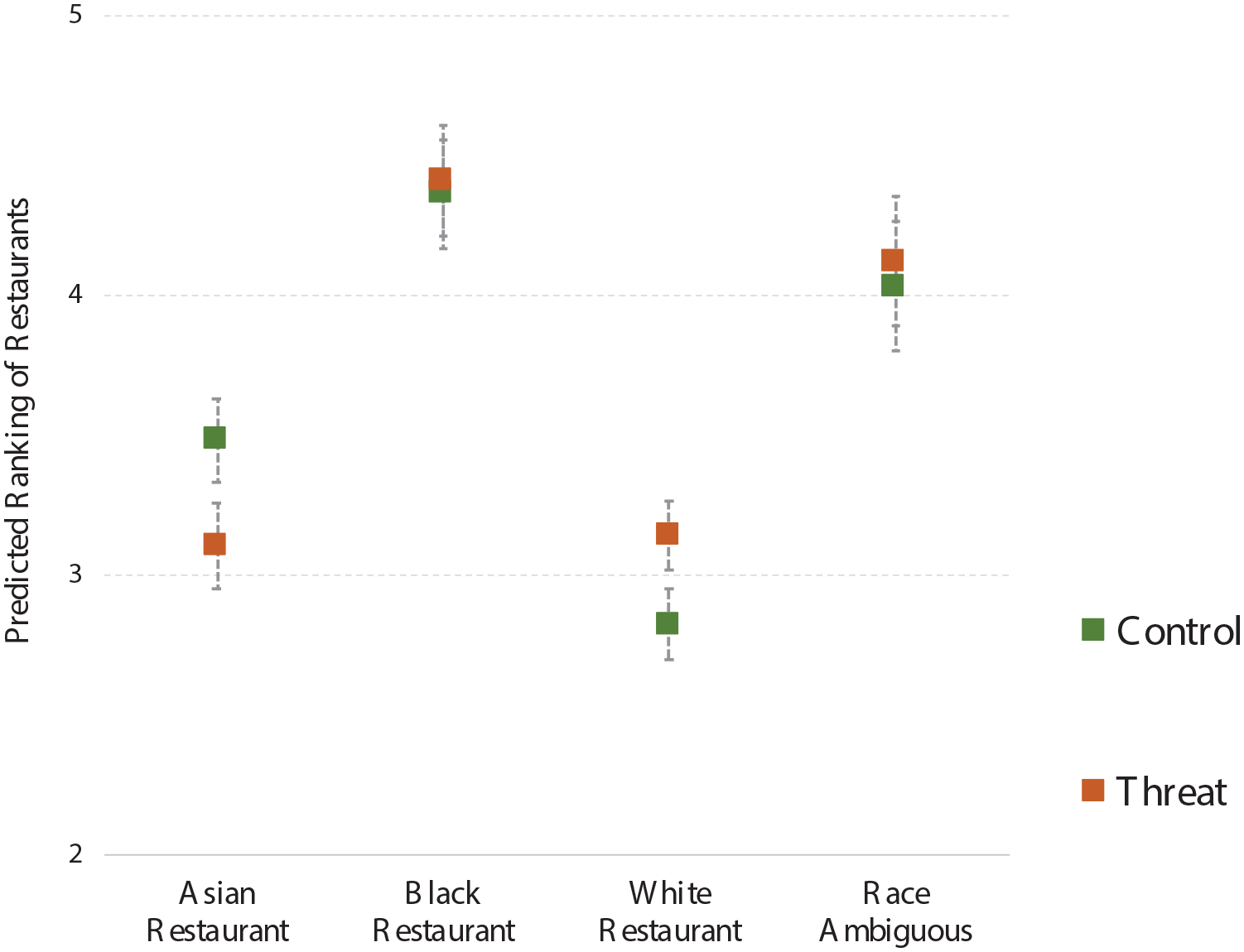
Predicted average ranking of ethnic and race-ambiguous restaurants by experimental condition. Estimates are derived from ordinary least sqaures regression models (see SI Appendix, Table S6, in the Supplemental Material) predicting Asian, black, white, and race-ambiguous restaurant rankings with 95 percent confidence intervals.
Three patterns are worth noting. First, we find a strong tendency among respondents to support black-owned over other ethnic businesses across study conditions. Regardless of treatment, predicted rankings are significantly higher for black-owned than Asian- and white- owned restaurants, although they are on par with rankings of the café—a racially ambiguous business.
Second, the ranking of Asian restaurants is significantly lower in the treatment than in the control condition (b = −.38, SE = .15, p < .01), suggesting a penalty for Asian business under the condition of Asia disease threat. In contrast, respondents exposed to the disease threat from Asia ranked white ethnic restaurants significantly higher compared to those in the control group (b = .32, SE = .14, p < .05). Taken together, the results suggest a consistent pattern of responses in which perceived disease threat from Asia decreases prosocial behavioral intent toward Asians.
Can Media Attention Disrupt Anti-Asian Biases?
Our experiment was fielded between March 7 and March 29, 2021, during which a shooting spree occurred at three massage parlors in the metropolitan area of Atlanta, Georgia (March 16). The Atlanta shootings killed eight people, six of whom were Asian women. Following the shooting, mass protests against anti-Asian violence occurred in cities across the country, and social and mainstream media capitalized on the shooting to highlight the surge in violence against Asians in the United States since the pandemic (Yancey-Bragg 2021). In a search of the keywords “Asian” and “violence” in the US Newsstream database, we found a nearly sixfold increase in the number of news articles after the shooting (538 articles between March 1 and March 15, 2021, and 3,124 articles between March 16 and March 31, 2021). The rise in news articles peaked in the immediate aftermath of the shooting, but the topic remained a frequent news item through the end of March (see SI Appendix, Figure S3, in the Supplemental Material).
To discern whether media attention and the socio-political events related to this shooting had an impact on the effect of our treatment, we compared donation patterns before (N = 525) and after (N = 330) the Atlanta shooting. 6 Results show that although the average donation given to each racial group is statistically indistinguishable before and after the shooting, the negative effect of the disease threat on donations to Asian recipients disappeared upon the mass killing. Prior to the event, participants gave Asian recipients significantly more in the control condition than those in the disease threat condition ($0.34 vs. $0.21), t(172) = 2.34, p = .02. After the shooting, however, the donation gap among Asian recipients shrunk and became no longer significant ($0.27 vs. $0.25), t(108) = .27, p = .78 (see SI Appendix, Table S8, in the Supplemental Material). Although social and political events sometimes fall short in shaping the ability of individuals and communities to receive fair and equal justice, we find evidence that heightened attention to Asian discrimination reduced the biases exhibited by white participants in our study. This finding is consistent with theories that hold racial discrimination to be rooted in perceptions of group threat (Bobo 1999). When Asians were widely characterized as victims of violence, the association of the disease threat with Asia no longer amplified biases against Asian Americans.
Discussion
When primed with information linking the threat of a new disease with Asia, white Americans across the political spectrum displayed less generosity to Asian Americans. The disease threat did not affect the donation amounts to white and black recipients. Thus, we know that the decline in donations toward Asian recipients was not due to a general trend in which people respond to pandemic threats with less generosity. Results also show that a significant spike in media attention about violence against Asians at least temporarily suppressed discriminatory behavior.
Our findings contribute to a growing body of evidence (e.g., Abascal et al. 2021; He et al. 2022; Lu et al. 2021) suggesting that the media framing of COVID-19 as a threat from China negatively affected the treatment of Asian Americans not just in terms of high-profile physical attacks and verbal assaults but also in terms of more subtle, everyday forms of bias and discrimination (e.g., bias in financial support). By putting MTurk workers in the position of having to choose whether to forgo an amount of pay commensurate with the going rate for such work, our study has strong external validity. Moreover, our findings suggest that it is not only conservatives with low levels of education who perpetuate anti-Asian bias in response to COVID-19; rather, all white Americans, regardless of political orientation and level of education, may act in biased ways toward Asian Americans when made to associate Asia with a disease threat. This finding, while inconsistent with mainstream narratives about class, conservatism, and racial bias, is consistent with sociological theory and empirical data showing that racial inequality is widespread and normalized in the United States and that it is maintained by people across the political spectrum and class structure (Sullivan 2014; Wellman 1993).
In general, our findings cannot be fully explained by behavioral immune system theory, which roots racial prejudice arising from disease outbreaks to germ aversion and infectability concerns (O’Shea et al. 2022). Because our dependent variable—donations to strangers—does not presuppose increased exposure to disease via face-to-face contact, we suspect other social psychological processes are also at play in driving discrimination against Asians in our study. In addition, the fact that anti-Asian bias in our study disappeared after Asians were widely framed in the media as victims of pandemic-related violence suggests that when groups are portrayed as less threatening, discriminatory behavior against these groups declines. Our findings are more consistent with theories that predict dominant groups will discriminate against groups who they perceive as threats to their group position (Blumer 1958; Fiske et al. 2007a). In these theoretical traditions, perceptions of threat are sensitive to macro-level change such that discriminatory behavior rises and falls as threats to group position become salient.
We find that the threat of a new disease from Asia did not increase white people’s discrimination against black Americans. Moreover, perceptions that the black recipients were more trustworthy than the Asian recipients mediates the gap in donations between Asian and black recipients. These, together with recent findings that participants also discriminated Hispanic Americans when primed with COVID-19 (Lu et al. 2021), help disentangle the broader intergroup processes that may have been at play during the pandemic. We take these findings as evidence that external threats led members of groups to redefine group boundaries (Gaertner et al. 1993). During periods of disease threat, instead of avoiding any outgroup who is physically and culturally distinct, dominant groups may include those who shared in the adversity brought on by the external threat.
It is important to note that from the perspective of group position theories, the fact that the disease threat from Asia did not amplify discrimination against black Americans is unlikely to be evidence of long-term, broader patterns of inclusion and more likely to be a manifestation of the socio-political climate at that moment. For example, the high ranking of the black-owned restaurant across both conditions may partly be “virtue signaling” spurred by the calls made across social media to support black-owned businesses in 2020 (Adamczyk 2020). Although the end of the pandemic might be near (Murray 2022), continuing our investigation of intergroup relations is critical because we may see rises and falls of racism and xenophobia in response to new external threats and changing group positions.
Implications for Science Communication
As scientists and public health experts have wrestled with how best to communicate the science behind COVID-19 vaccines and other prevention strategies (e.g., masks, physical distancing guidelines, etc.), it has sometimes seemed as though all facts were vulnerable to political misrepresentation. Our study demonstrates that brief, seemingly neutral scientific information leads to outgroup discrimination when the information itself is threatening. Because our control condition also mentioned Asia (as the place with high market growth of Android phones), we know that the disease threat from Asia—and not simply the salience of Asia—is what caused people to be less generous to Asian American recipients. We also know that because participants were more generous to black than Asian American recipients in the disease threat condition, external threats do not inevitably increase discrimination against outgroups. Given that Asian Americans are stereotyped as less American and are often treated as competitors by white Americans (Zou and Cheryan 2017), the public discourse that associated COVID-19 with China may have been especially dangerous for Asian Americans.
Our findings provide further support for the idea that linking diseases with the regions in which they were first identified can increase racial discrimination. In May 2021, the World Health Organization began labeling key variants of COVID-19 using letters of the Greek alphabet with the rationale to “avoid people calling variants by the places where they are detected, which is stigmatizing and discriminatory.” To the extent that such initiatives lessen the tendency for people to racialize diseases, these initiatives should also lessen racial bias and discrimination. In the case of COVID-19, Asian Americans are not only suffering from the physical effects of the pandemic but are also suffering from the effects that the racialization of COVID-19 has caused the Asian American community (i.e., increasing racial violence and overt and covert forms of bias and discrimination).
Directions for Future Research
As a first step, our study only speaks to how the disease threat from Asia affected prosocial behavior of white Americans toward other racial/ethnic groups. To fully understand the spillover effects of the pandemic on intergroup relations, future research should explore how black, Asian, and other racial/ethnic groups respond to an external disease threat.
In addition, although the current study allows us to show that racial bias shapes interracial behavior, qualitative, interview-based studies would allow for more thorough understanding into the thought processes of white Americans in relation to a racialized, global pandemic. This would advance understanding of the extent to which white Americans explicitly draw on racial meanings when thinking about belonginess, deservingness, and threat in relation to a new and dangerous disease.
Finally, our study shows that a one-time exposure to a threat from Asia increased racially biased behavior. Because the context was one in which Americans had been repeatedly exposed to information about a disease threat from Asia, we cannot know whether we would find the same pattern at a different point in history. Future research should examine the conditions under which external threats lead to long-term versus short-term changes in intergroup behavior as well as the effectiveness of interventions aimed at reducing bias. Our study captured behavior at only one point in time. We see the experimental paradigm developed for this study as easily adaptable to a longitudinal and/or repeated cross-sectional design. Given that scientific information, global/national health policies, disease prevention measures, and race relations have been in considerable flux since the start of the pandemic, tracking race-related behavior at multiple points in time during the pandemic would allow us to capture the stability and dynamism of intergroup relations.
Supplemental Material
sj-docx-1-srd-10.1177_23780231221095343 – Supplemental material for Assessing the Causal Link between the COVID-19 Pandemic and Racial Discrimination
Supplemental material, sj-docx-1-srd-10.1177_23780231221095343 for Assessing the Causal Link between the COVID-19 Pandemic and Racial Discrimination by Jun Zhao, Justine E. Tinkler and Kristen A. Clayton in Socius
Footnotes

Supplemental Material
Supplemental material for this article is available online.
1
On average, respondents completed our study in 13 minutes and were paid $1.00 for their participation. They also received an additional $1.00 bonus for the dictator game (see details in the following), making our compensation comply with the community guideline ($9.60 per hour).
2
After reading the excerpt, each participant was asked one comprehension question to assess their understanding of the story. To ensure data quality, we also embedded two “attention check” questions throughout the survey and used participants’ responses to open-ended questions to detect bots. Using the prevetted participant pool, the data show high levels of engagement among respondents: 98 percent passed our comprehension questions about the primes, and 96 percent of the respondents passed both attention checks.
3
We excluded participants who failed the comprehension question, failed any of the two attention checks (N = 35), and/or provided incomplete information on demographics (N = 17), resulting in a final analytical sample of 855 participants. Results are substantively the same when we included those who failed the manipulation and attention check questions (N = 890). Results are available on request.
5
Because we matched every vignette with the gender of the participant, readers should interpret model estimates as discrimination level toward same-gender others.
6
The two samples are comparable in terms of gender, education, and political ideology, although respondents tend to be younger in the postshooting sample (see SI Appendix, Table S7, in the Supplemental Material).
Author Biographies
References
Supplementary Material
Please find the following supplemental material available below.
For Open Access articles published under a Creative Commons License, all supplemental material carries the same license as the article it is associated with.
For non-Open Access articles published, all supplemental material carries a non-exclusive license, and permission requests for re-use of supplemental material or any part of supplemental material shall be sent directly to the copyright owner as specified in the copyright notice associated with the article.
