




Abstract
Peers are considered important for adolescents’ educational achievement and attainment, though little conclusive evidence demonstrate peer comparison effects. Using school and year fixed-effects models to account for peer group selection and comprehensive Danish administrative data on more than 260,000 students, across six cohorts, this study provides evidence of the so-called frog pond effect on the choice of secondary education among adolescents in Denmark. The frog pond effect is based upon a social comparison mechanism with heterogeneous effects. Through peer achievement, the author investigates the heterogeneous effects and show that peer achievement has different effects for low- and high-achieving students on choice of secondary education. The results shows that low-achieving students benefit from having high-achieving peers, while high-achieving students are negatively affected by their high-achieving peers, although only to a small extent. These findings lend support to the frog pond effect for high-achieving students.
Research on the effect of social contexts on individual achievement and attainment has a long tradition in sociology and related fields. In societies in which school choice is available, one of the primary concerns parents face is which school their child should attend. Should the school be more “elite,” such as having higher grade point averages (GPAs) or socioeconomic composition, or should the child attend a school with a more mixed ability or socioeconomic composition? Moreover, how will this choice of school and peer group affect the child’s educational attainment? One of the things parents chooses when they choose school for their children is the peer group of their children. Although many studies document how the peer group may affect the individual student’s educational achievement (e.g., Burke and Sass 2013; Hanushek et al. 2003; Lauen and Gaddis 2013), only few studies investigate how the peer group can affect educational choices (De Giorgi, Pellizzari, and Redaelli 2010; Espenshade, Hale, and Chung 2005; Jonsson and Mood 2008; Lauen 2007; Owens 2010). One strand of research investigate how reciprocated peers’ choice of education affects the individual student’s choice of education. This strand of research investigates how students conform to norms of their peer groups with regard to choice. This line of study can be found in the status attainment theory, which investigates how peers’ direct influence shape students’ educational expectations and choice (e.g., Jencks, Crouse, and Mouser 1983; Morgan 2005; Sewell, Haller, and Ohlendorf 1970; Sewell, Haller, and Portes 1969).
As the academic self-image is an important factor for educational attainment, high-achieving peers, might not be beneficial for all students. A line of research shows that although students with a high GPA are more likely to choose “elite” educations and labor market careers, they are less likely to choose an “elite” education and labor market career when placed in a school with higher GPA (e.g., Attewell 2001; Crosnoe 2009; Espenshade et al. 2005). This strand of research shows that it is not only important where you go to school but also with whom you go to school. Students form their beliefs about their academic abilities through experiences in the educational system, and they interpret their educational opportunities through interactions with peers and teachers (Thijs, Verkuyten, and Helmond 2010).
Although achievements are an important predictor of both choices of education and later labor market positions, the effect of peers on the choice of education is important in a life-chance perspective. Achieving diplomas and completing exams or other forms of formal education are among the key outcomes in creating equal life chances (e.g., Breen and Jonsson 2000; Shavit and Blossfeld 1993).
In this article, I focus on the social comparison mechanism, that is, how individuals use their peer groups to extrapolate and infer from their own perception of their abilities to their educational opportunities. To distinguish the effects of peers, studied in this article, from other sources of peer influences, I refer to peer effects as peer comparison effects. The main hypothesis of the article is that the social comparison mechanism leads students with high-achieving peers to lower their educational aspirations. I use comprehensive Danish administrative register data on a large panel data set of schools with multiple adjacent cohorts of students, along with placebo tests and balancing tests, to estimate the causal effect of peer achievement on the choice of education after compulsory schooling. The article contributes to the literature on frog pond effects and the social comparison mechanism by modeling the theory’s inherent idea of heterogeneous effects and showing that the social comparison mechanism results in heterogeneous effects. I show that attending a school with high-achieving peers on average reduces the probability that a student will attend the academic track of secondary education. This effect, however, is heterogeneous, as students at the lower end of the achievement distribution benefit from high-achieving peers, while peer achievement affects students at the highest end of the achievement distribution only to a limited degree.
Theory and Previous Research
The direction of peer effects on educational decisions is not evident, for at least two reasons. According to classical reference group theory, there are two processes through which peers affect the individual; the comparative and the normative functions of reference group theory. Peers can influence an individual by imposing norms on others behavior, creating and shaping educational aspirations, both high and low. This spillover in behaviors from the peer group is the normative function of the reference group (Goldsmith 2011; Jonsson and Mood 2008). Through the normative function of the reference group, researchers hypothesize that high-achieving peers set positive norms on schoolwork and thereby create motivations for learning and making higher aspiring choices (Alexander et al. 1979; Coleman 1988). The normative function of reference group theory explains how the students conform to group norms, which translates into achievement. Although the students might benefit in achievement and aspirations from high-achieving peers, the students can also suffer from being in a group of high-achieving students when the students compare themselves to one another.
Related to the theory of relative deprivation (Davis 1959; Merton 1962), the comparative function of reference group theory implies that students compare themselves with their immediate peer group. That is, students do not compare their performance with that of their objective position; instead, they compare their relative position to specific reference groups, that is, students within the classroom or their school (Bassis 1977; Goldsmith 2011; Jonsson and Mood 2008; McFarland and Buehler 1995). This comparison might be related to cognitive shortcuts, which are used to learn and infer about the individual’s abilities and opportunities (Tversky and Kahneman 1974). The comparative function explains the observed negative effects of high-achieving peers on choice of education or labor market outcomes (Crosnoe 2009; Davis 1966; Goldsmith 2011). The comparative function relates to the idea that when the students estimate their probability of succeeding in higher levels of education, they relate their achievements to that of their peers (Davis 1959; Jonsson and Mood 2008). Students may weigh their subjective cost and benefits of proceeding in higher levels of education. In this regard, the relative ranking in achievement of the individual student within schools or classroom may provide a biased signal of the student’s academic abilities and probability of succeeding at higher levels of education (Festinger 1954; Jonsson and Mood 2008). The mechanism that underlies the social comparison effect relates to the students’ academic self-image and ultimately self-esteem. For instance, consider two identical students with similar academic achievement. One student is placed in a low-achieving context, and he or she might therefore be at the top of the class, while another student is in a context with high-achieving peers. The latter student might be at the bottom of the class ranking. These contexts will therefore have different influences on the students. This is particularly true if the students compare their own achievement with that of their peers when trying to estimate how much effort they will need to put into homework, participation in classroom activities or, importantly for the present analysis, the probability of succeeding at higher levels of education.
Thus, there is a discrepancy between students’ expectations and experienced reality. According to reference group theory, peers, teachers and parents may regard students of similar ability differently in a high-achieving context than they would in a low-achieving context (Jonsson and Mood 2008). The negative effect of high-achieving peers reflects the students’ adjustment of their academic self-image and thus their self-esteem, which in turn affects the choice of secondary education (Crosnoe 2009; Davies and Kandel 1981; Marsh and Hau 2003; McFarland and Buehler 1995; Thijs et al. 2010; Wang 2015).
Although there is much research on the social comparison mechanism, only a few studies have looked at heterogeneous effects of the reference group on choice of education (e.g., Jonsson and Mood 2008; Marsh and Hau 2003). One theoretical argument suggests that the social comparison mechanism has heterogeneous effects, based upon the fact that all students in a high-achieving context have lower academic self-images and hence academic aspirations than similar students in low-achieving context. This theoretical perspective predicts that there are small varying effects across the achievement distribution of students (Marsh et al. 2008, 2014). Another theoretical argument states that the social comparison effect will have stronger negative effects for the low-achieving students than for high-achieving students (Coleman and Fults 1985). The proposed mechanism for this relationship between the students’ own achievement and that of their peers is that the high-achieving students benefit from selective school policies. High-achieving students might therefore benefit from being in a more competitive context than low-achieving students are. Although the empirical evidence for heterogeneous effects of social comparison is conflicting (Marsh et al. 2008), the heterogeneous effects arguably connects the normative function with the comparative function of the reference group theory, in that peer characteristics can partly offset one another. Low-achieving students might benefit from their high-achieving peers, as these students set positive norms and higher aspirations. As high-achieving students will be the ones who set the positive norms, they are likely unaffected by their low-achieving peers. Instead, other high-achieving students affect the high-achieving students, given that these students compare themselves more with one another.
There are primarily two channels through which the social comparison mechanism can operate: students’ choice and gatekeeping. Gatekeeping refers to institutions’ admission of students on the basis of certain criteria, such as the relative ranking results on a standardized test or GPA. Studies based upon gatekeeping, meaning admittance to “elite” universities on the basis of the relative ranking of the students, shows support for the frog pond effect (e.g., Attewell 2001; Espenshade et al. 2005). These studies show that relative rankings of the students have the (unintended) consequence of creating educational, and social, stratification. Overall, these studies show that the frog pond effect has different kinds of impact, depending on institutional context. In relation to “winner takes all” high schools, in which college admission is based on the actual ranking within schools, the relative ranking of the students will have a much higher impact on choice of and, ultimately, admission to college (Attewell 2001; Espenshade et al. 2005). Other studies have investigated the long-term effects of having peers of mothers with college degrees on educational attainment. These studies show that having peers of highly educated mothers may delay college enrollment but that having peers with higher educated mothers, tends to have positive effects on college enrollment (Bifulco, Fletcher, and Ross 2011; Bifulco et al. 2014).
In relation to the students’ choice of education, some studies demonstrate that students are negatively affected by attending schools or classrooms with high-achieving peers (Dryler 1999; Elsner and Isphording 2017; Jonsson and Mood 2008). These studies, however, also show that the negative effects of having high-achieving peers are relatively small compared with that of the individual students’ own achievement. Recently, studies have begun to investigate the effect of a student’s ordinal rank in the classroom on choice of education. These studies reveal positive effects of being in the top rank of the class on subject choice (e.g., Elsner and Isphording 2017; Murphy and Weinhardt 2020). Overall, the evidence of the social comparison effects is mixed because of social or institutional context and analytical strategies used in the research.
The institutional context means that actual and perceived constraints affect choices of education. One of the most important constraints lies in the grades the students receive, as grades influence choices because of institutional constraints, such as access to further education, and grades further reflect students’ abilities. Grades are in themselves an imperfect measure of the students’ abilities. Teachers might over- or underevaluate students’ skills and abilities, leading the students to have potentially biased beliefs about their own skills and abilities and, ultimately, their educational opportunities (Breen 1999; Mechtenberg 2009). Grading therefore also affects the students’ perception of their academic abilities and academic self-image, mediated through their relative ranking within their peer group (Thijs et al. 2010).
Educational decisions become costlier for the students, as they continue in more advanced levels of education, in that the students might suffer direct cost of education (i.e., tuition fees) or indirect costs of education (i.e., lost earnings while in education). Students therefore weigh the costs and benefits of completing a higher level education, making the signals of academic ability important for the students’ choice of education (Morgan 2005). As the relative achievement of the students, compared with that of their peers, may disrupt the signal that they receive through their grades, the social comparison mechanism thus becomes important when students need to decide what kind of education they want to pursue and when students evaluate the possibility to attain and complete the desired educational level.
On the basis of the theory of social comparisons, I formulate two hypotheses to be tested. The first hypothesis is that the social comparison mechanism leads students with high-achieving peers to lower their educational aspirations. Although the effects of high-achieving context are expected to be negative, the negative effects are assumed to be small compared with that of own achievement. As the context affects the students’ academic self-image, the second hypothesis is that this negative effect is driven by high achievers’ being more affected by having high-achieving peers. This hypothesis relates to the prediction from the social comparison mechanism that students in a high-achieving context will have lower academic self-images and hence academic aspirations, than similar students in low-achieving context.
In sum, peers’ achievement can affect the choice of secondary education either directly by setting norms, aspirations and by being a point of comparison or peers’ achievement indirectly affect the student’s achievement and therefore affect the choice of secondary education (Jonsson and Mood 2008). However, I estimate only the direct effect of peer achievement on choice of secondary education, as these effects reflect the social comparison mechanism.
The Danish Educational System
To investigate the social comparison effects on students’ choice of education, I use the case of Denmark. In Denmark, there are no tuition fees or any direct costs for education at any level of the educational system. Compared with other educational systems (e.g., the United States), the Danish educational system makes less use of ability grouping, although instructional grouping still occurs. There is no formal tracking of students in primary education, up until the completion of ninth grade. The absence of these features of the educational system, which can constrain the choice of education, makes Denmark an excellent case to study choice-driven social comparison effects.
Students attend compulsory schooling for 10 years, typically from the ages of 6 through 16 years, starting in zeroth grade and ending compulsory education in ninth grade.
In Denmark, elementary and lower secondary schools have since 1975 been merged into a mixed-ability comprehensive school for students aged 6 through 16 years. Students stay in the same class (i.e., with the same peers) from the age of 6 until the completion of compulsory schooling at age 16 unless they change schools. Only 4 percent of the students in the sample changed schools between eighth and ninth grades, suggesting that parents do not “shop” schools. Schools have large catchment areas inside the Danish municipalities, meaning that school change happens when the family moves to another municipality. This effectively lowers the possibility of parents’ being strategic in the choice of schools. Parents have little influence on the school composition. Parents also have very little influence on which teachers the schools employ. The same teachers typically follow the students for a couple of years. Students are exposed to the same peer group and teachers in all subjects. Given the persistence of the peer group within primary education in Denmark (i.e., few students change school during primary and secondary education), the analyses reflect the effect of having a particular peer group for 2 or more years, rather than only 1 year.
Upon completion of ninth grade, students must make their first educational decision: whether to continue on an academic track or a vocational track. The academic track of secondary education consists of four different tracks: an academic track, a business track, and a technical track, of which all have a three-year cycle, and the fourth track, which is a two-year academic track, typically undertaken by students who have finished the optional 10th grade in elementary school. While the academic track is strictly academic, the vocational track consists of both school-based training and practical training, in the form of an apprenticeship with an employer (i.e., a private company). Although the business and technical tracks of secondary academic education have a more practical focus, all academic tracks lead to the possibility of enrollment at university. The choice of secondary education is important, as it determines the educational attainment and, through this choice, many labor market outcomes.
Upon the completion of secondary education, students must choose whether to enroll in lower tertiary, intermediate tertiary, or higher tertiary education. Lower tertiary education is, in many respects, similar to the vocational track of secondary education, in that it is directed toward lower level public sector and technical education. Intermediate tertiary education is directed toward the public welfare and health sectors, such as nursing, teaching, policing, casework, and so forth. Some engineering education is also included in this group. Higher tertiary education includes university education, which typically takes five to six years to complete. Unlike many other educational systems, the different educational levels above secondary education only to a limited degree lead to further educational qualifications, making the choice of education after compulsory schooling very important.
The Danish educational system is largely choice driven after ninth grade, meaning that students make their own decisions as to which educational degree they want to pursue. For the cohorts that are investigated in this study, the secondary schools were not allowed to dismiss students on the grounds of ethnicity, socioeconomic status, or other diversity grounds. However, not all students are guaranteed access to the secondary school (gymnasium) of their own choice. When too many students apply to the same secondary schools, the students are admitted to the schools on the basis of their GPAs. The educational context might therefore have the unintended consequence of negatively affecting the student’s educational aspirations (e.g., Morgan 2005; Sørensen and Morgan 2006). The social comparison mechanism might therefore be of greater importance in choice-driven educational systems, such as the Danish system, than it would be in a more restrictive system based on “gatekeeping.”
Data
To test the social comparison theory, I use comprehensive Danish administrative register data, which contain information on both background characteristics on individual students and their peers. The size of the sample of students, schools, and years, along with the richness of the data and the low selectivity of students in the sample, makes the data ideal to study social comparison effects in choice of education.
These data contain information on parents’ education, income, marital status, employment, and ethnicity. The data also contain information on the number of members in each individual student’s family, allowing the calculation of family size. These background characteristics are measured one year before the students complete ninth grade. I use data on all students attending and completing compulsory schooling from 2005 through 2010 in Danish public and private schools.
The data cover 1,110 schools with at least 10 students in ninth grade, in one or more of the included years. I observe students only at the end of ninth grade, the year in which they must decide whether to pursue an academic career. I restrict my sample to schools that have at least 10 students within each of the six years of this study. I use these restrictions for two reasons. First, schools with fewer than 10 students might have student intake that is very different from that of the other schools (i.e., the schools might specialize in special needs or be continuation schools that take more special needs students than other schools). Second, 10 or more students will potentially allow more variation in the student characteristics, and students will have more peers with whom to compare themselves. These restrictions give me roughly 263,000 students across the six years, with an almost equal share of students in each year.
The outcome of interest is whether a student chooses to attend an academic track after the completion of compulsory schooling. As students have the option of choosing an optional 10th grade in primary education, before choosing whether to attend secondary education, the outcome variable is defined as choice of secondary academic education within two years of completing ninth grade.
The main explanatory variable is GPA at the end of ninth grade. GPA is compromised by the compulsory exams in Danish, mathematics, English, a second foreign language (German or French), and science. GPA ranges from −3 to 12. Grades are based on specific criteria, thereby reducing the problem of “grading on the curve” (Attewell 2001).
In the school year 2007–2008, the grading scale was changed from a 10-point scale (ranging from 0 to 13) to a 7-point scale (ranging from −3 to 12). To use GPA for all included years in the analyses, GPA is standardized to the 7-point scale. One caveat of using GPA as a measure of the social comparison mechanism is that the choice of education occurs at the same time as GPA is awarded. A unique feature of the Danish educational system is that the students are awarded two sets of grades: grades from the exams and teacher-assessed grades. The students’ teachers give the exam grades, along with a teacher assigned from a different school. The students’ own teachers award the teacher-assessed grades. These grades are provided by the teachers for each compulsory course and are award about halfway through ninth grade. The correlation between the teacher-awarded grades and the exam grades is large (.835), and estimations that use the exam grades are of the same size and direction as those presented later. Neither set of grades is made public on the individual level. As the students are typically exposed to the same set of peers for more than one year, the grades reflect long-term influence from the students’ peers. The assumption is that during long-term exposure to peers, students will have an idea of how they are performing relative to their peers. The use of teacher-assessed GPA is therefore a proxy of this knowledge, which is presumed to be shared among the students.
Table A1 in the Appendix shows the means and standard deviations of the outcome variable and main explanatory variables.
Table A1 shows that 65 percent of the students choose to enroll in the secondary academic track within two years of completing compulsory schooling, suggesting that the secondary academic track is a popular choice. I further divide the sample into quintiles of student GPA within each school and year. I create the quintiles because the relative rank in GPA can vary among school contexts (i.e., schools with more high-achieving students will tend to have higher GPAs, and schools with more low-achieving students will tend to have lower GPAs). From year to year, within the schools, the ability of the students might differ, such that a student in one year might be perceived as a low achiever, but in the following year, the student might have been a high achiever. Related to the social comparison theory, students will compare themselves with their peers within school and year. In the regression models, peer GPA and student GPA are standardized across schools and years to have a mean of 0 and a standard deviation of 1 to ease interpretation of the variables.
Table A1 also shows the distributions of the characteristics of the students in the first (lowest), second, third, fourth, or fifth (highest) quintile of the GPA distribution within a school in a given year. The descriptive results of Table A1 show that fewer students in the lowest quintile of GPA tend to choose secondary education than those in the other quintiles of the GPA distribution.
Compared with the total sample, the students in the lowest and second quintiles of the GPA distribution have larger shares of parents with no further education beyond compulsory education, and fewer students have parents with a tertiary education. Likewise, Table A1 shows more boys in the lowest quintile than in the other quintiles. Other than these differences in parents’ highest level of education and students’ gender, the characteristics are similar across the quintile distributions. Finally, Table A1 also shows the intraclass correlations of the individual characteristics. The intraclass correlations show that there are somewhat large differences between schools, over time, in characteristics such as girls, students’ starting later in school, parents’ living together, and household income. The student’s GPA, choice of secondary education, immigrants, and parental educational level are somewhat more stable among schools and years.
Methods
Choice of schools and the sorting of students into classrooms is seldom random (Burke and Sass 2013; Hanushek et al. 2003; Hoxby 2000). This nonrandom sorting of students complicates the estimations of the actual peer comparison effects. The choice of schools might be correlated with socioeconomic background: parents with high ambitions for their children or parents in a higher socioeconomic neighborhood might choose certain schools (Owens 2010).
Nonrandom sorting thus implies that unobserved student and family characteristics relate to the students’ average educational achievement and choice of education. For instance, the average student achievement and choice of postcompulsory education might be associated with unobserved school characteristics, such as very committed teachers or very active parental groups (Coleman 1988). The unobserved factors lead to bias in the estimation of peer comparison effects on the choice of secondary education.
I use a school and year fixed-effect model with school-specific linear time trends to eliminate the omitted variable bias typically associated with peer groups and schools. The intuition underlying this analytical approach is that the student composition within a school is as good as random between cohorts. I use the idiosyncratic variation in the student composition between cohorts within the same school to identify the peer comparison effects (Bifulco et al. 2011; Hoxby 2000). 1
Students’ achievement is observed in their last year of primary school in my data. The schools therefore make up the panel. As I am interested in social comparison effects, the choice of secondary education for student i depends on the means of the peer characteristics.
Using repeated cross-sectional data, I estimate the following linear probability model (LPM) for the students:

where i is individuals, s is schools, and t is time; yist is the choice of education (1 if secondary education academic track, 0 otherwise) for student i in school s and year t; β s is a school effect, measured by dummy variables; and γ t is a time effect, measured by dummy variables indicating the specific year. To identify the effects of peer achievement on choice of education, the unobserved determinant of educational choice must be uncorrelated with the treatment variable, peer achievement. Although school and year fixed effects control for sorting of students across schools, there might be a concern that there are time-varying unobserved factors that are correlated with changes in the achievement distribution of the students. I therefore add a full set of school-specific linear time trends, α s . Identification of the effects of peer achievement is achieved from the deviation in the achievement of students from the long-term school trend (Bifulco et al. 2014).
Contextual peer effects are measured by the vector
Exogenous peer effects are captured through δ4. As this coefficient measures the effect of peers’ achievement on students’ choice of secondary education, this coefficient has the main interest in equation 1. The classroom level might be endogenous to the composition of the peer group (i.e., parents and teachers place students in specific classrooms within a grade and school because of the students’ abilities). I therefore measure the peer comparison effects at the school-cohort level. 4
One apparent drawback of the method is that other important effects, such as teacher effects, are assumed to be captured by the school and year fixed effects. Should the teacher for instance direct attention toward the low-achieving students and through the students’ raised achievement thereby raise their aspirations, then the peer estimates obtained through the models would be downward biased. The effect of this, however, is likely shared by all students in the classroom, leading to higher achievement for all students. Teachers rarely teach the same courses in each grade. For each cohort, the effect of teachers will therefore be different and thus captured in the school and year fixed-effect models (Hanushek et al. 2003).
To analyze the heterogeneity of the social comparison mechanism, I estimate equation 1 by interacting the quintiles of student GPA with the mean peer GPA. This specification gives a mean estimate of the peer comparison effect heterogeneity and tests the social comparison effect for different levels of achievement. This specification allows investigation of heterogeneous effects of the social comparison effect, across the student’s achievement quintiles, giving evidence of whether low-achieving students are affected by their peer group in the same fashion as their high-achieving counterparts.
The main specifications of my models are based upon within-school variation in peer composition. To investigate whether some schools are more effective in making the students choosing the academic track of upper secondary education, I use the theoretically important between-school variation. To exploit this variation I estimate equation 1 as a hybrid model (Mundlak 1978). The hybrid model is estimated as a random-effect model in which schools means of the variables are included. A key advantage of this model over the models with fixed effects is that it estimates both within and between parameters. The hybrid specification of the model does not include the school-specific linear trends, as these trends eliminates between-school variation. The within-school parameters are identical to the ones shown by estimating equation 1 without a school-specific trend.
I estimate all models as LPMs. LPMs have the advantage of allowing comparisons across groups, which is not feasible with index function models such as logistic regression models (Karlson, Holm, and Breen 2012). LPMs give consistent, unbiased estimates of peer GPA on the choice of secondary education (Angrist and Pischke 2009; Mood 2010). To deal with heteroscedastic errors in the LPM, I cluster all estimations at the school and year level to correct for correlations between observations within same school and year (Elsner and Isphording 2017). One apparent drawback of using an LPM is that the model potentially gives predictions outside the interval of 0 and 1. However, the model does give accurate estimates for the average effect of peer GPA on choice of education (Angrist and Pischke 2009).
To evaluate the proposed estimation strategy, I also conduct balancing tests of the treatment variable, peer GPA. Following Billings, Deming, and Rockoff (2014) and Guryan, Kroft, and Notowidigdo (2009), I estimate a model in which peer GPA is the dependent variable, while the independent variables are composed of student’s own GPA and characteristics. Following Bifulco et al. (2011), these models also include peer characteristics, year fixed effects, school fixed effects, and school-specific linear trends. The estimations show whether there is bias in the allocation in the students according to peer GPA (i.e., students are grouped together on the basis of ability). To investigate whether there is a joint effect of individual characteristics on peer GPA, I conduct an F test on these characteristics. The student’s own GPA, however, is omitted from this F test.
To evaluate the balance on peer GPA, I estimate a different version of the balance models, in which the school-specific linear trends are excluded. The results of this analysis are shown in Appendix Table A2. The results of this balancing test show a positive association between students’ own GPA and peer GPA. Including school-specific linear trends, however, eliminates this association, and including peer characteristics in the model specification further eliminates any relationships between individual characteristics and peer GPA. This is validated by the insignificant F tests.
Analytical Strategy
Serving as a baseline, I estimate an LPM with no school or year fixed effects. This model’s purpose is to investigate the robustness of the identification strategy. I also estimate a school fixed-effect model, but without year fixed effects. This model also serves as a baseline for the models with school and year fixed effects. I then proceed to estimate the school and year fixed-effect models, and finally the model with the school and year fixed effects and school-specific linear trends is estimated.
Results
The first column of estimates in Table 1 shows the results of the LPM with no school or year fixed effects. 5 As can be seen in all the estimated models, own GPA is a good predictor of choosing secondary academic track, even when controlling for all other individual characteristics. 6
Probability of Choosing Academic Track of Secondary Education.
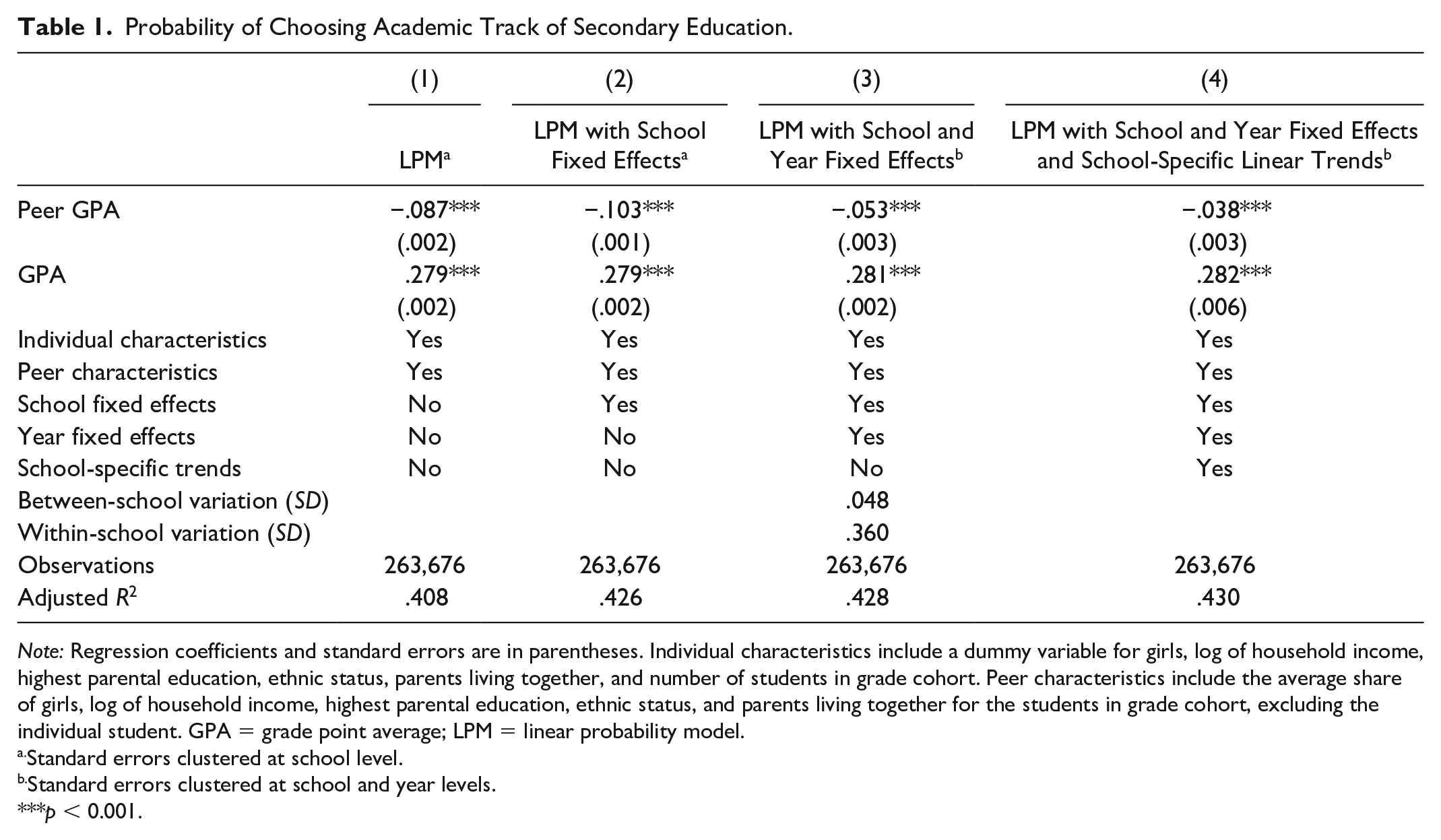
Note: Regression coefficients and standard errors are in parentheses. Individual characteristics include a dummy variable for girls, log of household income, highest parental education, ethnic status, parents living together, and number of students in grade cohort. Peer characteristics include the average share of girls, log of household income, highest parental education, ethnic status, and parents living together for the students in grade cohort, excluding the individual student. GPA = grade point average; LPM = linear probability model.
Standard errors clustered at school level.
Standard errors clustered at school and year levels.
p < 0.001.
The LPM estimates shows that there is a large negative effect of peer achievement on choice of secondary education. Table 1 shows the results of the LPM with school and year fixed effects. Consistent with previous studies, the model shows that later school start is negatively associated with choosing secondary academic track, while household income, gender (girls), having parents that live together, parental education, and being an immigrant are positively associated with choosing secondary academic track (e.g., Jonsson and Mood 2008; Owens 2010). These effects remain at the same level in all of the estimated models presented in Table 1.
The effect of peer achievement on choice of secondary education, however, changes magnitude when school fixed effects are included. The second column of Table 1 shows the estimates of this model. The school fixed-effect model suggests a negative effect of peer GPA (–0.10) on choice of the academic track of secondary education. The negative effect shown in the school fixed-effect model is somewhat reduced when estimating the school and year fixed-effect model, as shown in third column of Table 1. This result suggests that there is some sorting in the schools, which the school fixed-effect model does not account for. The student sorting, however, is handled in the school and year fixed-effect model.
The school and year fixed-effect model shows that peer GPA has a negative effect (–0.05) on the probability of choosing the academic track. This result shows that the relative achievement matters for the choice of education, supporting the social comparison theory. As this model is equivalent of a hybrid model that includes schools means of the variables in the model, this model also shows the within and between variation. The within and between variation from this hybrid model shows that there is considerably larger within-school variation in choice of secondary education than there is between schools (the between-school standard deviation is 0.05, whereas the within-school standard deviation is 0.36). The results from this hybrid model suggest the importance of accounting for the peer group within the schools. The effect of peer GPA is comparable with that found in similar studies (e.g., Jonsson and Mood 2008; Rosenqvist 2018). The model that includes school and year fixed effects and school-specific linear trends further supports this result. In this model, the effect of peer GPA is also negative, though of a lower magnitude than that of the other models (–0.04). The results suggest that the probability of choosing the academic track is lowered by approximately 4 percent for average-achieving students if they are placed in a high-achieving context of high-achieving peers, compared with an average-achieving context, holding own achievement constant. All of the estimated models presented in Table 1 support the hypothesis that there are negative effects of being in a high-achieving context. The results also support the prediction that the negative effects of being in a high-achieving context are small compared with the students’ own achievement.
Heterogeneous Social Comparison Effects
To investigate the heterogeneous social comparison effects, I estimate equation 1, in which the students’ placement in within-school and year quintile is interacted with different levels of peer GPA. 7 The results of these models relate to the second hypothesis of the social comparison mechanism, and Figure 1 shows the marginal effects of this model. The figure shows the marginal effects of the quintiles for peer GPA, set at 1 standard deviation below the mean, peer GPA at the mean and peer GPA at 1 standard deviation above the mean, with all individual, peer, and school characteristics held at the mean. The figure shows considerable heterogeneity on the effect of peer GPA on choice of education for each of the quintiles. Overall, the figure shows positive effects of being placed in a school with high-achieving students on the probability of choosing the academic track for the four lowest quintiles.

Predicted probability of choosing the academic track by student’s placement in within-school-year quintile of the grade point average (GPA) distribution in schools with different peer GPA. Linear probability models, student’s quintile placement interacted with peer GPA. School and year fixed-effects models with school-specific linear trends.
Figure 1 shows that the effects of peer GPA are largest for students in the second and third achievement quintiles of the GPA distribution, while the effect is comparatively smaller for students in the fourth and fifth achievement quintiles. For instance, changing a student from the first quintile from a setting of average achieving peers to a setting of high-achieving students (peer GPA 1 standard deviation above the mean) would result in an increase in the probability of choosing the academic track by about 8.9 percentage points (from a probability of 22 percent to 31 percent). Making the same change for students in the second or third achievement quintile would translate into an increase in the probability of choosing the academic track by 15 percentage points and 10 percentage points, respectively. The effects of peer GPA interacted with student quintile placement, in the two highest quintiles is somewhat lower. For instance, changing a student in the fourth quintile from a school context with an average peer GPA to a school with high-achieving students would translate into a gain of 3.3 percentage points. In the highest quintile, however, this change would lead to a lower probability of choosing the academic track (–2.3 percentage points). Contrary to this, high-achieving students seem to benefit from being in a low-achieving context, as generally stated from the frog pond theory.
The results from Table 1, however, are not due to a mechanical relation between student GPA and peer GPA. The results from Table 1 suggest that at a given achievement level, a student in a school with a low average achievement has a relatively higher achievement compared with a school with high achievement, but students in schools with high average achievement will also tend to have higher educational aspirations.
The results in Figure 1 suggest that students at the upper end of the achievement distribution benefit less from their peers when choosing secondary education compared with their peers in the lower and middle quintiles of the achievement distribution. This shows that the social comparison mechanism is smaller for those students who, plausibly, have already made their decisions as to whether to pursue an academic education. This result might not be surprising, as students who are at the top of the GPA distribution might be the same students who disseminate the positive norms and aspirations (e.g., Davies and Kandel 1981; Flashman 2012). These students therefore benefit less from their peers. This might be particularly true in choice-driven educational systems, such as the Danish system.
Alternative Tests of the Social Comparison Mechanism
To further validate my specification, I estimate different models in which peer GPA and student’s own GPA are excluded from the analysis. This analysis tests whether peer ability influences choice of education. Instead of peer GPA, I use the share of peers who have parents with upper tertiary (university) education as a proxy for peer ability (i.e., students of parents with higher educational levels will have higher ability or a higher level of resources to draw upon related to education and educational decisions; Breen and Goldthorpe 1997). If the effect of the relative GPA on choice of upper secondary education were purely associated with the peer quality, then the share of peers who have parents with upper tertiary education would be expected to be statistically significant and positive. In effect, this also tests the normative function of the reference group. Table A5 in the Appendix shows the results of this analysis. The first and second columns of Table A5 test whether the share of peers who have parents with upper tertiary education affects the individual students’ GPA, without and with peer characteristics. Peers’ parental educational level, however, does not affect the individual students’ GPA.
Columns 3 and 4 of Table A5 show that the peers’ parental educational level is as good as random, conditional on school and year fixed effects, with the exception of the students having parents with upper tertiary education, themselves, there is no other correlation between individual characteristics and the share of peers with parents with upper tertiary education. Finally, I test whether the share of parents with upper tertiary education affects choice of the academic track of secondary education. The result of this analysis shows that the share of peers with parents with upper tertiary education does not influence choice of secondary education, as shown by the imprecisely measured estimates. The results from these alternative analyses show that the choice of education is not affected by the peers’ ability, but through other mechanisms, as suggested by the social comparison theory.
Placebo Tests
To obtain valid estimates from equation 1, the estimations rely on the assumption that the peer composition is almost as good as random between cohorts. This assumption might seem rather strong, but it has a testable implication. The testable implication is that peer characteristics at time t should be uncorrelated with peer characteristics in the adjacent cohorts. If peer characteristics at time t are correlated with peer characteristics at times t – 1 and t + 1 (i.e., because of school-specific time trends), the correlation will indicate that the schools change their policies on whom to accept into the school, thereby changing the ability and achievement distribution of the students. This would lead to inconsistent estimates of the peer comparison effects (Lavy et al. 2012; Wooldridge 2002). I therefore estimate equation 1 in which I replace peer characteristics at time t with mean school characteristics in the adjacent cohorts at times t – 1 and t + 1. As seen in Table 2, there is no effect between placebo peer characteristics and the choice of secondary education at times t – 1 and t + 1. 8
Placebo Regressions Using Lags and Leads of Peer Characteristics.

Note: Probability of choosing academic track of secondary education. Linear probability models. School and year fixed-effects models with school-specific linear trends. Regression coefficients and standard errors are in parentheses. Standard errors clustered at school and year level. Individual characteristics include a dummy variable for girls, log of household income, highest parental education, ethnic status, parents living together, and number of students in grade cohort. Peer characteristics include the lags or leads of the following variables: Share of girls, log of household income, highest parental education, ethnic status, and parents living together for the students in grade cohort, excluding the individual student. GPA = grade point average.
p < 0.001.
These results show that the variation in peer GPA is not due to a change within schools in the policies of which students are accepted to attend the school (i.e., sorting of the students). The results of these placebo tests are evidence that the main results are not capturing spurious correlations between peer GPA and unobserved time-varying school factors. The placebo tests further show that the social comparison effect is on the grade level, with no spillover effects on adjacent cohorts. Students therefore relate their achievement to that of their peer group and not the achievement of others.
Discussion and Conclusion
In this study, I investigate the hypothesis that the social comparison mechanism leads students with high-achieving peers to lower their educational aspirations, and that the social comparison mechanism is heterogeneous across the achievement distribution. I investigate these hypotheses using administrative register data from six Danish cohorts of students in the ninth grade. I use school and year fixed effects with linear school-specific trends models to control for unobserved heterogeneity associated with peer group selection and influence. I furthermore investigate whether peers’ achievements affected the individual students’ choice of secondary education across the achievement distribution.
Controlling for own achievement, I find that the probability of choosing the academic track of secondary education is lowered if the student attends a school with high-achieving peers. These results support the hypothesis of the social comparison mechanism. The social comparison mechanism, however, is heterogeneous.
The analyses of heterogeneous effects also show that not all students are affected equally or even in the same manner by their peers, as is predicted by the frog pond theory. The results suggest that although low-achieving students benefit from high-achieving peers, high-achieving students benefit from low-achieving peers. Hence, students seem to conform to the same set of norms, leading to “regression to the mean” in educational aspirations.
As the social comparison mechanism might have varying effects across institutional contexts, one caveat of this study is that of the Danish education system. The choice of secondary education is largely choice driven, and the estimated effects might be smaller than they would be in other education systems in which the absolute ranking of the students has importance for admission to further education. This caveat means that the results might not be generalizable to all educational contexts.
The results presented here, however, underline the importance of the social comparison mechanism, in that not only do students’ own characteristics affect educational decisions, so does the social context in which they go to school.
Supplemental Material
sj-docx-1-srd-10.1177_23780231221088652 – Supplemental material for Does the Peer Group Matter? Assessing Frog Pond Effects in Transition to Secondary Schooling
Supplemental material, sj-docx-1-srd-10.1177_23780231221088652 for Does the Peer Group Matter? Assessing Frog Pond Effects in Transition to Secondary Schooling by Peter Rohde Skov in Socius
Footnotes
Funding
The author(s) disclosed receipt of the following financial support for the research, authorship, and/or publication of this article:The research presented here is supported by a grant from the Danish Strategic Research Council (Grant no. 10-093105/DSF).

Supplemental Material
Supplemental material for this article is available online.
1
As I observe the students only once, it is not possible to include individual student fixed effects or make value-added specifications.
2
As some families have negative income (i.e., because of debt), I use an inverse hyperbolic sine transformation of the income, thereby retaining the monotonicity of the income measure, and avoid censoring the data.
3
Alternatively, the models could be estimated with the inclusion of an indicator for whether the students started earlier than the year when the student turned seven. This indicator, however, does not influence the results shown in this article and was accordingly left out of the regression models.
4
The peer group is usually constant during the student’s time in school, unless the student composition changes for mobility-related reasons (i.e., the family’s moving from one school district to another). As there tend to be very low mobility patterns among Danish students attending primary education, I believe that this assumption is valid.
5
Stata code for the analyses is available in a supplementary file.
Author Biography
References
Supplementary Material
Please find the following supplemental material available below.
For Open Access articles published under a Creative Commons License, all supplemental material carries the same license as the article it is associated with.
For non-Open Access articles published, all supplemental material carries a non-exclusive license, and permission requests for re-use of supplemental material or any part of supplemental material shall be sent directly to the copyright owner as specified in the copyright notice associated with the article.
