




Abstract
The coronavirus disease 2019 pandemic continues to shape individuals’ decisions about employment and postsecondary education. The authors leverage data from a longitudinal qualitative study of educational trajectories to examine how individuals responded to the shifting landscape of work and education. In the final wave of interviews with 56 individuals who started their postsecondary education at a community college 6 years ago, the authors found that most respondents described engaging in satisficing behaviors, making trade-offs to maintain their prepandemic trajectories where possible. More than a quarter of individuals, primarily those with access to fewer resources, described trajectories fraught with insecurity; they struggled to juggle competing obligations, especially in the face of an unpredictable labor market. A small portion of participants described making optimizing decisions, which were sometimes risky, to prioritize their aspirations. These descriptive patterns may partially explain mechanisms shaping recent shifts in employment and postsecondary education, including lower labor-market engagement and declines in college enrollment.
In the wake of the coronavirus disease 2019 (COVID-19) pandemic, the world faced unprecedented lockdowns that transformed the nature of work and education (Moen, Pedtke, and Flood 2020). The resulting upheaval shaped decisions about employment and pursuing postsecondary education. For some, shifts toward remote work and schooling meant maintaining their current trajectory while adhering to public health guidance. For others, the pursuit of economic security and educational aspirations competed with other priorities, such as personal safety and caregiving (Malmendier 2021). Job resignations have soared in 2020 and 2021, with 3 percent of the entire U.S. workforce quitting in August 2021 alone, a phenomenon called the “Great Resignation” (BLS 2021a; Malmendier 2021; Rosalsky 2021). Likewise, disruption to college courses shaped individuals’ experiences and enrollment decisions; colleges faced declines in enrollment in fall 2020 and again in fall 2021 (NCES 2021; NSC 2021).
In this study, we examine how the pandemic shaped individuals’ work and education experiences using data from a longitudinal qualitative study of educational trajectories. Individuals in our sample were community college students who, as of spring 2015, aspired to transfer and earn a bachelor’s degree. Research suggests that the educational trajectories of community college entrants, in particular, are shaped by their employment and familial obligations, as many community colleges students are first-generation college students and from low-income families (Hart 2021; Rosenbaum, Deil-Amen, and Person 2007). In our final follow-up interview in fall 2020, we asked how individuals in our sample responded to the shifting landscape of work and education during the pandemic and whether and how they had maintained their previous trajectory toward their educational and career aspirations.
Many described optimizing and satisficing behaviors as they determined next steps toward (or away from) their goals. The largest proportion described satisficing in their pursuit of their aims, making decisions that maintained (to the extent possible) their prepandemic trajectories but avoiding additional risks. A few participants described making optimizing decisions, which were sometimes risky, to prioritize their aspirations despite difficult circumstances. Both optimizers and satisficers described support structures that enabled them to improve upon, or at least maintain, their prepandemic trajectories. More than a quarter of the sample, primarily those with fewer financial resources and minimal support structures, described trajectories fraught with insecurity, where they struggled to juggle obligations, especially in an unpredictable labor market. We found that black and Hispanic women appeared to be overrepresented among those struggling in our analytic sample, often because of precarious employment and job loss.
These descriptive patterns may partially explain mechanisms shaping employment and educational outcomes, including swelling job resignations and unfilled positions, lower labor-market engagement among women (who have taken on more caregiving responsibilities), and declines in college enrollment (BLS 2021a, 2021b; Calarco et al. 2021; Landivar et al. 2020; NSC 2021). Periods of economic downturn can destabilize working environments, and that upheaval may shift individual investments in education (Blustein et al. 2020; Foote and Grosz 2020). Unlike displaced workers in the Great Recession’s turbulent job market (Vuolo, Staff, and Mortimer 2012), workers during the COVID-19 pandemic continue to face disruptions arising from the intersection of family life and personal health with their own work and educational investments, which produces competing demands on their time.
How Competing Demands Shape Work and Educational Trajectories
Job security, flexibility, and safety influence individuals’ employment decisions (Duncan 1977; Oreopoulos and Salvanes 2011). Although job quality is often equated with earnings, job quality is a multifaceted social, personal, and economic construction (Findlay, Kalleberg, and Warhurst 2013; Liu, Thomas, and Zhang 2010). Employees’ day-to-day experiences and work satisfaction are often shaped by their autonomy and flexibility concerning how and when they perform tasks (Kalleberg 2011; Valcour 2007). The emphasis on individuals’ autonomy to determine where and when to perform work has taken on new meaning in the COVID-19 pandemic (Kaufman and Taniguchi 2021). Decisions about employees’ ability to work remotely, especially for jobs deemed “essential,” were made by employers (van Zoonen and Ter Hoeven 2022). Many individuals faced significant disruption in their day-to-day work experiences because of shifting work modalities (Lyttelton, Zang, and Musick 2020), job loss (Moen et al. 2020), and competing work and family demands (Calarco et al. 2021; Schieman et al. 2021). Still others weighed the long-term implications of leaving the workforce against the immediate need to care for children (Calarco et al. 2021; Schieman et al. 2021).
Individuals enrolled in postsecondary education, particularly those juggling education and work, faced further challenges during the pandemic that may contribute to decisions to disenroll. About half of college students surveyed in the National Center for Education Statistics Household Pulse Survey in fall 2020 reported that the COVID-19 pandemic was likely to impair their ability to complete their degree (NCES 2021). Common reasons for canceling enrollment plans included uncertainty about how classes and programs might change (30 percent), changes in financial aid (15 percent), and the need to care for others because of interrupted care arrangements (11 percent) (NCES 2021). Among college enrollees, those with financial constraints tend to prioritize working for pay over continuing their education; unfortunately, interruptions to enrollment ultimately extend time to a degree and decrease the odds of degree attainment (Bound, Lovenheim, and Turner 2012; Bozick 2007). Community college students are more likely to come from low-income families and to work during college than four-year college entrants (Snyder, de Brey, and Dillow 2019). Qualitative research suggests that many of them work in precarious jobs with unpredictable hours and rely on that employment to cover their financial obligations (Hart 2021).
The challenges experienced during the pandemic vary across subpopulations. People without college degrees are typically more vulnerable to unemployment and lower job quality (Schudde and Bernell 2019), and those conditions appear to be exacerbated during the pandemic (Moen et al. 2020). During the pandemic, youth have become more vulnerable, with higher rates of unemployment and deepened inequalities in job market entry across social class, particularly in countries, like the United States, without “institutional bridges” from school to work (Mont’Alvao, Aronson, and Mortimer 2020). Recent surveys show that many recent college graduates were fired, furloughed, or had reduced hours because of the pandemic (Kuperberg and Mazelis 2021). Women and people of color appear more likely to have been laid off (Dias 2021). Women of color, in particular, are more likely to be employed in the service industries adversely affected by pandemic closures (Folbre, Gautham, and Smith 2021; Marchand and Olfert 2013). Layoffs can force displaced workers into the gig economy or self-employed side hustles that shape their financial and employment stability (Lewchuk 2017). During the pandemic, layoffs disproportionately affected women, especially those of color and from low-income households (Moen et al. 2020). Parents of young children faced school and childcare closures (Garbe et al. 2020; Landivar et al. 2020), upsetting the delicate balance of work-family life. Disparate job loss may contribute to reliance on mothers as primary caregivers during the pandemic (Moen et al. 2020). Women, particularly those with young dependents, reduced their hours of working for pay at a rate of four to five times that of men (Collins et al. 2020), with some mothers emphasizing the practicality of decisions to reduce or forgo work (Calarco et al. 2021). Mothers who remained employed often took on a greater share of the pandemic parenting, where those working from home navigated the challenge of balancing their children’s schooling and their own work tasks (Calarco et al. 2021; Lyttelton et al. 2020; Petts, Carlson, and Pepin 2021). The pandemic also affected family formation and fertility decisions, often resulting in delays, which have greater implications for women (Kuperberg and Mazelis 2021).
Decision Making in Turbulent Times
People make difficult decisions about whether and how to balance investments in work and education with their other obligations. Rational choice theory suggests that people leverage information to make decisions that will maximize their returns (Becker 1976). People who optimize might take risks to gain more rewards, or leverage uncertain situations in ways that improve their overall satisfaction and happiness. However, individuals also face complex choice situations that make optimizing outcomes less feasible. People often “satisfice” instead of maximizing—seeking a “good enough” option among perceived alternatives (e.g., Schwartz et al. 2002:1178; Simon 1955). Sociological research from secondary schooling illustrates that students from various socioeconomic backgrounds make educational decisions on the basis of perceived utility of the potential pathway and perceived odds of success (Gabay-Egozi, Shavit, and Yaish 2010). In a study of curricular choices, a substantial proportion of students did not pick the highest reward (and highest risk) set of courses or the lowest reward (and least risky) pathway. Instead, many displayed “hedging” behavior, mixing coursework with potential high returns but high risk of failure with courses perceived as less risky with lower potential returns, similar to Schwartz et al.’s (2002) concept of satisficing. Students from lower socioeconomic status families were more likely than those from more affluent families to “hedge” their choices, suggesting they were more sensitive to perceived risk of failure.
Research suggests that women balancing work and caregiving are likely to describe satisficing behavior (Crompton and Harris 1998; Walters 2005). In trying to balance work and family goals, they fail to maximize success in either realm, with many emphasizing that their jobs were merely “okay for now” (Walters 2005:209). The pandemic likely heightened the sense of imbalance, especially for those without strong support systems to fall back on, as broader structures, such as daycares and schools, were suddenly unavailable and women were more likely than men to take on additional caregiving roles (Calarco et al. 2021).
Qualitative research on the work and education trajectories of individuals can help illuminate the diversity of experiences that undergird recent trends. We analyze interview data collected from a sample of working- and middle-class adults we have followed over six years, tracking progress toward their educational and career aspirations. In our latest wave of interviews, conducted in fall 2020, individuals described their work and educational trajectories in the wake of the COVID-19 pandemic, including challenges faced and adaptations made as they juggled shifting work, education, and family priorities during the pandemic.
Data and Methods
Sample
The individuals in our analytic sample initially attended two public community college districts located in different metro areas in central Texas, both of which primarily served nonwhite student populations (with Hispanics as the majority); a quarter of their students receive Pell grants (THECB 2017). We began interviewing students in spring 2015 and followed up with them in the fall of each subsequent academic year. The latest wave occurred in fall 2020, when much of the country still faced interruptions to daily life because of COVID-19. Although everyone in the sample initially attended a community college, they aspired to earn a bachelor’s degree and, in spring 2015, expressed an intention to transfer to a four-year institution within the next year. Because of these sample selection criteria, particularly that individuals planned to transfer within one year, our sample was positively selected among community college entrants.
We recruited 100 participants in the first year, and the subsequent response rate varied from year to year. In year 6, we interviewed 56 people who had been in touch with us since the first interview (those for whom we had longitudinal data on their educational and work trajectory). Table 1 includes their background information, current work intensity, and educational attainment and enrollment information. The majority of people in our analytic sample identified as Hispanic (59 percent [n = 33]). Of the 56 participants, 64 percent identified as white (n = 36), 14 percent as black (n = 8), 5 percent as American Indian or Alaska Native (n = 3), and 2 percent as Asian (n = 1); 9 percent did not disclose their race (n = 5, all of whom identified as Hispanic). The average age of participants in year 6 was 30, though age ranged from 24 to 61 years. A majority of participants in our sample, 63 percent, were the first in their families to attend college. On the basis of descriptions of family income, parental education and occupation, and self-reported social class, 68 percent were from working-class or lower middle-class families (the rest identified as middle-class). By our year 6 interviews, almost half of the analytic sample (n = 27) had received bachelor’s degrees (7 of whom were now pursuing graduate education). Among those who had not attained bachelor’s degrees (n = 29), 16 were enrolled in baccalaureate-granting institutions and 1 was enrolled at a community college (the remainder were no longer enrolled).
Description of Participants’ Background, Work Intensity, and Educational Enrollment.
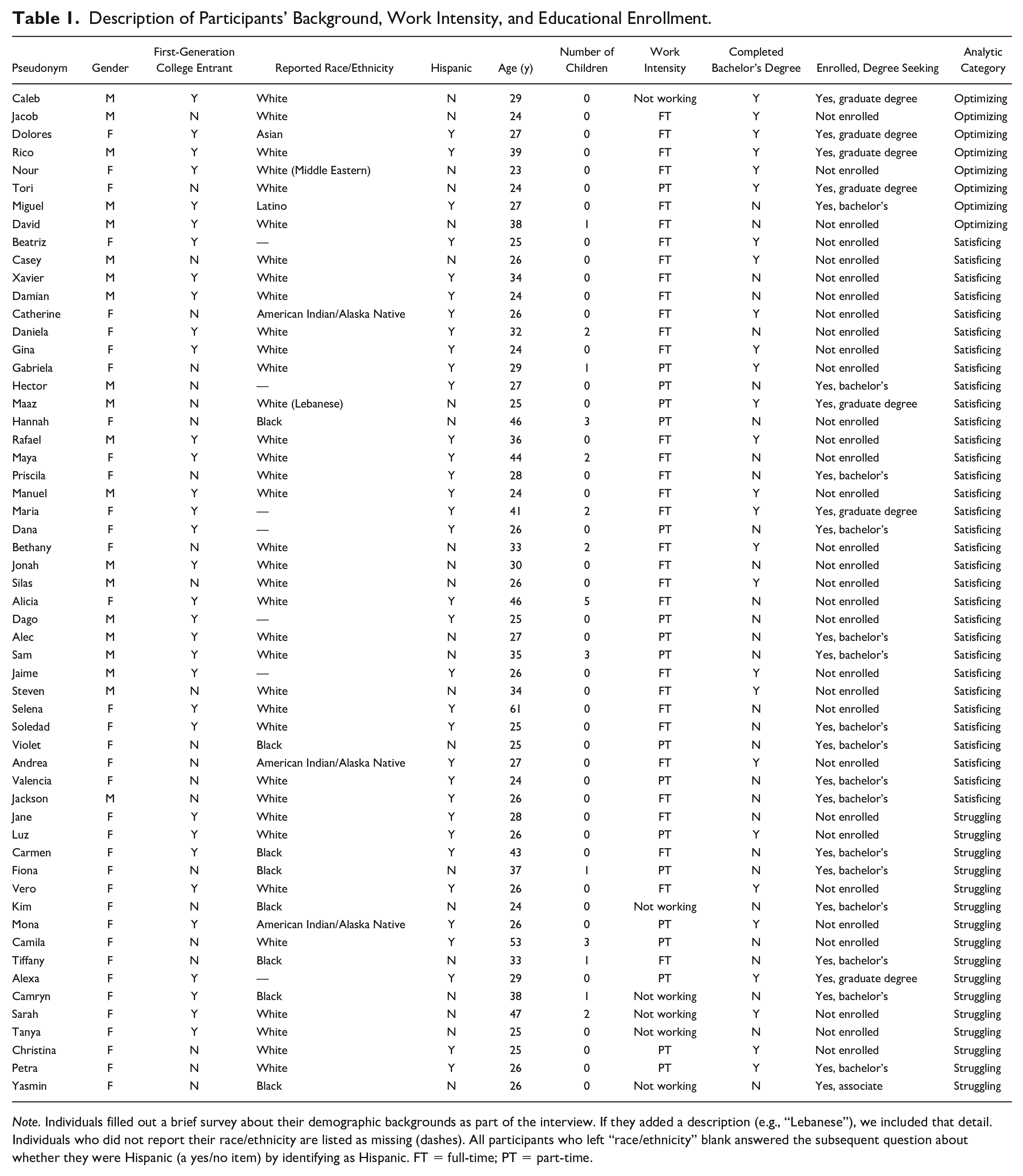
Note. Individuals filled out a brief survey about their demographic backgrounds as part of the interview. If they added a description (e.g., “Lebanese”), we included that detail. Individuals who did not report their race/ethnicity are listed as missing (dashes). All participants who left “race/ethnicity” blank answered the subsequent question about whether they were Hispanic (a yes/no item) by identifying as Hispanic. FT = full-time; PT = part-time.
Data Collection
We conducted 60-minute semistructured interviews (Patton 1990) every fall over the past six years, recording and transcribing the interviews each round. Our interview protocol included questions about where students were in their educational process, factors that shaped their trajectory, and their continued educational and career aspirations, in addition to what they were doing after graduation. In year 6, we probed about their experiences navigating work, education, and family life in the wake of the COVID-19 pandemic. We first asked general questions about their day-to-day life and how it had changed since the pandemic began; then we focused on how the pandemic affected their experiences in education, work, family, and health.
Data Analysis
Data analysis took place throughout the six years of data collection. Each year, we coded all interviews after collection and added to a memo for each participant that served as a longitudinal record capturing different themes and synthesizing student experiences across the years. We created an extended meta-matrix to explore students’ trajectories and make sense of themes that emerged from the coding and memoing processes. In our analysis for this article, we drew from the memos and the matrix. We elaborate in the following discussion.
Coding and Memoing
We coded the data with the qualitative software program Dedoose, using hybrid coding, each year (Miles, Huberman, and Saldaña 2014). In year 6, we first developed deductive codes from broad themes about the participants’ life experiences and COVID-19 (e.g., the education family of codes included education-why and education-finance; the COVID family of codes included COVID-education, COVID-family, COVID-work, COVID-health, and COVID-other) to understand participants’ recent experiences. These broad codes helped us to identify excerpts relevant to our research questions, including how individuals were navigating work and education during the pandemic. After each round of coding, we resolved disagreements and discussed the coding scheme to determine necessary revisions. Once we had coded the interviews, we examined them thematically and discussed themes as a team. We categorized themes and ideas that emerged inductively from the data and used them to build a meta-matrix.
After our initial coding, we created or updated longitudinal memos for each student. These detailed memos, 15 to 20 pages long, captured data from the six years of interview transcripts, surveys, and field notes. In year 6, one specific section of each memo was dedicated to students’ educational and work trajectories and how their trajectory was shaped by the pandemic; we relied most heavily on this section for analysis.
We created qualitative matrices (Miles et al. 2014) to synthesize findings across students, campuses, and data sources to build or extend theory on social mobility and educational trajectories and outcomes. We derived categories for the matrices from the themes identified during coding and memoing. We focused on how students understood their work and educational trajectories and experiences since March 2020, when many experienced disruptions to their education and employment. For each participant, our matrix also captured demographics, where they were in their pursuit of a bachelor’s degree, whether they were working for pay and how their employment experiences changed after March 2020, other obligations that shaped their educational and work experiences, and their continued career and educational aspirations.
Members of the research team were assigned a caseload of participants to analyze, tasked with filling out the matrix. To enhance the validity of our findings, the team met weekly to discuss the ongoing process and areas that needed clarification. Once the initial meta-matrix was filled in, we examined the data in the matrix inductively to see which themes and categories emerged, and then we went back over the data to classify interviewees into those themes. For example, we examined educational and work trajectories and, using quotations in the matrix and transcripts as evidence, placed students in categories that summarized their educational and employment experiences as described in the year 6 interview. We drew on our knowledge of each student’s trajectory, and considered whether they were able to make choices that improved their trajectory in some way. Although we considered how participants assessed their own experience (i.e., whether they believed they were on an upward trajectory), we weighted other evidence as well. For example, many participants noted they were “lucky” compared with some people they knew, but had lost jobs, experienced major disruptions to their trajectories, or took on financial responsibility for family members. We used these themes—in which individuals described their experiences of an upward trajectory (“optimizing”), maintaining their status quo (“satisficing”), and struggling to make ends meet (“struggling”)—to add a layer of coding to the matrix, evaluating which individuals followed the three patterns.
Results
Three major patterns defined how individuals described their work and educational trajectories and related responses: optimizing, satisficing, and struggling. Table 2 illustrates the distribution across identities in our sample. Fourteen percent of our sample (n = 8) described optimizing during the pandemic, emphasizing how they aligned their work and educational circumstances with their priorities (e.g., pursuing a job with preferrable conditions, like working in their preferred location). Optimizers were those who, in the face of the pandemic, had social or financial support structures that enabled them to focus on improving their situation to some degree. It is important to note, however, that there was variation within this category, as we describe below, and everyone was affected in some way by the pandemic. Yet the participants whom we label as optimizers were able to make choices that helped them move toward their goals in an upward trajectory, because of their access to some kind of safety net. The bulk of individuals we spoke with, 57 percent (n = 32), described satisficing in the wake of the pandemic. Satisficers maintained a work and education trajectory that they perceived as acceptable but not ideal; they rationalized their situation as a temporary holding pattern they could change after the pandemic. A smaller but substantial portion, 29 percent (n = 16), of participants described the precarious nature of their continued pursuit of employment and educational aspirations. Strugglers reported downward trajectories, describing difficulty maintaining their prepandemic trajectories because of competing obligations and unanticipated employment shifts. They emphasized juggling too many obligations, which left them focusing on surviving rather than moving toward their educational and career aspirations.
Sample Distribution into Categories of Decision Making and Demographics.

Note. The total number of participants was 56. This table shows the number of participants within each category (“optimizing,” “satisficing,” and “struggling”) by gender, whether they had dependents, and whether they identified as non-Hispanic White.
Optimizing
Individuals who described themselves as optimizing their work and educational situations during COVID-19 typically emphasized improvements in their working conditions, primarily working from home, that afforded them newfound flexibility. The majority (five of eight) of those who described their trajectories as improving during the pandemic were men. Optimizers typically acknowledged that they had a safety net, either family support or additional resources, that allowed them to improve their circumstances despite an ongoing pandemic.
David, a 38-year-old white man, graduated in 2020 with an associate degree in computer science. He described his family as thriving during the pandemic, largely because they spend more time together. They struggled at first with their daughter’s school moving online. David’s wife quit her job to support their daughter in online learning. David explained, “My wife had to come back out, because it was just like, ‘Man, somebody needs to be there with her, explaining the concepts, just working through some kind of online game or some little math puzzle or something.’” They then moved their daughter to a parochial school, which allowed David’s wife to return to work; like David, she found a remote position. Eliminating his commute and working from home improved David’s quality of life: Spending a lot more time with my daughter has been nice, my wife and I together, because my wife works from home too. We’re constantly with each other. . . . We’re a little bit more in sync than we used to be.
He elaborated: “Frustrating traffic every day to and from the office—not having that has been a big blessing.” David, like many optimizers, felt lucky to be thriving: “We’ve found opportunities to actually enhance our day-to-day interests, like education and work and all that stuff. It’s been largely good for us.” His ability to optimize arose partly from his wife’s initial sacrifice of her employment to support their daughter’s education and, subsequently, from their family’s having the resources to enroll their child in private schooling.
Nour, a first-generation college student who graduated from a selective public university, also described optimizing during the pandemic. She reconsidered her work and education options, relying on support from her parents, to determine what worked best for her. She quit her commercial banking job at the end of July 2020 because of the bank’s poor handling of COVID-19, explaining, “The management like took forever to make a decision [about working remotely], then sent everybody home. It was chaotic for a while . . . so I quit.” She admitted that it was risky: “It wasn’t the best decision to do during COVID.” However, she was able to take this risk because she had a strong safety net, and she got a new job in October “working full-time from home” and reported feeling “very lucky it worked out.” Unlike some individuals who faced negative trajectories during the pandemic, Nour was able to return home and live with her family, which provided a safety net that made it easier for her to leave a job that would not allow her to work from home. Her father owned a local liquor store that benefited from the pandemic (“Sales actually went up during the pandemic because people drank more,” she explained). Taking a risk to leave her job with no backup plan was made easier by supportive parents. Before the pandemic, she was enrolled in a master’s program but found that “studying was harder because, like, there wasn’t a lot of motivation to do it.” She elaborated on the challenges of taking “classes with professors that I haven’t met and won’t meet because of COVID,” explaining: “I would skip classes and just fall asleep or not do my assignments and wait till the last minute.” She planned to reenroll when classes were taught in person, which she preferred to doing coursework via Zoom. Although this delayed her educational trajectory, her work situation had significantly improved, and she had the flexibility to wait until graduate school would be available in her preferred instructional modality.
Several of the respondents reported making an easy transition to working from home, because of both the field they worked in and flexible work arrangements initiated by their employers. For some, those transitions translated to eliminating commuting time, which allowed them to invest more in postbaccalaureate education. For example, Dolores completed her bachelor’s degree in information technology and, during the pandemic, transitioned from part-time remote work to full-time remote work. The transition was “seamless” because her field, cybersecurity, is suited to remote work: it “wasn’t that big of a change.” Dolores was happy to “just try to stay at home so we don’t contract any diseases or anything.” Working remotely and the resulting lack of a commute also enabled her to pursue “personal goals” of spending more time with family and enrolling in online master’s degree coursework.
Individuals enrolled in graduate education who were otherwise financially secure, often because of external support from family or other resources, felt relatively protected from the pandemic’s toll on their trajectory, though for various reasons. Caleb, a white student, had graduated from one of the state’s flagships and was using military education benefits to fund his law school education, giving him financial security. Although he worried about the pandemic interfering in internship plans—noting that the “second summer in law school, that’s where you make connections and you get some experience”—he reported that online learning was “easier for everyone” and that, because distraction were fewer, his grades had improved since he had switched to remote coursework. Overall, he had secure funding to continue his education and benefited from the online environment, continuing to make progress toward his law degree. Tori, a white middle-class woman who was completing her master’s degree in speech and language pathology, acknowledged that her internship was interrupted when schools closed. However, because her university was close to home, she could stay with her parents, which offered her additional support. She explained, “I think that, even though it’s been hard, it’s nice to have time with my family, especially when I feel like people are really struggling right now.” Living with her parents allowed her to keep living costs low and focus on her education trajectory.
Although all of the people in this category perceived that they were gaining something professionally or personally from their pandemic-induced situations, and all had structural supports from family or other resources, there was variation among those optimizing. David held on to his job, and appreciated the flexibility of working from home so that he could spend more time with his family, a net benefit. For Nour and Tori, they moved home with their parents, a move that could be viewed as a delay of entry into adulthood (Kuperberg and Mazelis 2021), and could further delay other personal or financial decisions, such as starting a family or buying a home. Nour, furthermore, delayed her graduate education. However, it is important to note that Nour and Tori benefited from strong safety nets and felt that their ability to reach long-term goals (educational or professional) improved, while others in our study had parents or other family members move in with them and took on additional caretaking or financial responsibilities.
Satisficing
Satisficers (n = 32) often accepted their current situations as “good enough” (Schwartz et al. 2002), but several described themselves as being in a holding pattern. Like optimizers, many satisficers emphasized that job stability (n = 18) or family support (n = 13) enabled them to maintain their trajectory. However, unlike optimizers, they postponed seeking preferable alternatives, like pursuing their aspirations toward additional education or better employment.
Satisficers primarily described experiencing momentary disruptions to their work but ultimately being able to return with minimal impact on their financial stability. For example, Alec, a white man who was finishing his bachelor’s degree while working for a large technology company for about 30 hours a week, did not lose pay or work hours during the company’s short-term shutdown. Although he found some aspects of working and doing school from home challenging, he had more financial stability because of the way the company handled the shutdown: paying employees during closures and pivoting from in-person to remote work as necessary. He explained, “They paid us for a few months, and then . . . once we re-closed in July, they pushed everyone into a remote position.” When allowing people to work from home, they provided everyone with the supplies they needed. As a result, there was no financial loss for Alec and he continued to pay his rent and remain focused on school.
Dago, a Hispanic male who split his time between two jobs, described being able to maintain stability in his work trajectory despite a lack of similar support from his employer. Dago split his time between day trading and working at a cannabidiol dispensary. Although the dispensary closed briefly when nonessential businesses shut down, that did not seem to disadvantage him financially. He started making more money day trading than he had pre-COVID-19, which he attributed to the uncertainty of the market: “I’m really fortunate to be able to still make money while [experiencing] these crazy times.” Yet this line of work was risky and volatile, and Dago had no fallback. Although he lived with his mother, unlike Nour and Tori, he supported his family, not the other way around. Indeed, when his mother was unemployed because of COVID-19, he helped support their family. Dago left college before the pandemic and no longer planned on returning. He explained, “I dodged a bullet because it’s a lot—much harder to be doing school online, especially if you’re doing all these other much more complicated subjects.” The pandemic seemed to solidify his decision not to continue with college, on the basis of his perception of virtual schooling. Although he interprets this as “dodging a bullet,” he is no longer on the path he initially set out on, which was to obtain a bachelor’s degree. Reflecting on what it would be like to pursue a degree now, however, Dago felt satisfied with his decision to focus on work for the time being.
A current university student, Soledad, was working full-time at a call center while finishing up coursework for her bachelor’s degree. Although she was happy with recent changes that had made her work more flexible, the job was not ideal: “This is going to be a permanently remote thing, which is totally fine with me . . . and the hours are really flexible. The job itself is pretty terrible; I don’t like it, but it pays well.” However, as she looked toward her next steps, she feared the uncertainty in the job market and considered earning a master’s degree to delay employment decisions: I was just like, “Okay, if COVID is still happening by the time I graduate, I think I’m just going to do the master’s.” Because it’s going to be so hard to find a job right now. So I don’t want to be out there with just the bachelor’s trying to find a job when all of these work environments are still adjusting to how they’re going to do it, and a lot of places aren’t sure that they’re going to be even in office because a lot of businesses were able to accommodate for work from home. And I was looking at that a lot now because they’ve been able to show that’s something that they can do. And I’m like, “Okay, that would be harder for me to learn on the job.”
Although she wanted to quit her current job, she planned to delay until she perceived a more predictable job market, especially one that might provide additional training.
Dago, Alec, and Soledad illustrate what satisficing looked like among single individuals with no apparent caregiving roles. Parents with small children who described satisficing often relied on family or community to help them juggle increased caregiving responsibilities. They accepted their current nonoptimal circumstances, comparing them with alternatives they perceived as worse than their current holding pattern. For example, Daniela described working from home full-time while supporting her children’s online schooling as wearing “the same amount of hats” as before the pandemic, “but I have to do it simultaneously now.” She elaborated about her work: “The job itself is the same, but the environment since COVID has gotten a lot more. . . . I mean, it’s hard for me because I have a lot on my plate, you know what I mean?” Neighbors with similarly aged children who watched her kids offered essential support: We’re really close with both of our neighbors. . . . So my kids play with their kids a lot. I am so grateful because at least I can get a moment of silence, a moment of just—“Let me just think of nothing. Let me just let my brain just relax for a little bit.” I would say that’s probably been a bigger support group.
She was grateful for that community support, which made balancing full-time work with caring for her kids feasible. But at the same time, she acknowledged putting off her goals. She had disenrolled from college but still hoped to return. She said,
It frustrates me too because I’m like, “Well, how am I going to do this?” . . . I just don’t even know. It takes so much to go to college to stay focused. And I feel like my focus is just all over the place right now.
Because her current work and caregiving responsibilities were overwhelming, she could not invest the time in planning to transfer and finish her degree. Instead, she continued to put off her baccalaureate aspirations.
Other mothers similarly described putting aside ambitions to focus on maintaining their status quo in the challenging circumstances. Hannah, a black mother of four who had completed an associate degree four years earlier, worked for her church as a secretary. She transitioned to remote work during the shutdown, which changed the nature of her job but allowed her to prioritize the health of her family. “Part of what I do within my work or within my church community, church family,” she explained, “is visit those who are sick and visit those who are in the hospital. And you can’t do that now. . . . That’s been a big adjustment.” Like many other women in the study, Hannah experienced increased caretaking responsibilities. Although two of her four children no longer lived with her, she took on more caregiving responsibility than before the pandemic. She often helped her elderly mom by “running errands after work” to “alleviate her from having to get out and be exposed.” Hannah also supported one of her kids in online learning. She acknowledged that the transition to online schooling was a struggle: For the kids, learning it from a distance, and then as for parents having to help them adjust to that and then being home all day and providing them breakfast and lunch. I enjoyed it, but it was a little more than what I was used to. . . . It was a big adjustment, but I’d rather have done that than to be affected by COVID.
Hannah was adamant that she would not return to college during COVID-19, both because she requires in-person learning and because she felt that her family needed her too much at the moment: “With the COVID hitting and then seeing that I need to be of support to my kids, I said no. That’s not something I can focus on right now because my family’s more important.” She planned to delay her educational goals until her children returned to in-person schooling and her college coursework was offered in person.
Several satisficers described how additional pressures at home affected their ability to pursue additional opportunities. Gabriela, a working mother of one child, worked part-time as a freelancer for an architecture client and in her parent’s business in Mexico. She had completed her bachelor’s degree in architecture at a Texan university in the previous year and had taken a trip to visit family in Mexico when COVID-19 hit, explaining: “We were visiting . . . and then the shutdown started after spring break and so we just decided we should stay.” She had decided not to pursue full-time employment at the time so she could support her six-year-old son’s schooling: I am afraid to go back to a regular, like nine-to-five job, because I don’t know how I’ll be able to balance doing classes with my son and him going to school online and then me having to work . . . my son’s school is still doing everything online. So I just don’t know where I would balance it out to go back to work for a nine to five.
Gabriela had the benefit of a family business, owned by her father and brother, where she worked additional hours if needed. She wanted to go to graduate school, but COVID-19 changed her plans: “I was actually looking at the master’s in construction science. . . . They have an online program, but I won’t do that right now. Because of money reasons, it’s not a good year for that.” As she worked to balance competing priorities, she was unsure of what the future will look like, noting, “I guess the situation with COVID is so unclear on where I’m going to end up at.” Relying on her extended family to maintain stability felt necessary for the time being because, she explained, “I know I have a budget to keep.”
Struggling
Although satisficers were often able to leverage community, family, or personal resources to meet their needs, those who reported struggling in their work and educational trajectories (n = 16) often lacked access to social or financial supports. Strugglers, all of whom were women, primarily described unstable work trajectories, which affected the postsecondary education of those still enrolled. Strugglers reported one or more of the following: losing their jobs (n = 8), underemployment arising from decreased hours (n = 5), and working multiple jobs to get by (n = 4). They described a chaotic and challenging job market even for those who earned their baccalaureate (n = 7). For those with children (n = 5), the combination of negotiating job instability and supporting children in online learning created an almost untenable dynamic.
Respondents reported increased uncertainty about employment during the pandemic, citing the loss of opportunities because of shutdown. When service-based industries closed, many staff members were furloughed or laid off. Kim, a black 24-year-old college student who had recently transferred to a flagship university, scraped together jobs after she was let go from her position on campus. “I had to look for employment elsewhere. I’ve sort of just had multiple different jobs that I’m taking on, and then change a lot more than I normally would,” she explained. In addition to taking on gig economy jobs, for example through Instacart, she also had to move home abruptly when the university closed its dorms in the spring. At home, several other family members also struggled to find employment but worried about taking on jobs that increased their “exposure”: “Some of us in the family were not going to work for a little bit. Especially since, for my mom, she was looking for work just before COVID started. It made it harder for her to get a job.” Kim hoped to avoid jobs that would increase her family’s risk for getting COVID-19, but the jobs she took required interaction with people outside her household.
Tanya, a young white woman who was furloughed from her position at a local movie theater, similarly described difficulties finding employment over several months: I’m thinking about what I can do, jobs I can do at home that will allow me to make a living. That’s a lot of what I’ve been thinking about for this whole pandemic window period of time. I’m very money focused, like, “How can I sustain myself?”
While waiting to return to her theater job, she looked for other work. She took on babysitting and tutoring jobs to make ends meet. She eventually hoped to return to college to earn a degree, but her financial constraints made it harder to “pay full price for half the education” (referring to online coursework). The pressure of her immediate financial need to cover expenses also took precedence over her educational aspirations.
Vero, a 26-year-old Hispanic woman who identified as a working class, had completed her bachelor’s degree just before the pandemic began. In our previous interviews, she had described wanting a “settled life” and the job security that would come with a bachelor’s degree. She was working two jobs: seasonally, she was a tax preparer, and she also worked in an Amazon fulfillment center. During the pandemic, her hours at Amazon increased, but so did the stress and physical toll of the work. Neither job paid well (“they only pay me $11 an hour [for tax preparation],” which was more than she earned at her other job). Her tax preparation job was negatively affected by the pandemic, with fewer hours than usual. Like many essential workers, she understood that the demand for her work at the fulfillment center increased as others decided to stay home: “In a country where the pandemic has forced everyone to stay at home and don’t shop, either at the grocery store or at a mall, then what do you think Amazon’s going to have? Lots and lots of orders.” She continued to do the work, despite the difficult schedule and distress that it she was not putting her bachelor’s degree to good use, to offset her student loan debt and continue paying her bills.
Those caring for others seemed disproportionately affected by financial instability and lack of job security. Sarah, a 47-year-old white women who had also recently completed her bachelor’s degree, wanted to pursue a master’s, but her unstable employment made that goal feel impossible. “I wish I could afford [enrolling in the master’s program],” she explained; “at the least it would occupy my mind.” She lost her job early in the pandemic and “both [her] children lost their jobs and lost their living arrangements.” They moved back in with her, increasing her expenses. She felt “hopeless” in the face of the daily job search, elaborating: “I am unemployed since March [2020], so my days are filled with filling out applications online, to no end.”
Fiona and Tiffany, both black women balancing the need to work for pay with the need to care for dependent children, described difficulties with juggling those two priorities. Fiona worked at a tax preparation company early in the pandemic but had to quit “when the daycare funds ran out.” It was only after she was able to send her son to school full-time, when he entered kindergarten in the fall, that she could again pursue work. When her son went to in-person schooling, she started work as a home health aide, which offered flexible hours, necessary in case he needed to be home again. Tiffany, a single mother, was working three jobs when we interviewed her: one full-time position in a psychologist’s office and evening part-time work at QVC and at a children’s clothing store. Tiffany also supported her eight-year-old son’s online coursework: I would say that at the beginning [March 2020], it was a struggle to juggle everything because I’m used to a certain schedule. This time around [in fall 2020], I’m trying to stay on top of it, but, of course, life keeps happening.
Tiffany, who still intends to complete her bachelor’s degree, disenrolled from college in spring 2020 and reenrolled in fall 2020. Her son was still doing online schooling, and she described the struggle to “check in on” his online work and balance it with her own: Typically, I would be at work and I can do my school work in between breaks and stuff so I’m on top of it. But when we’re at home, if I make sure that he’s doing what he needs to do, I can’t make sure I’m doing what I need to do.
Tiffany also faced significant financial struggles during the pandemic; she explained that the costs of groceries increased with her son home “eating a lot.” Although she applied for government and community assistance, she didn’t “qualify for a lot of assistance.” She was almost evicted during COVID-19 because of a gap in pay between jobs: “I’ve fallen behind on my rent, and it was just a struggle trying to find someone that’ll help me.” Those who described their struggles during the pandemic often acknowledged difficulty with accessing resources, either financial or social supports, to offset the additional burden they had faced in recent months.
Discussion
In this study, we used interview data from 56 individuals we have followed over the past six years to understand how their work and educational trajectories were shaped by the pandemic. The majority of interviewees reported choosing satisficing behavior to maintain their current trajectory in the face of uncertainty; they sometimes put off ambitions to await more stability in the labor market, postsecondary education, and their home life. Although a small minority of individuals reported improving their conditions (14 percent), the vast majority reported making difficult decisions that threatened to modulate their aspirations; satisficers emphasized delaying job searches or returning to school while waiting for more certainty that such risks would work out. Much like the previous reports of women trying to balance work and family goals (Walters 2005), many individuals in our study described themselves as “okay” with their current trajectory, given the general upheaval around them. They generally accepted that they could not have it all.
The modal pattern of behavior in our sample was one focused on risk reduction. Our results suggest that many individuals in our sample saw themselves as being in a holding pattern. Many perceived risk in pursuing alternative work or, for some, reentering education at a time when it might be wise to stay on their current path. Some struggled to balance competing responsibilities, which further constrained their sense of having options. It is difficult to know, given the nature of our sample (which focused on baccalaureate aspirants who started at community colleges), how generalizable these experiences are, but our findings may partially explain some of the dips in college enrollment and unexpected rates of unfilled jobs observed over the past year and a half (BLS 2021a, 2021b; NCES 2020; NSC 2021). Satisficers often aimed to reduce that perceived risk for going without work or falling behind in college. For example, Soledad explained that she was staying in a job she disliked until the job market felt more predictable, and Daniela planned to put off finishing her bachelor’s degree until she could better balance work and school. Most satisficers, like optimizers, had some support structures or resources that allowed them a sense of stability, even if their conditions were not ideal.
Optimizers—most of whom had additional resources that served as a safety net in these difficult times—took risks to improve their work conditions or experienced newfound flexibility through remote work and online college courses. Most reported improved quality of work as a result of shifting to remote work or schooling. The shift to online college coursework enabled them to continue toward their educational aspirations, which likely would not have been possible if they had had to remain face to face. Offering flexibility through remote options is something for-profit colleges have excelled at, highlighting their flexibility for working students, yet before the pandemic, community colleges and universities often stuck to more traditional modalities (Rosenbaum et al. 2007). Through online college coursework, several satisficers also reported that they were able to remain engaged or to reengage in postsecondary education. However, for those struggling to meet their basic needs, more flexibility in postsecondary education was not enough to overcome their challenging circumstances.
We anticipated, on the basis of recent research (e.g., Folbre et al. 2021; Moen et al. 2020), uneven consequences of the pandemic on individuals’ work and education experiences across race and gender. More than a quarter of the sample described struggling against challenging circumstances. Women and women of color were disproportionately represented among those struggling in the wake of the pandemic. Several reported working in the service industry, which had become more unpredictable because of COVID-19 shutdowns, or juggling additional caregiving responsibilities that compounded their sense of instability.
Many of those who were overwhelmed by financial and familial constraints felt they were juggling too much to benefit from the added flexibility of remote work (among those working) or education. Most reported having to sacrifice, in terms of both moving toward their aspirations and maintaining their well-being. Similar to previous research documenting that women in service industries were likely to be negatively affected by economic downturns (Marchand and Olfert, 2013), we found that women were more likely than men in the sample to report struggling. Of the 20 men in the sample, 5 were optimizing and 15 satisficing, whereas 3 of 36 women reported optimizing, 17 satisficing, and 16 struggling. Only 2 of the 16 women who reported struggling were non-Hispanic white women, whereas black women were overrepresented (6 of the 8 black participants in the sample). Although our sample is not representative of the broader population, we expect that these results are not coincidental, as they align with broader patterns of systematic wealth inequality (Chetty et al. 2020; Conley 2010). Many strugglers lacked the family safety nets that bolstered the satisficers and optimizers in these difficult times. They also contended with precarious positions in service and care work that result from segregated labor markets stratified by race and gender (Folbre et al. 2021).
Our work further illuminates the experience of women with school-aged (or younger) children who have limited financial resources, contributing to a growing body of research on the implications of the pandemic for women (e.g., Calarco et al. 2021; Landivar 2020). Women were more likely than men to emphasize how childcare and the pressure to support their children’s online schooling influenced their employment trajectories and job satisfaction. Even among women who were not struggling, childcare contributed to satisficing behavior. Daniela, Hannah, and Gabriela noted that they could not focus on their own aspirations while facing the increased burden of helping their children with online schooling. Women with children described the difficulty of striking a balance between participating fully in the workforce and supporting families or children in online learning; they were now forced to, as Daniela described it, “wear many hats simultaneously.” These results are similar to patterns observed by Calarco et al. (2021), though we also illustrate the increased pressure faced by single mothers and working-class mothers struggling against precarious employment contexts.
Implications and Conclusions
The patterns of our results show that the majority of individuals in our sample, comprising primarily working and lower-middle class individuals, reported satisficing to get through the pandemic. A quarter of the sample struggled to make ends meet and felt, in some cases, “hopeless” (like Sarah) and unable to do what they “need to do” (like Tiffany). Forced to focus on survival, they had little time or energy to debate between alternatives; satisficing was not feasible. We also recognize that satisficing in a period of instability (e.g., during a global pandemic) likely looks different than satisficing in a period of perceived stability. Individuals made trade-offs that perhaps they would not have otherwise made. The risk of adding more to their plate (a new job, a new class) or leaving steady employment appeared greater than the same risk might in other contexts, with many individuals reporting that they were waiting for labor market or postsecondary conditions to steady.
Building on quantitative research demonstrating inequality in the pandemic’s consequences across gender and race (Dias 2021; Landivar 2020; Moen et al. 2020), our results illustrate how conditions during the pandemic may exacerbate existing wealth gaps. The experiences of those able to optimize or satisfice show how social support and financial resources insulate against periods of instability. For those experiencing instability without personal safety nets (personal, family, community resources), additional social policies (e.g., expanded unemployment benefits and childcare subsidies, both of which improve the financial security of recipients; Bhutta et al. 2021; Forry 2009) could fill the gap.
Footnotes
Acknowledgements
We would like to acknowledge Andrea Chevalier, Ashli Duncan, Wesley Edwards, Eliza Epstein, Marisol Garza, Catherine Hartman, Saralyn McKinnon-Crowley, Joanna Sánchez, and Elif Yucel for their research assistance. The time and energy of these amazing research assistants was crucial to supporting longitudinal data collection and analysis for this project over the course of six years.
Funding
The author(s) disclosed receipt of the following financial support for the research, authorship, and/or publication of this article: The research reported here was supported by the Greater Texas Foundation and by grant P2CHD042849 awarded to the Population Research Center at the University of Texas at Austin by the Eunice Kennedy Shriver National Institute of Child Health and Human Development. The content is solely the responsibility of the authors and does not necessarily represent the official views of the Greater Texas Foundation or National Institutes of Health. All opinions and any errors are our own.
