




Abstract
The primary means of social and intellectual reproduction in the professoriate is through mentoring doctoral students who become faculty mentors and publish research. However, opportunities to transition into such roles are not equal, and underrepresented groups face challenges building and sustaining their representation in the professoriate. What are social resources enabling them to overcome these challenges? To study this, the authors analyze nearly all PhD recipients in the United States from 1980 to 2015 (~1.03 million) and follow their careers. Women and underrepresented minorities are less likely to transition into academia than men and whites, but their chances increase when they are paired with same-attribute advisors and when they have significant group representation in their departments. In contrast, men and white scholars receive no costs or benefits from different- or same-attribute advisors. These findings warrant inspection to see how such relations can be fostered in all mentors.
Historically, women and racial minorities have been overwhelmingly absent from influential faculty positions (Cole 1979; Collins 1998:76; Elliot et al. 1996; Xie and Shauman 2003). To some extent this is changing as some groups (women and Asians) increasingly receive U.S. higher education degrees (see Table 1). However, some groups remain underrepresented (racial minorities), and the equalizing trend observed for higher degrees fails to extend to post-PhD careers. In U.S. academe (2018), only 33.5 percent of full-professor posts were held by women, 10.6 percent by scholars of Asian backgrounds, and only 7.8 percent by underrepresented minorities (URMs) (NCES 1995, 2003, 2014, 2019). Historical inequality persists among faculty positions.
Gender and Racial Composition of PhD Recipients, Faculty Members, Professors, and of U.S. Population, 1980 to 2010.

Sources: Calculated from the 1980, 1990, 2000, and 2010 U.S. censuses (CDC 2012); 1980, 1990, 2000, and 2010 ProQuest data; and 1991, 2001, and 2011 National Center for Education Statistics (1995, 2003, 2014) data;
Calculations from the ProQuest database.
Faculty members include full-time assistant, associate, and full professors; lecturers; and instructors.
Full professors.
Hispanic, African American, and Native American.
The persistence of racial and gender disparities in the professoriate, with distinct and intersecting causes, captures an academic tragedy. Departments aspire to appoint personnel on the basis of merit and universal criteria rather than biases and particular criteria favoring specific groups (Merton [1942] 1973). Yet we observe reproduced advantage and not distributed opportunity. The consequence is the social-intellectual reproduction of white men scientists and science that renders women’s and nonwhites’ pursuits less represented. This slows scientific advance, as research increasingly shows that diversity fosters innovation and improves the quality of ideas (Hofstra et al. 2020; Nielsen et al. 2017; Nielsen, Bloch, and Schiebinger 2018; Østergaard, Timmermans, and Kristinsson 2011; Page 2009).
These inequalities are the result of enduring reproduction dynamics. Majorities acquire their position by the usual means of publishing or status positioning in certain schools and with certain advisors. In contrast, underrepresented groups find their work devalued (Cohen and Huffman 2003; Hofstra et al. 2020) or have less access to resources (Frickel and Gross 2005). To overcome such barriers, underrepresented groups may benefit from different kinds of resources than majority groups. The main goal of this article is to identify social resources beneficial for gender and racial minorities to enter the professoriate.
To this end, we build upon three lines of prior work. First, we draw on research positing that processes of reproduction are inherent to academia. Both social and intellectual reproduction arise because academics are embedded in social milieus (Burris 2004; Clauset, Arbesman, and Larremore 2015; Dasgupta, McMahus Scircle, and Hunsinger 2015), in intellectual collaborations (Moody 2004; Wu, Wang, and Evans 2019), and in mentorship lineages (Collins 1998; Malmgren, Ottino, and Nunes Amaral 2010; Sugimoto et al. 2011) that reinforce extant ideas and relationships. But which relationships benefit underrepresented groups in academic careers over other kinds of ties?
To answer this question, we consider the disadvantaged position of underrepresented groups. Research finds that academia is unwelcoming to minorities and women, disproportionately pushing them out of academia through a “leaky” pipeline (Berryman 1983), discouraging them once there by creating a “chilly climate” (Britton 2017; Hall and Sandler 1982), conveying a sense of “threat” (Beasley and Fischer 2012), or creating perceptions of minority “exclusion” (Settles and O’Connor 2014). Prior work has also shown that usual mentors and advising milieus may not be sufficient: majority-group faculty members presume that underrepresented students will be as familiar with professorial cultural capital as majority-group students (Davidson and Foster-Johnson 2001; Lamont and Lareau 1988), or majority-group faculty members are unfamiliar with or unaware of micro-aggressions toward underrepresented students (Padilla 1994). Hence, usual advising relationships and norms are centered on (entrants from) dominant groups. Given these challenges, we argue that underrepresented groups particularly benefit from supportive relationships that enable them to make sense of systematic biases to navigate this terrain. This argument is rooted in general work on social ties arguing that relationships one can identify with and who understand difficulties of unwelcoming environments are key to thrive (Burt 1998; Durkheim [1893] 1994; Simmel 1964). Moreover, being embedded in supportive advising environments helps too (Collins 1989, 1998; Davidson and Foster-Johnson 2001; Posselt 2018). Studies in nonacademic settings suggest that such identification and support are found in same-gender and same-race ties (Burt 1998; Gaule and Piacentini 2018; Ibarra 1992, 1995; Lutter 2015; Smith et al. 2016; Zhang 2017) and social milieus (Bourdieu 1986; Coleman 1988; McPherson, Smith-Lovin, and Cook 2001). We integrate these ideas to offer an account of mentor dynamics in academia. We conjecture that identification with and support by same-gender and same-race mentors—exemplars who understand the plight of underrepresented students—are beneficial in helping women and minorities enter the professoriate.
Second, we draw on work concerning the persistent underrepresentation of women and minorities in the professoriate (Atir and Ferguson 2018; David 2015; Finkelstein, Conley, and Schuster 2016; Huang et al. 2020; King et al. 2017; Leahey 2007; Leahey, Crockett, and Hunter 2008; Lynn et al. 2019; Moss-Racusin et al. 2012; Rivera 2017; Rivera and Tilcsik 2019; Xie and Shauman 2003). This line of work consistently finds that underrepresented genders and races face undue barriers—some intersecting, others distinct—to career advancement into the professoriate. Yet this literature focuses on individuals who are already faculty members and does not differentiate between doctorates who do and do not pursue scholarly careers. This renders it difficult to determine which mechanisms are associated with transitions into scholarly careers or with exits from academe. By not examining the opportunity pool of “applicants,” prior work may have misidentified conditions facilitating scholarly careers, as nonresearch careers are not included as a comparison set.
We contribute to prior studies on gender and racial inequality in academe by shifting the focus from successful professors to the pool of potential professors who may or may not enter the professoriate. We follow doctorates and identify those who become professors with doctoral mentees, those who continue producing research even without mentees, and those who exit academe. 1 These outcomes are important to compare because the pool of PhDs is growing increasingly diverse, yet the most influential academic positions are failing to diversify at the same rate (see Table 1). Hence, our focus on post-PhD transitions identifies where stratification is highly acute. Entry into post-PhD positions is also where the conferral of decision power in academe is most granted (Bourdieu 1988). By considering doctorates, social ties, and postgraduate careers, we observe an important moment in the reproduction of gender and racial inequality in academia.
Third, this study builds on prior work on academic careers (Allison and Long 1987, 1992; Long 1978, 1990; Long, Allison, and McGinnis 1979; Long and Fox 1995; Long and McGinnis 1981). This line of work often considers faculty hiring and PhD department, coauthoring, or citation. It offers a variety of potential explanations for why faculty members are successful, yet it often considers careers in one particular discipline or one particular explanatory factor for career success. This renders it challenging to generalize findings or to compare explanatory factors and their associated covariates. Comparing such covariates is key in this study. Prior work argues that same-gender and same-race mentors of women and minorities harm careers, as they are underresourced (Cohen 1998; Jimenez et al. 2019; Padilla 1994). Yet if advisor resources (e.g., reputation) are not analytically distinct from advisors’ race or gender, one cannot delineate their effects.
We empirically contribute to prior work by introducing new data that give a more complete representation of research careers in contemporary U.S. academia. We use a sample of nearly all doctorates awarded in the United States (>1 million) from the period from 1980 to 2015. These data offer a comprehensive analysis of social groups, mentoring relationships and contexts, careers (failed and successful), and academic fields (55 disciplines), across more than three decades. We link these data to several other sources for a cross-discipline, generalizable, and longitudinal perspective. These data enable us to consider doctorates’ career likelihoods and allow us to gauge whether same-attribute mentoring is beneficial to offset inequality compared with other advisor resources, such as advisors’ citations or intellectual overlap between advisees, advisors, and departments.
Theory
Careers in Academia
We formulate academic careers as a process of social and intellectual reproduction, whereby some PhDs become professors with academic progeny and/or continue publishing research well after graduating, whereas others opt to exit academe altogether. Only a small portion of faculty members disproportionately generate future faculty members and published texts. These scholars actively pass down epistemology, knowledge, tastes, and ideas to others via their published texts (Callon, Law, and Rip 1986; Kuhn 1970; Merton 1957) and in particular to progeny they mentor and sponsor (Bourdieu 1988:88; Bryant 2005; Collins 1989, 1998; Levine 1995; Mullen 1994; Newby and Heide 1992; Shibayama 2016). Whose progeny and ideas survive and grow is thus a result of social and intellectual reproduction disproportionately controlled by those in positions of influence.
This disparity is observed in the careers of scholarly publishing and advising, in which distinct academic strata exist. In the United States, mentoring doctoral students reflects a scholar’s entry into elite university contexts, as mainly Research 1 universities confer PhDs. Being the primary advisor of doctorates also reflects an institutional commitment to a faculty member, as these roles are often occupied by tenured faculty members or those who have been in residence long enough to mentor students to a degree. Publishing is also a staple activity of elite university contexts, but it is often done in addition to advising doctorates. Scholars outside Research 1 universities may not advise doctoral students but still pursue research (e.g., think tanks, undergraduate colleges). Academic output and gender correlate with these institutional types (Bunker Whittington and Smith-Doerr 2008; Wolfinger, Mason, and Goulden 2009). Hence, it is meaningful to consider both mentoring progeny and publishing as reflective of different academic strata.
Gender and Racial Inequalities in Academia
A survey of the sociology of science literature shows that graduates from prestigious departments (Allison and Long 1987, 1992; Burris 2004; Clauset et al. 2015) and who show initial success (Bol, de Vaan, and van de Rijt 2018; Burris 2004; Merton [1942] 1973) are more likely to become professors. In short, graduates who go on in academe exhibit certain statuses and skills. But perhaps the most consistent finding is that women and minorities have lower chances of succeeding as scholars than their white men counterparts (Atir and Ferguson 2018; David 2015; Finkelstein et al. 2016; King et al. 2017; Long 1990; Long and Fox 1995; Moss-Racusin et al. 2012; Rivera 2017; Rivera and Tilcsik 2019; Xie and Shauman 2003). These studies specify multiple distinct and interrelated barriers that correlate with gender and racial disparities.
First, disadvantaged groups face discrimination and a lack of opportunities (Atir and Ferguson 2018; Ginther et al. 2011; Moss-Racusin et al. 2012; Rivera 2017; Rivera and Tilcsik 2019). For instance, women are often perceived as less competent (Moss-Racusin et al. 2012), hiring committees weigh factors unrelated to academic positions (e.g., relationship status) in their hiring decisions for women but not for men, the research topics associated with women are less likely to find employment (Kim et al. 2022), and research topics associated with African American/Black scientists are less likely to be awarded research grants (Hoppe et al. 2019).
Second, disadvantaged groups also have cultural and social capital less conducive to academic careers (King et al. 2017; Leahey 2007). Letters of recommendation for women, for example, are shorter and include more doubts about accomplishments compared with letters for recommendation for men (Trix and Psenka 2003). Additionally, academic culture and habits are not passed down to (women) minorities because they are less likely to receive mentorship (Bowie 1995; Croom 2017). Such lack in social capital originates early in school careers, as men and white teachers already perceive women and nonwhite students as more disruptive and less attentive compared with men and white students (Dee 2005).
Third, disadvantaged groups have experiences that draw them into the workforce and away from academia (Ellemers 2014; Roach and Sauermann 2010; Stephens and Levine 2011; Xie and Shauman 2003). Women experience “chilly climates” in departments and laboratories, decreasing their sense of belonging in academia (Berryman 1983; Britton 2017), and racial minorities experience being “the other” and experience anxiety of being evaluated differently and excluded on the basis of negative group stereotypes (Beasley and Fischer 2011; Johnsrud and Sadao 1998).
Finally, underrepresented groups also face different stressors in their personal or professional lives (Correll, Benard, and Paik 2007; El-Alayli, Hansen-Brown, and Ceynar 2018; Padilla 1994; Shen 2013; Staff and Mortimer 2012; Wolfinger et al. 2009). For women, the timing of the PhD coincides with child-bearing and its associated motherhood penalties for careers (Correll et al. 2007; Staff and Mortimer 2012). URMs are disproportionately pulled into service work related to issues on diversity, which significantly reduces time for research (Jimenez et al. 2019). Some of these mechanisms intersect and career barriers accumulate when, for instance, a PhD conferral coincides with child-bearing for URMs: motherhood penalties on top of minority exclusion create a double disadvantage.
Discrimination, socialization, selection, and stressor mechanisms thus disadvantage women and racial minorities in academia. These mechanisms are at times unique to either women or racial minorities, and sometimes they intersect and reinforce one another. The consequence is the social-intellectual reproduction of white men faculty and their ideas at the exclusion of other groups. For underrepresented groups to enter influential ranks in academe, the process of social and intellectual reproduction can be disrupted by social relations that enable them to move against the social and cultural “grain.”
Mentors in Academia
What relationships encourage doctorates to move into research careers and the professoriate? Scholars of science have long acknowledged how collaborators, general social milieus (e.g., Dasgupta et al. 2015; Lovitts and Nelson 2000; Moody 2004), and especially mentors (e.g., Davidson and Foster-Johnson 2001; Dennehey and Dasgupta 2017; Gaule and Piacentini 2018; Malmgren et al. 2010; Posselt 2018; Womack, Thakore, et al. 2020; Womack, Wood, et al. 2020) influence academic careers and output. PhD students are arguably reliant on the mentorship of thesis advisors or other departmental faculty members. They are only beginning their careers, and faculty mentors provide professional help, skills training, and letters of recommendation (Bourdieu 1988:90; Sugimoto et al. 2011; Zhao et al. 2007). This reliance reflects sustained interaction between mentors and mentees taking place over at least a few years.
There are multiple ways in which faculty mentors can be a resource and help doctoral students develop successful academic careers. Students’ careers can benefit from the reputation of star faculty mentors (Rivera 2017:1118), and popular advisors may help when that popularity reflects greater skill and ability to provide effective training. Early-career faculty mentors may be of special help because they reportedly invest more in their students’ training, because they have fewer administrative commitments and there is institutional pressure for them to be good advisors and obtain tenure partly on the basis of student letters (Malmgren et al. 2010). Students also benefit from mentors and departments with which they have intellectual fit, as that may lead faculty members to invest more in students’ career prospects (see Goldberg et al. 2016; Rivera 2012; Sugimoto 2011; Sugimoto et al. 2011). Last, students benefit from universities and departments that have more resources to support doctoral training (Burris 2004; Clauset et al. 2015). In sum, some advisors and departments offer more specific resources to their students than others.
Reproduction through Homogeneous or Resourceful Mentors?
The literature thus suggests various kinds of mentors and social milieus that could help students transition to becoming professors. But which ones specifically help underrepresented students? Would underrepresented students benefit most from having star faculty mentors, popular mentors, or perhaps mentors with the most similar intellectual interests? We wrote how women and nonwhite faculty members may have fewer such resources. Prior work uses this as a possible explanation for why women or nonwhite faculty mentors could fail to promote the careers of women and nonwhite students (Cohen 1998; Jimenez et al. 2019; Padilla 1994). Our study considers same-gender and same-race mentoring for women and nonwhite students net of such resources. 2 This is a key relation to consider, as there is theoretical reason to argue that underrepresented groups, by virtue of their outsider position, benefit from advisors and departmental milieus they can relate to and identify with, and it may not just be a matter of equal access to resources.
Women and nonwhite scholars are traditionally underrepresented in many academic settings. In some fields, they may seldom see advisors who are the same gender or race. As such, their cultural capital and experiences may be distinct from those of the other students and faculty members with whom they interact (Davidson and Foster-Johnson 2001; Lamont and Lareau 1988). We discussed before this can be experienced as a “chilly climate,” with an underappreciation of their efforts, a devaluation of their ideas, and a sense that they do not “belong.” In this situation, underrepresented groups may feel under threat (Moody 2001; Smith et al. 2016), which induces stress and anxiety (Beasley and Fischer 2012). To cope with this sense of ostensible illegitimacy, these groups may seek out and benefit from mentors with whom they do share a sense of familiarity, identification, and support. This process is analogous to Durkheim’s ([1893] 1994) view of individuals’ sense of community, which argues that people in situations of hardship will seek out others who “feel and think as we do.” We assume that these others recognize the hardship of their peers and provide familiarity and support. Simmel (1964) similarly argued that groups under threat “centralize” and seek a unified in group. Burt (1998), too, argued that “those who do not fit in” tend to borrow social capital from mentors more so than the dominant group does. In turn, the benefits of these ties increase when individuals face threats to their legitimacy (Burt 1997; Ibarra 1992).
So which mentor-mentee relationships are the ones that offer familiarity and support? What are mentor-mentee pairs in which the “goodness of fit” (Bozeman and Feeney 2008) is high (i.e., in which preferences, endowments, and knowledge are easily transmitted)? We conjecture that women and nonwhite students benefit from attributional similarity: whether advisors or potential mentors share a gender or race with their students. A long line of research shows that attributional similarity fosters trust and tie strength (Aral and Van Alstyne 2011; Granovetter 1973; Hofstra et al. 2017; McPherson et al. 2001). Pairs of similar gender or race share experiences that enable easier interaction, identification, and fit (Kalmijn 1998). Scholars enter social situations with gender- or race-specific cultural capital and values, and when those are acknowledged by similar others, their relationship grows stronger. For underrepresented groups in particular, same-gender and same-race mentoring may act as a strong social tie which provides support, familiarity, and trust (Bourdieu 1986; Coleman 1988; Lin, Ensel, and Vaughn 1981; McPherson et al. 2001).
Same-gender and same-race mentors may thus be beneficial for women and nonwhite students as they navigate academia through identification and familiarity (i.e., role modeling) and support. First, women and minority mentors may be role models (Gibson 2004; Lockwood and Kunda 1997) whom underrepresented group members seek to emulate. Mentees look to their mentors as older selves, and from that they envision an academic career. Prior work has shown that women engineering students see women mentors as role models who boost their career aspirations and confidence (Dennehey and Dasgupta 2017). Second, these mentors also likely already encountered challenges that the mentee would benefit from knowing about ahead of time. These mentors are often “first movers” who can do crucial interstitial translation work between the distal cultures and experiences of women and nonwhite students vis-à-vis what is common and expected in academia; that is, they support and train their mentees to become resilient and knowledgeable regarding academic culture and practice. In contrast, men and whites may find no extra career boost when mentored by white men advisors, because they are less likely to experience gender or racial barriers. They are often surrounded by similar others, which may reduce the added benefit for highly supportive role models or confidence boosts; in our analyses we explore how men and white scholars may benefit differently from same- or dissimilar-attribute mentors. Hence, we conjecture that women and nonwhite scholars benefit, compared with other mentoring features and compared with white and men students, from same-gender and same-race advisors.
The positive returns underrepresented groups experience from attribute-similar mentors can extend to wider social milieus, such as the gender and racial makeup of faculty in a student’s graduate department. There are several mechanisms by which such returns can vary. First, academic departments are prime sites of knowledge production and are the “administrative units” in universities (Allison and Long 1990). Graduate students embedded within departments draw ties and mentorship from nonadvisors found in these departments. In the case of doctoral students, this likely is a function of faculty composition. Our assumption is that when there are more same-gender and same-race faculty members available, underrepresented students are especially likely to select them and then draw supportive mentorship from them too. 3 Second, the gender and racial makeup of a department may also proxy its progressiveness on diversity that likely affects both faculty hiring and student admission outcomes. This is somewhat reflective of the “chilliness” of the department climate. Specifically, if there are more women and nonwhite faculty members, women and nonwhite students may experience a “warmer” climate causing more positive socialization experiences that, in turn, may reduce the additional benefits they gain from same-gender and same-race mentors.
Data and Measures
We test our conjectures using a unique longitudinal data set of dissertations filed at 222 PhD-granting universities in the United States in the period from 1980 to 2015. 4 These data come from ProQuest and capture only the U.S. PhD-granting universities in that time period that filed dissertations at ProQuest (and not those that did not), and the data encompass more than 1.03 million dissertations and their accompanying meta-information: name of the PhD candidate, year the doctorate was awarded, the academic discipline of the degree, the name of the primary advisor, the subject categories assigned to a thesis, and whether the candidate became a primary advisor to other students later in his or her career. We select doctoral candidates graduating in 2010 at the latest because doctoral students graduating after 2010 had little to no time to find postgraduation research positions. We do consider whether scholars who obtained their PhDs before 2011 had research careers in the period after 2010. During this period (1980–2010), approximately 1.2 million doctorates were awarded in total (National Science Foundation 2017). This suggests that the ProQuest data cover approximately 85.6 percent of the total number of U.S. doctorates over three decades. Figure 1 depicts the coverage of dissertations in the ProQuest database over time, suggesting a similar trend. In our inferential analyses, we weight the data by the total number of doctorates awarded by an institution in a given year (National Science Foundation 2017) to account for possible selectivity between universities in years in filing their doctorates’ theses in the ProQuest database. 5 In so doing, we present results that reflect the total population of U.S. PhD recipients (N = 1,037,480 unique PhDs in our data). In Online Supplement 5, we list all universities in the ProQuest data and the National Science Foundation data. On SocArXiv we provide the annotated code for the analyses, analyses output, and its associated code to replicate the figures, as well as directions to the licensed data sets used in this study (XXX reference blinded for review (https://osf.io/ckte3/). On this Web page, one can also find the U.S. Census Bureau and Social Security Administration (SSA) name data.

Doctorates awarded in the United States and dissertations filed in the ProQuest database follow a highly similar time pattern (1980–2010).
Dependent Variables: Elite Research Faculty Members and Continued Research Careers
We construct two measures that capture scholars’ careers. First, we construct a variable identifying who among the 1.03 million doctorates go on to become the primary faculty advisors of future graduating doctorates. 6 Uniquely, the ProQuest data allow us to follow PhD recipients who can potentially transition to advisors (n = 176,791 distinct advisors). Figure 2 provides a fictive example of two of such transitions. We label this outcome as whether PhD recipients become elite research faculty members (yes or no). It is indicative of hiring at U.S. PhD-granting research universities, and in many cases, becoming a primary advisor reflects tenure. On average, it takes about 10 years to make this transition, a time span during which most persons acquire tenure at U.S. research universities. We find that 6.3 percent of doctorates (n = 65,803) become elite research faculty members.

A fictive example of an academic lineage in the ProQuest data set.
There exists a broader assortment of scholarly careers than solely elite research faculty positions. To this end, we identify doctorates who keep publishing after graduation and over the course of their careers. We call this outcome continued research careers (yes or no). To construct this variable, we link advisees and advisors to their publication records in the Clarivate Analytics Web of Science (WoS) database. The is done by aligning information and metadata in ProQuest with those on publications in the WoS (1900–2017; ~38 million publications; see the Online Supplement, which details this procedure). Publication in WoS is not restricted to faculty members at PhD-granting institutions, but can be performed by persons in industry, at think tanks, and so forth. Using the ProQuest-WoS link, we measure whether scholars publish at least once five years after obtaining their PhDs or if they become PhD advisors (continued research careers: mean = 0.274, n = 283,772).
Measuring Student Gender and Race
The ProQuest data do not contain self-reports of gender and race, so we identify the likely race and gender associated with PhD recipients’ names. We do this by first using a method based on U.S. first names (Social Security Administration 2017) and last names (U.S. Census Bureau 2017) and then, where possible, filling in unclassified cases using two additional methods. First, we use the algorithm developed by Hofstra and colleagues (Hofstra et al. 2017, 2020; Hofstra and de Schipper 2018). This method compiles the composition of first names by gender from SSA data (1900–2017) and last names by race from U.S. censuses (2000 and 2010). It then matches those on the basis of first names (for gender) or last names (for race) to a separate data set of about 36,000 Private University scholars (1993–2015) and their self-reported genders and races. We then find which population-level threshold in the SSA or census data best predicts self-reported gender or race in the Private University data. This identifies what percentage of first name (last name for race) carriers being women (or a particular race) in a population best predicts self-reported “women” (or, e.g., “Asian”) in the Private University data. These optimal population-level thresholds in the SSA or census data are then used to assign gender and race in the ProQuest data. Using this, we matched 88 percent of students to a gender (12 percent unknown) and 86.2 percent (14.8 percent unknown) to a race with relatively little misclassification.
Second, to further classify the unknown genders and races, we use two alternative methods to predict gender (Genderize.io; Fox et al. 2015; Holman, Stuart-Fox, and Hauser 2018; Topaz and Sen 2016) and race (now using full names; Sood 2017; Sood and Laohaprapanon 2018). This decreases the percentage of unknown genders to 6.7 percent and unknown races to 8 percent (details are described in the Online Supplement). The race categories we use are white, Asian, and URMs. The URM category includes Hispanic, African American, and Native American names. We bin these together as URMs because (1) these traditionally underrepresented groups are often labeled as such (National Science Foundation 2017), and (2) they independently form groups too small for reliable statistical analysis. We recognize individuals have varying (degrees of) gender and racial identities. Our metric is a simplified signal of gender and racial identity that may better capture how an individual is perceived by others. We discuss some of the limitations this may have on our findings in the conclusion. Table 2 provides descriptive statistics on race and gender and other independent variables (introduced next).
Descriptive Statistics of the Independent Variables (N = 1,037,480).

Note: URM = underrepresented minority.
Mentorship Features
Attributional Similarity
We compare the gender and race of PhD recipients with the gender and race characteristics of their advisors and other faculty members in their departments. 7 To do this, we first measure whether students and primary thesis advisors share a gender (same-gender advisor, yes or no) and race (same-race advisor, yes or no). Next, we construct compositional measures that assess the fraction of faculty members in a department who share a gender and race with the PhD recipients. We measure this as the fraction of same-gender or same-race faculty members in the department in which one obtains one’s PhD. This variable is time sensitive, as it measures those same-gender and same-race faculty members from the prior to the subsequent five years from the graduate students’ graduation; for an Asian scholar graduated in 1997 in department z, for instance, we count the total number of Asian faculty members from 1992 to 2002 in department z and divide that number by the sum of all unique faculty members in those years in department z (percentage same-gender department and percentage same-race department). We assume that this is a realistic representation of the mentorship pool in departments during the time students receive their doctoral training. 8
Table 3 depicts the students’ gender and race matches with their advisors. The percentage of same-attribute advisors is particularly high for men (80.2 percent) and white (87.2 percent) students and lower for women (30.9 percent) and nonwhite (URM = 7.9 percent, Asian = 19.2 percent) students. Similarly, the observed probability of a student to link (Coleman segregation index; –1 = perfect avoidance, 1 = perfect segregation) with an advisor from the same group is high among men (.33) and white (.38) students and lower among women (.13) and nonwhite students (URM = .06, Asian = .14).9,10 Additionally, men and white rather than women and nonwhite students have higher odds of having same-attribute advisors or have more same-attribute faculty members in their departments (keeping discipline constant, p < .001 for all). This is consistent with the idea that overrepresented majorities (men and white scholars; see Table 1) have more opportunity to select same-attribute peers.
Same-Gender or Same-Race Advisors by Students’ Gender and Race.

Note: “Unknown” genders and races for students and advisors are excluded from these numbers. URM = underrepresented minority.
Advisor Resources
Advisors have different resources they bring to mentoring relations, and this affects students’ academic careers. We measure advisors’ resources as mentees’ graduation order, advisors’ popularity among students, and their academic reputation in publishing. First, graduation order is a proxy for the advisor’s career stage as well as the time and energy available for any particular student. This follows the rationale that early-career advisors may invest more in student training because they feel pressure to perform well and obtain tenure. Therefore, we measure the order in which PhD students graduate under the same advisors. If advisees graduated in the same year under the same advisor, they receive the same graduation order number.
Second, we consider the advisor’s experience. Some advisors might be popular because they are able to identify future successful students, or they are experienced at providing guidance and structure to the doctoral students’ training. Here, we use advisor popularity as a proxy for effectiveness and experience. Advisor popularity is the number of students who graduate under an advisor in a given year plus the number of other students who have graduated within two years under that same advisor. For instance, if scholar i graduated under advisor j in 1999 together with four others, while advisor j also graduated seven other students from 1997 to 2001, then advisor popularity is 11. We consider the logarithm of advisor popularity because it is right skewed.
Third and finally, some advisors are academically reputable, being cited often, and this success might influence their students. Mentees might learn from this success or benefit from a reputational effect: hiring committees may see students of star faculty members as star candidates (Rivera 2017) because advisor success might be partly attributed to them or because they might have received better mentoring and training. To capture this, we measure advisor cites as the cumulative number of citations an advisor has up to the year of the advisee’s graduation, as compiled from WoS publications (Levin et al. 2012). For advisors’ citations, we take the logarithm of the variable’s value plus 1 (log[X + 1]) because citations are right skewed and contain zero values in the case of no citations. 11
Intellectual Similarity to Advisors and Departments
We measure intellectual similarity of PhD recipients to their advisors and departments by their textual similarity. The ProQuest data are well suited for this because records include dissertation abstracts. Such abstracts provide a rich textual data source to measure intellectual overlap, as students’ written language reveals alignment with epistemic cultures and academic communities (cf. Evans 2016:3).
We measure the similarity of a student’s thesis to the published texts of their advisor and the doctoral theses of their department peers within ±5 years of their graduation date. To measure that, we concatenate the published texts of the advisor from the WoS and separately the department’s ProQuest theses in the 10-year period around the student’s graduation date. 12 We then calculate intellectual similarity on pairwise combinations of each student’s dissertation abstract to their advisor and department corpus via term frequency–inverse document frequency (tf-idf) weighted cosine similarity (Evans 2016). We adopt Evans’s (2016:6) formal specification:

where

where D is the number of corpora and dw is the number of corpora in which term w appears. The tf-idf weighted cosine similarity scores run from 0 (fully intellectually different) to 1 (fully intellectually similar) between each student-advisor or student-department. Correlations between the independent variables on advisors and departments are found in Appendix A.
Confounding Factors
Individual Merit
Our analyses control for the budding scholar’s individual reputation. Using publication data from WoS, we link to students’ scientific publication records and consider the students’ publications during the PhD and the total number of citations to those publications up until five years after the PhD (see the Online Supplement for detailed information). That way, students’ publications have at least some time to garner citations, whereas fast successful placement does not interrelate with publishing after the PhD. Including this variable enables us to show effects of the other independent variables net of initial individual reputation. 13 When students do not have publications in the WoS database, we set their citations to zero. Similar to advisors’ citations (r[mentor-mentee citations] = .305), we take the logarithm (log[student cites + 1]; mean = .598, SD = 1.227). 14
International Status
We control for students’ international status (percentage name carrier non-U.S. citizen) to proxy whether certain ethnic names are citizens or not. U.S. citizenship may relate to becoming an academic in the United States. Additionally, international status helps discern ethnic names from U.S. citizens (e.g., of Hispanic decent) or from abroad (e.g., students from Peru). Unfortunately, records distinguishing non-U.S. from U.S. names are hard to come by. Here, we use the Private University data (n = 20,264) in which personnel report their citizenship. From this, we derive the percentage of non-U.S. citizens for each distinct first and last name (e.g., the percentage of non-U.S. citizens carrying the last name “Kulkarni”). Next, we match that information to ProQuest using distinct last names (51 percent match). We then do the same for distinct first names when cases were not matched before (increasing matches to 90.5 percent). The remaining 9.5 percent of the cases are labeled as international, as a failed ProQuest–Private University link indicates that neither the first nor last name is frequently used. Approximately 22.7 percent of ProQuest students have names common to non-U.S. citizens.
Disciplines and Universities
We also control for discipline and university indicators as fixed effects. When dissertations are filed in ProQuest, subjects relevant to their theses are entered. We classify students’ filed subjects into 55 distinct disciplines on the basis of their initial National Research Council categories. When a thesis is filed in ProQuest, there are often multiple subjects affixed, so in some cases we must infer the primary discipline in which the thesis was awarded a degree. Using hand-labeled information on primary disciplines for a subset of theses, we developed a classifier that identifies which subject was the discipline in which the degree was awarded. It is 96 percent accurate (see the Online Supplement for a description). Filed dissertations in ProQuest also contain meta-information about the institution (Nuniversity = 222), which allows us to consider the university at which the dissertation was written and the PhD was awarded. 15
Analytical Strategy
We use logistic regression analyses to identify relational conditions associated with becoming an elite research faculty member (yes or no) or a continued researcher (yes or no). This takes the following form:

Equation 3 models the probability of the transition from PhD student to elite research faculty member or to continued researcher for scholar j.
We include three sets of additional fixed effects in our analyses. We use year fixed effects (year of awarded doctorate) to address right-censoring issues, or the fact that earlier cohorts of scholars have more time to find positions than later cohorts. Additionally, we use discipline and institution fixed effects. Disciplines vary in career trajectories and hiring norms, and universities vary greatly in resources and prestige (Abbott 1998; Burris 2004; Clauset et al. 2015). This results in correlated observations within universities and disciplines, and we want to prevent this from confounding our results. Discipline fixed effects may also offset variation across academic disciplines indexing their journals at different rates in WoS. This is an additional advantage given that the continued research careers outcome is based on survival in the WoS database.16,17
Finally, about 26.6 percent of the advisors’ names are missing. This has implications for our analyses on mentorship features. We take a two-step approach to address this. First, when we investigate baseline gender and racial inequality (Tables 4 and 5, introduced later on), we include an indicator for identifiable advisors (yes or no) and set graduation order and advisor popularity to 1 and intellectual similarity and citations to 0. This enables us to include unknown advisors. Second, in all subsequent analyses (i.e., which advisors help students most?), we drop cases from the data for which advisor names are missing and for which we are unaware of students’ gender or race. The benefit of this approach is that it first lays out all data available. For instance, we show career chances of students with (advisors of) “unknown” genders or races. Then in subsequent analyses, we use the most informative data to illuminate which advisors are most conducive to careers. 18
Gender and Racial Inequality among Elite Research Faculty Members and in Continued Research Careers.

Note: Weighted for the population number of PhD recipients on the university-year level. BIC = Bayesian information criterion; OR = odds ratios; SE = robust standard error; URM = underrepresented minority.
p < .001 (two sided).
Elite Research Faculty Members and Continued Research Careers Regressed on Gender and Race, Mentorship Features, and Confounders.

Note: Including year, university, and discipline fixed effects. Weighted for the population number of PhD recipients on the university-year level. Observations differ because there are constant “failures” within the fixed effects. BIC = Bayesian information criterion; OR = odds ratio; SE = robust standard error; URM = underrepresented minority.
p < .05, **p < .01, and ***p < .001 (two sided).
Results
Gender and Racial Inequalities in Academia
Table 4 presents how well our additive models explain variation in scholar careers. The first model introduces gender and race variables as predictors of elite research faculty positions and continued research careers. Then in ensuing models we add mentorship features and additional controls to see whether they improve model fit and/or mediate race and gender estimates. The introduction of new sets of covariates significantly improves model fit in every subsequent step. Yet gender and racial inequality persists independent of mentorship features or other controls (models 3 and 6).
Specifically, women have 20.6 percent lower odds of becoming elite research faculty and 10.5 percent lower odds of continuing to perform research compared with men (p < .001 for both). Additionally, nonwhite scholars are less likely to become elite research faculty members and to have continued research careers compared with white scholars. URMs (Hispanic, African American, or Native American scholars) have 22.2 percent lower odds of becoming elite faculty members and 46.9 percent lower odds for continued research than white scholars, and Asian scholars have 41 percent and 15.7 percent lower odds, respectively, compared with white scholars (p < .001 for all). These findings are consistent with work showing that women and nonwhite scholars have lower chances of scholarly careers than men or white scholars (Elliot et al. 1996; Jimenez et al. 2019; Xie and Shauman 2003).
In Table 5, we depict the detailed estimates from the “full” models 3 and 6 of Table 4. The returns of departmental gender and race compositions vary such that the positive returns on scholar reproduction hold up only until a certain threshold or proportion of representation exists (see Moody 2001; Smith et al. 2016). A polynomial specification for the fraction of same-gender or same-race faculty members in departments best fits the data in all cases (likelihood ratio tests, p < .01). Additionally, intellectual similarity to advisors and departments helps students to become elite research faculty members. Having a popular advisor positively relates to becoming an elite research faculty member, a later graduation order negatively relates to continued research careers, and having a highly cited advisor relates positively to continued research careers. As such, certain kinds of advisors and social milieus help students more than others. The number of citations PhDs receive also has a positive relation to both dimensions of scholarly careers, whereas the fraction of non-U.S. citizens who carry a student’s name is negatively related to both outcomes. 19
Reproduction through Homogeneous or Resourceful Mentors?
The prior set of results identifies persistent gender and racial differences in academic careers. The next set of results show how mentorship factors can offset inequalities specifically for women and nonwhite scholars. Because we expect that these features will have gender- and race-specific correlations, we move from our general models in Table 5 to group-specific results in Figures 3 to 5. Our results in Figure 3 (tables in Appendix B) show that departmental gender and racial representation can help underrepresented students to some extent, but seldom at a level that will bring parity: only by very large deviations from their representational means do underrepresented groups have career likelihoods similar to their white men counterparts. Our results in Figure 4 (tables in Appendix C) focus on mentoring qualities and find that same-attribute advisors are especially helpful to women and nonwhite students. And finally, the results in Figures 5 (tables in Appendix D) show how same-attribute advising has different returns for each gender and race. We detail these findings next.

Women and underrepresented minority (URM) (for elite research faculty members) students thrive in graduate departments with many faculty members like them.

Same-attribute advisors generally help underrepresented minorities (URMs) more than other mentor features to break into academia.

Women and underrepresented minority (URM) students often benefit more from same-attribute advisors than men and white students.
Representation in Departments
Our conjecture is that underrepresented groups benefit from same-group faculty members. Figure 3 highlights the test of this conjecture (tables in Appendix B) and depicts predicted probabilities of academic careers by departmental gender and racial representation for each gender and racial group. Figure 3 shows how the fraction of same-gender (top panels) or same-race (bottom panels) faculty members in graduate departments (x-axis) relates to students’ chances of academic careers (y-axis).20,21
Women and URMs (in non-STEM [science, technology, engineering, and mathematics] for continued research careers) have greater career chances when they train in departments with greater proportions of women and URM faculty members. But in reality it is only in departments with high proportions of 55 percent women faculty (>2 SDs from their mean) and a jump from 0 percent to 20 percent URM faculty members (>2 SDs from their mean) that we find that women and URMs have career gains that approach the chances of men and white students for either outcome. An increase in Asian representation among faculty members does result in greater chances for an elite faculty career, yet it negatively affects their chances of continued research careers. We reflect on this last finding when we synthesize our results.
The results also show notable patterns for dominant groups. For example, men students have lower career chances with increased representation in departments, and white students generally seem to be insensitive to changes in their representation. This suggests that majority groups’ career chances are mostly positively affected (men) or hardly affected (whites) by changes in faculty composition that move toward greater diversity. In sum, even with unlikely increases of women or URM faculty members in departments do women and URM students not reach parity with men and white students in their likelihood to have prolonged science careers. Moreover, it is reasonable to assume that some groups will remain numerical minorities, so parity is an unlikely scenario.
Mentorship Features Conducive to Students’ Careers
Next, we conjecture that underrepresented groups benefit more from same-attribute advisors compared with other advisor features. To test this, we interact all mentor features with students’ gender and race and then compare (standardized) gender- and race-specific covariates with one another. Figure 4 depicts the results of this exercise (tables in Appendix C) and graphs how each feature (x-axis) increases or decreases the odds (y-axis) of scholarly reproduction for each gender (top row) and race (bottom row).
For women, same-gender advisors consistently have positive returns for their career chances. Same-gender advising has the largest relative importance vis-à-vis most of the other mentorship features (tested using Wald tests). Specifically, women with same-gender advisors have about 11 percent higher odds of becoming elite faculty members and 4 percent higher odds of continuing their research careers over women with dissimilar-gender advisors. For URM students, we see they also consistently benefit from same-race advisors, and in their case always more than they benefit from other mentorship features. For Asians, we see that they benefit from same-race advisors in order to become elite research faculty members (but not continued research careers), and the feature has a larger magnitude than the other advisor features. Hence, same-attribute advisors often help the scholarly careers of underrepresented groups more than advisor resources or intellectual similarity with advisors or departments. Moreover, none other advisor features consistently help underrepresented groups. The results in Figure 4 thus show that same-attribute advisors are particularly helpful to women and URM scholars and that other specific factors may assist in less salient ways.
Same-Attribute Advisors by Student Gender and Race
Our results to this point suggest that same-attribute advisors are especially helpful to women and URMs compared with other advisor features. Next, we determine whether same-attribute advisors help women and nonwhite scholars more than they do men and white students. To illustrate this, we interact attributional similarity variables with students’ gender and race (full tables in Appendix D). Figure 5 graphs the results of these analyses, essentially showing the odds of prolonged science careers (y-axis) change under same-gender and same-race advisors (yes or no, x-axis) for each gender (top row) and race (bottom row).
We find that women (for elite faculty positions) and URM doctorates benefit more from same-gender and same-race advisors than men and white doctorates (interactions at least p < .05). Women’s odds of improved scholarly careers increase, with 11.6 percent and 4.5 percent for becoming a professor and/or continuing to publish, respectively, with same-gender instead of dissimilar-gender advisors. This increase is significantly different from men for elite faculty positions, for which men only gain benefits from either having similar-gender advisors for continued research careers. URMs’ odds of scholarly careers increase by 37 percent and 22.2 percent, respectively, under same-race rather than dissimilar-race advisors. This differs statistically from white scholars, who seem unaffected by having either similar- or dissimilar-race advisors. Asian scholars only benefit from same-race advisors for elite research faculty careers (p < .001): their odds of becoming elite research faculty members increase by 22.3 percent with Asian advisors, and this significantly differs from white scholars. 22
We also tested whether the career benefits of same-gender and same-race advisors decrease when women and nonwhite students are embedded in departments with more women and nonwhite faculty members, that is, whether “warmer” department climates possibly reduce benefits of role modeling and support. We find that only in the case of elite research faculty members among URMs does the benefit of URM advisors seem to decrease somewhat when the proportion URM faculty members in departments increases (p < .05), not for continued research careers or for women and Asian students.
Finally, it is possible that the results in Figure 5 arise because all groups benefit from women or URM advisors. Perhaps men and white students also benefit from being mentored by these professors. To investigate this, Figure 6 depicts supplemental analyses showing the odds of science careers (y-axis) with students and advisors with specific genders (top row) or races (bottom row) on the x-axis. These analyses suggest that women and URM advisors are beneficial to women’s and URMs’ careers, that men benefit from men advisors for continued research careers (but not for elite research faculty status), and that white students are insensitive to having white, URM, or Asian advisors for both of the career outcomes.
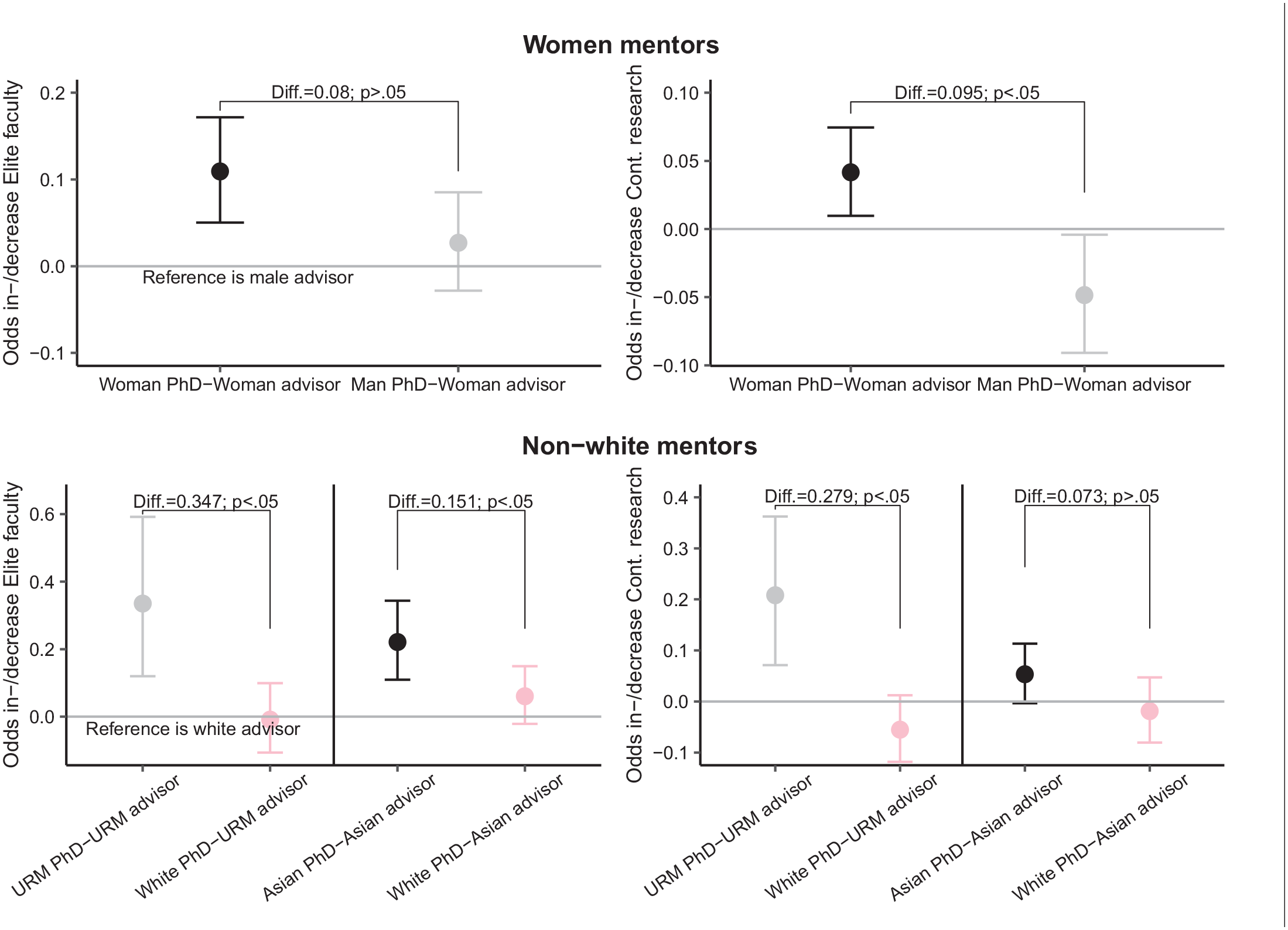
Only women and nonwhite PhD students benefit from women and nonwhite advisors.
Our findings signal nuanced differences in who benefits from same-gender and same-race advisors. For women and URMs in particular, attributional similarity with advisors seems beneficial: same-gender and same-race advisors are more beneficial for women and URM groups than most of other the mentor features, and it does more for women (for elite faculty positions) and URMs than for men and white students. This highlights the effectiveness of diversifying in terms of gender and race: women and URM students (the most severely underrepresented groups) benefit from diversifying the professoriate, while men and white students are mostly insensitive to the genders and races of their advisors. Asian scholars benefit only from Asian advisors and faculty members for elite careers. This suggests an “all-or-nothing” dynamic for Asian students, as Asian faculty compositions negatively affect the “less elite” career path, but Asian advisors and Asian faculty members in departments positively relates to higher status careers. Finally, same-attribute advisors’ being helpful for women and URMs is not because of group-specific mediation through other features (see Figure 4), nor do women or URM students with same-attribute rather than dissimilar-attribute advisors clearly benefit more from specific mentor features. 23
Conclusion
This study shows that woman and minority scholars have lower chances for research careers and professorships, net of many relevant factors. This suggests a prevailing structural inequity in academia. Most resources that enable advantageous career placement do not help underrepresented groups any more than they do majority groups, so they seem unlikely to overcome a structural deficit. Moreover, representational changes in social milieus do not appear to overcome this structural bias. Representational parity is also unlikely to solve this inequity because some groups will remain numerical minorities within American research universities for the foreseeable future. Reliance on compositional change and hiring alone will therefore, by itself, not achieve equitable career likelihoods for all groups. Some measures will likely work better than others, and only by considering such measures in tandem with others can we sufficiently improve academic career chances for underrepresented groups. What we find is that for underrepresented groups, the most beneficial and persistent factor is having a same-attribute advisor. What does that imply more broadly for professions and organizations?
What helps women and nonwhites enter influential systems seems different from what helps dominant groups gain a foothold. Because of cultural distance and lack of familiarity, underrepresented groups may reproduce their position (Willis 1977) and/or are dissuaded by myriad experiences reinforcing their sense of being an outsider. To overcome this, they may benefit from social support factors suited to their circumstance: social ties with whom they identify and familiarize. Not just achievement, status, intellectual taste, and any advisor’s attention will do. Beyond that, what is beneficial is contact with others who share cultural backgrounds and have transitioned into fields that value different forms of cultural capital. For women and minorities, these same-attribute advisors and faculty members are role models and first movers who found transition pathways to guide new recruits in those directions too. The conclusion here is not to enact same-attribute matching. Our results suggest that training, awareness, and identifying the issues and plight of underrepresented groups by white men faculty members may eventually bring their beneficial mentorship to students from underrepresented groups to the same levels as women and nonwhite advisors.
Interestingly, dominant groups (men and whites) are hardly affected by these relational conditions and are relatively unresponsive. In part this is due to their sizable proportion in relation to any minor shifts in association and representation. But it is also likely because majority students do not experience a sense of threat in broader society, and they can draw on cultural capital aligned (traditionally) with academe to find a variety of supportive mentors.
Limitations of This Study
There are at least three limitations to this study that merit acknowledgment. Predicting genders and races of scholars and advisors via their names may lead to misclassification and provides mainly a “signal” for an associated gender or race. Misclassification was relatively low in this study, and prior work showed that the method used here provides relatively accurate predictions and valid statistical conclusions (Hofstra and de Schipper 2018). Yet self-reported identities and less coarse classification of gender and race would be ideal. This work relied on traditional classifications and reports associated with names so as to identify historical inequities of race and gender, but in so doing we miss transgender and multiracial classifications as well as how identification on a continuum could apply. In addition, nonwhite names are most difficult to predict, which may introduce selection bias. In line with other works, we believe that the urgency of studying gender and race in academia outweigh misclassification problems, as there is no scalable method to collect self-reported gender and race to date (Mihaljević et al. 2019). Future research could consider the uncertainty that comes with the association between gender and race and names and how this approach excludes other important underrepresented groups.
Second, students may draw mentorship from sources other than primary advisors or departmental faculty members. The dissertation committee, for instance, likely plays a role in students’ success. Unfortunately, the information we could reliably derive from ProQuest’s metadata does not include the dissertation committee for a sizable period of time and reasonable sample of universities. If attributional similarity helps women and URM students, same-gender and same-race mentors beyond primary advisors may help these students as well. However, committee members are often drawn from the same department. This likely renders our departmental covariate a conservative estimate of attributional similarity because we pool effects of mentors and nonmentors.
Finally, the benefits of same-race and same-gender advisors for underrepresented groups may be due to various factors we do not measure directly. Through further study, we may be able to understand in more detail why those relations work for underrepresented students and how we might be able to train extant faculty members, independent of gender or race, to reinforce such relations. Our analyses rule out explanations of advisor resources (reputation, prestige, experience) or intellectual fit arguments. This leaves us with likely explanations such as personal identification and support specific to being an underrepresented person in academe rather than to general academic or intellectual experiences of being a scholar. Future work could establish more fine-grained measures for social interaction (e.g., separating role modeling from social support); or future work could consider in more detail how advisor gender and race coincide with departmental representation. Which departments decrease the benefit of same-gender and same-race mentors, diverse or homogeneous ones? However, for such approaches the depth vis-à-vis the number of observations is an obvious trade-off. Our study contributed a near census of PhD recipients and sacrificed depth for breadth in doing so.
Implications and Future Work
Ideally, rewards in academia are based on scholars’ academic achievements rather than ascribed properties (Merton [1942] 1973). Contrasting this ideal, we find a persistent stratified system of academic reproduction that aligns with previous work (Atir and Ferguson 2018; David 2015; Finkelstein et al. 2016; King et al. 2017; Long 1990; Long and Fox 1995; Moss-Racusin et al. 2012; Rivera 2017). We provided empirical insights into relations that might offset gender and racial inequality in academic careers. Some questions remain, and at least two of these merit attention.
First, how do departmental and disciplinary norms and cultures correspond with different rates of reproduction? Here, we used fixed effects for disciplines so as to find generalizable estimates of same-gender and same-race mentoring on scientific careers, but a deeper focus on disciplines may yield many insights. In cases in which disciplines produce more scholars, do they place their students within or outside the original discipline? Do these patterns lead to the growth, decline, or colonization of certain disciplines by others? Another question pertains to department prestige: how do our results vary by graduate program? In some departments, same-attribute mentoring may be more helpful than in others, similar to variation in departments that affect students’ productivity (Way et al. 2019). In this study we partly account for this variation by fixing university (under the assumption that university and departmental prestige correlate). Yet future work can help explicitly illuminate differences in same-attribute mentoring by departmental prestige.
Second, do mentors reproduce themselves through their progeny? Mentoring is argued to be a crucial step in placing ideas and practices in institutions (Bryant 2005; Collins 1998; Levine 1995). With the data at hand we could further test the extent to which scholars in different disciplines, of certain genders and races, and in certain kinds of mentor relationships, pass on their knowledge and ideas. For instance, it might be that same-race and same-gender dyads are efficient vehicles for passing on career-acquired knowledge. Ways to pursue these avenues of research could include directly comparing the topics and language of dissertation abstracts or comparing scholars’ bibliographies with those of their advisors. Toward this end, future scholars could further integrate and cross-disambiguate several distinct academic corpora (e.g., WoS, Google Scholar, Microsoft Academic Graph) into one that reflects the science universe across many disciplines.
Supplemental Material
sj-docx-1-srd-10.1177_23780231221085118 – Supplemental material for Diversifying the Professoriate
Supplemental material, sj-docx-1-srd-10.1177_23780231221085118 for Diversifying the Professoriate by Bas Hofstra, Daniel A. McFarland, Sanne Smith and David Jurgens in Socius
Footnotes
Appendix A
Correlation Matrix of the Independent Variables.

| (1) | (2) | (3) | (4) | (5) | (6) | (7) | (8) | |
|---|---|---|---|---|---|---|---|---|
| Attributional similarity | ||||||||
| (1) Same-gender advisor | ||||||||
| (2) Same-race advisor | .271 | |||||||
| (3) Percentage same-gender faculty department | .597 | .192 | ||||||
| (4) Percentage same-race faculty department | .161 | .676 | .229 | |||||
| Advisor resources | ||||||||
| (5) Graduation order | .175 | .191 | .144 | .107 | ||||
| (6) log(advisor popularity) | .260 | .296 | .195 | .181 | .614 | |||
| (7) log(advisor cites + 1) | .158 | .136 | .126 | .055 | .268 | .230 | ||
| Intellectual similarity | ||||||||
| (8) Intellectual similarity to advisor | .145 | .098 | .113 | .024 | .101 | .142 | .617 | |
| (9) Intellectual similarity to department | −.016 | −.023 | −.051 | −.066 | −.041 | −.023 | −.040 | .017 |
Note: All correlations depicted in this matrix are statistically significant at p < .001.
Appendix B
Appendix C
Appendix D
Acknowledgements
We thank Peter McMahan, Sebastian Munoz-Najar Galvez, Lanu Kim, Daniel Scott Smith, Vamshi Krishna, Mathijs de Vaan, and Niek C. de Schipper for helpful advice on earlier drafts of this article. We acknowledge Stanford University and the Stanford Research Computing Center for providing computational resources and support that contributed to these research results. Earlier versions of this study benefited from discussions at the 2018 INAS Conference at Stanford University, the 2018 SUNBELT, the School of Education at Stanford University, the departments of sociology at the University of Amsterdam, University of Groningen, Utrecht University, Radboud University, University of Copenhagen, and the University of California, Berkeley Haas School of Business.
Funding
The author(s) disclosed receipt of the following financial support for the research, authorship, and/or publication of this article: This research was supported by two National Science Foundation grants (#1633036 and #1827477) and by a grant from the Dutch Organization for Scientific Research (#019.181SG.005).

Supplemental Material
Supplemental material for this article is available online.
Notes
Author Biographies
References
Supplementary Material
Please find the following supplemental material available below.
For Open Access articles published under a Creative Commons License, all supplemental material carries the same license as the article it is associated with.
For non-Open Access articles published, all supplemental material carries a non-exclusive license, and permission requests for re-use of supplemental material or any part of supplemental material shall be sent directly to the copyright owner as specified in the copyright notice associated with the article.
