




Abstract
Recent research shows important racial/ethnic differences in how individuals spend time in housework. Yet our understanding of how the racial/ethnic makeup of couples shapes gender equality in the division of housework remains limited. The authors use couple-level data from the 2017–2019 waves of the Panel Study of Income Dynamics to visually illustrate how each partner’s race/ethnicity and their combination are associated with the gender division of housework among Black, Hispanic, and white individuals. The results show significant heterogeneity in the share of housework and total housework hours among racial/ethnic groups, underscoring the need for a couple-level understanding of how the racial/ethnic makeup of couples may shape the gender division of housework.
In the United States, one in six marriages formed in 2015 involved partners of different races or ethnicities, which represents a sixfold increase since the U.S. Supreme Court’s Loving v. Virginia ruling (Livingston and Brown 2017). Yet to date, our understanding of how the racial/ethnic makeup of couples shapes gender equality in the division of housework remains limited. Research shows that Hispanic women spend more time on housework than their Black and white counterparts, and these differences are exacerbated in same-race/ethnicity partnerships, while men’s housework hours vary little by race/ethnicity (Bolzendahl and Gubernskaya 2016; Sayer and Fine 2011). Because these findings are based on individual-level data and not couple-level data, we cannot draw clear conclusions about how equal these partnerships are in their relative contributions to couples’ total housework hours (see Ross 1987 for an exception on the basis of a 1978 U.S. sample). The goal of this data visualization is to use couple-level data to illustrate how the gender division of housework varies depending on the racial/ethnic makeup of contemporary couples among U.S. Black, Hispanic, and white individuals.
Figure 1 presents a heatmap of the gender division of housework by each partner’s race/ethnicity among different-sex couples, ages 18 to 64, in the 2017 and 2019 waves of the Panel Study of Income Dynamics (https://psidonline.isr.umich.edu) 2017–2019 (n = 7,281 couple-waves) (Jann 2019). Each square in Figure 1 is cross-classified into a grid by his race/ethnicity (horizontal axis) and her race/ethnicity (vertical axis), each square is colored from blue (lower share, more gender equal) to red (higher share, less gender equal), and the size of each square is proportional to the total weekly hours of housework done by both partners. Further information about the sample composition and how the figure was constructed is provided in the supplementary materials.
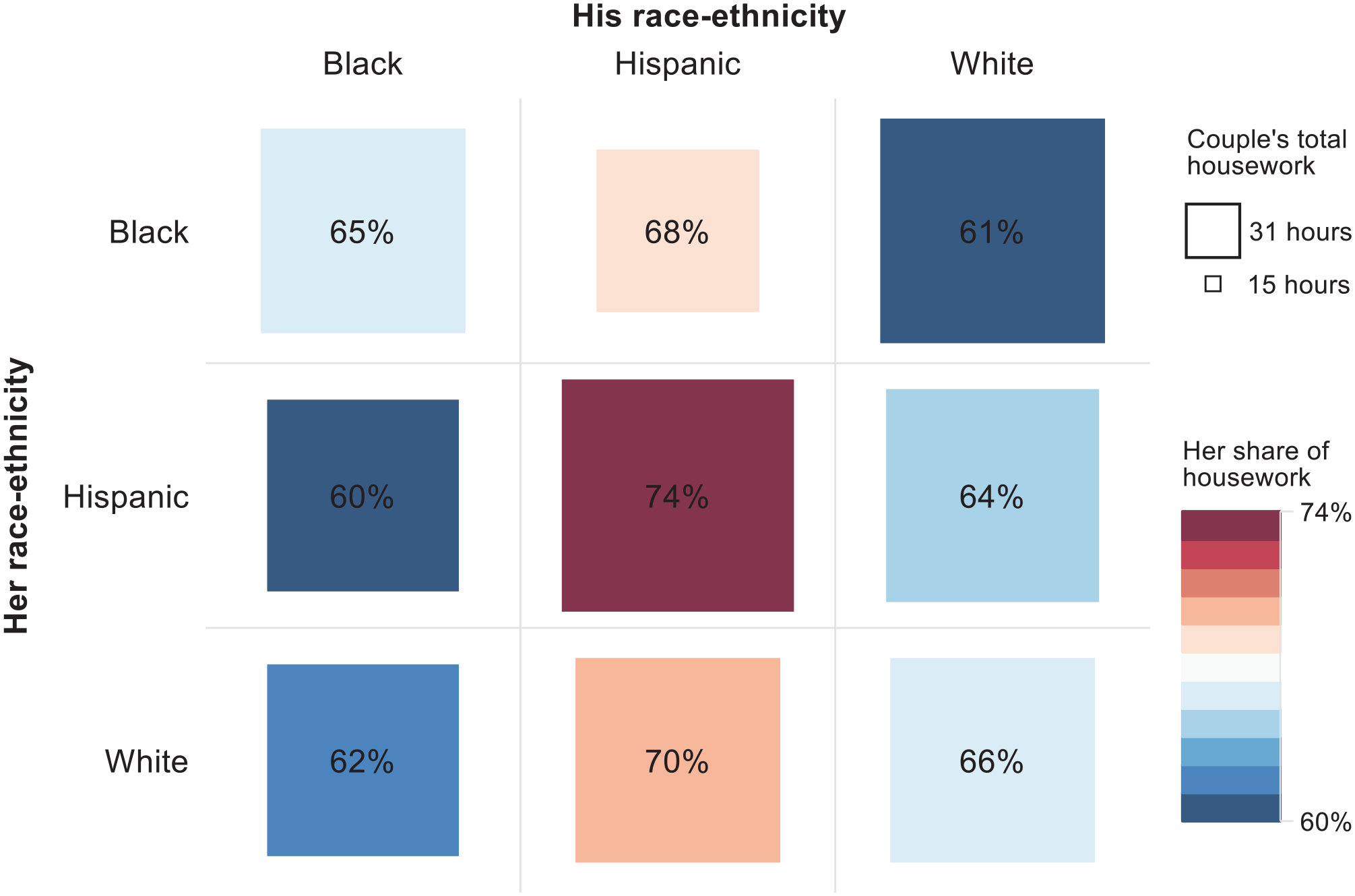
The gender division of housework by each partner’s race/ethnicity (n = 7,281).
Several aspects of Figure 1 are noteworthy. First, Figure 1 shows that both the relative and total contributions to housework vary considerably depending on the racial/ethnic makeup of couples. Women’s share of housework varies from 60 percent in Hispanic-woman/Black-man couples to 74 percent in Hispanic couples. Black-woman/Hispanic-man couples do the least total hours of housework (15 hours per week), while Hispanic couples do the most (31 hours per week). Second, in line with previous findings, racially homogamous couples display a more unequal division of housework (see diagonal). Yet one noteworthy exception is that being partnered to a Hispanic man is associated with doing a larger share of housework for all women regardless of their race/ethnicity (ranging from 68 percent to 74 percent). Conversely, being partnered to a Black man is associated with doing a smaller share of housework for both white (62 percent) and Hispanic women (60 percent). The most gender-equal partnership for Black women is to be partnered to a white man (61 percent).
The heatmap approach to visualizing the gender division of housework with squares of varying color and size provides several advantages. First, we easily identify how patterns vary both by race/ethnicity and racial homogamy, by comparing squares on the diagonal (racially homogamous couples) to those off the diagonal (interracial couples). Second, we simultaneously visualize two important dimensions of the gender division of housework: the relative division of housework (illustrated by the square’s color) and the total amount of housework (illustrated by the square’s size). Third, we summarize the equivalent of 27 data points (3 × 3 for the share, 3 × 3 for the total) in one reasonably sized figure.
These descriptive findings suggest the importance of the racial/ethnic makeup of couples in shaping gender equality within households. Further work should disentangle how compositional differences in working status, children, age, and partnership status contribute to these descriptive differences and how these findings vary across other forms of unpaid labor, such as adult care and childcare.
Supplemental Material
sj-docx-1-srd-10.1177_23780231221084765 – Supplemental material for Visualizing Racial-Ethnic Differences in the Division of Housework among Different-Sex Couples in the United States
Supplemental material, sj-docx-1-srd-10.1177_23780231221084765 for Visualizing Racial-Ethnic Differences in the Division of Housework among Different-Sex Couples in the United States by Léa Pessin and Elena Maria Pojman in Socius
Footnotes
Funding
The author(s) disclosed receipt of the following financial support for the research, authorship, and/or publication of this article: Dr. Pessin acknowledges assistance provided by the Population Research Institute at Penn State University, which is supported by an infrastructure grant by the Eunice Kennedy Shriver National Institute of Child Health and Human Development (P2CHD041025).

Supplemental Material
Supplemental material for this article is available online.
Author Biographies
References
Supplementary Material
Please find the following supplemental material available below.
For Open Access articles published under a Creative Commons License, all supplemental material carries the same license as the article it is associated with.
For non-Open Access articles published, all supplemental material carries a non-exclusive license, and permission requests for re-use of supplemental material or any part of supplemental material shall be sent directly to the copyright owner as specified in the copyright notice associated with the article.
