




Abstract
Stress researchers have emphasized the relationship between social stress and mental health. However, research investigating police brutality as a stressor is scarce. The authors conceptualize police brutality as a stressor, examining racial variation in its effects on mental health. Data came from the Survey of the Health of Urban Residents in the United States (n = 4,389). Negative encounters with the police were found to be associated with depressed mood and anxiety. The relationship between encounters with the police and depressed mood was stronger among Black respondents and Latinxs compared with Whites. Regardless of personal encounters with the police, the anticipatory stress of police brutality—concern that one might become a victim of police brutality—was associated with depression and anxiety. These findings highlight police brutality as an anticipatory stressor and have implications for whiteness as a resource that protects from the stress of negative police encounters.
Over the past several years, there has been increased attention to the impact of negative police encounters on the mental health of communities that are disproportionately policed. These encounters have generally been referred to as police brutality: police action that dehumanizes, with or without conscious intent (Alang et al. 2017; Bandes 1999). Police brutality encompasses physical, sexual, and psychological violence; verbal abuse; and intimidation (Bandes 1999). Police brutality is one of the most enduring forms of structural racism, rooted in the work of organized slave patrols that sought to keep enslaved Africans from fleeing (Alang 2018; Boyd 2018; Cooper 2015). Just like racism, police brutality can be conceptualized as a stressor. Stressors are situations, factors, or conditions that produce stress by impeding an individual’s ability to maintain normal functioning (Aneshensel 2015). We conceptualize police brutality as stressor under the stress process paradigm. The stress process is a prominent sociological framework for understanding variability in risks for negative mental health outcomes. A central premise of the stress process is that differential exposure to stressors is associated with variation in mental health outcomes (Pearlin 1989; Pearlin et al. 1981; Turner and Lloyd 1999). If negative encounters with the police are stressors, then persons with exposure to these encounters will also have worse mental health outcomes than those without negative encounters with the police.
Consistent with the stress process framework, research suggests that greater exposure to negative police actions is associated with a higher prevalence of delusional mood, paranoia, hallucinations, psychological distress, depression, anxiety, and suicidal ideation (Bor et al. 2018; DeVylder, Cogburn et al., 2017; DeVylder, Frey et al., 2017; Geller et al. 2014; McLeod et al. 2020). Geller et al. (2014) were among the first to examine the relationship between police encounters and anxiety. Using a New York City–based sample of young men between the ages of 18 and 26 years, they found that those with more frequent police encounters, especially encounters considered intrusive, were more likely to report symptoms of anxiety than those with fewer encounters. Risks for encounters with the police are higher for persons with prior criminal involvement (Bowleg et al. 2020; Geller et al. 2014), men (Miller et al. 2017), and young adults (Bui, Coates, and Matthay 2018; Miller et al. 2017). Regardless of personal encounters with the police, simply living in a neighborhood where pedestrians are frequently being frisked increases one’s odds of psychological distress (Sewell, Jefferson, and Lee 2016). Although this body of research generally highlights differences in exposure to police encounters and in mental health outcomes that stem from varied exposure to police encounters, less is known about how variation in mental health outcomes might depend on how people characterize or evaluate their own encounters with the police.
Stress researchers have argued that to fully understand the differential impact of stressors on mental health, attention must also be given to the evaluation or appraisal of the stressor (Louie and Wheaton 2019; McLeod 2012; Thoits 2006). In the case of police encounters, how individuals evaluate their own experiences with the police might matter for mental health beyond solely their exposure to police brutality. For example, Geller et al. (2014) found that when younger men perceived police actions to be fair, ethical, and respectful, they experienced less anxiety. We build on this work, using a larger national sample, to examine how personal evaluations of police actions might be associated with depression and anxiety, and how these associations might vary across racialized groups.
Exposure to stress is rooted in social status and circumstances (Turner, Wheaton, and Lloyd 1995). People with the most marginalized statuses are disproportionately exposed to stressors, and stressors that are strongly associated to less privileged statuses are more likely to endure over the life course (Pearlin, Aneshensel, and LeBlanc 1997; Pearlin et al. 2005). Exposure to stressors such as everyday experiences of racism, poverty, a history of incarceration, and involvement with the criminal justice system even prior to police stops are associated with a range of mental health outcomes (Bowleg et al. 2020; Fedina et al. 2018; Kwate and Goodman 2015; Williams et al. 1997). Racism disproportionately exposes people who are Black and other people of color to police brutality (Alang 2018; Boyd 2018). For example, they are more likely than Whites to be stopped; arrested; injured; psychologically, sexually, and emotionally assaulted; and killed by the police (Barber et al. 2016; Bui et al. 2018; Fedina et al. 2018; Feldman et al. 2016; Miller et al. 2017; Nix et al. 2017; Ross 2015). Therefore, as a stressor, police brutality does not affect every racial group equally. We expect, therefore, that people who are Black and other people of color are more likely than people who are White to anticipate negative police encounters.
We argue that police brutality is an anticipatory stressor. Anticipatory stressors are significant concerns about future harmful experiences, conditions, or events that may or may not ever occur (Pearlin and Bierman 2013). These kinds of stressors create vigilance: behaviors that indicate attempts to avoid or navigate predicted stress and are associated with chronic health conditions among Black adults (Lee and Hicken 2016). Goal-striving stress—an anticipatory stressor grounded in the probability of failed aspirations—is associated with high blood pressure among Black but not among White people (DeAngelis 2020). Grace (2020) examined the association between three kinds of anticipatory stressors—economic insecurity, exposure to traumatic events, and experiences of discrimination—and depressive symptoms among college seniors. The anticipation of traumatic events such as the potential death of a family member, being the victim of sexual assault, and being the victim of a violent crime was associated with depressive symptoms, and these associations varied by race (Grace 2020).
Similarly, the anticipation of police brutality might be associated with poor mental health. We already know that exposure to police brutality affects mental health. We also know that when unarmed Black Americans are killed by the police, the number of mental health days and prevalence of psychological distress increase significantly among Black people but not among Whites (Bor et al. 2018). Taken together, the effects of exposure to and anticipation of police brutality on mental health might vary across racial groups. We explore these relationships here.
Our first objective is to determine whether individual exposure to and evaluations of encounters with the police are associated with depression and anxiety. If negative encounters with the police are stressors following the stress process framework, then evaluations of personal encounters with the police should be given analytical significance when assessing the impact of negative police encounters on mental health. The second objective is to explore the associations between the anticipation of police brutality and depression and anxiety. Regardless of personal experiences of police brutality, the stressful anticipation that one might be a victim of police brutality also matters for mental health. We hypothesize that evaluations of encounters with the police and the anticipatory stress of police brutality both matter for mental health beyond personal exposure to police brutality. Finally, we examine whether the relationship between evaluations of personal encounters with the police and mental health outcomes vary by race and whether the relationship between the anticipation of police brutality and mental health outcomes vary by race.
Methods
Data
Data were obtained from the Survey of the Health of Urban Residents (SHUR) (n = 4,389). SHUR was administered online by Qualtrics to a nonprobability quota sample obtained through leveraging databases of individuals who have opted into participating in surveys. Qualtrics panels are frequently used in social science and epidemiological research (Beymer, Holloway, and Grov 2018; DeVylder, Frey et al. 2017; Grace 2020). The SHUR consists of adults ages 18 and older living in urban areas across the contiguous United States. Black/African American and Latinx populations were oversampled, as well as persons whose usual source of care was not a doctor’s office (Alang et al. forthcoming). Qualtrics implemented demographic screening questions and recruitment quotas to ensure that specific demographic characteristics were met.
Measures
Two main outcome variables are depressed mood and generalized anxiety, measured using the two-item Patient Health Questionnaire (PHQ-2) and the two-item Generalized Anxiety Disorder (GAD-2) instrument, respectively. The PHQ-2 and GAD-2 are both initial screening instruments used to assess depression and anxiety in primary care settings. The PHQ-2 asks respondents how often in the past two weeks they have been bothered by (1) little interest or pleasure in doing things and (2) feeling down, depressed, or hopeless. The GAD-2 asks respondents how often they have been bothered by (1) feeling nervous, anxious, or on edge and (2) not being able to stop or control worrying over the past two weeks. Responses for both the PHQ-2 and the GAD-2 include not at all (0), several days (1), more than half the time (2), and nearly every day (3). Scores for each measure range from 0 to 6. Scoring 3 or more on the PHQ-2 indicates likely major depressive disorder or depressed mood with sensitivity of 82.9 percent and specificity of 90.0 percent (Kroenke, Spitzer, and Williams 2003). Similarly, a cutoff score of 3 on the GAD-2 indicates likely generalized anxiety disorder at 86 percent sensitivity and 83 percent specificity (Kroenke et al. 2007). In our analyses, we use a binary measure for depressed mood: 0 if total score on the PHQ-2 is less than 3 (no depression) and 1 if equal to or greater than 3 (likely depressed mood). Generalized anxiety is also measured as 0 (no anxiety) or 1 (likely generalized anxiety).
The primary independent variables are negative encounters with the police and stressful anticipation of police brutality. Respondents were asked if they have ever had any personal negative encounters with the police. Negative encounters included police cursing at the respondent; hitting, kicking, or shoving the respondent; using an electroshock weapon such as a stun gun; or pointing a gun at them. Respondents who reported at least one negative encounter with the police were asked, “Thinking of your most recent experience(s) with the police, would you say the action of the officer was necessary?” The variable negative experiences with the police was then created with three mutually exclusive categories: no negative encounter, necessary negative encounter, and unnecessary negative encounter. We relied on self-reports of whether encounters were (un)necessary to highlight the importance of individuals’ own evaluations of their experiences with the police, an approach consistent with others that investigate the impact of police actions on health (Cooper et al. 2004; English et al. 2017), and with the subjective nature of stressors (Wheaton 1994). Stressful anticipation of police brutality was measured by the frequency of respondents’ worries about police brutality. Respondents were specifically asked how often they worry that they would be a victim of police maltreatment or brutality. Response categories were “never,” “sometimes,” and “always.”
We used self-reported race and ethnicity (Hispanic/Latinx or not) to create a combined race/ethnicity variable with ethnicity assigned first. Categories include non-Hispanic White, non-Hispanic Black/African American, Hispanic/Latinx, Native American, Asian, and other/multiple race. We included control variables in the data that are known to be associated with depression, anxiety, and police brutality. These covariates include age (18–24, 25–34, 35–44, 45–54, 55–64, and 65 years and older) (Bui et al. 2018; Miller et al. 2017) gender (male, female, and gender fluid) (Kahn et al. 2016; Mallory, Hasenbush, and Sears 2015; Nix et al. 2017), level of education (no high school; high school or GED; some college, associate degree, or vocational school; and bachelor’s degree or higher) (Bor et al. 2018; Bowleg et al. 2020; Fedina et al. 2018), work status (not in the labor force, unemployed or looking for work, employed part-time, and employed full-time) (Alang, McAlpine, and Hardeman 2020; Bowleg et al. 2020), as well as activity limitations (yes or no) and self-rated general health (excellent, very good, or good vs. fair or poor), both indicators of health status that are associated with exposure to police brutality and with mental health (Alang et al. forthcoming; McCauley 2017; Turner, Lloyd, and Taylor 2016).
Analyses
We performed a series of logistic models in which depressed mood and generalized anxiety were regressed on personal encounters with the police, controlling for sociodemographic characteristics and health status indicators. We also regressed our outcome variables on the frequency of worrying about police brutality: anticipation of police brutality, controlling for all covariates. We included interactions between police encounters and race/ethnicity and between anticipation of police brutality and race/ethnicity to assess whether race/ethnicity moderated the relationships between police encounters, anticipation of police brutality, and depression and anxiety. We computed predicted probabilities of depressed mood and generalized anxiety to further interpret associations with significant interactions effects.
Results
Characteristics of the sample are presented in Table 1. As shown, more than half of the respondents reported personally having negative encounters with the police, and 1 in 4 felt that negative police actions toward them were unnecessary. Although 10 percent of the sample always worried that they would become victims of police brutality, 6 in 10 never had such worries. Non-Hispanic Whites made up 63.6 percent of the sample, non-Hispanic Black respondents were 14.2 percent, Hispanic/Latinxs made up 11.6 percent, and American Indians and Alaskan Natives were 1.4 percent. Almost 4 percent were Asians, and 5.3 percent reported more than one racial category or another race not listed in the survey. One third of the respondents met the cutoff for depressed mood, and one third also met the cutoff for generalized anxiety. The sample was disproportionately female, and more than half had attended some college or obtained college degrees. About one third of the respondents were not in the labor force, but the majority worked for pay either full-time or part-time. Most of the respondents reported good, very good, or excellent general health, and 4 in 10 were somewhat limited in the kinds of activities they performed because of mental, physical, or emotional problems.
Descriptive Statistics by Exposure to Police Brutality.

Table 2 shows bivariate (unadjusted) associations between encounters with the police and the mental health outcomes of interest and between anticipation of police brutality and odds of depression and anxiety. Compared with persons with no negative encounters with the police, those who reported negative but necessary encounters with the police had significantly greater odds of meeting criteria for depressed mood (odds ratio [OR] = 1.68, 95% confidence interval [CI] = 1.45–1.96), and odds of depressed mood were highest among those who reported police encounters that were negative and unnecessary (OR = 2.21, 95% CI = 1.89–2.59). Similarly, unadjusted odds of depressed mood were higher among those who sometimes worry about police brutality (OR = 1.64, 95% CI = 1.42–1.89) compared with their counterparts who never worry about police brutality and highest among respondents who always worry about police brutality (OR = 2.36, 95% CI = 1.97–2.81). We also examined bivariate relationships between police brutality and generalized anxiety. As shown, negative encounters with police, whether perceived as necessary (OR = 1.74, 95% CI = 1.50–2.03) or unnecessary (OR = 2.12, 95% CI = 1.81–2.48), were associated with greater odds of depressed mood. We observed the same patterns with anticipation of police brutality. Unadjusted odds of generalized anxiety were higher among those who sometimes worry about police brutality (OR = 1.66, 95% CI = 1.42–1.90) compared with their counterparts who never worry about police brutality and highest for those who always worried about police brutality (OR = 2.54, 95% CI = 2.12–3.02).
Bivariate Odds of Depressed Mood and Generalized Anxiety by Experiences of Police Brutality.

Note: OR = odds ratio.
p ≤ .01. ***p ≤ .001.
Table 3 shows the adjusted relationships between police encounters and odds of depressed mood. In model 1, we explored the relationship between individual exposure to police brutality and depressed mood, controlling for sociodemographic and health characteristics of respondents. Respondents who had negative personal experiences with the police had greater odds of depressed mood compared with those who reported no negative encounters. Specifically, compared with persons without negative encounters, those who had experienced police brutality even though they evaluated these actions as necessary had 37 percent greater odds of depressed mood (OR = 1.37, 95% CI = 1.15–1.62). The odds among those who evaluated police actions as unnecessary were 73 percent greater than those with no exposure to police brutality (OR = 1.73, 95% CI = 1.45–2.07). Race and ethnicity and education were not associated with depressed mood. However, compared with persons between the ages of 18 and 24, those 35 and older had lower odds of depressed mood. Gender-fluid individuals were more likely to have a depressed mood compared with men, and odds of depressed mood were higher among unemployed persons compared with persons not in the work force.
Adjusted Odds of Depressed Mood by Experiences of Police Brutality, Controlling for Covariates.

Note: OR = odds ratio.
p ≤ .05. **p ≤ .01. ***p ≤ .001.
In model 2, we removed individual encounters with the police and added anticipation of police brutality. Compared with respondents who never worried about police brutality, odds of depressed mood were higher among those who sometimes worried about police brutality (OR = 1.32, 95% CI = 1.11–1.56) and highest among those who always worried that they or someone close to them would be a victim of police brutality (OR = 2.13, 95% CI = 1.68–2.70). The relationships between the covariates and depressed mood in model 2 were like those in model 1, except for education. In model 2, having some college education or higher was associated with lower odds of depressed mood. In model 3, we included both individual encounters with the police and anticipation of police brutality. Both variables were significantly associated with depressed mood, but the effects were slightly less than when the variables were included independently. Odds of depressed mood were greater among women and gender-fluid persons compared men. As in model 1, education was not associated with depressed mood.
In Table 4, we show associations between police brutality and generalized anxiety. Model 1 indicates that having a negative but perceived necessary encounter with the police was associated with higher odds of anxiety (OR = 1.43, 95% CI = 1.20–1.70), and these odds were even greater if the encounter was perceived to be unnecessary (OR = 1.72, 95% CI = 1.44–2.04). Asians had slightly lower odds of anxiety compared with Whites. Persons 35 and older had greater odds of anxiety compared with those ages 18 to 24. Being unemployed, having an activity limitation, and having poor overall health were all associated with greater odds of anxiety. As shown in model 2, the anticipation of police brutality was associated with greater odds of anxiety. Compared with respondents who were never concerned about police brutality, respondents who sometimes worried that they would be victims of police brutality had 40 percent greater odds of generalized anxiety (OR = 1.40, 95% CI = 1.18–1.66). Those who always worried about police brutality had more than two times greater odds of anxiety compared with those who never worried about police brutality (OR = 2.38, 95% CI = 1.87–3.01). Other than race, whereby Black and Latinx respondents, in addition to Asians, had lower odds of anxiety compared with White respondents, the associations of other covariates with odds of generalized anxiety were similar in model 2 as in model 1. In model 3, both individual encounters with the police and stressful anticipation of police brutality were significantly associated with greater odds of anxiety. The relationships between other covariates and anxiety in model 3 were similar as in model 2 except for race, for which persons who belong to the multiple/other racial category had lower odds of anxiety compared with Whites.
Adjusted Odds of Generalized Anxiety by Experiences of Police Brutality, Controlling for Covariates.

Note: OR = odds ratio.
p ≤ 0.05. **p ≤ 0.01. ***p ≤ 0.001.
Interaction effects from a fully adjusted model that includes an interaction between race/ethnicity and personal encounters with the police are shown in Table 5. The only significant interaction categories were Black and perceived necessary negative police encounter (OR = 1.89, 95% CI = 1.12–3.19), Latinx and perceived necessary police encounter (OR = 2.63, 95% CI = 1.53–4.52), and Latinx and perceived unnecessary encounter (OR = 1.72, 95% CI = 1.01–2.97).
Adjusted Odds of Depressed Mood in Model with Police Encounter and Race Interactions.

Note: OR = odds ratio.
p ≤ .01. ***p ≤ .001.
To ease interpretation, we plotted predicted probabilities of depressed mood from the model that included significant interactions. As shown in Figure 1, it is possible that having an encounter that is perceived as necessary (compared with having no negative encounter) increases the probability of depressed mood for Latinx and Black respondents relative to White respondents. And having an encounter that is perceived as not necessary (compared with having no encounter) might significantly increase the probability of depressed mood among Latinxs relative to Whites. Among those with no negative encounters with the police, odds of depressed mood were higher among White than among Black and Latinx respondents. Interactions between personal encounters with the police and race/ethnicity for predicting generalized anxiety were not significant. Similarly, interactions between stressful anticipation of police brutality and race for predicting both depressed mood and generalized anxiety were not significant.
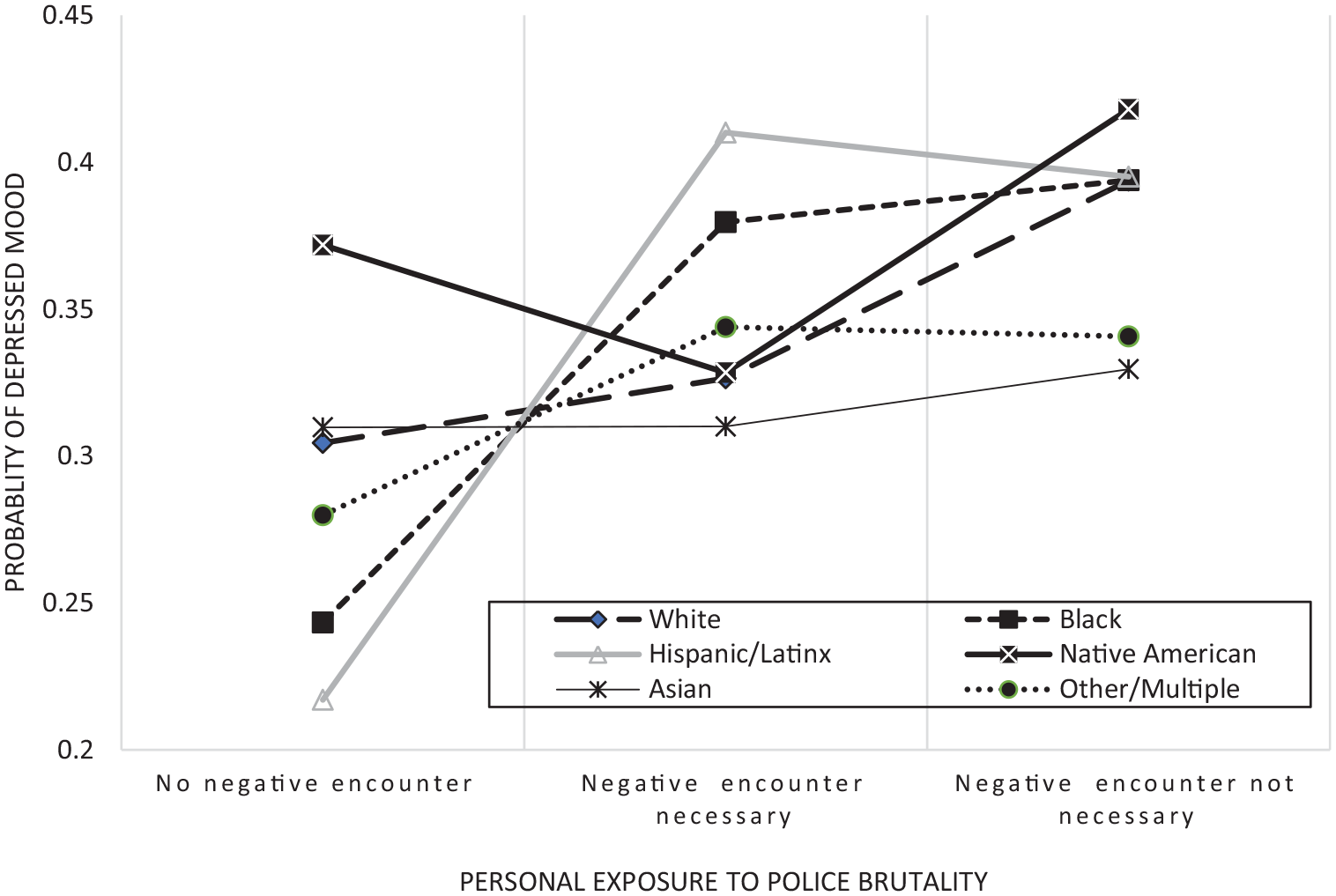
Predicted probabilities of depressed mood by race/ethnicity and police encounters.
Discussion
Negative encounters with the police are stressors that are associated with poor mental health outcomes. One mechanism that connects these encounters with mental health is trauma. The trauma from experiencing police brutality, like any other form of violence, can directly cause distressing and upsetting emotions, including sadness, anxiety, fear, anger, hypervigilance, and feelings of worthlessness, or hopelessness. People who experience violence and trauma can also feel disconnected to others and might not want to participate in activities they previously enjoyed (Briere and Hedges 2010; May and Wisco 2016). Police brutality might be particularly harmful for mental health because it is state sanctioned, police officers are ubiquitous, there is usually little or no accountability for harm caused by the police, and victims have little or no chances of obtaining justice (DeVylder, Fedina, and Link 2020).
Negative police encounters can also be associated with depression and anxiety indirectly because they worsen other social circumstances, including material conditions, which then increase risks for poor mental health. For example, negative experiences with the police might cause impairment of day-to-day functioning in social roles including employment and productivity. These encounters might also lead to loss of financial resources in legal battles or medical bills, all of which matter for mental health. Therefore, police brutality exacerbates the stressful conditions of everyday life among populations that are already disproportionately exposed to negative encounters with the police.
Regardless of whether people perceive police actions to be necessary, it matters for mental health. In some of the most publicized cases of police brutality, there has been public debate about whether the actions of the police were necessary. For example, it was questionable whether Officer Darren Wilson needed to fire his weapon 12 times at Michael Brown, shooting him a total of 6 times, or that Wilson believed that Brown looked like a demon and was going to kill him (Calamur 2014). To some police officers, courts, and members of the public, police violence is justified when the lives of others, including officers, are at risk (Harmon 2008; Holmes, Painter, and Smith 2019). We do not debate the necessity of police actions in this article, although we believe that police actions that dehumanize others constitute brutality. Instead, we highlight the findings from our analysis that harmful police actions are associated with poor mental health even if victims themselves think of these actions as justified. And when perceived as unnecessary, the impact of police action on mental health is magnified.
Our hypothesis that the anticipation of police brutality matters for mental health beyond personal exposure to police brutality was supported. Those who were often stressed about the possibility that they could become victims of police brutality had greater odds of depressed mood and generalized anxiety compared with persons who never worried about police brutality. This finding is consistent with those from a study among Black pregnant women in Atlanta (Jackson, James, and Owens, 2017). The authors found that the anticipation of negative encounters between youth and police increased the odds of antenatal depression and that this effect was exacerbated among women who already had young children at home. Similarly, avoiding the police because of forecasted negative encounters was associated with depressive symptoms among Black men in Washington, D.C. (Bowleg et al. 2020). The anticipation of experiencing a stressor results from both group and individual circumstances, social conditions, statuses, and identities that increase the likelihood of stress exposure (DeAngelis 2020; Grace 2020; Pearlin and Bierman 2013). Living in a context in which exposure to police brutality is likely or anticipated matters for individual well-being even if individuals themselves are not personally exposed. For example, multilevel analyses suggest that living in a neighborhood where police frequently use force and where police stops are more likely to result in frisking is associated with poor psychological and physical health, regardless of firsthand personal experiences of aggressive policing (Sewell and Jefferson 2016; Sewell et al. forthcoming)
The evaluation and appraisal of stressors is shaped by access to and availability of coping resources and responses (Jones, Cross, and DeFour 2007; Folkman 2013; Thoits 2013). Consequently, persons who frequently worry about police brutality are likely to believe that there is something about their circumstances that puts them at greater risk for experiencing police brutality and that makes it harder for them to cope with such experiences. For instance, one might worry that in addition to potential loss of life that might result from police brutality, the likelihood of nonindictment of the perpetrator may lead to feelings of denied justice, causing further psychological harm and ultimately increasing the stress associated with anticipating negative encounters with the police. We know that adverse physiological and emotional responses are associated with the anticipation of stressors such as discrimination (Sawyer et al. 2012). These responses are likely to be associated with the anticipation of police brutality and consequently with poor mental health, as shown by our analyses.
Racism is a stressor that affects mental health (Clark et al. 1999). Racism is also associated with police brutality (Alang 2018; Boyd 2018; Chaney and Robertson 2013). We found in this research that among those with negative experiences with the police, Black people and Latinxs had greater odds of depressed mood than Whites. This is similar to findings from a panel study showing that exposure to stressors explains more variance in depression symptomatology among Black than among White populations (George and Lynch 2003). Therefore, our finding may reflect disproportionate exposure to police brutality (an indicator of racism) among Black and Latinx respondents relative to Whites. It might also reflect racial differences in the meanings that people give to their experiences with the police. When stressors are attributed to or are grounded in racism, their effects on mental health of populations that experience racism are amplified (Brown 2008). Elevated odds of depressed mood among Black and Latinx respondents compared with White peers who experience police brutality may indicate combined effects of racism and police brutality. However, the reasons we see racial differences in the effects of police encounters on depression but not anxiety are unclear and require further investigation.
Our findings should be considered along with several limitations. First, the nonprobabilistic sampling design of the survey might cause our estimates to be sensitive to systematic errors, as survey respondents might differ from nonrespondents in ways that matter for the generalizability of our findings. The SHUR used quota sampling to match the urban population of the United States by age, race, and ethnicity (Alang et al. forthcoming). This is presumed to reduce some selection biases in a nonprobability sample (Baker et al. 2013). In addition, the current study does not seek to approximate point estimates that are generalizable to urban populations. Instead, we examine relationships between variables. Our findings in this light are noteworthy. Patterns of relationships are likely to be similar in probability and nonprobability samples if the composition of the nonprobability sample matches the composition of the population (Ansolabehere and Schaffner 2014; Blair and Zinkhan 2006; Pasek 2016).
A second limitation is lack of contextual data. Data on the timing, frequency, and causes of police encounters, as well as dimensions of appraisal of encounters such as threat, centrality, racial attributions, and controllability, would have informed our analyses of the relationships between evaluations of encounters with the police and mental health outcomes. Future studies should examine the role contextual characteristics of police encounters play in mental health outcomes.
Third, our data are not longitudinal, and our analyses are not causal. We only measure associations of police brutality with depressed mood and anxiety. It is possible that respondents may have depressive and anxiety symptoms that precede encounters with the police and that are caused by other exposures or sources of stress, such as racism and criminal involvement. Symptoms of depression and anxiety may also expose respondents to police encounters and might increase the frequency of worrying about being a victim of police brutality. We are unable to disentangle these relationships and model mental health outcomes before and after exposure to police brutality using our data. However, previous studies have used several cross-sectional surveys (Yimgang et al. 2017; Bor et al. 2018) and a two-wave survey (Geller, Fagan, and Tyler 2017) to model changes in mental health outcomes after community exposure to police violence and individual police encounters. Their findings suggest that exposure to police brutality leads to worse mental health. Therefore, we believe that higher odds of anxiety and depression among persons who have had negative encounters with the police compared with those who report no negative police encounters in our analyses are caused, in part, by exposure to police brutality.
Finally, there are caveats to conclusions we can make from using interactions in logistic regression models. The assumption that unobserved heterogeneity is similar when we estimate the models across race might not be met, making interpretations of interactions less straightforward (Mood 2010). For example, although higher odds of depression among Black and Latinx respondents with experiences of police brutality can mean that the effect of police brutality on depression is stronger among Black and Latinx persons than among Whites, it can also mean that one or more of our covariates are more important than police brutality for predicting depression among Black and Latinx populations.
Conclusion
Despite the limitations of this study, our findings have important implications. We argue that police encounters are stressors consistent with the stress process paradigm and that exposure to negative police encounters is associated with depressed mood and generalized anxiety. As for most stressors, social structures determine who is likely to be exposed to police brutality, and who is likely to be severely affected. Police brutality is tied to the social experiences of different racial groups, both historically and contemporarily. Being White offers some protection against police use of force (Kahn et al. 2016), signifying that White phenotypic features might be resources to limit exposure to stress. This should alarm us. It should also challenge us to engage theoretically and analytically with stressors (such as police brutality) and resources (such as being White) that have not received sufficient research attention because they are rendered normal, are entrenched in ordinary circumstances, yet create and exacerbate inequities in morbidity and mortality. Future research directions might also include identifying mediators that lie on the pathway between police brutality and poor mental health, as well as moderators that buffer the effects of negative police encounters on mental health.
More important, eliminating police brutality and addressing why anticipating police brutality is associated with both depressed mood and generalized anxiety are also important. That people worry about becoming victims of police brutality reflects vulnerability to police brutality and the severity of its impact. For some Black youth, this is their greatest worry (Smith Lee and Robinson 2019). Black people are disproportionately exposed to police violence when doing the most mundane activities, such as eating ice cream, driving to work, jogging, sleeping, or selling CDs. Victims of police brutality or persons disproportionately at risk for police brutality usually have no control over when they will experience police brutality and how its effects will be resolved. There is agreement among stress researchers that what makes a stressor characteristically chronic is that it is ongoing and open ended (Serido, Almeida, and Wethington 2004; Wheaton 1999). The stressful anticipation of police brutality is indicative of how individuals and communities view the value that the police and the broader society place on their lives. Ultimately, we need to fix systems that have continued to proliferate multiple enduring, overlapping and sometimes relatively unobserved stressors. Policing is one of these systems, and the anticipatory stress of police brutality is completely preventable. So are its effects.
