




Abstract
On the basis of a 2019 YouGov survey of white respondents (n = 734), the impact of racial beliefs on support for Donald Trump was explored. The analysis revealed that in addition to racial resentment, white nationalism—a desire to keep the United States white demographically and culturally—was strongly related to faith in Trump. Analyses based on a 2019 Amazon Mechanical Turk survey yielded similar results and also showed that white nationalism increased willingness to wear a MAGA hat. Future research on the political consequences of racial beliefs should focus on what whites think not only of blacks but also of themselves.
The scene is familiar. Donald Trump stands at the podium leading a political rally. In a theatrical performance, he holds court for an hour or two. Hands waving and his rhetoric peppered with terms such as “many people say,” “huge,” “fake,” and “vicious” (always toward him!), he excoriates his liberal enemies and incites the crowd. They applaud wildly and, at times, break out into chants such as “Lock her up” and “Send them back.” After his defeat in the 2020 presidential election, the slogans now include “Stop the steal” (AP Reporter 2020).
The backdrop behind him is instructive. No, there is no set of American flags or a Trump-Pence banner arranged from one side of the stage to the other. Rather, a slice of the audience has been strategically selected to sit behind the president—happily cheering at every opportunity. They send a message. First, they are all white—with the possible exception of the single onlooker holding up a “Blacks for Trump” sign. This anomalous image only makes the whiteness of the occasion more poignant (Givhan 2019). The president’s expressions of racial and ethnic animus are regularly featured and applauded (Fording and Schram 2020; Kulig et al. forthcoming; O’Connor and Marans 2018).
Second, the members of the backdrop crowd are almost all wearing bright red MAGA (Make America Great Again) hats—as Trump, dressed in an expensive suit and tie, often does himself (Herrman 2020). Hats are a sign of intense loyalty, whether it is a Yankees hat, a university hat, or a Trump hat. They are a public expression of identity—a proud announcement of allegiance (Crane 2012; see also Givhan 2019). For supporters, donning a MAGA hat expresses special affection for the president—a form of identity fusion (see Kunst, Dovidio, and Thomsen 2019). For critics, the hat has become a “provocation”: “a symbol of us vs. them, of exclusion and suspicion, of garrulous narcissism, of white male privilege, of violence and hate” (Givhan 2019; see also Barlow 2019). Indeed, then president-elect Joe Biden felt the need to respond to “a half-decade of domed messaging to troll Trump with a hat of his own” (Wolf 2020). In a rejoinder to “Make America Great Again,” Biden’s hat carried the rebuttal slogan “We Just Did” (Wolf 2020). At least a million customers have purchased an official MAGA hat (Brennan 2019), available for $30 on the Trump Web site (https://shop.donaldjtrump.com/collections/headwear). At a reduced price, thousands more unauthorized MAGA hats have been sold on Amazon and on Chinese e-commerce portals (Chen 2020; Herrman 2020). Who are these people who put on the MAGA hats? Who are these people who have intense faith in Donald Trump and believe that he will “make American great again”? In this article, we seek to address this question.
Trump communicates a unique message: he is strong; his opponents are weak. He understands and has a special capacity to protect his flock against the threats they face. He alone can make American great again, restoring the nation to a place where good, patriotic citizens are valued and not called a “basket of deplorables” (Reilly 2016). Those embracing this message have a deep allegiance to the man, not necessarily a specific ideology (Barber and Pope 2019). Their faith in Trump is consequential. The Republican Party platform should be anything Trump says it is. More than this, such faith inoculates Trump against any criticism: impeachments, repeated lies, accusations of sexual misconduct, corruption in his administration and pardoning criminal associates, attacks on previously treasured institutions such as the Central Intelligence Agency and the Federal Bureau of Investigation, the embrace of Vladimir Putin and other authoritarian rulers, knowingly misleading the public about wearing masks and the dangers of a pandemic whose death toll exceeds 430,000, false claims about the 2020 election being stolen, and best-selling exposés alleging that he is unfit for the presidency (see, e.g., Cohen 2020; Rucker and Leonnig 2020; Woodward 2020). Although a touch hyperbolic, Trump captured the loyalty of his audience at an Iowa campaign rally when he stated, “I could stand in the middle of Fifth Avenue and shoot somebody, and I wouldn’t lose any voters, OK? It’s, like, incredible” (Dwyer 2016).
Various explanations have been offered for this expression of faith in Trump. Given the whiteness of his supporters—whether in crowds or in the voting booth—and his frequent anti–minority group rhetoric, a common view is that Trump draws his support from those harboring racial animus. Like other Republicans before him, he is portrayed simply as “playing the race card” (Maxwell and Shields 2019). An alternative perspective is that the president’s unique appeal rests on his affirmation of whites’ in-group racial identity and legitimation of the desire to keep the nation culturally and demographically white (see, e.g., Jardina 2019b; Kaufmann 2019). The reference is to widespread attitudes in society and not to membership in a white supremacy group (Jardina 2019a, 2019b; Kaufmann 2019). Out-group racial animus and in-group racial solidarity are thus seen as analytically, if not substantively, distinct. As Kaufmann (2019) noted, “the common view that white identity leads to dislike of minorities is misplaced” (p. 128).
In this context, in the present project, we explore the relationship between racial beliefs and support for President Trump. Specifically, the focus is on the connection between belief in white nationalism and faith in Trump, controlling for a standard measure of racial resentment (Kinder and Sanders 1996) and a new measure of racial sympathy (Chudy 2017, 2021). Controls also are introduced for other explanations that might account for Trump’s appeal: membership in his base electorate, political allegiance (Republican, conservative ideology), and fear (of crime and of a chaotic world).
Racial Beliefs and Faith in Trump
Unpacking Racial Beliefs
Research surrounding racial beliefs has transitioned from traditional, overt racism in which blacks are seen as biologically and socially inferior, to “symbolic” or “laissez-faire” racism, in which blacks’ disadvantaged state is attributed to individual failings, and their receipt of government assistance is judged as special treatment (Bobo, Kluegel, and Smith 1997; Henry and Sears 2002). Kinder and Sanders (1996) defined this construct as “racial resentment” and developed a scale that is now the field’s standard measure. Extensive research shows that racial resentment is a robust predictor of a range of social policy preferences (Cramer 2020; Unnever, Cullen, and Jonson 2008). In fact, the failure to include racial resentment in policy analyses would risk omitted variable bias.
Recently, however, attempts have been made to unpack racial beliefs into different components and to explore their consequences. Two important advances merit attention. First, “defined as white distress over black suffering,” Chudy (2021:123) showed that “racial sympathy” differs from racial resentment and is related significantly to public policy preferences, such as government support for blacks, increased federal spending on welfare programs, and government subsidies for black businesses. She contended that positive racial attitudes can lead whites to endorse policies beneficial to African Americans. At issue is whether those with racial sympathy are less likely to look favorably upon Donald Trump.
Second, in light of the trends in growing demographic diversity creating a number of majority-minority states (Jardina 2019b, Jones 2016), scholars are focusing on what whites think not only about blacks but also about themselves, with attention paid to the influence of constructs such as white identity and consciousness (Jardina 2019b). Our interest is on what Kaufmann (2019) termed white “ethno-traditional nationalism,” also known as “white nationalism.” This is the “desire to limit change to the ethnic composition of the nation” (Kaufmann 2019:515), that is, to keep America a majority white nation. The essential point is that although modestly correlated, white nationalism is distinct conceptually and empirically from racial animus (Jardina 2019a, Kaufmann 2019), a relationship we show ahead. When nationalism and animus merge—and include views of black inferiority and racial hierarchy—they foster white supremacy. Still, the independent effects of white nationalism and racial resentment should be assessed. As noted later, both of these factors matter in expressions of faith in Trump.
Five key characteristics define white nationalism and the goal to keep the United States a white nation demographically and culturally. First, those holding white nationalistic beliefs view being white as part of their social identity, much in the same way being black or Hispanic is part of an individual’s social identity (Jardina 2019a; Kaufmann 2019). Second, they wish to maintain “the ethnic majority as an important component of the nation alongside other groups” (Kaufmann 2019:11; Swain 2001). This identity as part of the white ethnic majority and its symbols are highly valued. Third, they favor slower immigration, as opposed to outright rejection of immigration, to “permit enough immigrants to voluntarily assimilate into the ethnic majority,” which is critical to maintaining white ethno-traditionalism (Kaufmann 2019:11). Fourth, related to immigration, they are concerned about “the potential [immigration has] to transform societies,” which places their ethnic majority at risk (Kaufmann 2019:515). Fifth, those holding white nationalistic views do not inherently also hold views of racial animus or prejudice (i.e., white supremacy) (Taub 2016). They deeply resent this stigmatization (Hochschild 2016; Kaufmann 2019; Scott 2019). Again, they wish to “secure their multi-generational group attachments and identity reference points for posterity” (Kaufmann 2019:69).
Just to be clear, we decided to use the term white nationalism only after much deliberation. Our initial reluctance was because this phrase is at times used interchangeably in public and academic discourse with white supremacy. We have been careful to distinguish between the two constructs. We settled on white nationalism, however, because it captures the essence of the belief being measured: a preference for a nation that is culturally and demographically white (see Kulig et al. 2020). (Note that this is similar to “white Christian nationalism”; see Davis and Perry forthcoming; Whitehead, Perry, and Baker 2018.) Terms such as in-group solidarity–out-group hostility and ethno-traditional nationalism have merit and arguably could be used as alternatives (see, e.g., Fording and Schram 2020; Kaufmann 2019). Still, this language fails to convey descriptively the core theme being investigated: how whites think about the racial status of their nation at this historical juncture. White nationalism succeeds in this regard.
Consequences of Racial Beliefs
According to Jardina (forthcoming), the dominant paradigm in the study of electoral politics has been to “dismiss the study of in-group attitudes and identities among white Americans, focusing instead on whites’ out-group attitudes in the form of racial prejudice or racial resentment” (p. 3). Her work on white identity politics challenges this view as overly narrow. Beyond racial animus, observed Jardina (forthcoming), “some whites may also be swayed by their desire to protect the interests of their in-group and to maintaining their group’s power and privileges” (p. 3). As a result, “political candidates may be able to appeal to or activate two distinct, but arguably equally insidious, racial forces in contemporary electoral politics” (p. 3). Jardina (forthcoming) called these “in-group love and out-group hate” (p. 1). We argue that this revised perspective has implications for understanding whites’ allegiance to President Trump.
From the very start of his 2016 campaign, Donald Trump made race and ethnicity a key policy initiative, starting by accusing Mexican immigrants of “bringing drugs . . . bringing crime . . . [and being] rapists” (Enns 2018; Washington Post Staff 2015). Furthermore, he proposed banning immigrants from Muslim-majority nations and constructing a wall across the southern U.S. border to “stop the drugs . . . shore up the border . . . [and] to get all of the drug lords” (Garfield 2016). Aside from his policy positions, Trump has used racially infused comments to describe cities such as Chicago and Baltimore, to support Confederate monuments and actors on all sides in Charlottesville, to attack athlete-activists such as Colin Kaepernick, and to attack activist groups such as Black Lives Matter (BLM). Furthermore, Trump has promoted his appeal to whiteness by appointing alleged white nationalists Stephen Miller and Steve Bannon to key positions within his White House staff (Davis and Shear 2019). Ultimately, at issue is whether support for Trump is primarily rooted in racial resentment or in his appeal to white nationalism.
Although the size of the effect is in dispute (Enns 2018), there is a wealth of research showing that racial animus increased favorable ratings of and voting for Donald Trump. The extant studies also reveal, however, that another factor played a role in his primary and presidential elections: anti-immigrant sentiments (see, e.g., Fording and Schram 2020; Griffin and Teixeira 2017; Hooghe and Dassonneville 2018; Kaufmann 2019; McElwee and McDaniel 2017; Newman, Shah, and Collingwood 2018; Sides, Tesler, and Vavreck 2017). Trump’s political genius was in making immigration a salient issue (Kaufmann 2019). He used it not only to derogate out-group members but also to signal “to whites with higher levels of racial solidarity that he had their group’s interests in mind” (Jardina forthcoming:8). As Jardina (forthcoming) observed, Immigration arguably poses an exceptional threat to whites’ dominance because it introduces foreigners with unfamiliar cultures and languages that may be perceived as threatening the nation’s dominant Anglo-Saxon traditions, and it has contributed to the loss of white Americans’ numerical majority. . . . Several scholars and pundits have argued that immigration poses a risk to white American culture. (p. 8, note 8)
Importantly, Jardina’s (2019b, forthcoming) empirical analyses show that not only racial resentment but also white identity (the importance of being white to one’s identity) and white consciousness (whites cannot find a job because of minority hiring, whites must work together to change laws unfair to them) have political consequences. Using the (January) 2016 ANES Pilot Study, Jardina (2019b) examined how racial beliefs influenced “affective evaluations of Trump using the 101-point feeling thermometer measures, where respondents are asked to rate how warm or cold they feel toward a particular political figure” (p. 235). Beyond the effects of racial resentment, white identity and consciousness had a substantively large effect in increasing warmth toward Trump. Equally instructive, compared with other 2016 primary and general election candidates, Trump was “unique in his appeal to racially conscious whites” (Jardina 2019b:239; see also Jardina forthcoming). The data also demonstrated that white consciousness contributed to a preference for Trump in the 2016 presidential vote choice (Jardina 2019b). “We cannot understand the rise and success of Donald Trump,” Jardina (2019b) concluded, “without turning our attention to white racial identity and consciousness” (p. 265). 1
In this regard, Trump appears to have been remarkably effective in using racial messages to evoke white allegiance. Hochschild’s (2016) ethnographic study of Tea Party supporters in Louisiana is revealing. She began by documenting how whites in bayou country feel “culturally marginalized,” a “besieged minority” in which “strangers [people of color] step ahead of you in line, making you anxious, resentful, and afraid” (pp. 221–22). Attending the then-candidate’s campaign rally, Hochschild noted that “nearly everyone is white; apart from protesters, the only blacks I see are security guards or vendors hawking Trump T-shirts” (p. 222). Hochschild then described Trump’s special talent in appealing to his followers’ “emotional self-interest,” of providing “a giddy release from the feeling of being a stranger in one’s own land” (p. 228; see also Kimmel 2013; Schrock et al. 2017). Trump derogated out-groups such as radical Muslims, “bad hombres” from Mexico, and blacks and women receiving unfair advantages. He promised to make America great again for the real majority of Americans: whites. “The costumes, hats, signs, and symbols,” observed Hochschild, “reaffirm this new sense unity” (p. 226). Hochschild used Emile Durkheim’s concept of “collective effervescence” to capture the excitement Trump evoked and his ability to “unify worshipers” (pp. 225–26). Faith in Trump ran high. As one “middle-aged man” commented, “To be in the presence of such a man!” (p. 224 emphasis in original).
Research Strategy
In this context, in the current project, we examine whether three racial beliefs are associated with faith in Donald Trump: racial resentment and two new constructs, racial sympathy and white nationalism. The term faith is used because the outcome is not voting preferences but the belief that the president is a strong leader with special talents to protect the nation and to “make America great again.” Presented in the “Methods” section, a first and an important task is to show that the three racial beliefs are empirically distinct. This turns out to be the case, making further analysis possible. These results also constitute a unique methodological advance in the measurement of racial beliefs.
To assess the independent effects of racial beliefs, we propose four potential models that might predict faith in Trump. First, in the Trump base model, the president’s support comes from his political base, which includes men, Republicans, those living in the South, and evangelicals. Second, in the political model, support is derived from political values aligned with conservatives and antisocialist viewpoints. Third, in the crime salience model, support is tied to Trump’s ability to quell fears of crime and the perceptions of the dangerousness of the world with his masculinity, bravado, and support for greater security (e.g., border wall). Fourth, in the racial model—the main focus of the study—support for Trump stems from his policy positions and pronouncements on race in American society. This perspective would propose that those who harbor racial animus and lack sympathy for black distress would endorse the president. Given the president’s linking of whiteness to what makes American great and his appeal to whites’ emotional interests (Hochschild 2016), this model would also see white nationalism as a robust predictor of faith in Trump.
Before proceeding, some attention needs to paid to an alternative approach that focuses on “white Christian nationalism,” including its impact on voting for Donald Trump (see Whitehead et al. 2018; see also Jones 2016). Research in this vein surveys whites about their desire for the United States to be a Christian nation (e.g., “The federal government should advocate Christian values”). Originally, the view of America as a “WASP” (white Anglo-Saxon Protestant) country was hegemonic, but eventually Christian nationalism became associated with conservative social and political views and concentrated in southern states (Jones 2016). Following Jardina (2019b) and Kaufmann (2019), we focus on whites’ preference for an in-group nation (white nationalism) separately from religion (which we include as a control), assessing their effects independently. Note that support for Trump is not confined to southern or red states. In fact, because of population density, more Trump voters (38 million of 74 million) live in states won by Biden (Bump 2020). That said, we view research on white nationalism and on white Christian nationalism as complementary and as meriting attention in future studies.
Methods
Samples
We use two national-level surveys designed by the research team: one is used for the main analysis conducted by YouGov, and one serves as a supplementary analysis to assess the robustness of effects through Amazon’s Mechanical Turk (MTurk). The first survey was placed in the field June 7 to 10, 2019, by YouGov, an intetrnational survey company with a pool of more than 2 million U.S. residents who participate in large, opt-in panels. YouGov’s methodology includes a three-phase sampling strategy, which is designed to produce an estimated nationally representative sample of the target population (Rivers 2006). In the first phase, a synthetic sampling frame is constructed using high-quality probability surveys and large-scale, commercially available databases—in our case, the 2016 American Community Survey (ACS). Second, YouGov panel members are matched to this synthetic sampling frame on the basis of several demographic and behavioral characteristics; in our case, 1,427 panel members were matched on the basis of gender, age, race, and education. Third, propensity score weighting is used to adjust any biases within the sample (Rivers 2006; see Thielo 2017 for a detailed review). This methodology has been found to produce estimates of relational inferences that are in the same direction and of similar magnitude to large-scale probability-based samples (i.e., the General Social Survey) (Graham, Pickett, and Cullen forthcoming).
In our sample, this process led to the approximated representative sample of 1,200 respondents. Given the focus of this study, only white respondents were included in this study, which reduced the sample to 770 respondents. Finally, because of missing values (<5 percent), the final analytic sample was 734 white respondents. 2 Compared with ACS estimates of white Americans (in parentheses), this sample was 51.3 percent female (50.7 percent), 51.7 percent were married (52.2 percent), 44.6 percent had a college degree or higher (35.7 percent), 87.8 percent were registered voters (63.7 percent), and 38.2 percent resided in the South (35.6 percent). Furthermore, compared with Pew Research Center estimates (in parentheses), 33.9 percent of this sample identified as Republican (54 percent), and 29.8 percent identified as evangelical Christians (25.4 percent). Finally, 38.8 percent of our sample identified as politically conservative, compared with a Gallup estimate of 39 percent of white Americans.
The second survey, obtained via MTurk, was fielded in October 2019. Again, these data offered an opportunity to see if the YouGov findings with regard to racial beliefs had the same effects across an independent sample. This platform allows “workers” to select from and complete different tasks for a small financial incentive—$3.38 for completing our survey. The use of these opt-in surveys provides the benefits of reducing satisficing, interviewer effects, and measurement error (Chang and Krosnick 2009). To recruit high-quality respondents, only “workers” who had 90 percent or greater approval ratings were allowed the opportunity to complete this survey (Peer, Vosgerau, and Acquisti 2014).
Of the original 763 respondents, the sample was reduced to 465 responses by removing those who failed any one of two attention check items (e.g., mark “not likely at all”), were missing on variables used in the analytic models (<5 percent), and were nonwhite, given our interest in racial resentment and perceptions of white nationalism. Of this sample, 37.8 percent were women, 43.4 percent were married, 65.8 percent had a college degree or higher, 36.3 percent resided in the South, 26.0 percent identified as Republican, 12.0 percent identified as religious fundamentalist, and 30.1 percent identified as politically conservative.
Note that an emerging literature documents that results from matched opt-in samples (such as our YouGov sample) produce results more consistent (i.e., direction and magnitude of coefficients) with national probability samples (e.g., the General Social Survey) than do nonmatched opt-in samples (such as our MTurk sample) (see Graham et al. forthcoming; Thompson and Pickett 2019). Nonetheless, it is possible that our use of multi-item scales with strong measurement properties (i.e., α, factor loadings) yield comparable findings between the YouGov and MTurk data, resulting in similar factor loadings and coefficients for racial variables reported below. Furthermore, on the basis of the ACS white population estimates (described earlier), we also estimated these models using poststratification weights with the MTurk data, again producing similar results. We report the unweighted results because the use of models’ predictors to develop weights will unnecessarily increase the standard errors, thus decreasing the precision of the estimates produced (Solon, Haider, and Wooldridge 2015; Winship and Radbill 1994).
Dependent Variables
Our key dependent variable, faith in Trump, seeks not to capture who voted for Trump but those who embrace the president because they see him as a special leader. They admire his style and strength, his promise to care for them and protect them from threats, and his unique ability to return the United States to a nation they once cherished. Our goal was to select distinctive statements that reflected how Trump framed his candidacy to the electorate. Thus, using a Likert-type scale (1 = strongly disagree to 5 = strongly agree), respondents in both samples rated their agreement or disagreement with five items: (1) “I believe that President Trump will make America great again,” (2) “President Trump is 100% correct that we need a wall to make sure that gang members, criminals, and rapists do not come into the U.S.,” (3) “President Trump is the only politician who really cares about the common man,” (4) “President Trump knows how to protect America against threats from around the world,” and (5) “I love President Trump’s style because he tells it like it is” (see Table 2). These items appear to differentiate those with and without faith in Trump with high reliability (α = .974) and high factor loadings (between .920 and .974).
Unique to our MTurk sample, we asked respondents, “How willing or unwilling are you to wear a ‘Make America Great Again’ (MAGA) hat in public?” Response options ranged from 1 = very unwilling to 7 = very willing. This outcome is important because it represents a behavioral intention measure of faith in Trump. As noted, donning a bright red, easily distinguishable MAGA hat is a public expression of affinity for Donald Trump, one he encourages (Givhan 2020; see also Crane 2012). Wearing a MAGA hat is a “declaration of identity” to in-group members (Givhan 2019); it also risks exposing a Trump supporter to social exclusion, verbal insult, and even physical assaults from out-group members (see, e.g., Smith 2020; Torres 2019). If the findings hold with this dependent variable, it provides added confidence that the factor in question has effects that are robust across different ways of assessing faith in Trump.
Independent Variables
White nationalism is the key construct in the study. Again, this is not a measure of white supremacy or of belonging to a formal white racial organization. Consistent with Kaufmann’s (2019) use of the concept of ethno-traditional nationalism, white nationalism is used to capture the belief that the United States should remain culturally and demographically a white nation. Building on prior writings, but particularly on Kaufmann (2019), we developed a four-item scale to measure the concept, with responses (see Table 2) ranging from 1 = strongly agree to 5 = strongly disagree: (1) “The immigrants now invading our country—and their liberal supporters—want to turn America into a third-world country where white people are a tiny minority”; (2) “Although people won’t admit it, white people and their culture are what made America great in the first place”; (3) “Although everyone is welcome in the country, America must remain mostly a white nation to remain #1 in the world”; and (4) “We need to reduce immigration to keep the U.S. a mostly white nation—which is what God meant it to be” (α = .872, factor loadings between .813 and .883; see Table 1). All responses were recoded so that higher values indicated a greater preference for white nationalism.
YouGov Sample Descriptive Statistics (n = 734).

Note: MTurk = Amazon Mechanical Turk.
p < .05. **p < .01. ***p < .001.
Faith in Trump, Beliefs in White Nationalism, and MAGA Hat Wearing Responses (%).

Note: Percentages may not total to 100 percent, because of rounding. A = somewhat agree; D = somewhat disagree; NAD = neither agree nor disagree; NS = not sure; SA = strongly agree; SD = strongly disagree; SU = somewhat unwilling; SW = somewhat willing; TA = total of strongly agree and somewhat agree; TD = total of strongly disagree and somewhat disagree; U = unwilling; VU = very unwilling; VW = very willing; W = willing.
Aside from white nationalism, an averaged four-item scale of racial resentment drawn from Kinder and Sanders (1996) asked respondents in both samples to rate their level of agreement using a five-point Likert-type scale to statements such as “It’s really a matter of some people not trying hard enough; if blacks would only try harder, they could be just as well off as whites” (α = .888, factor loadings between .856 and .885). Responses were coded such that higher values indicate greater racial resentment toward blacks. Relatedly and confined to the MTurk sample, these items were adapted to develop a Hispanic resentment scale to reflect animus toward Hispanics, a group that Trump has denigrated publicly, using statements such as “Generations of discrimination have created conditions that make it difficult for Hispanics to work their way out of the lower class” (α = .887, factor loadings between .887 and .916).
Conversely, a four-item scale of racial sympathy developed by Chudy (2017) was used to capture white distress over black suffering in the YouGov sample. Respondents rated their level of sympathy for individuals in four vignettes on a five-point Likert-type scale, with higher values indicating more racial sympathy for the individuals in the vignettes (α = .791, factor loadings between .676 and .872). This scale was adapted to reflect white distress over Hispanics’ suffering in the MTurk sample using the same vignettes, but the word Hispanic was used in place of black (α = .831; factor loadings between .737 and .875).
A key consideration is whether the three racial beliefs are empirically distinct. In previous research, Chudy (2017, 2021) demonstrated that racial sympathy and racial resentment were not simply the opposite ends of the same attitudinal spectrum. Although correlated (r = –.45), they loaded on separate factors in factor analysis. Her analysis is presented in Table 3, and comparable results are found for both the YouGov and MTurk surveys. Our study introduces the measure for white nationalism, which is positively related to racial resentment (r = .576) and negatively related to racial sympathy (r = –.465) (see Table 1). The correlation between racial resentment and sympathy is –.510. Importantly, in both the YouGov and MTurk data, our exploratory factor analysis revealed that white nationalism, racial resentment, and racial sympathy load onto three separate factors (see Table 3). Taken together, these findings suggest that racial resentment, racial sympathy, and white nationalism are independent constructs whose potential separate effects merit examination both in the present analysis and in future studies. Note that, in and of itself, this finding represents an important measurement advance in the study of racial beliefs.
Comparison of Racial Sympathy and Racial Resentment.
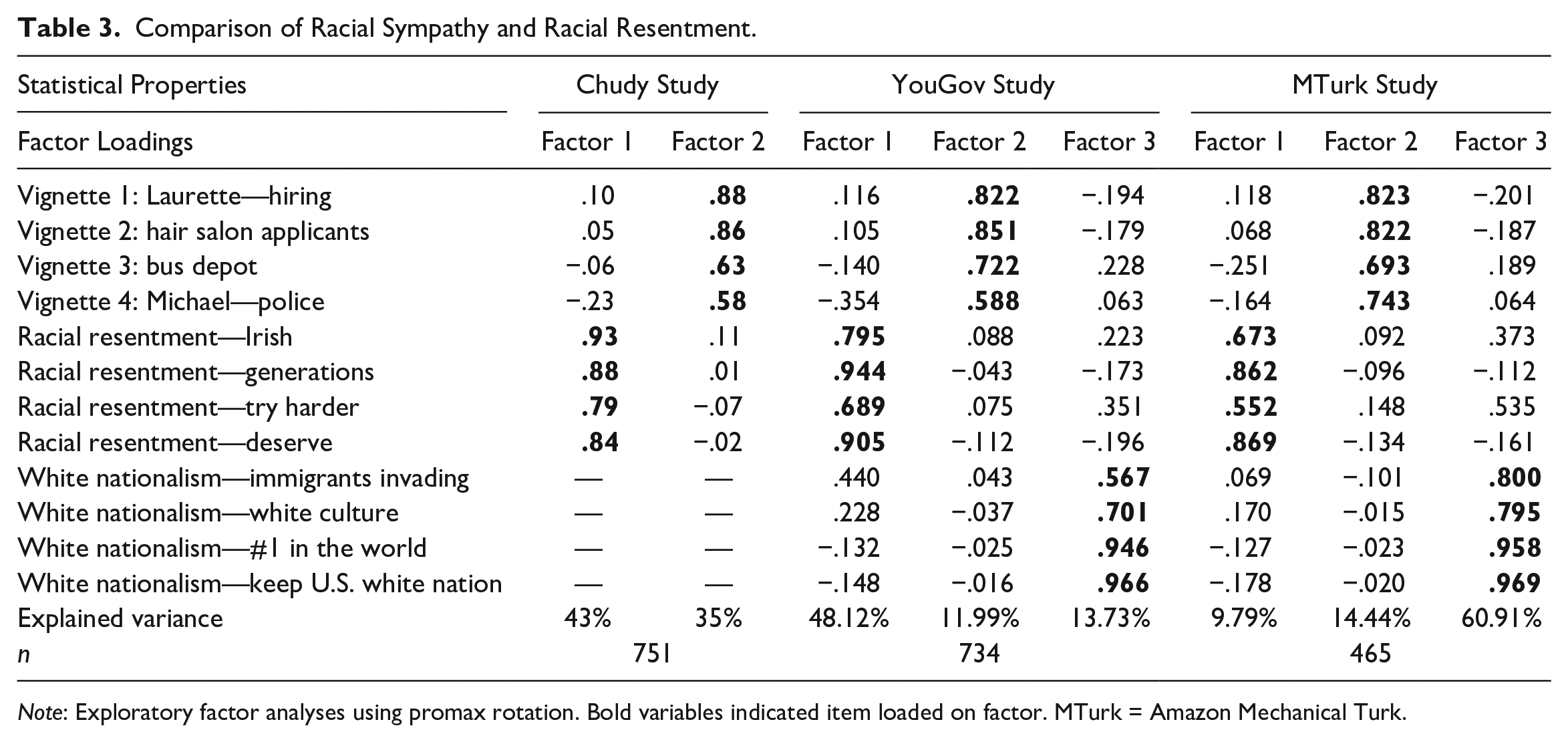
Note: Exploratory factor analyses using promax rotation. Bold variables indicated item loaded on factor. MTurk = Amazon Mechanical Turk.
Additionally, views about egalitarianism were identified through six items in the YouGov sample that were averaged to reflect antisocialist views (e.g., “We have gone too far in pushing equal rights in this country”). For a full listing of items, see the online Appendix. Respondents indicated their agreement or disagreement with these statements on a five-point Likert-type scale (α = .867, factor loadings between .661 and .829).
Respondents’ fear of crime was measured in the YouGov sample through the average response to five items about fear of either “you or a member of your household” experiencing one of these crimes: someone stealing money or property, home break-in, street robbery or mugging, rape or sexual assault, and murder. Respondents identified how afraid or unafraid of these crimes they were on a five-point Likert-type scale (α = .903, factor loadings between .787 and .900). Additionally, YouGov respondents reported their beliefs about the dangerousness of the world more broadly through four items (e.g., “Any day now chaos and anarchy could erupt all around us. All signs are pointing to it”; Altemeyer 1988). See the online Appendix for exact items. Respondents’ beliefs in a dangerous world were captured through agreement or disagreement with these statements on a five-point Likert-type scale (α = .796, factor loadings between .741 and .840).
Given the political divisions within the U.S. geographic regions, a dummy variable reflecting those living in the South was created for both samples on the basis of respondents’ identified state of residence and the U.S. census regions. Relatedly, consistent with previous research (see, e.g., King and Wheelock 2007; Shelley et al. 2021), political ideology in both samples was dummy-coded to reflect those who were reportedly conservative or very conservative in order to avoid excluding those who were “not sure” about their ideology (“not sure” n = 42). Additionally, political party affiliation in both samples was dummy-coded to reflect those identifying as Republican. Given their central beliefs about the “born again” experience (conversion), evangelical Christians were identified in the YouGov sample by their affirmative response to “Would you describe yourself as a born-again or evangelical Christian, or not?” (Pew Research Center 2018). In the MTurk sample, religious fundamentalists were identified through respondents’ describing their religious identity (“somewhat well” or “very well”) as “fundamentalist,” “born again,” or “evangelical” and/or endorsement that “the Bible means exactly what it says. It should be taken literally, word-for-word,” which is consistent with previous research (Baylor Religion Survey 2007; Maxwell and Shields 2019).
Furthermore, all analyses for both samples controlled for sociodemographic variables including age (continuously measured), sex (1 = female, 0 = male), marital status (1 = married, 0 = others), and education (1 = college degree or higher, 0 = less than a college degree). Education was coded in this way because support for Trump is markedly higher among non-college-educated whites (Sides 2017; Sides et al. 2017). In addition, the YouGov models controlled for being a registered voter in 2016 (1 = yes, 0 = no). 3
Analytic Strategy
The present analysis was carried out in four steps. First, we assess public attitudes toward Trump and white nationalism in the YouGov sample descriptively. Second, we explore a series of regression models using the YouGov sample to examine predictors of faith in Trump, with a special focus on the effects of racial beliefs. Third, using data from the MTurk sample, we explore a series of regression models using the MTurk data to assess predictors of faith in Trump, largely reproducing the findings from the YouGov data. Finally, we examine the MTurk sample’s attitude toward Trump using a proxy for faith in Trump: willingness to wear a MAGA hat. All regression models were estimated using ordinary least squares (OLS) regression. All variance inflation factors were less than the cutoff of 4.0, which indicates no concern with multicollinearity (Belsley, Kuh, and Welsch 1980; Fox 1991). Ultimately, controlling for a range of variables, the goal is to address the following question: Are racial beliefs, including white nationalism, related to faith in Trump?
Results
Faith in Trump and Support for White Nationalism: YouGov Sample
Table 2 reports the extent to which sample members agreed or disagreed with the items measuring faith in Trump and white nationalism. In describing the results, we present the total agree percentage, which includes those answering “agree” and “strongly agree.” As seen in Table 2, a substantial minority of respondents agreed with the five items used to measure faith in Trump. Nearly half (48.6 percent) of respondents agreed that “President Trump is 100% correct that we need a wall to make sure that gang members, criminals, and rapists do not come into the U.S.” More than 4 in 10 agreed that “President Trump knows how to protect America against threats from around the world” (45.3 percent), “I believe that President Trump will make America great again” (43.0 percent), and “I love President Trump’s style because he tells it like it is” (42.4 percent). Furthermore, more than a quarter (29.6 percent) agreed that “President Trump is the only politician who really cares about the common man.”
In addition, the respondents expressed a measure of support for the four items used to measure white nationalism. More than a third (35.9 percent) agreed that “The immigrants now invading our country—and their liberal supporters—want to turn America into a third-world country where white people are a tiny minority.” Nearly one in four (24.6 percent) endorsed the view that “Although people won’t admit it, white people and their culture are what made America great in the first place.” In addition, roughly 1 in 10 agreed that “Although everyone is welcome in the country, America must remain mostly a white nation to remain #1 in the world” (11.3 percent) and that “We need to reduce immigration to keep the U.S. a mostly white nation—which is what God meant it to be” (9.6 percent).
Predictors of Faith in Trump: YouGov Sample
Table 4 presents a series of OLS linear regression models, each with the theoretical potential to explain faith in Trump. As expected in the Trump base model, being a Republican, being an evangelical Christian, and residing in the South were each significant, with Republican affiliation being the strongest predictor (β = .502). The political model introduced conservative political ideology and antisocialist views, showing both to be significant predictors of faith in Trump. The crime salience model introduces belief in a dangerous world and fear of crime, showing these to also be significant predictors. Finally, the racial model presents the fully specified model; key variables from each previous model, with the exception of the crime salience model, retain significance in the analysis. Thus, all key variables in the Trump base model were positively and significantly related to faith in Trump (Republican, reside in South, evangelical Christian), as were the variables in the political model (conservative, antisocialist). Most important, racial beliefs appear consequential. Although racial sympathy was nonsignificant, racial resentment and white nationalism were the strongest predictors within the analysis, with white nationalism exerting the largest effect (β = .402). This model explained 74.9 percent of the variation in faith in Trump.
Ordinary Least Squares Regression Predicting Faith in Trump in the YouGov Sample (n = 734).

p < .05. **p < .01. ***p < .001.
Predictors of Faith in Trump: Supplementary MTurk Sample
As seen in Table 5, these multivariate findings regarding faith in Trump were largely reproduced using the MTurk sample across two models, one with measures of Hispanic resentment and sympathy and one with the traditional measure of racial resentment (toward blacks). In both analyses (models 1 and 2), white nationalism was the strongest predictor of faith in Trump (β = .431 and .360, respectively) followed by conservative political ideology (β = .332 and .312, respectively). In addition, Republican party affiliation and religious fundamentalism were significant predictors of faith in Trump. Notably, not only black resentment but also Hispanic resentment was associated with great support for Donald Trump. Neither black nor Hispanic sympathy was significantly related to the outcome variable.
To further test this effect, we used the MTurk sample to explicitly assess the willingness to wear a MAGA hat, a proxy for faith in Trump. As seen in Table 2, nearly three in four (71.2 percent) were either somewhat unwilling, unwilling, or very unwilling to wear this hat. However, a substantive proportion (23.5 percent) expressed a willingness to wear this symbol of Trump.
As seen in Table 5, consistent with the previous analyses, white nationalism was the most robust predictor (β = .375 and .324, respectively) of willingness to wear a MAGA hat in model 3 (using Hispanic resentment and sympathy) and a close second (β = .324) to conservative ideology (β = .335) in model 4 (using traditional racial resentment). However, neither racial resentment (Hispanic and black) nor Hispanic sympathy was statistically significant in either model.
Ordinary Least Squares Regression Predicting Faith in Trump and MAGA Hat Wearing in the Amazon Mechanical Turk Sample (n = 465).
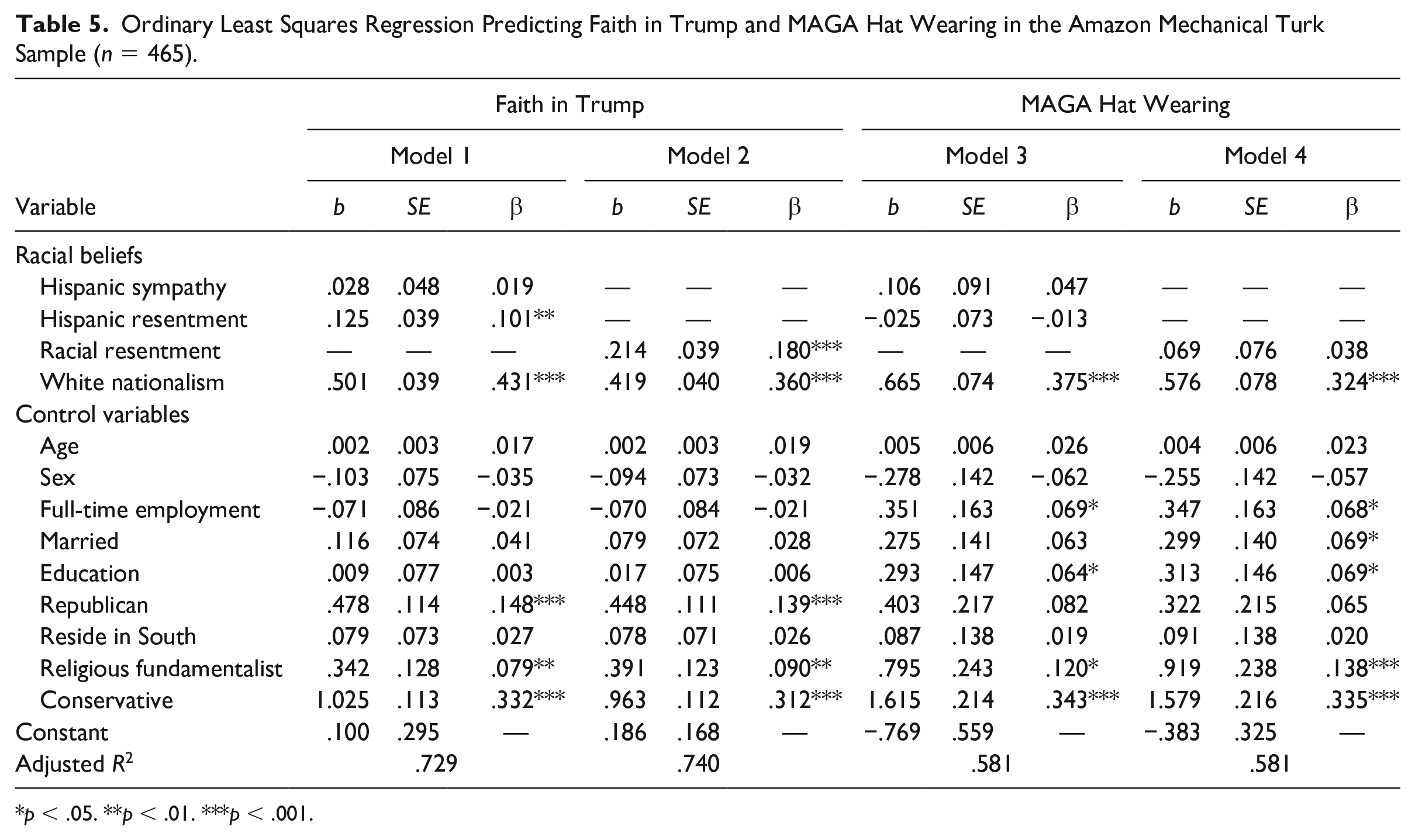
p < .05. **p < .01. ***p < .001.
Finally, sensitivity analyses were conducted to assess possible effects. First, as noted in endnote 1, OLS models were estimated that included income and full-time employment. These factors were not significant and did not alter the results. Second, an interaction effect of racial resentment × white nationalism was assessed. The interaction term was not significant. Third, nonsignificant results also were found for the interaction term of sex × white nationalism. Fourth, two of the items in the faith in Trump scale refer to President Trump’s building a wall to keep criminals from entering the United States and protecting Americans from threats from around the world, whereas the white nationalism scale refers to the need to reduce immigration in two items. It could be argued that the relationship between these two scales is due to this overlap. We disagree because one scale asks about faith in President Trump to prevent external threats, whereas the other scale asks about the impact of immigration on the racial composition of the United States. Still, we reestimated the multivariate analyses deleting the two items from the faith in Trump scale that referenced these external threats. As anticipated, white nationalism remained a robust predictor of faith in Trump in both the YouGov (model 4, β = .411) and MTurk data (model 1, β = .414; model 2, β = .342).
Discussion
As Jardina (forthcoming) emphasized, public support for Donald Trump is rooted in his appealing not only to out-group animus but also to in-group solidarity, a conclusion reinforced by the present study. As numerous news accounts document, President Trump’s 2020 electoral strategy involved openly stoking racial resentment and defending white nationalism (see, e.g., Costa and Rucker 2020; Dawsey and Stein 2020; Strauss 2020). Recent examples are legion.
In June, he retweeted a supporter filmed “shouting ‘white power’ while driving a golf cart bedecked with Trump memorabilia”—later taken down but never condemned (Beggin 2020). His retweet expressed his gratitude for these “great people” supporting him (Swasey 2020). In his July 4 rally at Mount Rushmore, he “excoriated racial justice protesters as ‘evil’ representatives of a ‘new far-left fascism’ whose ultimate goal is ‘the end of America’” (Costa and Rucker 2020). Echoing this animus, he has termed BLM as a “symbol of hate,” called protesters of police violence “thugs,” and labeled antiracism rallies “domestic terror” (Beggin 2020). In his trip to Kenosha, Wisconsin, he refused to meet with Jacob Blake, the African American man shot by a police officer, and defended Kyle Rittenhouse, a white teenager who traveled from Illinois to Kenosha, where he now stands accused of murdering two people with an AR-15-type weapon (Schechter 2020; Wise 2020). When asked about systemic racism, Trump said, “I don’t believe in that” (Lizza 2020).
He soon followed up by directing Russell Vought, Office of Management and Budget head, to cancel all federal government racial sensitivity training based on “critical race theory” and notions of “white privilege” (Dawsey and Stein 2020). Vought’s (2020) memorandum stated that the president believed that these programs “undercut our core values as Americans” and are “divisive, un-American propaganda.” Echoing the same theme, President Trump then attacked the educational 1619 Project, which reframes American history through the lens of slavery and the enduring antiblack animus it promoted. Arguing that “teaching this doctrine to our children is a form of child abuse in the truest sense of those words,” he created the 1776 Commission to develop a patriotic, “pro-American curriculum that celebrates the truth about our nation’s great history” (Watson and Segers 2020). Pollster Cornell Belcher captured the moment. “Without white resentment, there is no rationale for Donald Trump. . . . Without that, what reason do his supporters have to be with Donald Trump if he’s not going to be your tribal strong man? He started there and will end there” (quoted in Costa and Rucker 2020).
In this context, we explored “who wears the MAGA hat” in multiple models using two different white samples, numerous potential predictors, and a measure of faith in Trump, supplemented with a specific question on willingness to don a MAGA hat. The findings reveal that faith in Trump is not fully contingent on racial attitudes. Allegiance to the president is also derived from his presumed base of Republicans, those living in the South, and evangelical or fundamentalist Christians. Such support is bolstered as well by those with conservative political ideology and antisocialist beliefs. However, contrary to our hypothesized model, crime salience was not associated with faith in Trump in the model, including all predictor variables. The important point, however, is that even with controls for these political and social variables, racial beliefs of whites matter and are likely integral to understanding the intense loyalty of the president’s white followers.
Consistent with academic research and popular commentary, racial resentment was a significant predictor in all models with faith in Trump as the dependent variable (see Tables 4 and 5). Notably, this effect is demonstrated using the standard Kinder and Sanders (1996) measure of racial resentment and using an adaptation of this scale to assess Hispanic resentment. Future research should explore this finding on types of racial resentment. As a side note, Chudy (2017, forthcoming) argued that racial sympathy is activated when a policy is specifically relevant to African Americans (e.g., support for affirmative action, sentencing of a black criminal defendant). Given Trump’s racially charged rhetoric, it seemed plausible that racial sympathy might evoke less support for the president. This was not the case. Racial sympathy might be activated if respondents were asked about race-specific actions by the president, such as his criticism of BLM or canceling federal racial sensitivity training, but this remains to be demonstrated.
The importance of the contributions of Jardina (2019b, forthcoming) and Kaufmann (2019), and the ethnographic work of Hochschild (2016; see also Kimmel 2013), is that these works push social science to move beyond an overconcentration on out-group racial animus to consider in-group racial solidarity. Racial resentment remains a robust predictor essential to any quantitative study, but it is not the only racial attitude that has political consequences. These revisionist authors argue that increasing diversity, seen in both cultural and demographic trends, is fueling the creation of a group identity and consciousness among a sizable minority of whites (Jardina 2019b, forthcoming). These views cannot be reduced to white hatred and supremacy. Jardina speaks of white identity and consciousness and Kaufmann (2019) of ethno-traditional nationalism. We believe that the concept of “white nationalism” is parsimonious, describes beliefs about keeping the United States white accurately, and has intuitive appeal. Regardless of the label settled upon, future research on the effects of racial beliefs will benefit from including this factor in the analyses. The contemporary reality is that political allegiances and public policy preferences are shaped not only by what whites think about blacks but also by what whites think about themselves.
In this regard, Jardina’s (2019b, forthcoming) work is significant because it demonstrates empirically that white identity and consciousness predict warm feelings toward and a voting preference for Donald Trump. We build on her findings in two ways. First, methodologically, we confirm that measures of whiteness—in this case, white nationalism—are conceptually and empirically distinct from other racial beliefs, such as resentment and sympathy. Second, substantively, we show that white nationalism is a consistent and robust predictor of faith in Trump for white Americans. This association is initially demonstrated in the main analysis with the YouGov sample. With an independent sample, we then reproduce these results with MTurk data and proceed to establish that white nationalism also is related to willingness to wear a MAGA hat—again a behavioral expression of identity fusion with the president (Kunst et al. 2019). A sea of whites donning MAGA hats at campaign rallies thus seems due not only to the Trump camp’s marketing prowess but also to his follows’ desire to display faith in their man.
Taken together with Jardina’s (2019b, forthcoming) research, the present study appears to confirm what these observations of Trump campaign rallies suggest: race is integral to his popularity and electoral success among whites. Trump’s genius was in understanding that many white Americans felt like strangers in their own land, to use Hochschild’s (2016) poignant phrase. “Radical Islamists” and “bad hombres” as well as proposed bans and walls, were convenient conduits to communicate that he was on their side in the culture wars devaluing them and their social standing. The use of the MAGA acronym communicated that he was going to make their America great again by slowing demographic change and by defending the symbols of whiteness. Trump’s “racialized political narratives,” noted Fording and Schram (2020), “helped make his campaign slogan to ‘Make America Great Again’ easily be decoded to mean we need to ‘Make American White Again’” (p. 40). He promised to be their champion, and they responded with faith in Trump. He reaffirmed their status and served their emotional interests (Hochschild 2016).
Two issues remain to be determined. First, Trump’s 2020 campaign focused less on “dangerous” out-groups—Muslims and Mexicans—and more on animus toward African American (BLM) protesters. In the aftermath of the George Floyd incident and rising concern over racial justice (Eligon 2020), it is unclear if this political strategy will increase or erode faith in Trump. The recent presidential election, however, likely did little to suggest a decline in Trump’s popularity or to provide any incentive from him to change his political strategy. Although losing to Biden, Trump amassed more than 74.2 million votes—the second highest total historically (to Biden’s 81.3 million votes), including 95 percent of all Republicans and 58 percent of all white voters. These figures are similar to or higher than in the 2016 election; Trump even increased his support in 2020 among people of color. Young Americans constitute one crack in this wall of support. Exit polls report that nearly two thirds of those ages 18 to 24 (65 percent) cast their vote for Biden (CNN 2016, 2020). This generational gap in Trump support may dim the prospect of Trumpism, if not now, perhaps in the future.
Second, in the post-Trump era, it is unclear whether white in-group solidarity will grow and intensify or attenuate as cultural and demographic diversity become an unstoppable development (Jones 2016). It also remains to be seen if politicians within the Republican Party will continue to attempt to capitalize on racial resentment and white nationalism. Donald Trump shows no signs of receding into the dustbin of defeated presidential candidates, holding out the promise of a presidential run in 2024 and threatening to punish any politician who does not show sufficient loyalty to him, including in his doomed attempt to retain his office. Trump endures as the elephant in the Republican room. “Republicans should wake up,” observed Rubin (2020). “A sizable segment of ‘their’ base is not theirs at all. Those voters are the ones in red hats hollering that the election was stolen” (see also Thompson 2020). Indeed, commentators are holding a requiem for the establishment GOP, noting that the party of Lincoln is now owned by Trump (The Editorial Board 2020). According to the New York Times, the party “allowed itself to be co-opted by Trumpism. Its ideology has been reduced to a slurry of paranoia, white grievance and authoritarian populism” (The Editorial Board 2020). Republican presidential hopefuls are not running away from these sentiments but are embracing Trumpism and its emphasis on white working-class resentment toward liberal “socialism,” efforts to “defund the police,” and talk of “systemic racism” (see Waldman 2020). Still, central questions remain: Will whites with this inclination wear MAGA hats for other candidates, or is their faith in the president a historical quirk unique to Donald Trump? And what role will be played by racial beliefs, including white nationalism, in shaping such political allegiances?
Supplemental Material
sj-pdf-1-srd-10.1177_2378023121992600 – Supplemental material for Who Wears the MAGA Hat? Racial Beliefs and Faith in Trump
Supplemental material, sj-pdf-1-srd-10.1177_2378023121992600 for Who Wears the MAGA Hat? Racial Beliefs and Faith in Trump by Amanda Graham, Francis T. Cullen, Leah C. Butler, Alexander L. Burton and Velmer S. Burton in Socius
Footnotes
Acknowledgements
We would like to thank Ashley Jardina for her comments on an earlier draft of this paper.

Supplemental Material
Supplemental material for this article is available online.
Notes
Author Biographies
References
Supplementary Material
Please find the following supplemental material available below.
For Open Access articles published under a Creative Commons License, all supplemental material carries the same license as the article it is associated with.
For non-Open Access articles published, all supplemental material carries a non-exclusive license, and permission requests for re-use of supplemental material or any part of supplemental material shall be sent directly to the copyright owner as specified in the copyright notice associated with the article.
