




Abstract
Is carbon price adoption in wealthy democracies driven more by international or domestic forces? Event history analyses reveal that carbon price adoption is more likely in countries with less fossil fuel energy use (and, by proxy, less powerful fossil fuel business-elite actors) and with less encumbered democratic institutions (i.e., fewer institutional veto points). These findings are triangulated through cross-sectional comparisons and case studies. In short, wealthy democracies enact carbon prices according to the degree to which domestic actors or costs constrain or enable enactment and implementation. The author argues that the global free-rider problem, posed by nonbinding international climate agreements and lack of enforcement, and fossil fuel business-elite power undermine the force of international values and norms. World society scholarship should attend more to (1) whether international participation incurs substantial local costs or powerful stakeholder opposition and (2) whether the benefits of such participation are more domestically or globally distributed.
Keywords
For roughly a decade, environmental sociologists have argued that renewable energy development is not enough to curb CO2 emissions. It neither decouples emissions from economic growth (York and McGee 2017) nor completely replaces fossil fuel energy sources (York 2012). In practice, when renewables are deployed, consumption of all energy sources rises, and societies continue to use much of their original fossil fuel energy. This situation is termed the Jevons paradox, named after William Stanley Jevons, an English economist who observed that increases in the efficiency of coal steam engines were accompanied by increases in coal energy consumption (York and McGee 2016). To put the theory simply, as efficiency increases (more renewable energy on offer), so does consumption.
The Jevons paradox poses a critical problem for transitioning societies from fossil fuels because mainstream climate solutions center around renewable energy development. After confirming that renewables do not effectively displace fossil fuels, environmental sociologist Richard York concluded, “One implication of these results is that direct suppression of fossil-fuel use (for example, by a carbon tax) is likely to be much more effective at reducing fossil-fuel use than simply expanding non-fossil-fuel energy sources” (p. 443). Empirical work supports this conclusion. Active suppression of fossil fuel energy sources and carbon taxes reduce emissions at both the state (Grant, Bergstrand, and Running 2014; Grant, Jorgenson, and Longhofer 2020; Prasad and Munch 2012) and country (Andersson 2019; Best, Burke, and Jotzo 2020; Murray and Rivers 2015) levels.
For this reason, carbon prices (taxing emissions) are the favored policy instrument of experts (Cramton et al. 2017; Nordhaus 1994; Sandbu 2020) and are the primary policy recommendation from the latest report of the Intergovernmental Panel on Climate Change (Rogelj et al. 2018). Furthermore, their adoption does not limit economic growth, a common conservative critique (Driscoll 2020), suggesting that their implementation offers a smoother decoupling of emissions from economic growth. Thus, the policy is effective, is approved by experts, and does not limit national prosperity. What then impedes or, on the other hand, facilitates carbon price adoption? Economists can offer promising policy proposals for solving collective problems, but without proper sociological understandings of power and societal forces, we will not understand why key reforms are not implemented.
In this article, I ask whether carbon price adoption in wealthy democracies is driven more by international or domestic forces. Fourteen of 20 countries in this study have enacted carbon prices. Among those countries, there is substantial variation in the timing of implementation and the strength or impact of the prices. Countless scholars have studied carbon prices, and even more scholars call for their implementation, but none has studied the enactment of carbon prices specifically in more than a few countries. With sufficient data and cases available only now, this study is the first to conduct a medium-n, systematic comparative analysis of carbon price enactment. As carbon prices are currently framed as a central solution to global climate change, studying the conditions that support their enactment is crucial. Furthermore, because the United States and Europe are among the top three emitters of carbon, understanding what drives national carbon price adoption in wealthy countries is vital, and in part, this consideration motivates the selected sample of wealthy democracies.
In addition to contributing critical substantive findings on carbon price adoption, I test hypotheses from (1) world society theory (the spread of international values and norms) and (2) environmental sociology. First, studying carbon pricing is an ideal way to examine the spread of international values because a national carbon price is a domestic policy addressing a global problem. Domestic carbon prices are a useful metric for assessing whether international values drive climate action because the policy implementation involves real costs, unlike the signing of most international climate agreements. On the basis of the existing literature (Frank, Hironaka, and Schofer 2000; Longhofer and Jorgenson 2017; Longhofer et al. 2016; McCall 2020; Schofer and Hironaka 2005; Shorette 2012), it seems likely that the spread of international values and norms would affect carbon price adoption. Second, by making emissions expensive, carbon prices have the potential to trigger the mobilization of the climate denial countermovement (Brulle 2018; Dunlap and McCright 2015; Farrell 2016a; McCright and Dunlap 2010) that historically blocks climate policy proposals. The movement represents what environmental sociologists term a form of “anti-reflexivity,” obstructing climate reforms because of their “staunch commitment to protecting the current system of economic production” (Dunlap 2014:1). In many ways, explaining the implementation of carbon prices represents a competition between the spread of proclimate global values and international agreements associated with world society theory and the power of the denial countermovement associated with antireflexivity theory.
The article is organized as follows. First, I offer an overview of carbon prices, describe the literature-based theories to be tested, and outline my analytic techniques. Second, I present my findings, detailing which theories are supported in the analyses. I find that carbon price adoption is driven by domestic conditions and strongly associated with low levels of fossil fuel energy consumption and with low veto points. Wealthy democracies enact carbon prices according to the degree to which domestic actors or costs constrain or enable enactment and implementation. Third, I argue that the global free-rider problem, posed by nonbinding international climate agreements and lack of enforcement, and fossil fuel business-elite power undermine the force of international values and norms. World society scholarship should attend more to (1) whether international participation incurs substantial local costs or powerful stakeholder opposition and (2) whether the benefits of such participation are more domestically or globally distributed.
How Do Carbon Prices Work?
Carbon prices typically manifest in the form of either carbon taxes or emission trading systems (ETSs). Both are designed to incentivize those who rely on fossil fuels, such as utility companies, manufacturers, and individuals, to use low-carbon or zero-carbon options and thereby decrease their emissions. Their design and intent are straightforward. When utility companies face decreased profits because of an overreliance on fossil fuels, they phase out coal. When consumers see gasoline prices rise, they tend to buy more fuel-efficient cars and drive less. In general, research shows that both types of carbon prices are effective in changing behavior and lowering emissions (Best et al. 2020; Harrison 2010; Prasad and Munch 2012; York 2012). Furthermore, the revocation of a carbon price can cause a rise in emissions. When Australia terminated its ETS in 2014, carbon emissions rose (Plumer 2014).
Although both policies have an impact, carbon taxes and ETSs diverge in several noteworthy ways. A carbon tax is a “Pigouvian tax” or a tax that seeks to rectify a market failure or problematic market outcome by including that cost in market pricing. As markets do not naturally account for carbon emissions and climate change, economists and scientists increasingly advocate for carbon tax legislation to rectify this market failure. Carbon taxes set a price that taxes fossil fuels and emissions relative to the amount of carbon emitted per unit of energy that is produced. Because tax structures already exist in national economies, carbon taxes are relatively easy to implement, track, and enforce. In practice, governments often protect specific sectors of the economy from carbon taxation; thus, most carbon taxes apply to only a limited number of economic sectors. 1
ETSs are similar to carbon taxes but diverge in the implementation, monitoring required, and sometimes political viability. To implement the policy, governments set a cap on carbon emissions and subsequently sell permits to carbon polluters at a set price. It is mandatory that polluters purchase the correct amount of permits to cover all of their emissions. Any remaining permits that emitters save with carbon efficiency improvements can be sold to polluters that have increased emissions. Although this system requires more monitoring and enforcement, it is sometimes more politically viable because it allows businesses and organizations more flexibility, and often the costs are more hidden from consumers (Andrew, Kaidonis, and Andrew 2010; Cooper et al. 2017; Harrison 2010; Liu 2017). Differences aside, both policies set a price on carbon emissions to create a more stable world climate—at a cost.
Literature and Hypotheses
As opposed to most domestic policies (e.g., health, education, welfare), carbon prices serve primarily an international purpose rather than a national one and require national economies to pay for a problem that exists beyond their borders. National motivation is further complicated by the facts that international agreements are nonbinding and that economic and climate impacts vary across countries (Cooper et al. 2017; Harrison and Sundstrom 2007, 2010). Scholars interchangeably term this situation the “tragedy of the commons” or the “free-rider problem.” In essence, they refer to “the reluctance of one country to move ahead unilaterally with carbon pricing because it bears the costs while all countries benefit from a more stable global climate system” (Parry 2017:13). With these complexities in mind, scholars acknowledge methodological and theoretical difficulties inherent in assessing and explaining state climate performance or policies (Christoff and Eckersley 2011; Purdon 2015). In this article, I investigate whether carbon price adoption is driven more by international or domestic forces.
States are increasingly subject to the spread international norms and values (Mann 1984). “Many features of the contemporary nation-state derive from worldwide models constructed and propagated through global cultural and associational processes” (Meyer et al. 1997:144–45). The European Union (EU) region exemplifies this interconnectedness at both economic and political levels. Today, all national leaders and representatives are required, more and more, to balance domestic and international interests. Therefore, states may enact or reject carbon prices depending on their attention to global norms, levels of “international-mindedness,” global networks, signing of climate agreements, and more.
World society theorists are at the helm of this research in the comparative environmental policy field. They argue that once a model of an institution or policy exists and spreads to enough countries or is endorsed by a United Nations or even a multicountry pledge, it becomes a norm and therefore easier for domestic policy makers to adopt. The world society hypothesis also predicts that even a nonbonding international agreement ought to matter, precisely because the key mechanism is norms rather than an enforcement mechanism. Scholars have applied the theory to a number of arenas, from education (Schofer and Meyer 2005) to gender equity (Berkovitch and Bradley 1999; Swiss 2012). With regard to the environment, scholars find that international norms and institutions support state-level environmental action and a decrease in carbon emissions (Frank et al. 2000; Longhofer and Jorgenson 2017; Longhofer et al. 2016; McCall 2020; Schofer and Hironaka 2005; Shorette 2012). In fact, they argue that international institutions, nongovernmental organizations, and norms can play a larger role in positive environmental and climate outcomes than domestic conditions. To these ends, I test the role of environmental international nongovernmental organization (INGOs), the Kyoto Protocol, and participation in the EU ETS. Number of environmental INGOs is often used in world society research to explain proenvironment and climate outcomes (Frank et al. 2000; Longhofer and Jorgenson 2017; Longhofer et al. 2016). Furthermore, the Kyoto Protocol is a major historical event that established agreed-upon targets for countries to lower emissions. The EU ETS, a regional agreement, establishes a carbon price for all EU countries (whether they have national policies or not) and can serve as motivation to further limit emissions or to avoid further prices on carbon emissions. Cumulative number of prior carbon price adopters, indicating policy diffusion, is also relevant to the world society literature and was tested as well.
A state’s ability to enact carbon prices can also depend on its domestic political institutions, “understood as the path-dependent rules of the game that shape and constrain actor behavior” (Amable et al. 2019:438) and inherent capacities (Meckling and Nahm 2018a, 2018b). Some scholars cite parliamentary systems (Dolsak 2001) or proportional representation (Finnegan 2019; Harrison 2010) as assisting the outcome of state climate action. These political systems support the increased presence of green or left parties, which are also linked to supporting more proclimate outcomes (Christoff and Eckersley 2011; Harrison 2012; Tobin 2017; Vasseur 2014, 2016). Furthermore, the level of corporatism, or “the coordinated, cooperative, and systematic management of the national economy by the state, centralised unions, and employers” (Siaroff 1999), has a significant impact on the climate policy-making process in industrialized democracies. In fact, comparative research shows that because corporatist regimes can offer more policy consensus and economic stability, they also tend to support the passage of climate policy and work toward collective interests (Matthews 2001; Scruggs 1999). All in all, there is agreement that institutions remain key for state climate action and policy making (Christoff and Eckersley 2011; Driscoll 2019; Tobin 2017; Wood et al. 2020). To these ends, I test the role of political institutions in three measures: veto points, left parties, and corporatism.
I use veto points because it is a well-traveled metric for comparing political institutions (Huber, Ragin, and Stephens 1993; Immergut 1990; Prasad 2006) and also for climate policy outcomes (Christoff and Eckersley 2011; Madden 2014). Veto points, or stages in the process of policy making when actors or institutions can halt or impede passage, have a significant impact on the passage of any national policy. As an index of presidentialism, bicameralism, single-member district presence, federalism, referenda, and judicial review, it combines institutional dynamics that have been demonstrated in the literature to block climate policies.
States may enact or reject carbon prices depending on the domestic costs or benefits associated with energy transition to non–fossil fuel sources. States also may enact or reject carbon prices because of the mobilization or political clout of domestic fossil fuel business interests. As carbon prices are intended to transform energy structures, their passage may hinge on the political dynamics underlying energy sources within each country. Findings are sometimes mixed on whether fossil fuel energy sources influence proclimate state action. Dolsak (2001) and Karlas (2017) found a relationship, but Bailer and Weiler (2015) did not. Still, more and more, scholarship shows a relationship. Research at the level of the U.S. states highlights the importance of fossil fuel production for enacting renewable energy policy (Fisher 2006; Harrison 2012; Prasad and Munch 2012; Stokes 2020; Vasseur 2014, 2016).
The role of fossil fuel firm power is nontrivial in shaping climate policy outcomes. In two recent and exceptional works on comparative domestic climate policies, there is rich evidence that carbon polluters often have privileged political access and significant power in shaping policy outcomes (Mildenberger 2020; Stokes 2020). Furthermore, there is a variety of actors who attempt to block climate change action and use key strategies to great success. These actors, together, are often referred to as the “denial countermovement,” and scholars find that they wield significant influence in the area of politics and public opinion (Dunlap and McCright 2015). The fossil fuel industry and corporations deliver substantial anticlimate lobby power (Brulle 2018) and fund climate denial groups and research (Farrell 2016a). Conservative think tanks and foundations fund anticlimate groups, front groups and Astroturf campaigns, and the production of denial ideology in parties (Brulle 2014; Dunlap and McCright 2015). The Koch brothers, for example, bankrolled the Tea Party to include climate denial in its party platform (Dunlap, McCright, and Yarosh 2016). Individuals such as contrarian scientists often receive undue media exposure (Boykoff 2008) and work to spread misinformation on climate science often to further their personal interests (Oreskes and Conway 2011). The conservative mainstream and social media with conservative politicians support this political project with near ideological unity (Carmichael and Brulle 2017; Dunlap and McCright 2015). Ideologically, the central claims of the denial countermovement are that (1) there is shoddy evidence of anthropogenic climate change; (2) even if climate change occurs, it will result in a net positive for society; and (3) any measures that serve to fix climate change will injure society, especially economically.
Scholars argue that denial movements occur in countries with “strong commitments to neoliberalism and a powerful fossil fuels industry” (Dunlap and McCright 2015:319) and represent a form of “antireflexivity” or blocking reforms because of their “staunch commitment to protecting the current system of economic production” (Dunlap 2014:1). In sum, this “denial countermovement” has wielded powerful influence at multiple levels in society. Toward these ends, I test percentage fossil fuel energy consumption of total energy consumption. 2 In addition to revealing national fossil fuel energy use, the variable is often considered a proxy measure for relative fossil fuel business-elite presence or influence. It even influences public opinion on climate change (Knight 2018).
Table 1 displays a summary of all conditions, variable definitions, and data sources. My two main models in the “Results” section will thus focus on international versus domestic conditions, as both sets of factors have strong support in the literature.
Summary of Conditions, Variable Definitions, and Data Sources.
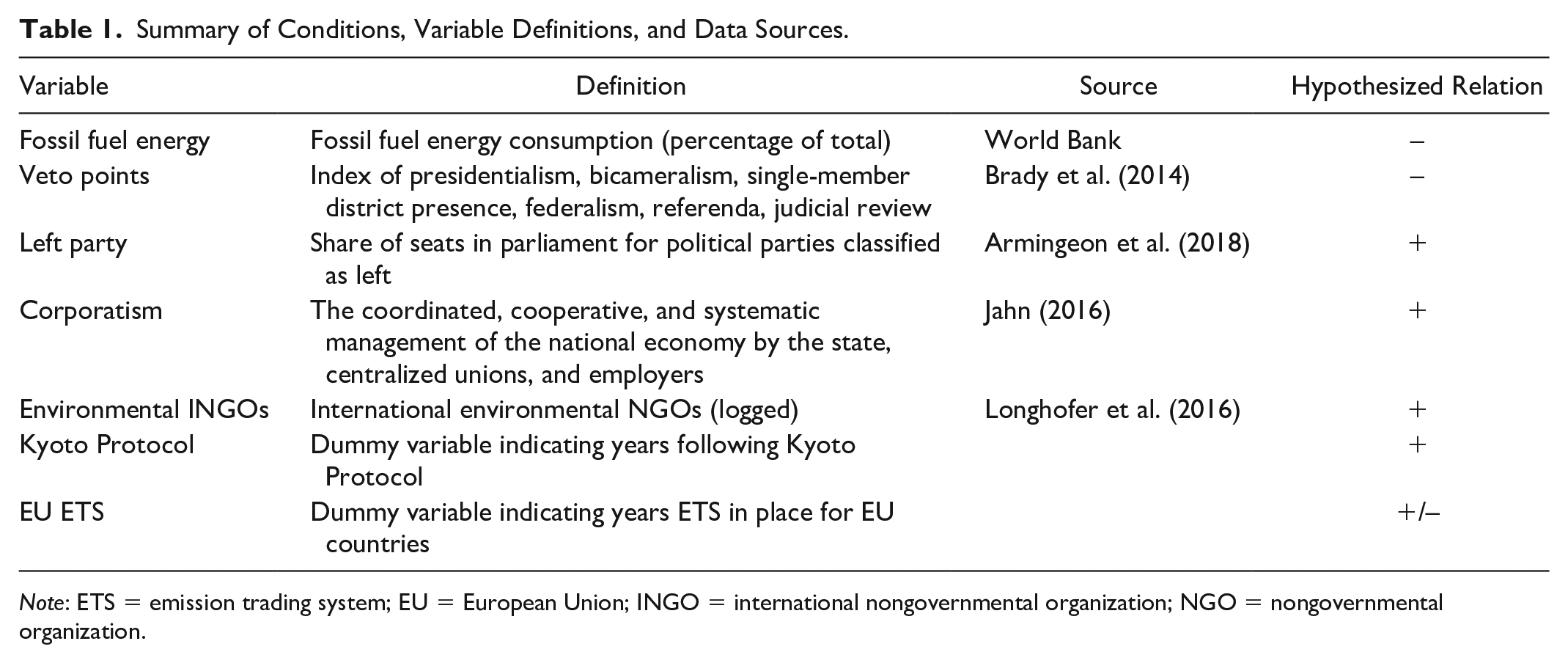
Note: ETS = emission trading system; EU = European Union; INGO = international nongovernmental organization; NGO = nongovernmental organization.
Discrete-Time Event History Analysis
I compare 20 wealthy democracies: Australia, Austria, Belgium, Canada, Denmark, Finland, France, Germany, Ireland, Italy, Japan, Netherlands, New Zealand, Norway, Portugal, Spain, Sweden, Switzerland, United Kingdom, and the United States. I have selected these countries for their comparability and widespread use in the field of comparative political economy (Kenworthy and Hicks 2008). Also, because they are wealthy, they bear greater responsibility for their substantial carbon emissions. Some of them have enacted carbon prices, but the timing has differed. Some have yet to do so. I conduct discrete-time event history analysis (Allison 2014) of the 20 democracies to assess conditions present during the years that countries enacted carbon price policies. The method has been used by scholars to address similar macrolevel policy questions (Frank et al. 2000; Kenworthy and Hicks 2008; Longhofer et al. 2016; Martin 2010; Scruggs 2003).
The event history models assess conditions under which wealthy democracies enact carbon price policies. The dichotomous dependent variable (enactment) was coded 0 for every year a country did not enact the policy and coded 1 the year the policy was passed (typically the year before implementation). Countries were removed from the risk set for every year following the year of passage. Because of data set limitations, years range from the first carbon tax, implemented in 1990 by Finland, to Portugal’s in 2015. Supplement Table A displays the type of carbon price enacted (tax or ETS) by country. Most policies are carbon taxes, with the exception of Australia’s, New Zealand’s, and Switzerland’s additional ETSs. Note that the dichotomous dependent variable is broad and collapses some variation between carbon taxes and ETSs. Still, both policies limit emissions and price carbon (although by alternative means), typically involve the same stakeholders, and produce government revenue. Linear and quadratic control variables were used to account for the passage of time (see Allison 2014).
Table 2 displays the results of four models. The modeling strategy consists of first testing domestic conditions (model 1), streamlining domestic conditions (model 2), testing international values and norms (model 3), and testing a combined model (model 4). In the domestic model (model 1), fossil fuel energy, veto points, and the linear and quadratic controls are significant. Left party strength and corporatism, however, are not significant. 3 Both fossil fuel energy and veto points are in the expected direction, negative, indicating that they both impede the enactment of carbon taxes. In the parsimonious model (model 2), fossil fuel energy, veto points, and the linear and quadratic controls are significant, with the same coefficient directions as in model 1. In the international model (model 3), the international variables, environmental INGOs, EU ETS, and Kyoto Protocol, are not significant. In the combined model (model 4), fossil fuel energy and the linear and quadratic controls are significant. The added international variables, environmental INGOs, EU ETS, and the Kyoto Protocol, are not significant. 4 In sum, the parsimonious model (model 2) consisting of a combination of fossil fuel energy and veto points best explains the enactment of a carbon price. These findings indicate that carbon price adoption is driven primarily by domestic conditions.
Discrete-Time Logistic Event History Analysis.

Note: Numbers in parentheses are standard errors. ETS = emission trading system; EU = European Union; INGO = international nongovernmental organization.
p < .05. **p < .01. ***p < .001.
Discussion
Despite the rising salience of global climate change, why might domestic conditions be the primary driver of carbon price adoption in this sample of wealthy democracies? The analyses indicate that many countries have delayed enacting carbon prices because (1) they are deterred by the economic costs associated with taxing high fossil fuel use, or fossil fuel actors block policy because of their significant position in the economy and energy infrastructures, and (2) their political institutions are encumbered by veto points, which can block enactment of legislation. Clearly, signing international climate agreements versus taxing emissions entail different calculations and policy decisions.
Figure 1 details the domestic conditions argument by illustrating the impact of these factors on carbon price strength, further validating the event history analysis results. Divided into four quadrants, the figure depicts the impact of fossil fuel energy and veto points on the strength of carbon prices (revenue per GDP). In the bottom left quadrant, countries with low veto points and low fossil fuel energy clearly have an easier time enacting more powerful carbon prices. In the bottom right quadrant, the findings are mixed. Although countries have low veto points, enacting a substantial carbon price is more challenging because of high fossil fuel dependence. In the top right quadrant, it is clear that with a combination of high fossil fuel dependence and veto points, countries have a very difficult time enacting strong carbon prices. In the top left quadrant, the case of Switzerland illustrates the fact that with low fossil fuel dependence, veto points do not necessarily preclude implementation, confirming that fossil fuel dependence plays a pivotal role in enactment.

Carbon price revenue percentage of GDP with fossil fuel energy and veto points.
The enactment of carbon prices can be delayed or blocked by both costs associated with energy transition (Fisher 2006; Prasad and Munch 2012; Vasseur 2014, 2016) and fossil fuel business-elite power, denial, or antireflexivity (Dunlap and McCright 2015; McCright and Dunlap 2010; Mildenberger 2020; Stokes 2020). For some countries, enacting carbon prices is linked to energy path dependence or fossil fuel energy circumstantial luck. Some governments have made decisions that decrease their likelihood of enacting strong carbon prices. For example, energy economists assert that nuclear power can be key for transitioning to lower carbon societies and caution against phasing it out too quickly (Jenkins et al. 2018). Belgium has been phasing out its nuclear power for several years and has not enacted a carbon price. Its fossil fuel energy use is climbing. Figure 2 displays Belgium’s decline of non–fossil fuel energy sources and nuclear with the recent rise of fossil fuel–sourced energy.

Belgian (left) and Japanese (right) energy use.
A similar story holds for Japan after the Fukushima Daiichi nuclear disaster in 2011 (see Figure 2). Japan began to source energy from coal to replace nuclear power, and as a result, fossil fuel energy and emissions climbed. Since then, Japan has reinstated some nuclear power, in part to combat climate change (Kyodo 2019; Suzuki 2019). The Japanese carbon price, although it exists, is minimal. Japan’s high fossil fuel energy use prevents it from moving forward with higher carbon pricing and climate action. Increasing fossil fuel energy consumption can discourage pricing carbon because of the cost. In short, the spread of international values is interrupted when domestic costs to action are high.
The power of fossil fuel business-elite is substantial in some cases and confirms the antireflexivity of the denial countermovement. In the United States, for instance, the American Clean Energy and Security Act of 2009 (a proposed carbon price) faced significant opposition from a variety of actors. The American Petroleum Institute (representing firms in the petroleum industry) sent a letter of opposition to the U.S. Congress (Gerard 2009), and oil lobbying groups held rallies with free music and food, bombarding the American public with ads opposing the bill (Fahrenthold 2009). A lobbying firm hired by the American Coalition for Clean Coal Electricity (representing major U.S. coal firms and utilities) even sent falsified constituent letters to members of Congress in opposition (Strom 2009). Furthermore, the extensive and subversive role played by Koch Industries, an oil giant, and conservative think tanks in the bill’s demise is catalogued in a recent book (Leonard 2019). Here we see a clear influence of think tanks (Brulle 2014; Jacques, Dunlap, and Freeman 2008), corporations (Brulle 2018; Farrell 2016a), and conservative groups (Farrell 2016b; McCright and Dunlap 2000, 2003) identified in sociological research on the denial countermovement and antireflexivity. Although examining how fossil fuel business-elite block carbon prices is beyond the scope of this work, their role is notable, particularly in political contexts in which policy-making regimes receive undue influence from private organizations, wealthy individuals, and corporations (Campbell and Pedersen 2014; Hacker and Pierson 2010; Hertel-Fernandez 2019). 5
Veto points effectively served as a broad measure of the openness of policy regimes to carbon price policy proposals and the number of ways they can be blocked. Although less powerful as a predictor of carbon price enactment, they play an important role in case analyses. 6 Veto points supply actors who oppose a policy with multiple opportunities to block it. In France, for instance, minority opposition has the option of sending an enacted policy to the Constitutional Council for judicial review and possible veto. Thus, proposed carbon prices were blocked twice because of minority opposition in France, until a successful third attempt to price carbon in 2013 (Rocamora 2017). Without a judicial veto point, France would have had an enacted carbon price 13 years earlier. Likewise, the American Clean Energy and Security Act would have become law after passing the House of Representatives in 2009. The requirement for Senate approval (a veto point) meant that fossil fuel groups and other actors had an additional opportunity to lobby against the policy. In the end, the policy proposal never reached the Senate floor: “10 moderate Democratic senators from coal and manufacturing states sent a letter to President Obama” opposing the bill (“Cap and Rage” 2009). All in all, veto points, which signify the openness of political institutions to policy proposals, have both empirical and theoretical support for affecting carbon price enactment. In sum, the spread of international forces is further interrupted when there are both powerful domestic interest groups and institutional barriers.
Conclusion
Clearly, signing climate agreements and taxing emissions entail different calculations and policy decisions. Many countries are enacting carbon prices within the convenience of their domestic, especially energy, limitations (see Figure 1) precisely because the global free-rider problem undermines the force of international norms and values. As long as the free-rider problem exists, most countries will not move beyond “manageable” or token sacrifices determined largely by interest group politics. My findings on carbon prices are consistent with those of scholars who find that current international forces often do little to shape significant national climate action (Christoff and Eckersley 2011; Harrison and Sundstrom 2007; Lachapelle and Paterson 2013; Victor et al. 2017).
Although it would seem probable that international climate agreements, the EU, and environmental INGOs would have an impact on carbon price adoption, it is likely that the spread of international norms is not sufficient for the enactment of domestic carbon pricing, because there are powerful actors with an interest in blocking the policy (antireflexivity). Other arenas, such as education, have more local benefits that outweigh costs. These findings are important for scholars of world society to take into account, extending previous work that argues against the direct connection between policy and practice, highlighting the importance of national contexts (Shorette 2012). In addition to climate change, it is likely that issues plagued by the free-rider problem and politicization, such as refugee asylum (Thielemann 2018; Thielemann and Dewan 2006), are also less amenable to world society theory. Thus, future world society scholarship should attend more to (1) whether international participation incurs substantial local costs or powerful stakeholder opposition and (2) whether the benefits of such participation are more domestically or globally distributed. These allowances provide a deeper understanding of the limits of the theory for explaining the spread of international values, norms, and change.
As current climate action and carbon pricing fall short, future agreements and international laws must contain an enforcement mechanism so that policy makers take climate change mitigation seriously. This is no small political task, but certain ideas put forth by economists such as “climate clubs” or agreements between countries that incur sanctions or trade disadvantages to nonparticipants may be promising (Cooper et al. 2017; Nordhaus 2015), especially if they allow some domestic flexibility but are still binding (Stiglitz 2015). The newly proposed EU border carbon tax is encouraging as well because it counters the free-rider problem for “cleaner” European firms and incentivizes countries that export to Europe to improve their emission standards.
This study on the enactment of carbon prices is the first to conduct medium-n, systematic comparative analysis of carbon prices. As this is an early study in the political economy of carbon pricing, the selected conditions and explanations are broad. As more countries enact carbon prices over time and more variation exists, refinements will follow. Larger n comparative work should use more robust tests and longitudinal data on carbon prices, revenue, public opinion, and more, once available. Small-n case work should investigate a number of hypotheses indicated in this study but beyond its scope, such as the explanatory power of fossil fuel firm power versus path dependence of energy structures. This article offers clarity about the conditions that support the enactment of carbon prices, but it is also an invitation for future research to evaluate, clarify, trace, and examine this policy, believed by many scholars to be the most powerful policy instrument for addressing climate change.
Supplemental Material
sj-pdf-1-srd-10.1177_2378023121992252 – Supplemental material for Drivers of Carbon Price Adoption in Wealthy Democracies: International or Domestic Forces?
Supplemental material, sj-pdf-1-srd-10.1177_2378023121992252 for Drivers of Carbon Price Adoption in Wealthy Democracies: International or Domestic Forces? by Daniel Driscoll in Socius
Footnotes
Acknowledgements
I am indebted to Lane Kenworthy, Jeff Haydu, and Isaac Martin, who supported the article from its inception, advised me at every stage, and read numerous drafts. I am also grateful for the constructive feedback I received from colleagues while I was a visiting researcher at the Max Planck Institute for the Study of Societies and the Early Career Workshop at the 2020 SASE conference. All errors are my own.
Funding
The author disclosed receipt of the following financial support for the research, authorship, and/or publication of this article: This research was supported by the Horowitz Foundation for Social Policy and the Institute for Practical Ethics at the University of California, San Diego.

Supplemental Material
Supplemental material for this article is available online.
Notes
Author Biography
References
Supplementary Material
Please find the following supplemental material available below.
For Open Access articles published under a Creative Commons License, all supplemental material carries the same license as the article it is associated with.
For non-Open Access articles published, all supplemental material carries a non-exclusive license, and permission requests for re-use of supplemental material or any part of supplemental material shall be sent directly to the copyright owner as specified in the copyright notice associated with the article.
