




Abstract
The authors examine how print news media classify militant groups as terrorist. Drawing on a relational view of news media and contentious politics, the authors develop a theory of repertoires of contention and classification. The authors argue that news media interpret the social standing of actors from the categories implied by the tactics they use and that variation in tactical repertoires explains the variation in classification among different groups and within individual groups over time. Using newly collected annual data on media coverage of 746 groups across 589,779 news articles from 1970 through 2013, statistical analyses support the authors’ argument. Moreover, consistent with scholarship on the evolution of political violence, the authors show that the effects of repertoires are sensitive to historical developments and vary in relation to key events, further supporting a relational repertoire view of the classification of terrorism.
Labeling a political actor as a terrorist is one of the most consequential frames that can be deployed. Terrorism classifications affect legal rights (Chapekis and Moore 2019; Fitzpatrick 2002; Smith and Damphousse 1998), the nature of government interventions (Beck and Miner 2013; Chou 2016; Cronin 2003), and public perceptions (Baele et al. 2019; Haner et al. 2019; Huff and Kertzer 2018). Consequently, a growing collection of scholarship has used both experimental and statistical methods to identify the organizational characteristics that influence both legal and social classifications of political violence (e.g., Alimi 2006; Beck and Miner 2013; Chou 2016; Huff and Kertzer 2018; Kearns, Betus, and Lemieux 2019; Kurzman, Kamal, and Yazdiha 2017). However, historical approaches to the problem of terrorism highlight how labels are contextually dependent, differing in time and place with meanings that evolve over time (Lizardo 2008; Rapoport 2004; Rasler and Thompson 2009; Tilly 2004). Research focused on identifying the organizational markers that signal terrorism has not yet accounted for this dynamic, as recent studies tend to be limited to specific types of groups (e.g., formally designated terrorist organizations), single national contexts, or a temporal focus on the twenty-first century.
In this study, we bring together historically sensitive conceptualizations of terrorism and the study of organizational markers of terrorism. We do so in the context of media coverage using newly collected annual data on the classification of 746 extremist organizations worldwide in 589,779 news articles from 1970 to 2013. Media coverage is a crucial area to examine the classification of violence, as the boundary between terrorism and other forms of contention is formed and contested during the process of reportage itself (Abrahamian 2003; Ben-Yehuda 2005; Hodges 2011; Jackson 2005; Oliverio 1998). Consequently, news media coverage recursively shapes—and is shaped by—legal sanction, social classification, and popular perceptions of terrorism.
To account for the fact that the application of terrorist as a label varies not only among groups but also within groups over time, we advance a novel theorization that simultaneously explains variation on both of these dimensions. Building on the work of Charles Tilly (1986, 2006, 2008), we argue that the differential classification of terrorism is shaped by the repertoires of contention that groups employ. Repertoires of contention not only constitute the tactics that contentious actors could possibly use or choose to use but also convey critical information about the meaning of contentious acts and the legitimacy of their perpetrators (Tilly 1978, 1986, 2004; see also Jansen 2017). We thus argue that observers classify violence on the basis of the repertoires groups use. Our analyses support this assertion. Although repertoires do not simply replace other mechanisms that have been found to influence classification, we find that variation in tactical repertoires account for differences in terrorist classification both between groups and within groups over time, while reflecting the historical contingencies that have shaped what constitutes terrorism over the past half century.
The Social Construction of Terrorism
Terror, terrorist, and terrorism are indeterminate concepts. They evoke an intuitively potent but empirically ambiguous distinction between certain types of actors and forms of violence. As such, how this label is defined and applied is a persistent issue for studies of political violence (see Lizardo 2008; Tilly 2004). Long before the veritable explosion of research on terrorism that followed the September 11, 2001, attacks on the United States (see Young and Findley 2011), a review of terrorism scholarship identified more than a hundred different definitions (Schmid and Jongman 1988). In particular, definitions tend to draw distinctions on the basis of actors’ aims, the intensity of violence, or the targets of violence, such as whether the targets are civilian or military (Goodwin 2006; Weinberg, Pedahzur, and Hirsch-Hoefler 2004). These efforts to define terrorism are oriented largely toward distinguishing so-called terrorists from other perpetrators of political violence (Goodwin 2006; Young and Findley 2011) and other movement organizations more generally (Beck 2008, 2015; Beck and Schoon 2018; Gunning 2009). Even so, Brannan, Esler, and Strindberg’s (2001) observation holds true that “a great number of scholars are studying a phenomenon, the essence of which they have (by now) simply agreed to disagree upon” (p. 11).
Troublingly, this ambiguity extends into legal systems. The U.S. government alone uses at least 22 different legal definitions of terrorism (Perry 2003). The consequences of this ambiguity are evident in national security and foreign policy, in which designating an actor as a terrorist is a crucial policy tool (Cronin 2003), and uncertainty increases the risks for bias and missing emergent threats (Fitzpatrick 2002; Pillar 2001). Thus, at an institutional level, scholars have examined why certain groups are formally designated as foreign terrorist organizations (FTOs) by the United States, showing that classification is based primarily on groups’ ideologies and perceived power relative to the state (Beck and Miner 2013; Chou 2016; Robison, Crenshaw, and Jenkins 2006). A consistent finding is that Islamist groups are significantly more likely to be classified as terrorists than non-Islamist ones.
At the level of popular perception, U.S.-based experimental research shows that the way ordinary citizens classify terrorism is based in large part on “fairly subjective considerations about the perpetrator” (Huff and Kertzer 2018:56). In fact, the label “Islamist” appears to be received as a synonym for terrorism by the public (Abrahamian 2003; Baele et al. 2019; Haner et al. 2019). Similarly, studies show that law enforcement tends to rely on characteristics of perpetrators—rather than the impact of their actions or whom they target—to make judgments about terrorist threats and prosecutions (Chapekis and Moore 2019; Kurzman et al. 2017; Smith and Damphousse 1998).
Although these studies have consistently highlighted actors’ ideological orientations and organizational characteristics, historically sensitive theories of terrorism emphasize how the salience of these factors evolves over time. Among the most prominent works in this vein of scholarship is Rapoport’s (2004) delineation of four waves of terrorism spanning the nineteenth and twentieth centuries (see also Rasler and Thompson 2009). In his work, he highlighted how the meaning of terrorism has changed over more than 100 years in relation to global trends in political violence, transnational political dynamics, and various historical contingencies. Lizardo (2008) also linked definitions of terrorism to global historical changes in the nature of the international system (see also Bergesen and Lizardo 2004). Similarly, Tilly (2004) presented a historically rooted analysis to argue that clearly delineated definitions of terrorism risk reifying causally incoherent and heterogeneous phenomena.
The dynamic nature of classification emphasized by these theories is observable not only on a global-temporal scale but at the level of specific actors as well. Even for actors that are formally classified as terrorists, public reception and classification can change dramatically over time. For example, prior to its rise as the ruling party in South Africa, the African National Congress was widely recognized, written about, and legally designated as a terrorist group (Goodwin 2007). Furthermore, although official designations and political reception can evolve, so too does public perception. For example, although the Kurdistan Workers’ Party (PKK) in Turkey is classified by Turkey, the United States, and the European Union, among others, as a terrorist organization, recent observers have begun to question this designation, arguing that it is out of date (for a discussion, see Schoon 2015). Similarly, in the United States there are ongoing debates over whether white nationalist organizations should be classified as terrorists (Kurzman et al. 2017), made all the more pressing in a time of increased mobilization against systemic racism.
Such changes in classification cannot be accounted for by static organizational characteristics, however. There has been a disconnect between research on the perception of terrorism and how the use of political violence evolves, at both the global level and at the level of individual actors. Consequently, although particular markers—such as espousing an Islamist or a leftist motivation—will likely be influential in distinguishing between groups at various points in time, such differences are poorly equipped to explain why the classification of specific groups changes. Similarly, although other conditions such as levels of violence or target types may allow us to account for variation within groups over time, these conditions are insensitive to the fact that the meaning and implications of terrorism can change dramatically.
In an effort to better account for the dynamic nature of terrorism as a social classification, we develop a theory that links variation in terrorist classification to variation in actors’ repertoires of contention. We do so in the context of news media coverage of political violence, as previous research identifies media classification as a key mechanism for elite and public perception of militant groups. Media representations reflect broader public debates, political norms, and social pressures. Moreover, media representations also shape debates and norms (Hodges 2011). News media attend to spectacular events and have a bias toward framing particular crises as terrorism (Abrahamian 2003; Ben-Yehuda 2005; Juergensmeyer 2001). Media discourse is also a forum in which images of terrorism are constructed, competing labels adjudicated, and social control imposed (Jackson 2005; Oliverio 1998). Examining news media classifications is thus a crucial arena for understanding the social construction of terror.
Classification and Repertoires of Terrorism
Originally introduced to conceptualize the evolution of collective action in French history, the term repertoires of contention was developed by Charles Tilly (1978, 1986, 2006, 2008) to account for the relationship between groups’ tactics and the way these tactics are embedded in the broader social environment. Building on the observation that social movements and other political actors use only a narrow set of tactics despite an array of possibilities, the notion of repertoire highlights the context of the tactics used by contentious actors (Tilly 1986). Because repertoires represent historically contingent forms of action, they form legible categories that aid in the interpretation of action (Tilly 2006), thereby providing a basis for differentiating between legitimate and illegitimate modes of contention (Tilly 1978). In this way, a repertoire is akin to a toolkit in two senses: it represents a set of tactics available to particular actors and a set of cultural meanings available for interpreting the social standing of actors (Jansen 2017).
Building from the dual nature of repertoires as both sets of tactics and vehicles for meaning, we contend that repertoires of contention are an important and overlooked factor shaping variation in whether contentious actors are classified as “terrorist.” The dynamic nature of repertoires of contention, in terms of both their use by actors and the meaning implied to audiences, addresses the key limitation of existing explanations of terrorist classification, namely, that classification varies both between groups and over time.
In addition to the observation that new repertoires of contention can emerge over time (sometimes suddenly and quite unexpectedly; see Jansen 2017), the specific repertoires individual groups use also routinely evolve. For example, in the late 1970s, the Liberation Tigers of Tamil Eelam (LTTE) relied primarily on guerilla warfare, later using targeted assassinations before pioneering the use of suicide attacks in the early 1990s (Bloom 2005). In fact, the assassination of Rajiv Gandhi by a female Tamil suicide bomber is a watershed moment in establishing the tactic as part of the modern repertoire of terror. The PKK in Turkey followed a similar trajectory over the same time period (Schoon 2017), as did Hamas in Israel, using suicide tactics in tandem with their global rise (Pape 2005). In these cases, the repertoires that were common globally and the repertoires used by individual groups changed over time.
At the same time, the meanings associated with these repertoires are also dynamic. Many violent acts are ambiguous. For example, a vehicle-ramming attack can be the work of terrorist—as in Nice, France, in 2016—or an individual’s murderous rampage—as in Toronto, Canada, in 2018. Similarly, a mass shooting may be an inexplicable act of violence—as in Las Vegas, Nevada, in 2017—or the terrorizing of a community—as in Christchurch, New Zealand, in 2019. It is only once tactics become widely used and associated with a particular form of political action that they are established as repertoires.
Once certain tactics are established as repertoires, they signal meaning independent of the characteristics of the actors using them. When violence conforms to known repertoires of contention, the act itself is sufficient for classification of an event because the repertoires already represent categorizations themselves. This is illustrated by the 2019 Sri Lankan Easter attacks, in which bombings of hotels and churches killed more than 250 people. When the attacks occurred, the perpetrators were unknown. The civil war with the LTTE had ended a decade before, and no one came forward in the immediate aftermath to claim responsibility. However, there was crucial information encoded in the action that was sufficient for classification: the attacks were suicide bombings. Suicide attacks are an uncontested marker of terrorism and in fact are a primary part of the contemporary terrorist repertoire (Bloom 2005; Pape 2005). No further information was required for media and government officials to classify the incident as terrorism. Thus, the macro context of repertoires of contention provided the interpretive lens for observers.
Although repertoires of contention facilitate the classification of actions, as Tilly (2006) articulated, accumulated actions serve to classify the actors as well. As repertoires are categorizations, the use of a particular one ties an actor to the presumptions of that category, whether in motivations, identity, political claims, or legitimacy (see also Bergesen 2007). Illustrating this point, Tilly (2006:30–31) used the example of Reuters news coverage of “insurgents” in Iraq. He details how the named classification, “insurgent,” is embedded in a context of a particular repertoire of contention, which allows the reader to infer the actor’s standing and political goals even without knowing particulars about the perpetrator’s characteristics, ideology, or claims.
Thus, we contend that the tactical repertoires that actors favor will influence the extent to which they are classified as “terrorist.” Stated formally:
Hypothesis 1: Differences in tactical repertoires will account for differences in classification between groups.
Hypothesis 2: Differences in tactical repertoires will account for differences in classification within groups over time.
Furthermore, we argue that the prevalence and interpretation of repertoires changes over time and is sensitive to historical contingency. Thus:
Hypothesis 3: The relationship between a tactical repertoire and classification will vary by era of terrorism.
Although there is little doubt that attributes of contentious actors (such as their overarching ideological orientation) will also matter for distinguishing between groups, such attributes tend to be highly stable and thus are incapable of explaining variation in groups’ classification over time. Moreover, although the target of violence and the number of people injured or killed shapes the social significance of events, these conditions are not sufficiently legible to result in classification. For example, a suicide bombing at a government facility that kills 1 person is more easily classified as terrorism than a shootout on a city street that kills 20. It is not merely who is targeted (government vs. civilians) or how many people are killed (1 vs. 20) that implies terrorism. Rather, it is the manner in which violence is perpetrated that is embedded with meaning. In the sections that follow, we demonstrate this empirically.
Data and Methods
We analyze newly collected data on media coverage of actors engaged in contentious politics from 1970 through 2013. Actors were identified using the Global Terrorism Database (GTD), which is the largest publicly available database of extremist violence around the world. The GTD includes information on the perpetrators of events characterized by “the threatened or actual use of illegal force and violence by a non-state actor to attain a political, economic, religious, or social goal through fear, coercion, or intimidation” (START 2018). We began by collecting news coverage data for all groups that perpetrated more than one attack at any time from 1970 to 2013 (group N = 1,229). We compiled data on media coverage for each of these groups for each year it was active. As detailed below, we examine conditions affecting variation in terrorist classification both between groups and within groups over time. The analytic strategy used to accomplish this (which we detail below) requires that all groups appear at least twice in the data set. Therefore, the analyses presented below center on the subset of groups included in the GTD that were active for two or more years. 1
To compile data on media coverage, we used LexisNexis to search archives of the New York Times (NYT), the Times of London (TL), and the Associated Press (AP) for coverage of each organization in each year they were active. Although all news sources have potential biases, the NYT and TL are the longest running newspapers of record in the United States and United Kingdom, respectively. The AP is a global wire service, which gathers news reports from around the world and sells them to other news organizations. Because of their structure, wire services tend to have much more expansive coverage of world events. Moreover, wire services maintain an explicitly neutral position, because overtly interpretative reporting might limit their resale market. 2 These three news sources also have searchable archives for the entirety of the period from 1970 to 2013, allowing us to account for continuities in coverage over time. 3 Pairwise correlation of the coverage levels for each group-year by each news source ranges from 73 percent to 86 percent, indicating that different news sources are capturing similar dynamics. Consequently, we follow prior scholarship and aggregate coverage from these media outlets for the analyses presented below (see Seguin 2016).
Dependent Variable: Terrorist Classification
We measured classification in the media by the extent to which a group is discussed in the context of terrorism. Because terrorism is not clearly defined academically, legally, or socially, labeling a group “terrorist” implies a level of certitude that is often lacking in media coverage. Rather, classification emerges through a process of consensus building, as questions are raised (“is this terrorism?”), interpretations proffered (“links to terrorism”), and opinions amplified (“this is terrorism”). By selectively quoting public officials, providing interpretive cues, and featuring competing interpretations, the media can shape the extent to which terrorism emerges as a salient lens for interpreting a group (Huff and Kertzer 2018). As such, our dependent variable measures the proportion of news articles that invoke terrorism in their coverage for each group in each year.
A critical challenge in compiling data on media coverage of groups engaged in political violence around the globe across more than 40 years is the harmonization of group aliases. Although the GTD provides names for most groups, media coverage of these groups often uses acronyms or initials (e.g., the Revolutionary Armed Forces of Colombia is a translation of Fuerzas Armadas Revolucionarias de Colombia, and media coverage routinely references the group by its Spanish initials as FARC), and transliterations of non-English words vary (e.g., al Qaeda, al-Qaeda, al-Qaida, al Qa’ida are all common alternative spellings for the Arabic words meaning “the base”).
Therefore, the first step in compiling our data set was to identify common spellings, abbreviations, acronyms, translations, and transliterations of the names of all groups included in our data. After compiling this information, we searched for references to each group for each year in each news source to obtain counts of the total number of unique news articles referencing each actor. This provided a measure of total news coverage. We identified a total of 589,779 news articles referencing the groups included in our analysis. We then repeated our search procedure for each group-year but constrained our search to articles that reference the group in conjunction with references to terror and its derivatives (i.e., terrorist and terrorism).
For the analyses presented in this study, we distinguished between groups that were never covered as terrorists and those that simply received no coverage in a given year. Group-years with news coverage but no references to terror and its derivatives in their coverage were coded 0, whereas group-years with no coverage at all were recoded as missing. Among 756 groups that appeared in the data set for at least two years, 10 of the groups (1.3 percent) received no coverage in any of these three news sources during any year between 1970 to 2013 and were therefore coded as missing. The final data set is an unbalanced panel of 3,003 group-years accounting for 746 groups.
A potential limitation of our approach to measuring classification is that well-known groups might not be referred to as terrorists simply because this classification is implicit. To assess this possibility, we randomly sampled news coverage for organizations included in the United States’ list of FTOs to see if articles that did not reference terrorism were systematically omitting this key descriptor. We found no evidence of systematic bias. Articles routinely provide some descriptors to characterize the group (i.e., leftist guerillas, rebels, etc.), indicating that it was not merely the absence of any classification but rather the presence of alternative classifications for these groups.
Independent Variables
To account for groups’ repertoires of contention (our key independent variables), we calculated the proportion of a group’s attacks that use four tactical repertoires: assassinations, air travel–related hijackings (skyjackings), kidnappings, and suicide attacks. Our measures of tactical repertoires are drawn from the GTD’s data on attack types. For each type of tactic, we divide the number of attacks using each tactic by the total number of attacks for each group-year, calculating the proportion of all group-year attacks that used each repertoire. Using proportions allows us to account for the degree to which groups tend toward particular repertoires, net of their overall levels of activity. Thus, although groups may use any number of tactics—such as guerilla warfare, intercepting military transports, individual knife attacks by members, or other forms of violence (all of which are captured in the indicator measuring the number of attacks for each year that serves as the denominator for calculating our measures)—we are interested specifically in the proportion of all of these attacks that use tactics that prior scholarship has identified as being associated with terrorism at various times over the past 50 years.
Additionally, we included measures corresponding with other explanations of terrorism classification that focus on groups’ ideological orientations, the levels of violence groups perpetrate, and target types. To account for groups’ ideological orientations, we collected data from multiple sources. The GTD does not include information on ideology, so we began by compiling other data sets of actors engaged in political violence, including the Big Allied and Dangerous database, version 1 (Asal and Rethemeyer 2008), data from Beck and Miner (2013), and data from Robison et al. (2006). We harmonized and merged the GTD with these data sets. Because existing data did not account for all groups in our analyses, we conducted additional research on the remaining organizations from academic texts, media coverage, and online databases (the Stanford Mapping Militants Project and South Asia Terrorism Portal). Through these sources we were able to classify an additional 53 organizations, resulting in positive classification for 84.25 percent of all group-years in the data. On the basis of these data, we include measures of two ideological orientations that prior scholarship has identified as influencing whether groups are classified as terrorist: Islamist and leftist. Each indicator was constructed as a binary variable (1 = ideology present, 0 = else). 4
To account for the severity of violence perpetrated by groups, we include a count measure of the casualties attributed to each group for each year it was active and the number of attacks perpetrated by each group for each year. These data are drawn from the GTD. Finally, to account for the types of targets, we used data from the GTD to distinguish between government (i.e., government installations, government officials, military or police) and nongovernment targets (i.e., civilians) and calculated the proportion of targets that were government versus nongovernment targets.
In addition to these variables, we include a number of control variables. First, we expect that one feature that will strongly affect how groups are covered in the media is whether groups are formally designated as terrorists by national governments. Such formal classifications simultaneously reduce the ambiguity of classification and increase groups’ visibility. Therefore, we include measures of whether groups are included on the United States’ FTO list or the United Kingdom’s list of proscribed organizations. During the period under study, groups were added to and removed from these lists. To account for these changes over time, our measures are coded positively (1 = listed, 0 = else) for each year that a group appears on each list. Our focus on designations by the United States and United Kingdom is based on the countries of origin for the news sources used in our analysis. Moreover, although there is substantial overlap between the two lists, they are distinct (correlation = 60.6). Data for these measures were compiled from government documentation.
Additionally, we control for the number of years a group was active, measured continuously as years since first attack. Because our outcome is a proportion, we also control for each group’s total level of news coverage (see Papke and Wooldridge 1996) and included an annual time control. Table 1 presents descriptive statistics for all variables presented in our analyses. 5
Descriptive Statistics.

Methods
Our theory implies that tactical repertoires should influence variation in terrorism classification both between groups and within groups over time. To account for both of these dimensions, we use a hybrid version of a random-effects model (Allison 2009), which simultaneously produces estimates for within-group variation (with results that are identical estimates produced using a standard fixed-effect [FE] model) and between-group variation. For our purposes, the hybrid model is preferable to a standard FE regression, which uses prior observations of the same group to control for all time-invariant characteristics, regardless of whether they are observed or not. The structure of FE regression does not allow the estimation coefficients for variables that are time invariant. This is consequential, because groups’ ideological orientations are time invariant (Asal, Rethemeyer, and Schoon 2019; Olzak 2016; Robison et al. 2006). Given the prominence of ideological orientations as an explanation of terrorist classification, we consider the estimation of these effects to be important both substantively and theoretically.
In contrast to FE regression, hybrid models are capable of simultaneously estimating time-invariant effects, within-group effects, and between-group effects (Allison 2009). This is accomplished by including two versions of each variable. Coefficients for within-group effects are produced using a group-mean-centered version of a given variable

where
As detailed above, a key insight of historical research and theories of terrorism is that the salience of various conditions affecting terrorism classification has changed over time. For example, suicide attacks did not gain prominence until the 1990s, when LTTE’s use of the tactic brought it to global prominence (Bloom 2005). Similarly, existing scholarship argues that the association between Islamism and terrorism emerged following the Iranian revolution of 1979 (Rapoport 2004).
Such historical variation provides an opportunity to assess the substantive validity of our statistical analyses. We expect that the significance of key variables will change in relation to key historical periods and developments. Our expectation of temporal variation is more precise than hypothesizing that certain statistical effects will significantly interact with time; rather, the statistical significance of tactics and ideological orientations should be anchored to specific historical developments. To assess how the effects of various conditions influencing terrorism classification correspond to such historical benchmarks, we interact statistically significant tactical repertoires and ideological orientations with an annual time control and examine the average marginal effects by year to assess changes in the effects relative to historical benchmarks outlined in previously scholarship.
Media Classification of Terrorism
Table 2 presents results of our analysis of the conditions shaping terrorist classification in the media. Between-group coefficients are presented in the first column. Within-group coefficients are presented in the second column.
Hybrid Random-Effects Model Results for Percentage Terrorist Coverage.

Note: Standard errors are in parentheses.
Variables are standardized for purposes of interpretation.
p < .05. **p < .01. ***p < .001.
Between-Group Variation in Terror Classification
Looking first at the conditions that affect between-group variation in rates of terrorist classification, we find significant effects for assassination, kidnapping, and suicide. Consistent with our theorizing, these results indicate that groups that tend more toward these three tactics are more likely to be classified as terrorist than groups that tend less toward these tactics, providing support for hypothesis 1. We find no effect for skyjackings. In part, the absence of any effect for skyjacking could be driven by the fact that there are few instances of these types of events. 6 However, this is nevertheless informative, insofar as the results indicate that skyjacking does not systematically distinguish groups as being more or less terroristic.
We see strong significant effects for both Islamist and leftist ideological orientations. The effect of an Islamist ideological orientation aligns with the increasingly robust finding that the terrorist label is substantially more likely to be applied to groups that espouse an Islamist ideological orientation (Beck and Miner 2013; Chou 2015; Huff and Kertzer 2018; Kearns et al. 2019). The association between a leftist ideological orientation and terrorism is consistent with prior scholarship (Oliverio 1998; Rapoport 2004; Rasler and Thompson 2009; Robison et al. 2006) and reflects the salience of prominent leftist groups—such as the FARC in Colombia, the Shining Path in Peru, the PKK in Turkey, among others—in public discourses of terrorism. We also see a strong effect for FTO designation. The effect of FTO designation reinforces the importance of political classification and the influence of formal designations on media representation.
Our analyses show a null effect for the number of casualties caused by each group in a given year, the number of attacks perpetrated by a group in a given year, and the degree to which a group targets government versus nongovernment entities. Each of these variables correspond with prior explanations of terrorist classification or definitional features of terrorism. The null effects indicate that, relative to tactical repertoires, ideological orientation, and formal designations, these conditions fail to meaningfully explain differences in the terrorist classification between groups. We also find no effect for the United Kingdom’s list of proscribed organizations. In an alternative analysis, we included the measure of each year a group appeared on the United Kingdom’s proscribed list but removed our measure of FTO designation. In that model, the effect of the United Kingdom’s designation was statistically significant. This indicates that the variation accounted for by the United Kingdom’s proscribed list is better explained by FTO designation. We interpret this as indicating that the U.S. government has an outsized and international influence on media discourses of terrorism, which previous studies also have demonstrated (Beck and Miner 2013; Cronin 2003). Thus, taken together, the between-group analysis highlights the role that tactical repertoires play in classification (hypothesis 1), situating their effects alongside indicators that have received consistent and robust support in prior scholarship that similarly examines between-group variation in classification.
Within-Group Variation in Terror Classification
Beyond distinguishing groups from one another, we also know that the reception and interpretation of groups changes over time. For example, Hizballah is formally designated as an FTO by the American government, espouses an Islamist ideological orientation, and has used assassination, kidnapping, and suicide bombing as tactics since the early 1980s. However, in 1992, Hizballah became a lawful participant in Lebanon’s parliament, and the degree to which they are discussed as terrorists as opposed to a legitimate political party has varied over time. This is reflected in our data, in which the proportion of the group’s news coverage referencing terrorism peaked at 77 percent in 1983, dropping to 33 percent in 1992 with its entry into legal politics, and reaching 27 percent two years later. Similarly, despite a leftist political ideology, FTO designation, and actively engaging in kidnapping, assassinations, and suicide attacks, the interpretation and classification of the PKK in Turkey has evolved over time. In our data, terrorist coverage of the PKK shifted from a peak of 83 percent in 1987 to only 56 percent in 2013 (the final year of our data). The lower rate of terror references at the end of our data aligns with contemporaneous observations that “[the PKK’s] terrorist status is falling out of date. At this point it has to be recognized for the constructive role it can play in Iraq and the wider region” (Bloomberg 2014). Although the reception, interpretation and, consequently, terrorist classification of violent groups evolves over time, prior research offers little explanation for these changes. To this end, our within-group analyses offer important insights.
We find that only two conditions significantly influence within-group variation: the rate at which groups use suicide attacks as a tactical repertoire (consistent with hypothesis 2) and a change in FTO designation. The salience of FTO status is in many ways self-evident. Only 66 groups have ever been designated as FTOs, 13 of which were subsequently delisted. It is little surprise that a change in FTO status shapes how groups are discussed in media coverage. This confirms that media discourse can reflect elite taste as much as popular perception (see Oliverio 1998).
The significance of suicide attacks is more informative, highlighting repertoires as a key interpretive dimension of political violence that prior work on the classification of violent groups has effectively overlooked. To put the effect of suicide attacks in context, it is fruitful to compare the average marginal effect of suicide attacks versus that of FTO designation. Comparing the within-group marginal effects of FTO designation (.095) and percentage suicide attacks (.106) shows that if a group uses suicide attacks in every incident it perpetrates in a given year, the effect on classification is larger than the effect of being formally designated an FTO. Although the assumption that groups would shift entirely to suicide attacks in a given year may seem like an extreme assumption, approximately 5 percent of the groups included in our analysis did just that for at least one year (n group-years = 43), with many more groups dramatically (but not entirely) increasing their rate of suicide attacks at various times. These changes imply that group’s may be engaged in campaigns of suicide terrorism (see Pape 2005), which solidifies their membership in the category of terrorist that the repertoire implies. The finding that a large-scale shift toward suicide attacks has an effect that is comparable with formal designation as a terrorist organization by the U.S. government highlights the significance of this particular repertoire.
Comparing Findings with Historical Benchmarks
As noted above, scholars of terrorism observe that what constitutes terrorism has evolved—in some ways dramatically—over time. In particular, some tactical repertoires and ideological orientations are predominantly associated with distinct historical periods over the past half-century (Rapoport 2004; Rasler and Thompson 2009; Robison et al. 2006; Tilly 2004). For example, although suicide attacks have been used since the 1980s, this tactic did not gain salience and become distinctly associated with terrorism until the mid-1990s, after the LTTE gained global prominence through its use of this repertoire (Bloom 2005). In contrast, not all tactics are linked so clearly to specific historical benchmarks. Neither kidnapping nor assassination is associated with distinct historical events or periods of terrorism (Rapoport 2004). Similarly, the association between terrorism and Islamism has been observed only in the last two decades of the twentieth century, becoming cemented after the turn of the millennium (Robison et al. 2006), mostly replacing a focus on leftist international terrorism. Thus, for each of these key predictors, there are specific historical periods when we would expect to see significant effects for particular tactical repertoires and ideologies, and others when we would not (hypothesis 3). We use these periods as historical benchmarks to assess the substantive validity of our key findings.
Figure 1 shows the average marginal effects of the extent to which groups’ tactics involve suicide attacks, with error bars denoting 95 percent confidence intervals. Consistent with the fact that suicide attacks did not emerge as a common repertoire of contention until the 1990s, when they became the dominant tactic of the LTTE, the effect of suicide terrorism is indistinguishable from zero prior to 1996. From that year onward, we see a significant effect of suicide terrorism that grows dramatically. The lag between the introduction of suicide attacks by the LTTE, which began suicide bombings in 1991, and the influence of this tactic on terrorism classification aligns with our theory, which posits that repertoires acquire meaning through repeated enactments over time.

Average marginal effect of suicide attacks (percentage) by year.
Turning to the marginal effects of our measure of assassination, we do not see the kind of change that we observed in the effect of suicide attacks. Figure 2 shows that the effect of assassination is present from the beginning of our data until 2010, when the effect becomes indistinguishable from zero. Again, this is aligns with prior scholarship (see Goodwin 2006; Rasler and Thompson 2009), which does not identify assassination as belonging to particular periods of terrorism.

Average marginal effect of assassination (percentage) by year.
Figure 3 shows the average marginal effect of kidnapping. Like assassination, prior scholarship does not definitively link kidnapping to a particular historical period, and this is reflected in our findings. Although the magnitude of the effect declines gradually throughout the entire period, it remains significant for the entire 43 years covered by our data. We note that our data end in 2013, before the recognition of the Islamic State as a global terrorist threat. One of the Islamic State’s preferred tactics has been the kidnapping and execution of civilians and soldiers, so a new meaning for the tactic might emerge.

Average marginal effect of kidnapping (percentage) by year.
Turning to the effects of particular ideological orientations, Figure 4 shows the effect of Islamism over time. Here, we see a null effect from 1970 until 1983, after which the effect of Islamism becomes significantly different from zero and grows rapidly over time. Again, this corresponds with the historical record. As Robison et al. (2006) noted, many scholars identify the Iranian revolution of 1979 as the beginning of an era of transnational terrorism rooted in Islamist ideologies (see also Rapoport 2004). The association between Islamist violence and terrorism gained broader salience, however, in 1983 when a Shiite militia named Islamic Jihad claimed credit for the bombing of barracks housing French and American peacekeeping forces during the Lebanese civil war. The combination of targets (NATO forces), tactics (suicide bombings), casualties (more than 300 killed and many more injured), and ideology coalesced to form a decisive image of the “other” associated with Islamist violence. Again, the results of our quantitative analyses align with these historical benchmarks.
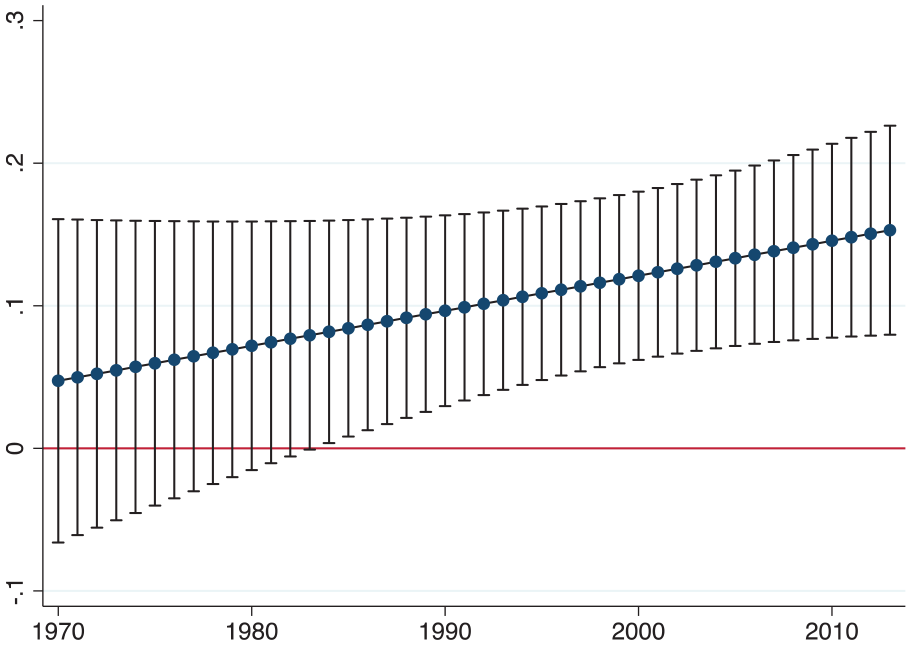
Average marginal effect of Islamist by year.
Finally, leftist violence is not as clearly linked to a particular period as Islamist political violence. Rapoport (2004) saw leftist violence as central to the third wave of violent terrorism, which emerged alongside the Vietnam War (which began in 1965), and the influence of Marxist ideology is evident in groups such as the Basque Euskadi Ta Askatasuna in the early 1960s (Sullivan 1988). However, with the end of the Vietnam War, the leftist Palestinian Liberation Organization emerged as one of the most prominent terrorist organizations worldwide and continued to be influential through the 1980s. Other notable leftist groups, such as the PKK, FARC, and Shining Path, either formed or gained international recognition in the early 1980s, and continued into the twenty-first century. Although the end of the cold war shifted attention away from leftist organizations, the groups that did survive through the 1990s were among the most prominent groups associated with terrorism.
Figure 5 shows that the effect of leftist ideology became significant in the early 1980s, and the effect continued until 2010. Although the null effect in the 1970s does not align with Rapoport’s (2004) “third wave,” which began more than a decade and a half before, it does correspond with the emergence or rise to international prominence of emblematic organizations—the Palestinian Liberation Organization, PKK, FARC, Shining Path—which remained iconic well beyond the end of the cold war. Thus, although the linkage between our findings and historical benchmarks is less clear for this particular variable, the observed effects of leftist ideology is not incompatible with historical patterns. Consequently, we contend that, taken together, the alignment between the effects of these historically contingent conditions and associated historical benchmarks suggests that our findings are reflective of these temporal dynamics and are not simply artifacts of the data, as predicted by hypothesis 3.

Average marginal effect of leftist by year.
Conclusions
Classifying contentious actors as terrorists draws a symbolic boundary, clearly identifying a group’s actions and motives as illegitimate. Yet there are historical and contextual inconsistencies in how this boundary is drawn. We have argued that the basis of terrorism classification is linked to the categories implied by repertoires of contention. Through repeated performances, repertoires acquire meanings. As groups rely on particular repertoires associated with terrorism, they are labeled in kind. Our analyses support this argument. Across more than half a million news articles, we find that a greater tendency toward particular tactics explains variation in terrorist classification both between groups and within groups over time.
This research advances the important literature on the classification of terrorism in several ways. By showing that tactics create the potential for classifying actors as terrorist, our analysis points to theoretical understandings that go beyond a realist view on the use of violence. Groups use violence for purposes as much symbolic as practical (Juergensmeyer 2001), and even when used for practical reasons, the symbolic aspects of terrorism have effects that are real in their consequences.
Moreover, by accounting for a global spectrum of groups spanning more than 40 years, our study uniquely situates prior research on how organizational characteristics predict classification in multinational and historical contexts. Although we document additional support for the already robust finding that a group’s ideological orientation affects its probability of being classified as “terrorist,” we also establish the salience of repertoires of contention as an important marker of terrorism. We do not contend that repertoires of contention are more important than other factors (we are cautious not to draw strong conclusions from the fact that measures of tactical repertoires have larger effect sizes and marginal effects than other significant variables), but we believe that an analytic focus on repertoires of contention has several important benefits that are distinct from those gained by a focus on groups’ static characteristics.
First, repertoires of contention function as public codes (see Lizardo 2017) that are immediately accessible. Although a group’s ideological orientation similarly functions as a public code, identifying a groups’ ideological orientation requires that a perpetrator be positively identified. Unless the perpetrator is already well known, information about motives and ideology can take time to identify or may simply never emerge. In contrast, the tactics used constitute the most visible manifestation of militant violence. Thus, repertoires of contention allow us to account for why certain perpetrators, and potentially certain acts, become labeled terrorist before their actual ideologies (or even their actual perpetrators) are known.
Second, and relatedly, prior research has focused primarily on high-profile groups, such as those legally designated as FTOs or those that are large and persistent, about which a great deal of information is known and classification is straightforward. However, around the globe, there are a great many movements and actors that use violence in pursuit of a wide variety of ends (see LaFree, Dugan, and Miller 2015). Given this breadth, it is important that explanations of why some actors are labeled as terrorists, and thus receive greater attention and are subject to greater government interventions, account for the full spectrum of existing militant groups, not just those whose motives, agendas, and ideologies are well established and widely known. As our analyses illustrate, theorizing classification as repertoire provides an explanation that is widely applicable and sensitive to variation across both time and space.
The effect of FTOs also raises interesting possibilities about the effect of other official designations and processes vis-à-vis nation-states on the classification of violent groups. Although beyond the scope of this study, we encourage future researchers to examine how factors such as state sponsorship, cooperation with states (as in the case of the Peoples’ Protection Units in Syria), peace talks, or other relationships with states influence the dynamics of classification.
Finally, our analyses highlight directions for further research into the evolution of how terrorism is defined, as well as how violent events, in addition to actors, are classified. For example, on August 3, 2019, a lone gunman carrying a semiautomatic rifle walked into a Walmart store in El Paso, Texas, and opened fire, killing 22 people and injuring 24 more. As 1 of more than 30 armed mass killings in the United States up to that point in 2019 (Vigdor 2019), 7 the attack in El Paso stood out in no small part because much of the media coverage, and federal prosecutors, classified the perpetrator as a terrorist. The next morning, August 4, another gunman carrying a semiautomatic rifle stood at the entrance to a bar in Dayton, Ohio, and opened fire, killing 10 and injuring another 27. Less than 24 hours after the mass killing in El Paso, questions immediately arose over whether this, too, constituted an act of terrorism. With no information about the perpetrator or his motives, the basic features of the tactical repertoire—a mass shooting using a semiautomatic rifle—coupled with a single identifying feature of the perpetrator—a white man—raised the possibility. As more information emerged about the perpetrator and his motives, questions of terrorism faded.
In light of our findings, the fact that the question of terrorism was raised at all after Dayton highlights the possibility that we may be witnessing the construction of a new repertoire of contention. Mass shootings by white nationalists have become prominent in recent years, with massacres in Norway in 2011; Charleston, in 2015; Quebec City in 2017; Pittsburgh in 2018; and Christchurch in 2019. Thus, policy makers, news media, and the public currently debate whether violent white nationalism is a form of terrorism when it targets civilians at worship or lawmakers in the Capitol. One method for drawing the social boundary is through understanding the motivation and political claims of the perpetrators: is racism a terroristic ideology? We suggest, however, that it is the marrying of a particular political claim with a particular tactic—in essence, completing a contentious performance—that might lead to the differentiation of the repertoire. As in a previous episode, in which suicide attacks by Islamists came to signify terrorism, if racist extremists continue to prefer the tactic of mass shooting, then future attacks may be immediately legible as terrorism. Our theorization and analyses pave the way for future research examining these dynamics.
Supplemental Material
sj-rtf-1-srd-10.1177_2378023121990165 – Supplemental material for Repertoires of Terror: News Media Classification of Militant Groups, 1970 to 2013
Supplemental material, sj-rtf-1-srd-10.1177_2378023121990165 for Repertoires of Terror: News Media Classification of Militant Groups, 1970 to 2013 by Eric W. Schoon and Colin J. Beck in Socius
Supplemental Material
sj-xlsx-1-srd-10.1177_2378023121990165 – Supplemental material for Repertoires of Terror: News Media Classification of Militant Groups, 1970 to 2013
Supplemental material, sj-xlsx-1-srd-10.1177_2378023121990165 for Repertoires of Terror: News Media Classification of Militant Groups, 1970 to 2013 by Eric W. Schoon and Colin J. Beck in Socius
Footnotes
Acknowledgements
The authors contributed equally to this research and would like to thank Susan Olzak, Natasha Quadlin, Charles Seguin, Reuben Thomas, and Mike Vuolo for their advice and insights during the research process. We also thank Sophia Fearon, XY Ma, Nichole Miller, Sami Moses, Esther Park, Elizabeth Russ, and Kristen Softley for their research assistance during data collection, with a special thanks to Allison Hansen. This article benefited from feedback from the University of California, Irvine, Comparative Sociology Workshop and the Theorizing Social Change: Policy, Institutions, Culture Conference at New York University Abu Dhabi.
Supplemental Material
Supplemental material for this article is available online.
1
Limiting data to repeat perpetrators is a common way to account for ephemeral and less verifiable claims of responsibility (Asal and Rethemeyer 2008;  ). Analyses of the larger data that included the full set of 1,229 groups using models that did not require multiple group observations yielded results that were fully consistent with the between-group effects presented below. Results are available upon request.
2
Importantly, the NYT and TL do purchase articles from the AP, presenting a risk that we are repeatedly sampling the same article. To guard against this possibility, for each year we removed duplicate articles (i.e., articles with the same title and byline).
3
We also considered data from Reuters (a United Kingdom–based wire service) but excluded these data because coverage was unavailable for 25 percent of the period under investigation.
4
5
In addition to the variables included in the analysis presented, we also ran models including controls for groups’ regions of origin, whether the groups targeted the United States or United Kingdom, pre- and post-2001, whether there was an ongoing war in a group’s country of origin, each group’s cumulative total of prior news coverage, and three other distinct tactical repertoires—bombings, barricade attacks, and attacks on infrastructure—none of which was statistically significant. We also included a measure of a right-wing ideological orientation (as coded by ), which was nonsignificant. The findings presented below were robust to alternative model specifications, and replication materials for all alternative model specifications are provided in the supplementary materials.
6
Skyjackings appear only 21 times in our data. We ran models excluding measures of skyjacking, which did not alter our findings.
7
Defined as three or more killings in a single event, per U.S. Public Law 112-265.
Author Biographies
References
Supplementary Material
Please find the following supplemental material available below.
For Open Access articles published under a Creative Commons License, all supplemental material carries the same license as the article it is associated with.
For non-Open Access articles published, all supplemental material carries a non-exclusive license, and permission requests for re-use of supplemental material or any part of supplemental material shall be sent directly to the copyright owner as specified in the copyright notice associated with the article.
